
Seem.
Description
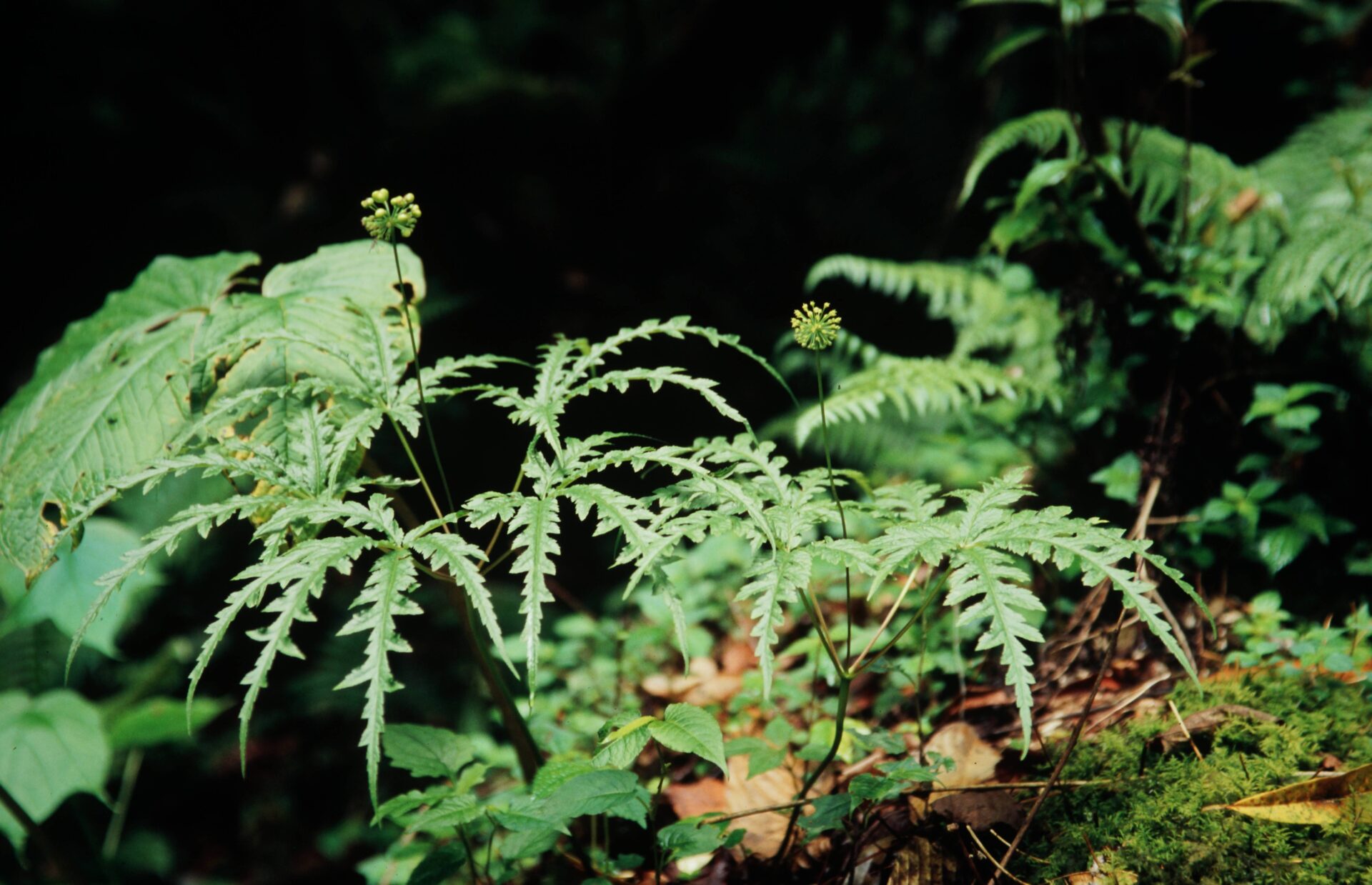
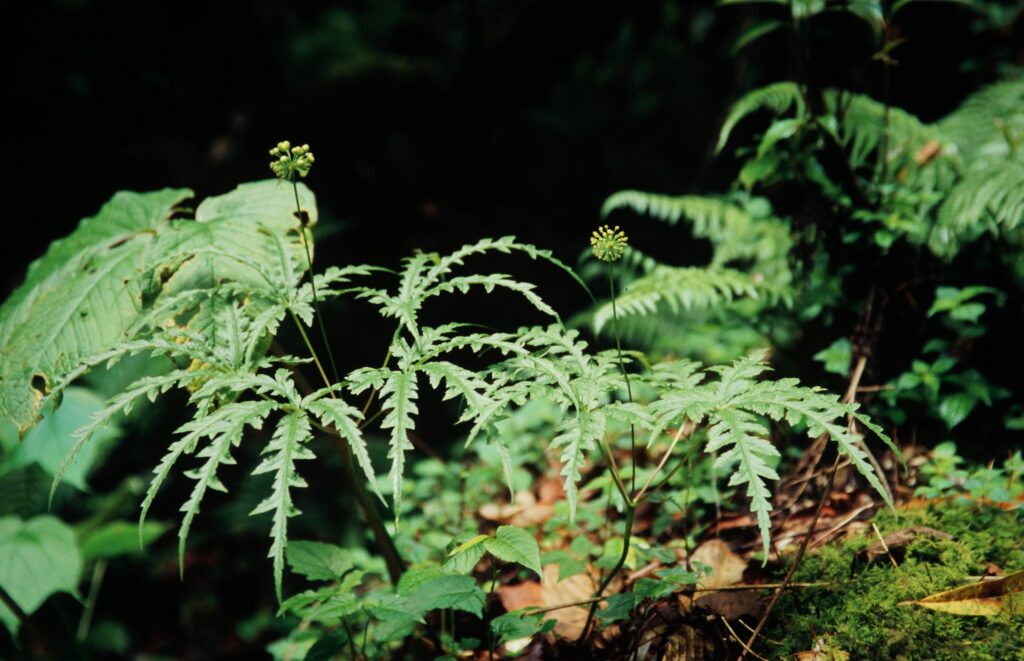
Panax bipinnatifidus is a Sino-Himalayan ginseng distributed through the eastern Himalaya and adjacent uplands of mainland Asia, with GBIF documenting some 900 occurrences across India, Nepal, Bhutan, China, Myanmar, Vietnam and Thailand. It is a herb of shaded, humus-rich temperate broad-leaved and conifer forests, growing among leaf litter on cool, moist slopes and in mossy understorey, generally between about 1800 and 3500 m. The photographed plant from Chaana in West Bengal, India, at roughly 1800 m and flowering in May, sits at the lower edge of this altitudinal band, typical of its occurrence beneath dense Himalayan forest canopy where it relies on consistent shade and well-drained organic soils.
It is a glabrous perennial herb arising from a stout, often moniliform (beaded) or fusiform fleshy rhizome that creeps horizontally. The single erect aerial stem bears a terminal whorl of (usually three to five) long-petiolate, palmately compound leaves, the leaflets characteristically deeply bipinnatifid or pinnately divided with the laminae much dissected, a feature that distinguishes the species and gives it its epithet. From the centre of the leaf whorl rises a slender peduncle terminating in a solitary, simple umbel of small greenish-white, pentamerous, mostly bisexual flowers with an inferior two-celled ovary and two styles. The fruit is a small, laterally compressed, red drupe that turns red at maturity, often with a black apical spot.
The genus Panax, the true ginsengs, is taxonomically complex in the Himalaya, where P. bipinnatifidus has historically been confused with P. pseudoginseng and treated under several varieties (var. bipinnatifidus, var. angustifolius) and synonyms; molecular and morphological work has helped clarify the dissected-leaved entity. Like its congeners it accumulates triterpenoid ginsenosides in the rhizome and is harvested as a substitute for ginseng across the Himalaya, which together with habitat loss exposes wild populations to over-collection. The species is consequently of growing conservation concern and is regarded as threatened or vulnerable in parts of its range, prompting interest in cultivation and sustainable management.
Author: Seem. · Sources: POWO (Kew), GBIF, Flora of China Vol. 13, Flora of Bhutan Vol. 2, Flora of Nepal, Flora of Pakistan, Wen's monograph of Panax (Araliaceae)