
(Griff.) G.M.Plunkett & Lowry
Description
Heptapleurum rhododendrifolium is an epiphytic to semi-epiphytic shrub distributed across the eastern Himalayas and into Southeast Asia, with records from Nepal, Sikkim, Bhutan, northeast India, Myanmar, southern China, and extending to Fiji, Papua New Guinea, and Indonesia. GBIF documents 136 occurrences across this broad range. The species inhabits subtropical and warm-temperate evergreen forests at elevations of 1,200–2,500 m, where it typically grows as an epiphyte on mossy tree trunks and branches, or occasionally as a terrestrial shrub on steep, humus-rich banks in areas of persistent cloud immersion and high rainfall.
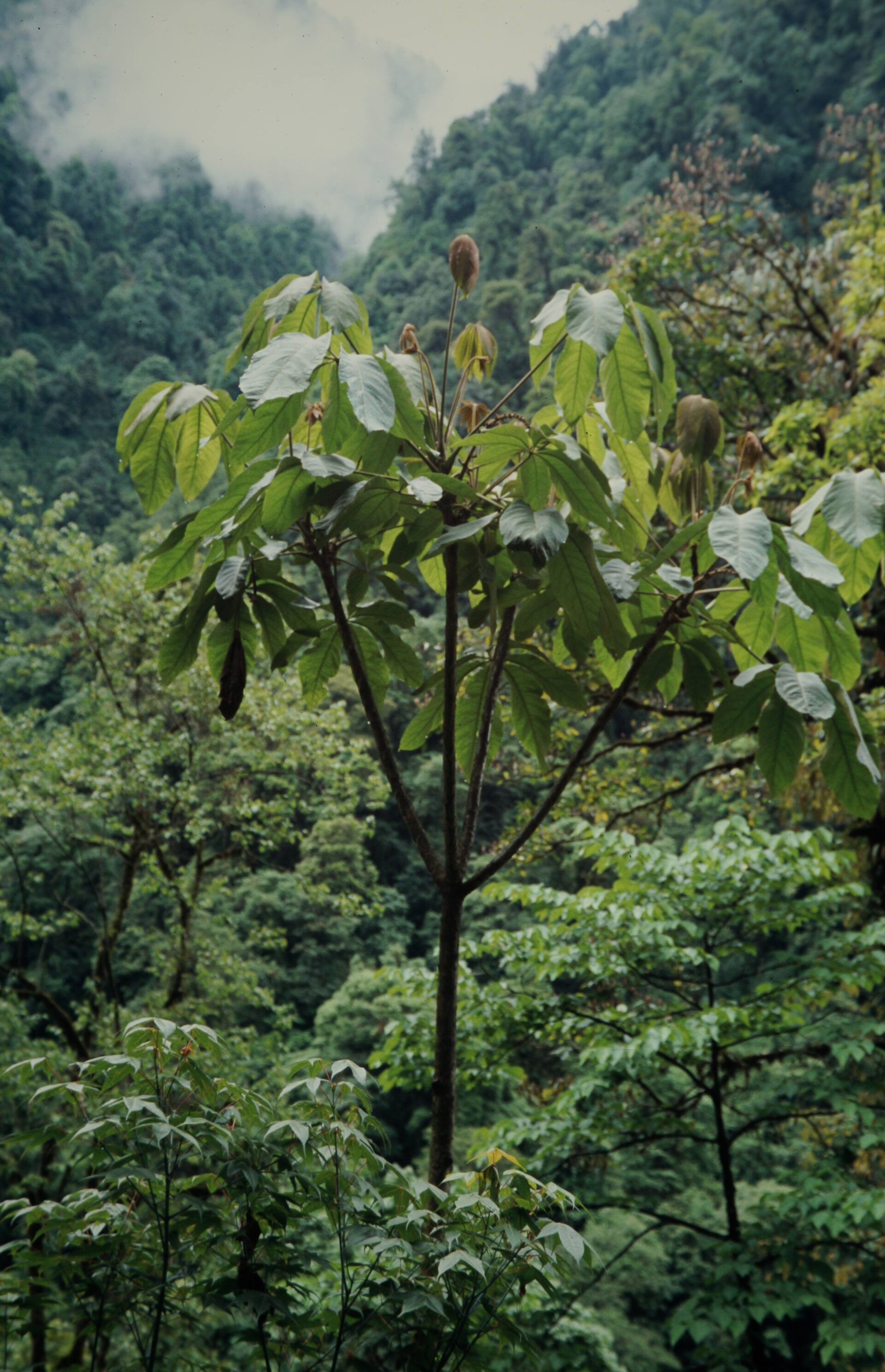
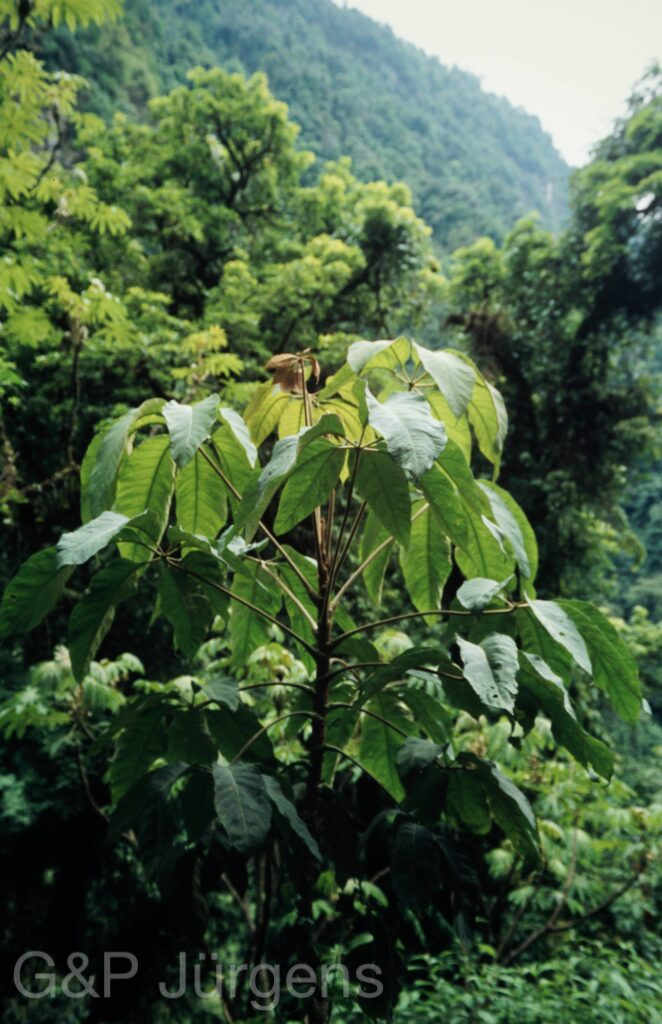
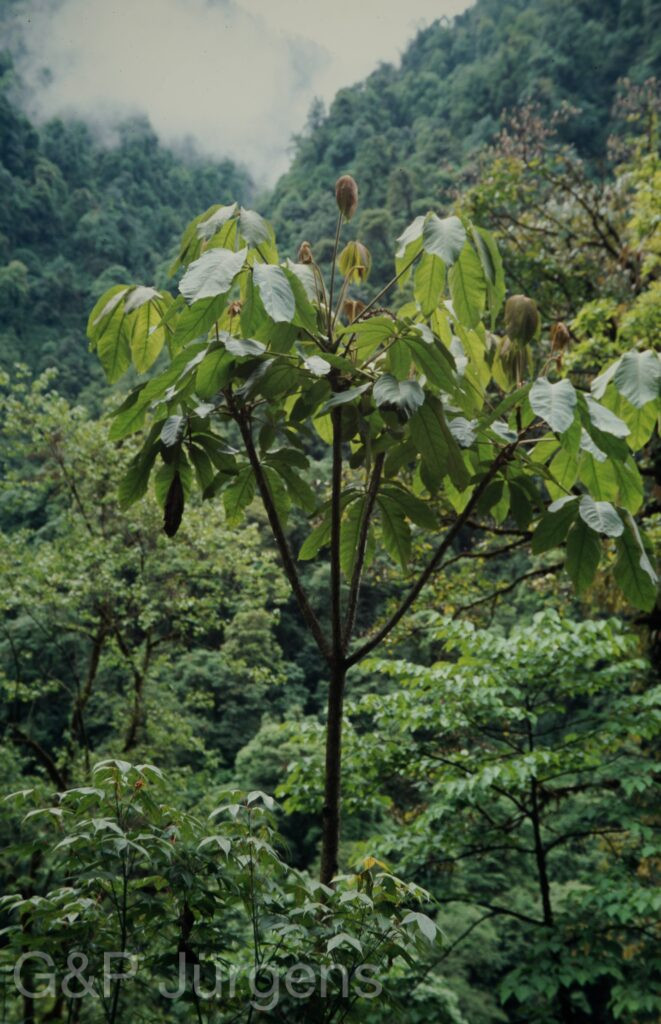
Heptapleurum rhododendrifolium is an evergreen shrub, 1–4 m tall, with stout, sparsely branched stems. The leaves are digitately compound, clustered near the branch tips, with 5–9 coriaceous leaflets. Leaflets are oblong-elliptic to oblanceolate, 8–20 cm long, glossy dark green above and often pale or ferruginous-tomentose beneath, with entire margins and a prominent midrib — the overall appearance recalling Rhododendron foliage, hence the epithet. Petioles are stout, 10–20 cm long. The inflorescence is a terminal, compound umbel of numerous small, greenish-white flowers, each 3–4 mm across, with 5–7 petals and an equal number of stamens. The ovary is inferior, 5–7-locular. The fruit is a subglobose drupe, 4–6 mm in diameter, ripening to dark purple or black, with persistent style remnants.
This species was long placed in Schefflera sensu lato, but recent molecular phylogenetic studies by Plunkett and Lowry have led to its transfer to the reinstated genus Heptapleurum, which accommodates the Asian and Pacific clade formerly within Schefflera. The photographed specimen from Ringi Chu in Sikkim at 1,900 m represents a typical mid-elevation epiphytic occurrence in one of the wettest valleys of the eastern Himalayas. The species plays an ecological role as a provider of fruit resources for montane bird communities. Its broad distribution from the Himalayas to the Pacific islands reflects an ancient tropical Asian lineage with considerable dispersal capacity.
Author: (Griff.) G.M.Plunkett & Lowry · Sources: POWO (Kew), GBIF, Flora of China Vol. 13, Flora of Bhutan Vol. 2, Plunkett & Lowry (2018) — Phylogenetics of Araliaceae