Tag:

Nepal

Flowers of Nepal — 1313 wild plant species documented from the Nepalese Himalaya, from subtropical foothills to high alpine meadows above 4,000 m. Nepal’s dramatic elevation gradient makes it one of the richest botanical regions on Earth, home to rhododendrons, primulas, gentians and the famed blue poppies (Meconopsis). Every entry gives a botanical description, native distribution, habitat and flowering season, alongside the original field photograph and the location where it was taken.

(Wall.) Royle

Bh2008 611 P920
Bhutan, Punakha 2400m, May

Description

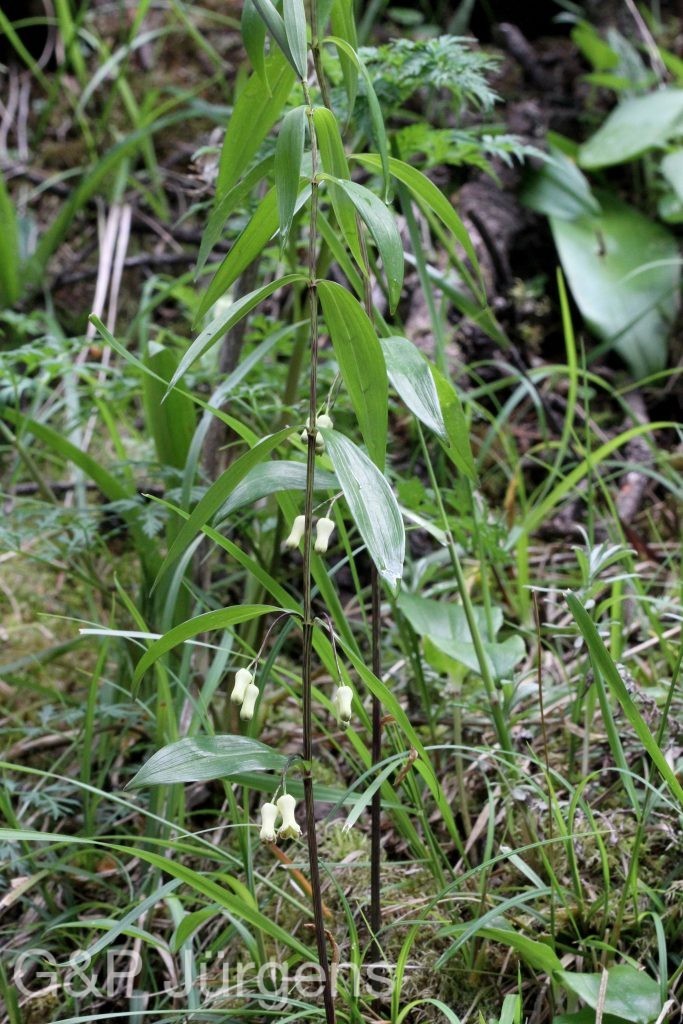
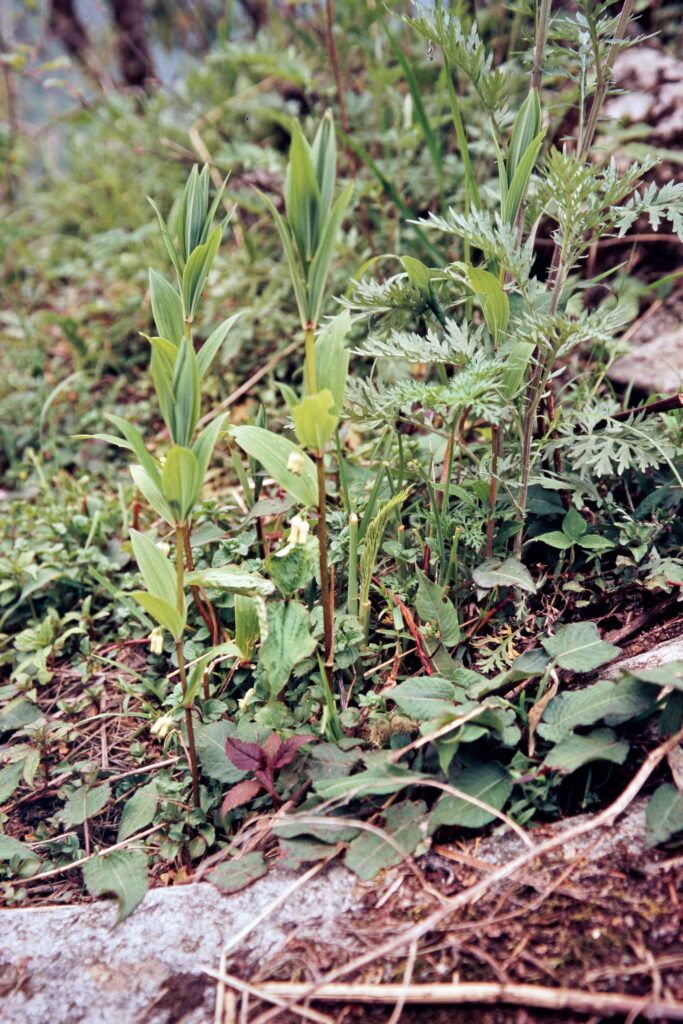
Polygonatum cirrhifolium is a rhizomatous perennial herb widely distributed across the Himalaya and the mountains of central and western China, recorded from China, Nepal, India, Bhutan, Myanmar and Vietnam, with around 2251 georeferenced records (records from Canada, Norway and Britain reflect cultivation). It occurs in temperate forest, forest margins, shrubberies and grassy alpine slopes, on moist humus-rich soils typically between about 2000 and 4000 m. The photographed plant from Punakha in Bhutan at 2400 m, flowering in May, sits near the lower edge of its broad altitudinal span.

It has a stout, knotted, horizontal rhizome from which arises an erect to arching stem. The narrow, linear-lanceolate leaves are borne in whorls of three or more, and the epithet cirrhifolium refers to their slender apices, which are characteristically prolonged and curled into tendril-like tips. The pendent flowers hang one to four together in the leaf axils; each perianth is tubular, pale rose-purple to whitish, the six tepals fused into a cylinder with short lobes and enclosing six stamens. The fruit is a globose berry that ripens from red to purplish-black.

Polygonatum, in Asparagaceae subfamily Nolinoideae, is here represented by a whorled-leaved species readily told from P. oppositifolium by its tendrilled leaf tips. The rhizome, known in Chinese and Himalayan medicine, is gathered as a tonic drug, and the species is among the sources of the herbal material huangjing. The pendent nectar-bearing flowers are bumblebee-pollinated and the berries bird-dispersed. Though widespread and not threatened overall, sustained medicinal harvesting locally depletes wild populations.

Author: (Wall.) Royle · Sources: POWO (Kew), GBIF, Flora of China, Flora of Bhutan, Annotated Checklist of the Flowering Plants of Nepal, Jeffrey monograph of Polygonatum
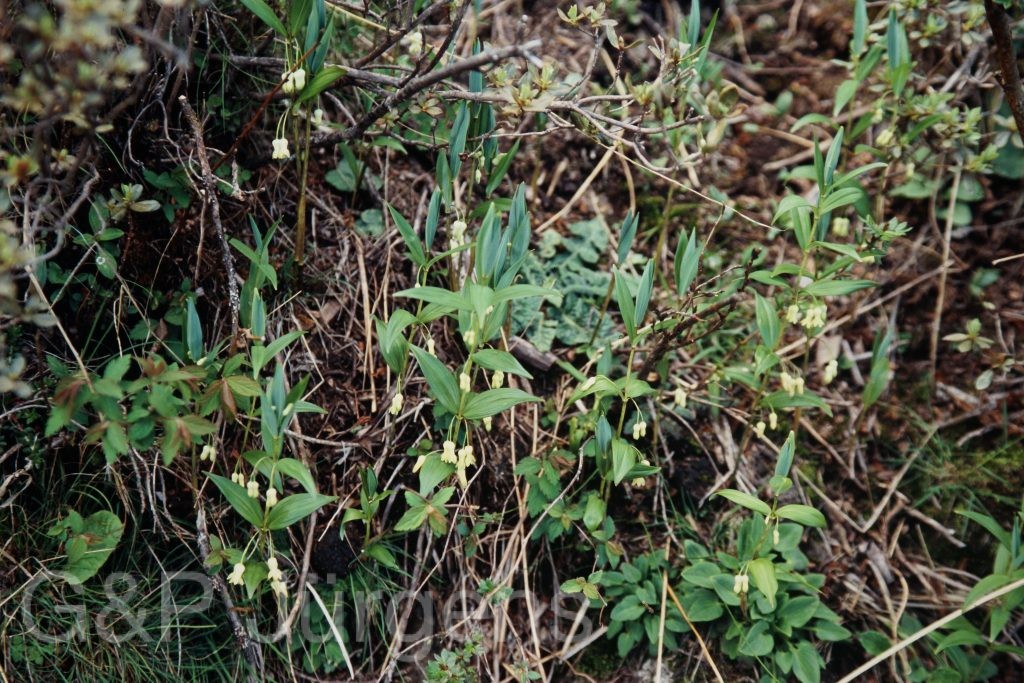
Decne.

Garh 07 101 ergebnis
India Garhwal Trijugin 2300m, June

Description

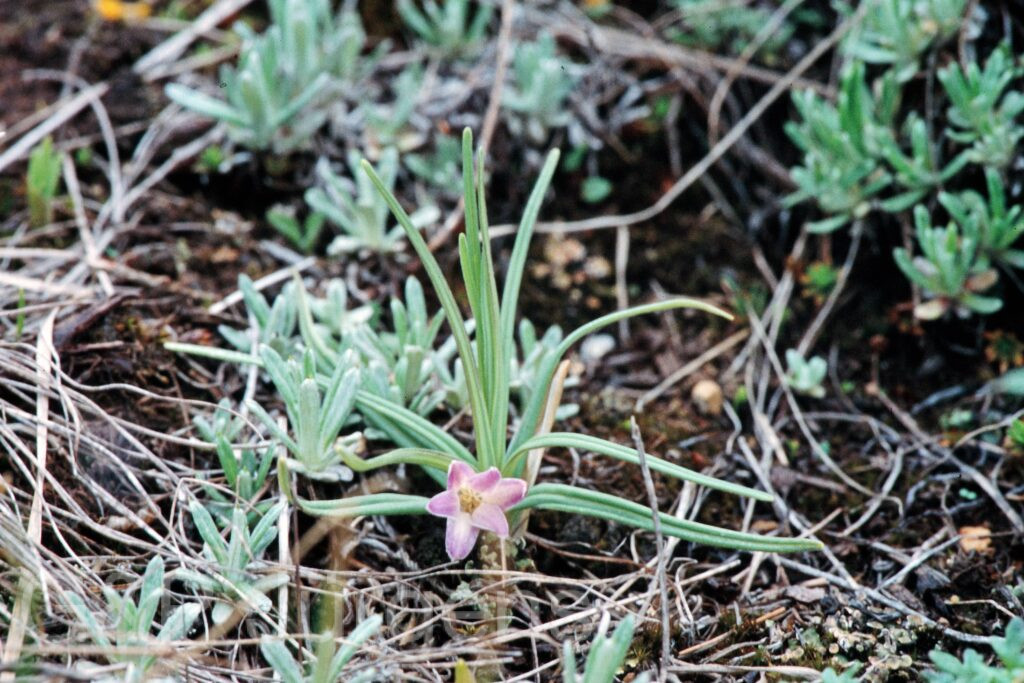
Polygonatum geminiflorum is a western Himalayan Solomon's seal distributed from Afghanistan and Pakistan through Kashmir, Himachal Pradesh, and Uttarakhand to western Nepal, with disjunct records from the Caucasus region (Georgia, Armenia). GBIF records 123 occurrences across this range. The species inhabits moist, shaded understorey habitats in temperate oak-conifer and mixed broadleaved forests at elevations of 1,800–3,200 m. It favours deep, humus-rich forest soils and is frequently found on north-facing slopes, along streams, and at the base of boulders under canopies of Quercus semecarpifolia, Cedrus deodara, and Abies pindrow.
Polygonatum geminiflorum is an erect, herbaceous perennial arising from a stout, horizontal, moniliform rhizome bearing conspicuous circular stem scars (Solomon's seals). Stems are simple, arching, 30–60 cm tall, glabrous, and angular in cross-section. Leaves are alternate, sessile, elliptic to ovate-lanceolate, 5–10 cm long, glaucous beneath, with parallel venation and slightly clasping bases. Flowers are typically borne in pairs (geminate) from leaf axils — the diagnostic character reflected in the epithet — occasionally solitary or in threes. Each flower is tubular-campanulate, 12–18 mm long, white to cream with green tips, pendulous on slender pedicels 1–2 cm long. The six tepals are fused for most of their length. The fruit is a globose berry, 8–10 mm in diameter, ripening from green to dark blue-black.
The photographed specimen from Trijugin in Garhwal at 2,300 m in June represents a characteristic occurrence in the west-central Himalayan forests during peak flowering season. Polygonatum geminiflorum is distinguished from the related P. verticillatum by its alternate (not whorled) leaves and consistently paired flowers. The Caucasian disjunction is biogeographically significant, representing a relictual Tertiary connection between the western Himalayan and Irano-Turanian floras. The rhizomes are used in traditional Ayurvedic medicine as a tonic and are locally harvested, which in some areas may impact wild populations.

Author: Decne. · Sources: POWO (Kew), GBIF, Flora of Pakistan (Liliaceae), Flora of British India Vol. 6, Tamura: Liliaceae in Flora of China Vol. 24

Hook.

Nepal 99 117 ergebnis
West-Nepal South of Rara-Lake 3750m, June

Description

Polygonatum graminifolium is a high-alpine Solomon's seal restricted to the Himalaya, recorded from Pakistan, India, Nepal and Bhutan; GBIF documents only about 18 occurrences, indicating a narrow range and limited collecting. It inhabits open alpine and subalpine slopes, rocky meadows, grassy turf and the margins of dwarf shrubberies, generally on stony, well-drained soils above the forest line. The plant photographed south of Rara Lake in western Nepal at 3750 m in June is characteristic of its elevation, roughly 3000-4300 m, where the short season compels rapid flowering soon after snowmelt in early summer.

It is a small, slender perennial herb growing from a short, knotted, horizontal rhizome bearing the circular scars that give the genus its name. The wiry, erect to arching stem is unbranched and bears narrow, grass-like (graminoid) leaves that are linear to linear-lanceolate, sessile and parallel-veined, arranged alternately or sometimes subverticillately, their slenderness giving the species its epithet. The flowers are small, tubular-campanulate and pendulous, solitary or paired in the leaf axils, white to greenish-white and often green-tipped, on short pedicels. The perianth tube is cylindrical with six short recurved lobes enclosing six included stamens, and the ovary develops into a small globose berry ripening bluish-black to red.

The epithet graminifolium, grass-leaved, distinguishes it from broader-leaved Himalayan congeners. Polygonatum is a north-temperate genus formerly placed in Liliaceae or Convallariaceae and now treated within an expanded Asparagaceae. Its restricted distribution and modest occurrence record suggest specialisation to alpine turf, though no formal conservation assessment exists; like related species its rhizomes have potential use in the regional pharmacopoeia.

Author: Hook. · Sources: POWO (Kew), GBIF, Flora of China, Flora of Pakistan, Flora of Bhutan, Jeffrey revision of Polygonatum

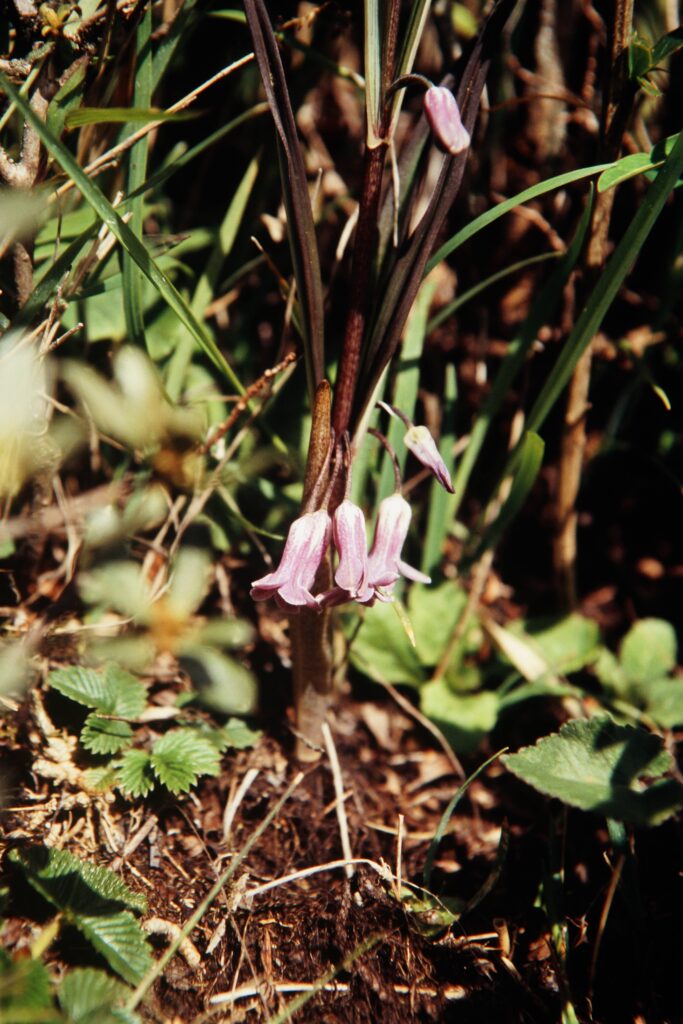
Baker

Sikkim2011 51
Sikkim Vista-valley 3800m, June
Bhutan2014 991
Bhutan Chele-La 4000m, May

Description

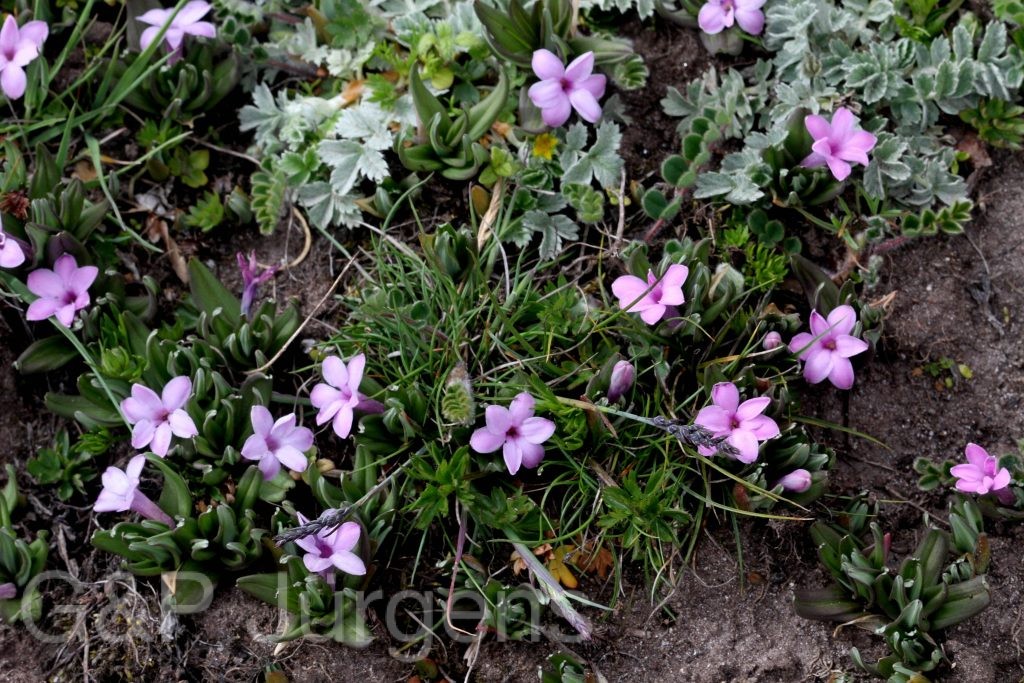
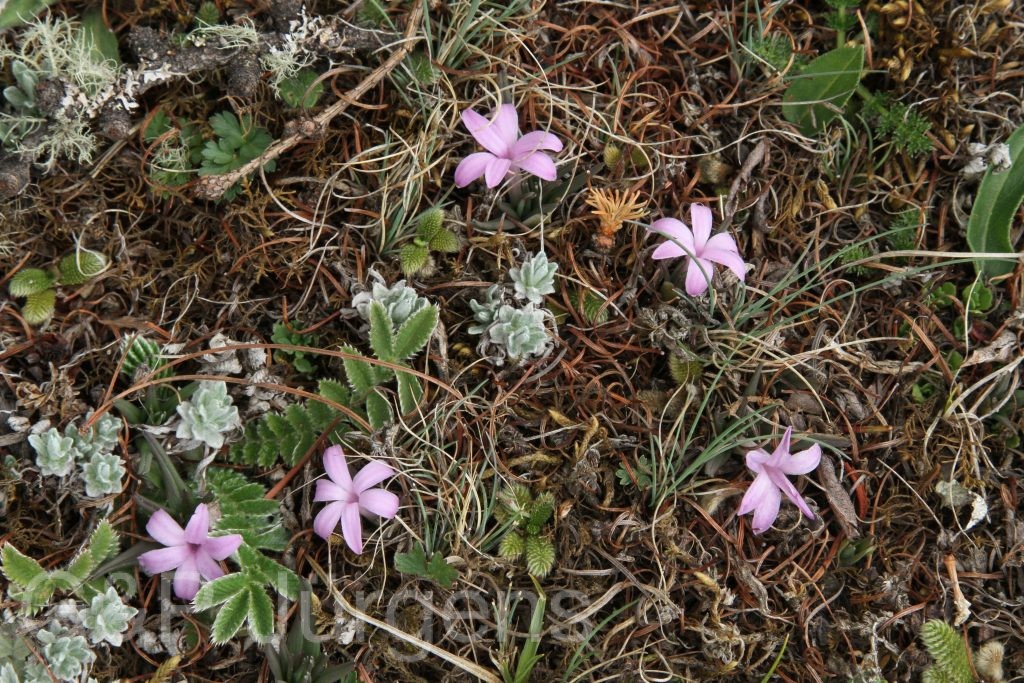
Polygonatum hookeri is a dwarf alpine Solomon's-seal of the Sino-Himalayan high mountains, recorded from China, Nepal, India, Bhutan and Pakistan across some 400 GBIF occurrences. The illustrated plants were photographed in the Vista-valley of Sikkim at 3800 m in June and on the Chele-La in Bhutan at 4000 m in May. It grows in open alpine turf, on grassy slopes, stony meadows and the margins of rhododendron scrub, typically between 3000 and 4500 m, forming low patches in short high-elevation vegetation where it flowers soon after snowmelt.

The plant is a diminutive rhizomatous perennial, spreading by a slender creeping rhizome and producing very short, sometimes almost stemless aerial shoots. The leaves are small, narrowly elliptic to oblong and crowded toward the top of the shoot. The flowers are solitary or paired and conspicuously large relative to the plant, bell- to funnel-shaped, lilac, rose-pink or purplish, borne low among the leaves; the perianth is tubular with six short lobes. The fruit is a small globose berry, ripening red, containing few seeds.

Long placed in the Liliaceae or Convallariaceae, Polygonatum is now treated in the Asparagaceae (subfamily Nolinoideae). P. hookeri is among the smallest and most alpine members of the genus, its dwarf cushion-like habit an adaptation to the harsh high-mountain environment, and it is much esteemed by rock-garden growers. The bird-dispersed berries aid colonisation of new ground. The species is widespread across the high Himalaya and of least conservation concern.

Author: Baker · Sources: POWO (Kew), GBIF, Flora of China, Flora of Bhutan, Flora of Nepal, Jeffrey – The Genus Polygonatum (Liliaceae/Asparagaceae) revision

(Wall.) Royle

Nepal 97 328 P653
Nepal Arun-Valley 2000m May

Description

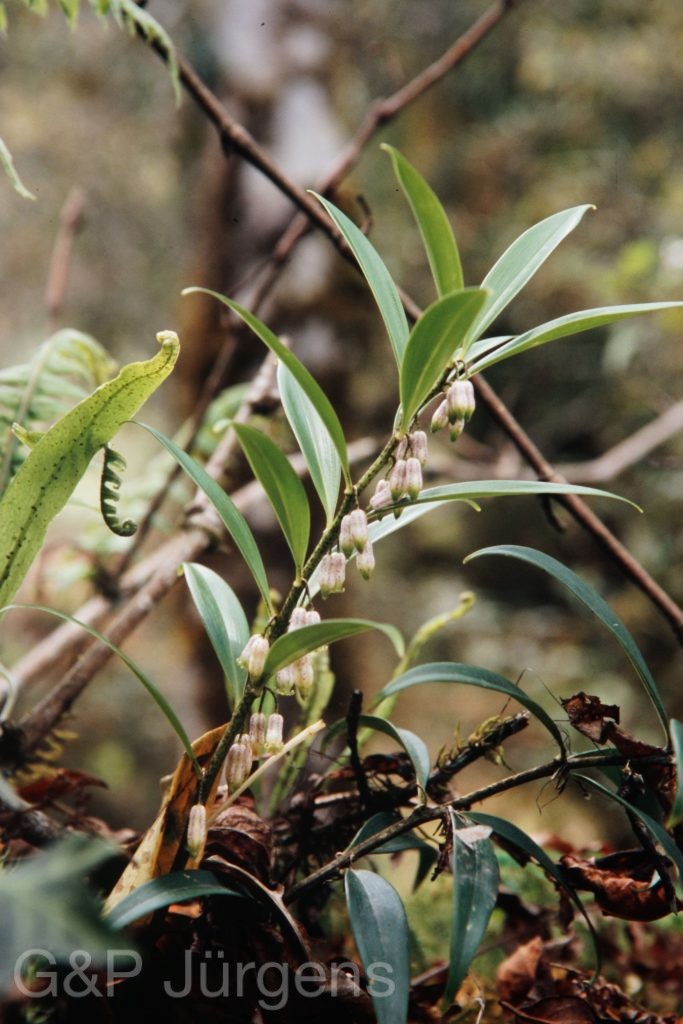
Polygonatum oppositifolium is a rhizomatous perennial herb of the Himalaya and adjacent mountains, ranging through India, Nepal, China, Bhutan and Myanmar, with around 184 georeferenced records concentrated along the southern Himalayan flank (several distant country codes reflect cultivation or data artefacts rather than wild populations). It grows in moist, shaded broad-leaved and mixed forest, on banks and among rocks in leaf-litter-rich soils at middle elevations. The photographed plant from the Arun Valley of eastern Nepal at about 2000 m, flowering in May, typifies its warm-temperate forest habitat.

The plant has a creeping, knotted, fleshy rhizome from which arises an arching to suberect stem. As the epithet indicates, the lanceolate to ovate-lanceolate leaves are predominantly opposite (occasionally whorled), sessile to shortly petiolate, acuminate and prominently veined. The flowers hang in short axillary cymes; each perianth is tubular and greenish-white, the six tepals fused into a cylindrical tube with short recurved lobes, enclosing six included stamens with filaments adnate to the tube. The fruit is a small globose berry, ripening dark blue to blackish and containing few seeds.

Polygonatum (Solomon's seal), placed in Asparagaceae subfamily Nolinoideae, is distinguished from related genera by its rhizome scars and tubular flowers. P. oppositifolium is notable within the Himalayan members for its opposite leaf arrangement. The pendent flowers are bumblebee-pollinated and the berries bird-dispersed. The rhizomes are gathered locally in traditional medicine; while not currently regarded as threatened, such harvesting and forest degradation warrant monitoring of wild stands.

Author: (Wall.) Royle · Sources: POWO (Kew), GBIF, Flora of China, Annotated Checklist of the Flowering Plants of Nepal, Flora of Bhutan, Jeffrey monograph of Polygonatum
Royle ex Kunth

Bh2008 333 P513
Bhutan Phobjika 2700m, April
Nepal 1994 59 ergebnis
Ost-Nepal Bhalukhob 
1900m April

Description

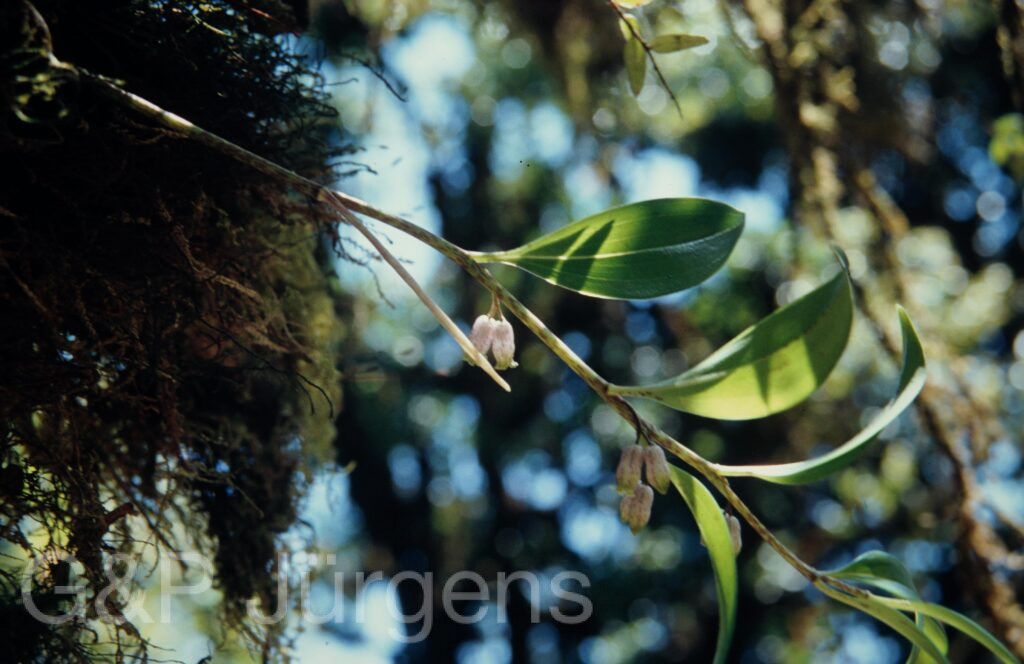
Polygonatum punctatum is a Sino-Himalayan Solomon's seal distributed through China, Nepal, India, Bhutan, Myanmar, Thailand, Vietnam and Laos, with over 450 georeferenced occurrences and additional records from cultivation. It is a plant of cool, shaded temperate forest, mossy banks, rock ledges and humus-rich slopes, where it often grows as a lithophyte or epiphyte. The populations documented at Phobjikha in Bhutan at about 2700 m and at Bhalukhob in eastern Nepal at about 1900 m, both in April, reflect its montane forest habitat, emerging and flowering in spring.

The species grows from a creeping, knotted rhizome that produces an arching to pendent leafy stem. The leaves are alternate, sometimes appearing sub-opposite, ovate to lanceolate and acuminate, often somewhat leathery. Slender axillary inflorescences bear one to several tubular flowers; the perianth is fused into a narrow cylindrical tube, greenish-white and frequently marked with purple dots or spots (the punctate patterning evoked by the epithet), with six short lobes and included stamens. The fruit is a small globose berry, dark purple to blackish when ripe, containing a few seeds.

Within Asparagaceae (formerly Convallariaceae or Liliaceae sensu lato), Polygonatum is a Northern Hemisphere genus whose East Asian and Himalayan species are taxonomically intricate, separated by leaf arrangement, flower number, perianth markings and rhizome form. The frequently epiphytic or saxicolous habit of P. punctatum is unusual within the largely terrestrial genus. Widespread and locally common, it is not regarded as threatened, though several Himalayan congeners are harvested for the medicinal rhizome.

Author: Royle ex Kunth · Sources: POWO (Kew), GBIF, Flora of Bhutan, Flora of Nepal, Flora of China, Jeffrey's revision of Polygonatum

H. Hara

BhutanPG2011 164
Bhutan Tsochenchen, 3600m June
Bh09 183 P318
Bhutan Phajoding, 3600m June

Description

Polygonatum singalilense H.Hara is an alpine Solomon's-seal of the eastern Himalaya, named for the Singalila ridge and known from about 66 records in Nepal, India, Bhutan and adjacent China, with herbarium material in Great Britain. It occurs in moist alpine meadows, dwarf-shrub heath, rhododendron scrub and the edges of fir forest, typically among rocks and mossy banks in the upper temperate to subalpine zone. The plants illustrated from Tsochenchen and Phajoding in Bhutan, both near 3600 m in June, are characteristic of its cool, humid, snow-influenced habitats with a brief flowering season at the onset of the monsoon.

This is a small rhizomatous perennial herb growing from a knotty, horizontally creeping rhizome bearing the scars ("seals") of previous shoots. The stem is short, erect to arching and unbranched. Leaves are alternate to subverticillate, sessile or shortly petiolate, ovate to lanceolate, and glabrous. The flowers are solitary or few in the leaf axils, pendulous, with a tubular to campanulate, gamophyllous perianth that is whitish to greenish, often tinged purple; the six tepals are fused with short free lobes, the stamens inserted within the tube. The fruit is a small globose berry, ripening dark blue to blackish and containing few seeds.

The species belongs to a complex of dwarf, alpine Himalayan Polygonatum often confused with P. hookeri and relatives, distinguished by stature, leaf arrangement and perianth proportions. Its nectar-rich tubular flowers are bumblebee-pollinated, and the fleshy berries are bird-dispersed. As a narrow-range montane endemic of the eastern Himalaya, P. singalilense is potentially sensitive to grazing, collection and upward shifts of vegetation belts under climate warming, though it has not been formally assessed.

Author: H. Hara · Sources: POWO (Kew), GBIF, Flora of Bhutan, Flora of Nepal, Flora of China, Hara's Flora of Eastern Himalaya, monograph/revision of Polygonatum

(L.) All.

Bh09 60 P108 ergebnis
Bhutan Jili-La 3500m, May

Description

Polygonatum verticillatum ((L.) All.), the whorled Solomon's-seal, is a temperate to subalpine rhizomatous herb with a remarkably broad Eurasian range. It extends from western and central Europe across Russia and the Caucasus to Central Asia, the Himalaya and southwest China; the very large number of GBIF occurrences (over 121,000) reflects its abundance across European mountains, though the Himalayan populations recorded from Nepal and Bhutan represent the easternmost segment of its distribution. It grows in shady deciduous and coniferous woodland, on grassy slopes and among rocks in alpine meadows, ascending to around 3,800 m, as exemplified by the collection from Jili-La in Bhutan at 3,500 m in May.

The plant arises from a creeping, knotted, horizontal rhizome and produces erect, terete, glabrous stems 30–80 cm tall. The leaves are sessile and arranged in distinct whorls of three to eight at each node, narrowly lanceolate to linear-oblong and acuminate, with the upper ones often subverticillate. The pendent, tubular-campanulate flowers are greenish-white, borne singly or in axillary clusters of two to four on slender pedicels; the perianth tube is six-lobed at the mouth and encloses six included stamens. The fruit is a globose berry that ripens from green through red to a deep purplish-black.

Within the genus the species is distinguished by its whorled leaf arrangement, contrasting with the alternate, distichous leaves of the related P. multiflorum and P. odoratum. The Himalayan rhizomes are valued in Ayurvedic and Tibetan medicine, where the plant is one of the sources traded as "Meda," a use that locally threatens wild stands through overharvesting. Across its wide global range, however, the species remains common and is assessed as of least concern.

Author: (L.) All. · Sources: POWO (Kew), Flora of Nepal, GBIF, Flora of China Vol. 24, Jeffrey: The Genus Polygonatum (Liliaceae) in Eastern Asia (1980)

Wall. ex Meisn.

Bh09 277 P456
Bhutan Phobjika 2800m, June

Description

Polygonum filicaule is a small Himalayan and East Asian knotweed ranging from the Himalaya through southern China to Taiwan and Japan; GBIF lists around 358 occurrences across China, India, Pakistan, Japan and Taiwan. It inhabits cool, moist temperate sites, growing in damp turf, moss carpets, stream banks, marshy meadows and seepage zones, often as a prostrate component of open subalpine grassland. The accompanying photograph from Phobjika in Bhutan at about 2800 m in early June shows the species at the start of its flowering season in the broad, marshy glacial valley floors for which that locality is well known. Under POWO this name is treated as a synonym, the accepted name being Persicaria filicaulis.

It is a delicate, creeping, mat-forming perennial herb with thread-like (filiform), much-branched stems that root at the lower nodes, the epithet filicaule alluding to these slender stems. The ochreae are membranous, tubular and shortly ciliate, sheathing the nodes. Leaves are small, ovate to oblong-lanceolate, shortly petiolate or subsessile, with entire margins and often a fine pubescence. Flowers are minute and few, borne in short, lax terminal or axillary clusters; the perianth is five-parted, white to pink, persistent and enclosing the fruit. The achene is small, trigonous, dark brown and lustrous.

The species belongs to a group of diminutive, mat-forming Asian polygonums now widely placed in Persicaria, distinguished from robust upright knotweeds by their creeping habit and reduced inflorescences. As a wetland and seepage specialist it contributes to high-altitude turf communities and is well adapted to grazed, trampled and seasonally waterlogged ground. It is not considered threatened, being widespread and tolerant of disturbance, though dependent on the persistence of moist montane grassland.

Author: Wall. ex Meisn. · Sources: POWO (Kew), GBIF, Flora of Bhutan, Flora of China (Polygonaceae), Hara & Williams Enumeration of the Flowering Plants of Nepal

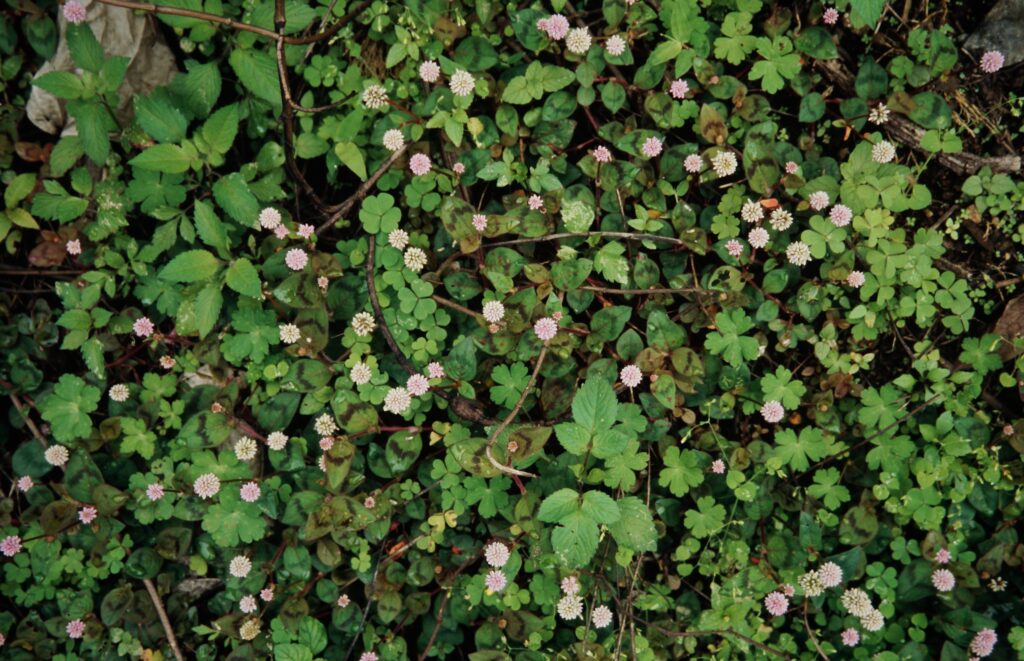
D.Don

Sikkim 2006 261 ergebnis
India West-Bengal, Lingza 1300m, May

Description

Polygonum microcephalum is a herb of the eastern Himalaya and montane Southeast Asia, widely distributed from Nepal and north-east India through Bhutan and south-western China (Yunnan, Sichuan, Xizang) to northern Myanmar and Vietnam. The very large global occurrence figures returned under the accepted genus Persicaria reflect aggregated records of the broader complex; this taxon is properly treated as Persicaria microcephala (D. Don) H. Gross. It grows in moist, shaded situations — forest understorey, streamsides, ditches and disturbed clearings — chiefly between about 800 and 2,800 m. The plant photographed at Lingza in West Bengal, India, at 1,300 m in May represents its typical low-montane subtropical broadleaf forest habitat.

It is a perennial herb with slender, often reddish, ascending to scrambling stems rooting at the lower nodes, the swollen nodes sheathed by membranous, cylindrical ochreae. The leaves are alternate, ovate to broadly lanceolate, acuminate, frequently marked with a dark chevron and red venation, the surfaces sometimes finely pubescent. The flowers are minute and aggregated into small, dense, head-like or short-spike inflorescences, the perianth of five tepals white to pinkish; stamens commonly eight. The fruit is a trigonous, dark, shining achene enclosed within the persistent perianth.

The segregation of Persicaria from Polygonum sensu lato, supported by molecular phylogenetics, places this species in a large genus characterised by ochreate sheaths and capitate or spiciform inflorescences. The dark-marked, often red-flushed foliage has brought certain forms into cultivation. The species is widespread, ecologically adaptable and of no conservation concern, behaving locally as a colonist of disturbed ground.

Author: D.Don · Sources: POWO (Kew), Flora of China Vol. 5, Flora of Bhutan Vol. 1, GBIF, Hong et al.: Polygonaceae in Flora of China