Tag:

Nepal

Flowers of Nepal — 1313 wild plant species documented from the Nepalese Himalaya, from subtropical foothills to high alpine meadows above 4,000 m. Nepal’s dramatic elevation gradient makes it one of the richest botanical regions on Earth, home to rhododendrons, primulas, gentians and the famed blue poppies (Meconopsis). Every entry gives a botanical description, native distribution, habitat and flowering season, alongside the original field photograph and the location where it was taken.

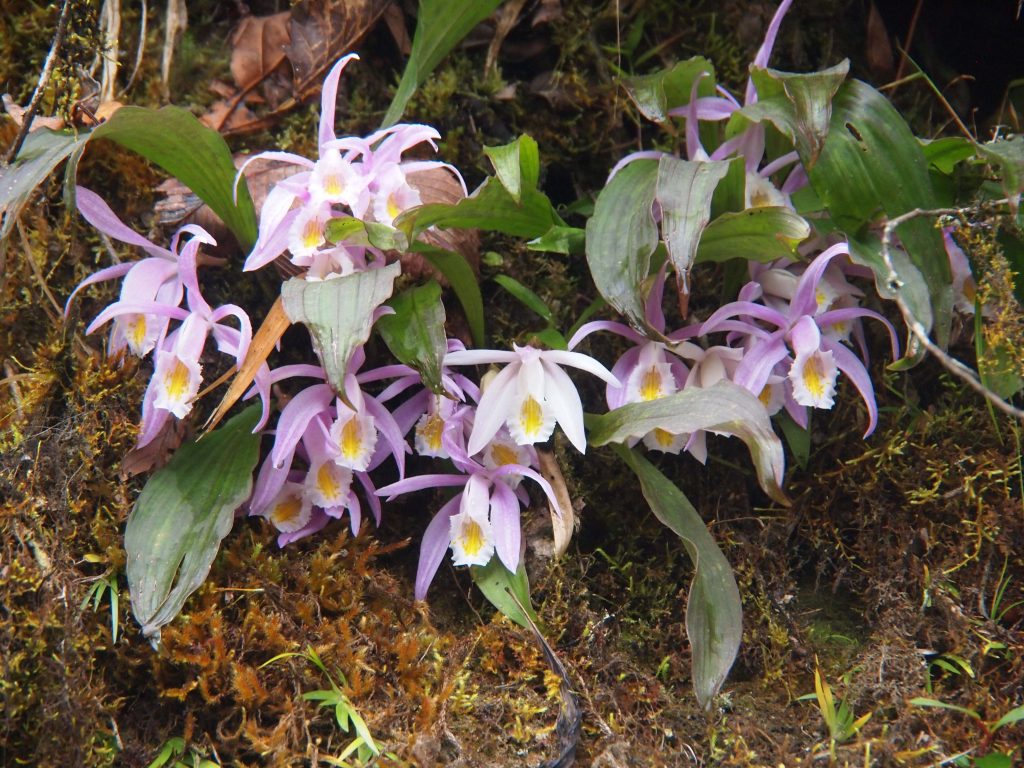
(Lindl.) Rollisson

Sikkim2011 381
Sikkim Lachen 2600m, June
Nepal 2001 262 ergebnis ergebnis
Nepal (Gorkha) Jaurey Kharka 2700m, May
Nepal 2001 263 ergebnis ergebnis
Nepal (Gorkha) Jaurey Kharka 2700m, May

Description

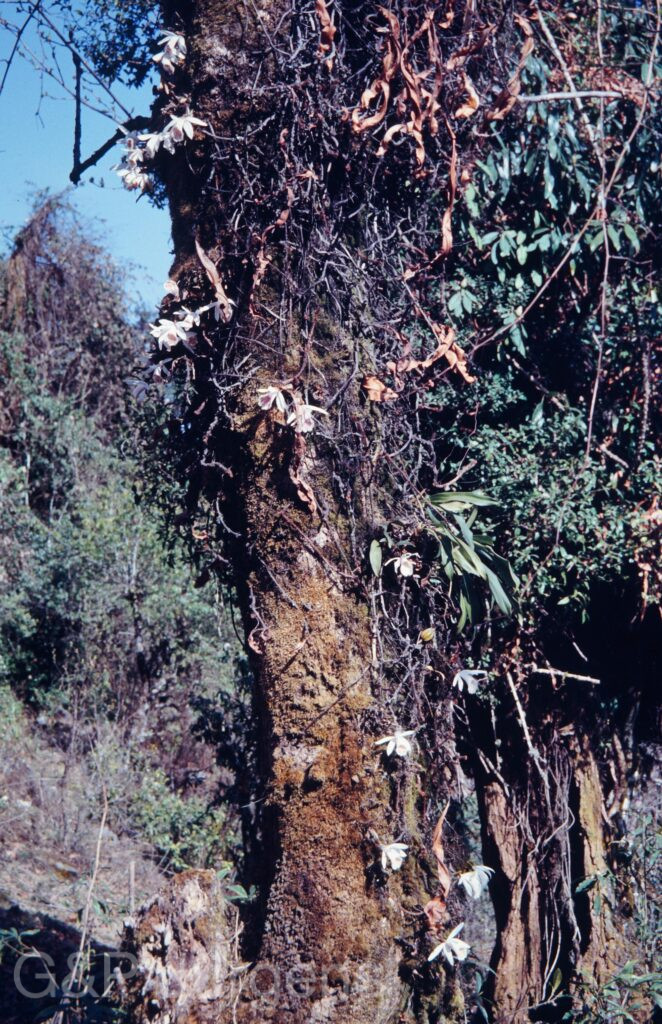
Pleione hookeriana is a small epiphytic and lithophytic orchid of the eastern Himalaya and Indochina, distributed across Nepal, India, Bhutan, China and Laos, with about 204 GBIF occurrences. It inhabits cool, humid montane forest, growing on mossy tree trunks, branches and shaded rocks in the temperate zone, favouring situations with abundant atmospheric moisture. The images document it in Sikkim near Lachen at about 2600 m in June and in the Gorkha district of Nepal at Jaurey Kharka around 2700 m in May, where it flowers on moss-clad substrates as the monsoon approaches.

It is a dwarf, deciduous orchid growing from a small annual pseudobulb that bears a single plicate leaf. The flower is solitary and produced with or just before the leaf on a short scape arising from the base of the pseudobulb. The sepals and petals are narrow, spreading and pale pink to rose-lilac; the labellum is comparatively large, obovate, fringed at the margin, and marked within by a yellow to brown-spotted, lamellate throat that contrasts with the paler perianth. The column is slender and winged. The fruit is a dry dehiscent capsule releasing dust-like seeds.

Pleione hookeriana is the smallest-flowered species of its genus and is distinguished by its diminutive habit and patterned lip. Like all Pleione it has an annual pseudobulb cycle and depends on mycorrhizal fungi for seed germination. The showy lip and contrasting throat markings attract bee pollinators in spring. As an attractive orchid it is subject to horticultural collection, and the entire genus is listed on CITES Appendix II, regulating international trade.

Author: (Lindl.) Rollisson · Sources: POWO (Kew), GBIF, Flora of China, Flora of Bhutan, The Genus Pleione (Cribb & Butterfield), CITES Appendices
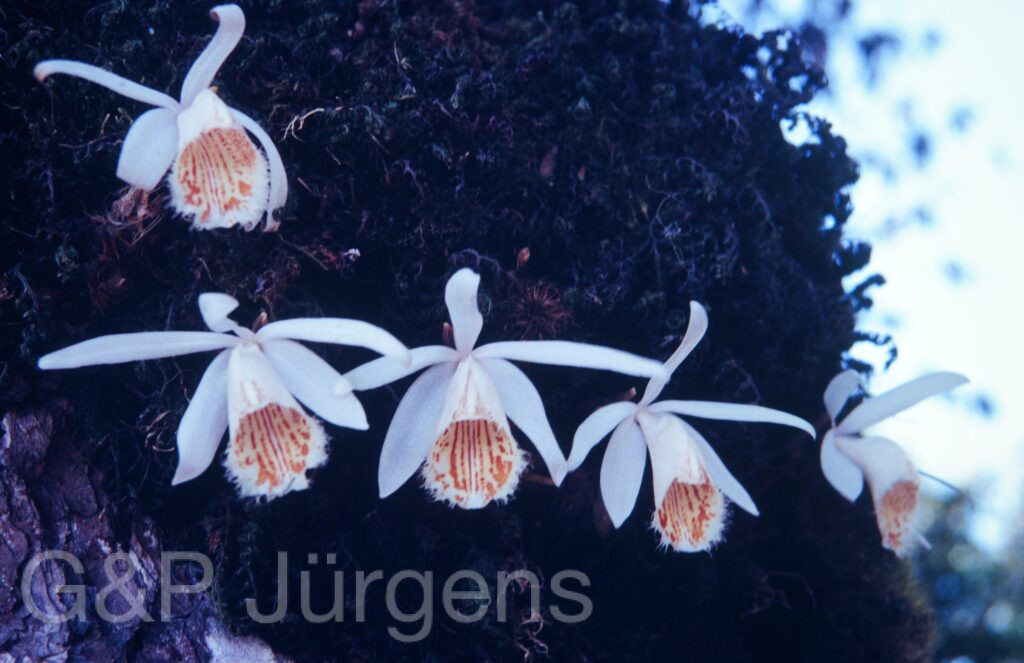
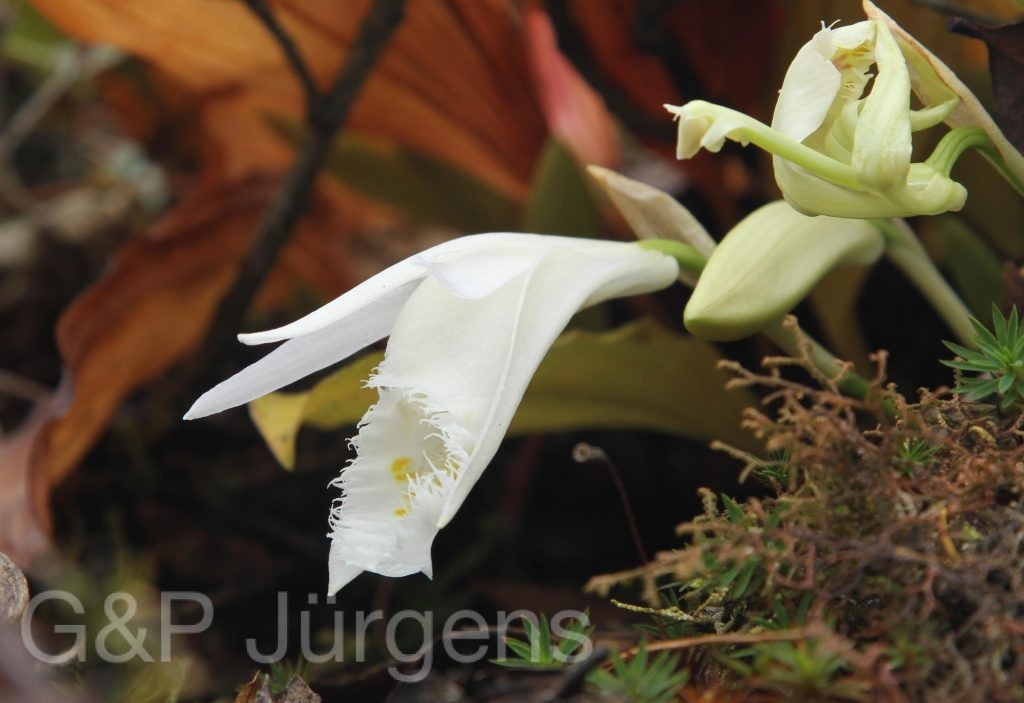
(Sm.) D.Don

Nepal1992 42 P60 ergebnis
Nepal Nundhaki 1500m March 
Nepal1992 56 P81 ergebnis
Nepal Nundhaki 1500m March 
Nepal1992 242 P359 ergebnis
Nepal Nundhaki 1500m March 

Description

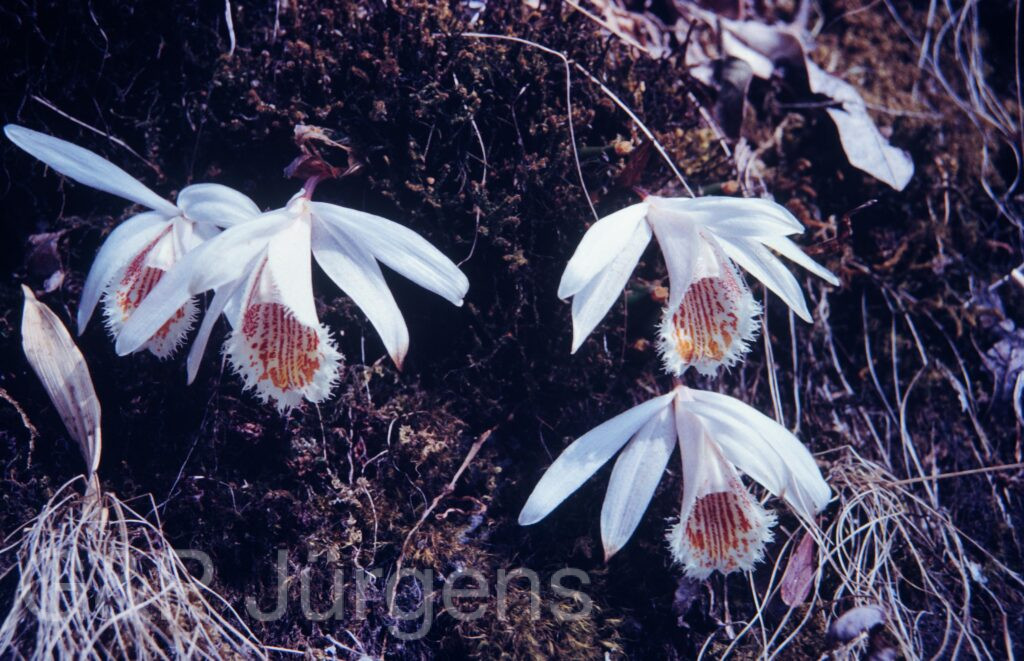
Pleione humilis is a dwarf orchid of the Himalaya and adjoining mountains, native to Nepal, India, Bhutan, Myanmar and Thailand, with around 136 georeferenced occurrences across this eastern arc. It grows chiefly as an epiphyte on mossy tree trunks and branches, and occasionally as a lithophyte on shaded, humus-covered rocks, in cool, humid temperate forest. The illustrated plant from Nundhaki in Nepal, at about 1500 m and flowering in March, exemplifies the species' habit of blooming in late winter to early spring, characteristically before or as the new leaves expand at relatively low montane elevations.

The plant grows from small, flask- to top-shaped, often warty pseudobulbs, each producing a single (occasionally paired) plicate, deciduous leaf. The flowers, usually borne singly on a short scape from the base of the pseudobulb, are large for the plant's size and showy, with spreading, narrow, white to pale pink sepals and petals. The conspicuous trumpet-shaped labellum is broadly funnel-form and frilled at the margin, white marked within by yellow to brown and red blotches and bearing several toothed or fringed keels (lamellae) along the disc. The slender, winged column lies enclosed within the lip, and the fruit is a ribbed dehiscent capsule shedding dust-like seeds.

Pleione is a small genus of about two dozen Sino-Himalayan and Southeast Asian orchids, much admired and cultivated, of which P. humilis is one of the winter-flowering, single-leaved species. As with all orchids it is protected under CITES Appendix II, and wild populations are threatened by collection for horticulture and by clearance of the moist forest on which the epiphytic plants depend; conservation therefore hinges on protecting both the species and its montane forest habitat.

Author: (Sm.) D.Don · Sources: POWO (Kew), GBIF, Flora of Bhutan (Orchidaceae), Flora of China (Orchidaceae), Cribb & Butterfield: The Genus Pleione (monograph)

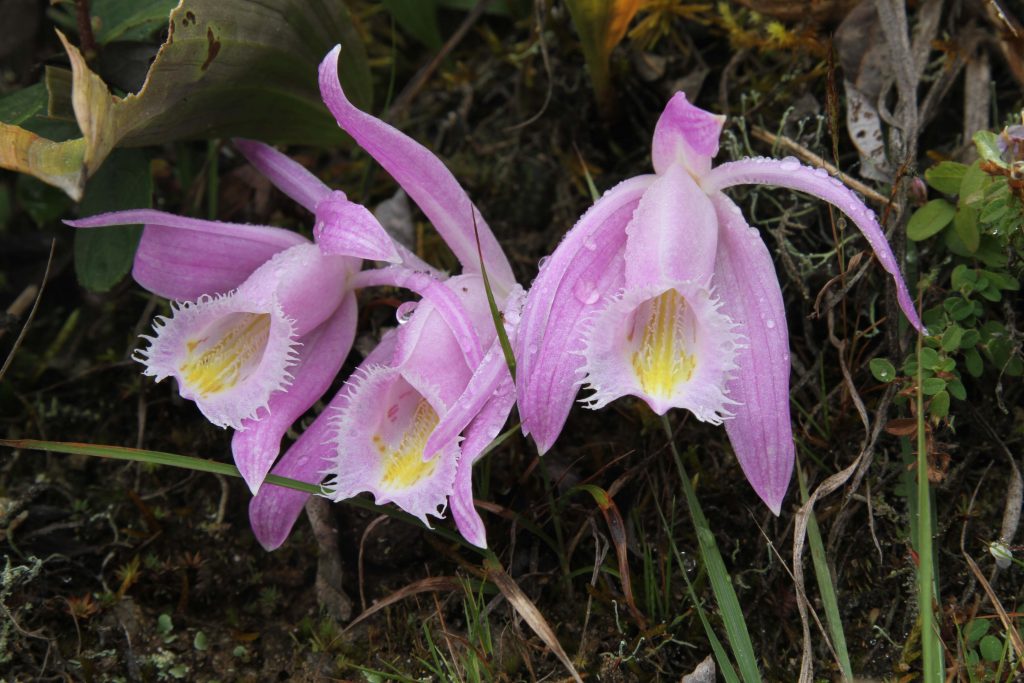
(Sm.) D.Don

Bhutan2012 828 Kopie
Bhutan Tongsa 2050m, October
Bhutan2012 831 Kopie
Bhutan Tongsa 2050m, October
Bhutan2012 1302
Bhutan Trashigang 1900m, October

Description

Pleione praecox is an autumn-flowering epiphytic and lithophytic orchid of the eastern Himalaya and Indo-Burmese region, ranging through India, Nepal, Bhutan, China, Thailand, Myanmar, Vietnam and Bangladesh, with cultivated records in Britain and the United States among its roughly 335 GBIF occurrences. It grows on mossy tree trunks, rocks and banks in humid broadleaved montane forest, typically between about 1200 and 2500 m. The cited Bhutanese plants from Trongsa (2050 m) and Trashigang (1900 m), both flowering in October, exemplify its diagnostic late-season anthesis, the epithet praecox referring to bloom appearing as or before the leaves develop.

The species is a deciduous sympodial orchid producing conspicuous, flask-shaped to conical pseudobulbs, often mottled green and purple, each typically bearing one or two pleated, lanceolate leaves that are shed in the dormant season. The showy flowers, borne singly (rarely paired) on a short scape from the base of a pseudobulb, have spreading rose-pink to magenta sepals and petals. The funnel-shaped labellum is the showpiece: broad, fimbriate at the margin, and marked internally with several toothed or lamellate crests and reddish-brown blotching. The column is slender and winged, and the fruit is an ellipsoid capsule.

Pleione is a small genus of subtribe Coelogyninae, and P. praecox is among its most horticulturally prized species, widely cultivated by alpine and orchid growers, which accounts for its scattered records in Europe and North America. Its showy labellum attracts bee pollinators despite offering little reward. Although locally frequent, wild populations face pressure from commercial and amateur collection of pseudobulbs and from clearance of montane forest, making in-situ conservation of its epiphytic habitat important.

Author: (Sm.) D.Don · Sources: POWO (Kew), GBIF, Flora of Bhutan, Flora of China (Orchidaceae), Cribb & Butterfield The Genus Pleione

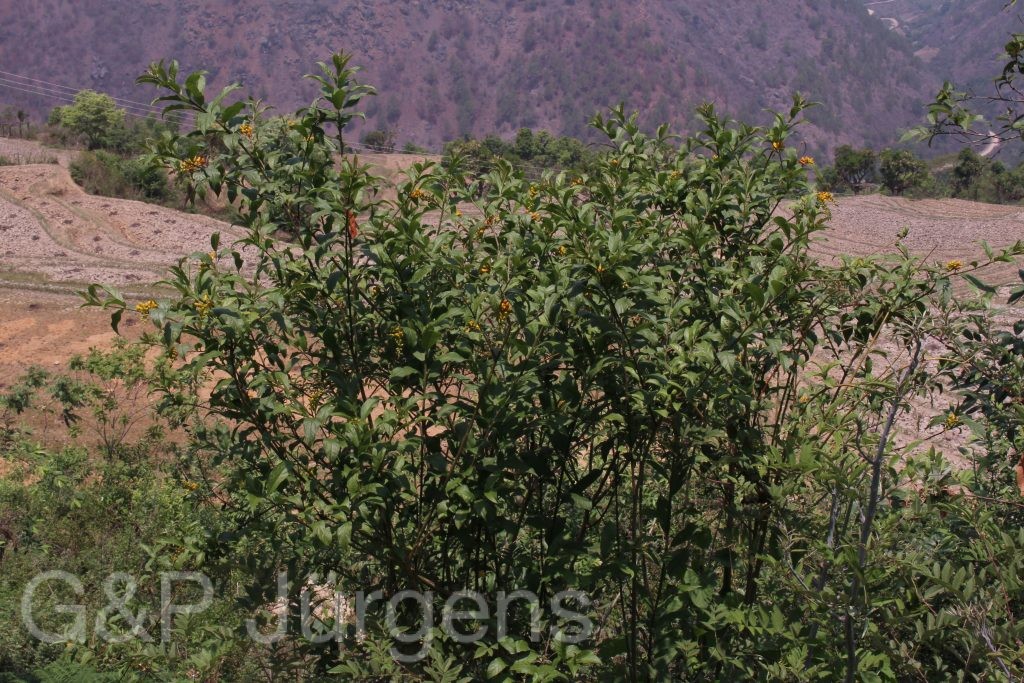
Plumeria rubra

by GP Jürgens

L.

Nepal 97 575 P1112
Nepal Sabha-Khola 550m May
Nepal 1994 36 ergebnis
Ost-Nepal Simbhuwa Kola 
1000m April

Description

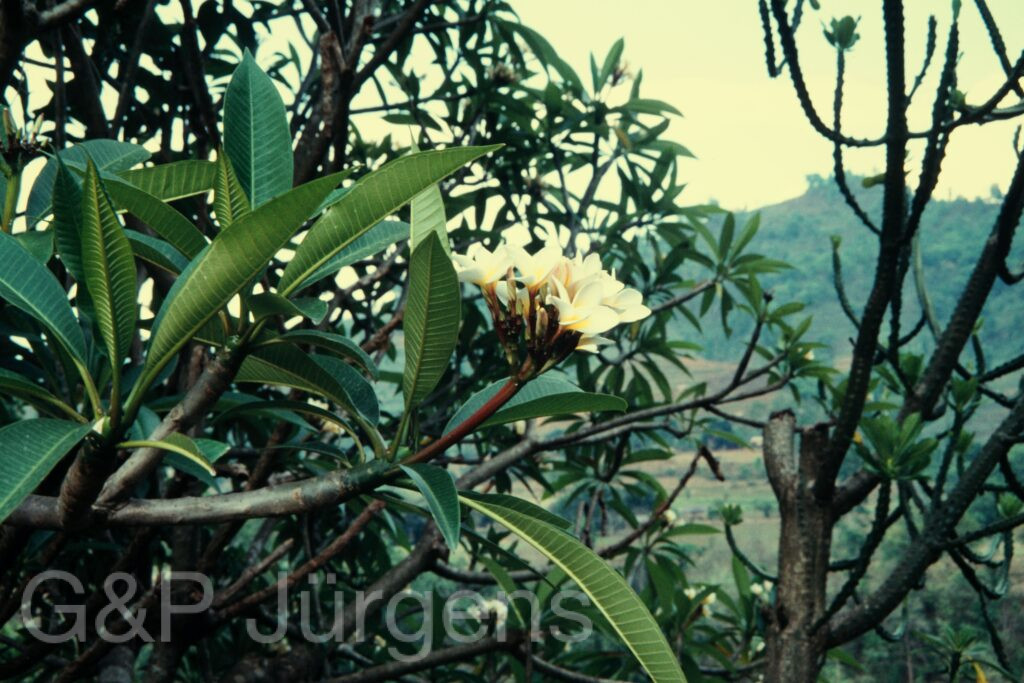
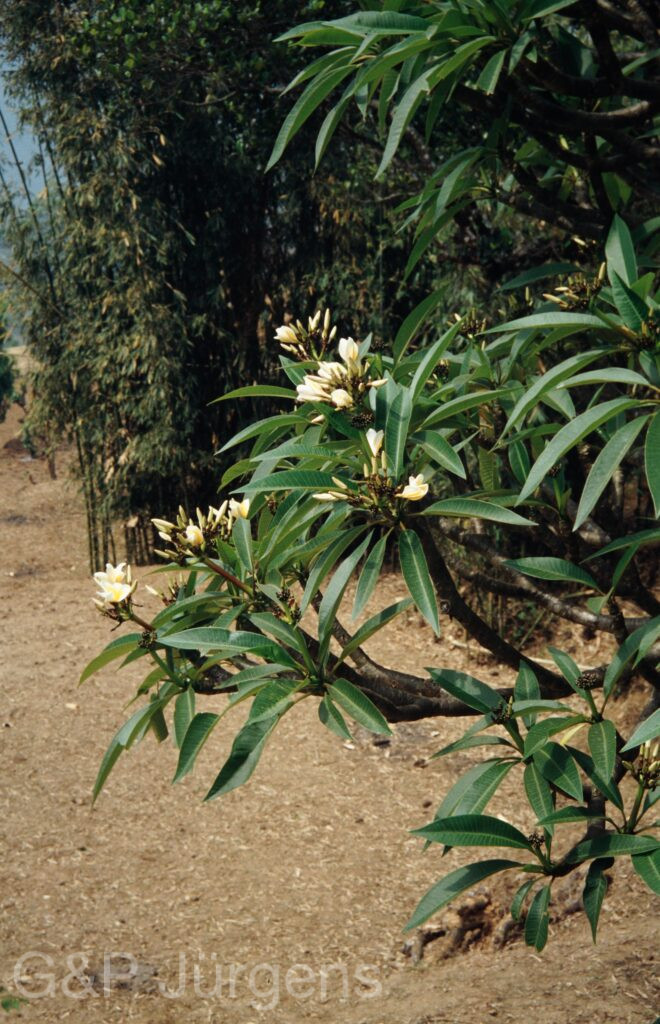
Plumeria rubra, the red frangipani, is a small tree native to Mexico and Central America but now pantropical through cultivation, a spread vividly reflected in its GBIF record of over 11,600 occurrences spanning Mexico, Guatemala, Costa Rica, Panama, Brazil, Colombia, Ecuador, Peru, the United States, India, South Africa, Indonesia, China, French Polynesia and many more. In the Himalayan foothills it is an introduced ornamental and temple tree rather than a wild element; the images from the Sabha-Khola valley (550 m, May) and the Simbhuwa Kola in eastern Nepal (1000 m, April) document it in the warm, frost-free lowland and lower hill zone where it is widely planted around dwellings, gardens and shrines. It tolerates seasonal drought, thriving in open, sunny, well-drained sites and flowering through the warm pre-monsoon and monsoon months.

It is a deciduous tree to about 5-8 m with a spreading crown of stout, blunt, sparingly branched stems exuding copious milky latex when cut. The large, alternate leaves are clustered toward the branch tips, oblong to elliptic-lanceolate, leathery, with prominent pinnate lateral veins joined by a marginal collecting vein. The strongly fragrant flowers are borne in terminal cymes; each has a salverform corolla with five overlapping, asymmetric lobes, typically white to yellow with a yellow eye in many forms but ranging to pink and deep red in the species and its cultivars. The fruit is a pair of divergent, cylindrical follicles releasing numerous winged seeds.

Plumeria belongs to the Apocynaceae subfamily Rauvolfioideae and comprises several New World species, of which P. rubra is the most variable and most widely grown, hybridising freely in cultivation. Its latex contains the iridoid glycoside plumieride and related compounds, and the plant carries deep cultural significance across South and Southeast Asia for use in offerings and garlands. Though of conservation concern nowhere because of its vast cultivated range, in the Himalaya it persists entirely as a human-introduced ornamental and has not naturalised into native forest.

Author: L. · Sources: POWO (Kew), GBIF, Flora of China Vol. 16, Flora of Nepal, Woodson's revision of Plumeria (Apocynaceae of the New World)

D.Don

Bhutan2015 187
Bhutan Zhemgang 1000m, October
Bhutan2015 188
Bhutan Zhemgang 1000m, October
Bhutan2014 194
Bhutan Trashyangtse 2100m, May
Bhutan2014 195
Bhutan Trashyangtse 2100m, May

Description

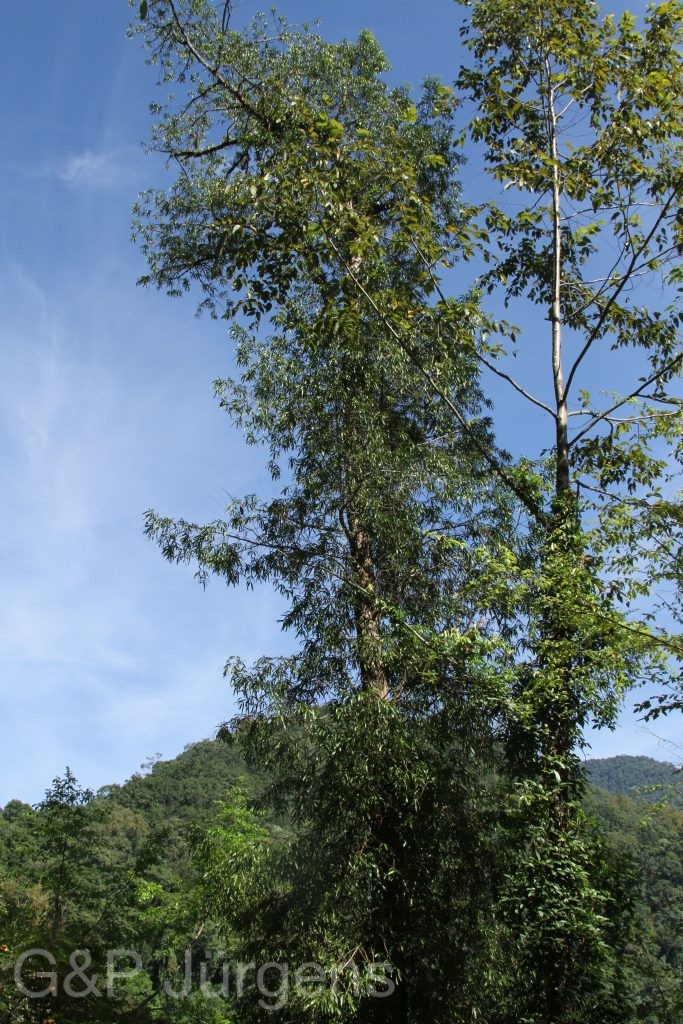
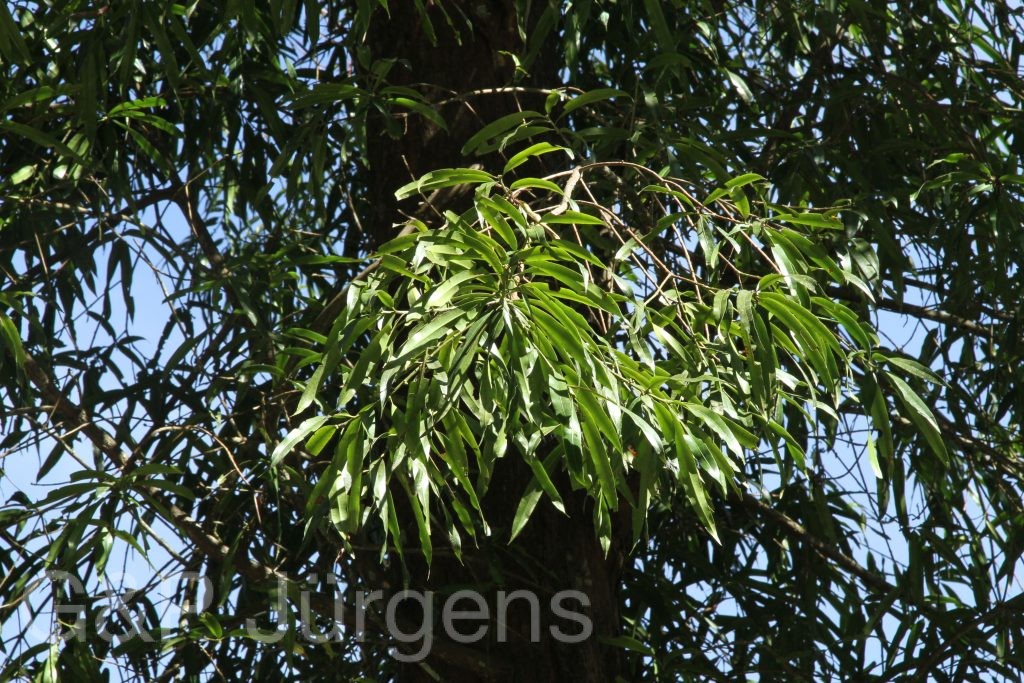
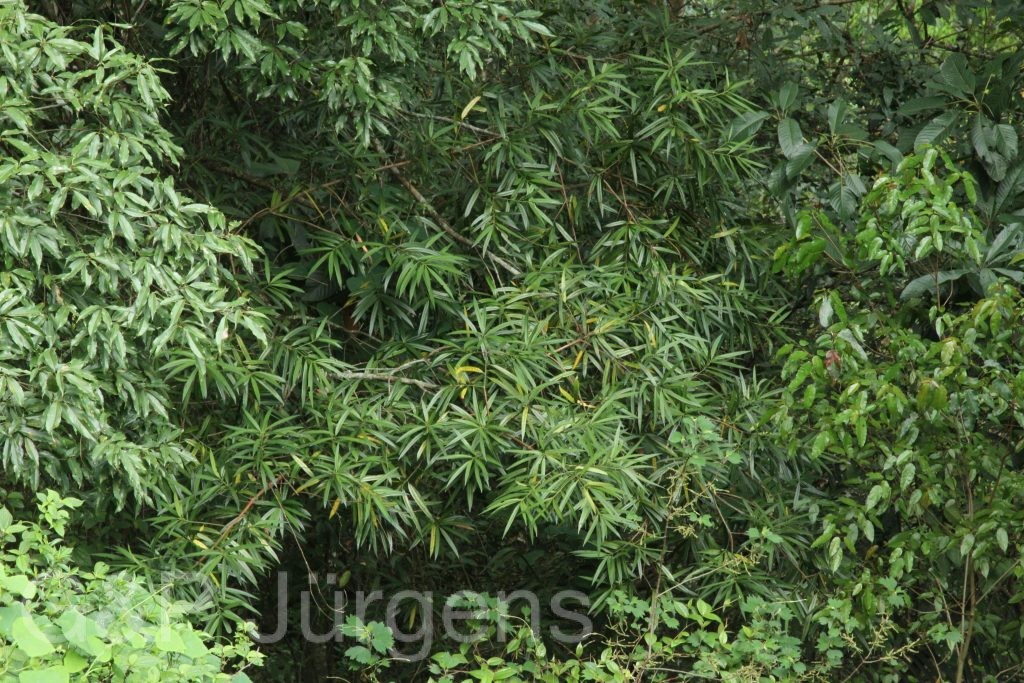
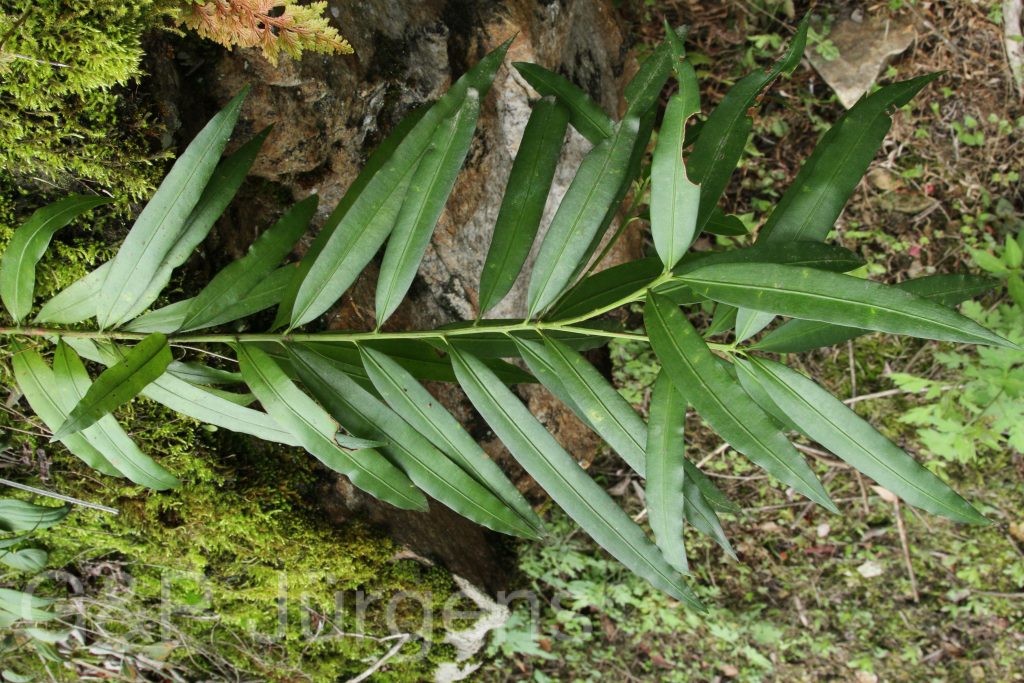
Podocarpus neriifolius, the brown pine or oleander-leaved podocarp, is a broadly distributed evergreen conifer of tropical and subtropical Asia and the western Pacific, with GBIF recording over 3,100 occurrences from Papua New Guinea, Fiji, Indonesia, Vietnam, China, Malaysia, the Solomon Islands, the Philippines, India, Thailand, Nepal, Vanuatu, Cambodia, Laos and beyond. In the eastern Himalaya it occurs in warm broad-leaved and mixed forest of the foothills and lower mountains, generally between about 500 and 2100 m. The images from Zhemgang in Bhutan at 1000 m, in October, and from Trashyangtse at 2100 m, in May, bracket its altitudinal range in that country, showing it as a scattered emergent or canopy tree in humid, evergreen subtropical forest on well-drained slopes.

It is an evergreen tree commonly 10-25 m tall, occasionally much larger, with grey to brown, fibrous, flaking bark and a dense crown. The leaves are spirally arranged but often appearing two-ranked, simple, narrowly lanceolate and leathery with a prominent midrib and a long, gradually tapering apex, recalling the foliage of oleander as the epithet indicates. The species is dioecious: pollen cones are slender, cylindrical and borne in leaf axils, while the seed cones are reduced to one or two ovules seated on a swollen, fleshy receptacle (the epimatium and aril) that ripens red to purple, the single seed crowned by a green to bluish covering and dispersed by birds.

Podocarpus is the largest genus of the Southern Hemisphere-centred family Podocarpaceae, and P. neriifolius is among its most wide-ranging species, exhibiting considerable variation in leaf size across its vast area. It is valued for its fine, even timber, which has led to local overexploitation, though its enormous geographic range means it is assessed by the IUCN as Least Concern overall. In the Himalaya it represents a tropical-Gondwanan conifer lineage reaching its northern limits in the warm forests of the eastern foothills.

Author: D.Don · Sources: POWO (Kew), GBIF, Flora of China Vol. 4, Flora of Bhutan Vol. 1, Flora of Nepal, de Laubenfels' revision of Podocarpus and the Podocarpaceae

Royle

Sikkim2011 57
Sikkim Tanghu 3900m, June
Sikkim2011 70
Sikkim Tanghu 3900m, June
Sikkim2011 72
Sikkim Tanghu 3900m, June

Description

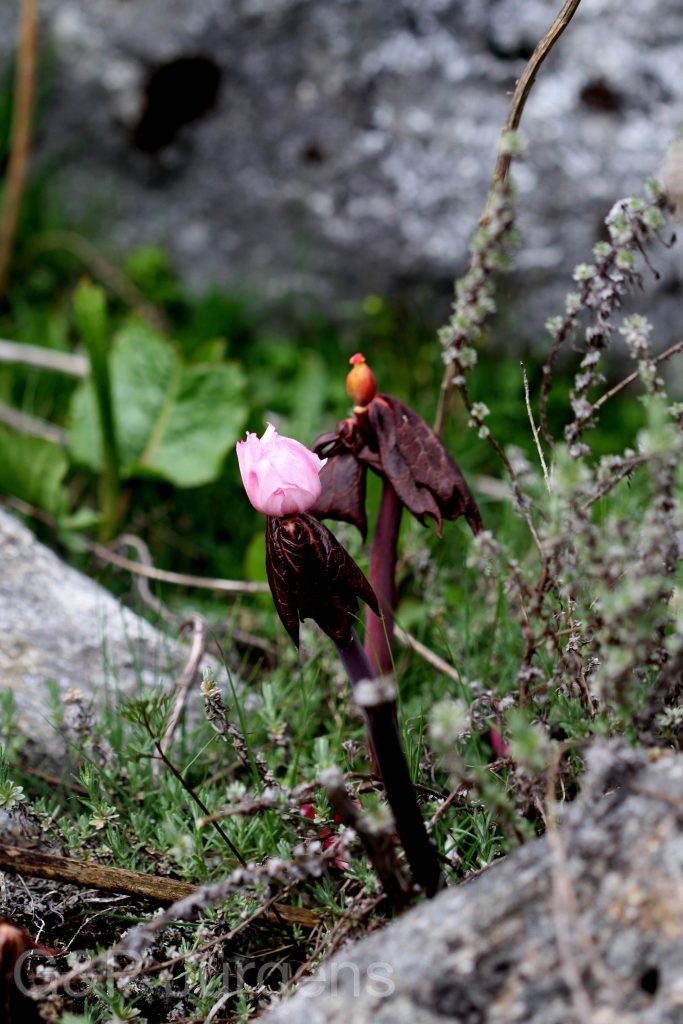
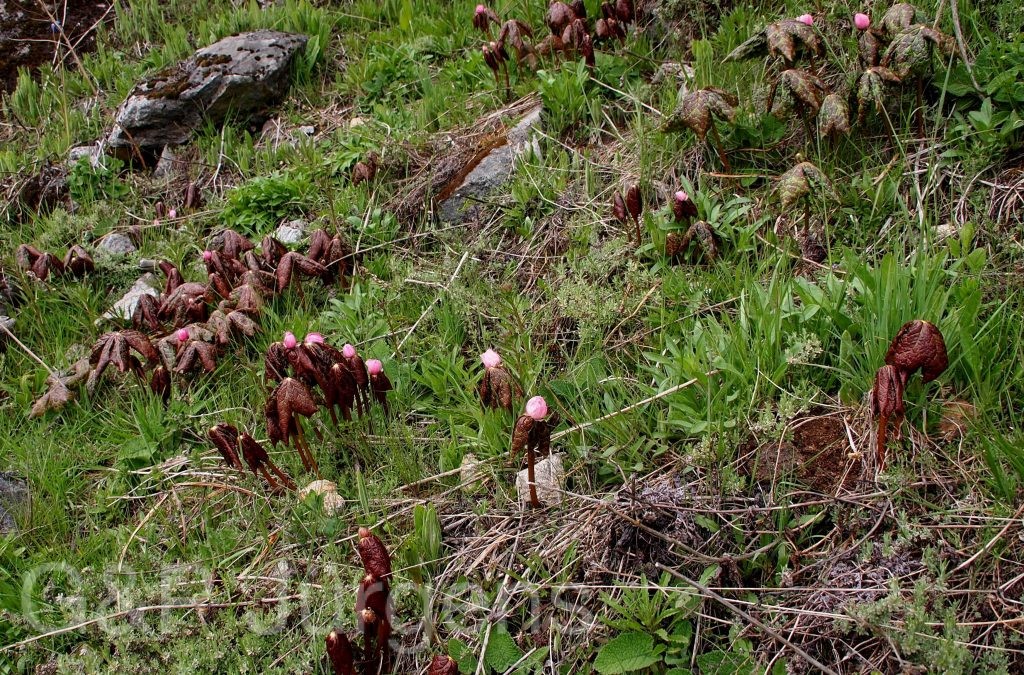
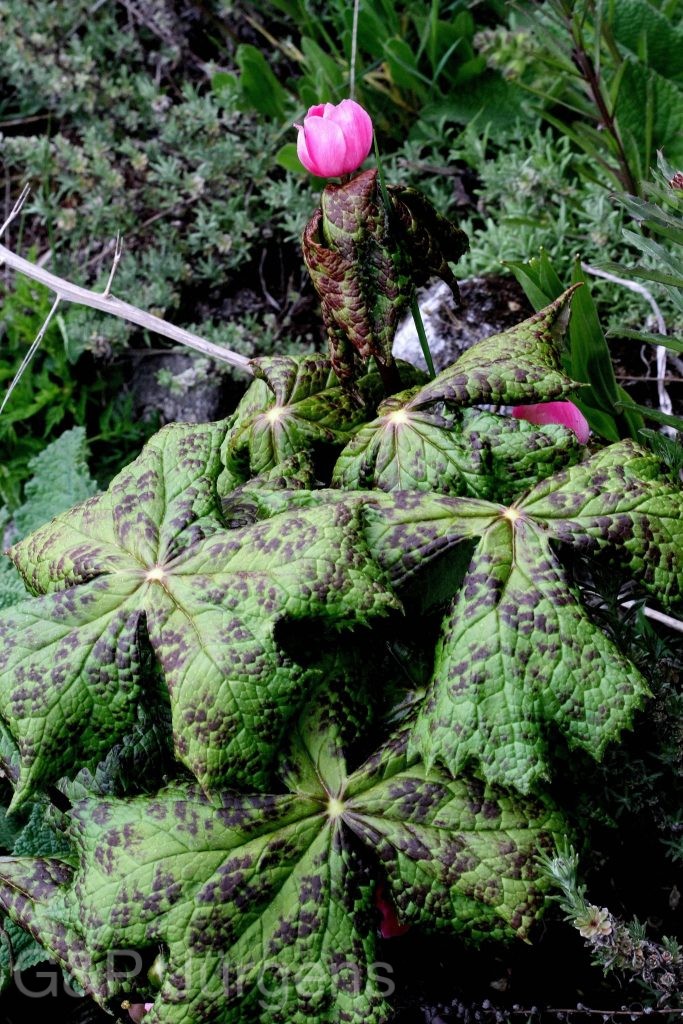
Podophyllum hexandrum, the Himalayan mayapple, is a perennial herb of the high temperate and subalpine Himalaya, occurring through China, India, Pakistan, Nepal, Bhutan and Afghanistan, with around 860 occurrences in GBIF. It grows in moist alpine meadows, open fir and birch forest, shaded scrub and along the margins of melting snowfields, typically between about 2500 and 4500 m. The plant photographed at Tanghu in northern Sikkim at 3900 m in June, emerging and flowering as the snow recedes, is characteristic of its high-elevation niche, where the rich, moist humus of the upper forest and meadow ecotone supports dense local stands.

The species arises from a stout, creeping, knotty rhizome and produces a single erect aerial stem 15–50 cm tall bearing usually two large, long-petiolate leaves that are deeply palmately three- to five-lobed, the lobes themselves further cut and toothed, often bronze-mottled when young. A solitary, nodding to erect flower is borne at the fork of the leaves; it is cup-shaped with white to pale pink petals and (as the epithet indicates) commonly six stamens. The fruit is a large, fleshy, ovoid berry ripening to bright red and containing numerous seeds embedded in pulp.

GBIF flags the name as a synonym, the species being widely treated under the accepted name Podophyllum hexandrum, with the genus Sinopodophyllum (S. hexandrum) recognised by some authors to accommodate the Asian taxon apart from the North American Podophyllum peltatum; the source page links to that segregate name. The plant is the principal natural source of podophyllotoxin, a lignan of major pharmaceutical importance as a precursor of anticancer agents. Heavy harvesting of the rhizomes for this trade, together with habitat disturbance, has caused marked local declines, and the species is regarded as threatened and is subject to conservation and CITES-related concern across much of its range.

Author: Royle · Sources: POWO (Kew), GBIF, Flora of China Vol. 19, Flora of Bhutan Vol. 1, Flora of Pakistan, Medicinal Plants of the Himalaya: A Monograph of Podophyllum

Baker

Nepal 99 85 ergebnis
West-Nepal Bhulbhule 3200m, June

Description

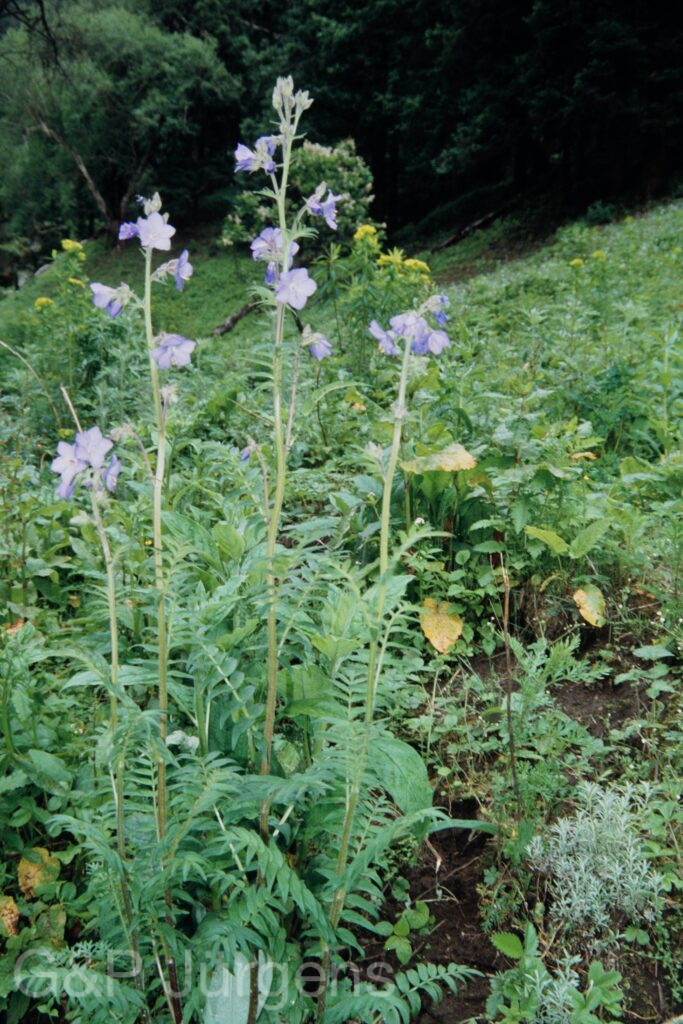
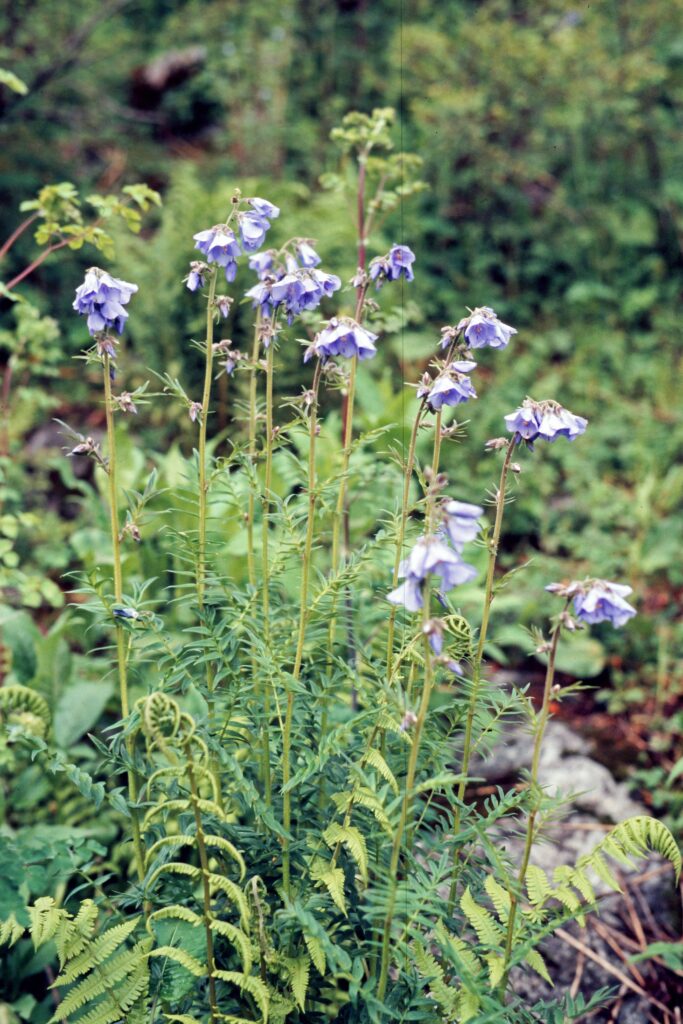
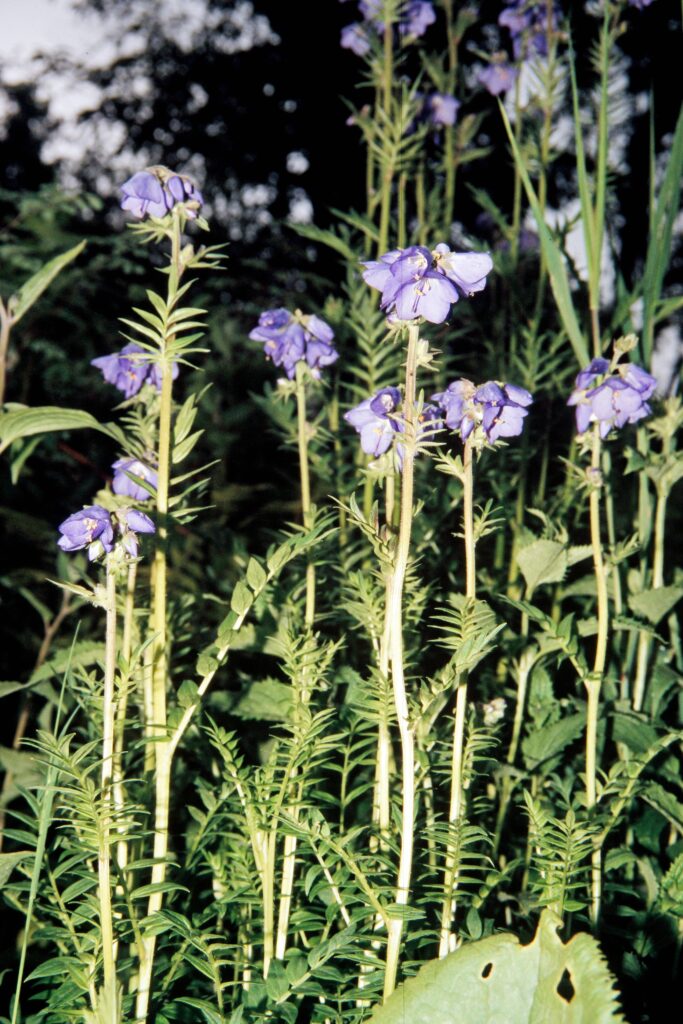
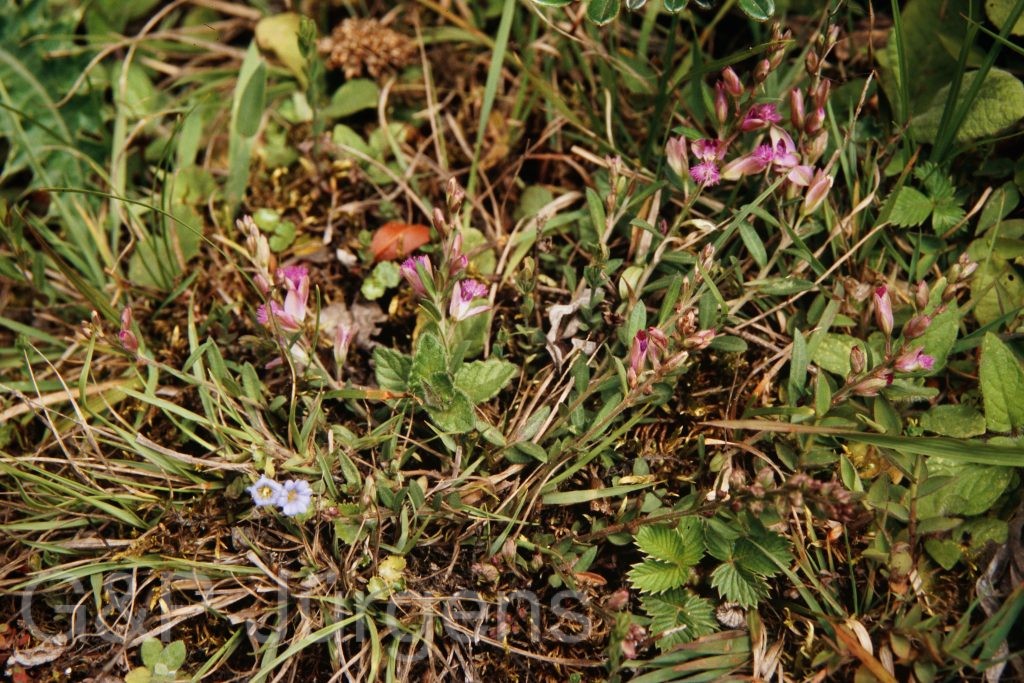
Polemonium caeruleum var. himalayanum is the Himalayan expression of the wide-ranging Jacob's ladder, here documented chiefly from Nepal, with only about 16 georeferenced GBIF occurrences reflecting its restricted recording rather than true rarity. It is a herb of moist alpine and upper-subalpine meadows, streambanks, open shrubberies and damp rocky slopes, typically between about 3000 and 4000 m. The populations noted at Bhulbhule in West Nepal at 3200 m and at Seema in Garhwal at 3400 m, both flowering in June at the start of the monsoon, are characteristic of its preference for cool, humus-rich, seasonally moist ground in the high western and central Himalaya.

It is an erect perennial herb arising from a short rhizome, the stems leafy and often glandular-pubescent above. The leaves are alternate and pinnately compound, the numerous lanceolate to ovate leaflets arranged ladder-like along the rachis, giving the plant its vernacular name. The flowers are borne in a terminal, somewhat congested panicle; each has a campanulate, glandular five-lobed calyx and a broadly campanulate to rotate blue corolla with five spreading lobes, the five stamens inserted in the throat with hairy filament bases, and a three-lobed style exserted. The fruit is an ovoid, three-valved loculicidal capsule containing several angular seeds.

GBIF treats the name as a synonym, with Polemonium caeruleum himalayanum recognised as the accepted infraspecific taxon within the circumboreal P. caeruleum complex. The protandrous, nectar-rich flowers are visited by bees and long-tongued insects, promoting outcrossing. As a high-altitude meadow plant it is sensitive to overgrazing, though not presently assessed as threatened.

Author: Baker · Sources: POWO (Kew), GBIF, Flora of Nepal, Flora of Bhutan Vol. 2, Flora of China Vol. 16, A Systematic Treatment of Polemonium (Polemoniaceae)

Buch.-Ham. ex D. Don

Bhutan2014 669
Bhutan Wangdi-Phodrang 2280, May

Description

Polygala arillata is a shrubby milkwort of the Himalaya and Southeast Asia, distributed from Nepal, NE India and Bhutan through southern China to Myanmar, Thailand, Vietnam, Bangladesh, Sri Lanka and Malesia, with 2,908 GBIF occurrences. It grows in temperate and subtropical broad-leaved forest, forest margins, clearings and shrubby slopes, commonly between about 1,000 and 2,800 m. The Bhutanese collection from Wangdi Phodrang at about 2,280 m in May reflects its late-spring flowering in mid-montane forest, where it grows as a conspicuous understorey or edge shrub.

It is an erect shrub or small tree 1–3 m tall with terete, finely pubescent branchlets. The leaves are alternate, elliptic to obovate-oblong, 8–18 cm long, acuminate, entire and shortly petiolate, often somewhat membranous. The inflorescence is a pendent terminal or leaf-opposed raceme of showy flowers; each flower has five sepals, the two inner enlarged into petaloid, deep yellow to reddish wings, and three petals fused into a tube with a fringed keel, the whole strongly zygomorphic. The fruit is a fleshy, laterally compressed, reddish capsule, and the seeds bear a conspicuous white aril, from which the epithet arillata is derived.

The species belongs to the large, cosmopolitan genus Polygala and is among its more robust, woody Asian representatives. GBIF treats the name as accepted. The arillate seeds suggest dispersal by birds or ants attracted to the fleshy appendage, and the showy keeled flowers are adapted to insect pollination. Widespread and locally common, it is of least concern; its roots and bark are used in regional traditional medicine.

Author: Buch.-Ham. ex D. Don · Sources: POWO (Kew), Flora of China Vol. 11, Flora of Bhutan Vol. 1, GBIF, Bennett: Polygalaceae in Hooker's Flora of British India (1882)

L.

Bh2008 521 G796
Bhutan Punakha 2400m, May

Description

Polygala sibirica L. is a small perennial milkwort with one of the widest distributions in its genus, ranging across temperate Eurasia from eastern Europe through Central and northern Asia to the Himalaya, China, Japan and southward into Southeast Asia and Australasia. GBIF records confirm its presence in Russia, China, Mongolia, India, Nepal, Bhutan, Pakistan, Korea, Japan and many other countries, with several thousand occurrences. It grows on dry grassy slopes, open stony banks and forest margins from the lowlands to about 3,000 m. The plant photographed at Punakha in Bhutan at 2,400 m, flowering in May, exemplifies its occurrence on sunny montane slopes.

The species is a tufted perennial herb arising from a woody rootstock, with several ascending to spreading, often hairy stems 10–30 cm long. The leaves are alternate, sessile or nearly so, lanceolate to elliptic, the lower ones smaller. The flowers are borne in lax terminal racemes; the two large petaloid lateral sepals (wings) are greenish-veined, and the small blue to purplish corolla bears a conspicuous fringed keel-petal crest. The fruit is a flattened, narrowly winged, obcordate capsule containing two hairy seeds with a small aril.

Polygala sibirica is closely allied to the medicinally important P. tenuifolia, and its roots are similarly used in traditional Chinese medicine (yuan zhi) as a source of saponins. Its enormous range and ecological tolerance make it one of the most successful milkworts, and it is of least conservation concern.

Author: L. · Sources: POWO (Kew), GBIF, Flora of China Vol. 11, Flora of Bhutan Vol. 1, Bennett: Polygalaceae in Hooker's Flora of British India

Baker

Sikkim 2006 315 ergebnis
India West-Bengal, Chaana 1800m, May

Description

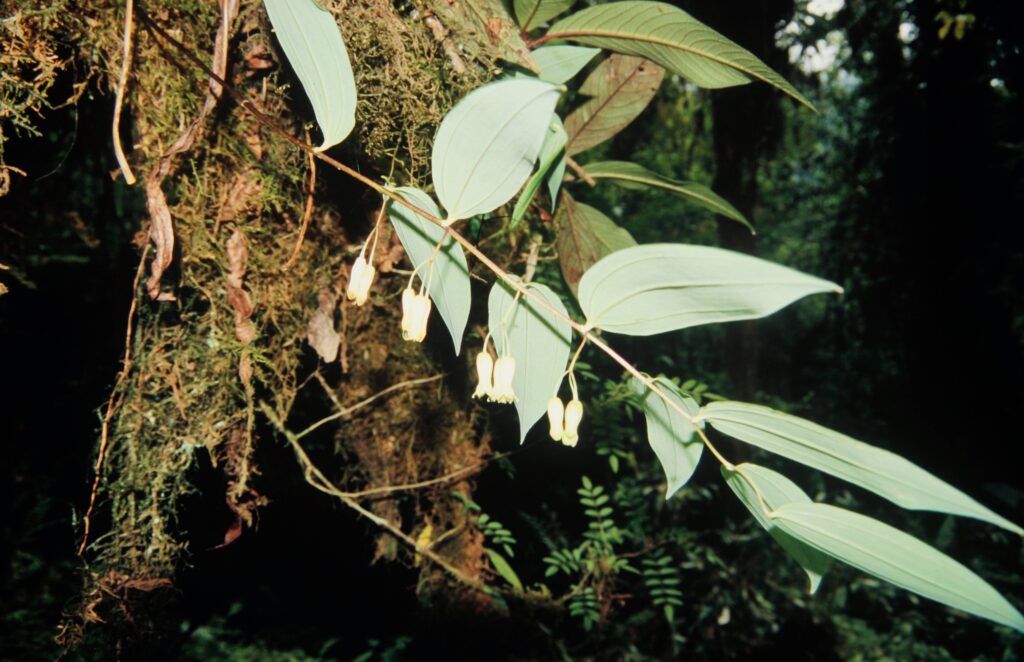
Polygonatum brevistylum is a rhizomatous perennial of the eastern Himalaya and adjacent ranges. GBIF documents it (some 27 occurrences) from Nepal, India, Bhutan and Myanmar, in moist temperate forest, forest margins, shrubberies and shaded banks. It grows in cool, humus-rich soils within the broadleaved and mixed conifer zone, generally between about 1,500 and 3,000 m. The photographed plant is from Chaana in West Bengal (Darjeeling–Sikkim Himalaya) at around 1,800 m, flowering in May, a representative low-montane station for the species as it sends up shoots in spring.

The plant has a stout, knotty, horizontally creeping rhizome from which arises an erect or arching stem. The leaves are alternate, ovate to elliptic and acuminate, glabrous, sessile or shortly petiolate. The flowers are pendent and borne in few-flowered axillary clusters; the perianth is tubular-campanulate, white to greenish-white, with six short lobes, and, as the epithet brevistylum signals, a notably short style. The fruit is a globose berry, ripening blue-black to purplish and containing several seeds.

Polygonatum (Solomon's-seal), now placed in Asparagaceae (formerly Convallariaceae or Liliaceae sensu lato), is taxonomically intricate in the Himalaya, where several closely allied rhizomatous species occur. The short style and the clustered axillary flowers are useful diagnostic characters separating P. brevistylum from sympatric congeners. Himalayan Polygonatum rhizomes are widely gathered for food and traditional medicine, so localised harvesting pressure may affect accessible populations.

Author: Baker · Sources: POWO (Kew), Flora of China Vol. 24, Flora of Bhutan Vol. 3, GBIF, Jeffrey: The Genus Polygonatum (Liliaceae) in Eastern Asia