
Buch.-Ham. ex D. Don
Description
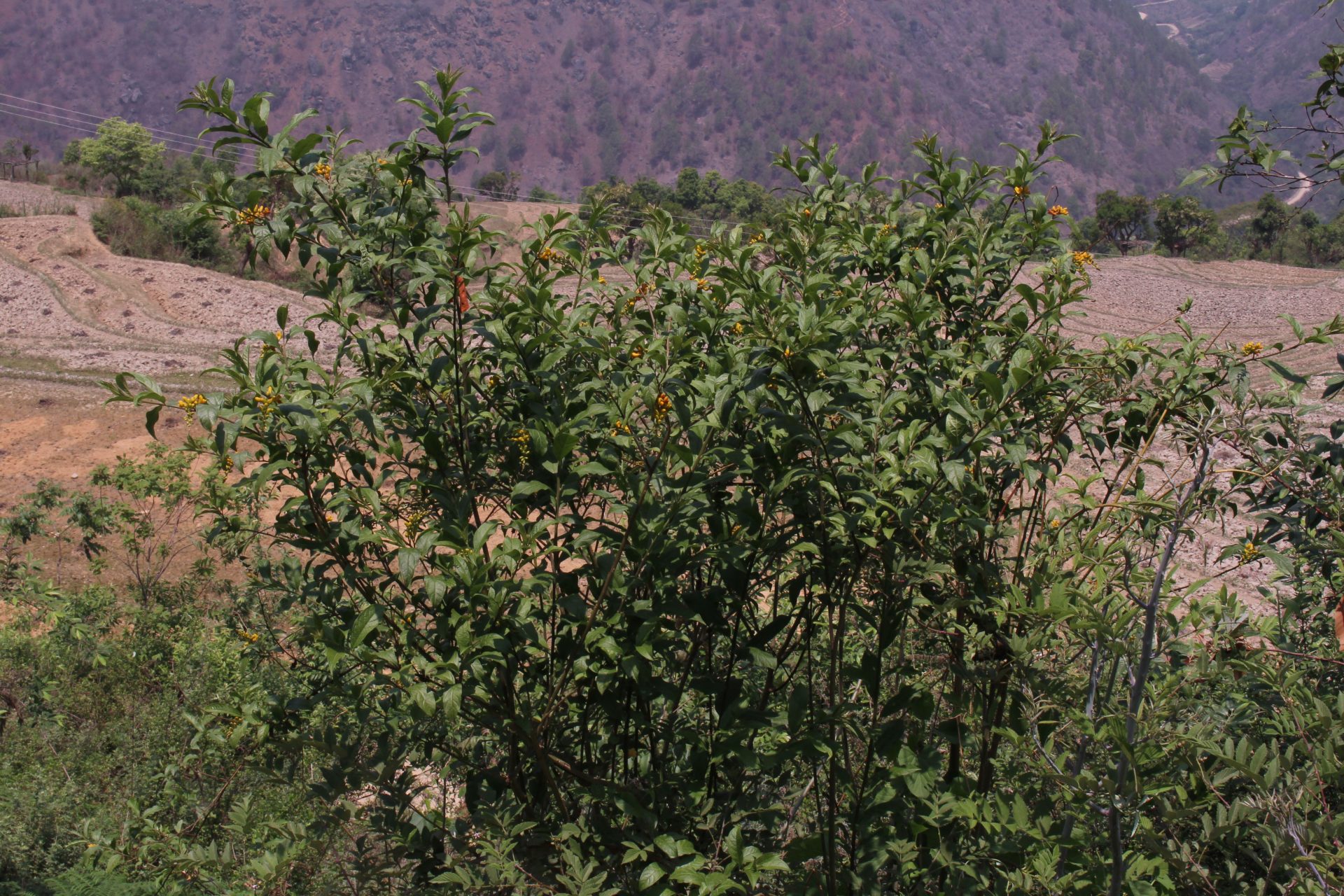
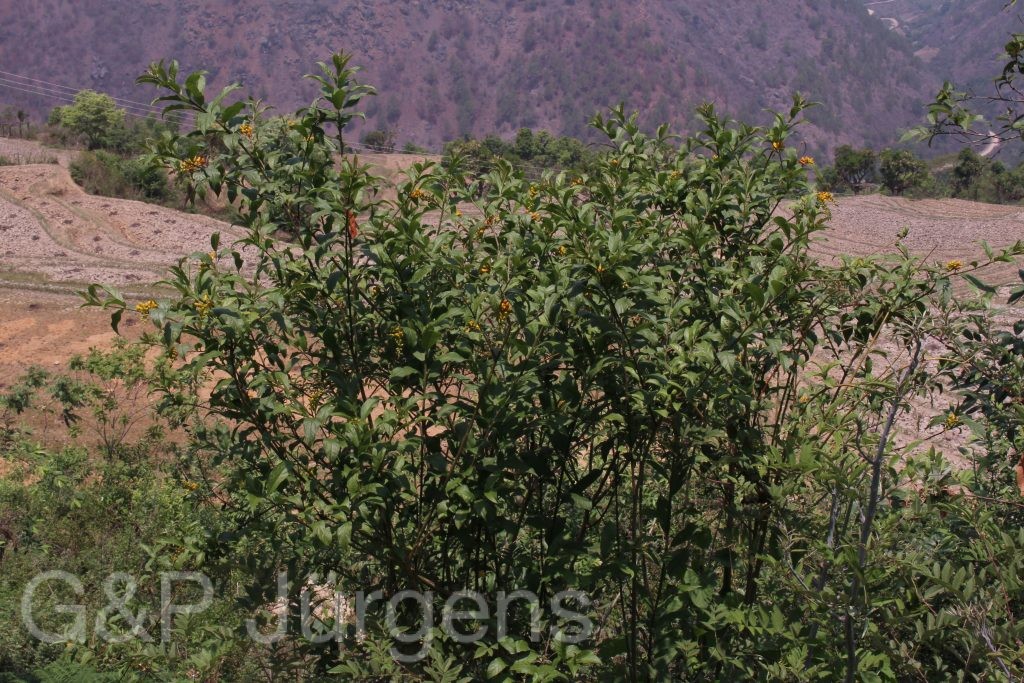
Polygala arillata is a shrubby milkwort of the Himalaya and Southeast Asia, distributed from Nepal, NE India and Bhutan through southern China to Myanmar, Thailand, Vietnam, Bangladesh, Sri Lanka and Malesia, with 2,908 GBIF occurrences. It grows in temperate and subtropical broad-leaved forest, forest margins, clearings and shrubby slopes, commonly between about 1,000 and 2,800 m. The Bhutanese collection from Wangdi Phodrang at about 2,280 m in May reflects its late-spring flowering in mid-montane forest, where it grows as a conspicuous understorey or edge shrub.
It is an erect shrub or small tree 1–3 m tall with terete, finely pubescent branchlets. The leaves are alternate, elliptic to obovate-oblong, 8–18 cm long, acuminate, entire and shortly petiolate, often somewhat membranous. The inflorescence is a pendent terminal or leaf-opposed raceme of showy flowers; each flower has five sepals, the two inner enlarged into petaloid, deep yellow to reddish wings, and three petals fused into a tube with a fringed keel, the whole strongly zygomorphic. The fruit is a fleshy, laterally compressed, reddish capsule, and the seeds bear a conspicuous white aril, from which the epithet arillata is derived.
The species belongs to the large, cosmopolitan genus Polygala and is among its more robust, woody Asian representatives. GBIF treats the name as accepted. The arillate seeds suggest dispersal by birds or ants attracted to the fleshy appendage, and the showy keeled flowers are adapted to insect pollination. Widespread and locally common, it is of least concern; its roots and bark are used in regional traditional medicine.
Author: Buch.-Ham. ex D. Don · Sources: POWO (Kew), Flora of China Vol. 11, Flora of Bhutan Vol. 1, GBIF, Bennett: Polygalaceae in Hooker's Flora of British India (1882)