Tag:

Nepal

Flowers of Nepal — 1313 wild plant species documented from the Nepalese Himalaya, from subtropical foothills to high alpine meadows above 4,000 m. Nepal’s dramatic elevation gradient makes it one of the richest botanical regions on Earth, home to rhododendrons, primulas, gentians and the famed blue poppies (Meconopsis). Every entry gives a botanical description, native distribution, habitat and flowering season, alongside the original field photograph and the location where it was taken.

D.Don

Sikkim 2006 463 ergebnis
India West-Bengal, Ruigi-Chu 2100m, May

Description

Polygonum molle D.Don is a robust perennial knotweed of the Himalaya and adjacent uplands. Under current circumscription the name is treated as a synonym, the accepted genus being Koenigia, into which many former Asian Polygonum and Aconogonon species have been transferred following molecular phylogenetic studies. The taxon occurs from Pakistan and Nepal eastward through Sikkim and Bhutan into southwest China, with the broad GBIF country list reflecting the wide aggregate concept of the genus and numerous cultivated or naturalised records across Europe and North America. It was recorded in West Bengal at Ruigi-Chu at 2,100 m in May, growing in moist temperate forest clearings, stream banks, and shrubby slopes between about 1,500 and 3,000 m.

The plant forms stout, erect, much-branched stems up to 1–2 m tall arising from a woody rootstock, the nodes sheathed by membranous, often brownish ochreae. The leaves are large, ovate to ovate-lanceolate, acuminate, with a softly pubescent (hence "molle") and somewhat velvety lower surface. Numerous small whitish to greenish flowers are borne in much-branched, paniculate inflorescences of slender racemes; each flower has a five-parted perianth that persists around the trigonous, glossy achene at maturity.

The transfer to Koenigia reflects a substantial reorganisation of tribe Persicarieae, in which the traditional broad Polygonum proved polyphyletic. Plants of this group are pioneer colonisers of disturbed temperate habitats and contribute to slope stabilisation. Robust and widespread, the species is of no conservation concern, though its taxonomy at species rank remains in flux pending fuller sampling.

Author: D.Don · Sources: POWO (Kew), Flora of China Vol. 5, Flora of Bhutan Vol. 1, GBIF, Schuster et al.: Phylogeny of Polygoneae (Taxon, 2011)
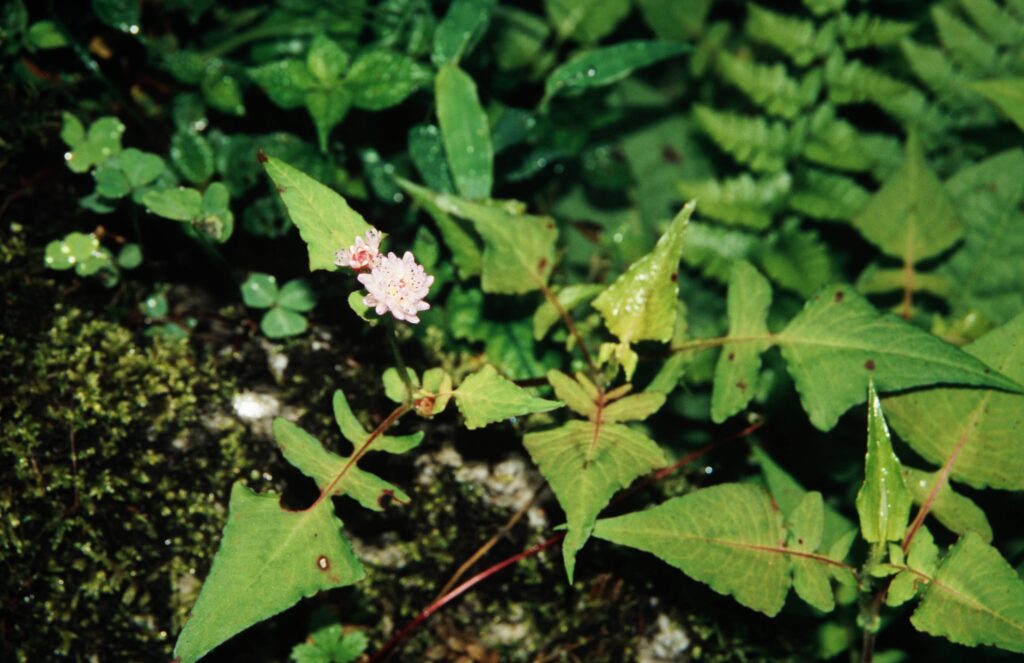
Buch.-Ham.

Sikkim 2006 458 ergebnis
India Sikkim, Ringi-Chu 2100m May

Description

Polygonum runcinatum is a widely distributed knotweed found across the Himalaya and extending through much of eastern and southeastern Asia to Malesia. Its range encompasses Nepal, Bhutan, India, Pakistan, Myanmar, China, Taiwan, Thailand, Vietnam, Malaysia, Indonesia, and Papua New Guinea, with scattered records elsewhere. GBIF documents over 1,660 occurrences, reflecting its abundance and broad ecological amplitude. The species colonises moist, open to semi-shaded habitats including forest margins, stream banks, roadsides, damp meadows, and disturbed ground at elevations from 500 to 3,500 m. The photograph from Ringi-Chu in Sikkim at 2,100 m, taken in May, shows the species at a mid-elevation site in the eastern Himalaya.
The plant is a prostrate to ascending perennial herb, 20–60 cm long, often forming extensive mats. Stems are slender, branched, rooting at lower nodes, reddish-brown, glabrous to sparsely pubescent. Leaves are distinctive: ovate to lanceolate, 3–8 cm long, with a hastate to runcinate base bearing prominent, backward-pointing basal lobes — the feature indicated by the epithet runcinatum. The upper leaf surface frequently bears a dark, V-shaped or chevron-like blotch, a useful field character. Ocreae are tubular, membranous, ciliate. Flowers are borne in dense, globose, terminal capitate heads, 8–12 mm in diameter, on slender peduncles. Individual flowers are small, with a five-lobed perianth, pink to deep rose, occasionally white. Stamens usually eight. The achene is trigonous, dark brown, enclosed within the persistent perianth.
Polygonum runcinatum has been transferred by some authors to Persicaria as P. runcinata (Buch.-Ham.) H.Gross, reflecting the broad restructuring of Polygonum sensu lato based on molecular phylogenetic evidence. The species is ecologically versatile and often weedy, colonising disturbed habitats rapidly. It plays a role in soil stabilisation on moist slopes and provides floral resources for small pollinators. It is not threatened and is considered common to locally abundant throughout its extensive range.

Author: Buch.-Ham. · Sources: POWO (Kew), GBIF, Li et al.: Polygonaceae in Flora of China Vol. 5, Grierson & Long: Flora of Bhutan Vol. 1

L.

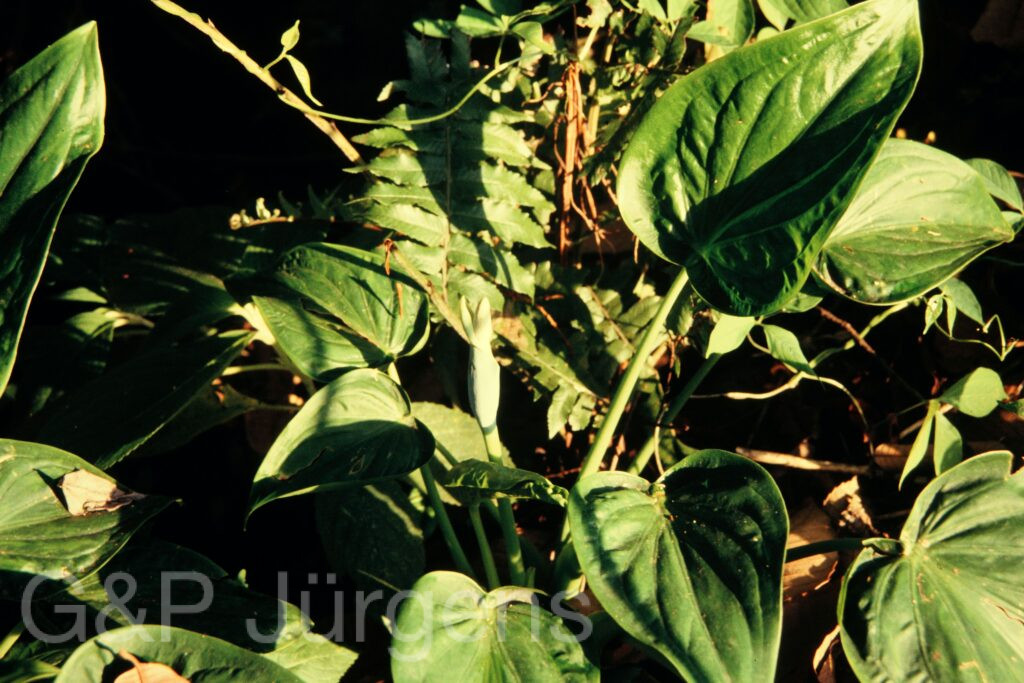
Nepal 97 548 P1074
Nepal Sabha-Khola 530m May

Description

Pontederia hastata is an aquatic to semi-aquatic herb of tropical and subtropical Asia and Australasia, with 931 GBIF occurrences extending from India, Nepal, China and Sri Lanka through Southeast Asia to the Philippines, Papua New Guinea, Fiji and northern Australia. It grows in still and slow-moving fresh water, inhabiting ponds, ditches, marshes, paddy fields and the margins of streams and pools in the lowlands and low hills. The plant recorded along the Sabha-Khola in Nepal at 530 m in May exemplifies its lowland wetland habitat, where it grows rooted in shallow water or mud and flowers in the warm pre-monsoon period.

The species is a perennial, more or less emergent herb arising from a creeping rhizome and rooting at the nodes. The leaves are long-petiolate, the petioles sometimes slightly spongy and inflated, bearing sagittate to hastate blades with diverging basal lobes that give the plant its epithet. The flowers are borne in a dense spike or raceme subtended by a leaf-like spathe; each is bluish to pale violet, with six perianth segments fused below into a tube, six stamens often differing in length, and a tricarpellate ovary. The fruit is a capsule enclosing numerous small seeds dispersed by water.

The taxon has long been known as Monochoria hastata, reflected in the source link, but Monochoria is now subsumed within an enlarged Pontederia on phylogenetic grounds, making Pontederia hastata the accepted name. Like its relatives, the plant is an effective coloniser of disturbed aquatic and agricultural wetlands; it is widely used as a leaf vegetable and remains common, of no conservation concern across its broad range.

Author: L. · Sources: POWO (Kew), GBIF, Flora of China Vol. 24, Flora of Bhutan Vol. 3, Flora of Nepal, Flora of Pakistan, Pellegrini's revision of Pontederiaceae

A.Benn.

Bhutan2015 560
Bhutan Mo-Chu 1500m, October

Description

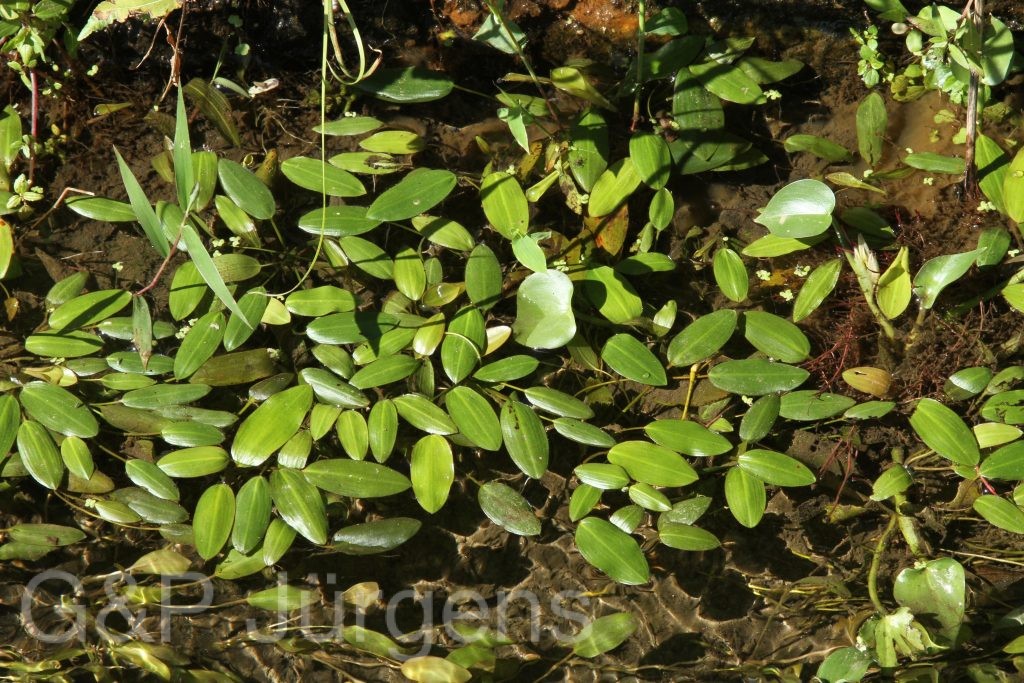
Potamogeton distinctus is an aquatic herb widespread across temperate and subtropical Asia, recorded from Japan, Korea, China, Taiwan and the Russian Far East through the Himalaya (India, Nepal, Bhutan) into Southeast Asia and beyond. It is a plant of still and slow-moving fresh water — ponds, ditches, paddy fields, oxbows and the margins of slow rivers — from the lowlands to the lower montane belt. The individual photographed along the Mo Chu in Bhutan at 1,500 m in October illustrates its occurrence in a sluggish river backwater of the inner valleys, where it persists into autumn. It is well known as a weed of rice cultivation across its eastern range.

It is a perennial rooting in mud and spreading by slender, whitish, often tuber-bearing rhizomes. The plant is heterophyllous: submerged leaves are translucent, narrow and sessile or short-petioled, while the floating leaves are coriaceous, elliptic to oblong, long-petioled and with rounded to subcordate bases. Membranous stipules (ochreae) sheath the stem at the nodes. The inflorescence is a dense, cylindrical, emergent spike raised above the water on a stout peduncle; the small flowers each bear four clawed tepal-like segments and four stamens. The fruit is a small, obliquely obovoid drupelet with a short beak and a dorsal keel.

Potamogeton (Potamogetonaceae) is a cosmopolitan genus prone to hybridisation and to plastic, environmentally induced variation, which complicates identification; floating-leaved species such as P. distinctus are best separated on fruit, stipule and tuber characters. The species is widespread, often abundant, and of no conservation concern, though as a paddy weed it is locally controlled.

Author: A.Benn. · Sources: POWO (Kew), Flora of China Vol. 23, Flora of Bhutan Vol. 3, GBIF, Wiegleb & Kaplan: Account of Potamogeton (1998)

Wall.

Nepal 99 360 ergebnis
West-Nepal Kalmura 3800m, June
Nepal 99 128 ergebnis
West-Nepal Kalmura 3800m, June

Description

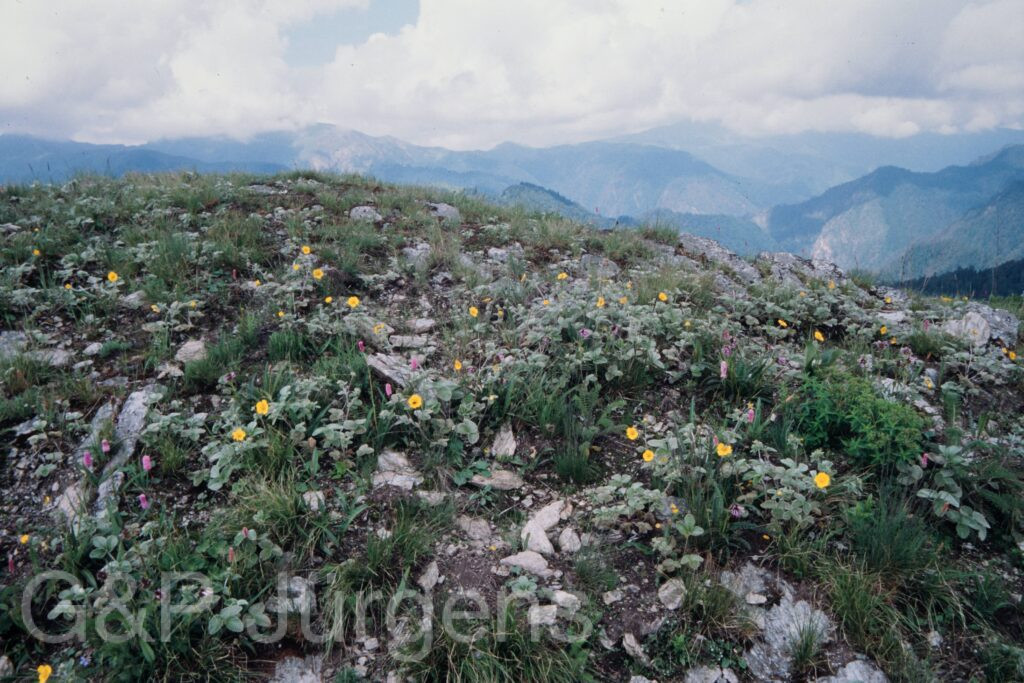
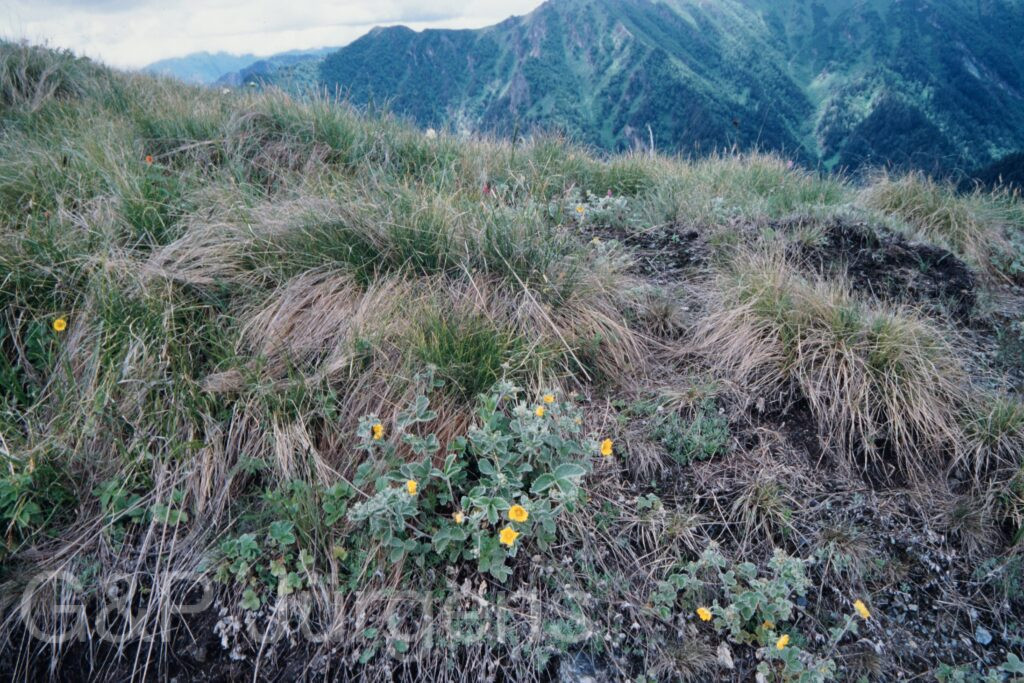
Potentilla argyrophylla is a showy alpine cinquefoil of the Himalaya, native across India, Nepal, Pakistan, Afghanistan and China. Its large GBIF tally (over 1300 occurrences) includes numerous European and North American records (Sweden, Germany, Norway, France, the United States and others) that reflect its long cultivation as a hardy garden perennial rather than any natural range there. In the wild it occupies open alpine meadows, grassy slopes, forest margins and rocky pastures of the upper subalpine and alpine zones. The illustrated plant was photographed in West Nepal at Kalmura at about 3800 m in June, a typical high-meadow station near the centre of its altitudinal range of roughly 3000 to 4500 m.

The plant is a tufted perennial herb arising from a stout, woody rootstock and bearing several ascending flowering stems. The leaves are pinnate or trifoliolate with three to several obovate, toothed leaflets, conspicuously silvery-white tomentose beneath (the epithet argyrophylla, silver-leaved) and greener above. The flowers are borne in loose, branched cymes; each has five green sepals alternating with an epicalyx, and five broad, obcordate petals that are typically golden-yellow but in some forms deep red or apricot. The numerous stamens surround a domed receptacle bearing many free carpels, which mature into a head of small, dry achenes.

Potentilla is a large, taxonomically complex genus of the Rosaceae, and P. argyrophylla together with the closely allied P. atrosanguinea forms a Himalayan group much hybridised in horticulture, where it has given rise to many garden cultivars. In the wild it is common and widespread, of no conservation concern, and an important nectar source for high-altitude bees and other insects.

Author: Wall. · Sources: POWO (Kew), GBIF, Flora of Pakistan, Flora of China, Annotated Checklist of the Flowering Plants of Nepal, Soják's revisional studies of Potentilla (Rosaceae)

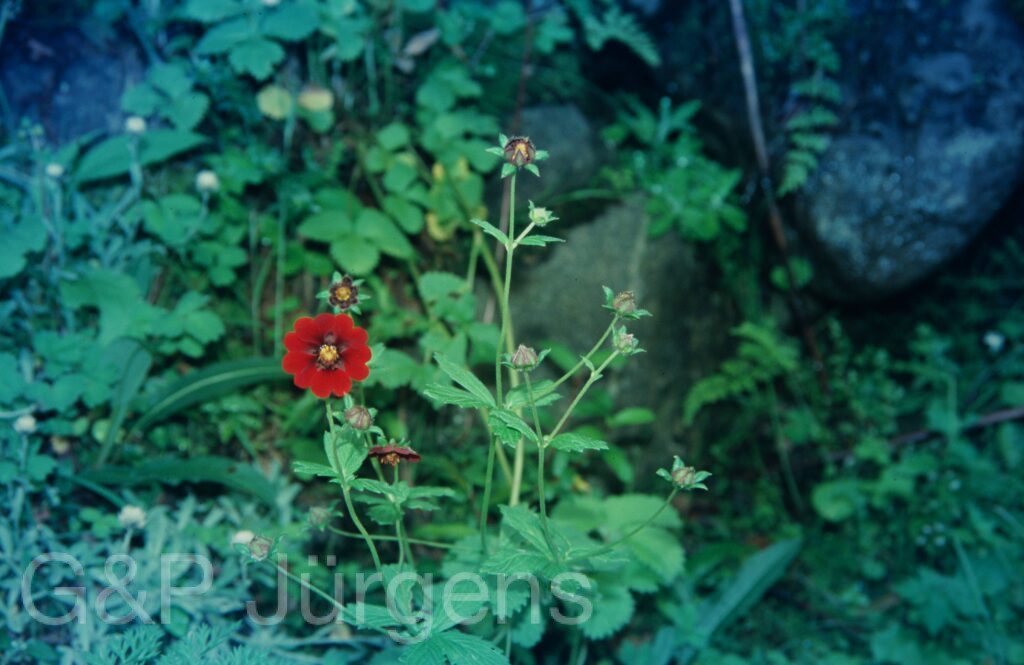
Lodd, G.Lodd. & W.Lodd

Nepal 99 110 ergebnis
West-Nepal South of Rara-Lake 3600m, June
Garw 2005 48 ergebnis ergebnis
India Garhwal Valley of flowers 3350m, September

Description

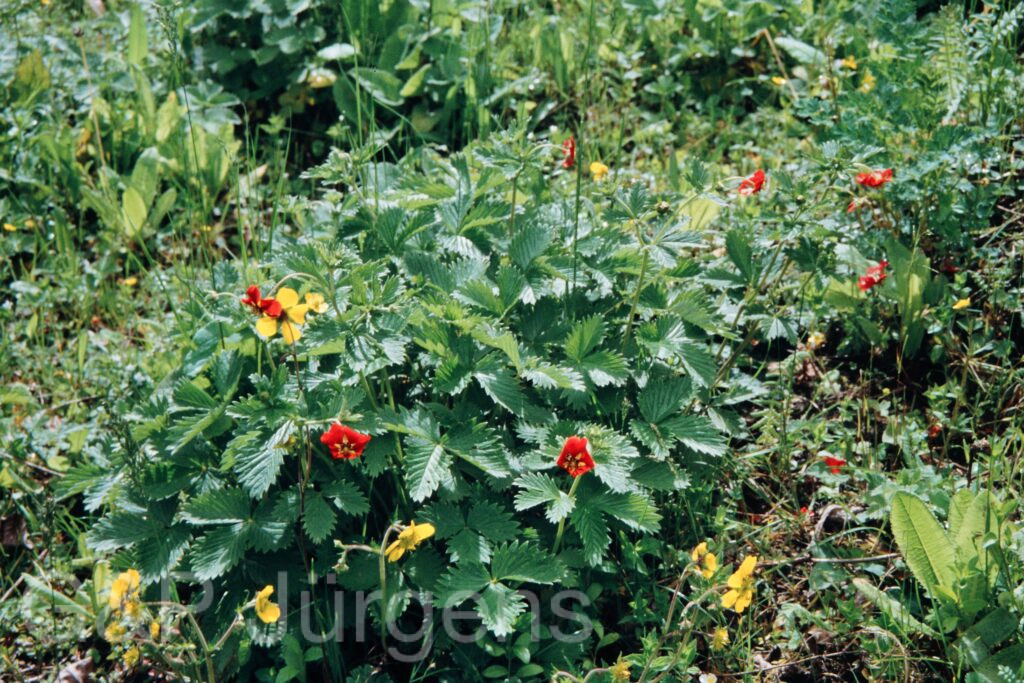
Potentilla atrosanguinea is a Himalayan alpine herb ranging from Pakistan through the western and central Himalaya into Nepal. GBIF documents about 450 occurrences, drawing on native populations in India, Nepal and Pakistan plus numerous cultivated and naturalised records across Europe and North America. It grows in alpine and subalpine meadows, open grassy slopes and rocky ground, typically between about 2500 and 4000 m. The photographed plants come from West Nepal south of Rara Lake at roughly 3600 m in June and the Valley of Flowers in Garhwal, India, at about 3350 m in September, both species-rich high-meadow settings.

The species is a tufted perennial arising from a stout, woody rootstock. The basal leaves are long-petioled and pinnately or digitately compound, with three to five obovate, coarsely toothed leaflets that are green above and densely white-tomentose beneath. The stems are erect, branched and silky-hairy, bearing reduced cauline leaves. The flowers are borne in lax cymes and are showy, with five spreading petals ranging from deep blood-red and orange to occasionally yellow, an epicalyx alternating with the calyx lobes, and numerous stamens. The fruit is an aggregate of small dry achenes on a dry receptacle.

GBIF flags the recorded name as a SYNONYM, with Potentilla atrosanguinea as the accepted name. The species is variable in flower colour and leaf division, and several varieties and segregates have been recognised. Its richly coloured forms have entered horticulture and underlie garden hybrids. Widespread and common across its native alpine range, it is of no conservation concern and is an important component of Himalayan meadow communities.

Author: Lodd, G.Lodd. & W.Lodd · Sources: POWO (Kew), GBIF, Flora of Nepal, Flora Simlensis, Th. Wolf: Monographie der Gattung Potentilla

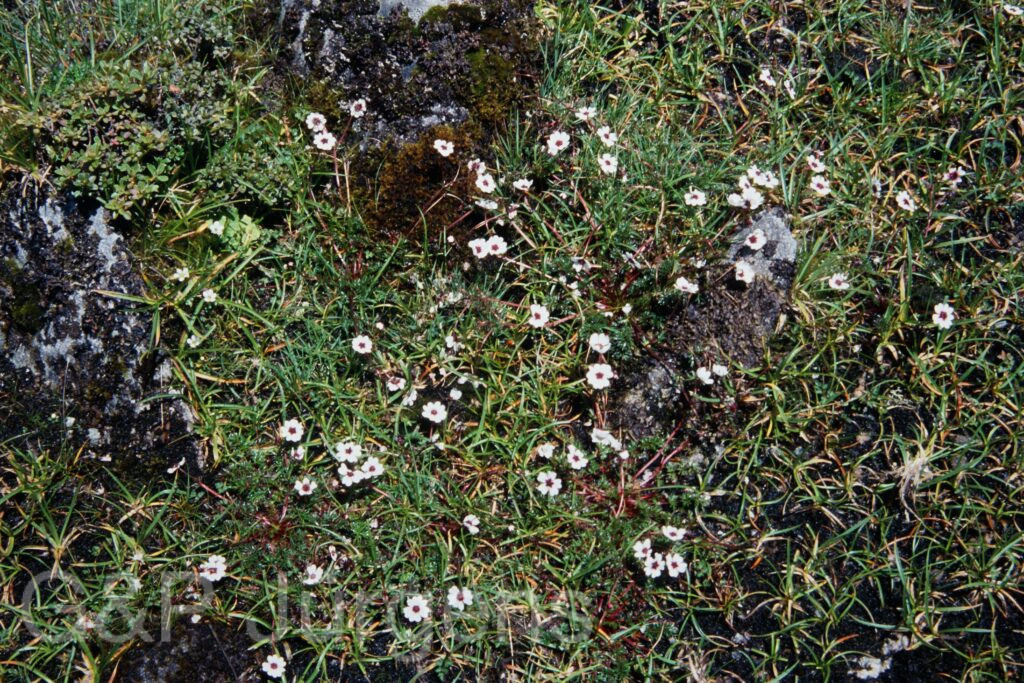
D.Don

Sikkim2003 132 G180
Sikkim Dzongri 3900m, August
Sikkim2003 133 W181
Sikkim Dzongri 3900m, August

Description

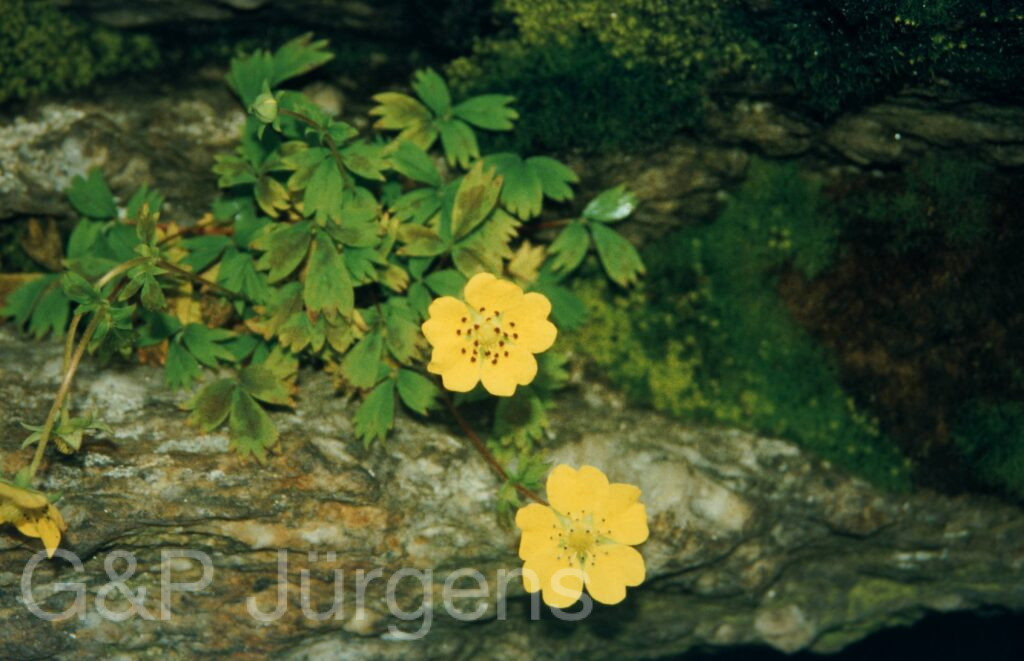
Potentilla coriandrifolia D.Don is a high-alpine perennial distributed across the eastern and central Himalaya and adjacent mountains, recorded from China, Nepal, India, Bhutan and Myanmar, with extralimital cultivated records elsewhere; some 542 georeferenced occurrences are documented in GBIF. It inhabits open turf, stony alpine meadows, gravelly slopes and the margins of moraines, typically between 3500 and 4800 m. The photographed plant grows at Dzongri in Sikkim at about 3900 m, flowering in August, a setting typical of the cool, well-drained alpine sward where this cushion-forming herb thrives among dwarf rhododendrons and graminoids.

The plant develops from a stout, woody, branched rootstock crowned by the persistent remains of old petioles, forming low tufts or loose mats. The leaves are radical, pinnate or pinnatisect with a coriander-like (coriandrifolium) dissection, the leaflets deeply incised into narrow oblong segments and often somewhat glaucous or silky beneath. Flowering stems are slender, ascending and few-flowered. The flowers are typically yellow, occasionally suffused with reddish or purplish tones at the base of the petals, with five obcordate petals exceeding the calyx, an epicalyx alternating with the sepals, and numerous stamens surrounding a central tuft of carpels. The fruit is an aggregate of dry achenes seated on a hairy receptacle.

A member of the large and taxonomically intricate genus Potentilla, this species belongs to the assemblage of dwarf Himalayan cinquefoils adapted to short growing seasons and intense insolation. Its distinctive finely cut foliage distinguishes it from related alpine taxa such as P. microphylla. Though not assessed as threatened, populations are restricted to fragile high-altitude habitats sensitive to grazing pressure and climate-driven upslope shifts, making the species a useful indicator of alpine ecosystem condition.

Author: D.Don · Sources: POWO (Kew), GBIF, Flora of China, Flora of Bhutan, Annotated Checklist of the Flowering Plants of Nepal, Soják monograph of Potentilla

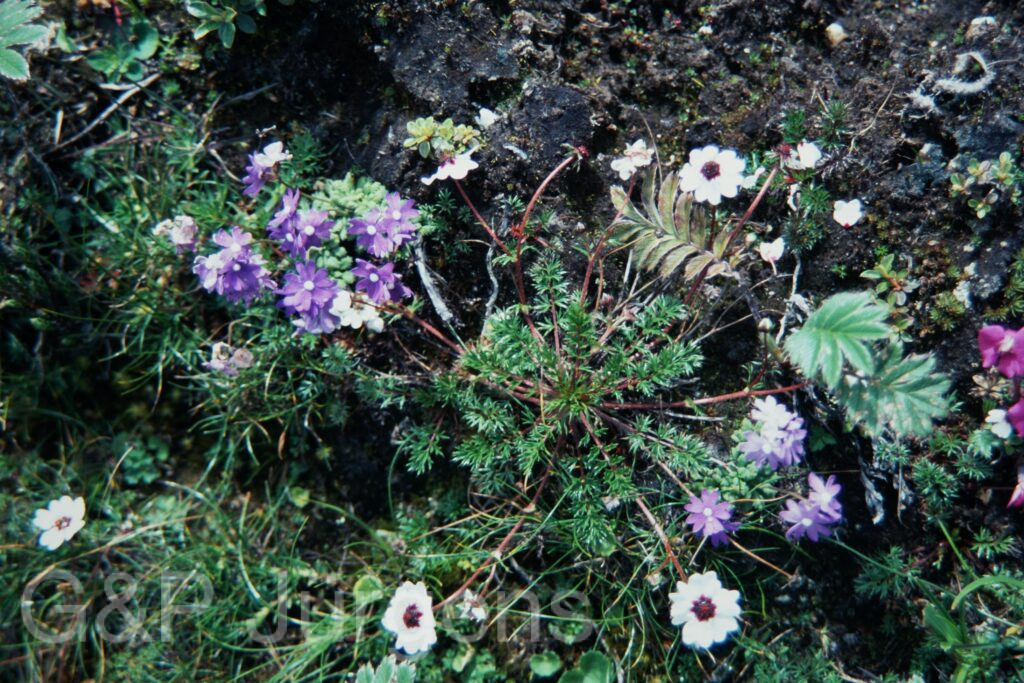
Wall. & Lehm.

Nepal 99 481 ergebnis
West-Nepal Churta-Khola 3700m, June
Garw 2005 309 ergebnis
India Garhwal Patanathi 3600m, September

Description

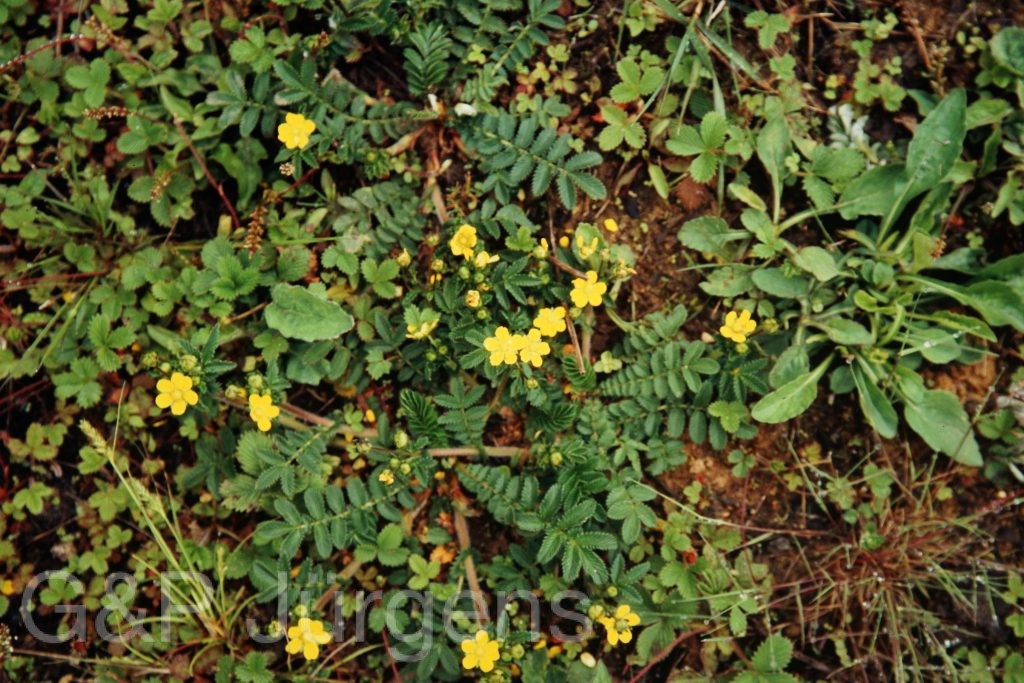
Potentilla eriocarpa is a mat-forming alpine cinquefoil distributed throughout the Himalaya and adjacent ranges, from Afghanistan and Pakistan eastward through India, Nepal and Bhutan into south-western China and Myanmar. GBIF records some 667 occurrences, densest in Nepal, the Indian Himalaya and the Chinese borderlands. It is a plant of the high alpine zone, colonising rock crevices, screes, stony meadows, moraines and exposed ridges, characteristically between about 3000 and 4800 m. The populations imaged in West-Nepal at Churta-Khola (3700 m, June) and in Indian Garhwal at Patanathi (3600 m, September) reflect its broad flowering season across the western Himalaya, from early summer into autumn near the upper limits of vascular plant growth.

The species forms low, dense cushions or tufts from a stout, woody, branched caudex clothed in the persistent remains of old stipules and leaf-bases. The leaves are ternate, the three obovate to cuneate leaflets coarsely toothed toward the apex, dark green and glabrescent above, paler and often silky beneath. The flowering stems are short, ascending to decumbent, bearing one to few flowers. Each flower has five sepals alternating with five epicalyx segments, five broadly obovate, often emarginate yellow petals, numerous stamens and many carpels on a hairy receptacle. The diagnostic feature, reflected in the epithet, is the densely woolly-hairy (eriocarpous) achenes forming the fruiting head.

Potentilla is a large and taxonomically intricate northern-temperate genus, and P. eriocarpa, described by Wallich and Lehmann, belongs to the predominantly Asian alpine cushion-forming group. Its ternate leaves and conspicuously hairy achenes separate it from the many associated Himalayan cinquefoils. As a widespread, abundant high-alpine perennial it is of no conservation concern, and is a significant component of cushion-plant and fellfield communities at extreme elevations.

Author: Wall. & Lehm. · Sources: POWO (Kew), GBIF, Flora of China, Flora of Pakistan, Flora of Bhutan, Annotated Checklist of the Flowering Plants of Nepal, monograph of the genus Potentilla (Wolf)

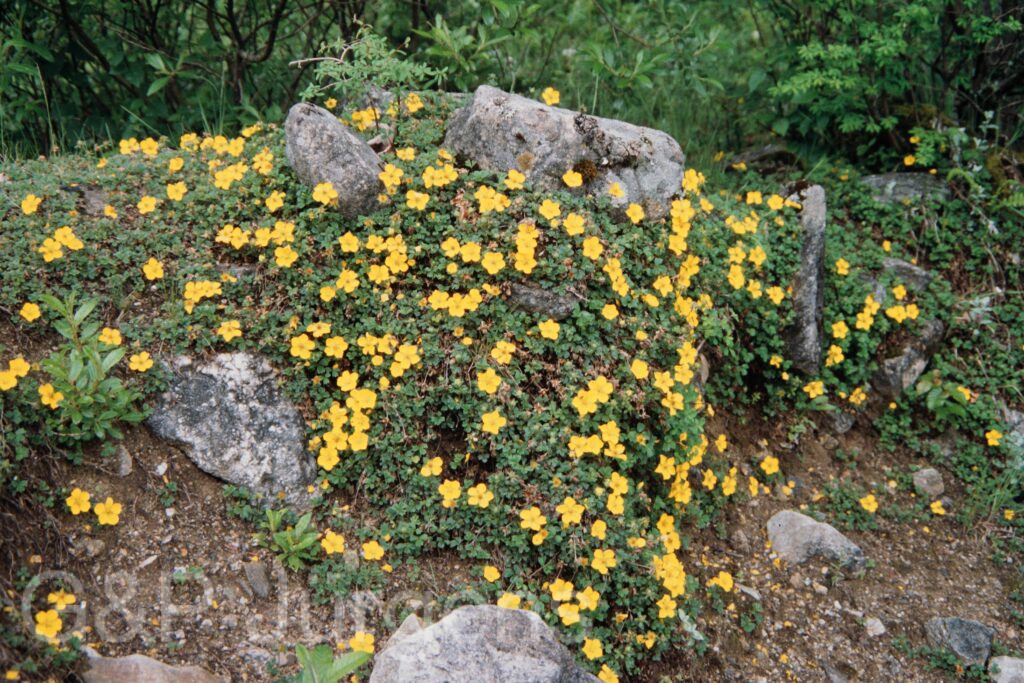
(D.Don) Maxim.

Sikkim2003 189 P260
Sikkim Dzongri 4100m, August

Description

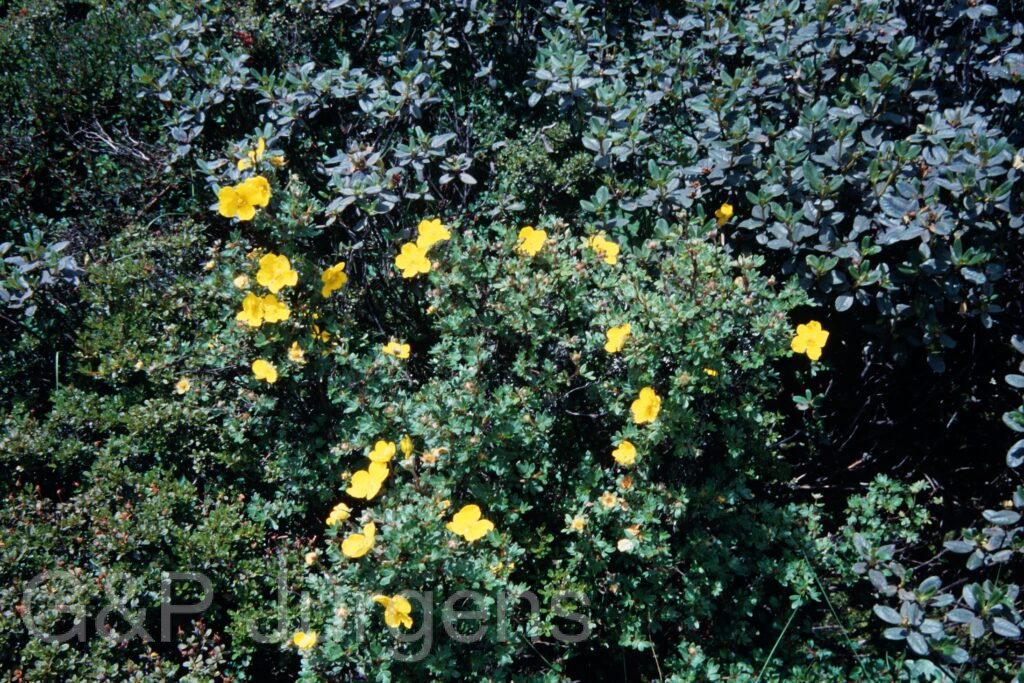
Potentilla fruticosa var. arbuscula is a shrubby cinquefoil of the high mountains of the Sino-Himalayan region, recorded from China, Nepal, Bhutan and Japan. GBIF treats the name as a synonym, with Potentilla fruticosa var. arbuscula (here cited following the source) regarded as the accepted designation for this entity; in modern treatments the shrubby cinquefoils are often placed in the segregate genus Dasiphora. It grows in alpine and subalpine scrub, open meadows, rocky slopes and stream-sides above and near the treeline, generally between about 3000 and 4500 m. The photographed plant comes from Dzongri in Sikkim at around 4100 m, flowering in August. With over 400 georeferenced records it is a well-documented high-montane shrub.

It forms a low, much-branched deciduous shrub, often spreading or cushion-like at the highest elevations, the bark shredding and the young shoots silky-hairy. The leaves are pinnate with usually five small, narrow, oblong leaflets that are green above and densely silvery-silky beneath, with revolute margins. The flowers are solitary or few in the leaf axils and at the branch tips; each has five green sepals alternating with epicalyx segments and five broad, rounded, golden-yellow petals exceeding the calyx. The numerous stamens surround a hairy receptacle bearing many free carpels, which ripen into a head of small hairy achenes.

The shrubby cinquefoil complex is taxonomically intricate and widely cultivated in horticulture; var. arbuscula is distinguished within it by its dense indumentum and Himalayan high-altitude form. Its abundant nectar-rich flowers attract a range of insect pollinators. As a common and broadly distributed alpine shrub it is of least conservation concern.

Author: (D.Don) Maxim. · Sources: POWO (Kew), GBIF, Flora of China, Flora of Bhutan, Soják's revisions of Potentilla and Dasiphora

Trevir.

Bh09 289 P475
Bhutan Tongsa, 2300m June
Garw 2005 284 ergebnis
India Garhwal Kunol 2650m, September

Description

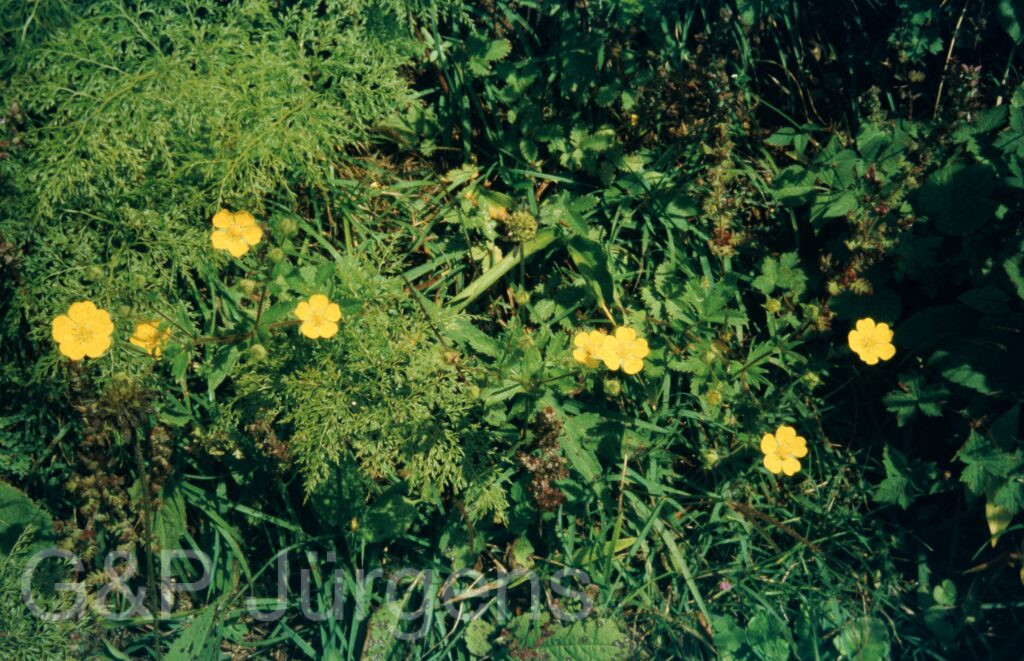
Potentilla lineata is a widespread Asian cinquefoil ranging across the Himalaya and into China, Myanmar and Vietnam, well represented in GBIF with around 519 records from China, Nepal, India, Bhutan, Pakistan and beyond. In GBIF the queried name is treated as a synonym, with Potentilla lineata itself given as the accepted name. It occupies open grassy slopes, forest clearings, banks, pastures and disturbed roadsides through the temperate and subalpine belts, roughly 1500 to 3500 m. The collections cited from Tongsa in Bhutan at 2300 m in June and from Kunol in the Garhwal Himalaya at 2650 m in September show its long flowering season across the monsoon.

It is a perennial herb with a woody rootstock producing erect to ascending, often silky-hairy stems. The leaves are pinnate or digitately compound with toothed, oblong to obovate leaflets that are typically green and appressed-hairy above and densely silvery- or white-tomentose beneath, the strongly impressed venation giving rise to the epithet lineata. The flowers are borne in lax terminal cymes; each has five yellow petals alternating with an epicalyx and five sepals, numerous stamens and many carpels seated on a hairy receptacle. The fruit is an aggregate of small dry achenes.

Potentilla is a large and taxonomically complex genus in which hybridisation and polyploidy blur species boundaries, and P. lineata has accordingly accumulated several synonyms. The silvery indumentum reduces water loss and reflects intense montane radiation. With its broad ecological tolerance and ready colonisation of disturbed ground, the species is common and of no conservation concern, functioning as a characteristic component of Himalayan grazing land and successional grassland.

Author: Trevir. · Sources: POWO (Kew), GBIF, Flora of China (Rosaceae), Flora of Bhutan, Annotated Checklist of the Flowering Plants of Nepal, Soják taxonomic studies of Potentilla