Tag:

Spring

B.Heyne ex Schult.

Nepal 2009 124 ergebnis
Nepal Helambu Melanele Pul 850, May

Description

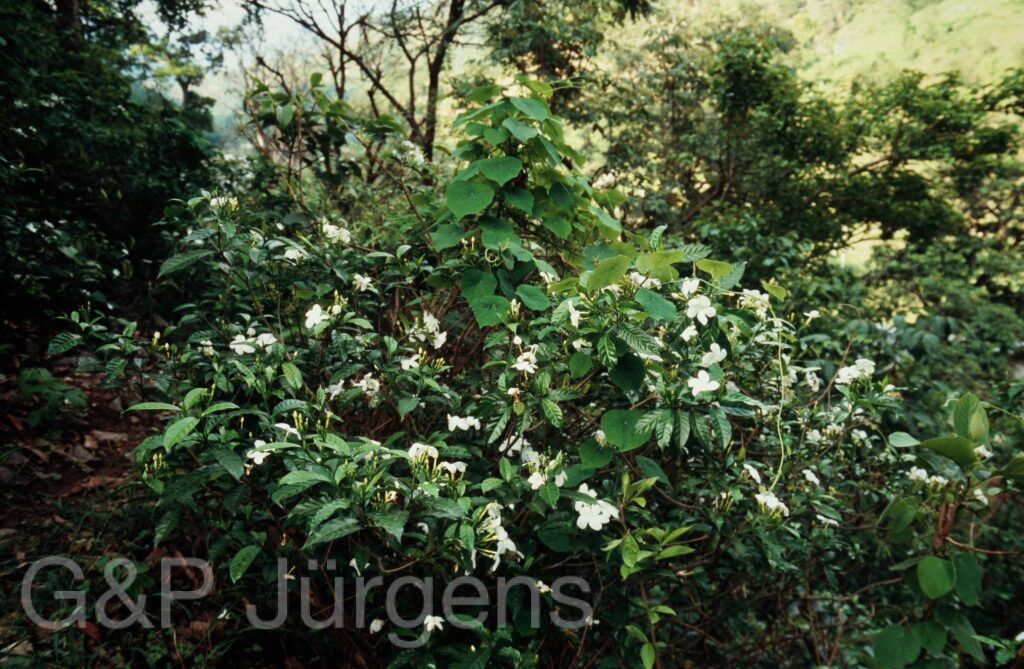
Coffea benghalensis, the Bengal coffee, is a shrub of the warm subtropical lowlands and lower hills of the Indian subcontinent and Indo-Burmese region, recorded from India, Nepal, Bangladesh, Bhutan, China and Indonesia. It grows in the understorey of moist subtropical broad-leaved forest, along forest margins, ravines and shaded stream banks at low elevations. The specimen photographed at Melanele Pul in the Helambu region of Nepal at 850 m in May is a typical occurrence in the warm foothill forest zone, flowering in the pre-monsoon season when the white blossoms appear briefly along the branches.

It is a small, glabrous, evergreen shrub with slender, opposite branches. The leaves are opposite, ovate to elliptic and acuminate, thin-textured and glossy, with conspicuous interpetiolar stipules characteristic of the Rubiaceae. The fragrant flowers are borne in axillary clusters, sessile or nearly so against the stem; each has a small calyx and a white, salverform corolla with usually five to seven spreading lobes and a slender tube, the stamens inserted in the throat. The fruit is a small fleshy drupe (berry) that ripens dark, containing the characteristic paired, plano-convex seeds, the coffee beans of the genus.

Coffea is a palaeotropical genus of the Rubiaceae centred on Africa and Madagascar but with a small Asian contingent including C. benghalensis, described by B.Heyne ex Schult. Although it lacks the commercial importance of C. arabica and C. canephora, it is of botanical interest as one of the few coffees native to mainland Asia and is locally used. Its sweetly scented, short-lived flowers are insect-pollinated, and the fleshy drupes are dispersed by birds and other animals through the foothill forests it inhabits.

Author: B.Heyne ex Schult. · Sources: POWO (Kew), GBIF, Flora of China, Annotated Checklist of the Flowering Plants of Nepal, Flora of British India, Davis et al. taxonomic revision of Coffea (Rubiaceae)

(L.) DeFilipps

Nepal 97 543 P1063
Nepal Sabha-Khola 1000m May

Description

Combretum indicum (L.) DeFilipps, the Rangoon creeper, is a vigorous woody climber of the Combretaceae native to tropical Asia and now pantropically cultivated and naturalised. Its native and introduced records span India, Nepal, Myanmar, Thailand, Indochina, southern China, Malaysia, Indonesia and the Philippines, with widespread escapes in tropical Africa, the Americas, Australia and the Pacific. It is a plant of warm lowland and foothill environments: forest margins, riverbanks, thickets and hedgerows, often in secondary and disturbed vegetation. The plant photographed along the Sabha-Khola in Nepal at 1,000 m in May reflects its occurrence in the warm sub-Himalayan zone, where it flowers in the pre-monsoon season.

The plant is a large scandent shrub or liana, climbing by means of persistent woody petiole bases that function as hooks. The leaves are opposite, elliptic to oblong, entire and shortly petiolate, with the petiole base hardening and remaining as a spinescent peg. The flowers are borne in terminal and axillary spike-like racemes and are famously colour-changing: each long-tubed, five-petalled flower opens white and turns through pink to deep red over successive days, fragrant especially at night, indicating moth pollination. The fruit is an ellipsoid, five-winged or five-angled, leathery pseudo-drupe.

Formerly placed in the genus Quisqualis, the species is universally grown as an ornamental for its showy, sweetly scented, colour-shifting inflorescences, and its seeds and leaves have a long history of use in traditional medicine, notably as an anthelmintic. This horticultural ubiquity accounts for its extensive naturalisation, and in some warm regions it behaves as an invasive, smothering native vegetation, so that its spread beyond cultivation warrants management attention.

Author: (L.) DeFilipps · Sources: POWO (Kew), GBIF, Flora of China Vol. 13, Flora of Nepal, Exell: Combretaceae (Flora Malesiana)

Edgew.

Bhutan2014 817
Bhutan Punaka 1310m, May
Bhutan2014 818
Bhutan Punaka 1310m, May

Description

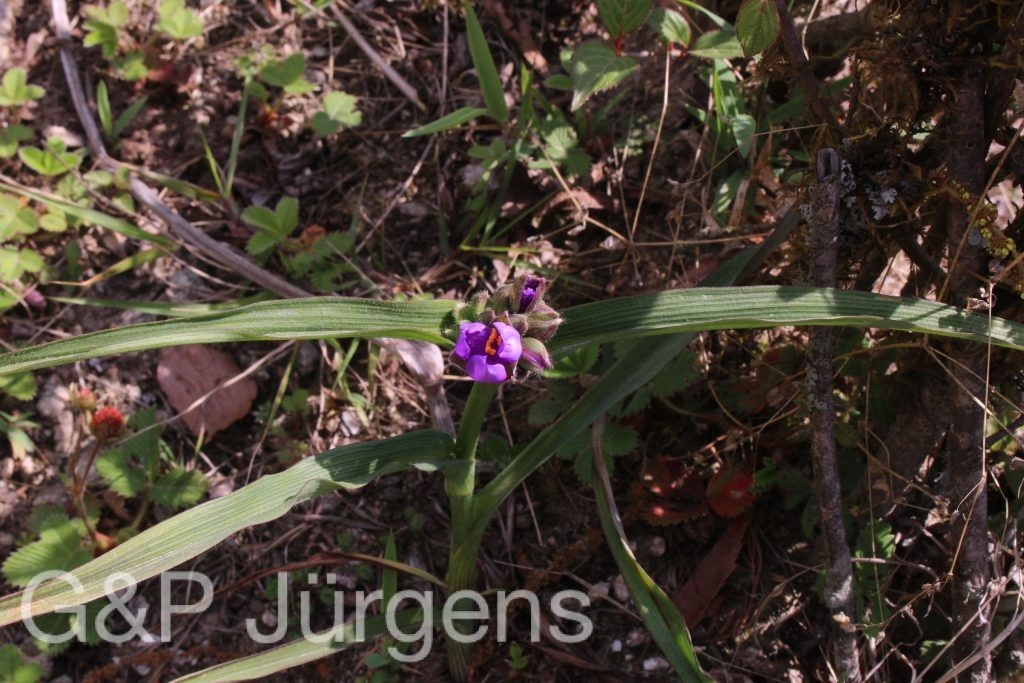
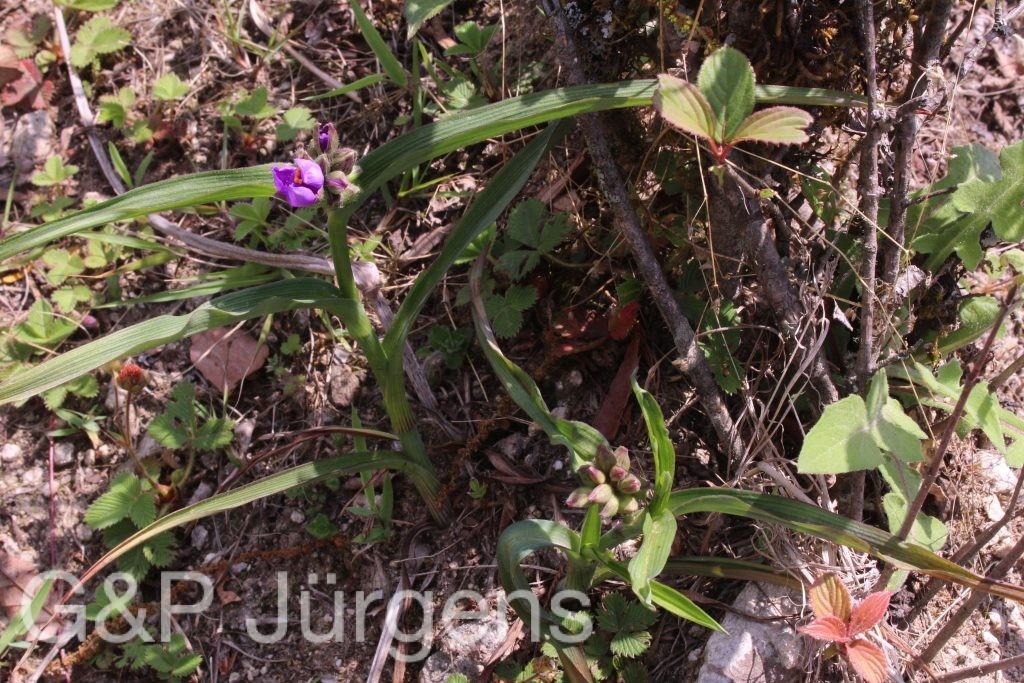
Commelina maculata is a perennial herb of the Himalaya and adjacent Asian mountains, recorded by GBIF from China, Nepal, India, Thailand, Bhutan, Myanmar, Vietnam and Sri Lanka across about 310 occurrences. It grows in moist, often shaded places, along forest margins, on grassy and rocky banks, beside paths and watercourses, and in disturbed ground, generally at low to middle elevations. The plant photographed at Punakha in western Bhutan at about 1310 m, flowering in May, occupies the warm temperate valley habitat where this species is common in the early monsoon season.

The plant has ascending to decumbent, somewhat fleshy stems that root at the lower nodes, with sheathing leaf bases typical of the family. The leaves are alternate, lanceolate to ovate-lanceolate, with entire margins and a closed basal sheath, often with a fringe of hairs at the sheath mouth. The flowers emerge from a folded, boat-shaped spathe and are zygomorphic, with three sepals and three petals of which the two upper petals are larger and conspicuously blue, the lower one reduced and paler; there are six stamens, several modified as staminodes with cruciform antherodes. Each flower is ephemeral, opening for part of a single day. The fruit is a small loculicidal capsule containing few rugose seeds.

Commelina is a large pantropical genus whose Asian montane species, including C. maculata, are distinguished by spathe form, seed sculpturing and indumentum. The fleeting, nectarless flowers rely on pollen-foraging insects, and the staminodes function as a visual lure. As a plant of disturbed and marginal habitats the species is weedy, resilient and widely distributed, and it is of no conservation concern. Its broad Indo-Malayan to Himalayan range reflects the success of the genus in seasonally moist, sunny situations.

Author: Edgew. · Sources: POWO (Kew), GBIF, Flora of China, Flora of Bhutan, Faden Commelinaceae studies, Annotated Checklist of the Flowering Plants of Nepal

(Wall. ex R.Br.) B.L.Burtt

Nepal 97 369 P725
Nepal Arun-Valley 1750m May
Nepal 99 927 ergebnis
West-Nepal Roha 2750m, July

Description

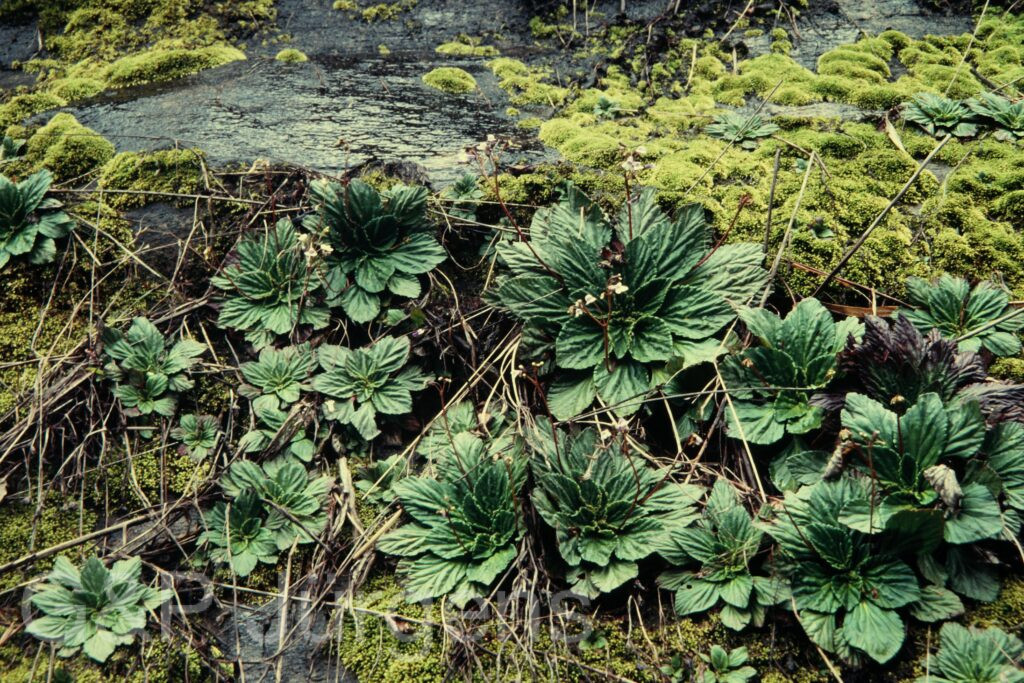
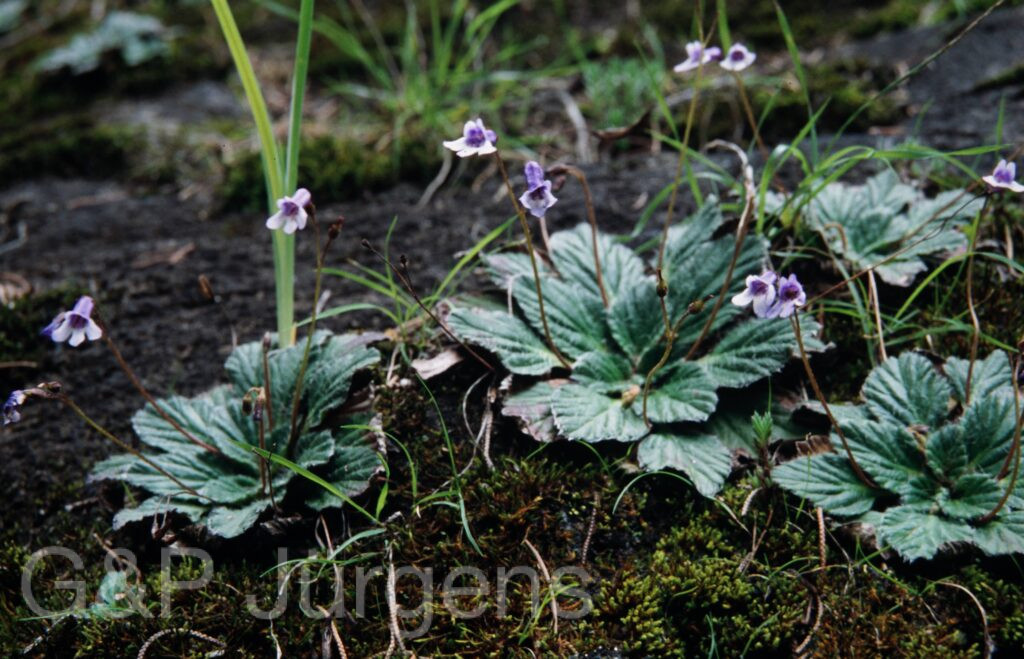
Corallodiscus lanuginosus (Wall. ex R.Br.) B.L.Burtt is a rosette-forming, rupicolous perennial of the Gesneriaceae, distributed across the Himalaya and southwest China. GBIF data (over 2,000 occurrences) record it from China, Nepal, India, Bhutan, Pakistan, Myanmar, and Thailand, indicating a broad Sino-Himalayan range. It was photographed in Nepal in the Arun Valley (1,750 m, May) and at Roha in west Nepal (2,750 m, July), reflecting its occurrence on shaded, mossy cliff faces, rock crevices, and boulders in montane forest, generally between about 1,500 and 3,500 m where humidity is high.

The plant forms a compact basal rosette of leaves pressed against the rock surface. The leaves are obovate to elliptic, with a crenate margin, the upper surface dark green and rugose, the lower surface densely clothed in woolly, rusty to whitish hairs (hence "lanuginosus"). Slender, leafless scapes bear cymose clusters of flowers; the corolla is tubular-campanulate and bluish-violet to purple with a paler throat, with the slightly oblique limb and reduced fertile stamens typical of the genus. The fruit is a slender capsule.

Corallodiscus belongs to the Old World Gesneriaceae (subfamily Didymocarpoideae) and is closely allied to the lithophytic Himalayan radiation that includes Didymocarpus and allies; the input subtribe name reflects this placement. Many populations exhibit poikilohydric, resurrection-like desiccation tolerance, surviving dry periods on exposed rock and reviving with the monsoon. Widespread and locally common on cliffs, the species is not considered threatened.

Author: (Wall. ex R.Br.) B.L.Burtt · Sources: POWO (Kew), Flora of China Vol. 18, Flora of Bhutan Vol. 2, GBIF, Burtt: Studies in the Gesneriaceae of the Old World

Wall.

Nepal 97 354 P693
Nepal Arun-Valley 1650m May

Description

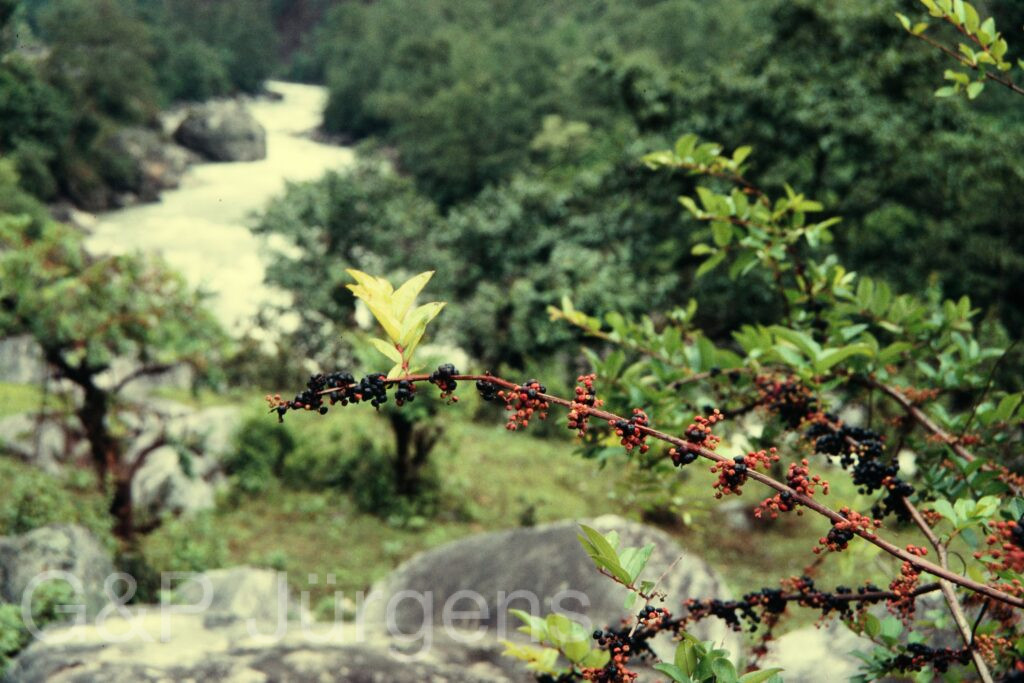
Coriaria nepalensis is a shrub of the Himalaya and adjacent mountains of western China, ranging from Pakistan through the Indian Himalaya, Nepal and Bhutan to south-western China and Myanmar. GBIF aggregates around 1880 occurrences, including scattered introductions in Europe and Japan where it is grown as a curiosity. It is a vigorous colonist of open hillsides, landslips, riverbanks, terrace edges and disturbed ground, often forming thickets on poor soils between about 1000 and 3000 m. The plant from the Arun Valley of eastern Nepal at 1650 m in May is characteristic of its role as a pioneer of the subtropical to warm-temperate hill zone.

It is a much-branched deciduous shrub with arching, reddish, four-angled young branchlets. The leaves are opposite or whorled, sessile or subsessile, ovate to ovate-lanceolate, entire and conspicuously three- to five-veined from the base. The small flowers are borne in slender axillary or terminal racemes, with five sepals and five small petals; after flowering the petals enlarge, becoming fleshy and dark purple-black, closely investing the cluster of achene-like fruitlets to form a juicy, mulberry-like pseudo-fruit. These succulent infructescences are bird-dispersed but, like the whole plant, are highly poisonous, containing the convulsant sesquiterpene coriamyrtin.

Coriariaceae is a small, isolated family of the single genus Coriaria, with a remarkable disjunct distribution across the Mediterranean, eastern Asia, the Himalaya, New Zealand and the Americas, a textbook case of relictual biogeography. C. nepalensis fixes atmospheric nitrogen through root nodules harbouring the actinomycete Frankia, underpinning its success on impoverished, eroded substrates. Widespread and weedy in its native range, it is of no conservation concern, though its toxicity is locally significant to livestock.

Author: Wall. · Sources: POWO (Kew), GBIF, Flora of China Vol. 11, Flora of Bhutan Vol. 1, Flora of Pakistan, Annotated Checklist of the Flowering Plants of Nepal, Skog revision of Coriaria

Royle

Nepal 2009 86 ergebnis
Nepal Helambu Bolgoau 2000, May

Description

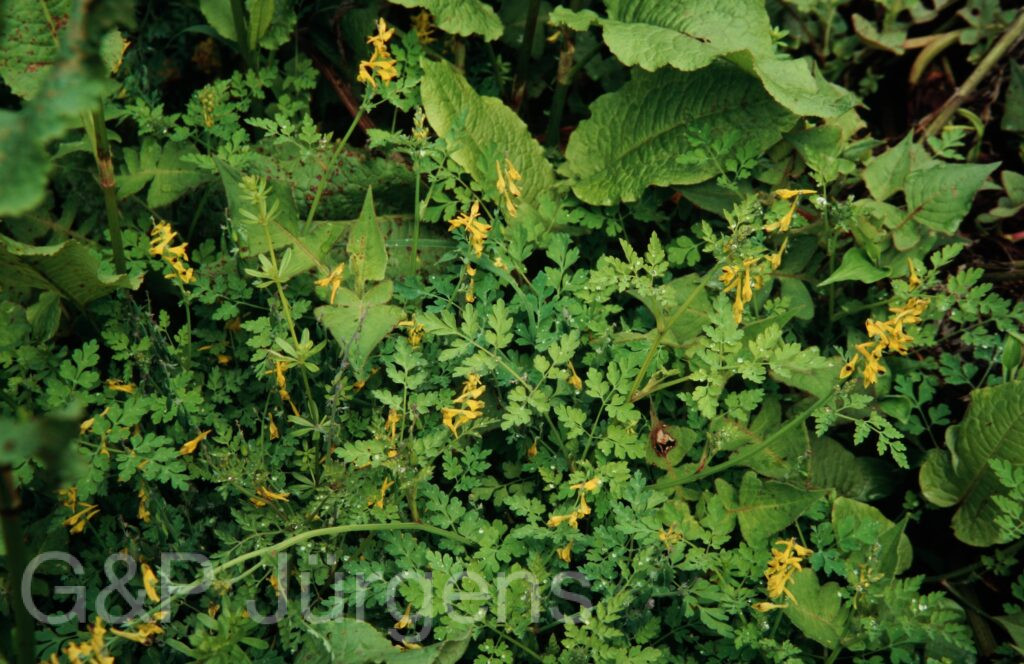
Corydalis cornuta is a Himalayan fumitory whose reliable distribution lies along the temperate ranges of Nepal, India, Pakistan, Afghanistan and adjacent China; GBIF returns 273 occurrences, though several listed countries reflect database artefacts rather than genuine native populations. It grows in moist shaded sites, on damp banks, forest floors, ledges and cultivated terrace margins in the temperate belt, broadly between about 1800 and 3000 m. The illustrated plant was recorded in Nepal, in Helambu near Bolgoau, at around 2000 m in May, a typical mid-montane spring station where the slender annual completes its cycle before the monsoon.

The plant is a delicate, glabrous annual herb with brittle, often branched stems arising from a slender root. Leaves are alternate and two- to three-pinnately dissected into small obovate to cuneate ultimate segments, the foliage glaucous and somewhat fern-like. The flowers are borne in short, leaf-opposed or terminal racemes; each is strongly zygomorphic and yellow, with four petals in two whorls, the outer upper petal prolonged backwards into a slender nectar spur and the inner pair connate over the stigma. There are two stamens, each split into three (diadelphous), and a superior ovary that ripens into a narrow, linear, dehiscent capsule shedding shining black seeds.

Corydalis is treated here within an expanded Papaveraceae (incorporating the former Fumariaceae), consistent with the input family. POWO and GBIF accept the name. The genus is enormously diverse in the Himalaya and Tibet, and the spurred yellow-flowered annuals such as this form a distinctive ecological group of the moist temperate forest floor.

Author: Royle · Sources: POWO (Kew), GBIF, Flora of Pakistan, Annotated Checklist of the Flowering Plants of Nepal, Flora of China, The Genus Corydalis (Papaveraceae/Fumariaceae monograph)

Hook.f. & Thomson

Bhutan2014 185
Bhutan Trachyangtse 2300m, May

Description

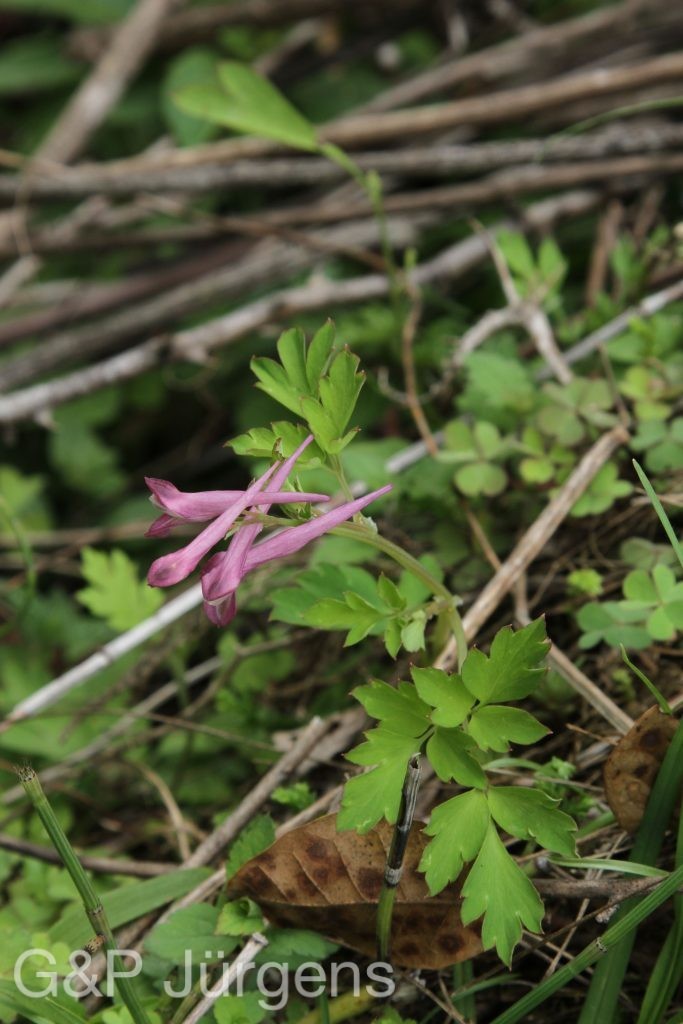
Corydalis leptocarpa is a Sino-Himalayan to East Asian fumitory recorded from China, Bhutan, India, Myanmar, Japan, Nepal, Thailand and Korea, with around 163 GBIF occurrences spanning this broad temperate range. It is a plant of shaded, humid forest, woodland margins, mossy banks and damp ravines, typically at montane elevations from roughly 1500 to 3000 m. The individual photographed near Trashiyangtse (Trachyangtse, eastern Bhutan) at about 2300 m in May illustrates its association with moist broad-leaved forest in spring, when the slender stems and pale flowers appear in the dappled understorey.

The species is a slender, erect to ascending annual or short-lived perennial herb with brittle, somewhat glaucous foliage. The leaves are bi- to triternately compound, the ultimate segments ovate and lobed, borne on delicate petioles. The inflorescence is a lax raceme of pale yellow, zygomorphic flowers; each has four petals, the upper outer one prolonged backward into a slender spur, enclosing two stamen bundles and an elongate ovary. The fruit, as the epithet leptocarpa ('slender-fruited') indicates, is a narrow, linear, pendulous capsule that dehisces elastically to scatter the shining black seeds, which often bear an oily elaiosome.

Corydalis is one of the largest genera of the Papaveraceae (subfamily Fumarioideae), exceptionally diverse in the Sino-Himalaya, where hundreds of species occupy habitats from forest floor to alpine scree. C. leptocarpa belongs to the yellow-flowered woodland element of the genus. Many Corydalis species rely on ant-mediated seed dispersal of their elaiosome-bearing seeds. With its wide East Asian range and tolerance of forest-edge habitats it is not considered threatened, though it remains tied to intact montane forest cover.

Author: Hook.f. & Thomson · Sources: POWO (Kew), GBIF, Flora of China, Flora of Bhutan, Annotated Checklist of the Flowering Plants of Nepal, Lidén & Zetterlund monograph of Corydalis

Ludlow & Stearn

Bh2008 36 P59
Bhutan Dochu-La 2850m, April

Description

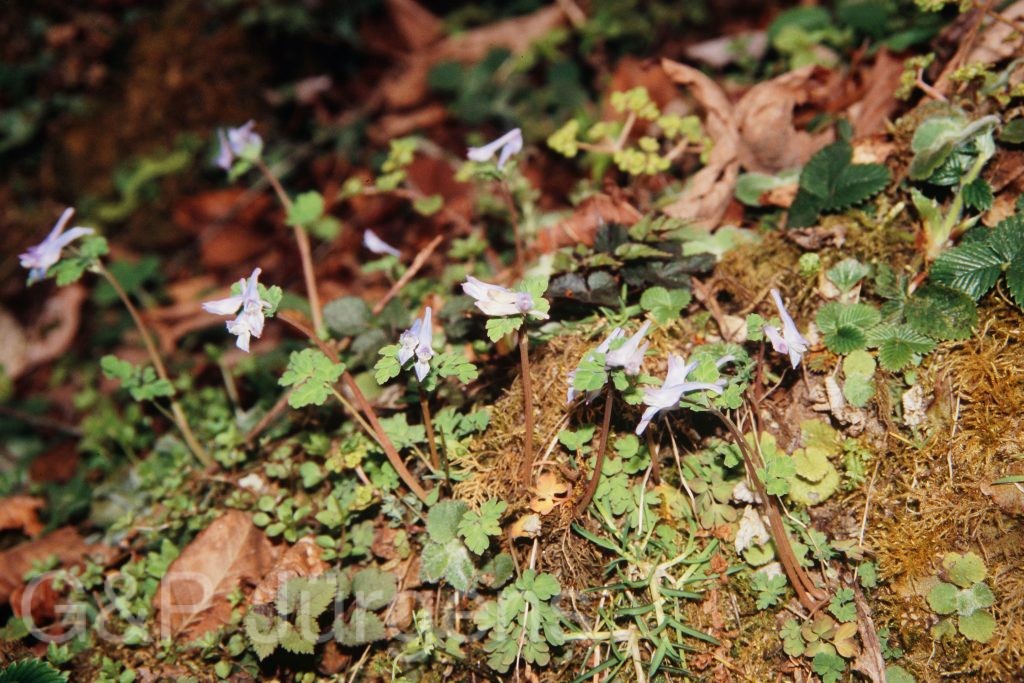
Corydalis oligantha is an apparently Bhutanese endemic, the only GBIF records (about 6) deriving from Bhutan and described from there by Ludlow and Stearn. It is a plant of moist, shaded temperate habitats, growing on humus-rich banks, forest floors, mossy rock crevices and damp clearings, around 2800 to 3000 m. The specimen illustrated from Dochu-La in western Bhutan at 2850 m in April, flowering early in spring as the snow recedes, exemplifies its preference for cool, moisture-retentive woodland margins and its brief vernal growing season.

It is a slender, often glaucous herb with watery sap and a fleshy rootstock or small tuber. The leaves are alternate and finely dissected, ternately or pinnately compound into narrow segments, giving the delicate, fern-like aspect typical of the genus. The flowers, comparatively few in the lax raceme as the epithet oligantha (few-flowered) implies, are strongly zygomorphic: each has four petals, the upper one prolonged backwards into a conspicuous nectar spur, the inner pair coherent over the stamens and stigma, the colour generally yellow to purplish. The fruit is a slender, two-valved dehiscent capsule releasing several shining seeds, often bearing an elaiosome.

Corydalis is an exceptionally large and taxonomically difficult genus that radiates spectacularly across the Sino-Himalaya, and narrow endemics such as C. oligantha contribute to Bhutan's distinctive alpine and temperate flora. The spurred, bilabiate flowers reflect specialised pollination by long-tongued bees, while seed elaiosomes promote ant dispersal. With an extremely restricted range and very few documented occurrences, this species is potentially of high conservation concern and would benefit from targeted survey and assessment.

Author: Ludlow & Stearn · Sources: POWO (Kew), GBIF, Flora of Bhutan, Ludlow & Stearn studies of Bhutan plants, Flora of China (Papaveraceae), Lidén & Zetterlund monograph of Corydalis

(Prain) Fedde

Bh2008 379 G589
Bhutan Gogona 3200m, May

Description

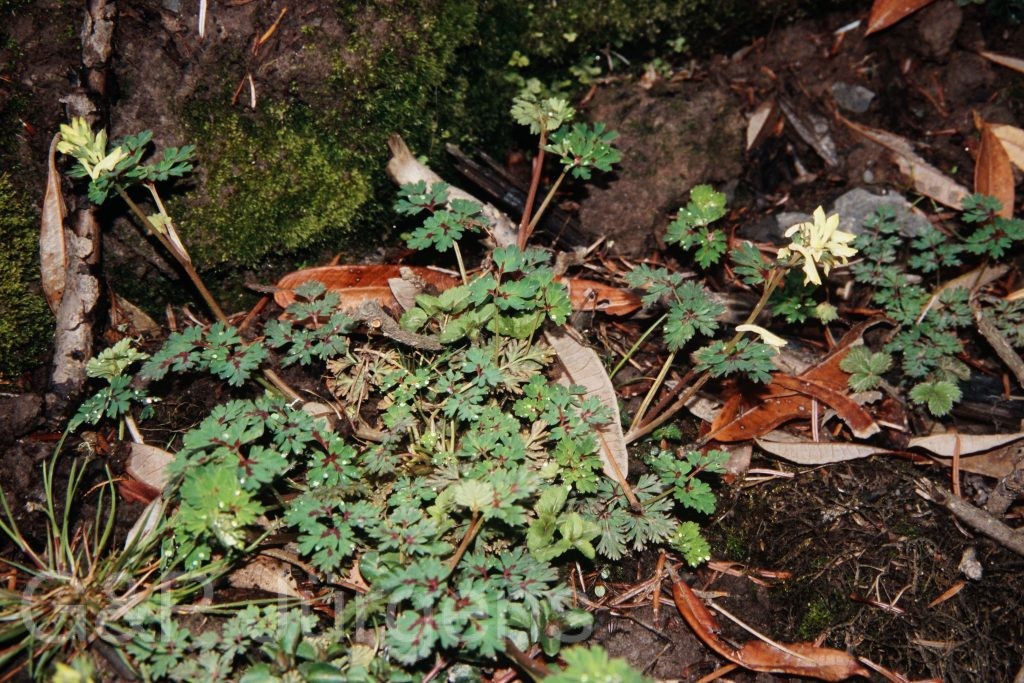
Corydalis sikkimensis is an Eastern Himalayan endemic distributed across the high mountains of Sikkim and adjacent India, eastern Nepal, Bhutan and southern Xizang (China), with GBIF documenting 18 georeferenced collections from these four countries (IN, NP, BT, CN). It occupies the subalpine to lower alpine belt, typically between 3000 and 4000 m, growing in moist shaded conifer and Rhododendron forest margins, on humus-rich banks, beside snow-melt rivulets and among damp rocks. The photographed plant from Gogona in central Bhutan at about 3200 m in May illustrates its phenology, flowering with the early summer monsoon when soils are saturated and light is filtered through the forest canopy.

It is a slender, glabrous, glaucous perennial herb arising from a small fibrous-rooted or shortly tuberous rootstock. The erect to ascending stems bear thin, several-times ternately or pinnately divided leaves, the ultimate segments ovate to obovate and often shallowly lobed, the lower leaves long-petiolate. Flowers are borne in lax terminal racemes subtended by small entire or toothed bracts; each zygomorphic flower comprises four petals, the upper petal produced into a slender, somewhat curved or decurved spur, the inner petals connate at the apex and crested. The corolla is typically blue to purplish-blue. The fruit is a narrow dehiscent capsule containing small black shining seeds.

A member of the large and taxonomically intricate genus Corydalis (Papaveraceae, subfamily Fumarioideae), the species belongs to the predominantly Sino-Himalayan radiation centred on the eastern Himalaya and Hengduan Shan. Like many congeners it is pollinated by long-tongued bumblebees attracted to the spurred corolla, and its alkaloid-rich tissues are characteristic of the family. Though restricted in range, it occurs in remote, little-disturbed high-elevation habitats and is not presently regarded as threatened, but its narrow endemism makes it sensitive to climate-driven shifts in the alpine zone.

Author: (Prain) Fedde · Sources: POWO (Kew), GBIF, Flora of China Vol. 7, Flora of Bhutan Vol. 1, Flora of Nepal, Monograph of the genus Corydalis (Lidén & Zetterlund)

Griff.

Bhutan2014 160
Bhutan Trashigang 1570m, May
Bhutan2014 161
Bhutan Trashigang 1570m, May

Description

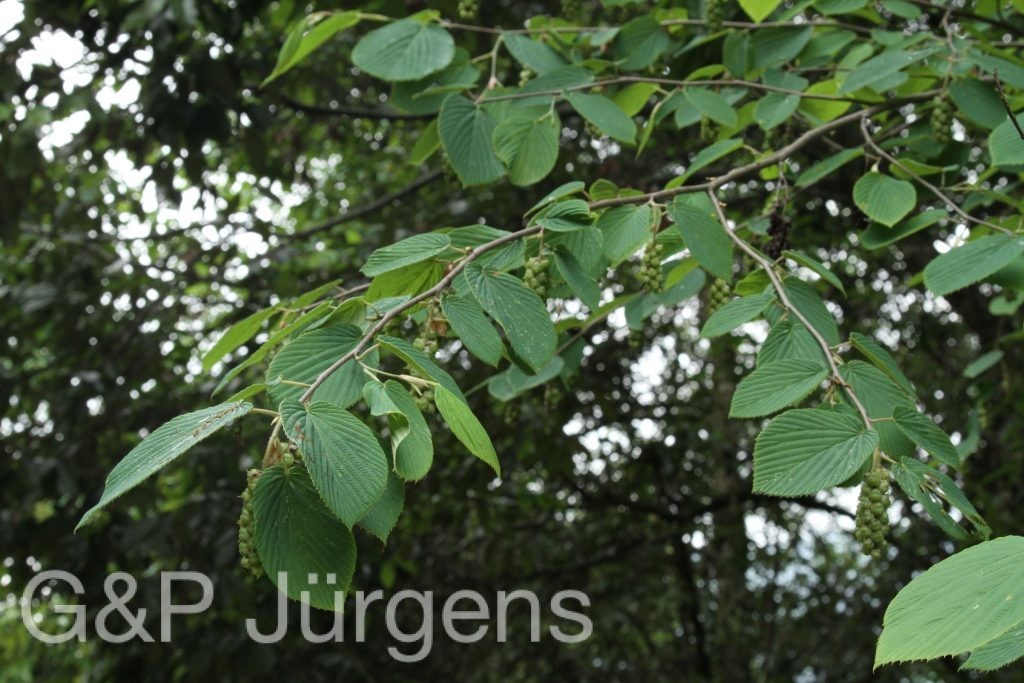
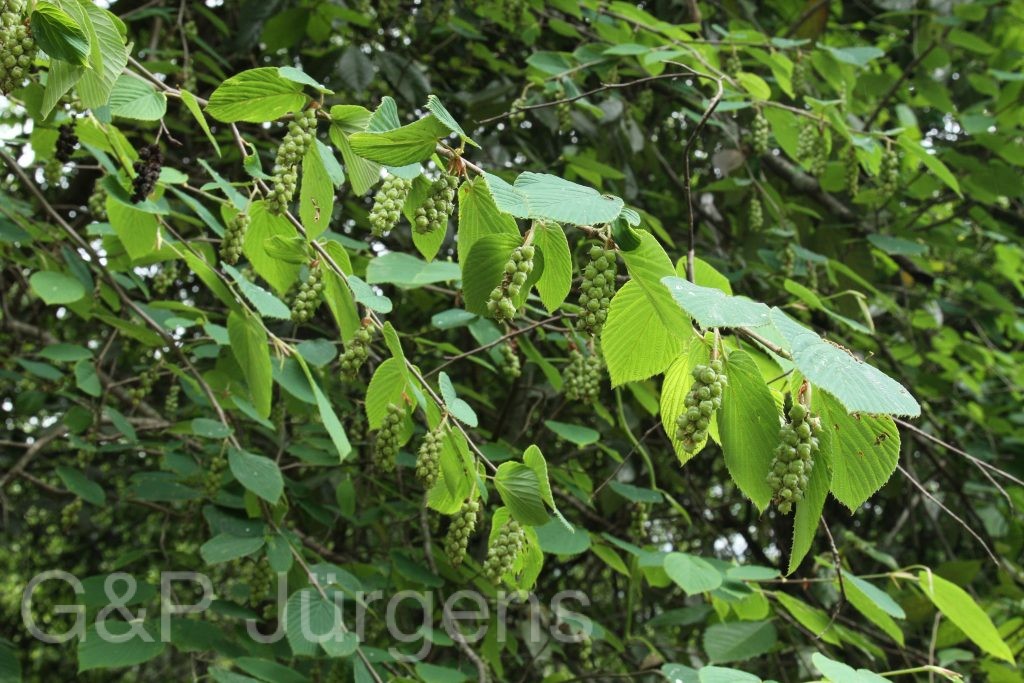
Corylopsis himalayana is an eastern Himalayan winter-hazel distributed through NE India, Bhutan and adjacent SW China, GBIF recording around 181 occurrences (together with scattered cultivated records elsewhere). It is a shrub or small tree of temperate broadleaved forest, forest margins and thickets, typically on moist, well-drained slopes. The photographed plant from Trashigang in eastern Bhutan at 1,570 m (May) is characteristic of its mid-elevation habitat in the warm temperate forest zone, where it occurs among other deciduous understorey and edge species.

It is a deciduous shrub or small tree with alternate, ovate to obovate leaves that are obliquely cordate at the base, with a serrate margin, prominent straight lateral veins and stellate or simple hairs beneath, the foliage often expanding after or with the flowers. The flowers are borne in pendent, catkin-like racemes; each is small, with five yellow, spathulate petals, five stamens and a half-inferior ovary, and the inflorescences are subtended by conspicuous bracts. The fruit is a woody, two-beaked capsule splitting to release shining black seeds.

Corylopsis belongs to the witch-hazel family Hamamelidaceae, a lineage of considerable phylogenetic interest as an early-diverging element of the eudicots, and the genus is prized horticulturally for its early-spring display of fragrant yellow racemes. C. himalayana represents the western, Himalayan outpost of a genus otherwise centred on East Asia, a distribution pattern echoing the well-known Sino-Himalayan to Japanese floristic links. Restricted to montane forest, it benefits from the conservation of intact temperate woodland across its limited range.

Author: Griff. · Sources: POWO (Kew), Flora of Bhutan Vol. 1, GBIF, Flora of China Vol. 9, Endress: Hamamelidaceae (in Families and Genera of Vascular Plants)