Tag:

Spring

(Franch.) Prain

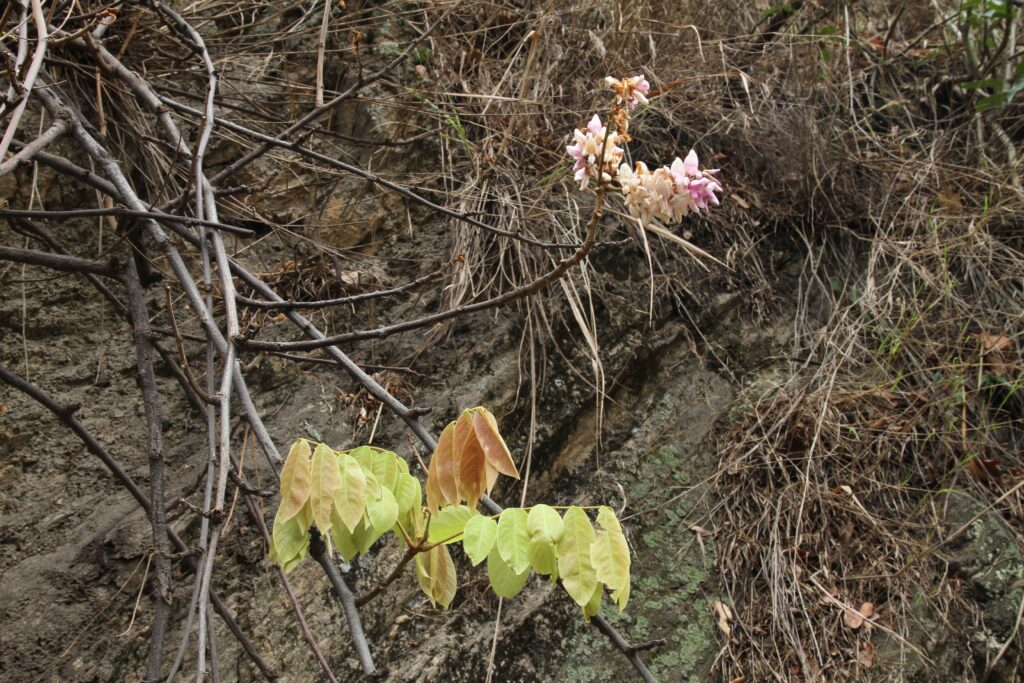
Bhutan2014 67 ergebnis
Bhutan Tashigang 1500m, May
Bhutan2014 68 ergebnis
Bhutan Tashigang 1500m, May

Description

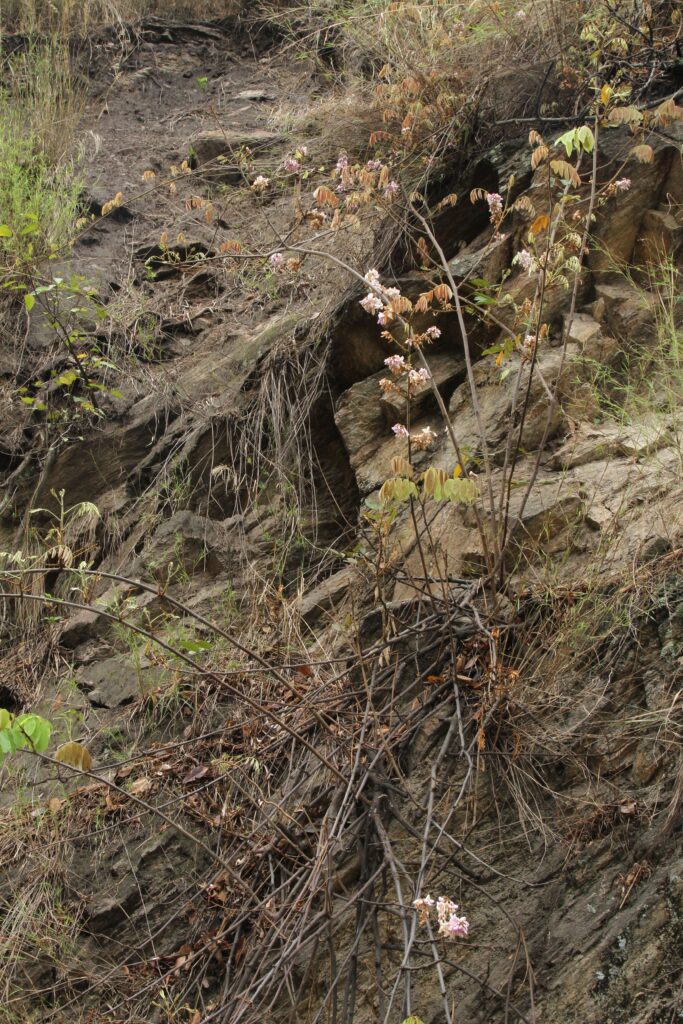
Cladrastis delavayi is a deciduous tree native to southern China (Yunnan, Sichuan, Guizhou, Guangxi) and the eastern Himalayan foothills, with records extending into Bhutan. The species occurs in warm-temperate to subtropical broadleaved forests, forest margins, and river valleys at elevations of 1,000–2,500 m, often growing on calcareous substrates. It has been documented from the Tashigang district in eastern Bhutan at 1,500 m, where it flowers in May before the onset of the summer monsoon, representing the western limit of its distribution in the Himalayan region.
Cladrastis delavayi is a medium-sized tree reaching 8–20 m in height, with a smooth, greyish bark. The leaves are alternate, imparipinnately compound, 15–30 cm long, with 9–13 leaflets that are ovate to elliptic, 4–10 cm long, papery in texture, glabrous above and sparsely pubescent beneath. The inflorescence is a terminal, erect panicle 15–30 cm long, bearing numerous papilionaceous flowers. The flowers are white to pale pink, approximately 1.5–2 cm long, fragrant, with a broadly campanulate calyx. The standard petal is reflexed and suborbicular. The fruit is a linear-oblong, flattened legume 5–10 cm long, indehiscent or tardily dehiscent, containing 1–4 seeds.
Originally described by Franchet as Sophora delavayi from material collected by Delavay in Yunnan and later transferred to Cladrastis by Prain, this species belongs to the small tribe Cladrastideae, which has a notable disjunct distribution between East Asia and eastern North America. With over 570 occurrence records in GBIF, C. delavayi is moderately well collected, though many records originate from cultivated specimens in botanical gardens in Europe, North America, and Japan. The presence of this species in Bhutan underscores the floristic affinity between eastern Bhutan and the Sino-Himalayan phytogeographic region. The tree is valued ornamentally for its attractive flowering and autumn foliage.

Author: (Franch.) Prain · Sources: POWO (Kew), GBIF, Flora of China Vol. 10, Grierson & Long: Flora of Bhutan Vol. 1 (1987), Duley & Vincent: Cladrastis (Leguminosae) Revisited (2003)
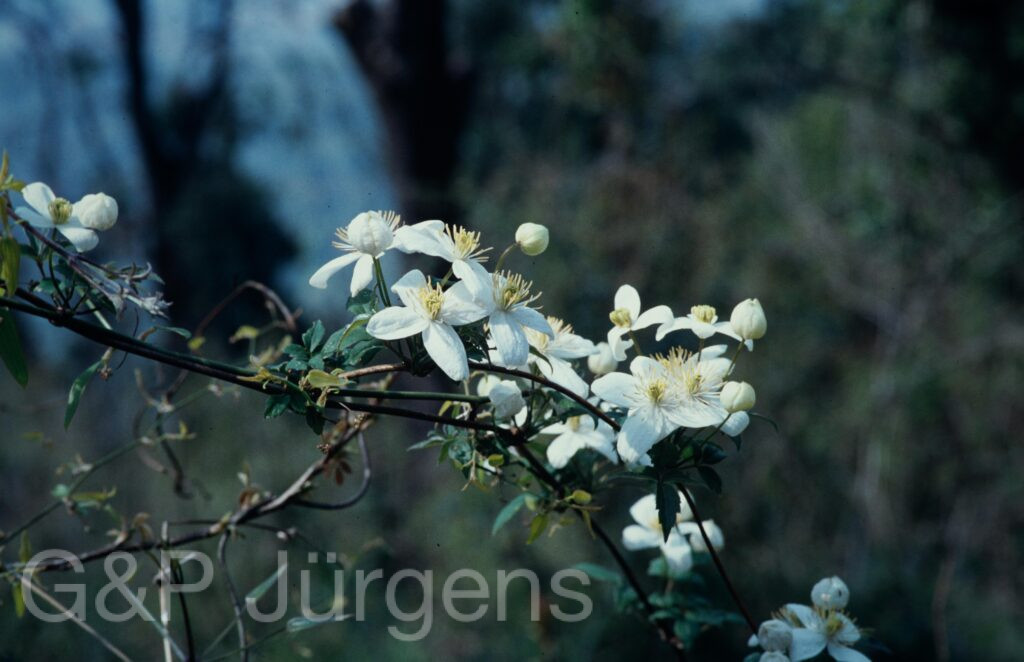
Buch.-Ham. ex DC.

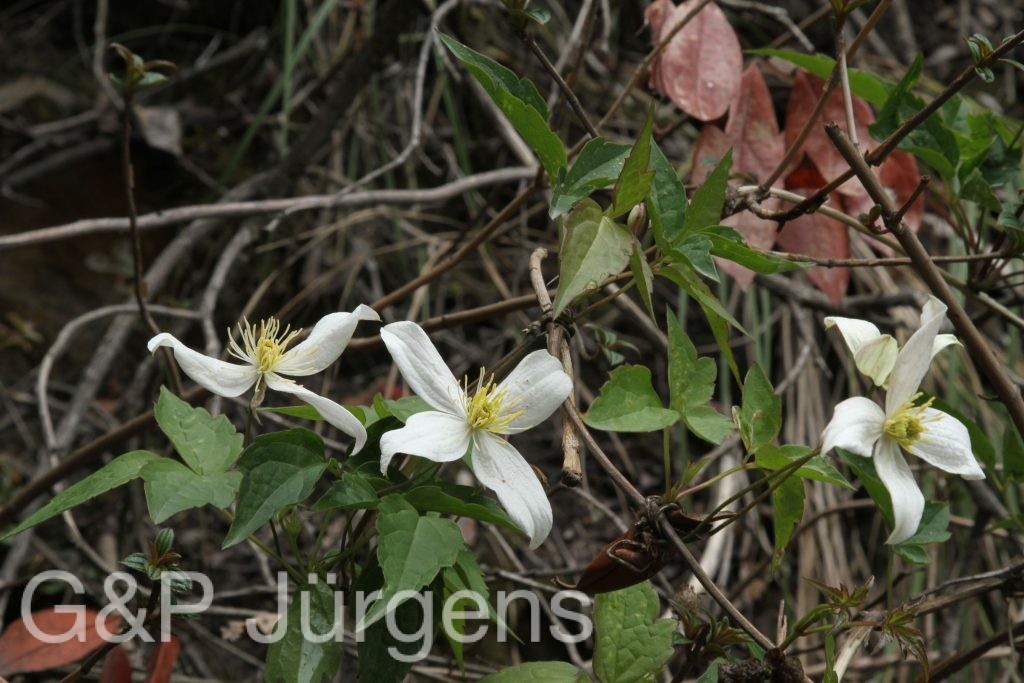
Bhutan2014 36
Bhutan Sandrup 1000m, May
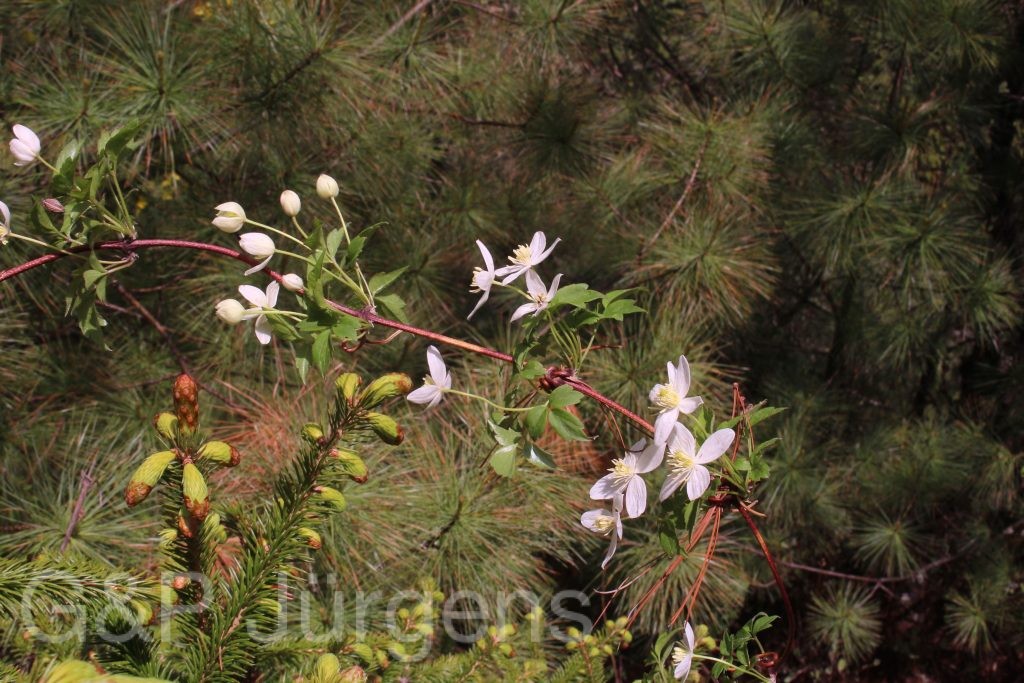
Bhutan2014 971
Bhutan Chele-La 3400m, May
Nepal 1994 66 ergebnis
Ost-Nepal Jaljale Himal 2400m, April

Description

Clematis montana is a widespread Himalayan and Sino-Himalayan climber ranging from Pakistan and Kashmir eastward through Nepal, Bhutan and northern India into central and southwestern China and Myanmar. Reflecting its long history in horticulture, GBIF records exceed 6300 and include numerous cultivated and naturalised occurrences in Britain, continental Europe, North America, New Zealand and Australia alongside its native Asian range. In the wild it grows over an exceptionally broad elevational span, scrambling through forest margins, scrub, hedgerows and over rock from warm temperate valleys to high subalpine slopes. The Bhutanese material imaged at Sandrup (1000 m) and Chele La (3400 m) and the East Nepal population on the Jaljale Himal (2400 m), all flowering April to May, illustrate its vernal, pre-monsoon blooming across this range.

It is a vigorous woody climber with slender, ridged, eventually brown stems and clambering by twining petioles. The leaves are opposite and ternate, the three leaflets ovate to lanceolate, irregularly toothed or lobed and often softly hairy. Flowers are borne singly or in fascicles from the axils of the previous year's growth, each large and showy with four (occasionally more) spreading, petaloid sepals that are white to pink and frequently fragrant; true petals are absent. The numerous stamens have yellow anthers. The fruit is an aggregate of achenes, each tipped by a long, persistent, plumose silky style aiding wind dispersal.

Within Clematis the species belongs to sect. Montanae of spring-flowering, ternate-leaved climbers, and is morphologically variable, with several named varieties and many garden cultivars selected for flower colour and size. It is an early-season nectar source and a robust coloniser of disturbed and edge habitats. It is common and not of conservation concern; its naturalisation beyond Asia underscores its competitive vigour and broad climatic tolerance.

Author: Buch.-Ham. ex DC. · Sources: POWO (Kew), GBIF, Flora of China, Flora of Bhutan, Annotated Checklist of the Flowering Plants of Nepal, Grey-Wilson's Clematis the Genus (monograph)

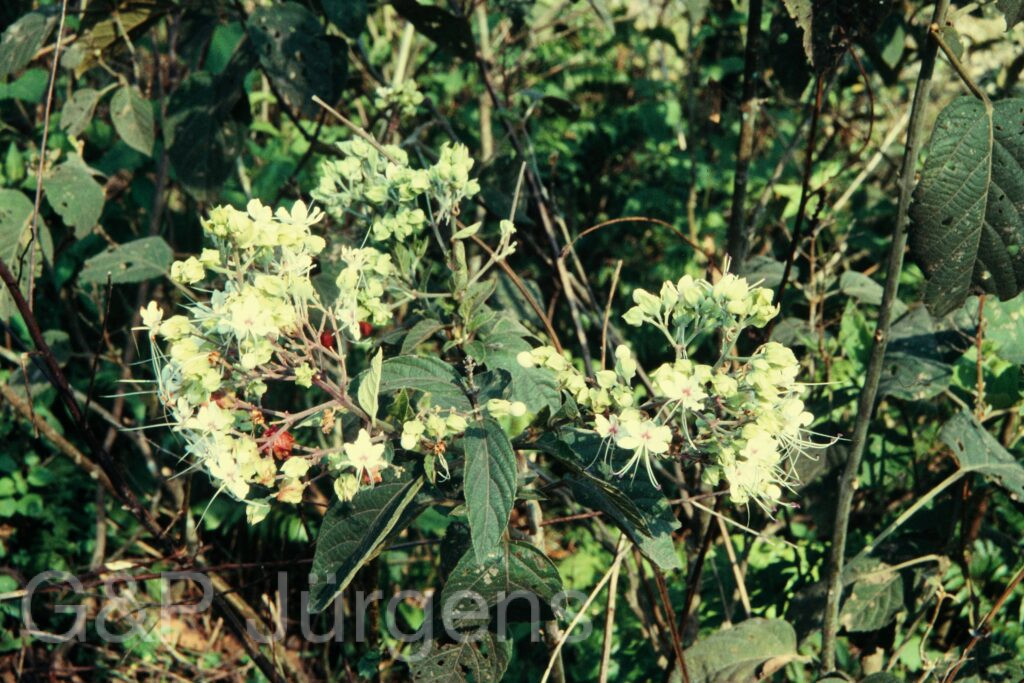
L.

Nepal 97 545 P1067
Nepal Sabha-Khola 520m,May
Nepal 97 543 P1063

Nepal Sabha-Khola 520m, May

Description

Clerodendrum infortunatum is a common shrub of the lowland and foothill regions of tropical southern and southeastern Asia. GBIF records document a wide range across India, Thailand, Sri Lanka, Indonesia, Malaysia, Nepal, Bangladesh, the Philippines, China, Bhutan and Myanmar, with naturalised or cultivated occurrences in Brazil, Mexico, Singapore and elsewhere, amounting to over 2200 records. It is a plant of forest margins, clearings, wastelands, roadsides and disturbed secondary scrub, often forming dense thickets in the warm humid lowlands. The photographed material from the Sabha-Khola valley in Nepal at 520 m, flowering in May, is typical of its occurrence in the subtropical foothill belt, where it blooms in the pre-monsoon period.

It is an erect, soft-wooded shrub usually under 2 m, with quadrangular young stems and large, broadly ovate to cordate leaves that are opposite, softly pubescent and emit a characteristic unpleasant smell when crushed. The flowers are borne in large, lax, terminal panicled cymes; each has an inflated, often reddish calyx and a white to pinkish-tinged, salverform corolla with a slender tube and five spreading lobes, the four stamens and style long-exserted. The fruit is a fleshy drupe seated on the persistent, accrescent calyx, splitting at maturity into four nutlet-like pyrenes.

Formerly placed in the Verbenaceae, Clerodendrum is now treated within the Lamiaceae following molecular phylogenetic reclassification. C. infortunatum is well known in traditional medicine across South Asia, where its leaves and roots are used against fevers and skin and digestive ailments. Ecologically it is a pioneer of disturbed ground, its exserted flowers attracting butterflies and other long-tongued pollinators, and its drupes dispersed by birds.

Author: L. · Sources: POWO (Kew), GBIF, Flora of Nepal, Flora of China (Lamiaceae), Revision of Clerodendrum (Steane & Mabberley)

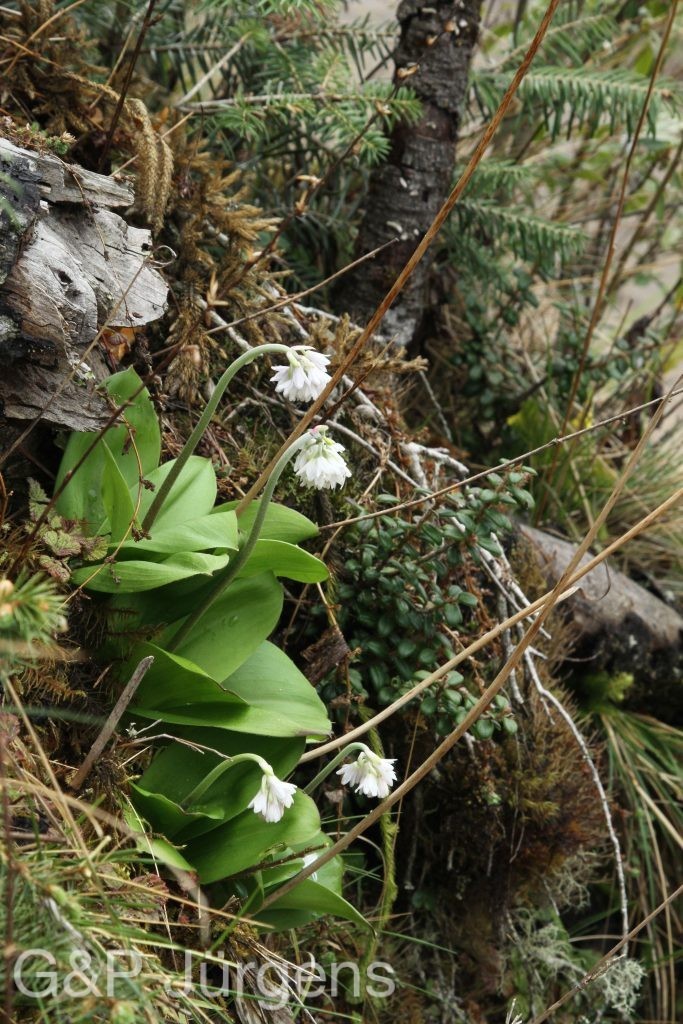
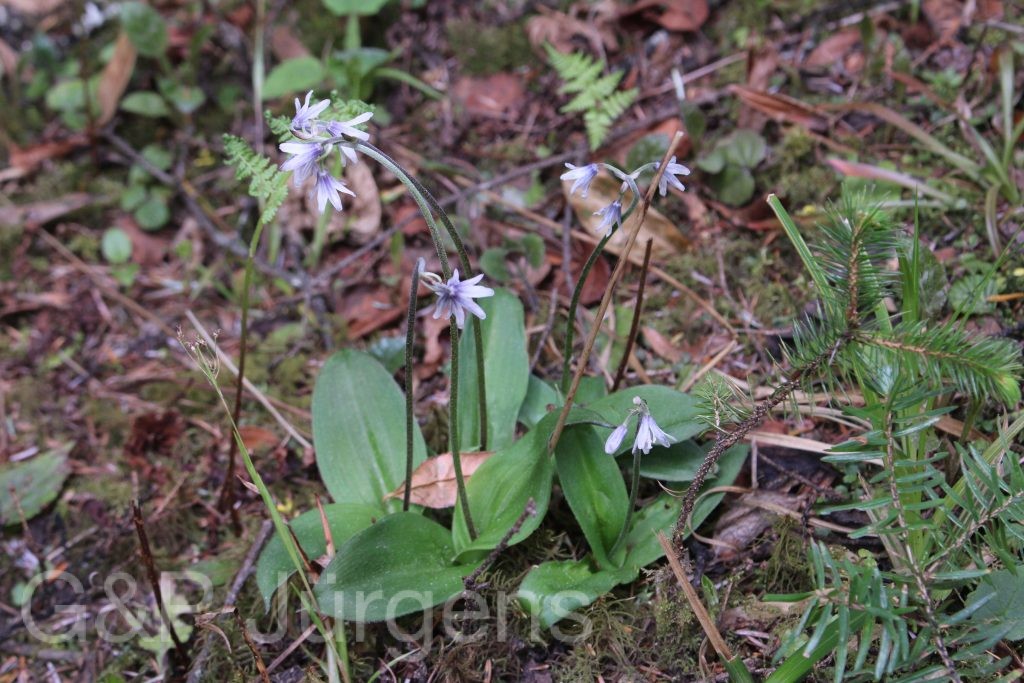
(Kunth ex Baker) H.Hara

Bhutan2014 578
Bhutan Phobjika 3100m, May
Bhutan2014 827
Bhutan Thimphu 2450m, May

Description

Clintonia udensis var. alpina is a rhizomatous woodland herb of the temperate Himalaya and the mountains of East Asia. GBIF records (around 230 occurrences) span China, India, Nepal, Bhutan, Myanmar, Korea and Japan, the species as a whole forming a classic Sino-Himalayan to East Asian arc. It is a plant of moist, shaded forest floors, growing among mosses beneath fir, hemlock and rhododendron, and along cool stream banks in the upper temperate and subalpine zones. The photographed plants came from Bhutan at Phobjika near 3100 m and above Thimphu at about 2450 m, both flowering in May, consistent with its habit of blooming as the snowmelt recedes.

The plant arises from a slender creeping rhizome and produces a basal rosette of two to five leaves. These are oblong-elliptic to obovate, entire, glabrous and somewhat fleshy, narrowed to a sheathing base. From the centre rises a leafless scape bearing a small umbel-like cluster of nodding, white, campanulate flowers; each has six free, oblong tepals, six stamens with versatile anthers, and a superior ovary topped by a short style. The fruit is a globose berry that ripens from green to a striking blue-black, borne erect on the lengthening pedicels, the contrast of dark fruit and green foliage being characteristic of the genus.

Clintonia is a small Northern Hemisphere genus of the Liliaceae traditionally placed near Medeola, with a disjunct distribution between eastern Asia and North America that makes it a textbook example of the boreal-temperate floristic link. The alpine variety represents the higher-elevation, smaller Himalayan expression of the wide-ranging C. udensis. The species is frequent in suitable forest and is of no conservation concern, its blue berries dispersed by birds.

Author: (Kunth ex Baker) H.Hara · Sources: POWO (Kew), GBIF, Flora of China, Flora of Bhutan, Annotated Checklist of the Flowering Plants of Nepal, Utech's taxonomic studies of Clintonia (Liliaceae)

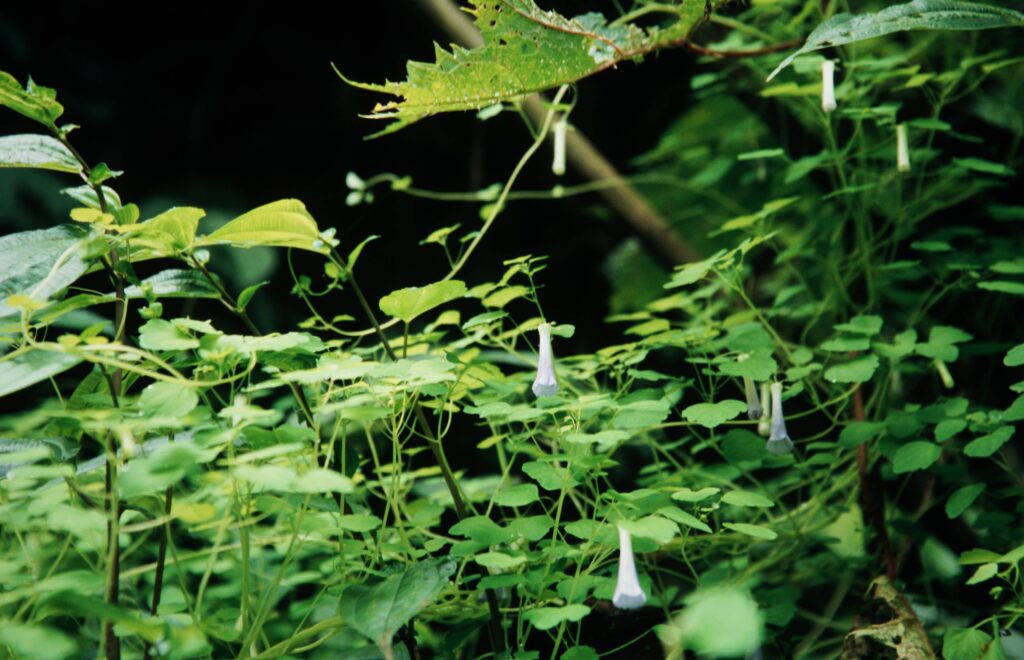
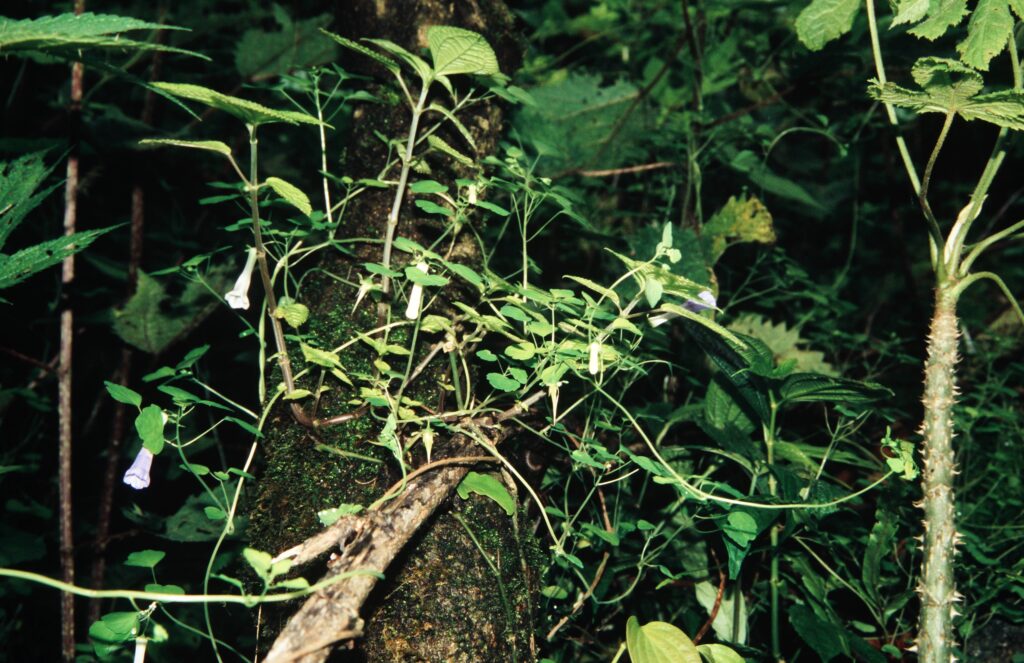
Hook.f. & Thomson

Description

Codonopsis gracilis is a slender twining herb distributed across the eastern Himalaya and into mainland Southeast Asia and southern China. Its range extends from Nepal, Bhutan, and northeastern India (Sikkim, West Bengal, Assam, Meghalaya) through Myanmar and Vietnam to southern China (Yunnan, Sichuan, Guizhou). GBIF records 72 occurrences across these countries. The species grows in margins of subtropical and warm temperate broadleaved forests, thickets, hedgerows, and along streams, at elevations of 1,200–2,800 m. The photograph from Ruigi-Chu in West Bengal at 1,850 m, taken in May, shows the species at a mid-elevation site in the Sikkim-Darjeeling region during the early monsoon flowering period.
The plant is a perennial twining herb arising from a slender, fusiform or cylindrical root. Stems are slender, glabrous or sparsely pubescent, extensively twining through surrounding vegetation, reaching 1–3 m. Leaves are alternate or opposite on lower stems, ovate to broadly ovate, 2–5 cm long, with crenate to serrate margins, sparsely hairy above, paler beneath. Flowers are solitary, axillary, pendulous on slender pedicels. The calyx lobes are five, lanceolate to ovate, spreading. The corolla is broadly campanulate, 15–25 mm long, pale blue to lilac with darker purple veins and markings inside, particularly prominent reticulate venation in the throat. Stamens five, free; the ovary is semi-inferior. The fruit is a broadly conical capsule, dehiscing by apical valves.
Codonopsis gracilis is distinguished from congeners by its relatively small, delicate habit and slender roots, lacking the thick, fleshy taproots prized in traditional medicine that characterize species such as C. pilosula and C. tangshen. The genus Codonopsis comprises approximately 40 species centred on the Sino-Himalayan region, and molecular phylogenetic studies have confirmed its placement within Campanulaceae sensu lato. C. gracilis is not currently considered threatened and remains locally frequent in forest margins across its wide range.

Author: Hook.f. & Thomson · Sources: POWO (Kew), GBIF, Hong & Lammers: Campanulaceae in Flora of China Vol. 19, Grierson & Long: Flora of Bhutan Vol. 2

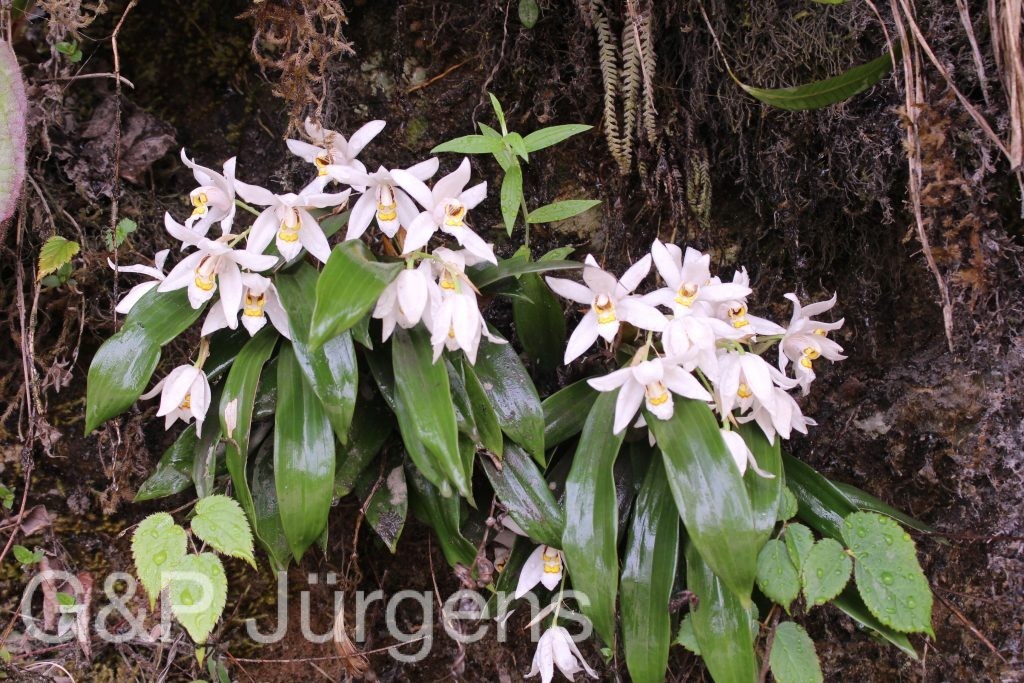
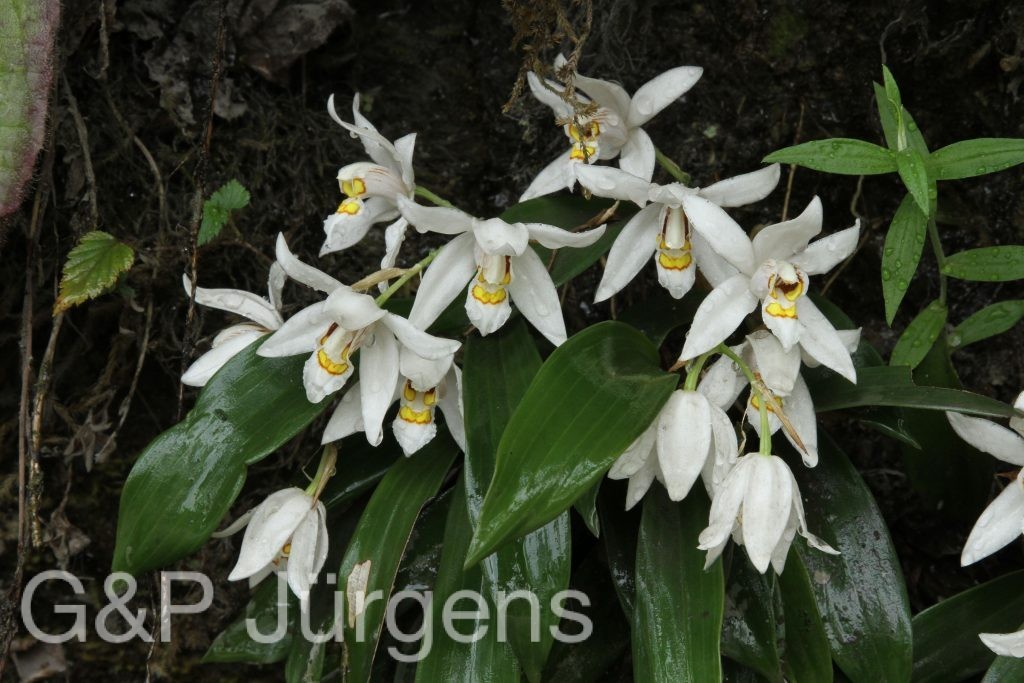
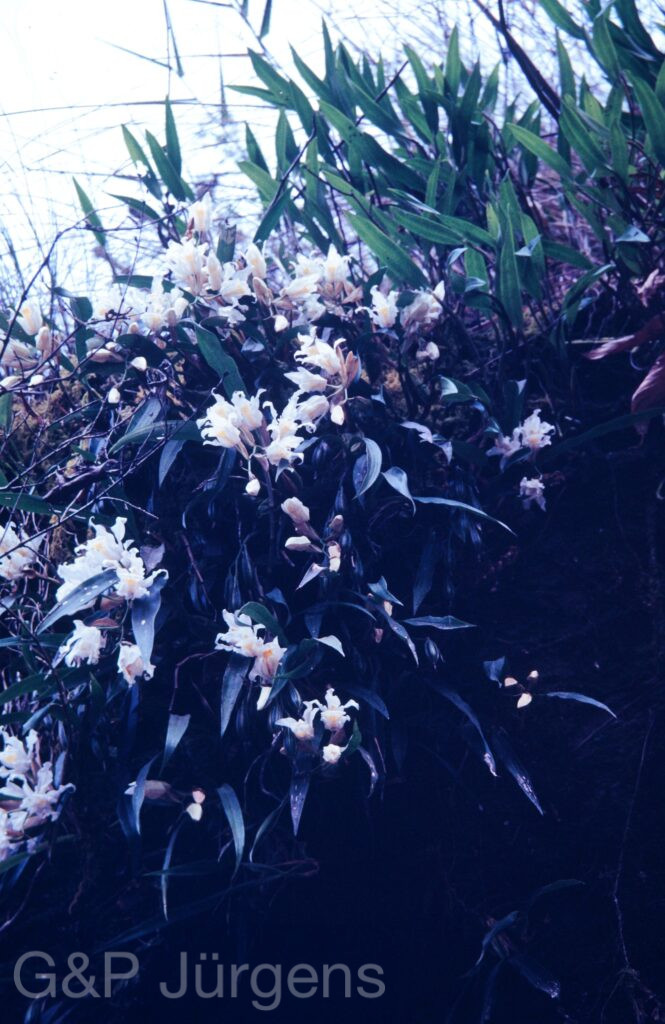
Lindl.

Bhutan2014 17
Bhutan Sandrup 800m, May
Bhutan2014 19
Bhutan Sandrup 800m, May

Description

Coelogyne corymbosa is an epiphytic orchid widely distributed through the eastern Himalaya and adjoining Southeast Asia, native to China, India, Nepal, Bhutan, Myanmar, Thailand, Laos and Vietnam, with 424 GBIF records making it one of the better-documented Coelogyne of the region. It is a cool-growing epiphyte and lithophyte of mossy montane and cloud forest, usually between about 1800 and 3000 m, though the caption locality of Sandrup in southern Bhutan at 800 m in May reflects collection in the warmer foothill belt at the lower margin of its range; the bulk of its populations occupy higher, mist-bathed forest.

The plant forms ovoid to oblong pseudobulbs, spaced along a creeping rhizome, each topped by a pair of narrowly elliptic, plicate leaves. The inflorescence is a short, few-flowered raceme produced from the apex of the young growth. The flowers are relatively large for the plant and brilliant white, with spreading lanceolate sepals and petals; the trilobed lip is the diagnostic feature, conspicuously marked in the throat with bright orange-yellow blotches ringed in dark reddish-brown, set off by raised, fringed keels. The fruit is a ribbed capsule.

Coelogyne is a large Asian genus of tribe Arethuseae, and C. corymbosa belongs to a group of small, high-elevation, white-flowered species distinguished by their boldly ocellate lips. Cool-growing and floriferous, it is valued in cultivation, but its principal habitat in undisturbed mossy forest makes wild populations sensitive to logging and to the warming of montane climates. International trade is regulated under CITES Appendix II.

Author: Lindl. · Sources: POWO (Kew), GBIF, Flora of China, Flora of Bhutan, The Genus Coelogyne (Clayton & Cribb)

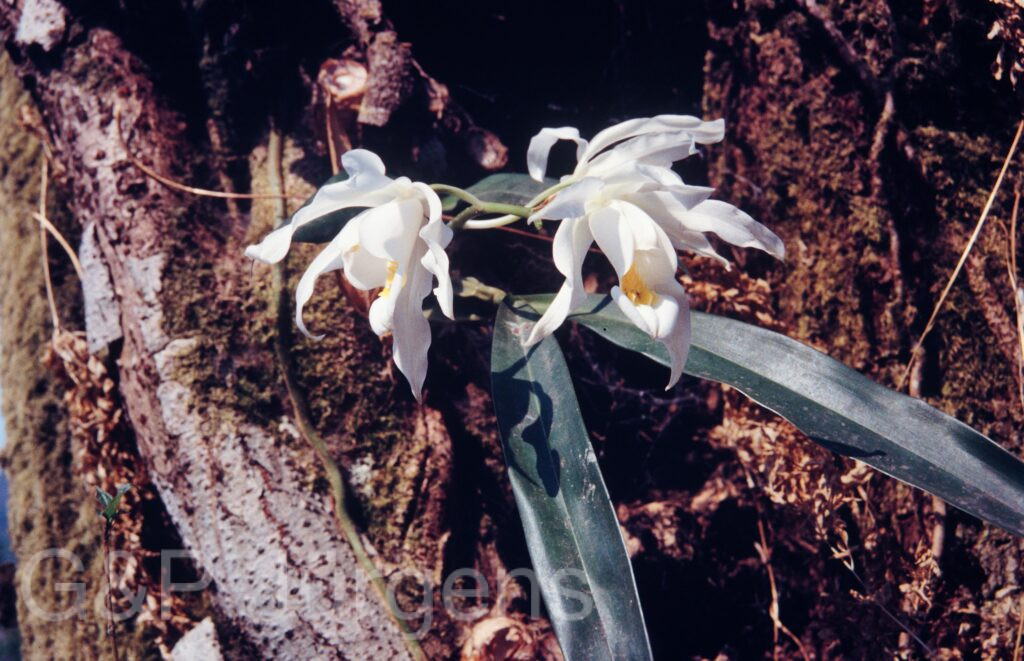
Lindl.

Nepal1992 90 P124 ergebnis
Nepal Amjilassa 2300m March 
Nepal1992 165 P240 ergebnis
Nepal Amjilassa 2300m March 

Description

Coelogyne cristata is an epiphytic orchid of the central and eastern Himalaya, native to Nepal, India, Bhutan and China and widely grown in cultivation, a circumstance reflected in the broad GBIF country list (over 400 records spanning numerous European and American countries alongside its native range), most extraterritorial records being garden plants. In the wild it grows as an epiphyte and occasional lithophyte on mossy tree trunks, branches and shaded rock faces in humid temperate forest. The illustrated plant from Amjilassa in eastern Nepal, at about 2300 m and flowering in March, typifies its preference for cool, mist-laden montane forest where it blooms in the dry late-winter to early-spring season.

The plant grows from a creeping rhizome bearing crowded, ovoid to oblong, glossy green pseudobulbs, each topped by two strap-shaped, plicate, leathery leaves. The inflorescence is a pendulous to arching raceme arising from the base of the pseudobulb and carrying several large, fragrant flowers. These are crystalline white, with spreading, somewhat undulate sepals and petals and a trumpet-shaped, three-lobed labellum whose disc bears conspicuous golden-yellow, fringed and crested keels — the feature giving rise to the epithet cristata. The column is slender and winged, and the fruit is a ribbed dehiscent capsule releasing dust-like seeds.

Coelogyne is a large Asian orchid genus, and C. cristata ranks among its most celebrated members, long prized in horticulture for its abundant snow-white blooms. Like all orchids it is listed under CITES Appendix II, and wild populations are vulnerable to over-collection for the ornamental trade and to loss of the humid forest habitat on which it depends; sustaining intact montane forest is therefore central to its in-situ conservation across the Himalaya.

Author: Lindl. · Sources: POWO (Kew), GBIF, Flora of Bhutan (Orchidaceae), Flora of China (Orchidaceae), Pearce & Cribb: The Orchids of Bhutan (monograph)

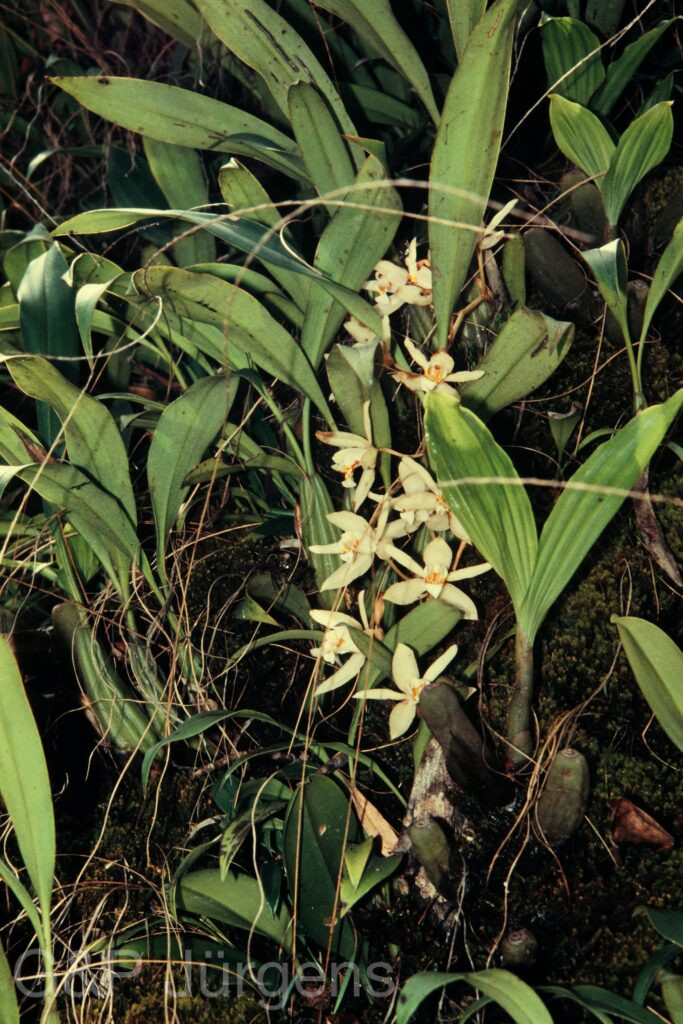
Lindl.

Nepal 97 444 G862
Nepal Tashigaon 2900m May
Nepal 97 446 P864
Nepal Tashigaon 2900m May

Description

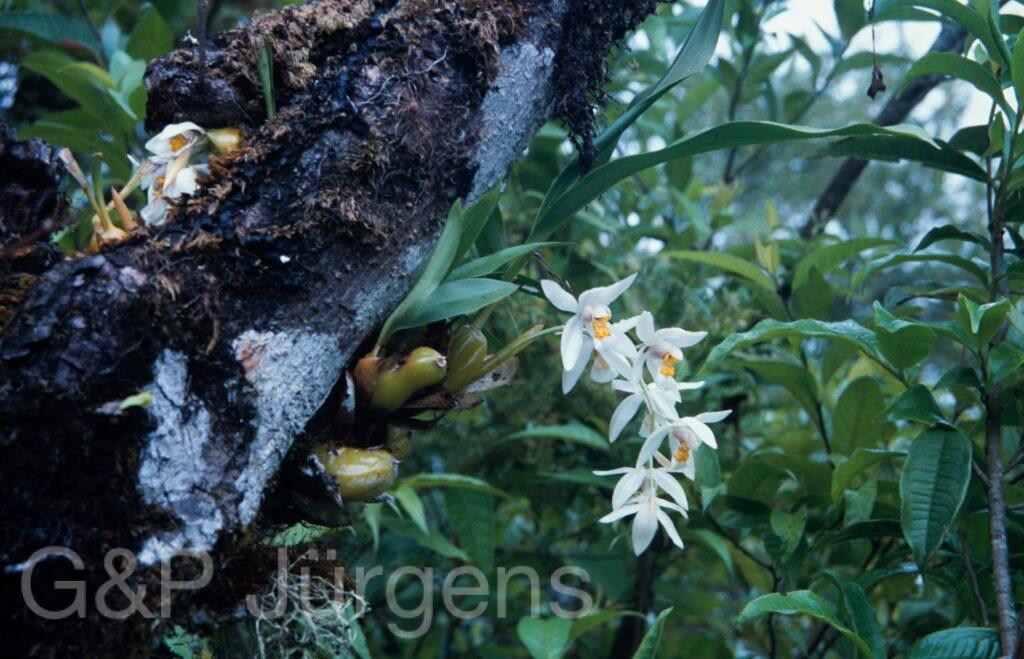
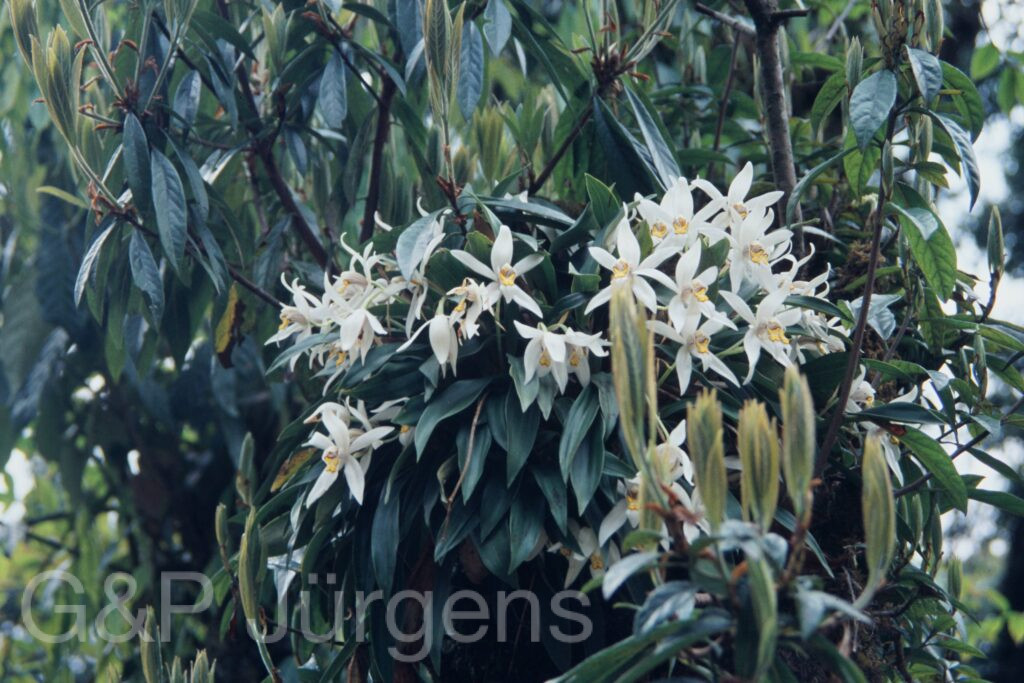
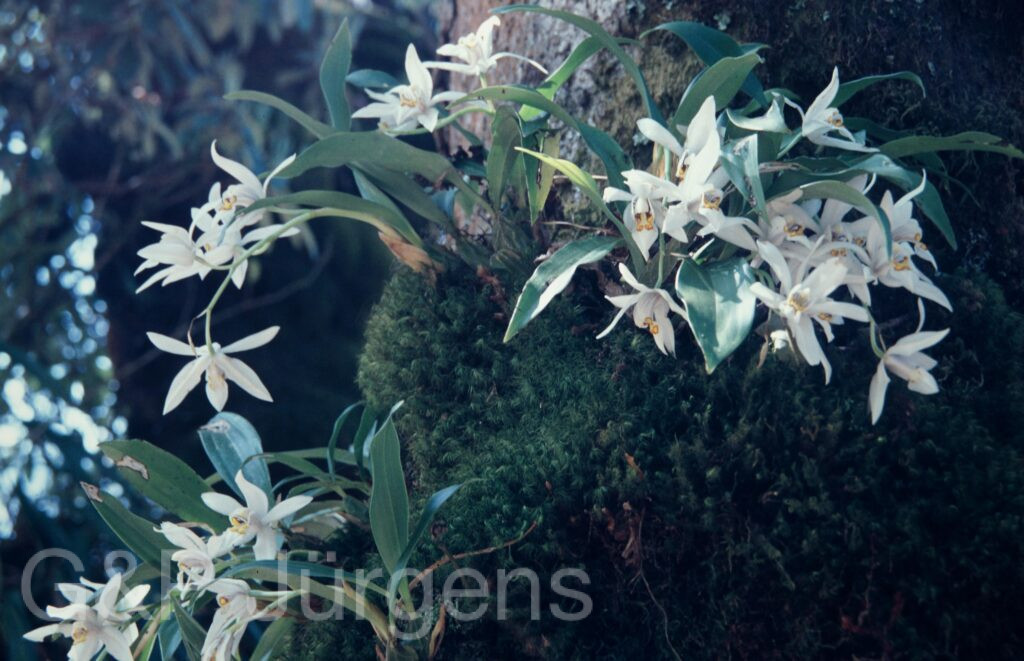
Coelogyne flaccida Lindl. is an epiphytic orchid of the Himalaya and Southeast Asia, recorded from China, India, Nepal, Bhutan, Thailand, Laos, Vietnam and Myanmar, with cultivated records widely scattered elsewhere; GBIF documents around 243 occurrences. It grows as an epiphyte, occasionally a lithophyte, on mossy tree trunks and shaded rocks in broadleaved evergreen and mixed forest, generally between about 900 and 2300 m, though montane records reach higher. The photographed plant was found at Tashigaon in Nepal at about 2900 m in May, at the upper, cooler edge of its range where this pseudobulbous orchid flowers in spring on humid, well-shaded substrates.

The plant is sympodial, with clustered, oblong to ovoid pseudobulbs borne on a creeping rhizome, each pseudobulb bearing one or two apical, plicate, lanceolate to elliptic leaves. The inflorescence is a pendent, laxly several-flowered raceme arising from the base of the pseudobulb. The flowers are fragrant, the sepals and petals creamy-white to pale buff and somewhat flaccid (the epithet flaccida), and the trilobed labellum is marked with conspicuous yellow to orange-brown keels and reddish-brown veining on the side lobes. The fruit is a ribbed dehiscent capsule releasing dust-like seeds.

Within the large Asiatic genus Coelogyne, this species belongs to the white-flowered, pendent-racemed group allied to C. cristata and C. corymbosa and is widely grown by orchid enthusiasts. Like other epiphytic orchids it depends on undisturbed humid forest and mycorrhizal partners for germination. Although fairly widespread, wild populations are vulnerable to habitat loss and collection, and all Coelogyne are listed on CITES Appendix II, regulating international trade.

Author: Lindl. · Sources: POWO (Kew), GBIF, Flora of China, Flora of Bhutan, Annotated Checklist of the Flowering Plants of Nepal, Clayton The Genus Coelogyne: A Synopsis

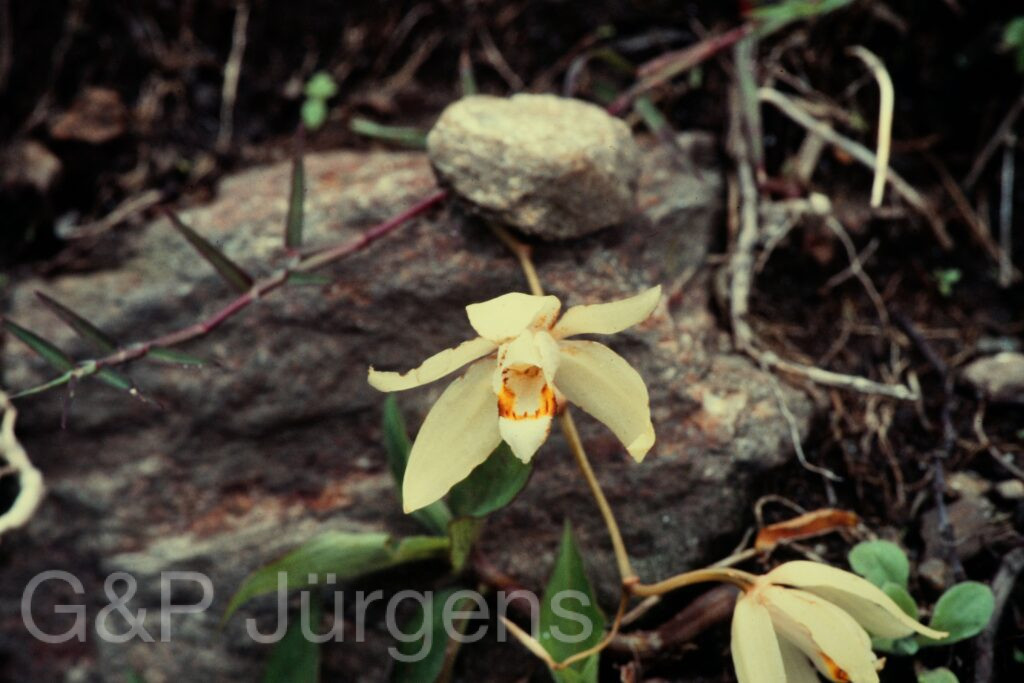
Lindl.

Nepal 2001 237 ergebnis ergebnis
Nepal (Gorkha) Niuli Kharka 2500m, May
Sikkim2004 334 G595 ergebnis
Sikkim Choka 3330m, April
Nepal 1994 288 ergebnis
Ost-Nepal Milka-Danda 2850m, May 

Description

Coelogyne punctulata Lindl. is an epiphytic orchid of the Himalaya and neighbouring mountains, recorded from India, Nepal, Bhutan, China, Myanmar, Vietnam and Bangladesh (225 GBIF occurrences). It grows on mossy trunks and branches, and occasionally as a lithophyte on shaded rocks, in temperate broad-leaved and mixed forest, generally between 2000 and 3300 m. It was documented in Nepal at Niuli Kharka in Gorkha around 2500 m and at Milka-Danda in the east near 2850 m, both in May, and in Sikkim at Choka at 3330 m in April, reflecting the cool, humid mid-montane forests it favours.

It is a sympodial epiphyte with closely set, ovoid to oblong pseudobulbs borne on a creeping rhizome, each bearing one or two plicate, elliptic-lanceolate leaves narrowed to a petiole-like base. The inflorescence is a few-flowered raceme arising with the new growth. The flowers are white to pale cream, the elliptic sepals and narrower petals spreading, and the showy trilobed labellum marked with yellow or orange keels and reddish-brown to ochre spotting on the disc, the lateral lobes erect about the column. The fruit is a ribbed, dehiscent capsule releasing dust-fine seeds.

Coelogyne is a large Asian genus and C. punctulata sits within the section of small-flowered white-and-spotted species; it has at times been confused with the related C. nitida, a synonymy reflected in the original page reference. The deceptive, nectarless flowers are pollinated by bees, and the minute wind-dispersed seeds depend on mycorrhizal fungi for germination. As a forest epiphyte it is vulnerable to habitat loss and orchid collection, concerns shared across wild-harvested Coelogyne, and the genus is listed under CITES Appendix II.

Author: Lindl. · Sources: POWO (Kew), GBIF, Flora of China, Flora of Bhutan, The Orchids of the Sikkim-Himalaya (King & Pantling), Coelogyne monograph (Clayton, The Genus Coelogyne)

Lindl.

Nepal 2001 464 ergebnis ergebnis
Nepal (Gorkha) Gunda 1700m, May

Description

Coelogyne uniflora (long known as Panisea uniflora) is an epiphytic orchid distributed across the eastern Himalaya and Indochina, ranging from Nepal, Sikkim and Bhutan through northeast India to southern China, Myanmar, Thailand, Laos, Cambodia and Malaysia; GBIF records 90 occurrences across this range. It grows as an epiphyte on mossy trunks and branches, and occasionally as a lithophyte on shaded rocks, in humid subtropical to lower temperate broad-leaved and evergreen forest, generally between about 1000 and 2200 m. The photographed plant from Gunda in the Gorkha district of Nepal at 1700 m in May illustrates its flowering at the onset of the monsoon, when atmospheric humidity in these mid-montane forests is high.

It is a small, tufted, sympodial epiphyte with closely spaced, ovoid to cylindrical pseudobulbs borne on a creeping rhizome, each pseudobulb bearing one or two narrowly lanceolate, plicate leaves. The inflorescence is short and few-flowered, usually carrying a single relatively large flower (whence uniflora) at or near the base of the new growth. The flower has spreading, pale creamy-white to yellowish sepals and petals; the lip (labellum) is three-lobed, often marked with reddish-brown to orange and bearing low keels on the disc, the lateral lobes erect. The column is slender and the fruit a ribbed dehiscent capsule releasing dust-like seeds.

The species exemplifies recent generic realignments within the Coelogyninae (Orchidaceae): the genus Panisea has been subsumed into a broadly circumscribed Coelogyne on molecular phylogenetic grounds, so the wp_link "panisea-uniflora" reflects the former placement while Coelogyne uniflora is the currently accepted name. Like other coelogynes it produces minute wind-dispersed seeds dependent on mycorrhizal fungi for germination. Though wide-ranging, epiphytic orchids are sensitive to deforestation and collection and are afforded CITES Appendix II protection.

Author: Lindl. · Sources: POWO (Kew), GBIF, Flora of China Vol. 25, Flora of Bhutan Vol. 3, Flora of Nepal, The Genus Coelogyne: A Synopsis (Clayton & Pradhan)