
Lindl.
Description
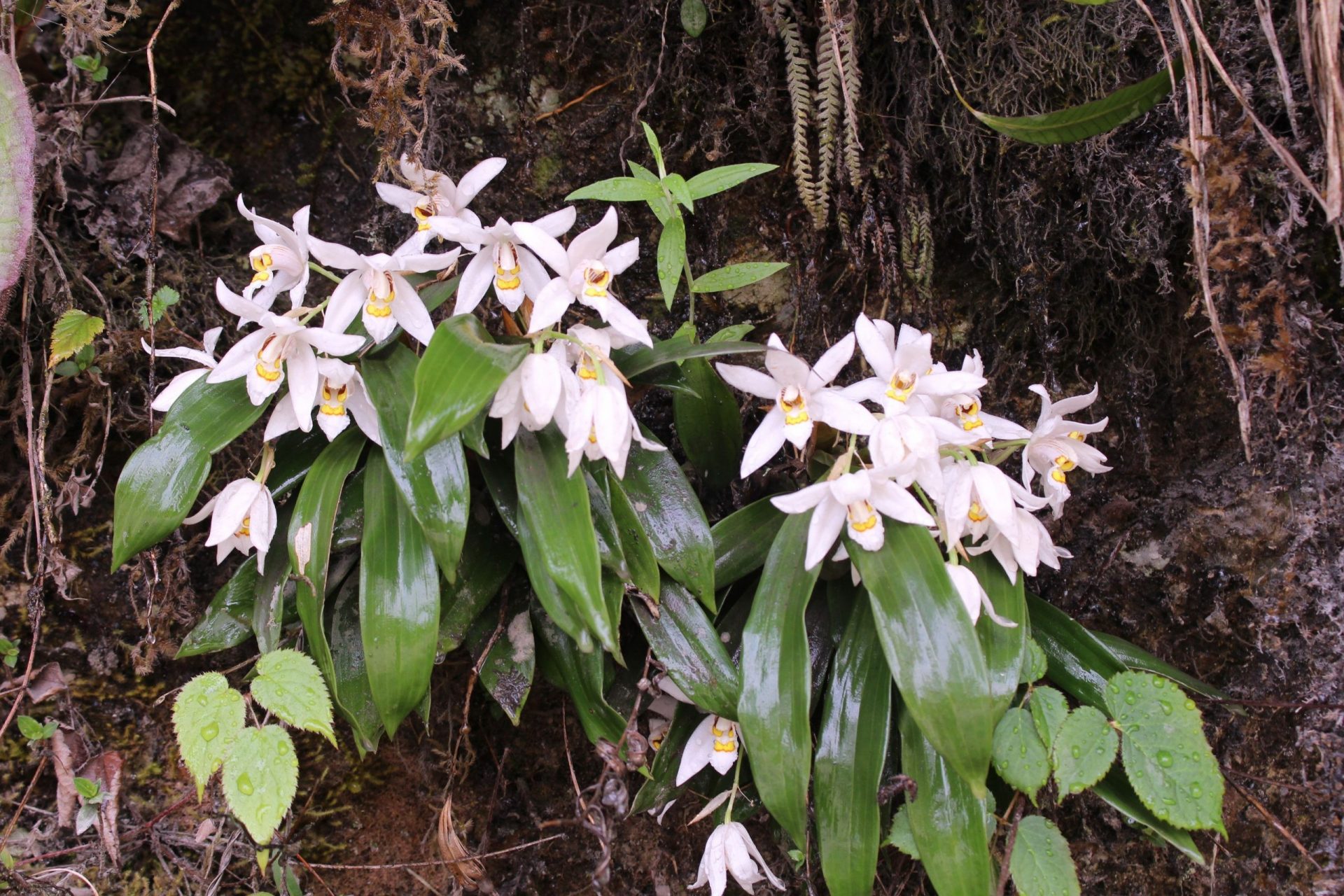
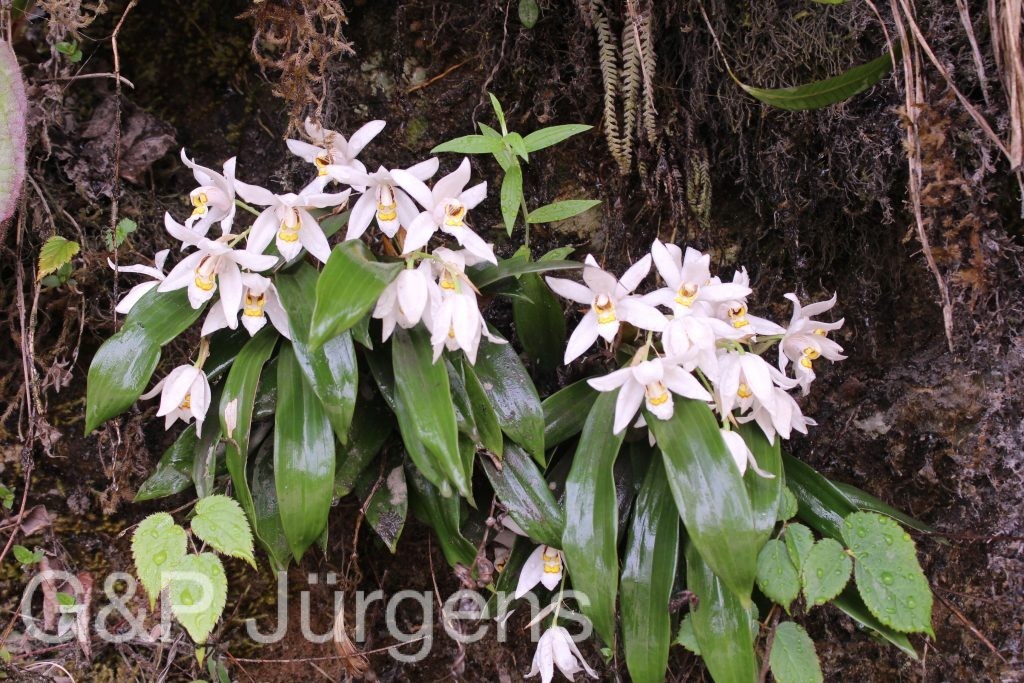
Coelogyne corymbosa is an epiphytic orchid widely distributed through the eastern Himalaya and adjoining Southeast Asia, native to China, India, Nepal, Bhutan, Myanmar, Thailand, Laos and Vietnam, with 424 GBIF records making it one of the better-documented Coelogyne of the region. It is a cool-growing epiphyte and lithophyte of mossy montane and cloud forest, usually between about 1800 and 3000 m, though the caption locality of Sandrup in southern Bhutan at 800 m in May reflects collection in the warmer foothill belt at the lower margin of its range; the bulk of its populations occupy higher, mist-bathed forest.
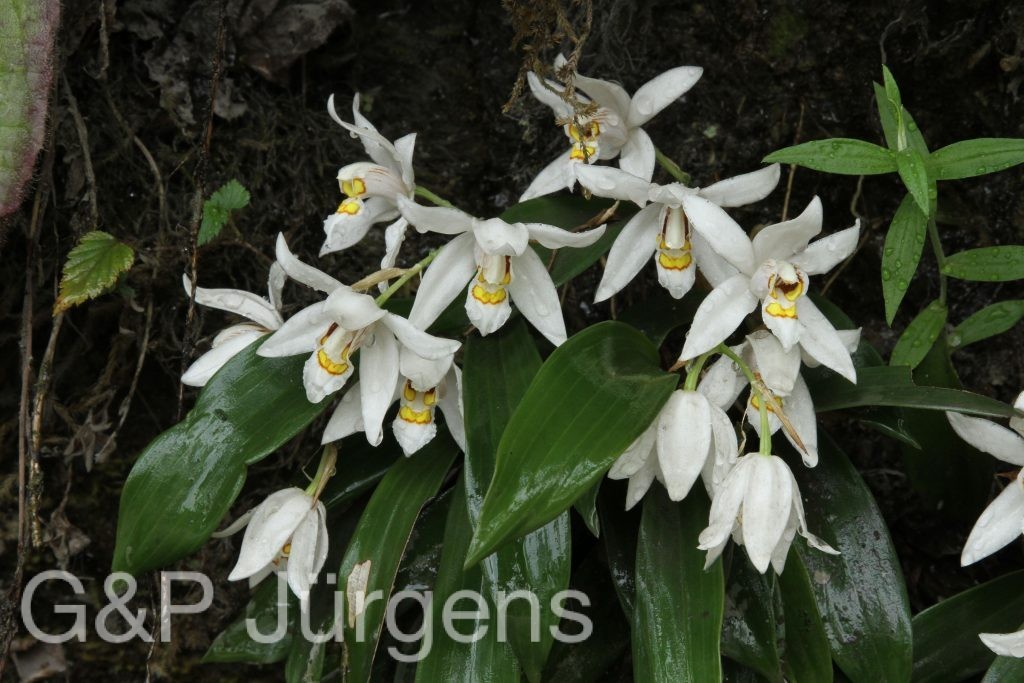
The plant forms ovoid to oblong pseudobulbs, spaced along a creeping rhizome, each topped by a pair of narrowly elliptic, plicate leaves. The inflorescence is a short, few-flowered raceme produced from the apex of the young growth. The flowers are relatively large for the plant and brilliant white, with spreading lanceolate sepals and petals; the trilobed lip is the diagnostic feature, conspicuously marked in the throat with bright orange-yellow blotches ringed in dark reddish-brown, set off by raised, fringed keels. The fruit is a ribbed capsule.
Coelogyne is a large Asian genus of tribe Arethuseae, and C. corymbosa belongs to a group of small, high-elevation, white-flowered species distinguished by their boldly ocellate lips. Cool-growing and floriferous, it is valued in cultivation, but its principal habitat in undisturbed mossy forest makes wild populations sensitive to logging and to the warming of montane climates. International trade is regulated under CITES Appendix II.
Author: Lindl. · Sources: POWO (Kew), GBIF, Flora of China, Flora of Bhutan, The Genus Coelogyne (Clayton & Cribb)