Tag:

Subalpine (2500-3500 m)

Rchb.f.

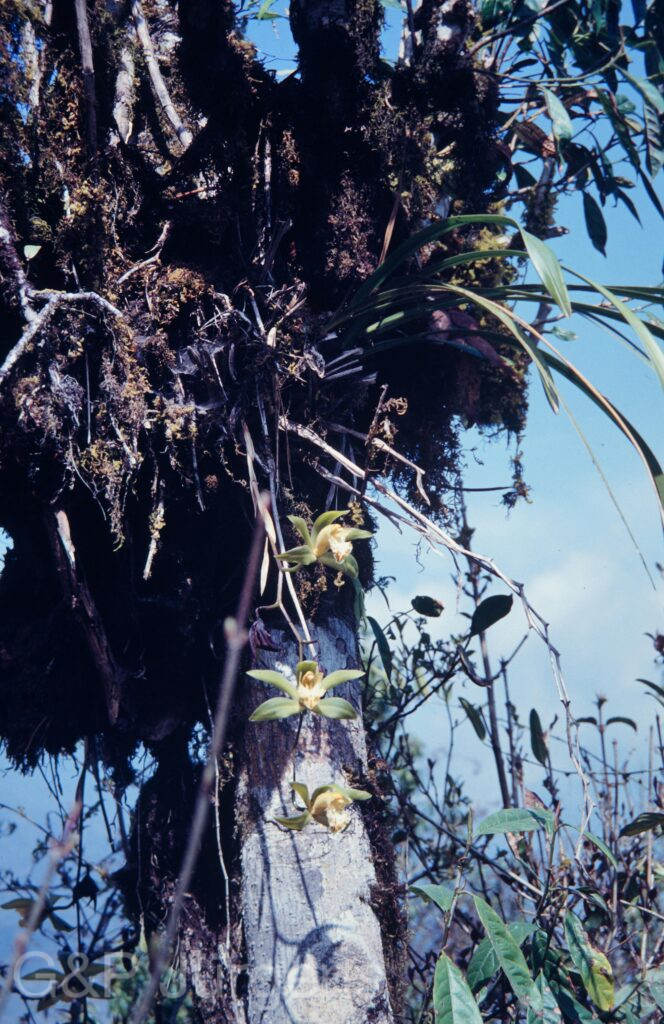
Nepal1992 60 P85 ergebnis
Nepal Milka Danda 2700m March 
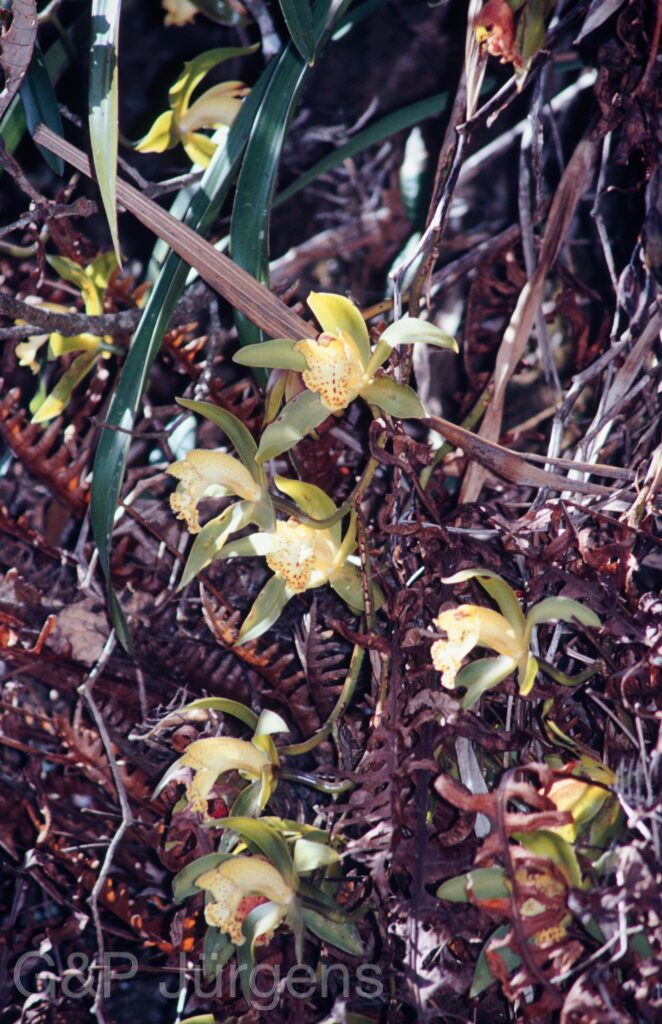
Nepal1992 157 P230 ergebnis
Nepal Milka Danda 2700m March 

Description

Cymbidium hookerianum is a large-flowered orchid of the Himalaya and southwestern China, distributed through China, India, Bhutan, Nepal, Myanmar and Thailand, with around 185 GBIF records. It is chiefly an epiphyte, also growing on mossy rocks, in cool, humid temperate broadleaved and evergreen forest, typically between about 1500 and 2800 m. The gathering from Milka Danda in Nepal at 2700 m in March documents its early-spring flowering, when this mid-montane cloud-forest belt provides the moist, shaded, well-ventilated conditions the species requires.

It is a robust sympodial epiphyte forming clusters of stout, ovoid pseudobulbs partly sheathed by the bases of the long, arching, linear-lanceolate leaves. The inflorescence is a long arching to pendent raceme bearing several large, fragrant flowers. The sepals and petals are broad and spreading, apple-green to yellow-green, while the trilobed labellum is whitish to cream, spotted and blotched with crimson or maroon, with raised keels along its disc; the column is winged in typical Cymbidium fashion. The fruit is an ellipsoid capsule releasing innumerable dust-like seeds.

Cymbidium is a genus of tribe Cymbidieae long prized in horticulture, and C. hookerianum (commemorating J. D. Hooker) is an important parent in modern hybrids. Its showy, scented flowers are pollinated by bees, while the minute seeds depend on mycorrhizal fungi for germination. Wild populations are vulnerable to over-collection for the ornamental trade and to forest loss, and Cymbidium species are listed on CITES Appendix II, regulating their international commerce.

Author: Rchb.f. · Sources: POWO (Kew), GBIF, Flora of China, Flora of Bhutan, The Genus Cymbidium (Du Puy & Cribb)
G.Don

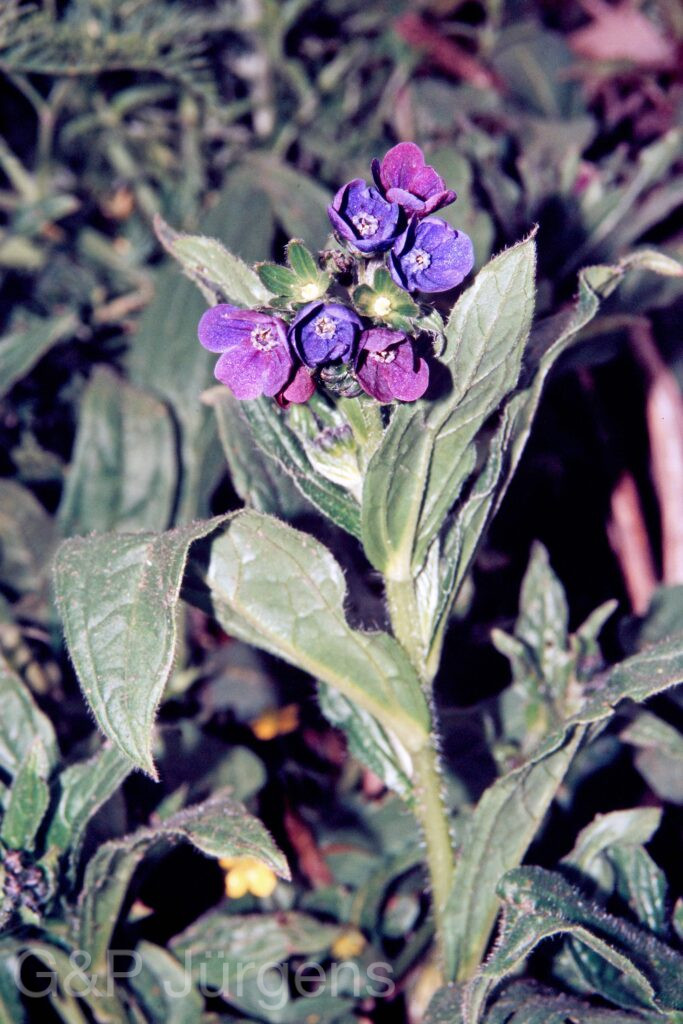
Garh 07 107 ergebnis
India Garhwal Mandakini 2900m, June
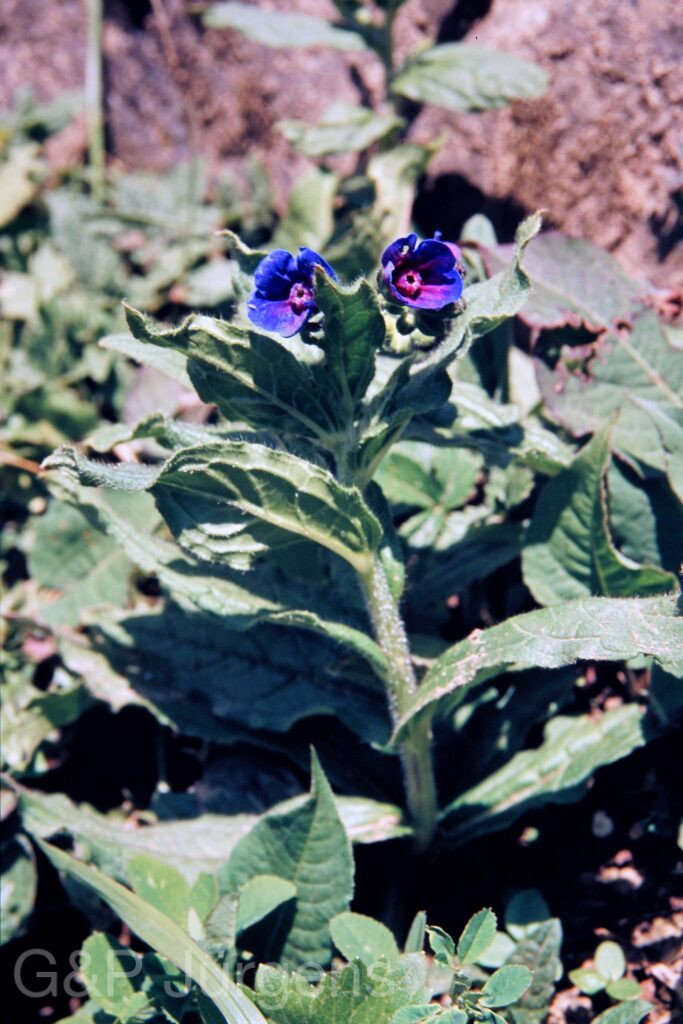
Garh 07 56 ergebnis
India Garhwal Mandakini 2900m, June

Description

Cynoglossum wallichii is a widespread Asian herb recorded across China, India, Nepal, Pakistan, Bhutan and Afghanistan, with naturalised or casual occurrences in the United States and parts of Europe. GBIF treats the name as a synonym, with Cynoglossum wallichii accepted under that combination. It occupies open hill slopes, forest margins, grassy clearings, fallow ground and roadside banks from about 1500 to 3500 m. The depicted plant from the Mandakini valley in Garhwal, India, at around 2900 m and flowering in June, is characteristic of its preference for disturbed, sunny temperate slopes during the early monsoon.

The plant is an erect annual or biennial herb, the stems simple or branched above and clothed, like the foliage, in appressed to spreading hispid hairs. The leaves are alternate, the lower oblanceolate and narrowed to a petiole, the upper sessile, lanceolate and somewhat clasping. The inflorescence consists of elongating, ebracteate scorpioid cymes bearing small, pale to bright blue, salverform to funnelform flowers with prominent fornices closing the throat. The fruit separates into four ovoid nutlets densely covered with glochidiate (barbed) bristles, an epizoochorous adaptation that promotes dispersal on animal fur.

The epithet honours Nathaniel Wallich, the Danish botanist whose Himalayan collections underpin much early taxonomy of the region. Within Cynoglossum the species belongs to a critical complex whose delimitation has prompted segregation into related genera such as Lindelofia and Paracaryum. The barbed nutlets account for its readiness to colonise trampled and grazed ground, and its weedy tendencies explain the scattered extra-Asian records; it is of no conservation concern.

Author: G.Don · Sources: POWO (Kew), GBIF, Flora of China Vol. 16, Flora of Pakistan, Flora of Nepal, A Revision of Cynoglossum (Boraginaceae) (Brand)

D.Don

Nepal 99 86 ergebnis
West-Nepal Bhulbhule 3200m, June
Nepal 99 383.JPG ergebnis
West-Nepal Linji-Khola 3200m, June
Garh 07 213 ergebnis
India Garhwal Panwali 3200m, June

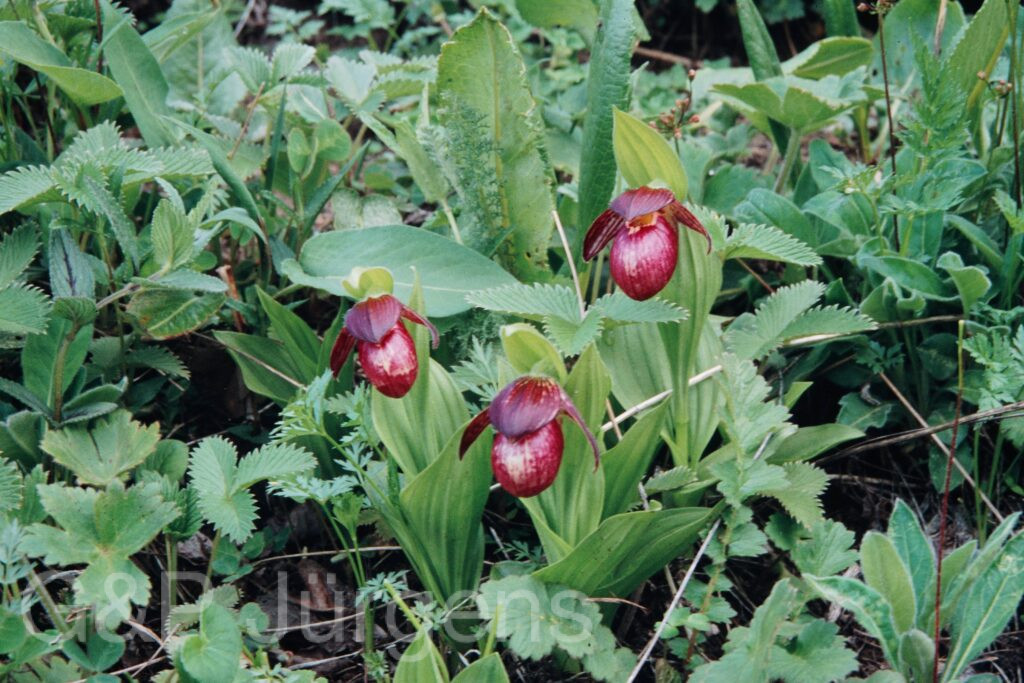
Description

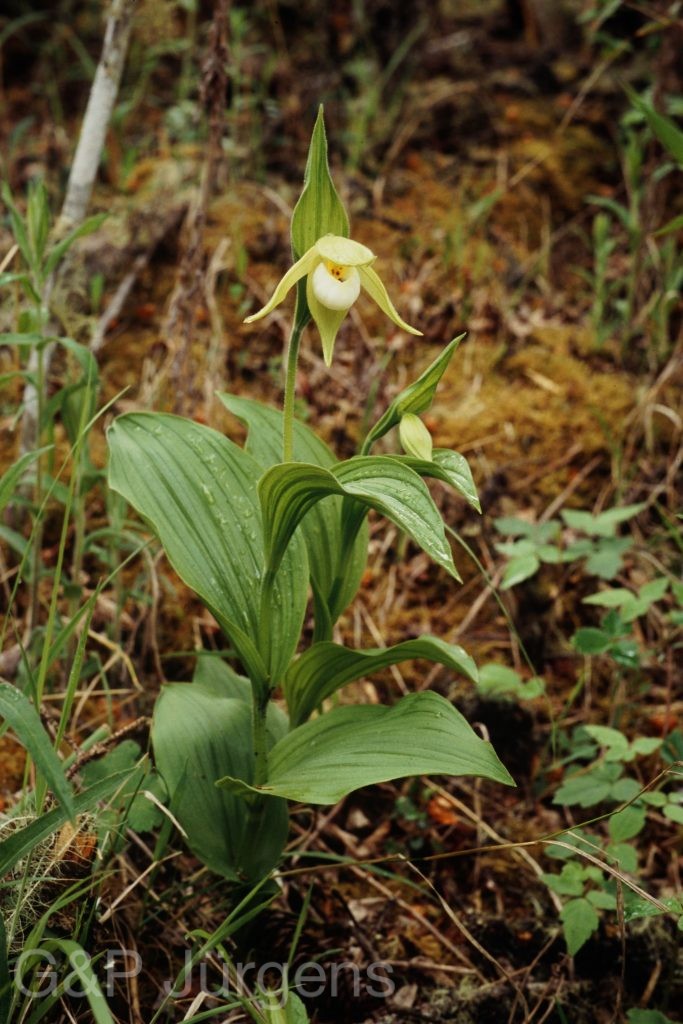
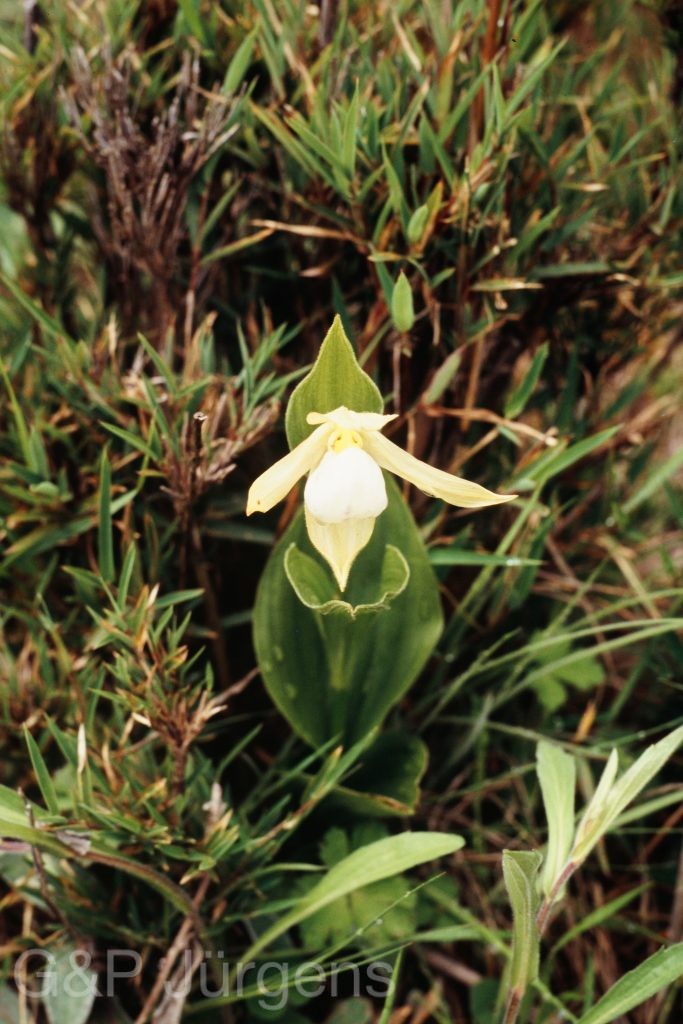
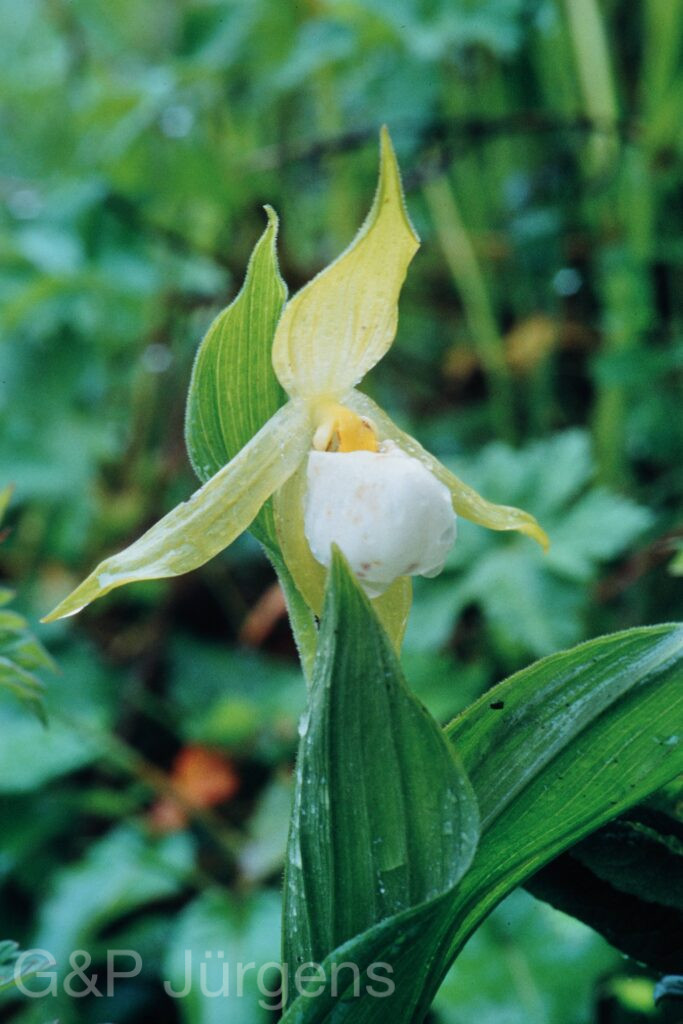
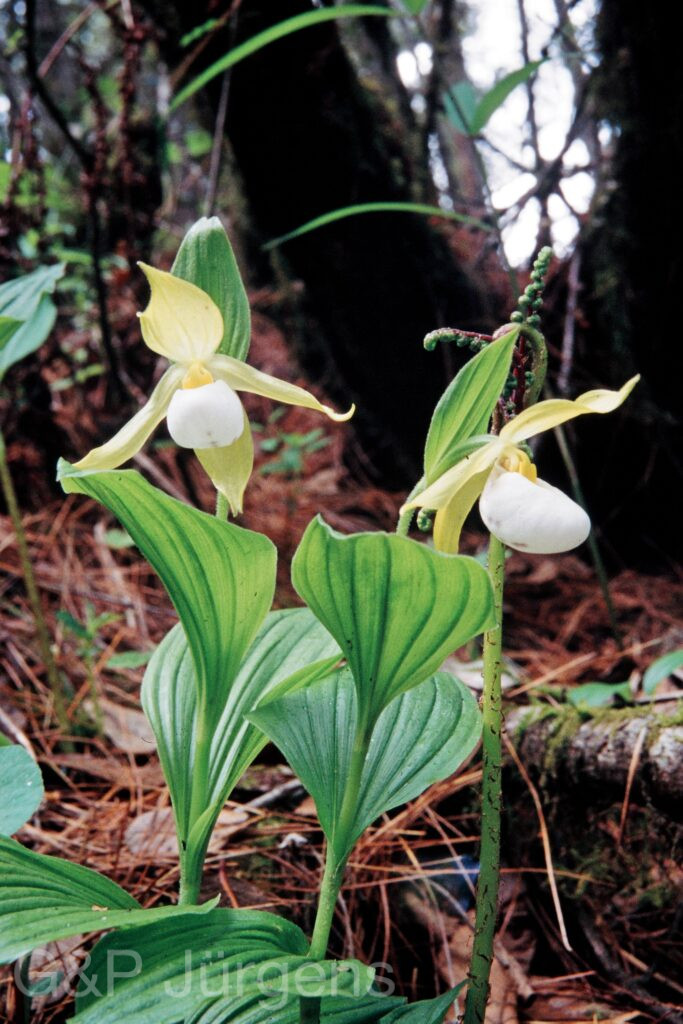
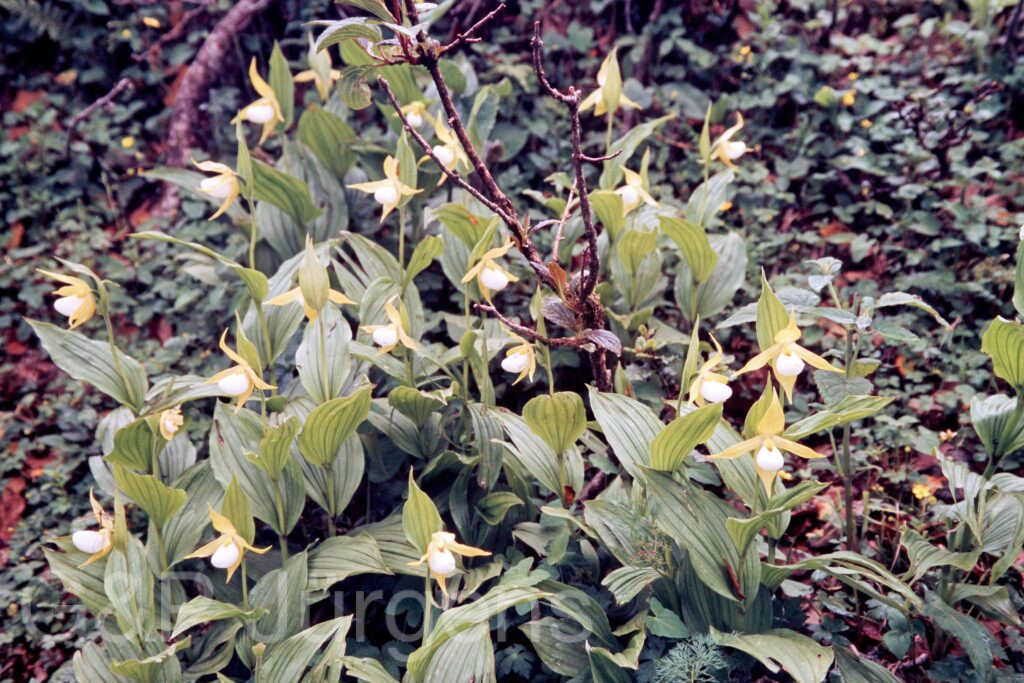
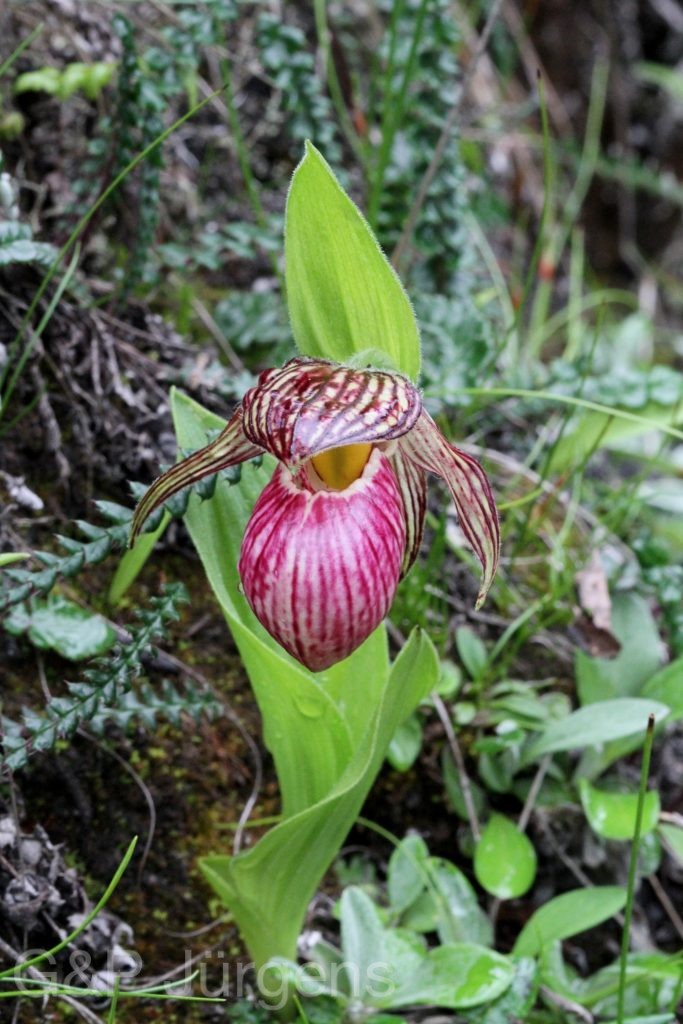
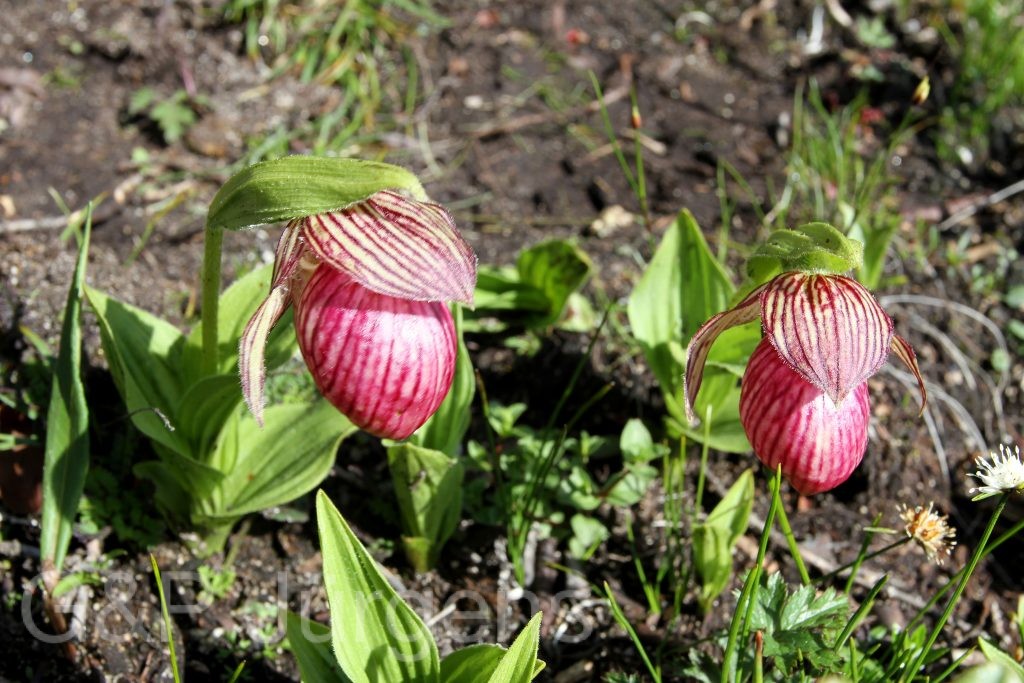
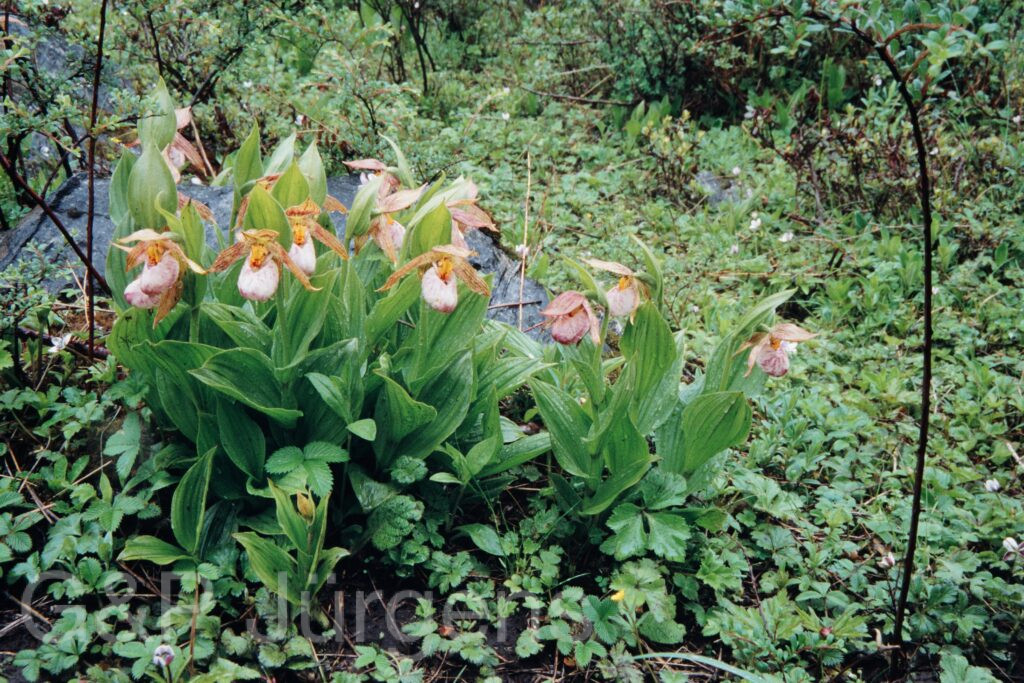
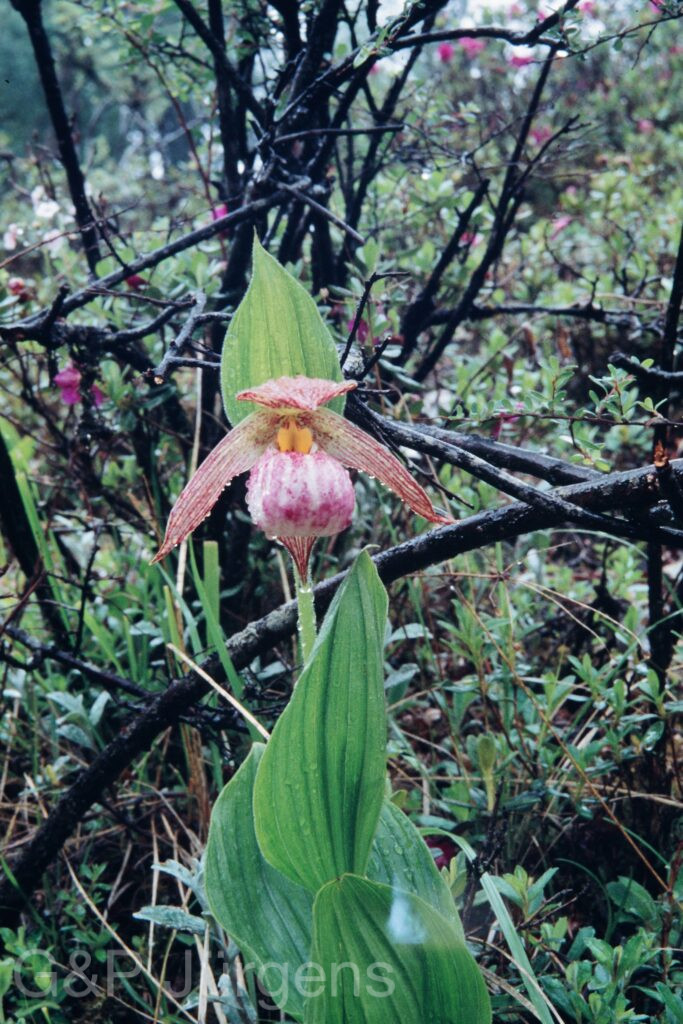
Cypripedium cordigerum, the Himalayan slipper orchid, ranges along the temperate Himalaya from Pakistan through India, Nepal and Bhutan into adjacent China, with 190 occurrences in GBIF. It grows in cool, humus-rich habitats: open coniferous and mixed forest, forest clearings, shrubberies and grassy alpine slopes, generally between 2700 and 4000 m. The gatherings figured span this band, from Bhutan's Yetong-La at 3000 m through West Nepal (Bhulbhule, Linji-Khola, 3200 m) to Garhwal's Panwali at 3200 m, all in June, illustrating its early-summer flowering on moist, partly shaded mountain soils as the growing season opens.

The plant arises from a short, creeping rhizome bearing thick fleshy roots, producing an erect, pubescent leafy stem 20-45 cm tall. The leaves are several, alternate, broadly elliptic to ovate, plicate (longitudinally folded) and clasping at the base. The flower is usually solitary and terminal, subtended by a leafy bract; the sepals and lateral petals are greenish to yellowish-white, lanceolate and somewhat twisted, while the labellum forms the characteristic inflated, slipper-shaped pouch, white often flushed pink within. The fertile anthers flank a shield-like staminode; the fruit is an erect, ribbed dehiscent capsule containing innumerable dust-like seeds.

Cypripedium (Orchidaceae, subfamily Cypripedioideae) comprises the temperate lady's-slipper orchids, employing deceptive trap-pollination whereby insects enter the pouch and exit past the anthers. The input family is given as "Orchideaceae"; the accepted family is Orchidaceae. Like its congeners, C. cordigerum depends on mycorrhizal associations and is slow to establish, making it vulnerable to collection and habitat loss; it is listed on CITES Appendix II and warrants conservation attention across its Himalayan range.

Author: D.Don · Sources: POWO (Kew), GBIF, Flora of Bhutan, Flowers of the Himalaya, The Genus Cypripedium (A Monograph)

Sw.

Bh09 317 P521
Bhutan Yetong-La, 3100m June

Description

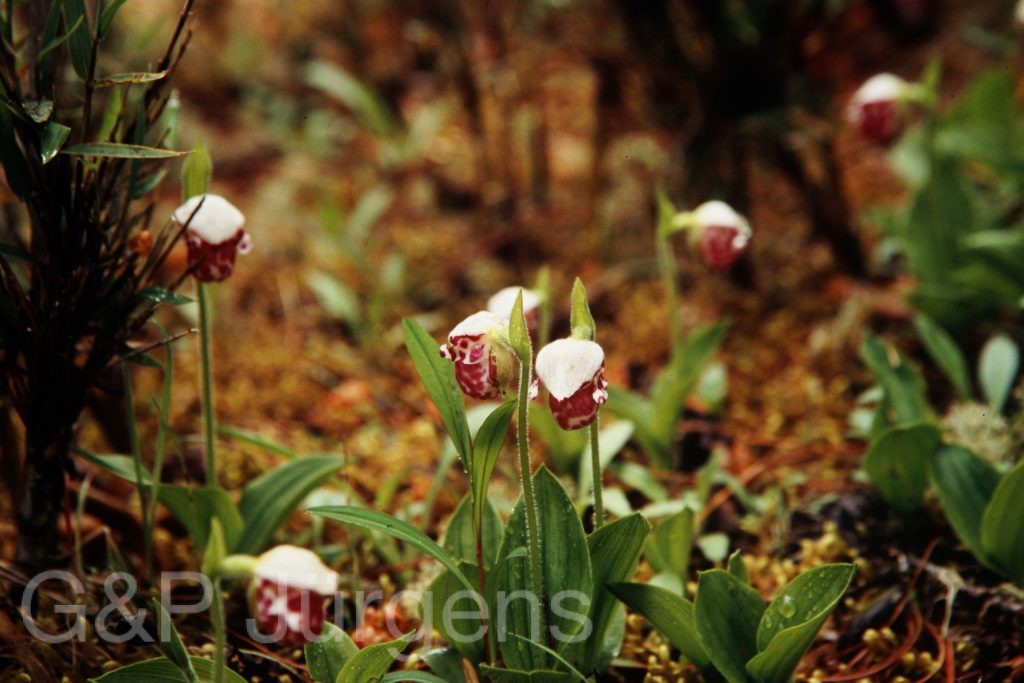
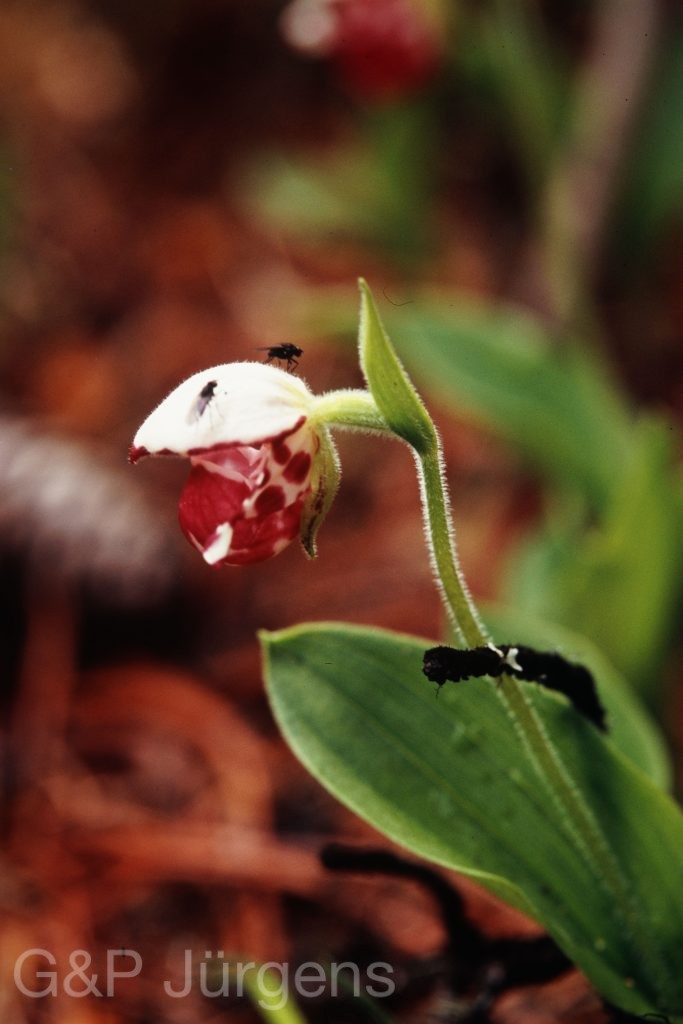
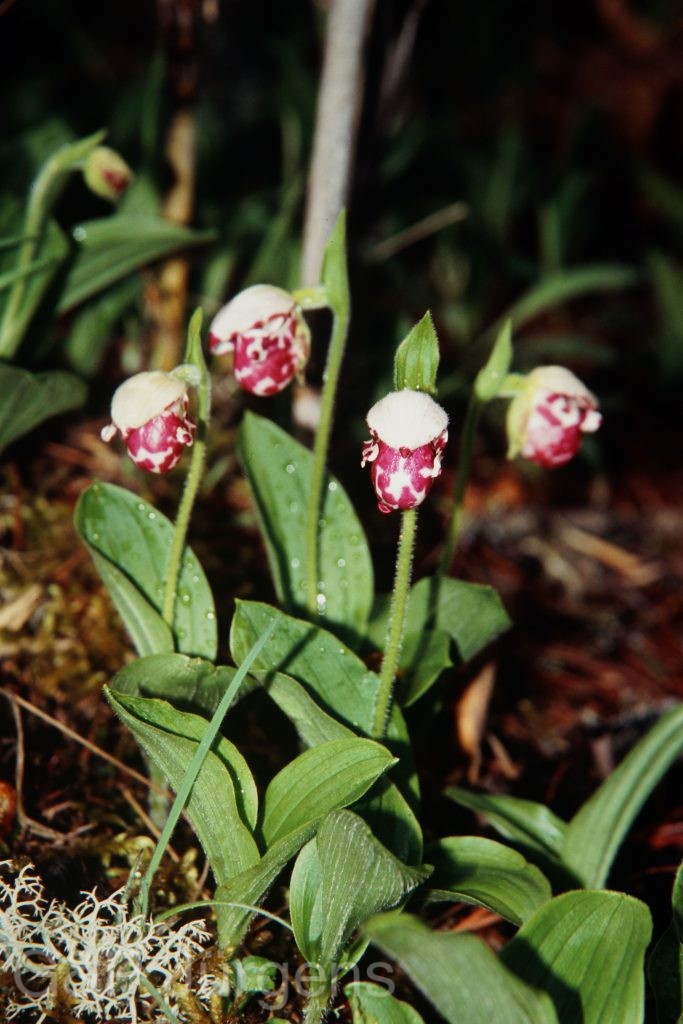
Cypripedium guttatum is a broadly circumboreal slipper orchid with one of the widest ranges in its genus, documented across Russia, China, Mongolia, Korea, Japan, Kazakhstan, Bhutan and into North America, the nearly 4900 records reflecting its extensive Eurasian-American boreal distribution. At the southern Himalayan limit of its range it ascends into cool montane forest, the images recording plants on the Yetong-La in Bhutan at about 3050 to 3100 m in June. It grows in coniferous and mixed woodland, forest margins, grassy clearings and on mossy, humus-rich or calcareous ground, typically in light shade with consistent soil moisture.

It is a small terrestrial orchid spreading by slender creeping rhizomes, often forming loose colonies. The erect stem bears usually two subopposite, broadly elliptic to ovate, plicate leaves with conspicuous parallel venation. A single terminal flower is produced; the characteristic inflated, pouch-shaped labellum and the sepals and petals are white boldly blotched and mottled with rose-purple to magenta, the lateral sepals being fused into a synsepal beneath the lip. As in all Cypripedium the column bears two fertile anthers and a shield-like staminode, and the flower offers no nectar reward, attracting small bee pollinators by deceit before the inferior ovary matures into a capsule of dust-like seeds.

The species is placed in section Trigonopedia of Cypripedium and is notable for its small stature and strikingly spotted bicoloured flower. Like other slipper orchids it depends on mycorrhizal fungi for seed germination and establishment, and reproduces both clonally via rhizomes and by minute wind-dispersed seed. Although its overall range is vast and it is locally abundant in parts of Siberia, populations at the range periphery, including the Himalaya, are sparse, and the species faces collection and habitat-loss pressures that warrant local conservation attention.

Author: Sw. · Sources: POWO (Kew), GBIF, Flora of China, Genera Orchidacearum (Cypripedioideae), Cribb monograph of the genus Cypripedium

Rolfe ex. Hemsl.

BhutanPG2011 188
Bhutan Tsochenchen, 3600m June
BhutanPG2011 794
Bhutan Chele-La, 3850m July
Nepal 99 48 ergebnis
West-Nepal Nyor Gaad 2700m, June
Nepal 99 51 ergebnis
West-Nepal Nyor Gaad 2700m, June
Nepal 99 370 ergebnis
West-Nepal Nyor Gaad 2700m, June

Description

Cypripedium himalaicum is a terrestrial slipper orchid native to the eastern Himalayas, found in Bhutan, Nepal, Sikkim, and southern Tibet. It grows in alpine meadows and open forests at elevations of 3,000 to 4,500 m.

The plant reaches 15–35 cm in height, bearing one or two broadly elliptic leaves. The solitary flower is distinctive: the dorsal sepal is greenish-white with purple veins, the petals are narrow and twisted, and the lip forms a large inflated pouch, pale yellowish-green with purple spotting. Flowering occurs from May to July.

Cypripedium himalaicum is one of the highest-altitude slipper orchids in the world. It is classified as vulnerable due to habitat loss and overcollection. All Cypripedium species are listed under CITES Appendix II.

Author: Rolfe ex. Hemsl. · Sources: POWO (Kew), Flora of Bhutan, CITES Checklist

(D.Don) Hutch.

Bhutan2012 477
Bhutan Pele-La 3300m, June

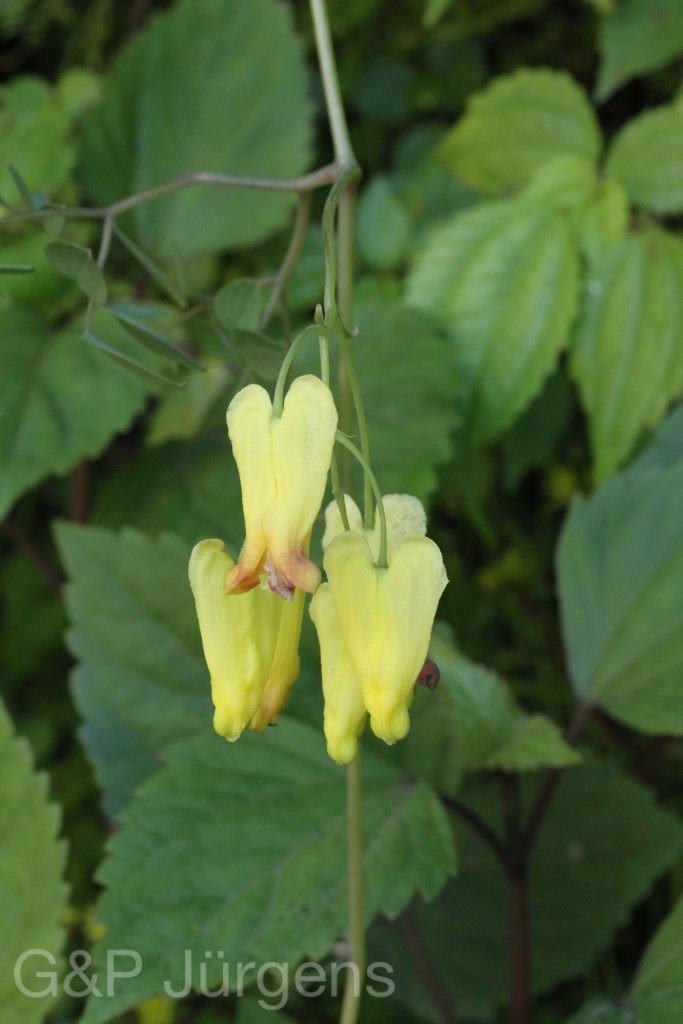
Description

Dactylicapnos scandens is a climbing fumitory of the Himalaya and adjacent China and Indochina, native across China, India, Nepal, Bhutan, Myanmar, Vietnam, Thailand and Sri Lanka; its more than 300 GBIF records include numerous cultivated and naturalised occurrences in Europe, North America and New Zealand, reflecting its popularity as an ornamental climber. It grows in moist temperate forest, thickets and shrubby clearings, scrambling over other vegetation, mostly between about 1500 and 3300 m. The plant shown from Pele-La in Bhutan at 3300 m, flowering in June, sits at the upper edge of this range in cool broadleaved and conifer forest.

It is a herbaceous to suffrutescent perennial climber with slender, much-branched stems clinging by means of branched, tendril-like leaflet tips. The leaves are alternate, two- to three-pinnately compound and glaucous, the ultimate segments small and ovate, the terminal portions modified into coiling tendrils. The flowers hang in pendulous racemes and are zygomorphic with two bilaterally symmetrical, spurred or saccate outer petals enclosing two inner petals, the whole corolla bright golden-yellow. The fruit is an elongate, several-seeded capsule that dehisces to release shining black seeds, each bearing an elaiosome.

Dactylicapnos was separated from Dicentra and Corydalis on the basis of its climbing habit, tendrillate leaves and capsular fruit. D. scandens, based on D. Don's Fumaria scandens and transferred by Hutchinson, is widespread and not threatened, and its toxic isoquinoline alkaloids have attracted pharmacological interest in traditional medicine.

Author: (D.Don) Hutch. · Sources: POWO (Kew), GBIF, Flora of Bhutan, Flora of China, Lidén & Fukuhara revision of Dactylicapnos

(W.W.Sm. & Cave) B.L.Burtt

Nepal 97 130 P229
Nepal Mewa-Khola 2600m April
Nepal1992 238 W349 ergebnis
Nepal Kyapra 2800m March 
Nepal1992 108 W148 ergebnis
Nepal Kyapra 2800m March 

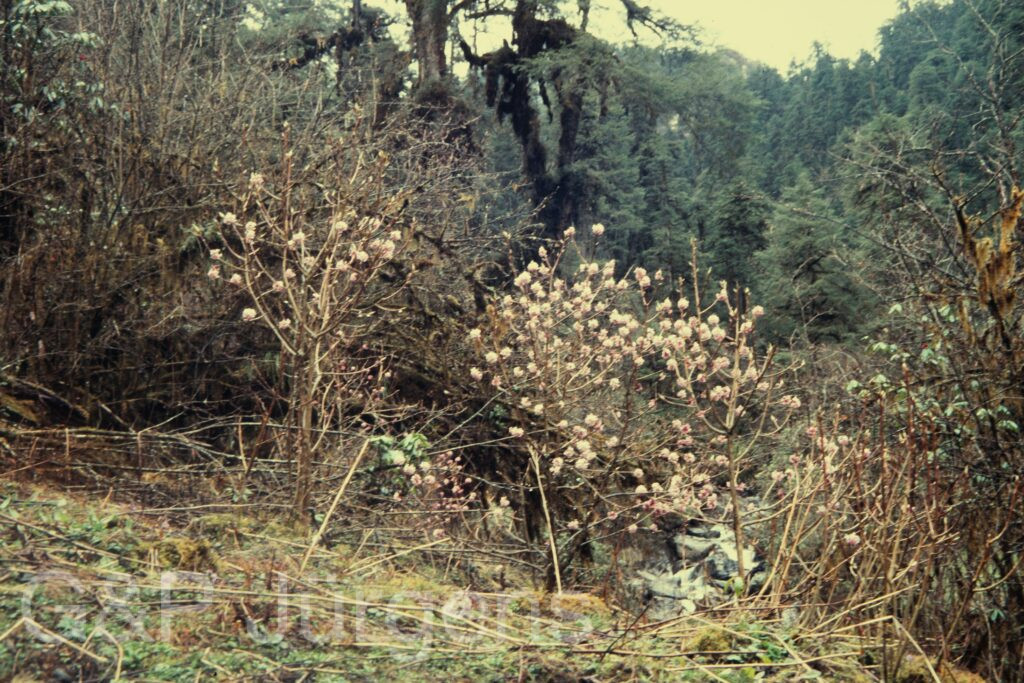
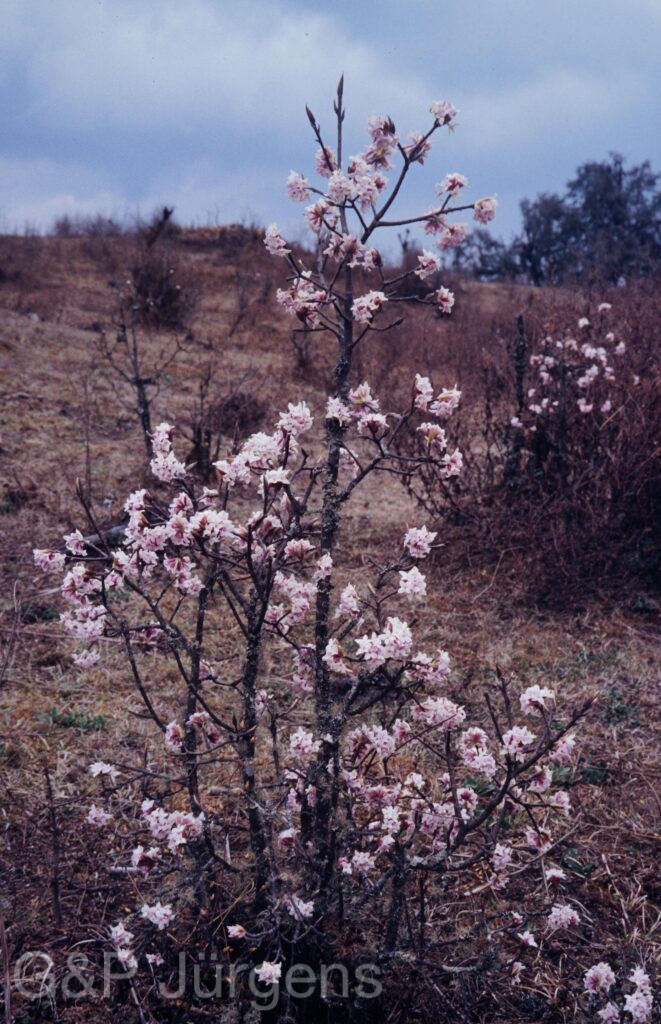
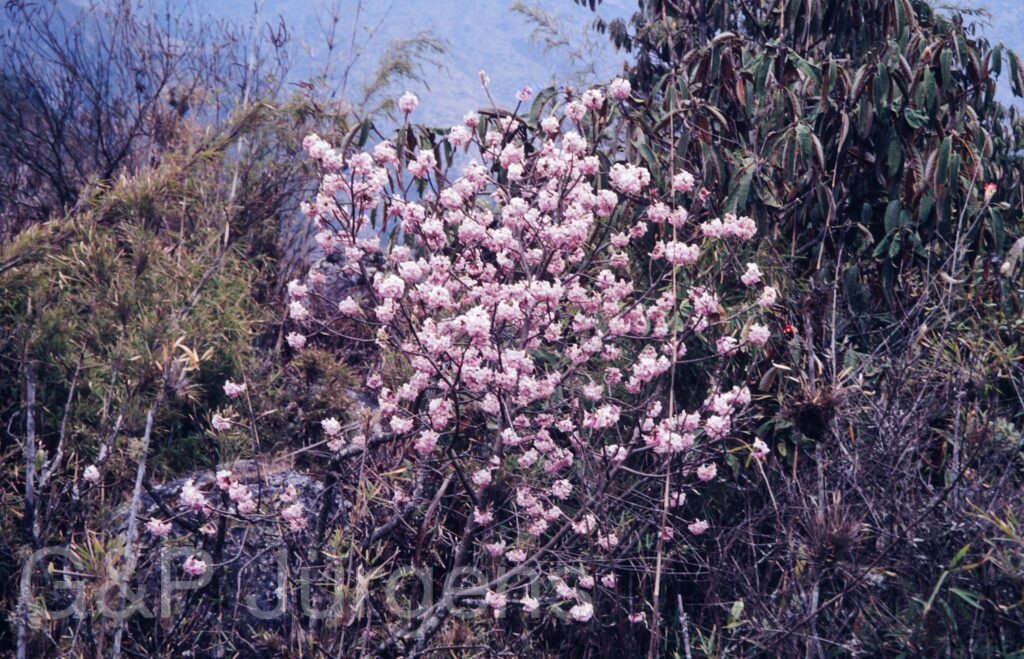
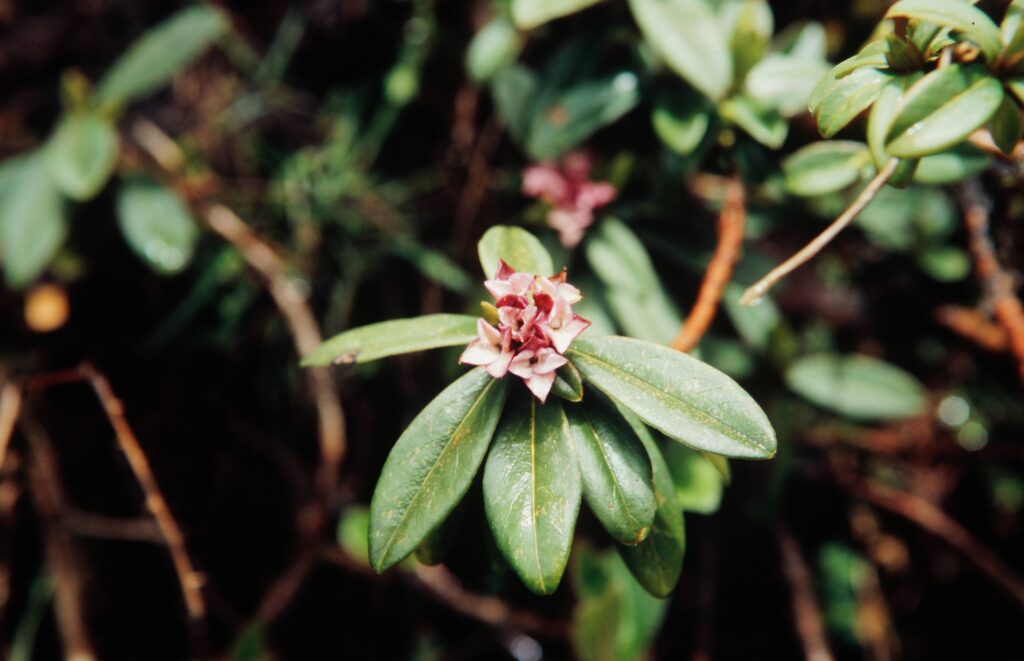
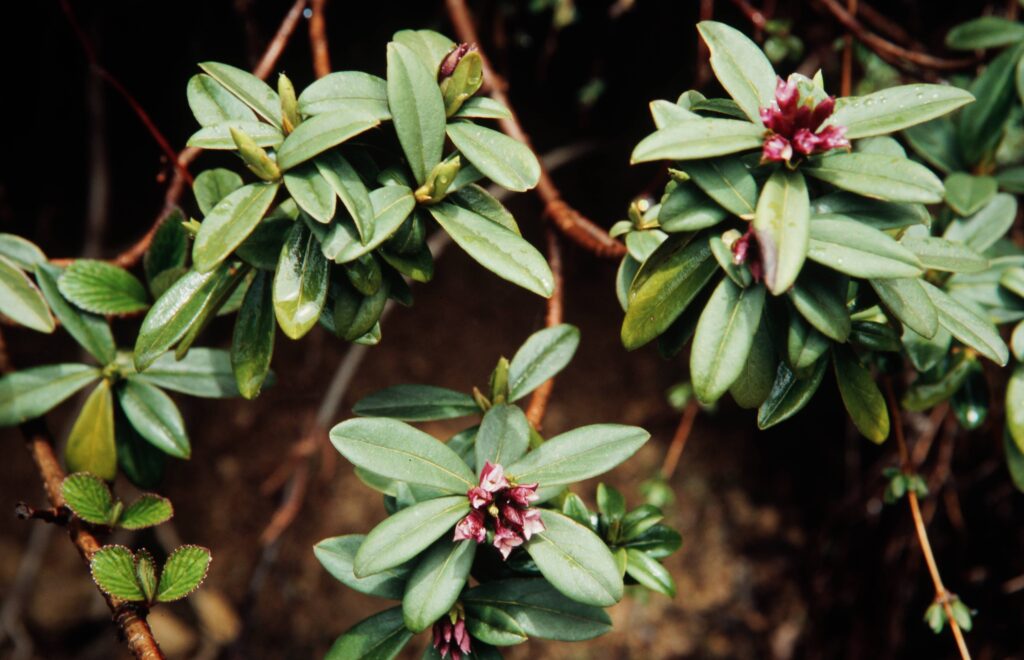
Description

Daphne bholua var. glacialis is a Himalayan variant of the paper daphne, distributed across the China-Nepal-India sector of the range, with about 79 GBIF occurrences. It grows in cool temperate forest and forest-edge scrub, in clearings, on shrubby slopes and along ridges, on moist but well-drained humus-rich soils, frequently with rhododendron, oak and conifers. The collections illustrated from the Mewa Khola at 2600 m in April and from Kyapra at 2800 m in March, both in eastern Nepal, are characteristic of its range of roughly 2400-3500 m, where it flowers in late winter and early spring; the epithet glacialis alludes to this hardy, high-cold habitat where the smaller-leaved form prevails.

This variety is a much-branched erect shrub typically 1-2.5 m tall, with tough, fibrous, pliant bark. The leaves are alternate, leathery, elliptic to oblanceolate, entire and glossy above, clustered toward the branch tips and more readily deciduous than in the typical variety. The fragrant flowers are borne in dense terminal and subterminal clusters; lacking petals, the showy perianth consists of a slender hypanthial tube expanding into four spreading lobes that are pinkish-purple outside and paler within, intensely scented. Eight stamens are inserted in two whorls within the tube, and the superior ovary ripens into a small ovoid drupe that turns black.

The taxon is treated by POWO as variety glacialis of Daphne bholua, distinguished from the typical form chiefly by its more deciduous, smaller leaves and tolerance of higher, colder sites. Like other Himalayan daphnes its bark yields strong fibre used in handmade lokta paper, and the whole plant contains acrid, irritant compounds. It is prized in horticulture for its winter fragrance; wild populations can be affected by bark harvesting and habitat clearance.

Author: (W.W.Sm. & Cave) B.L.Burtt · Sources: POWO (Kew), GBIF, Flora of China, Flora of Nepal, Halda The Genus Daphne, Brickell & Mathew Daphne monograph

Maxim.

BhutanPG2011 486 scaled
Bhutan Ludlow-Sherriff-Trail Warrtlang-La, 4350m June

Description

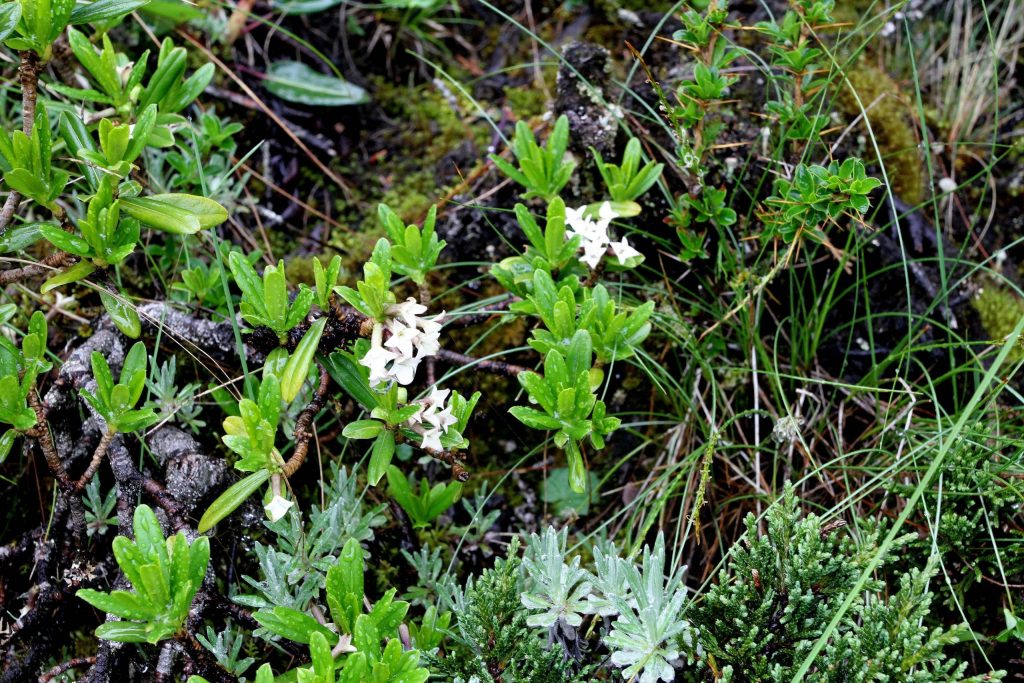
Daphne tangutica is distributed across a broad elevational and geographical range from the eastern Himalayas to central and western China, with the core of its distribution in Sichuan, Gansu, and Qinghai provinces. GBIF records over 1,150 occurrences, predominantly from China, with additional records from Bhutan, India, Nepal, and Pakistan. The species inhabits Rhododendron scrub, alpine meadows, rocky slopes, and open coniferous forest margins at 2,500–4,500 m elevation. Collections from Tamrong in West Bengal at 3,200 m and from the Warrtlang-La along the Ludlow–Sherriff Trail in Bhutan at 4,350 m demonstrate its remarkable altitudinal amplitude within the eastern Himalayan region.
Daphne tangutica is an evergreen shrub, typically 0.5–1.5 m tall, compact and densely branched. Leaves are alternate, clustered towards the branch tips, oblanceolate to elliptic, 3–8 cm long, coriaceous, dark glossy green above and paler beneath, with entire revolute margins. Flowers are borne in dense terminal clusters of 3–8, each flower with a tubular hypanthium 10–14 mm long, the four spreading lobes white internally and purplish-rose externally. The flowers are intensely fragrant. Stamens are eight, in two whorls, inserted on the hypanthium tube. The fruit is an ovoid drupe, 6–8 mm long, red at maturity, containing a single seed.
Daphne tangutica was described by Maximowicz in 1882 from material collected in Gansu. It is closely related to D. retusa, and the two species have been confused in herbaria; D. tangutica is generally distinguished by its longer, more lanceolate leaves and more elongate hypanthium tube. The occurrence at 4,350 m on the Warrtlang-La approaches the upper limit for any Daphne species in the Himalayas and attests to the species' tolerance of extreme alpine conditions. It has been widely introduced into horticulture in Europe and North America, prized for its fragrant spring flowers and compact evergreen habit.

Author: Maxim. · Sources: POWO (Kew), GBIF, Flora of China Vol. 13, Flora of Bhutan Vol. 2, Brickell & Mathew: Daphne — The Genus in the Wild and in Cultivation (1976)

Munz

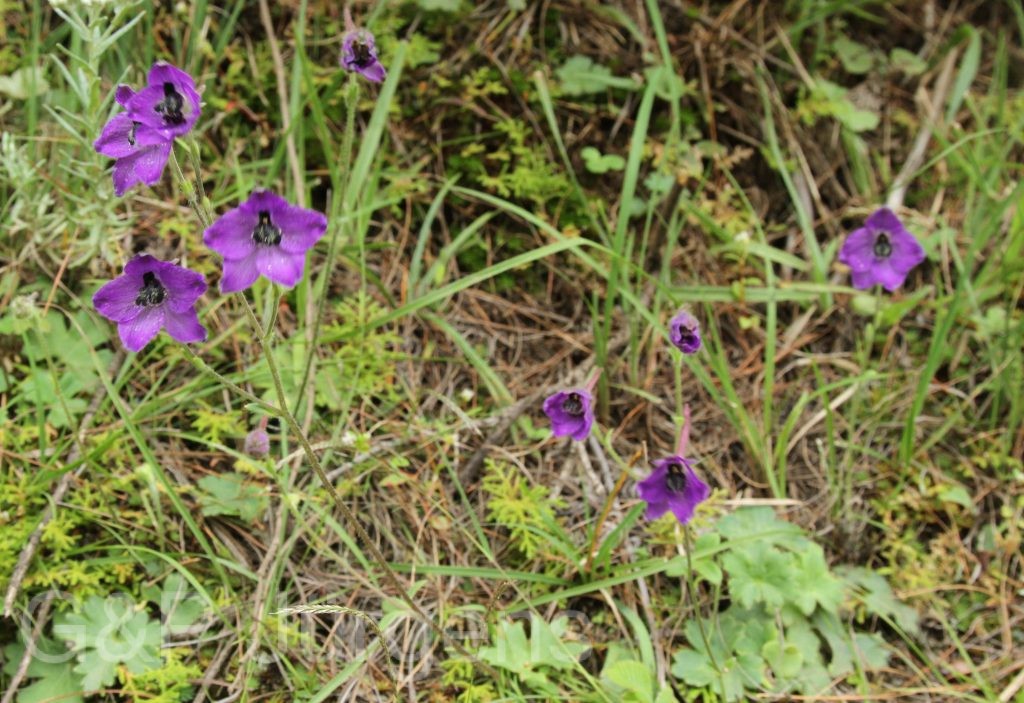
Bhutan2012 184
Bhutan Haar-Valley, 3200m September
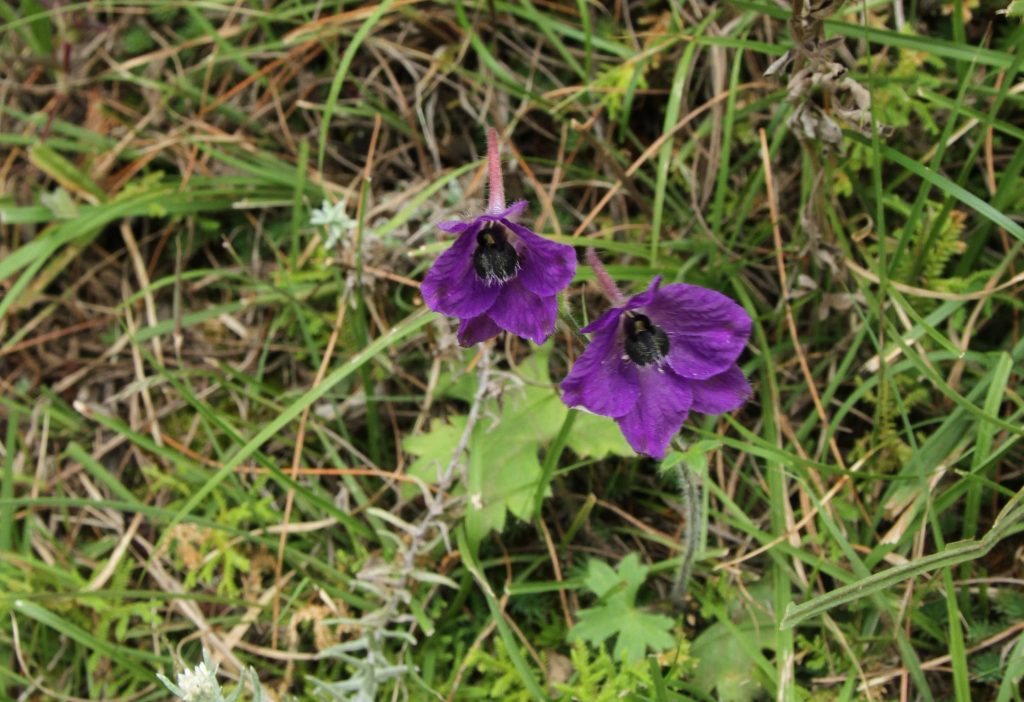
Bhutan2012 185
Bhutan Haar-Valley, 3200m September

Description

Delphinium cooperi is a Himalayan larkspur of restricted range, recorded principally from Bhutan and Nepal, with only about 42 GBIF occurrences reflecting its narrow distribution. It grows on open alpine and subalpine slopes, meadow margins and among scrub in cool, moist montane settings. The photographed plant in the Haa (Haar) valley of western Bhutan at 3200 m, flowering in September, captures its late-season anthesis in the high inner valleys, where it occupies humus-rich, well-drained ground in a cool, monsoon-influenced climate. Its limited recorded range marks it as a regional endemic of the eastern Himalaya.

The species is an erect perennial herb arising from a fibrous or somewhat thickened rootstock. The leaves are palmately divided into several cuneate, toothed or further-lobed segments, larger and longer-petiolate toward the base and reduced upward. The inflorescence is a terminal raceme of zygomorphic flowers in shades of blue to violet; as in all Delphinium the upper sepal is prolonged backward into a conspicuous spur that encloses the nectariferous petal spurs. Stamens are numerous and the gynoecium of free carpels matures into a cluster of erect, many-seeded follicles that split along the inner suture to shed angular seeds.

Delphinium belongs to the buttercup family Ranunculaceae, within the tribe Delphinieae characterised by spurred, bilaterally symmetrical flowers. The long-spurred corolla of D. cooperi is adapted to pollination by long-tongued bumblebees that probe the nectar spurs. As with many members of the genus, the plant contains toxic diterpenoid alkaloids that deter grazing. Given its apparently narrow eastern-Himalayan range and modest population records, the species warrants attention as a potentially vulnerable regional endemic dependent on intact subalpine habitat.

Author: Munz · Sources: POWO (Kew), GBIF, Flora of Bhutan, Annotated Checklist of the Flowering Plants of Nepal, Munz Delphinium monograph

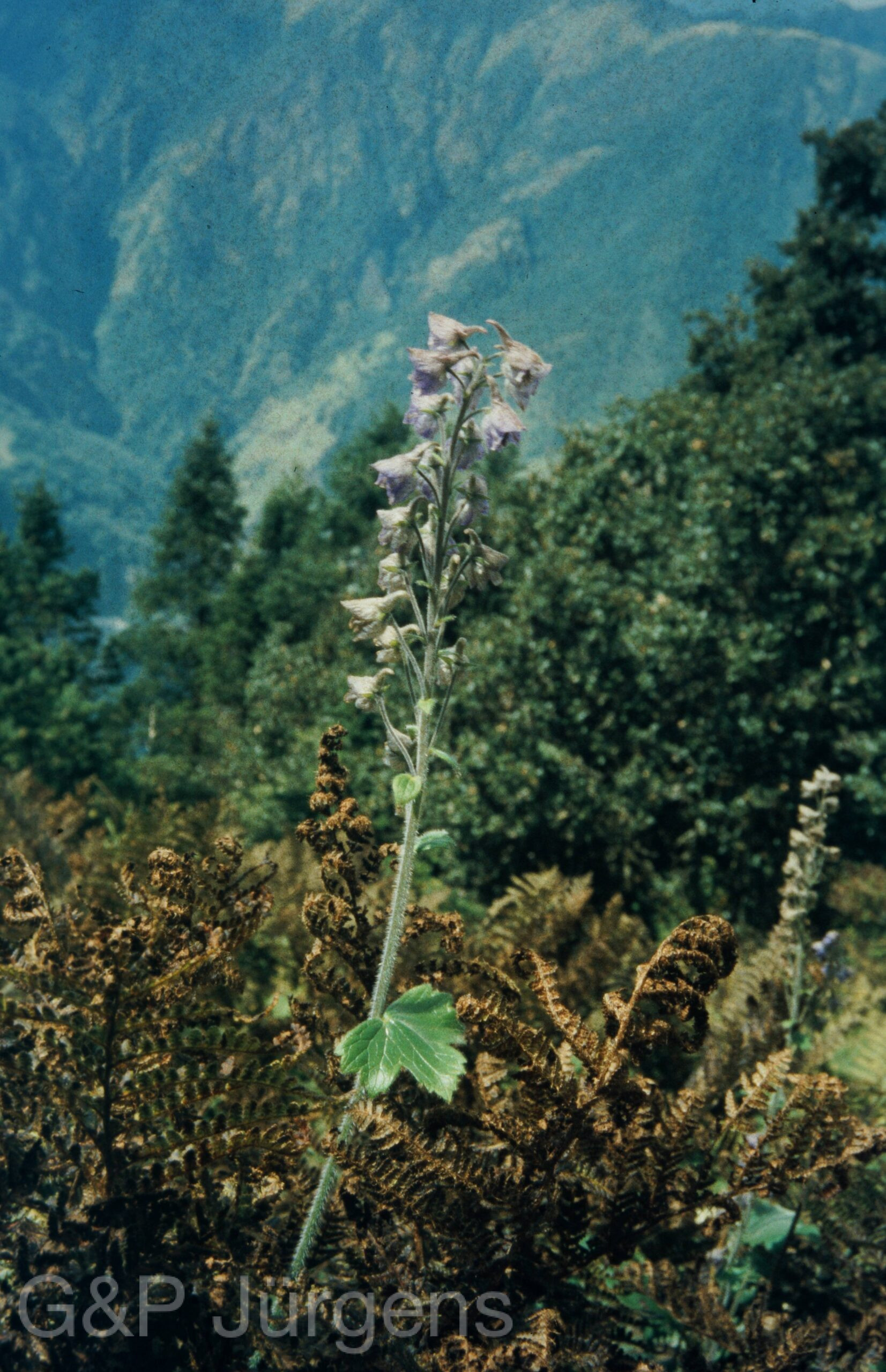
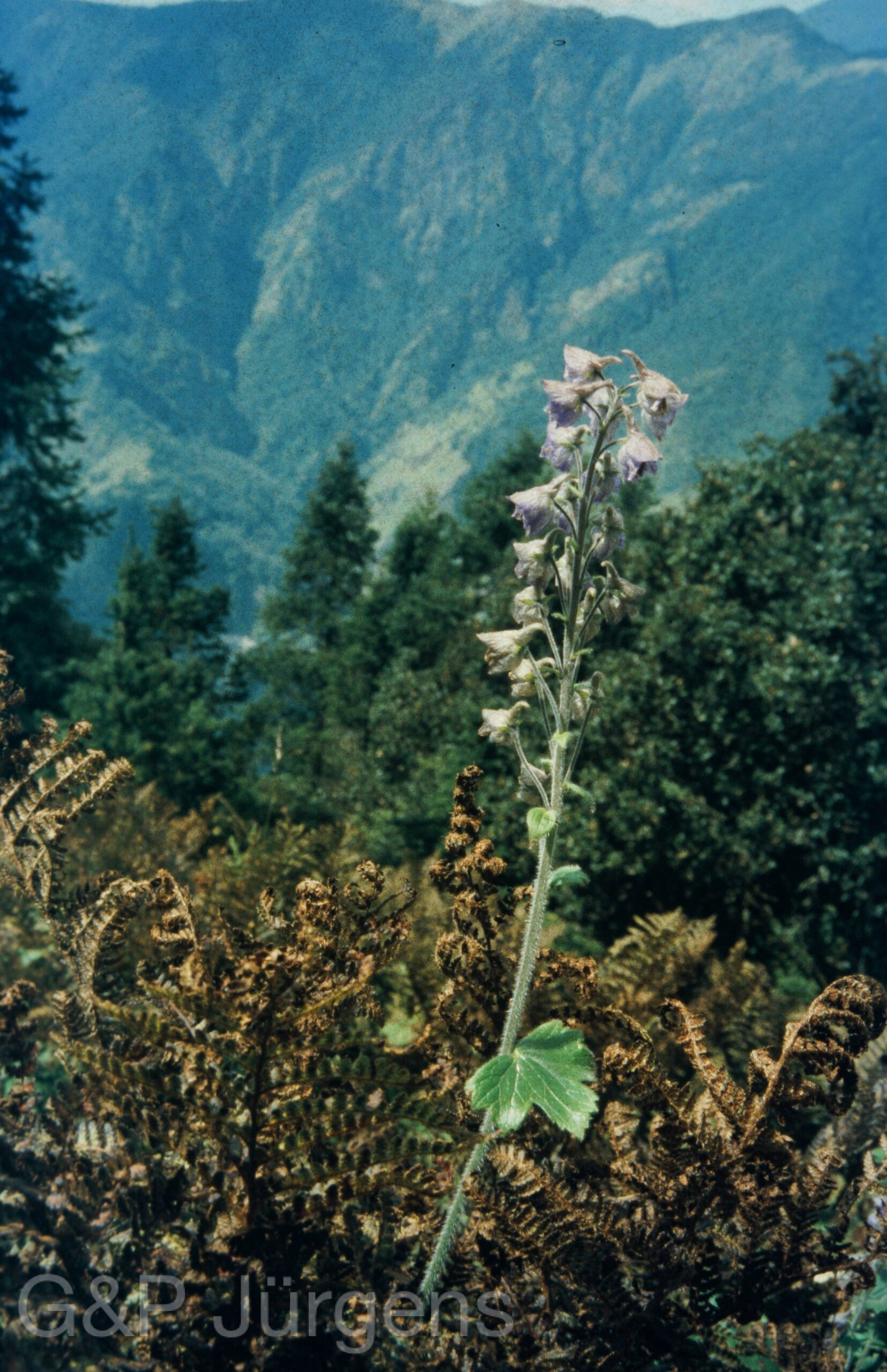
Duthie ex Huth

Description

Delphinium densiflorum is a herbaceous perennial of the western and central Himalaya, recorded from India, Nepal and adjacent China (Xizang), with some 70 georeferenced occurrences documented in GBIF. It inhabits subalpine and alpine meadows, open slopes, forest margins and rocky grassland, where it flowers in the late monsoon. The plant illustrated was photographed in the Indian Garhwal Himalaya near Ali at about 3140 m in September, a typical elevation; across its range it generally occupies the belt from roughly 2800 to 4000 m, favouring moist, well-drained soils with abundant summer rainfall.

The species forms an erect, simple or branched stem arising from a fibrous to slightly tuberous rootstock, clothed below with petiolate, palmately divided leaves whose laminae are deeply cut into narrow, toothed lobes. As the specific epithet implies, the inflorescence is a dense, many-flowered raceme of strongly zygomorphic flowers. Each flower has five petaloid sepals, the uppermost prolonged into a conspicuous backward-pointing spur, and small petals modified into nectaries concealed within. The flowers are typically deep blue to violet; the fruit is a cluster of several erect, beaked follicles releasing numerous angular, scaly seeds.

Delphinium densiflorum belongs to the large genus Delphinium (Ranunculaceae), of which the Himalaya is a notable centre of diversity. Like other larkspurs it contains diterpenoid alkaloids and is poisonous to grazing livestock, a trait that influences its persistence in heavily pastured alpine meadows. The spurred flowers are adapted to pollination by long-tongued bumblebees. No major conservation concern is recognised, though localised pressure from grazing and habitat disturbance affects subalpine populations across the region.

Author: Duthie ex Huth · Sources: POWO (Kew), GBIF, Flora of China, Flora of Bhutan, Annotated Checklist of the Flowering Plants of Nepal, Munz Monograph of the Genus Delphinium