Tag:

Subalpine (2500-3500 m)

Wall. ex Lindl.

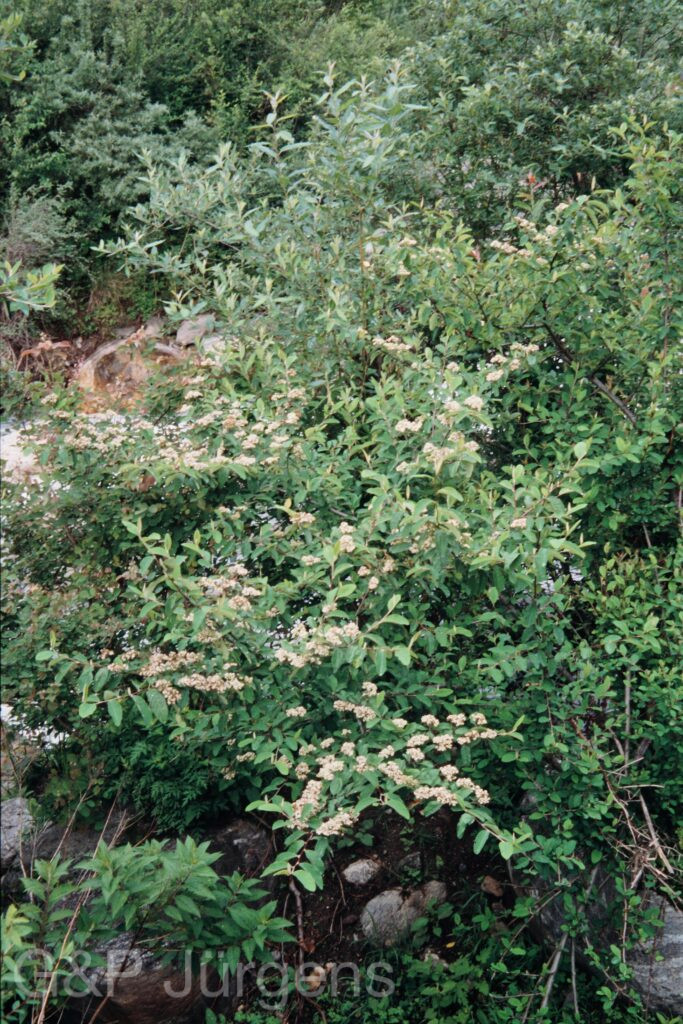
Nepal 99 567 ergebnis
West-Nepal Hurikot 2700m, June

Description

Cotoneaster frigidus is a large shrub or small tree native to the Himalaya, recorded from Nepal, India, Bhutan and China, with its many further records from Britain, New Zealand, the United States and continental Europe reflecting its long history in cultivation and naturalisation. In the wild it occupies open slopes, forest margins, scrub and ravines in the temperate Himalayan zone, typically between about 1800 and 3000 m. The plant photographed at Hurikot in West Nepal at 2700 m in June is a representative wild occurrence in the moist temperate hill forest belt, flowering as the summer monsoon approaches.

It is a vigorous, semi-deciduous shrub or small tree with arching, spreading branches and grey-brown bark. The leaves are alternate, elliptic to oblong, dark green and glabrous above and grey-tomentose beneath when young, with an entire margin and a short petiole. The small, white, five-petalled flowers are borne in dense, many-flowered, flat-topped corymbs and have numerous stamens and a half-inferior ovary. The fruit is a small, bright red, globose pome borne in heavy, conspicuous clusters that persist into winter, each containing usually two pyrenes.

Cotoneaster is a taxonomically intricate genus of the Rosaceae, subfamily Amygdaloideae (Maloideae), in which apomixis and hybridisation have generated many microspecies. Cotoneaster frigidus is among the largest-growing and most ornamental species and is the parent of widely grown garden hybrids such as the 'Cornubia' group; in parts of Britain and elsewhere it has escaped to become naturalised. Its abundant red pomes are eaten and dispersed by birds, while the nectar-rich flowers attract bees, making it ecologically valuable in both its native and introduced ranges.

Author: Wall. ex Lindl. · Sources: POWO (Kew), GBIF, Flora of China, Annotated Checklist of the Flowering Plants of Nepal, Flora of Bhutan, Fryer & Hylmö's Cotoneasters monograph
Wall. ex Lindl.

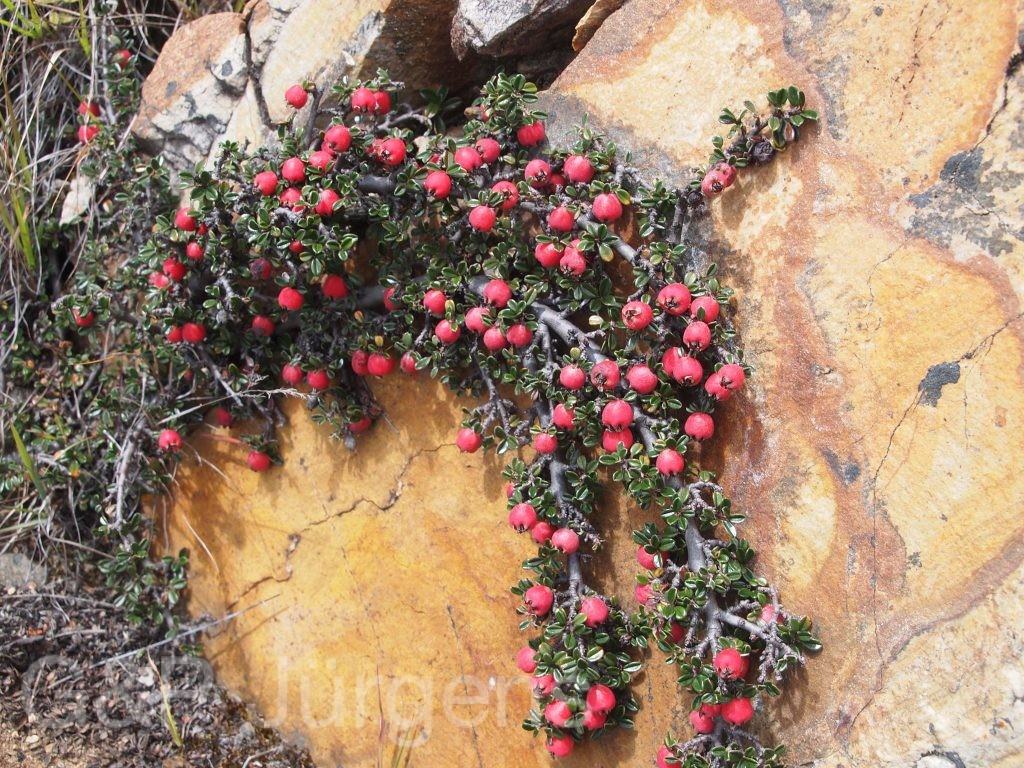
Bhutan2012 894
Bhutan Tumching-La 3850m, October
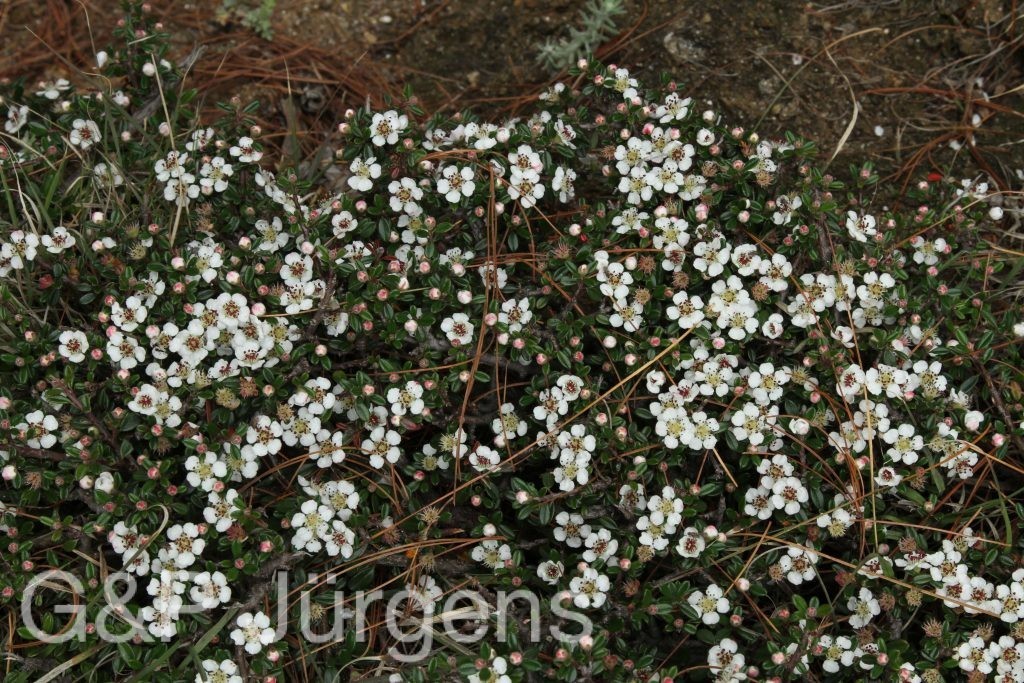
Bhutan2014 410
Bhutan Yatong-La 2900m, May
Bhutan2014 409
Bhutan Yatong-La 2900m, May

Description

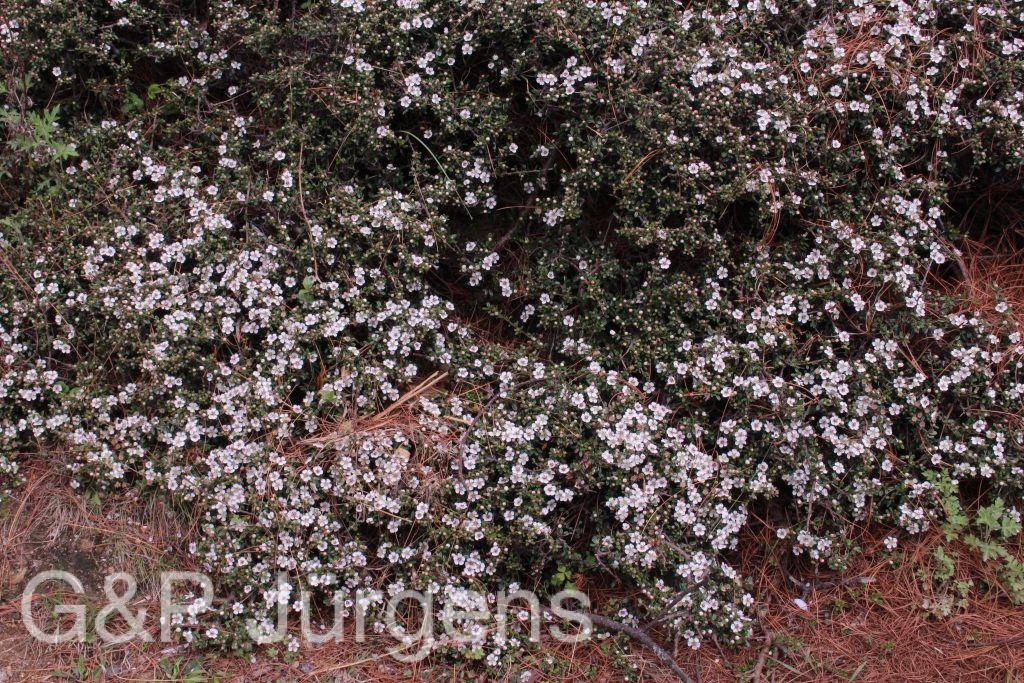
Cotoneaster microphyllus is a small-leaved, prostrate to spreading shrub native to the Himalaya and western China, recorded from Pakistan, Nepal, India, Bhutan and China; extensively grown as a groundcover and rock-garden plant, it has naturalised widely, giving GBIF records from Great Britain, Ireland, France, Germany, the United States, Australia and New Zealand among some 2800 occurrences. In its native range it grows on rocky slopes, cliff ledges, open hillsides and amid alpine scrub from the temperate to subalpine zone. The images document it in Bhutan at Tumching-La near 3850 m in October, when the fruit is ripe, and at Yatong-La around 2900 m in May at flowering.

It is an evergreen, much-branched shrub with rigid, spreading to procumbent branches, the young shoots strigose. The leaves are small, 4-10 mm, obovate to elliptic, dark glossy green and glabrescent above, grey-tomentose beneath, with revolute margins. The flowers are solitary or in pairs, with white, spreading petals, numerous stamens with reddish anthers, and two carpels. The fruit is a globose pome 5-8 mm in diameter, bright crimson to scarlet, crowned by the persistent calyx, conspicuous against the dark foliage and persisting into winter.

Cotoneaster microphyllus belongs to a taxonomically intricate, largely apomictic complex within the genus, in which many microspecies have been segregated and circumscriptions remain contentious; much horticultural material formerly under this name belongs to related taxa. Apomixis fixes minor variants as discrete lineages. The bird-dispersed fruit accounts for its frequent escape and naturalisation, and in some regions it is regarded as a minor invasive. The wild species is common and of least conservation concern.

Author: Wall. ex Lindl. · Sources: POWO (Kew), GBIF, Flora of China, Flora of Bhutan, Flora of British India, Fryer & Hylmö Cotoneasters: A Comprehensive Guide

C.B.Clarke

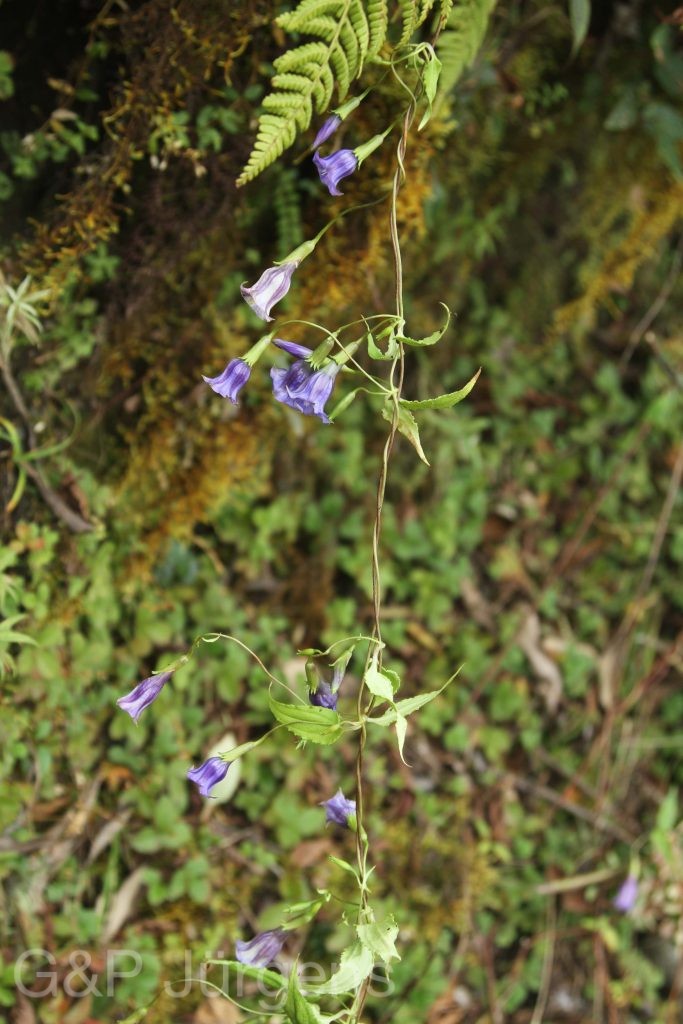
Bhutan2015 592
Bhutan Mo-Chu 1900m, October
Bhutan2015 594
Bhutan Mo-Chu 1900m, October
Bhutan2012 938 scaled
Bhutan Tumching-La 3200m, October
Bhutan2012 936
Bhutan Tumching-La 3200m, October

Description

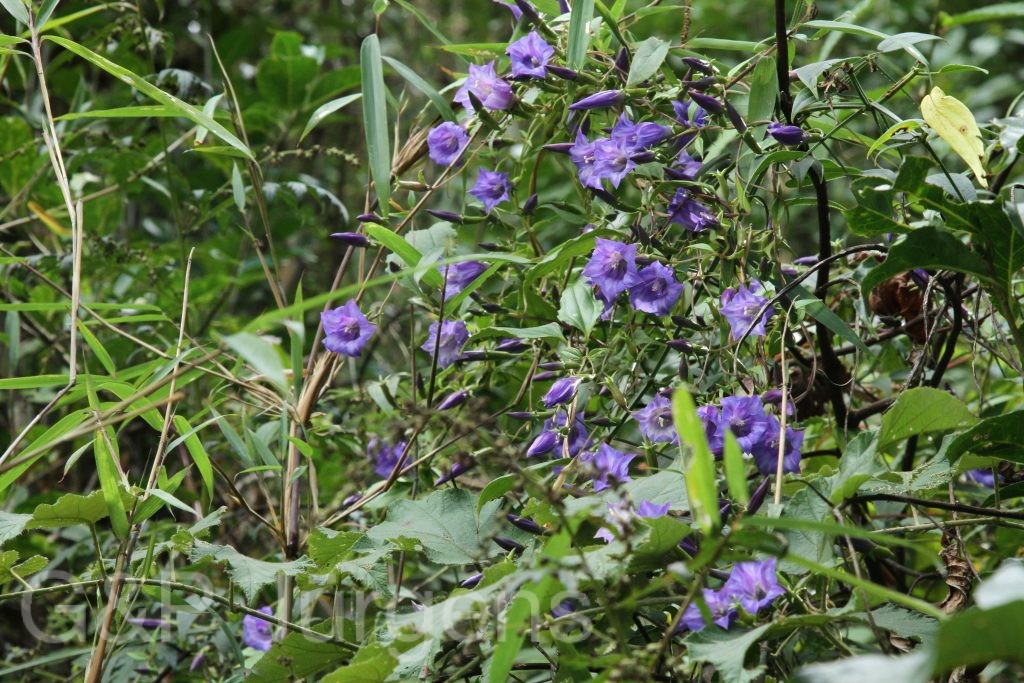
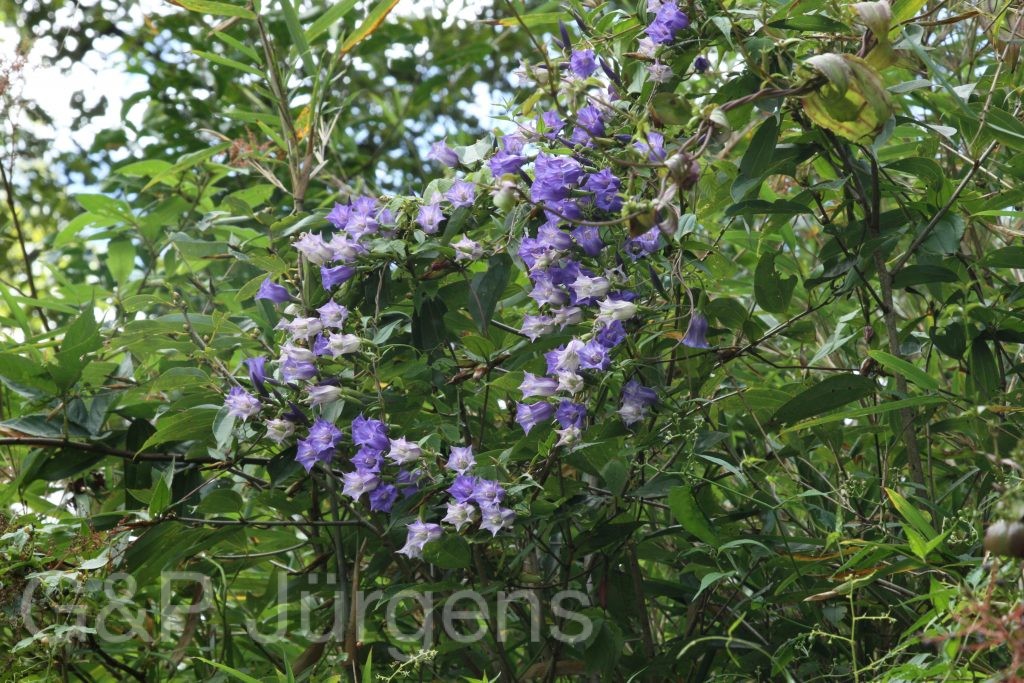
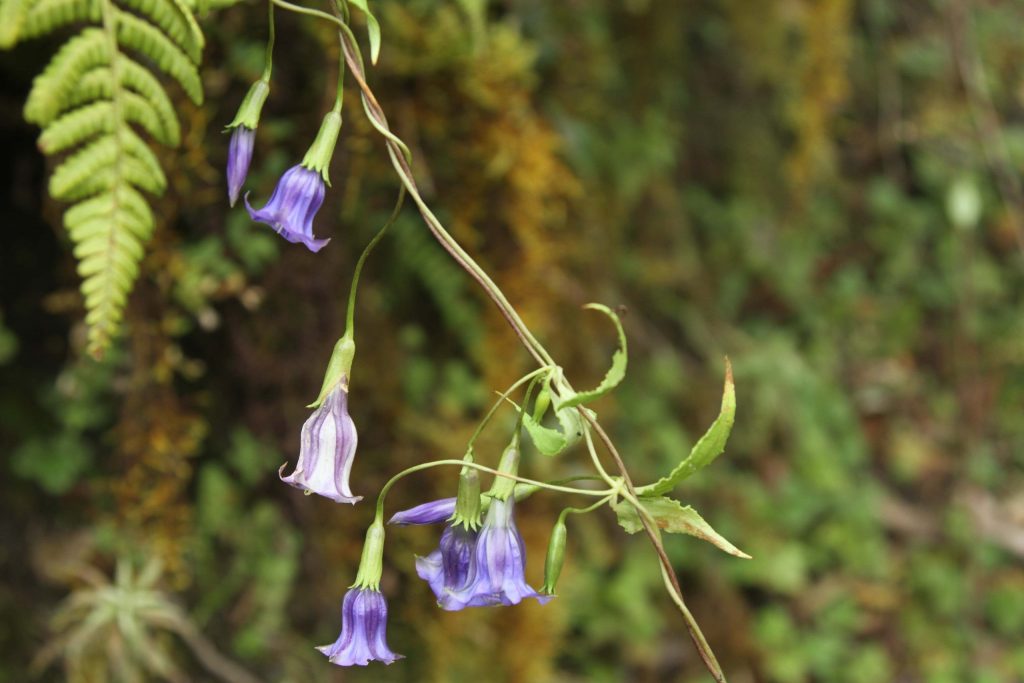
Crawfurdia speciosa C.B.Clarke is a climbing perennial gentian of the eastern and central Himalaya, distributed through Nepal, north-east India, Bhutan, south-west China and into northern Vietnam, with scattered records from Bangladesh and Pakistan. It is a plant of moist, shaded temperate forest, scrambling through shrubs and over the herbaceous understorey along forest margins, stream banks and clearings. The two photographed Bhutanese populations bracket its altitudinal span, from the warm Mo-Chu valley at 1900 m to the cool Tumching-La pass at 3200 m, both flowering in October. This autumn flowering, well after the monsoon, is characteristic of the twining Asian gentians and exploits the late-season window before the onset of winter.

Unlike the familiar erect, rosette-forming gentians, Crawfurdia is a slender, herbaceous, twining climber with weak quadrangular stems and opposite, ovate to ovate-lanceolate leaves tapering to an acuminate tip and bearing prominent palmate-curved venation. The flowers, solitary or few in the upper leaf axils, are showy and pendent; the campanulate to tubular corolla is blue to blue-purple, with short spreading lobes and conspicuous plicate folds (plicae) between them, a hallmark of the gentian family. The fruit is a stalked, flattened capsule that protrudes from the persistent corolla on an elongating gynophore, releasing numerous small, winged, wind-dispersed seeds.

The genus Crawfurdia is closely allied to Gentiana and Tripterospermum, and has at times been merged with them; molecular studies confirm the twining Sino-Himalayan gentians as a distinct lineage. The pendent blue corolla suggests pollination by late-season bees. Though not currently regarded as threatened, its dependence on intact mid- to high-elevation forest makes it sensitive to deforestation across its eastern Himalayan range.

Author: C.B.Clarke · Sources: POWO (Kew), GBIF, Flora of China (Gentianaceae), Flora of Bhutan, Annotated Checklist of the Flowering Plants of Nepal, Gentianaceae: Systematics and Natural History (Struwe & Albert)

R.D.Good

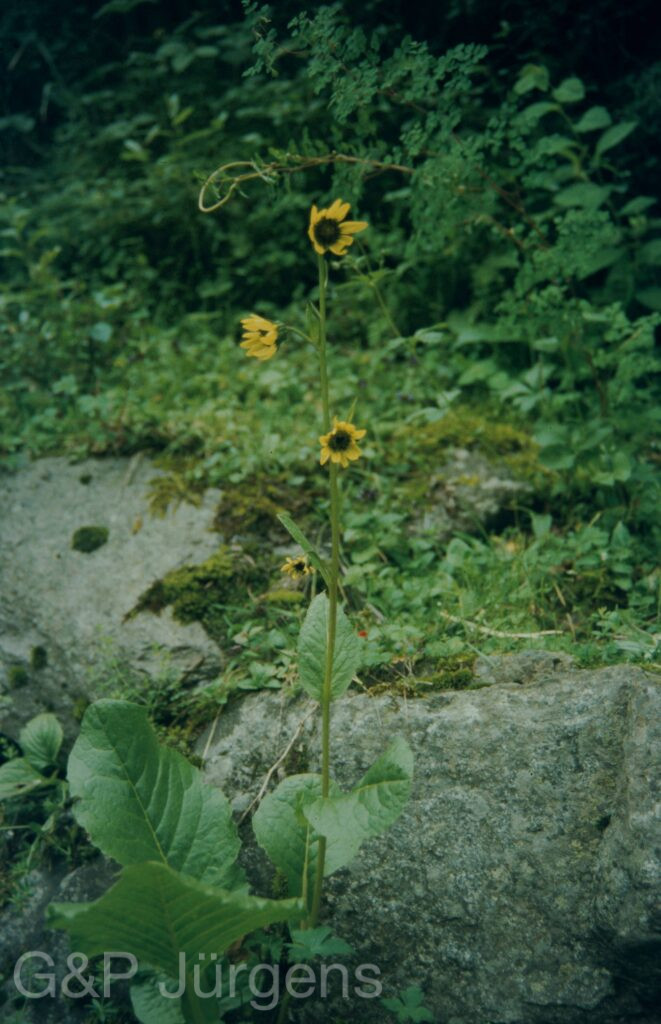
Garw 2005 46 ergebnis ergebnis
India Garhwal Valley of flowers 3300m, September

Description

Cremanthodium arnicoides is a Sino-Himalayan alpine composite recorded from Nepal, India and China, with additional herbarium-based occurrences abroad; GBIF lists about 268 records concentrated along the high ranges. It inhabits alpine meadows, moist grassy slopes, scree margins and streamsides, generally between roughly 3000 and 4500 m. The plant photographed in the Valley of Flowers, Garhwal (India), at about 3300 m in September captures its characteristic montane meadow habitat at the close of the monsoon flowering season, when its nodding golden capitula are conspicuous among late summer herbage.

The species is a tufted perennial herb arising from a short rhizome with fibrous roots. The basal leaves are long-petiolate with reniform to cordate, palmately veined blades and dentate margins, forming a rosette, while the stem leaves are smaller and progressively sessile. The erect, sparsely arachnoid-hairy scape bears solitary, nodding radiate capitula; the involucral bracts are blackish-green and somewhat hairy, the ligulate ray florets are yellow and elongate, and the central disc florets are tubular. The cylindrical achenes are glabrous and crowned by a copious white pappus of soft barbellate bristles.

Cremanthodium is a genus of about seventy alpine species characteristic of the Himalaya and Hengduan Mountains, distinguished from related Ligularia and Senecio by its typically solitary, nodding capitula adapted to cold, high-altitude conditions, the pendent heads protecting the florets from rain and intense radiation. Many species are narrow endemics; C. arnicoides has a moderately wide Himalayan range and is not regarded as threatened, though as a high-elevation specialist it is potentially sensitive to climate warming and habitat shifts in the alpine zone.

Author: R.D.Good · Sources: POWO (Kew), GBIF, Flora of China, Flora of Bhutan, Annotated Checklist of the Flowering Plants of Nepal, Good's revision of Cremanthodium

Thoth.

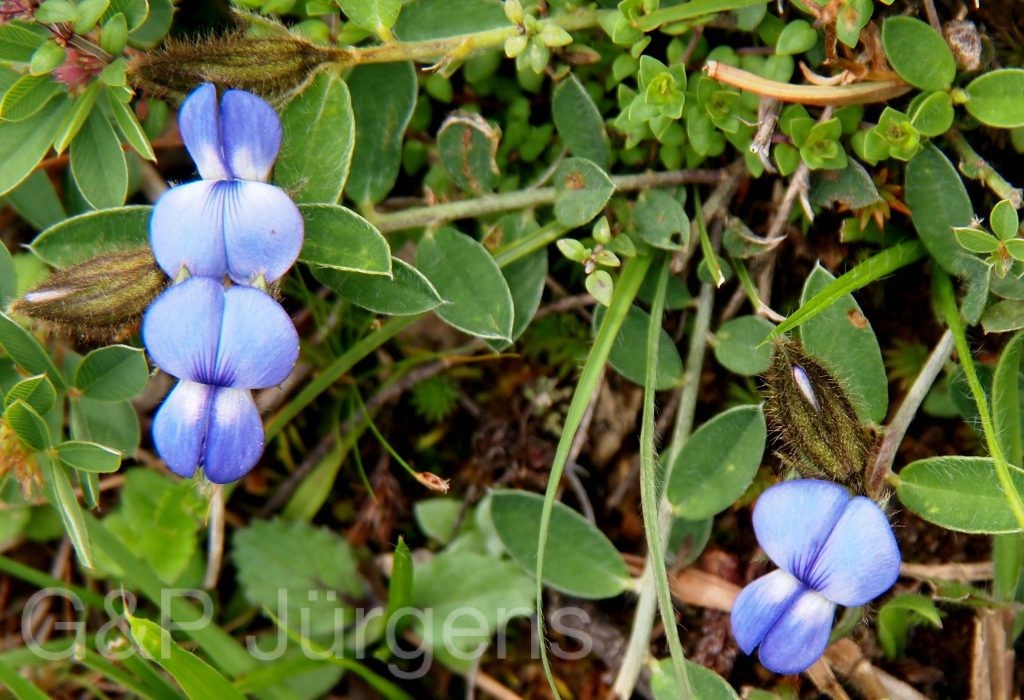
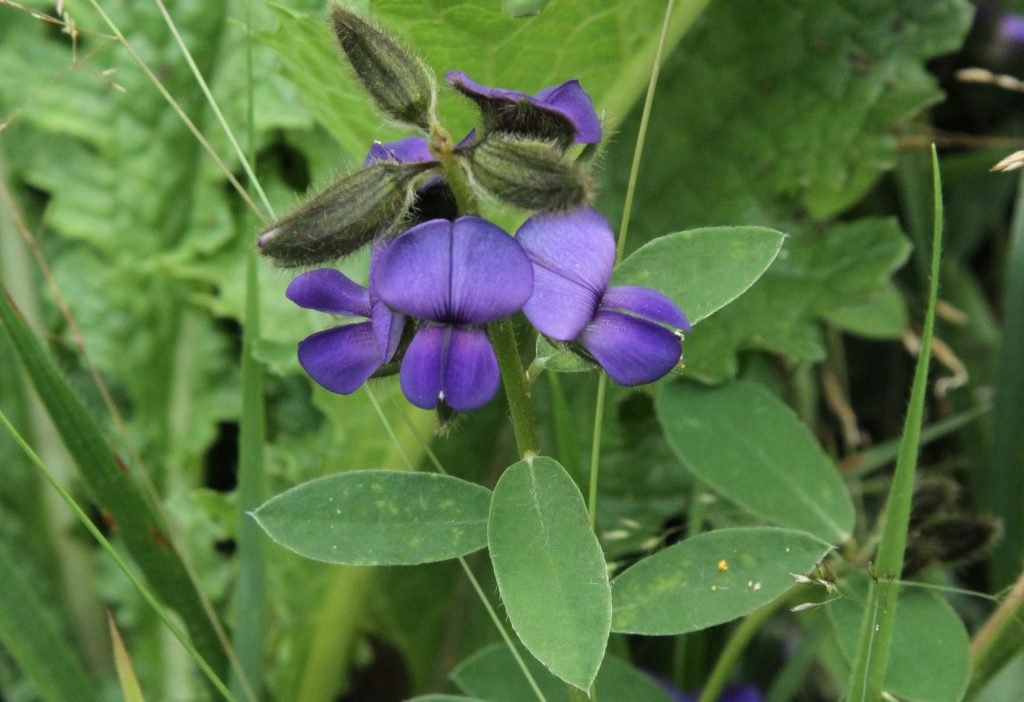
Bhutan2012 190
Bhutan Haar-Valley, 3300m September
Bhutan2012 362
Bhutan Dochu-La 2700m, September

Description

Crotalaria bhutanica is a narrowly distributed legume of the eastern Himalaya, described from and centred on Bhutan; it has no georeferenced records in GBIF, underscoring how poorly documented and locally restricted this taxon remains. It is a plant of open grassy slopes, scrub and disturbed montane ground, and the two collection sites given, the Haar valley at about 3300 m and Dochu-La at 2700 m, both in September, place it in the cool temperate to subalpine zone of western and central Bhutan, where it flowers and fruits in the late monsoon and early autumn.

Like others of its genus, the species is a herb or small subshrub with simple or trifoliolate leaves and stems bearing the appressed hairs characteristic of Crotalaria. The flowers are arranged in terminal or leaf-opposed racemes and have the typical papilionaceous structure of the genus, with a large rounded standard, two lateral wings and a beaked keel enclosing the stamens and style; the corolla is yellow, sometimes veined or flushed with brown or purple. The fruit, as in all Crotalaria, is an inflated, bladder-like pod in which the loosened seeds rattle when ripe, the feature that gives the genus its name (from the Greek krotalon, a rattle).

Crotalaria (tribe Crotalarieae, subfamily Faboideae) is a large pantropical genus, and C. bhutanica is one of its restricted Himalayan endemics, distinguished within the regional flora by its combination of habit, indumentum and floral detail. Like most papilionoid legumes it forms nitrogen-fixing root nodules with rhizobia and is pollinated by bees adapted to tripping the keel mechanism. Given its apparently very limited range, the absence of occurrence data, and ongoing pressures on Himalayan grassland habitats, the species warrants targeted survey and a formal conservation assessment.

Author: Thoth. · Sources: POWO (Kew), GBIF, Flora of Bhutan, Polhill Crotalaria in Africa and Madagascar, Legumes of the World (Lewis et al.)

L.

Bhutan2012 625
Bhutan Wangdi 2800m, September

Description

Crotalaria sessiliflora is a wide-ranging Asian-Australasian rattlepod, recorded by GBIF (3102 occurrences) from China, Japan, Korea, Taiwan, India, Thailand, Indonesia, Papua New Guinea, Australia, Nepal, the Philippines, Myanmar, Bhutan, Malaysia and Indochina. It is a plant of open, sunny, seasonally dry habitats, occupying grasslands, hill slopes, fallow fields, roadsides and waste ground from the lowlands up into the lower mountains, roughly to 2800 m. The photographed plant from near Wangdi in western Bhutan at about 2800 m, flowering in September, sits at the upper elevational margin of the species and reflects its late-monsoon flowering across the eastern Himalaya.

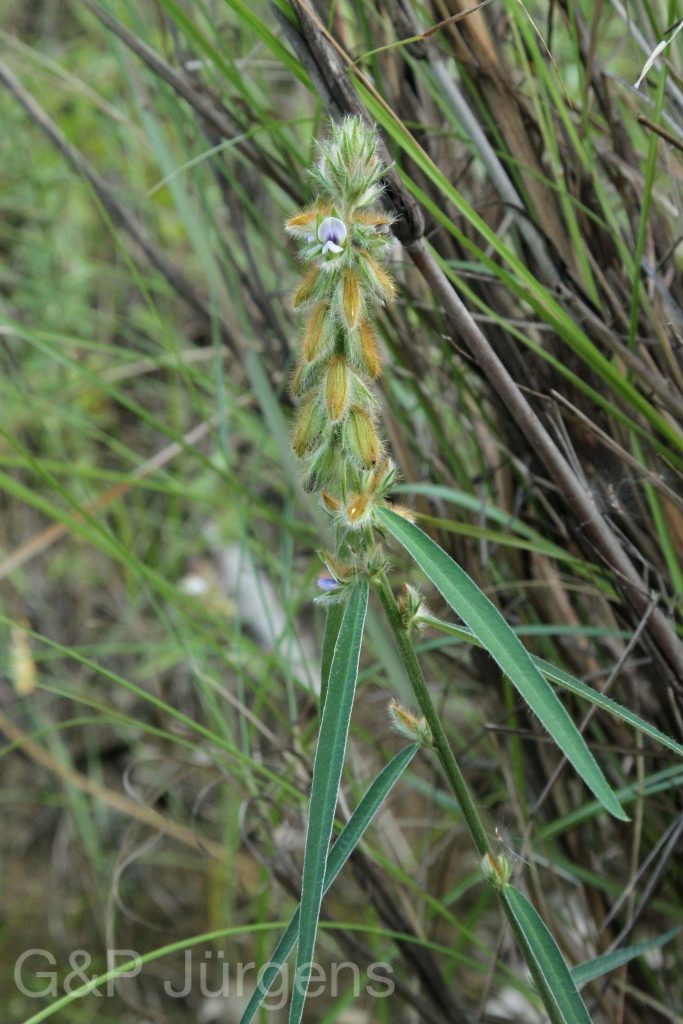
The species is an erect annual herb, usually 30-100 cm tall, with stems and foliage clothed in long, spreading brownish hairs. The leaves are simple (unifoliolate), narrowly linear to oblanceolate, sessile or shortly petiolate, with conspicuous setose stipules. The flowers are borne in dense, head-like or short terminal racemes, often crowded and almost sessile as the epithet indicates, each subtended by leafy bracts. The papilionate corolla is blue, violet or pale purple, the standard hairy outside. As in Crotalaria the stamens are monadelphous with dimorphic anthers. The fruit is a small, inflated, oblong pod enclosed by the persistent calyx, the loose seeds rattling within when ripe.

Described by Linnaeus, the species belongs to the large pantropical genus Crotalaria (Fabaceae, subfamily Faboideae, tribe Crotalarieae). Like its relatives it forms root nodules with rhizobial bacteria, fixing atmospheric nitrogen and enriching soils, and is sometimes grown as a green manure. The plant contains pyrrolizidine alkaloids and is used in traditional Asian medicine, though these compounds render it potentially toxic to livestock. With an extensive range and weedy tendencies it is of least conservation concern.

Author: L. · Sources: POWO (Kew), GBIF, Flora of China, Flora of Bhutan, Monograph of the genus Crotalaria (Polhill)

(Edgew.) Al-Shehbaz, O’Kane & R.A.Price

Bh09 187 G324
Bhutan Phajoding, 3700m June
Nepal 99 155 ergebnis
West-Nepal South of Rara-Lake 3400m, June

Description

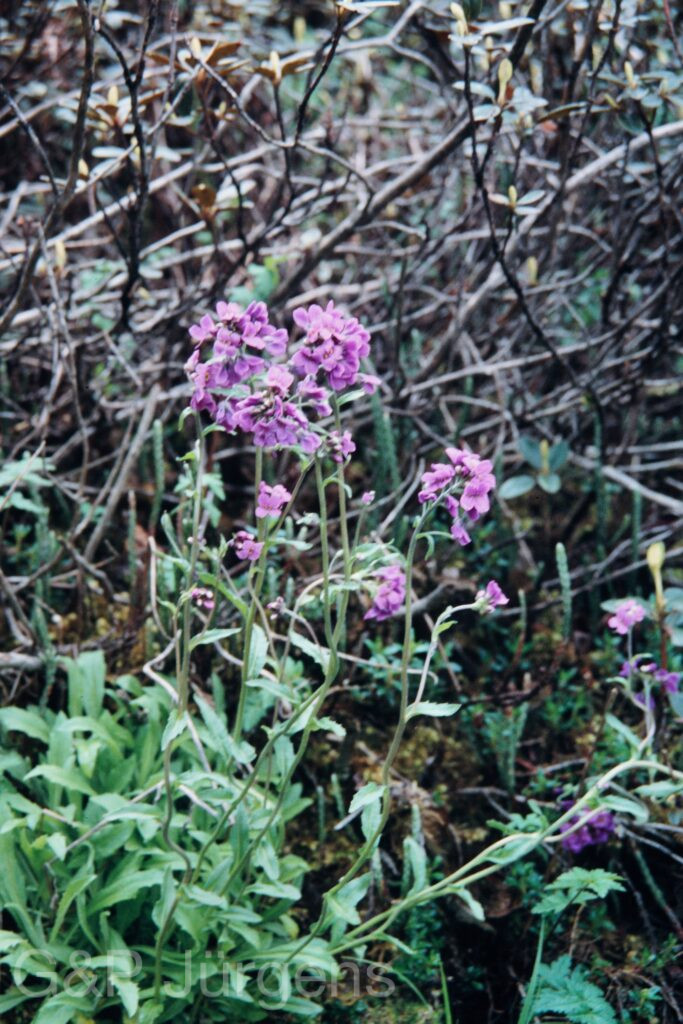
Crucihimalaya himalaica is a widespread alpine crucifer of the High Asian mountains, strongly represented in GBIF with about 704 occurrences spanning India, China, Nepal, Pakistan, Bhutan, Afghanistan, Iran and Myanmar. It is a plant of open, often disturbed high-elevation ground, growing on stony slopes, screes, moraine, grazed turf, fallow and the margins of cultivation in the subalpine and alpine belts. The plants photographed at Phajoding in Bhutan at about 3700 m and south of Rara Lake in West Nepal at 3400 m, both in June, illustrate its characteristic occupation of open alpine slopes early in the growing season across the breadth of the range.

It is an annual to short-lived perennial herb with a basal rosette of oblanceolate to spathulate leaves bearing toothed or lyrate-pinnatifid margins, the herbage often clothed in branched (stellate or dendritic) and simple hairs. The erect, sparingly leafy stems terminate in racemes of small flowers with four free sepals and four white to pale lilac petals arranged in the cruciform pattern of the family, and six stamens in the usual tetradynamous arrangement. The fruit is a slender, linear, elongate silique that ascends to spreading and dehisces by two valves from a persistent septum to release the seeds.

The genus Crucihimalaya was segregated from Arabis and allied genera on molecular and morphological grounds by Al-Shehbaz, O'Kane and R.A.Price, and it is closely related to Arabidopsis, making the group of interest in comparative and evolutionary genomics. As an abundant, ecologically flexible species thriving in both natural and anthropogenically disturbed alpine habitats, C. himalaica is of no conservation concern, and its wide range reflects effective dispersal and tolerance of harsh, open mountain conditions.

Author: (Edgew.) Al-Shehbaz, O'Kane & R.A.Price · Sources: POWO (Kew), GBIF, Flora of China, Flora of Bhutan, Flora of Pakistan, Al-Shehbaz Brassicaceae of the Himalaya

D.Don

Nepal 99 694 ergebnis ergebnis
West-Nepal Pugmo-Khola 3400m, July

Description

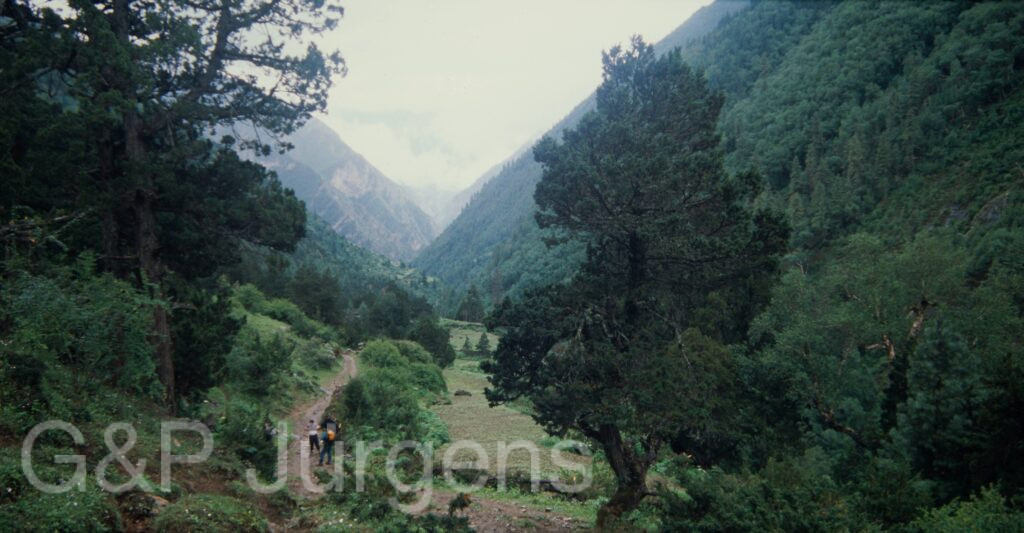
Cupressus torulosa D.Don, the Himalayan or Bhutan cypress, is a coniferous evergreen tree of the Cupressaceae native to the Himalaya and southwestern China. Its native range covers India, Nepal and China, while the large GBIF tally of 1,094 occurrences and many additional countries (New Zealand, USA, Britain, Germany, Australia, South Africa, Brazil and others) reflects its extensive cultivation as an ornamental and forestry tree. In the wild it grows on dry, calcareous and rocky slopes in temperate forests, typically between 1,800 and 3,300 m. The photographed tree from the Pugmo-Khola in West Nepal at 3,400 m, in July, marks the upper edge of its altitudinal distribution.

The plant is a tall, conical to broadly columnar tree reaching 20–45 m, with reddish-brown, fibrous, vertically peeling bark and spreading branches bearing slender, pendulous, terete branchlets. The leaves are scale-like, decussate, closely appressed, dark green and obtuse, lacking a conspicuous dorsal gland. It is monoecious, the small ovoid male cones terminal on lateral branchlets and the female cones globose, 1–2 cm across, composed of 8–12 woody peltate scales each bearing a small umbo and ripening from glaucous green to grey-brown in the second year, releasing numerous narrowly winged seeds.

The taxonomy of Asian Cupressus has been much debated, with several Himalayan and Chinese populations variously segregated or lumped, but C. torulosa is consistently accepted as the core western Himalayan species. Long valued for its durable, aromatic timber and planted around temples and monasteries, it is locally over-exploited; while not globally threatened, several native stands are fragmented, and it remains an important component of dry temperate conifer woodland.

Author: D.Don · Sources: POWO (Kew), GBIF, Flora of China Vol. 4, Flora of Bhutan Vol. 1, Flora of Pakistan (Cupressaceae), Farjon: A Monograph of Cupressaceae and Pinus

Edgew.

Garw 2005 300 ergebnis
India Garhwal Kunol 3100m, September
Nepal 99 855 ergebnis
West-Nepal Sanu Bheri 3850m, July
Nepal 99 856 ergebnis
West-Nepal Sanu Bheri 3850m, July
Garw 2005 44 ergebnis ergebnis
India Garhwal Valley of flowers 3150m, September

Description

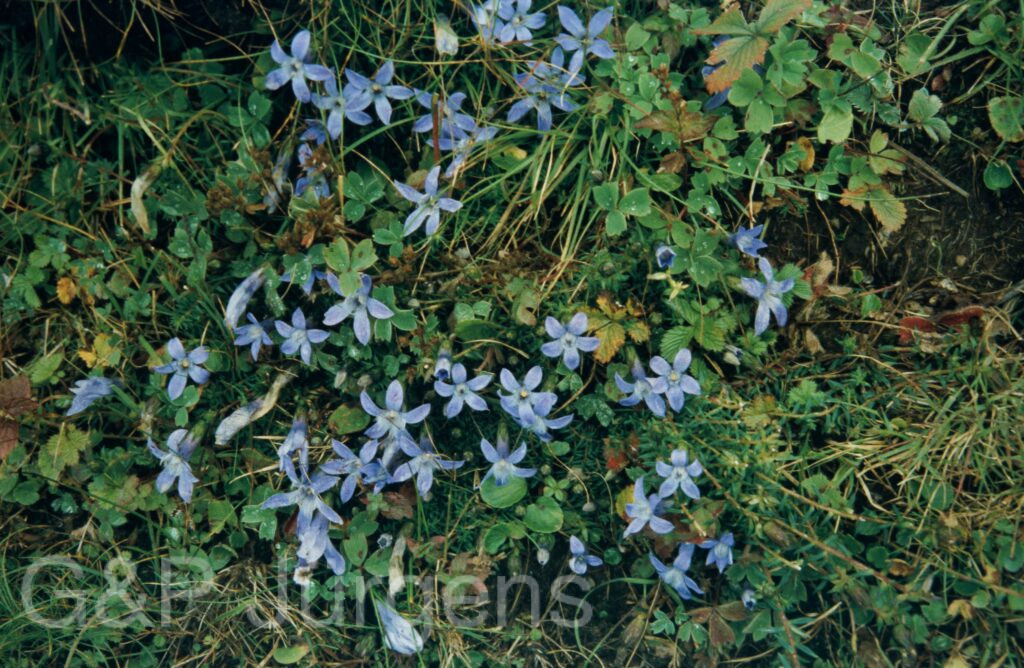
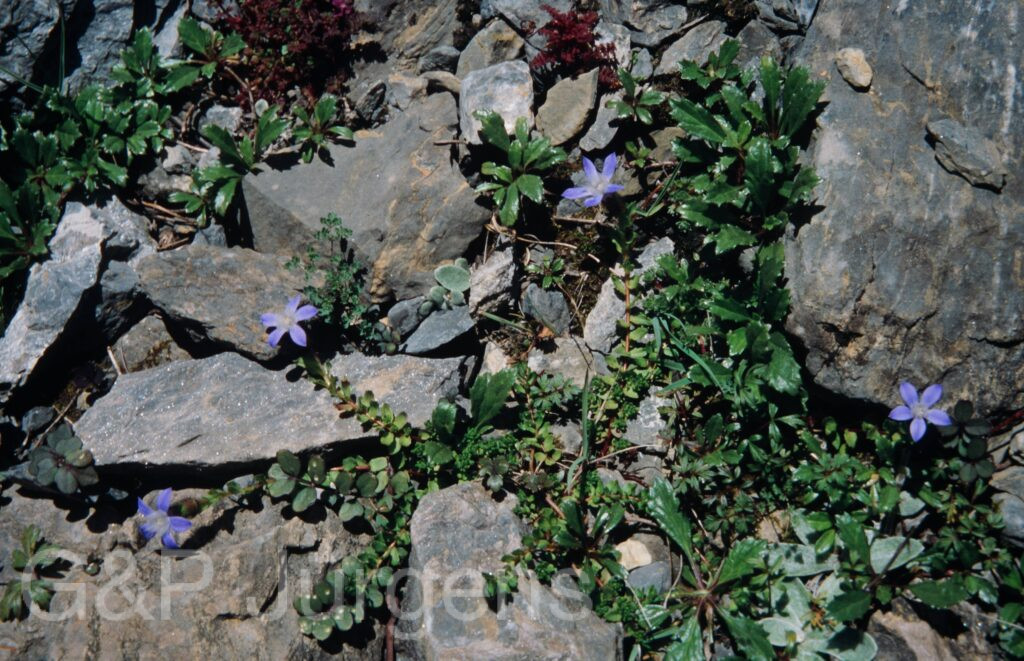
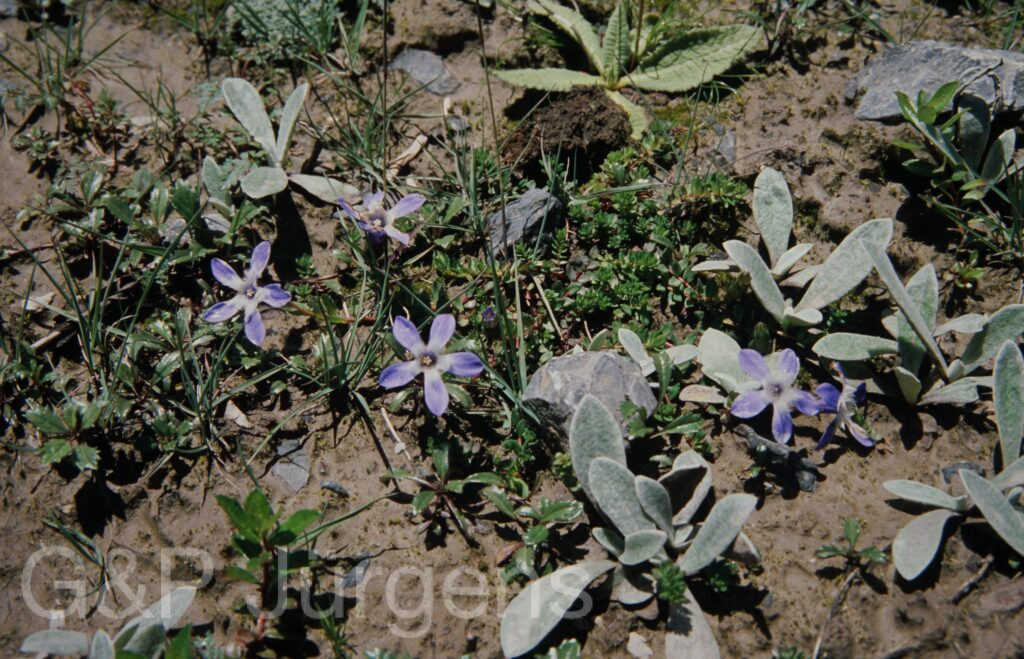
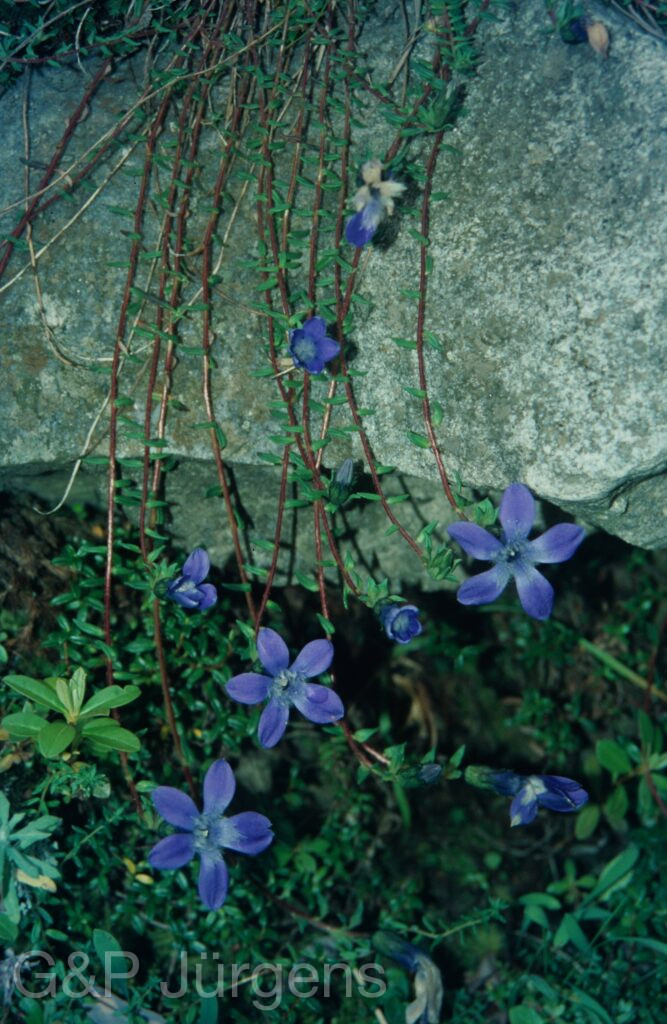
Cyananthus microphyllus is an alpine cushion-forming herb endemic to the Himalaya, documented from Nepal, India and China, with the available occurrence records concentrated along the central and western Himalayan arc. It grows in alpine meadows, on open stony slopes, rock ledges and the gravelly margins of glacial moraines, generally between about 3000 and 4500 m. The images, gathered at Kunol in Garhwal at 3100 m and in the Valley of Flowers at 3150 m in September and at Sanu Bheri in West Nepal at 3850 m in July, capture its late-monsoon flowering in high pastures and rocks where the mats anchor in thin, well-drained soils.

The plant forms low, much-branched, somewhat woody-based mats from a slender taproot. The wiry, prostrate to ascending stems are clothed in numerous small, alternate, ovate to elliptic leaves that are often revolute at the margin and sparsely hairy. The flowers are solitary and terminal, with a campanulate, conspicuously hairy calyx whose tube is shorter than the deeply five-lobed, blue corolla; the corolla throat bears a dense ring of white hairs, a defining feature of the genus. Five stamens alternate with the corolla lobes, and the inferior to half-inferior ovary develops into a capsule that exceeds the persistent calyx and dehisces to release numerous small seeds.

Cyananthus is a small Sino-Himalayan genus of perhaps two dozen species, allied to the bellflowers but distinguished by the bearded corolla throat and largely inferior ovary. Cyananthus microphyllus is recognised among the small-leaved, blue-flowered species by its diminutive, densely leafy mats. Its restricted high-elevation distribution makes it sensitive to climatic shifts and trampling by grazing livestock, and as a late-flowering alpine it provides an important resource for bumblebees and other cold-adapted pollinators.

Author: Edgew. · Sources: POWO (Kew), GBIF, Flora of China, Annotated Checklist of the Flowering Plants of Nepal, Flowers of the Himalaya (Polunin & Stainton), revision of Cyananthus (Campanulaceae)

Moq.

Garw 2005 206 ergebnis ergebnis
India Garhwal Pana 2800m, September

Description

Cyathula tomentosa is a coarse perennial herb of the Himalaya, Sino-Himalaya and parts of tropical Africa, recorded from Nepal, NW and NE India, Bhutan, southern China and Myanmar, with disjunct records from New Guinea and Rwanda; GBIF holds 238 occurrences. It grows on forest margins, shrubby slopes, roadsides, clearings and other disturbed, semi-shaded ground in the temperate and subtropical zone. The collection from Pana in Garhwal, India, at about 2,800 m in September corresponds to its late-summer to autumn fruiting in mid-montane forest country.

It is an erect to ascending, much-branched herb up to about 1–1.5 m tall, with quadrangular, densely white-tomentose stems. The leaves are opposite, ovate to elliptic, 4–12 cm long, acuminate, with a soft woolly indumentum, especially beneath. The inflorescence is a long, interrupted, spike-like thyrse of dense glomerules, each cluster comprising a central fertile flower surrounded by modified sterile flowers whose perianth segments and bracteoles are produced into hooked, hardened spines. The perianth of the fertile flower is membranous; the fruit is a small utricle enclosed within the indurated, burr-like cluster.

The species belongs to Cyathula (Amaranthaceae, subfamily Amaranthoideae), allied to Achyranthes and Pupalia, the genus being distinguished by its glomerules of hooked sterile flowers. GBIF treats the name as accepted. The barbed fruiting clusters are an effective epizoochorous dispersal mechanism, attaching to fur and clothing, which accounts for the plant's affinity for disturbed and trackside habitats. It is widespread and of no conservation concern.

Author: Moq. · Sources: POWO (Kew), Flora of China Vol. 5, Flora of Bhutan Vol. 1, GBIF, Townsend: Amaranthaceae in Flora of Tropical East Africa (1985)