Author

GP Jürgens

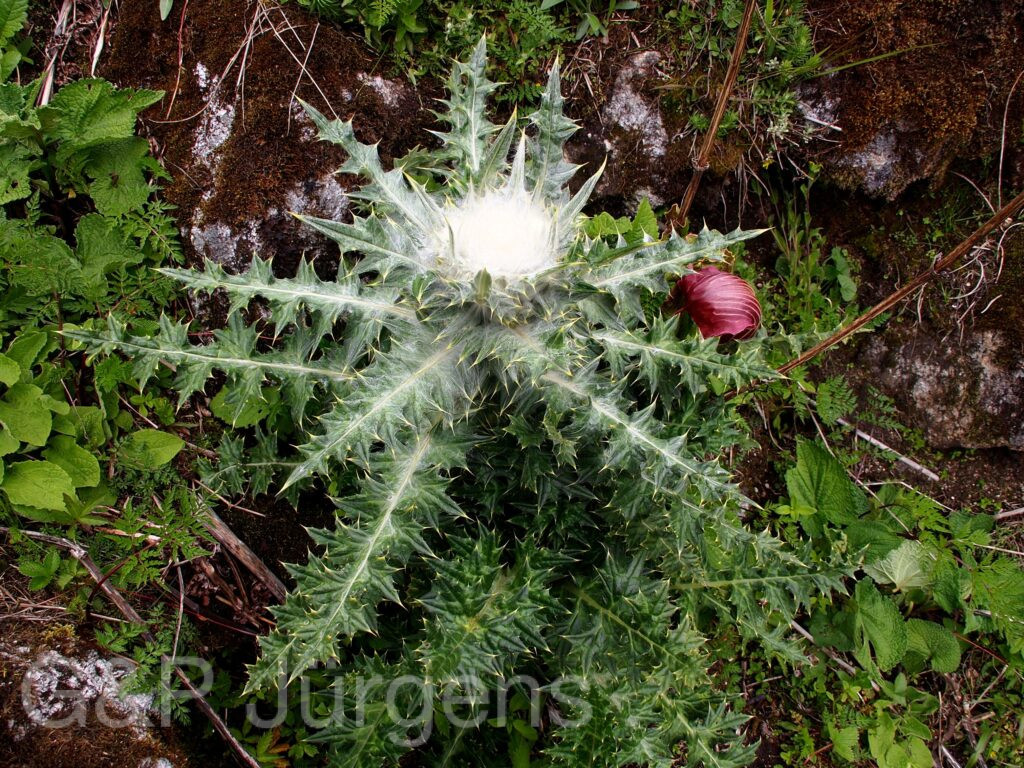
Petr.

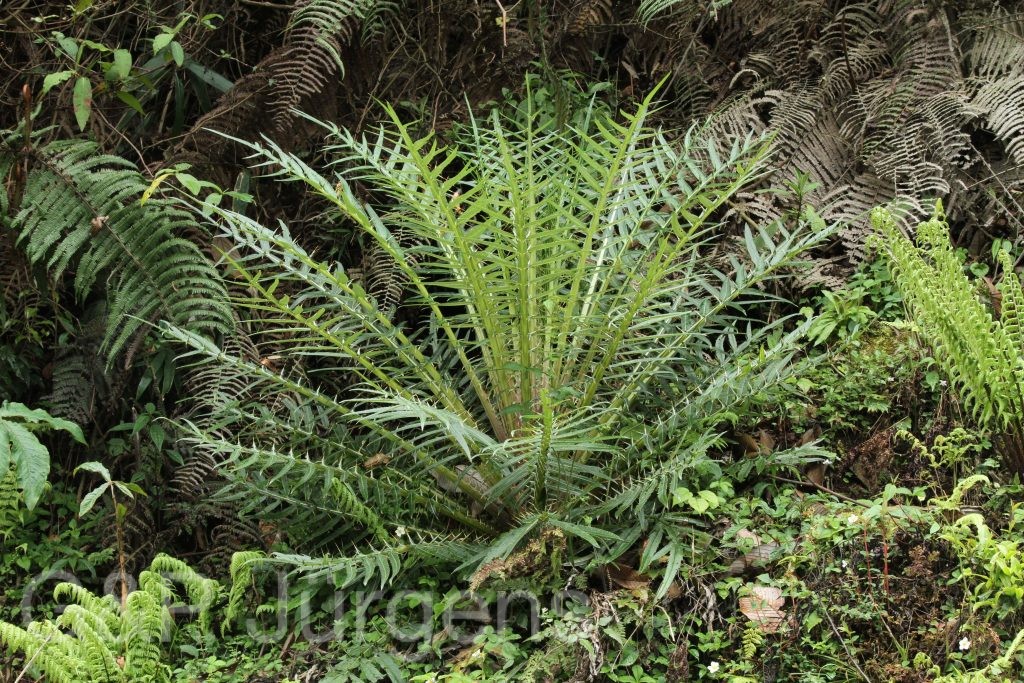
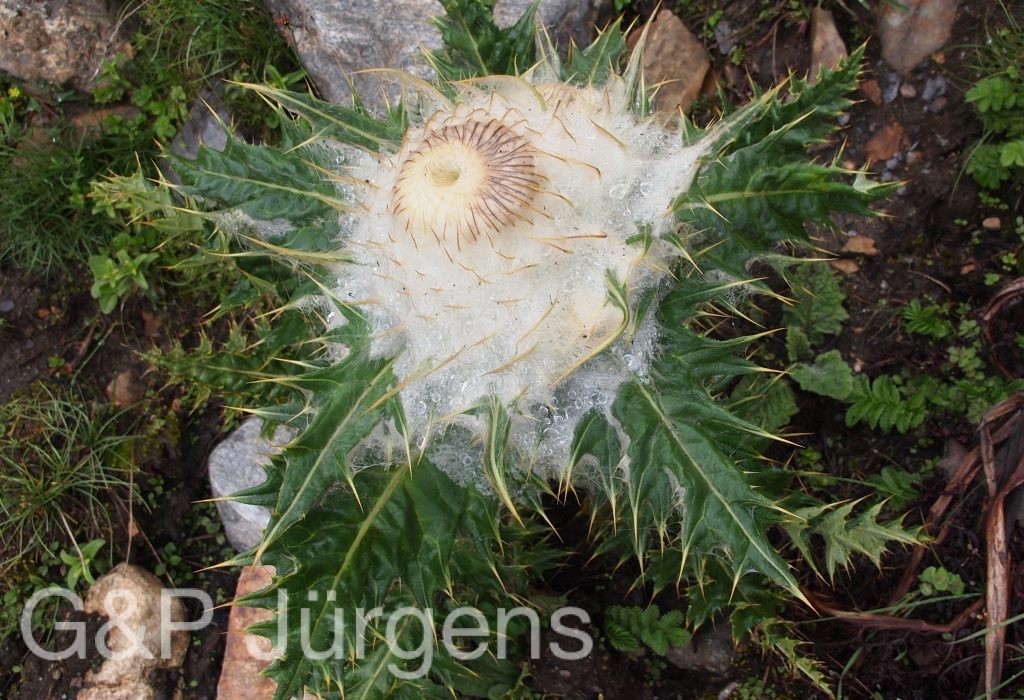
Sikkim2011 257
Sikkim Lada-La 3800m, June
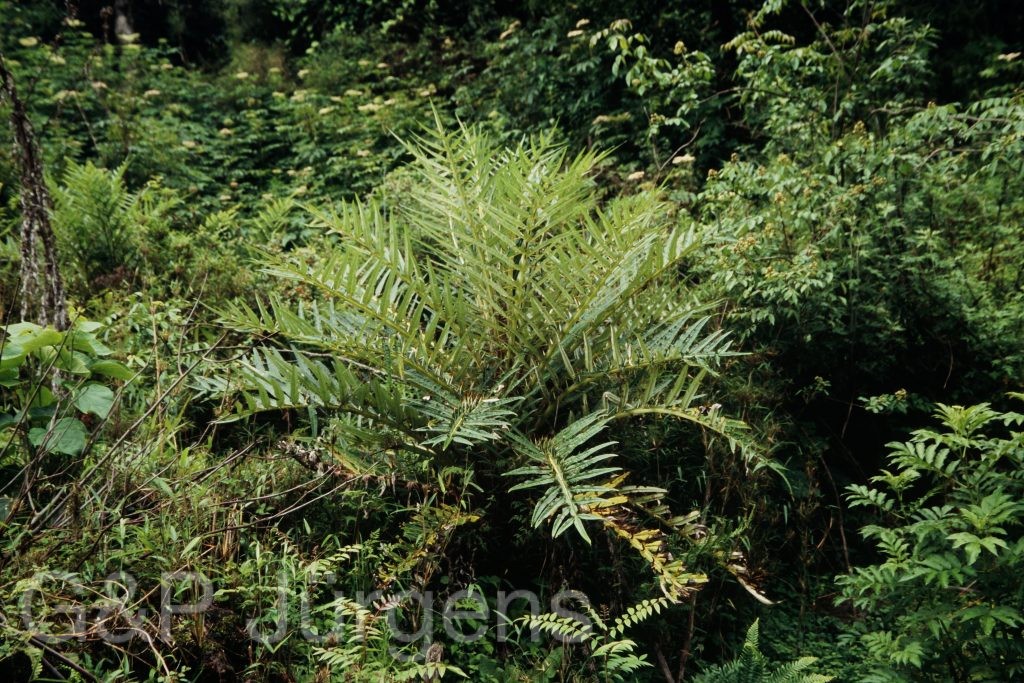
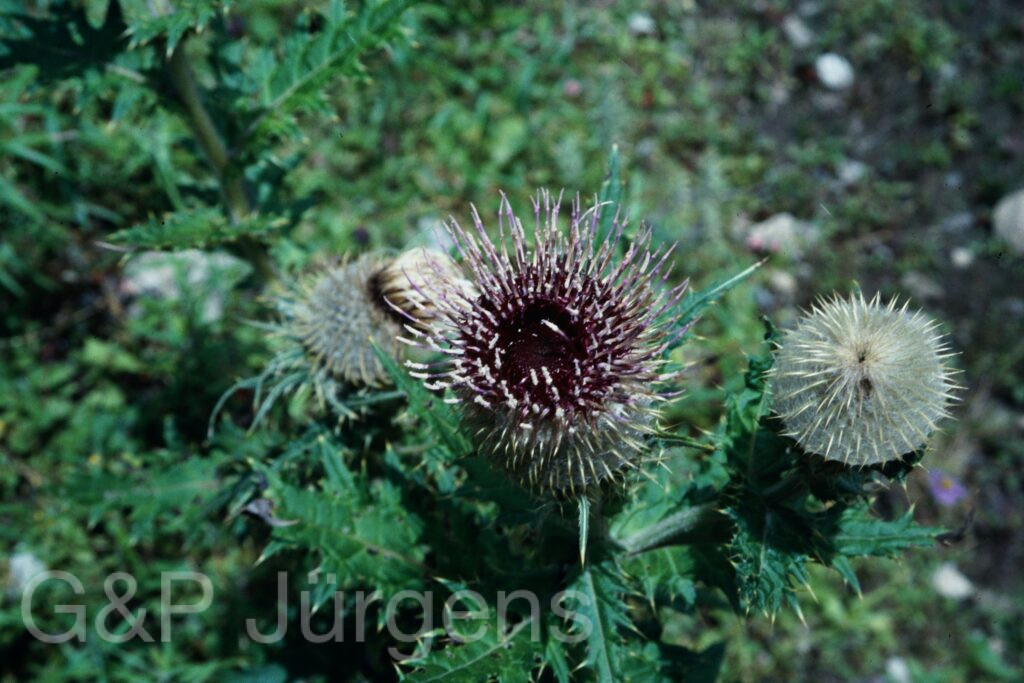
BhutanPG2011 284
Bhutan Jule-Tso, 4200m June
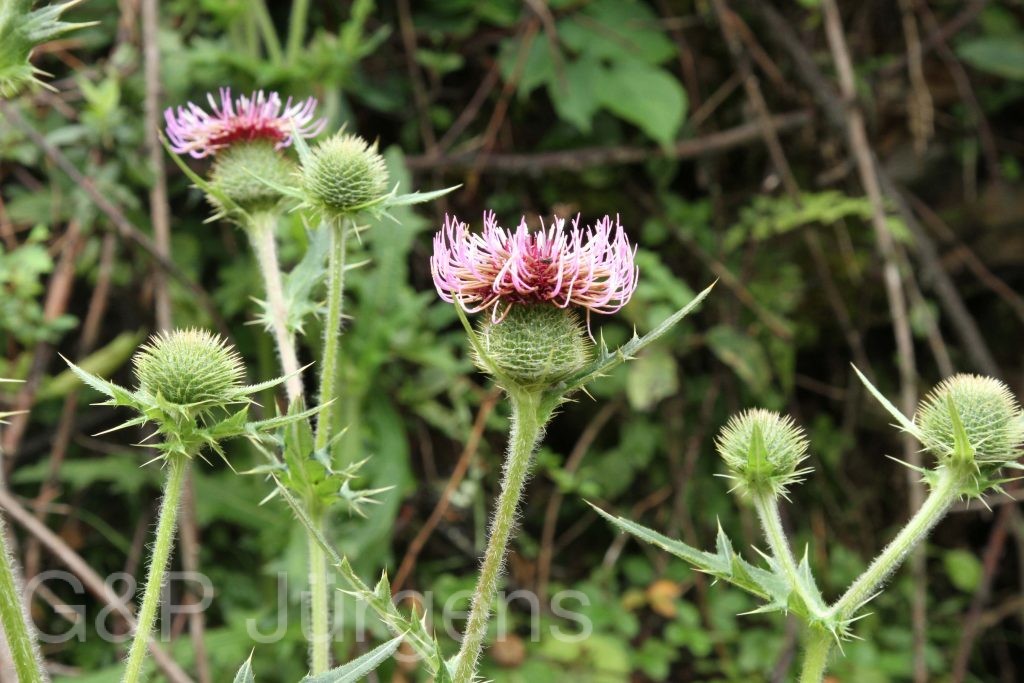
Sikkim2003 412 W574
Sikkim Zemu Valley 3400m August

Description

Cirsium eriophoroides is a robust alpine thistle of the eastern Himalaya and Sino-Tibetan mountains, recorded from China, India, Bhutan, Myanmar and Nepal, with about 234 GBIF occurrences. It grows in subalpine to alpine meadows, open grassy slopes, forest clearings and disturbed pasture, generally between about 3000 and 4500 m. The photographed plants come from Lada-La in Sikkim (3800 m, June), Jule-Tso in Bhutan (4200 m, June) and the Zemu Valley in Sikkim (3400 m, August), spanning the early and late high-Himalayan growing season.

The plant is a stout biennial or perennial herb with an erect, ridged, cobwebby-woolly stem reaching well over a metre. The leaves are oblong-lanceolate, deeply pinnatifid and conspicuously spiny along the margins, decurrent on the stem and white-tomentose beneath. The large capitula are solitary or few at the stem apex, subtended by leafy bracts and densely enveloped in long, white, arachnoid wool, the epithet "eriophoroides" likening this to the cottongrass Eriophorum. The involucral phyllaries are narrow and spine-tipped; the florets are tubular and purple to reddish, the fruit a smooth cypsela bearing a plumose pappus of feathery bristles.

Cirsium is a large genus of the tribe Cardueae, and C. eriophoroides represents the woolly-headed high-montane element well developed in the Sino-Himalaya. Its conspicuous capitula are visited by bumblebees and other long-tongued insects. Widespread and often associated with grazed ground, it is not regarded as threatened.

Author: Petr. · Sources: POWO (Kew), GBIF, Flora of China, Flora of Bhutan, Annotated Checklist of the Flowering Plants of Nepal, Compositae of the Sino-Himalaya (Cardueae studies)
(Hook.f.) Petr.

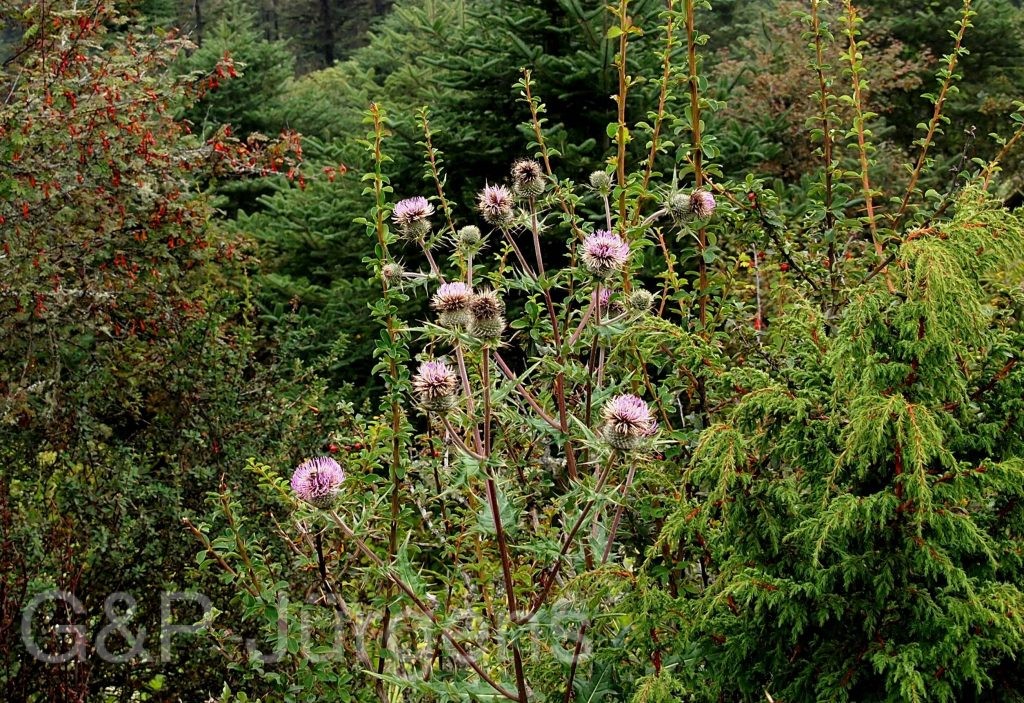
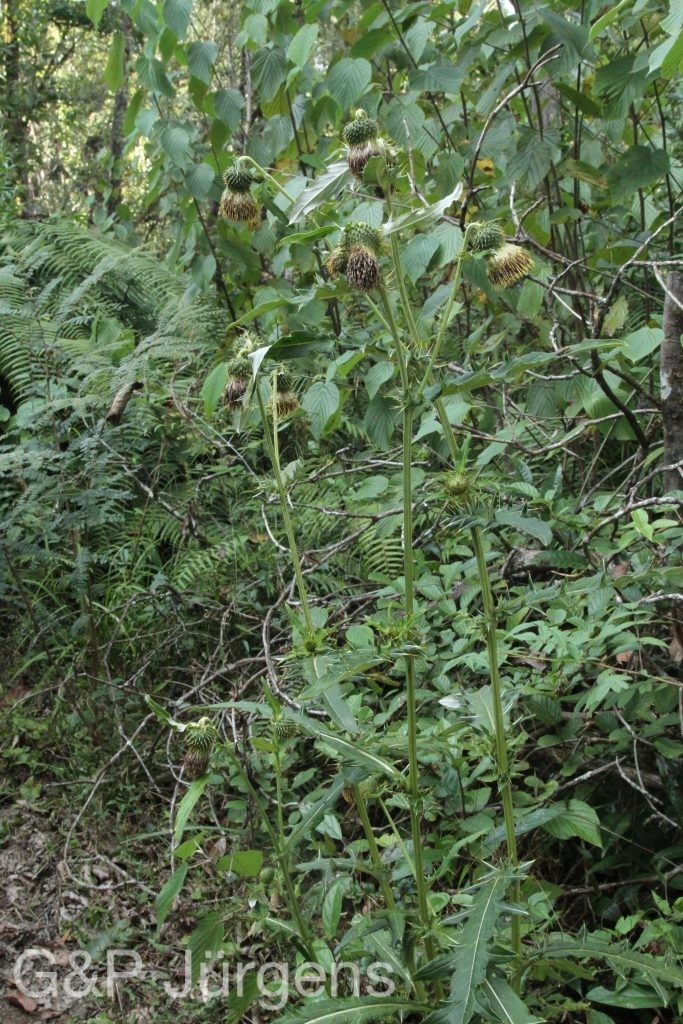
Bhutan2012 65
Bhutan Shele-La, 3900m September

Description

Cirsium falconeri is a robust subalpine to alpine thistle distributed along the Himalaya and adjacent ranges, recorded from Pakistan, India, Nepal, Bhutan, Myanmar and south-western China (Xizang, Yunnan), with some 207 georeferenced occurrences documenting its broad east-to-west arc. It favours open grassy hillsides, forest margins, moist meadows and disturbed slopes between roughly 2700 and 4300 m, where it forms scattered stands among tall-herb communities. The photographed plant from the Shele-La pass in Bhutan at about 3900 m in September typifies its preference for cool, humid high-altitude grasslands flowering toward the end of the monsoon.

The species is a stout biennial or short-lived perennial herb 0.6–2 m tall, with erect, longitudinally ribbed, often arachnoid-tomentose stems arising from a thickened taproot. The leaves are large, pinnatifid to pinnatisect, glabrescent to thinly cottony above and grey-tomentose beneath, with the lobes spiny-margined and the stem-leaves decurrent or amplexicaul. The capitula are large, hemispheric and usually nodding, solitary or few, subtended by reduced spiny floral leaves; the involucral bracts are linear-lanceolate and spinescent. Florets are numerous, tubular and purple to pinkish-red. The cypselae are oblong and glabrous, crowned by a copious pappus of plumose, basally connate bristles aiding wind dispersal.

Within Cirsium, a large Holarctic genus of spiny-leaved thistles, C. falconeri belongs to the Himalayan assemblage of stout nodding-headed species and was originally described under Cnicus before transfer to Cirsium. The nodding capitula are interpreted as protecting pollen and developing achenes from monsoon rain, while the nectar-rich heads attract bumblebees and other long-tongued alpine pollinators. The species remains widespread and locally common and is of no recognised conservation concern, though high-elevation grazing locally affects populations.

Author: (Hook.f.) Petr. · Sources: POWO (Kew), GBIF, Flora of China Vol. 20-21, Flora of Bhutan, Flora of Nepal, Kitamura Compositae of the Himalaya

Petr.

Bhutan2015 459
Bh15-549
Bhutan2014 204
Bhutan Trashyangtse 2100m, May

Description

Cirsium interpositum is a Himalayan and East Asian thistle recorded from China, Turkey, India and Korea, with 55 georeferenced occurrences. Under the GBIF backbone the name is treated as a SYNONYM, with Cirsium interpositum itself given as the accepted name in this dataset, reflecting unsettled circumscription within the genus; it is closely allied to the C. lipskyi complex referenced in the source record. It grows on grassy montane slopes, in open scrub, forest margins and disturbed clearings, generally in the temperate zone. It was photographed at Trashyangtse in eastern Bhutan at 2100 m in May, flowering in the cool spring of the mid-montane valleys.

It is an erect spiny perennial herb with a ribbed, often winged and prickly stem arising from a stout rootstock. The alternate leaves are oblong-lanceolate, pinnately lobed and conspicuously armed with marginal spines, green and roughly hairy above and frequently paler or tomentose beneath, the bases decurrent. The flower heads are ovoid to subglobose, solitary or clustered at the stem tips, with an involucre of many imbricate, spine-tipped phyllaries. All florets are tubular (discoid) and purple to reddish-purple, the slender corollas deeply lobed. The fruit is a smooth oblong cypsela crowned by a pappus of long plumose (feathery) bristles, a defining feature of Cirsium.

The genus Cirsium belongs to tribe Cardueae and is distinguished from the closely related Carduus by its plumose rather than barbellate pappus. The taxonomic ambiguity surrounding C. interpositum is typical of the genus, in which hybridisation and variation blur species limits across the Sino-Himalaya. Ecologically it is a plant of open, disturbed montane ground, visited by bees and butterflies. It is not assessed as threatened.

Author: Petr. · Sources: POWO (Kew), GBIF, Flora of China, Flora of Bhutan, Cirsium monograph (Cardueae systematics, Werner & Petrak)

(M.Bieb.) Fisch.

Bh09 287 P470
Bhutan Pele-La, 2900m June

Description

Cirsium laniflorum is a thistle whose GBIF-documented range lies chiefly in the Pontic–Caucasian and adjacent regions, with records from Ukraine, Turkey, Azerbaijan, Russia and Belgium among its roughly 92 occurrences; the himalayaflora image, taken at the Pele La in central Bhutan at 2900 m in June, documents a Himalayan population of a Cirsium of this affinity flowering in early summer. The plant occupies open grassy slopes, meadow margins, disturbed ground and roadside banks, growing on well-drained mineral soils in cool montane conditions where it forms part of the tall-herb and pasture vegetation.

The species is a robust biennial or perennial herb with an erect, often longitudinally ridged stem arising from a stout rootstock. The leaves are alternate, oblong-lanceolate in outline and pinnatifid, their lobes and margins armed with stiff yellowish spines, and the surfaces are more or less woolly, particularly beneath. The capitula are terminal, solitary or in small clusters, subtended by spine-tipped involucral bracts and conspicuously clothed in cobwebby, woolly indumentum, a feature evoked by the epithet laniflorum ("woolly-flowered"). The florets are all tubular and purple to pink-purple, and the cypselae bear a plumose, feathery pappus that detaches as a unit.

Cirsium belongs to tribe Cardueae of the Asteraceae, the spiny thistle group, in which the woolly involucres of species like C. laniflorum help insulate the developing florets and deter herbivores. The tubular flowers are visited by bumblebees, butterflies and other long-tongued insects, and the plumed achenes disperse on the wind. With a broad if scattered Eurasian distribution, the species is not of conservation concern; like many thistles it can behave as a ruderal coloniser of disturbed and grazed ground.

Author: (M.Bieb.) Fisch. · Sources: POWO (Kew), GBIF, Flora of China (Asteraceae), Flora of Bhutan, Werner Cirsium revision

Petr.

Bhutan2012 167
Bhutan Haar-Valley, 3200m September

Description

Cirsium shansiense is an Asian thistle distributed from China through the Himalaya, recorded from China, India, Bhutan, Japan and Turkey, with 575 georeferenced occurrences indicating a broad and well-collected range. It grows on grassy slopes, in open scrub, along forest margins, roadsides and disturbed clearings, from the warm-temperate into the montane zone. It was photographed in the Haa Valley of western Bhutan at 3200 m in September, flowering in the late-monsoon to early-autumn period when it is conspicuous on open montane slopes and pastures.

It is a robust erect perennial herb 0.5 to 1.5 m or more tall, with ribbed, often somewhat cobwebby stems arising from a stout root. The alternate leaves are lanceolate to elliptic in outline, pinnately lobed and conspicuously spiny along the margins, green above and grey-arachnoid-tomentose beneath, with bases that are sessile or slightly decurrent. The flower heads are ovoid, solitary or few at the branch tips, with an involucre of numerous imbricate, narrow, spine-tipped phyllaries that are usually arachnoid-hairy. All florets are tubular and reddish-purple to rose-purple. The fruit is a smooth oblong cypsela crowned by a pappus of long plumose bristles.

The species belongs to tribe Cardueae; like other members of Cirsium it is separated from Carduus by the feathery (plumose) pappus bristles. Cirsium shansiense is one of the more widespread and variable East Asian thistles, and its broad distribution from Japan to Turkey reflects considerable ecological tolerance. Its nectar-rich heads attract bees and butterflies, and it readily colonises grazed and disturbed ground. It is common and of no conservation concern.

Author: Petr. · Sources: POWO (Kew), GBIF, Flora of China, Flora of Bhutan, Cirsium monograph (Cardueae systematics, Petrak & Werner)

L.

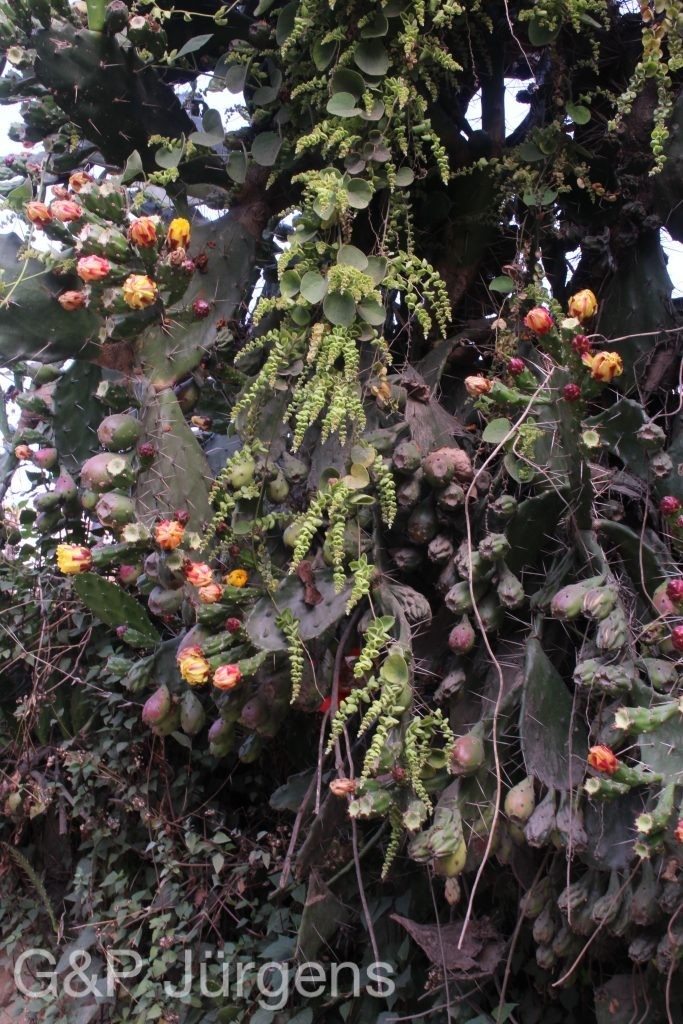
Bhutan2014 691
Bhutan Phobjika 2810m, May (see also Opuntia humifusa)
Nepal 97 29 P46 ergebnis
Nepal Dhoban 735m, April

Description

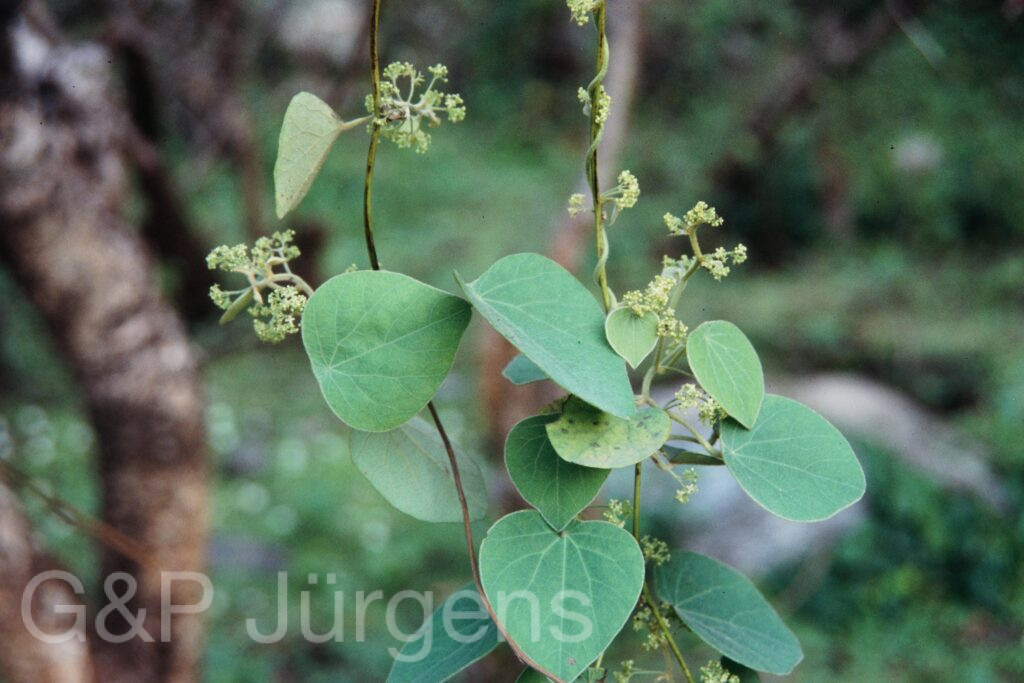
Cissampelos pareira is a pantropical climbing vine with an exceptionally broad distribution spanning the Americas, Africa, Madagascar and tropical Asia; GBIF records some 12107 occurrences across Mexico, Brazil, Costa Rica, Colombia, Argentina, India, Madagascar, Nepal, the Philippines, Ecuador and many other countries. It is a plant of warm, often disturbed habitats, scrambling over hedges, thickets, forest margins, fences and waste ground from sea level well into the hills. The collections cited from Phobjika in Bhutan at about 2810 m in May and from Dhoban in Nepal at about 735 m in April illustrate its wide ecological amplitude in the Himalayan foothills, where it persists from the subtropical lowlands up into cool mid-montane settings.

It is a slender, twining perennial herb or woody-based liana, the stems wiry and often finely pubescent. The leaves are alternate, broadly ovate to orbicular or peltate, frequently emarginate or mucronate at the apex and cordate to truncate at the base, with a long petiole inserted near the margin. The species is dioecious: the small greenish male flowers have fused sepals and a cup-shaped corolla with united stamens, while the female flowers are borne in axillary clusters subtended by conspicuous, often enlarged leaf-like bracts. The fruit is a small, laterally compressed, hairy red drupe with a characteristically curved (horseshoe-shaped) endocarp.

A member of the moonseed family (Menispermaceae), C. pareira is famous as a source of bisbenzylisoquinoline alkaloids and is used pan-tropically in traditional medicine, where it forms part of the complex of plants known as pareira brava. The curved endocarp and fleshy drupe are adapted to bird dispersal, which together with its tolerance of disturbance underlies its remarkable cosmopolitan spread. Taxonomically the species is broadly circumscribed and notoriously variable, encompassing numerous infraspecific forms, and it is widespread and of no conservation concern.

Author: L. · Sources: POWO (Kew), GBIF, Flora of China Vol. 7, Flora of Bhutan Vol. 1, Flora of Nepal, Diels Menispermaceae (Das Pflanzenreich)

Citrus medica

by GP Jürgens

L.

Bhutan2012 805 Kopie
Bhutan Zhemgang 1300m, October
Bhutan2015 298
Bhutan Zhemgang 1300m, October

Description

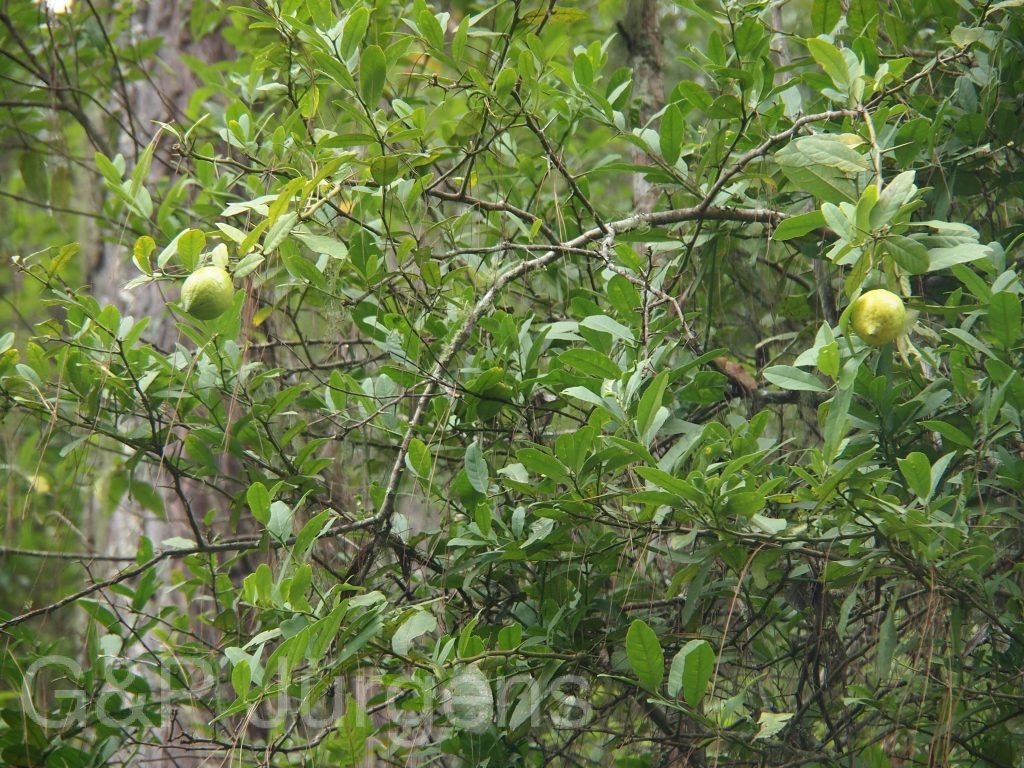
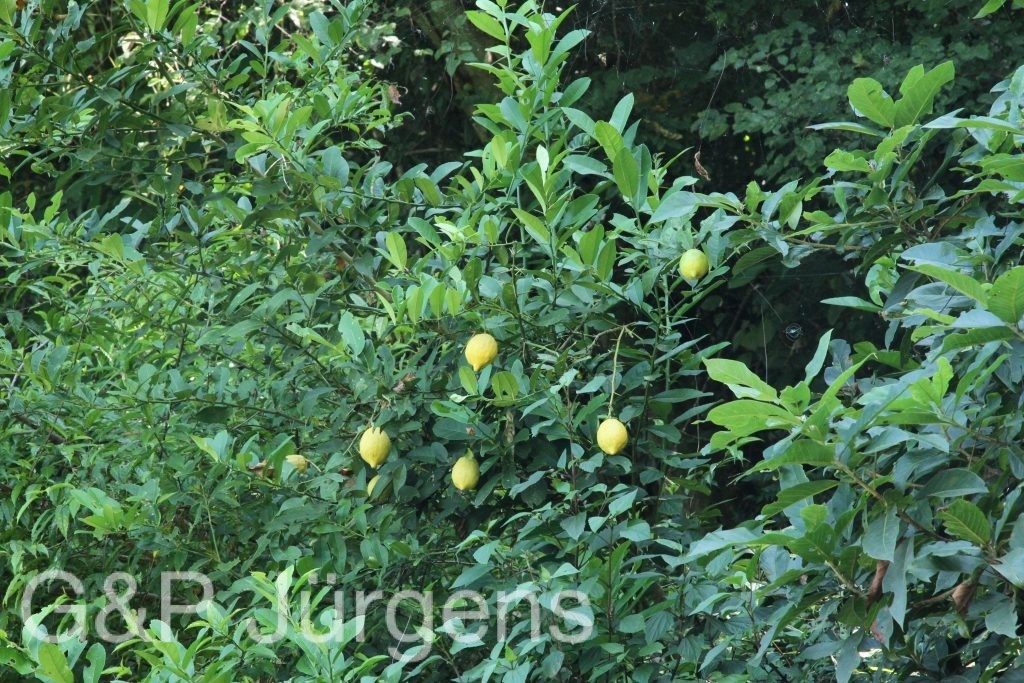
Citrus medica, the citron, is one of the foundational species of the cultivated citrus complex, thought to have originated in the foothills of the eastern Himalaya and northeastern India and now grown throughout the tropics and warm temperate zones; GBIF records (over 2200) span India, China, the Americas, Southeast Asia, the Mediterranean and Pacific islands, largely reflecting cultivation and naturalisation. In the Himalayan region it occurs in subtropical valleys and around settlements, in forest margins and cultivated ground, generally below about 1500 m. The photographed plant from Zhemgang in Bhutan (1300 m, October) is consistent with this warm, mid-elevation distribution.

The plant is a small, straggling shrub or small tree with stiff, angular twigs bearing stout axillary spines. The leaves are simple (a unifoliolate compound leaf), elliptic to ovate-oblong, crenate-margined, leathery, gland-dotted and aromatic, with the petiole only narrowly winged or wingless. The flowers are often tinged purple or pink in bud, fragrant, with four or five petals and numerous stamens. The fruit is a very large, ellipsoid to oblong hesperidium with a thick, fragrant, warty or rugose rind and a comparatively small, scant, acidic pulp; in some forms the fruit is deeply divided into finger-like segments (the "Buddha's hand" cultivar).

Together with the pummelo (C. maxima) and mandarin (C. reticulata), the citron is one of the three ancestral taxa from which most cultivated citrus hybrids derive, making it of central importance to citrus phylogeny and breeding. It is of great cultural and economic value—its rind is candied (succade) and the fruit is used ceremonially (the etrog in Jewish ritual). As a long-domesticated crop it is not of conservation concern, though wild Himalayan germplasm is a valuable genetic resource.

Author: L. · Sources: POWO (Kew), GBIF, Flora of China (Rutaceae), Flora of Bhutan, The Citrus Industry (Swingle & Reece)

Hook.f. & Thomson

Bhutan2012 133
Bhutan Haar-Valley, 3100m September

Description

Clematis acutangula is an eastern Himalayan climber distributed through Bhutan, northern India, southern China and northern Myanmar, a comparatively restricted range reflected in the small number of GBIF records, about 61. It is a plant of temperate forest margins, scrub and thickets in the wetter montane ranges, scrambling over shrubs and into the lower canopy. The Bhutanese material photographed in the Haa (Haar) Valley at 3100 m in September documents the species in its upper-montane habitat, flowering at the close of the monsoon when many late-season Himalayan clematis come into bloom.

It is a woody to herbaceous climber whose stems are distinctly angular and sharply ridged, the feature from which the epithet acutangula derives. The leaves are opposite and compound, typically pinnate to biternate with ovate to lanceolate, toothed leaflets, the plant climbing by means of twining petioles and rachides. The flowers are nodding and campanulate, with four thick, recurved-tipped, petaloid sepals coloured yellowish to greenish-yellow, often tinged or dotted with purple; true petals are absent and the numerous stamens are enclosed within the bell. The fruit is a head of compressed achenes each bearing a long, persistent, plumose style that aids wind dispersal.

The species belongs to the autumn-flowering, yellow- to nodding-flowered assemblage of Asian Clematis allied to sect. Meclatis/Tubulosae groups, distinguished within the eastern Himalayan flora by its strongly angled stems and bell-shaped flowers. Its limited distribution and dependence on intact temperate forest scrub make it a characteristic but local element of the Bhutan-Sikkim montane flora; it is not formally assessed for conservation but its narrow range warrants attention.

Author: Hook.f. & Thomson · Sources: POWO (Kew), GBIF, Flora of Bhutan, Flora of China, Grey-Wilson's Clematis the Genus (monograph), Flora of British India

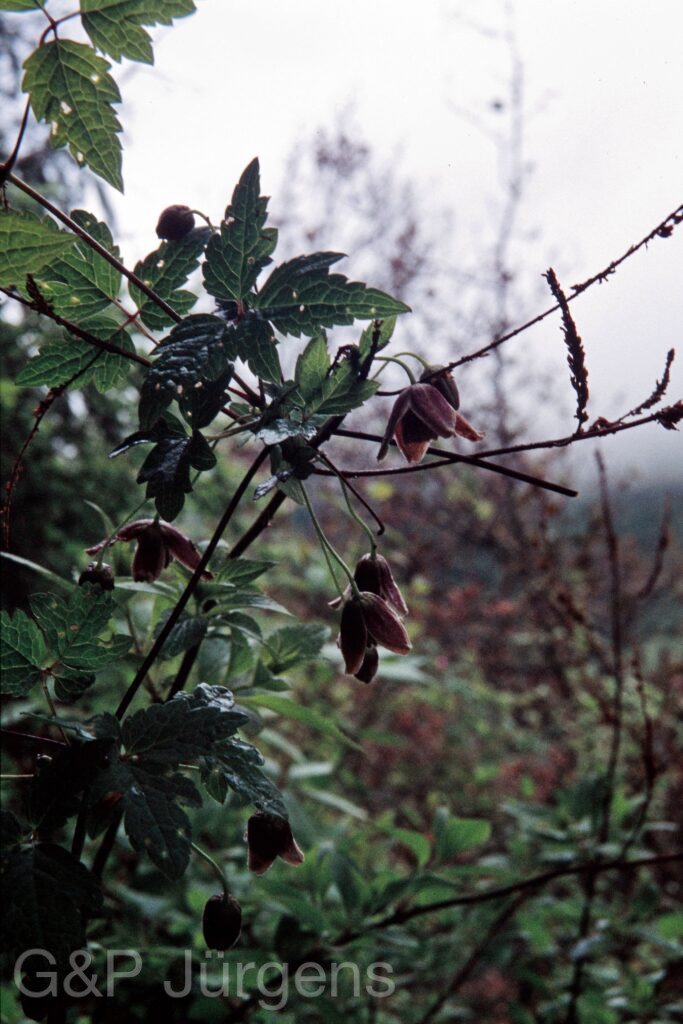
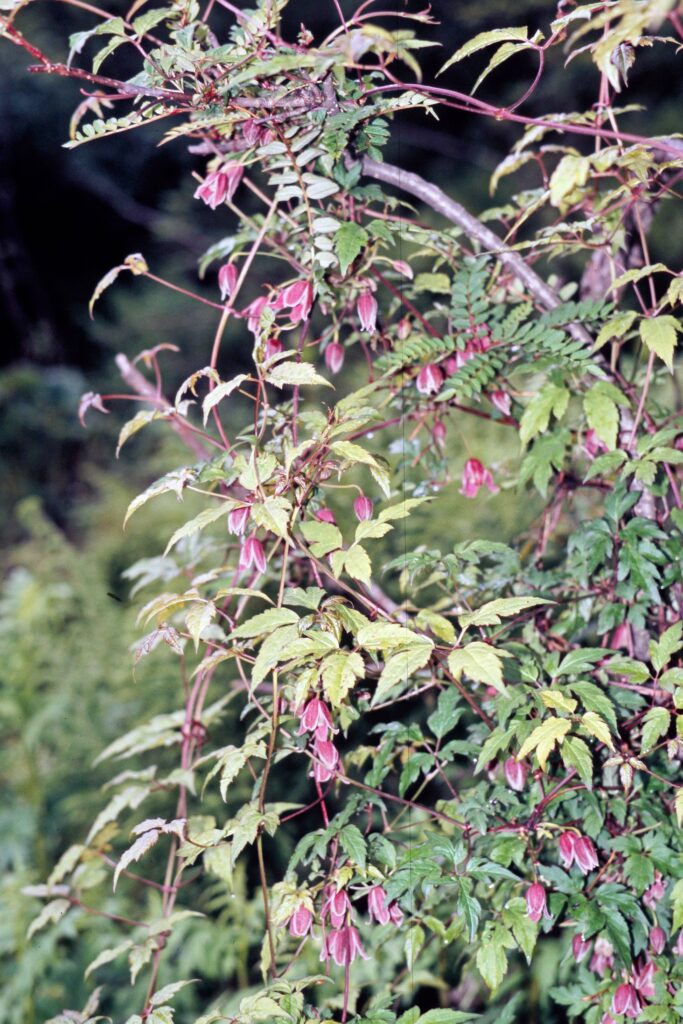
Edgew.

Nepal 99 580 ergebnis
West-Nepal Garpung-Khola 3400m, July
Garh 07 576 ergebnis
India Garhwal Seema 3400m, June

Description

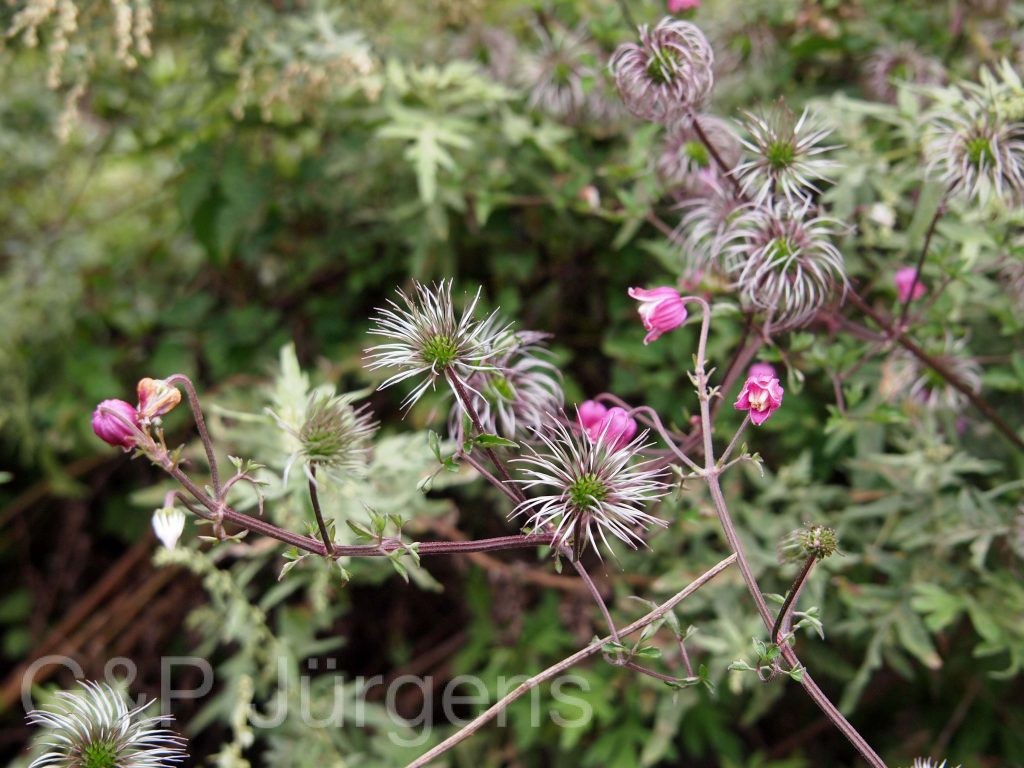
Clematis barbellata is a Sino-Himalayan climber of the temperate and subalpine belt of the central and eastern Himalaya, with georeferenced collections (some 159 occurrences in GBIF) spanning India, Nepal, Bhutan, Pakistan, Myanmar and adjacent China. It ascends through shrubberies, forest margins and open rocky slopes, scrambling over Berberis, Rosa and Rhododendron thickets between roughly 2700 and 3800 m. The species is well represented in the western and central Himalaya, as documented by the photographed populations from West Nepal at the Garpung-Khola at 3400 m in July and from Garhwal at Seema, India, near 3400 m in June, where it flowers during the early monsoon.

It is a woody, deciduous climber with slender, ribbed, often purplish stems clambering by means of twining petioles. The leaves are opposite and pinnately to biternately compound, the leaflets ovate to lanceolate, acuminate, coarsely toothed or lobed and somewhat hairy beneath. The nodding, campanulate flowers are solitary or few in the leaf axils and lack true petals; the four spreading to incurved sepals are dull purple to violet-brown, thick-textured and conspicuously bearded along the margins with pale hairs, hence the epithet barbellata. Numerous stamens surround the many free carpels, which mature into a cluster of achenes bearing long, plumose, persistent styles that aid wind dispersal.

Within Clematis, the species belongs to the group of montane, axillary-flowered bell clematises related to C. montana and C. connata, distinguished by its barbellate sepal margins. As a member of Ranunculaceae it contains protoanemonin-type compounds rendering the foliage acrid and unpalatable to grazers. Though restricted to high elevations, it remains locally frequent across a broad Himalayan range and is not considered threatened, its principal role being as a structural element of subalpine scrub.

Author: Edgew. · Sources: POWO (Kew), GBIF, Flora of Bhutan, Flora of Pakistan, Annotated Checklist of the Flowering Plants of Nepal, Grey-Wilson Clematis: The Genus

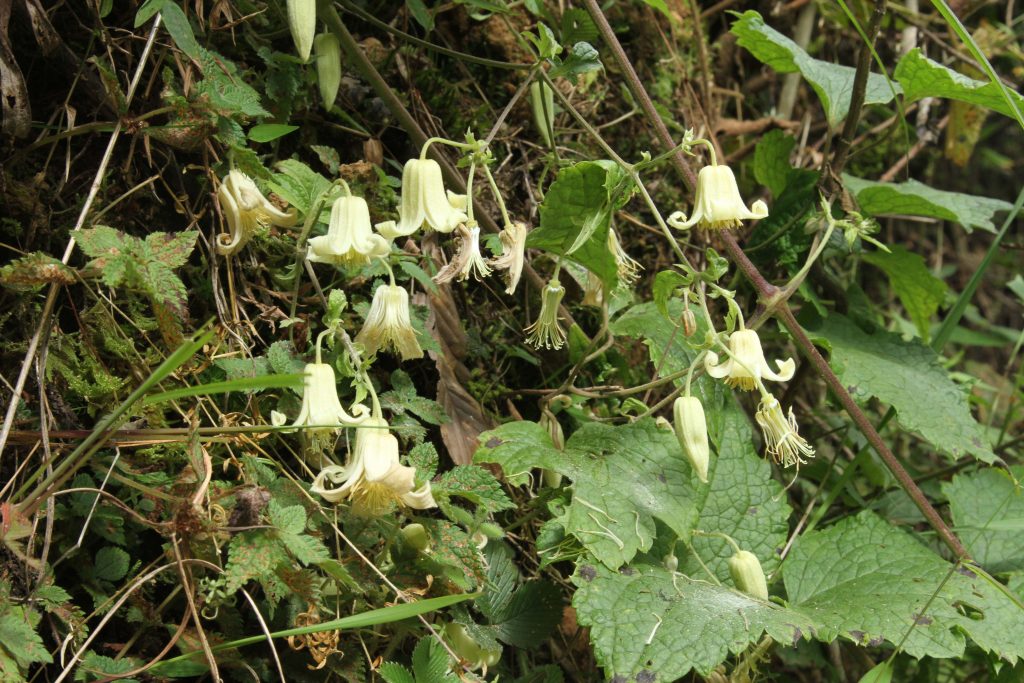
DC.

Bhutan2012 503
Bhutan Pele-La 3000m, September

Description

Clematis buchananiana is a widespread climber of the Himalaya and montane Southeast Asia, ranging from Pakistan and Nepal through India, Bhutan and southern China to Myanmar, Thailand and Vietnam; with over 1100 GBIF occurrences it is among the better-documented Asian clematids, the scattered records from Britain, New Zealand and the United States representing cultivation. It scrambles over shrubs, forest margins, hedgerows and roadside thickets in temperate and subtropical zones, broadly between 1500 and 3000 m, flowering late in the season. The photographed plant from the Pele-La in central Bhutan at 3000 m in September shows its characteristic autumn flowering at the upper edge of its altitudinal span.

It is a woody to herbaceous perennial climber with ribbed, often pubescent stems and opposite, pinnate leaves bearing broadly ovate to cordate, coarsely toothed leaflets. The flowers, borne in axillary cymose panicles, are pendulous and bell-shaped (campanulate), the four thick, yellow to greenish-yellow tepals being densely tomentose outside and reflexed or recurved at the tips; true petals are absent. As in all Clematis the showy structures are sepaloid, surrounding numerous stamens and carpels. The fruit is a head of achenes, each bearing a long, plumose, feathery style that aids wind dispersal.

The species belongs to Clematis section Connatae (the nodding, campanulate-flowered, woolly-tepalled Asian group), in which it is distinguished by leaf form and the dense indumentum of its tepals. Ecologically valuable as a late-season nectar source, it is a common and adaptable species across a vast range and is of no conservation concern.

Author: DC. · Sources: POWO (Kew), GBIF, Flora of Bhutan, Flora of China, A Monograph of the Genus Clematis (Grey-Wilson)