Author

GP Jürgens

Royle

Bhutan2014 1073
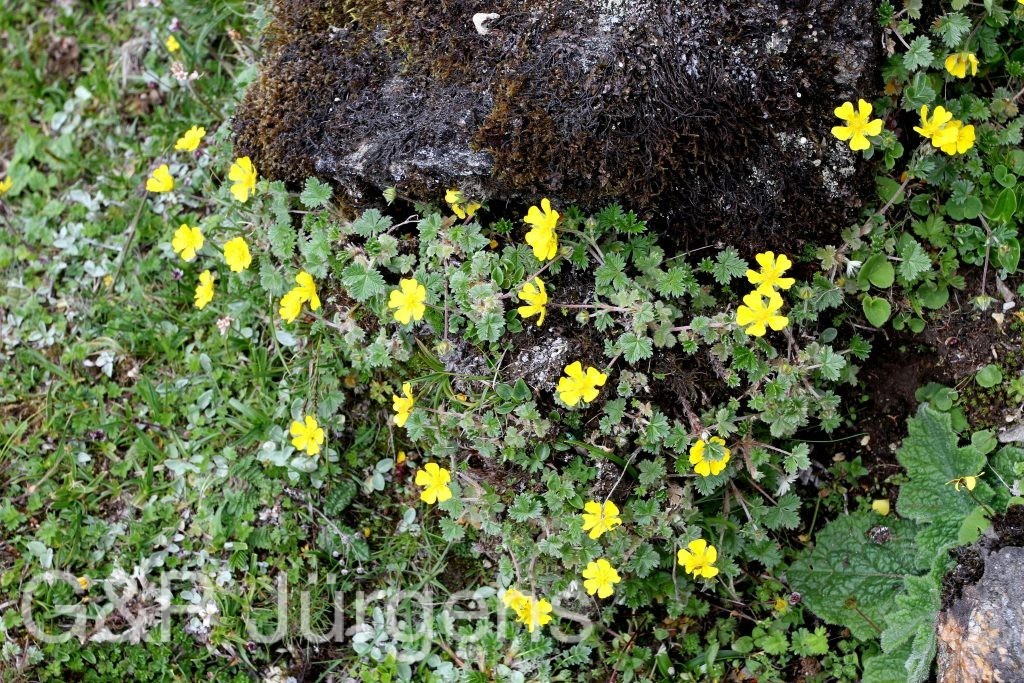
Bhutan Paro 2500m, May

Description

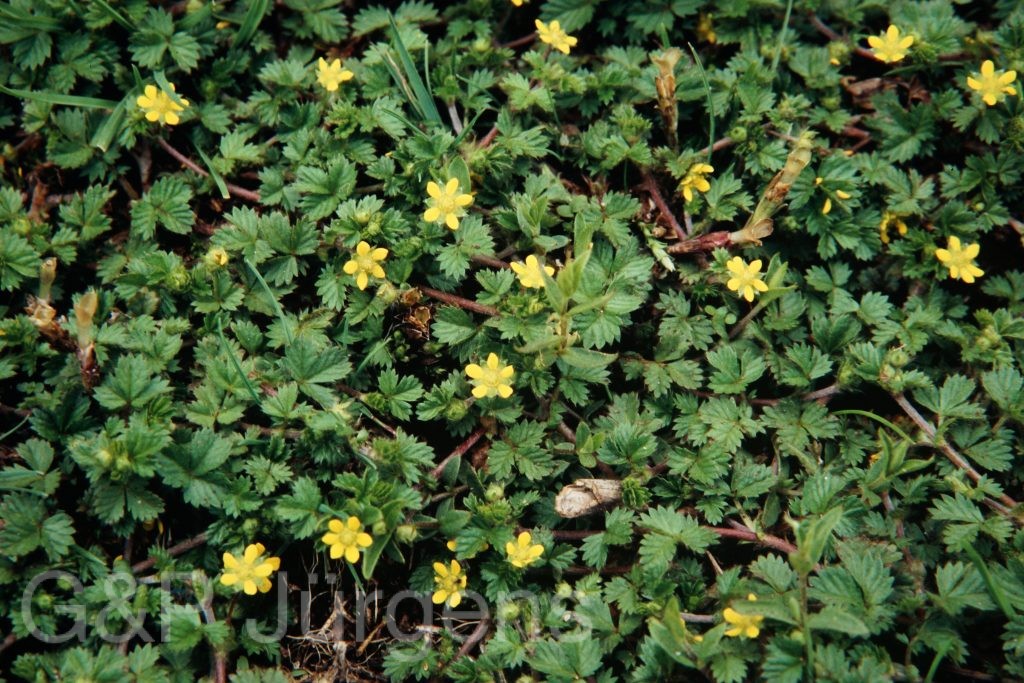
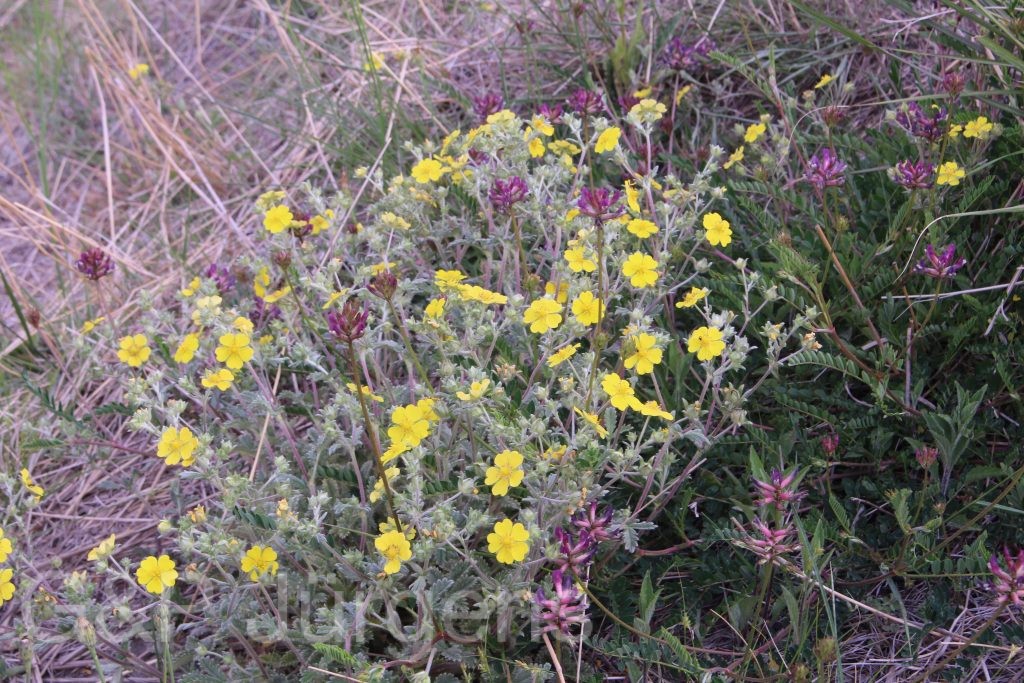
Potentilla saundersiana is a high-altitude cinquefoil of the central Asian and Himalayan mountains, distributed across China, Nepal, India, Bhutan and Pakistan, with GBIF recording about 1092 occurrences. It is a plant of dry alpine and subalpine habitats, frequenting stony slopes, gravelly meadows, open grassland and rock crevices over a wide elevational span, often from around 2500 up to well above 4500 m. The photographed material from near Paro in western Bhutan at 2500 m, flowering in May, lies toward the lower end of its range, where it grows on sunny, well-drained banks; the species more typically ascends into the high alpine turf and screes of the inner ranges.

It is a tufted perennial herb arising from a stout, branched, woody rootstock crowned by the persistent remains of old leaf bases. The leaves are mostly basal and digitately compound, with three to five obovate leaflets that are deeply incised or toothed, green above and densely white-tomentose beneath, giving the plant a characteristic silvery aspect. The flowering stems are slender and few-leaved, bearing a lax cyme of flowers. Each flower has an epicalyx and calyx of five segments each and five bright yellow, obcordate petals surrounding numerous stamens and a domed receptacle of many carpels. The fruit is an aggregate of small, dry, glabrous achenes seated on the dry receptacle.

Potentilla is a large and taxonomically complex genus in which polyploidy, apomixis and hybridisation blur species boundaries, and P. saundersiana itself is a variable aggregate within which several varieties have been recognised. Its dense leaf indumentum and cushion-forming habit are adaptations to the cold, dry, high-radiation conditions of the alpine zone. As a widespread and abundant component of Himalayan and Tibetan alpine grassland it is of no conservation concern, though it is a useful indicator of dry alpine and steppe habitats.

Author: Royle · Sources: POWO (Kew), GBIF, Flora of China, Flora of Bhutan, Flora of Pakistan, Wolf monograph of the genus Potentilla
(Wolf) Soják

Bh2008 595 P890
Bhutan Chele-La, 3950m June

Description

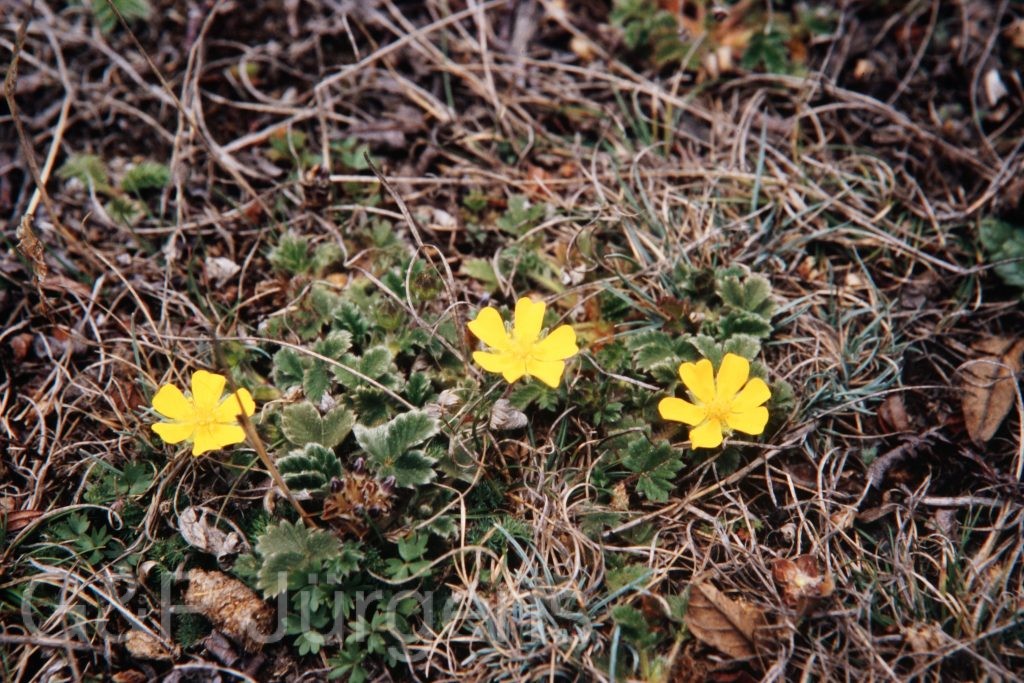
A high-alpine cushion-forming herb of the central and eastern Himalaya and the Tibetan Plateau, recorded across China, Nepal, India and Pakistan, with some 175 georeferenced GBIF occurrences. It occupies dry, open alpine turf, gravelly slopes, rocky ledges and exposed ridge crests, typically between about 3500 and 5000 m. The depicted plant was photographed in June on the Chele-La in western Bhutan at roughly 3950 m, a windswept pass habitat where dwarfed, mat-forming growth is favoured under intense insolation, cold nights and a short summer growing season.

The taxon forms dense, low caespitose tufts arising from a thick, branched, often woody-based rootstock crowned with marcescent stipules and leaf remnants. The leaves are digitate (palmate), with three to five obovate, deeply incised-serrate leaflets that are green and sparsely strigose above and densely white-tomentose beneath, the indumentum giving the foliage a silvery cast. Slender, ascending cymes bear few yellow flowers; each has five sepals alternating with smaller epicalyx segments, five obcordate golden petals slightly exceeding the calyx, numerous stamens and an apocarpous gynoecium of many free carpels. The fruit is a cluster of small, glabrous, smooth to faintly rugose achenes.

GBIF treats the name as a synonym, with Potentilla saundersiana caespitosa accepted; the variety represents a compact, densely tufted high-elevation expression of the widespread, polymorphic P. saundersiana complex. The species is one of many silvery alpine cinquefoils whose infraspecific limits remain debated. Ecologically it stabilises thin alpine soils and provides nectar to short-season pollinators. Though local populations are restricted to specialised habitats, the broad geographic range and abundance of suitable terrain mean it is not regarded as threatened.

Author: (Wolf) Soják · Sources: POWO (Kew), GBIF, Flora of China, Flora of Bhutan, Soják revisions of Potentilla

Franch.

BhutanPG2011 236
Bhutan Tsochenchen, 3700m June
Also included: Calathodes palmata Hook.f. & Thomson

Description

Potentilla saundersiana (the variety jaquemontii here referred to it) is a cushion-forming cinquefoil of the high mountains of Central Asia and the Himalaya, ranging through China, Nepal, India, Bhutan and Pakistan, with GBIF recording over 1000 occurrences; the European points from Germany, France and Sweden reflect herbarium and cultivated material. It is a plant of stony alpine meadows, gravelly slopes, rock crevices and dry pastures in the alpine and subnival zones, frequently above 3500 m and reaching well over 4500 m. The illustrated plant from Tsochenchen in Bhutan at 3700 m, flowering in June, is typical of these exposed, well-drained high-altitude sites; the caption notes the co-occurring Calathodes palmata.

It is a low, tufted perennial herb arising from a stout, branched, woody rootstock (caudex) clothed in old leaf-bases, forming compact mats. The leaves are digitate (palmate), with several narrow, deeply toothed leaflets that are densely white-tomentose, especially beneath, giving the foliage a silvery, felted appearance adapted to drought and cold. The flowers are borne in lax cymes on slender stems; each has five yellow obcordate petals, an epicalyx alternating with the five calyx lobes, and numerous stamens. The fruit is an aggregate of dry achenes seated on a hairy receptacle.

Within the large and taxonomically complex genus Potentilla, P. saundersiana belongs to a group of densely tomentose, alpine cushion cinquefoils, and infraspecific variants such as var. jaquemontii reflect variation in indumentum and leaflet form across its wide range. Abundant and widespread, it is of no conservation concern.

Author: Franch. · Sources: POWO (Kew), GBIF, Flora of Bhutan, Flora of China, Potentilla (Th. Wolf monograph)

(Blume) W.Theob.

Bh09 186 G323
Bhutan Phajoding, 3700m June

Description

Potentilla sundaica (Blume) W.Theob. is a widespread perennial cinquefoil ranging across tropical and subtropical Asia from the Himalaya (Nepal, Bhutan, northern India, Pakistan, Afghanistan) through China, Korea, Japan and Taiwan into South-East Asia, Indonesia, Sri Lanka and the Russian Far East, the GBIF dataset recording some 5,300 occurrences over this broad area. It is a plant of open grassy slopes, forest clearings, roadsides, streambanks and disturbed montane ground, ascending from lowland to high-montane elevations. The illustrated collection comes from Phajoding above Thimphu in Bhutan at 3700 m in June, near the upper part of its altitudinal range, where it grows in moist alpine to subalpine turf.

It is a slender perennial or sometimes short-lived herb with ascending to decumbent, often reddish, hairy stems arising from a slender rootstock. The leaves are mostly ternate, occasionally with an additional pair of leaflets, the leaflets obovate to oblong-cuneate, coarsely serrate to dentate in the upper part and clothed with appressed to spreading hairs; the leaves are stipulate at the base. The flowers are borne in lax, few- to several-flowered cymes, each with an epicalyx of bracteoles alternating with the five calyx lobes and five obovate yellow petals roughly equalling or shorter than the sepals. Numerous stamens surround a domed receptacle bearing many carpels. The fruit is an aggregate of small, smooth to faintly wrinkled achenes seated on a slightly hairy receptacle.

Long known under the name Potentilla kleiniana, this species is a member of the taxonomically difficult P. sundaica complex, whose variable leaf division and indumentum have generated numerous synonyms and infraspecific names across its vast range. As a hardy colonist of open and disturbed habitats it is ecologically a pioneer of grasslands and trodden ground, and it is a frequent component of grazed montane pasture. Given its abundance and ecological amplitude it is of no conservation concern, ranking among the more ubiquitous Asian cinquefoils.

Author: (Blume) W.Theob. · Sources: POWO (Kew), GBIF, Flora of China, Flora of Bhutan, Potentilla of the Sino-Himalaya (Soják)

(Blume) Merr.

Bhutan2015 274
Bhutan Zhemgang 1000m, October

Description

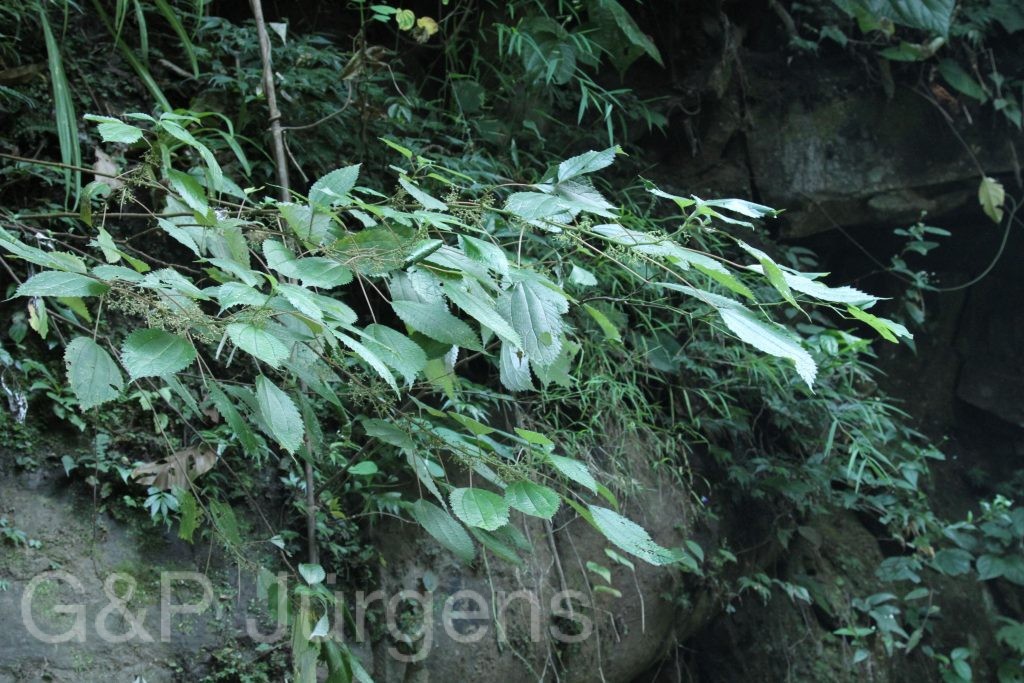
Pouzolzia sanguinea (Blume) Merr. is a widespread shrub of the nettle family ranging through tropical and subtropical Asia, from the Himalaya and India eastward to China, Taiwan, Japan, and across Southeast Asia to Indonesia, Malaysia and the Philippines; GBIF holds over 3100 occurrences. It is a plant of forest margins, secondary scrub, ravines, roadside banks and disturbed slopes at low to mid elevations, ascending into the warm broad-leaved zone. In Bhutan it was recorded at Zhemgang at about 1000 m in October, a subtropical hill setting typical of its preference for humid, partially shaded ground in the outer ranges.

It is an erect to spreading shrub with terete, often reddish or purple-tinged young branches that are appressed-pubescent. The leaves are alternate, ovate to elliptic-lanceolate, acuminate, with three prominent basal veins, the upper surface scabrid or strigose and the lower paler and pubescent; stipules are present and the leaves lack the stinging hairs of true nettles. The plant is monoecious, the small greenish flowers borne in dense axillary glomerules, with unisexual perianths; the female flowers develop into a small, shining, longitudinally ribbed achene enclosed by the persistent accrescent perianth.

The species is taxonomically variable and several infraspecific variants have been recognised across its broad range, contributing to a tangled synonymy under Pouzolzia. Like many Urticaceae it yields a strong bast fibre and is used locally for cordage, while leaves serve as fodder and in folk medicine. Its tolerance of disturbance and wide ecological amplitude make it a common pioneer rather than a species of conservation concern, and it figures as a characteristic element of regenerating Himalayan hill forest.

Author: (Blume) Merr. · Sources: POWO (Kew), GBIF, Flora of China, Flora of Bhutan, Flora of British India, Urticaceae monograph (Friis; Wilmot-Dear & Friis revision of Pouzolzia)

W.W. Sm.

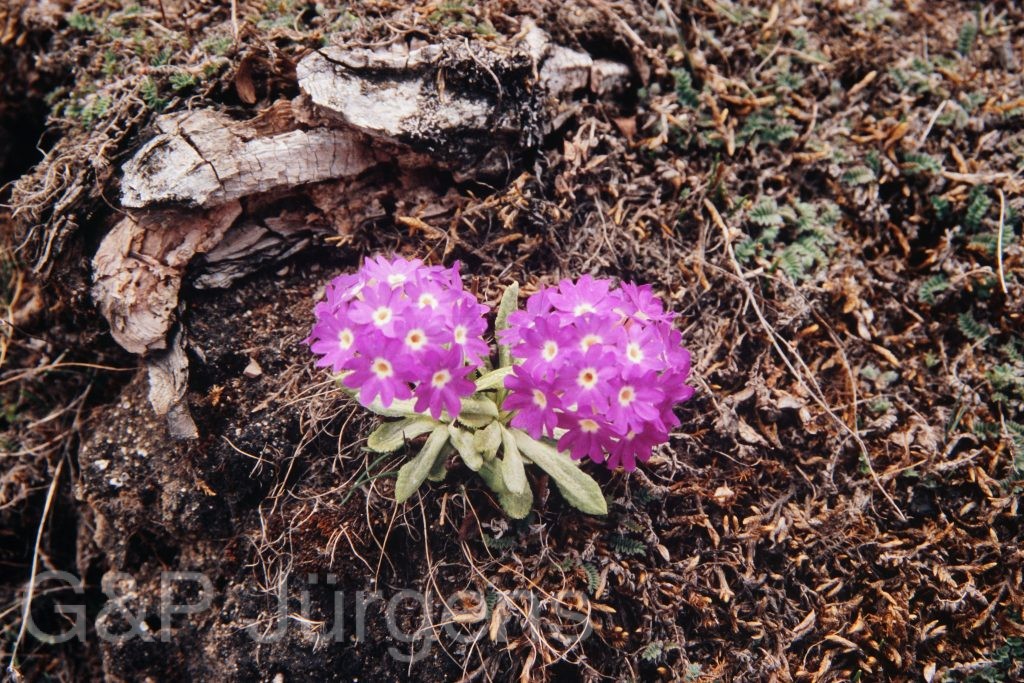
Bhutan2014 924
Bhutan Chele-La 4000m, May
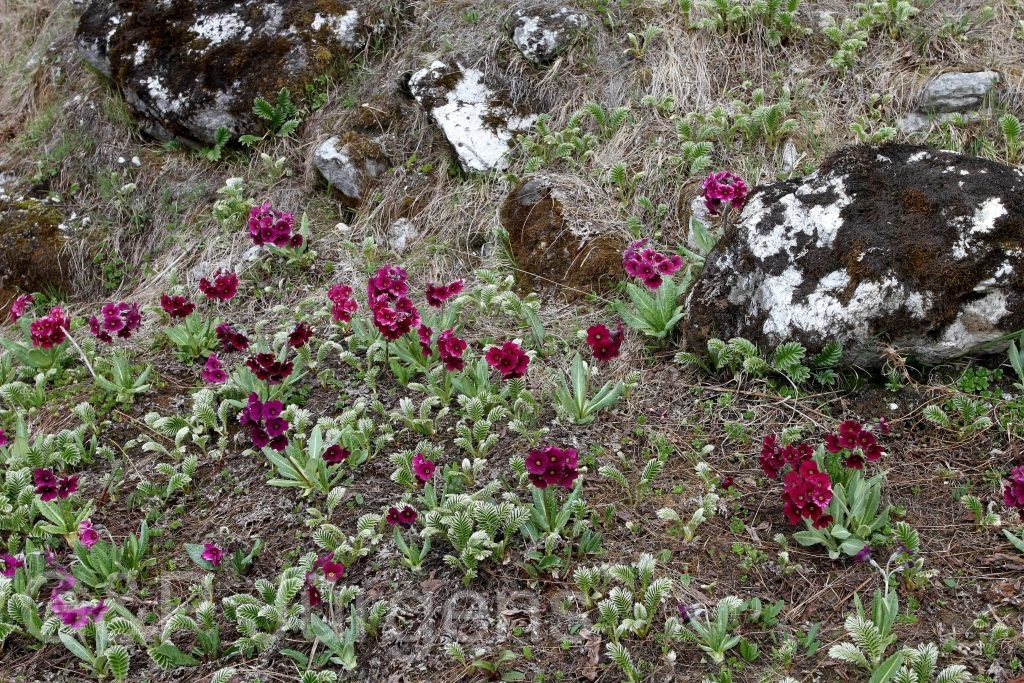
Bhutan2014 926
Bhutan Chele-La 4000m, May
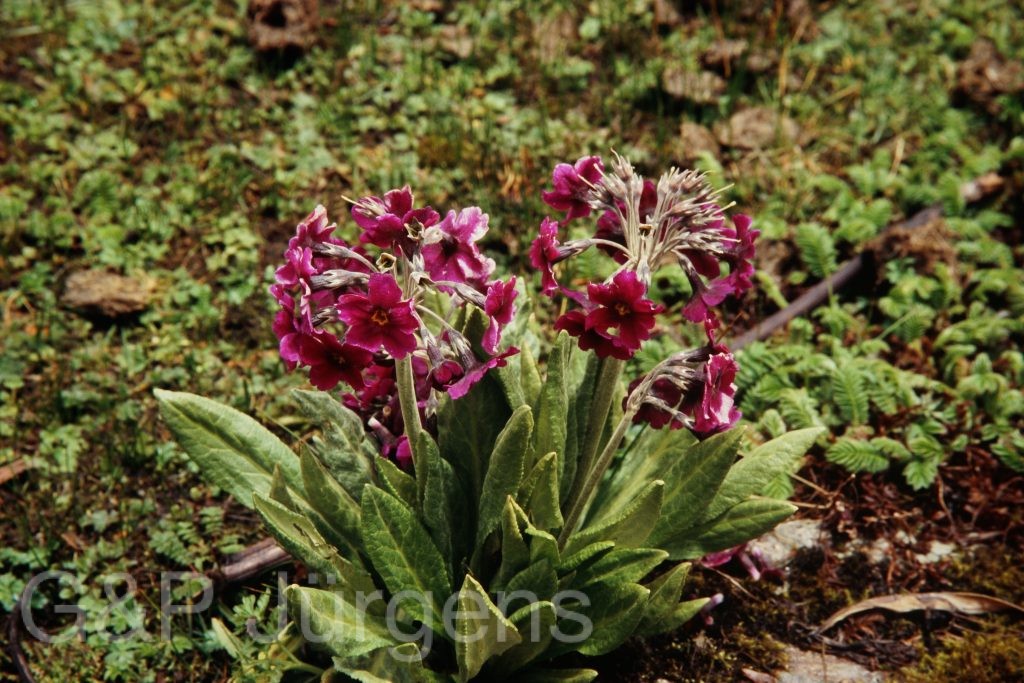
Bh2008 588 G880
Bhutan Chele-La 3900m April

Description

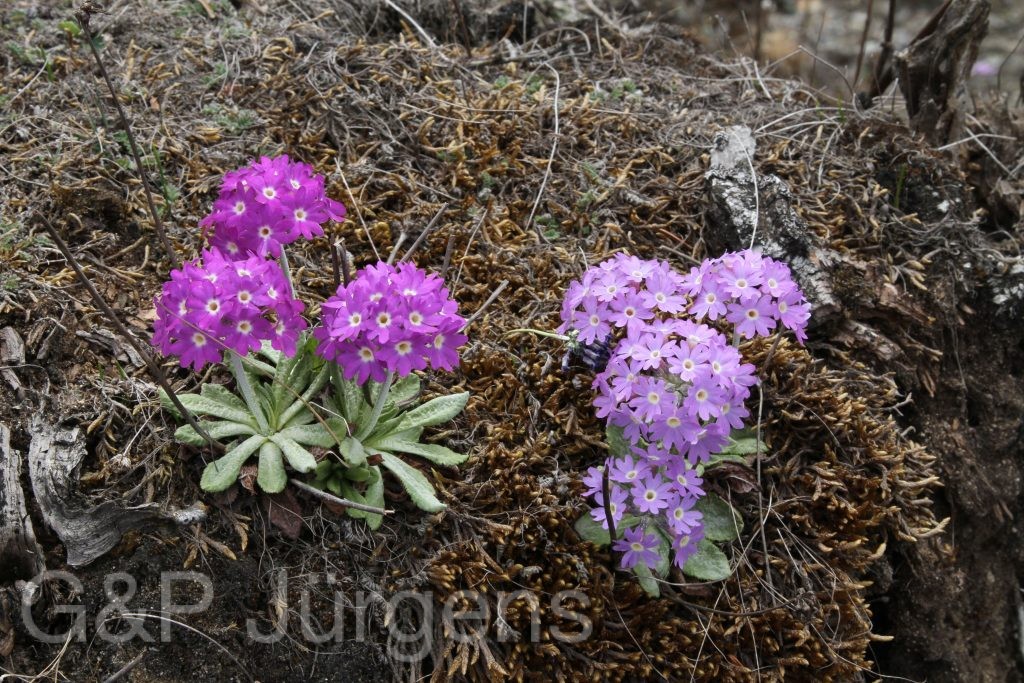
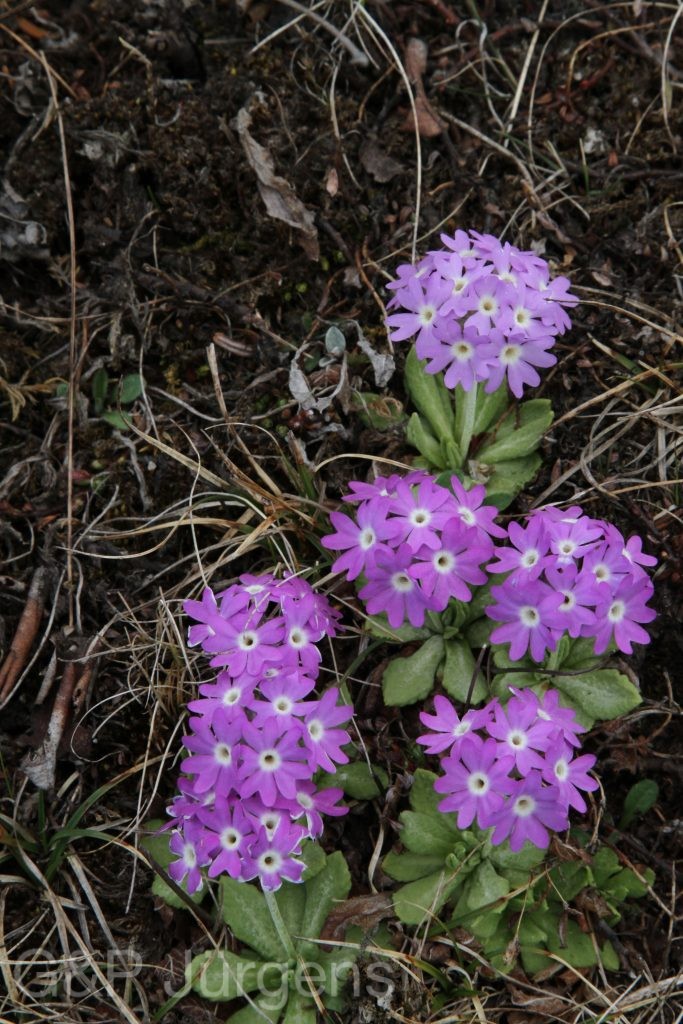
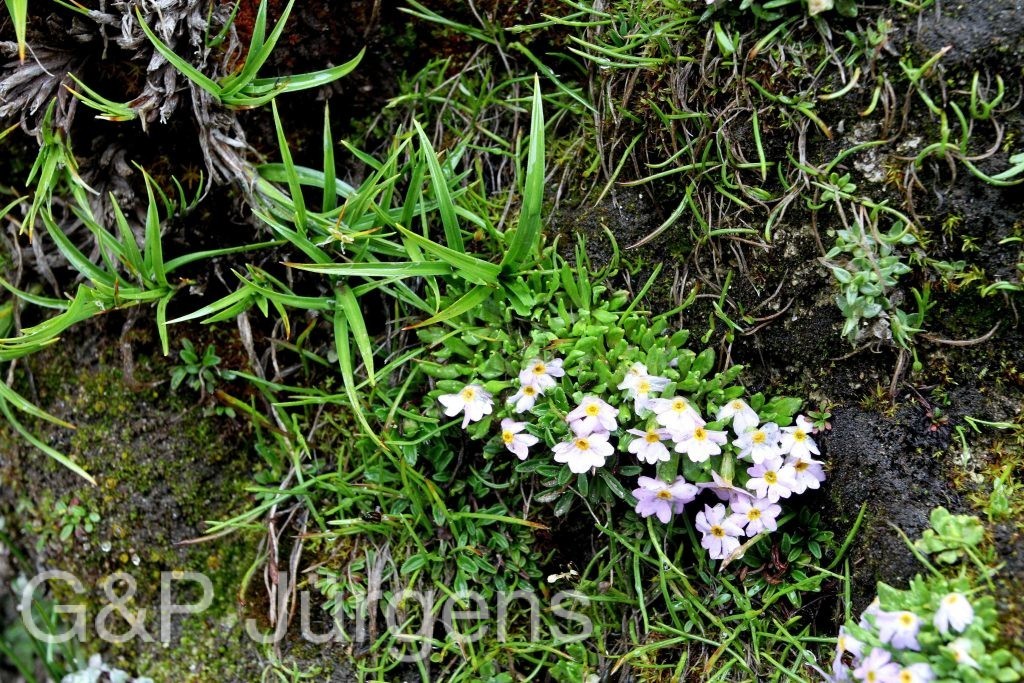
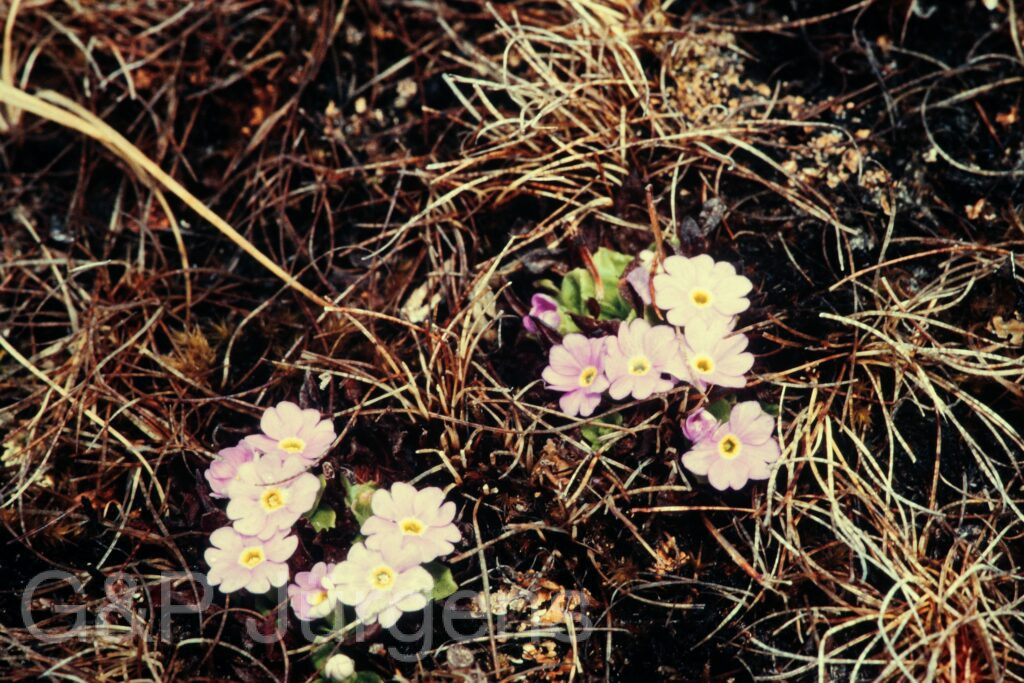
Primula atrodentata is a small alpine primrose of the high eastern and central Himalaya, native to China, Nepal, India, Bhutan and Pakistan, with about 161 georeferenced records confined to the upper subalpine and alpine zones. It grows on damp open slopes, alpine meadows, rocky turf and the margins of snow-melt seepages, typically between about 3000 and 4500 m. The photographed plants were recorded at the Chele-La in western Bhutan at 3900-4000 m, flowering in April and May immediately after snow-melt, when these cushion-forming primulas carpet the freshly exposed turf.

The species is a low, tufted perennial herb with a short rhizome and a basal rosette of obovate to spathulate leaves, the blade narrowed to a winged petiole, the margins finely toothed and the undersurface mealy with white or yellowish farina; the rosettes are often clothed at the base with persistent bud-scales. The flowers are borne in a dense, globose terminal umbel atop a slender, farinose scape that elongates after anthesis. The corolla is salver-shaped with a slender tube and spreading, notched lobes, coloured pale lilac to violet or rarely white, with a small yellow eye. The fruit is a small ovoid capsule shorter than the persistent calyx.

Primula atrodentata belongs to section Capitatae of the genus, the dense-headed primulas, distinguished by its compact globose umbel and toothed, farinose leaves; the epithet refers to the dark-tipped (atro-) teeth of the leaf margin and calyx. A characteristic early-flowering snow-melt species, it is heterostylous and insect-pollinated. Widespread and locally abundant across its alpine range, it is not regarded as threatened.

Author: W.W. Sm. · Sources: POWO (Kew), GBIF, Flora of Bhutan, Flora of China, The Genus Primula (Richards)

Balf. f. & R.E. Cooper

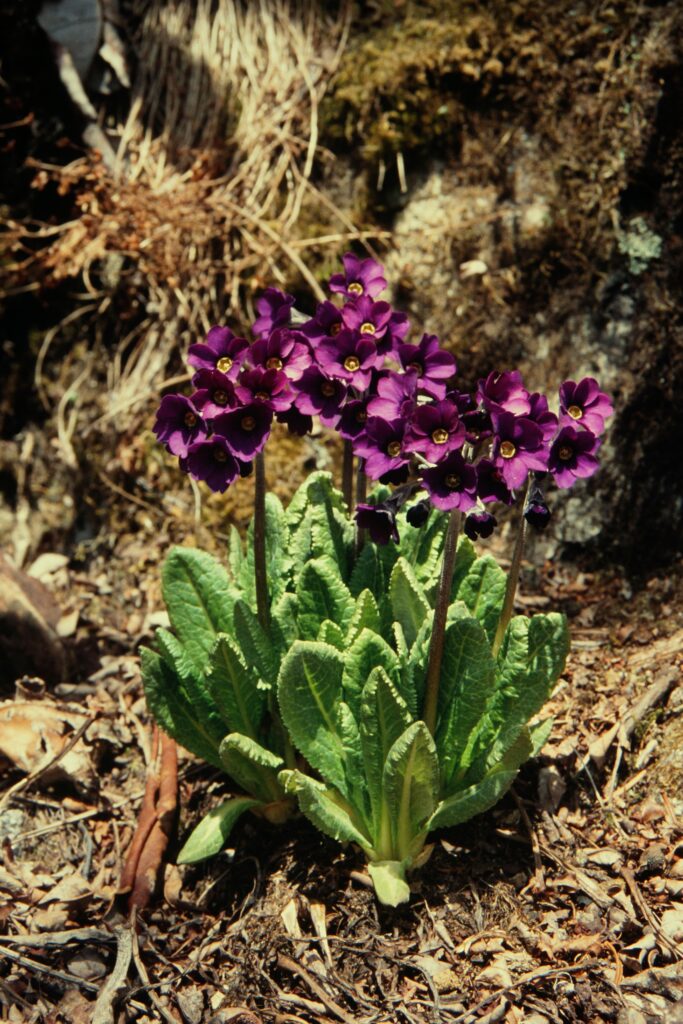
Sikkim2011 266
Sikkim Lada-La 4000m, June
Sikkim2011 335
Sikkim Lada-La 4000m, June
Bh09 120 P192
Bhutan Jimilangtso, 4000m June
Bh09 150 G268
Bhutan Jimilangtso, 4000m June
Sikkim2004 211 G358
Sikkim/India Gometang 4200m May

Description

Primula calderiana is an eastern Himalayan alpine primrose distributed through Nepal, India (Sikkim), Bhutan and adjacent China, with about 313 georeferenced records; isolated entries from Japan and elsewhere reflect cultivation or data artefacts. It grows on moist alpine meadows, damp turf, streamsides and the margins of melting snow between roughly 3500 and 4500 m. The documented localities at Lada-La (4000 m) and Gometang (4200 m) in Sikkim and at Jimilangtso (4000 m) in Bhutan, flowering in May and June, capture its appearance just after snowmelt in the high pastures.

It is a stout, scapose perennial with a basal rosette of obovate to spathulate leaves that are toothed at the margin and often dusted beneath with whitish or yellowish farina. The leafless scape bears a terminal umbel of several flowers, each subtended by linear bracts. The corolla is salver- or funnel-shaped with a slender tube and spreading limb of five notched lobes, ranging from deep purple to crimson with a contrasting yellow or dark eye, and a campanulate calyx. The fruit is a small capsule containing numerous seeds.

Primula calderiana belongs to section Petiolares, a notoriously difficult group whose species hybridise and intergrade across the eastern Himalaya; it is closely allied to P. tsariensis and related farinose primroses. As an early-flowering snowmelt specialist it is an indicator of intact alpine turf, and like many high-elevation Petiolares it is locally collected for gardens. It remains widespread within its core range.

Author: Balf. f. & R.E. Cooper · Sources: POWO (Kew), GBIF, Flora of Bhutan, Annotated Checklist of the Flowering Plants of Nepal, Richards' Primula monograph

Hook.

Bhutan2015 372
Bhutan Tumching-La 4000m, October

Description

Primula capitata is an eastern Himalayan primrose distributed through Nepal, Sikkim and northern India, Bhutan and adjacent southern China and northern Myanmar, with around 476 GBIF records (additional entries from Europe, North America, Japan and Korea reflecting its cultivation). It is a plant of open, moist alpine and subalpine habitats, growing in damp meadows, on grassy slopes, streamsides and among rocks. The imaged populations at Tumching La (4000 m) and Shele La (3000 m) in Bhutan and at Dzongri in Sikkim (4100 m) span its typical elevational range and its notably late, monsoon-to-autumn flowering from August into October, when much of the alpine flora has already set seed.

The species forms a rosette of oblanceolate to spathulate leaves that are crenate to denticulate at the margin and densely white- or yellow-farinose beneath. From the rosette rises a stout, farinose scape bearing the diagnostic inflorescence: a dense, flat-topped to hemispherical capitate head of many small flowers, the lowermost opening first so that the head appears truncate. Each flower has a tubular calyx and a violet to deep blue-purple corolla with a short tube and small, spreading limb-lobes, the throat farinose. The plant is heterostylous. The fruit is a small capsule enclosed in the persistent calyx.

Primula capitata belongs to sect. Capitatae, a small group distinguished by their compact, drumstick-like heads of farinose flowers. Several subspecies and varieties have been recognised on the basis of leaf and farina characters and degree of late-season flowering. Its dependence on cool, moist alpine turf ties its distribution to the high monsoon-influenced ranges of the eastern Himalaya; it is locally common and not regarded as threatened, and is valued in cultivation as a hardy late-flowering rock-garden primula.

Author: Hook. · Sources: POWO (Kew), GBIF, Flora of Bhutan, Flora of China, Annotated Checklist of the Flowering Plants of Nepal, Richards' Primula (monograph)

W.W. Smith

BhutanPG2011 557 01 1
Bhutan Ludlow-Sherriff-Trail Dem-Tso, 4600m July
BhutanPG2011 558 1
Bhutan Ludlow-Sherriff-Trail Dem-Tso, 4600m July

Description

Primula caveana is a diminutive high-alpine primrose of the eastern Himalaya, recorded from Nepal, India, Bhutan and adjacent China, with about 115 georeferenced occurrences indicating a restricted range at extreme elevation. It is a plant of cold, exposed screes, rock crevices, moraine and damp gravelly turf near the upper limit of vegetation, generally between roughly 4200 and 5000 m. The documented gathering from Dem-Tso on the Ludlow-Sherriff Trail in Bhutan at 4600 m, flowering in July, is fully characteristic of its harsh, late-season nival habitat where snow persists late and the growing season is brief.

It is a small, farinose, scapose perennial forming a tight basal rosette of obovate to spathulate leaves that are toothed toward the apex and densely coated, especially beneath, with conspicuous yellowish or white farina. The short scape bears a few-flowered umbel subtended by farinose bracts. The corolla is salver-shaped with a slender tube and a spreading limb of five notched lobes, deep blue to violet with a yellow or white meal-dusted eye, set in a powdery campanulate calyx. The fruit is a small capsule with numerous seeds.

Primula caveana belongs to section Soldanelloides (allied to the Petiolares group), a cluster of high-elevation, farinose primroses that are taxonomically intricate and often hybridise. The heavy farina is interpreted as protection against intense ultraviolet radiation and water loss at extreme altitude. As a narrowly distributed nival specialist confined to the highest meadows and screes, it is of particular interest for monitoring the effects of alpine climatic change.

Author: W.W. Smith · Sources: POWO (Kew), GBIF, Flora of Bhutan, Annotated Checklist of the Flowering Plants of Nepal, Richards' Primula monograph

G.Watt

BhutanPG2011 562 01
Bhutan Ludlow-Sherriff-Trail Dem-Tso, 4600m July
Nepal 97 183 P363
Nepal Tayla-La 4500m April

Description

Primula concinna is a dwarf high-alpine primrose of the eastern Himalaya, recorded from Nepal, India, Bhutan and south-west China (with a cultivated record in Japan) across 123 georeferenced occurrences. It is a plant of the upper alpine zone, growing in short turf, on moist gravelly slopes, rock ledges and the margins of snow-melt flushes. The collections at Dem-Tso on the Ludlow-Sherriff Trail in Bhutan (4600 m, July) and Tayla-La in Nepal (4500 m, April) place it among the highest-altitude primulas, typically between about 4000 and 5000 m, flowering as the snow recedes.

It is a diminutive rosette-forming perennial herb, often only a few centimetres tall. The leaves are spathulate to oblanceolate, crowded into a flat basal rosette, with toothed or crenate margins and frequently a coating of pale farina (mealy powder) beneath. The flowers are borne singly or in a small umbel on a short scape, each with a tubular calyx and a rose-purple to lilac-pink corolla with a yellow or whitish eye, the limb flat and the lobes notched. The species is heterostylous (pin and thrum forms), and the fruit is a small capsule shorter than or about equalling the calyx.

Primula concinna belongs to the predominantly Sino-Himalayan section Minutissimae, a group of tiny, high-altitude, often farinose primulas distinguished by their cushion or rosette habit and solitary to few-flowered scapes. The heterostylous flowers promote outcrossing by alpine insects, chiefly bees and flies. Restricted to high, often remote terrain and locally frequent there, it faces few direct threats, though as a high-mountain specialist it is potentially sensitive to climate-driven shifts in snow cover.

Author: G.Watt · Sources: POWO (Kew), GBIF, Flora of Bhutan, Flora of China, Flora of Nepal, Richards Primula (monograph)