
Franch.
Also included: Calathodes palmata Hook.f. & Thomson
Description
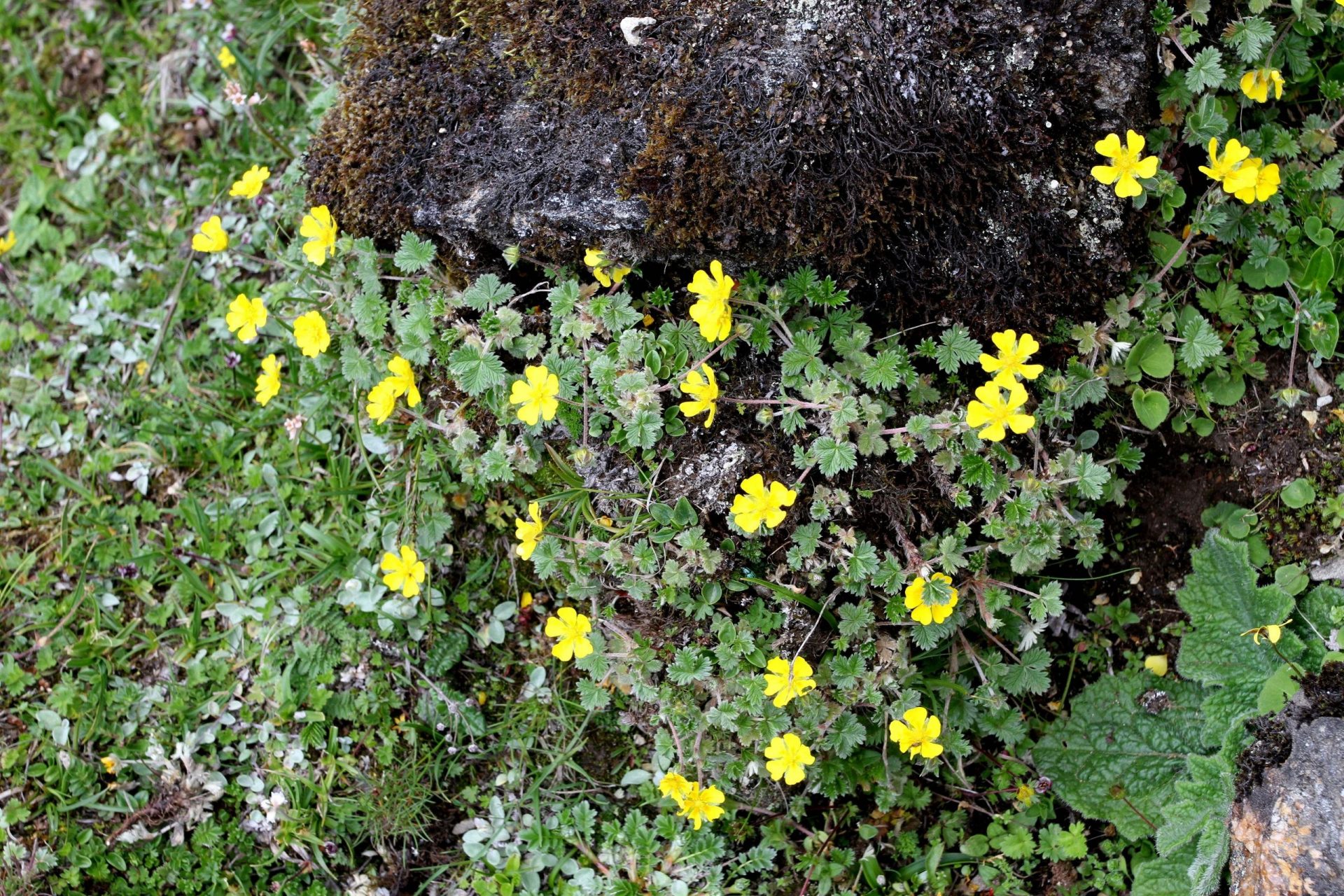
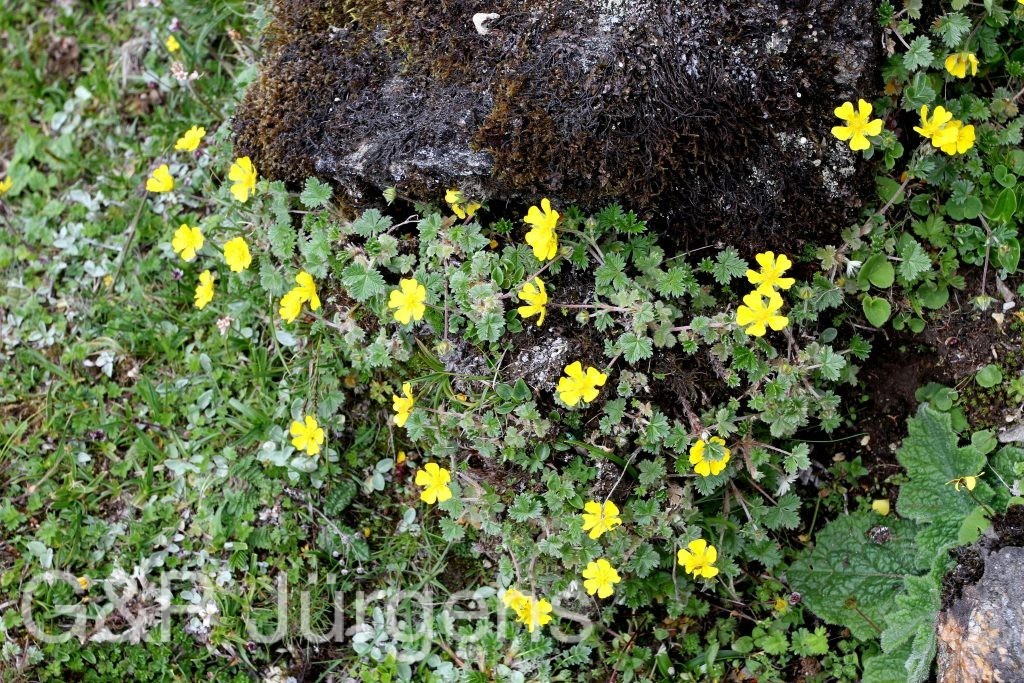
Potentilla saundersiana (the variety jaquemontii here referred to it) is a cushion-forming cinquefoil of the high mountains of Central Asia and the Himalaya, ranging through China, Nepal, India, Bhutan and Pakistan, with GBIF recording over 1000 occurrences; the European points from Germany, France and Sweden reflect herbarium and cultivated material. It is a plant of stony alpine meadows, gravelly slopes, rock crevices and dry pastures in the alpine and subnival zones, frequently above 3500 m and reaching well over 4500 m. The illustrated plant from Tsochenchen in Bhutan at 3700 m, flowering in June, is typical of these exposed, well-drained high-altitude sites; the caption notes the co-occurring Calathodes palmata.
It is a low, tufted perennial herb arising from a stout, branched, woody rootstock (caudex) clothed in old leaf-bases, forming compact mats. The leaves are digitate (palmate), with several narrow, deeply toothed leaflets that are densely white-tomentose, especially beneath, giving the foliage a silvery, felted appearance adapted to drought and cold. The flowers are borne in lax cymes on slender stems; each has five yellow obcordate petals, an epicalyx alternating with the five calyx lobes, and numerous stamens. The fruit is an aggregate of dry achenes seated on a hairy receptacle.
Within the large and taxonomically complex genus Potentilla, P. saundersiana belongs to a group of densely tomentose, alpine cushion cinquefoils, and infraspecific variants such as var. jaquemontii reflect variation in indumentum and leaflet form across its wide range. Abundant and widespread, it is of no conservation concern.
Author: Franch. · Sources: POWO (Kew), GBIF, Flora of Bhutan, Flora of China, Potentilla (Th. Wolf monograph)