Author

G & P Jürgens

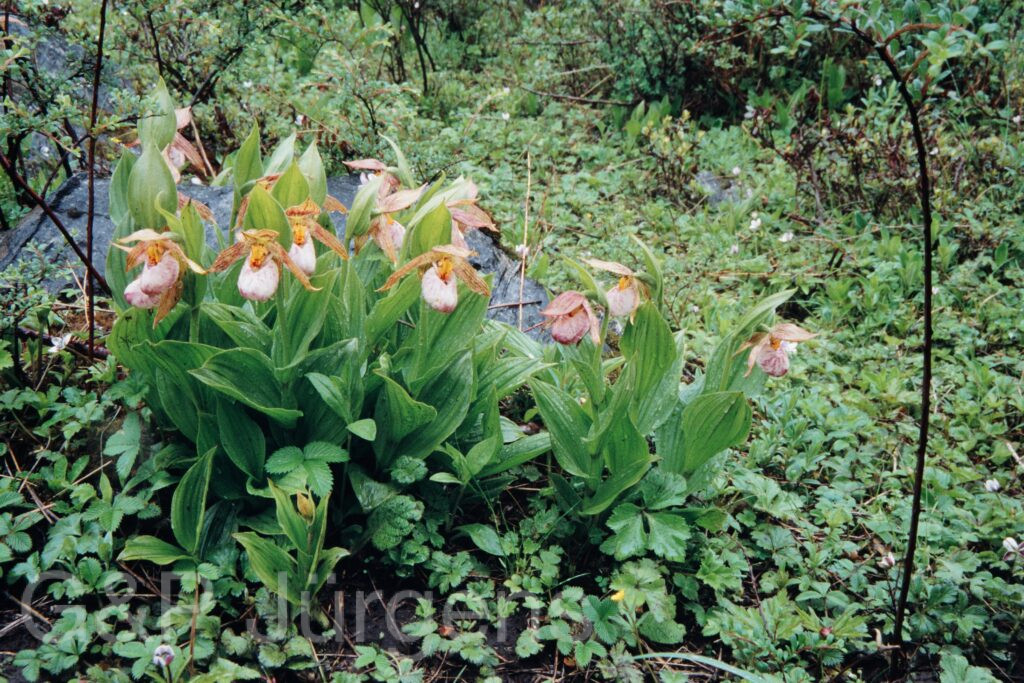
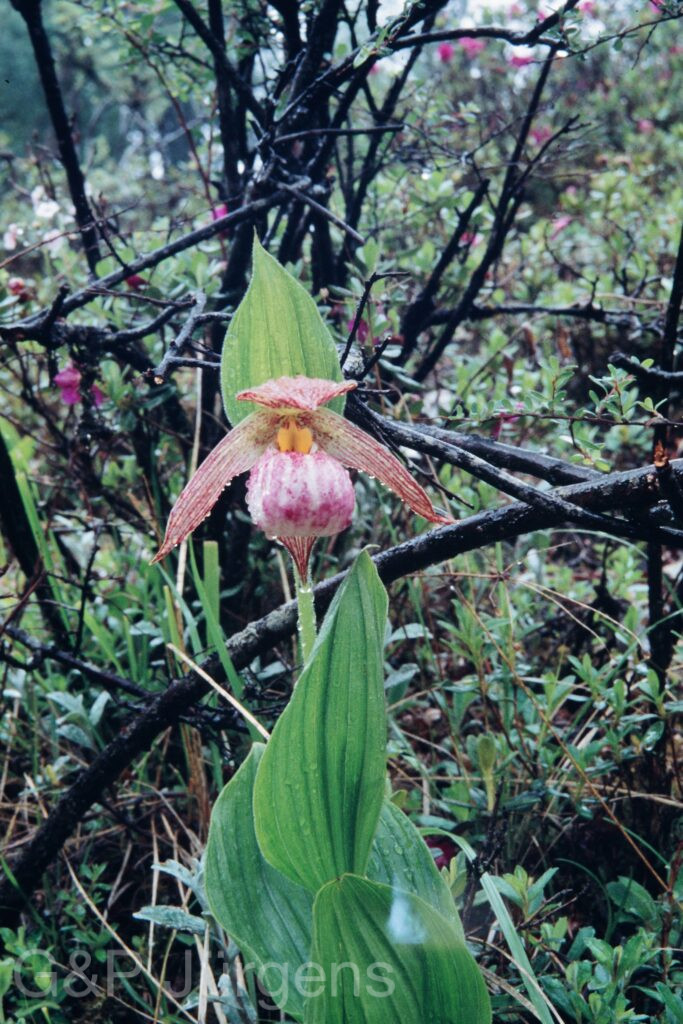
Rolfe ex. Hemsl.

BhutanPG2011 188
Bhutan Tsochenchen, 3600m June
BhutanPG2011 794
Bhutan Chele-La, 3850m July
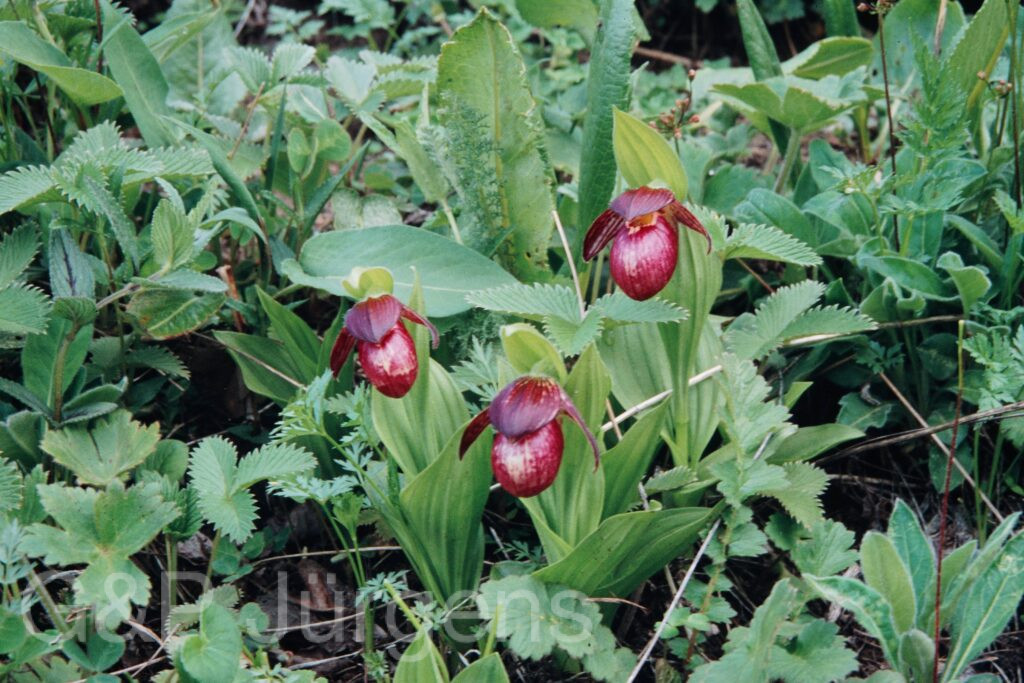
Nepal 99 48 ergebnis
West-Nepal Nyor Gaad 2700m, June
Nepal 99 51 ergebnis
West-Nepal Nyor Gaad 2700m, June
Nepal 99 370 ergebnis
West-Nepal Nyor Gaad 2700m, June

Description

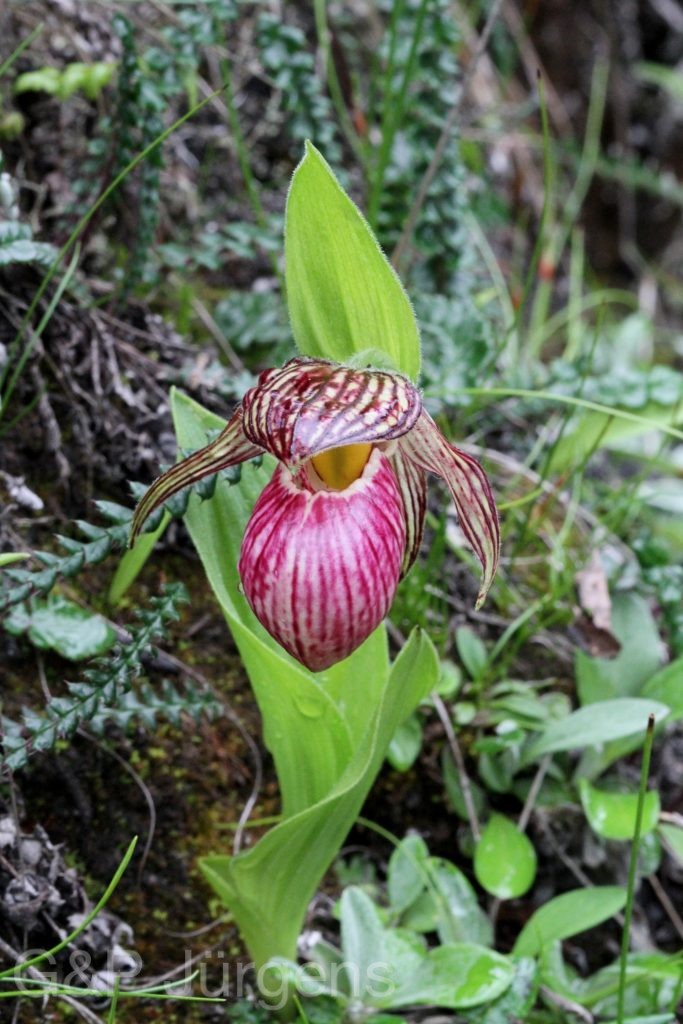
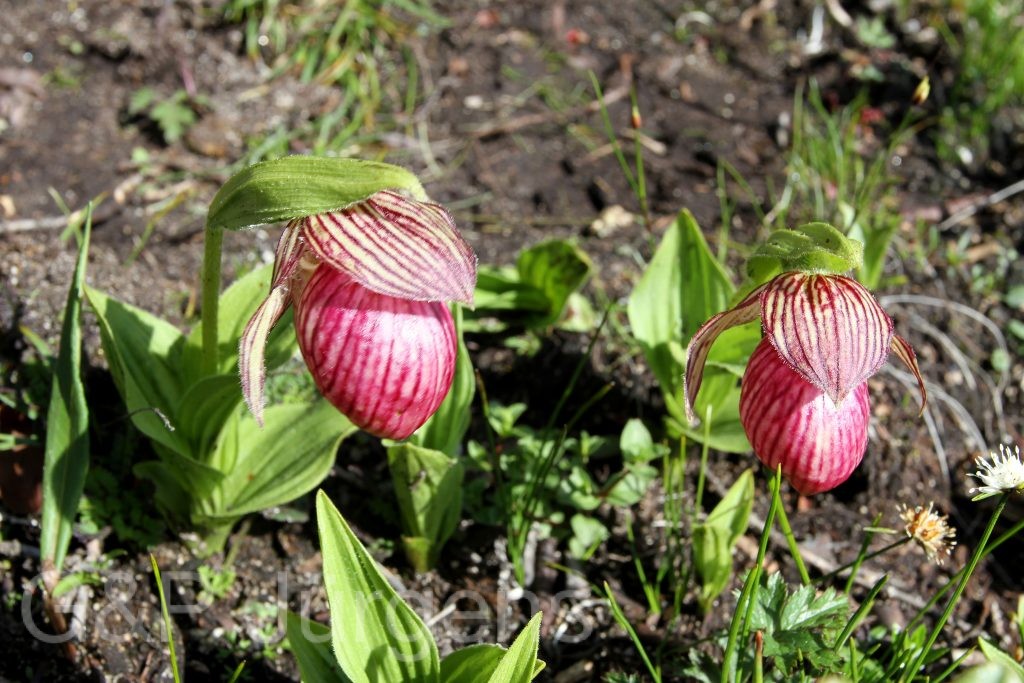
Cypripedium himalaicum is a terrestrial slipper orchid native to the eastern Himalayas, found in Bhutan, Nepal, Sikkim, and southern Tibet. It grows in alpine meadows and open forests at elevations of 3,000 to 4,500 m.

The plant reaches 15–35 cm in height, bearing one or two broadly elliptic leaves. The solitary flower is distinctive: the dorsal sepal is greenish-white with purple veins, the petals are narrow and twisted, and the lip forms a large inflated pouch, pale yellowish-green with purple spotting. Flowering occurs from May to July.

Cypripedium himalaicum is one of the highest-altitude slipper orchids in the world. It is classified as vulnerable due to habitat loss and overcollection. All Cypripedium species are listed under CITES Appendix II.

Author: Rolfe ex. Hemsl. · Sources: POWO (Kew), Flora of Bhutan, CITES Checklist
King ex Rolfe

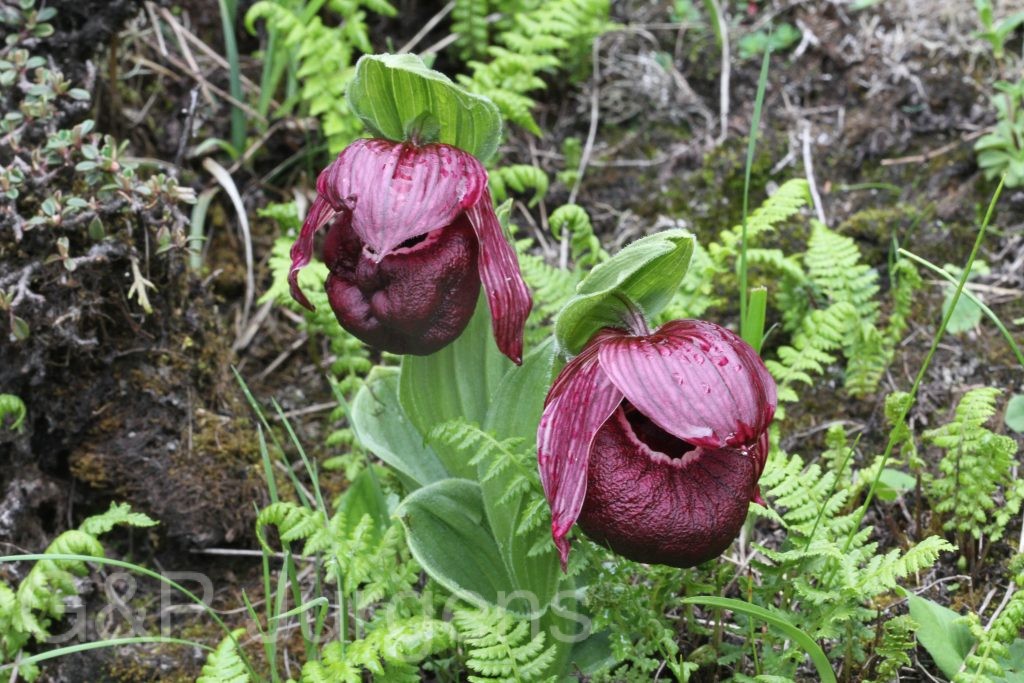
BhutanPG2011 177
Bhutan Tsochenchen, 3600m June

Description

Cypripedium tibeticum is a terrestrial slipper orchid of the high Sino-Himalaya, native to China, India and Bhutan and reaching the eastern Tibetan plateau, with several hundred recorded occurrences concentrated in the mountains of southwest China. It is a plant of subalpine and alpine habitats, growing in open coniferous and Rhododendron woodland, scrub margins, grassy slopes and damp meadows, generally between about 2300 and 4200 m. The individual shown at Tsochenchen in Bhutan at 3600 m in June illustrates its flowering in early summer in cool, humus-rich montane turf.

The plant is a perennial herb arising from a short, creeping rhizome with fleshy roots, producing erect stems each bearing usually three to four broadly elliptic to ovate, plicate leaves with prominent venation. The solitary, terminal flower is large and conspicuous, subtended by a leafy bract. The sepals and petals are deep purple to blackish-maroon, often paler-veined, the dorsal sepal broad and the lateral sepals fused into a synsepal beneath the lip. The defining feature is the large, inflated, pouch-like labellum, deep wine-purple and reticulately veined, which functions as a trap pollination chamber. The column bears a flat, sterile staminode, and the fruit is an erect capsule.

The species belongs to Cypripedium section Cypripedium, the temperate slipper orchids, and is among the most variable and widespread members in the Himalayan–Tibetan region, with several varieties described. Its showy flowers and deceptive food-mimic pollination by bees make it of pollination-biological interest. Heavily threatened by collection and habitat disturbance, it is listed on CITES Appendix II and is of genuine conservation concern across its range.

Author: King ex Rolfe · Sources: POWO (Kew), GBIF, Flora of China, The Orchids of Bhutan (Pearce & Cribb), Cribb The Genus Cypripedium, CITES Appendices

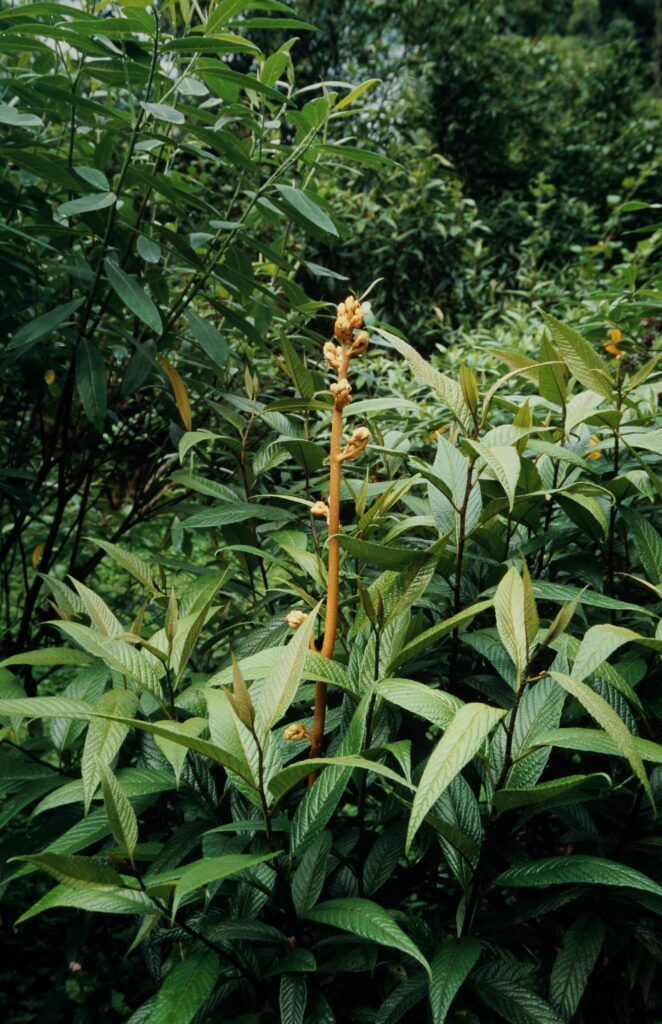
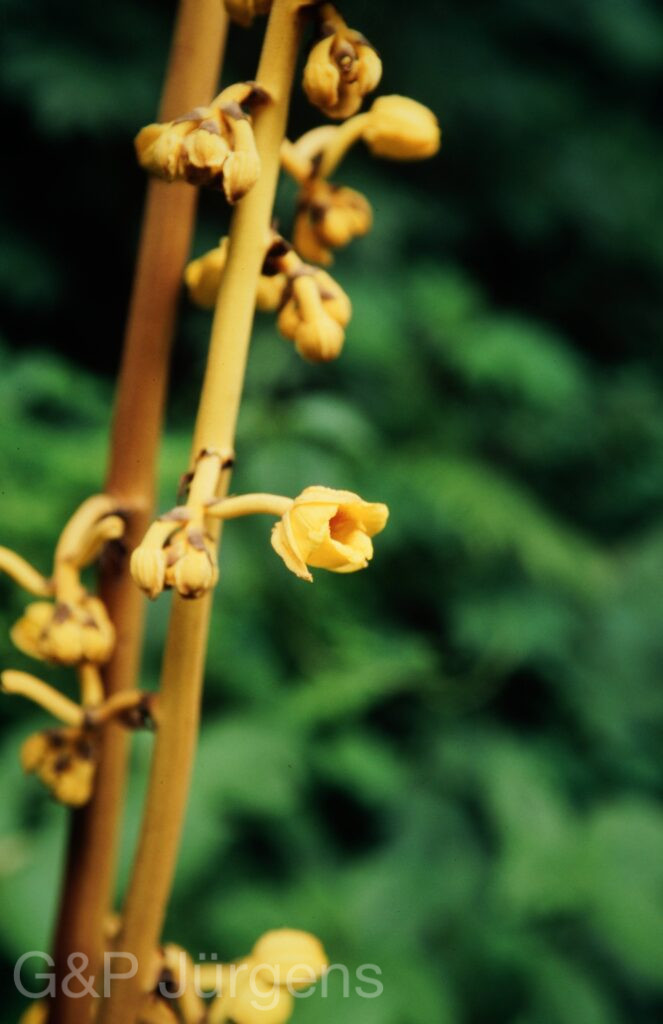
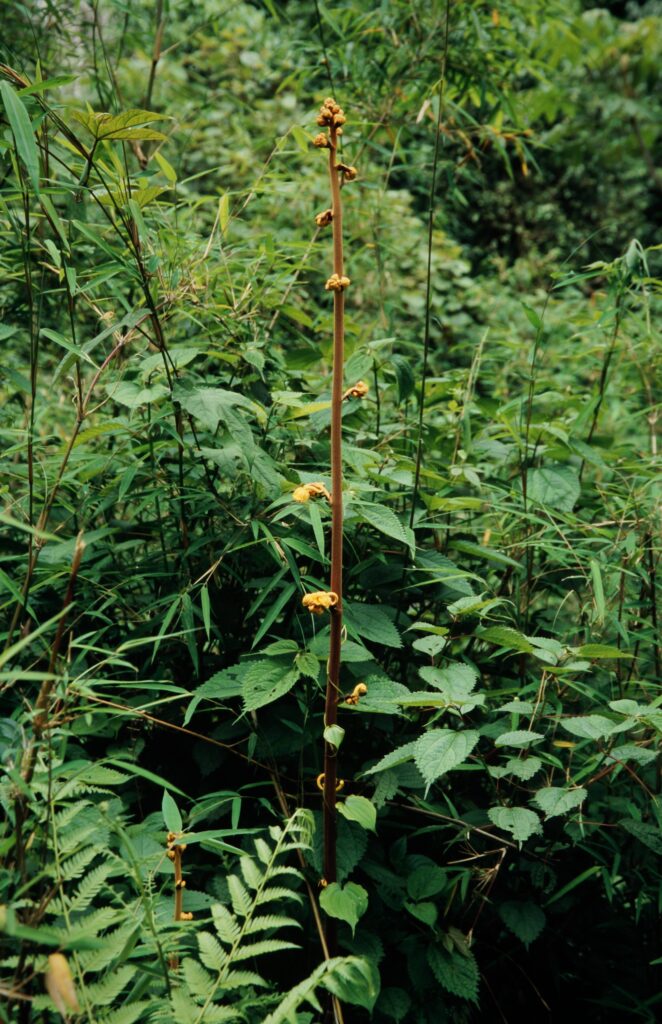
Hook.f. & Thomson

Sikkim 2006 306 ergebnis
Sikkim Ringi-Chu Tolung Gompa 2410m, May
Sikkim 2006 477 ergebnis
Sikkim Ringi-Chu Tolung Gompa 2410m, May
Sikkim 2006 475 ergebnis
Sikkim Ringi-Chu Tolung Gompa 2410m, May

Description

Cyrtosia lindleyana Hook.f. & Thomson is a leafless, mycoheterotrophic orchid of the tribe Vanilleae, distributed across the eastern Himalaya and into mainland and insular Southeast Asia. Its range, documented through some 400 georeferenced records, spans Nepal, northeast India, Bhutan, southern China, Taiwan, Myanmar, Vietnam and Indonesia. The species favours the deep humus and leaf litter of shaded, humid broad-leaved and mixed forests, where it depends on a mycorrhizal fungal partner for its entire nutrition. It typically occurs at montane elevations between roughly 1,500 and 2,800 m, consistent with the photographed population at Ringi-Chu near Tolung Gompa in Sikkim, recorded at 2,410 m in May.

Lacking chlorophyll, the plant emerges only to flower and fruit, arising from a stout, fleshy, coralloid rhizome that ramifies through the substrate. The erect, brownish to ochre, scale-clad inflorescence bears a loose raceme or panicle of comparatively large flowers. These are fleshy and yellowish, often suffused with brown or russet tones, with spreading sepals and petals and a concave, somewhat saccate lip bearing internal ridges. The fruit is distinctive among orchids: a large, fleshy, berry-like, indehiscent capsule, red at maturity, containing hard-coated seeds rather than the typical dust-fine orchid seed.

The genus Cyrtosia, together with allied Galeola, exemplifies the repeated evolution of full mycoheterotrophy within Vanilleae and is of considerable interest for studies of orchid–fungus associations. Because the plants are inconspicuous and only briefly visible, the species is easily overlooked and under-recorded. As an obligate forest-floor mycoheterotroph it is highly sensitive to logging and disturbance of soil mycota, and like all orchids is afforded protection under CITES Appendix II.

Author: Hook.f. & Thomson · Sources: POWO (Kew), GBIF, Flora of China Vol. 25, Flora of Bhutan Vol. 3, Pearce & Cribb: The Orchids of Bhutan (2002)

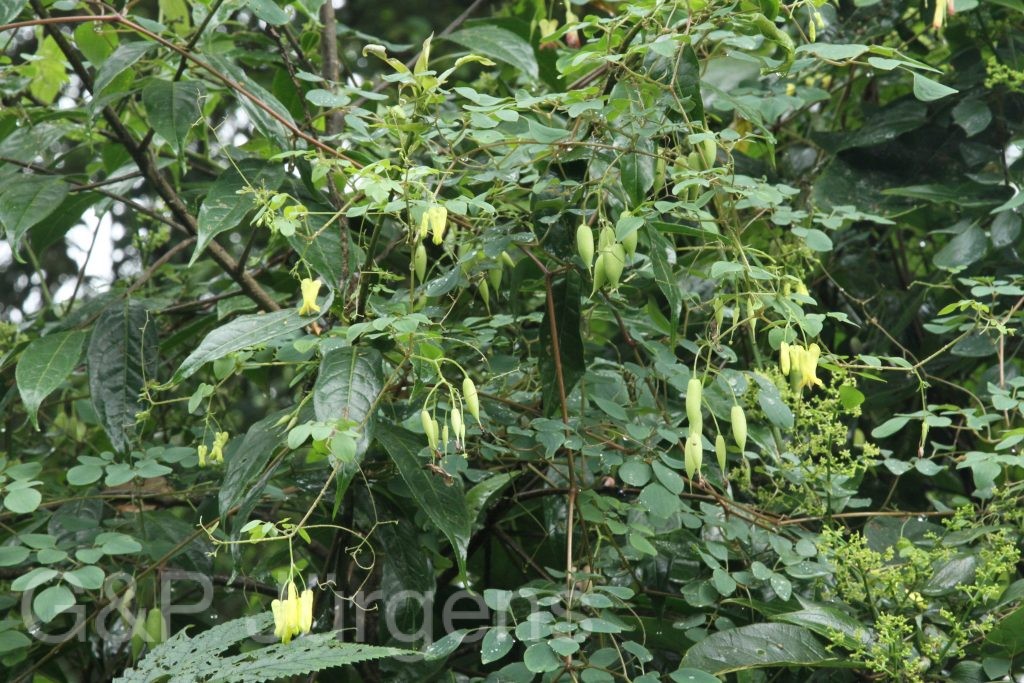
(Fedde.) Hand.-Mazz.

Bhutan2012 678
Bhuitan Tserang 1300m, June

Description

Dactylicapnos lichiangensis (Fedde) Hand.-Mazz. is a scandent herbaceous climber of the Fumarioideae, distributed across the eastern Himalaya and the Sino-Himalayan transition zone. GBIF records (136 occurrences) confirm its presence in southwest China (notably Yunnan, where the epithet references the Lijiang district) and Bhutan, where it ascends into the subtropical and warm-temperate belts. The species was photographed at Tserang in Bhutan at 1,300 m in June, a typical setting along moist forest margins, shaded ravines, and shrubby thickets where it scrambles over neighbouring vegetation. It favours humid, sheltered microhabitats on well-drained slopes between roughly 1,200 and 2,800 m.

The plant is a delicate, glabrous annual or short-lived perennial with slender, brittle, much-branched stems that climb by means of tendril-like terminations of the much-divided leaves. The foliage is biternately to triternately compound, the ultimate segments ovate to lanceolate, glaucous beneath. The pendent, few-flowered racemes bear distinctive yellow, heart-shaped flowers; the outer pair of petals is saccate at the base, forming a dorsal pouch characteristic of the genus, enclosing the inner petals. The fruit is a slender capsule containing several glossy black seeds, each typically bearing an elaiosome that promotes myrmecochorous dispersal.

Dactylicapnos was segregated from Dicentra on the basis of its climbing habit and tendrillar leaves, and lichiangensis sits within a cluster of yellow-flowered Sino-Himalayan species often confused in herbaria. Like many Fumarioideae it contains isoquinoline alkaloids of pharmacological interest. Although not formally assessed as threatened, its restricted distribution and dependence on intact forest-edge habitat make local populations sensitive to deforestation.

Author: (Fedde.) Hand.-Mazz. · Sources: POWO (Kew), Flora of China Vol. 7, Flora of Bhutan Vol. 1, GBIF, Lidén & Fukuhara: Taxonomy of Fumariaceae (1997)

(D.Don) Soó

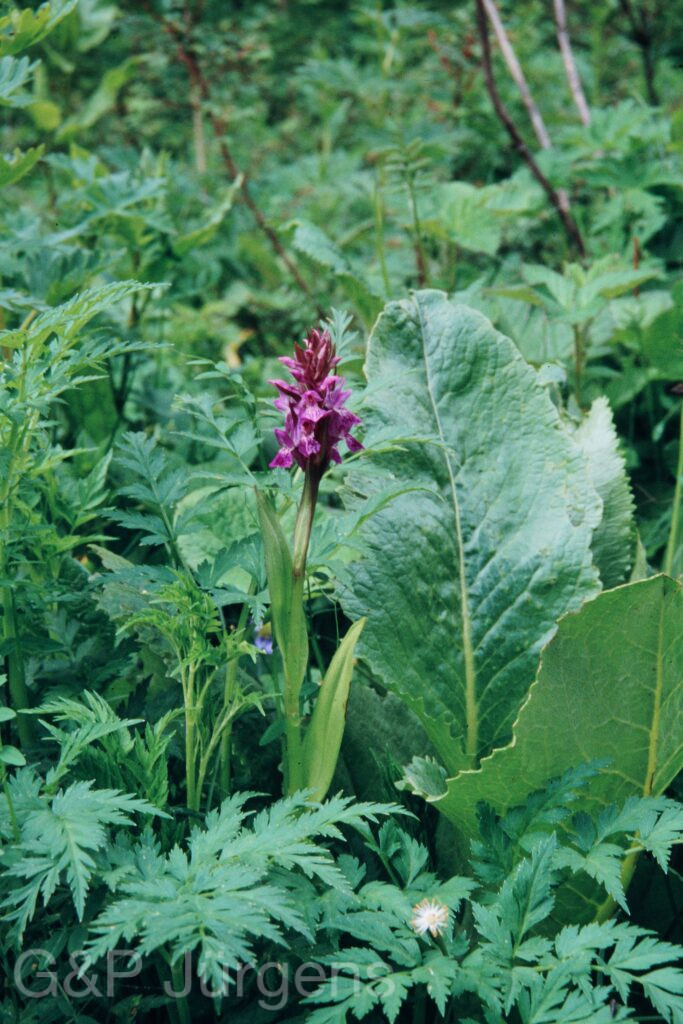
Nepal 99 109 ergebnis
West-Nepal South of Rara-Lake 3600m, June
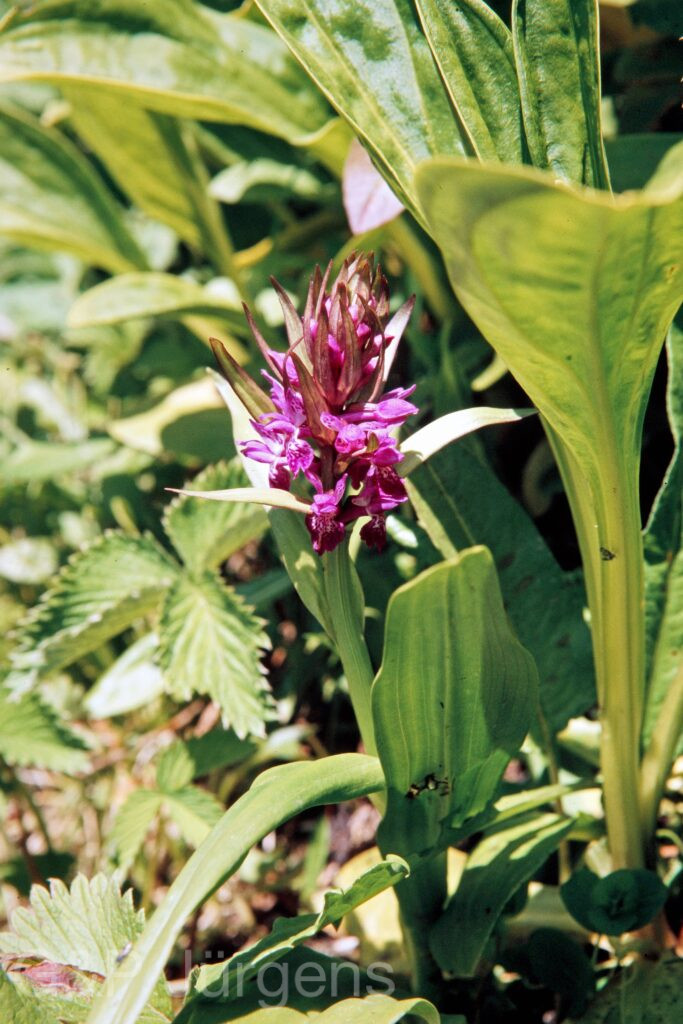
Garh 07 43 ergebnis
India Garhwal Nanu at Mandakini 2400m, June

Description

Dactylorhiza hatagirea (D.Don) Soó is a terrestrial marsh orchid of the Himalaya and Central Asia, recorded from Afghanistan, Pakistan, India, Nepal, Bhutan, China, Mongolia and Russia; the GBIF dataset of 311 occurrences reflects a wide but increasingly fragmented high-altitude range. It grows in moist alpine and subalpine meadows, marshy grassland, streamsides and damp slopes, broadly between 2500 and 4000 m. The photographed plants from south of Rara Lake in West Nepal at about 3600 m and from Nanu at the Mandakini in Garhwal, India, at about 2400 m, both flowering in June, exemplify its early-summer anthesis in cool, wet, open meadows across the western and central Himalaya.

The species is an erect, glabrous, tuberous perennial herb arising from palmately lobed, hand-shaped root-tubers — the digitate tubers giving both the generic name and the local trade name "Hatajari" or "Salampanja." The stem is stout and hollow, bearing several oblong-lanceolate, sheathing, usually unspotted leaves grading into bracts above. The inflorescence is a dense, many-flowered terminal spike of pink to purple-violet flowers; each has spreading sepals, a hooded arrangement of the upper segments, and a broad, three-lobed, darkly spotted labellum with a stout, descending spur. The column bears two pollinia, and the fruit is a ribbed, dehiscent capsule releasing minute, dust-like seeds.

Dactylorhiza (Orchidaceae, subtribe Orchidinae) is a north-temperate genus of tuberous marsh orchids defined by palmately divided tubers and spurred, lobed labella; D. hatagirea is its principal Himalayan representative. The dried tubers are intensively harvested for the salep trade and traditional medicine, and this over-collection, compounded by grazing and habitat loss, has driven steep population declines. It is consequently listed on CITES Appendix II and regarded as threatened and legally protected across much of its range, making it a priority for conservation and sustainable management.

Author: (D.Don) Soó · Sources: POWO (Kew), GBIF, Flora of China, Flora of Bhutan, Annotated Checklist of the Flowering Plants of Nepal, Pridgeon et al. — Genera Orchidacearum

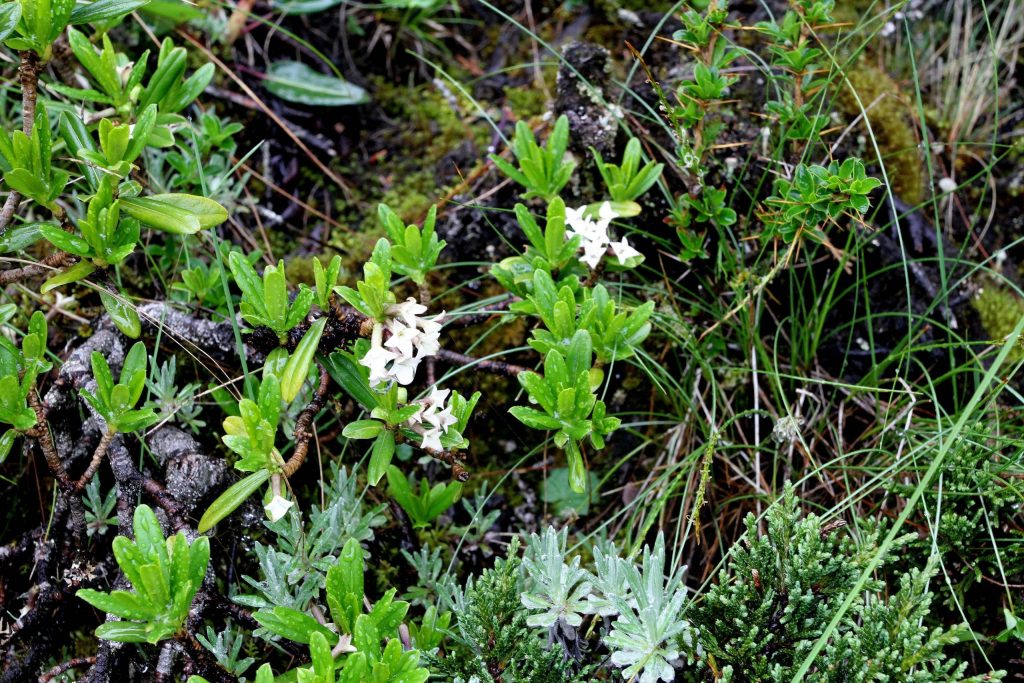
Maxim.

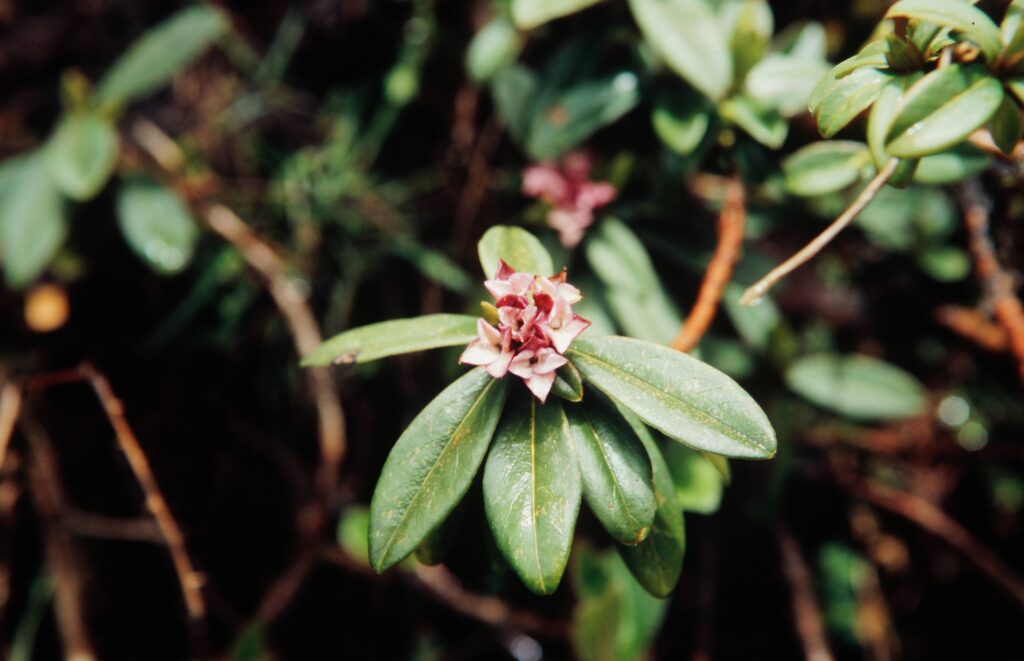
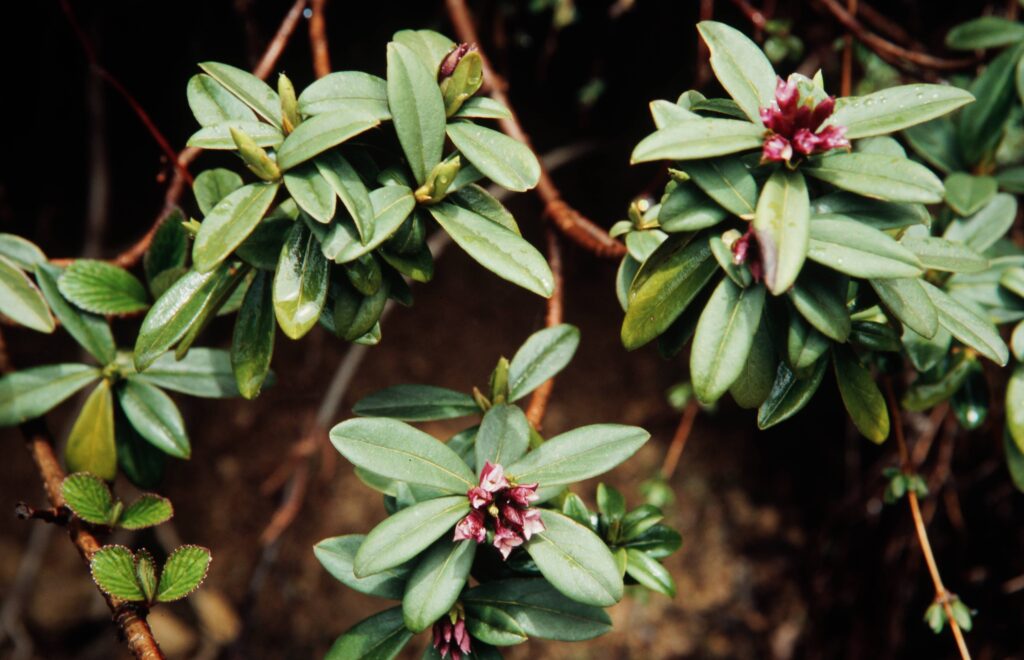
BhutanPG2011 486 scaled
Bhutan Ludlow-Sherriff-Trail Warrtlang-La, 4350m June

Description

Daphne tangutica is distributed across a broad elevational and geographical range from the eastern Himalayas to central and western China, with the core of its distribution in Sichuan, Gansu, and Qinghai provinces. GBIF records over 1,150 occurrences, predominantly from China, with additional records from Bhutan, India, Nepal, and Pakistan. The species inhabits Rhododendron scrub, alpine meadows, rocky slopes, and open coniferous forest margins at 2,500–4,500 m elevation. Collections from Tamrong in West Bengal at 3,200 m and from the Warrtlang-La along the Ludlow–Sherriff Trail in Bhutan at 4,350 m demonstrate its remarkable altitudinal amplitude within the eastern Himalayan region.
Daphne tangutica is an evergreen shrub, typically 0.5–1.5 m tall, compact and densely branched. Leaves are alternate, clustered towards the branch tips, oblanceolate to elliptic, 3–8 cm long, coriaceous, dark glossy green above and paler beneath, with entire revolute margins. Flowers are borne in dense terminal clusters of 3–8, each flower with a tubular hypanthium 10–14 mm long, the four spreading lobes white internally and purplish-rose externally. The flowers are intensely fragrant. Stamens are eight, in two whorls, inserted on the hypanthium tube. The fruit is an ovoid drupe, 6–8 mm long, red at maturity, containing a single seed.
Daphne tangutica was described by Maximowicz in 1882 from material collected in Gansu. It is closely related to D. retusa, and the two species have been confused in herbaria; D. tangutica is generally distinguished by its longer, more lanceolate leaves and more elongate hypanthium tube. The occurrence at 4,350 m on the Warrtlang-La approaches the upper limit for any Daphne species in the Himalayas and attests to the species' tolerance of extreme alpine conditions. It has been widely introduced into horticulture in Europe and North America, prized for its fragrant spring flowers and compact evergreen habit.

Author: Maxim. · Sources: POWO (Kew), GBIF, Flora of China Vol. 13, Flora of Bhutan Vol. 2, Brickell & Mathew: Daphne — The Genus in the Wild and in Cultivation (1976)

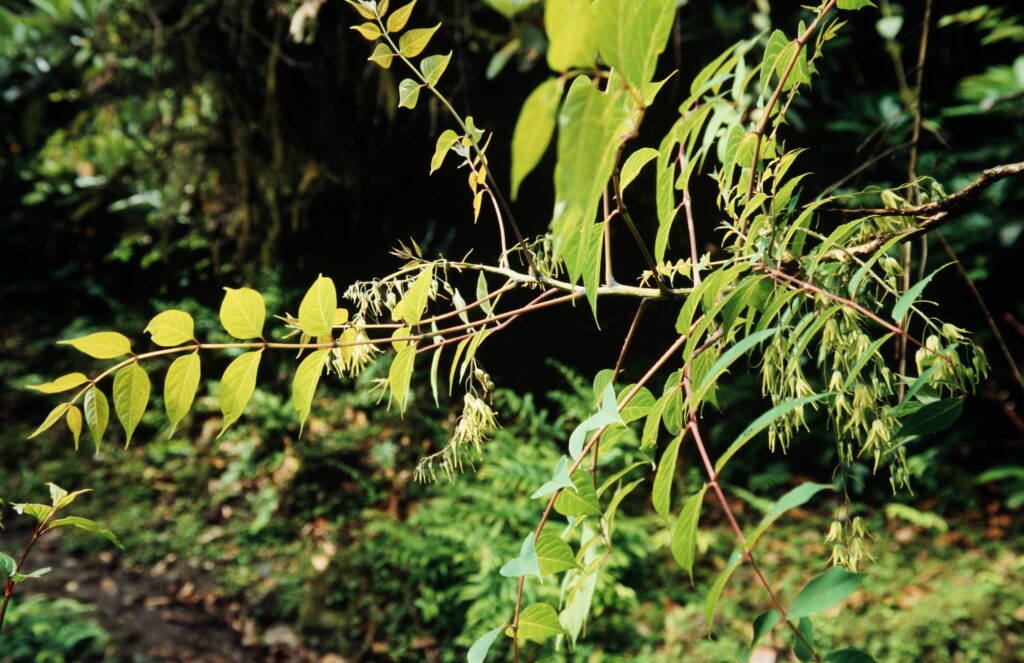
Hook.f. & Thomson

Sikkim 2006 329 ergebnis
India West-Bengal, Chaana 1700m, May

Description

Decaisnea insignis is a deciduous shrub of the Himalaya and southwest China, native to China, India, Bhutan, Nepal and Myanmar, and now widely grown as an ornamental, accounting for numerous records in Europe, North America and elsewhere. It occupies moist temperate forest, forest margins, ravines and shrubby slopes, typically between about 1500 and 3500 m. The photographed plant from Chaana in West Bengal, India, at roughly 1700 m and flowering in May, is characteristic of cool, humid mid-montane forest where it favours sheltered, well-watered situations with rich, humus-laden soils.

The plant is an erect, sparsely branched shrub with stout, pithy stems. The leaves are large, alternate, imparipinnate, with numerous ovate to ovate-lanceolate, entire, acuminate, glaucous-backed leaflets. The flowers are borne in pendulous terminal panicles and are functionally unisexual, with six narrow, greenish-yellow, petaloid sepals and no true petals. The most distinctive feature is the fruit: pendent, cylindrical, sausage-shaped follicles that ripen a striking metallic blue, the fleshy interior containing a translucent, sweetish pulp embedding numerous flattened black seeds, giving rise to the common name dead man's fingers.

The genus commemorates the French botanist Joseph Decaisne, and insignis alludes to its remarkable blue fruit. Some authors treat the blue-fruited Himalayan plants as D. insignis distinct from the yellow-fruited Chinese D. fargesii, though the two are frequently united. The Lardizabalaceae is a small, mainly East Asian family of climbers and shrubs; D. insignis is anomalous as an erect, non-twining member. The conspicuous fleshy fruits suggest vertebrate dispersal, and the species is widely cultivated and not threatened.

Author: Hook.f. & Thomson · Sources: POWO (Kew), GBIF, Flora of China Vol. 7, Flora of Bhutan Vol. 1, Flora of Nepal, A Revision of the Lardizabalaceae

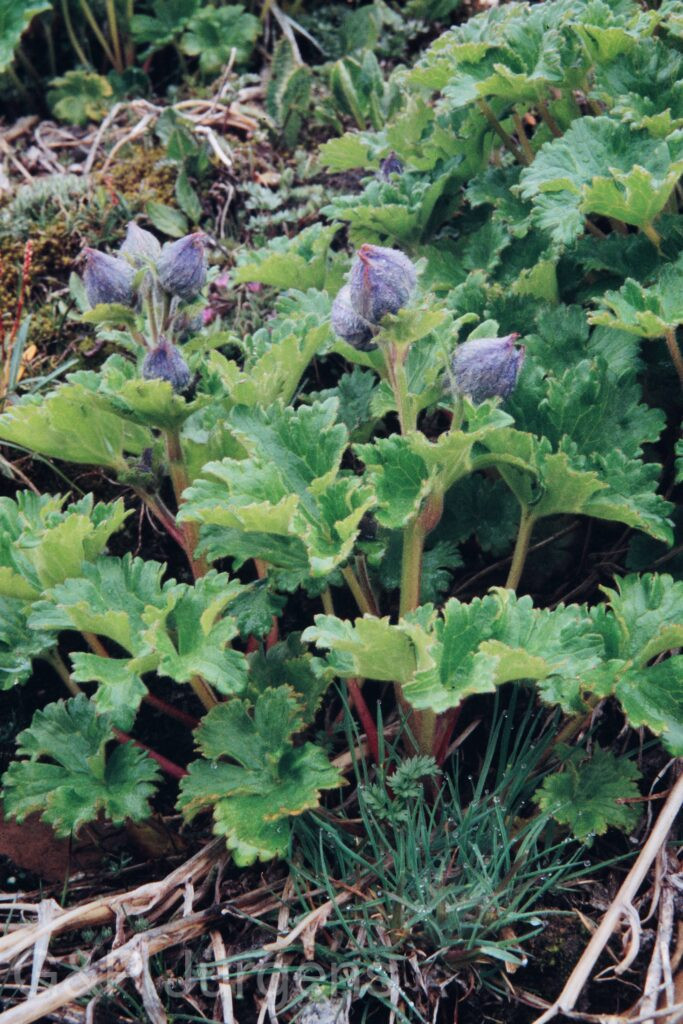
Royle

Nepal 99 666 ergebnis
West-Nepal Kagmara-La 5500m, July

Description

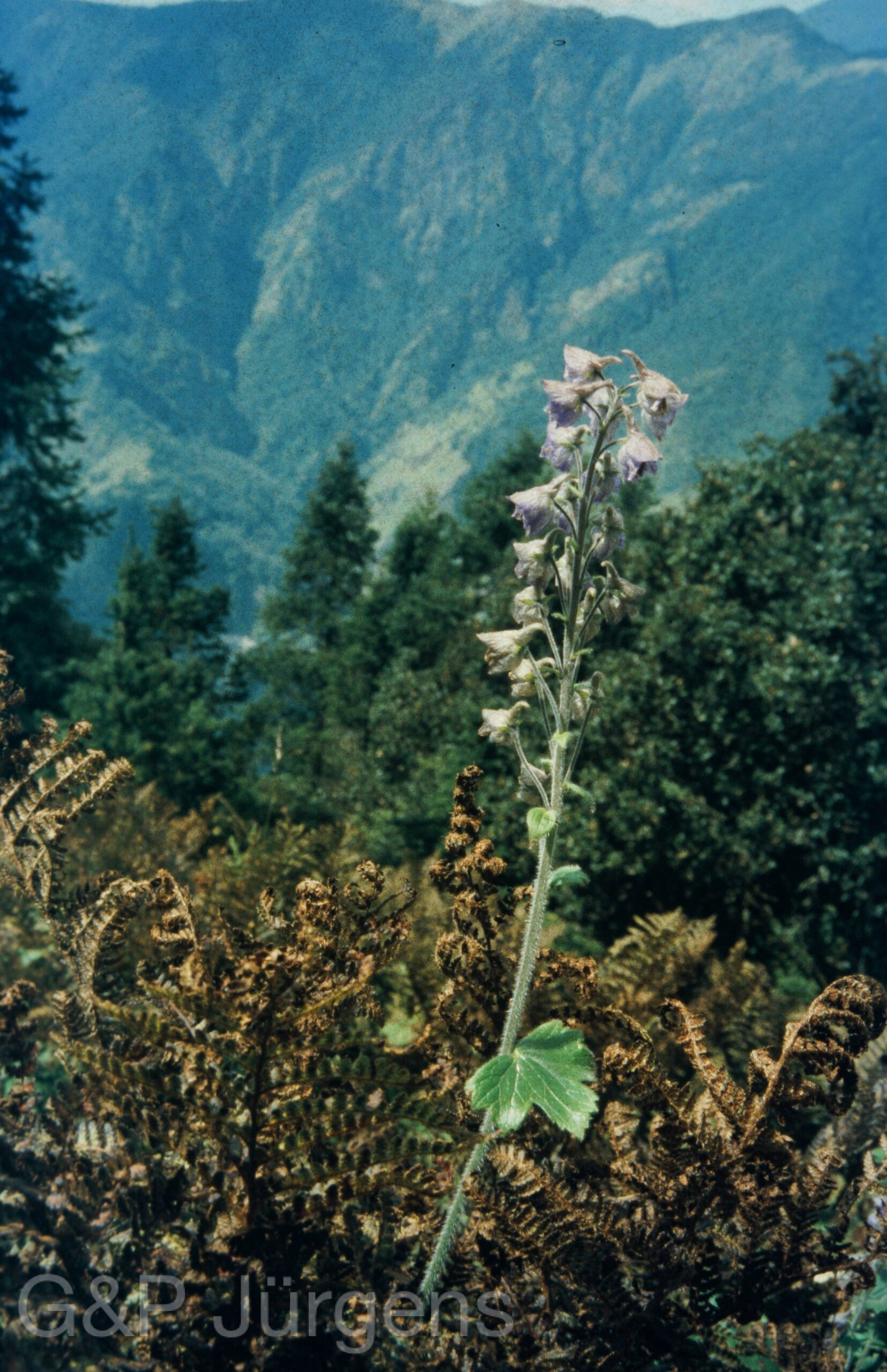
Delphinium brunonianum is a high-alpine perennial of the inner Himalaya and adjacent Central Asian ranges, recorded from Afghanistan, Pakistan, Tajikistan, Uzbekistan and Iraq eastward through northern India, Nepal and Bhutan into south-western China (Tibetan plateau), with some 698 georeferenced GBIF occurrences across this circum-Tibetan arc. It inhabits open stony slopes, screes, moraines and short alpine turf at extreme elevations, typically between about 4000 and 5500 m. The photographed plant from the Kagmara La in West Nepal at 5500 m in July represents the upper range of the species, where it flowers briefly during the short post-monsoon window on wind-exposed, gravelly ground.

It forms a low, tufted herb 8-20 cm tall arising from a stout rootstock, the whole plant glandular-pubescent and emitting a strong musky odour. The leaves are mostly basal, reniform to orbicular in outline and palmately three- to five-lobed with crenate segments. The few-flowered inflorescence bears unusually large, nodding, inflated flowers; the five petaloid sepals are pale to deep blue-purple, broadly ovate, the upper one prolonged into a short blunt spur, and the dark, hairy petals form a contrasting central boss. The fruit is a cluster of three erect, glandular follicles releasing winged seeds.

The species belongs to Delphinium sect. Brunoniana, a small group of musk-scented, large-flowered high-altitude larkspurs. Its strong scent and inflated corolla are associated with bumblebee pollination in a cold, insect-poor environment. Widely used in Tibetan and Himalayan folk medicine, it remains locally common across a vast remote range and is not considered threatened, though it is restricted to fragile alpine habitats sensitive to climate warming and grazing pressure.

Author: Royle · Sources: POWO (Kew), GBIF, Flora of China, Flora of Pakistan, Annotated Checklist of the Flowering Plants of Nepal, Munz monograph of Delphinium

Duthie ex Huth

Description

Delphinium densiflorum is a herbaceous perennial of the western and central Himalaya, recorded from India, Nepal and adjacent China (Xizang), with some 70 georeferenced occurrences documented in GBIF. It inhabits subalpine and alpine meadows, open slopes, forest margins and rocky grassland, where it flowers in the late monsoon. The plant illustrated was photographed in the Indian Garhwal Himalaya near Ali at about 3140 m in September, a typical elevation; across its range it generally occupies the belt from roughly 2800 to 4000 m, favouring moist, well-drained soils with abundant summer rainfall.

The species forms an erect, simple or branched stem arising from a fibrous to slightly tuberous rootstock, clothed below with petiolate, palmately divided leaves whose laminae are deeply cut into narrow, toothed lobes. As the specific epithet implies, the inflorescence is a dense, many-flowered raceme of strongly zygomorphic flowers. Each flower has five petaloid sepals, the uppermost prolonged into a conspicuous backward-pointing spur, and small petals modified into nectaries concealed within. The flowers are typically deep blue to violet; the fruit is a cluster of several erect, beaked follicles releasing numerous angular, scaly seeds.

Delphinium densiflorum belongs to the large genus Delphinium (Ranunculaceae), of which the Himalaya is a notable centre of diversity. Like other larkspurs it contains diterpenoid alkaloids and is poisonous to grazing livestock, a trait that influences its persistence in heavily pastured alpine meadows. The spurred flowers are adapted to pollination by long-tongued bumblebees. No major conservation concern is recognised, though localised pressure from grazing and habitat disturbance affects subalpine populations across the region.

Author: Duthie ex Huth · Sources: POWO (Kew), GBIF, Flora of China, Flora of Bhutan, Annotated Checklist of the Flowering Plants of Nepal, Munz Monograph of the Genus Delphinium

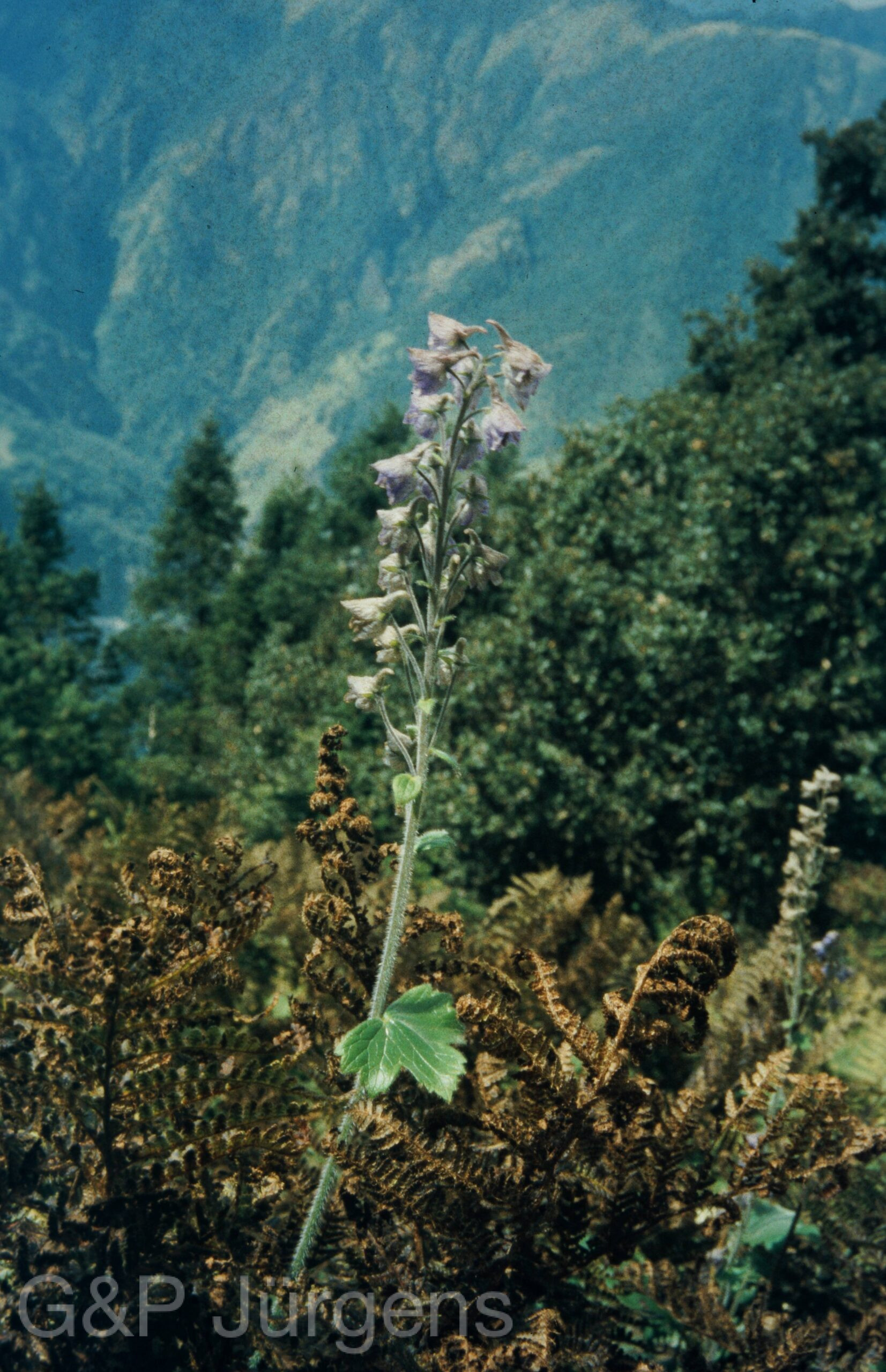
Wall.

Garh 07 298 ergebnis
India Garhwal Sangam 1400m, June

Description

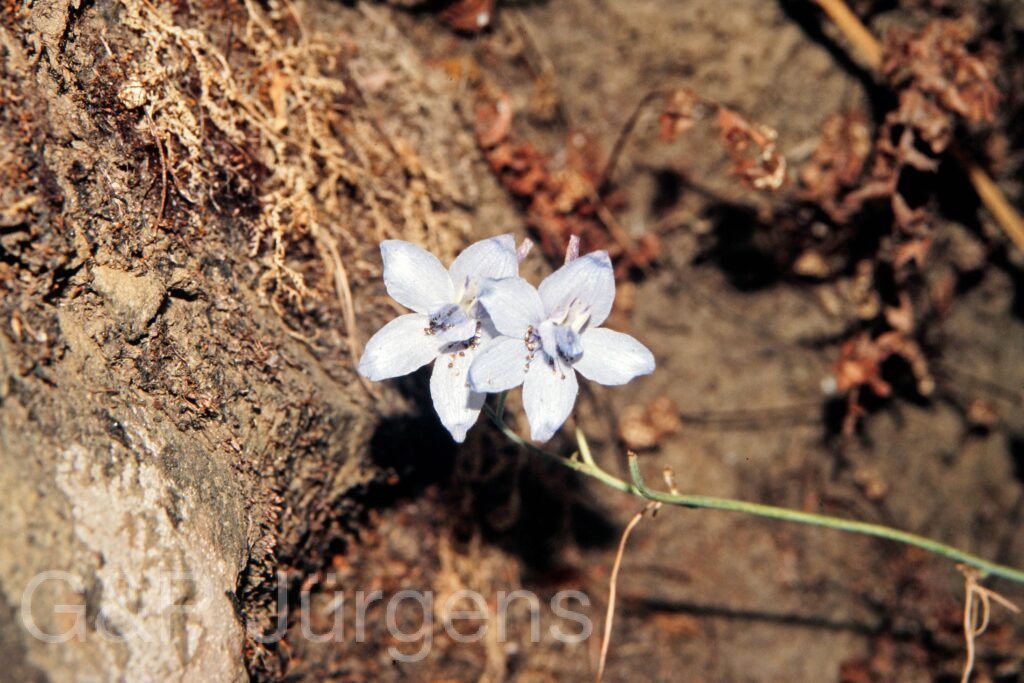
Delphinium denudatum is a perennial larkspur of the western and central Himalaya, documented by GBIF (58 occurrences) from India, Pakistan, Nepal and adjacent China. It occupies shaded, moist temperate forest, forest margins, shrubberies and grassy slopes, generally between about 1200 and 3000 m, lower than many alpine delphiniums. The cited record from Sangam in Garhwal at 1400 m in June reflects this warm-temperate forest habitat, where the plant flowers in early summer in cool, humid, partly shaded ground beneath broadleaved and mixed woodland of the western Himalayan ranges.

The species is an erect perennial herb arising from a tuberous to fibrous rootstock, with slender, sparingly branched stems. The leaves are palmately divided into several broad, toothed or lobed segments, the lower long-petiolate and the upper reduced. The inflorescence is a lax, few- to many-flowered raceme of zygomorphic flowers; the showy blue to violet perianth comprises five petaloid sepals, the uppermost prolonged backward into a conspicuous spur that encloses the nectar-bearing spurs of the two upper petals, while the smaller lower petals are often bearded. The fruit is a group of several erect, many-seeded follicles dehiscing along the ventral suture.

Delphinium belongs to the tribe Delphinieae of the Ranunculaceae, distinguished from Aconitum by its spurred rather than hooded flowers, and its alkaloid-rich tissues underlie a long history of medicinal use of the roots of this species in regional traditional systems. The spurred flowers are adapted for pollination by long-tongued bees. Though comparatively few collections are recorded, the species is fairly widespread in suitable habitat; localised harvesting for medicine warrants attention.

Author: Wall. · Sources: POWO (Kew), GBIF, Flora of Pakistan, Flora of Nepal, Flora of China Vol. 6, Munz A Synopsis of the Asian Species of Delphinium