Author

G & P Jürgens

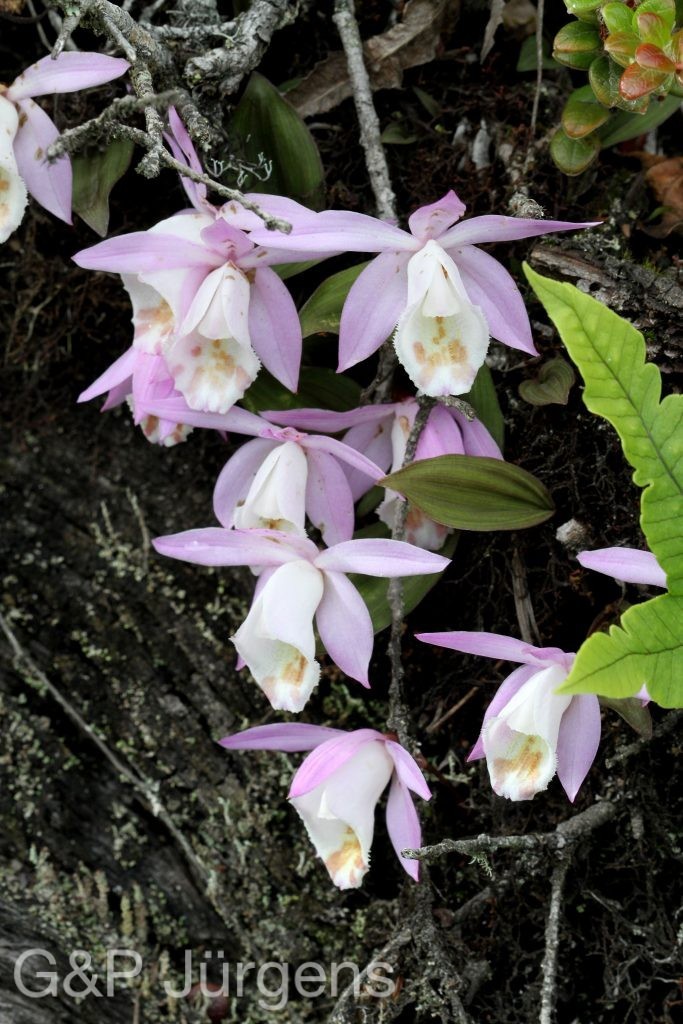
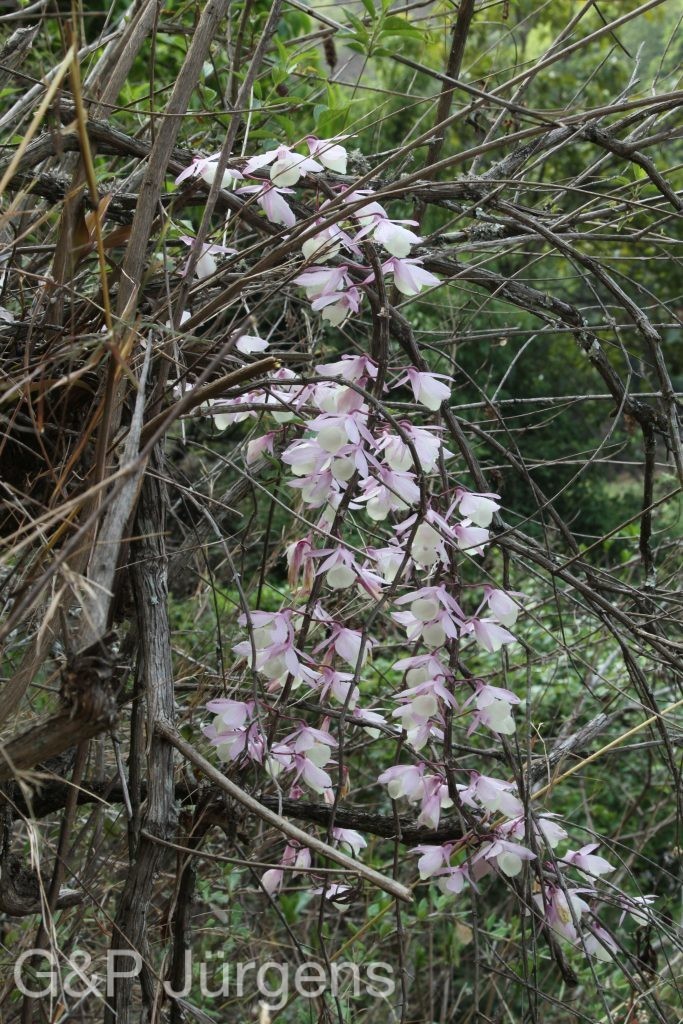
Wall. ex Lindl.

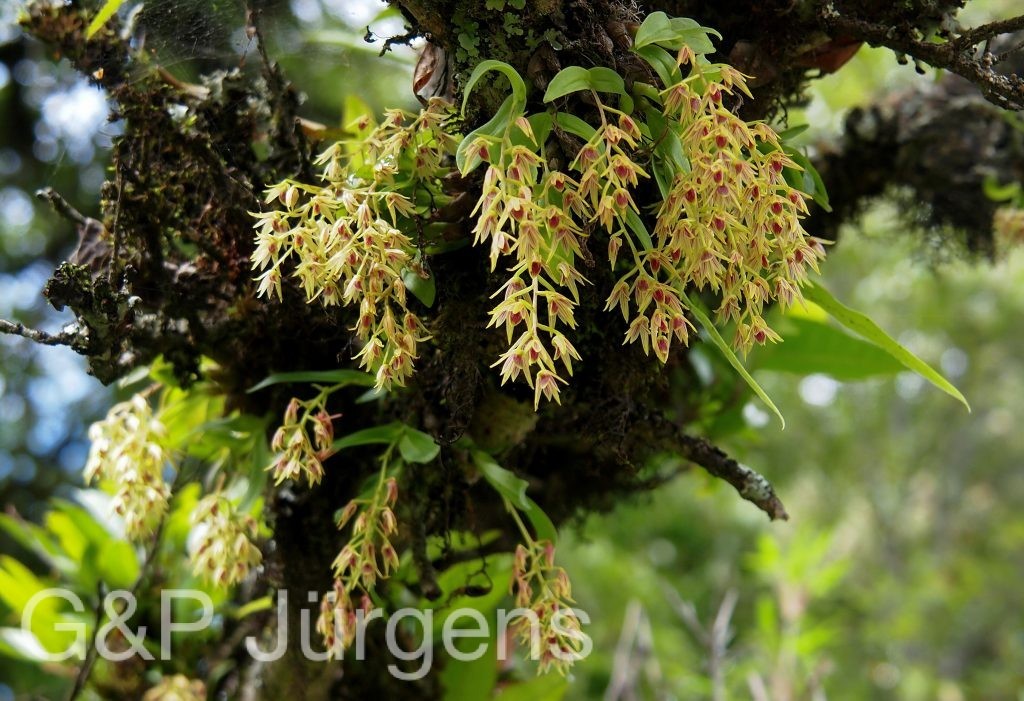
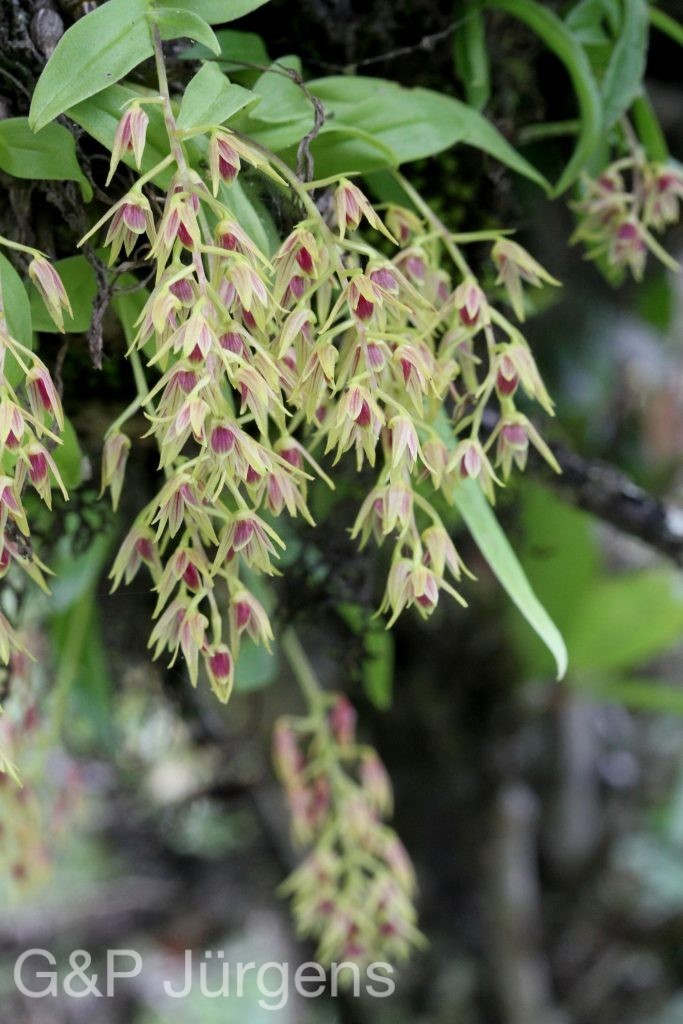
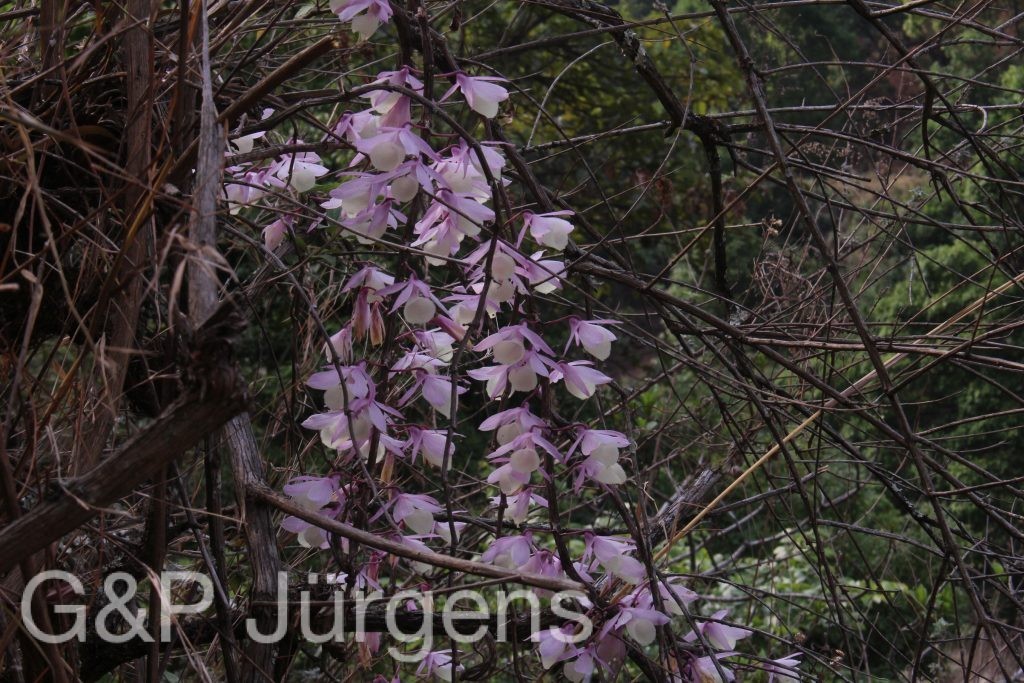
Nepal 2009 114 ergebnis
Nepal Helambu Indrawati-Valley 1500, May

Description

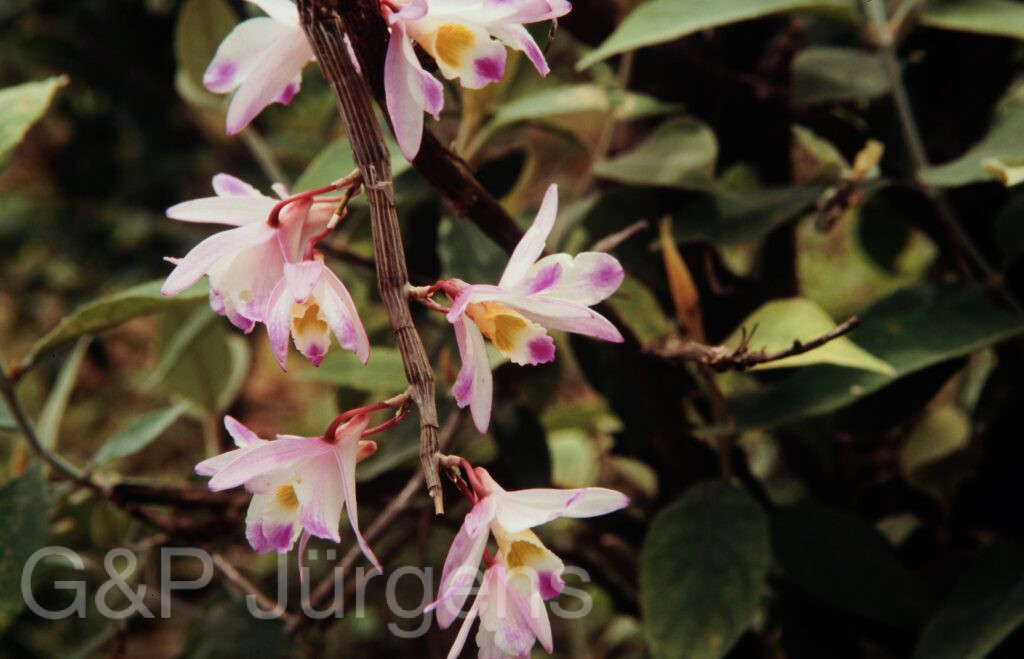
Dendrobium amoenum Wall. ex Lindl. is an epiphytic orchid distributed across the central and eastern Himalaya and adjacent ranges, with records (GBIF: c. 147 occurrences) from India, Nepal, Bhutan and Myanmar, extending into the Malesian region (Indonesia). It is a characteristic element of humid temperate and subtropical broad-leaved forests, growing on mossy trunks and branches at roughly 1,000–2,000 m. The photographed material from Nepal's Helambu region in the Indrawati Valley, at about 1,500 m and flowering in May, falls squarely within its preferred mid-montane belt, where seasonal monsoon humidity and cloud-forest conditions favour epiphytic growth.

The species forms slender, pendulous, terete stems up to 30–60 cm long, often becoming leafless before flowering and bearing thin internodes. The leaves are distichous, lanceolate and deciduous, leaving conspicuous nodal sheaths. Flowers are borne singly or in small clusters from the nodes of older canes, are fragrant, and measure roughly 3–4 cm across. The sepals and petals are white, frequently tinged or tipped with pale rose-purple, while the rounded, pubescent lip is white with a yellow to greenish central disc and a fine purple apical margin. The column is short, bearing four pollinia within an operculate anther cap.

Dendrobium amoenum belongs to the large, taxonomically complex genus Dendrobium (section Dendrobium), members of which display the characteristic deciduous habit and nodal flowering. Like many Himalayan epiphytic orchids it is sensitive to deforestation and to collection pressure, and the genus is listed under CITES Appendix II. The input family "Orchideaceae" is an orthographic variant of the accepted Orchidaceae.

Author: Wall. ex Lindl. · Sources: POWO (Kew), Flora of Bhutan Vol. 3, Flora of Nepal, GBIF, Pearce & Cribb: The Orchids of Bhutan (2002)
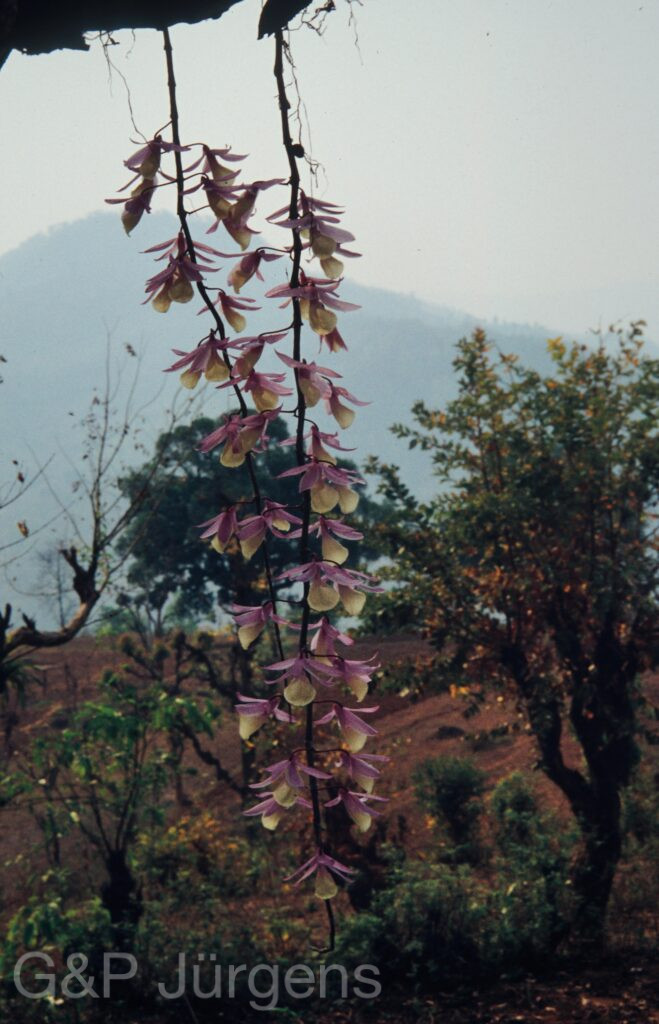
C.E.C. Fisch.

Sikkim2011 17
Sikkim Lachen 2460m, June
Bhutan2014 703
Bhutan Wangdi Phodrang 2280m, May
BhutanPG2011 56 ergebnis
Bhutan Jakar, 20m June
Bhutan2014 702
Bhutan Jakar, 2600m June
Nepal 1994 8 ergebnis
Ost-Nepal Tumlingtar 340m April

Description

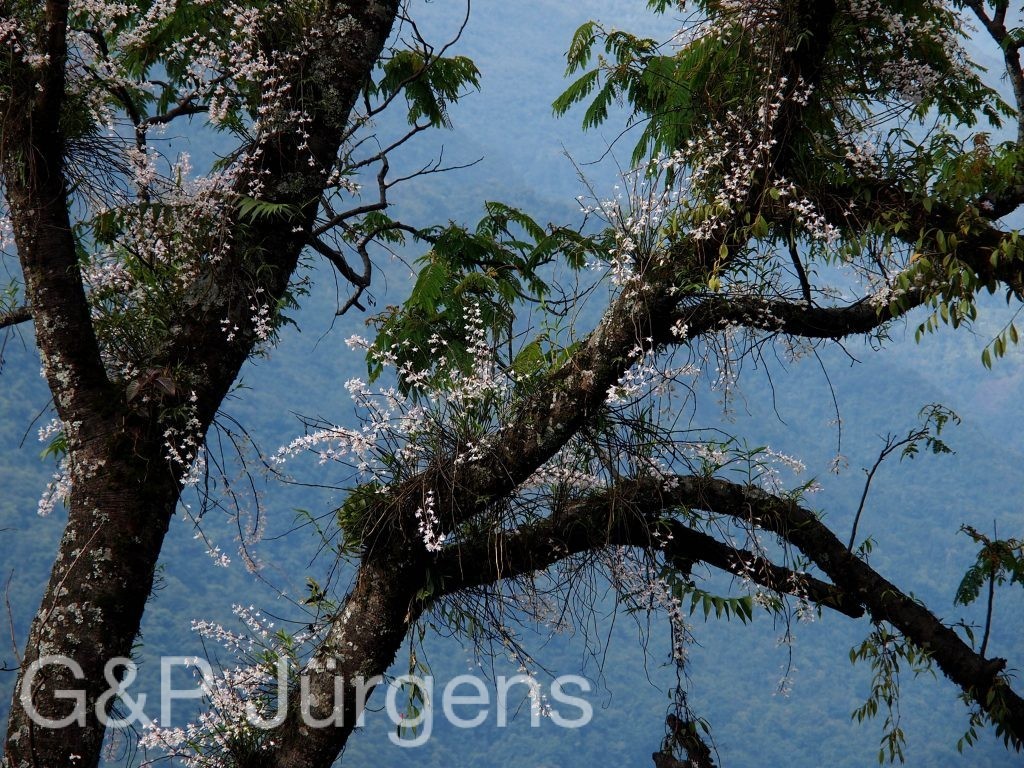
Dendrobium aphyllum is a widespread epiphytic orchid of tropical and subtropical Asia, ranging from India and Nepal through southern China and across mainland Southeast Asia, with GBIF documenting occurrences from India, China, Thailand, Bhutan, Nepal, Vietnam, Myanmar and Laos among many territories. It grows as an epiphyte, and sometimes a lithophyte, on tree trunks and rocks in warm, humid lowland and lower montane forest, enduring a distinct dry season during which the canes shed their leaves. It occupies low to middle elevations; the records span Tumlingtar in eastern Nepal at about 340 m to Sikkim's Lachen and Bhutanese sites up to roughly 2600 m, with the photographed material flowering from April through June across this broad altitudinal range.

The plant produces long, slender, pendulous cane-like stems that branch and trail from the host, leafy when young and largely leaf-shedding before flowering. The leaves are thin, lanceolate and deciduous. The flowers emerge in twos and threes from the nodes of the bare, hanging canes, fragrant and delicately coloured, with pale rose-pink to lilac sepals and petals. The labellum is broadly funnel-shaped to subobicular, cream to pale yellow and finely downy within, often marked with darker veining and rolled around the column to form a trumpet, the lower margin sometimes faintly fringed. The fruit is a pendent capsule.

D. aphyllum is placed in Dendrobium section Dendrobium and is characterised by its leafless flowering canes, as reflected in the epithet; it has accumulated synonymy and is sometimes confused with related pendent species such as D. primulinum and D. anosmum. Long cultivated as an ornamental and used in some traditional medicines, it remains common over much of its vast range, though localised populations are depleted by wild collection and lowland forest clearance.

Author: C.E.C. Fisch. · Sources: POWO (Kew), GBIF, Flora of China, The Orchids of Bhutan (Pearce & Cribb), Dendrobium and its Allies (Lavarack et al.)

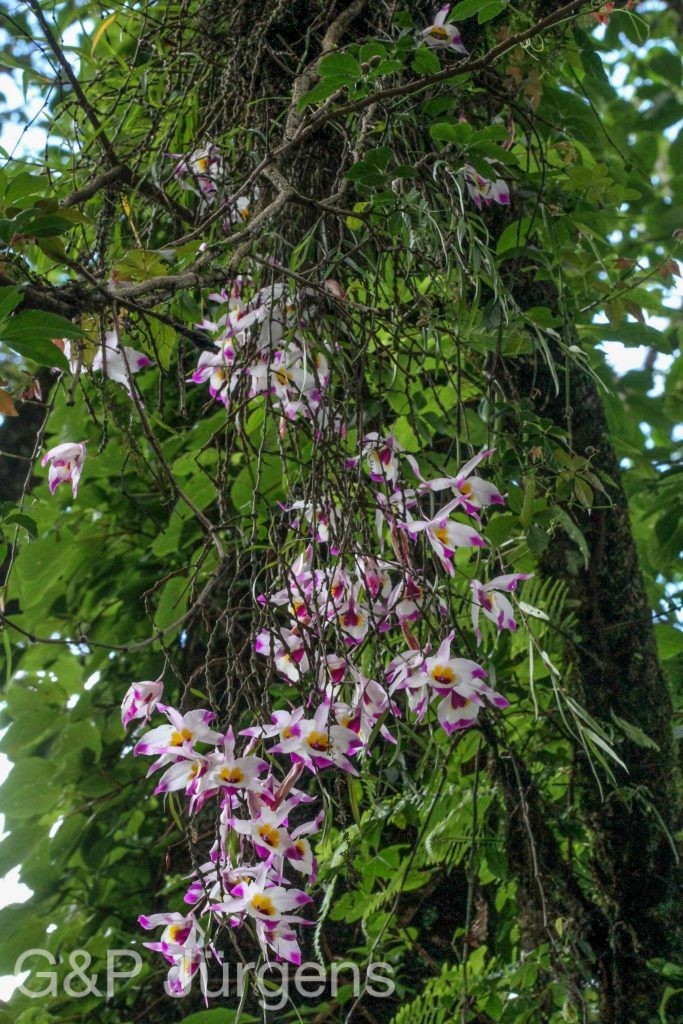
Hook.

BhutanPG2011 8
Bhutan Paro, 2400m June

Pendent epiphyte to 50 cm long and slender branched, bearing few linear-oblong leaves from bead-like.

Description

Dendrobium falconeri is a pendent epiphytic orchid native to the Himalayas, ranging from Nepal and northeast India through Bhutan to Myanmar, Thailand, and southwest China. It grows on mossy tree trunks and branches in humid montane forests at 800–2,000 m elevation.

The plant has slender, branching, wiry stems up to 50 cm long, bearing small, linear-oblong leaves at intervals along bead-like nodes. The flowers are among the most beautiful in the genus: 4–5 cm across, white to pale pink with bright purple tips on the petals and a large, trumpet-shaped lip marked with two conspicuous maroon-purple blotches and a yellow throat. Flowers appear singly or in pairs from leafless nodes, typically from March to May.

Dendrobium falconeri is prized in orchid cultivation for its striking colour pattern. In the wild, it is increasingly rare due to overcollection and deforestation. Listed under CITES Appendix II.

Author: Hook. · Sources: POWO (Kew), Flora of Bhutan, CITES Checklist, OrchidSpecies.com

Lindl.

BhutanPG2011 422011 Bhutan Dendrobium porphyrochilum
Bhutan Wangdi, 2500m June
BhutanPG2011 41
Bhutan Wangdi, 2500m June

Description

Dendrobium porphyrochilum is a small epiphytic orchid of the Eastern Himalaya and adjacent Southeast Asia, recorded from India, Nepal, Thailand, China, Myanmar, Vietnam and Bhutan, with a modest set of georeferenced occurrences in GBIF. It grows as an epiphyte on the mossy trunks and branches of trees in cool, humid evergreen and mixed montane forest, where steady atmospheric moisture and a seasonal cool rest govern its growth. The species occurs at middle elevations of the temperate forest belt; the photographed plant from Wangdue in western Bhutan at about 2500 m, flowering in June, is typical of its altitudinal preference and its early-summer anthesis with the onset of the monsoon.

The plant forms small, tufted, slender, somewhat fusiform or cane-like stems clustered together, each bearing a few narrow, grass-like leaves toward the apex. The inflorescence is a short, arching to pendent raceme bearing several relatively small, nodding flowers that open more or less together. The sepals and petals are yellowish-green to olive or pale greenish, narrow and spreading. The labellum, from which the epithet derives, contrasts sharply, being deep purple to maroon-brown, recurved and obscurely lobed, sometimes bearing low keels along the disc. The short column has a foot forming a small mentum with the lateral sepals. The fruit is a small capsule.

The species belongs to Dendrobium section Oxyglossum (in the broad sense applied to small-flowered Himalayan dendrobiums of this alliance) and is distinguished among its temperate relatives by the dark, contrastingly coloured lip set against pale tepals. As a forest epiphyte of restricted abundance, it is dependent on intact, humid mid-elevation woodland and is therefore susceptible to deforestation and to over-collection, although it has not been formally assessed for conservation status.

Author: Lindl. · Sources: POWO (Kew), GBIF, Flora of China, The Orchids of Bhutan (Pearce & Cribb), Dendrobium and its Allies (Lavarack et al.)

(Forssk.) I.Darbysh.

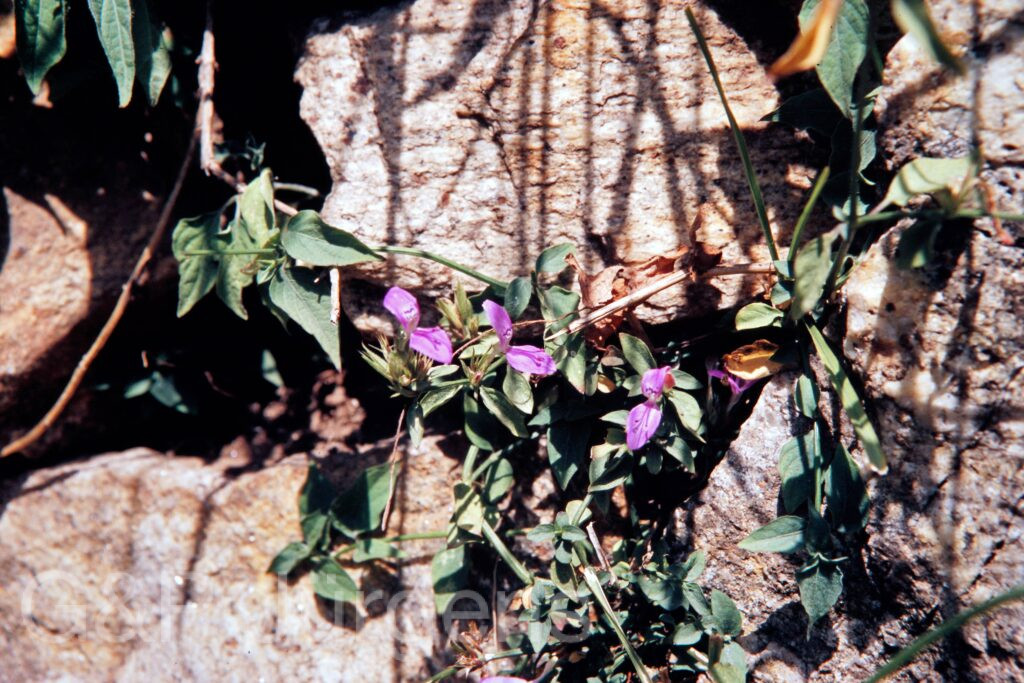
Garh 07 15 ergebnis
India Garhwal Uniana at Mandakini 1300m, June

Description

Dicliptera paniculata (Forssk.) I.Darbysh. is a widespread herb of the Acanthaceae with a remarkably broad palaeotropical distribution spanning Africa and southern Asia. Its more than two thousand georeferenced records extend from West and East Africa and the Arabian Peninsula across Pakistan, India and into China, with strong representation in arid and seasonally dry tropical environments. It is a plant of disturbed ground, scrub, dry hillsides, roadsides and the margins of cultivation, generally at low to moderate elevations. The population shown at Uniana on the Mandakini in Garhwal, photographed at 1,300 m in June, marks the foothill Himalayan extension of its range, where it flowers with the onset of the monsoon.

The plant is an erect to ascending annual or short-lived perennial herb with quadrangular, somewhat swollen-noded stems that are often sparsely pubescent. The leaves are opposite, ovate to lanceolate, entire and shortly petiolate, with the characteristic cystoliths of the family visible as fine streaks. The inflorescence is a lax, paniculately branched arrangement of cymose clusters, each subtended by paired bracts; the flowers have a slender, bilabiate corolla, typically pink to pinkish-purple, with two stamens. The fruit is the explosively dehiscent, clavate capsule typical of the family, ejecting seeds borne on hooked retinacula.

The species was long known under Forsskål's basionym and other generic placements before its current combination, reflecting ongoing reassessment of Dicliptera and allied genera within tribe Justicieae. Its wide ecological amplitude and tolerance of disturbance make it a successful colonist of human-modified landscapes, and it is nowhere considered at risk. As a nectar source it is visited by a range of insects, and within the Himalayan foothills it forms part of the seasonal weedy flora of the monsoon months.

Author: (Forssk.) I.Darbysh. · Sources: POWO (Kew), GBIF, Flora of China Vol. 19, Flora of Pakistan, Darbyshire et al.: Acanthaceae (Flora of Tropical East Africa)

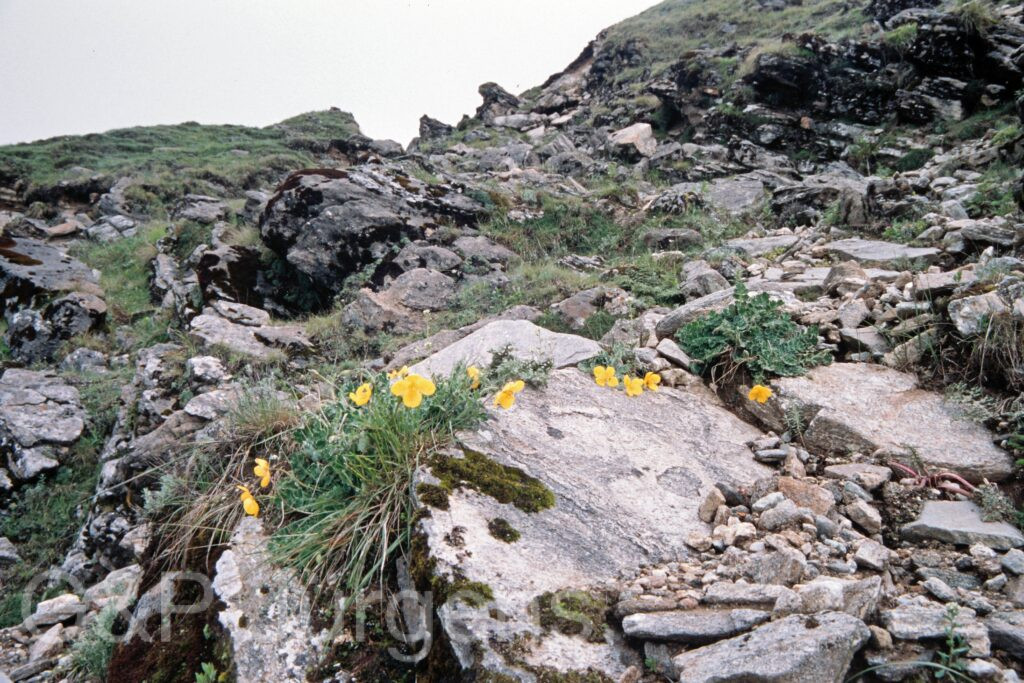
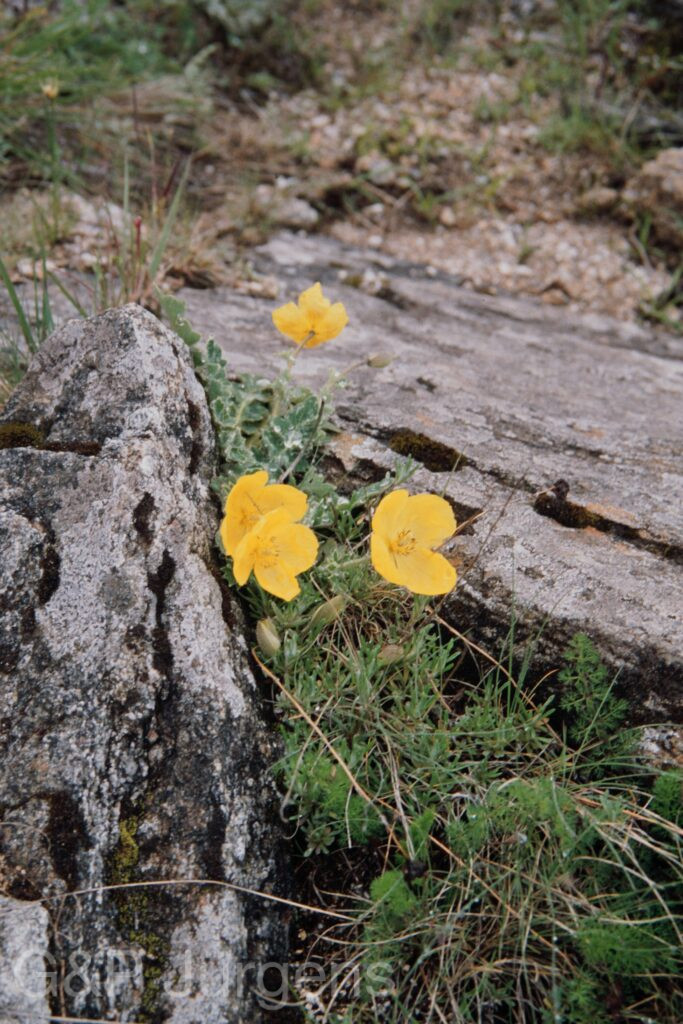
Hook.f. & Thomson

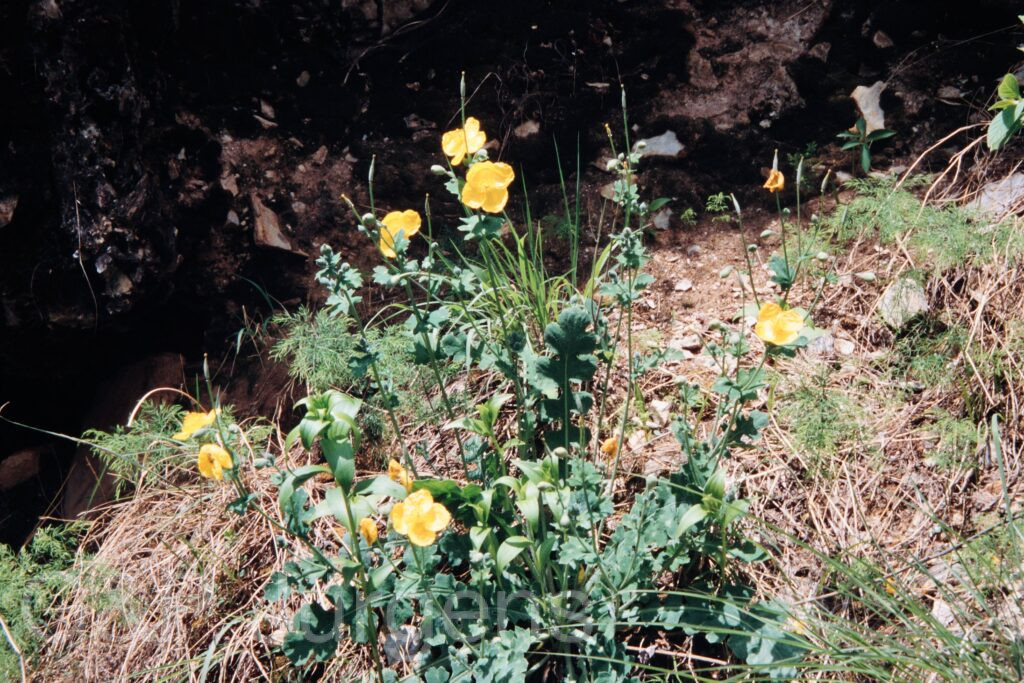
Nepal 99 399 ergebnis
West-Nepal Talphi 2830m, June
Nepal 99 551 ergebnis
West-Nepal Talphi 2830m, June
Nepal 99 552 ergebnis
West-Nepal Talphi 2830m, June

Description

Dicranostigma lactucoides Hook.f. & Thomson is a yellow-flowered Himalayan poppy relative known from about 145 records in Nepal, China, India and Bhutan. It is a plant of dry, open, often disturbed ground: stony slopes, rock crevices, river terraces, field margins and roadside banks in the inner valleys, generally in the warm-temperate to subalpine belt between roughly 2500 and 4000 m. The individual photographed at Talphi in West Nepal at 2830 m in June reflects its preference for sunny, well-drained, somewhat ruderal sites in the comparatively arid trans-Himalayan rain-shadow.

The species is an erect annual to short-lived perennial herb containing yellow to orange latex. The basal leaves form a rosette and are oblanceolate in outline, pinnately lobed to lyrate-pinnatifid with a large terminal lobe, glaucous and somewhat lettuce-like, whence the epithet "lactucoides." Cauline leaves are smaller and clasping. The flowers are borne on slender pedicels; two caducous sepals enclose four broad, crinkled, bright yellow petals surrounding numerous stamens. The fruit is the diagnostic feature of the genus: a slender, elongate, more or less cylindrical siliqua-like capsule dehiscing from the apex, crowned by a short style with a forked (bifid) stigma, and releasing many small seeds.

Dicranostigma is a small Asian genus close to Glaucium and Chelidonium in tribe Chelidonieae, distinguished by its elongate capsule and divided stigma; D. lactucoides is its principal Himalayan representative. Like its allies it contains benzylisoquinoline alkaloids and has been used locally in folk medicine. As a ruderal, weedy colonist of open ground it is resilient to moderate disturbance and is not regarded as threatened across its Sino-Himalayan range.

Author: Hook.f. & Thomson · Sources: POWO (Kew), GBIF, Flora of China, Flora of Nepal, Hooker's Flora of British India, monograph of Papaveraceae tribe Chelidonieae

Wall.

Sikkim 2006 449 ergebnis
India West-Bengal, Tolung 2450m, May

Description

Didymocarpus oblongus is a relatively uncommon gesneriad endemic to the eastern Himalaya, recorded from Nepal, northeast India (Sikkim, Darjeeling, Assam), Bhutan, and adjacent parts of southern China (Xizang, Yunnan). It inhabits shaded, damp rock faces, mossy cliff ledges, and steep earth banks in montane broadleaved and mixed forests, typically at elevations between 1,800 and 3,000 m. The species has been documented from the Tolung area of West Bengal at approximately 2,450 m, where it grows in the moist understorey of temperate forests during the spring season.
The plant is a perennial herb with a short, erect stem 5–15 cm tall, arising from a fleshy rootstock. Leaves are arranged in an opposite, often crowded rosette-like cluster near the stem apex; they are oblanceolate to oblong, 5–15 cm long and 2–5 cm wide, with a crenate to serrate margin, the upper surface dark green and sparsely pilose, the lower surface paler and more densely pubescent. The inflorescence is a lax cyme of 2–6 flowers borne on a slender peduncle 5–10 cm long. The calyx is tubular, five-lobed. The corolla is tubular-funnelform, 2–3 cm long, typically pale purple to lavender with darker markings in the throat. Stamens are two, with the filaments inserted at mid-tube; the anthers are coherent face to face. The fruit is a slender, elongate capsule 2–4 cm long, dehiscing loculicidally.
Didymocarpus is a genus of approximately 100 species centred in mainland Asia, with the Himalayan region representing a significant centre of diversity. D. oblongus is distinguished from allied species by its oblong leaf shape, relatively long peduncles, and high-elevation habitat preference. With only 88 occurrence records in GBIF and a restricted distribution along the eastern Himalayan arc, the species warrants conservation attention, particularly as its cliff-face and forest-understorey habitats are sensitive to deforestation and landslide disturbance.

Author: Wall. · Sources: POWO (Kew), GBIF, Flora of Bhutan Vol. 2, Flora of China Vol. 18, Möller & Clark: Gesneriaceae classification (2013)

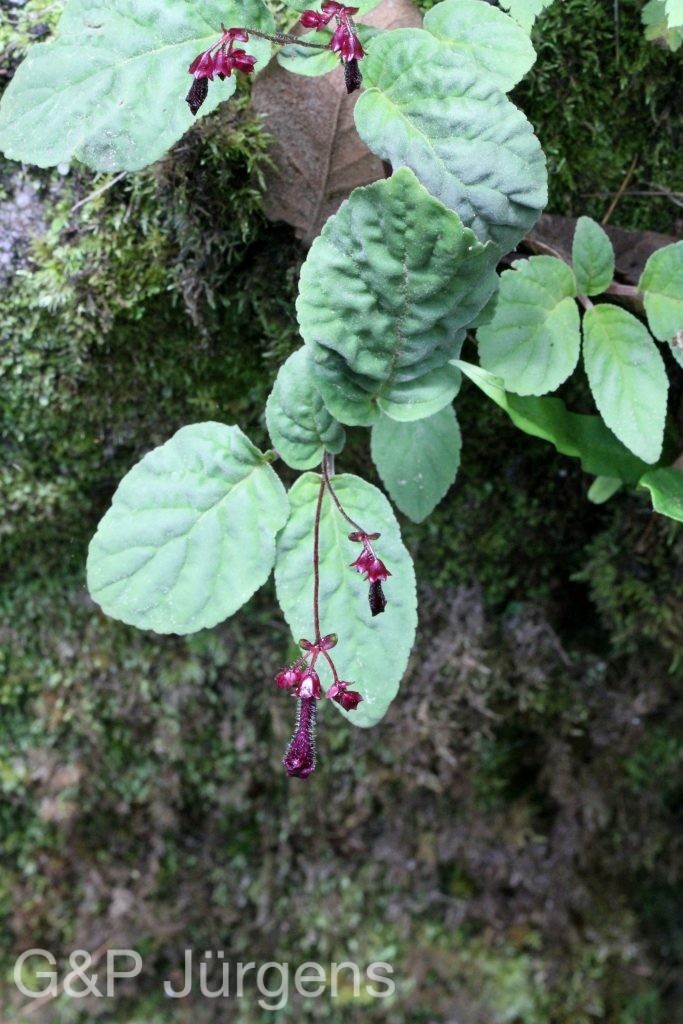
C.B.Clarke

BhutanPG2011 78 ergebnis 1
Bhutan Menchuang, 2800m June

Description

Didymocarpus podocarpus is an eastern Himalayan gesneriad recorded from Nepal (NP), India (IN) and Bhutan (BT), with 59 GBIF occurrences reflecting its relatively localised montane distribution. It is a lithophyte and epiphyte of shaded, humid temperate forest, growing on moss-covered rocks, cliff faces and tree trunks where atmospheric humidity is high, typically in the 2000-3000 m belt. The illustrated material was gathered at Menchuang in Bhutan at about 2800 m in June, during the early monsoon when the genus comes into flower.

It is a perennial herb with a short rhizomatous base and erect to ascending stems bearing opposite or whorled leaves clustered toward the apex. The leaf blades are ovate to elliptic, crenate-serrate at the margin, and often somewhat fleshy with sparse hairs. The inflorescence is an axillary cyme of several flowers; the calyx is tubular and shortly lobed, while the corolla is tubular and two-lipped with a spreading limb in shades of purple to violet. Only two stamens are fertile, a diagnostic feature of Didymocarpus, the anthers cohering in pairs. The fruit is a slender, elongate, podocarpic (long-pointed) capsule that dehisces to release numerous minute seeds, the epithet alluding to this fruit form.

Didymocarpus is a large Asian genus centred on the Sino-Himalayan and Southeast Asian region, traditionally placed in subtribe Didymocarpinae of Gesneriaceae, the rank cited here verbatim as the family field. Many species are narrow-range rock specialists vulnerable to habitat disturbance, and several Himalayan taxa, including this one, are of biogeographic interest as components of the moist broadleaf forest gesneriad flora.

Author: C.B.Clarke · Sources: POWO (Kew), GBIF, Flora of Bhutan, Flora of Nepal, The Gesneriaceae of the Indian subcontinent, Monograph of the genus Didymocarpus (Weber & Burtt)

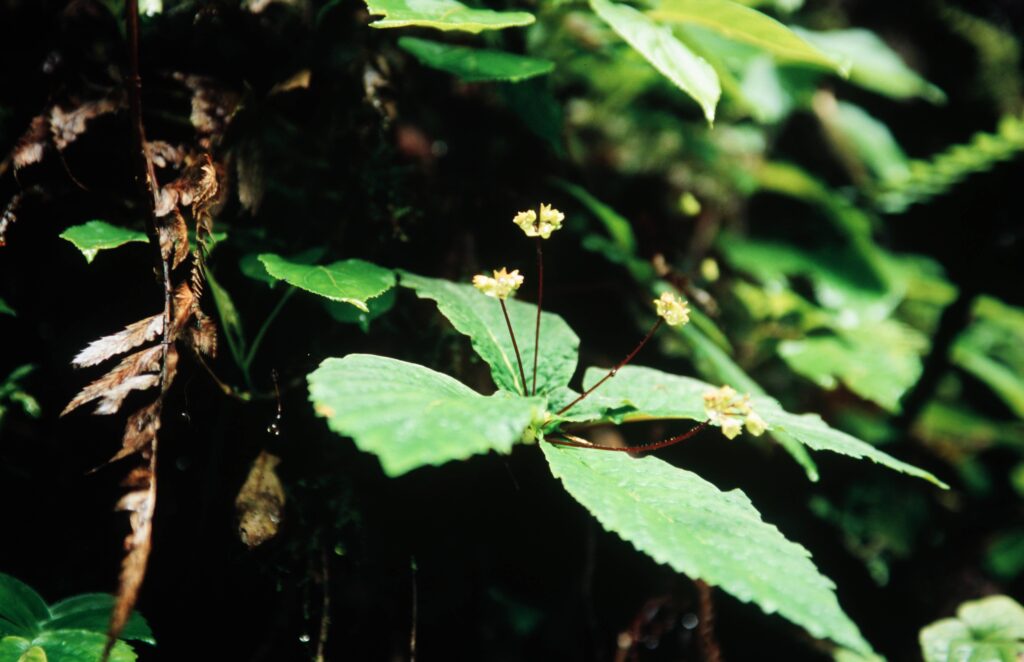
Lindl.

Nepal 99 891 ergebnis
West-Nepal Suli-Khola 2900m, July

Description

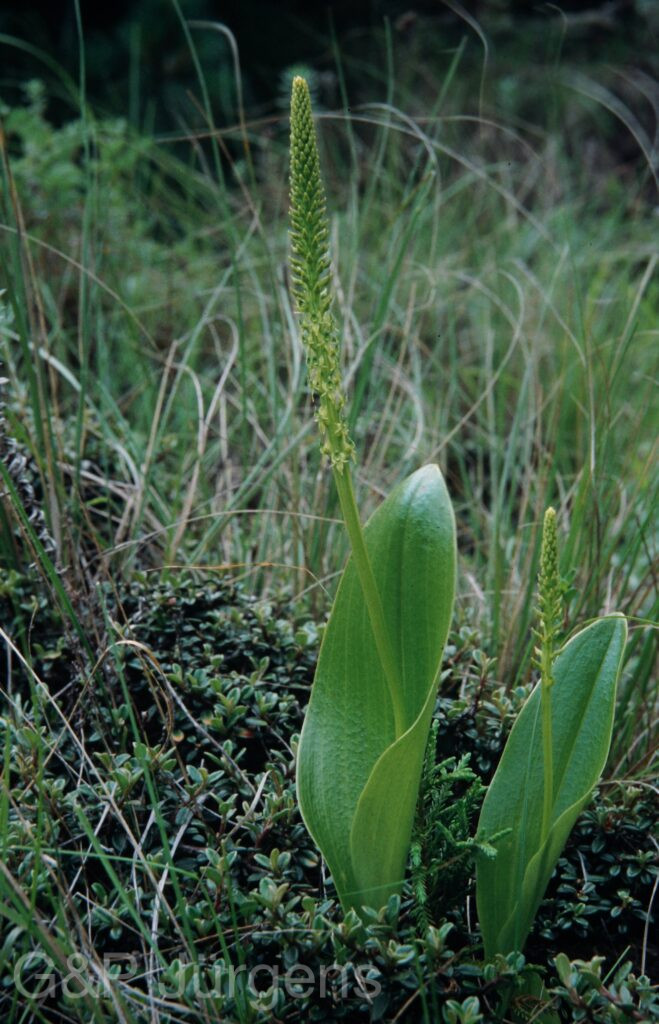
Dienia cylindrostachya is a terrestrial orchid distributed across the Himalaya and adjacent montane Asia, recorded from India, Nepal, Bhutan, China, Hong Kong, Myanmar and Pakistan, with GBIF documenting some 98 georeferenced occurrences. It favours humus-rich, shaded forest floors, mossy banks and damp grassy slopes in the temperate zone, typically between about 1500 and 3000 m. The photographed plant was found in West Nepal along the Suli-Khola at 2900 m in July, an elevation and season that coincide with its summer flowering during the monsoon, when soil moisture and atmospheric humidity are at a maximum.

The species is a small, glabrous herb arising from a fleshy, ovoid pseudobulb or thickened stem-base. It bears a few thin, plicate, ovate-elliptic to lanceolate leaves that are membranous and sheathing at the base. The inflorescence is an erect, slender, densely many-flowered cylindrical raceme, from which the epithet derives, carrying numerous minute, non-resupinate flowers in shades of greenish-yellow to purplish. The sepals and petals are small and spreading; the lip is broad, often auriculate or saccate at the base, and the column is short and stout. The fruit is a small, ellipsoid, ribbed capsule releasing dust-like seeds.

Long placed in Malaxis, the species is now treated in Dienia (Malaxidinae, Epidendroideae), a segregate distinguished by non-resupinate flowers and column structure. The family is rendered "Orchideaceae" in the source but the taxon belongs to the Orchidaceae. As an easily overlooked terrestrial of intact temperate forest, it is sensitive to deforestation, though its wide Asian range affords some resilience.

Author: Lindl. · Sources: POWO (Kew), GBIF, Flora of Nepal, Flora of China, Flora of Bhutan, Genera Orchidacearum (Pridgeon et al.)

L.

Bhutan2015 172
Bhutan Zhemgang 1000m, October

Description

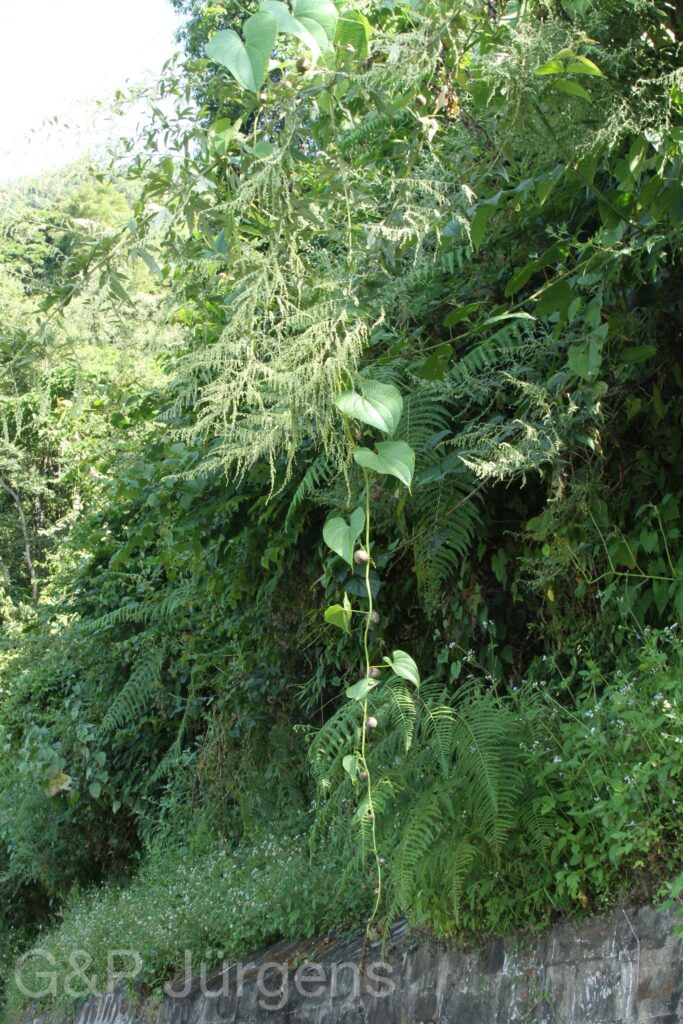
Dioscorea bulbifera, the air potato or aerial yam, is a widely distributed twining vine of the Old World tropics, native across tropical Africa and Asia and now pantropically naturalised, including invasive populations in the southern United States, the Pacific and the Neotropics. It is among the most heavily recorded yams, GBIF holding over 16,000 occurrences. In the Himalaya it grows in subtropical forest, forest margins, thickets and disturbed ground at low to middle elevations. The plant from Zhemgang in central Bhutan at 1000 m in October occupies this warm foothill zone, where its aerial tubers ripen toward the season's end.

It is a herbaceous perennial climber arising from an underground tuber, the slender stems twining to the left (sinistrorse) and bearing in the leaf axils the diagnostic rounded to angular aerial bulbils that give the plant its names and serve as its chief means of propagation. The leaves are alternate, broadly cordate-ovate with a deeply notched base and long acuminate apex, palmately veined and long-petiolate. It is dioecious: the minute flowers are borne in slender pendulous spikes, staminate clustered and pistillate more lax, with a perianth of six tepals; the fruit, where set, is a three-winged loculicidal capsule with winged seeds, though sexual reproduction is often supplanted by the prolific bulbils.

Dioscorea, the type genus of Dioscoreaceae, is a large pantropical genus of economically vital yams. D. bulbifera is enormously variable, comprising numerous cytotypes and forms; some strains are cultivated for edible tubers while others are bitter and toxic, containing the sapogenin diosgenin and the toxic principle dioscorine. Its facility for clonal spread by bulbils has made it a notorious invasive weed beyond its native range, though within the Himalaya it is a common, unremarkable component of the disturbed subtropical flora.

Author: L. · Sources: POWO (Kew), GBIF, Flora of China Vol. 24, Flora of Bhutan Vol. 3, Annotated Checklist of the Flowering Plants of Nepal, Burkill account of Asiatic Dioscoreaceae