Author

G & P Jürgens

Benth.

Garw 2005 221 ergebnis ergebnis
India Garhwal Simkarok 2700m, September

Description

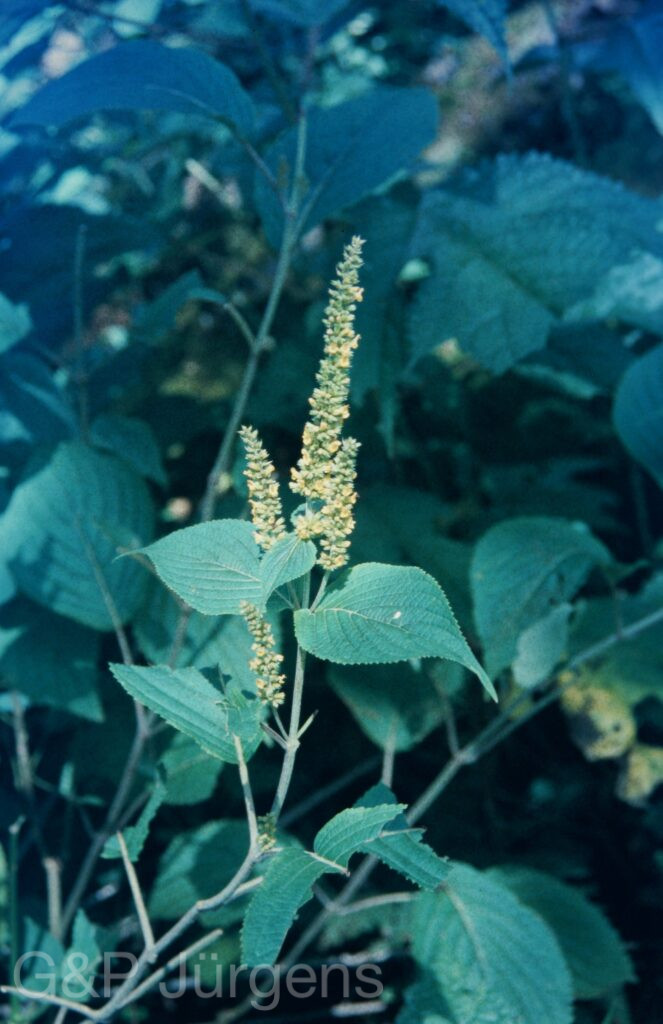
Elsholtzia flava is a Sino-Himalayan element distributed across the temperate to subtropical mountains of southern and eastern Asia, with verified records from China, Nepal, India, Bhutan and Japan; GBIF aggregates some 558 occurrences, several of them at the eastern margin of the genus's range. In the western Himalaya it ascends to around 2700 m, as documented by the photographed material from Simkarok in Indian Garhwal collected in September, the late-monsoon flowering season. It is a plant of open slopes, forest margins, clearings and disturbed ground on moist, humus-rich soils, behaving as a robust ruderal sub-shrub that exploits gaps in the upper temperate broadleaf belt.

The species is a coarse, aromatic perennial or shrubby herb reaching 1-2 m, with erect, branched, quadrangular and finely pubescent stems woody at the base. The leaves are opposite, petiolate, broadly ovate to ovate-lanceolate, acuminate at the apex and crenate-serrate along the margins, glandular-punctate beneath and exuding the characteristic mint scent of the genus. Small flowers are crowded into dense, secund, cylindrical spike-like verticillasters; the campanulate calyx is five-toothed and the corolla pale yellow ("flava"), two-lipped, with four didynamous exserted stamens. The fruit comprises four smooth, ovoid-oblong nutlets enclosed in the persistent calyx.

Elsholtzia (Lamiaceae, tribe Elsholtzieae) is centred on eastern Asia and includes many late-flowering, nectar-rich, bee-pollinated species important to autumn foragers. E. flava is locally common and not regarded as threatened, its tolerance of disturbance favouring persistence; its terpenoid-rich essential oils link it to congeners long used in folk medicine and as aromatic herbs across the Himalayan and Chinese highlands.

Author: Benth. · Sources: POWO (Kew), GBIF, Flora of China, Flora of Bhutan, Flora of Pakistan, Press et al. Annotated Checklist of the Flowering Plants of Nepal, Harley et al. Labiatae (Kubitzki, The Families and Genera of Vascular Plants)
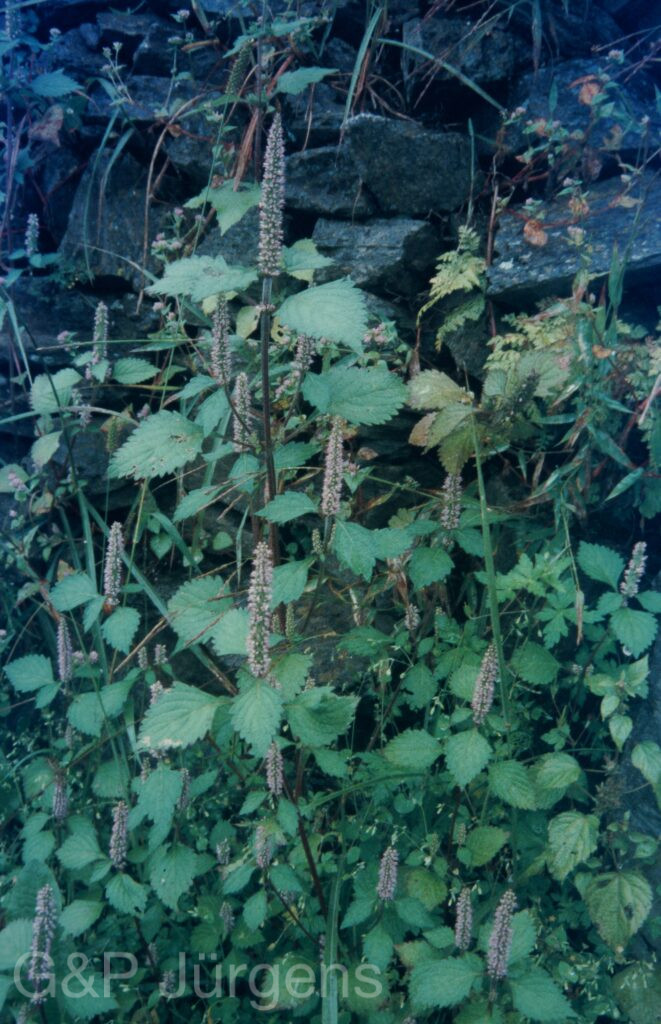
Benth.

Garw 2005 241 ergebnis ergebnis
India Garhwal Bora 2200m, September

Description

Elsholtzia pilosa is a wide-ranging Asian mint distributed from the Indian Himalaya, Nepal and Bhutan eastward through Bangladesh, Myanmar, Thailand and Vietnam to southern China, with nearly 400 GBIF occurrences indicating it is a frequent component of its region. It is a plant of open, disturbed and seasonally moist ground, growing along forest margins, on grassy banks, in fallow fields, by paths and on damp slopes, often as a weedy colonist of cultivated and waste land. The plant figured from Bora in Garhwal, India, at about 2200 m in September is typical of its montane range of roughly 1500-3000 m, the autumn flowering coinciding with the close of the monsoon.

It is an erect, aromatic annual herb with a quadrangular, usually pilose stem branching from the base. The leaves are opposite, ovate to lanceolate, with a serrate-crenate margin, an acuminate apex and a cuneate base tapering to a slender petiole, sparsely hairy and gland-dotted. The small flowers are crowded into dense, one-sided, spike-like terminal verticillasters, each subtended by a bract; the corolla is purplish to pinkish-white and bilabiate, with the four stamens exserted as in the genus. The calyx is tubular and ribbed, becoming enlarged in fruit and enclosing the four smooth, ovoid nutlets characteristic of the mint family.

The epithet pilosa refers to the soft, spreading hairiness of the herbage. Elsholtzia is a mainly eastern Asian genus of aromatic herbs and subshrubs, several species of which are used medicinally and as flavourings, the essential oils giving the foliage its pungent scent. As a pioneer of disturbed ground, E. pilosa is well adapted to anthropogenic habitats, which accounts for its broad and locally abundant distribution across the Himalaya and southern China.

Author: Benth. · Sources: POWO (Kew), GBIF, Flora of China, Flora of Bhutan, Hooker Flora of British India, Press Labiatae of the Himalaya

(Lindl. ex Wall.) Koord. & Valeton

Bhutan2012 649
Bhutan Tserang 1660m, September

Description

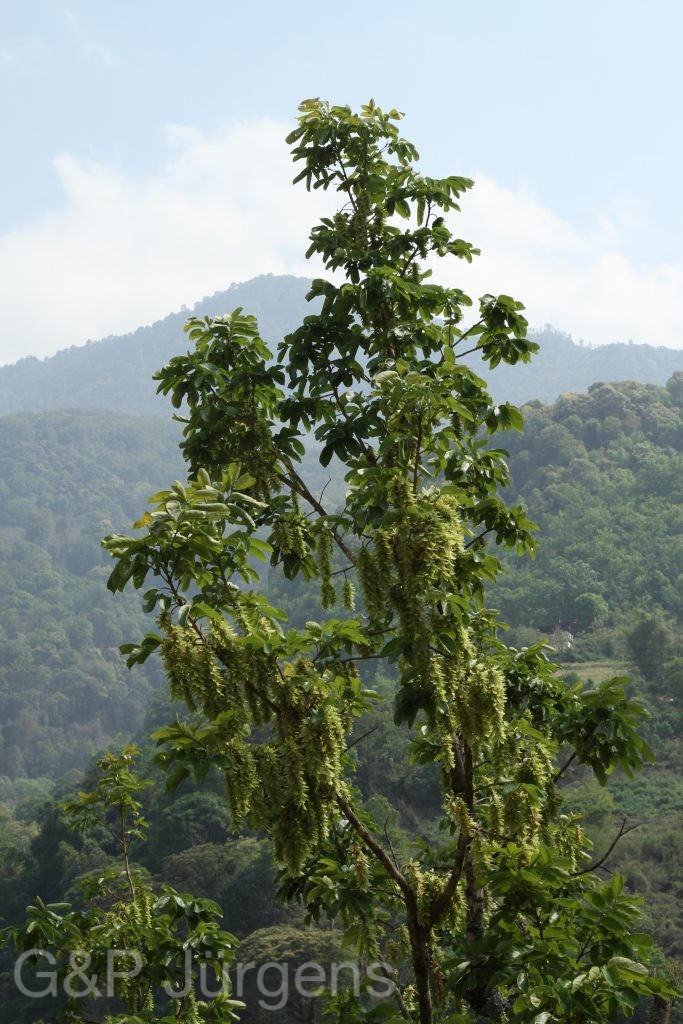
Engelhardia spicata var. colebrookeana is a subtropical tree of the walnut family ranging across the southern Himalaya and into Southeast Asia, with GBIF records from China, India, Nepal, Bhutan, Thailand, Vietnam, Indonesia and the Philippines. It is a component of warm broad-leaved and pine-oak forest, secondary woodland and forest margins, mostly between 800 and 2,000 m. The photographed tree grows at Tserang in southern Bhutan at about 1,660 m in September, when the long, drooping fruiting catkins with their winged nutlets are conspicuous in the subtropical foothill forest.

The plant is a medium-sized to large deciduous or semi-evergreen tree with grey, somewhat fissured bark. The leaves are alternate and pinnately compound, with several pairs of opposite to subopposite, elliptic-oblong, entire leaflets that are glabrous to finely hairy and oblique at the base. The species is monoecious, with slender pendulous catkins; the female flowers develop into a characteristic infructescence in which each small, hard nutlet is subtended by a large, three-lobed, membranous wing-bract that acts as a samara for wind dispersal. This trilobed wing readily distinguishes Engelhardia from its relatives in the family.

Following GBIF, this taxon is treated as a synonym under the accepted name Engelhardia spicata colebrookeana, a variety distinguished from typical E. spicata by indumentum and leaflet characters. The Juglandaceae are an economically and phylogenetically important temperate-to-tropical family, and Engelhardia represents its warm Asian element. The tree is widespread, used locally for timber, fuel and tannin, and is not considered threatened, persisting well in disturbed and secondary forest.

Author: (Lindl. ex Wall.) Koord. & Valeton · Sources: POWO (Kew), GBIF, Flora of China Vol. 4 (Juglandaceae), Grierson & Long: Flora of Bhutan Vol. 1, Manning: The Genera of Juglandaceae

(Kurz) W.E.Manning ex Steenis

Bhutan2014 684
Bhutan Wangdi-Phodrang 2280m, May

Description

Engelhardia spicata var. integra (Kurz) W.E.Manning ex Steenis is a tree of the walnut family, Juglandaceae, native to the subtropical and warm-temperate forests of South and Southeast Asia. GBIF (around 136 occurrences) records the taxon from China, India, Indonesia, the Philippines, Thailand, Bhutan, Vietnam, Myanmar and Nepal, where it forms a component of broad-leaved hill and montane forest, often on forest margins and slopes. It typically occurs in the subtropical mid-montane belt; the tree photographed at Wangdi-Phodrang in Bhutan at 2,280 m in May represents it in early-season flower within this characteristic elevational zone.

Engelhardia spicata is a medium to large deciduous tree with pinnately compound leaves; in var. integra the leaflets are characteristically entire-margined (hence "integra"), distinguishing it from forms with toothed leaflets. The leaflets are opposite to subopposite along the rachis, elliptic to oblong, glabrous to thinly pubescent. The species is monoecious, with flowers borne in long, pendulous catkin-like spikes; the most striking feature is the fruit, a small nutlet subtended by a conspicuous, enlarged, three-lobed membranous wing (an accrescent bract) that develops into a samaroid structure adapted for wind dispersal, the spikes hanging in long tassels at maturity.

The genus Engelhardia (sometimes spelled Engelhardtia) belongs to subfamily Engelhardioideae of the Juglandaceae, a primarily tropical Asian lineage distinguished from the temperate walnuts and hickories by its winged, bract-derived fruits. The wind-dispersed samaras are an important diagnostic and ecological character, enabling the tree to colonise open and disturbed hill forest. As a widespread but variable species, E. spicata has been treated with several infraspecific taxa, of which var. integra is recognised on the basis of its entire leaflet margins.

Author: (Kurz) W.E.Manning ex Steenis · Sources: POWO (Kew), Flora of China Vol. 4, Flora of Bhutan Vol. 1, GBIF, Manning: The genus Engelhardia (Juglandaceae)

Wall. ex  Klotzsch & Garcke

Nepal 99 7 ergebnis
Westnepal, Jumla 2300m June

Description

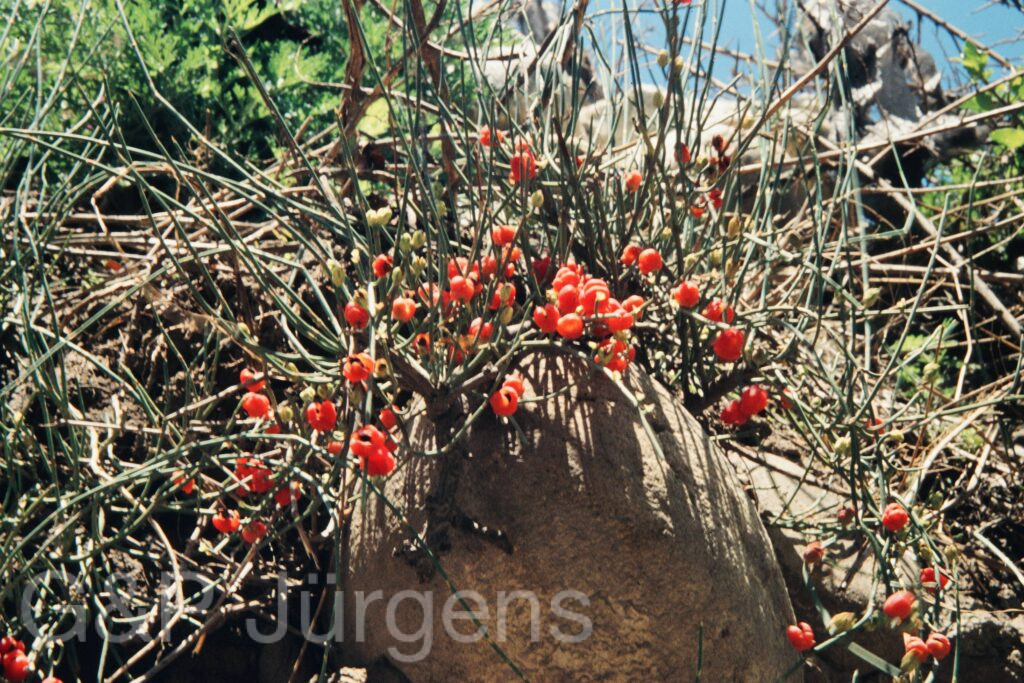
Ephedra gerardiana is a dwarf gymnosperm shrub of the high mountains of central and southern Asia, native across China, Nepal, India, Pakistan, Afghanistan, Bhutan, Tajikistan and Kyrgyzstan; its roughly 539 GBIF occurrences cluster along the Himalaya and the Tibetan plateau margins. It is a plant of dry, cold, high-elevation environments, as recorded near Jumla in West Nepal at about 2300 m in June, and ascends well above the treeline into the alpine and steppe zone. It thrives on stony slopes, gravel terraces and dry riverbeds, tolerating intense insolation, drought and winter cold in the rain-shadow valleys of the inner Himalaya.

The plant is a low, densely tufted, mat-forming shrublet with rigid, jointed, green photosynthetic stems that perform the work of the much-reduced, scale-like leaves borne in pairs at the swollen nodes. As a gymnosperm it bears no true flowers; reproductive structures are small cones, the plants typically dioecious, with pollen in axillary microsporangiate cones and ovules in compact megasporangiate cones. After pollination the female bracts become fleshy and bright red, forming a berry-like structure enclosing one or two seeds, dispersed by birds.

Ephedra is the sole genus of Ephedraceae within the gnetophytes, an isolated lineage of seed plants; E. gerardiana is the principal Himalayan species and a traditional source of the alkaloid ephedrine, harvested medicinally as somlata. This value, combined with slow growth and harsh, slowly regenerating habitats, has made wild populations locally vulnerable to over-collection and grazing, prompting conservation attention in parts of its range even though the species remains widespread overall.

Author: Wall. ex  Klotzsch & Garcke · Sources: POWO (Kew), GBIF, Flora of China Vol. 4, Flora of Pakistan, Flora of Nepal, Monograph of the Genus Ephedra (Stapf)

Schrenk & C.A.Mey.

Nepal 99 527 ergebnis
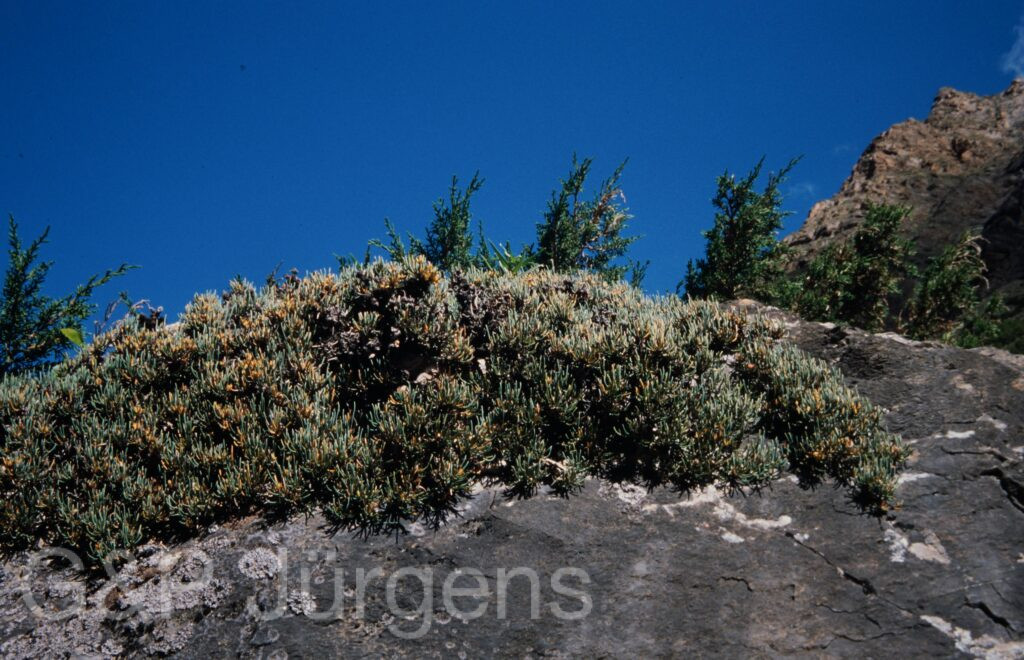
West-Nepal Churta-Khola 3800m, June

Description

Ephedra intermedia Schrenk & C.A.Mey. is a gymnospermous, ephedroid shrub of the Ephedraceae, widely distributed across the arid mountains and steppes of Central Asia, ranging from China, Mongolia and Kazakhstan through Kyrgyzstan, Tajikistan, Turkmenistan, Uzbekistan, Afghanistan, Iran and Pakistan to the dry trans-Himalayan valleys of India and Nepal (GBIF: c. 1,587 occurrences). It is a xerophyte of stony slopes, dry riverbeds, gravelly steppe and arid montane scrub. The photographed plant from Churta-Khola in west Nepal at about 3,800 m, recorded in June, illustrates its occurrence in the high, dry inner-Himalayan rain-shadow zone.

The plant is a densely branched, erect to spreading shrub up to about 1 m tall, with rigid, jointed, longitudinally grooved green stems that carry out photosynthesis; the leaves are reduced to small membranous scales fused into sheaths at the nodes. As a gnetophyte it is non-flowering: the reproductive structures are unisexual cones, the plants generally dioecious. Male cones are clustered with stamens bearing pollen sacs, while the female cones, after fertilisation, develop fleshy red bracts surrounding the ovule, forming a berry-like, fleshy false fruit that is bird-dispersed.

Ephedra is the sole genus of Ephedraceae and one of three living genera of the Gnetales, of considerable interest in seed-plant phylogeny. Species of the genus, including E. intermedia, are a traditional source of the alkaloid ephedrine and have a long history of medicinal use ("ma huang"). The species is widespread and of least conservation concern, though it is locally harvested.

Author: Schrenk & C.A.Mey. · Sources: POWO (Kew), Flora of China Vol. 4, Flora of Pakistan, Flora of Nepal, GBIF, Freitag & Maier-Stolte: Ephedraceae monograph

Boiss.

Nepal 99 836 ergebnis
Nepal Baga-La Phedi 4000m, July
Nepal 99 840 ergebnis
Nepal Baga-La Phedi 4000m, July

Description

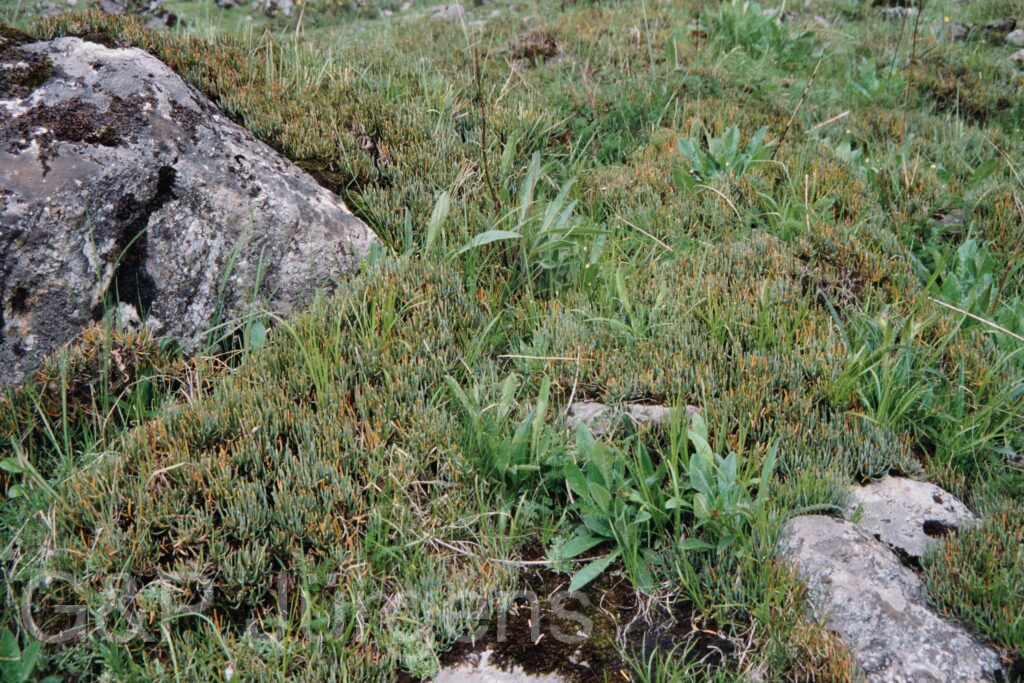
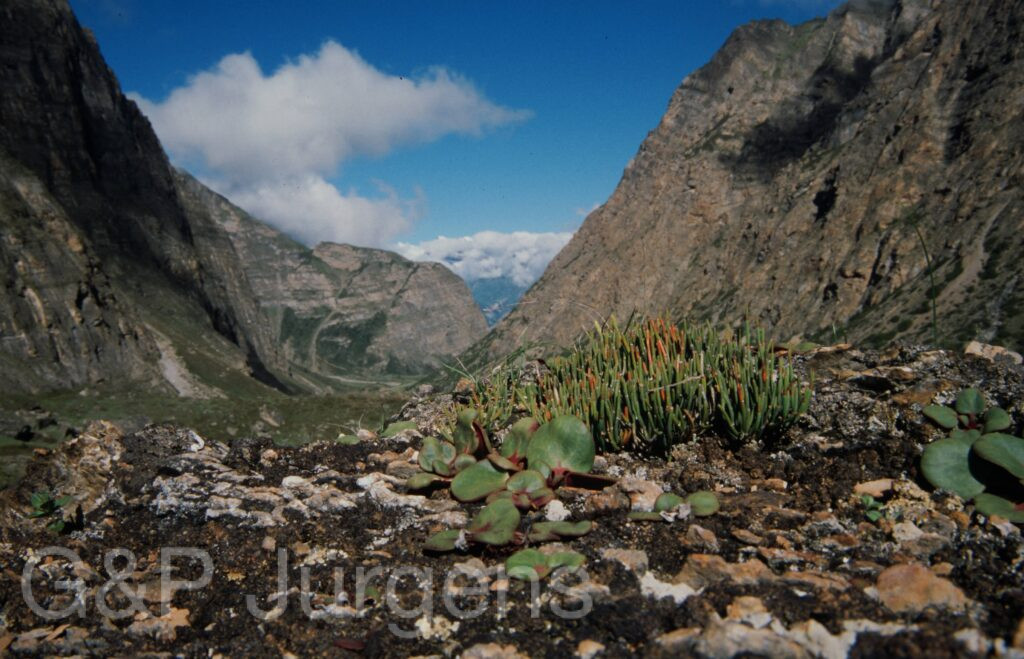
Ephedra pachyclada Boiss. is a xerophytic, gymnospermous shrub of the Ephedraceae ranging from the eastern Mediterranean and Arabia through Iran, Afghanistan and Pakistan to the western and central Himalaya. Its records extend across Egypt, Israel, Jordan, Saudi Arabia, Yemen, Oman, Iran, Afghanistan, Pakistan and into India and Nepal. The species is adapted to arid and semi-arid, sun-exposed habitats: dry rocky slopes, gravelly fans, cliff ledges and the stony soils of cold high-mountain deserts and the trans-Himalayan rain shadow. It occurs over a wide altitudinal span, and the population at Baga-La Phedi in Nepal, photographed at 4,000 m in July, exemplifies its occurrence in the cold, dry alpine zone.

The plant is a densely branched, often cushion-like or rigidly erect shrub with stout, jointed, longitudinally grooved green stems that perform photosynthesis in place of the reduced, scale-like leaves, which are paired and connate into small sheaths at the nodes. Like all Ephedra it is dioecious and wind- or insect-pollinated; the male cones bear clustered microsporangia, while the female cones produce ovules whose enveloping bracts become fleshy and red, forming a berry-like, succulent seed cone that aids in dispersal by birds.

Ephedra pachyclada is a taxonomically variable species, divided into several subspecies and forming part of a complex of robust Asian ephedras whose delimitation remains debated. The genus is renowned as a source of the alkaloids ephedrine and pseudoephedrine, giving it a long history of medicinal use, and several Asian species have been subject to harvesting pressure. As a hardy stabiliser of dry, eroding mountain slopes the species also has ecological value in fragile high-altitude desert ecosystems.

Author: Boiss. · Sources: POWO (Kew), GBIF, Flora of Pakistan, Flora Iranica, Freitag & Maier-Stolte: Revision of Ephedra in the Old World

(L.) Crantz

Nepal 99 880 ergebnis
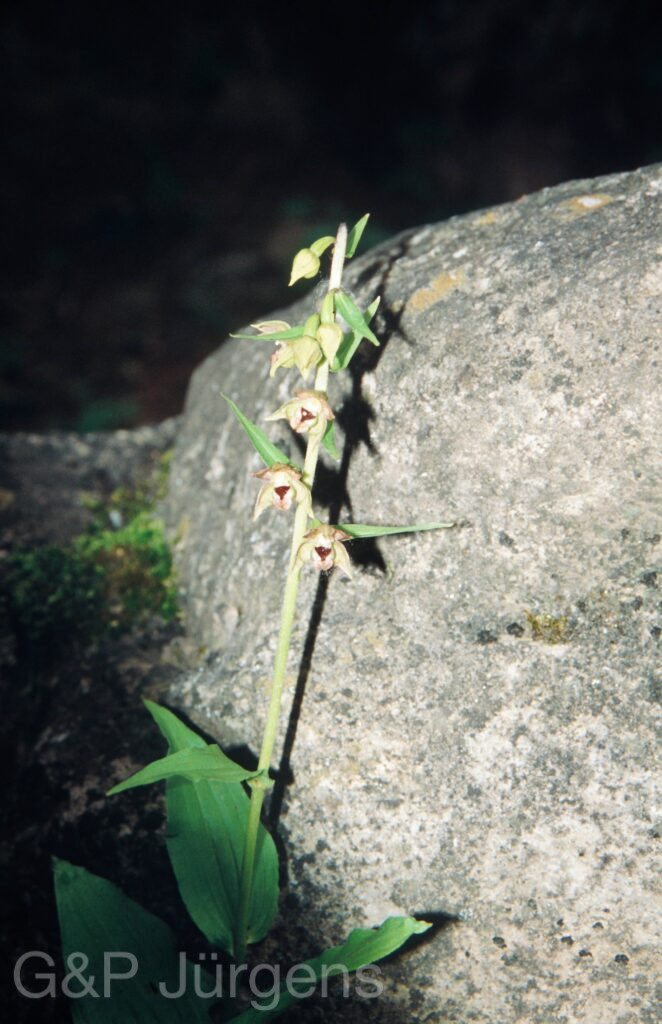
West-Nepal Suli-Khola 3200m, July

Description

Epipactis helleborine, the broad-leaved helleborine, is among the most widespread terrestrial orchids in the world, native across Europe, North Africa and temperate Asia and naturalised extensively in North America. Its enormous GBIF dataset of over 378,000 occurrences spans France, the Netherlands, Germany, Britain, the United States, Canada and much of Eurasia, reflecting its tolerance of woodland, scrub, road verges and disturbed ground from the lowlands to the mountains. Within the Himalaya it ascends to high elevations, the material illustrated here coming from West Nepal at Suli-Khola at 3200 m in July, where it flowers in shaded summer pastures and forest edges on calcareous or humic soils.

The plant is a stout, leafy perennial herb growing from a short rhizome with numerous fleshy roots. The erect stem bears several broadly ovate to lanceolate, plicate, spirally arranged cauline leaves that diminish into bracts upward. The inflorescence is a one-sided, many-flowered raceme of nodding flowers; each flower has greenish to purplish ovate tepals and a distinctive two-part labellum comprising a cup-shaped hypochile holding nectar and a heart-shaped, recurved epichile bearing two basal bosses. The column is short, and pollination is typically effected by wasps; the fruit is a pendent, ribbed capsule releasing innumerable dust-like seeds.

Epipactis helleborine is taxonomically variable, encompassing numerous regional ecotypes and segregate microspecies, and is notable for its partial mycoheterotrophy, drawing carbon from ectomycorrhizal fungi which permits it to grow in deep shade. Its colonisation of urban and ruderal habitats has made it a successful adventive, and in parts of North America it is regarded as weedy. The species is of least conservation concern globally given its abundance and ecological adaptability.

Author: (L.) Crantz · Sources: POWO (Kew), GBIF, Flora Europaea, Genera Orchidacearum, The Genus Epipactis: A Monograph, Orchids of the Himalaya

Lindl.

Nepal 99 177 ergebnis
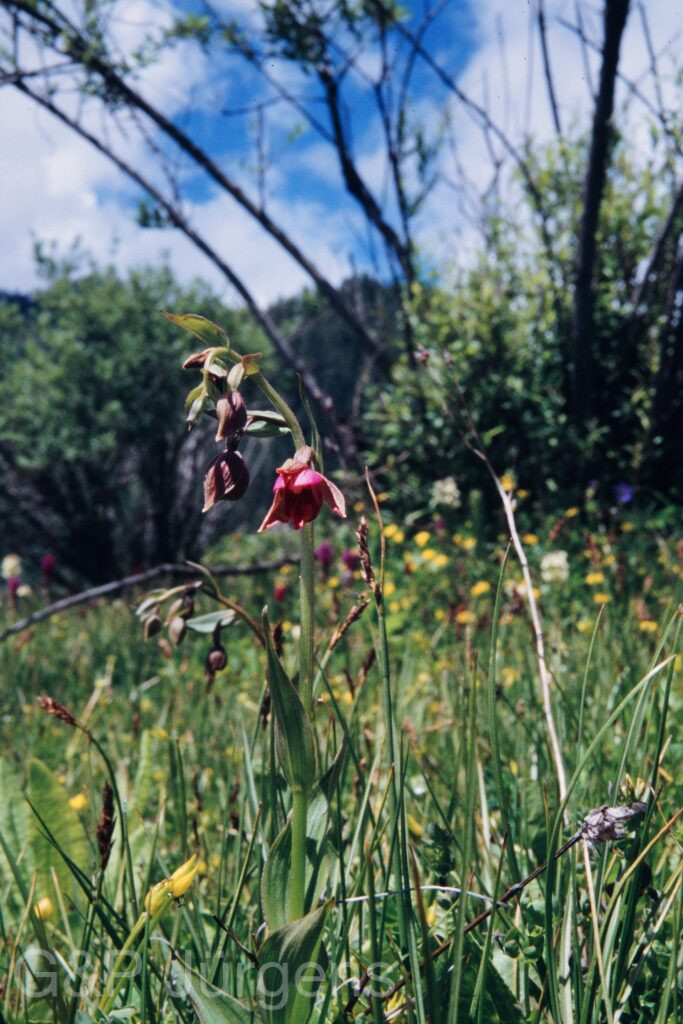
West-Nepal Lara-Lake 3000m, June

Description

Epipactis royleana Lindl. is a terrestrial orchid of central and western Asia and the Himalaya, with GBIF documenting some 262 occurrences across Nepal, India, China, Pakistan, Afghanistan, Tajikistan, Kyrgyzstan, Uzbekistan, Bhutan, Myanmar and Russia, with scattered records farther afield. It typically grows in moist habitats such as streamsides, marshy meadows, seepage slopes and open coniferous woodland from the montane to subalpine zones, often between about 1500 and 3500 m. The plant photographed at Lara-Lake in West Nepal, at roughly 3000 m in June, illustrates its preference for the damp, lake-margin grasslands of the high Himalayan valleys.

The species is a rhizomatous perennial with erect, leafy stems arising from a short creeping rootstock. The leaves are alternate, ovate to lanceolate, sheathing at the base and prominently veined. The inflorescence is a lax, one-sided terminal raceme of several to many resupinate flowers; each flower has spreading, greenish to purplish-tinged sepals and petals, with a labellum divided into a cup-like basal hypochile and a triangular, often pinkish epichile. As in all Epipactis, the column bears a single anther and the pollinia are mealy, and the fruit is a pendulous, ridged capsule releasing dust-like seeds.

Epipactis is a Holarctic genus in which Himalayan and central Asian taxa form a distinct group; E. royleana is among the more widespread members, exhibiting considerable variation in flower colour across its range. Like other members of the genus it depends on mycorrhizal fungi for germination and early establishment, and its small seeds are wind-dispersed. The species is not currently regarded as threatened across its broad distribution, though, as a wetland-associated orchid, local populations are sensitive to drainage and habitat disturbance.

Author: Lindl. · Sources: POWO (Kew), GBIF, Flora of China, Flora of Pakistan, Flora of Nepal, Delforge Orchids of Europe and Asia

(Cambess.) Christenh. & Byng

BhutanPG2011 207
Bhutan Tsochenchen, 3500m June
BhutanPG2011 586
Bhutan Ludlow-Sherriff-Trail Miluthang, 4450m July
Nepal 99 130 ergebnis
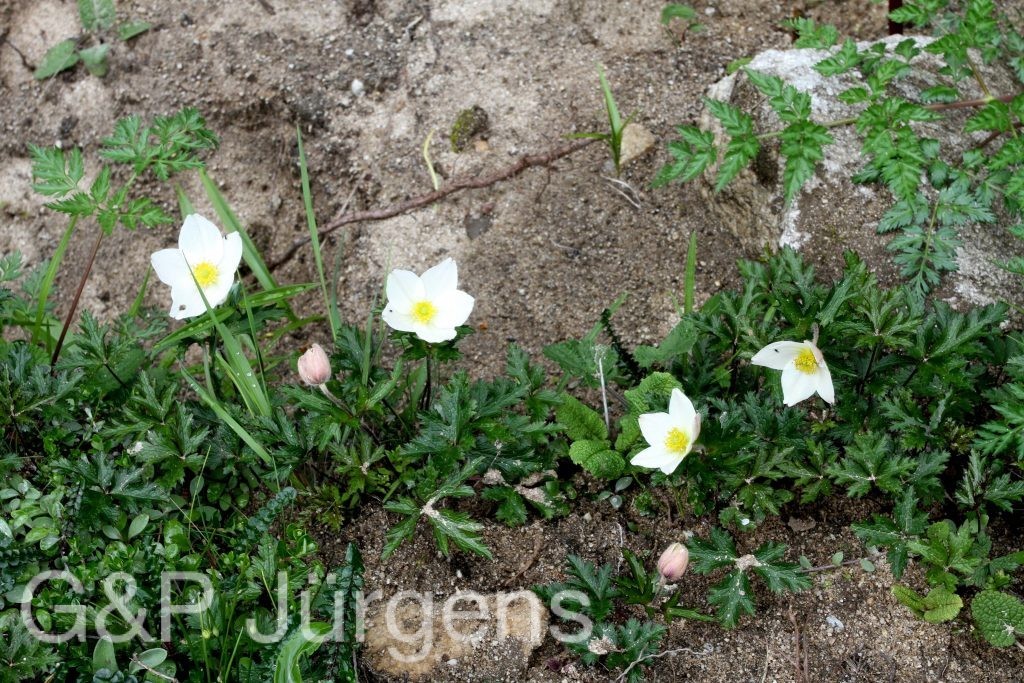
West-Nepal South of Rara-Lake 3800m, June
Nepal 99 529 ergebnis
West-Nepal South of Rara-Lake 3800m, June

Description

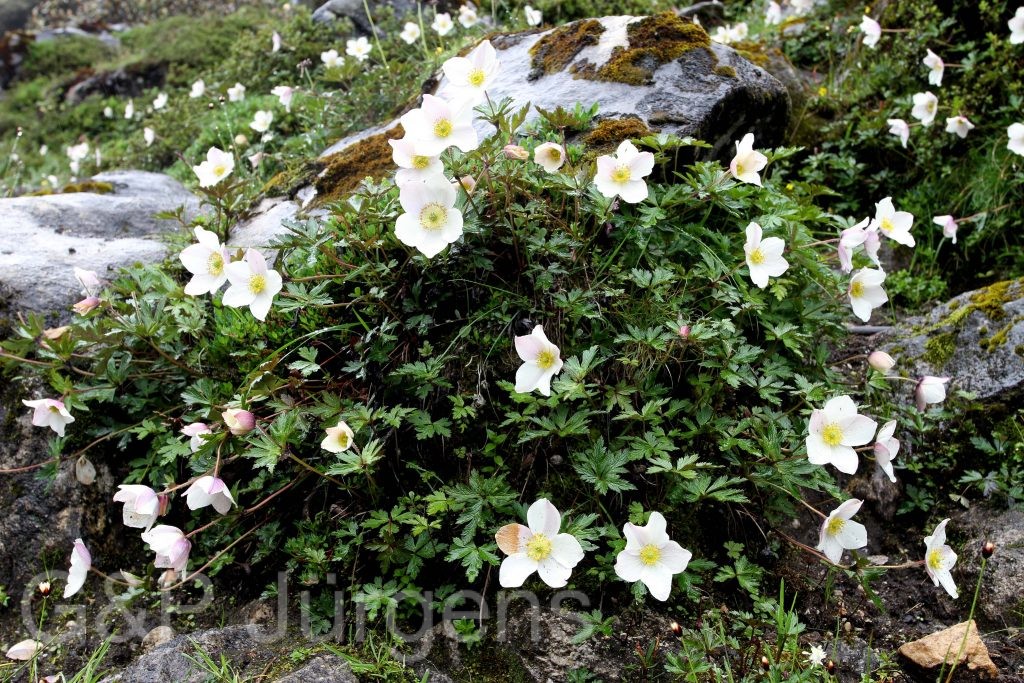
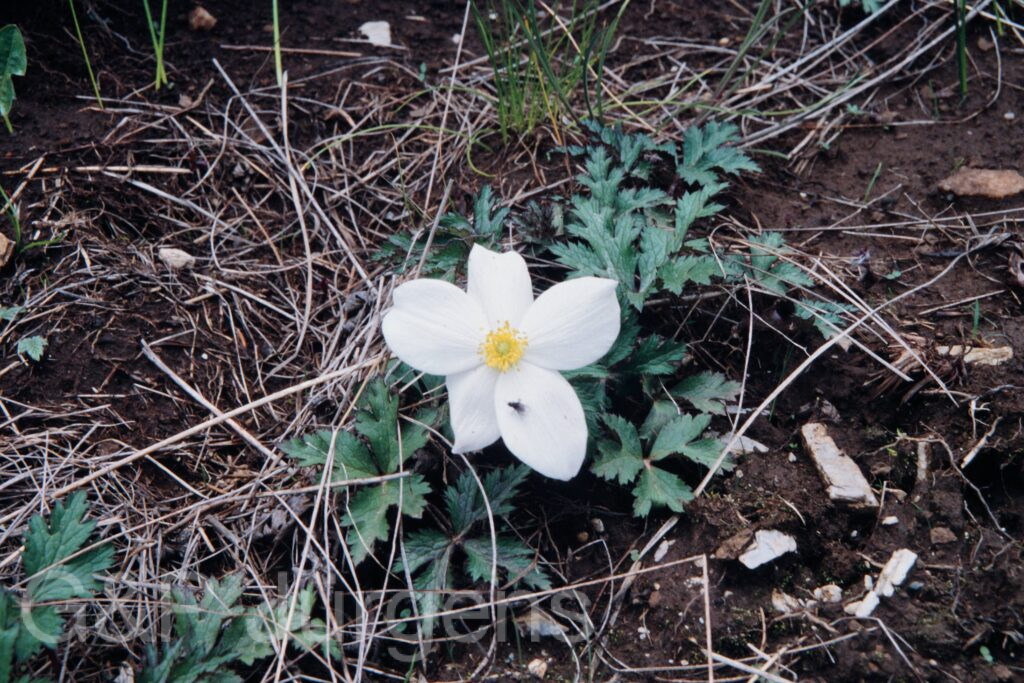
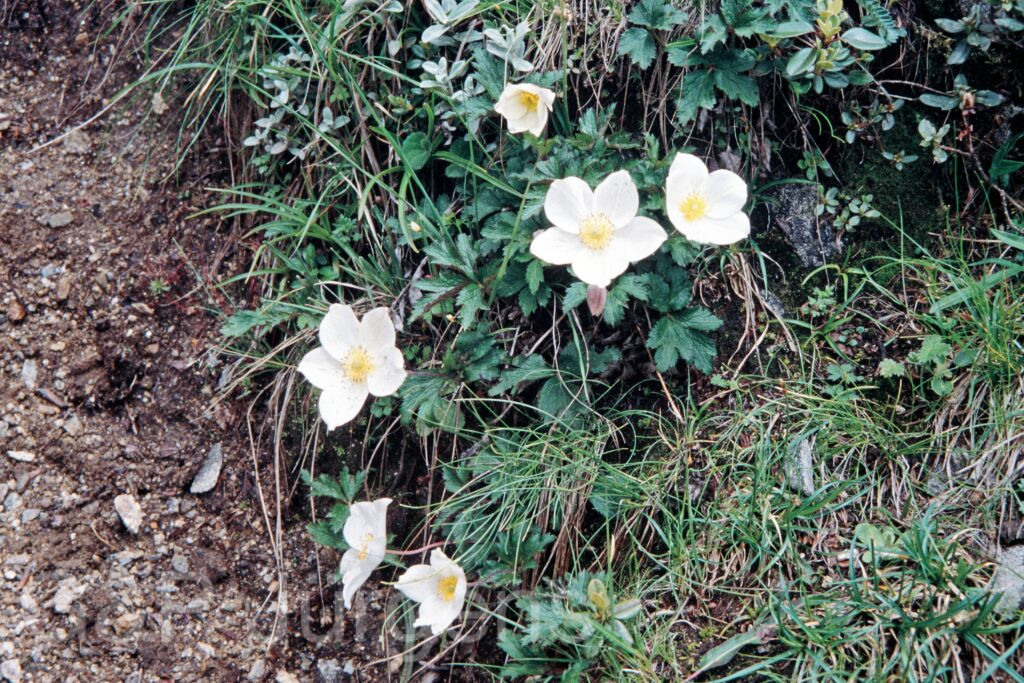
Eriocapitella rupicola, formerly Anemone rupicola, is a Himalayan and Sino-Himalayan herb distributed from Pakistan through Nepal, India and Bhutan into China, with around 507 GBIF occurrences. It grows in alpine and subalpine habitats, on rocky slopes, cliff ledges, open meadows, stony pastures and among boulders, often in well-drained sites in the upper subalpine to alpine zone. The images document it widely in the range: Bhutan at Tsochenchen around 3500 m in June and along the Ludlow-Sherriff Trail at Miluthang near 4450 m in July, and West Nepal south of Rara Lake at about 3800 m in June, where its white blooms open through the early summer.

It is a perennial herb arising from a stout rootstock, with basal leaves that are ternately to palmately divided into toothed, deeply cut segments, hairy on the surfaces. The flowering stems are erect and bear an involucre of stalked, leaf-like bracts below the flowers. The flowers are solitary or few, comparatively large and showy, with several (commonly five) petaloid white sepals, often flushed pink or bluish on the reverse, and numerous stamens surrounding a head of carpels. The fruit is a head of densely woolly, long-hairy achenes, the indumentum aiding wind dispersal.

The species has been transferred to Eriocapitella, a segregate genus carved from the broadly circumscribed Anemone on molecular and morphological grounds by Christenhusz and Byng; POWO accepts this placement, with Anemone rupicola as a synonym. The woolly achene heads (the basis of the generic name) are characteristic. The showy white flowers attract generalist alpine insect pollinators. Widespread across the Himalaya, it is common and of least conservation concern.

Author: (Cambess.) Christenh. & Byng · Sources: POWO (Kew), GBIF, Flora of China, Flora of Bhutan, Flora of Nepal, Christenhusz & Byng revision of Anemone s.l.