Author

G & P Jürgens

D.Don

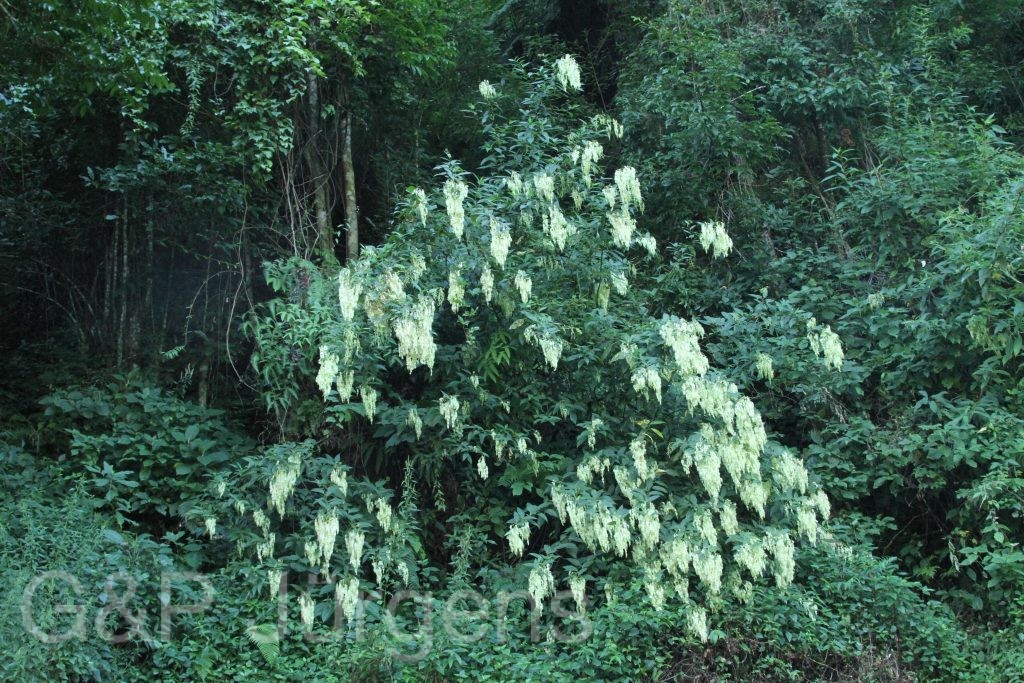
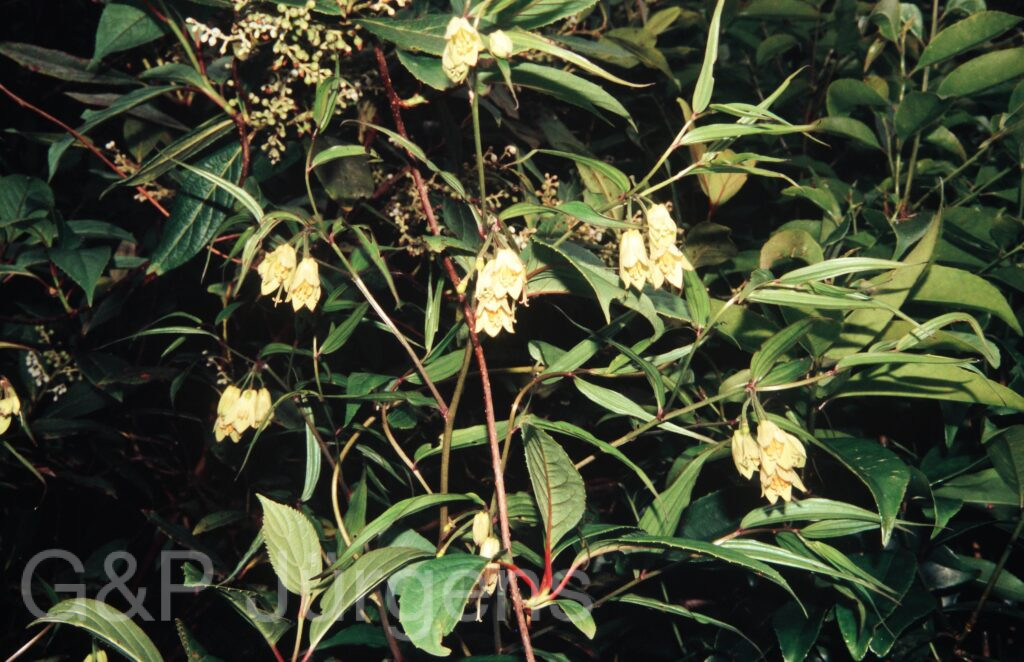
Nepal 2009 101 ergebnis
Nepal Helambu Samathang 2410, May

Description

Disporum calcaratum is a rhizomatous woodland herb widespread from the Himalaya through southern China to mainland and insular Southeast Asia, with GBIF occurrences in China, Thailand, Myanmar, India, Nepal, Vietnam, Indonesia, Malaysia, Bhutan and Laos. It grows in the shaded understorey of moist broad-leaved and mixed forest, on humus-rich slopes and along stream banks, generally between 1,500 and 2,800 m. The photographed plant was recorded at Samathang in the Helambu region of Nepal at about 2,410 m in May, flowering during the moist pre-monsoon period typical of its mid-montane habitat.

The plant arises from a short, creeping rhizome and produces erect, branching stems bearing alternate, ovate to ovate-lanceolate leaves with prominent arcuate venation, rounded to cordate bases and acuminate tips. The flowers hang in terminal and axillary umbellate clusters; the six tepals are narrow, recurved and purple to violet, each outer tepal extended at the base into a short, conspicuous saccate spur that gives the species its epithet. There are six stamens with the typical Disporum arrangement, and a superior, three-locular ovary. The fruit is a globose, dark blue to black berry containing several seeds, dispersed by birds.

Disporum is now placed in the Colchicaceae rather than the older Liliaceae, and D. calcaratum is readily recognised among Asian congeners by its spurred, purple, pendent flowers. The species is widespread and ecologically a minor but characteristic element of the montane forest floor, important in shaded herb-layer communities. It is common across its broad range and is not regarded as threatened, though it depends on the persistence of intact, humid forest understorey.

Author: D.Don · Sources: POWO (Kew), GBIF, Flora of China Vol. 24 (Colchicaceae), Grierson & Long: Flora of Bhutan Vol. 3, Hara et al.: An Enumeration of the Flowering Plants of Nepal
Buch.-Ham. ex D.Don

Bhutan2015 87
Bhutan Galephug 700m, October
Bhutan2015 86
Bhutan Galephug 700m, October
Bhutan2015 286
Bhutan Zhemgang 910m, October

Description

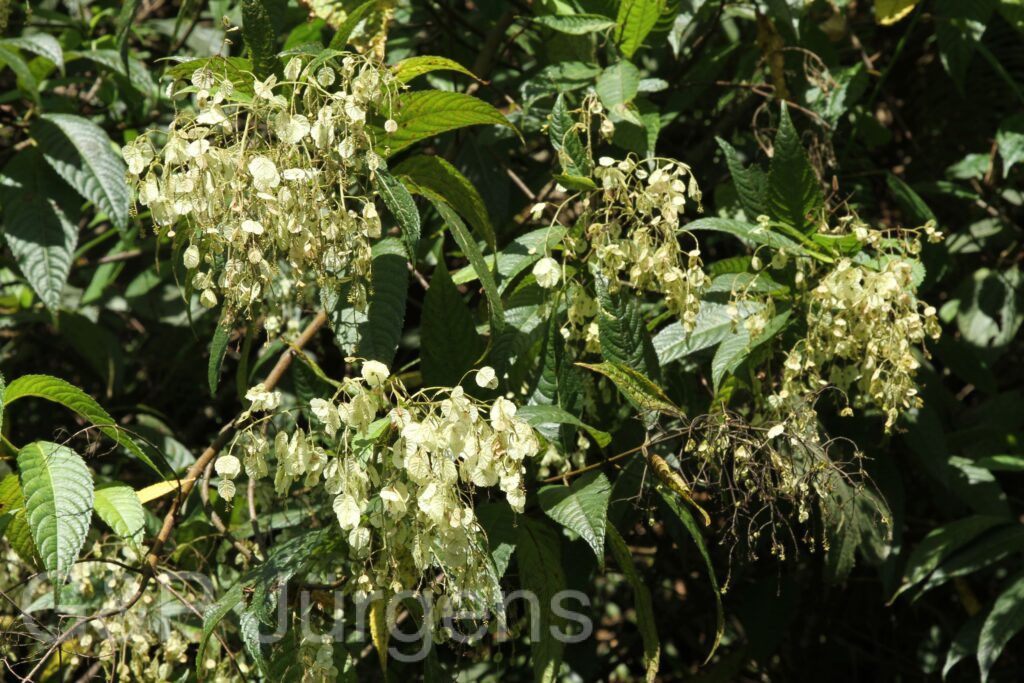
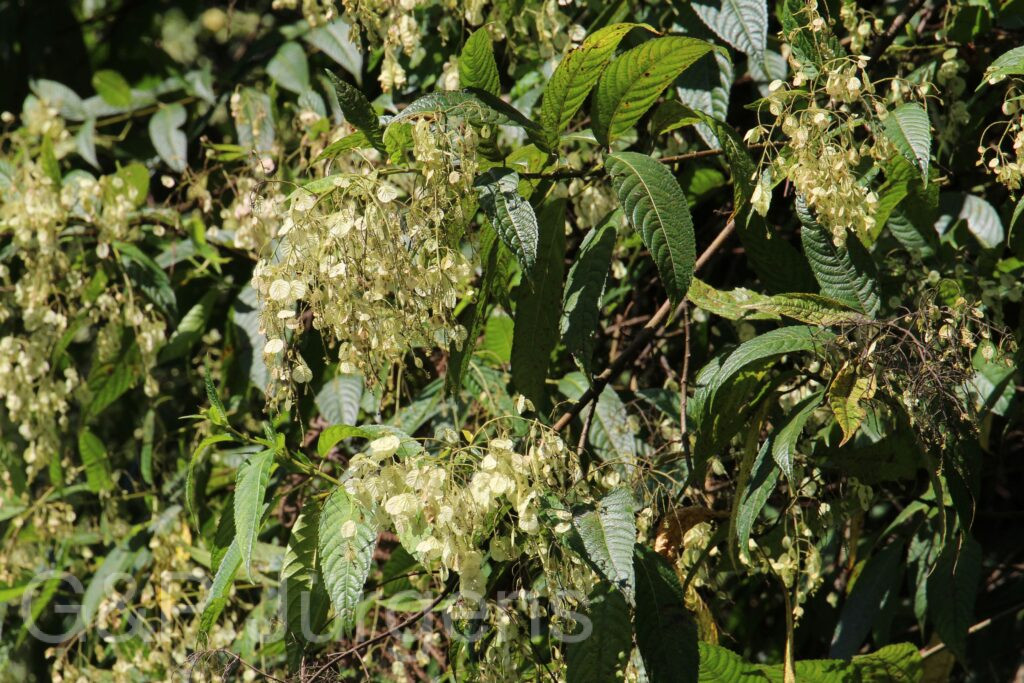
Dobinea vulgaris is a shrub or small subshrub of the eastern Himalaya and adjoining parts of southwestern China and northern Southeast Asia, recorded by GBIF from China, Nepal, India, Bhutan, Myanmar and Thailand across roughly 263 georeferenced occurrences. It is a plant of warm subtropical lower hill slopes, occupying open forest, scrub, rocky banks, ravines and disturbed roadside ground, generally at low to mid elevations. The Bhutanese records cited here, from Galephug at about 700 m and from Zhemgang at around 910 m, both in October, place it firmly in the low foothill zone of the southern Himalaya, where it flowers and fruits towards the close of the monsoon. It favours seasonally warm, humid conditions and is frequently found in secondary vegetation.

The plant has soft, somewhat herbaceous to weakly woody stems and opposite, simple leaves that are ovate to elliptic-lanceolate, acuminate, and conspicuously serrate or crenate-serrate along the margin, a foliage aspect unusual for the family. It is functionally dioecious: the small male flowers are borne in slender axillary or terminal panicles, while the female flowers are solitary or few and are remarkable for being adnate to an enlarged, persistent, leaf-like (foliaceous) bract that expands greatly in fruit and acts as a wing for wind dispersal. The fruit is a small compressed drupe-like structure carried on this accrescent membranous bract.

Dobinea is a small genus of only two species, and its placement within Anacardiaceae has historically been contentious; the herbaceous habit, opposite serrate leaves and unique bract-borne female flowers led some authors to segregate it (with Campylopetalum) into the family Podoaceae, although modern molecular phylogenetics confirms its position within an expanded Anacardiaceae, near the base of the family. This makes Dobinea vulgaris of particular interest to systematists studying the early diversification and morphological boundaries of the cashew family. The species is locally common within its range and is not regarded as of conservation concern.

Author: Buch.-Ham. ex D.Don · Sources: POWO (Kew), GBIF, Flora of China Vol. 11, Flora of Bhutan Vol. 2, Flora of Nepal, Flora of Pakistan, Pell et al.: systematics of the Anacardiaceae (including the Dobinea/Podoaceae problem)

DC. ex Royle

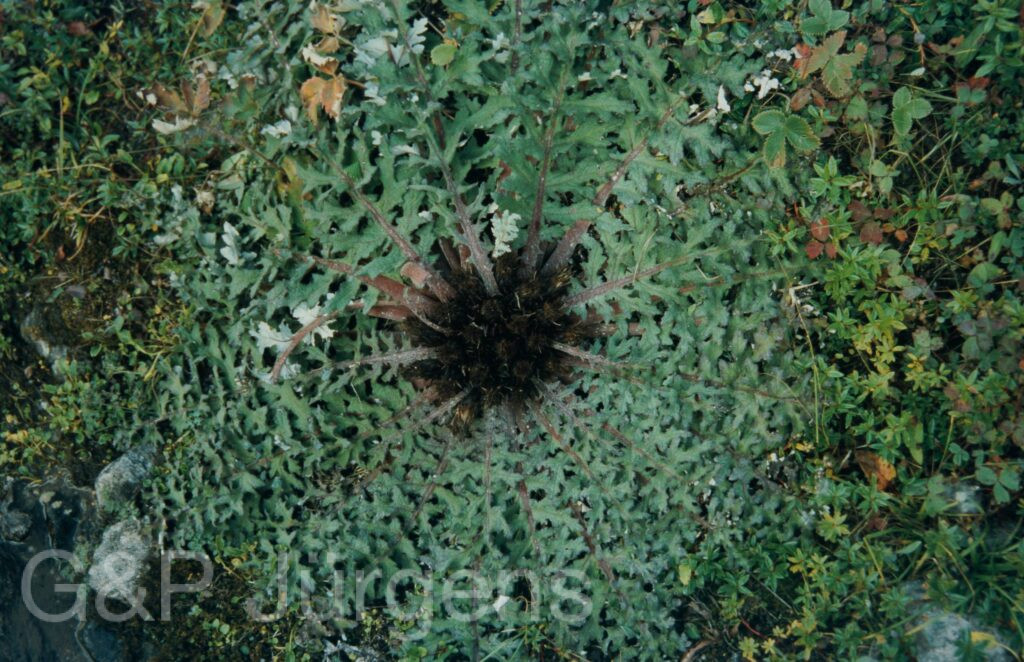
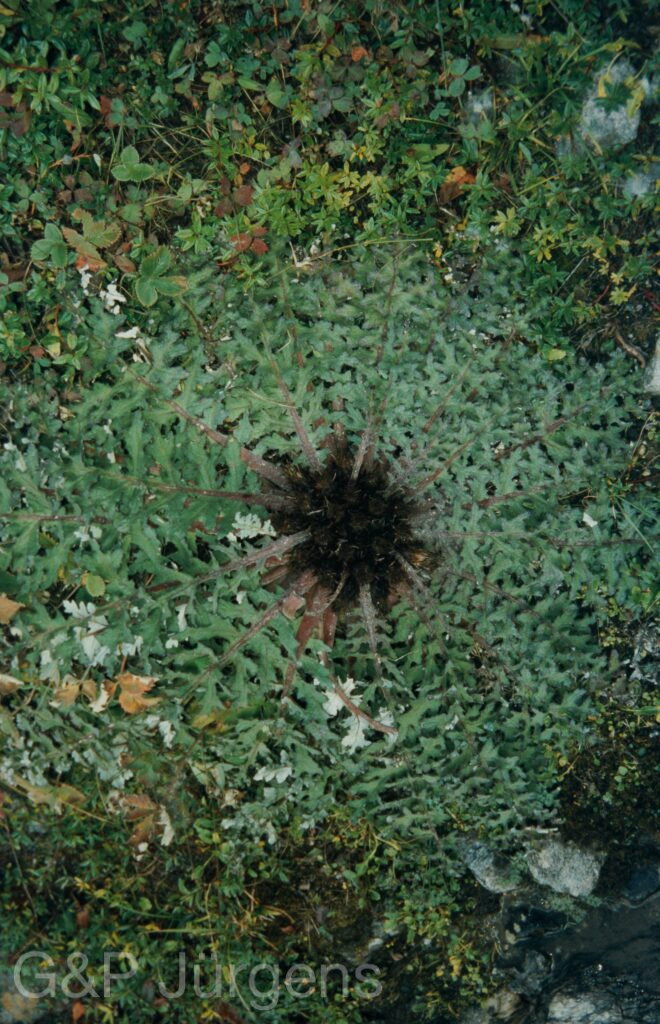
Garw 2005 308 ergebnis ergebnis
India Garhwal Kuari-Pass 3700m, September

Description

Dolomiaea macrocephala is a stemless alpine thistle-relative of the western and central Himalaya and adjacent Central Asian highlands, recorded from India, Nepal, Pakistan, China, Iran and Mongolia, with about 131 occurrences in GBIF. It grows on open alpine slopes, stony pastures and grazed meadows of the upper subalpine and alpine zones, generally between 3000 and 4500 m, often in well-drained turf exposed to full sun. The photograph from the Kuari Pass in Garhwal, India, at about 3700 m in September shows the plant in fruit late in the alpine season among the short turf of the high-meadow belt.

The species is a perennial, essentially acaulescent herb arising from a stout taproot and a short rootstock. The leaves form a flat or appressed basal rosette and are pinnatifid to lyrate with spiny-toothed margins, green above and frequently white-tomentose beneath. As the specific epithet indicates, the conspicuously large flower heads are sessile or nearly so, sitting in the centre of the rosette; the involucre bears numerous imbricate, often spine-tipped phyllaries surrounding a head of purple, tubular disc florets. The achenes are oblong and crowned by a pappus of plumose or barbellate bristles aiding wind dispersal.

The genus Dolomiaea was long included within Jurinea and Saussurea and belongs to the thistle tribe Cardueae of the Asteraceae; molecular studies support its recognition as a distinct Sino-Himalayan and Central Asian lineage. The ground-hugging rosette and centrally clustered heads represent a typical adaptation to wind exposure and heavy grazing at high elevation. Several species, including this one, have a history of use in Tibetan and Himalayan herbal medicine. Widespread across its montane range, D. macrocephala is not regarded as threatened.

Author: DC. ex Royle · Sources: POWO (Kew), GBIF, Flora of China, Flora of Pakistan, Annotated Checklist of the Flowering Plants of Nepal, Susanna and Garcia-Jacas revisions of the Cardueae

(DC.) Alv.Fern.

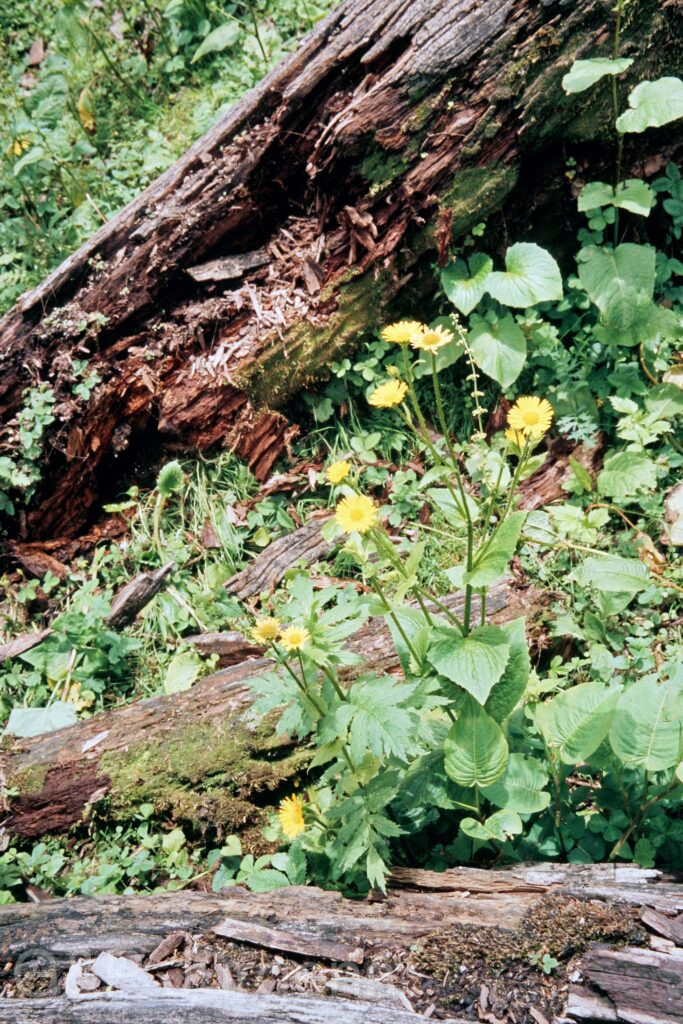
Garh 07 333 ergebnis
India Garhwal Mahji 2650m, June

Description

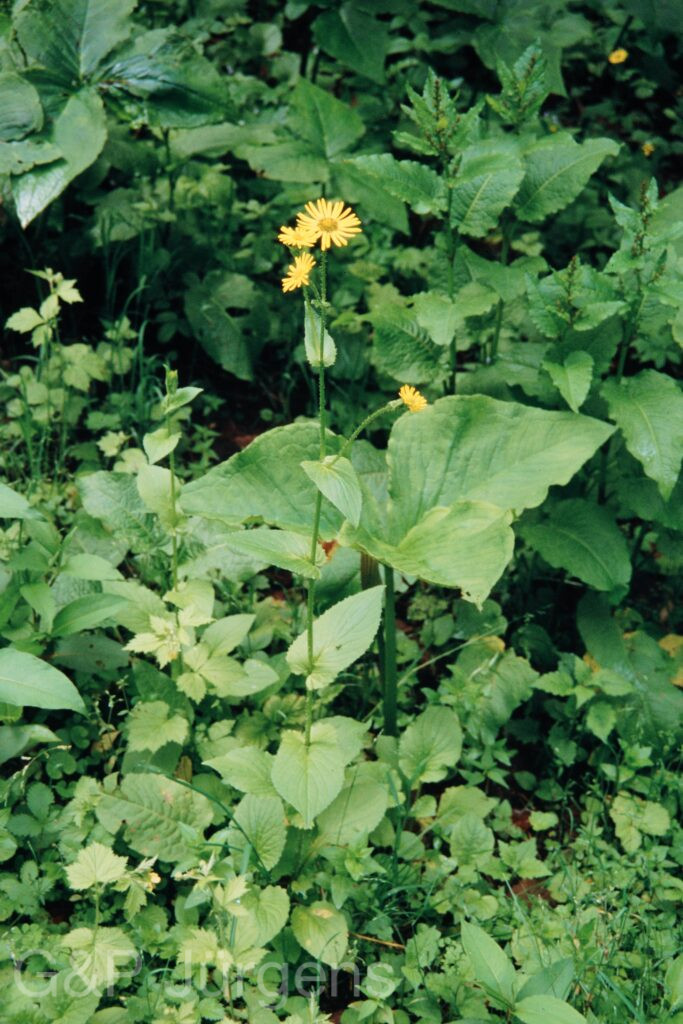
Doronicum kamaonense is a perennial herb of the temperate and subalpine Himalaya, distributed across India, Pakistan, Nepal, Bhutan and south-western China, with some 191 georeferenced occurrences documented in the GBIF network. It is a plant of moist alpine meadows, open grassy slopes, stream margins, the edges of birch and rhododendron scrub, and rocky pastures, typically occurring between about 2500 and 4000 m elevation. The plant photographed at Mahji in the Indian Garhwal Himalaya at 2650 m in June, when its golden flower heads coincide with the early monsoon flush of the high pastures, sits squarely within this favoured montane zone, where snowmelt keeps the substrate cool and humus-rich.

The species forms a short, ascending or erect stem 15–45 cm tall arising from a knotty, often shortly creeping rhizome bearing fibrous roots. The basal leaves are long-petiolate with ovate to cordate, crenate or sinuate-dentate blades, while the cauline leaves become sessile and clasping, reduced upwards. The stems and foliage are clothed in glandular and eglandular hairs. Flower heads are usually solitary, terminal and radiate, 3–5 cm across, subtended by a hemispherical involucre of narrow, acuminate, pubescent phyllaries. The bright yellow ray florets are ligulate and pistillate; the disc florets are tubular and hermaphrodite. The fruit is a ribbed cypsela, those of the ray often lacking a pappus while the disc achenes bear a pappus of barbellate bristles.

Within Doronicum, a Eurasian genus of the tribe Senecioneae, D. kamaonense belongs to the assemblage of Himalayan leopard's-banes that diversified along the great montane arc. Its combination of cordate basal leaves and typically single heads distinguishes it from related taxa, though intergrading populations and broad morphological plasticity have long complicated its circumscription. Like many high-altitude Senecioneae it is insect-pollinated and flowers with the brief alpine growing season. The species is widespread and locally common across its range and is not regarded as threatened, though grazing pressure and trampling locally affect meadow populations.

Author: (DC.) Alv.Fern. · Sources: POWO (Kew), GBIF, Flora of China Vol. 20-21, Flora of Bhutan Vol. 2, Flora of Pakistan, A Revision of the Genus Doronicum (Compositae)

DC.

Nepal 99 467 ergebnis
West-Nepal Churta-Khola 3200m, June

Description

Doronicum roylei is a Himalayan leopard's-bane distributed from Pakistan and the Western Himalaya through India and Nepal into Bhutan, with GBIF recording 67 occurrences across PK, IN, NP and BT. It grows in subalpine and alpine meadows, on open grassy slopes, among shrubberies and along moist banks, broadly between about 3000 and 4200 m. The photographed plant was found in West Nepal at Churta-Khola near 3200 m, flowering in June. In the GBIF backbone the name is flagged as a SYNONYM, with Doronicum roylei itself given as the accepted name, so that binomial is retained here as the correct designation.

The species is a perennial herb arising from a short, often tuberous or knotty rhizome, with erect, simple or sparingly branched, glandular-hairy stems. The basal and lower leaves are petiolate, ovate to cordate and toothed, while the upper cauline leaves become sessile and amplexicaul, clasping the stem. The capitula are large, radiate and usually solitary (or few), with an involucre of narrow green phyllaries; the bright yellow ray florets are female and ligulate, surrounding numerous yellow, tubular, bisexual disc florets. The fruit is a cypsela, typically with a pappus of fine bristles on the disc florets, in the manner characteristic of the genus.

Doronicum is a genus of the tribe Senecioneae centred on the temperate mountains of Eurasia, with a notable Himalayan and Central Asian radiation. As a showy meadow composite it is a typical component of Himalayan summer-flowering alpine flora. It is locally common across its range and is not regarded as threatened, though grazing pressure affects accessible high pastures.

Author: DC. · Sources: POWO (Kew), GBIF, Flora of Pakistan, Annotated Checklist of the Flowering Plants of Nepal, Flora of China (Asteraceae: Senecioneae)

Schrenk

Nepal 99 656 ergebnis
West-Nepal, Kagmara-La, July

Description

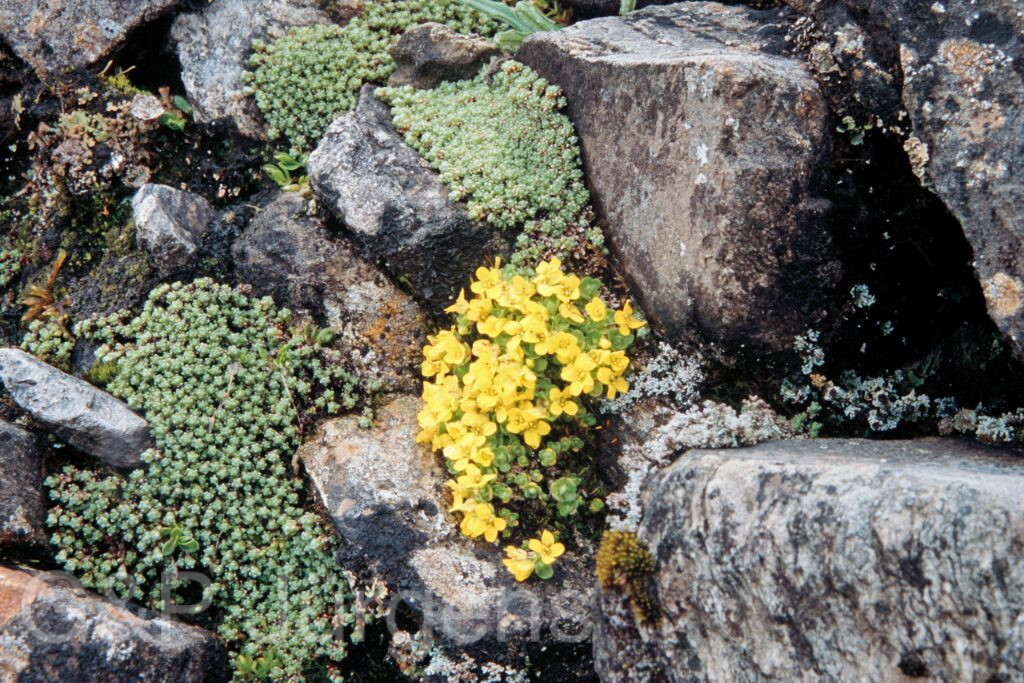
Draba oreades is a circum-Asian alpine crucifer with a wide range across the mountains of Central Asia and the Himalaya into Siberia and Mongolia; GBIF records nearly 1200 occurrences spanning China, India, Pakistan, Nepal, Kazakhstan, Russia, Kyrgyzstan, Tajikistan and beyond. It is a true alpine, growing on stony slopes, screes, moraines, rock ledges and gravelly alpine turf, generally above 3500 m and ascending well beyond 4500 m. The photograph from the Kagmara-La in West Nepal in July depicts it flowering in midsummer on a high Himalayan pass, the brief window when these cold-desert and alpine habitats become accessible to its yellow-flowered cushions.

It is a small, tufted or cushion-forming perennial herb arising from a branched, often woody caudex clothed in persistent old leaves. The leaves are mostly in dense basal rosettes, oblong to oblanceolate or spathulate, entire, and covered with stellate and simple hairs giving a greyish, scabrid texture. The flowering stems are short, leafless or few-leaved and bear compact corymbose racemes that elongate in fruit. Flowers are small with four bright yellow petals, fading paler. The fruit is a short, ovate to oblong-elliptic silicula, somewhat compressed and often twisted or hairy, containing several small seeds in two rows.

Draba is a large and notoriously complex genus of cold and high-mountain regions, and D. oreades belongs to the yellow-flowered, cushion-forming alpine assemblage adapted to short seasons, intense radiation and frost. Such compact, taprooted, densely hairy growth forms are classic alpine convergences conserving heat and moisture. The species is widespread and not threatened, serving as a characteristic pioneer of unstable high-elevation substrates throughout the Asian highlands.

Author: Schrenk · Sources: POWO (Kew), GBIF, Flora of China (Brassicaceae), Flora of Pakistan, Jordal & Al-Shehbaz studies of Draba

Royle

Description

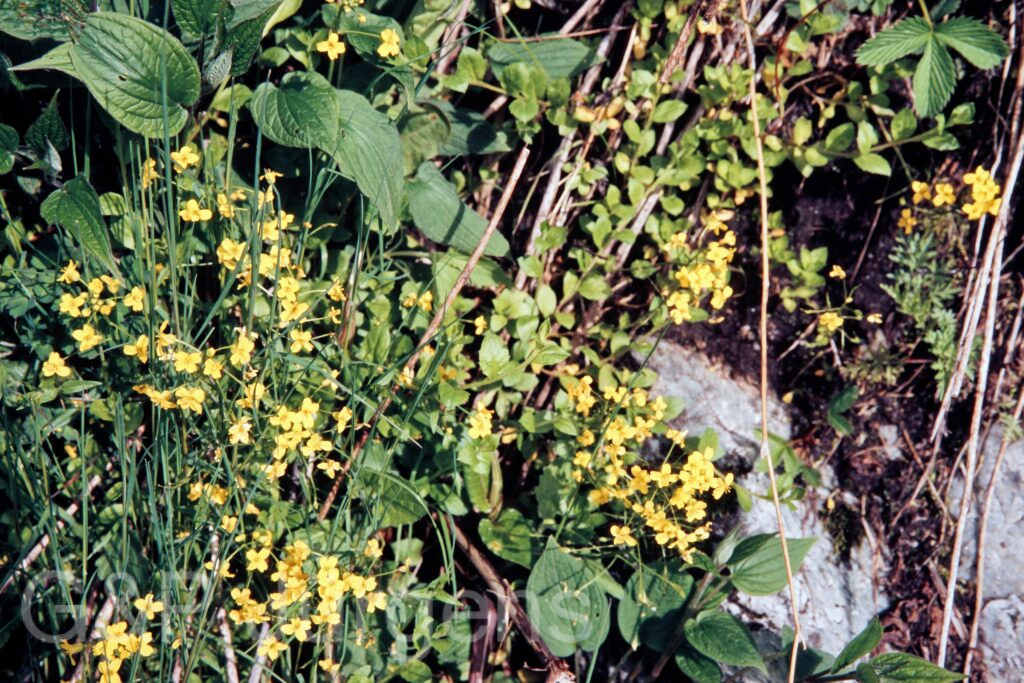
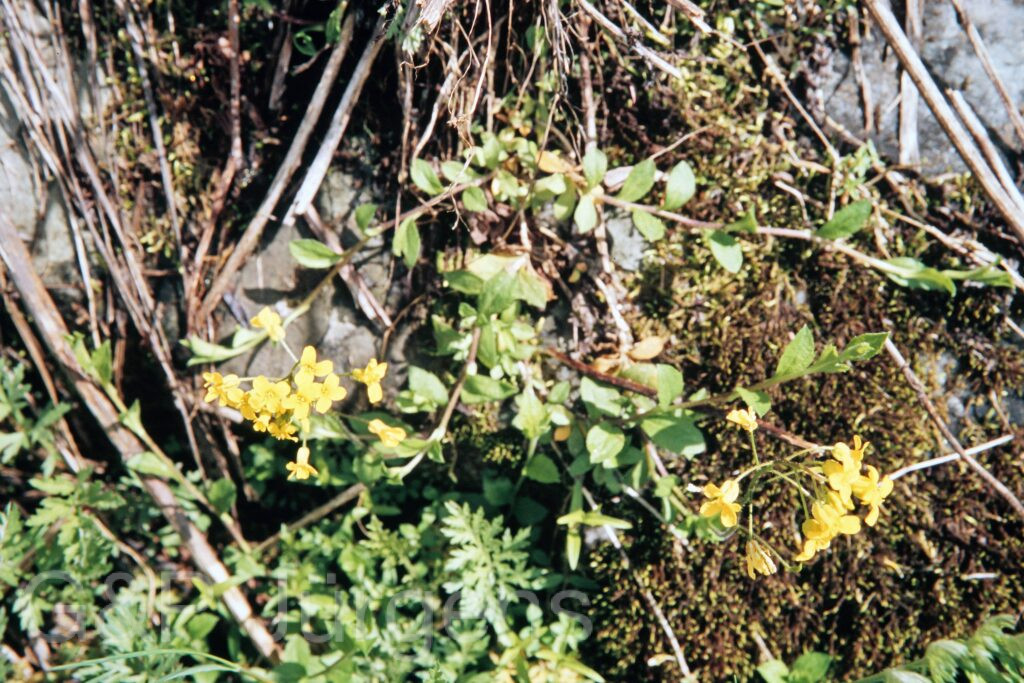
Draba radicans is a high-alpine crucifer of the Himalayan chain, with GBIF documenting 55 occurrences from Nepal, India and Bhutan. It is a plant of the upper subalpine to alpine zone, growing among rocks, screes, moist turf and the margins of snowmelt flushes where competition from taller vegetation is slight. The image was taken at Dohdi-Tal in Garhwal, India, at about 3400 m in June, when receding snow exposes the open stony slopes and the rosettes come into flower at the start of the brief alpine growing season.

It is a small perennial herb forming low rosettes or loose mats from a slender taproot and branching caudex, the specific epithet radicans alluding to its tendency to root and spread at the base. The leaves are mostly basal, oblanceolate to spathulate, entire or obscurely toothed, and clothed in simple, forked and stellate hairs characteristic of the genus. The flowering stems are short and often leafless or few-leaved, bearing a short raceme of small flowers with four yellow (fading whitish) petals, four sepals and the tetradynamous stamens of the family. The fruit is a flattened, oblong to elliptic silicula on a short pedicel, containing several small seeds.

Draba (Brassicaceae) is one of the largest genera of arctic and alpine plants, with numerous narrowly distributed Himalayan species whose delimitation rests on trichome type and fruit shape. D. radicans is part of the diverse Himalayan alpine Draba assemblage, an element sensitive to climatic warming and the upward retreat of snowbeds. Though not formally assessed, its restriction to cold high-elevation habitats makes such alpine specialists of conservation interest as indicators of mountain ecosystem change.

Author: Royle · Sources: POWO (Kew), GBIF, Flora of Pakistan, Annotated Checklist of the Flowering Plants of Nepal, Jafri's Flora of West Pakistan (Brassicaceae), Schulz monograph of Draba

(DC.) Anderb.

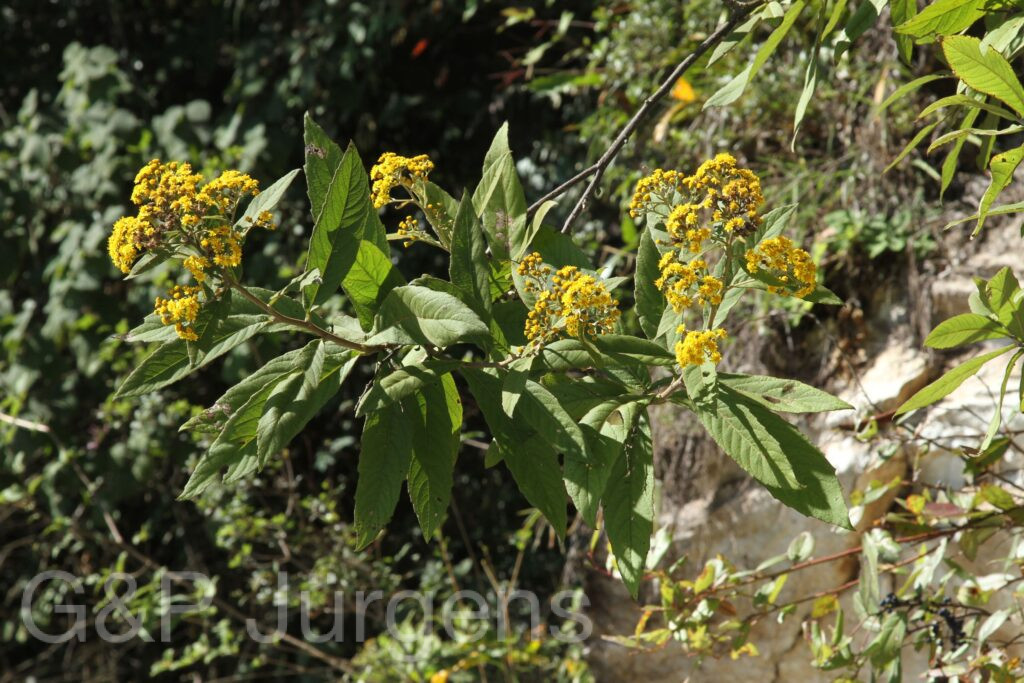
Bhutan2012 1356
Bhutan Sandrup 1500m, October

Description

Duhaldea eupatorioides is a subtropical to warm-temperate composite of the Himalaya and adjacent montane Asia, recorded from India, China, Nepal, Bhutan, Thailand, Myanmar, Bangladesh, Pakistan, Laos and Vietnam, with GBIF listing about 156 occurrences. It grows on open hillsides, forest margins, scrub, roadcuts and grassy slopes in the foothill and lower montane belt, broadly from 1000 to 2500 m. The photographed plant was found in Bhutan at Sandrup at 1500 m in October, when the species comes into bloom at the close of the monsoon, its leafy stems carrying numerous small heads above the autumn grassland.

It is an erect, somewhat woody-based perennial herb or subshrub with leafy, branching, often pubescent stems. The leaves are alternate, ovate-lanceolate to elliptic, acuminate, with serrate margins and a finely hairy surface, narrowing to a short petiole or sessile base, the foliage recalling Eupatorium, hence the epithet. The capitula are small, numerous, and aggregated into terminal corymbose panicles; each head is radiate, with an involucre of several rows of imbricate bracts, marginal yellow ray florets and yellow tubular disc florets. The fruit is a ribbed, hairy cypsela crowned by a pappus of barbellate bristles, dispersed by wind.

The species belongs to the tribe Inuleae and to genus Duhaldea, a segregate split from the broadly defined Inula on molecular and morphological grounds; older floras may list it under Inula eupatorioides. A tolerant species of open and disturbed montane habitats, it is widespread and not of conservation concern. Its Sino-Himalayan to Indochinese range typifies the warm-temperate element of the southern Asian mountain arc.

Author: (DC.) Anderb. · Sources: POWO (Kew), GBIF, Flora of China, Flora of Bhutan, Flora of Nepal, generic revision of Inuleae (Anderberg)

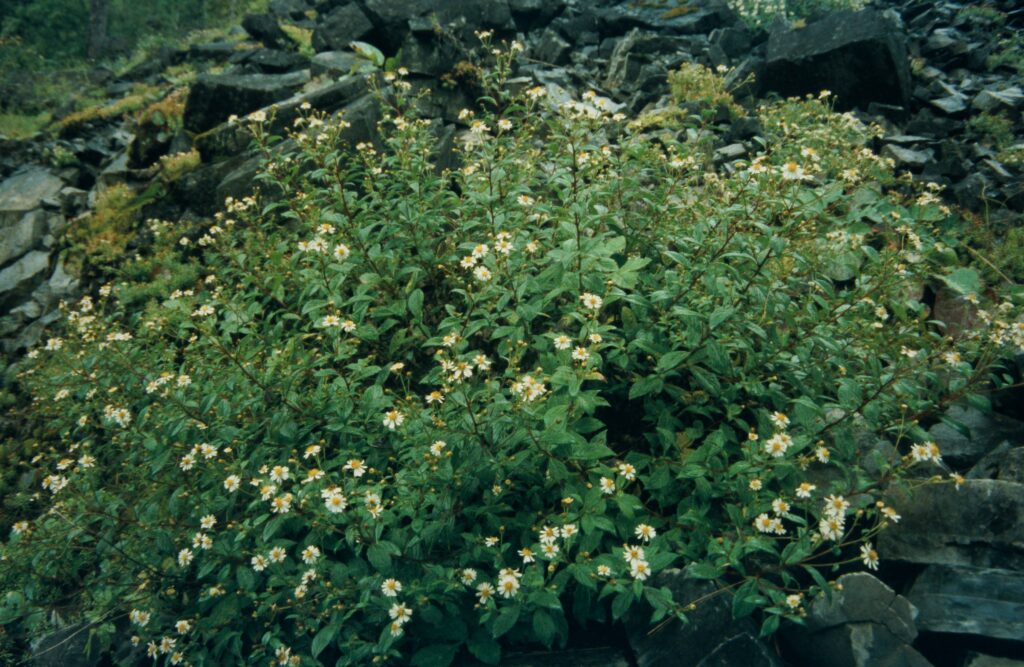
(Wall. ex DC.) Anderb.

Garw 2005 265 ergebnis
India Garhwal Kuno 2800m, September

Description

Duhaldea nervosa is a perennial composite of the Himalaya and montane south-east Asia, recorded from China, Nepal, Thailand, India, Bhutan, Myanmar, Cambodia and Vietnam. Its roughly 584 georeferenced collections span the temperate to subtropical hill belt from the western Himalaya eastward into Indochina. It grows on grassy slopes, open hillsides, forest margins, roadside banks and in scrub, favouring well-drained sunny to lightly shaded ground. The photographed plant from Garhwal at Kuno at 2800 m, flowering in September, is typical of its upper-temperate habitat and its late-monsoon to autumn flowering, when the capitula open above the surrounding herbage.

It is an erect, often hairy perennial herb with leafy stems arising from a woody rootstock. The alternate leaves are elliptic to lanceolate or oblong, with a finely toothed margin and conspicuous, raised lateral veins on the lower surface, the prominent venation giving the species its epithet nervosa. The capitula are radiate and borne in terminal corymbose clusters, each head with an involucre of several rows of imbricate, herbaceous to membranous bracts. The yellow ray florets are female and ligulate, surrounding numerous yellow, tubular, bisexual disc florets. The fruit is a ribbed, cylindrical cypsela crowned by a pappus of barbellate bristles that aids wind dispersal.

Duhaldea was segregated from the broadly defined Inula and now comprises a group of Asian species formerly placed in that genus; D. nervosa was transferred from Inula by Anderberg, as the parenthetical authorship records. Members of the tribe Inuleae, these plants are visited by a range of generalist insect pollinators. D. nervosa is widespread and locally common across its extensive range and is of no conservation concern, several allied species being used in regional folk medicine.

Author: (Wall. ex DC.) Anderb. · Sources: POWO (Kew), GBIF, Flora of China Vol. 20-21, Flora of Bhutan Vol. 2, Flora of Nepal, Anderberg's Phylogeny and Reclassification of the Tribe Inuleae

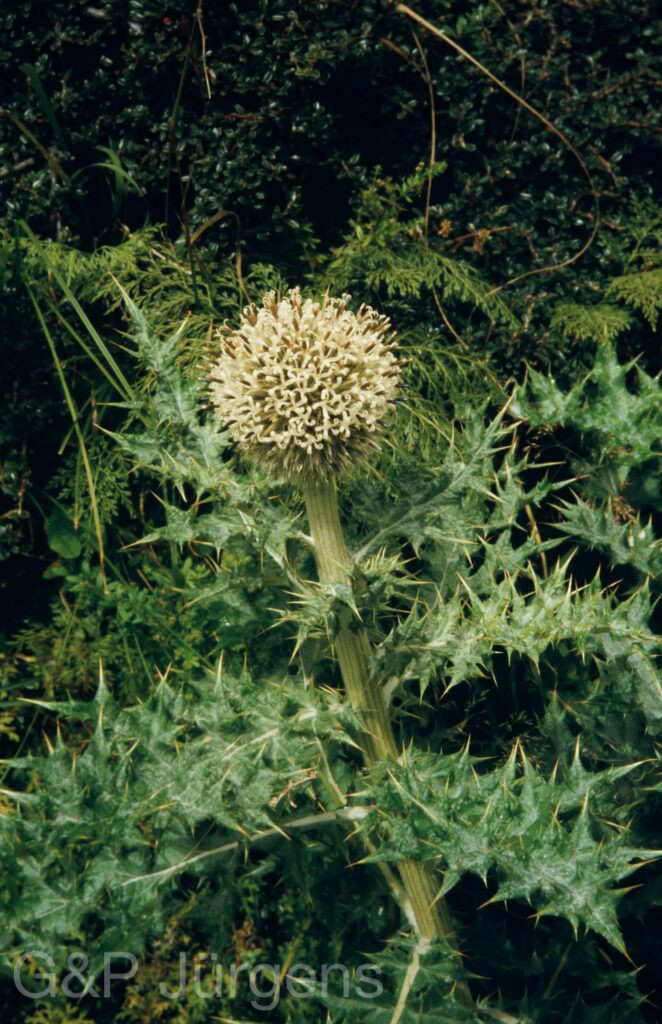
DC.

Garw 2005 182 ergebnis ergebnis
India Garhwal Pana 2800m, September

Description

Echinops cornigerus is a Sino-Himalayan globe-thistle distributed across the western and central Himalaya and adjacent Tibetan plateau, with verified records from India, Pakistan, Nepal, Bhutan and China, alongside a scatter of cultivated or extra-regional occurrences (Iran, France, Belgium) among the roughly 294 georeferenced GBIF collections. It inhabits open, sunny slopes, dry stony pastures, forest margins and disturbed ground in the upper temperate to subalpine belt, typically between about 2000 and 3500 m. The plant photographed at Pana in the Garhwal Himalaya at 2800 m in September, fruiting at the close of the monsoon, exemplifies its preference for well-drained montane grassland exposed to strong insolation.

A stout perennial herb, it forms an erect, ridged and somewhat cottony-tomentose stem arising from a woody rootstock. The leaves are coriaceous, deeply pinnatifid to bipinnatifid, glabrescent and green above but white-tomentose beneath, the lobes terminating in conspicuous rigid yellowish spines. The inflorescence is the spherical compound capitulum characteristic of the genus: numerous one-flowered capitula aggregated into a globose synflorescence, each enclosed by stiff bristly involucral scales. The corollas are tubular, pale blue to whitish, and the achenes are cylindrical, densely hairy and crowned by a short pappus of fused scales.

The genus Echinops is taxonomically intricate, the spherical secondary head having evolved as a striking adaptation that pools many reduced florets into a single pollinator-attracting unit. The spiny architecture deters mammalian grazing, an advantage in heavily pastured Himalayan rangelands. Though not assessed as threatened, populations are locally affected by overgrazing and slope disturbance, and the species remains a useful indicator of dry montane grassland.

Author: DC. · Sources: POWO (Kew), GBIF, Flora of Pakistan, Flora of China (Asteraceae), Annotated Checklist of the Flowering Plants of Nepal, Kew monograph of Echinops