Author

G & P Jürgens

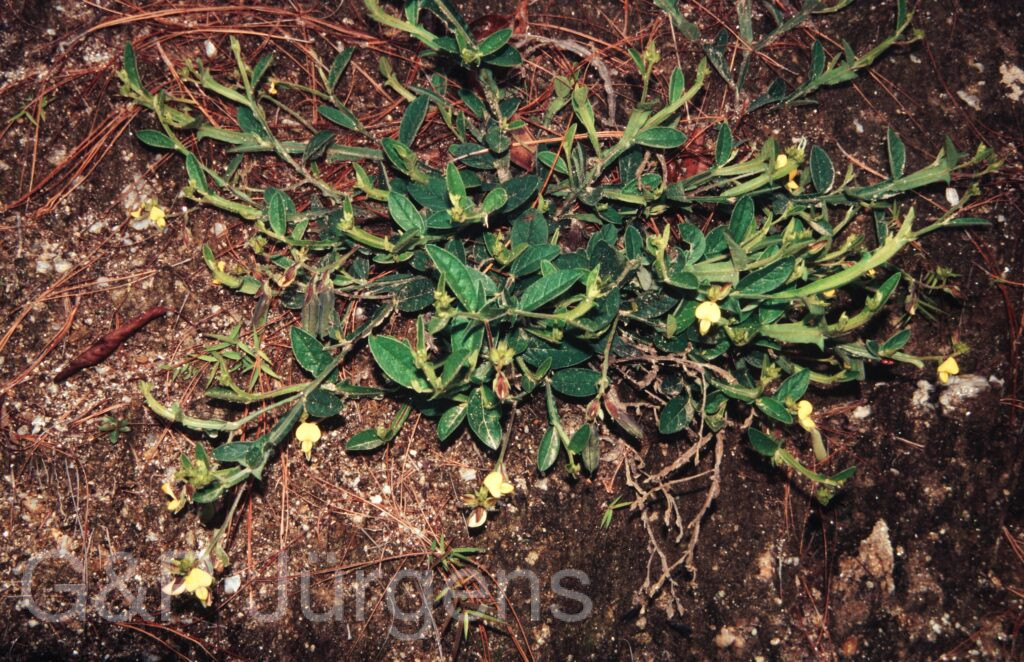
B.Heyne ex Roth

Nepal 2009 120 ergebnis
Nepal Helambu Melanehe Pul 1080, May

Description

Crotalaria albida is one of the most widespread Asian rattlepods, ranging from Pakistan, India, Nepal, Bhutan and Bangladesh eastward through China, Taiwan, Hong Kong, Myanmar, Thailand, Laos, Vietnam and Malesia to the Philippines, Indonesia, New Guinea and Australia, with naturalised records in Sri Lanka and the United States; over 2100 GBIF occurrences attest to this amplitude. In the Himalaya it favours open grassy hillsides, dry banks, pine-forest margins and disturbed roadsides on well-drained, often acidic soils. The plant photographed near Melamchi Pul in the Helambu region of central Nepal, at about 1080 m in May, typifies its preference for warm, low to mid-montane slopes between roughly 300 and 2300 m.

It is a slender, erect to ascending perennial herb or subshrub 30-90 cm tall, the wiry stems clothed in appressed silvery hairs. The leaves are simple, unifoliolate, oblong to oblanceolate and shortly petiolate, paler and pubescent beneath. The inflorescence is a slender terminal raceme of small papilionaceous flowers; the standard is pale yellow, often veined reddish-brown, and the keel is incurved and beaked. The calyx is bilabiate and hairy. As in the genus, the fruit is a short, inflated, glabrescent legume in which the loosened seeds rattle when dry.

The epithet albida alludes to the whitish, silky indumentum. Crotalaria is a large pantropical genus, and many species, including this one, contain pyrrolizidine alkaloids that render them toxic to livestock, though the plant is used locally in folk medicine. Its nitrogen-fixing root nodules enrich degraded slopes, and the species behaves as a pioneer colonist of disturbed ground, accounting for its extensive distribution and naturalisation.

Author: B.Heyne ex Roth · Sources: POWO (Kew), GBIF, Flora of China, Flora of Nepal, Flora of British India, Le Roux monograph of Crotalaria
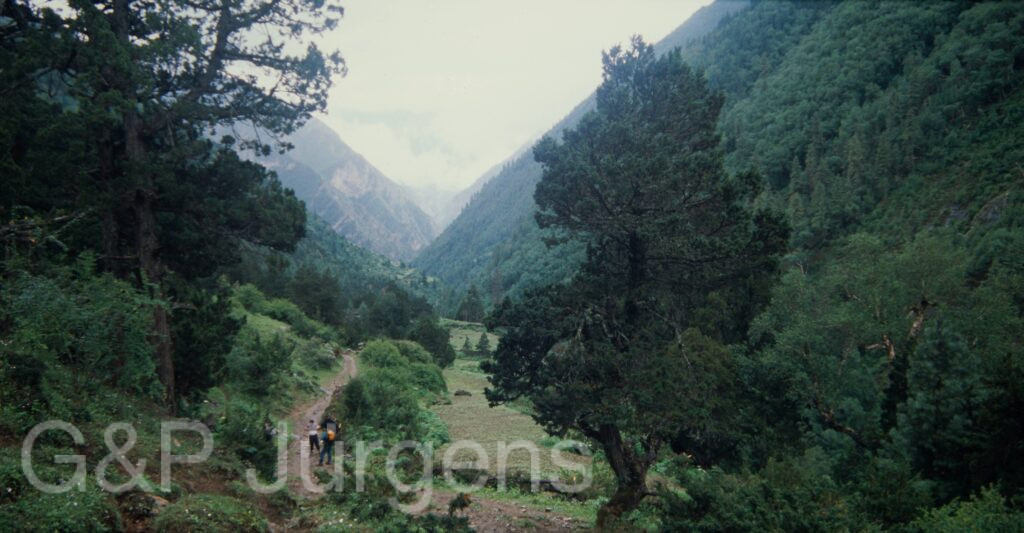
D.Don

Nepal 99 694 ergebnis ergebnis
West-Nepal Pugmo-Khola 3400m, July

Description

Cupressus torulosa D.Don, the Himalayan or Bhutan cypress, is a coniferous evergreen tree of the Cupressaceae native to the Himalaya and southwestern China. Its native range covers India, Nepal and China, while the large GBIF tally of 1,094 occurrences and many additional countries (New Zealand, USA, Britain, Germany, Australia, South Africa, Brazil and others) reflects its extensive cultivation as an ornamental and forestry tree. In the wild it grows on dry, calcareous and rocky slopes in temperate forests, typically between 1,800 and 3,300 m. The photographed tree from the Pugmo-Khola in West Nepal at 3,400 m, in July, marks the upper edge of its altitudinal distribution.

The plant is a tall, conical to broadly columnar tree reaching 20–45 m, with reddish-brown, fibrous, vertically peeling bark and spreading branches bearing slender, pendulous, terete branchlets. The leaves are scale-like, decussate, closely appressed, dark green and obtuse, lacking a conspicuous dorsal gland. It is monoecious, the small ovoid male cones terminal on lateral branchlets and the female cones globose, 1–2 cm across, composed of 8–12 woody peltate scales each bearing a small umbo and ripening from glaucous green to grey-brown in the second year, releasing numerous narrowly winged seeds.

The taxonomy of Asian Cupressus has been much debated, with several Himalayan and Chinese populations variously segregated or lumped, but C. torulosa is consistently accepted as the core western Himalayan species. Long valued for its durable, aromatic timber and planted around temples and monasteries, it is locally over-exploited; while not globally threatened, several native stands are fragmented, and it remains an important component of dry temperate conifer woodland.

Author: D.Don · Sources: POWO (Kew), GBIF, Flora of China Vol. 4, Flora of Bhutan Vol. 1, Flora of Pakistan (Cupressaceae), Farjon: A Monograph of Cupressaceae and Pinus

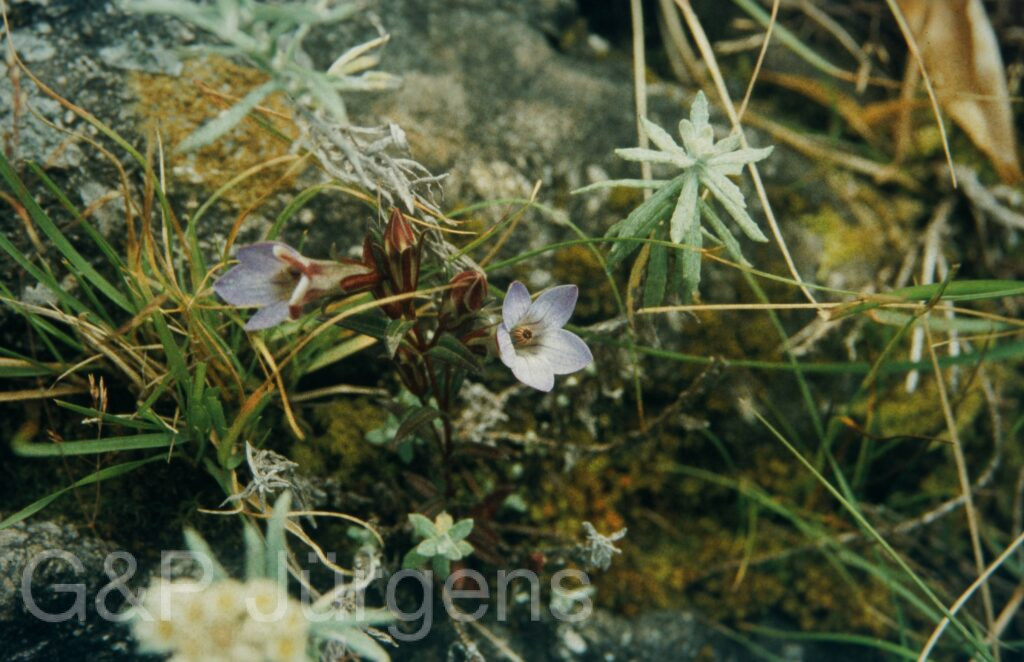
Wall. ex Benth.

Garw 2005 294 ergebnis
India Garhwal Patanati 3600m, September

Description

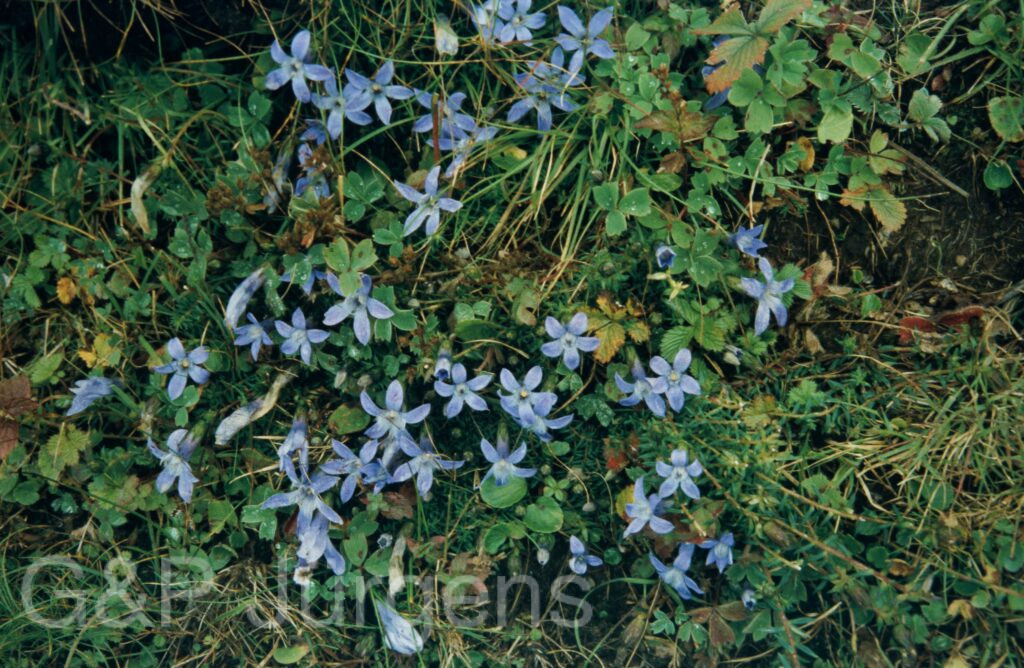
Cyananthus integer is a cushion-forming alpine herb of the western and central Himalaya, recorded by GBIF from India, Nepal and adjacent territories across some 48 occurrences, with an accepted status under its current name. It is a plant of high-altitude open habitats: stony alpine meadows, gravelly slopes, rock crevices and the margins of moraine, typically between about 3300 and 4300 m. The photographed material from Patanati in Garhwal at 3600 m, flowering in September, illustrates both its preferred elevation and its late-season phenology, the blooms opening towards the close of the monsoon when many co-occurring alpines are already in fruit. Like other members of its genus it thrives on the well-drained, sun-exposed turf and screes of the upper alpine zone.

The plant forms low, somewhat trailing to ascending mats from a slender woody rootstock, with numerous prostrate or decumbent stems clothed in small, alternate, entire to shallowly toothed leaves that are often densely arranged toward the stem tips. The solitary, terminal flowers are the conspicuous feature: a broadly funnelform to campanulate corolla, blue to violet-blue, with five spreading lobes and a conspicuous tuft of hairs in the throat. The calyx is tubular and frequently dark-hairy, the stamens five, and the ovary inferior to half-inferior. The fruit is a capsule that releases small seeds, the persistent calyx aiding wind exposure on the open slopes.

Cyananthus is a Sino-Himalayan genus of roughly twenty species centred on the Himalaya and southwest China, distinguished from related Campanulaceae by its throat-bearded, often deeply lobed corolla and its alpine, cushion-forming habit. C. integer sits among the blue-flowered, entire- to weakly toothed-leaved species and is told from relatives by leaf form and indumentum. As a widespread but elevation-restricted alpine it has not been flagged as threatened, though high-mountain plants of this kind are increasingly studied as indicators of climatic shifts in the Himalayan alpine belt.

Author: Wall. ex Benth. · Sources: POWO (Kew), GBIF, Flora of China Vol. 19, Flora of Nepal, Flora of Pakistan, Cyananthus monograph (a revision of the genus by Sykes/Brown)

Edgew.

Garw 2005 300 ergebnis
India Garhwal Kunol 3100m, September
Nepal 99 855 ergebnis
West-Nepal Sanu Bheri 3850m, July
Nepal 99 856 ergebnis
West-Nepal Sanu Bheri 3850m, July
Garw 2005 44 ergebnis ergebnis
India Garhwal Valley of flowers 3150m, September

Description

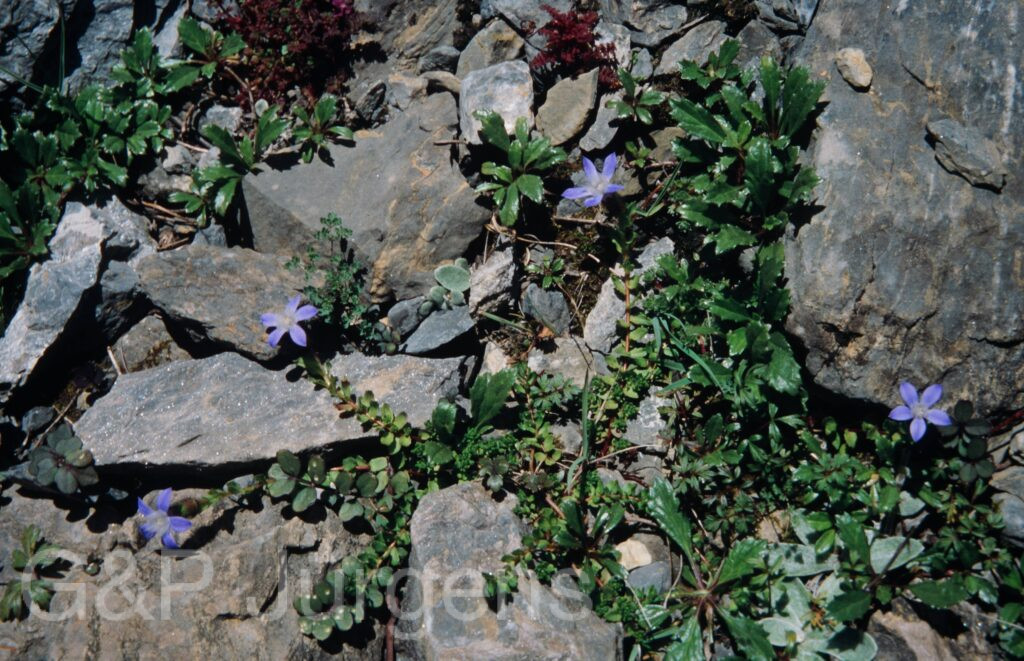
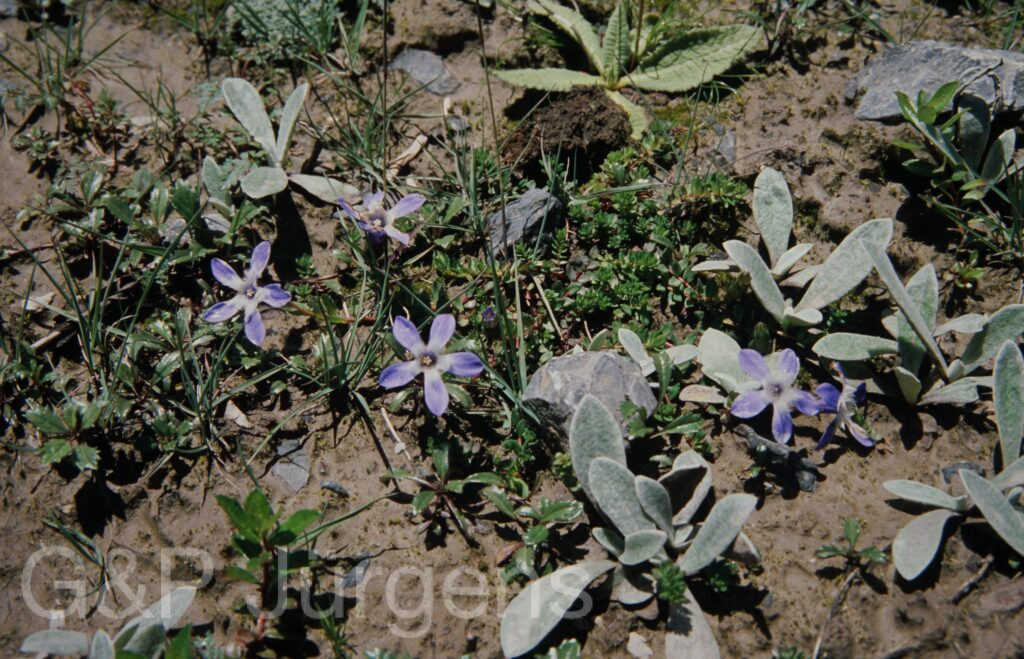
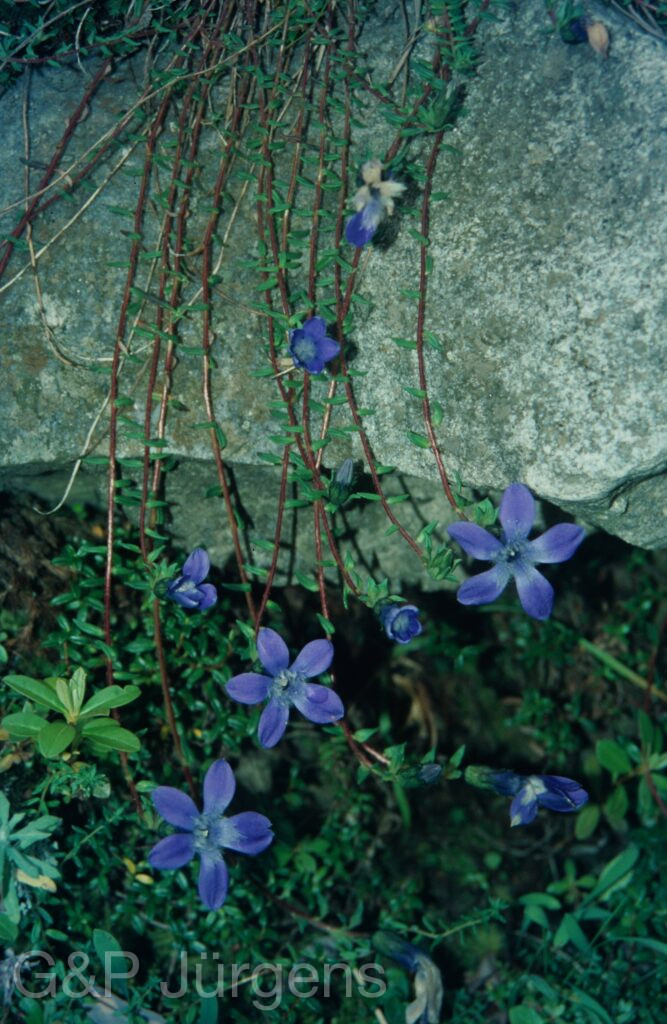
Cyananthus microphyllus is an alpine cushion-forming herb endemic to the Himalaya, documented from Nepal, India and China, with the available occurrence records concentrated along the central and western Himalayan arc. It grows in alpine meadows, on open stony slopes, rock ledges and the gravelly margins of glacial moraines, generally between about 3000 and 4500 m. The images, gathered at Kunol in Garhwal at 3100 m and in the Valley of Flowers at 3150 m in September and at Sanu Bheri in West Nepal at 3850 m in July, capture its late-monsoon flowering in high pastures and rocks where the mats anchor in thin, well-drained soils.

The plant forms low, much-branched, somewhat woody-based mats from a slender taproot. The wiry, prostrate to ascending stems are clothed in numerous small, alternate, ovate to elliptic leaves that are often revolute at the margin and sparsely hairy. The flowers are solitary and terminal, with a campanulate, conspicuously hairy calyx whose tube is shorter than the deeply five-lobed, blue corolla; the corolla throat bears a dense ring of white hairs, a defining feature of the genus. Five stamens alternate with the corolla lobes, and the inferior to half-inferior ovary develops into a capsule that exceeds the persistent calyx and dehisces to release numerous small seeds.

Cyananthus is a small Sino-Himalayan genus of perhaps two dozen species, allied to the bellflowers but distinguished by the bearded corolla throat and largely inferior ovary. Cyananthus microphyllus is recognised among the small-leaved, blue-flowered species by its diminutive, densely leafy mats. Its restricted high-elevation distribution makes it sensitive to climatic shifts and trampling by grazing livestock, and as a late-flowering alpine it provides an important resource for bumblebees and other cold-adapted pollinators.

Author: Edgew. · Sources: POWO (Kew), GBIF, Flora of China, Annotated Checklist of the Flowering Plants of Nepal, Flowers of the Himalaya (Polunin & Stainton), revision of Cyananthus (Campanulaceae)

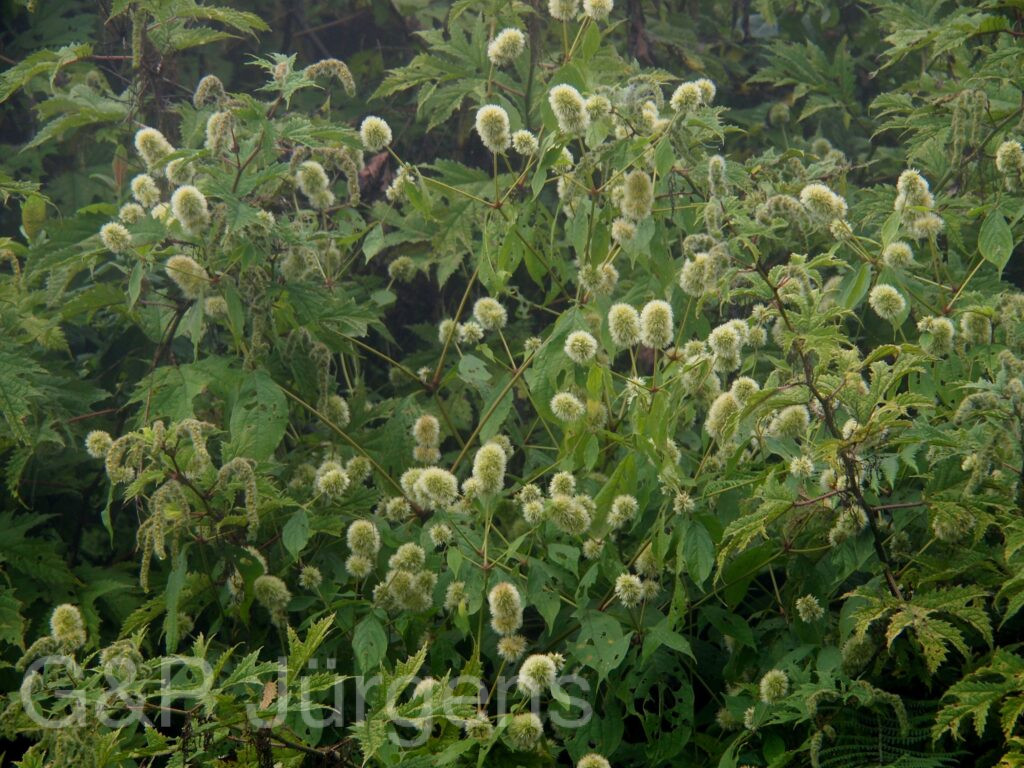
Moq.

Bhutan2012 836
Bhutan Tongsa 2100m, October

Description

Cyathula capitata Moq. is a robust perennial herb of the amaranth family distributed through the Himalaya and the mountains of southwestern China. GBIF records place it in China, Nepal, India and Bhutan, confirming a Sino-Himalayan range, with an outlying Italian record reflecting cultivated or naturalised material. It grows in forest margins, shrubby clearings, grassy slopes and along trails and streamsides in the temperate zone, generally between about 1,500 and 2,800 m. The plant photographed at Tongsa (Trongsa) in central Bhutan at 2,100 m in October illustrates its late-season fruiting on humid montane slopes.

The species is an erect, branching herb up to 1 m or more tall with angular, pubescent stems swollen at the nodes. The leaves are opposite, broadly elliptic to obovate, acuminate, entire and softly hairy. The small flowers are aggregated into dense, globose, capitate heads borne on long peduncles; each head contains both fertile flowers and sterile flowers modified into hooked, recurved bristles. The membranous tepals subtend a single-seeded utricle, and the indurated hooked bracteoles of the head function in epizoochorous dispersal, attaching to animal fur.

Cyathula is allied to Achyranthes and Pupalia within the Amaranthaceae, distinguished by its globose flower heads with hooked sterile bristles. C. capitata is used in traditional medicine in parts of its range, where the roots serve as a substitute for those of Achyranthes. It is widespread within suitable montane habitat and is not regarded as threatened.

Author: Moq. · Sources: POWO (Kew), GBIF, Flora of China Vol. 5, Flora of Bhutan Vol. 1, Townsend: Amaranthaceae in Flora of Tropical East Africa

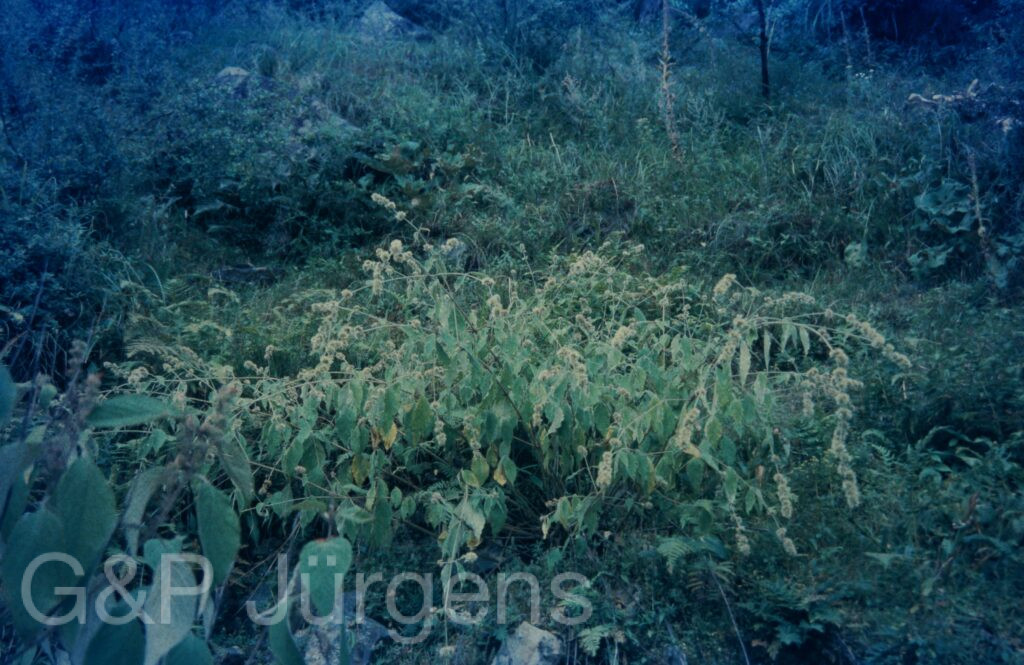
Moq.

Garw 2005 206 ergebnis ergebnis
India Garhwal Pana 2800m, September

Description

Cyathula tomentosa is a coarse perennial herb of the Himalaya, Sino-Himalaya and parts of tropical Africa, recorded from Nepal, NW and NE India, Bhutan, southern China and Myanmar, with disjunct records from New Guinea and Rwanda; GBIF holds 238 occurrences. It grows on forest margins, shrubby slopes, roadsides, clearings and other disturbed, semi-shaded ground in the temperate and subtropical zone. The collection from Pana in Garhwal, India, at about 2,800 m in September corresponds to its late-summer to autumn fruiting in mid-montane forest country.

It is an erect to ascending, much-branched herb up to about 1–1.5 m tall, with quadrangular, densely white-tomentose stems. The leaves are opposite, ovate to elliptic, 4–12 cm long, acuminate, with a soft woolly indumentum, especially beneath. The inflorescence is a long, interrupted, spike-like thyrse of dense glomerules, each cluster comprising a central fertile flower surrounded by modified sterile flowers whose perianth segments and bracteoles are produced into hooked, hardened spines. The perianth of the fertile flower is membranous; the fruit is a small utricle enclosed within the indurated, burr-like cluster.

The species belongs to Cyathula (Amaranthaceae, subfamily Amaranthoideae), allied to Achyranthes and Pupalia, the genus being distinguished by its glomerules of hooked sterile flowers. GBIF treats the name as accepted. The barbed fruiting clusters are an effective epizoochorous dispersal mechanism, attaching to fur and clothing, which accounts for the plant's affinity for disturbed and trackside habitats. It is widespread and of no conservation concern.

Author: Moq. · Sources: POWO (Kew), Flora of China Vol. 5, Flora of Bhutan Vol. 1, GBIF, Townsend: Amaranthaceae in Flora of Tropical East Africa (1985)

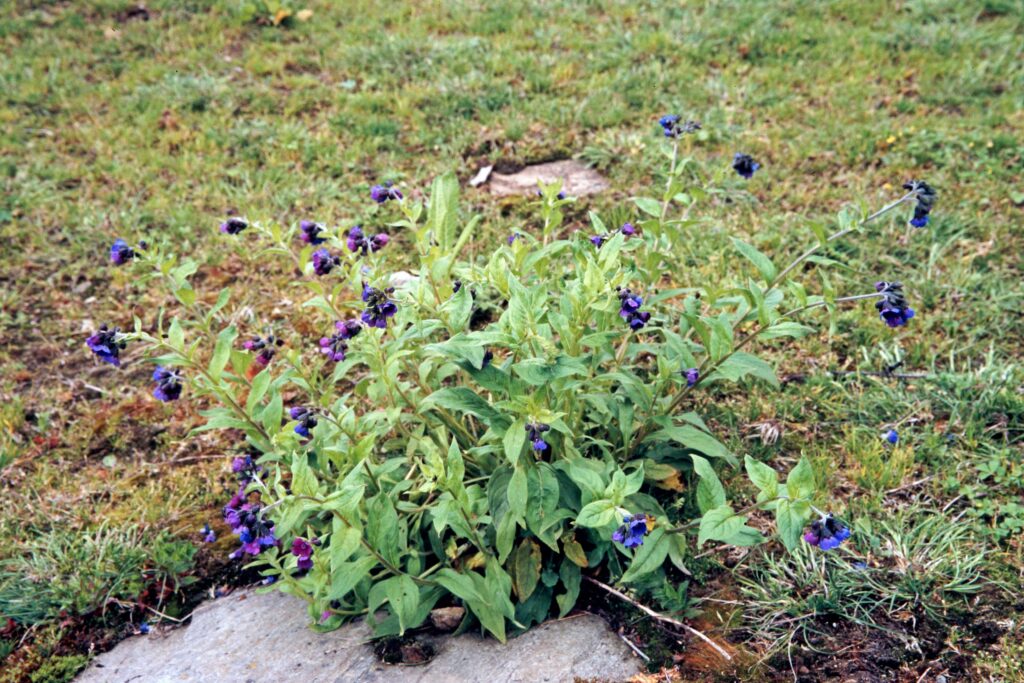
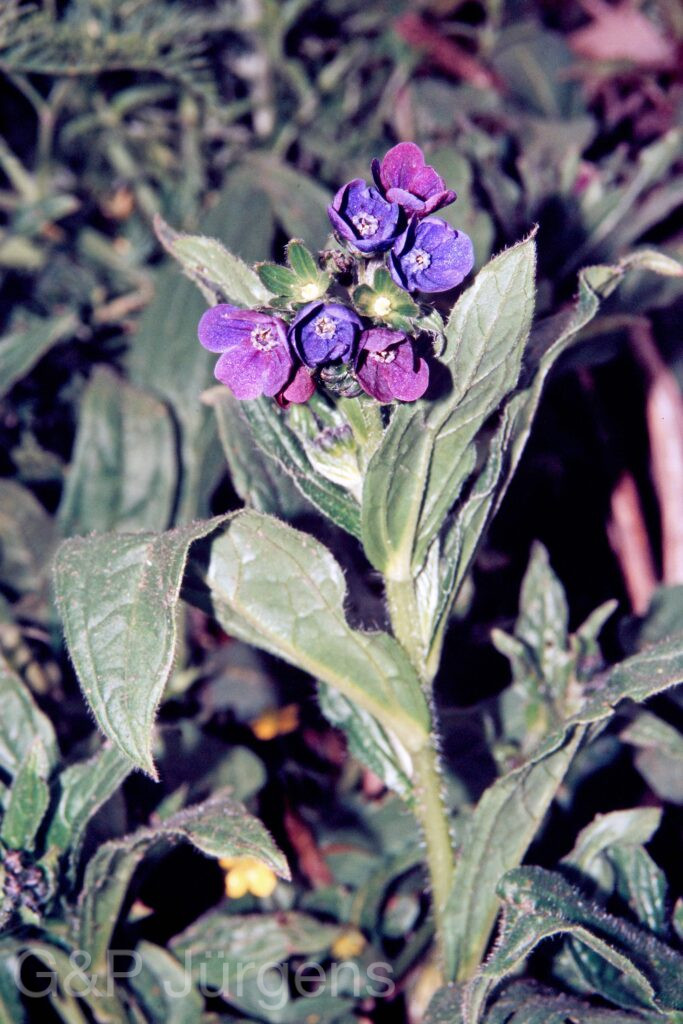
Benth.

Garh 07 558 ergebnis
India Garhwal Sena 3760m,

Description

Cynoglossum microglochin is a high-altitude species of hound's-tongue distributed across the western and central Himalayas, from Afghanistan and Pakistan through northwest India (Kashmir, Himachal Pradesh, Uttarakhand) to Nepal, Bhutan, and into southwestern China. GBIF records document 209 occurrences across its range. The species typically inhabits open alpine meadows, grassy slopes, and disturbed ground along trails at elevations of 2,800–4,200 m, where it grows in well-drained, often stony soils among other subalpine and alpine herbaceous communities.
The plant is an erect or ascending perennial herb, 20–50 cm tall, with stems covered in appressed or spreading hairs. Basal leaves are oblanceolate to spatulate, 5–15 cm long, petiolate, with entire margins and a dense indumentum of short, stiff hairs on both surfaces. Cauline leaves are progressively smaller, sessile, and semi-amplexicaul. The inflorescence consists of terminal, ebracteate, scorpioid cymes that elongate considerably in fruit. Flowers are small, 3–5 mm in diameter, with blue to violet corollas; the tube is short, with rounded fornices closing the throat. The nutlets, typically four per flower, are ovoid, 2–3 mm long, and densely covered with short, glochidiate (barbed) prickles — notably smaller than those of congeners such as C. zeylanicum, a character reflected in the epithet 'microglochin' (small barb).
This species is distinguished from the widespread Cynoglossum glochidiatum by its smaller nutlet spines and generally more compact inflorescence. It was photographed at Sena in Garhwal at 3,760 m, near the upper limit of its elevational range. Though not currently assessed by the IUCN, its preference for undisturbed alpine habitats makes it potentially sensitive to grazing pressure and climate-driven upward shifts in vegetation zones. Its biogeographical range, extending from the Hindu Kush to the eastern Himalayas, indicates a broadly adapted yet montane-restricted taxon.

Author: Benth. · Sources: POWO (Kew), GBIF, Flora of British India Vol. 4, Flora of Pakistan (Boraginaceae), Kazmi (1970) — Revision of Boraginaceae

G.Don

Garh 07 107 ergebnis
India Garhwal Mandakini 2900m, June
Garh 07 56 ergebnis
India Garhwal Mandakini 2900m, June

Description

Cynoglossum wallichii is a widespread Asian herb recorded across China, India, Nepal, Pakistan, Bhutan and Afghanistan, with naturalised or casual occurrences in the United States and parts of Europe. GBIF treats the name as a synonym, with Cynoglossum wallichii accepted under that combination. It occupies open hill slopes, forest margins, grassy clearings, fallow ground and roadside banks from about 1500 to 3500 m. The depicted plant from the Mandakini valley in Garhwal, India, at around 2900 m and flowering in June, is characteristic of its preference for disturbed, sunny temperate slopes during the early monsoon.

The plant is an erect annual or biennial herb, the stems simple or branched above and clothed, like the foliage, in appressed to spreading hispid hairs. The leaves are alternate, the lower oblanceolate and narrowed to a petiole, the upper sessile, lanceolate and somewhat clasping. The inflorescence consists of elongating, ebracteate scorpioid cymes bearing small, pale to bright blue, salverform to funnelform flowers with prominent fornices closing the throat. The fruit separates into four ovoid nutlets densely covered with glochidiate (barbed) bristles, an epizoochorous adaptation that promotes dispersal on animal fur.

The epithet honours Nathaniel Wallich, the Danish botanist whose Himalayan collections underpin much early taxonomy of the region. Within Cynoglossum the species belongs to a critical complex whose delimitation has prompted segregation into related genera such as Lindelofia and Paracaryum. The barbed nutlets account for its readiness to colonise trampled and grazed ground, and its weedy tendencies explain the scattered extra-Asian records; it is of no conservation concern.

Author: G.Don · Sources: POWO (Kew), GBIF, Flora of China Vol. 16, Flora of Pakistan, Flora of Nepal, A Revision of Cynoglossum (Boraginaceae) (Brand)

(Sw. ex Lehm.) Thunb. ex Brand

Nepal 99 361 ergebnis
Nepal Kalomura 4050m, July
Nepal 99 556 ergebnis
Nepal Churta-Khola 3800m, July

Description

Cynoglossum zeylanicum (Sw. ex Lehm.) Thunb. ex Brand is a widely distributed herb of the borage family, ranging across tropical and warm-temperate Asia and now widely naturalised elsewhere. GBIF documents a very large number of records (c. 2,637) from China, India, Nepal, Sri Lanka, the Philippines, Japan, Korea and beyond, with introduced populations in the Americas and the Caucasus. In the Himalaya it ascends from foothill grasslands to subalpine meadows; the photographed material from west Nepal at Kalomura (c. 4,050 m) and Churta-Khola (c. 3,800 m), both flowering in July, shows it reaching the upper limits of its altitudinal range on open, disturbed slopes during the monsoon.

The plant is an erect biennial or short-lived perennial herb, 30–80 cm tall, clothed throughout in appressed to spreading hispid hairs. The leaves are alternate, the basal ones petiolate and oblong-lanceolate, the cauline leaves sessile and progressively reduced upward. The inflorescence is a scorpioid, bracteate cyme. Flowers are small with a five-lobed campanulate corolla, blue to pale blue with white fornices closing the throat. The fruit is a schizocarp splitting into four ovoid nutlets densely covered with glochidiate (barbed) bristles, an epizoochorous adaptation aiding dispersal on animal fur.

The species has at times been treated under Cynoglossum or segregated genera within tribe Cynoglosseae, and the glochidiate nutlets are diagnostic for the group. Its wide ecological amplitude and effective animal dispersal explain its near-cosmopolitan, often weedy distribution; it is of no conservation concern and is locally regarded as a minor pasture weed.

Author: (Sw. ex Lehm.) Thunb. ex Brand · Sources: POWO (Kew), Flora of China Vol. 16, Flora of Nepal, Flora of Pakistan, GBIF, Brand: Das Pflanzenreich – Borraginaceae

Rchb.f.

BhutanPG2011 228
Bhutan Tsochenchen, 3600m June

Description

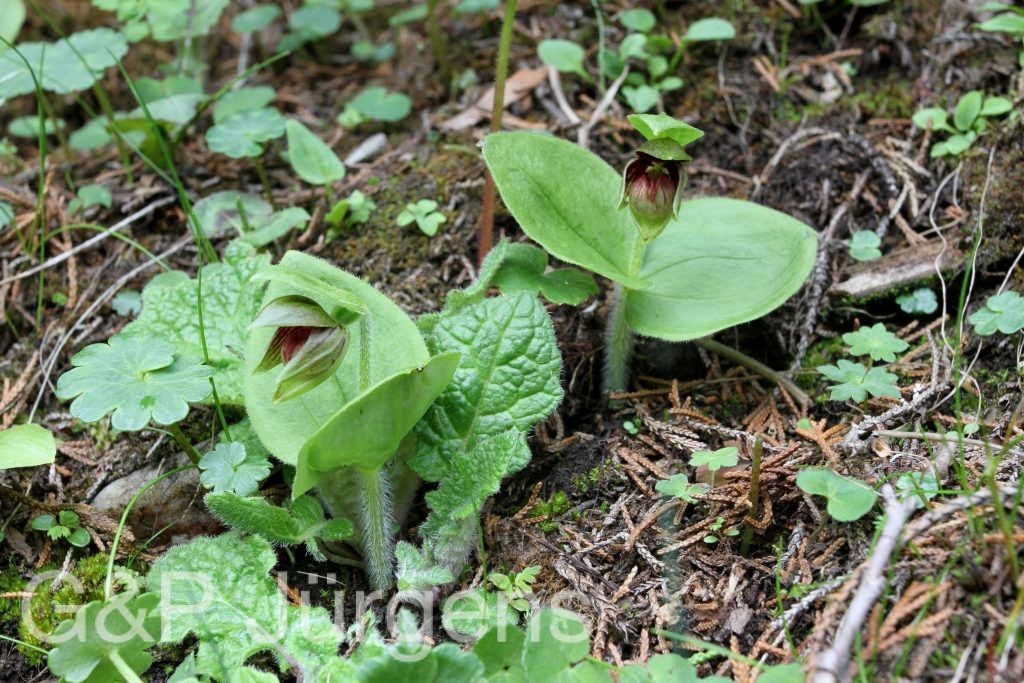
Cypripedium elegans Rchb.f. is a diminutive lady's-slipper orchid of the eastern Himalaya, recorded by GBIF from India, Nepal, Bhutan and China across some 59 occurrences. It is a plant of cool, humid high-altitude habitats, growing in mossy alpine and subalpine scrub, beneath Rhododendron and dwarf bamboo, and on shaded humus-rich banks, generally between about 3000 and 4000 m. The individual photographed at Tsochenchen in Bhutan at around 3600 m in June, early in the alpine season, reflects its preference for sheltered, perennially moist sites with deep leaf litter and a stable cool microclimate.

The plant arises from a short creeping rhizome and produces a slender, low erect stem bearing usually two broadly elliptic to ovate, plicate, prominently veined leaves that are held more or less opposite or subopposite near the top of the stem. The single nodding flower is small for the genus; the dorsal sepal and the synsepal (the fused lateral sepals) are ovate and the petals narrow, the whole pale yellowish-green to greenish, often faintly marked. The labellum is modified into the characteristic inflated, slipper-shaped pouch that traps and temporarily detains pollinating insects, which exit past the staminode and stigma, effecting pollination.

Cypripedium belongs to subfamily Cypripedioideae, the slipper orchids, marked by their two fertile anthers and saccate lip. Cypripedium elegans is one of the smallest and most delicate Himalayan members of the genus. It is uncommon, slow to establish, and like all Cypripedium it is highly sensitive to collection and habitat disturbance; the genus is listed on CITES Appendix II and several species are of conservation concern. Its restricted high-Himalayan range makes it a notable narrow-altitude alpine specialist.

Author: Rchb.f. · Sources: POWO (Kew), GBIF, Flora of Bhutan, Flora of China, Cribb monograph The Genus Cypripedium, Pearce and Cribb Orchids of Bhutan