Araceae

Mart.

Bhutan2014 32
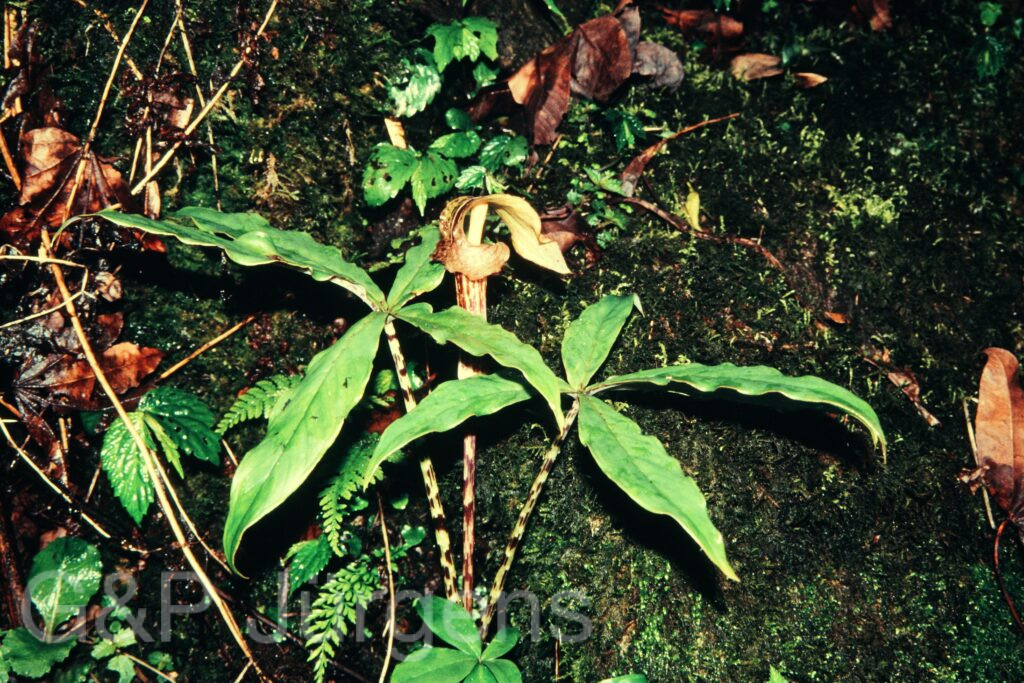
Bhutan, Trashigang 1300m, May
Nepal 97 432 G839
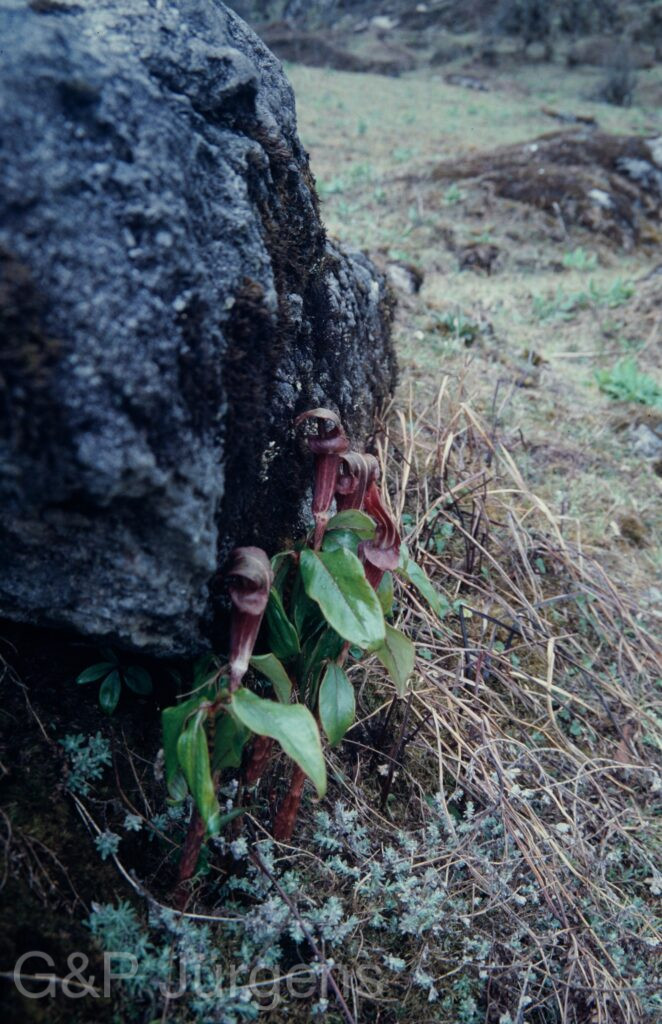
Nepal Tashigaon 3100m May
Nepal 1994 269 ergebnis
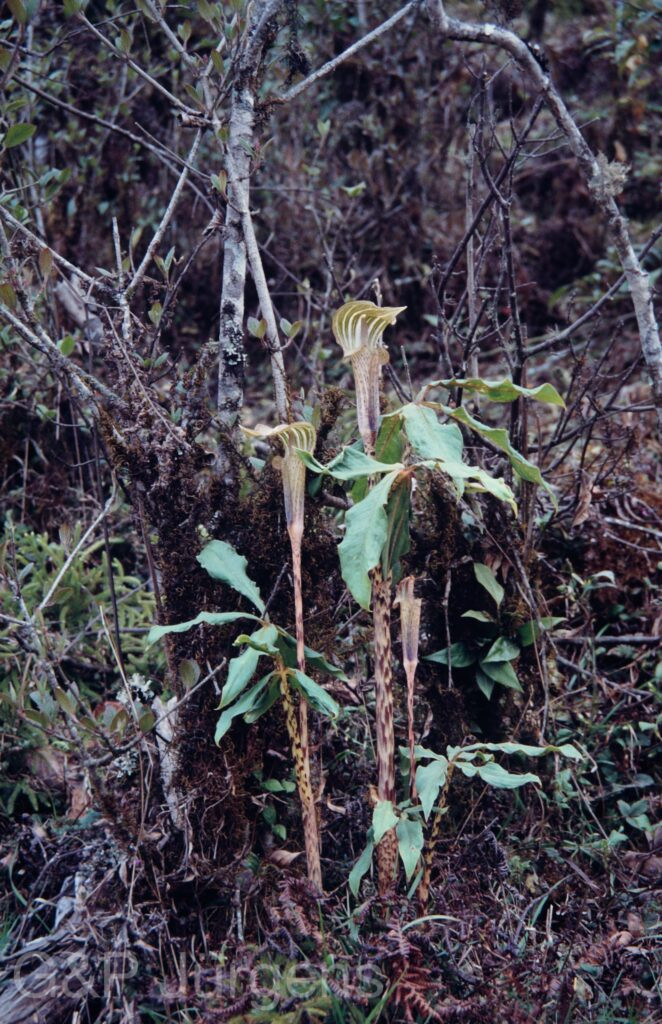
Ost-Nepal Milka-Danda 3200m May 
Nepal1992 184 P270 ergebnis
Nepal Banyang 1900m March 

Description

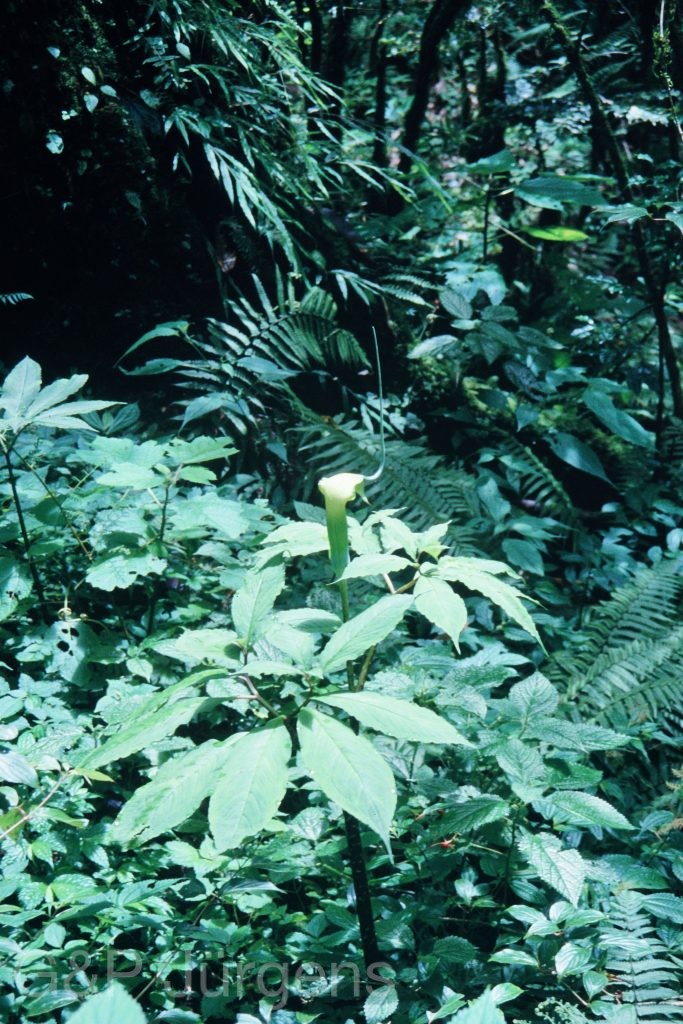
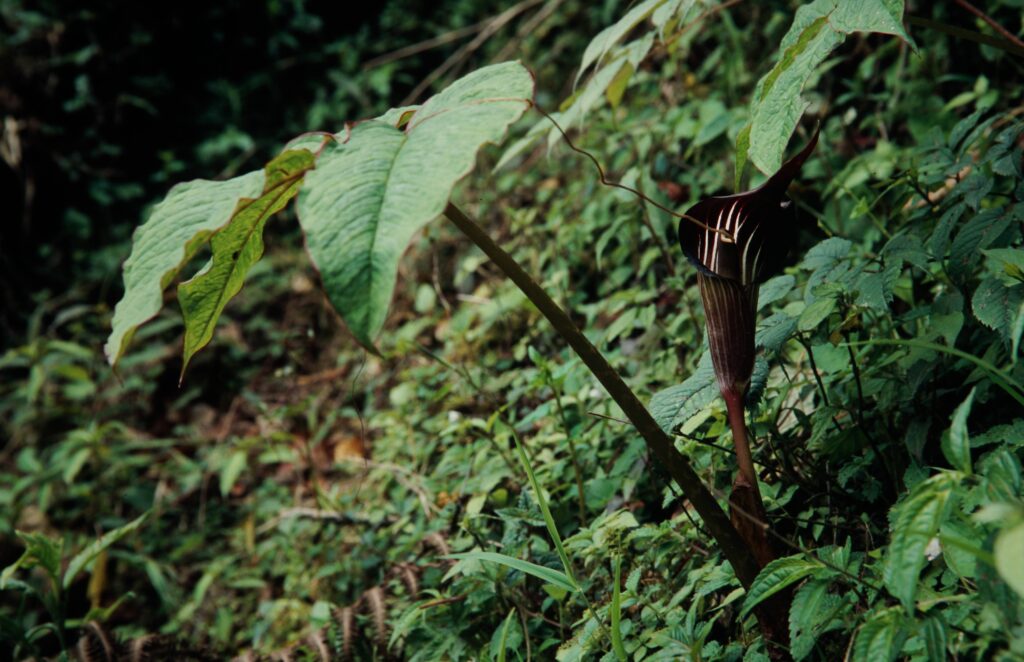
Arisaema nepenthoides is a Himalayan cobra lily distributed from Nepal eastward through Sikkim, Bhutan and north-east India to Myanmar and south-western China, with about 322 GBIF occurrences reflecting its montane range. It is a herb of cool temperate to subalpine forest, growing in moist broad-leaved and conifer-Rhododendron forest, shady banks and forest margins, broadly from 1,900 to 3,600 m. The localities recorded for the photographed plants span this range, from Trashigang in eastern Bhutan at 1,300 m and Banyang in Nepal at 1,900 m to Tashigaon at 3,100 m and Milka Danda at 3,200 m, flowering between March and May as the snows recede.

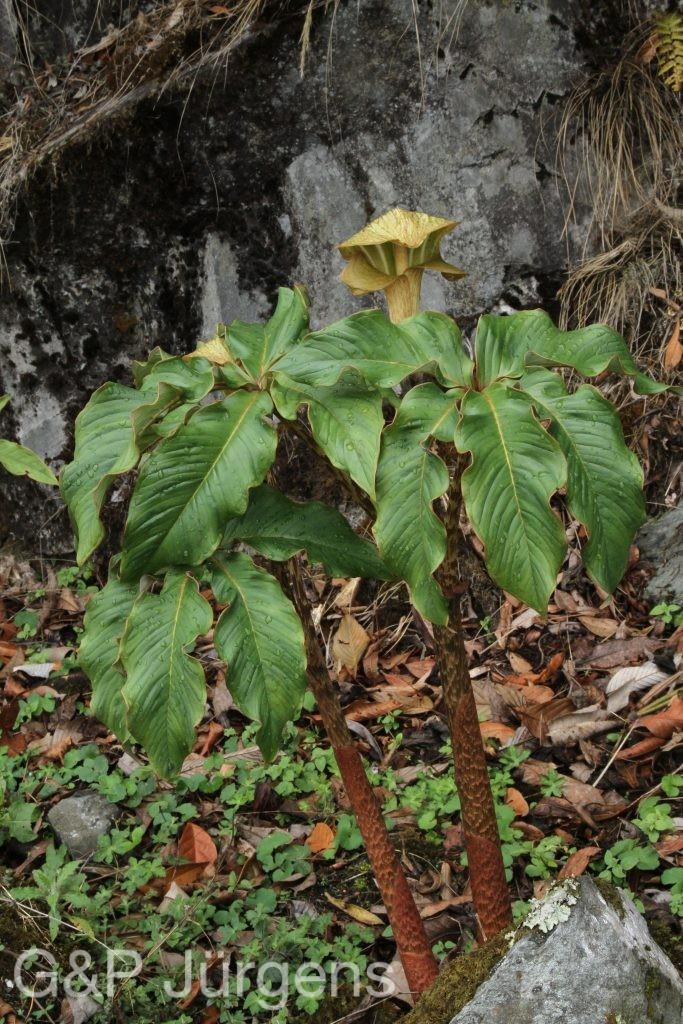
It is a tuberous perennial arising from a depressed corm, producing a stout, conspicuously mottled pseudostem patterned with brownish-purple and pale markings reminiscent of a snake's skin. Usually two leaves are produced, each pedately divided into several elliptic to oblanceolate leaflets. The inflorescence is a spadix enclosed in a spathe whose tube is greenish and prominently striped, opening into a hooded, incurved limb that recalls the pitcher of a Nepenthes, hence the epithet nepenthoides. The species is dioecious, with the sexes distinguished by the spadix appendage; pollinated female plants develop a dense head of orange-red berries, each with few seeds.

Arisaema is a large genus centred on the Sino-Himalayan region, and A. nepenthoides belongs to a group recognised by its mottled pseudostem and distinctive hooded spathe. Like many relatives it shows sequential gender change, individuals functioning as male when small and as female once the tuber attains sufficient size, an adaptation to resource availability. Pollination is effected by fungus gnats and small flies attracted into the spathe chamber. The conspicuous spathe makes it a sought-after ornamental, but it remains widespread and locally common across the eastern Himalaya and is not considered threatened.

Author: Mart. · Sources: POWO (Kew), GBIF, Flora of China, Flora of Bhutan, The Genus Arisaema (Gusman & Gusman), Araceae of the Himalaya
Arisaema speciosum

by GP Jürgens

(Wall.) Mart.

Nepal 97 439 P855
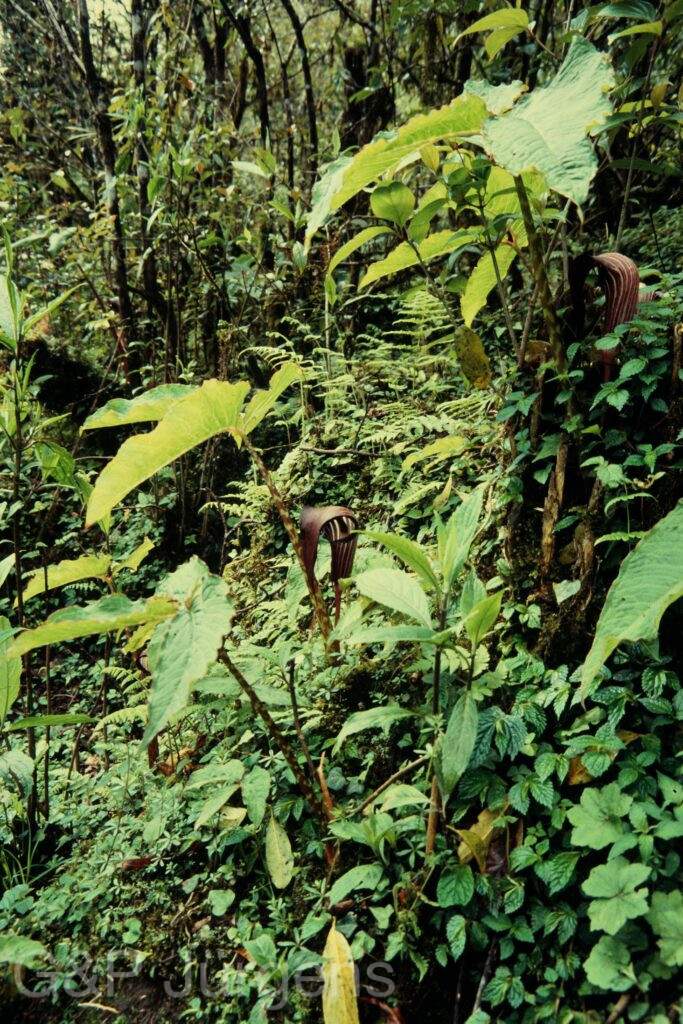
Nepal Tashigaon 3100m May
Sikkim 2006 6 ergebnis
India West-Bengal Maneybhajang 2000m, May

Description

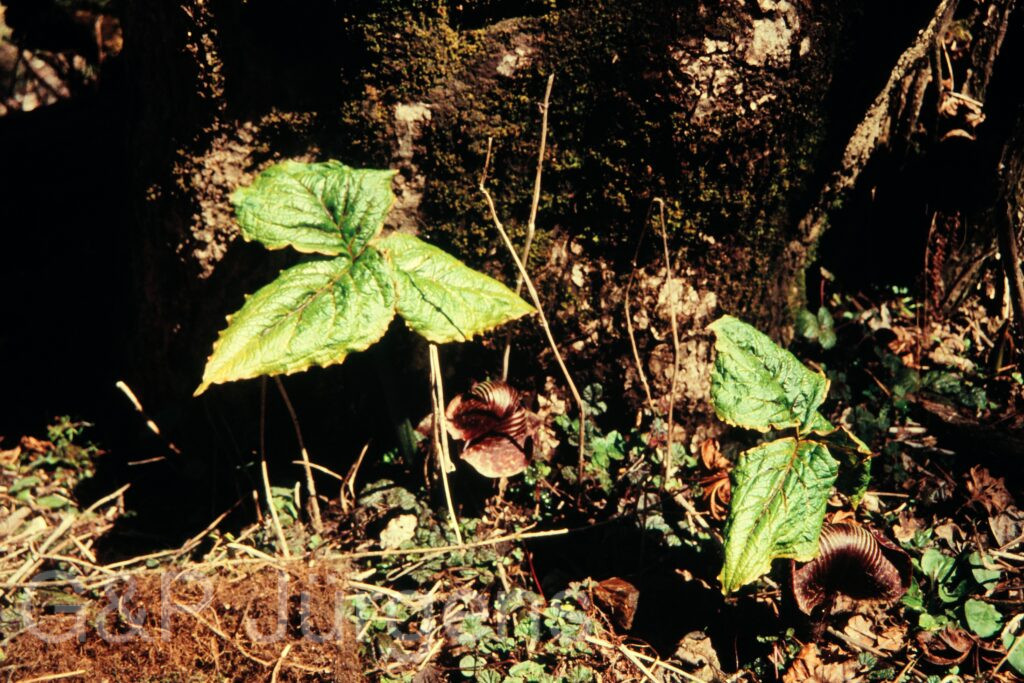
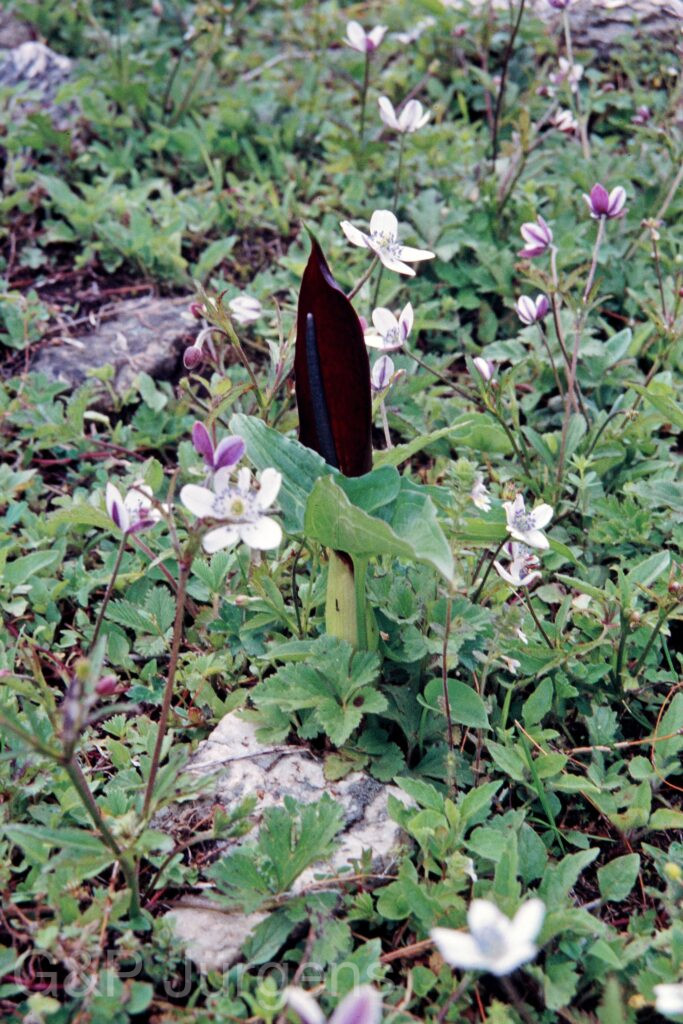
Arisaema speciosum is an eastern Himalayan cobra lily distributed from Nepal through Sikkim and West Bengal in India, Bhutan and into south-central China, with peripheral records in Myanmar and Thailand; GBIF holds nearly 200 occurrences. It grows in cool, humid temperate forest, in the shade of broadleaved and mixed conifer woodland, on rich, moist, humus-laden soils along stream banks, ravines and shaded slopes. The collections illustrated, from Tashigaon in eastern Nepal at about 3100 m and from Maneybhajang in West Bengal at around 2000 m, both in May, reflect its montane belt of roughly 2000-3300 m, where it emerges and flowers as the pre-monsoon rains advance.

The plant arises from a depressed, tuberous corm and produces a single trifoliolate leaf on a stout, mottled petiole; the three leaflets are broadly ovate, acuminate and often suffused dark purplish-red along the margins and central rib. The inflorescence is a spathe with a deep maroon, white-striped tube and an arching, dark purple-brown limb. Most striking is the spadix, whose appendage is prolonged into a very long, pendent, whip-like filiform tail hanging well below the spathe. The plant is typically dioecious, sex expression varying with tuber size, and female spadices ripen into a dense club of bright red berries.

The epithet speciosum, meaning showy, refers to the dramatic spathe and trailing appendage. Within the large Asian genus Arisaema it belongs to a group with trifoliolate leaves and long-tailed spadices. Like its congeners it is protogynous and paradioecious, with pollination effected by fungus gnats lured into the spathe chamber. The species is grown by specialist cultivators, and habitat disturbance and over-collection are potential local conservation concerns.

Author: (Wall.) Mart. · Sources: POWO (Kew), GBIF, Flora of China, Flora of Bhutan, Gusman The Genus Arisaema, Murata monograph of Arisaema

Arisaema tortuosum

by GP Jürgens

(Wall.) Schott

Sikkim2003 53 P72
Sikkim above Yoksam 2500m, August

Description

Arisaema tortuosum, the whipcord cobra lily, is a wide-ranging Himalayan and peninsular Indian aroid recorded from India, Nepal, China, Bhutan, Sri Lanka, Myanmar, Malaysia and Indonesia, with some 780 georeferenced occurrences and a number of records from cultivation in Europe and North America. It grows in moist forest, scrub, grassy clearings and shaded banks across a wide elevational span. The population photographed above Yoksam in western Sikkim at about 2500 m in August illustrates its montane forest habitat, in leaf and inflorescence during the monsoon on humus-rich soils.

The plant arises from a depressed, tuberous corm and produces one or two large, long-petiolate leaves divided into numerous radiating or pedately arranged leaflets. The inflorescence is a spathe enclosing a spadix, the latter prolonged into a remarkably long, erect or sinuous flagelliform appendage that gives the species its name and tortuosum epithet. Flowers are unisexual and borne at the spadix base, the species being protogynous and capable of size-dependent sex change between female, monoecious and male states. Pollinated fungus-gnats are trapped within the chamber. The fruit is a dense cluster of red berries borne on the swelling infructescence.

Arisaema is a large genus of considerable horticultural interest, and A. tortuosum is one of its most widespread and variable members, with several recognised varieties differing in leaflet number and spadix coloration. Its sequential hermaphroditism, in which individuals switch sex according to accumulated resources, is a celebrated example of size-dependent gender lability. Common across its extensive range, it is of least conservation concern.

Author: (Wall.) Schott · Sources: POWO (Kew), GBIF, Flora of Bhutan, Flora of Nepal, Flora of China, Gusman & Gusman's The Genus Arisaema

Hara & H.Ohashi

Nepal 97 249 P520
Nepal below Thudam 3450m, May

Description

Arisaema vexillatum is a narrowly distributed tuberous aroid of the eastern Himalaya and adjacent China, known from only China and Nepal with a sparse total of about 11 georeferenced records, reflecting both genuine rarity and limited collecting. It grows in cool-temperate to subalpine forest and shrubberies, in moist, humus-rich soils sheltered by rhododendron and conifer cover. The type material and the photographed plant come from the upper Arun drainage of eastern Nepal below Thudam at around 3450 m, flowering in May as the snow recedes, indicating a strongly montane ecology dependent on persistent soil moisture.

The plant arises from a depressed, subglobose tuber and produces typically a single leaf with a long sheathing petiole. The leaf blade is pedately divided into several oblong-lanceolate, acuminate leaflets arranged in a radiate fashion. The inflorescence is a spathe enclosing the spadix, the spathe tube cylindrical and the limb arching forward; the spadix appendix is slender and the plant is generally monoecious-dioecious depending on tuber size, a sex-lability typical of the genus. The fruiting spadix develops into a dense, club-shaped syncarp of bright red, few-seeded berries.

Arisaema vexillatum belongs to a difficult complex of eastern Himalayan species and was described by Hara and H. Ohashi from Nepalese collections. Like most Arisaema it depends on fungus-gnat and small-fly visitors trapped within the spathe for pollination. Its limited known range and montane habitat suggest vulnerability to habitat disturbance, though its conservation status remains formally unassessed and additional fieldwork would likely clarify its true distribution.

Author: Hara & H.Ohashi · Sources: POWO (Kew), GBIF, Flora of China, Annotated Checklist of the Flowering Plants of Nepal, Gusman & Gusman The Genus Arisaema

Remusatia pumila

by GP Jürgens

(D.Don) H.Li & A.Hay

Bhutan2012 715
Bhutan Galephu 850m, October
Nepal 1994 228 ergebnis
Ost-Nepal Mewa-Khola 1900m April 

Description

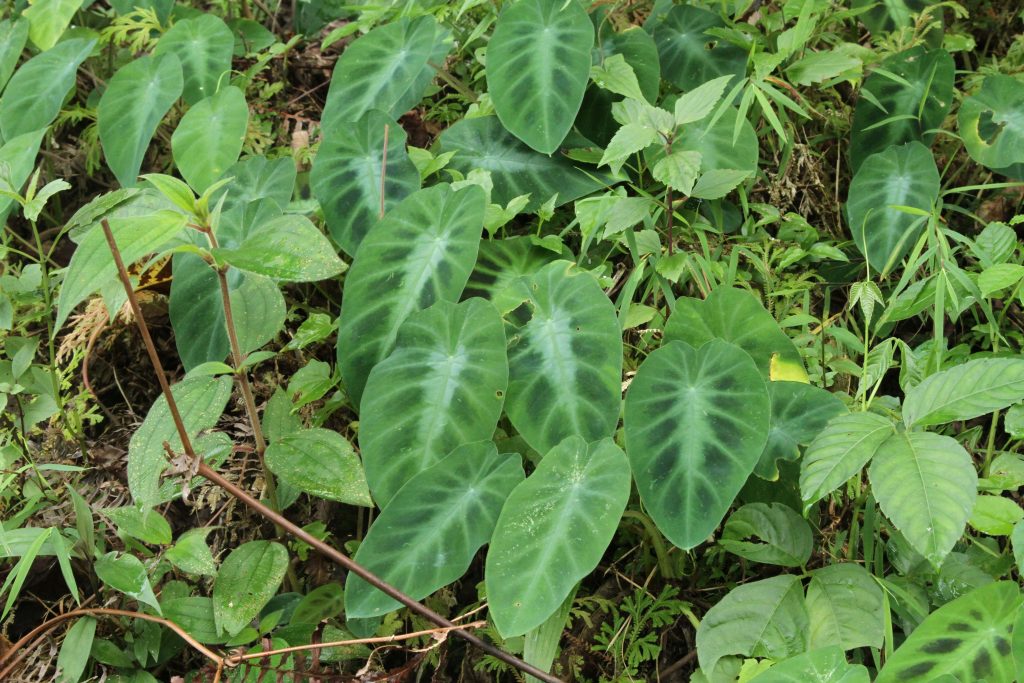
Remusatia pumila (D.Don) H.Li & A.Hay is a small tuberous aroid of the eastern Himalaya and Indo-Burmese region, documented by about 269 records spanning India, Nepal, Bhutan, China, Myanmar, Thailand, Malaysia, Indonesia and Vietnam, with naturalised reports elsewhere. It grows as a lithophyte and epiphyte on mossy rocks, boulders and tree trunks in humid broad-leaved and subtropical forest, favouring shaded, seepage-moistened microsites. The cited gatherings from Galephu in southern Bhutan at 850 m in October and the Mewa Khola of East Nepal at 1900 m in April reflect its span across the warm-temperate to subtropical foothill belt.

The plant is a diminutive geophyte arising from a small subglobose tuber that produces clusters of bulbil-bearing structures. The leaves are few, with slender petioles and ovate to ovate-cordate, peltate or sagittate blades. As in all Remusatia, vegetative reproduction is conspicuous: erect to spreading bulbiliferous shoots bear numerous hooked, scale-covered bulbils that detach and disperse epizoochorously. The inflorescence is a spathe enclosing a spadix with basal female and upper male flower zones separated by sterile flowers; flowering is comparatively infrequent relative to the prolific bulbil production.

The species was long placed in Gonatanthus, a genus now subsumed within Remusatia, the combination reflecting molecular and morphological reassessment of the tribe Colocasieae. Reliance on hooked bulbils for dispersal by passing animals is a key adaptation to its epilithic and epiphytic, often ephemerally exposed habitats. Widespread and locally frequent, it is not considered threatened, though its dependence on undisturbed humid forest links its persistence to lowland and submontane habitat integrity.

Author: (D.Don) H.Li & A.Hay · Sources: POWO (Kew), GBIF, Flora of China, Flora of Bhutan, Flora of Nepal, Araceae of the Indian subcontinent / monograph of Remusatia and Colocasieae

Remusatia vivipara

by GP Jürgens

(Roxb.) Schott

Bhutan2015 106 1
Bhutan Galephug 600m, October
Nepal 1994 223 ergebnis
Ost-Nepal Mewa-Khola 1900m April 

Description

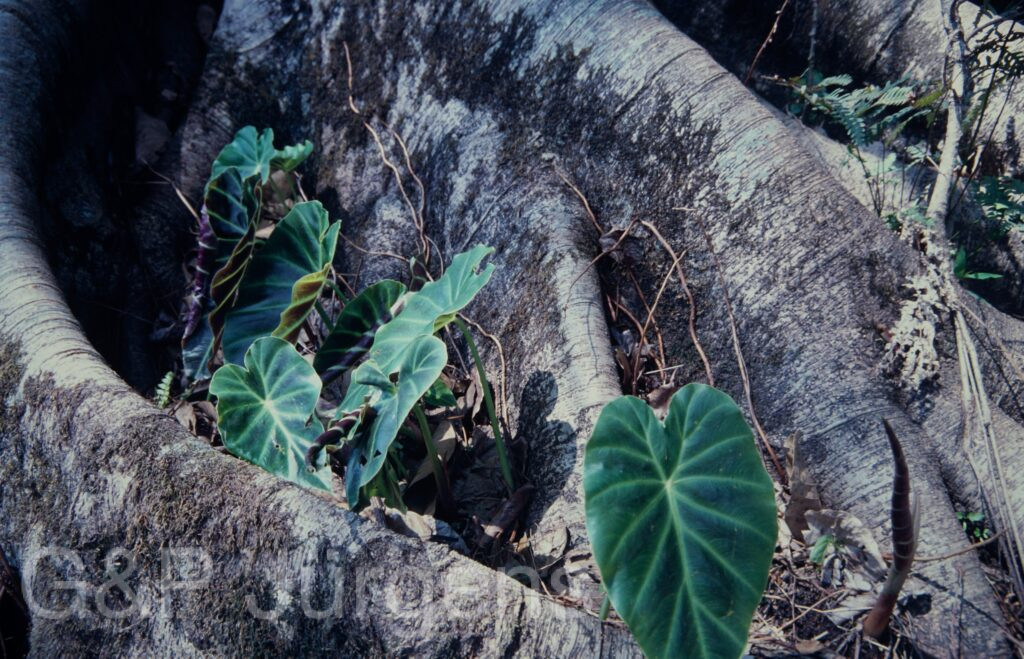
Remusatia vivipara (Roxb.) Schott is a widespread tuberous aroid of the Old World tropics, the most broadly distributed member of its genus, with nearly 790 records spanning the Himalaya and India, China and Taiwan, Southeast Asia, Indonesia and Australia, tropical Africa and Madagascar, and Arabia, plus naturalised occurrences elsewhere. It is chiefly an epiphyte and lithophyte on mossy tree trunks, cliffs and boulders in humid forest, descending into shaded ravines and persisting in disturbed semi-shade. The cited gatherings from Galephug in southern Bhutan at 600 m in October and the Mewa Khola of East Nepal at 1900 m in April span its lowland-to-submontane range.

The plant grows from a small depressed-globose tuber that gives rise annually to one or few leaves and to the conspicuous bulbiliferous shoots characteristic of the genus. The leaf blade is ovate to ovate-cordate and peltate, on a long sheathing petiole. Dispersal is dominated by erect, spike-like bulbil-bearing axes densely set with small, scale-covered bulbils armed with recurved hooks that catch on the fur and feathers of passing animals. Flowering, where it occurs, produces a spathe with a basal convolute tube and expanded limb, subtending a spadix with separate female and male zones; sexual reproduction is much less frequent than vegetative propagation.

The extraordinary pantropical range of R. vivipara is largely attributable to this epizoochorous bulbil dispersal, supplemented by human movement of ornamental and tuber stock. Its placement in Colocasieae, near Colocasia and Gonatanthus, has been confirmed by molecular work. The species is common, ecologically plastic and locally weedy, and is of no conservation concern; in cultivation it is valued as a curious bulbil-producing aroid.

Author: (Roxb.) Schott · Sources: POWO (Kew), GBIF, Flora of China, Flora of Bhutan, Flora of Nepal, monograph of Remusatia and tribe Colocasieae

(Roxb.) Schott

Sikkim 2006 487 ergebnis
India West-Bengal, Ruigi-Chu 1800m, May
Bhutan2015 147
Bhutan Galephug 800m, October

Description

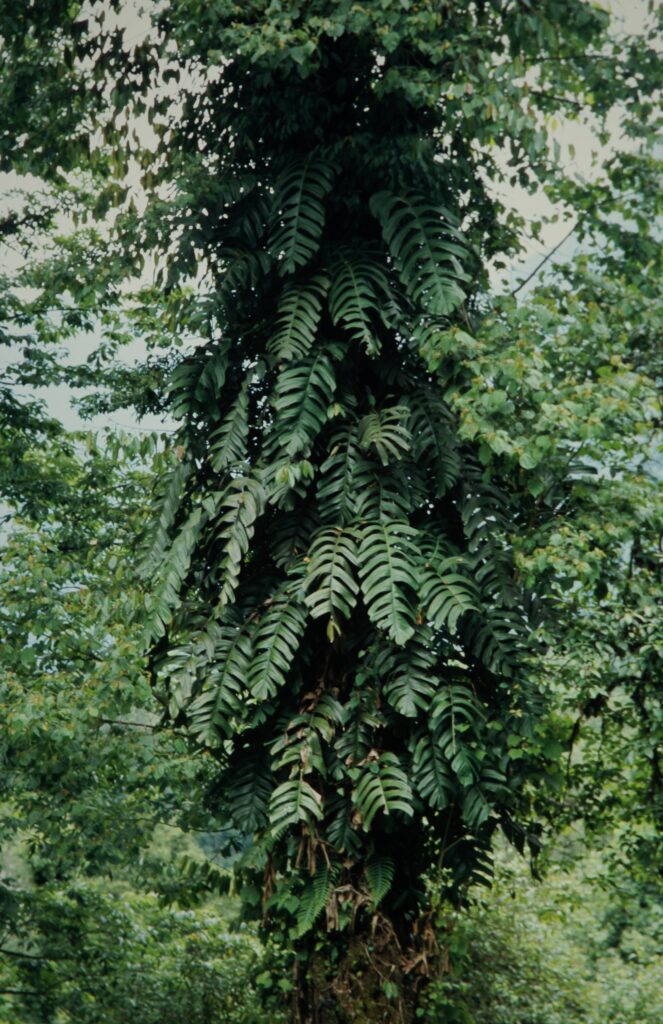
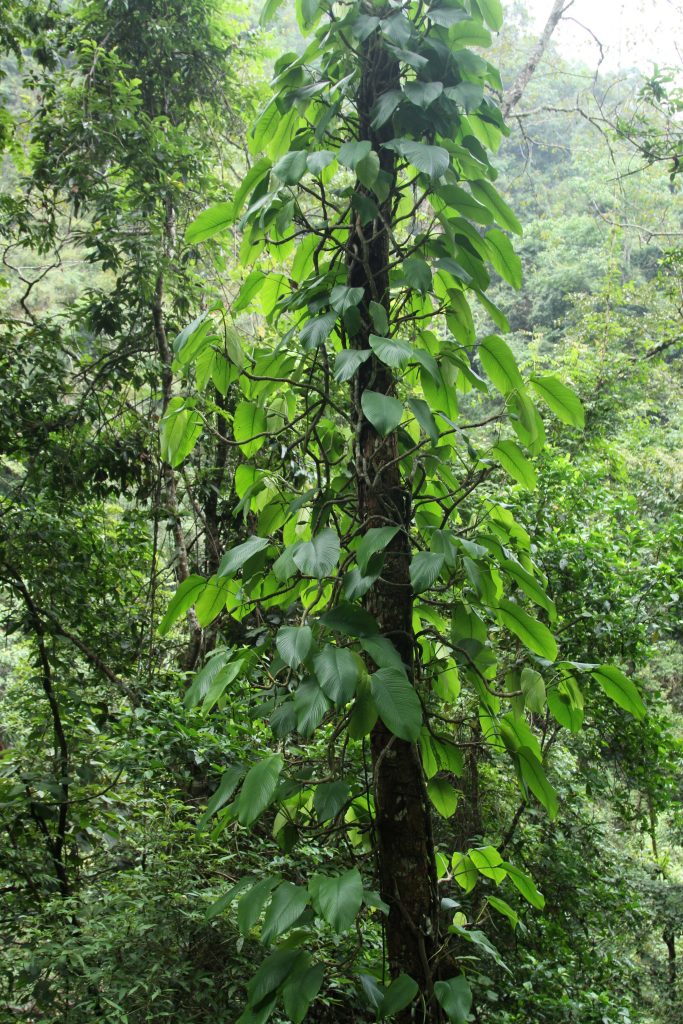
Rhaphidophora decursiva ((Roxb.) Schott) is a robust root-climbing aroid widely distributed across tropical and subtropical Asia, ranging from the eastern Himalaya and northeast India through Bangladesh, Myanmar, Thailand, Laos, Vietnam and southern China to Sri Lanka and the Malay region. The roughly 700 GBIF records confirm a strong concentration in the Indo-Burmese hill forests. It is a hemiepiphyte of humid evergreen and semi-evergreen broad-leaved forest, climbing tree trunks and clambering over rocks in shaded, moist ravines from near sea level to about 2,000 m. The cited material from Ruigi-Chu in West Bengal at 1,800 m in May and from Galephug, Bhutan, at 800 m in October illustrates its wide altitudinal amplitude across the Himalayan foothills.

The plant produces stout, scandent stems that cling by abundant clasping adventitious roots, the internodes green to brownish and somewhat flattened against the support. The leaves are large and long-petiolate, the lamina ovate-oblong in juveniles but becoming deeply pinnatifid in adults, divided almost to the midrib into numerous decurrent segments that give the species its epithet. The inflorescence is a cylindrical spadix subtended by a thick, boat-shaped, yellowish to greenish spathe; the flowers are bisexual and naked, lacking a perianth, and the infructescence ripens into a dense cluster of berries.

The genus Rhaphidophora belongs to the tribe Monstereae and is distinguished from the Neotropical Monstera by its Old World distribution and bisexual flowers. R. decursiva is among the most widespread members of the genus and shows considerable leaf heteroblasty between juvenile shingling and mature pinnatifid stages. Locally the plant is used in traditional medicine and is occasionally grown as a foliage ornamental. It is common and not regarded as threatened.

Author: (Roxb.) Schott · Sources: POWO (Kew), Flora of Bhutan Vol. 3, GBIF, Flora of China Vol. 23, Boyce & Croat: The Überlist of Araceae (Monstereae)

Schott

Bhutan2012 769
Bhutan Zemgang 1500m, October

Description

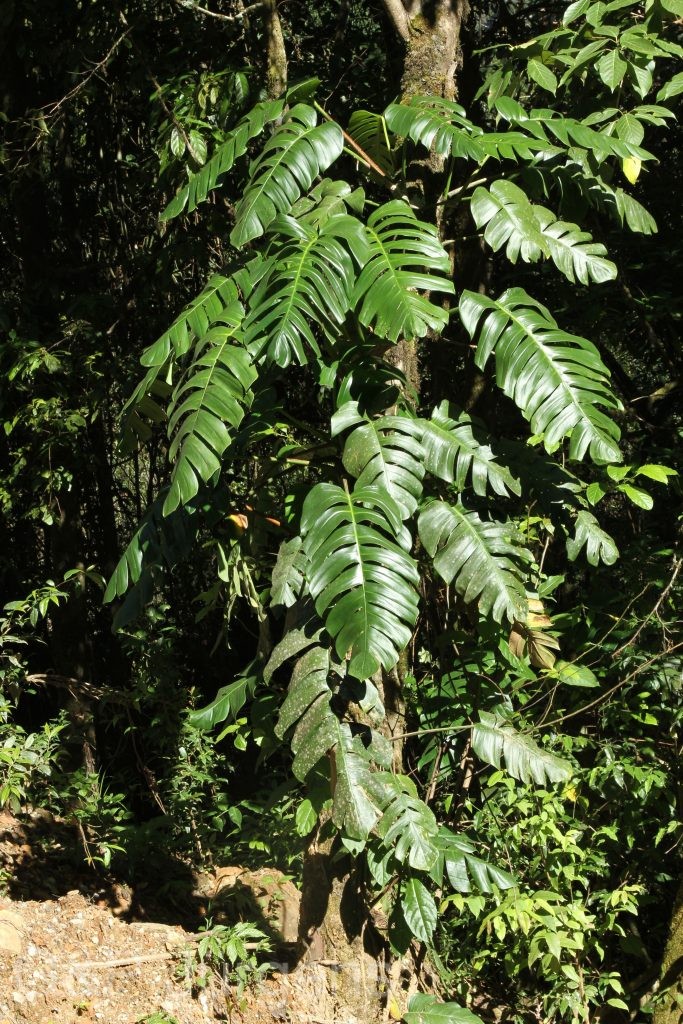
Rhaphidophora hookeri is a robust root-climbing aroid of the warm-temperate and subtropical broad-leaved forests of the eastern Himalaya and northern Indochina. GBIF occurrences place it across China, Thailand, India, Vietnam, Bhutan, Laos, Bangladesh, Myanmar and Nepal, with around 253 records reflecting its sparse but wide montane distribution. It is a hemiepiphyte of humid, shaded forest, ascending tree trunks and rock faces by adventitious clasping roots in evergreen ravines and along stream margins. The photographed plant from Zemgang in central Bhutan at 1500 m, recorded in October, is typical of the mid-elevation foothill forests where the species favours high atmospheric humidity, deep shade and moss-covered substrates.

It is a perennial climber with thick, fleshy stems that adhere closely to the support, the internodes marked by prominent scars and bearing dense feeding roots. The leaves are large, glossy and entire to obliquely ovate-elliptic, the petioles geniculate and sheathing at the base. The inflorescence is a cylindrical spadix subtended by a thick, deciduous, boat-shaped spathe; the flowers are bisexual and naked, lacking a perianth, densely packed over the spadix. The fruit is a fleshy syncarp of berries, releasing numerous small seeds at maturity.

The genus Rhaphidophora comprises some hundred species of palaeotropical climbing aroids, distinguished within the Monstereae by their bisexual flowers and the absence of a perianth. R. hookeri, named in honour of J. D. Hooker, is one of the few representatives reaching the Himalayan region. Like related climbing aroids it shows marked heteroblastic development, juvenile shingle-leaved shoots differing strongly from the adult climbing stems, an adaptation to the vertical microhabitats of dense forest interiors.

Author: Schott · Sources: POWO (Kew), GBIF, Flora of Bhutan, Flora of China (Araceae), Revision of Rhaphidophora (Boyce, Araceae monographs)

(Wall. ex Schott) Cusimano & Hett.

Nepal 99 241 ergebnis
West-Nepal Tallekh 3000m, June
Nepal 2009 97 ergebnis
Nepal Helambu Samathang 2410, May

Description

Sauromatum diversifolium is a tuberous aroid of the Himalaya and adjacent uplands, distributed through India, China, Nepal, Bhutan, Myanmar and Thailand, with around 146 recorded occurrences. It grows in moist temperate forest, on shaded banks, in open grassy slopes and among rocks where seasonal soil moisture is reliable, emerging with the onset of the warm season and dying back to its tuber during the dry winter. In Nepal it occupies the middle to upper montane zone, as shown by collections from Tallekh in the west at about 3000 m in June and from Samathang in the Helambu region at 2410 m in May, the latter dates coinciding with its early-season flowering.

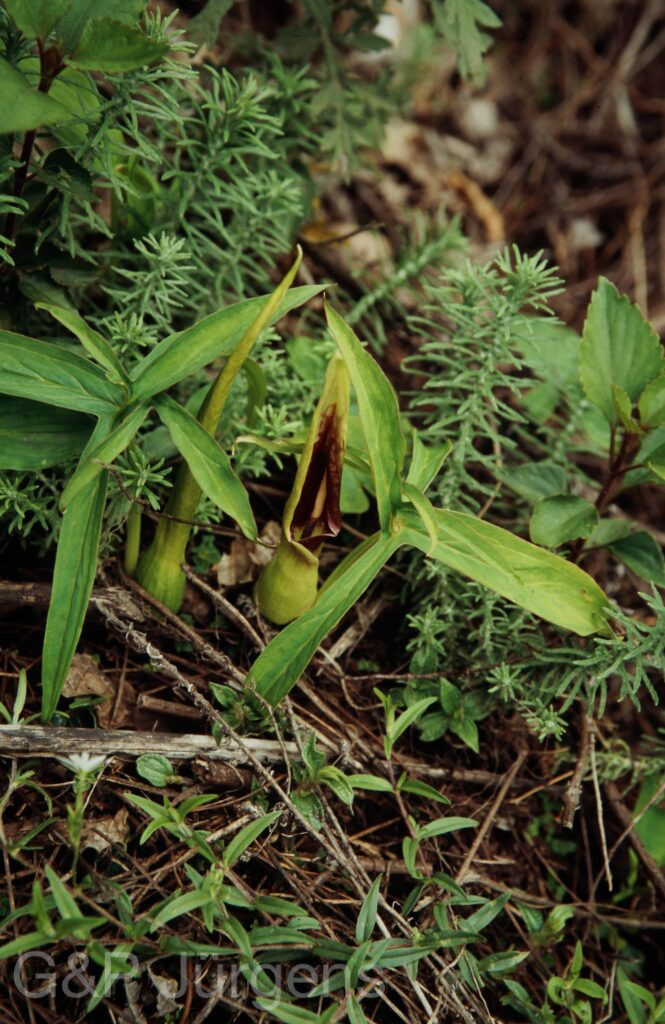
The plant arises from a subglobose, depressed tuber and typically produces a single long-petiolate leaf whose blade is deeply pedately divided into several lanceolate to elliptic segments, the lobes acuminate and the petiole often mottled. The inflorescence is a typical aroid spadix subtended by a spathe, the spathe tube convolute and the limb expanded, lanceolate and often dull purple or marked within. The spadix bears a sterile terminal appendix above separated zones of female and male flowers, and emits a faint odour at anthesis to attract small dipteran and beetle pollinators. The fruiting head is a cluster of small berries.

The species was transferred to Sauromatum by Cusimano and Hettich on molecular and morphological evidence that united the former Typhonium diversifolium with the saururoid lineage. The genus is protogynous and largely sapromyophilous, with thermogenic spadices that volatilise scent to lure pollinators into the floral chamber. Widespread and locally frequent in suitable montane habitat, S. diversifolium is not regarded as threatened, though like many tuberous aroids it is sensitive to grazing pressure and the loss of forest-edge microhabitats.

Author: (Wall. ex Schott) Cusimano & Hett. · Sources: POWO (Kew), GBIF, Flora of China Vol. 23, Flora of Bhutan Vol. 3, Flora of Nepal, Cusimano et al. molecular phylogeny of Areae (Araceae)

  • 1
  • 2