Fabaceae

Vassilcz.

Nepal 99 606 ergebnis
West-Nepal Kagmara Phedi 3900m, July

Description

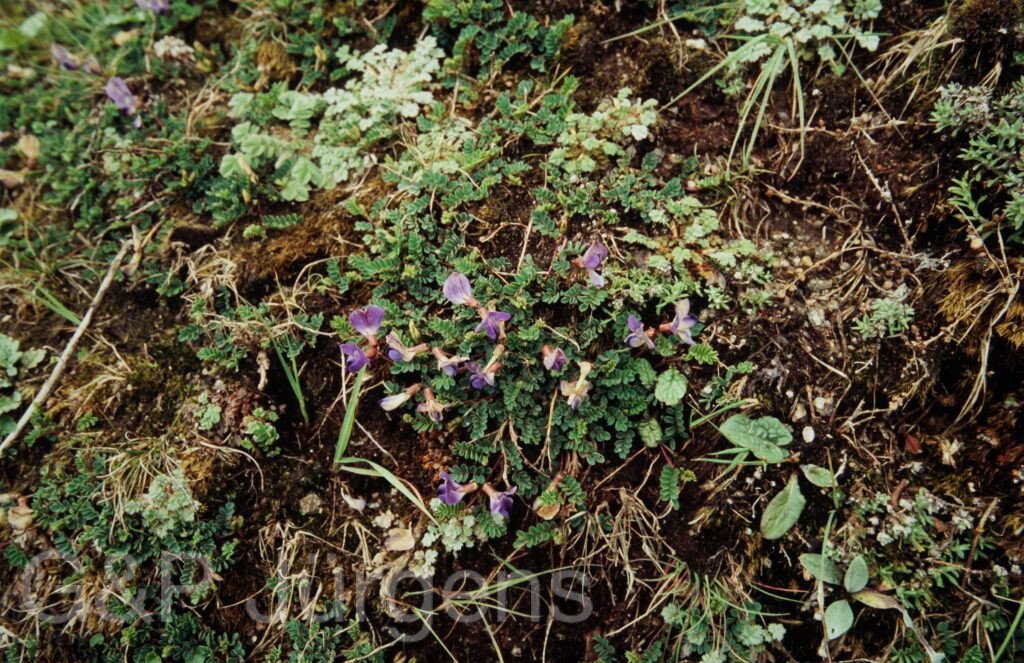
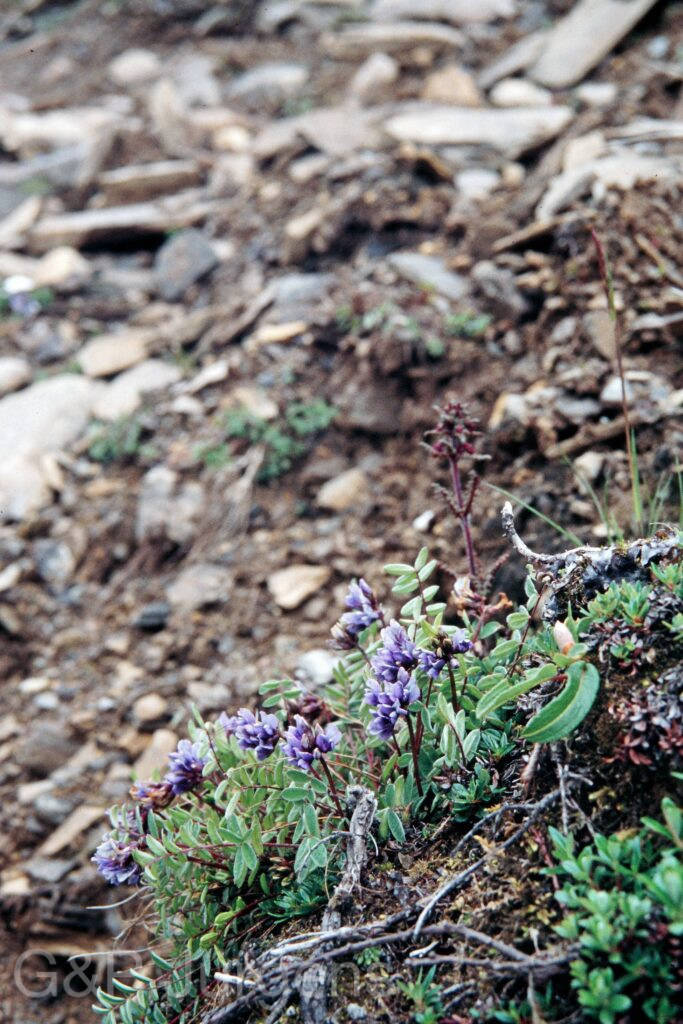
Oxytropis williamsii is a high-alpine legume of the central and western Himalaya, recorded with some 154 georeferenced collections from Nepal and adjacent Tibetan China (Xizang). It inhabits open stony slopes, dry alpine turf, gravelly moraine flanks and the margins of glacial meltwater channels in the upper subnival belt, typically between about 3800 and 4800 m. The plant photographed at Kagmara Phedi in West Nepal at 3900 m in July exemplifies its preference for cold, well-drained, continental sites with a short growing season and intense insolation.

The species forms a low, tufted, more or less acaulescent perennial arising from a stout, woody, branched caudex crowned by persistent stipule and petiole remains. The leaves are imparipinnate, with numerous small, oblong to elliptic leaflets densely clothed in appressed silky-villous hairs that lend the plant a silvery-grey aspect. Flowers are borne in compact, shortly pedunculate racemes or capitate clusters; the papilionaceous corolla is purple to violet, with the keel terminating in the sharp acuminate beak diagnostic of Oxytropis as distinct from Astragalus. The calyx is tubular and pubescent, and the fruit is an inflated, hairy legume, more or less bilocular through intrusion of the dorsal suture.

Membership in Oxytropis and its allies reflects a radiation of cushion- and tussock-forming legumes adapted to the cold deserts of the Tibetan plateau and its Himalayan rim. Such species contribute nitrogen fixation and soil stabilisation in nutrient-poor alpine substrates, and like many Oxytropis may accumulate swainsonine-type alkaloids. Restricted to remote, sparsely collected terrain, O. williamsii has not been formally assessed, though its specialised habitat warrants monitoring under warming and grazing pressure.

Author: Vassilcz. · Sources: POWO (Kew), GBIF, Flora of China, Flora of Nepal, Annotated Checklist of the Flowering Plants of Nepal, monograph of Oxytropis (Vassilczenko / Astragalology)
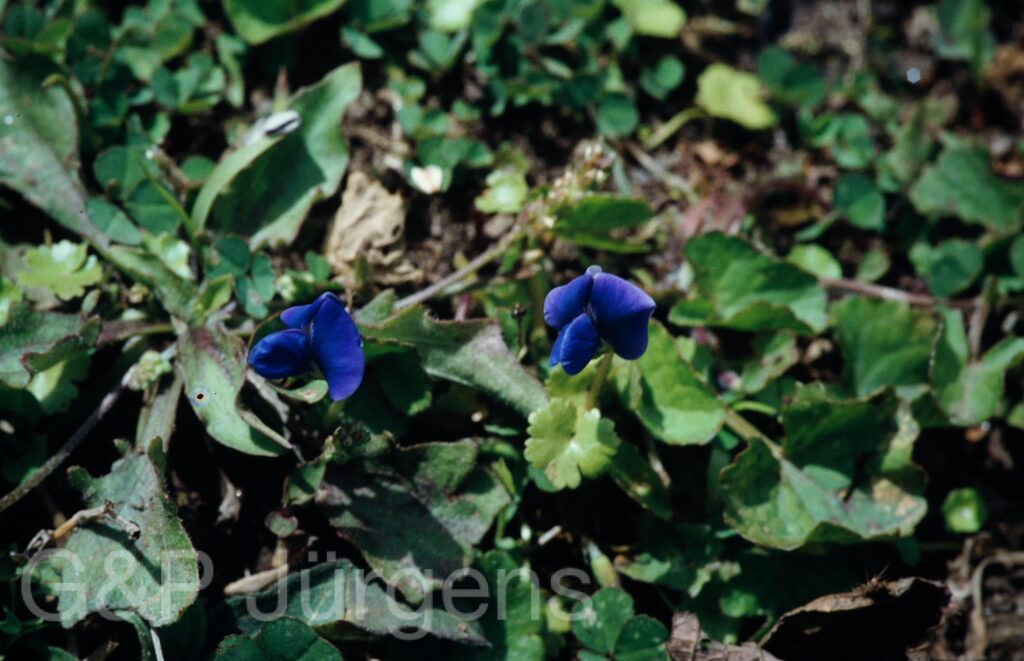
Buch.-Ham. ex D.Don

Nepal 97 497 G979
Nepal Arun-Valley 1750m May
Nepal 97 336 P666
Nepal Arun-Valley 1750m May
Nepal 1994 58 ergebnis
Ost-Nepal Bhalukhob 
1900m April

Description

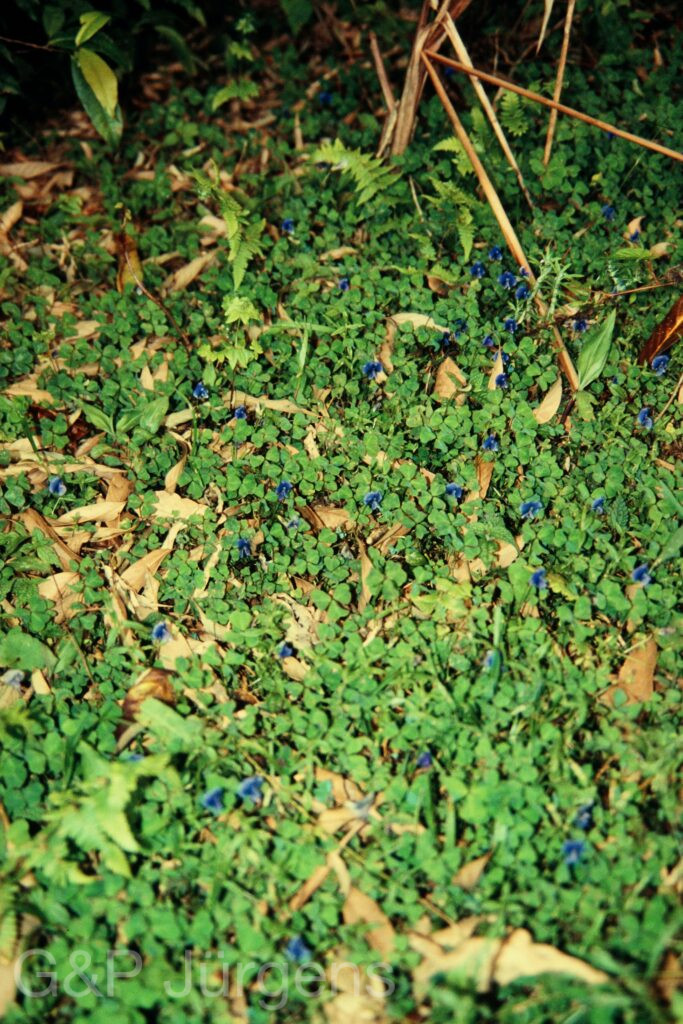
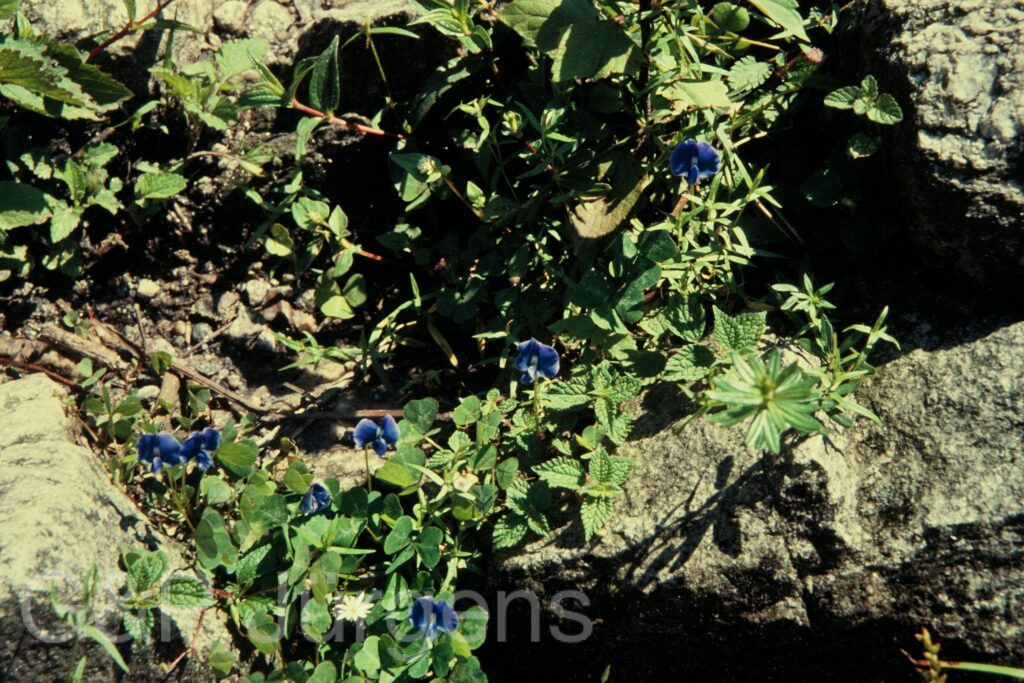
Parochetus communis, the shamrock pea, is a creeping perennial legume with a remarkably wide Afro-Asian montane distribution. GBIF documents around 1730 occurrences spanning the Himalaya (Nepal, India, Bhutan, China), Southeast Asia (Myanmar, Thailand, Vietnam, Malaysia, Indonesia, Sri Lanka), the East African highlands (Ethiopia, Kenya, Tanzania, Uganda, Rwanda, Burundi, DR Congo, Malawi) and naturalised in New Zealand. It grows in moist grassland, forest clearings, streambanks, terrace edges and shaded turf, generally between 1500 and 3000 m. The photographed plants are from eastern Nepal at Bhalukhob (1900 m, April) and the Arun Valley (1750 m, May), where it carpets damp banks in spring.

The plant forms prostrate, rooting stems that spread into loose mats and root at the nodes. The leaves are trifoliolate and clover-like, the obcordate leaflets often marked with a darker band, borne on slender petioles with small stipules. The flowers are solitary or paired in the leaf axils, papilionaceous with a standard, wing and keel; the corolla is a vivid cobalt to gentian-blue, occasionally with paler markings, exceeding the tubular calyx. The fruit is a slender, linear-oblong legume that dehisces to release several small seeds.

Parochetus (Fabaceae, subfam. Faboideae) is a small genus historically treated as monotypic until the segregation of the African P. africanus, leaving Asian material under P. communis. GBIF treats the name as accepted. Its disjunct, sky-island range across Asian and African mountains makes it a classic subject in studies of tropical-alpine biogeography. Widespread and adaptable, it is of least concern and is also cultivated as an ornamental groundcover.

Author: Buch.-Ham. ex D.Don · Sources: POWO (Kew), GBIF, Flora of China, Annotated Checklist of the Flowering Plants of Nepal, Polhill studies of Papilionoid legumes

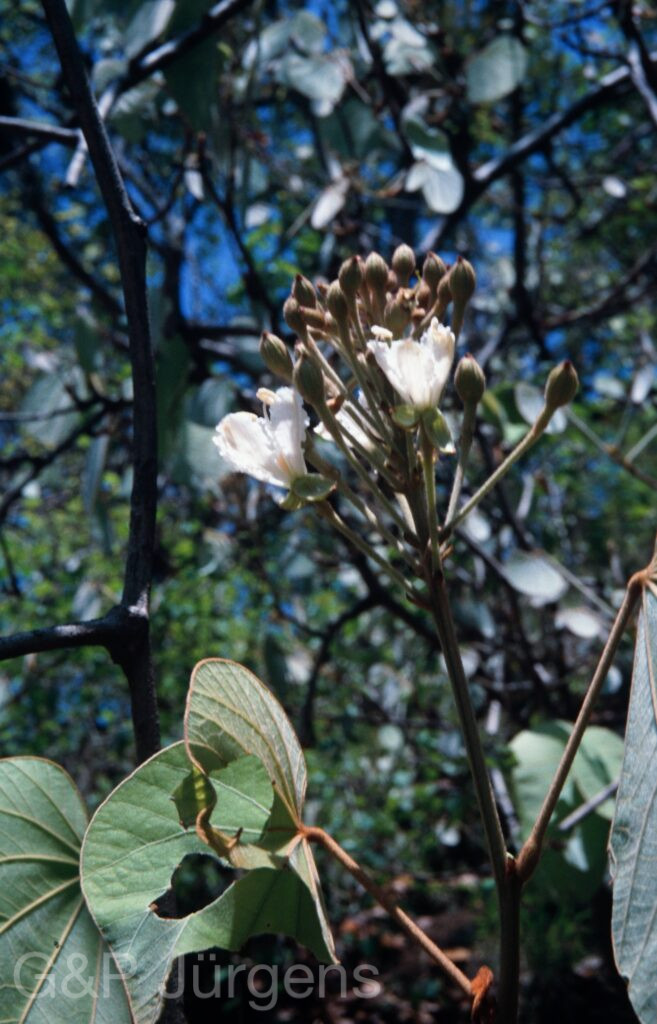
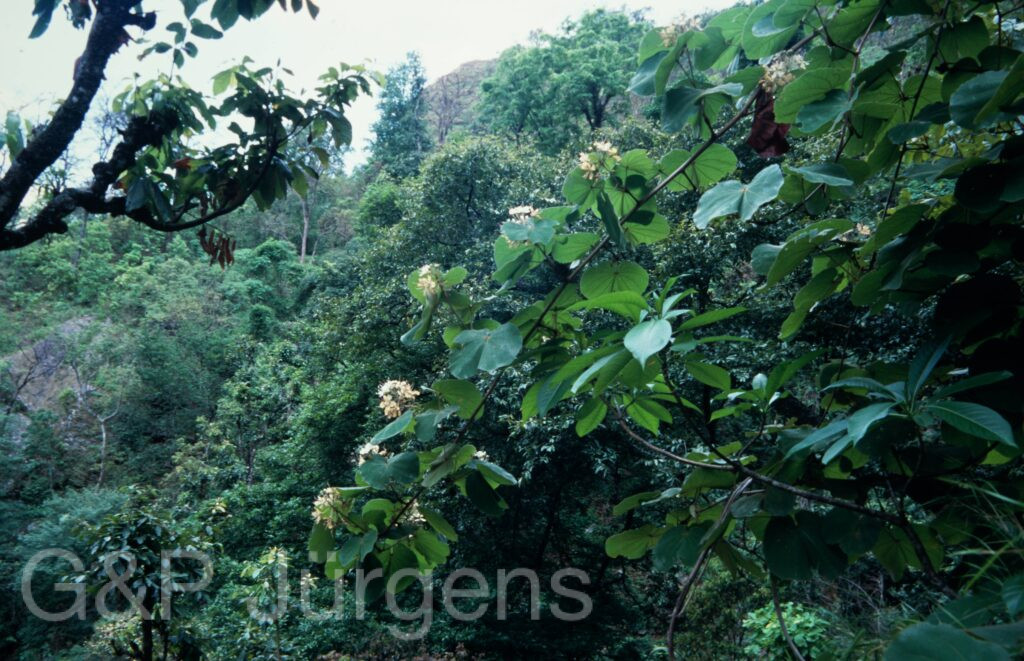
(Wight & Arn.) Benth.

Nepal 2001 184 ergebnis ergebnis
East-Nepal Sabha-Khola 2000m, May
Nepal 2001 476 ergebnis ergebnis
Nepal (Gorkha) Labubhesi 1200m, May

Description

Phanera vahlii (formerly placed in Bauhinia) is a massive woody climber of the Indian subcontinent and Indo-Burmese region, native to India, Nepal, Bhutan, Bangladesh, Myanmar, Laos, Vietnam and China, with over 400 georeferenced records and many further occurrences reflecting cultivation and naturalisation elsewhere. It is a liana of subtropical forests, riverine thickets and forest edges. The Nepalese populations documented from the Sabha Khola in the east at about 2000 m and from Labubhesi in Gorkha at about 1200 m, both flowering in May, span its broad altitudinal tolerance from foothill valleys into temperate forest.

The plant is a gigantic, high-climbing leguminous vine ascending by paired, coiled tendrils, with stems and young parts clothed in dense ferruginous tomentum. The leaves are large, broadly orbicular and conspicuously bilobed at the apex, deeply notched between two rounded lobes in the manner characteristic of the Bauhinia alliance, the lower surface rusty-pubescent. The flowers are borne in large terminal panicles; each has a campanulate calyx and five cream to yellowish-white, clawed petals, with fertile stamens and reduced staminodes. The fruit is a large, woody, oblong pod densely covered with brown velvety hairs and containing several flattened seeds.

The segregation of Phanera from Bauhinia, based on tendrillate climbing habit, stamen number and pollen characters, is now widely followed though some authorities retain a broadly circumscribed Bauhinia. The species is economically important: its tough fibre yields cordage and its very large leaves are used as plates and for wrapping. Widespread and frequently exploited, it is not considered threatened.

Author: (Wight & Arn.) Benth. · Sources: POWO (Kew), GBIF, Flora of Nepal, Flora of British India, Flora of China, Wunderlin's revision of Bauhinia and Phanera

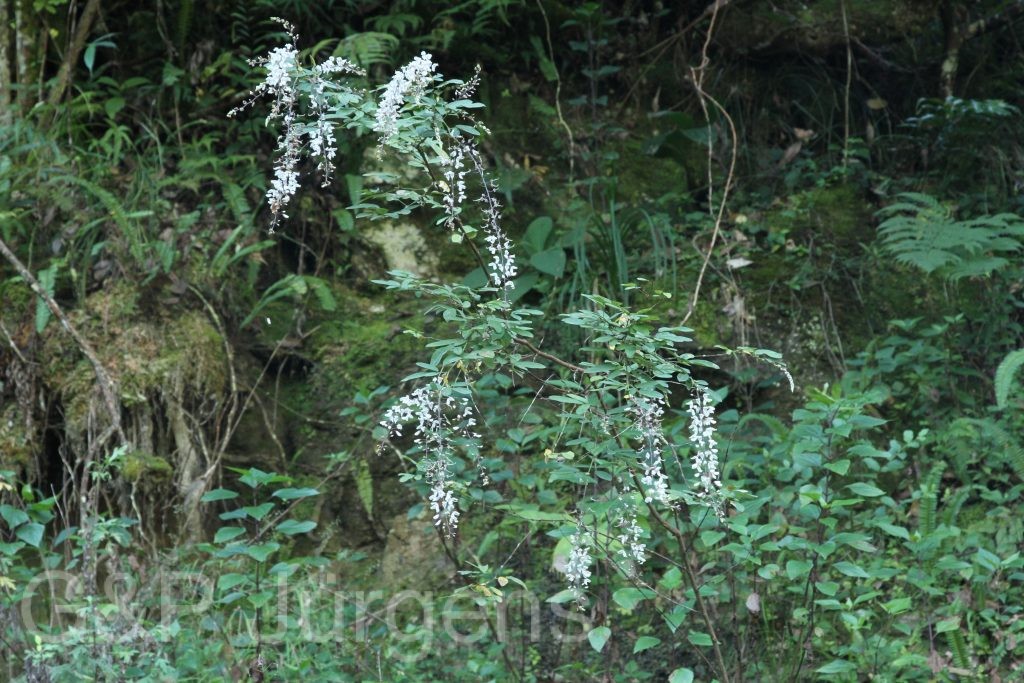
(L.) Desv.

Bhutan2015 553
Bhutan Moshu 1400m, October
Bhutan2015 554
Bhutan Moshu 1400m, October

Description

Phyllodium pulchellum (L.) Desv. is a widely distributed subtropical to tropical legume of South and Southeast Asia and Australasia, with an extensive GBIF range (including CN, TW, IN, ID, TH, PH, AU, PG, VN, MM, LA, LK, KH, NP, JP, MY and BD, among others) and around 2442 occurrences. It inhabits open forest, woodland margins, savanna, grassy slopes and disturbed roadside thickets at low to moderate elevations. The image record from Moshu in southern Bhutan at 1400 m, in October, places it in the warm subtropical foothill zone at the lower margin of the Himalayan flora, well below the alpine taxa with which it is here grouped.

It is a shrub or subshrub with erect, branched and often tomentose stems. The leaves are pinnately trifoliolate, the terminal leaflet markedly larger than the laterals and ovate to elliptic with an entire margin. The inflorescence is highly distinctive: an elongate terminal raceme in which the small flowers are borne in clusters concealed between pairs of large, rounded, conspicuously veined bracts arranged like the leaves of a fern frond, the feature for which the genus Phyllodium is named. The flowers are typical papilionate legumes, small and whitish to pale yellow. The fruit is a small flattened lomentum, breaking transversely into one-seeded segments.

Phyllodium belongs to the tribe Desmodieae of subfamily Faboniodeae (Papilionoideae), allied to Desmodium, and the paired foliaceous bracts are a hallmark of the genus. The lomentum segments, with their hooked or sticky surfaces, promote epizoochorous dispersal. As a nitrogen-fixing legume it is significant in early-successional and grassland communities, and is used in traditional medicine across its range; it is widespread and not of conservation concern.

Author: (L.) Desv. · Sources: POWO (Kew), GBIF, Flora of China (Fabaceae: Desmodieae), Flora of Bhutan, Ohashi monograph of the Desmodium group (Leguminosae)

(DC.) M.L.Zhang & Podlech

Nepal 2009 27 ergebnis
Nepal Helambu Koktrok 3000m, May

Description

Phyllolobium donianus (correctly P. donianum, the accepted spelling), formerly placed in Astragalus, is a Sino-Himalayan legume distributed from Nepal through northern India, Sikkim and Bhutan into south-western China, with 256 GBIF records concentrated in the central and eastern Himalaya. It grows on open grassy slopes, forest clearings, banks and stony alpine pastures in the temperate to subalpine zone. The cited collection from Koktrok in the Helambu region of Nepal at 3000 m in May places its flowering in the late-spring period on warm-temperate mountain grassland before the onset of the summer monsoon.

It is a perennial herb with slender, ascending to trailing stems arising from a woody rootstock, the herbage thinly clothed in appressed medifixed (dolabriform) hairs typical of the genus. The leaves are imparipinnate with several pairs of small elliptic to obovate leaflets. The flowers are pea-shaped (papilionaceous), borne in axillary racemes on long peduncles, the corolla purplish to violet-blue with a notched standard, oblong wings and a blunt keel, subtended by a campanulate, hairy calyx with short teeth. The fruit is a small, membranous to leathery legume, somewhat inflated and stipitate, dehiscing to release several reniform seeds.

Phyllolobium was segregated from the vast genus Astragalus by Zhang and Podlech on the basis of molecular and morphological evidence, comprising a distinctive Asian clade of milkvetches. P. donianum, transferred from Astragalus donianus DC., exemplifies this realignment. Like other milkvetches it is nitrogen-fixing through rhizobial symbiosis and bee-pollinated; it is widespread and not of conservation concern.

Author: (DC.) M.L.Zhang & Podlech · Sources: POWO (Kew), GBIF, Flora of China, Annotated Checklist of the Flowering Plants of Nepal, Flora of Bhutan, Zhang & Podlech monograph of Phyllolobium

(Hook.) Sweet

Bhutan2014 342
Bhutan Tumching-La 3000m, May
Bhutan2014 886
Bhutan Chele-La 3300m, May

Description

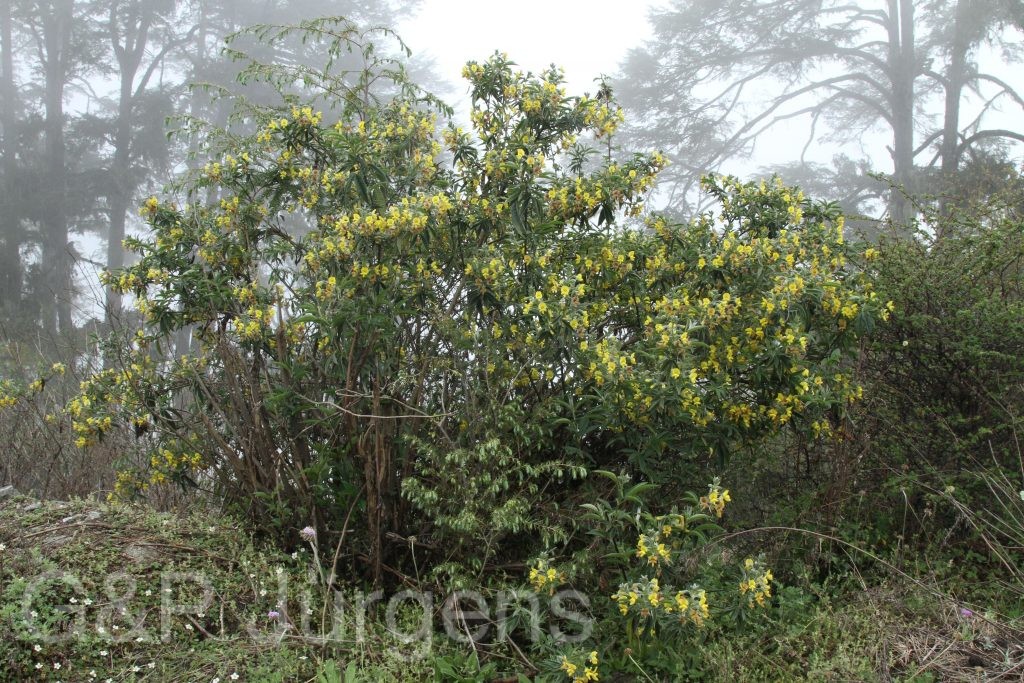
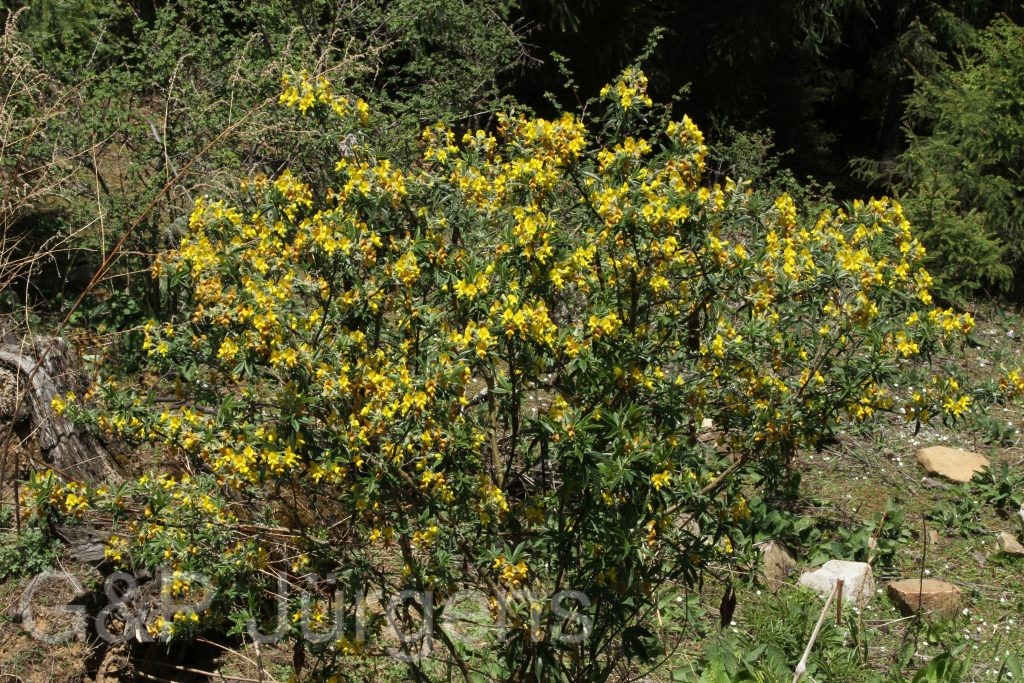
Piptanthus nepalensis is a Sino-Himalayan shrub distributed along the southern flank of the great ranges from Nepal and northern India eastward through Bhutan into south-western China (Yunnan, Sichuan, Xizang), with outlying records in Myanmar; the species is widely cultivated and naturalised in temperate gardens, accounting for the European, North American and Antipodean records (GB, DE, BE, NL, US, CA, NZ) among its more than 1600 georeferenced occurrences. It favours open scrub, forest margins, rocky slopes and stream banks in the upper montane and subalpine belts, typically between about 2500 and 4000 m. The populations on the Bhutanese passes of Tumching-La (3000 m) and Chele-La (3300 m), flowering with the spring thaw in May, are characteristic of its habitat among Rhododendron and conifer scrub.

It is a deciduous to semi-evergreen shrub reaching 1-4 m, with stout greenish branchlets bearing silky-pubescent young growth. The leaves are trifoliolate, long-petiolate and stipulate, the leaflets elliptic to lanceolate, dark green and glabrescent above, glaucous and appressed-silky beneath. The showy golden-yellow papilionaceous flowers, 2.5-3 cm long, are borne in terminal erect racemes; the calyx is bilabiate and silky, and the standard, wings and keel are typical of the tribe Thermopsideae. The fruit is a flattened, elongate, dehiscent legume to 12 cm, glaucous-pubescent and containing several dark reniform seeds.

Piptanthus is a small genus of the broadly defined Thermopsideae allied to Thermopsis and Anagyris, distinguished by its woody habit and trifoliolate leaves. Long-cultivated for its early bloom, P. nepalensis hosts nitrogen-fixing rhizobia that aid colonisation of skeletal soils. It is not considered threatened, being abundant across a broad range, though its toxic quinolizidine alkaloids deter browsing.

Author: (Hook.) Sweet · Sources: POWO (Kew), GBIF, Flora of China, Flora of Bhutan, Flora of Nepal, Turner's revision of Piptanthus (Thermopsideae)

Senna alata

by GP Jürgens

(L.) Roxb.

Bhutan2012 728
Bhutan Galephu 380m, September

Description

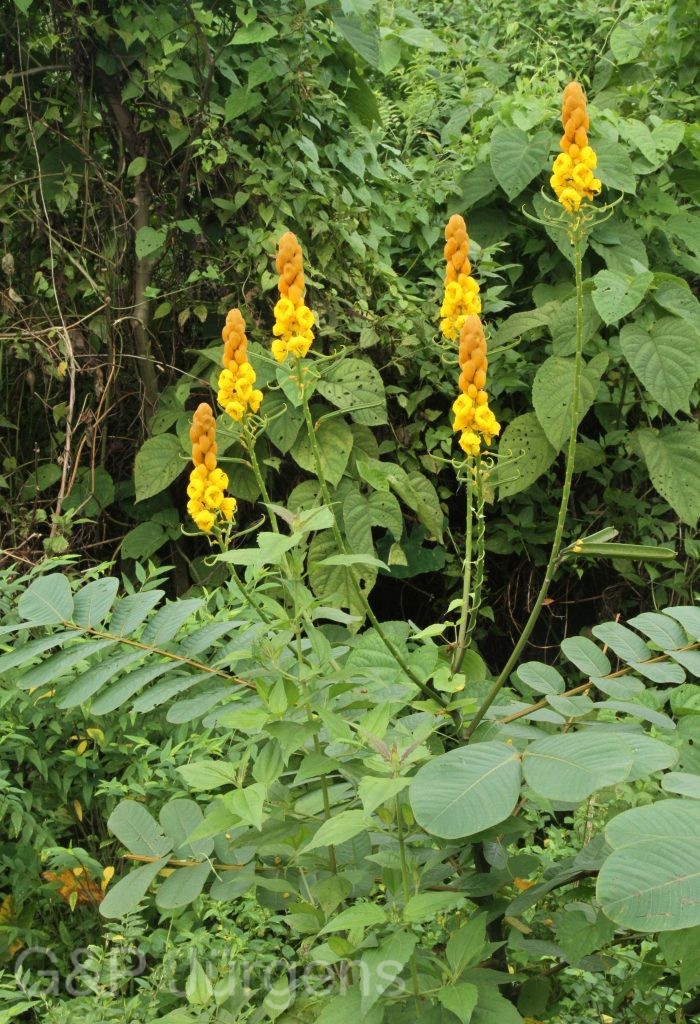
Senna alata, the candle bush or ringworm shrub, is a pantropical species of probable Neotropical origin, now widely naturalised throughout the tropics; GBIF records (12391 occurrences) span Brazil, the United States, Mexico, India, Australia, Indonesia, Taiwan, the Philippines, West Africa and much of Southeast Asia. It thrives in warm, humid lowland habitats, occupying riverbanks, ditches, waste ground, field margins and other disturbed, moist sites, generally below about 1000 m. The photographed plant from Galephu in southern Bhutan at only 380 m, flowering in September, marks its presence in the hot, subtropical Himalayan foothills where it occurs as an introduced or cultivated ornamental and medicinal plant.

The species is a robust, fast-growing shrub or small tree reaching 2-4 m, with stout, sparsely branched stems. The large pinnate leaves bear 6-14 pairs of oblong leaflets that are rounded at the apex, the rachis often narrowly winged. The inflorescence is a dense, erect, candle-like terminal raceme of bright golden-yellow flowers, each enclosed in bud by an orange bract that falls at anthesis. The flowers have five subequal petals and fertile and reduced stamens characteristic of Senna. The distinctive fruit is a straight, oblong, four-winged (alate) pod, dehiscing to release numerous flattened seeds, the wings giving the species its epithet.

Described by Linnaeus and transferred by Roxburgh, the species belongs to genus Senna (Fabaceae, subfamily Caesalpinioideae), segregated from the broad old concept of Cassia. It is renowned in ethnomedicine, its anthraquinone-rich leaves used as a topical antifungal treatment for ringworm and other skin conditions. While valued horticulturally and medicinally, its vigour and prolific seed make it a potential weed of disturbed tropical land. It is of least conservation concern given its enormous, partly anthropogenic range.

Author: (L.) Roxb. · Sources: POWO (Kew), GBIF, Flora of China, Flora of Bhutan, Cassiinae: A Synoptic Revision of Senna (Irwin & Barneby)

Sunhangia elegans

by GP Jürgens

(DC.) H.Ohashi & K.Ohashi.

Bhutan2014 125
Bhutan Trashigang 1570m, May
Bhutan2014 126
Bhutan Trashigang 1570m, May

Description

Sunhangia elegans—long familiar as Desmodium elegans—is a shrubby legume widely distributed through the Himalaya and adjoining mountains of China, Nepal, India, Pakistan and Bhutan, with around 1611 occurrence records; the scatter of points in distant countries largely reflects cultivation and naturalisation of this popular ornamental. It grows on open hillsides, forest margins, scrub, roadsides and disturbed slopes, mostly in the warm-temperate to subtropical montane belt. The illustrated plant from Trashigang in eastern Bhutan at 1570 m, flowering in May, sits within this characteristic mid-elevation habitat.

It is a deciduous shrub with arching, much-branched stems bearing trifoliolate leaves; the leaflets are rhombic-ovate to broadly elliptic, the terminal one largest, green above and paler and finely pubescent beneath. The inflorescences are terminal and axillary panicles of many papilionaceous flowers ranging from pale lilac and pink to purple, with the typical standard, wing and keel petals and diadelphous stamens. The fruit is a flattened, jointed loment constricted between the seeds and breaking into one-seeded articles whose hooked hairs cling to fur and clothing, effecting epizoochorous dispersal.

The genus Desmodium has recently been dismembered on molecular evidence, with several Asiatic species transferred by H. Ohashi and K. Ohashi to segregate genera, here placed in Sunhangia, with the accepted combination Sunhangia elegans. Like other members of the tribe Desmodieae it forms root nodules with nitrogen-fixing rhizobia, enriching poor montane soils, and is valued both as fodder and as a hardy garden shrub. It is widespread and faces no recognised conservation concern.

Author: (DC.) H.Ohashi & K.Ohashi. · Sources: POWO (Kew), GBIF, Flora of China (Fabaceae), Annotated Checklist of the Flowering Plants of Nepal, Grierson & Long Flora of Bhutan, Ohashi & Ohashi's revision of the Desmodium group (Leguminosae)

DC.

Bhutan2012 628
Bhutan Wangdi 2600m September
Bhutan2012 734
Bhutan Galephu 650m, October

Description

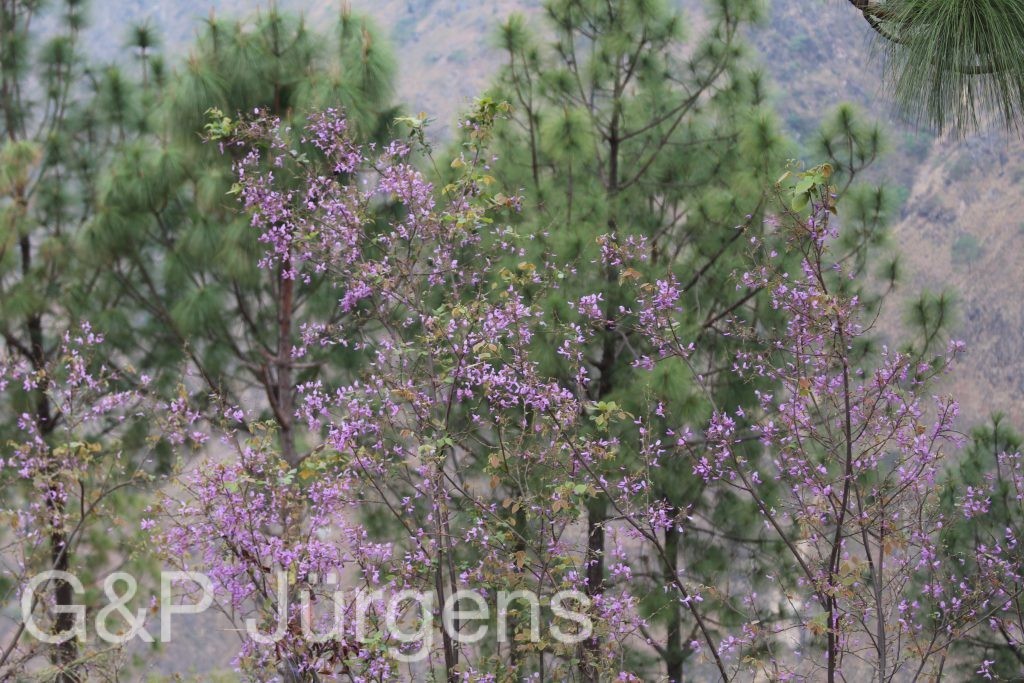
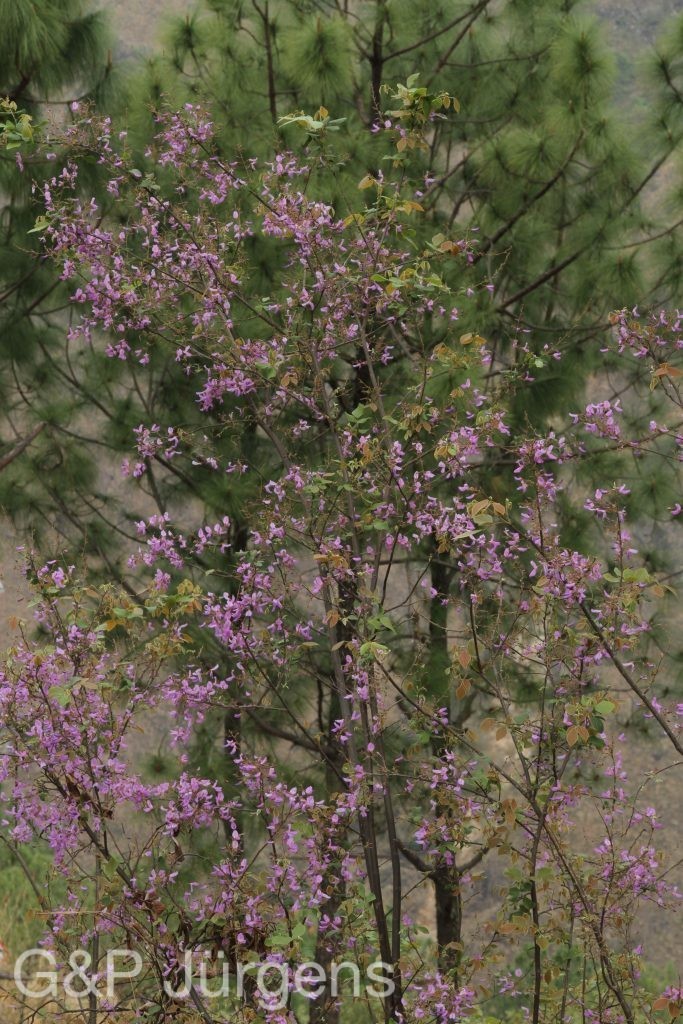
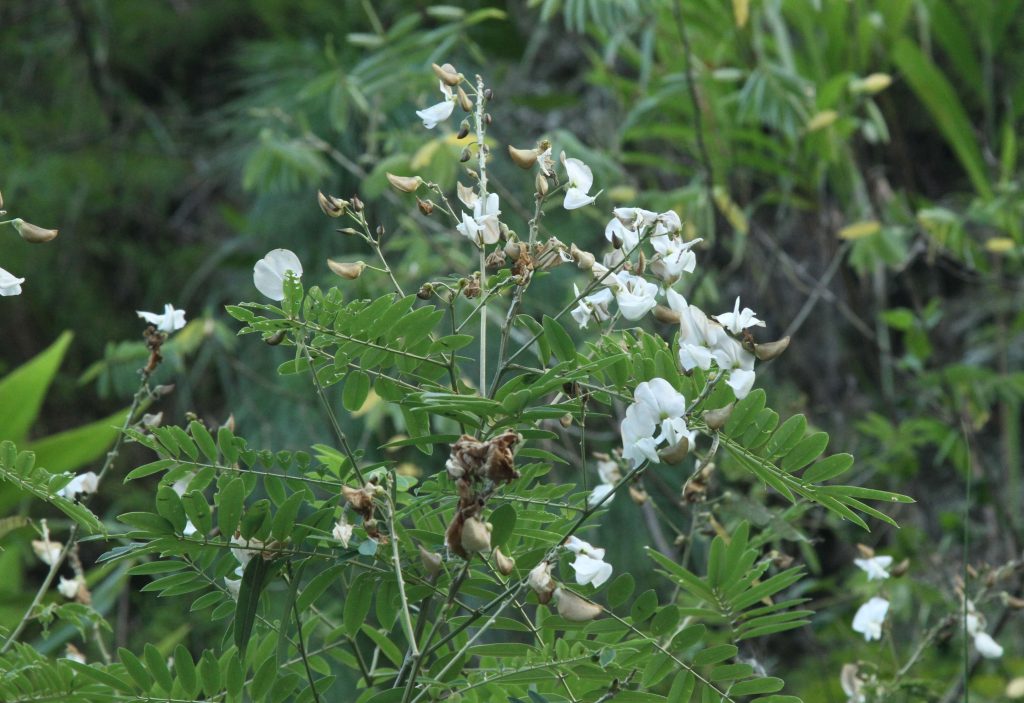
Tephrosia candida is a shrubby legume native to the Indian subcontinent and adjacent Himalaya, including India, Nepal and Bhutan, but now pantropically naturalised through widespread cultivation, with GBIF records from Brazil, Indonesia, Taiwan, China, Papua New Guinea, Australia, Madagascar, the Caribbean, the Mascarenes and beyond. It thrives in warm subtropical and tropical conditions on forest margins, roadsides, river banks and disturbed open ground. The Bhutanese collections illustrate its altitudinal breadth, from Galephu in the foothills at about 650 m in October to Wangdi at 2600 m flowering in September.

The plant is an erect, much-branched shrub up to about 3 m, with silky-pubescent young growth. The leaves are imparipinnate with numerous (often 8-12 pairs of) narrowly oblong leaflets that are silky-sericeous beneath, giving the foliage a greyish sheen. The flowers are borne in dense terminal racemes; each papilionate flower has a campanulate pubescent calyx and a white to pale pink or cream corolla with a broad standard silky on the outer face, the keel and wings enclosing diadelphous stamens. The fruit is a flattened, linear, densely velvety-pubescent dehiscent pod that twists on splitting to expel several seeds.

A member of the papilionoid Fabaceae and tribe Millettieae, T. candida is a nitrogen-fixing species long valued as a green manure, cover crop, fallow improver and erosion-control plant, which explains its extensive intentional dispersal across the tropics. Like other Tephrosia it contains rotenoid compounds and has been used as a fish poison and insecticide. Robust and weedy in cultivation, it is in no way of conservation concern and can become locally naturalised.

Author: DC. · Sources: POWO (Kew), GBIF, Flora of Bhutan, Flora of British India, Brummitt's and related revisions of Tephrosia (Leguminosae)

Benth.

Sikkim2011 151
Sikkim Kalep 3670m, June
Nepal 99 452 ergebnis
West-Nepal Naphukana 3080m, June

Description

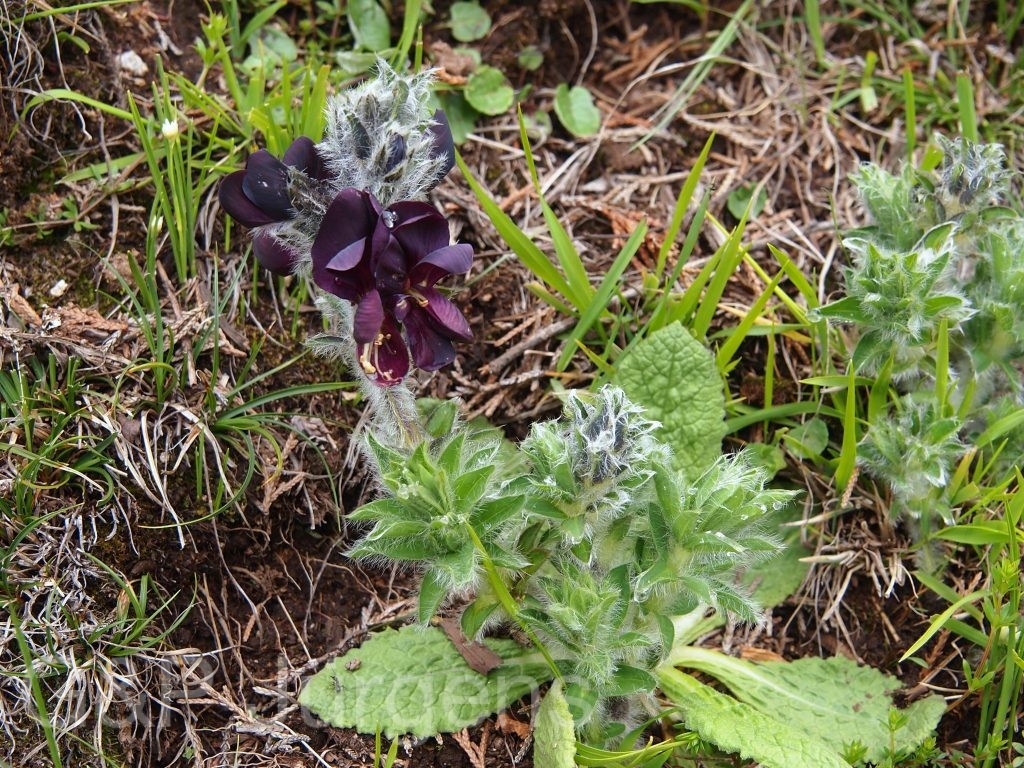
Thermopsis barbata Benth. is a distinctive legume of the high Himalaya, occurring across China, India, Nepal and Bhutan. It is documented from Sikkim at Kalep around 3670 m and from West-Nepal at Naphukana near 3080 m, both flowering in June, within the subalpine to alpine belt. The species favours open stony slopes, dry grassy hillsides, gravelly pastures and the margins of alpine scrub, typically between 3000 and 4500 m, on well-drained, often disturbed substrates exposed to strong sun and seasonal aridity. Its roughly 606 GBIF records indicate a widespread but characteristically montane Himalayan range.

The plant is a robust perennial herb arising from a stout rootstock, the erect stems and foliage conspicuously clothed in long, soft, silky to villous hairs that give the epithet barbata. The leaves are palmately trifoliolate with elliptic to obovate leaflets and large persistent stipules. The flowers are arranged in a dense terminal raceme and are notably large for the genus, the papilionaceous corolla a deep purple to violet-maroon rather than the yellow usual in Thermopsis, subtended by hairy bracts and an enlarged calyx. The fruit is a hairy, flattened, several-seeded legume.

Thermopsis barbata is exceptional within its predominantly yellow-flowered, north-temperate genus for its dark purple corolla and dense pubescence, traits interpreted as adaptations to the cold, high-radiation alpine environment. Like many genistoid legumes it contains quinolizidine alkaloids that deter herbivores. Widespread and locally frequent across its range, it is not regarded as threatened, though high-altitude grazing and pasture degradation may locally affect populations.

Author: Benth. · Sources: POWO (Kew), GBIF, Flora of China, Flora of Nepal, Flora of British India, Legumes of the World (Lewis et al.)