Fabaceae

Thoth.

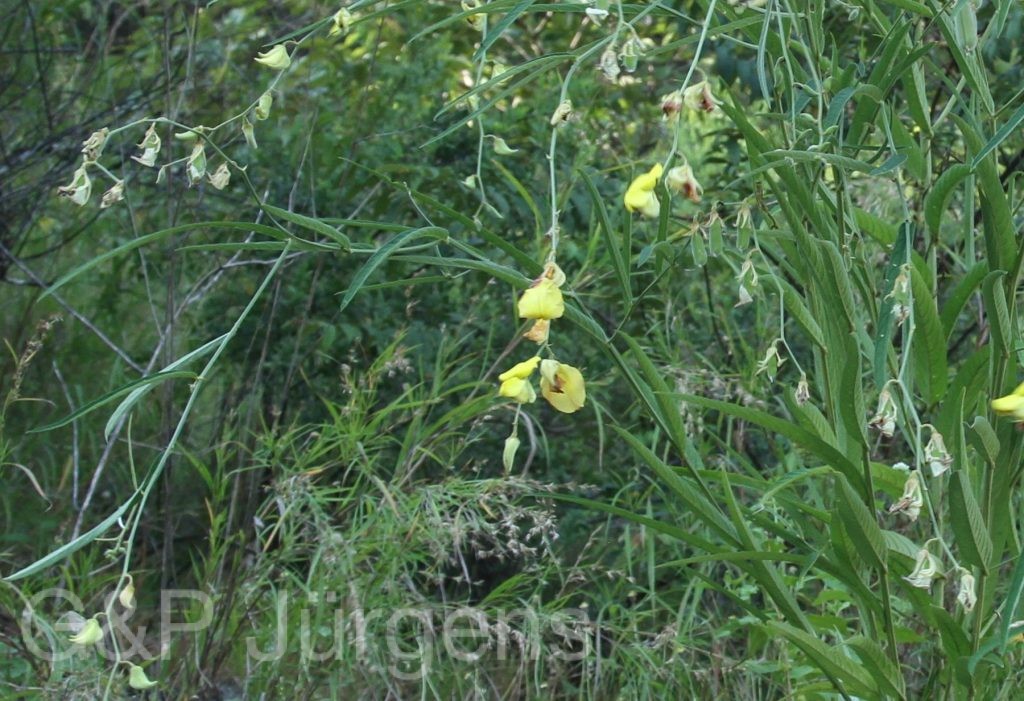
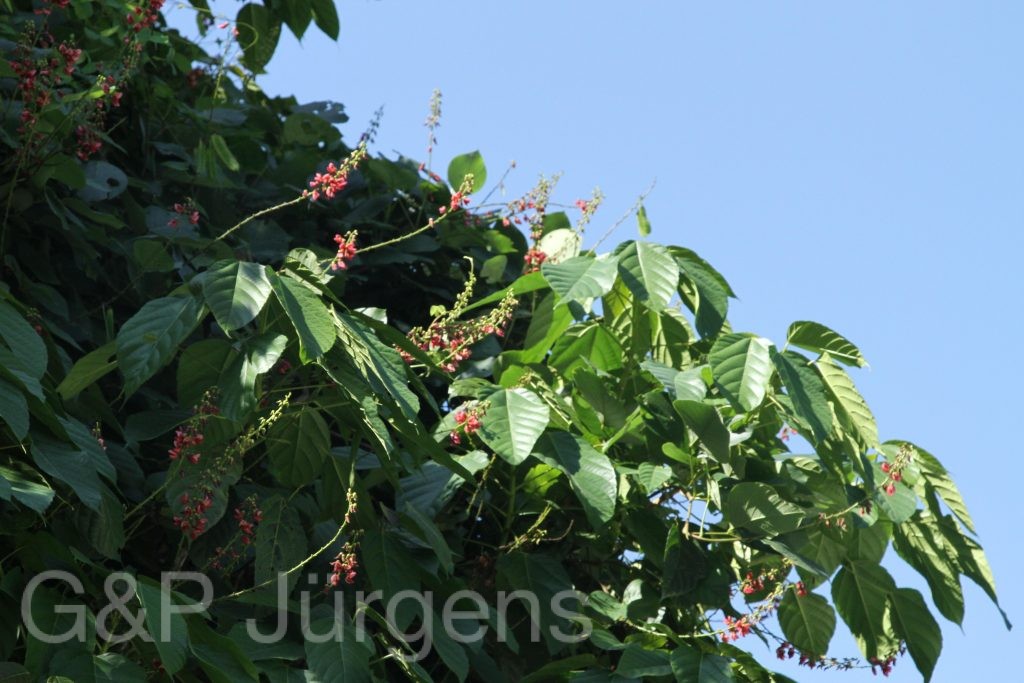
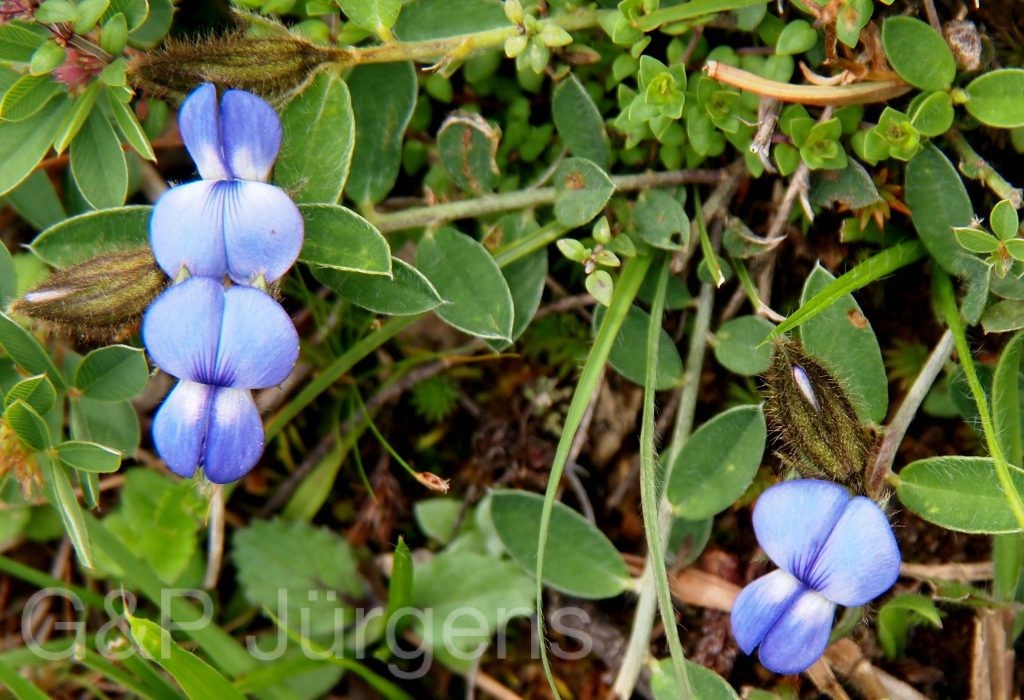
Bhutan2012 190
Bhutan Haar-Valley, 3300m September
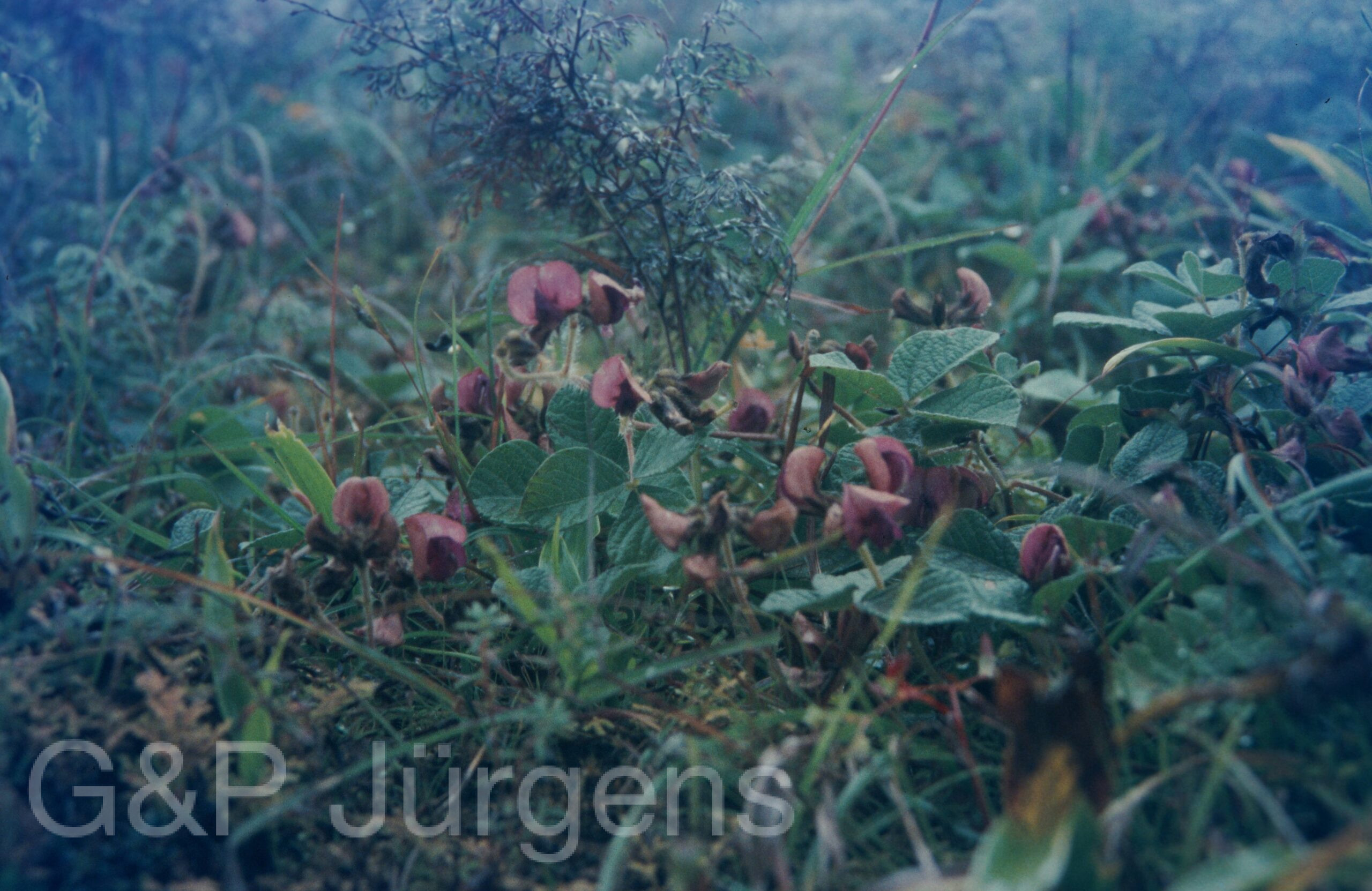
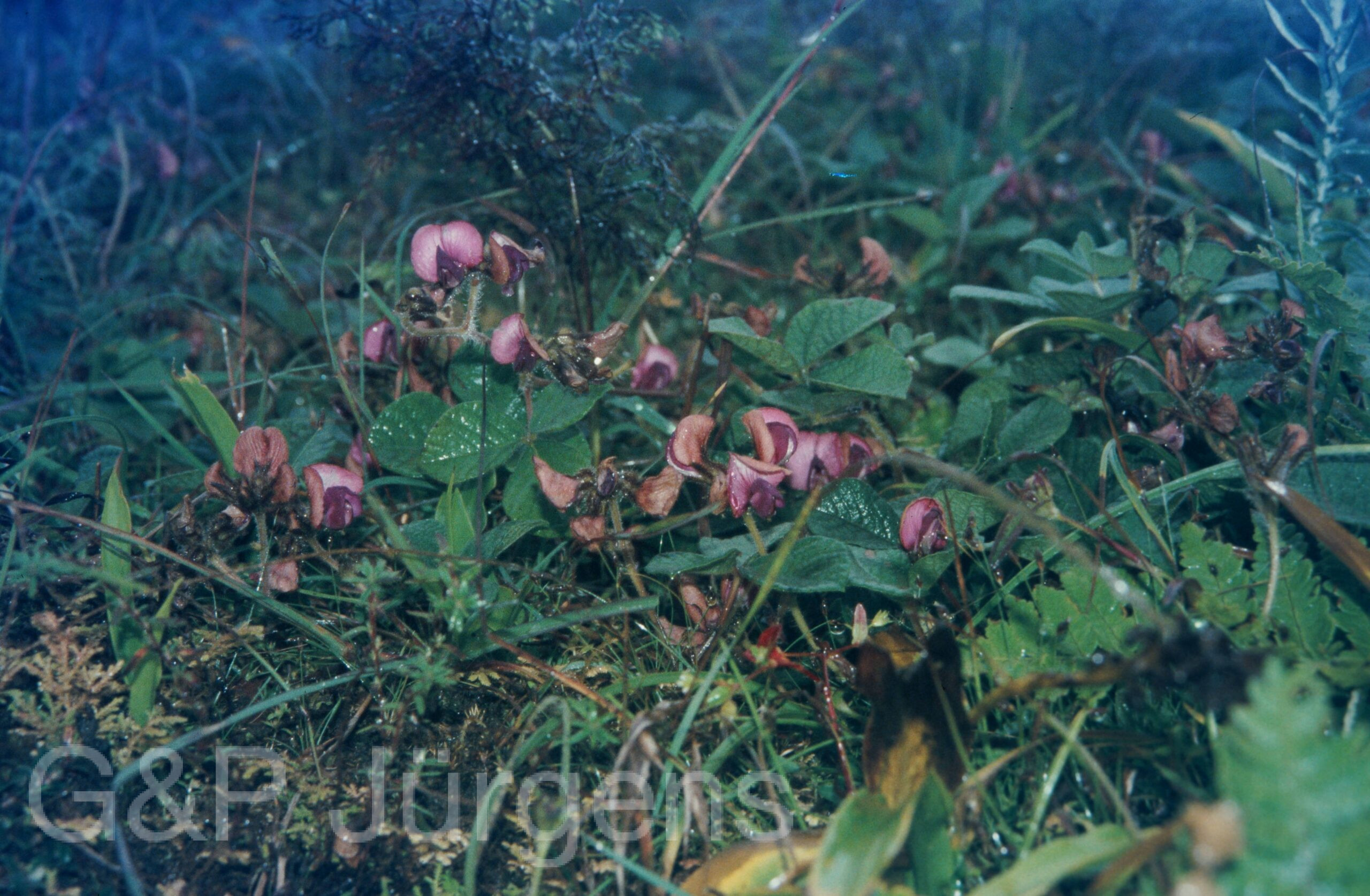
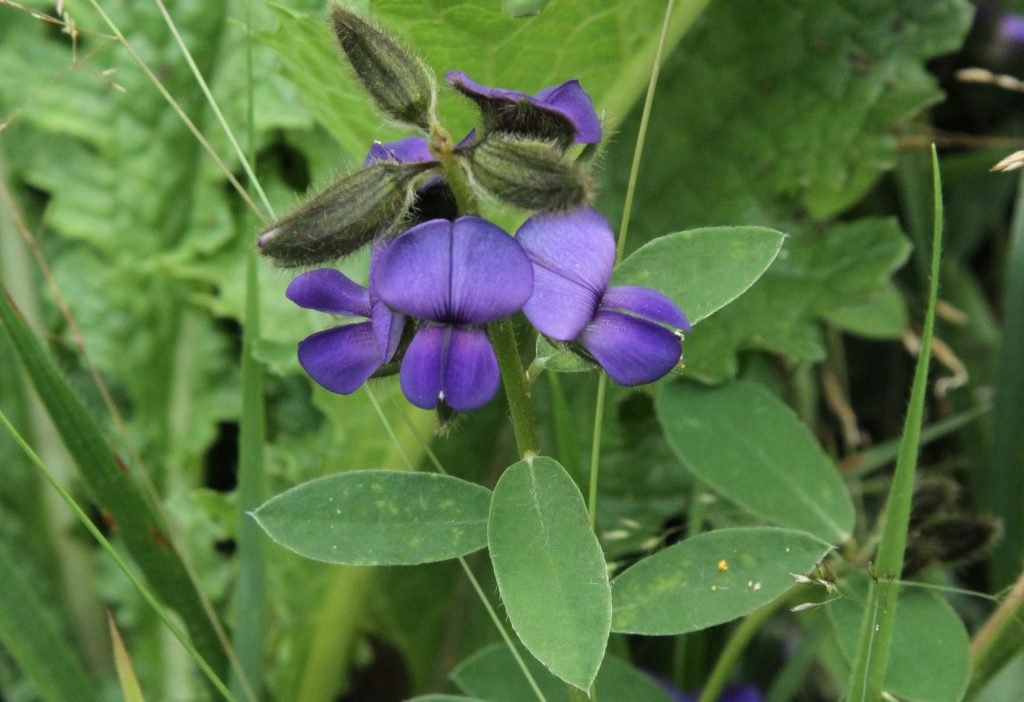
Bhutan2012 362
Bhutan Dochu-La 2700m, September

Description

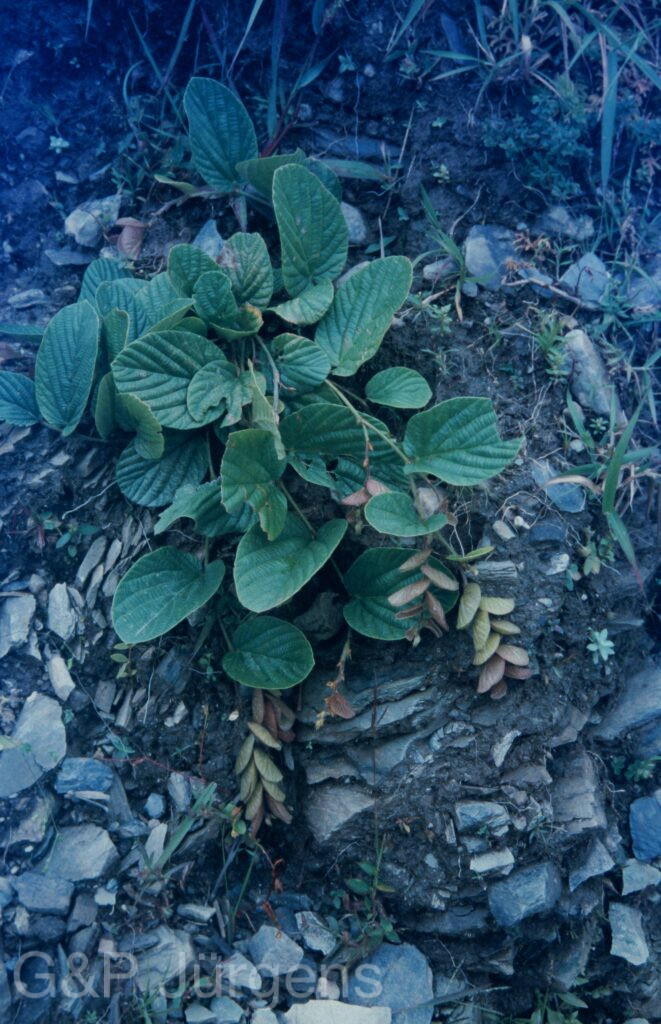
Crotalaria bhutanica is a narrowly distributed legume of the eastern Himalaya, described from and centred on Bhutan; it has no georeferenced records in GBIF, underscoring how poorly documented and locally restricted this taxon remains. It is a plant of open grassy slopes, scrub and disturbed montane ground, and the two collection sites given, the Haar valley at about 3300 m and Dochu-La at 2700 m, both in September, place it in the cool temperate to subalpine zone of western and central Bhutan, where it flowers and fruits in the late monsoon and early autumn.

Like others of its genus, the species is a herb or small subshrub with simple or trifoliolate leaves and stems bearing the appressed hairs characteristic of Crotalaria. The flowers are arranged in terminal or leaf-opposed racemes and have the typical papilionaceous structure of the genus, with a large rounded standard, two lateral wings and a beaked keel enclosing the stamens and style; the corolla is yellow, sometimes veined or flushed with brown or purple. The fruit, as in all Crotalaria, is an inflated, bladder-like pod in which the loosened seeds rattle when ripe, the feature that gives the genus its name (from the Greek krotalon, a rattle).

Crotalaria (tribe Crotalarieae, subfamily Faboideae) is a large pantropical genus, and C. bhutanica is one of its restricted Himalayan endemics, distinguished within the regional flora by its combination of habit, indumentum and floral detail. Like most papilionoid legumes it forms nitrogen-fixing root nodules with rhizobia and is pollinated by bees adapted to tripping the keel mechanism. Given its apparently very limited range, the absence of occurrence data, and ongoing pressures on Himalayan grassland habitats, the species warrants targeted survey and a formal conservation assessment.

Author: Thoth. · Sources: POWO (Kew), GBIF, Flora of Bhutan, Polhill Crotalaria in Africa and Madagascar, Legumes of the World (Lewis et al.)
DC.

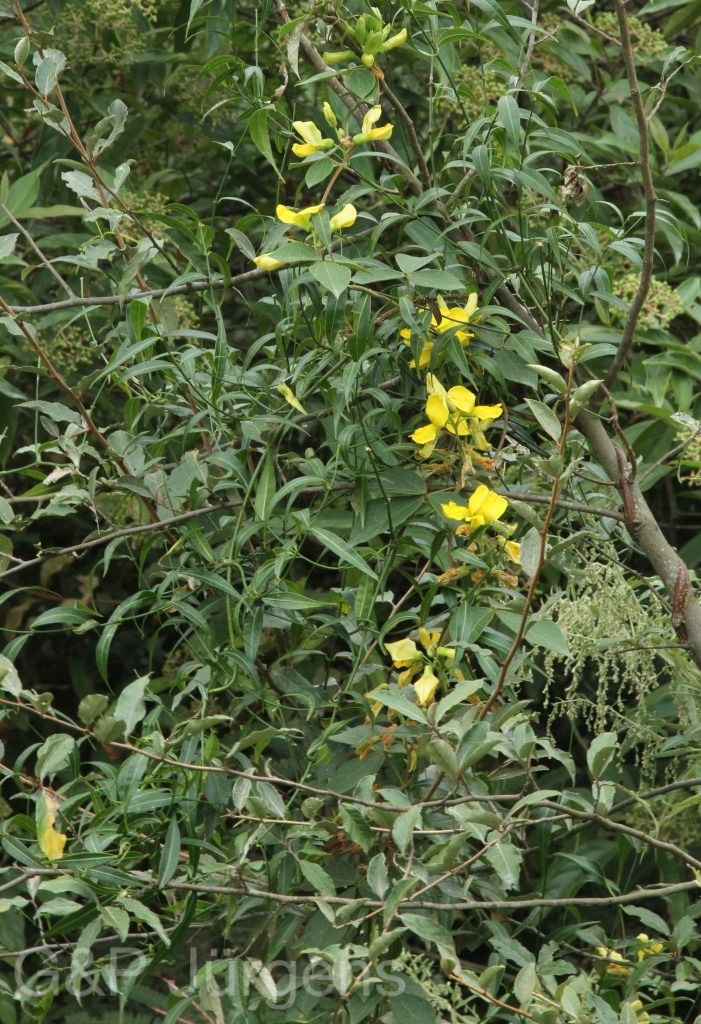
Bhutan2012 822 Kopie
Bhutan Trongsa 2100m, October
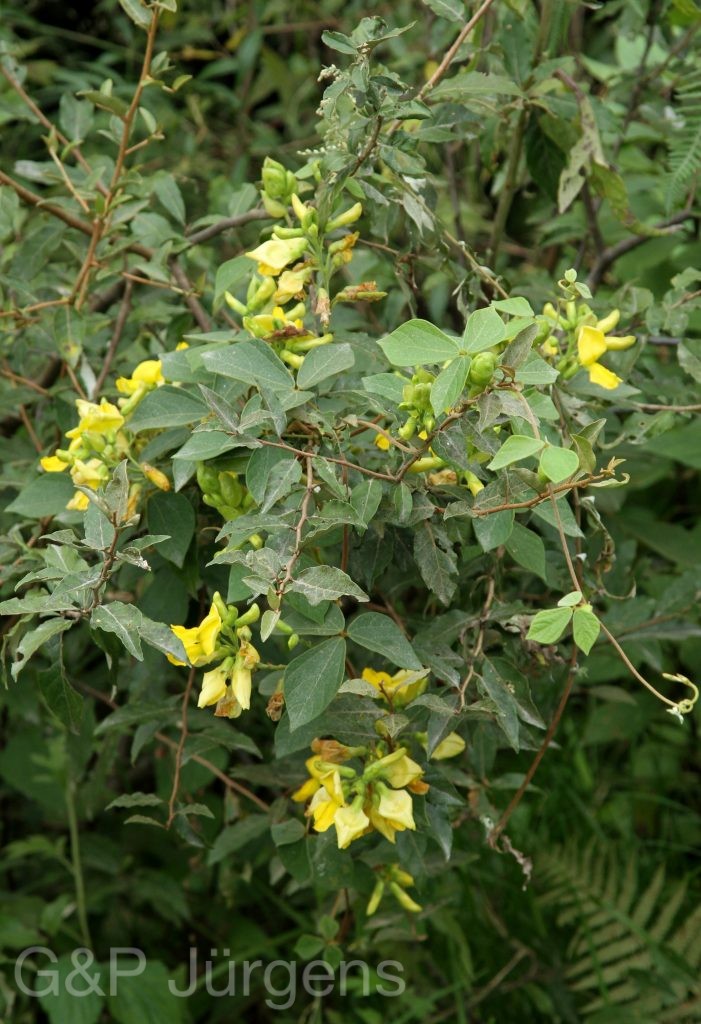
Bhutan2012 823
Bhutan Trongsa 2100m, October

Description

Crotalaria cytisoides is a shrubby rattlepod of the Himalaya and into Southeast Asia. GBIF records it from China, India, Nepal, Myanmar, Thailand, Bhutan, Laos, Malaysia and Indonesia, with further occurrences extending to Madagascar and Uganda, totalling over 400 records. It grows on open hill slopes, scrub, grassy banks, forest margins and roadsides at lower to middle elevations, broadly between 1000 and 2700 m. The plant shown was photographed near Trongsa in central Bhutan at 2100 m in October, flowering in the post-monsoon period along the warm temperate hill zone where this species is a frequent component of disturbed scrub.

It is a much-branched shrub or undershrub with silky-pubescent young branches. The leaves are trifoliolate, the obovate to elliptic leaflets softly hairy beneath, subtended by small stipules. The flowers are borne in terminal and leaf-opposed racemes; the papilionaceous corolla is yellow, sometimes veined or flushed reddish-brown on the standard, with the keel beaked as is typical of the genus. The fruit is an inflated, oblong legume in which the loosened ripe seeds rattle when shaken, the feature giving Crotalaria its English name rattlepod.

Crotalaria is a large pantropical legume genus, and like its relatives it forms root nodules with nitrogen-fixing rhizobia, enriching poor soils and contributing to its success as a coloniser of disturbed ground. Many species, including this one, contain pyrrolizidine alkaloids that deter herbivores and can be toxic to livestock. With its wide distribution, ruderal tendency and abundant seed production, C. cytisoides is common and of no conservation concern across its broad range.

Author: DC. · Sources: POWO (Kew), GBIF, Flora of China, Flora of Bhutan, Annotated Checklist of the Flowering Plants of Nepal, A revision of the genus Crotalaria (Leguminosae)

L.

Bhutan2012 625
Bhutan Wangdi 2800m, September

Description

Crotalaria sessiliflora is a wide-ranging Asian-Australasian rattlepod, recorded by GBIF (3102 occurrences) from China, Japan, Korea, Taiwan, India, Thailand, Indonesia, Papua New Guinea, Australia, Nepal, the Philippines, Myanmar, Bhutan, Malaysia and Indochina. It is a plant of open, sunny, seasonally dry habitats, occupying grasslands, hill slopes, fallow fields, roadsides and waste ground from the lowlands up into the lower mountains, roughly to 2800 m. The photographed plant from near Wangdi in western Bhutan at about 2800 m, flowering in September, sits at the upper elevational margin of the species and reflects its late-monsoon flowering across the eastern Himalaya.

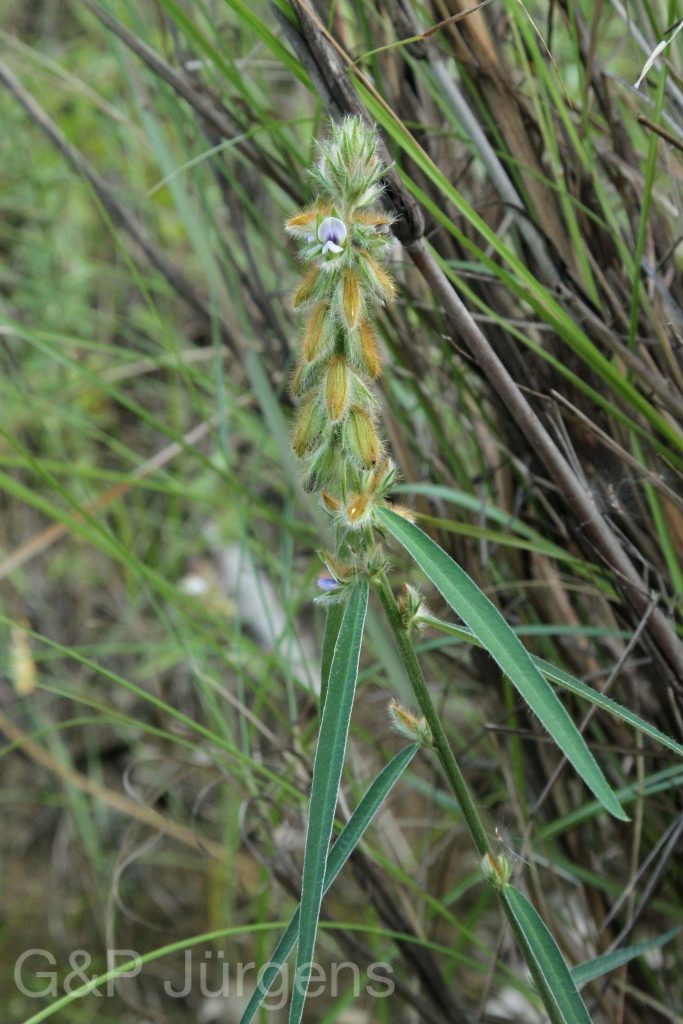
The species is an erect annual herb, usually 30-100 cm tall, with stems and foliage clothed in long, spreading brownish hairs. The leaves are simple (unifoliolate), narrowly linear to oblanceolate, sessile or shortly petiolate, with conspicuous setose stipules. The flowers are borne in dense, head-like or short terminal racemes, often crowded and almost sessile as the epithet indicates, each subtended by leafy bracts. The papilionate corolla is blue, violet or pale purple, the standard hairy outside. As in Crotalaria the stamens are monadelphous with dimorphic anthers. The fruit is a small, inflated, oblong pod enclosed by the persistent calyx, the loose seeds rattling within when ripe.

Described by Linnaeus, the species belongs to the large pantropical genus Crotalaria (Fabaceae, subfamily Faboideae, tribe Crotalarieae). Like its relatives it forms root nodules with rhizobial bacteria, fixing atmospheric nitrogen and enriching soils, and is sometimes grown as a green manure. The plant contains pyrrolizidine alkaloids and is used in traditional Asian medicine, though these compounds render it potentially toxic to livestock. With an extensive range and weedy tendencies it is of least conservation concern.

Author: L. · Sources: POWO (Kew), GBIF, Flora of China, Flora of Bhutan, Monograph of the genus Crotalaria (Polhill)

Andrews

Bhutan2012 1148
Bhutan Trashiyangtse 1780m, October

Description

Crotalaria tetragona Andrews is a tall rattlepod widely distributed across tropical and subtropical Asia, native from India, Nepal, Bhutan and Bangladesh through southern China, Myanmar, Thailand, Laos, Vietnam, Cambodia and the Malesian region; GBIF lists about 405 occurrences, with records from Brazil, Jamaica, Colombia and Mauritius indicating introduction and naturalisation. It grows in open grassland, forest margins, scrub and disturbed roadside ground in the warm subtropical and submontane zone, generally below about 2000 m. The photographed plant from Trashiyangtse in eastern Bhutan at around 1780 m, flowering in October, reflects its occurrence in warm, lower-elevation valley habitats.

The species is a robust erect perennial herb or subshrub with conspicuously four-angled, often winged stems, the epithet tetragona alluding to this quadrangular form. The leaves are simple, elliptic to lanceolate and entire. The flowers are borne in long terminal racemes and are large and bright yellow, with the standard frequently veined reddish-brown; the calyx is deeply lobed and the keel beaked in the papilionaceous arrangement. The fruit is a large, inflated, oblong pod that turns blackish and rattles when the loose seeds detach at maturity, giving the genus its common name.

Crotalaria (Fabaceae, subfamily Faboideae, tribe Crotalarieae) is a large pantropical genus of nitrogen-fixing legumes, several used as green manure and fibre plants. C. tetragona is locally common and weedy, of least conservation concern, and like its congeners may contain pyrrolizidine alkaloids rendering it toxic to livestock.

Author: Andrews · Sources: POWO (Kew), GBIF, Flora of China, Flora of Bhutan, Flora of British India, Polhill monograph Crotalaria in Africa and Asia

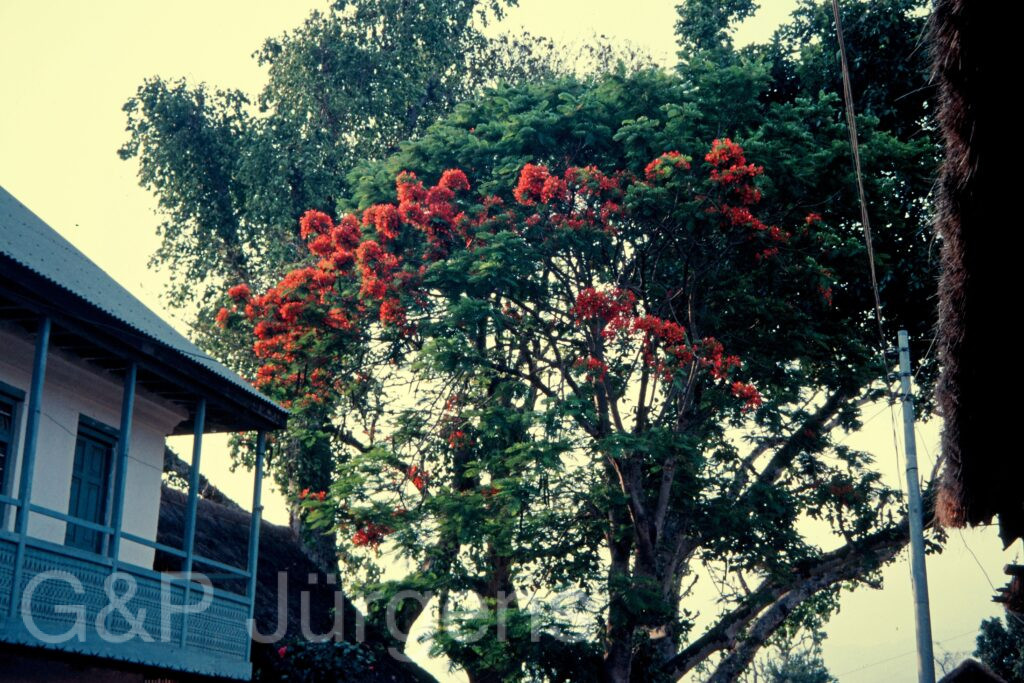
Delonix regia

by GP Jürgens

(Bojer ex. Hook.) Raf.

Nepal 97 595 P1150
Nepal Sabha-Khola 1200m,May
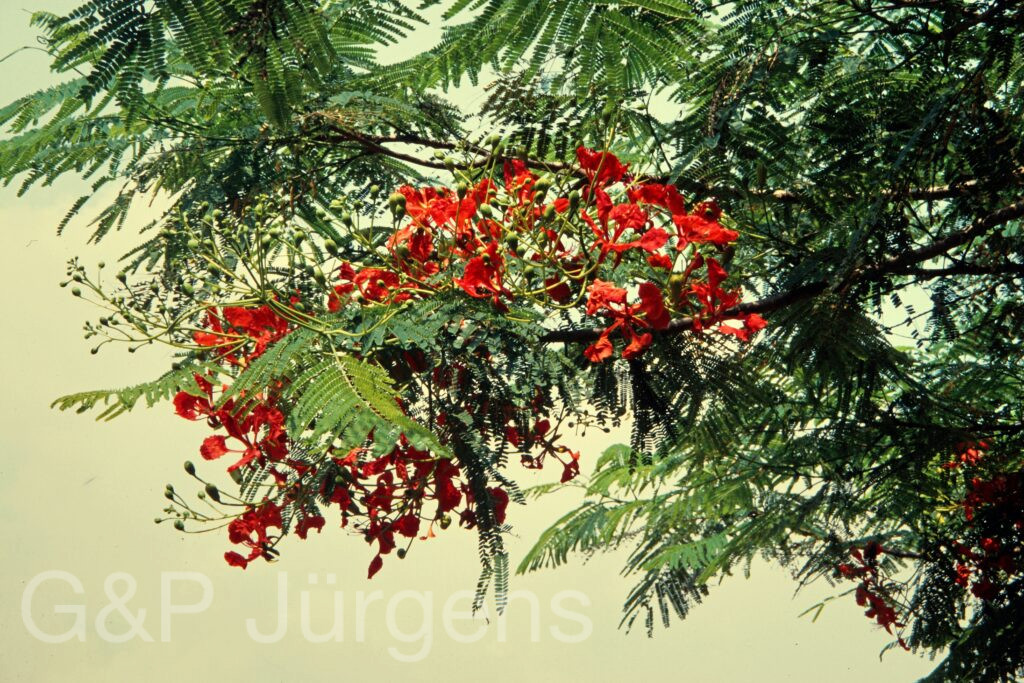
Nepal 97 596 G1151
Nepal Sabha-Khola 1200m,May
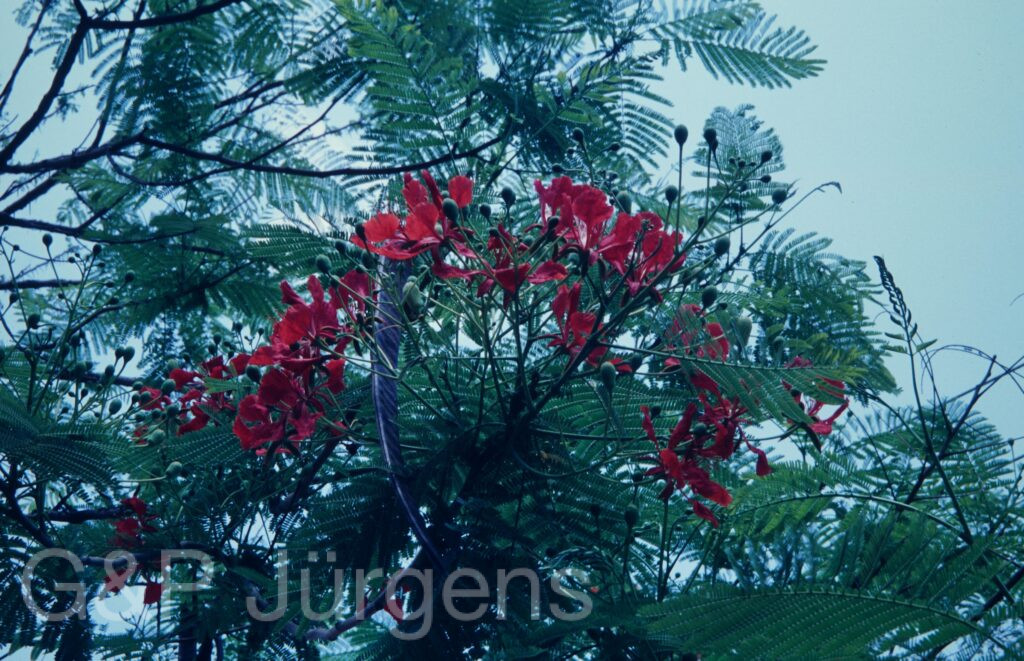
Nepal 1994 335 2 ergebnis
Ost-Nepal Chainpur 400m May 

Description

Delonix regia is one of the most widely cultivated ornamental trees of the tropics, native to the deciduous and dry forests of western Madagascar but now naturalised and planted across the warm regions of every continent. GBIF records reflect this pantropical spread, with occurrences across India, Australia, Brazil, Mexico, the United States, Tanzania, Madagascar, Thailand, China, Kenya, South Africa and the Dominican Republic, drawn from more than 27,000 documented collections. In the eastern Himalaya it occurs only as an introduced shade and avenue tree of the warm lowlands and foothills; the photographed material from the Sabha-Khola valley at 1200 m and from Chainpur in East Nepal at around 400 m, flowering in May, lies near the upper altitudinal limit at which the species thrives, requiring frost-free, seasonally dry, sun-exposed sites.

It forms a spreading, umbrella-crowned deciduous tree to 10–15 m, the trunk often buttressed and the bark smooth and grey. The leaves are large, bipinnate and fern-like, with 10–25 pairs of pinnae each bearing numerous small oblong leaflets. The flowers, borne in showy corymbose racemes, are large and zygomorphic with five clawed, spreading petals, four scarlet to orange-red and one larger, whitish or yellow petal streaked with red; the ten stamens are long and exserted with red filaments. The fruit is a large, woody, flattened legume to 60 cm long, persistent and dark brown when ripe, containing numerous hard, mottled seeds.

A member of the Caesalpinioid clade of the Fabaceae, Delonix is a small genus centred on Madagascar and East Africa. Though abundant in cultivation, the species is assessed as of conservation concern in its native range owing to deforestation and a highly restricted wild distribution. Its conspicuous flowering, drought tolerance and nitrogen-fixing capacity have made it a favoured street and amenity tree throughout the tropics, where it is valued equally for shade and ornament.

Author: (Bojer ex. Hook.) Raf. · Sources: POWO (Kew), GBIF, Flora of Nepal, Flora of Madagascar (Flore de Madagascar et des Comores), Legumes of the World (Lewis et al.)
(Grierson & D.G.Long) Panigrahi

Nepal 97 51 P77
Nepal Mewa-Khola 1130m April
Nepal 97 50 P76
Nepal Mewa-Khola 1130m April

Description

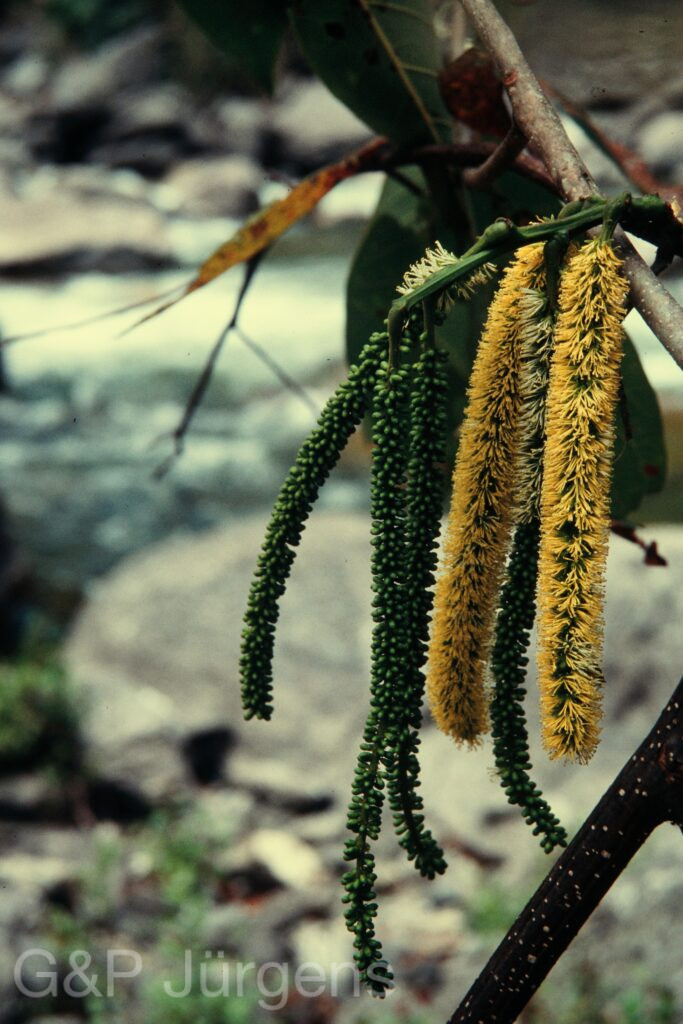
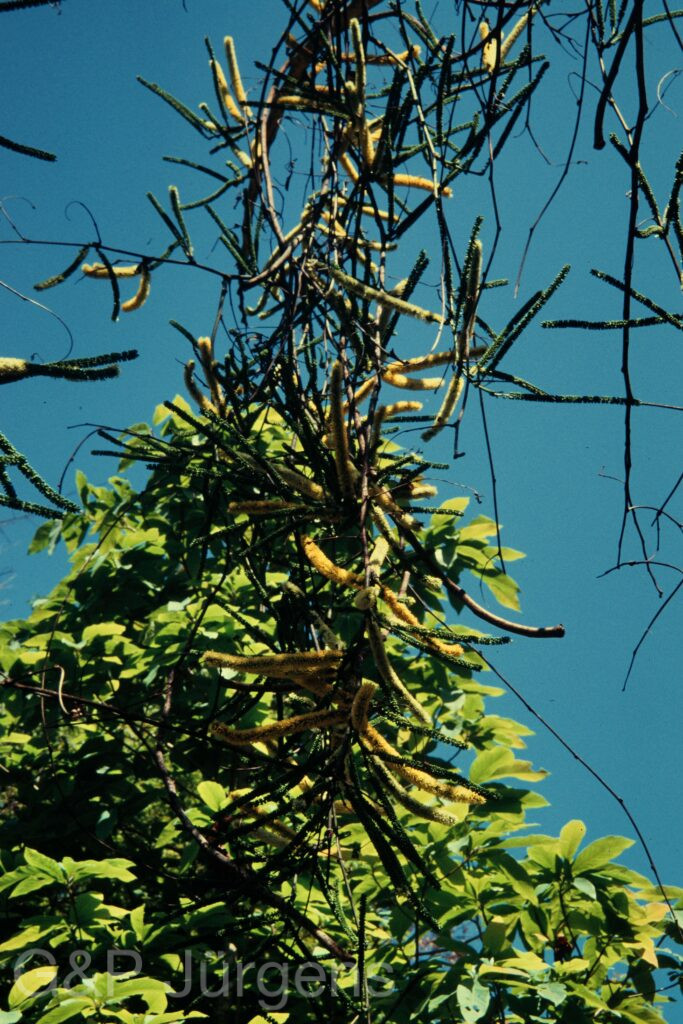
Entada rheedii subsp. sinohimalensis is a Sino-Himalayan liana of warm lower-montane forest, treated by GBIF as a synonym of the accepted Entada rheedii sinohimalensis (under E. rheedii Spreng.). It is a localised eastern Himalayan taxon ranging from Nepal and Sikkim into Bhutan and adjacent China and Myanmar; GBIF holds a single Bangladesh record, underscoring how sparsely this giant climber is documented. It grows in broadleaved subtropical forest and ravine vegetation at low elevations, as in the Mewa Khola of eastern Nepal at 1130 m in April, where it scrambles high into the canopy along humid river valleys.

It is a massive woody liana with stout, twining stems and tendrillate, bipinnate leaves whose pinnae bear several pairs of asymmetric oblong leaflets, the terminal pair of pinnae often modified into a coiling tendril. The flowers are small, sessile and crowded in slender elongate spikes, creamy white to greenish-yellow, with a five-toothed calyx, five free petals and ten exserted stamens giving the inflorescence a feathery aspect. The fruit is among the largest of any legume – a huge, woody, flattened pod up to a metre long that breaks transversely into one-seeded segments, each enclosing a large, hard, glossy brown "sea bean" capable of long-distance hydrochory.

Within the mimosoid clade of Fabaceae, Entada is a pantropical genus of lianas, and subsp. sinohimalensis represents the inland Himalayan-Chinese expression of the widespread E. rheedii. The buoyant, durable seeds are dispersed by water and ocean currents and are used as charms and in folk medicine. The taxon is rarely collected and its conservation status remains unassessed.

Author: (Grierson & D.G.Long) Panigrahi · Sources: POWO (Kew), GBIF, Flora of China, Flora of Bhutan, Annotated Checklist of the Flowering Plants of Nepal, Brenan monograph of Entada

Roxb.

Bhutan2015 65
Bhutan Wangdi Phodrang 1900m, October
Bhutan2012 464
Bhutan Wangdi 2500m, September

Description

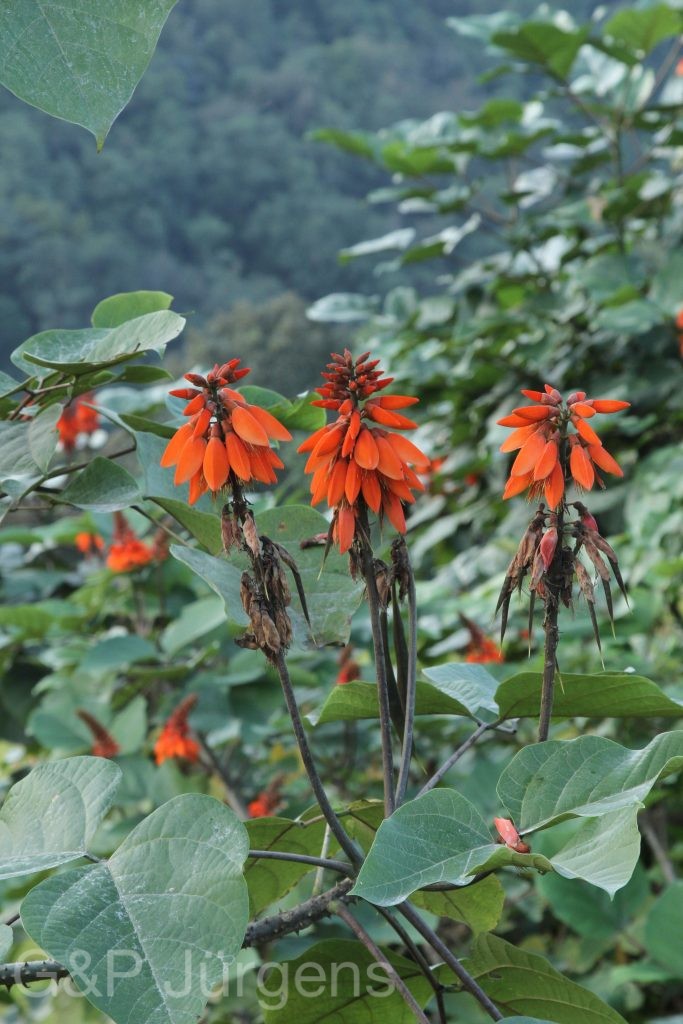
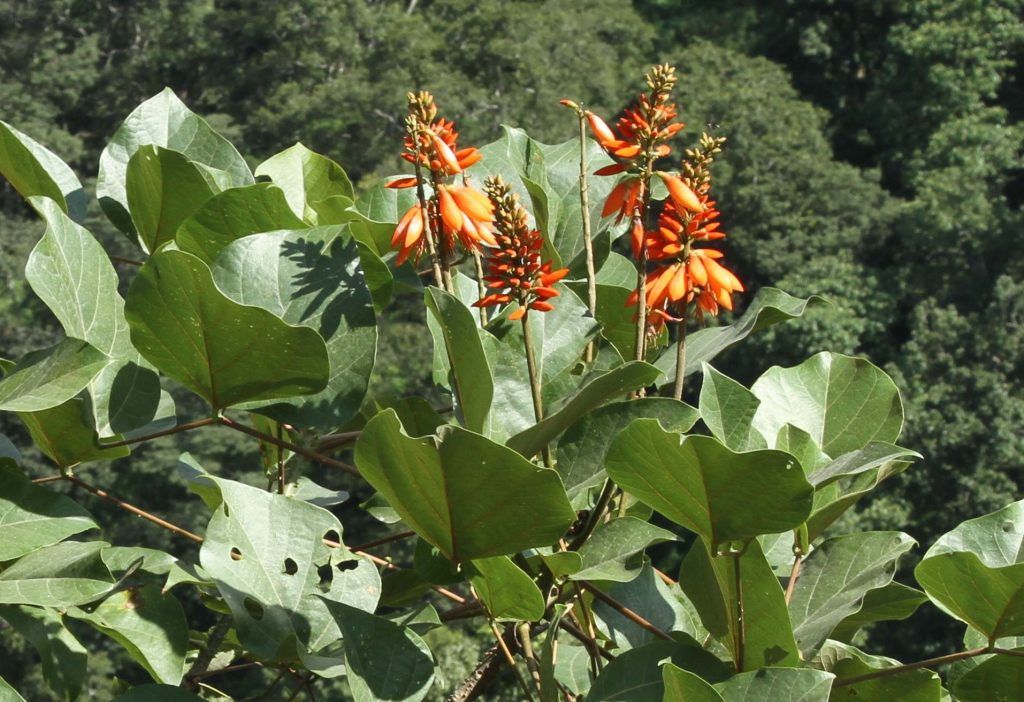
Erythrina arborescens is a Himalayan to Southeast Asian coral tree distributed across China, India, Nepal, Bhutan, Myanmar, Bangladesh, Japan and Thailand, with about 369 GBIF occurrences spanning this wide subtropical to warm-temperate range. It grows in open broad-leaved forest, forest margins, valley slopes and disturbed ground, generally from about 1300 to 3000 m. The trees photographed near Wangdi Phodrang in Bhutan at about 1900 m in October and at about 2500 m in September illustrate its mid-elevation valley habitat, where its scarlet flower spikes appear after the leaves toward the close of the monsoon.

The species is a small to medium-sized deciduous tree with a stout trunk and branches armed with scattered conical prickles. The leaves are alternate and trifoliolate, with broadly ovate to rhombic leaflets, the terminal one largest, on a long prickly petiole. The inflorescence is a dense terminal raceme of large, showy, bright red papilionaceous flowers in which the broad standard petal is conspicuously enlarged while the wings and keel are reduced, an arrangement adapted to bird pollination. The fruit is an elongate, torulose, dehiscent legume constricted between the few shining red-brown seeds.

Erythrina is a pantropical genus of about 130 species notable for ornithophilous, nectar-rich flowers and seeds containing toxic isoquinoline alkaloids. E. arborescens is among the few species extending into temperate Himalayan elevations, its post-monsoon flowering and copious nectar attracting sunbirds and other nectarivorous birds that serve as pollinators. Widely distributed and tolerant of disturbance, it is of least concern; it is locally valued as a shade and ornamental tree and features in traditional medicine across its range.

Author: Roxb. · Sources: POWO (Kew), GBIF, Flora of China, Flora of Bhutan, Annotated Checklist of the Flowering Plants of Nepal, Krukoff & Barneby studies of Erythrina

Wall. ex Benth.

Bhutan2015 109
Bhutan Galephu 500m, October

Description

Flemingia paniculata Wall. ex Benth. is a subshrubby legume of the warm submontane belt of tropical and subtropical Asia, recorded from Thailand, Myanmar, India, Nepal, Malaysia, China, Bhutan, Laos and the Philippines, with about 106 georeferenced occurrences in GBIF. It grows in open forest, scrub, grassy slopes, forest margins and disturbed ground at low to moderate elevations, broadly from near sea level to around 1500 m. The photographed plant was found at Galephu in southern Bhutan at about 500 m in October, in the hot, humid foothill zone where the species flourishes in seasonally dry secondary vegetation.

The plant is an erect or ascending perennial herb or small shrub with ribbed, often pubescent stems. The leaves are characteristically unifoliolate (reduced to a single leaflet, unlike the trifoliolate condition of many congeners), the blade ovate to elliptic, prominently veined and frequently glandular, subtended by persistent stipules. The flowers are borne in dense terminal and axillary panicles; the papilionaceous corolla is typically purplish to pinkish, enclosed by a calyx whose lobes are unequal. The fruit is a small, inflated, two-seeded legume that is somewhat hairy and gland-dotted, dehiscing to release the seeds.

Flemingia belongs to the tribe Phaseoleae and is closely allied to Cajanus, distinguished by its glandular indumentum and pod structure; the genus has medicinal and dye uses across its range, several species yielding the orange resin known as waras. Plants help colonise disturbed and degraded slopes and, as nitrogen-fixing legumes, contribute to soil enrichment. The species is widespread and not of conservation concern, though its foothill habitats face pressure from agricultural expansion.

Author: Wall. ex Benth. · Sources: POWO (Kew), GBIF, Flora of China, Flora of Bhutan, Flora of Thailand, Lewis et al. Legumes of the World

Roxb.

Description

Flemingia procumbens is a prostrate, sub-Himalayan legume distributed from the western Himalaya eastward through Nepal into southern China, with scattered records reaching Laos and New Guinea. GBIF documents some 61 occurrences across India, China, Nepal, Laos and Papua New Guinea, reflecting a discontinuous range spanning warm-temperate montane slopes and submontane grasslands. The species favours open, sunny banks, terraced field margins, dry hill grasslands and stony, well-drained soils, typically flowering in late summer and early autumn. The material illustrated here was gathered in India at Garhwal, Simkarok, at about 2600 m in September, an elevation characteristic of its mid-altitude preference along the outer Himalayan ranges.

The plant is a low perennial herb or subshrub with trailing to decumbent, often somewhat woody stems arising from a stout rootstock, the younger branches finely pubescent. The leaves are pinnately trifoliolate with prominent stipules, the leaflets elliptic to obovate, entire-margined and glandular-punctate beneath, borne on short petiolules. Small papilionaceous flowers, pink to purplish, are aggregated in dense axillary or terminal racemes subtended by bracts; the calyx is deeply lobed and the standard petal exceeds the wings and keel. The fruit is a small, turgid, two-seeded pod which dehisces explosively at maturity, releasing minute, smooth seeds.

Flemingia is a genus of the tribe Phaseoleae closely allied to Moghania and frequently subsumed within or segregated from it by various authors; the gland-dotted foliage and inflated pods are diagnostic of the group. Several species yield the orange resinous dye and dusting powder known as waras, harvested from glandular hairs of the inflorescences. F. procumbens has no recognised conservation concern given its broad if sparse distribution, though montane grassland habitats face pressure from grazing and land conversion.

Author: Roxb. · Sources: POWO (Kew), GBIF, Flora of China, Flora of British India, The Legumes of the Indian Subcontinent, A Revision of the Genus Flemingia (Leguminosae-Papilionoideae)

(L.) W.T.Aiton

Garw 2005 246 ergebnis ergebnis
India Garhwal Sitel 1850m, September

Description

Flemingia strobilifera is a widespread shrub of tropical and subtropical Asia, now pantropical through introduction, recorded from India, China, Nepal, Myanmar, Thailand, Taiwan, the Philippines, Malaysia, Indonesia, Papua New Guinea and numerous tropical American localities; its roughly 3874 georeferenced records make it by far the most abundantly documented species in this group. It thrives in open forest, scrub, grassland, roadsides and disturbed ground from the lowlands to about 1900 m. The plant photographed at Sitel in the Garhwal Himalaya at 1850 m, flowering in September, marks the upper subtropical edge of its Himalayan range.

It is an erect, branching shrub to about 1-2 m with finely pubescent, angled stems. The leaves are simple (not trifoliolate as in most relatives), ovate to elliptic, acuminate, with three prominent basal veins and entire margins. The species is at once recognised by its inflorescence: the small purplish papilionaceous flowers are enclosed within conspicuous, accrescent, folded and reniform bracts that overlap to form a cone- or strobilus-like cluster, hence the epithet strobilifera. The fruit is a small, inflated, two-seeded pod hidden among the persistent bracts.

Flemingia, of tribe Phaseoleae, is distinguished from Cajanus and allies by its glandular pods and, in this species, the showy enclosing bracts. F. strobilifera is highly variable and several infraspecific forms have been recognised. It is widely used in folk medicine and as a green manure and cover crop, and its nitrogen-fixing root nodules aid soil improvement on poor ground. A vigorous coloniser, it is locally regarded as weedy and is of no conservation concern.

Author: (L.) W.T.Aiton · Sources: POWO (Kew), GBIF, Flora of China, Flora of British India, Annotated Checklist of the Flowering Plants of Nepal, Mukerjee revision of Flemingia