Tag:

Autumn

Hook.f. & Thomson

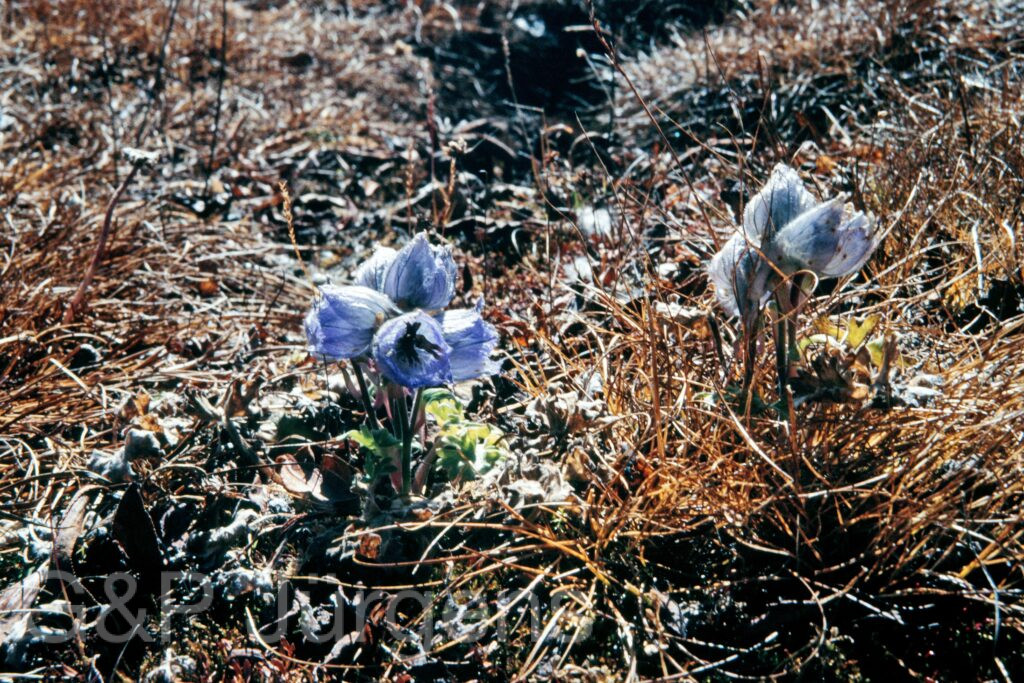
Nepal 95 415 G723 ergebnis
Nepal Jaisuli Kund 4200m October

Description

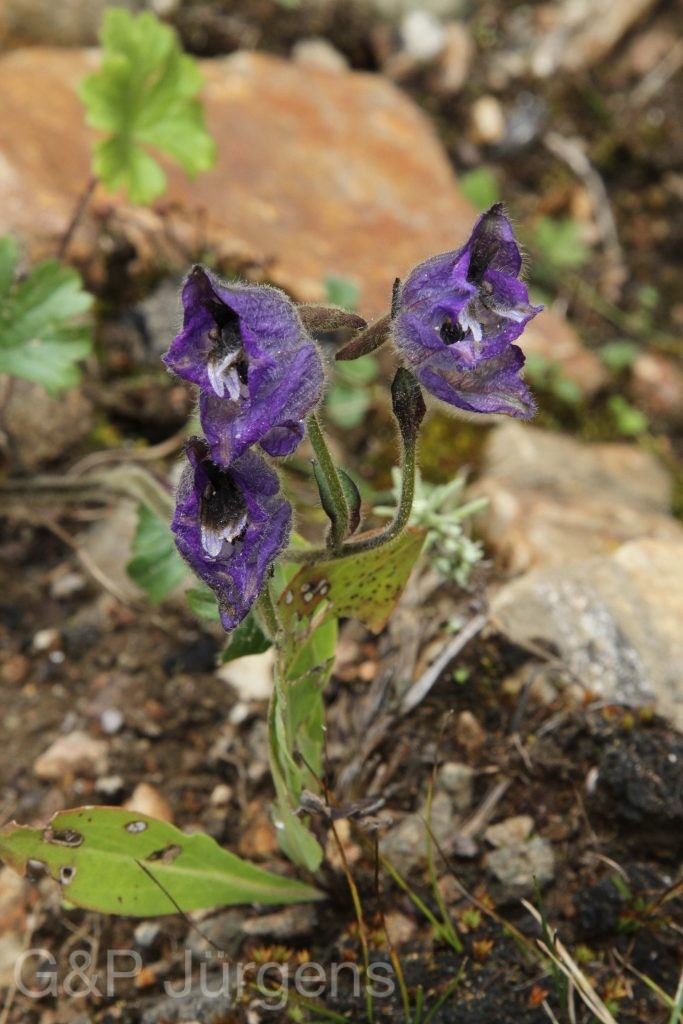
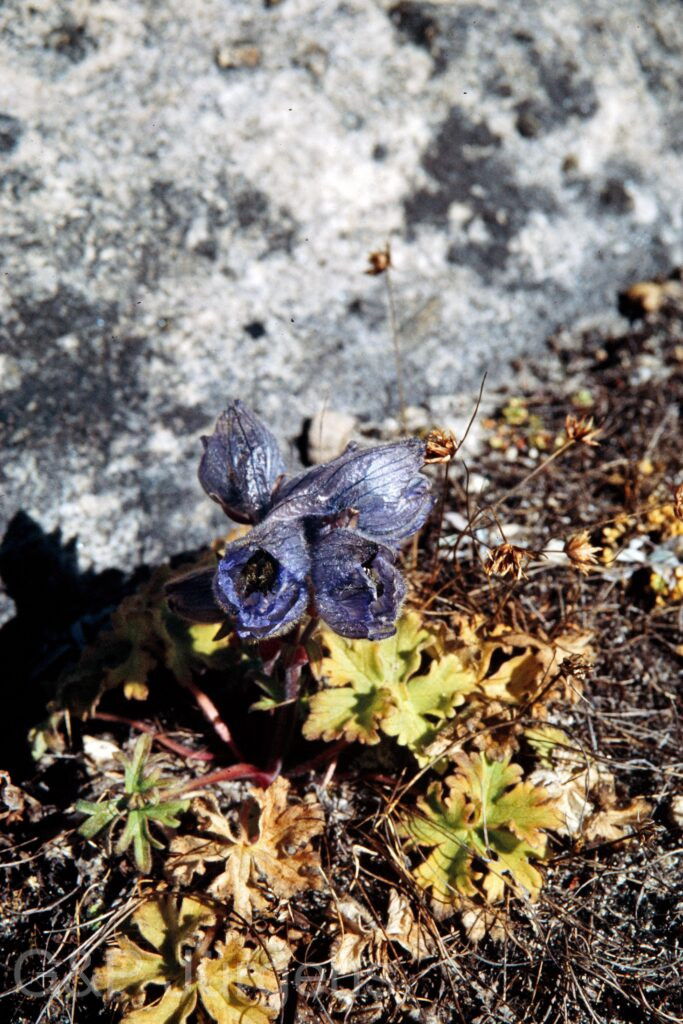
Delphinium glaciale is a high-alpine larkspur distributed across the central and eastern Himalaya, with documented occurrences in Nepal, India, Bhutan and southern Tibet (China); GBIF records some 85 collections from this range. It is a plant of the upper alpine and subnival zones, typically encountered between roughly 4000 and 5000 m on open screes, moraines, glacial forelands and stony alpine turf, as reflected by the population photographed near Jaisuli Kund in Nepal at about 4200 m in October. It tolerates a short growing season, intense insolation and prolonged snow cover.

The species is a dwarf, cushion-forming or compactly tufted perennial herb arising from a stout woody rootstock. Stems are short, ascending and densely covered, like the foliage, in spreading whitish to yellowish hairs that lend the plant a shaggy appearance. The leaves are palmately divided into narrow segments, mostly basal or crowded toward the stem base. The inflorescence is few-flowered and condensed; the zygomorphic flowers are deep blue to violet-blue, the posterior sepal prolonged into a stout spur enclosing two nectariferous petals, the whole densely pubescent externally. The fruit is a cluster of erect, hairy follicles releasing small angular seeds.

Within Delphinium the species belongs to the assemblage of dwarf, glandular- or villous-haired Sino-Himalayan high-alpine larkspurs adapted to glacial habitats, a feature echoed in the epithet glaciale. Its compact habit and dense indumentum are classic adaptations to wind exposure and cold. Like most members of the genus it contains diterpenoid alkaloids and is toxic to livestock. No specific conservation assessment has been published; its restriction to remote subnival terrain confers natural protection, though high-altitude warming and habitat shifts may threaten such narrowly zoned alpine specialists.

Author: Hook.f. & Thomson · Sources: POWO (Kew), GBIF, Flora of Nepal, Flora of Bhutan, Flora of China, Annotated Checklist of the Flowering Plants of Nepal, Munz Monograph of Delphinium
Huth

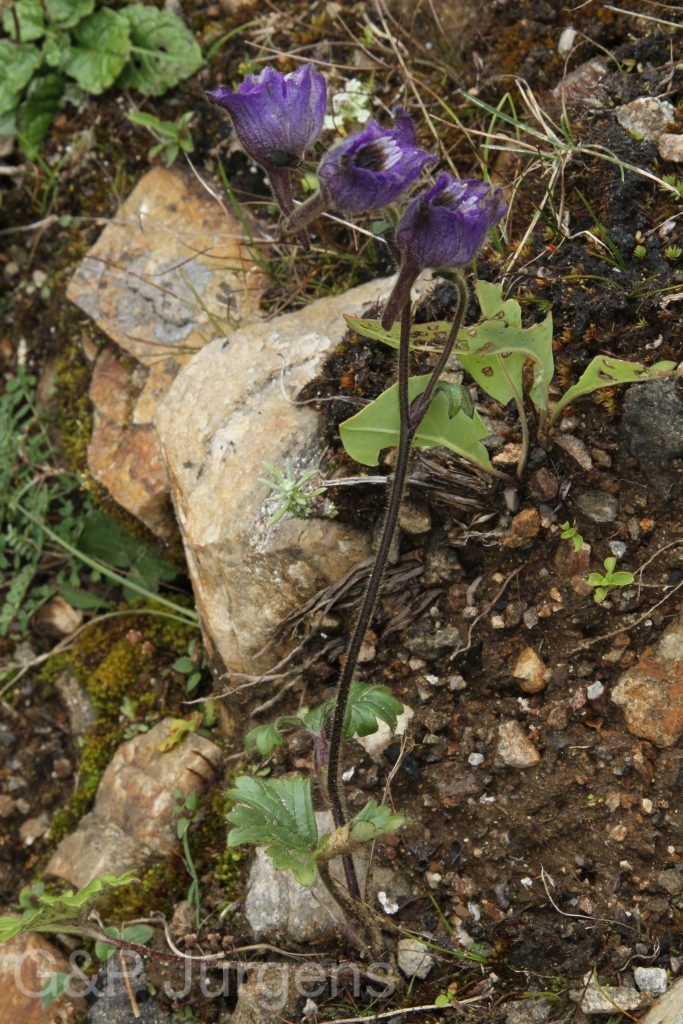
Nepal 95 120 P208 ergebnis
Nepal south of Rupien La 3450m October

Description

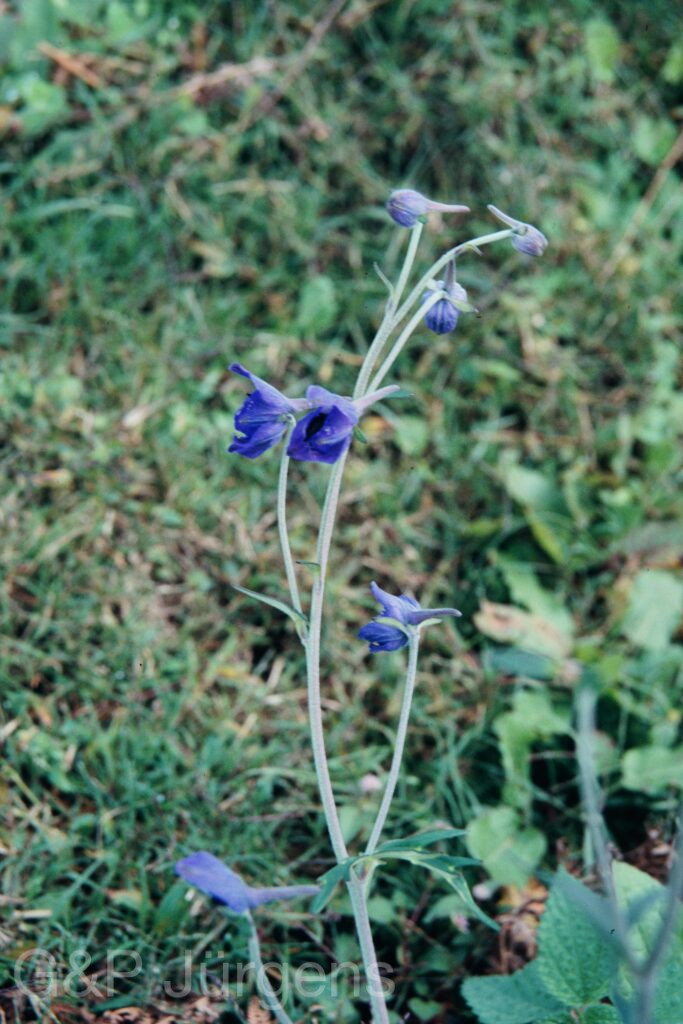
Delphinium kamaonense is a Himalayan and Sino-Himalayan larkspur recorded by GBIF (839 occurrences) from China, Nepal, India and Bhutan. It is a plant of open subalpine and alpine habitats, growing on grassy slopes, among low scrub, on stony pastures and along rocky margins, generally between about 3000 and 4500 m. The individual photographed south of the Rupien La in Nepal at 3450 m in October exemplifies its late, post-monsoon flowering, when many high-altitude perennials complete their reproductive cycle before the onset of winter.

The species is a perennial herb arising from a fibrous or somewhat woody rootstock, with erect, slender stems that are often finely pubescent above. The leaves are alternate, long-petiolate below, with a palmately divided to deeply lobed blade whose segments are further cut into narrow ultimate lobes. The flowers are borne in a lax raceme or panicle and are strongly zygomorphic; the five petaloid sepals are deep blue to violet, the uppermost prolonged backwards into a conspicuous slender spur that encloses the nectariferous spurs of the two upper petals. The dark inner petals form a contrasting central eye. The fruit consists of several erect, many-seeded follicles.

Delphinium is a large northern-temperate genus well represented in the Himalaya, and D. kamaonense belongs to the assemblage of blue-flowered alpine larkspurs centred on the western and central ranges. The spurred flowers are adapted for pollination by long-tongued bumblebees capable of reaching the concealed nectar. Like most members of the genus the plant contains toxic diterpenoid alkaloids that deter grazing. The species is widespread within its high-elevation niche and is not currently considered to be at conservation risk.

Author: Huth · Sources: POWO (Kew), GBIF, Flora of China, Flora of Bhutan, Annotated Checklist of the Flowering Plants of Nepal, Monograph of the Genus Delphinium (Munz)

Kitam. & Tamura

Nepal 95 413 P722 ergebnis
Nepal Jaisuli Kund 4450m October
Nepal 95 414 P724 ergebnis
Nepal Jaisuli Kund 4450m October

Description

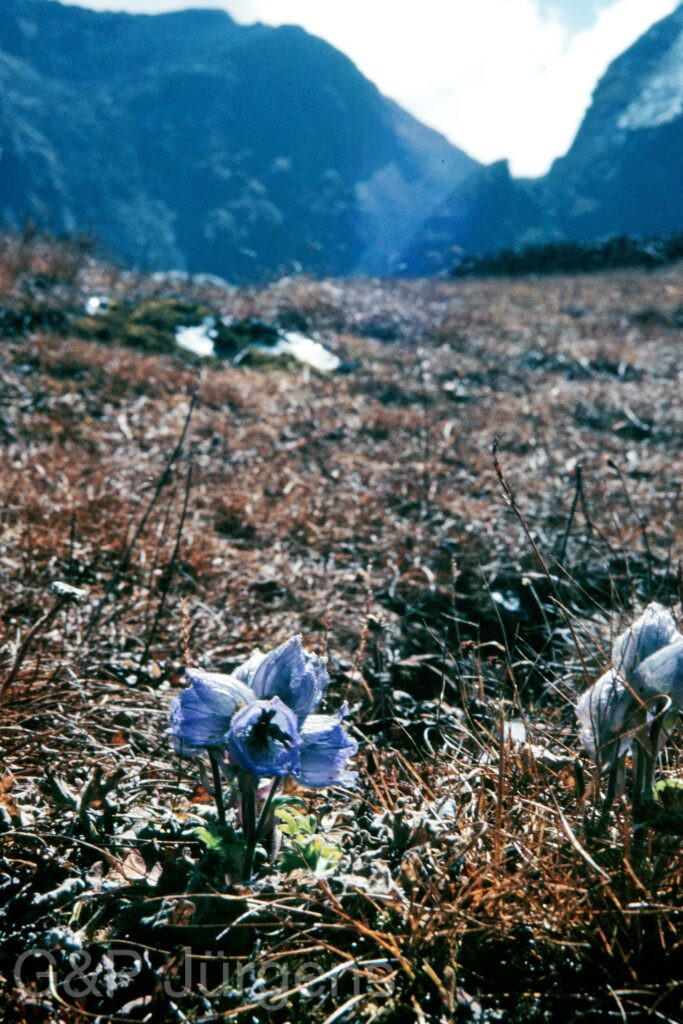
Delphinium nepalense is a high-alpine larkspur of the Central and Western Himalaya, recorded from Nepal, Bhutan and Pakistan; GBIF holds about 51 occurrences, reflecting a limited but genuine montane distribution. It is a plant of the upper alpine zone, growing on open grassy slopes, stony meadows, screes and the margins of glacial tarns, as documented at Jaisuli Kund in Nepal at 4450 m. At such elevations it experiences a brief, cool growing season and flowers comparatively late, persisting into October as shown in the field record, when many co-occurring alpines have already set seed.

It is a perennial herb arising from a fibrous to somewhat tuberous rootstock, with erect or ascending stems. The leaves are palmately divided into narrow lobes or segments, the lower ones long-petiolate and the upper progressively reduced and sessile. The inflorescence is a few-flowered raceme of strongly zygomorphic flowers; the five petaloid sepals are blue to violet-purple, the uppermost prolonged backward into a prominent spur that encloses the nectar-bearing spurs of the two upper petals, while the smaller petals form a contrasting honey-guide at the throat. The fruit is a cluster of erect follicles splitting along the ventral suture to release flattened, scaly or winged seeds.

The species was described by Kitamura & Tamura, authorities on the Himalayan Ranunculaceae. Within Delphinium it belongs to the perennial Himalayan element, allied to species such as D. brunonianum and D. kamaonense. As in much of the genus, the flowers are pollinated chiefly by bumblebees adapted to probing the long spur, and the foliage contains diterpenoid alkaloids that render the plant toxic and unpalatable to grazing livestock. Although not formally assessed for conservation, its restricted high-altitude range makes it sensitive to grazing intensity and to the upslope compression of alpine habitat under a warming climate.

Author: Kitam. & Tamura · Sources: POWO (Kew), GBIF, Flora of Nepal, Flora of Pakistan, Munz's monograph of the genus Delphinium

Hook.f. & Thomson

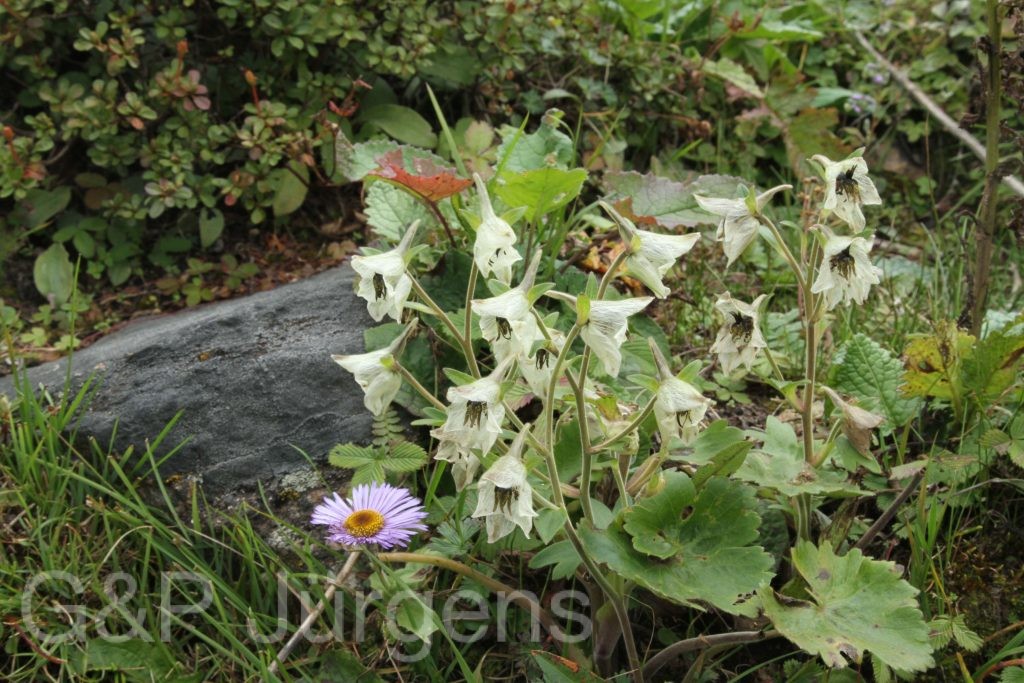
Bhutan2012 283
Bhutan Shele-La, 3900m September
Sikkim2003 283 P389
Sikkim Saniti-Lake 4300m August

Description

Delphinium viscosum is an alpine perennial of the Himalaya, recorded from India, Nepal, Bhutan and China, with 105 occurrences in GBIF reflecting its restricted high-altitude range. It inhabits open alpine slopes, stony meadows, scree margins and rocky pastures, generally between 3500 and 4500 m, where it flowers in late summer and early autumn. The collections figured, from Bhutan's Shele-La at 3900 m in September and Sikkim's Saniti-Lake at 4300 m in August, illustrate its occupancy of cold, exposed alpine terrain at the upper limit of herbaceous vegetation, on well-drained gravelly soils among low alpine swards.

The plant arises from a thickened, somewhat woody rootstock, producing erect stems usually 15-40 cm tall that are conspicuously glandular-viscid and hairy, the sticky pubescence giving the species its epithet. The leaves are alternate, orbicular to reniform in outline and palmately divided into several broad, toothed or further-lobed segments. The inflorescence is a few-flowered terminal raceme of showy zygomorphic flowers; the five petaloid sepals are deep blue to violet, the uppermost prolonged backward into a prominent spur enclosing the nectariferous true petals. The fruit is a cluster of usually three erect, glandular follicles releasing winged or scaly seeds.

Delphinium (Ranunculaceae) is a large genus of the northern temperate zone with a notable Sino-Himalayan radiation of alpine species; D. viscosum belongs to the glandular, spur-flowered montane group adapted to short alpine seasons. Like all larkspurs it contains toxic diterpenoid alkaloids. Its spurred flowers favour pollination by long-tongued bumblebees. With a limited high-alpine distribution, it is potentially sensitive to grazing and climatic change, though its remote habitats afford some natural protection.

Author: Hook.f. & Thomson · Sources: POWO (Kew), GBIF, Flora of China, Flora of Bhutan, A Taxonomic Revision of Himalayan Delphinium (Ranunculaceae)

C.Marquand & Airy Shaw

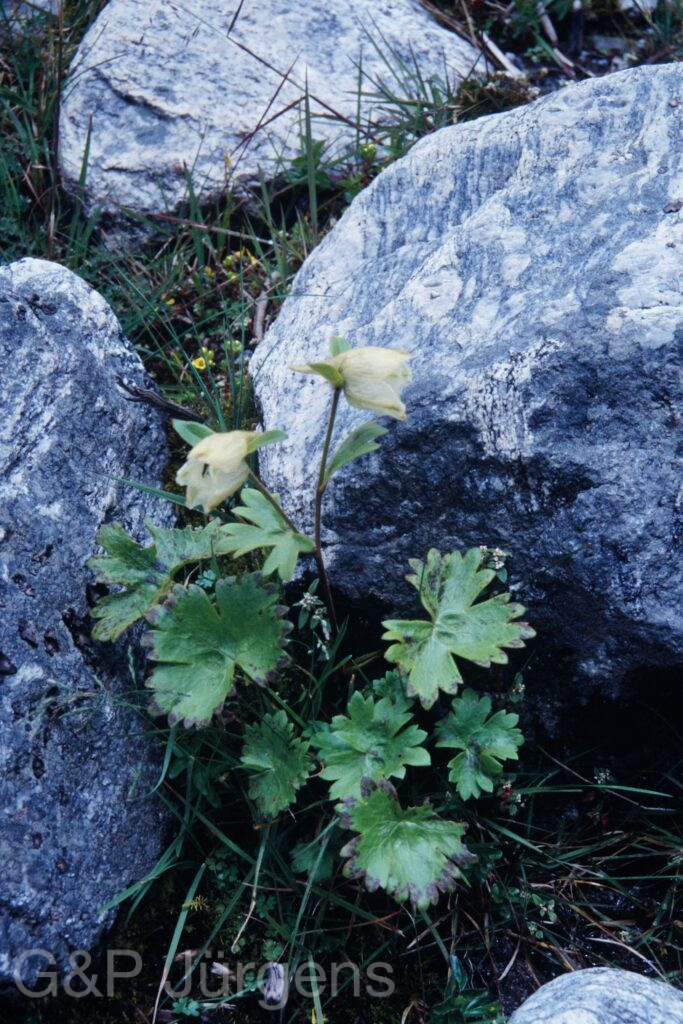
Bhutan2012 270
Bhutan Shele-La, 4000m September
Bhutan2012 271
Bhutan Shele-La, 4000m September

Description

Delphinium wardii C.Marquand & Airy Shaw is a high-alpine larkspur of very limited distribution; GBIF holds only about 10 occurrences, from Bhutan, neighbouring China (southern Tibet) and northeastern India. It is a plant of open alpine habitats, growing on stony slopes, rocky meadows, scree and grassy turf above the treeline, generally between about 3800 and 4500 m. The individual photographed at Shele-La in Bhutan at 4000 m in September, flowering in the late-season alpine zone, exemplifies its occupation of cold, well-drained, exposed high-altitude sites near the upper limit of vascular plant growth in the eastern Himalaya.

It is a perennial herb arising from a fibrous to somewhat woody rootstock, with erect stems of modest height, often pubescent in the upper parts. The leaves are palmately divided into narrow lobes or segments, the basal leaves long-petiolate and the cauline ones smaller and shorter-stalked. The flowers are borne in a few-flowered terminal raceme; each is zygomorphic with five petaloid sepals, the uppermost prolonged backward into a conspicuous spur, the whole flower deep blue to violet-blue. Within the sepals sit the smaller petals, the upper pair extended into nectar-bearing spurs enclosed in the sepaline spur. The fruit is a cluster of several erect follicles releasing angular, scaly seeds.

The genus Delphinium is well represented in the Sino-Himalayan alpine flora, where its spurred, bee-pollinated flowers are adapted to long-tongued bumblebees that probe the nectar spurs. Like its congeners the plant contains diterpenoid alkaloids and is poisonous to livestock. With an extremely small known range, very few documented collections and confinement to a narrow, climatically vulnerable high-alpine band, Delphinium wardii is a regionally restricted endemic of the eastern Himalaya whose limited occurrence record warrants particular attention to its conservation.

Author: C.Marquand & Airy Shaw · Sources: POWO (Kew), GBIF, Flora of Bhutan, Flora of China, Annotated Checklist of the Flowering Plants of Nepal, Wang & Warnock revision of Delphinium

Lindl.

Bhutan2012 1365
Bhutan Sandrup 1400m, October
Bhutan2012 1366
Bhutan Sandrup 1400m, October

Description

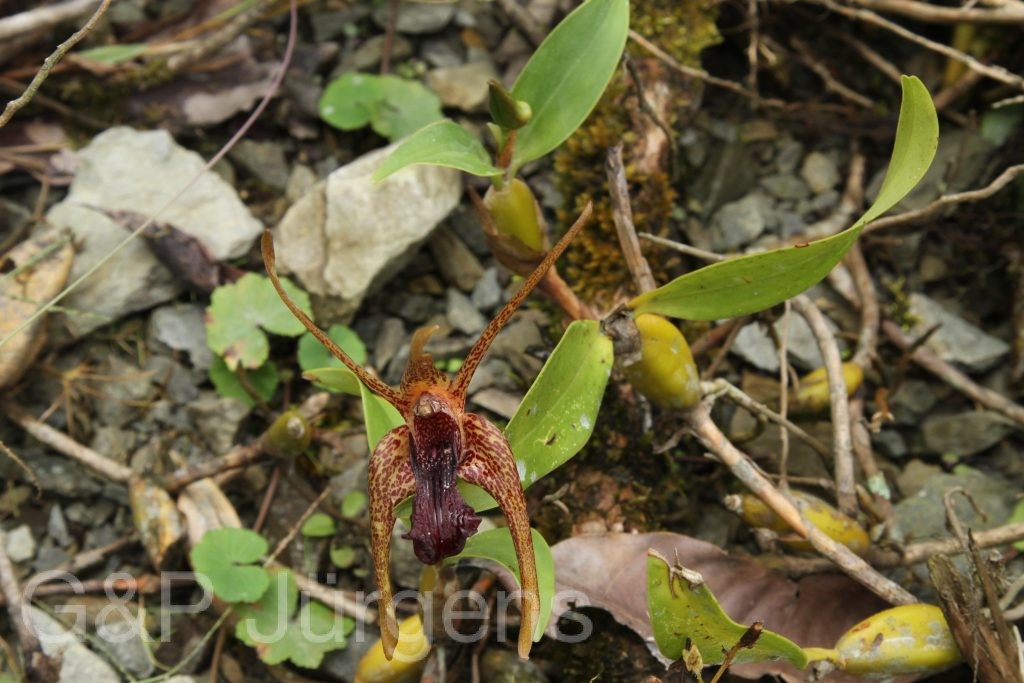
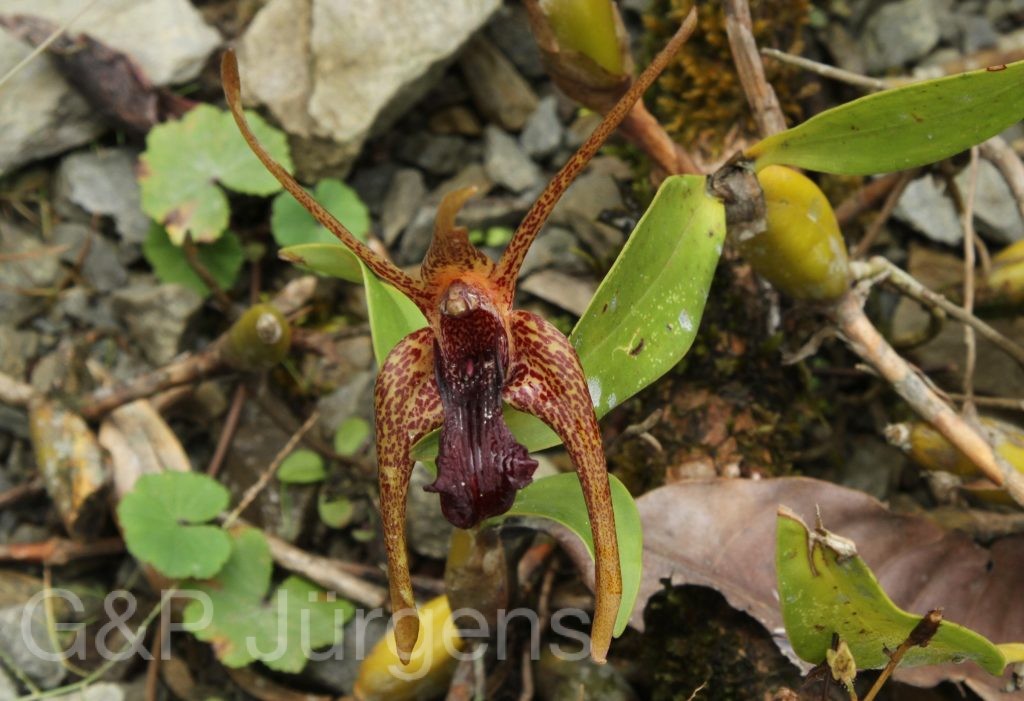
Dendrobium amplum (often treated under the segregate genus Epigeneium as E. amplum) is an epiphytic orchid distributed across the eastern Himalaya and adjacent Southeast Asia. GBIF documents 230 occurrences from China, India, Nepal, Bhutan, Myanmar, Bangladesh, Vietnam and Thailand, with herbarium and cultivated records also in Europe and North America. It inhabits mossy trunks and large branches in humid subtropical broadleaved forest, generally between roughly 1000 and 2000 m. The plant shown was recorded at Sandrup in Bhutan at 1400 m in October, a warm-temperate forest belt where seasonal monsoon moisture sustains a rich epiphytic flora.

The species has a creeping rhizome from which arise well-spaced, ovoid to fusiform pseudobulbs, each conspicuously four-angled and topped by two (rarely three) ovate-elliptic, coriaceous leaves. The inflorescence emerges from the apex of the pseudobulb and carries one to a few comparatively large, showy flowers. The spreading sepals and petals are pale green to yellowish, variously suffused or veined with brown and purple, while the three-lobed labellum bears a recurved, acute or apiculate midlobe and is marked with reddish-purple lines over a callused disc. The mentum is short and the column foot prominent.

Described by John Lindley, the species belongs to a group of broad-bulbed Dendrobium species frequently placed in Epigeneium, a genus whose limits remain debated; POWO accepts the Dendrobium placement. The autumn-flowering habit and large flowers make it attractive to collectors. While ranging widely and not formally listed as threatened, it depends on intact mature forest and is sensitive to habitat loss and over-collection.

Author: Lindl. · Sources: POWO (Kew), GBIF, Flora of Bhutan, Flora of China, Orchids of Bhutan, Dendrobium and its Relatives (Lavarack et al.)

Dalzell

Nepal 95 433 P754 ergebnis
Nepal Trisuli 2500m October
Nepal 95 434 P755 ergebnis
Nepal Trisuli 2500m October

Description

Dendrobium crispum, as applied here, is an epiphytic orchid of the Himalayan and Indo-Burmese region. Under current taxonomy the name Dendrobium crispum Dalzell is treated as a synonym, the accepted concept here being Dendrobium crispum (with the linked material referable to Dendrobium peguanum); GBIF records, though few, point to occurrence in India and adjacent Himalaya. It grows as an epiphyte on tree trunks and mossy branches in humid broadleaved and subtropical forest. The photograph was taken near Trisuli in Nepal at about 2500 m in October, indicating a montane forest habitat with seasonal monsoon moisture.

The plant forms clustered, slender, often pendent or ascending stems (pseudobulbs) bearing distichous, narrowly oblong to lanceolate leaves with sheathing bases. The flowers are small, borne in short few-flowered racemes from the upper nodes; the sepals and petals are pale, the lateral sepals forming a short mentum with the column foot, and the labellum is the most ornamented part of the flower, with a recurved, often crisped or fringed margin and a coloured, sometimes pubescent disc. The column is short, bearing a terminal anther with waxy pollinia, and the small fruit is a ribbed dehiscent capsule releasing dust-like seed.

Dendrobium is one of the largest orchid genera, and the taxonomy of small-flowered Himalayan species has been repeatedly revised, with several names entering synonymy as concepts were clarified, including the present one. Like most epiphytic orchids the species depends on mycorrhizal fungi for germination and on insect pollinators. All Dendrobium are listed on CITES Appendix II; the chief threats are forest clearance and collection for the horticultural trade.

Author: Dalzell · Sources: POWO (Kew), GBIF, Flora of China, Orchids of Nepal, CITES Appendix II listings, Seidenfaden's revisions of Asian Dendrobium

Griff.

Nepal 95 303 P547 ergebnis
Nepal Bharang 1850m October

Description

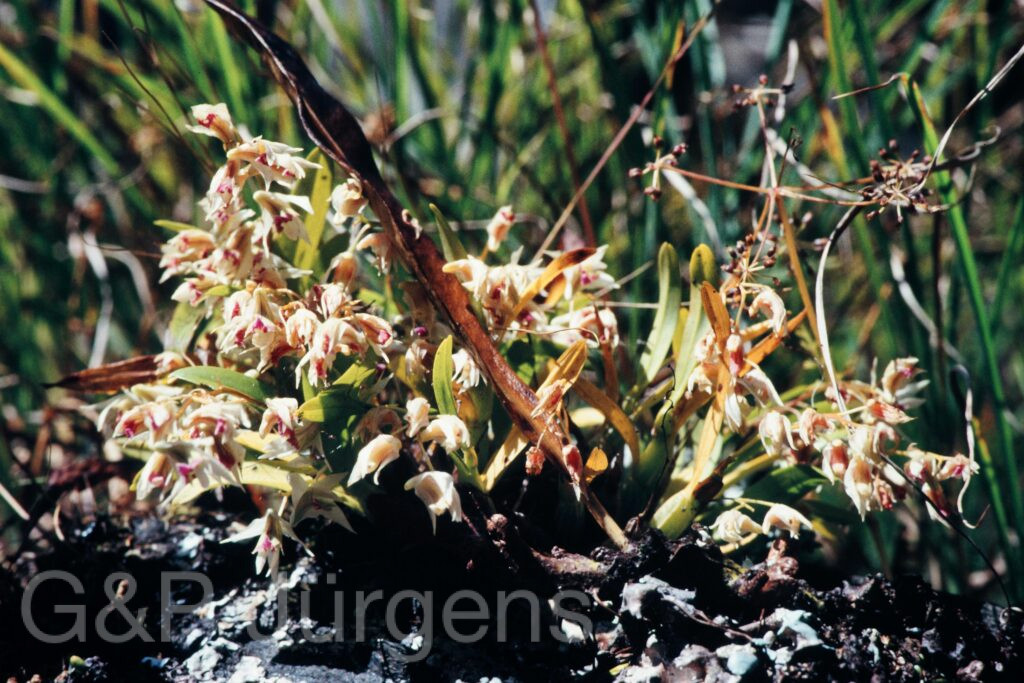
Dendrobium eriiflorum is an epiphytic orchid of the eastern Himalaya and Indo-Burmese region, distributed through Nepal, northern India, Bhutan, Bangladesh and Myanmar into Thailand, peninsular Malaysia and Indonesia; GBIF records about 112 occurrences across this range. It is a plant of the subtropical to lower temperate broadleaved forest, growing as an epiphyte on tree trunks and mossy branches in humid, shaded montane woodland, as documented at Bharang in Nepal at 1850 m. In this elevational band it benefits from high atmospheric moisture and a pronounced monsoon, and is recorded in flower in October toward the close of the wet season.

It is a small, tufted epiphyte with clustered, slender, erect to pendent stems (pseudobulb-like canes) sheathed by the membranous bases of the leaves. The leaves are thin, narrowly lanceolate, distichous and deciduous, leaving the older canes leafless. The inflorescences are short, few-flowered racemes arising laterally near the stem apex; the flowers are small, pale greenish-white to cream and densely covered externally with fine hairs, the hairy perianth recalling the genus Eria and giving rise to the epithet "eriiflorum". The lip is three-lobed with a recurved apex, and the column bears a short foot forming a mentum, with the pollinia waxy in the manner typical of Dendrobium.

The species was described by William Griffith, an early explorer of the Himalayan and Burmese flora. Within the large, taxonomically complex genus Dendrobium it falls among the small-flowered Himalayan species; the distinctive pubescent flowers are an unusual diagnostic feature among its relatives. Pollination in such Dendrobium is generally by small bees attracted to the lip. As an epiphyte dependent on intact, humid forest canopy, it is sensitive to deforestation and to the horticultural collection that affects many Himalayan orchids; like all Dendrobium it is listed on CITES Appendix II, regulating international trade.

Author: Griff. · Sources: POWO (Kew), GBIF, Flora of Bhutan, Orchids of Nepal, Seidenfaden's monographic studies of Dendrobium

Griff.

Bhutan2015 449
  Bhutan Jakar 2500m, October
Bhutan2015 450
  Bhutan Jakar 2500m, October
Bhutan2015 451
  Bhutan Jakar 2500m, October
Bhutan2012 1129
Bhutan Koma-Chu-Valley 950m, October
Bhutan2012 1131
Bhutan Koma-Chu-Valley 950m, October
Bhutan2012 1358
Bhutan Sandrup 1500m, October

Description

Dendrobium fuscescens Griff. is an epiphytic orchid of the eastern Himalaya and adjacent Indo-Burmese region, recorded by GBIF from China, India, Myanmar, Nepal and Bhutan across some 69 occurrences. It grows on the trunks and branches of trees in humid broad-leaved and mixed forests, ranging over a broad altitudinal span as shown by the Bhutanese records at Jakar around 2500 m, in the Koma-Chu valley near 950 m, and at Sandrup about 1500 m, all in October. This spread from warm temperate valleys to cooler montane forest reflects a tolerance of moist, shaded, mossy bark substrates with good air movement.

The plant produces clustered, slender, elongate cane-like pseudobulbous stems that are somewhat flattened and grooved, becoming yellowish with age. The thin-textured, lanceolate to oblong leaves are distichously arranged along the stems and are usually deciduous in the dry season, leaving the canes bare. Short lateral racemes of a few small flowers arise from nodes on the older leafless stems; the flowers are pale, often tinged greenish or brownish-yellow (the epithet fuscescens alluding to the darkening tint), with spreading lanceolate sepals and petals and a labellum bearing a hairy or papillose disc and recurved lateral lobes, the lateral sepals forming a short mentum at the column foot.

Dendrobium is one of the largest orchid genera, and D. fuscescens belongs among the slender deciduous-caned Himalayan species. It is poorly documented, with few georeferenced records, and like most epiphytic orchids it is sensitive to deforestation and collection. No formal assessment singles it out as threatened, but its dependence on intact forest canopy makes habitat protection important, and all Dendrobium are listed on CITES Appendix II.

Author: Griff. · Sources: POWO (Kew), GBIF, Flora of Bhutan, Flora of China, World Checklist of Dendrobium, Seidenfaden monograph of Orchids of Indochina

Paxton

Bhutan2012 755
Bhutan Galephu 1000m, October
Bhutan2012 756
Bhutan Galephu 1000m, October
Bhutan2012 754
Bhutan Galephu 1000m, October
Bhutan2012 455
Bhutan Wangdi 2500m, September
Bhutan2012 1007
Bhutan Trithangebe 900m, October

Description

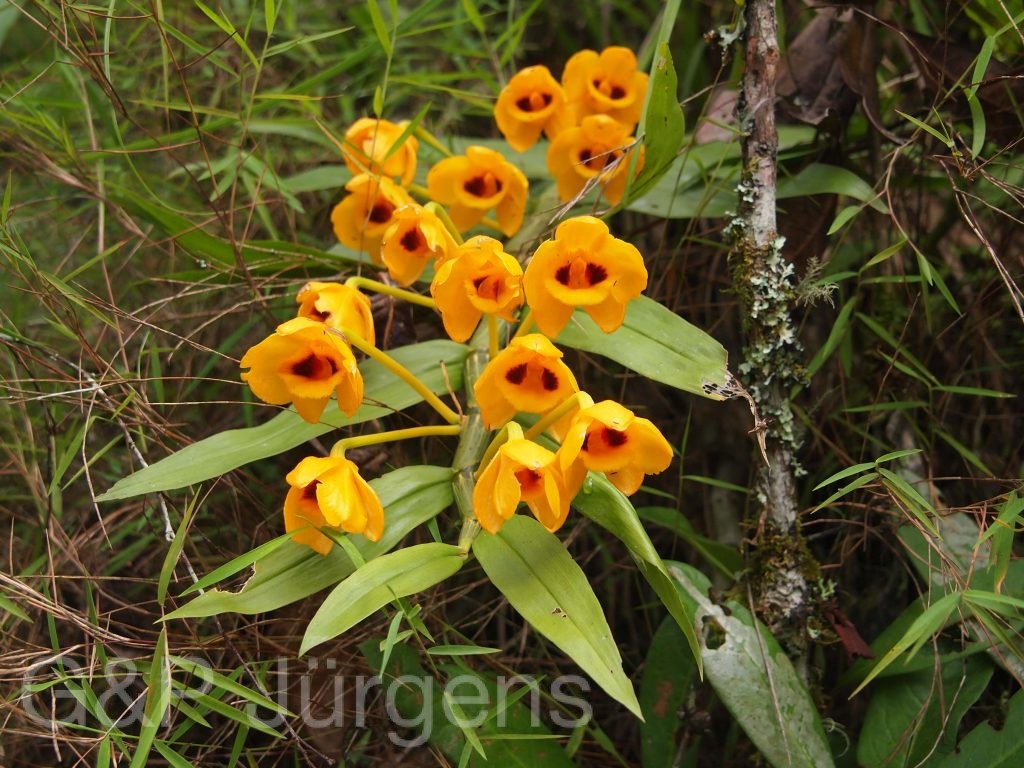
Dendrobium gibsonii is an epiphytic orchid widespread across the Sino-Himalayan and Indo-Chinese region, recorded from China, India, Thailand, Myanmar, Vietnam, Nepal, Bhutan, Laos and Malaysia, with 87 GBIF occurrences mapping a broad subtropical to lower-montane distribution. It is an epiphyte of warm, seasonally moist evergreen and semi-deciduous forest, favouring well-lit branches where it endures a pronounced dry season. In Bhutan it was photographed across a notable altitudinal spread, from Galephu and Trithangebe at around 900-1000 m in October to Wangdi at 2500 m in September, illustrating its tolerance of both the hot southern foothills and cooler inner valleys.

The plant produces long, pendulous to arching, slender canes that are somewhat swollen and channelled, bearing distichous, oblong-lanceolate, deciduous leaves. The inflorescences arise laterally on the older leafless canes as short, pendent racemes of several golden-yellow flowers. The sepals and petals are spreading and orange-yellow, while the broad, rounded lip is conspicuously fringed at the margin and marked with a pair of dark maroon or purple-brown blotches in the throat, a diagnostic feature. The fruit is a pendulous ribbed capsule.

The species belongs to Dendrobium section Dendrobium (the so-called nobile alliance), characterised by leafy canes that flower from the nodes after leaf fall. Its showy fringed, blotched lip makes it horticulturally desirable, and wild collection for the ornamental trade adds to pressure from habitat loss across the foothill forests. Although the wide range buffers it against immediate extinction risk, like many Asian Dendrobium it is listed under CITES Appendix II to regulate international trade.

Author: Paxton · Sources: POWO (Kew), GBIF, Flora of China, Flora of Bhutan, Dendrobium and its Allies (Lavarack, Harris & Stocker)