Tag:

Autumn

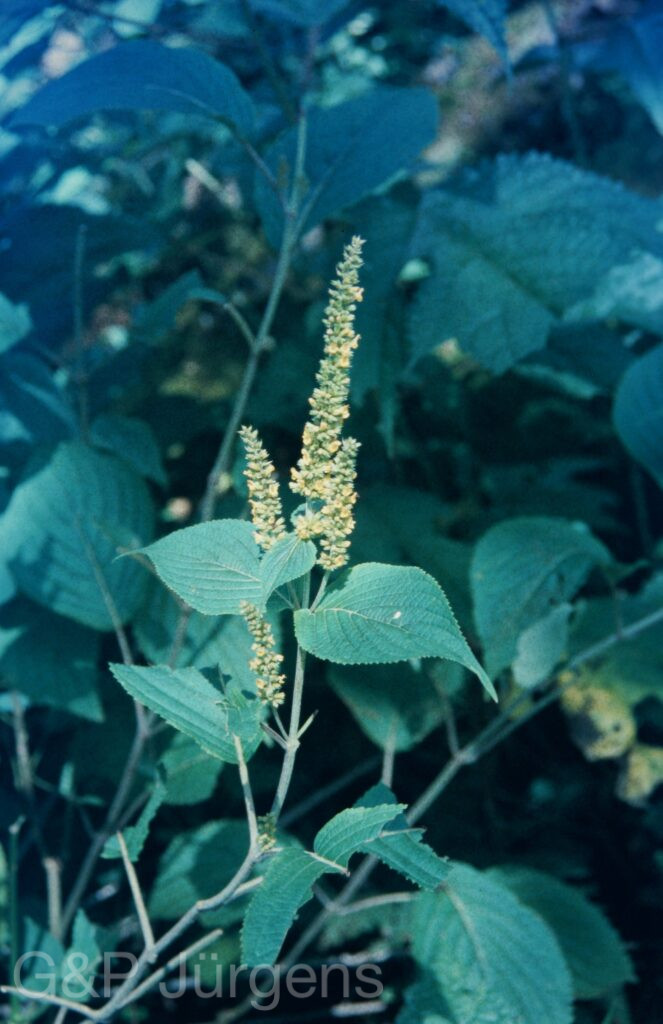
(Wall. ex DC.) Anderb.
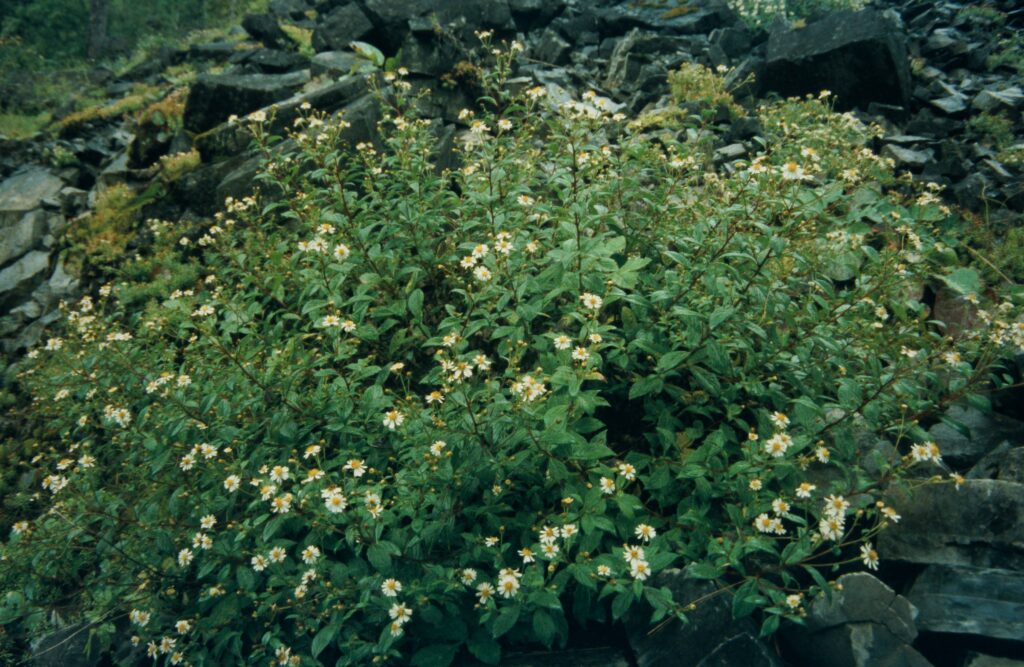
Garw 2005 265 ergebnis
India Garhwal Kuno 2800m, September

Description

Duhaldea nervosa is a perennial composite of the Himalaya and montane south-east Asia, recorded from China, Nepal, Thailand, India, Bhutan, Myanmar, Cambodia and Vietnam. Its roughly 584 georeferenced collections span the temperate to subtropical hill belt from the western Himalaya eastward into Indochina. It grows on grassy slopes, open hillsides, forest margins, roadside banks and in scrub, favouring well-drained sunny to lightly shaded ground. The photographed plant from Garhwal at Kuno at 2800 m, flowering in September, is typical of its upper-temperate habitat and its late-monsoon to autumn flowering, when the capitula open above the surrounding herbage.

It is an erect, often hairy perennial herb with leafy stems arising from a woody rootstock. The alternate leaves are elliptic to lanceolate or oblong, with a finely toothed margin and conspicuous, raised lateral veins on the lower surface, the prominent venation giving the species its epithet nervosa. The capitula are radiate and borne in terminal corymbose clusters, each head with an involucre of several rows of imbricate, herbaceous to membranous bracts. The yellow ray florets are female and ligulate, surrounding numerous yellow, tubular, bisexual disc florets. The fruit is a ribbed, cylindrical cypsela crowned by a pappus of barbellate bristles that aids wind dispersal.

Duhaldea was segregated from the broadly defined Inula and now comprises a group of Asian species formerly placed in that genus; D. nervosa was transferred from Inula by Anderberg, as the parenthetical authorship records. Members of the tribe Inuleae, these plants are visited by a range of generalist insect pollinators. D. nervosa is widespread and locally common across its extensive range and is of no conservation concern, several allied species being used in regional folk medicine.

Author: (Wall. ex DC.) Anderb. · Sources: POWO (Kew), GBIF, Flora of China Vol. 20-21, Flora of Bhutan Vol. 2, Flora of Nepal, Anderberg's Phylogeny and Reclassification of the Tribe Inuleae
Duranta erecta

by GP Jürgens

L.

Bhutan2015 508
Bhutan Phobjika 2800m, October

Description

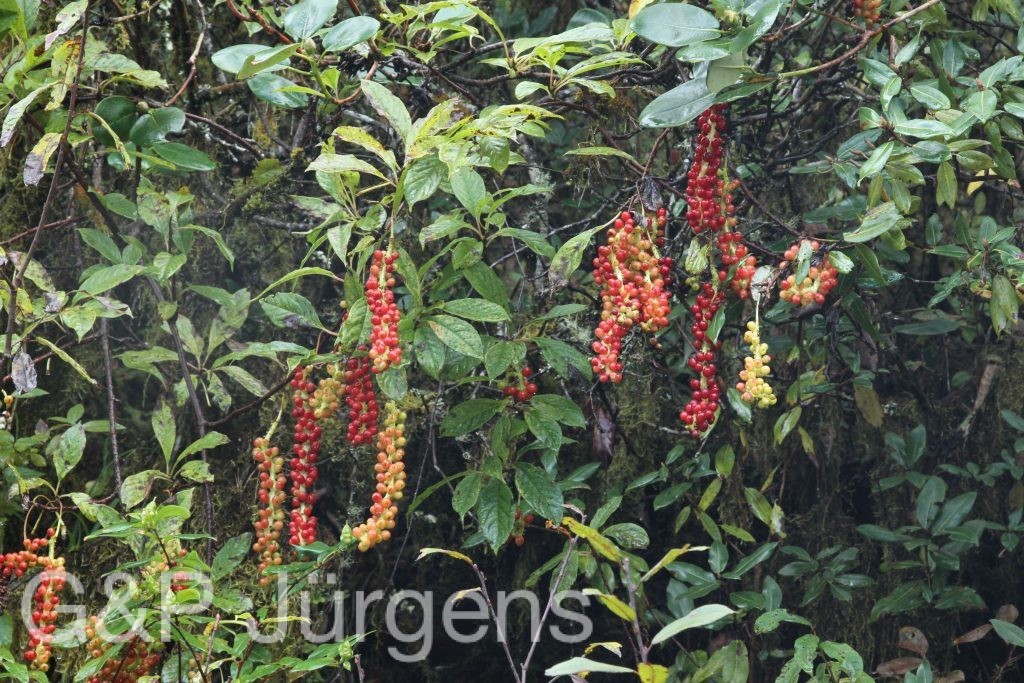
Duranta erecta, commonly called golden dewdrop or pigeon berry, is native to the Neotropics, ranging from Mexico, the Caribbean and Central America through tropical South America to Argentina and Brazil. It has, however, become one of the most widely cultivated and naturalised ornamental shrubs in warm regions worldwide, a fact reflected in its enormous GBIF tally of over nineteen thousand occurrences spanning the Americas, Asia, Africa and Australia. In the Himalaya it occurs only as a cultivated and locally escaping plant; the individual photographed at Phobjika in Bhutan at 2800 m in October represents such a planting in a temperate valley, well above the species' tropical comfort zone, where it is grown as a hedge or garden ornamental and flowers and fruits abundantly in the warm season. It thrives in disturbed ground, gardens, roadsides and waste places, and in many tropical countries is regarded as an invasive weed.

The plant is an evergreen, often spreading shrub or small tree to several metres, with slender, arching, sometimes pendulous and frequently spiny branches that may be four-angled when young. The leaves are opposite or whorled, elliptic to obovate, entire to toothed in the upper half, and light green. The flowers are borne in slender terminal and axillary racemes; the tubular corolla is pale blue to lavender (occasionally white), with five spreading, slightly unequal lobes. The fruit is a glossy, rounded, yellow to orange drupe enclosed by the persistent, beaked calyx, borne in showy pendent clusters; the berries and foliage contain saponins and are toxic to humans and livestock, though birds disperse the seeds freely.

Duranta is a small genus traditionally placed in the Verbenaceae, and D. erecta is its most familiar species, prized horticulturally for its long flowering season, attractive golden fruits and several variegated and golden-leaved cultivars. Its ornamental virtues are matched by a significant ecological downside: through bird-mediated seed dispersal it has become a serious environmental weed in parts of Australia, southern Africa and the Pacific. Its presence in the high Bhutanese Himalaya illustrates the global reach of horticultural commerce, and although frost limits its persistence at such elevations, its weediness elsewhere makes it a species of note for biosecurity rather than conservation.

Author: L. · Sources: POWO (Kew), GBIF, Flora of China Vol. 17, Flora of Bhutan Vol. 2 Part 2, Flora of Nepal, Flora of Pakistan, A Generic Revision of the Verbenaceae (Harold N. Moldenke)

DC.

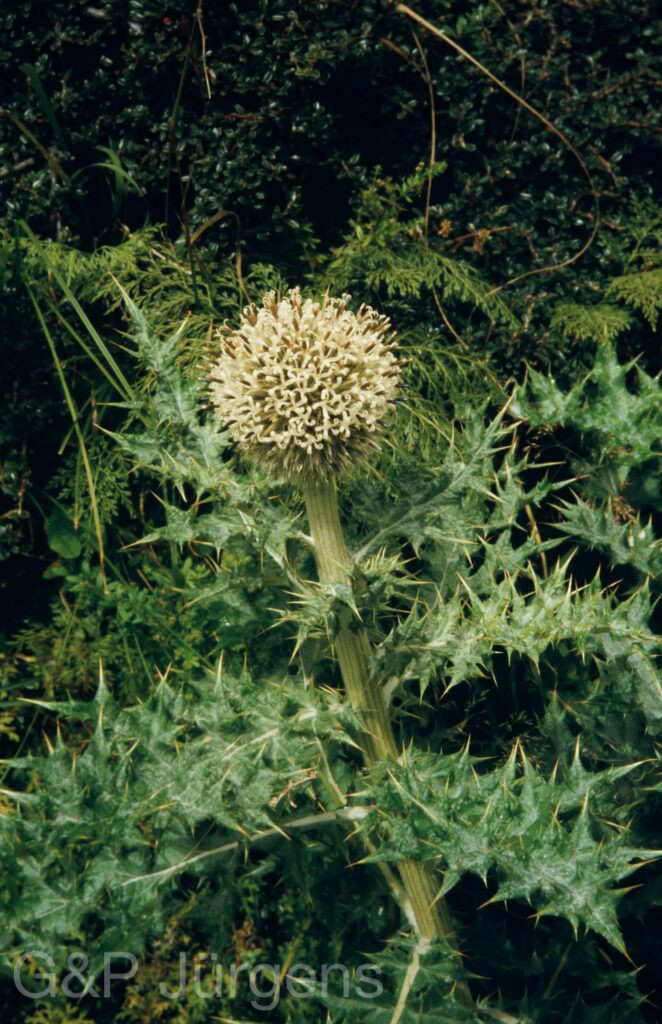
Garw 2005 182 ergebnis ergebnis
India Garhwal Pana 2800m, September

Description

Echinops cornigerus is a Sino-Himalayan globe-thistle distributed across the western and central Himalaya and adjacent Tibetan plateau, with verified records from India, Pakistan, Nepal, Bhutan and China, alongside a scatter of cultivated or extra-regional occurrences (Iran, France, Belgium) among the roughly 294 georeferenced GBIF collections. It inhabits open, sunny slopes, dry stony pastures, forest margins and disturbed ground in the upper temperate to subalpine belt, typically between about 2000 and 3500 m. The plant photographed at Pana in the Garhwal Himalaya at 2800 m in September, fruiting at the close of the monsoon, exemplifies its preference for well-drained montane grassland exposed to strong insolation.

A stout perennial herb, it forms an erect, ridged and somewhat cottony-tomentose stem arising from a woody rootstock. The leaves are coriaceous, deeply pinnatifid to bipinnatifid, glabrescent and green above but white-tomentose beneath, the lobes terminating in conspicuous rigid yellowish spines. The inflorescence is the spherical compound capitulum characteristic of the genus: numerous one-flowered capitula aggregated into a globose synflorescence, each enclosed by stiff bristly involucral scales. The corollas are tubular, pale blue to whitish, and the achenes are cylindrical, densely hairy and crowned by a short pappus of fused scales.

The genus Echinops is taxonomically intricate, the spherical secondary head having evolved as a striking adaptation that pools many reduced florets into a single pollinator-attracting unit. The spiny architecture deters mammalian grazing, an advantage in heavily pastured Himalayan rangelands. Though not assessed as threatened, populations are locally affected by overgrazing and slope disturbance, and the species remains a useful indicator of dry montane grassland.

Author: DC. · Sources: POWO (Kew), GBIF, Flora of Pakistan, Flora of China (Asteraceae), Annotated Checklist of the Flowering Plants of Nepal, Kew monograph of Echinops

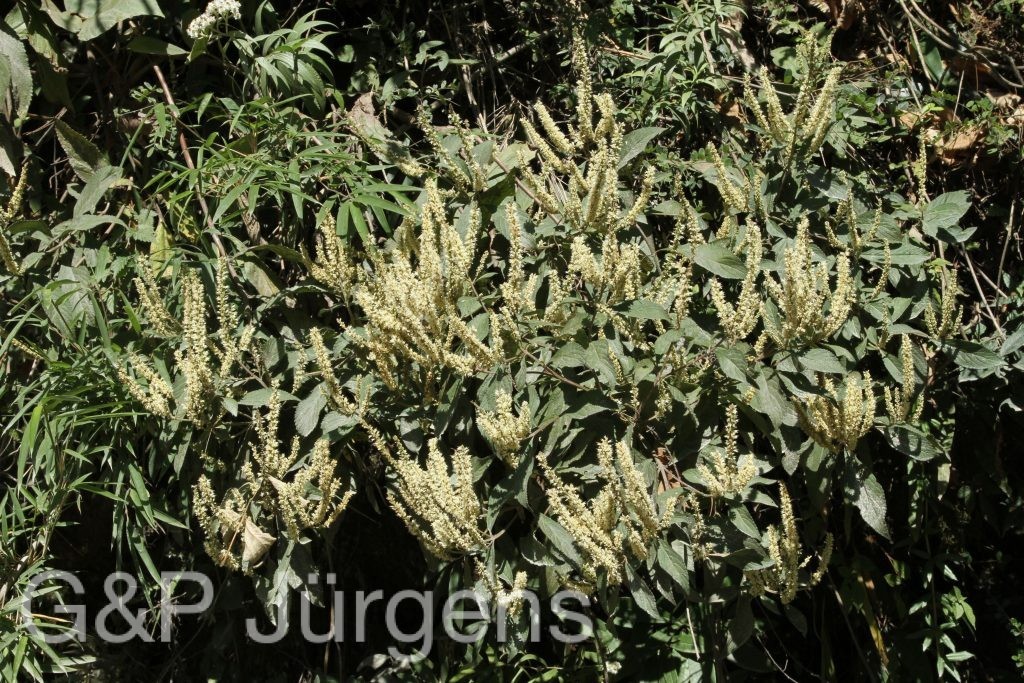
Benth.

Garw 2005 221 ergebnis ergebnis
India Garhwal Simkarok 2700m, September

Description

Elsholtzia flava is a Sino-Himalayan element distributed across the temperate to subtropical mountains of southern and eastern Asia, with verified records from China, Nepal, India, Bhutan and Japan; GBIF aggregates some 558 occurrences, several of them at the eastern margin of the genus's range. In the western Himalaya it ascends to around 2700 m, as documented by the photographed material from Simkarok in Indian Garhwal collected in September, the late-monsoon flowering season. It is a plant of open slopes, forest margins, clearings and disturbed ground on moist, humus-rich soils, behaving as a robust ruderal sub-shrub that exploits gaps in the upper temperate broadleaf belt.

The species is a coarse, aromatic perennial or shrubby herb reaching 1-2 m, with erect, branched, quadrangular and finely pubescent stems woody at the base. The leaves are opposite, petiolate, broadly ovate to ovate-lanceolate, acuminate at the apex and crenate-serrate along the margins, glandular-punctate beneath and exuding the characteristic mint scent of the genus. Small flowers are crowded into dense, secund, cylindrical spike-like verticillasters; the campanulate calyx is five-toothed and the corolla pale yellow ("flava"), two-lipped, with four didynamous exserted stamens. The fruit comprises four smooth, ovoid-oblong nutlets enclosed in the persistent calyx.

Elsholtzia (Lamiaceae, tribe Elsholtzieae) is centred on eastern Asia and includes many late-flowering, nectar-rich, bee-pollinated species important to autumn foragers. E. flava is locally common and not regarded as threatened, its tolerance of disturbance favouring persistence; its terpenoid-rich essential oils link it to congeners long used in folk medicine and as aromatic herbs across the Himalayan and Chinese highlands.

Author: Benth. · Sources: POWO (Kew), GBIF, Flora of China, Flora of Bhutan, Flora of Pakistan, Press et al. Annotated Checklist of the Flowering Plants of Nepal, Harley et al. Labiatae (Kubitzki, The Families and Genera of Vascular Plants)

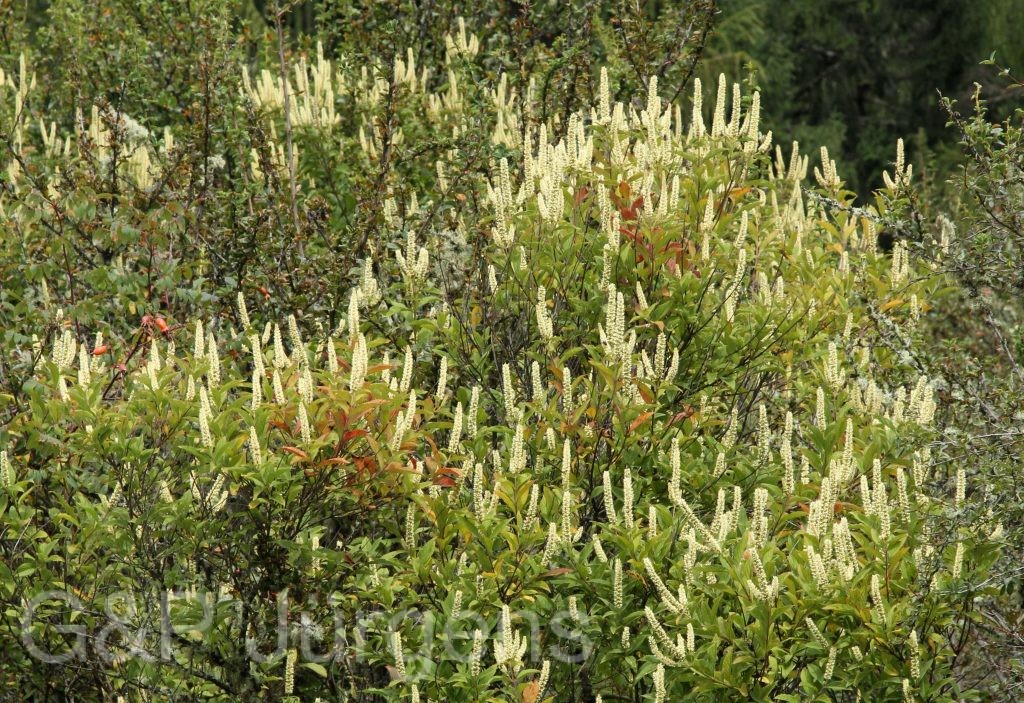
Rehder

Bhutan2015 463
  Bhutan Jakar 2100m, October
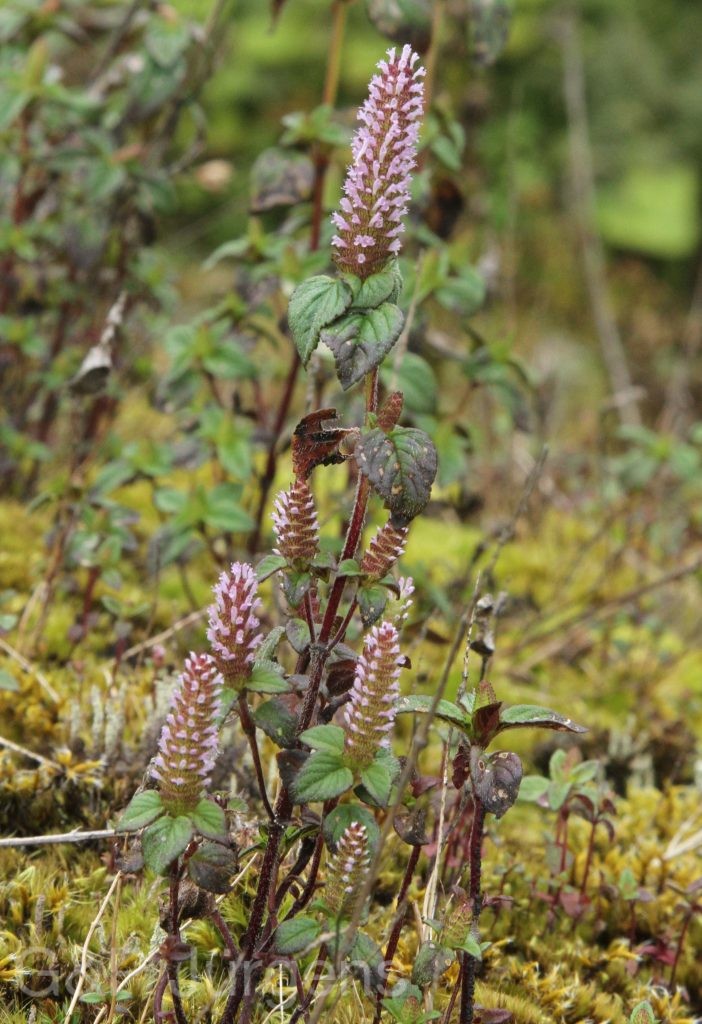
Bhutan2012 104
Bhutan Shele-La, 3600m September
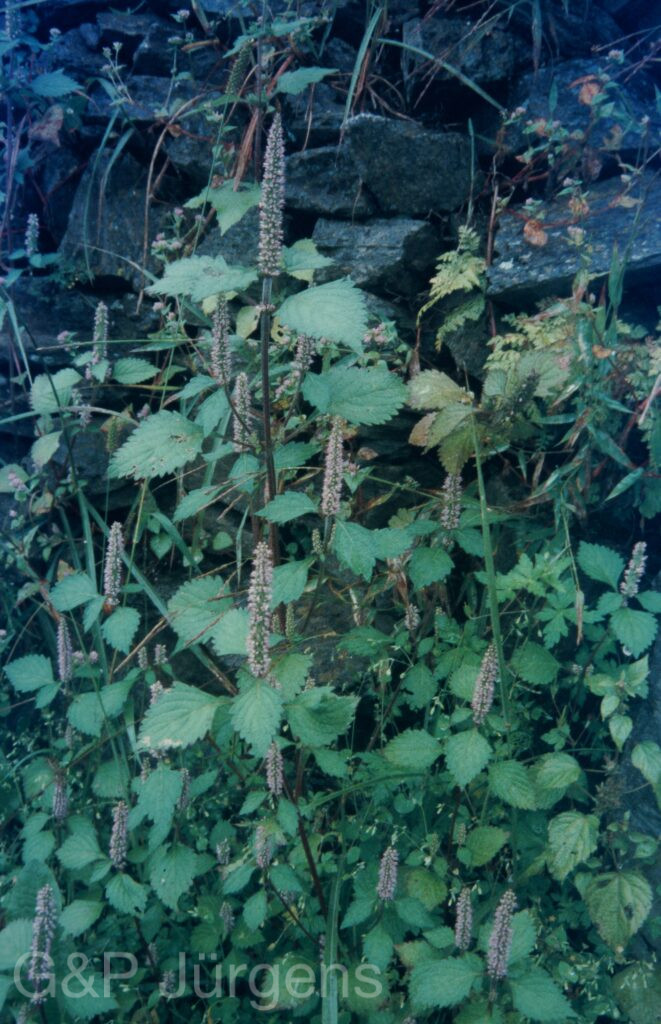
Garw 2005 203 ergebnis ergebnis
India Garhwal Pana 2750m, September
Bhutan2015 607
Bhutan Gasa 1950m, October

Description

Elsholtzia fruticosa is a widespread shrubby mint of the Himalaya and south-western China, recorded by GBIF (1928 occurrences) from China, Nepal, India, Bhutan, Pakistan, Malaysia and Myanmar. It is a plant of open, disturbed and sunny situations, colonising forest margins, scrub, roadsides, terraced field edges, river banks and clearings, broadly between 1500 and 3600 m. The cited collections span a wide elevational and seasonal range, from Bhutan's Gasa (1950 m) and Jakar (2100 m), through Garhwal in India (Pana, 2750 m), up to the Shele-La pass at 3600 m, flowering from September into October, reflecting its autumn-blooming habit across the central and eastern Himalaya.

The species is an aromatic, much-branched shrub or subshrub reaching 1-3 m, with quadrangular, pubescent stems woody at the base. The opposite leaves are lanceolate to elliptic, serrate, pinnately veined, often greyish-tomentose beneath and dotted with aromatic glands. The small flowers are crowded into dense, cylindrical, spike-like terminal and axillary thyrses, frequently secund, with the whitish to pale-yellow flowers turned to one side of the axis. Each flower has a campanulate calyx and a bilabiate corolla; the four stamens are exserted, giving the inflorescence a feathery aspect. The fruit comprises four small, smooth nutlets (mericarps) enclosed within the persistent calyx.

Described under the combination by Rehder, the species belongs to genus Elsholtzia (subfamily Nepetoideae, tribe Elsholtzieae), a group of aromatic herbs and shrubs centred on temperate Asia. Its essential-oil-rich foliage is used in local traditional medicine and as a minor source of nectar for late-season pollinators. As a vigorous, pioneer-like colonist of disturbed ground with a very broad range, it is of least conservation concern and is locally abundant rather than rare.

Author: Rehder · Sources: POWO (Kew), GBIF, Flora of China, Flora of Bhutan, A Revision of the Genus Elsholtzia (Lamiaceae)

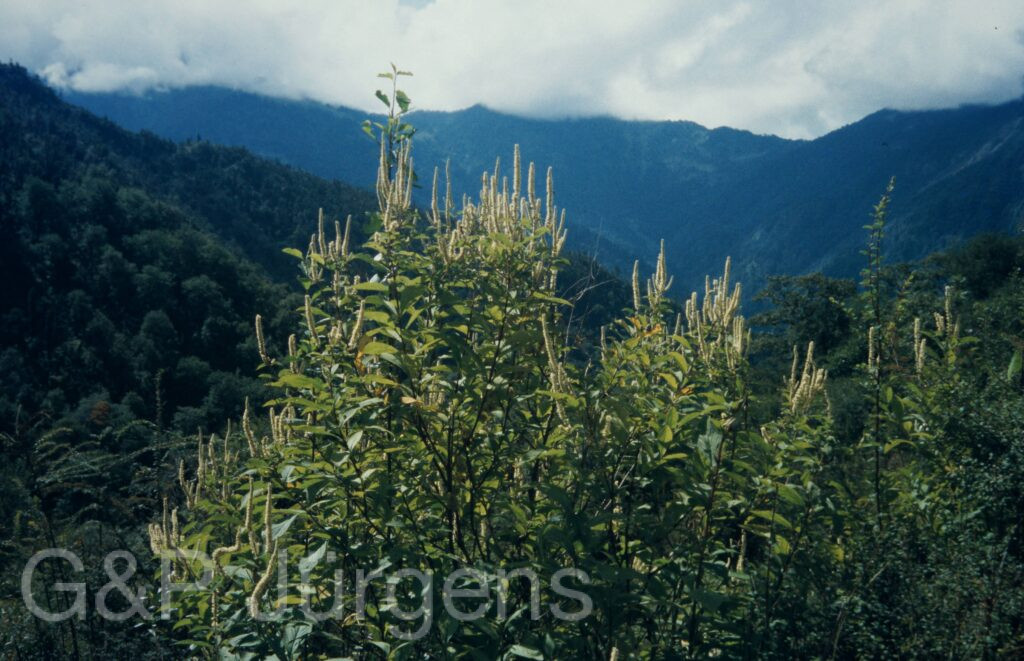
Benth.

Garw 2005 241 ergebnis ergebnis
India Garhwal Bora 2200m, September

Description

Elsholtzia pilosa is a wide-ranging Asian mint distributed from the Indian Himalaya, Nepal and Bhutan eastward through Bangladesh, Myanmar, Thailand and Vietnam to southern China, with nearly 400 GBIF occurrences indicating it is a frequent component of its region. It is a plant of open, disturbed and seasonally moist ground, growing along forest margins, on grassy banks, in fallow fields, by paths and on damp slopes, often as a weedy colonist of cultivated and waste land. The plant figured from Bora in Garhwal, India, at about 2200 m in September is typical of its montane range of roughly 1500-3000 m, the autumn flowering coinciding with the close of the monsoon.

It is an erect, aromatic annual herb with a quadrangular, usually pilose stem branching from the base. The leaves are opposite, ovate to lanceolate, with a serrate-crenate margin, an acuminate apex and a cuneate base tapering to a slender petiole, sparsely hairy and gland-dotted. The small flowers are crowded into dense, one-sided, spike-like terminal verticillasters, each subtended by a bract; the corolla is purplish to pinkish-white and bilabiate, with the four stamens exserted as in the genus. The calyx is tubular and ribbed, becoming enlarged in fruit and enclosing the four smooth, ovoid nutlets characteristic of the mint family.

The epithet pilosa refers to the soft, spreading hairiness of the herbage. Elsholtzia is a mainly eastern Asian genus of aromatic herbs and subshrubs, several species of which are used medicinally and as flavourings, the essential oils giving the foliage its pungent scent. As a pioneer of disturbed ground, E. pilosa is well adapted to anthropogenic habitats, which accounts for its broad and locally abundant distribution across the Himalaya and southern China.

Author: Benth. · Sources: POWO (Kew), GBIF, Flora of China, Flora of Bhutan, Hooker Flora of British India, Press Labiatae of the Himalaya

Benth.

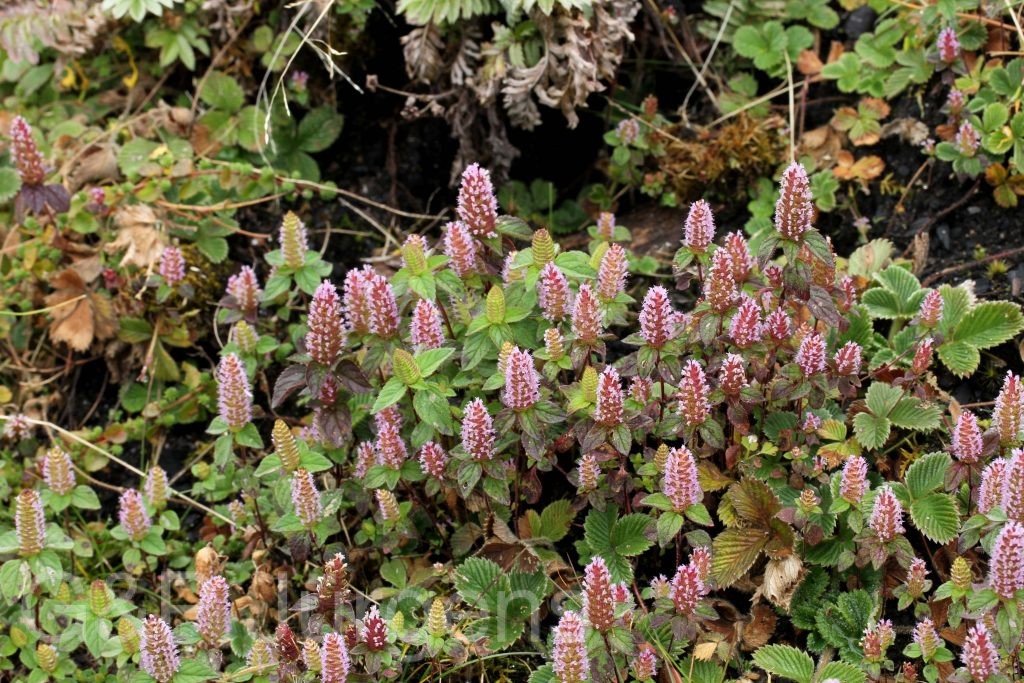
Bhutan2012 306
Bhutan Shele-La 4100m, October
Bhutan2012 915
Bhutan Tumching-La 4000m, October

Description

Elsholtzia strobilifera is a high-montane to alpine herb widely distributed across the Sino-Himalayan region, recorded from Nepal, India, Bhutan, Pakistan, Myanmar, China and Taiwan, with some 493 georeferenced occurrences documented in GBIF. It is a plant of open stony slopes, grazed alpine meadows, screes and forest margins, typically between 3000 and 4300 m. The collections illustrated here, from the Bhutanese passes Shele-La at 4100 m and Tumching-La at 4000 m in October, exemplify its characteristic late-season flowering at the upper limits of vegetation, where it often forms part of dwarf-herb communities on disturbed and well-drained substrates.

It is an annual or short-lived herb, usually 5-30 cm tall, with erect or ascending, often purplish, quadrangular stems that are puberulent and frequently branched from the base. The leaves are opposite, ovate to elliptic, shortly petiolate, with crenate-serrate margins and gland-dotted surfaces emitting an aromatic scent when bruised. The inflorescence is a dense, ovoid to shortly cylindrical terminal spike of crowded verticillasters, the conspicuous broad floral bracts giving the cone-like appearance reflected in the epithet. Each tubular, bilabiate corolla is pale violet to pinkish, two-lipped and exserted-stamened; the fruit comprises four smooth, ellipsoid nutlets enclosed in the persistent calyx.

The genus Elsholtzia (Lamiaceae, subfamily Nepetoideae) comprises aromatic herbs and subshrubs centred on eastern Asia, several yielding essential oils. E. strobilifera is among the most cold-tolerant members, ascending higher than most congeners. Its capacity to colonise grazed and physically disturbed alpine ground confers ecological resilience, and it is not regarded as threatened given its broad range and abundance, though high-altitude populations are sensitive to changing grazing regimes and warming treelines.

Author: Benth. · Sources: POWO (Kew), GBIF, Flora of China, Flora of Bhutan, A Revision of the Genus Elsholtzia (Lamiaceae)

(Lindl. ex Wall.) Koord. & Valeton

Bhutan2012 649
Bhutan Tserang 1660m, September

Description

Engelhardia spicata var. colebrookeana is a subtropical tree of the walnut family ranging across the southern Himalaya and into Southeast Asia, with GBIF records from China, India, Nepal, Bhutan, Thailand, Vietnam, Indonesia and the Philippines. It is a component of warm broad-leaved and pine-oak forest, secondary woodland and forest margins, mostly between 800 and 2,000 m. The photographed tree grows at Tserang in southern Bhutan at about 1,660 m in September, when the long, drooping fruiting catkins with their winged nutlets are conspicuous in the subtropical foothill forest.

The plant is a medium-sized to large deciduous or semi-evergreen tree with grey, somewhat fissured bark. The leaves are alternate and pinnately compound, with several pairs of opposite to subopposite, elliptic-oblong, entire leaflets that are glabrous to finely hairy and oblique at the base. The species is monoecious, with slender pendulous catkins; the female flowers develop into a characteristic infructescence in which each small, hard nutlet is subtended by a large, three-lobed, membranous wing-bract that acts as a samara for wind dispersal. This trilobed wing readily distinguishes Engelhardia from its relatives in the family.

Following GBIF, this taxon is treated as a synonym under the accepted name Engelhardia spicata colebrookeana, a variety distinguished from typical E. spicata by indumentum and leaflet characters. The Juglandaceae are an economically and phylogenetically important temperate-to-tropical family, and Engelhardia represents its warm Asian element. The tree is widespread, used locally for timber, fuel and tannin, and is not considered threatened, persisting well in disturbed and secondary forest.

Author: (Lindl. ex Wall.) Koord. & Valeton · Sources: POWO (Kew), GBIF, Flora of China Vol. 4 (Juglandaceae), Grierson & Long: Flora of Bhutan Vol. 1, Manning: The Genera of Juglandaceae

(Buch.-Ham. ex DC.) Nakai

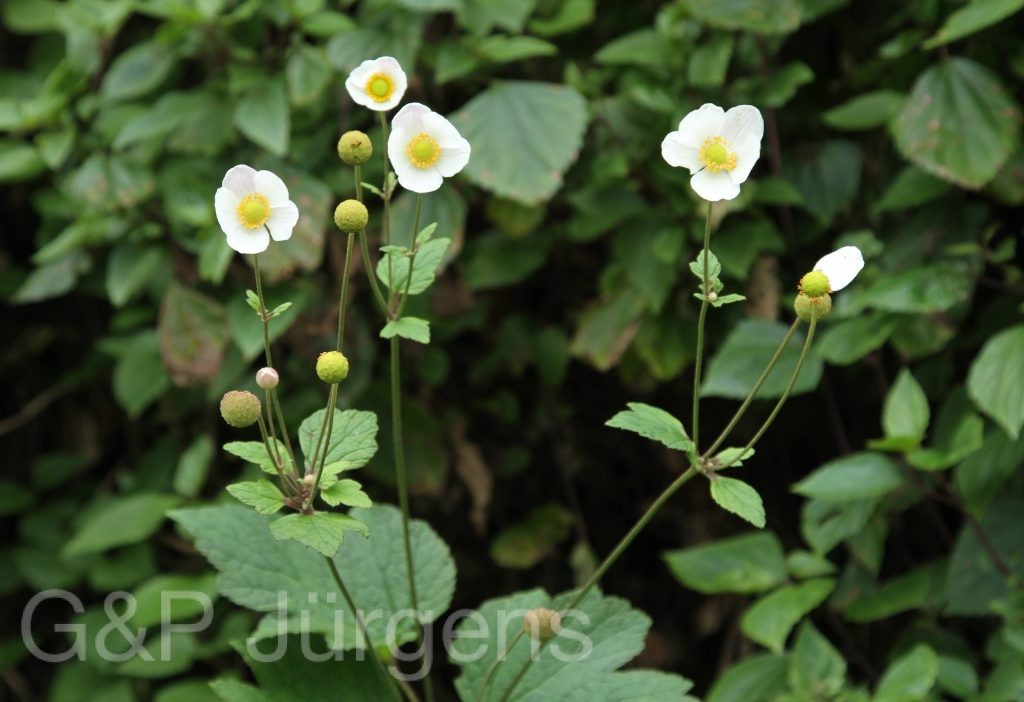
Bhutan2012 1325
Bhutan Pemagatse 1900m, October
Bhutan2012 447
Bhutan Wangdi 2500m, September

Description

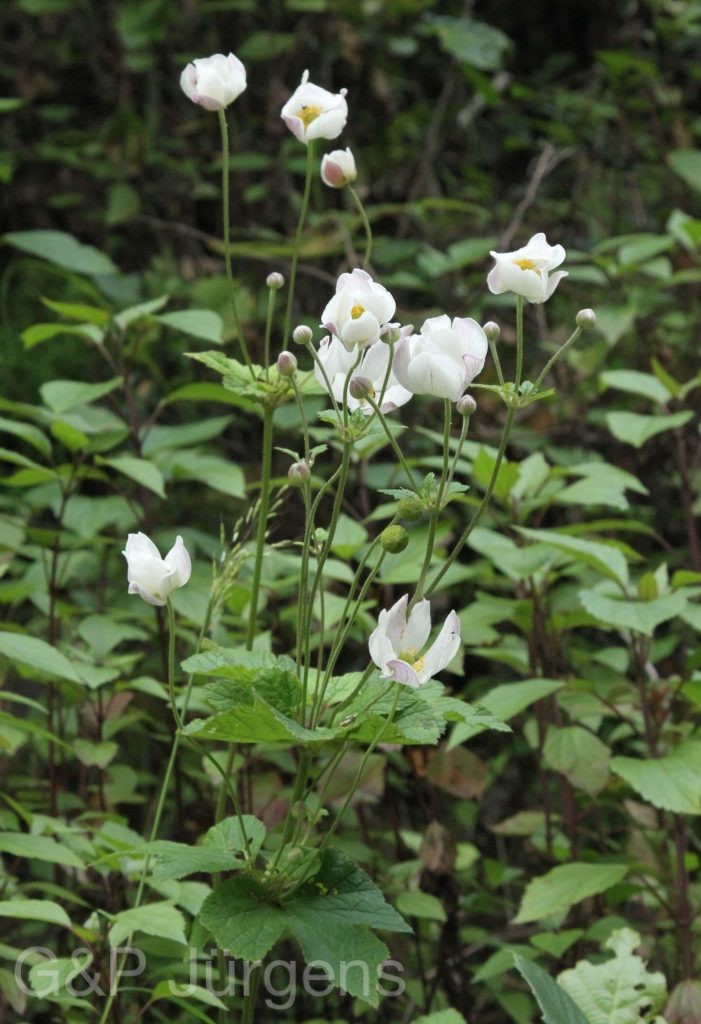
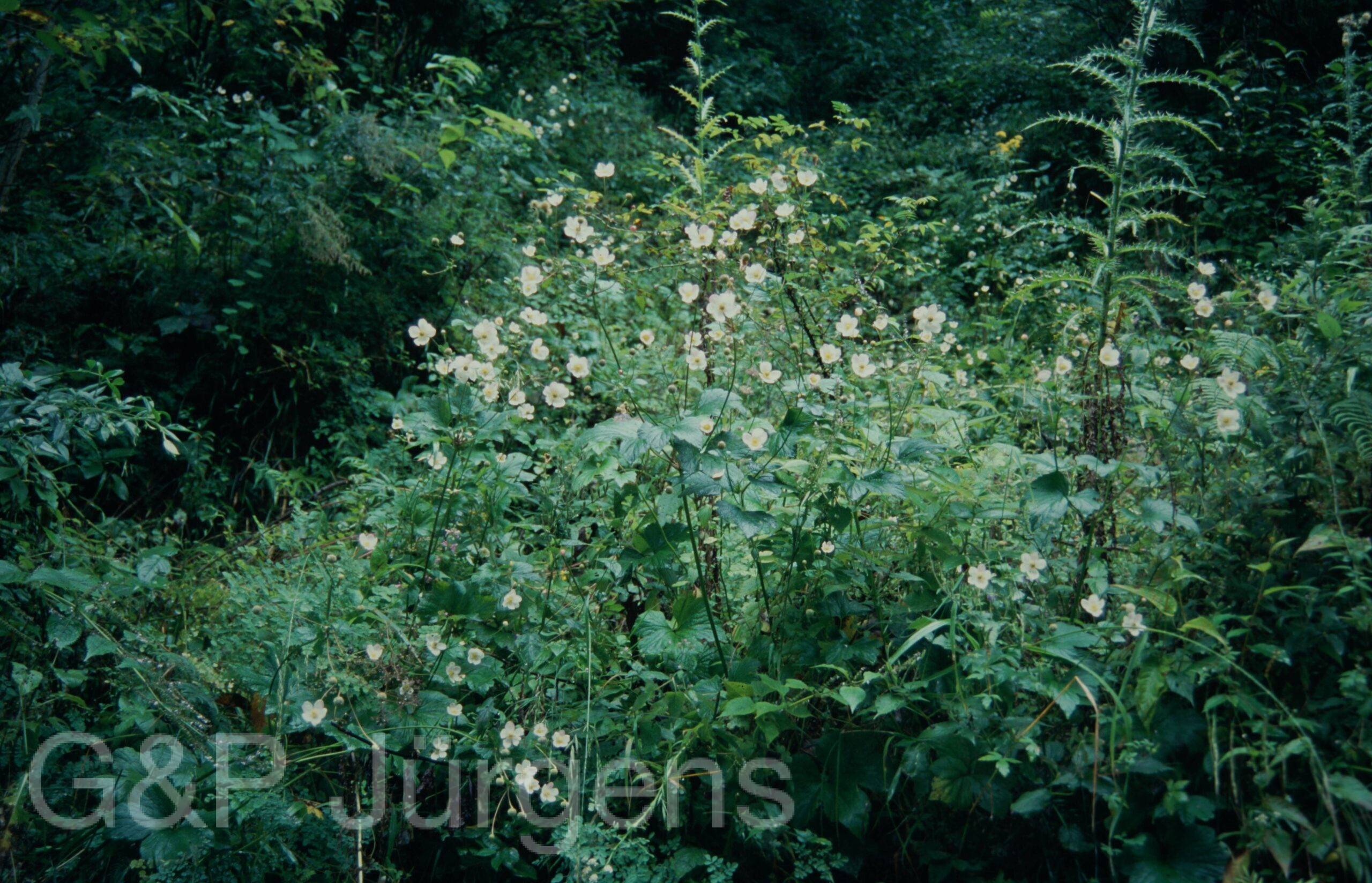
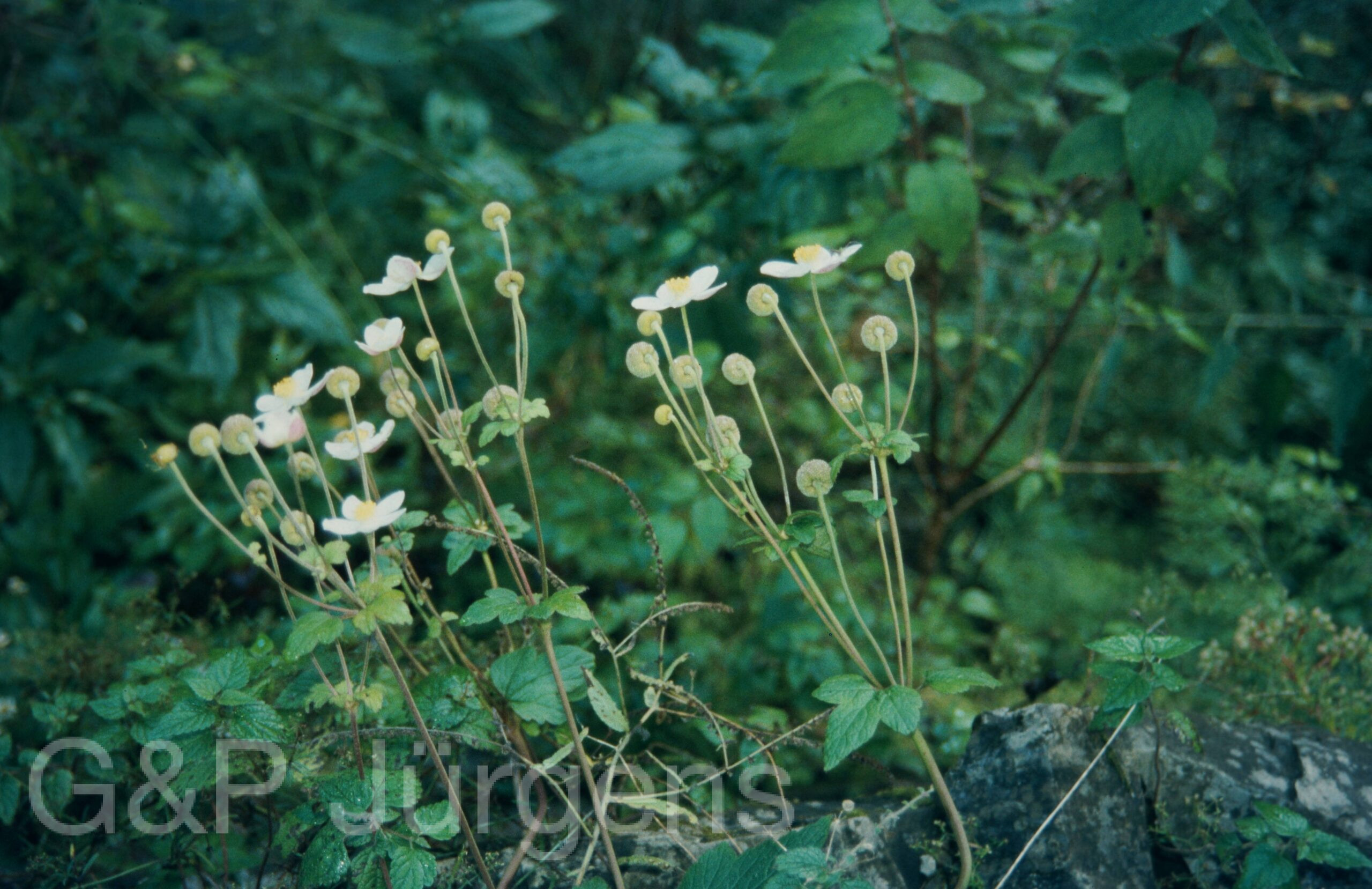
Eriocapitella vitifolia (formerly Anemone vitifolia) is a robust perennial herb widespread across the Himalaya and East Asia, recorded from China, Nepal, India, Bhutan, Taiwan, Myanmar, Pakistan and beyond, with nearly 2000 georeferenced occurrences in GBIF reflecting both its native range and ornamental cultivation. It favours forest margins, open slopes, shrubberies and disturbed banks, mainly in the warm- to cool-temperate belt between about 1500 and 3000 m. The plants illustrated were photographed in Bhutan at Pemagatse (1900 m) and Wangdi (2500 m) and in the Indian Garhwal at Sitel (1850 m), flowering from September into October.

The species arises from a stout, woody rootstock and produces long-petiolate basal leaves with broadly cordate-ovate, vine-like (vitifolia, grape-leaved) blades that are shallowly three- to five-lobed, toothed, and densely white-tomentose beneath. Tall, branching flowering scapes bear cymose clusters of showy flowers, each with five to many petaloid sepals (true petals absent) that are white to pale pink, surrounding a central mass of numerous yellow stamens and a domed cluster of carpels. The fruiting head is globose and conspicuously woolly, the densely hairy achenes being adapted for wind dispersal, a feature reflected in the generic name.

Eriocapitella was segregated from Anemone (Ranunculaceae) on molecular and morphological grounds, comprising the woolly-fruited Asian anemones, and E. vitifolia is one of its most familiar Himalayan representatives. It is widely grown in temperate gardens and is an ancestral parent of the cultivated Japanese anemones, explaining scattered records in Europe, North America and southern Africa. Containing acrid ranunculaceous compounds, it is avoided by grazers and, common and adaptable, is of no conservation concern.

Author: (Buch.-Ham. ex DC.) Nakai · Sources: POWO (Kew), GBIF, Flora of China, Flora of Bhutan, Annotated Checklist of the Flowering Plants of Nepal, Hoot et al. Phylogeny of Anemone and Allies

Roxb.

Bhutan2015 65
Bhutan Wangdi Phodrang 1900m, October
Bhutan2012 464
Bhutan Wangdi 2500m, September

Description

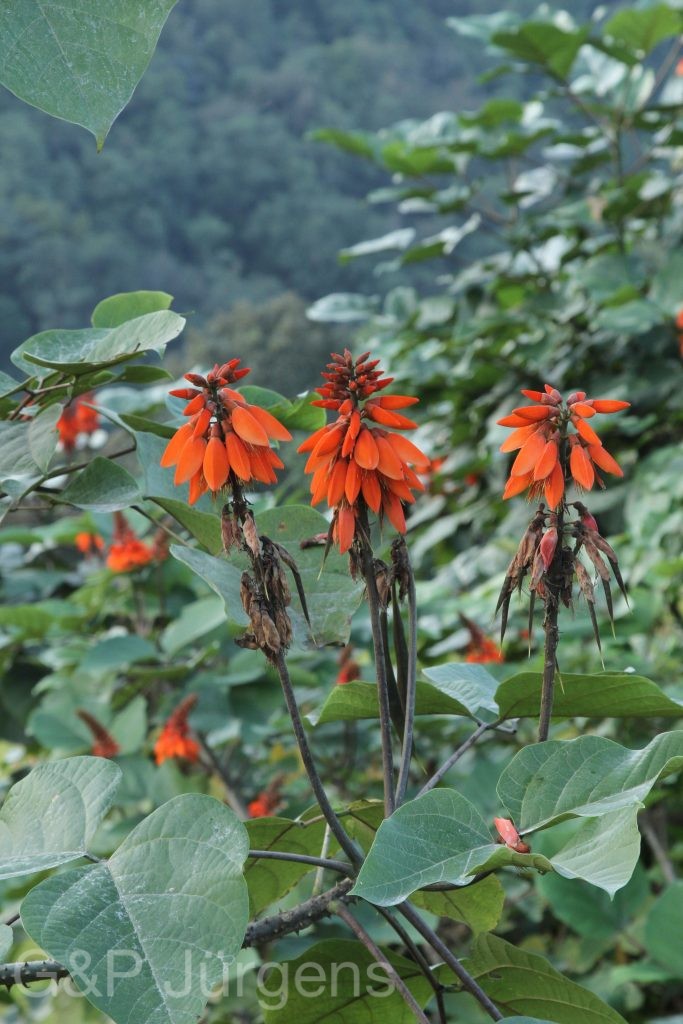
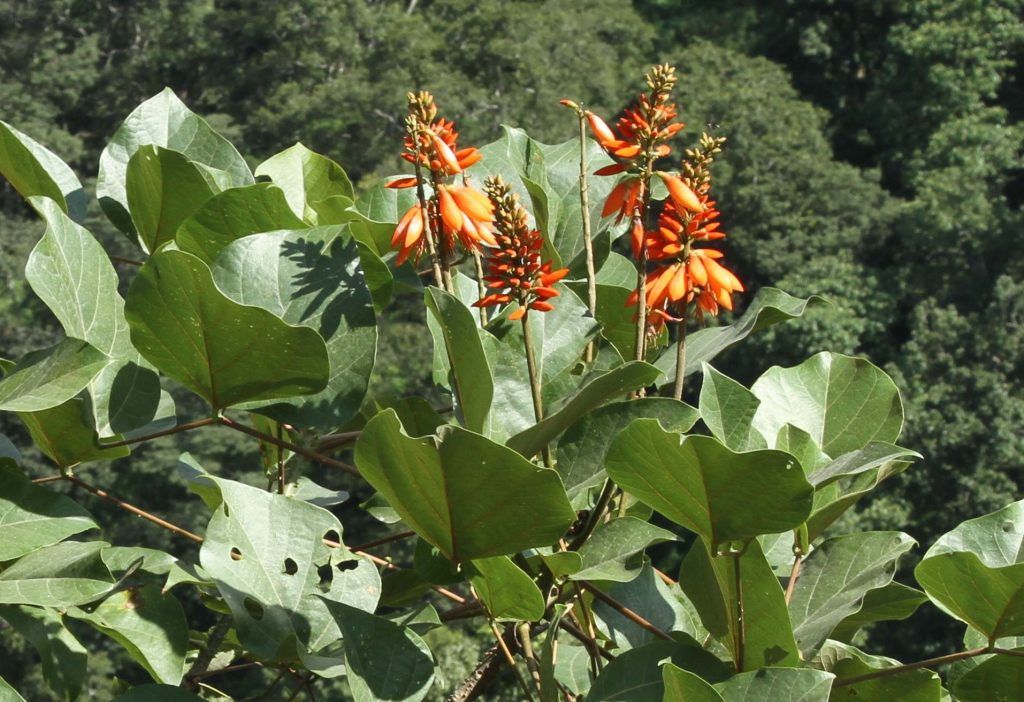
Erythrina arborescens is a Himalayan to Southeast Asian coral tree distributed across China, India, Nepal, Bhutan, Myanmar, Bangladesh, Japan and Thailand, with about 369 GBIF occurrences spanning this wide subtropical to warm-temperate range. It grows in open broad-leaved forest, forest margins, valley slopes and disturbed ground, generally from about 1300 to 3000 m. The trees photographed near Wangdi Phodrang in Bhutan at about 1900 m in October and at about 2500 m in September illustrate its mid-elevation valley habitat, where its scarlet flower spikes appear after the leaves toward the close of the monsoon.

The species is a small to medium-sized deciduous tree with a stout trunk and branches armed with scattered conical prickles. The leaves are alternate and trifoliolate, with broadly ovate to rhombic leaflets, the terminal one largest, on a long prickly petiole. The inflorescence is a dense terminal raceme of large, showy, bright red papilionaceous flowers in which the broad standard petal is conspicuously enlarged while the wings and keel are reduced, an arrangement adapted to bird pollination. The fruit is an elongate, torulose, dehiscent legume constricted between the few shining red-brown seeds.

Erythrina is a pantropical genus of about 130 species notable for ornithophilous, nectar-rich flowers and seeds containing toxic isoquinoline alkaloids. E. arborescens is among the few species extending into temperate Himalayan elevations, its post-monsoon flowering and copious nectar attracting sunbirds and other nectarivorous birds that serve as pollinators. Widely distributed and tolerant of disturbance, it is of least concern; it is locally valued as a shade and ornamental tree and features in traditional medicine across its range.

Author: Roxb. · Sources: POWO (Kew), GBIF, Flora of China, Flora of Bhutan, Annotated Checklist of the Flowering Plants of Nepal, Krukoff & Barneby studies of Erythrina