Tag:

Autumn

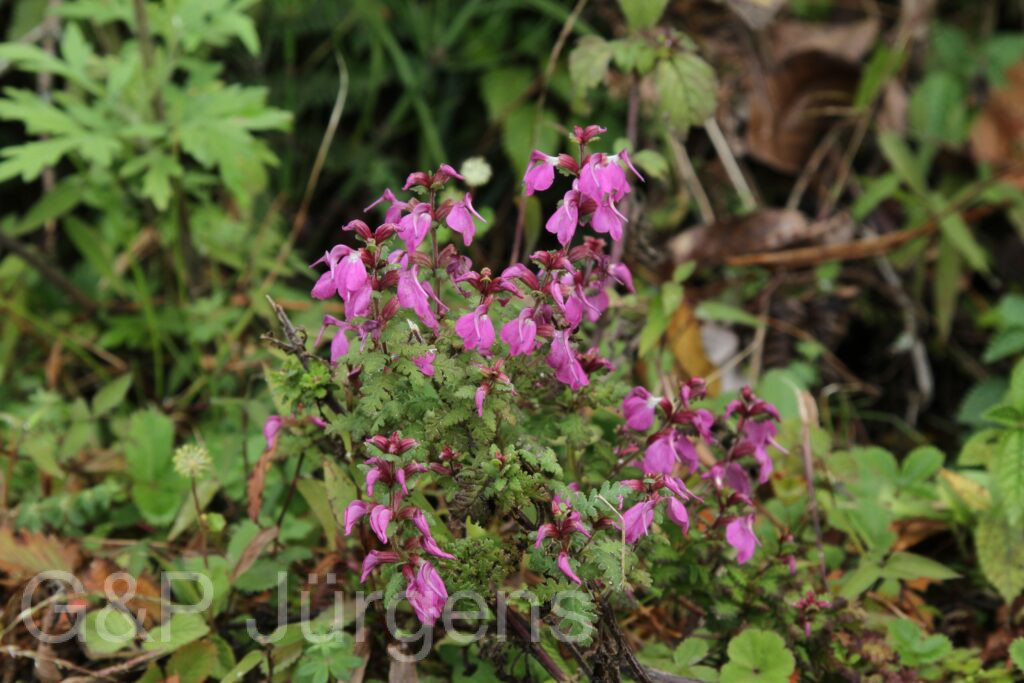
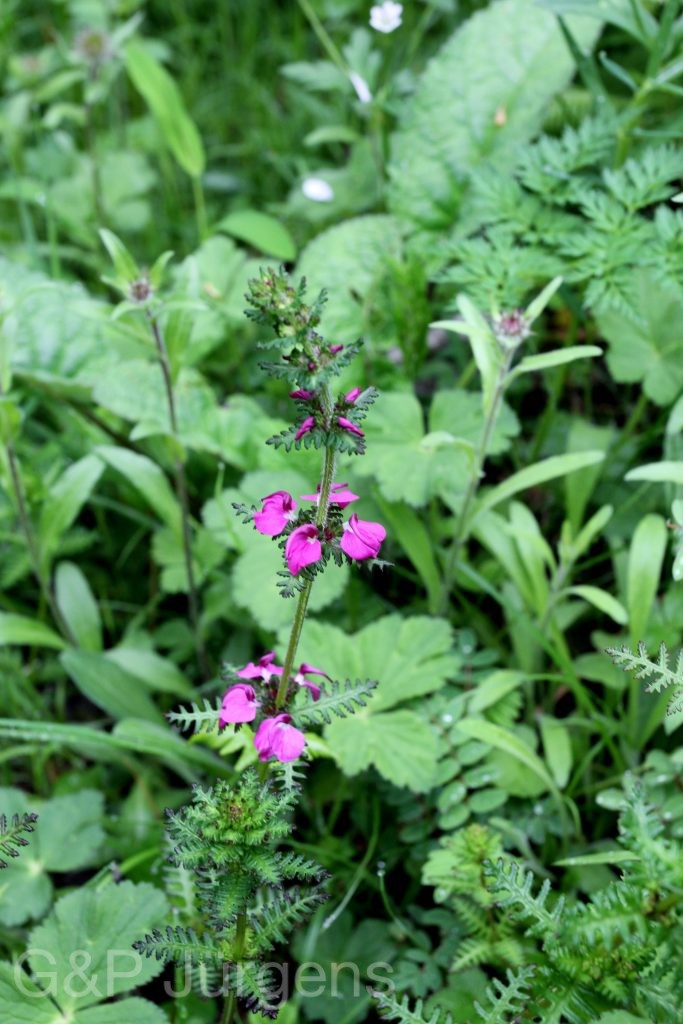
(Prain) P.C.Tsoong

Bhutan2012 1298
Bhutan Trashigang 1900m, October
BhutanPG2011 391
Bhutan Dur Tsa-Chu 3380m, June

Description

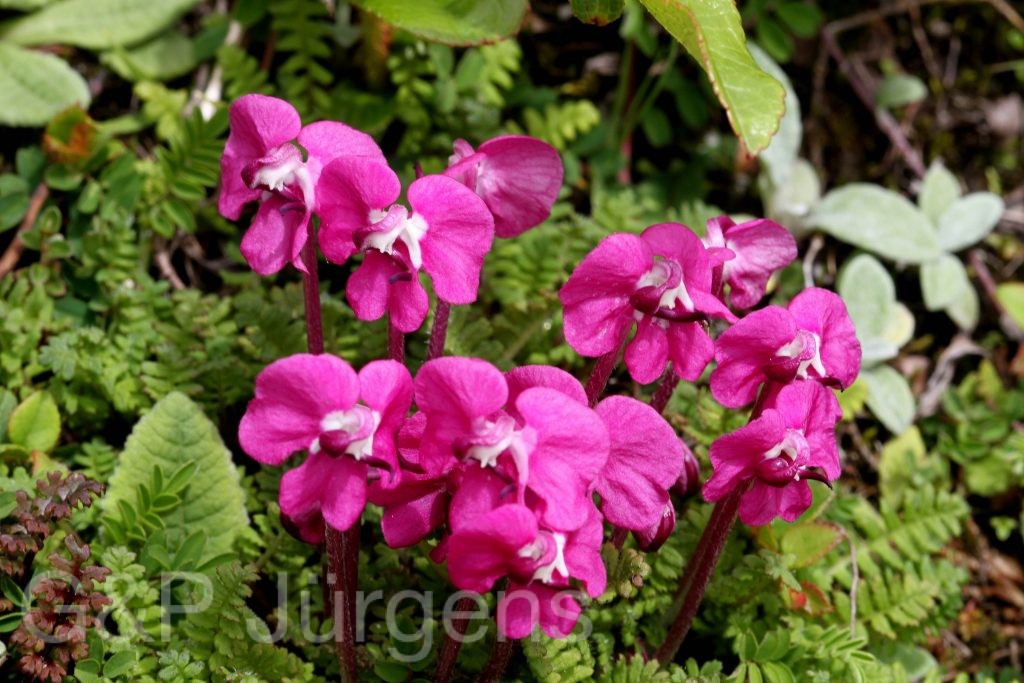
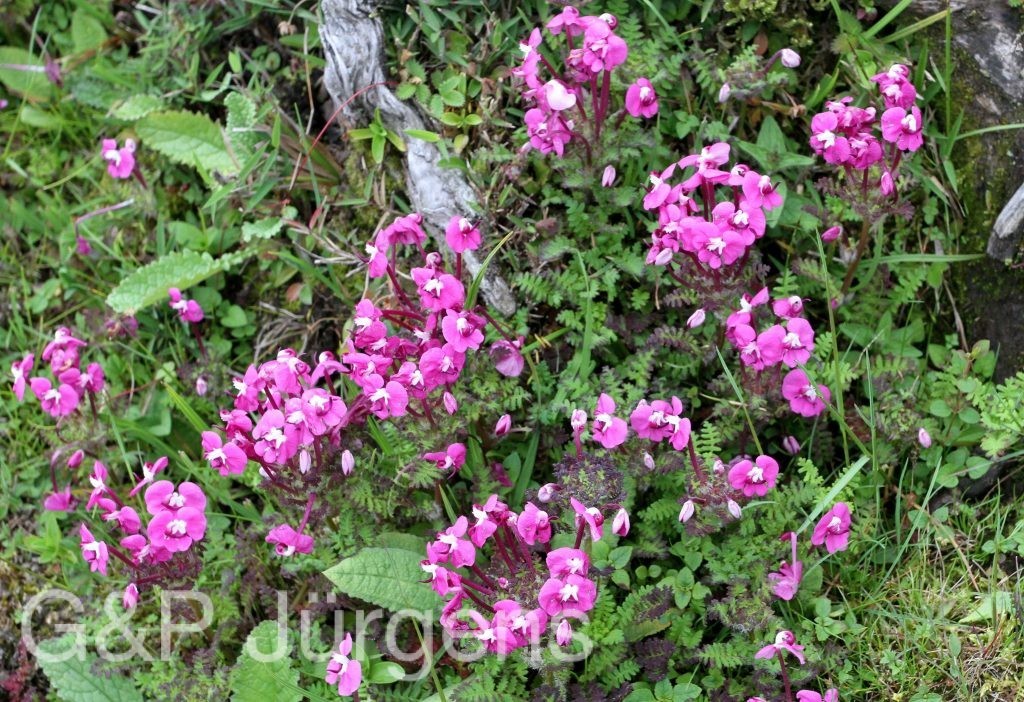
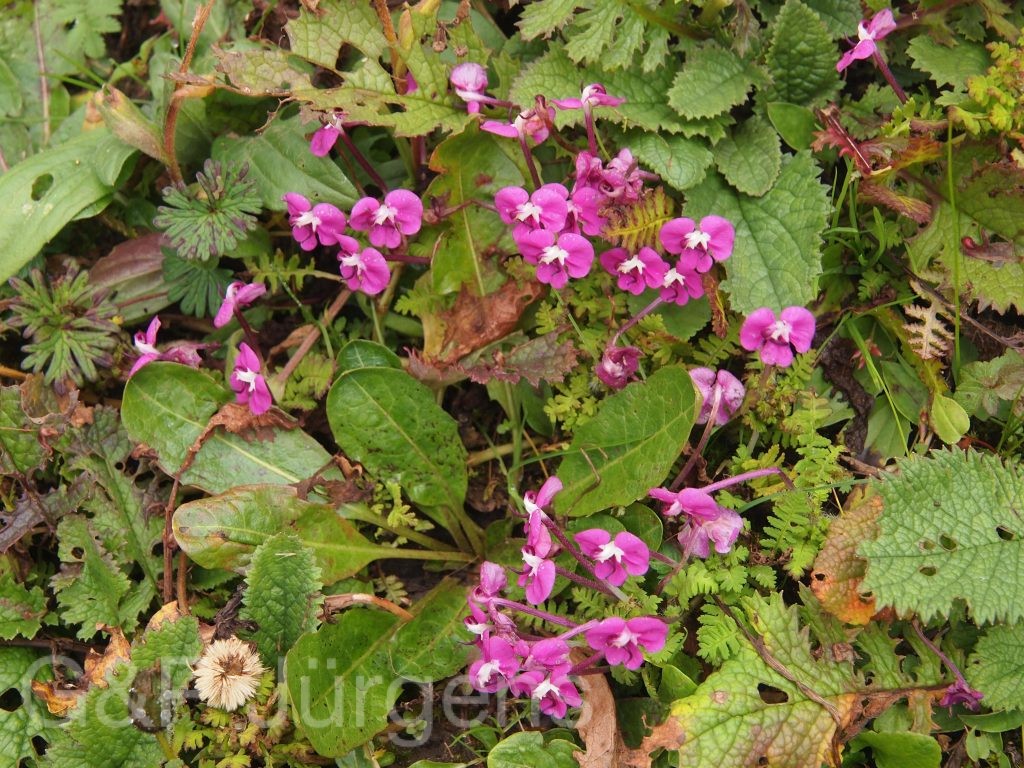
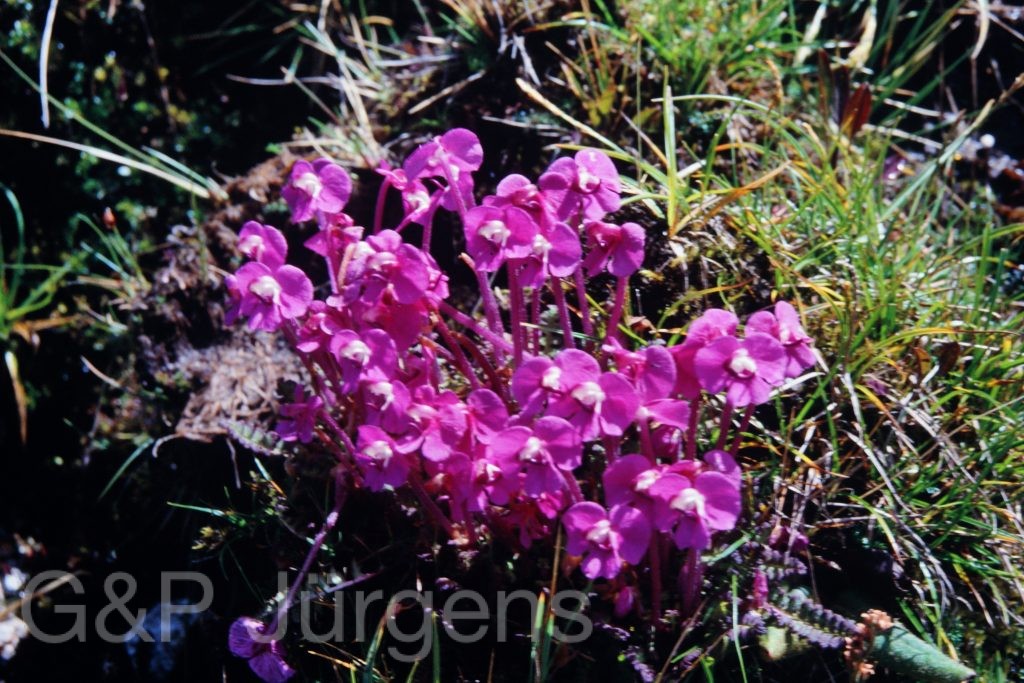
Pedicularis gracilis subsp. macrocarpa is a Sino-Himalayan lousewort distributed across southern China, northern India, Nepal and Bhutan, with about 33 documented GBIF occurrences. It occupies open forest, grassy slopes, scrub and meadow margins through a broad temperate to subalpine elevation span. The Bhutanese records illustrate this amplitude well: a population at Trashigang at 1900 m flowering in October and another at the Dur Tsa-Chu at 3380 m flowering in June, indicating tolerance of both warm-temperate forest and high subalpine grassland, on moist, humus-rich and seasonally damp ground.

It is a slender erect perennial herb, the stem often branched and the foliage finely dissected: the leaves are alternate or subopposite, pinnately divided into narrow, serrate segments. The flowers are borne in lax, leafy-bracteate terminal racemes; each has a tubular, toothed calyx and a strongly two-lipped pink to purplish corolla typical of the genus, the galeate upper lip (galea) often beaked or hooded and the spreading three-lobed lower lip forming a landing platform. The four didynamous stamens are concealed within the galea. As the subspecific epithet macrocarpa indicates, the fruit is a comparatively large, laterally compressed, beaked loculicidal capsule containing several seeds.

GBIF treats this name as a synonym while retaining Pedicularis gracilis subsp. macrocarpa as accepted, distinguished from the typical subspecies by its larger fruit. Like all louseworts it is a hemiparasite, drawing water and nutrients from neighbouring roots via haustoria while retaining green foliage. The galeate flowers are pollinated by bumblebees. The taxon is locally distributed but not of conservation concern.

Author: (Prain) P.C.Tsoong · Sources: POWO (Kew), GBIF, Flora of China Vol. 18, Flora of Bhutan Vol. 2, Flora of Nepal, A Monograph of the Genus Pedicularis
Wall. ex Benn.

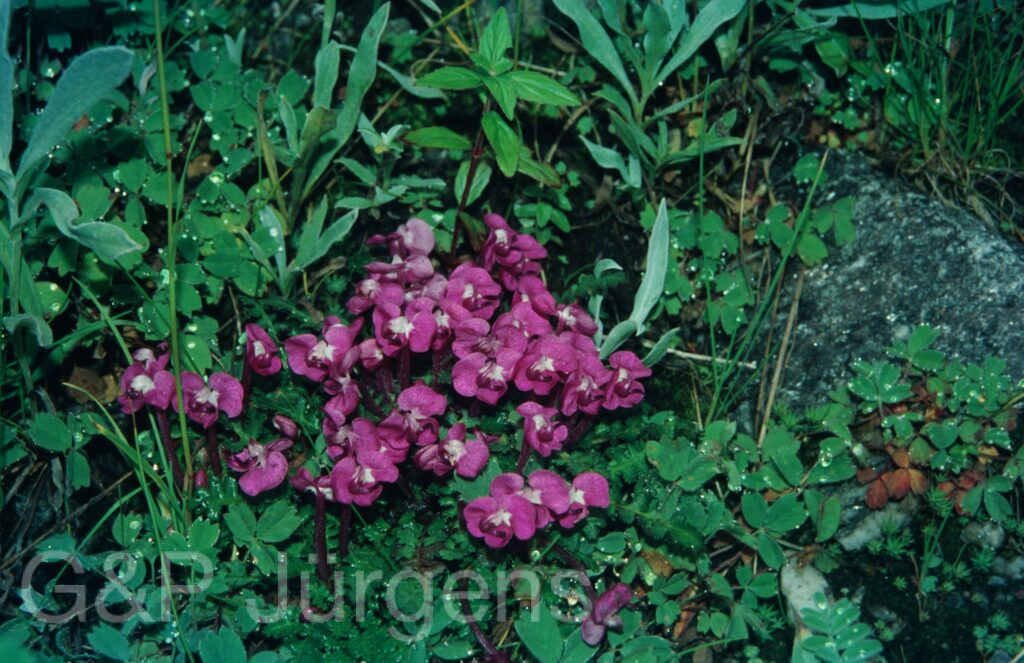
Garw 2005 62 ergebnis ergebnis
India Garhwal Valley of flowers 3400m, September
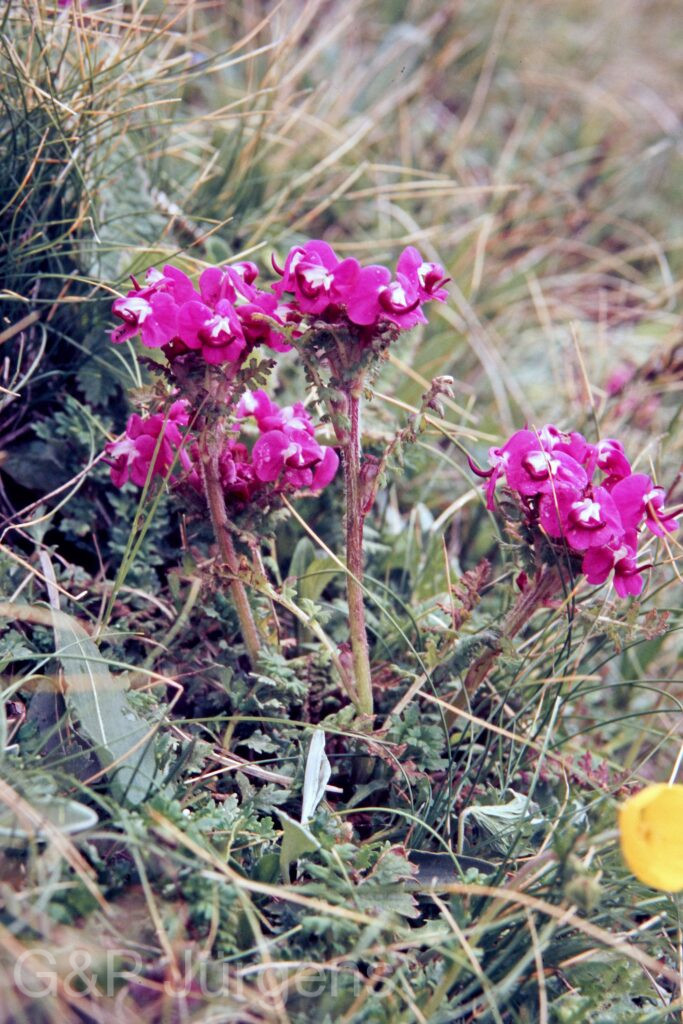
Garh 07 473 ergebnis
India Garhwal Khiar Kutti 3740m, June

Description

Pedicularis hookeriana Wall. ex Benn. is a hemiparasitic alpine herb distributed across the high Himalaya and adjoining mountains, recorded from Nepal, India, China and Myanmar, with some 61 georeferenced occurrences in GBIF. It inhabits open alpine meadows, moist turf, streamsides and the margins of dwarf-shrub communities, typically between 3300 and 4500 m. The species was documented in the Indian Garhwal Himalaya, both in the celebrated Valley of Flowers at 3400 m in September and at Khiar Kutti at 3740 m in June, the latter coinciding with the early-summer flush of alpine bloom after snowmelt. Like all members of the genus it attaches to the roots of neighbouring graminoids and forbs through haustoria, supplementing its own photosynthesis.

It is a low, often tufted perennial with a thickened rootstock and few erect or ascending stems. The leaves are mostly basal and rosulate, oblong to lanceolate in outline and deeply pinnatisect, the segments incised-dentate and frequently tinged with anthocyanin. The flowers are borne in a short, dense terminal raceme; the calyx is tubular and toothed, while the showy bilabiate corolla is pink to purplish-red, its galea curved and beaked, contrasting with a broad spreading lower lip. The fruit is an obliquely ovoid, somewhat compressed capsule containing several small seeds.

Within the large and taxonomically complex genus Pedicularis, P. hookeriana belongs to the beaked-galea assemblage that radiated extensively across the Sino-Himalayan region, one of the world's principal centres of diversity for the genus. Its long, curved corolla beak is an adaptation to pollination by long-tongued bumblebees, which the flower architecture mechanically guides. Though not formally assessed as threatened, its restriction to fragile alpine turf makes it sensitive to grazing pressure and climate-driven upslope shifts of vegetation belts.

Author: Wall. ex Benn. · Sources: POWO (Kew), GBIF, Flora of China, Flora of Bhutan, Flora of Nepal, Pedicularis monograph (Prain; Tsoong revision of Asian Pedicularis)

D.Don

Sikkim2011 202
Sikkim Lachung 3000m, June
BhutanPG2011 735 01 01
Bhutan Haa-Valley, 2750m June
Bhutan2012 77
Bhutan Shele-La, 4000m September
Sikkim2003 115 P155
Sikkim below Dzongri 4000m August

Description

Pedicularis siphonantha is a Himalayan lousewort distributed through southern China, Nepal, northern India, Sikkim, Bhutan, Myanmar and Pakistan, well represented in GBIF with 810 occurrences. It is a plant of moist alpine and subalpine meadows, open hillsides, Rhododendron scrub and streamside turf, mostly between 2700 and 4500 m. The accompanying records span its range and season: Lachung in Sikkim at 3000 m and the Haa Valley in Bhutan at 2750 m in June, and the higher Shele-La (4000 m) and slopes below Dzongri (4000 m) flowering on into August and September, reflecting a long summer-to-autumn anthesis across an altitudinal gradient.

It is a perennial herb with erect or ascending stems arising from a stout rootstock, bearing leaves that are pinnatisect into oblong, doubly toothed segments. The rose-pink to purplish-red flowers are crowded in terminal racemes; the corolla is strongly two-lipped, its most distinctive feature a long, slender, often curved or twisted tubular galea drawn out into a beak (the siphon-like form giving the epithet), with a spreading three-lobed lower lip. The four stamens lie under the galea, and the fruit is an obliquely ovoid capsule containing several seeds.

Like all Pedicularis, it is a hemiparasite, drawing water and nutrients from the roots of neighbouring meadow plants through haustoria while retaining green photosynthetic foliage. The elongate corolla tube indicates pollination by long-tongued bumblebees. Pedicularis is exceptionally species-rich and difficult in the Sino-Himalaya, with corolla architecture central to species delimitation. Widespread and locally abundant, P. siphonantha is not regarded as threatened, though louseworts as a group are sensitive to changes in their host-rich alpine grassland communities.

Author: D.Don · Sources: POWO (Kew), GBIF, Flora of China, Flora of Bhutan, Yamazaki: Pedicularis monograph

(G.Forst.) Hook. & Arn.

Bhutan2012 1010
Bhutan Trithangebe 1000m, October
Bhutan2012 1011
Bhutan Trithangebe 1000m, October
Sikkim 2006 472 ergebnis
India West-Bengal, Ruigi-Chu 2000m, May

Description

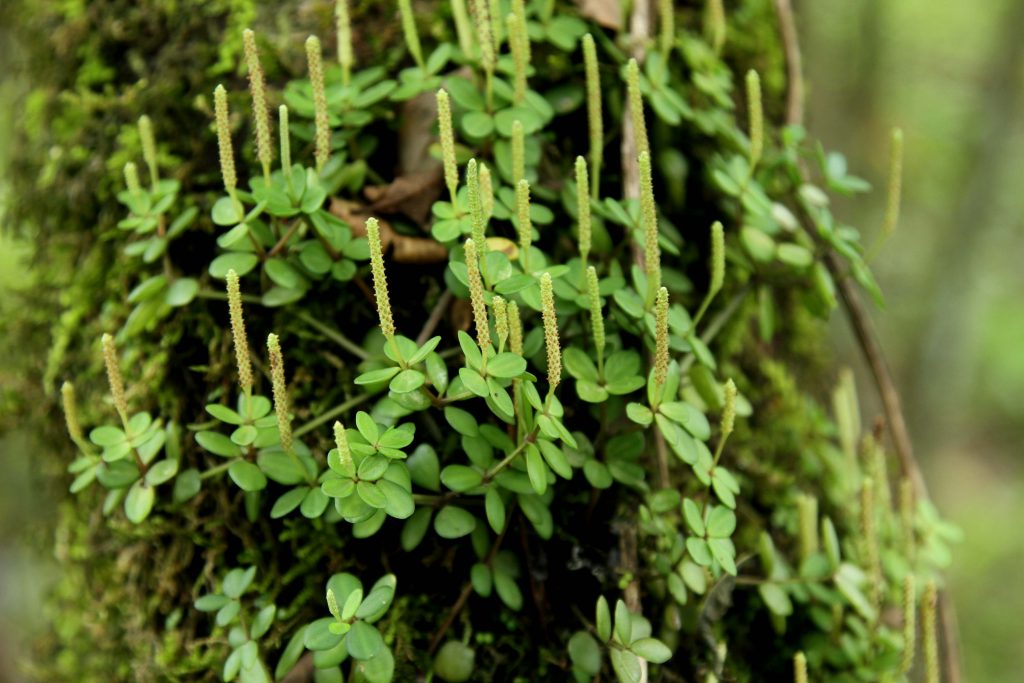
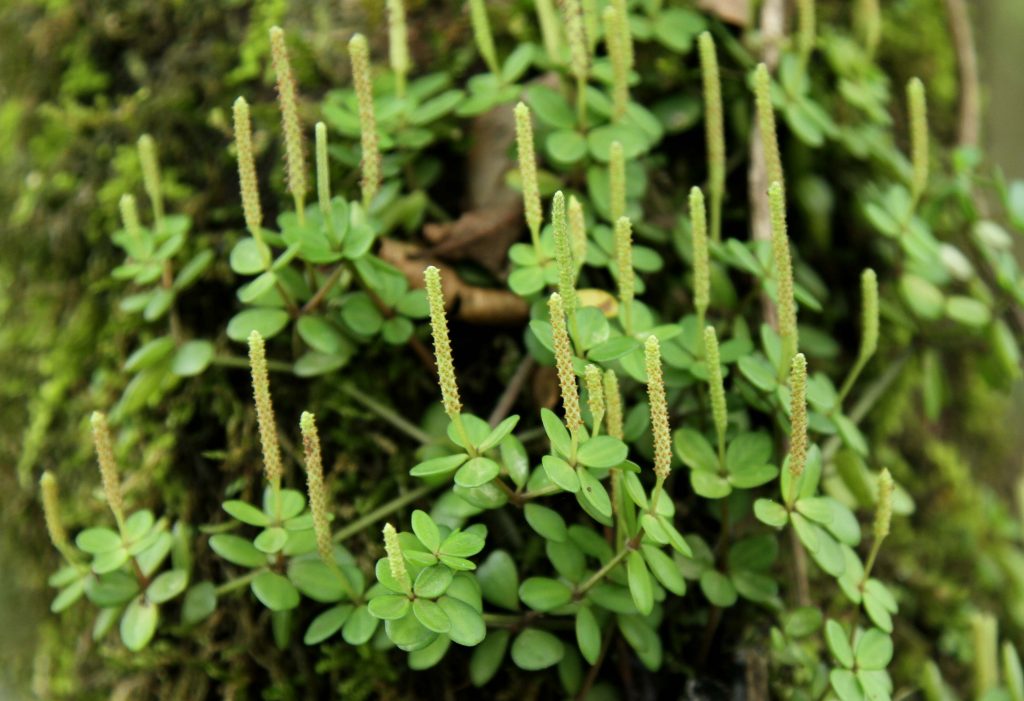
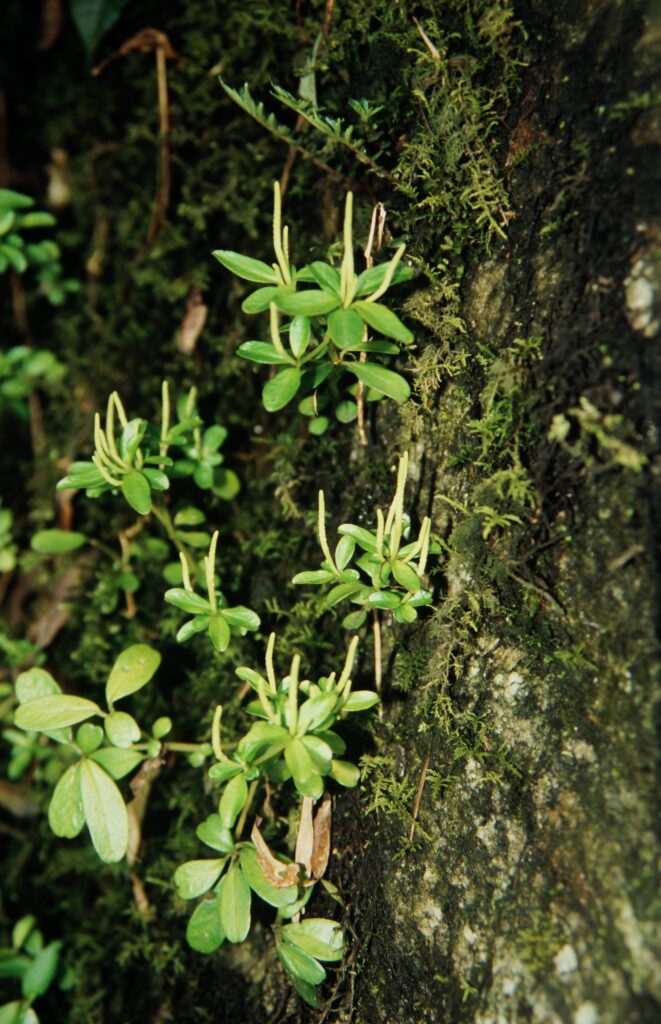
Peperomia tetraphylla is a small succulent herb of pantropical and warm-temperate distribution. GBIF (some 13,039 occurrences) documents it from the Americas (Brazil, Mexico, the United States, the Andes), Africa and the Indian Ocean islands, Asia (China, India, Indonesia, Taiwan) and Australasia, reflecting an extraordinarily wide range. It grows as an epiphyte on mossy trunks and as a lithophyte on shaded, humid rocks in forest. The illustrated plants are from Bhutan at Trithangbi (1,000 m, October) and West Bengal at Ruigi-Chu (2,000 m, May), spanning its Himalayan altitudinal range in moist broadleaved forest.

The plant is a fleshy, glabrous to finely pubescent herb with creeping then ascending stems rooting at the nodes. The leaves are succulent, characteristically borne in whorls of three to four (whence tetraphylla), small, elliptic to obovate and shortly petiolate. The inflorescence is a slender terminal or axillary spike of minute, naked, bisexual flowers lacking a perianth, each subtended by a peltate bract; the stamens are two and the stigma single. The fruit is a tiny ovoid drupelet, often borne sessile along the rachis.

Peperomia (Piperaceae) is a large pantropical genus, and P. tetraphylla is notable as one of its most widespread species, occurring on most continents. Its small succulent leaves and CAM-like physiology suit it to the seasonally dry, epiphytic microhabitats it occupies. Of no conservation concern given its vast range, it is locally used in folk medicine and is grown as a miniature ornamental, illustrating the cosmopolitan tropical element reaching into the lower Himalaya.

Author: (G.Forst.) Hook. & Arn. · Sources: POWO (Kew), Flora of China Vol. 4, Flora of Bhutan Vol. 1, GBIF, Wanke et al.: Phylogeny of Piperaceae

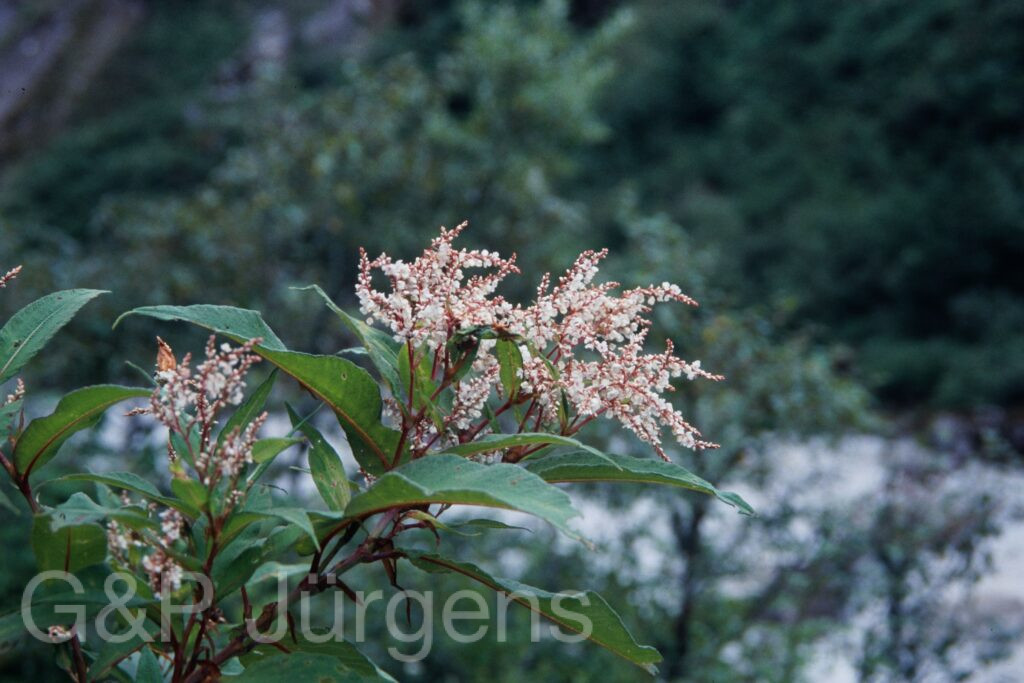
(Hook.f.) Ronse Decr.

Bhutan2012 20
Bhutan Shele-La, 3200m September
Bhutan2012 91
Bhutan Shele-La, 3200m September

Description

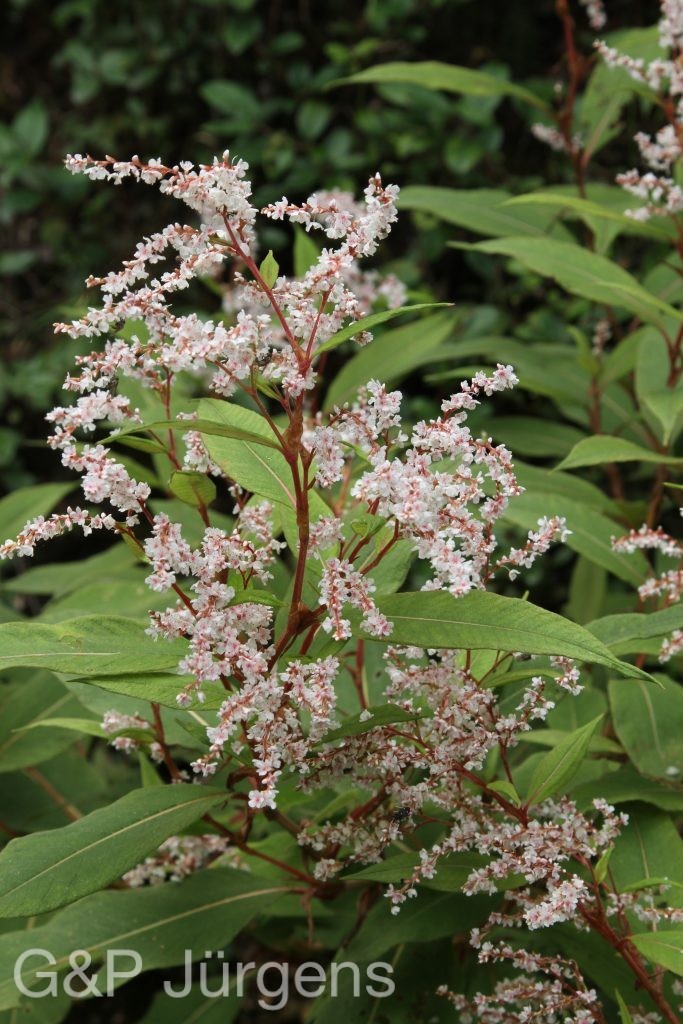
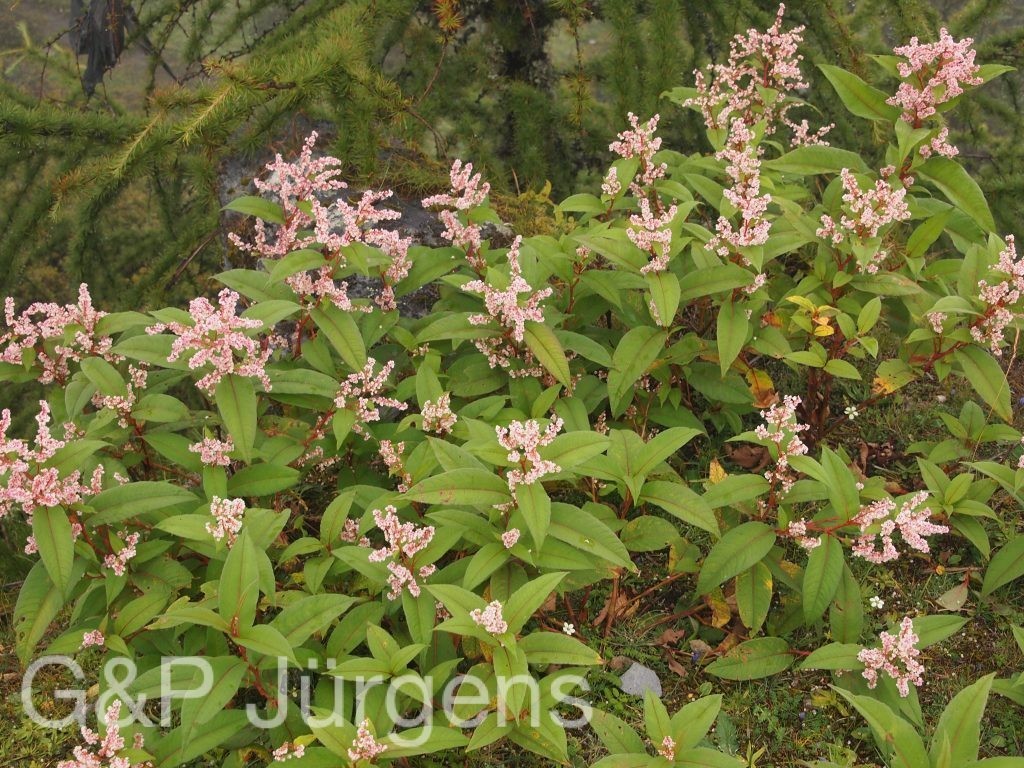
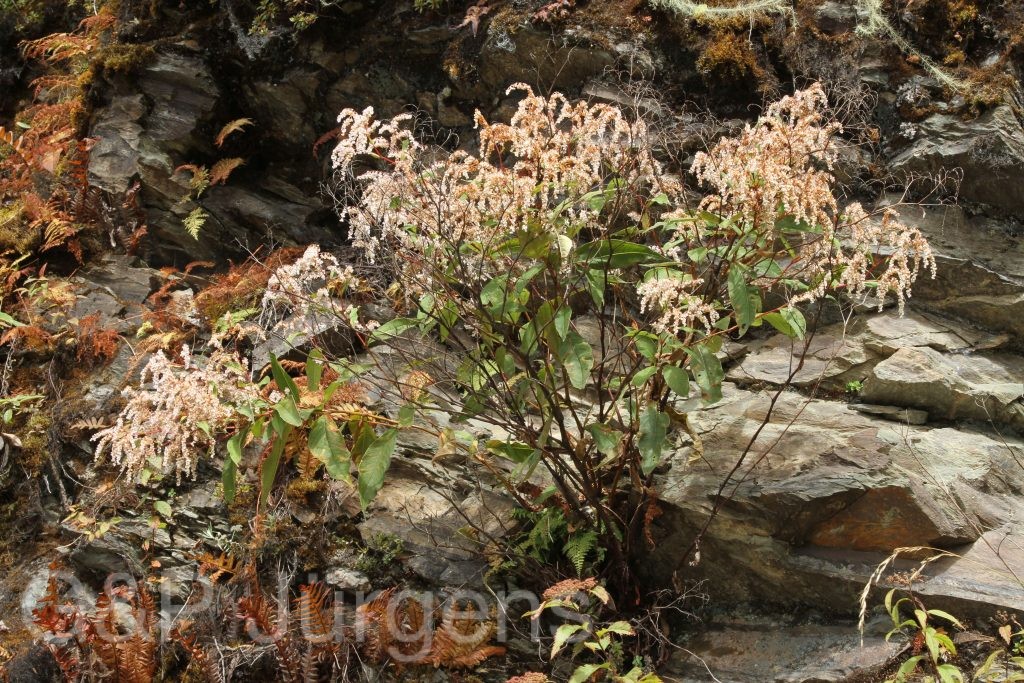
Persicaria campanulata is a clump-forming perennial of the eastern Himalaya and western China, also widely naturalised in temperate gardens elsewhere. GBIF records show its native range across China, Nepal and Bhutan, together with introduced populations in Ireland, Britain, Denmark and New Zealand, totalling around 66 occurrences. It grows on damp, shaded banks, woodland margins, streamsides and moist montane meadows, favouring cool, humid sites with reliable moisture. The photographed plant from the Shele-La in Bhutan at 3200 m, recorded in September, is characteristic of its occurrence in the upper temperate forest and subalpine zone, where it flowers into the late summer and autumn. GBIF lists the name as a synonym (the species having previously been placed in Aconogonon and Polygonum), but Persicaria campanulata is the currently accepted combination.

It is a rhizomatous, spreading herb with erect to ascending, branched stems. The leaves are ovate to elliptic-lanceolate, acuminate, often softly tomentose and pale beneath, with the membranous, tubular ochreae sheathing the nodes characteristic of the family. The flowers are small and bell-shaped, fragrant, borne in dense, branched terminal panicles; the campanulate perianth, from which the epithet derives, is pink to white with five lobes, enclosing eight stamens and a three-styled ovary. The fruit is a small, trigonous, brown achene.

The genus Persicaria comprises knotweeds segregated from a broadly defined Polygonum, distinguished by their fringed ochreae and spicate or paniculate inflorescences. P. campanulata is valued horticulturally for its long autumn flowering, but the same vigorous rhizomatous habit that makes it ornamental has allowed it to escape and naturalise, becoming locally invasive in damp ground in parts of the British Isles and New Zealand.

Author: (Hook.f.) Ronse Decr. · Sources: POWO (Kew), GBIF, Flora of Bhutan, Flora of China (Polygonaceae), Polygonaceae monograph (Brandbyge)

(Buch.-Ham. ex D.Don) H.Gross

Bhutan2012 949
Bhutan Tumching-La 2900m, October
Bhutan2012 950
Bhutan Tumching-La 2900m, October

Description

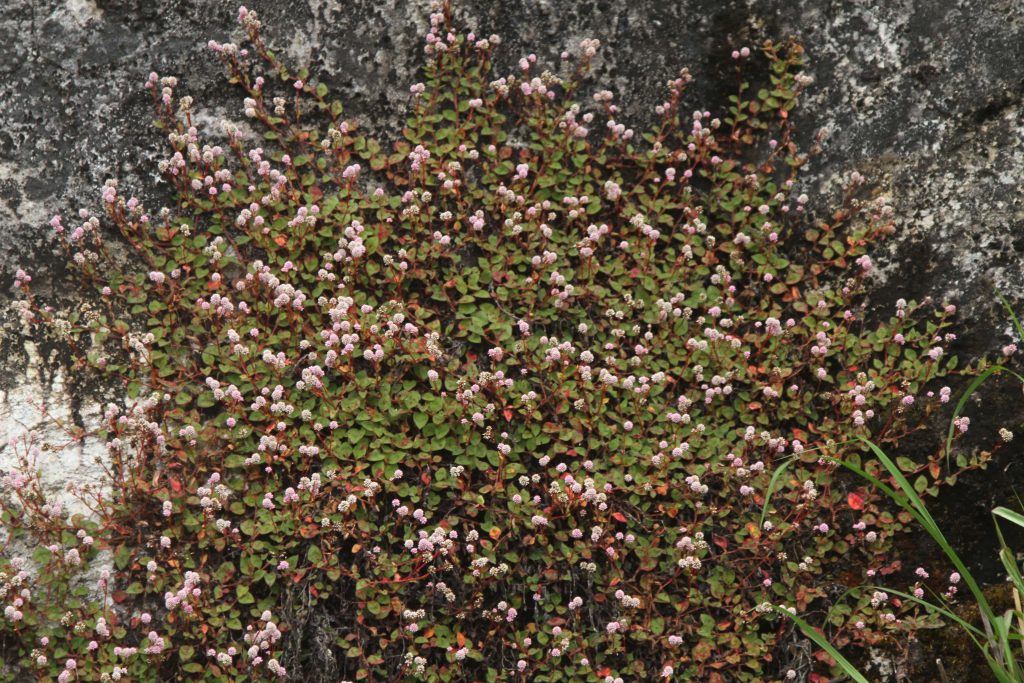
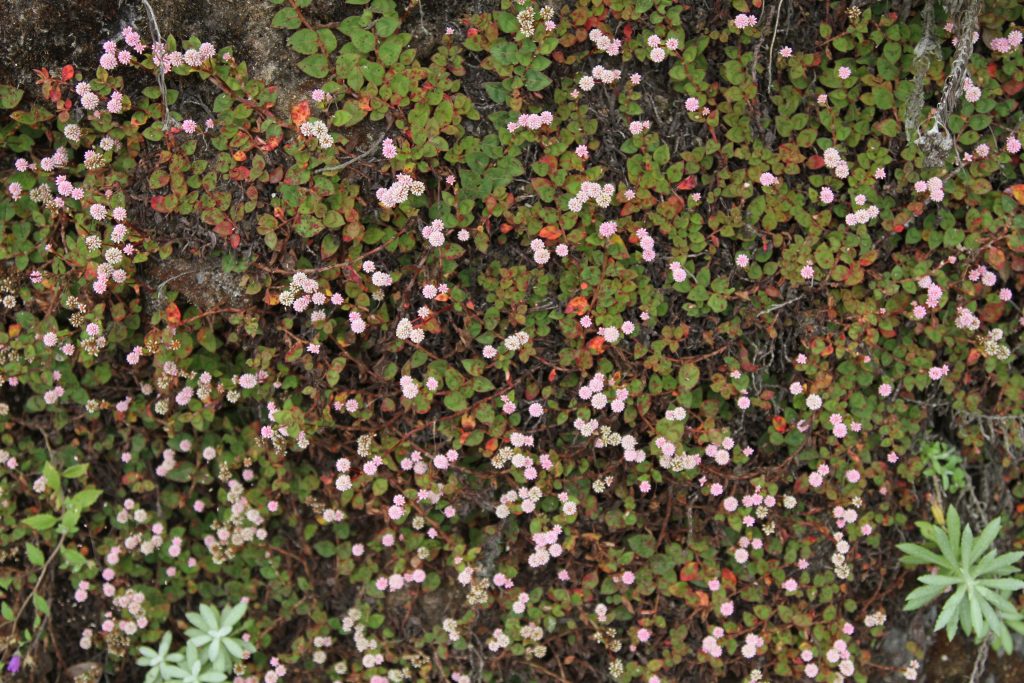
Persicaria capitata (Buch.-Ham. ex D.Don) H.Gross is a mat-forming perennial native to the Himalaya and southern China that has become widely naturalised as an ornamental and weed. GBIF documents nearly 23,000 occurrences, with native records from India, Nepal, China and Taiwan and extensive introduced populations across Portugal, Spain, Italy, the Netherlands, Great Britain, the United States, Mexico, Brazil, Colombia, Ecuador, Costa Rica, Australia, New Zealand, South Africa, Japan and Réunion. In its native range it grows on rocky banks, walls, gravelly slopes and disturbed mid-montane ground. The Bhutanese plant photographed at the Tumching-La, at about 2900 m in October, reflects its occurrence in the cool temperate zone of the eastern Himalaya.

The plant is a low, creeping herb that roots at the nodes to form dense mats; the slender, often reddish stems bear membranous ochreae at the swollen nodes. The leaves are ovate to elliptic, frequently marked with a dark V-shaped band and sometimes tinged purple. The flowers are aggregated into small, dense, globose heads borne on slender peduncles; the perianth is pink, five-lobed and persists in fruit. The fruit is a small trigonous achene enclosed by the perianth.

Widely grown as a ground-cover ornamental, P. capitata escapes readily and is recorded as an environmental weed in parts of the Mediterranean, Macaronesia, Australasia and the Americas. Its capacity to root at the nodes and spread vegetatively, combined with prolific seed production, underlies its colonising success. The species is not of conservation concern; instead it exemplifies how a Himalayan native can attain a near-cosmopolitan distribution through horticultural dispersal and subsequent naturalisation.

Author: (Buch.-Ham. ex D.Don) H.Gross · Sources: POWO (Kew), GBIF, Flora of China, Flora of Bhutan, Flora of Nepal, Hara & Williams Polygonaceae treatments

(L.) H. Gross

Bhutan2015 92
Bhutan Galephug, 600m, October

Description

Persicaria chinensis (L.) H. Gross is a widespread, often weedy perennial of warm-temperate to subtropical Asia, now naturalised well beyond its native range. GBIF records over 12,500 occurrences spanning China, Taiwan, Japan, India, Nepal, Thailand, Myanmar, the Malesian archipelago and the Philippines, with introduced populations in Australia, New Zealand, Réunion, the United States and Jamaica. It favours moist, disturbed ground, forest margins, roadside banks, streamsides and clearings from the lowlands to mid-montane elevations. The Bhutanese plant photographed at Galephug, at about 600 m in October, reflects its abundance in the humid foothill belt of the eastern Himalaya.

The plant is a sprawling to scrambling herb with branched, often reddish stems that are swollen at the nodes and sheathed by membranous ochreae characteristic of the family. The leaves are ovate to ovate-lanceolate, frequently with a dark chevron-shaped marking, and taper to an acute apex. The inflorescence comprises numerous small, capitate clusters of flowers; the perianth is white to pinkish and five-lobed, becoming fleshy and bluish-black in fruit. The fruit is a trigonous achene enclosed by the persistent, juicy perianth, which gives the fruiting heads a berry-like appearance.

Segregated by some authors as Polygonum chinense, the taxon is morphologically variable, and several varieties and forms have been recognised across its vast range. Its fleshy fruiting perianth promotes endozoochorous dispersal by birds, contributing to its colonising success and to its status as an invasive in several introduced territories. The species is of no conservation concern; rather, its broad ecological amplitude and ready establishment on disturbed soils make it one of the more conspicuous and adaptable knotweeds of monsoonal Asia.

Author: (L.) H. Gross · Sources: POWO (Kew), GBIF, Flora of China, Flora of Bhutan, Flora of Nepal, Hara & Williams Polygonaceae treatments

Greuter & Burdet

Bhutan2015 483
Bhutan Pele-La 3100m, October
Sikkim2003 410 G570
Sikkim Zemu Valley 3400m August

Description

Persicaria wallichii (the accepted name under which this taxon is listed, the binomial here being treated as a synonym in GBIF) is a robust perennial knotweed native to the Himalaya and adjacent mountains of China and Myanmar, where it occupies open hillsides, forest margins, riverbanks and disturbed ground in the temperate and subalpine zones. From its Himalayan homeland it has spread widely as an introduced and frequently invasive plant, the GBIF dataset recording it across much of Europe as well as North and South America and New Zealand, totalling well over a thousand occurrences. The illustrated plants from Pele-La in Bhutan at 3100 m, flowering in October, and from the Zemu Valley in Sikkim at 3400 m in August, exemplify its native montane setting.

The plant forms tall, spreading clumps from a vigorous, far-creeping rhizome, with erect to ascending stems that are reddish-tinged and somewhat woody at the base. The leaves are large, ovate-lanceolate to triangular, acuminate, cordate to truncate at the base, often white-tomentose beneath, and subtended by membranous, brownish ochreae sheathing the swollen nodes. The numerous small flowers are borne in much-branched, lax panicles of slender spike-like racemes; each flower has a white to pinkish perianth of five tepals enclosing eight stamens and a trifid style. The fruit is a small, glossy, three-angled (trigonous) achene enclosed by the persistent perianth.

Formerly placed in Polygonum and Aconogonon (reflected in the synonymy and field labels), the species sits within a much-revised section of Persicaria. Its dense rhizomatous growth allows it to form persistent thickets, and outside its native range it behaves as an aggressive colonist of riverbanks and waste ground, prompting management concern in several countries; within the Himalaya it remains a common and ecologically benign component of moist montane vegetation.

Author: Greuter & Burdet · Sources: POWO (Kew), GBIF, Flora of Bhutan, Flora of China (Polygonaceae), Annotated Checklist of the Flowering Plants of Nepal

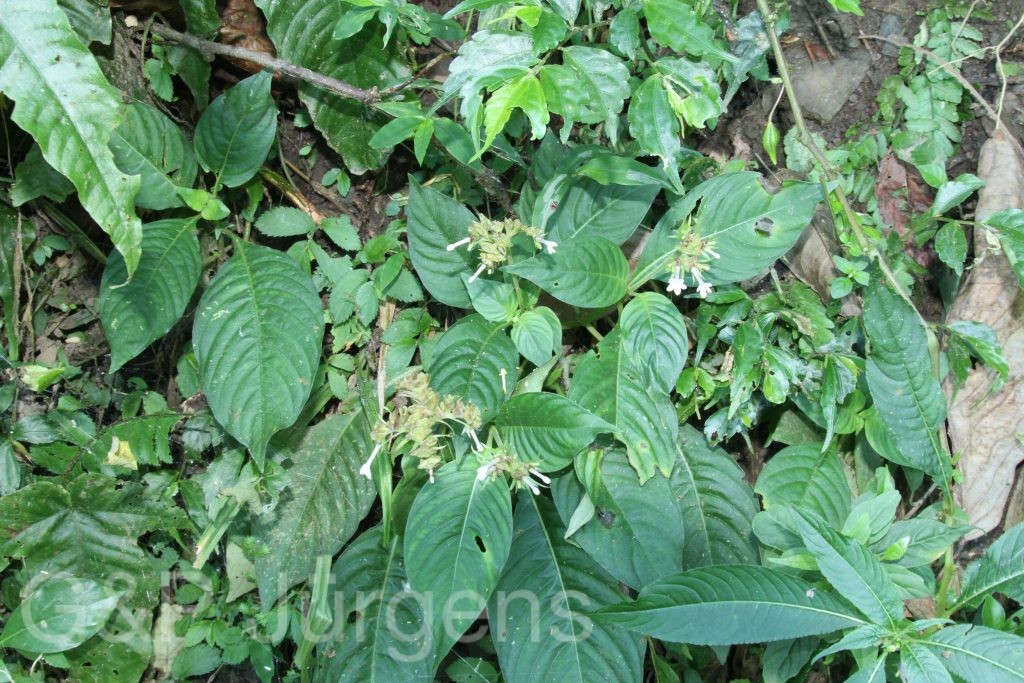
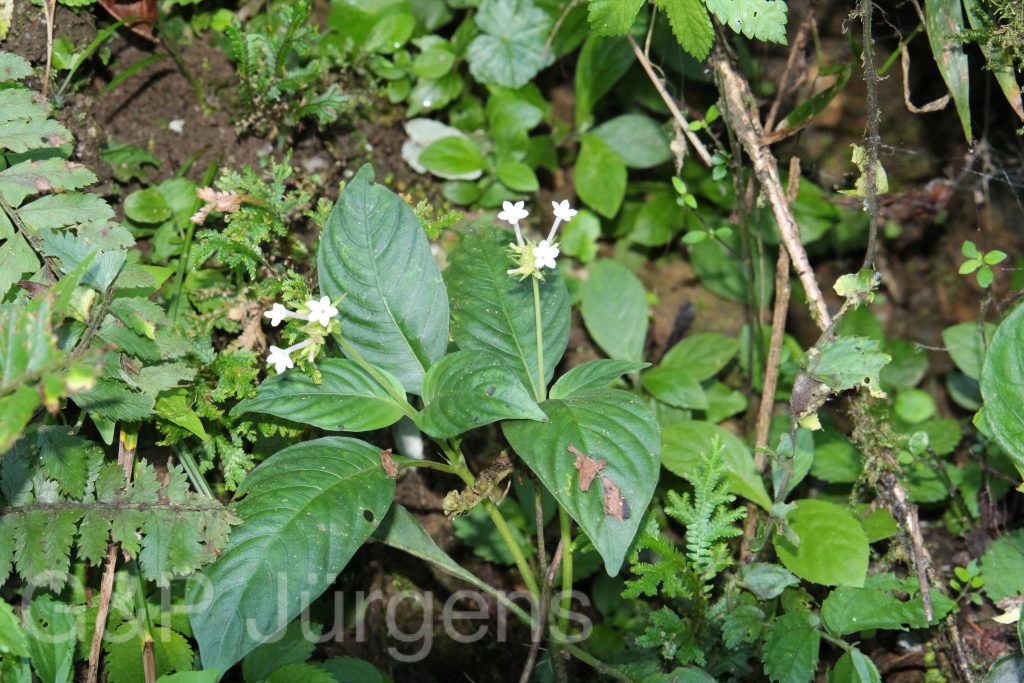
(Forssk.) Sweet

Bhutan2015 104
Bhutan Galephug 600m, October
Bhutan2015 107
Bhutan Galephug 600m, October

Description

Phaulopsis imbricata is a widespread tropical herb whose principal range lies across sub-Saharan Africa and Madagascar, GBIF recording over 2700 occurrences from countries including South Africa, Tanzania, Ethiopia, Kenya, Cameroon, Uganda, Zambia, Zimbabwe, Mozambique and Madagascar. The Himalayan material represented here, photographed in Bhutan at Galephug at 600 m in October, lies at the lowland subtropical margin of its distribution, where it occurs in the warm, humid foothill belt. Throughout its range it grows in shaded, moist forest understorey, along streambanks, forest margins and disturbed ground.

It is a soft, decumbent to ascending perennial or annual herb with quadrangular, often rooting stems. The leaves are opposite and frequently markedly anisophyllous (unequal in each pair), ovate to elliptic, with entire to undulate margins and pinnate venation. The flowers are borne in dense, secund, imbricate, spike-like cymes subtended by conspicuous, overlapping, often whitish or pale bracts, from which the epithet derives. Each flower has a small, white to pale bluish, two-lipped tubular corolla, two or four stamens, and a bilocular ovary. The fruit is the characteristic acanthaceous loculicidal capsule with a retinaculate (jaculator) seed-ejection mechanism.

The species belongs to the Acanthaceae (subfamily Acanthoideae) and is the type and most variable member of the small Old World genus Phaulopsis. Its enormous geographic and ecological amplitude has generated considerable infraspecific variation and a long synonymy. As a tolerant colonist of forest edges and disturbed sites it is not of conservation concern; its disjunct presence in the eastern Himalaya illustrates the Afro-Asian links of moist tropical floras.

Author: (Forssk.) Sweet · Sources: POWO (Kew), GBIF, Flora Zambesiaca, Flora of Tropical East Africa, Flora of Bhutan, monograph of Phaulopsis (Manktelow)

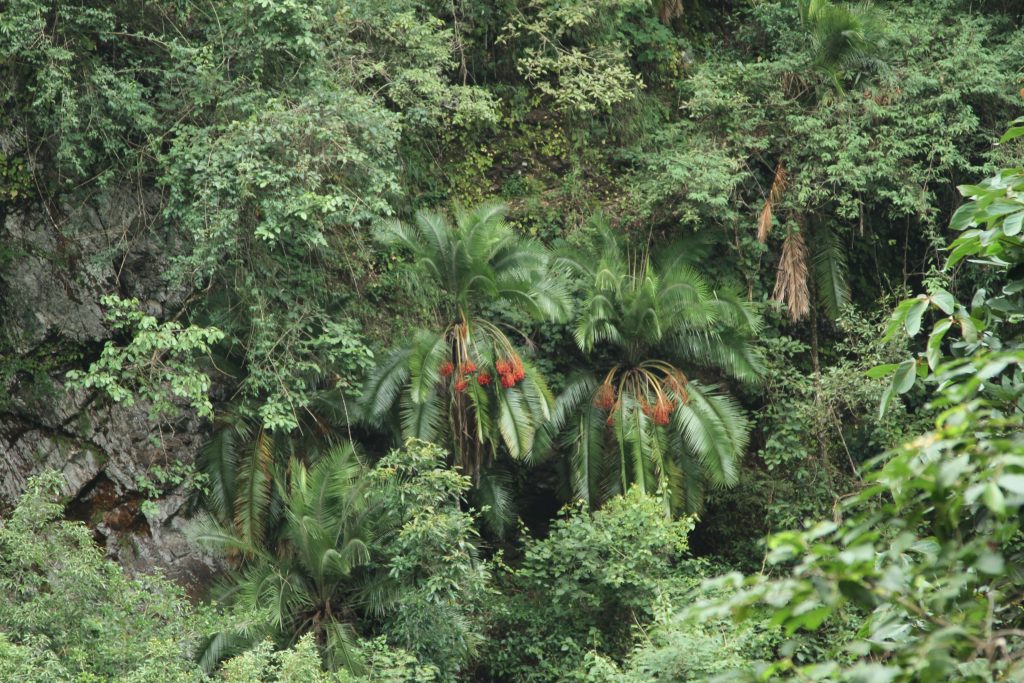
Kunth

Bhutan2012 770
Bhutan Zemgang 1600m, October

Description

Phoenix loureiroi Kunth is a small date palm broadly distributed across South and Southeast Asia, recorded by GBIF from Taiwan, India, Thailand, China, Vietnam, Nepal, Myanmar, the Philippines, Laos, Pakistan, Cambodia and Bhutan, with cultivated occurrences in the United States, Cuba, Brazil and Spain, totalling over 2000 records. It grows in open forest, savanna, grassy slopes and rocky hillsides from the lowlands into the lower montane zone, tolerating seasonally dry, fire-prone ground. The Bhutanese material from Zhemgang at 1600 m in October reflects its presence in the warm subtropical foothills.

It is a small, often clustering palm with a short, sometimes subterranean stem clothed in persistent leaf bases, rarely forming a slender erect trunk. The leaves are pinnate and arching, the leaflets (pinnae) linear-lanceolate and stiff, the lower ones modified into sharp spines (acanthophylls), a defining feature of Phoenix. The plants are dioecious, the inflorescences branched spadices enclosed in a spathe, the small unisexual flowers cream to yellowish. The fruit is a small ellipsoid drupe ripening purplish-black to reddish, with thin sweet flesh around a single grooved seed, dispersed by birds.

Phoenix loureiroi is a polymorphic species with several recognised varieties spanning its wide range. As a relative of the cultivated date palm, it provides minor local uses for thatch, fibre and fruit, accounting for the scattered cultivated records. Its fire- and drought-tolerant habit and broad Indo-Malesian to Sino-Himalayan distribution make it a resilient element of open landscapes, and it is not threatened, although habitat conversion locally reduces wild populations.

Author: Kunth · Sources: POWO (Kew), GBIF, Flora of China Vol. 23, Flora of Bhutan Vol. 3, Flora of Pakistan, Barrow monograph of the genus Phoenix (Palmae)