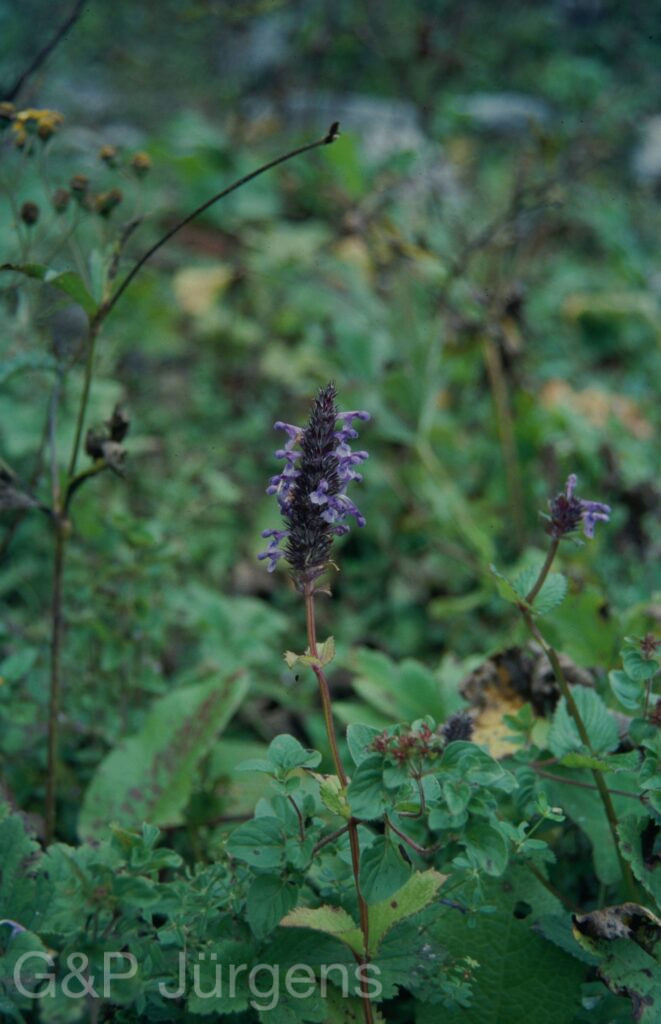
Tag:

Autumn

(D.Don) Hand.-Mazz.

Garw 2005 28 ergebnis ergebnis
India Garhwal Valley of flowers 2950m, September

Description

Nepeta laevigata is a perennial herb widely distributed across the temperate and subalpine Himalaya, ranging from Afghanistan and Pakistan eastwards through northern India and Nepal into south-western China, with a documented occurrence base of some 846 records (additional points from Germany, Norway and the United States reflecting cultivated or vouchered specimens). It favours open grassy slopes, forest margins, alpine meadows and disturbed ground between roughly 2400 and 3600 m. The plant illustrated here was photographed in India's Garhwal, in the celebrated Valley of Flowers at about 2950 m in September, where it flowers in the post-monsoon season among the rich herbaceous turf.

The species forms erect, quadrangular stems arising from a woody rootstock, typically 30-90 cm tall and often branched above. The leaves are opposite, ovate to ovate-lanceolate, crenate-serrate at the margin, cordate or truncate at the base and borne on distinct petioles, the surfaces glabrous to thinly pubescent and gland-dotted. The inflorescence is a slender terminal raceme or spike of well-spaced verticillasters subtended by small bracts; the flowers are bilabiate, the calyx tubular and bluntly toothed, the corolla white to pale violet with a hooded upper lip and a broad, often spotted lower lip. The fruit comprises four smooth nutlets enclosed in the persistent calyx.

Membership in Lamiaceae, subfamily Nepetoideae, is confirmed by the aromatic foliage, square stems and characteristic verticillate cymes. Like many catmints, N. laevigata is strongly insect-pollinated, its nectar-rich corollas visited by bees and bumblebees. The species is common across much of its montane range and is not regarded as threatened; it functions as a typical component of Himalayan meadow and forest-edge communities, where its volatile terpenoid oils may deter generalist herbivores.

Author: (D.Don) Hand.-Mazz. · Sources: POWO (Kew), GBIF, Flora of China, Flora of Pakistan, Flora of Bhutan, Annotated Checklist of the Flowering Plants of Nepal, Budantsev revision of Nepeta
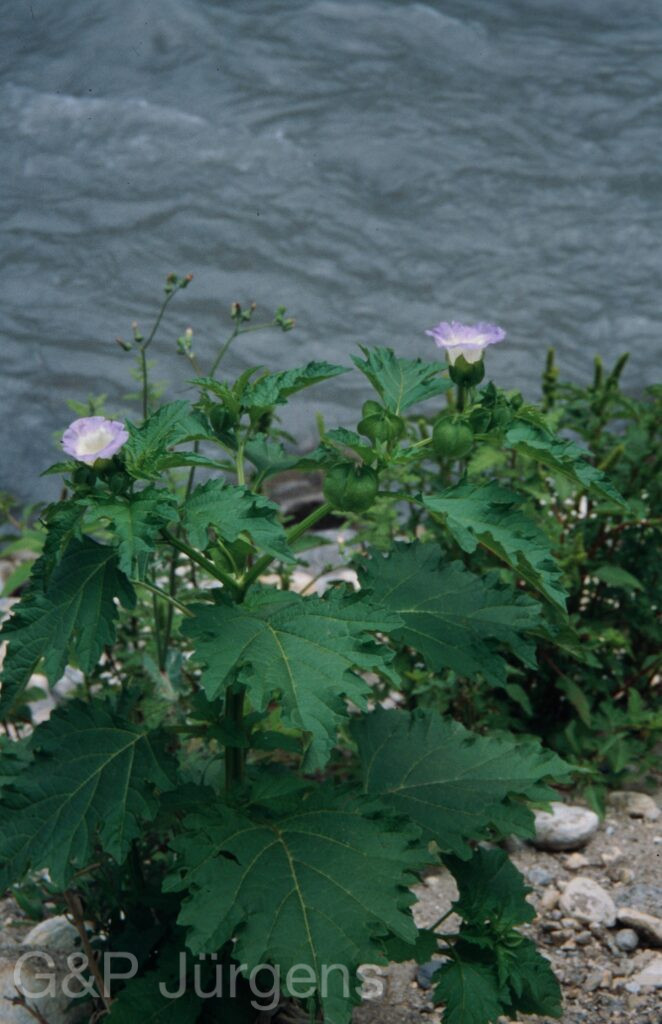
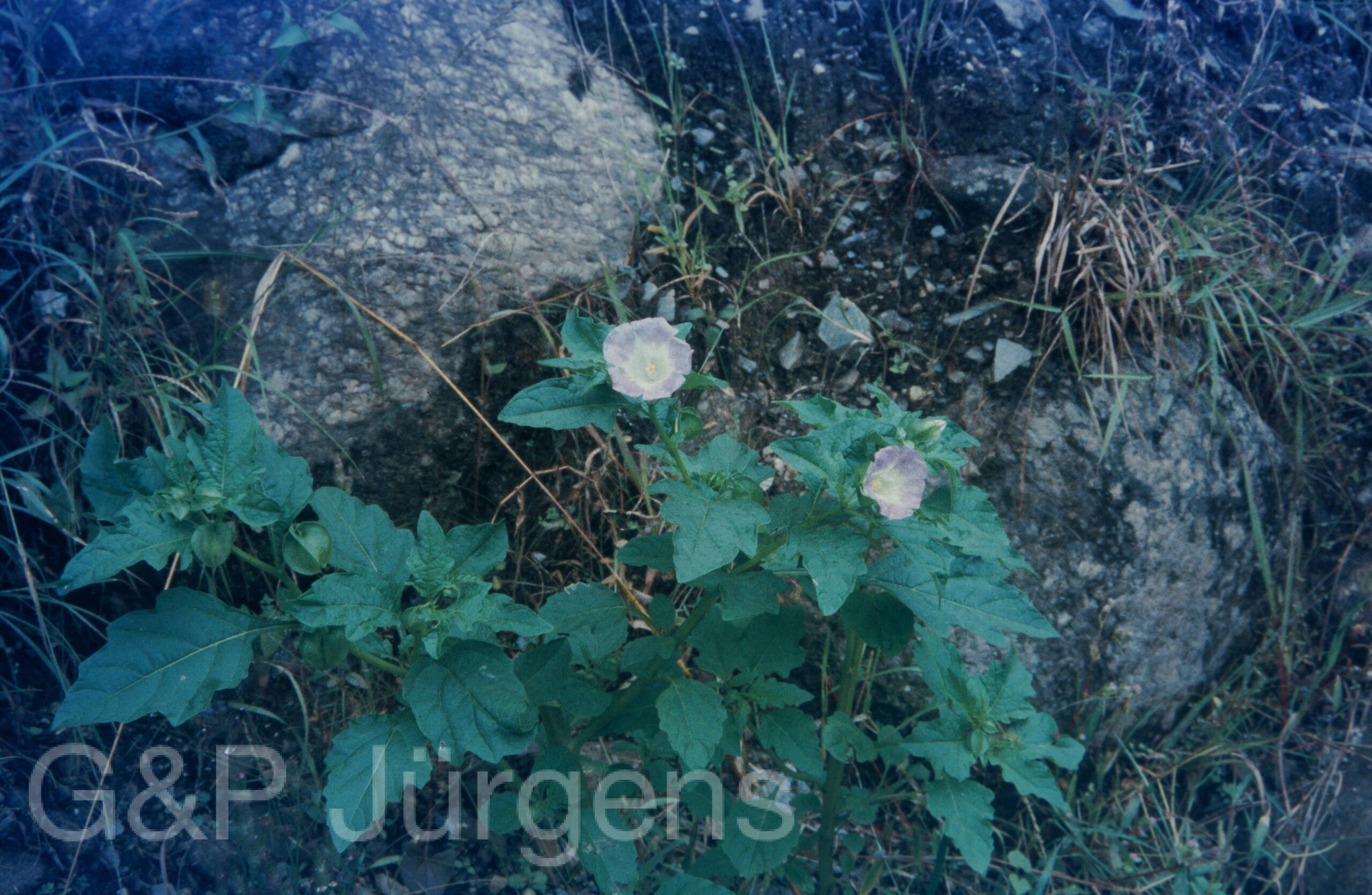
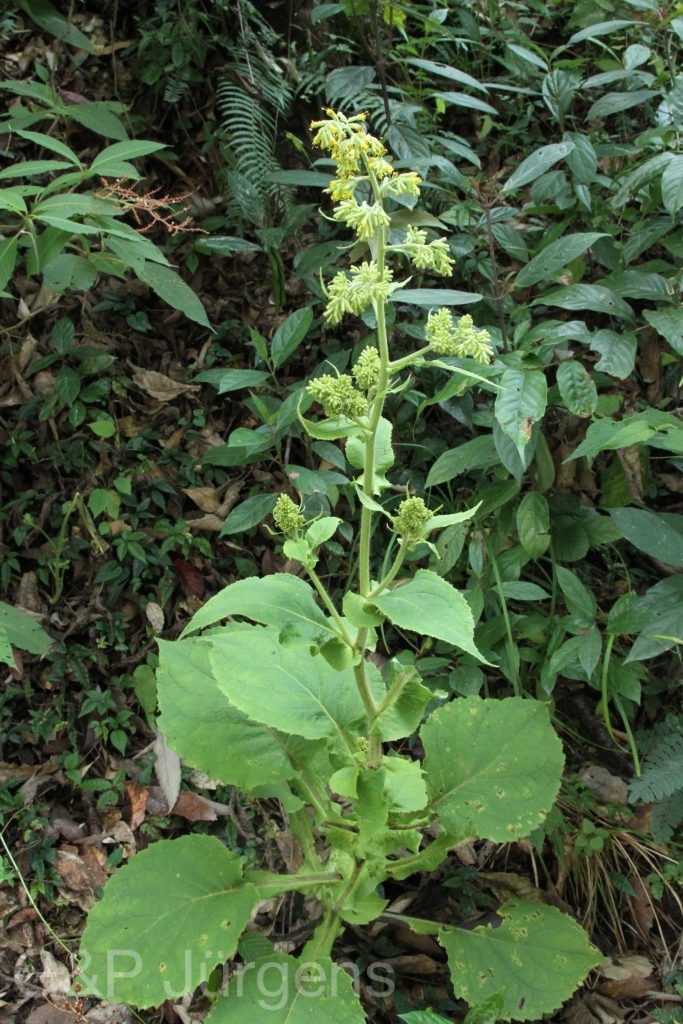
(L.) Gaertn.

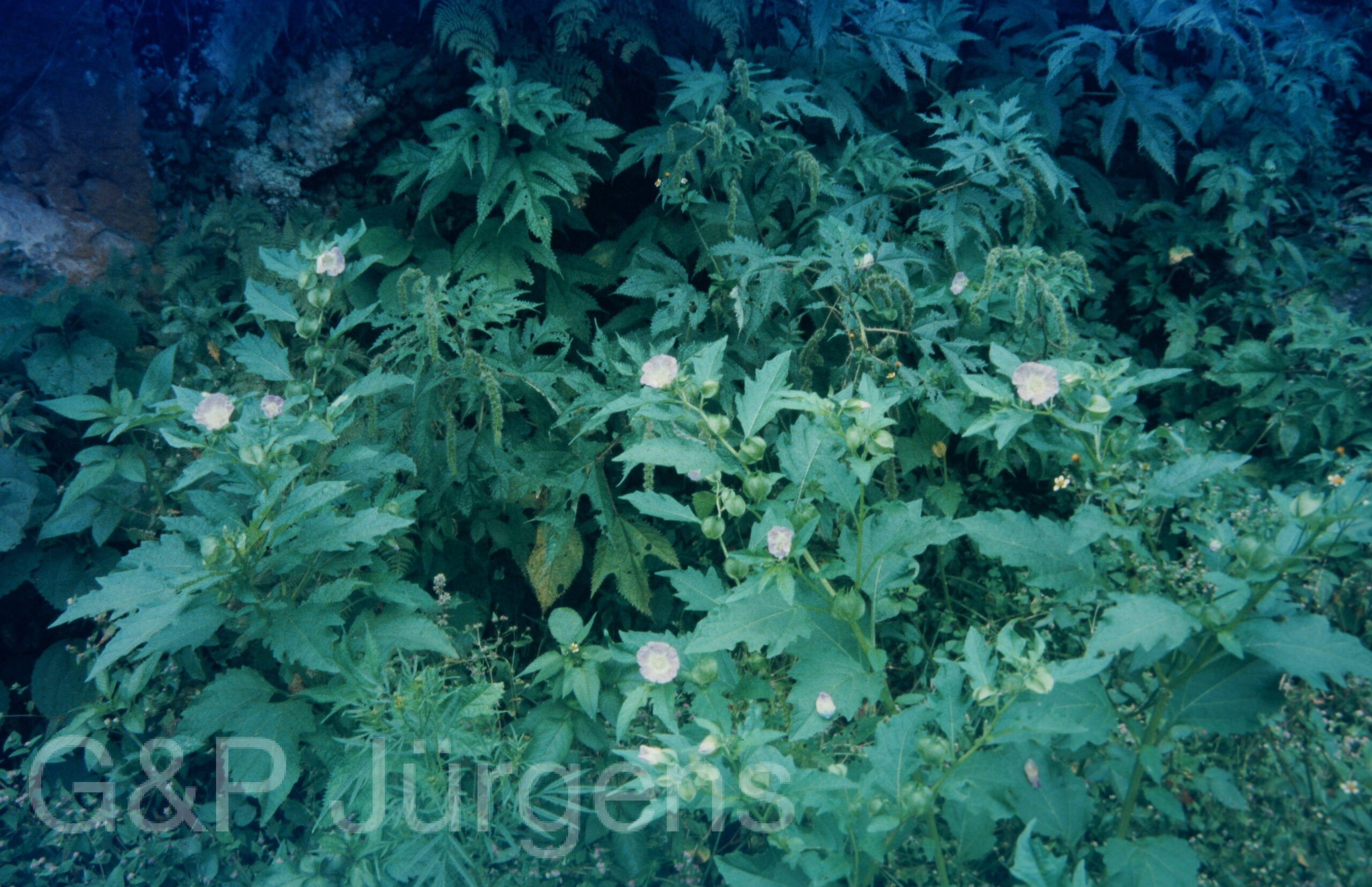
Nepal 99 955 ergebnis
West-Nepal Dunai 2150m, July

Description

Nicandra physalodes (L.) Gaertn., the shoo-fly plant or apple-of-Peru, is an annual herb native to the Andean region of South America (notably Peru) but now naturalised almost worldwide as a weed of cultivation and waste ground. The very large GBIF occurrence record spans Europe, North and South America, southern Africa, Australasia, China and beyond, reflecting its cosmopolitan ruderal status. In the Himalaya it is a familiar plant of cultivated fields, village margins and disturbed ground; the records from Dunai in west Nepal at 2,150 m in July and from Sitel in Garhwal, India, at 1,850 m in September document its occurrence as a monsoon-season weed in the western and central Himalayan hill zone.

Nicandra is a robust, erect, glabrous annual reaching up to 1–1.5 m, with stout, angular, branching stems. The leaves are alternate, ovate to elliptic, with coarsely sinuate-dentate or lobed margins. The solitary, axillary flowers are pale blue to lilac with a paler, often whitish throat; the corolla is broadly campanulate and shallowly five-lobed. Most distinctive is the persistent, accrescent calyx with five deeply sagittate-cordate, sharply angled lobes that enlarge and become inflated and papery, enclosing the dry, many-seeded berry in a manner resembling the husk of Physalis, hence the epithet physalodes.

The genus Nicandra is monotypic and forms an isolated lineage within Solanaceae, placed in its own subfamily Nicandroideae and of long-standing interest in phylogenetic studies of the family. The plant is mildly toxic, containing withanolide-type compounds, and has been used traditionally as an insect repellent, accounting for the vernacular name shoo-fly. Its remarkable success as a global colonist makes it a textbook example of a New World species turned cosmopolitan agricultural weed.

Author: (L.) Gaertn. · Sources: POWO (Kew), GBIF, Flora of China Vol. 17, Flora of Pakistan (Solanaceae), Hunziker: The Genera of Solanaceae

Griff.

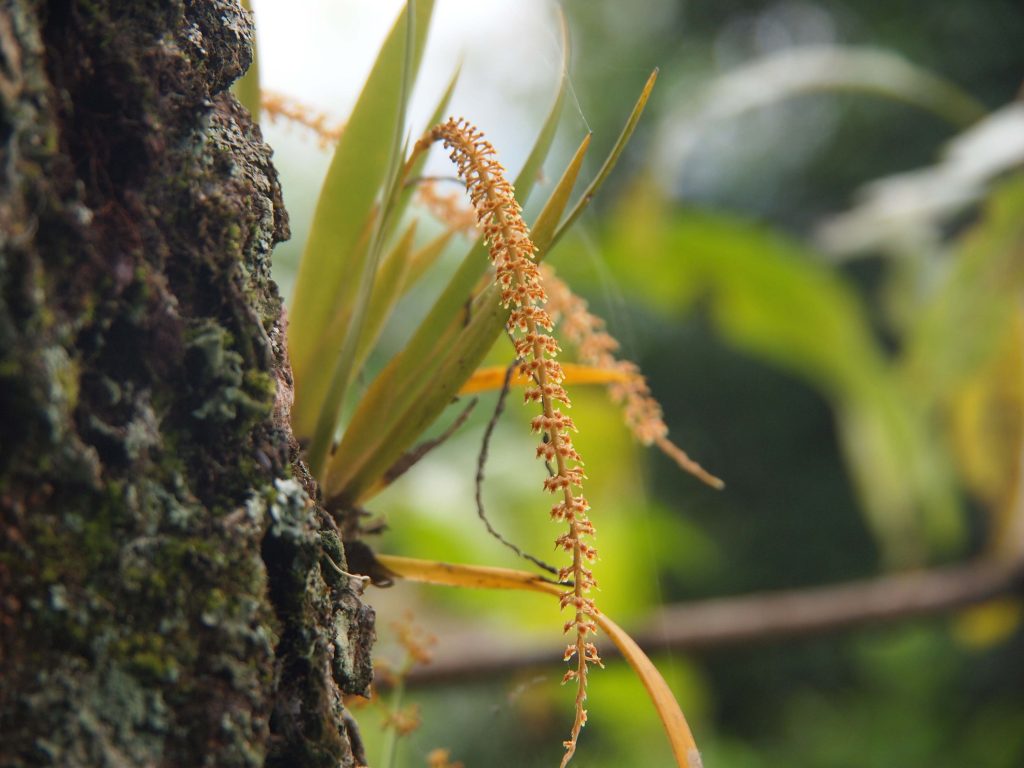
Bhutan2012 814 Kopie
Bhutan Zemgang 2000m, October
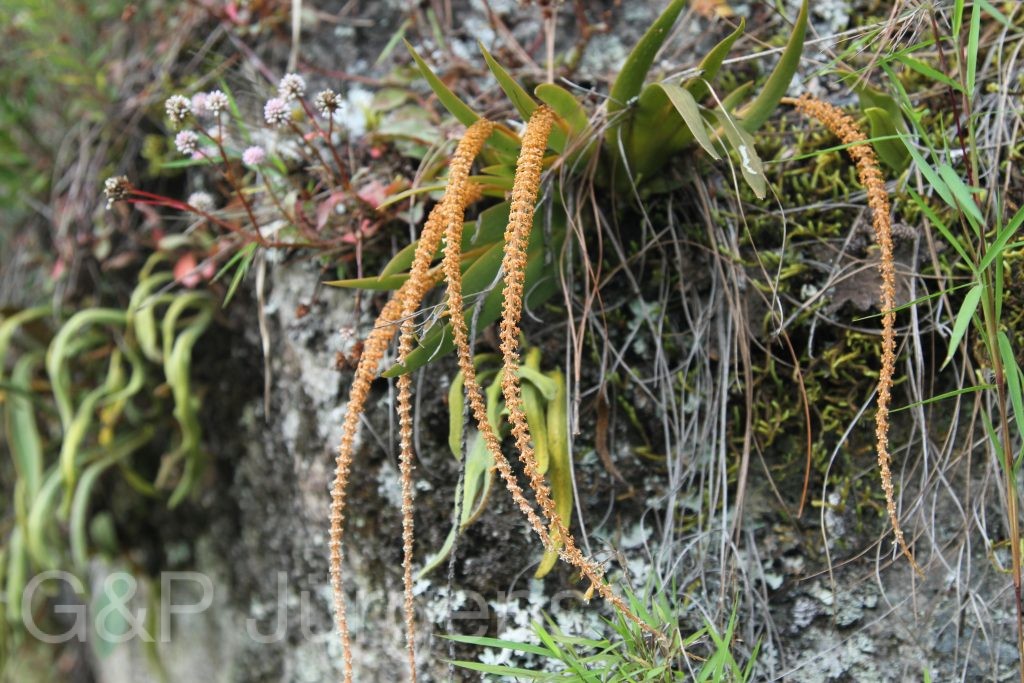
Bhutan2012 1146
Bhutan Tashiyangtse 1500m, October

Description

Oberonia acaulis is a small epiphytic orchid widespread across tropical and subtropical Asia, recorded from India, Nepal, Bhutan, China, Myanmar, Bangladesh, Thailand, Vietnam and beyond, with about 198 GBIF occurrences. It grows in warm, humid broad-leaved and subtropical forest, perched on tree trunks and branches in shaded, moist situations from the lowlands into the lower montane zone. The images document it in Bhutan at Zemgang around 2000 m and at Tashiyangtse near 1500 m, both in October, when the minute flowers are borne in dense spikes among forest epiphyte communities.

It is a tufted, dwarf epiphyte lacking pseudobulbs, with a short stem bearing a fan of equitant, laterally flattened (iris-like), fleshy leaves arranged in two ranks. From the centre of the fan arises a slender, erect to arching scape terminating in a long, densely many-flowered cylindrical raceme. The flowers are extremely small, numerous, yellowish to orange-brown, arranged in whorls; the labellum is the most conspicuous part, typically three-lobed with a divided or toothed apex, distinguishing the species within the genus. The fruit is a tiny ellipsoid capsule.

Oberonia is a large pantropical genus of "button orchids" notable for the diminutive size and great number of their flowers, which complicates field identification and rests heavily on the structure of the lip. The minute flowers are thought to be pollinated by small flies or midges. Like all orchids the genus is listed on CITES Appendix II; O. acaulis is widespread and common across its broad range and is not considered threatened.

Author: Griff. · Sources: POWO (Kew), GBIF, Flora of China, Flora of Bhutan, Flora of British India, Genera Orchidacearum (Vol. 4 Epidendroideae)

Bureau & Franch.

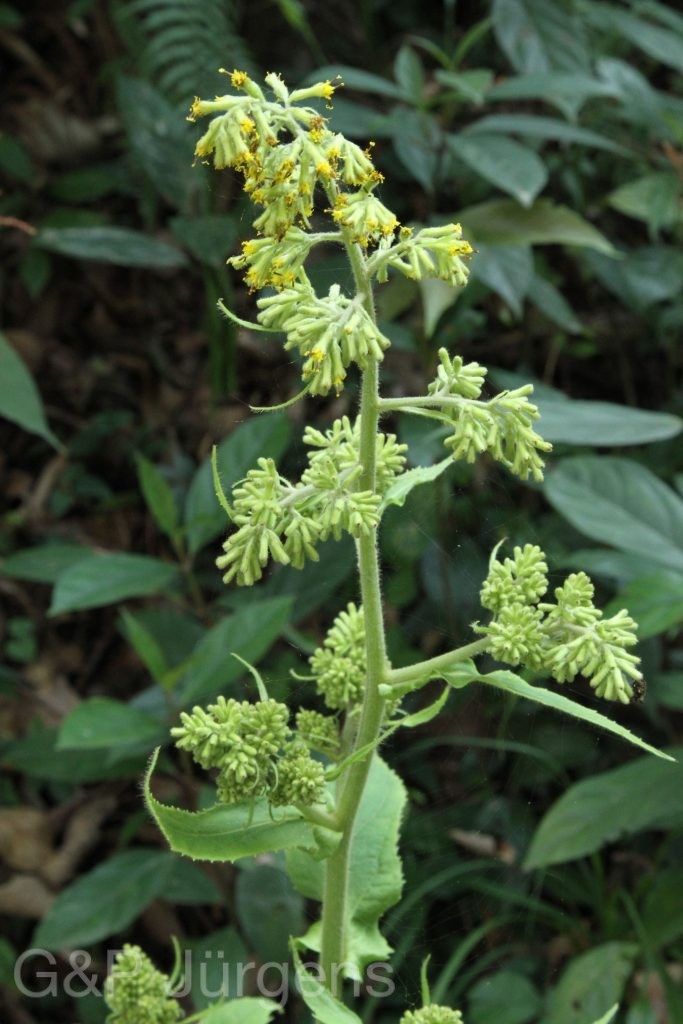
Bhutan2015 458
Bhutan Trongsa 2100m, October
Bhutan2015 457
Bhutan Trongsa 2100m, October

Description

Onosma paniculatum is a robust, bristly-hairy herb of the eastern Himalaya and adjacent China, with GBIF documenting 255 occurrences across China and Bhutan. It favours open, sunny banks, dry rocky slopes, roadside cuttings and disturbed grassy ground in warm-temperate to montane country. The photographed plant grows at Trongsa in central Bhutan at about 2100 m, flowering in October, a relatively low and autumn-flowering station consistent with the species' tolerance of dry, exposed habitats.

The plant is a biennial or short-lived perennial with stiffly erect stems clothed in spreading, often pustular-based setae that render it harshly scabrid. The basal and lower leaves are linear to lanceolate, the cauline leaves smaller and sessile. The inflorescence is an open, branched panicle of scorpioid cymes; the flowers are pendent with a tubular-campanulate corolla, blue to violet (sometimes purplish), exserted anthers and a long, slender style. The fruit comprises four smooth, ovoid-trigonous nutlets.

GBIF treats the spelling Onosma paniculatum as a synonym, with Onosma paniculata accepted as the correct orthography. Onosma is a large Old World genus whose roots yield naphthoquinone red dyes long used locally, and several Himalayan species are gathered for traditional medicine and colouring. The genus is taxonomically difficult owing to indumentum variation and intergrading forms, so reliable identification depends on nutlet and corolla detail. Its prominence at disturbed sites makes it a familiar, weedy component of the eastern Himalayan flora.

Author: Bureau & Franch. · Sources: POWO (Kew), GBIF, Flora of China, Flora of Bhutan, Riedl's revision of Onosma (Boraginaceae)

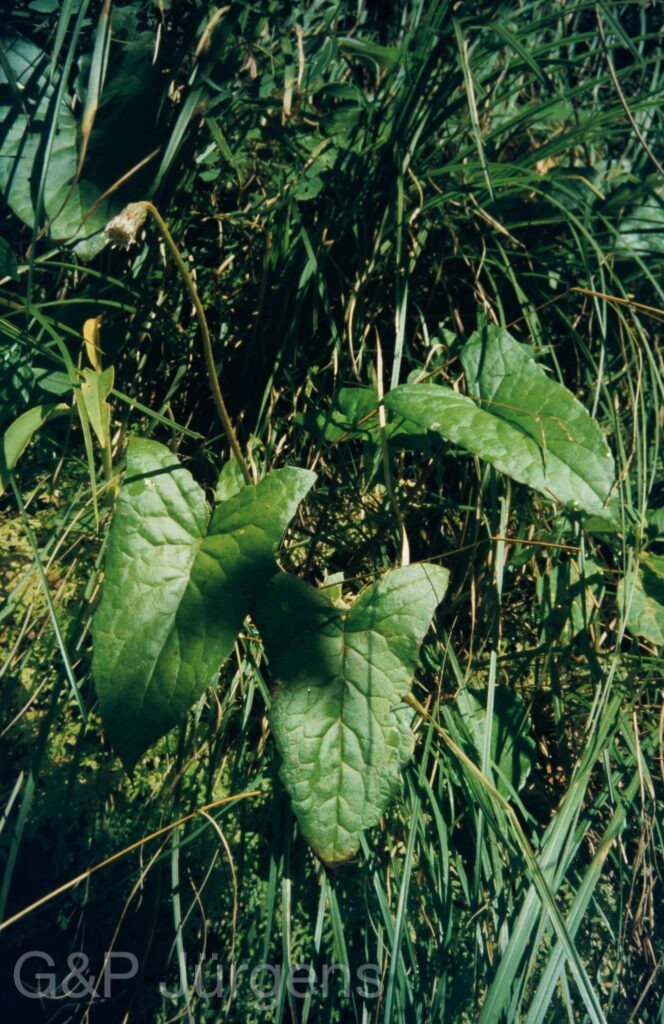
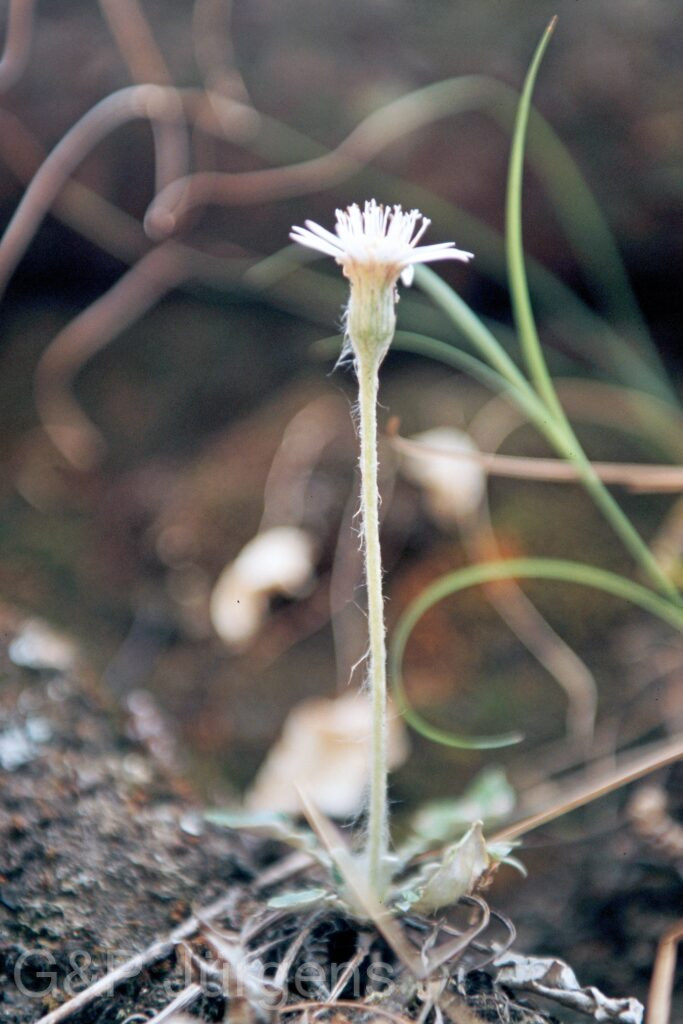
(Royle) X.D.Xu & V.A.Funk

Garw 2005 419 ergebnis
India Garhwal Didina 2470m, September
Garh 07 70 ergebnis
India Garhwal Nanu Mandakini 2300m, June

Description

Oreoseris gossypina is a rosette-forming perennial herb of the temperate and subalpine Himalaya, recorded from Pakistan, India, Nepal, China and Bhutan across more than 300 occurrences. It typically inhabits open grassy slopes, rocky banks and forest margins, often on disturbed or grazed ground, at elevations of roughly 1800 to 3500 m. The documented collections derive from Garhwal in India, at Didina (2470 m, September) and the Nanu Mandakini valley (2300 m, June), the two dates spanning much of its long flowering and fruiting season in the Western Himalaya.

The plant produces a basal rosette of obovate to oblanceolate leaves that are conspicuously white-woolly beneath, the dense cottony indumentum giving rise to the epithet gossypina. The leaf margins are sinuate-dentate and the lamina narrows into a winged petiole. Solitary capitula are borne on slender, bracteate scapes; each head is heterogamous and radiate, with an involucre of imbricate, often arachnoid-hairy phyllaries. The marginal ray florets are ligulate and pale, the disc florets tubular; the achenes are ribbed and surmounted by a pappus of barbellate bristles aiding wind dispersal.

The species was long placed in Gerbera and is also encountered under Leibnitzia; its current placement in Oreoseris (Mutisieae) reflects molecular and morphological revision by X.D. Xu and V.A. Funk. As a member of an early-diverging composite lineage it is of phylogenetic interest, and its mutisioid floral structure attracts a range of pollinating insects. The species is widespread and faces no recognised threat.

Author: (Royle) X.D.Xu & V.A.Funk · Sources: POWO (Kew), GBIF, Flora of China, Flora of Pakistan, Annotated Checklist of the Flowering Plants of Nepal, Xu & Funk revision of Mutisieae

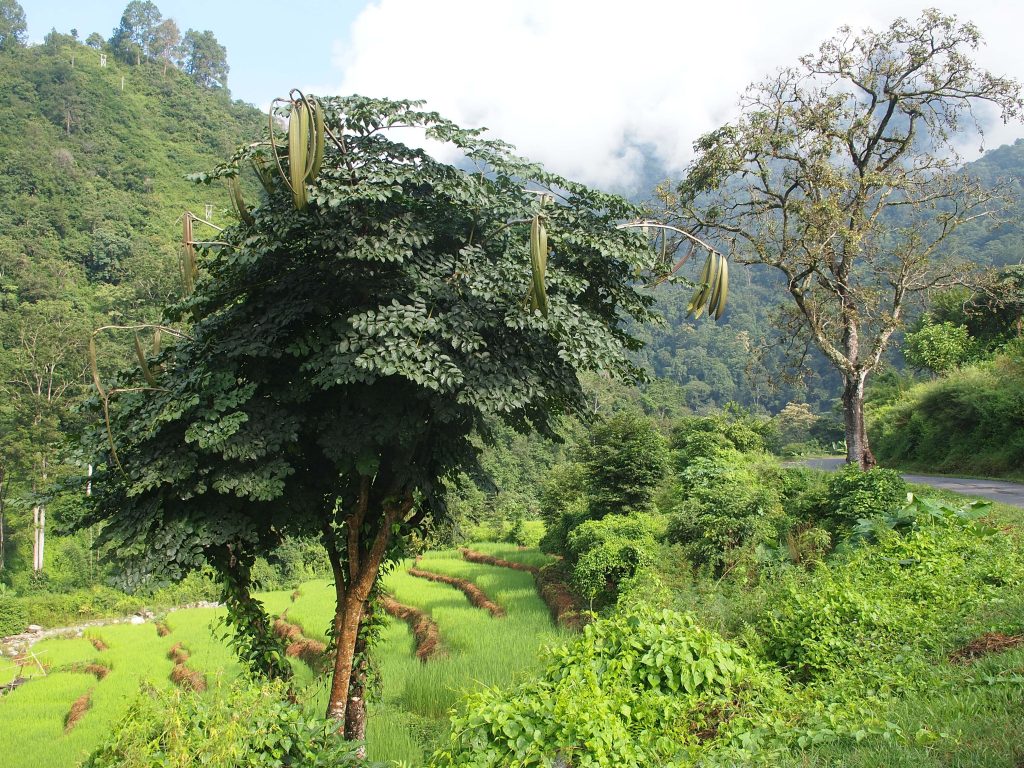
(L.) Kurz

Bhutan2012 969
Bhutan Trithangebe 900m, October
Bhutan2015 103
Bhutan Galephug 500m, October

Description

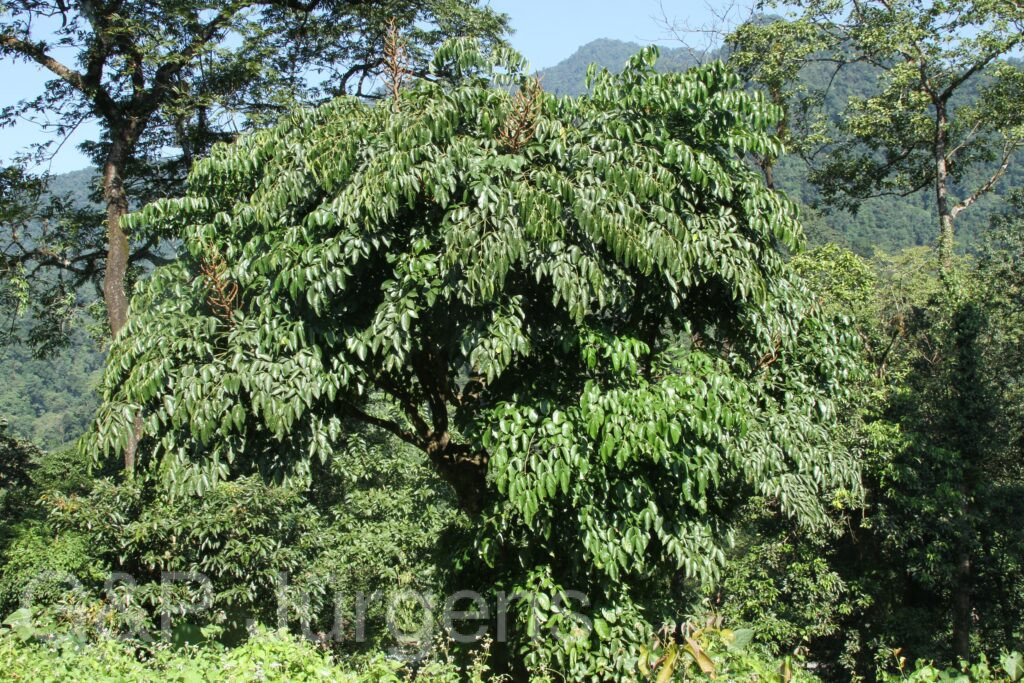
Oroxylum indicum, the Indian trumpet tree or midnight horror, is a small deciduous tree of subtropical and tropical Asia, ranging from India, Nepal and Bhutan through Bangladesh, Myanmar and southern China to Indochina, Thailand, Sri Lanka and across Malesia to the Philippines. GBIF aggregates around 1440 occurrences. It is a tree of forest margins, secondary growth, ravines and roadsides at low to moderate elevations, often in seasonally dry monsoon forest. The Bhutanese specimens at Trithangebe (900 m) and Galephug (500 m) in October occupy this warm foothill zone, fruiting at the close of the monsoon when the great pendulous pods become conspicuous.

The tree has a sparse crown and stout, soft-wooded branches marked with prominent leaf scars. Its leaves are very large, opposite and two- to three-pinnate, often a metre or more across, with ovate, acuminate leaflets, the falling rachides littering the ground beneath. The flowers open at night in a long erect terminal raceme, each large, fleshy and campanulate, lurid reddish-purple outside and paler within, malodorous and bat-pollinated. Most striking is the fruit: a flattened, sword-shaped, sabre-like capsule up to a metre long that splits into two woody valves to release numerous flat seeds broadly winged with a papery membrane for wind dispersal.

A member of Bignoniaceae, Oroxylum is a distinctive near-monotypic genus set apart by its enormous pinnate leaves, nocturnal chiropterophilous flowers and giant samaroid pods. The species is of considerable ethnobotanical importance: its bark, seeds and young fruit are widely used in Ayurvedic and traditional medicine, and the tender pods are eaten as a vegetable. Despite localised harvesting it remains common and widespread, and is not regarded as globally threatened.

Author: (L.) Kurz · Sources: POWO (Kew), GBIF, Flora of China Vol. 18, Flora of Bhutan Vol. 2, Annotated Checklist of the Flowering Plants of Nepal, Gentry monograph of Bignoniaceae

Oryza sativa

by G & P Jürgens

L.

Bhutan2015 559
Bhutan Moshu 1700m, October

Description

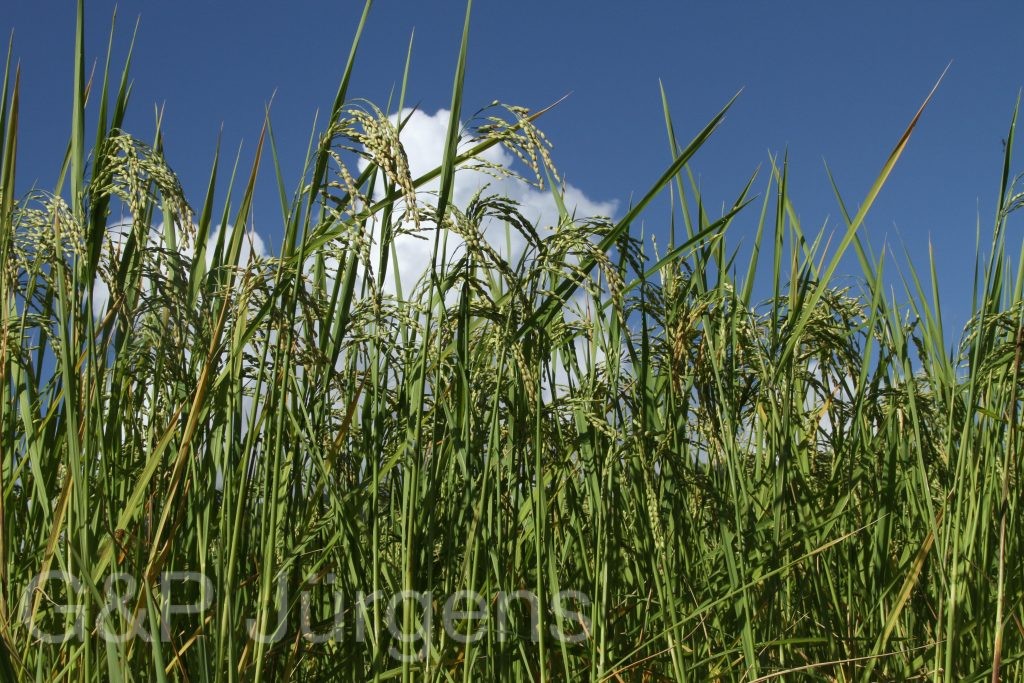
Oryza sativa, Asian cultivated rice, is the world's most important cereal staple and is grown across the warm-temperate to tropical zones of every inhabited continent. Domesticated in Asia from wild progenitors such as O. rufipogon, it is documented in GBIF by more than four hundred thousand occurrences spanning India, China, Southeast Asia, the Americas, Africa, Europe and beyond, reflecting both its agricultural ubiquity and intensive germplasm collection. It is essentially never truly wild but rather a cultigen of flooded paddies, irrigated terraces and seasonally inundated fields, with weedy and feral forms persisting around cultivation. The plant photographed at Moshu in Bhutan at 1700 m in October represents the terraced mid-montane rice cultivation characteristic of the Bhutanese Himalaya, where hardy, often red-grained landraces are grown well above the typical lowland range and are harvested as the autumn paddies ripen to gold.

The plant is an annual (occasionally short-lived perennial) grass forming erect tufts of hollow, jointed culms typically 0.5 to 1.5 m tall, rooting at the lower nodes and tolerant of standing water. The leaves are linear, flat and scabrous, with a long membranous ligule and well-developed auricles at the junction of sheath and blade. The inflorescence is a terminal, much-branched, nodding panicle bearing numerous laterally compressed spikelets, each reduced to a single fertile floret subtended by two small sterile lemmas; the fertile lemma is keeled and may be awned or awnless. Six stamens and a feathery, two-branched stigma effect predominantly self-pollination, and the fruit is the familiar caryopsis (grain), enclosed by the persistent lemma and palea as the husk.

Oryza belongs to the grass family Poaceae, tribe Oryzeae, a lineage of marsh-adapted grasses. As a domesticate, O. sativa encompasses immense genetic diversity organised principally into the indica and japonica subspecies groups, together comprising tens of thousands of landraces and modern cultivars adapted to environments from deepwater floodplains to upland terraces. Bhutanese and Himalayan rice agriculture, often involving cold-tolerant high-altitude landraces, is of particular interest for crop genetic conservation. The species is of no conservation concern itself, but the in-situ and ex-situ preservation of its traditional landraces and of wild Oryza relatives is a recognised priority for global food security.

Author: L. · Sources: POWO (Kew), GBIF, Flora of China Vol. 22, Flora of Bhutan Vol. 3 Part 2, Flora of Nepal, Flora of Pakistan, Wild and Cultivated Rices (Oryza): a Taxonomic Treatment (T.T. Chang; Vaughan, The Wild Relatives of Rice)

Benth. ex Naudin

Bhutan2012 538
Bhutan Wangdi 2600m, September
Bhutan2012 539
Bhutan Wangdi 2600m, September

Description

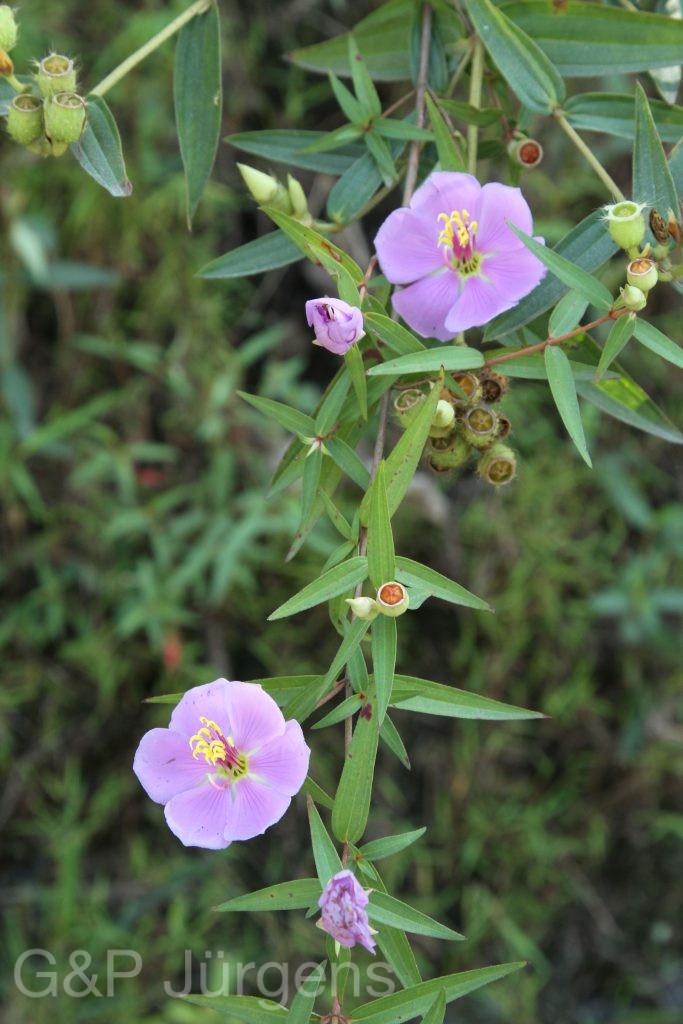
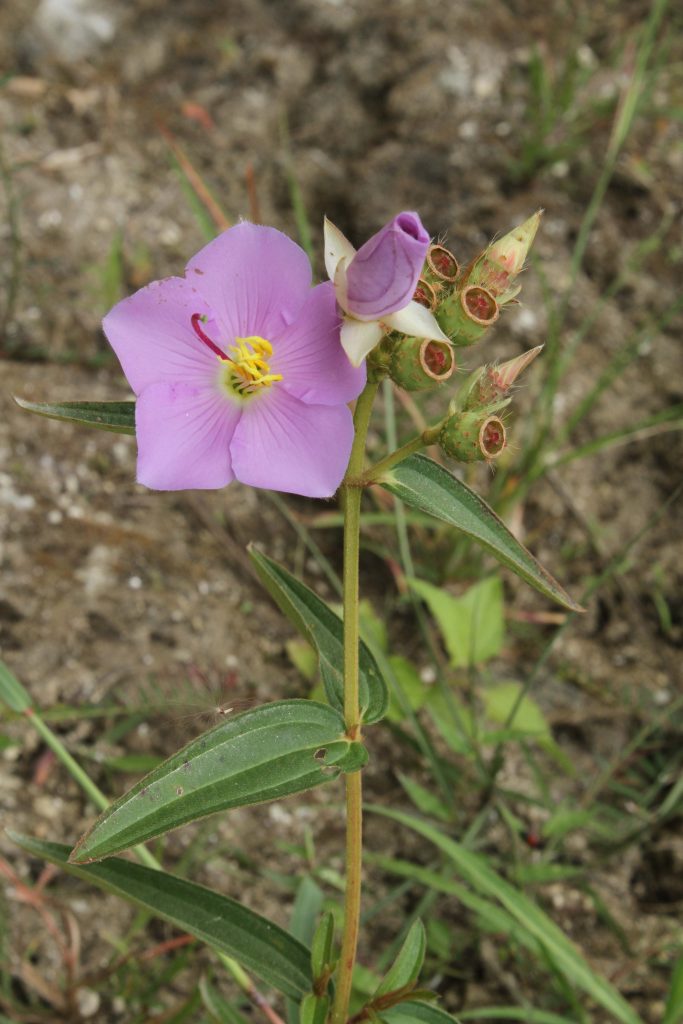
Osbeckia capitata Benth. ex Naudin is a subshrubby herb of the eastern Himalaya, recorded by GBIF (69 occurrences) from China, India, Bhutan and Bangladesh. It occupies open grassy slopes, forest clearings, scrub margins and disturbed banks in the subtropical to lower temperate hill zone, flowering through the late monsoon. The photographed plant from Wangdue Phodrang (Wangdi) in western Bhutan at 2600 m in September is characteristic of its occurrence on warm, humid mid-elevation slopes among grasses and low shrubs.

The plant is an erect to ascending perennial herb with quadrangular, bristly stems bearing opposite, sessile to shortly petiolate leaves. The blades are ovate to lanceolate, setose on both surfaces, with the strongly arcuate three-to-five longitudinal nerves diagnostic of the family. As the epithet capitata indicates, the flowers are aggregated into dense terminal heads or capitate clusters; each flower has four pink to purple petals, a setose, urceolate hypanthium, and the typical melastomataceous androecium of curved stamens whose elongate, beaked anthers open by apical pores. The fruit is a setose urceolate capsule retained within the persistent hypanthium.

Osbeckia is a palaeotropical genus of around 50 species best developed in tropical Asia, separated from Melastoma by its smaller, dry, poricidal-anthered flowers and capsular fruits; the capitate inflorescence distinguishes O. capitata within the Himalayan members. The poricidal anthers are adapted to buzz-pollination by bees, and several congeners have local medicinal use. The species is not assessed as threatened, persisting in open and lightly disturbed montane habitats across its eastern Himalayan range.

Author: Benth. ex Naudin · Sources: POWO (Kew), GBIF, Flora of Bhutan, Flora of China, Melastomataceae of the Indian Subcontinent, Hansen monograph on Osbeckia

Wall.

Bhutan2015 71
Bhutan Wangdi Phodrang 1700m, October
Bhutan2012 422
Bhutan Wangdi 2700m, September

Description

Osbeckia nutans Wall. is a subshrubby herb of the eastern Himalaya and adjoining Southeast Asia, recorded by GBIF (71 occurrences) from India, Nepal, Bhutan, Myanmar and Vietnam. It is a plant of open hillsides, grassy banks, forest clearings and roadside scrub in the subtropical to lower temperate zone, flowering chiefly in the autumn months. The cited Bhutanese material, gathered near Wangdue Phodrang at 1700 m in October and at 2700 m in September, illustrates its tolerance of a fairly wide altitudinal span on the warm, humid southern slopes where it colonises disturbed and seasonally moist ground.

The plant is an erect to ascending perennial with quadrangular, often setose stems bearing opposite, sessile to subsessile leaves. The leaf blades are lanceolate to ovate-lanceolate with the characteristic melastomataceous three-to-five strongly arcuate longitudinal nerves, and the surfaces are clothed in stiff appressed bristles. As the epithet nutans implies, the flowers or buds are inclined to nodding; the showy pink to purplish blooms have four petals, a setose, urceolate hypanthium, and the typical Melastomataceae androecium of geniculate stamens with elongate, beaked anthers opening by terminal pores. The fruit is a setose, urceolate capsule enclosed in the persistent hypanthium.

Osbeckia is a palaeotropical genus of around 50 species centred on tropical Asia, distinguished from the related Melastoma by its smaller, dry, pore-opening capsules. Its poricidal anthers are adapted to buzz-pollination by bees. Several Osbeckia species have ethnomedicinal uses in the region. Osbeckia nutans is locally frequent and not regarded as threatened, persisting well in open and lightly disturbed habitats.

Author: Wall. · Sources: POWO (Kew), GBIF, Flora of Bhutan, Flora of China, Melastomataceae of the Indian Subcontinent, Hansen monograph on Osbeckia

Buch.-Ham. ex D.Don

Bhutan2012 530
Bhutan Tserang 1300m, September
Bhutan2012 660
Bhutan Tserang 1600m, September
Bhutan2015 206
Bhutan Zhemgang 1000m, October
Bhutan2015 207
Bhutan Zhemgang 1000m, October

Description

Osbeckia stellata Buch.-Ham. ex D.Don is a shrub of the melastome family ranging across the Himalaya and tropical Asia, recorded from China, India, Nepal, Bhutan, Myanmar, Thailand, Vietnam, Malaysia and Laos, with about 704 GBIF occurrences. It grows on open hillsides, forest margins, scrub, grassy banks and disturbed slopes in the subtropical and warm-temperate belt, generally between about 900 and 2000 m. It was recorded in Bhutan at Tserang at 1300 and 1600 m and at Zhemgang around 1000 m, flowering in September and October, when its conspicuous magenta blooms colour the autumn hill vegetation of the outer ranges.

It is an erect, branched shrub with quadrangular, often reddish stems bearing appressed, bristly stellate or strigose hairs. The leaves are opposite, ovate-lanceolate, entire, and conspicuously three- to five-nerved with the characteristic curved-convergent venation of Melastomataceae, both surfaces rough with stiff hairs. The flowers are large and showy, borne in terminal cymose clusters; the four broad obovate petals are rose-purple to magenta, surrounding eight stamens with distinctively geniculate, beaked anthers, set on an urceolate hypanthium clothed in branched, stellate-tipped bristles. The fruit is an urn-shaped capsule enclosed by the persistent bristly hypanthium, releasing numerous minute cochleate seeds.

Osbeckia is distinguished from the related Melastoma by its smaller seeds and capsular fruit, and O. stellata is among the most ornamental and widespread Himalayan species, sometimes grown for its vivid flowers. Its poricidal anthers are buzz-pollinated by bees, while the small seeds are dispersed from the dry capsules. Common in disturbed and secondary habitats, it readily colonises cleared ground and is of no conservation concern.

Author: Buch.-Ham. ex D.Don · Sources: POWO (Kew), GBIF, Flora of China, Flora of Bhutan, Flora of British India, Melastomataceae monograph (Hansen revision of Osbeckia)