Tag:

Autumn

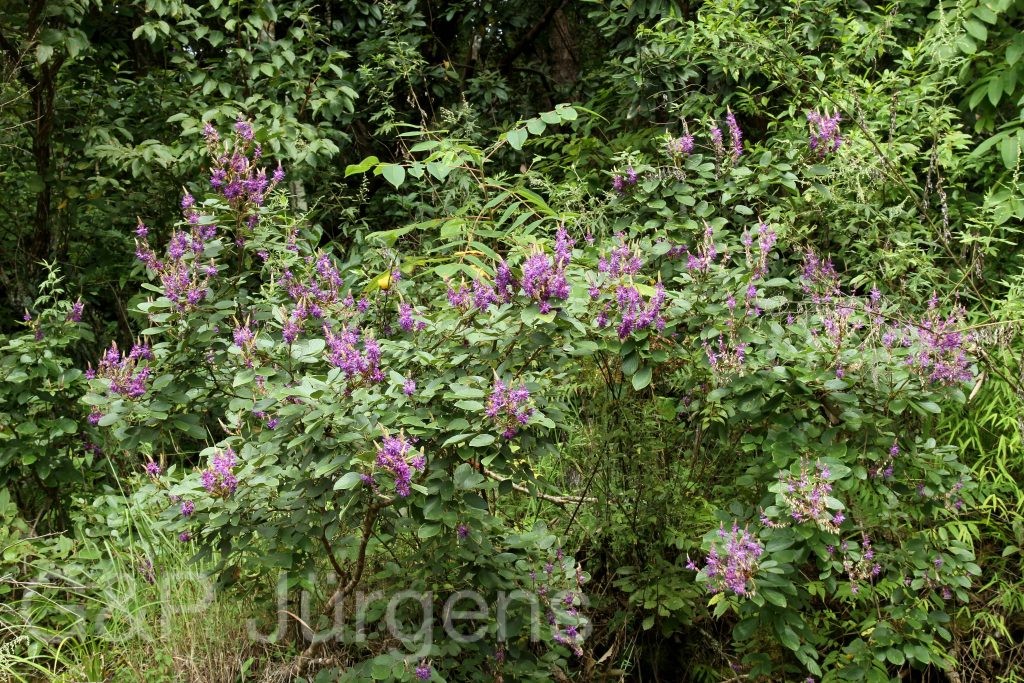
Blume

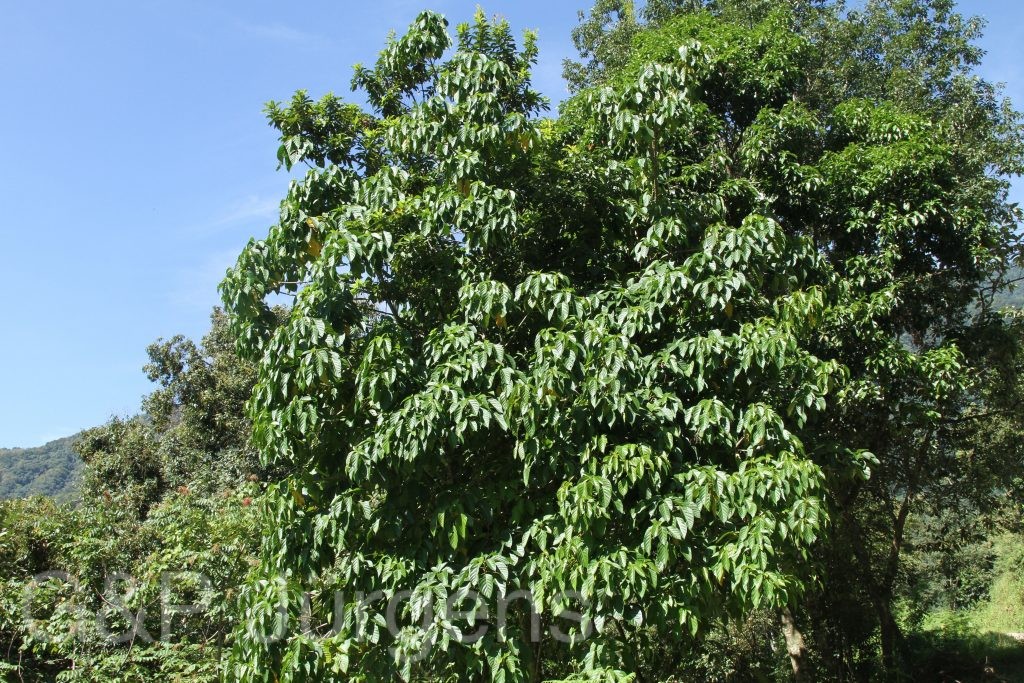
Bhutan2015 194
Bhutan Zhemgang 1000m, October
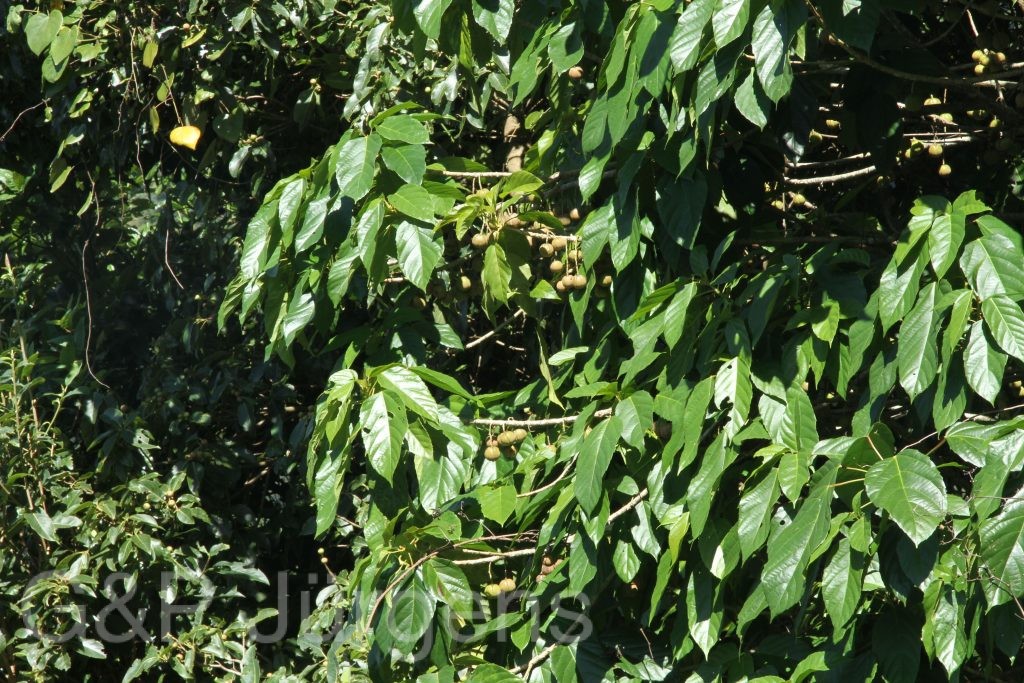
Bhutan2015 195
Bhutan Zhemgang 1000m, October

Description

Ostodes paniculata is a tree or large shrub widely distributed through tropical and subtropical Asia, recorded by GBIF from China, Indonesia, Thailand, India, Myanmar, Vietnam, Nepal, Bhutan, Laos, Cambodia, Malaysia and Korea across more than 1100 occurrences. It is a component of evergreen and semi-evergreen broad-leaved forest in warm, humid lowland and lower montane settings, usually below about 1500 m, often on hillslopes and in valley forest. The photographed individual from Zhemgang in southern Bhutan at about 1000 m, in October, reflects this warm-temperate to subtropical foothill habitat where the species reaches the northern margin of its range along the Himalayan front.

The plant is a monoecious, evergreen tree with smooth bark and a milky or watery exudate. The leaves are alternate, simple, broadly elliptic to ovate, long-petiolate with a pair of glands at the petiole apex, the margin serrate to glandular-toothed and the base often with a few prominent basal nerves. The inflorescences are terminal panicles bearing numerous small white to creamy flowers, the staminate and pistillate flowers separate, with five petals and conspicuous disk glands; staminate flowers have numerous stamens. The fruit is a globose, three-locular capsule, somewhat woody, that splits septicidally to release the large smooth seeds.

Ostodes is a small genus of the Euphorbiaceae (subfamily Crotonoideae) centred on tropical Asia, and O. paniculata is its most widespread and well-known species, valued locally for its timber and seed oil. Its broad range and tolerance of secondary forest mean it is not of conservation concern, and it is frequent across much of Indo-Malaya. Phytogeographically it exemplifies the Indo-Malayan element that penetrates the Himalaya through the warm, wet foothill forests of Bhutan and northeast India.

Author: Blume · Sources: POWO (Kew), GBIF, Flora of China, Flora of Bhutan, Flora of Thailand, Radcliffe-Smith Euphorbiaceae treatments
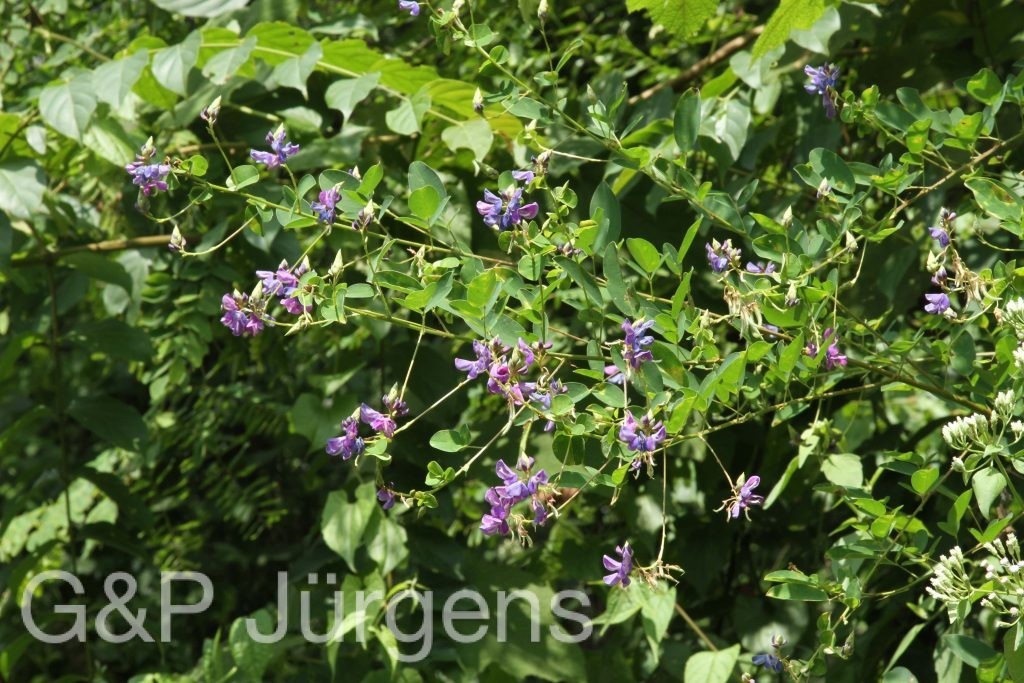
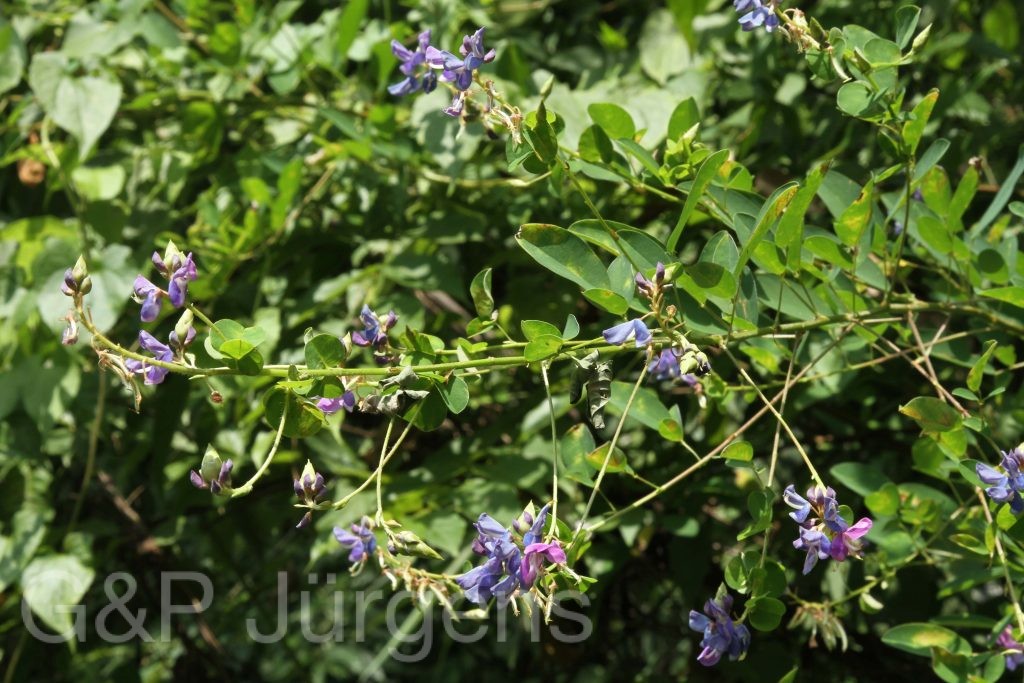
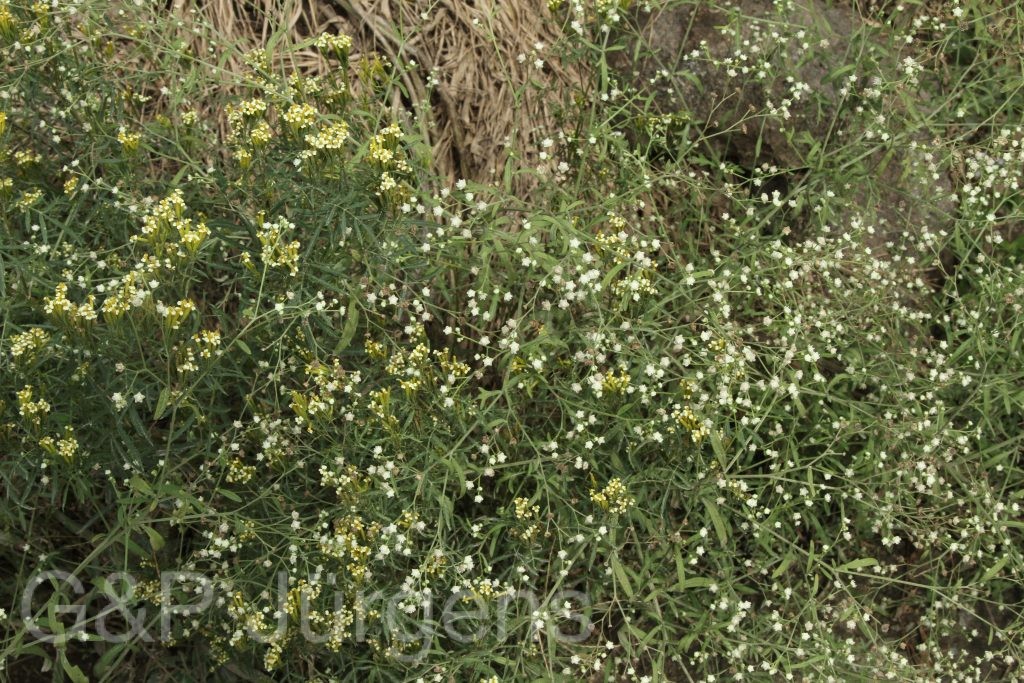
Ototropis conferta

by GP Jürgens

 (DC.) H.Ohashi & K.Ohashi.

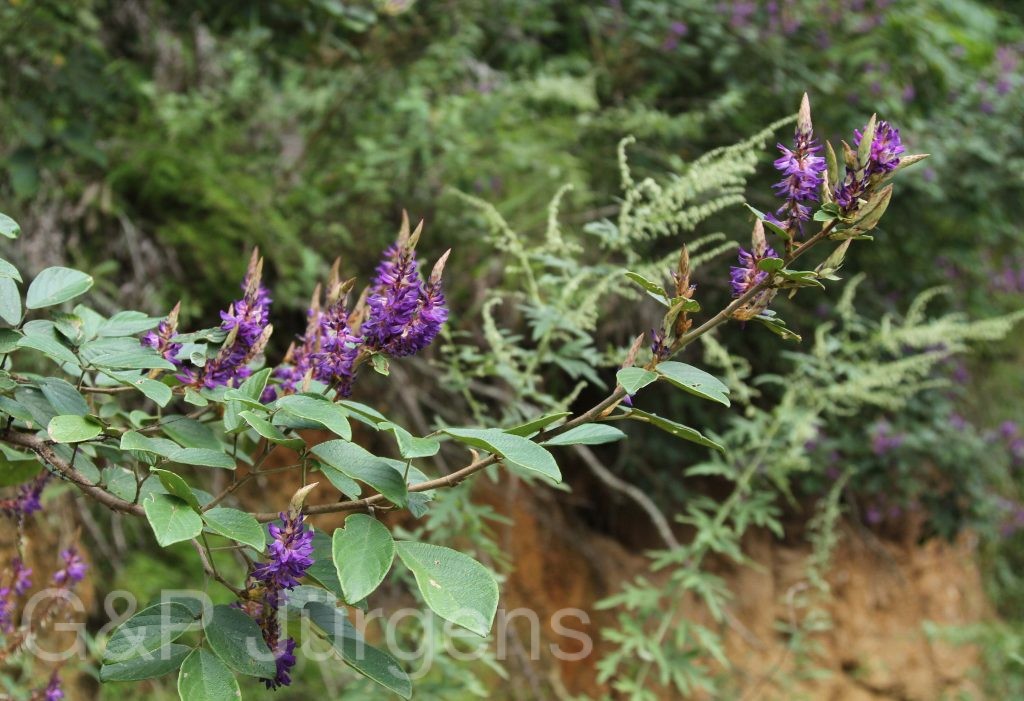
Bhutan2012 958
Bhutan Trithangebe 1200m, October
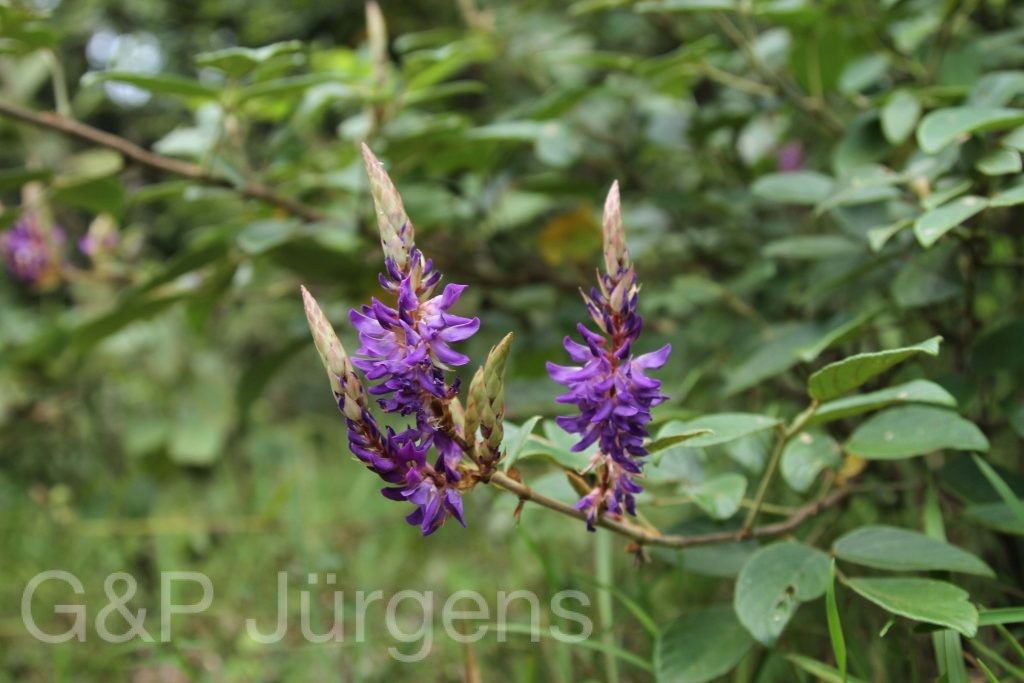
Bhutan2012 959
Bhutan Trithangebe 1200m, October
Bhutan2012 1004
Bhutan Trithangebe 1400m, October

Description

Ototropis conferta is a Himalayan legume distributed through Nepal, India and Bhutan, with GBIF recording about 112 occurrences across the central and eastern ranges. It is a shrub of warm temperate and subtropical hill forest, growing on open slopes, forest edges, scrub and roadside banks typically between roughly 1000 and 2000 m. The accompanying records from Trithangebe in southern Bhutan at 1200 and 1400 m, flowering in October, capture its characteristic autumn flowering in the lower-montane belt, where it forms part of the shrubby understorey and edge vegetation alongside other broom-like legumes on well-drained, often disturbed ground.

It is a woody shrub with slender, sometimes arching branches that are finely pubescent when young. The leaves are pinnately trifoliolate, the leaflets elliptic to ovate with entire margins and an appressed indumentum, subtended by small stipules. The inflorescences are dense, many-flowered terminal and axillary racemes or panicles, the epithet referring to the crowded arrangement of the flowers. Each papilionaceous flower has a campanulate calyx and a corolla of standard, wings and keel, coloured pink to purple, fading as it ages. The diadelphous stamens are enclosed within the keel. The fruit is a flattened, several-jointed loment that breaks at maturity into one-seeded articles, their surfaces clad in hooked hairs that promote epizoochorous dispersal.

The species was long placed in the large genus Desmodium as D. confertum, and was transferred to Ototropis by H.Ohashi and K.Ohashi following molecular and morphological revision of the Desmodieae, which fragmented the traditional broad Desmodium into several segregate genera. As a nitrogen-fixing pioneer of forest edges and disturbed slopes it contributes to soil enrichment and early successional cover, and its adhesive loment articles make it an effective colonist of new ground. It is neither rare nor of particular conservation concern across its Himalayan range.

Author: (DC.) H.Ohashi & K.Ohashi. · Sources: POWO (Kew), GBIF, Flora of Bhutan, Annotated Checklist of the Flowering Plants of Nepal, Ohashi & Ohashi revision of the Desmodium group, Legumes of the World

(DC.) H.Ohashi & K.Ohashi

Bhutan2012 985
Bhutan Trithangebe 1050m, October
Bhutan2012 986
Bhutan Trithangebe 1050m, October

Description

Ototropis multiflora (DC.) H.Ohashi & K.Ohashi, long familiar as Desmodium multiflorum, is a shrubby legume widely distributed through tropical and subtropical Asia. GBIF records (over 1400 occurrences) extend from Pakistan, Nepal, northern India and Bhutan eastward through southern China, Taiwan, Myanmar, Thailand, Laos, Vietnam and Malaysia. It grows in open forest, scrub, forest margins, roadsides and grassy hill slopes at lower and middle elevations, broadly from near sea level to about 2400 m. The specimen photographed at Trithangebe in Bhutan at 1050 m in October, flowering late in the warm season, typifies its preference for warm, well-lit subtropical foothill habitats.

It is an erect, much-branched shrub up to about 1-2 m tall, with young stems and foliage softly pubescent. The leaves are pinnately trifoliolate; leaflets are ovate to elliptic, the terminal one largest, densely soft-hairy beneath, and subtended by persistent stipules. Flowers are borne in many-flowered terminal and axillary racemes or panicles, each papilionaceous corolla pink to purple, the keel enclosing the diadelphous stamens. The fruit is a flattened, several-jointed loment, the segments shallowly constricted and clothed in hooked uncinate hairs that adhere to fur and clothing, promoting epizoochorous dispersal.

The segregation of Ototropis from the broadly defined Desmodium follows molecular work by H. Ohashi and K. Ohashi that resolved tribe Desmodieae into several well-supported genera; Ototropis multiflora is therefore the currently accepted name. As a nitrogen-fixing legume it contributes to soil fertility on disturbed slopes and is used locally as fodder and in traditional medicine. Widespread, weedy and adaptable, it is of least conservation concern and readily colonises secondary habitats.

Author: (DC.) H.Ohashi & K.Ohashi · Sources: POWO (Kew), GBIF, Flora of China, Flora of Bhutan, Ohashi & Ohashi revision of tribe Desmodieae, Annotated Checklist of the Flowering Plants of Nepal

DC.

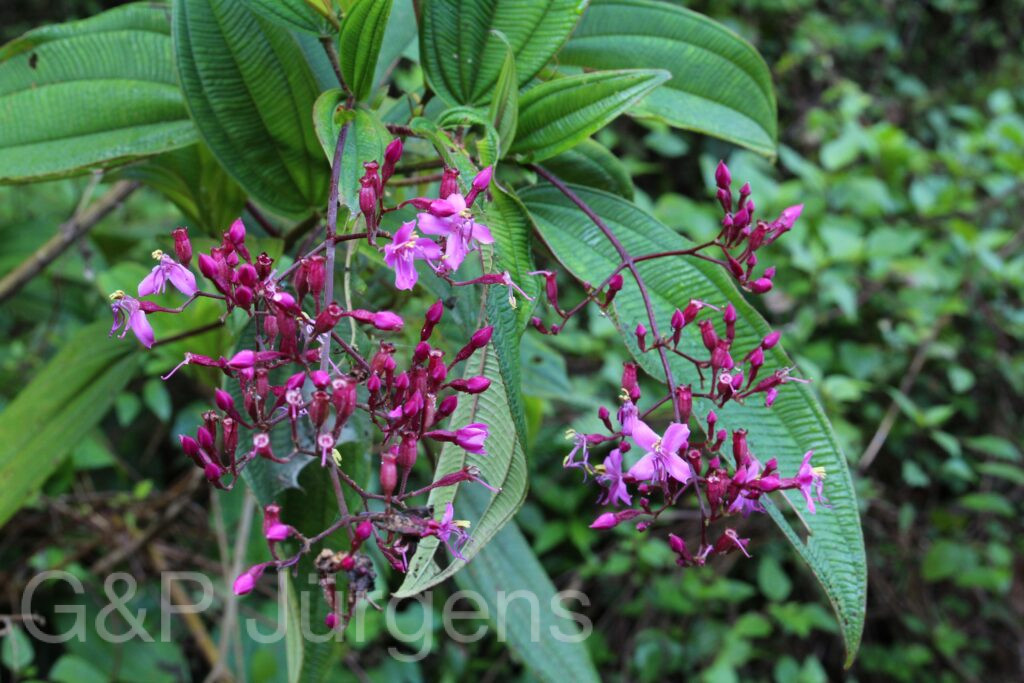
Bhutan2015 552
Bhutan Mo-Chu 1400m, October

Description

Oxyspora paniculata is a widespread species of the family Melastomataceae, distributed from the eastern Himalayas through mainland Southeast Asia to southern China and Vietnam. GBIF records over 1,090 occurrences across Nepal, India, Bhutan, Myanmar, China, Laos, Vietnam, and Japan. The species inhabits warm-temperate to subtropical broadleaved forests, forest margins, and streamsides at elevations of 500–2,200 m, favouring humid, semi-shaded habitats with well-drained acidic soils. Along the Mo-Chu valley in Bhutan at 1,400 m, it grows in the understorey of warm broadleaved forests dominated by Castanopsis and Schima.
Oxyspora paniculata is a shrub or subshrub, typically 1–3 m tall, with quadrangular, often narrowly winged stems. Leaves are opposite, ovate to ovate-lanceolate, 8–18 cm long, acuminate at the apex, with 3–5 prominent acrodromous veins and finely serrulate margins. The inflorescence is a terminal, lax panicle of cymes, 10–25 cm long, bearing numerous small flowers. Flowers are tetramerous, with pink to mauve petals 6–10 mm long and eight stamens of two lengths; the longer stamens bear sigmoid filaments and poricidal anthers with a short dorsal spur. The fruit is a urceolate capsule dehiscing by four apical valves, releasing numerous minute, cuneate seeds.
The genus Oxyspora comprises approximately 20 species centred in the Sino-Himalayan region and mainland Southeast Asia. Oxyspora paniculata is the most widespread member of the genus and has at times been confused with O. vagans, from which it differs in its distinctly winged stems and larger panicles. The species plays an important ecological role as a nectar source for pollinators in subtropical forest margins and is occasionally used in traditional medicine in parts of northeast India.

Author: DC. · Sources: POWO (Kew), GBIF, Flora of China Vol. 13, Flora of Bhutan Vol. 2, Renner et al.: Melastomataceae of the Old World (2021)

Wall.

Bhutan2012 27
Bhutan Shele-La, 3500m September

Description

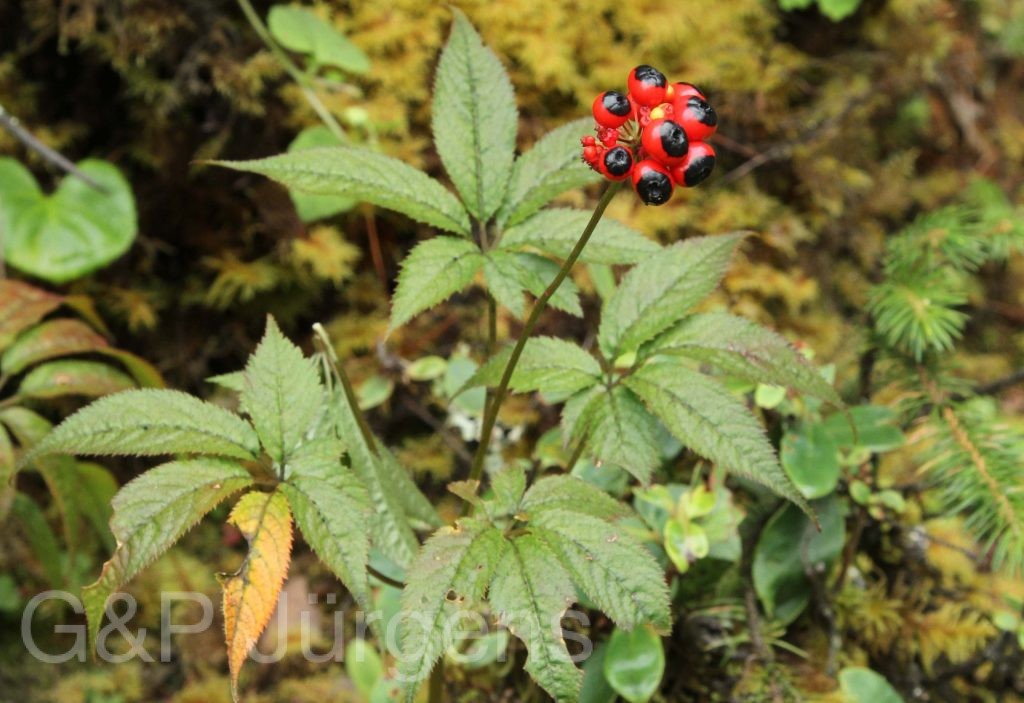
Panax pseudoginseng is a rhizomatous perennial herb of the eastern Himalaya and Sino-Himalayan region, distributed across Nepal, India, Bhutan, China and Myanmar; its c. 255 georeferenced records define a temperate to subalpine forest range (records from Japan, North America, Russia and Europe largely reflect cultivation and study collections). It grows in shaded, humus-rich understorey of broadleaf and mixed forest, on mossy banks and in damp ravines, typically between 2500 and 4000 m. The plant photographed at Shele-La in Bhutan at 3500 m in September grows in the cool, moist upper-temperate to subalpine forest where the genus reaches its Himalayan optimum.

It is a slender erect herb 30-70 cm tall arising from a knotted, often elongate fleshy rhizome bearing prominent stem scars. A single whorl of palmately compound leaves crowns the stem, each leaf with three to five serrate, obovate to oblong leaflets, the terminal ones largest. From the centre rises a long peduncle bearing a solitary terminal umbel of small greenish flowers, each with five petals, five stamens and an inferior two-carpellate ovary with two recurved styles. The fruit is a small, fleshy red drupe, sometimes black-tipped, containing two flattened seeds.

Described by Wallich (as Wall.), P. pseudoginseng is the Himalayan representative of Panax, the ginseng genus of the Araliaceae, and a close relative of the medicinally renowned P. ginseng and P. notoginseng. Its rhizome contains ginsenosides and is harvested in traditional Himalayan and Chinese medicine, exposing wild populations to over-collection. The brightly coloured drupes are bird-dispersed. Because of its slow growth, narrow forest habitat and medicinal value, the species is regarded as conservation-sensitive and locally depleted by harvesting.

Author: Wall. · Sources: POWO (Kew), GBIF, Flora of Bhutan, Flora of China, Flora of Nepal, Wen's revision of Panax (Araliaceae)

Roxb.

Bhutan2012 749
Bhutan Zhemgang 850m, September
Bhutan2015 127
Bhutan Zhemgang 850m, September

Description

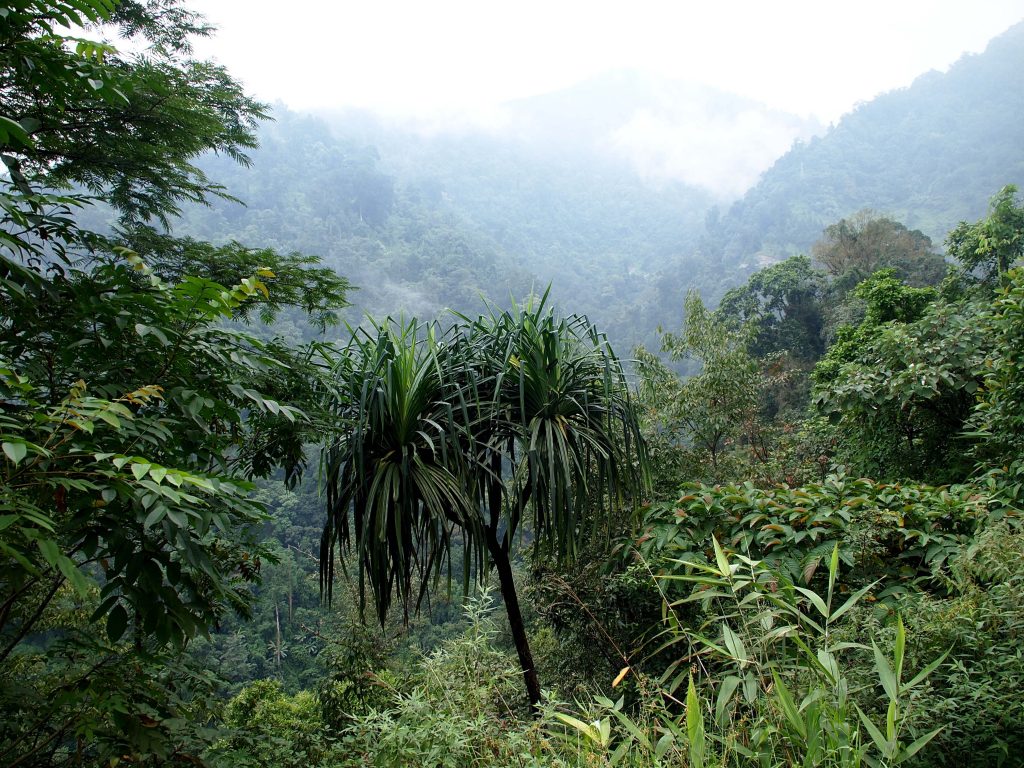
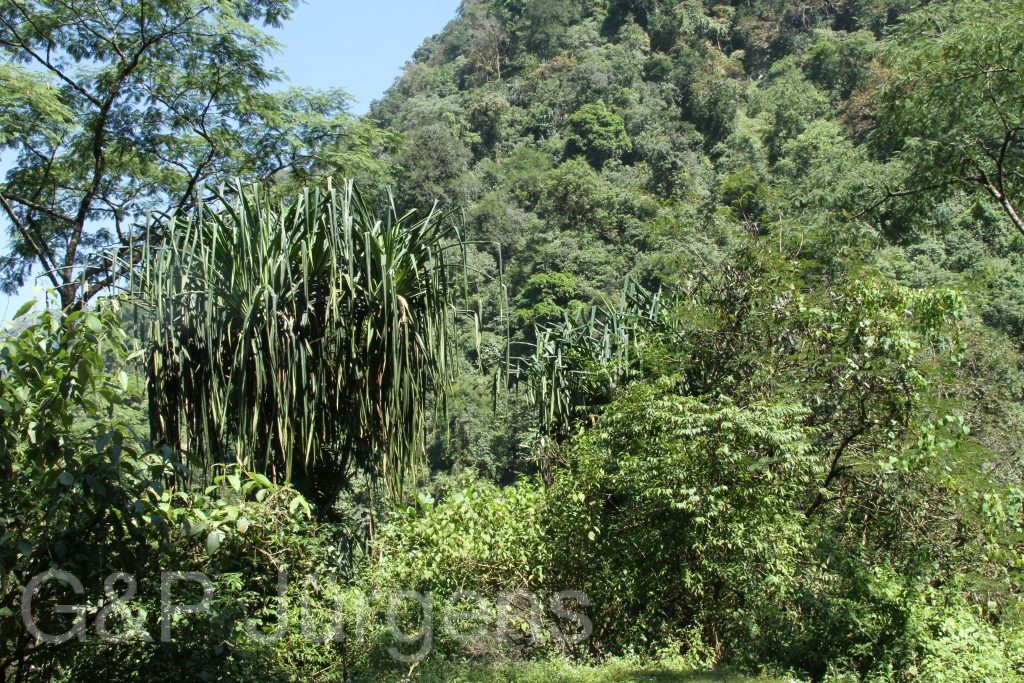
Pandanus furcatus, the Himalayan screw-pine, is a tree-like monocot of the eastern Himalaya and Southeast Asia, recorded by GBIF from Indonesia, Sri Lanka, India, Nepal, China, Malaysia, Thailand, Bhutan, Bangladesh and Myanmar (with cultivated records in Europe) across roughly 352 georeferenced occurrences. It is a plant of warm, humid, subtropical forest, favouring stream banks, moist ravines, gullies and shaded valley bottoms where the air remains saturated, generally at low elevations in the foothill zone. The photographed plant from Zhemgang in central Bhutan at about 850 m in September is characteristic of its occurrence along the moist inner-valley watercourses of the southern Himalaya, where it forms a conspicuous element of riparian vegetation.

The plant grows as a small tree with a slender trunk supported above the ground by a cone of stout, downwardly directed stilt (prop) roots, the stem typically branching and bearing terminal tufts of leaves. The leaves are very long, strap-shaped (ensiform) and spirally arranged in three ranks that twist around the stem, with sharp spiny teeth along the margins and the midrib beneath. Like all Pandanus it is dioecious. The male inflorescence is a much-branched, pendulous, fragrant spike subtended by white bracts, while the female inflorescence develops into a large, pendent, globose to ovoid syncarp (compound fruit) composed of numerous angular, wedge-shaped drupes that ripen yellow to orange-red.

Pandanus furcatus belongs to the Pandanaceae, an ancient pantropical family of arborescent monocots distinguished by their stilt roots, spiral tristichous leaves and dioecious habit. Among Himalayan species it is notable for ascending to relatively high elevations for the genus and for its role in stabilising stream banks and providing fruit and shelter for wildlife; the leaves are used locally for weaving and thatching. Although harvested locally, the species has a broad distribution and is locally common, and it is not regarded as globally threatened.

Author: Roxb. · Sources: POWO (Kew), GBIF, Flora of China Vol. 23, Flora of Bhutan Vol. 3, Flora of Nepal, Flora of Pakistan, Stone: revisional studies of Pandanus and the Pandanaceae

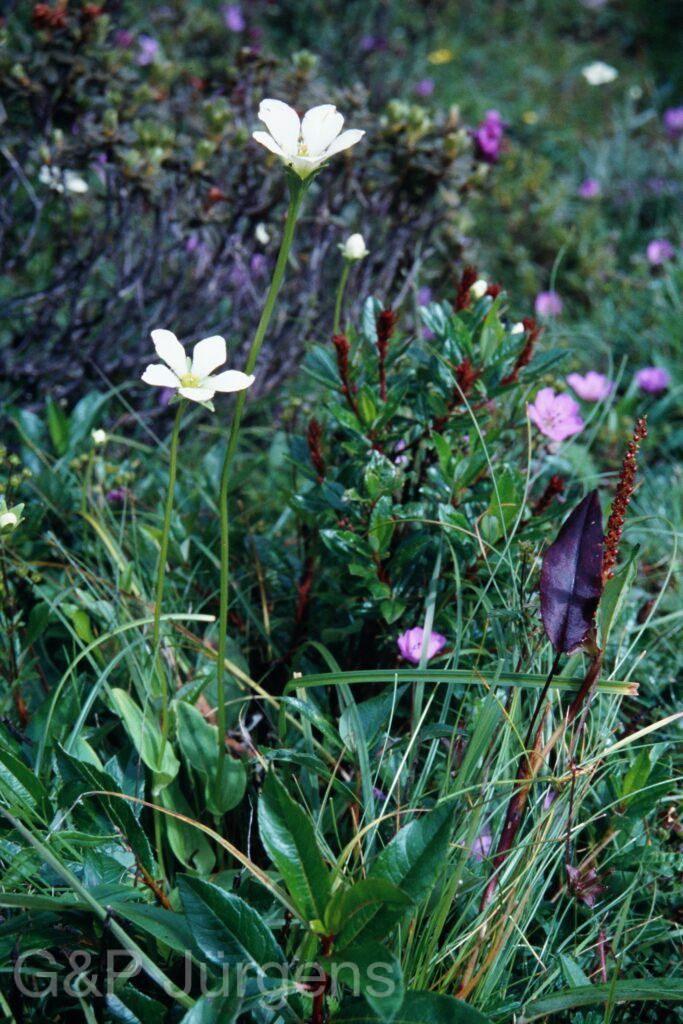
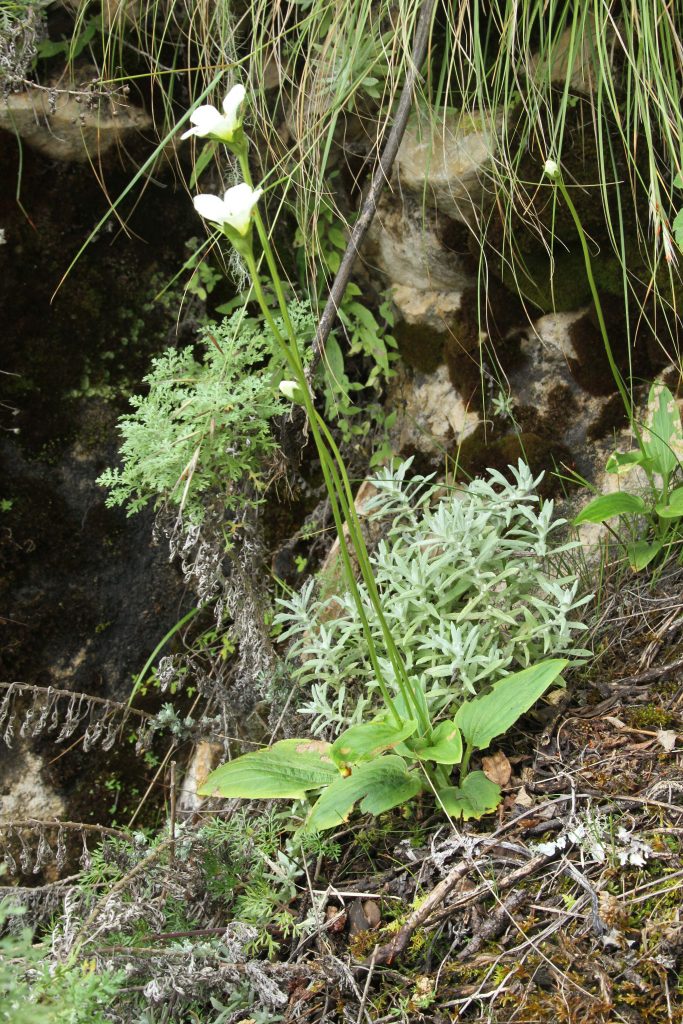
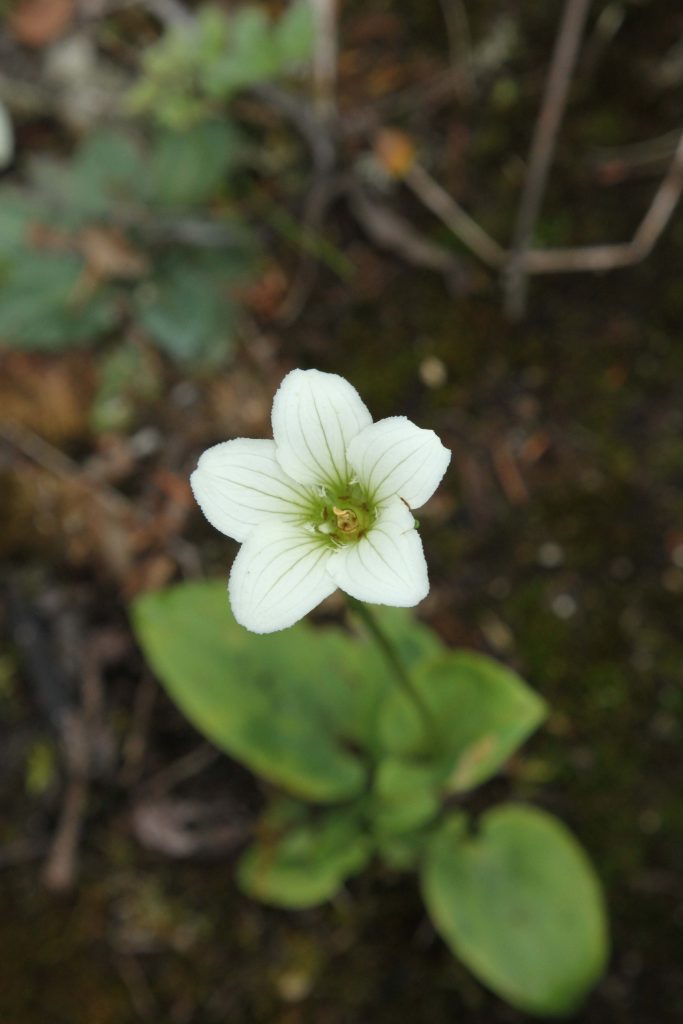
W.E.Evans

Bhutan2012 67
Bhutan Shele-La, 3800m September

Description

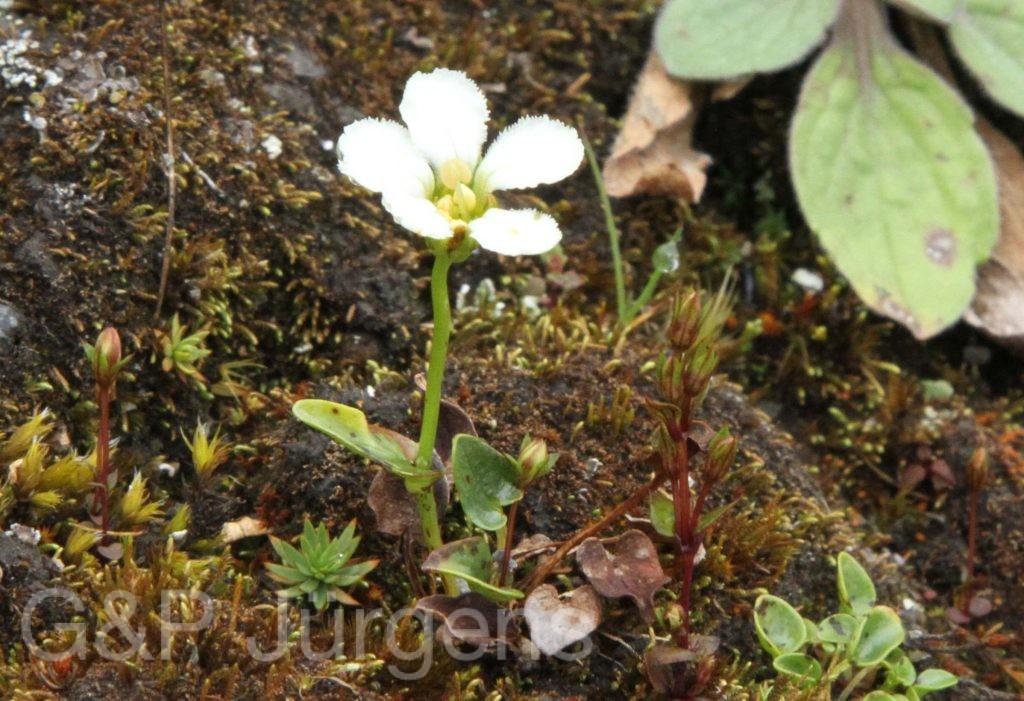
Parnassia cooperi is an alpine perennial herb of the eastern Himalaya, known from a small set of 12 GBIF occurrences in China, Bhutan and India. It inhabits moist alpine meadows, seepage slopes, streamsides and damp grassy turf in the upper temperate to alpine zone, generally between about 3500 and 4300 m. The plant recorded on the Shele-La in Bhutan at 3800 m in September represents its typical high-elevation habitat, flowering late in the season on cool, humid, well-watered ground where snowmelt and monsoon moisture persist.

The species is a slender, glabrous, rosette-forming herb arising from a short rhizome. The basal leaves are long-petiolate with ovate to cordate, entire blades, while each erect, unbranched flowering stem bears a single sessile or clasping cauline leaf below the solitary terminal flower. The flower has five free, white petals, frequently veined, and alternates fertile stamens with conspicuous fringed or gland-tipped staminodes, the latter a defining feature of the genus. The superior to half-inferior ovary ripens into a capsule that dehisces into valves, releasing numerous small seeds.

Though traditionally placed in its own family Parnassiaceae or in Saxifragaceae, Parnassia is here listed under Celastraceae, reflecting molecular evidence that nests the Parnassia-Lepuropetalon lineage within an expanded Celastrales. Parnassia cooperi is a narrow-range eastern Himalayan endemic whose restricted distribution and specialised wetland-alpine habitat make it potentially vulnerable to grazing pressure and climatic shifts, warranting monitoring despite its current data-poor conservation status.

Author: W.E.Evans · Sources: POWO (Kew), GBIF, Flora of China Vol. 8, Flora of Bhutan Vol. 1, Flora of Nepal, Flora of Pakistan, Wu's monograph of Parnassia

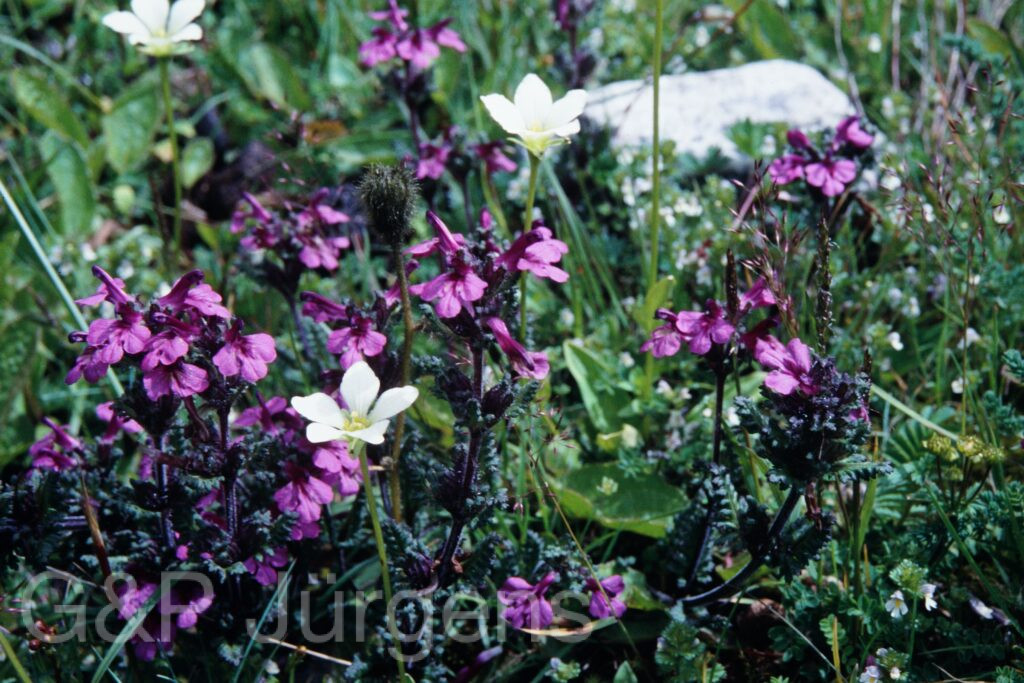
Wall. ex Royle

Sikkim2003 258 P353
Sikkim Dzongri 4200m August
Sikkim2003 261 P360
Sikkim Dzongri 4200m August

Description

Parnassia nubicola Wall. ex Royle is a perennial herb of moist alpine habitats distributed along the Himalaya and into adjoining Central Asia, recorded from China, India, Nepal, Pakistan, Afghanistan and Bhutan, with around 182 georeferenced occurrences clustered in the high Sino-Himalayan ranges. It favours wet alpine meadows, marshy turf, seepage slopes, streamsides and the moist margins of snowmelt flushes, where soils remain saturated through the growing season. The photographed plants from Dzongri in Sikkim at about 4,200 m in August and from the Shele-La in Bhutan at about 4,000 m in September show its preference for the upper subalpine to alpine zone, where it flowers in late summer.

It grows from a short rhizome as a rosette of long-petioled basal leaves with ovate to cordate, entire blades. The flowering stems are erect and bear usually a single clasping, sessile cauline leaf below the solitary terminal flower. Each flower has five green sepals and five white petals conspicuously veined with green or yellowish lines. Between the fertile stamens lie five fringed staminodes divided into numerous gland-tipped filaments, a hallmark of the genus; the superior ovary ripens into a capsule splitting into four valves to release many small seeds.

The family attribution to Celastraceae follows recent molecular classifications, in which Parnassia (formerly placed in Saxifragaceae or its own Parnassiaceae) is treated within an expanded Celastraceae. The conspicuous nectar-secreting staminodes are associated with generalist insect pollination. Widespread and locally common across its broad range, P. nubicola is not considered threatened, though wetland alpine populations are sensitive to drainage, trampling and grazing.

Author: Wall. ex Royle · Sources: POWO (Kew), Flora of China Vol. 8, Flora of Bhutan Vol. 1, GBIF, Simmons: Celastraceae (in Kubitzki, 2004)

L.

Bhutan2015 523
Bhutan Wangdi 1800m, October

Description

Parthenium hysterophorus is a neotropical annual of Central American and Caribbean origin that has become one of the world's most aggressive invasive weeds, GBIF recording nearly 39,000 occurrences spanning the Americas, Africa, the Middle East, South Asia and Australasia. It colonises waste ground, roadsides, overgrazed pasture, field margins and other disturbed, open habitats from the lowlands to mid-elevations, thriving on a wide range of soils. In the Eastern Himalaya it has spread along valley roads and settlements, the figured plant from Wangdi in central Bhutan at about 1800 m, photographed in October, documenting its ongoing upward and eastward expansion into mountain agricultural landscapes.

It is an erect, much-branched annual herb with longitudinally grooved, pubescent stems. The lower leaves are deeply bipinnatisect and form a basal rosette, while the upper leaves become smaller and less divided; all are softly hairy and bear glandular trichomes. The numerous small, whitish capitula are arranged in lax terminal panicles, each head containing five short, female ray florets and many functionally male disc florets. The involucre is shallow with two series of phyllaries. At maturity each ray achene falls together with two adjacent sterile disc florets and subtending bracts as a wedge-shaped dispersal unit bearing two small scale-like pappus elements.

A member of tribe Heliantheae, Parthenium hysterophorus is notorious for its prolific seed output, allelopathic suppression of neighbouring vegetation, and production of the sesquiterpene lactone parthenin, which causes contact dermatitis and respiratory allergy in humans and is toxic to livestock. Its invasion degrades rangeland and crops across the tropics and is the target of biological control using host-specific beetles and rusts. In the Himalayan region it is regarded as a serious emerging threat to biodiversity and pastoral livelihoods rather than a species of conservation concern.

Author: L. · Sources: POWO (Kew), GBIF, Flora of Bhutan, Flora of China, CABI Invasive Species Compendium, Navie's monograph of Parthenium hysterophorus

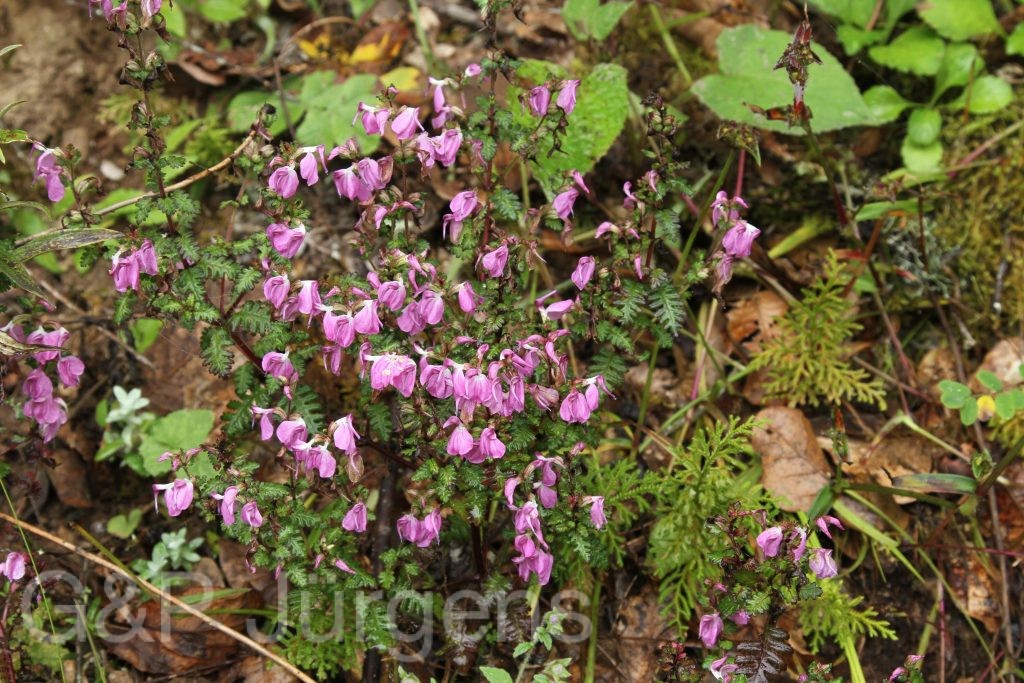
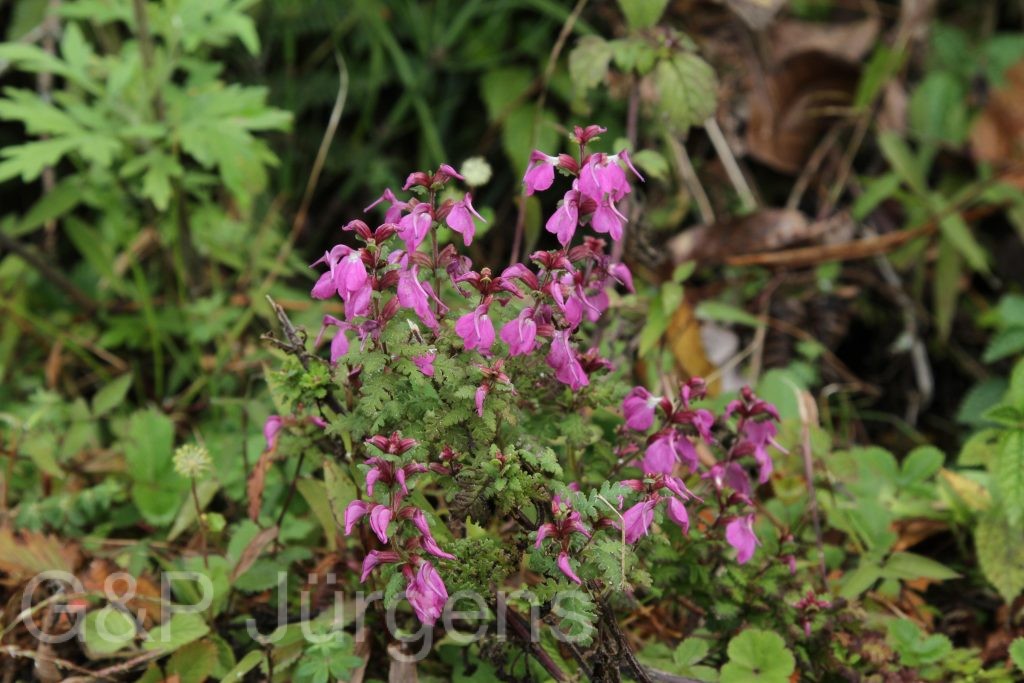
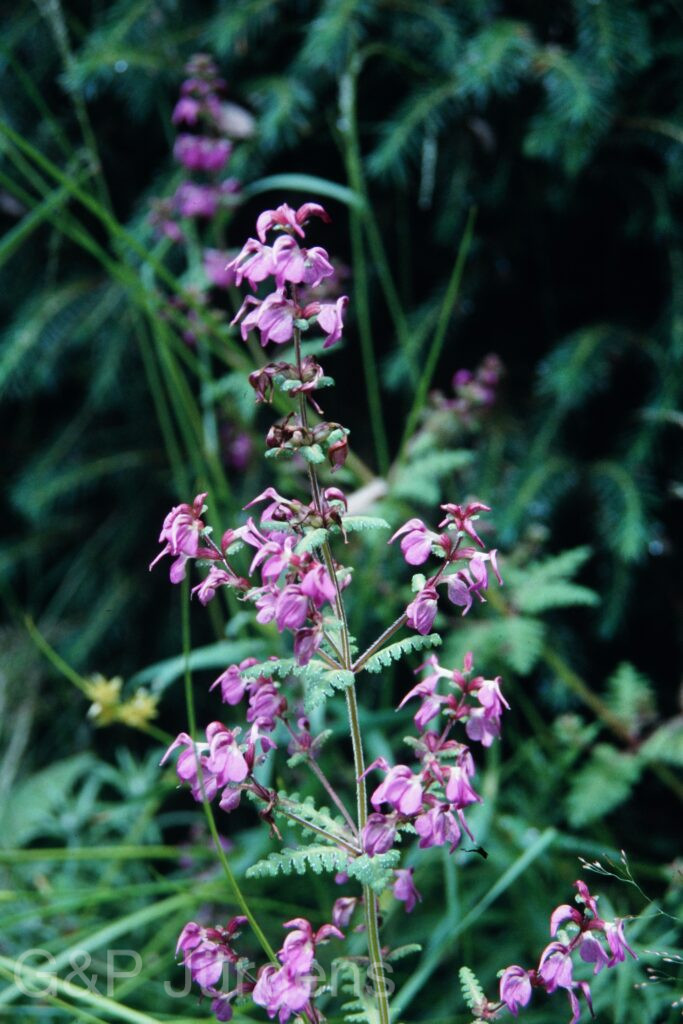
Wall. ex Benth.

Bhutan2012 834
Bhutan Trongsa 1850m, October
Bhutan2012 1299
Bhutan Trashigang 1820m, October
Sikkim2003 388 P550
Sikkim Zemu Valley 3300m August

Description

Pedicularis gracilis Wall. ex Benth. is a hemiparasitic herb of the Himalaya and adjacent mountains, occurring across China, Nepal, India, Bhutan, Pakistan and Myanmar. It is recorded from Bhutan at Trongsa and Trashigang between 1820 and 1850 m, flowering in October, and from the Zemu Valley in Sikkim at about 3300 m in August, spanning the warm temperate to subalpine zones. The species grows in open forest, scrub, grassy slopes, meadows and along stream banks, generally between 1500 and 3500 m, where, like all lousewort, it attaches to the roots of neighbouring plants as a facultative root hemiparasite. Its roughly 1008 GBIF records indicate a common and widely distributed species.

The plant is a slender, erect annual or short-lived perennial with a fibrous root system and a tall, sparingly branched stem. The leaves are alternate and pinnatisect, the segments themselves toothed or incised, giving a fern-like aspect. The flowers are borne in a long, lax, leafy-bracted terminal raceme; each has a tubular five-lobed calyx and a two-lipped corolla in pink to rose-purple, the upper lip (galea) hooded and beaked to enclose the four didynamous stamens, the lower lip three-lobed and spreading. The fruit is an obliquely ovoid, beaked capsule containing several seeds.

Pedicularis is one of the largest genera of the Sino-Himalaya, with the region a global centre of its diversity, and the intricate galea forms are closely tied to specialisation upon long-tongued bumblebee pollinators. As a hemiparasite the genus can influence community composition and is sensitive to changes in host vegetation. Being widespread and frequent, P. gracilis is of no particular conservation concern, though it serves as a useful indicator of intact montane grassland and forest-edge habitats.

Author: Wall. ex Benth. · Sources: POWO (Kew), GBIF, Flora of China, Flora of Bhutan, Flora of Nepal, Pedicularis monographs (Prain; Tsoong)