
Roxb.
Description
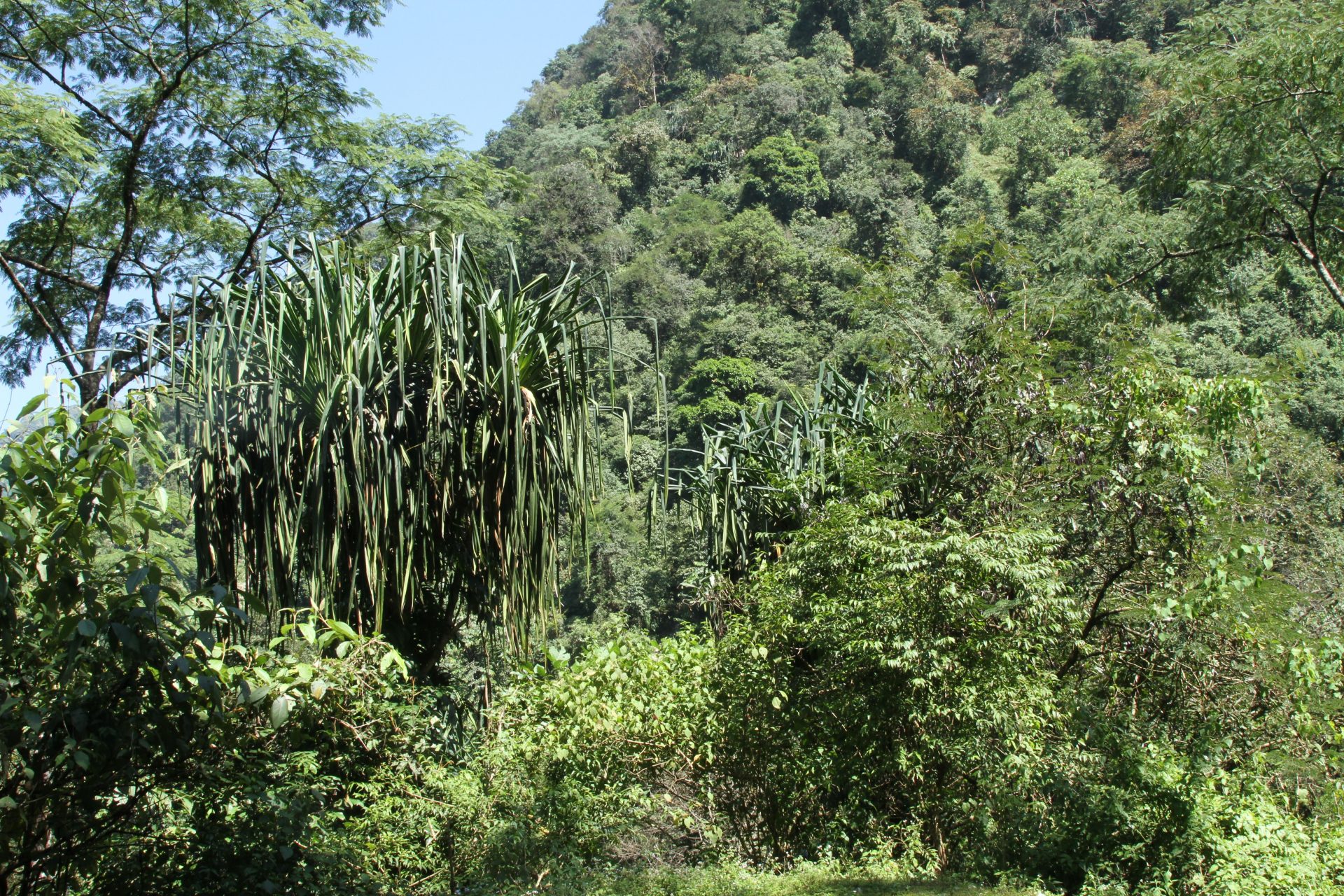
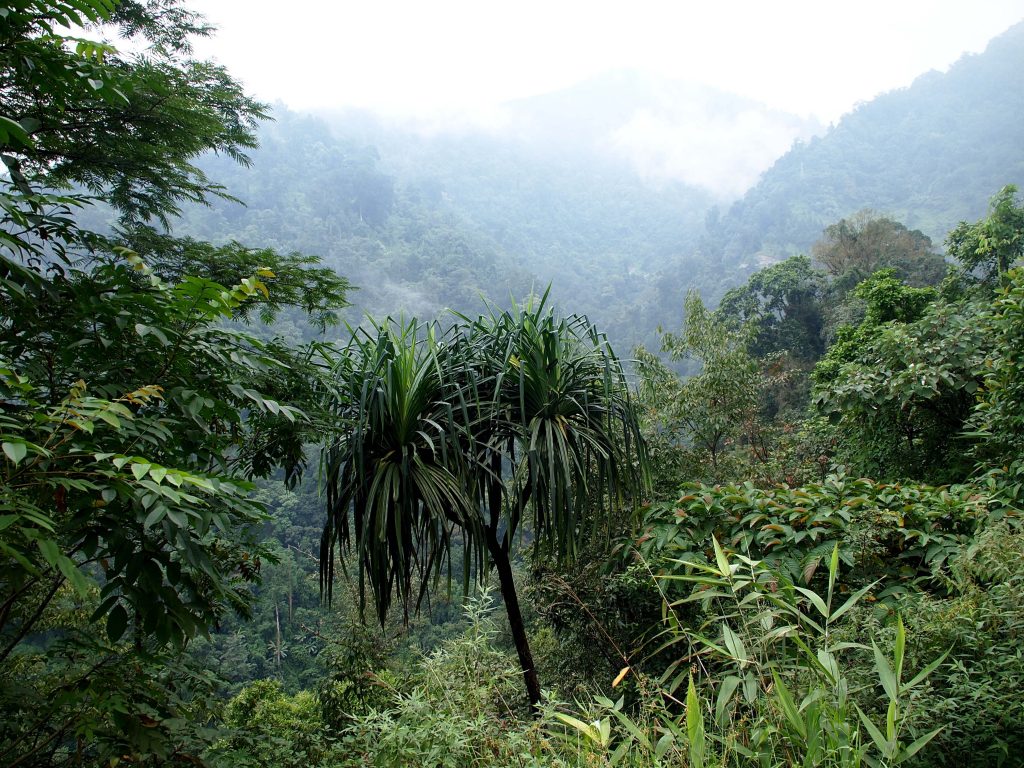
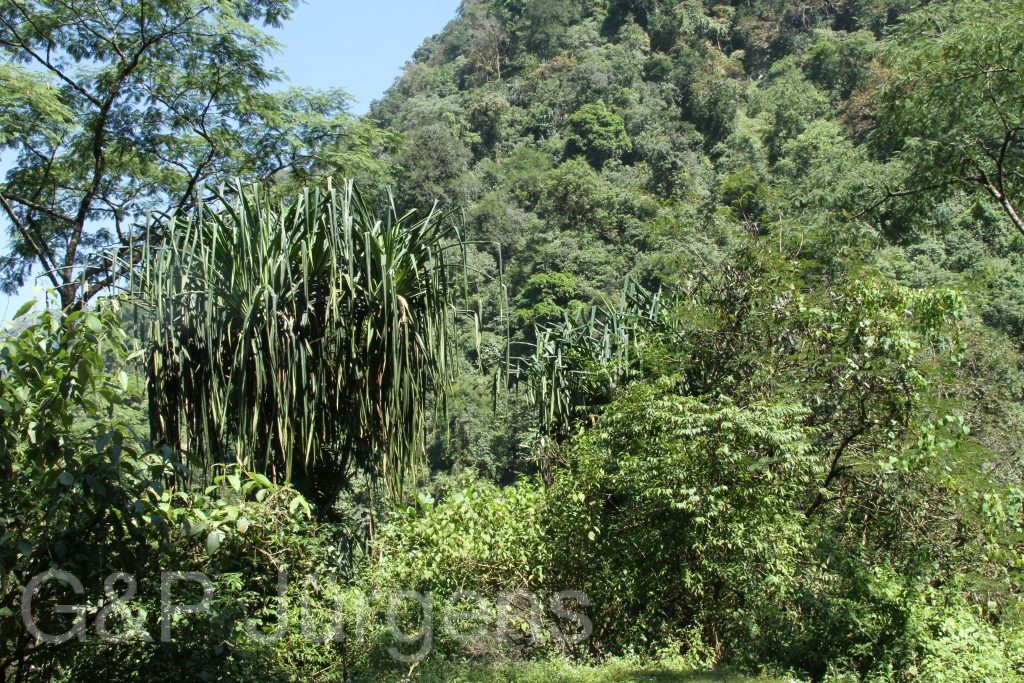
Pandanus furcatus, the Himalayan screw-pine, is a tree-like monocot of the eastern Himalaya and Southeast Asia, recorded by GBIF from Indonesia, Sri Lanka, India, Nepal, China, Malaysia, Thailand, Bhutan, Bangladesh and Myanmar (with cultivated records in Europe) across roughly 352 georeferenced occurrences. It is a plant of warm, humid, subtropical forest, favouring stream banks, moist ravines, gullies and shaded valley bottoms where the air remains saturated, generally at low elevations in the foothill zone. The photographed plant from Zhemgang in central Bhutan at about 850 m in September is characteristic of its occurrence along the moist inner-valley watercourses of the southern Himalaya, where it forms a conspicuous element of riparian vegetation.
The plant grows as a small tree with a slender trunk supported above the ground by a cone of stout, downwardly directed stilt (prop) roots, the stem typically branching and bearing terminal tufts of leaves. The leaves are very long, strap-shaped (ensiform) and spirally arranged in three ranks that twist around the stem, with sharp spiny teeth along the margins and the midrib beneath. Like all Pandanus it is dioecious. The male inflorescence is a much-branched, pendulous, fragrant spike subtended by white bracts, while the female inflorescence develops into a large, pendent, globose to ovoid syncarp (compound fruit) composed of numerous angular, wedge-shaped drupes that ripen yellow to orange-red.
Pandanus furcatus belongs to the Pandanaceae, an ancient pantropical family of arborescent monocots distinguished by their stilt roots, spiral tristichous leaves and dioecious habit. Among Himalayan species it is notable for ascending to relatively high elevations for the genus and for its role in stabilising stream banks and providing fruit and shelter for wildlife; the leaves are used locally for weaving and thatching. Although harvested locally, the species has a broad distribution and is locally common, and it is not regarded as globally threatened.
Author: Roxb. · Sources: POWO (Kew), GBIF, Flora of China Vol. 23, Flora of Bhutan Vol. 3, Flora of Nepal, Flora of Pakistan, Stone: revisional studies of Pandanus and the Pandanaceae