Tag:

Autumn

L.

Bhutan2012 534
Bhutan Wangdi 2600m, September
Nepal 97 68 P104
Nepal Mewa-Khola 1250m April
Nepal 97 67 P103
Nepal Mewa-Khola 1250m April

Description

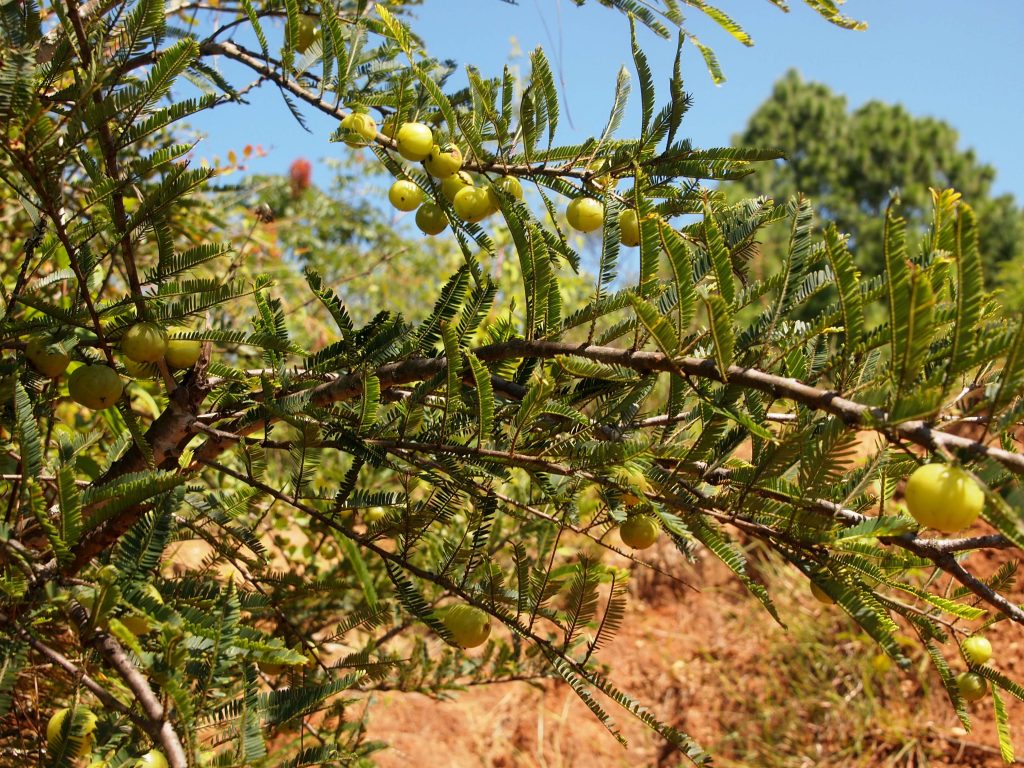
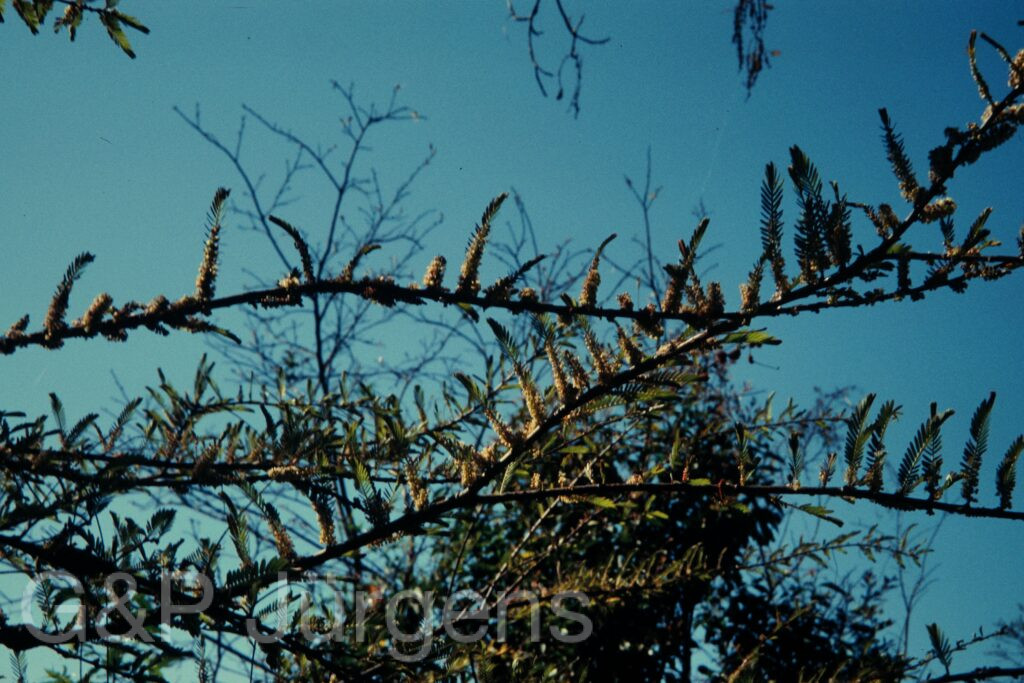
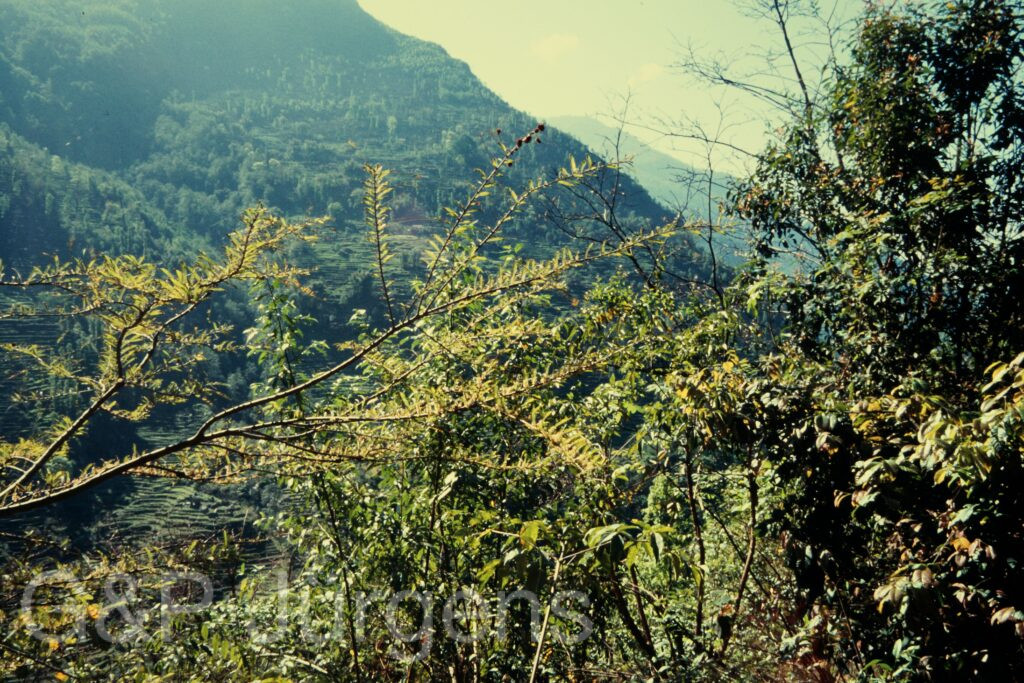
Phyllanthus emblica, the emblic myrobalan or Indian gooseberry (amla), is a small to medium tree of tropical and subtropical Asia with a very broad distribution embracing India, China, much of Southeast Asia, Sri Lanka, Nepal, Bhutan and many introduced ranges, recorded in GBIF by more than 19000 occurrences. It is a plant of deciduous and mixed dry forest, open hillsides, scrub and cultivated and disturbed ground, and is very widely planted, generally from the lowlands up into the hills. The cited material spans Mewa Khola in eastern Nepal at 1250 m, in leaf and flower in April, and Wangdi in Bhutan at 2600 m in September, the latter near the upper elevational limit and reflecting the species' wide ecological amplitude across the southern Himalayan belt.

The tree reaches up to about 8–18 m, with smooth, pale, often flaking bark and slender, feathery branchlets bearing numerous small, distichous, oblong-linear leaves that closely resemble the pinnae of a compound leaf, the whole leafy branchlet being deciduous as a unit. It is monoecious, the small, greenish-yellow, apetalous flowers borne in clusters in the leaf axils. The fruit is the most distinctive feature: a fleshy, globose, pale green to yellowish drupe-like capsule, 1.5–2.5 cm across, with six faint longitudinal furrows, a hard central stone, and a markedly sour, astringent flesh.

Phyllanthus is a vast pantropical genus now placed in the family Phyllanthaceae, segregated from a broadly defined Euphorbiaceae. P. emblica is among the most economically and culturally important of its members: the vitamin-C-rich fruit is a staple of Ayurvedic and traditional medicine and is widely eaten preserved or processed, while the tree yields tannins, dye and timber. It is extensively cultivated and naturalised well beyond its native range. Being abundant, hardy and widely grown, the species is of no conservation concern and is in many areas a familiar element of agroforestry and village landscapes.

Author: L. · Sources: POWO (Kew), GBIF, Flora of China Vol. 11, Flora of Bhutan Vol. 1, Flora of Nepal, A Monograph of the Genus Phyllanthus (Phyllanthaceae)
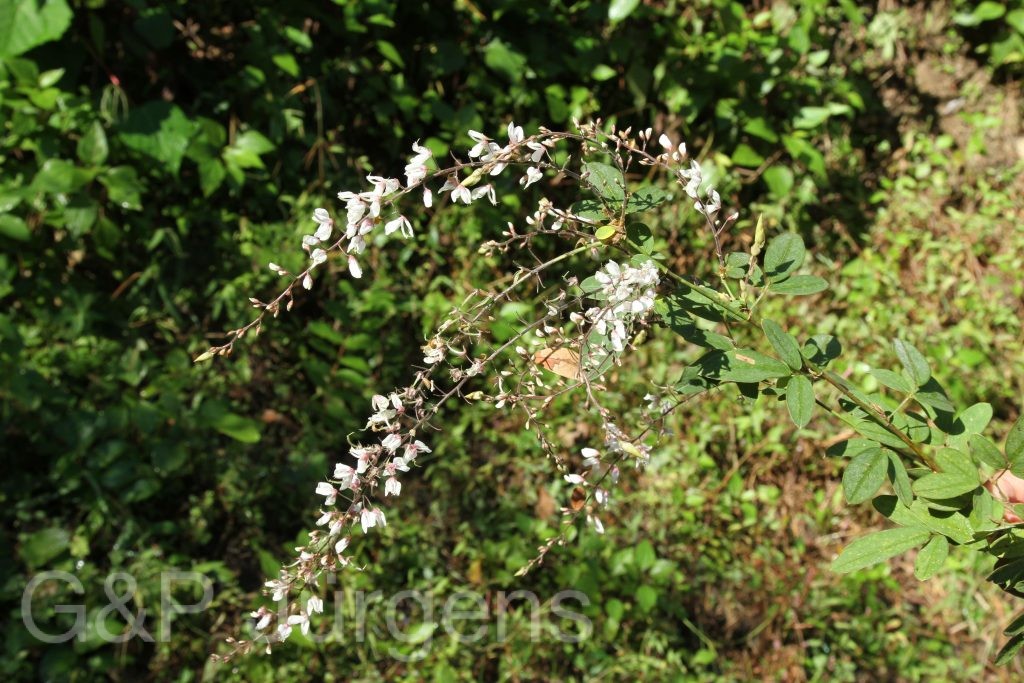
(L.) Desv.

Bhutan2015 553
Bhutan Moshu 1400m, October
Bhutan2015 554
Bhutan Moshu 1400m, October

Description

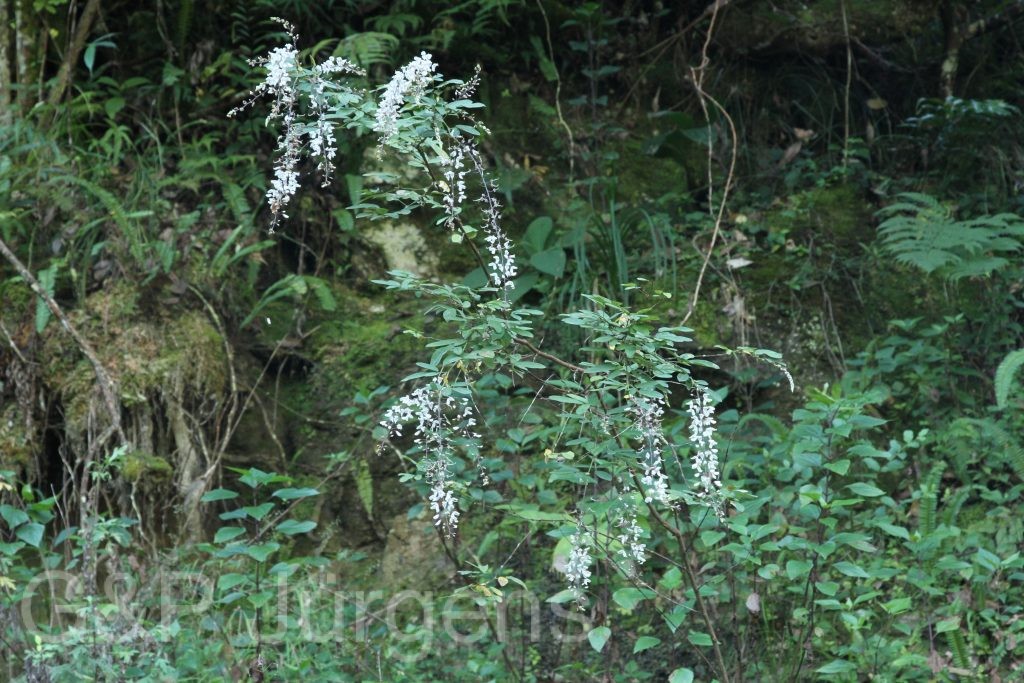
Phyllodium pulchellum (L.) Desv. is a widely distributed subtropical to tropical legume of South and Southeast Asia and Australasia, with an extensive GBIF range (including CN, TW, IN, ID, TH, PH, AU, PG, VN, MM, LA, LK, KH, NP, JP, MY and BD, among others) and around 2442 occurrences. It inhabits open forest, woodland margins, savanna, grassy slopes and disturbed roadside thickets at low to moderate elevations. The image record from Moshu in southern Bhutan at 1400 m, in October, places it in the warm subtropical foothill zone at the lower margin of the Himalayan flora, well below the alpine taxa with which it is here grouped.

It is a shrub or subshrub with erect, branched and often tomentose stems. The leaves are pinnately trifoliolate, the terminal leaflet markedly larger than the laterals and ovate to elliptic with an entire margin. The inflorescence is highly distinctive: an elongate terminal raceme in which the small flowers are borne in clusters concealed between pairs of large, rounded, conspicuously veined bracts arranged like the leaves of a fern frond, the feature for which the genus Phyllodium is named. The flowers are typical papilionate legumes, small and whitish to pale yellow. The fruit is a small flattened lomentum, breaking transversely into one-seeded segments.

Phyllodium belongs to the tribe Desmodieae of subfamily Faboniodeae (Papilionoideae), allied to Desmodium, and the paired foliaceous bracts are a hallmark of the genus. The lomentum segments, with their hooked or sticky surfaces, promote epizoochorous dispersal. As a nitrogen-fixing legume it is significant in early-successional and grassland communities, and is used in traditional medicine across its range; it is widespread and not of conservation concern.

Author: (L.) Desv. · Sources: POWO (Kew), GBIF, Flora of China (Fabaceae: Desmodieae), Flora of Bhutan, Ohashi monograph of the Desmodium group (Leguminosae)

Picea spinulosa

by G & P Jürgens

(Griff.) A.Henry

Bhutan2015 407
Bhutan Jakar 2550, October
Sikkim2004 440 P767
Sikkim/India Lachung 3400m May

Description

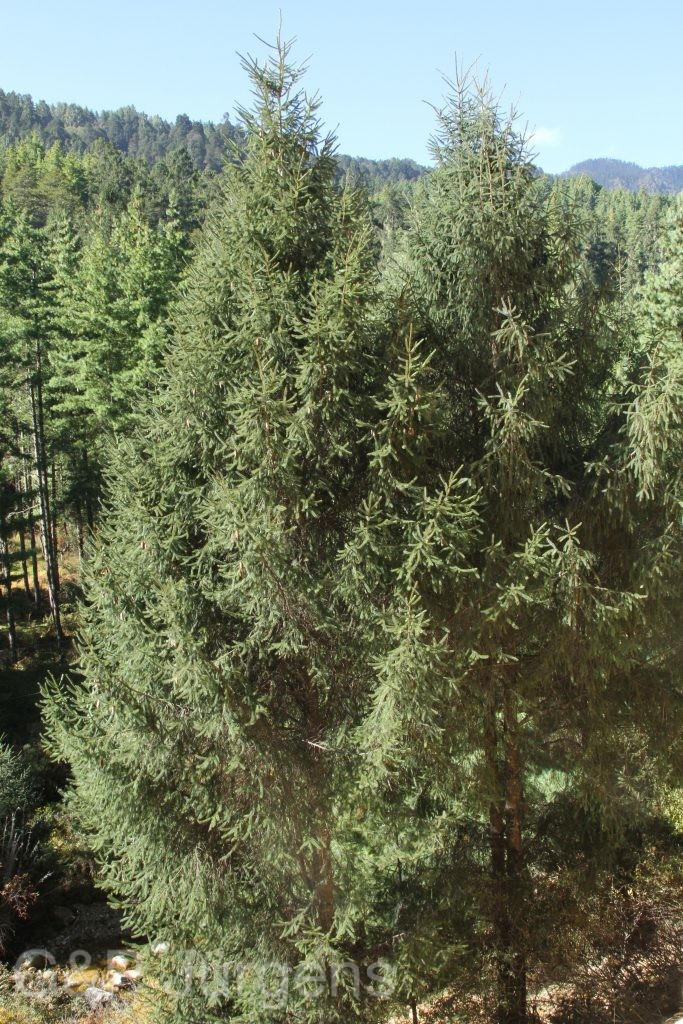
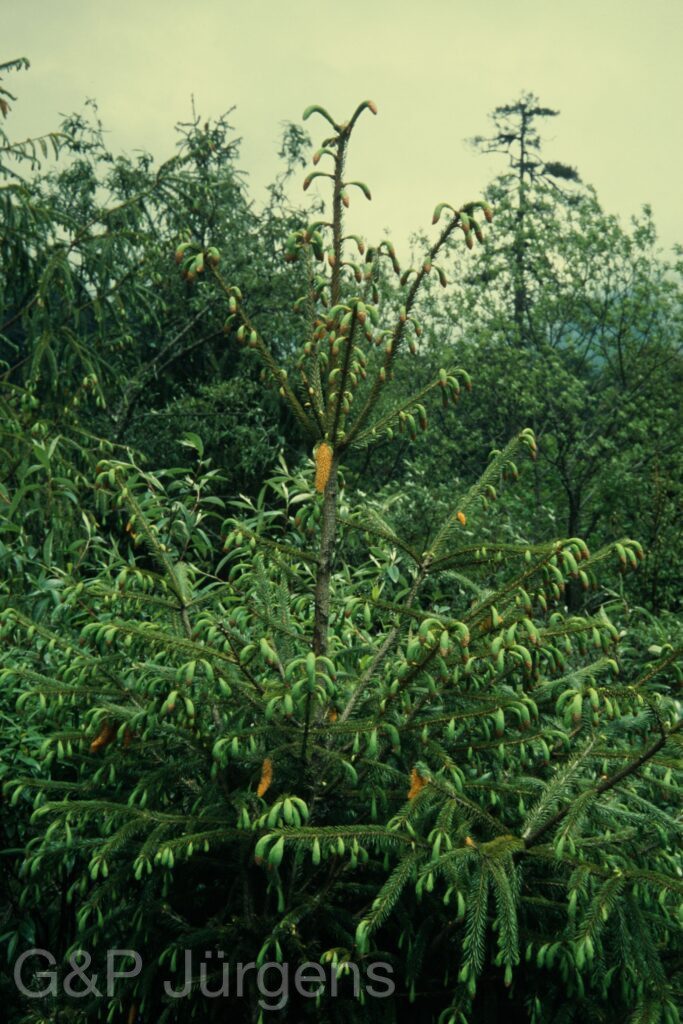
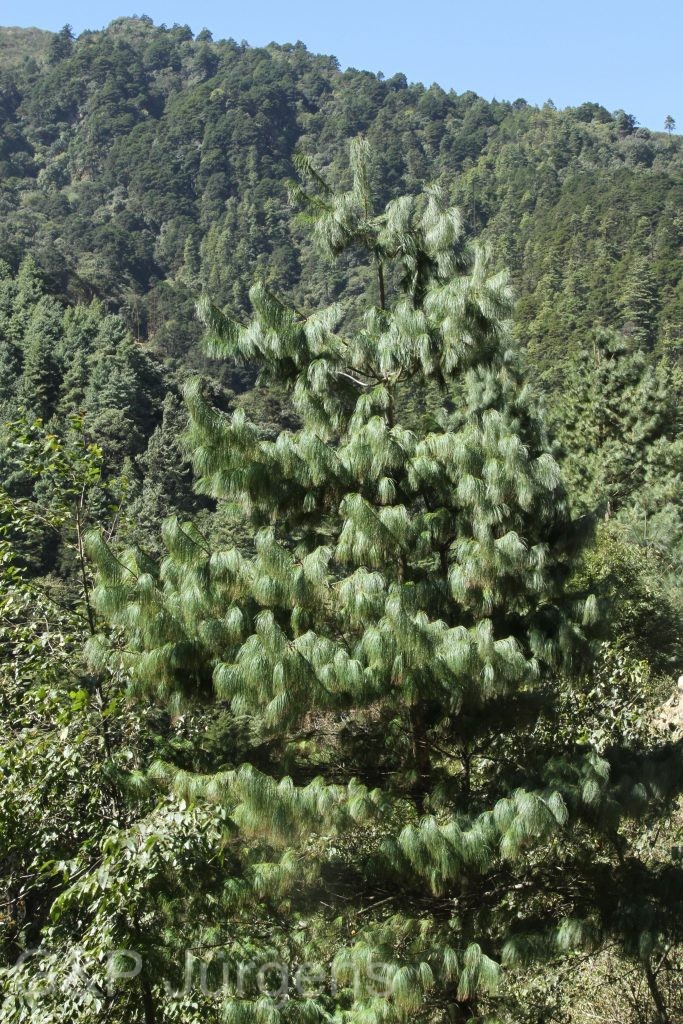
Picea spinulosa, the Sikkim or Himalayan weeping spruce, is a coniferous tree endemic to the eastern Himalaya, native to Bhutan, India (Sikkim), Nepal and adjacent China (Xizang); GBIF lists 291 occurrences, many from cultivated arboretum specimens in Europe and North America. In the wild it forms montane coniferous and mixed forests, often on north-facing slopes and in sheltered valleys, generally between about 2300 and 3700 m. The trees illustrated were photographed at Jakar in Bhutan at 2550 m in October and at Lachung in Sikkim at 3400 m in May, spanning the typical altitudinal range.

It is a tall evergreen tree with a conical to columnar crown and pendulous, weeping branchlets that give the species its distinctive habit. The bark is grey and scaly; the needle leaves are flattened, sharply pointed (spinulose, as the epithet notes), borne singly on small peg-like pulvini and showing two whitish stomatal bands beneath. The seed cones are pendulous, cylindrical, green ripening to pale brown, with thin, rounded, entire scales. Pollen and seed cones mature in a single season, and the winged seeds are dispersed by wind from the opening cones.

Picea spinulosa belongs to Pinaceae and is a regional dominant of the eastern Himalayan temperate conifer forests, frequently associating with Tsuga, Abies and broadleaved genera. Its graceful weeping form has led to its planting in temperate arboreta worldwide, accounting for the wide scatter of cultivated records. The species yields useful softwood timber. Although restricted in natural range, it remains locally common; nonetheless its forests are vulnerable to logging, fire and the cumulative effects of land-use change across the eastern Himalaya.

Author: (Griff.) A.Henry · Sources: POWO (Kew), GBIF, Flora of China, Flora of Bhutan, Conifers of the World, Farjon A Handbook of the World's Conifers

Wedd.

Bhutan2015 180
Bhutan Zhemgang 1000m, October

Description

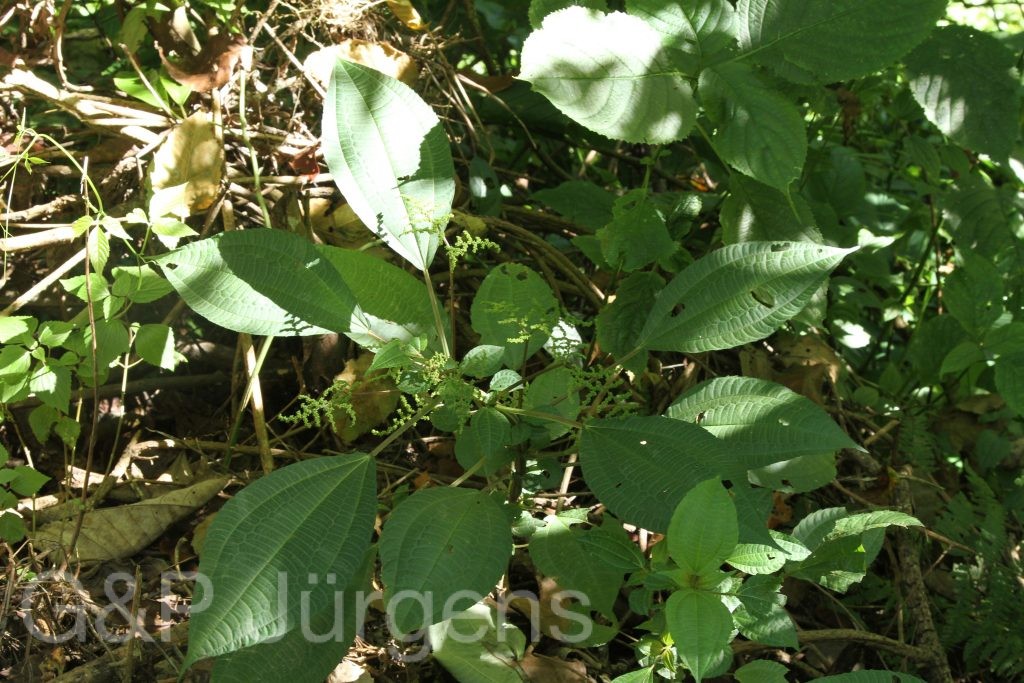
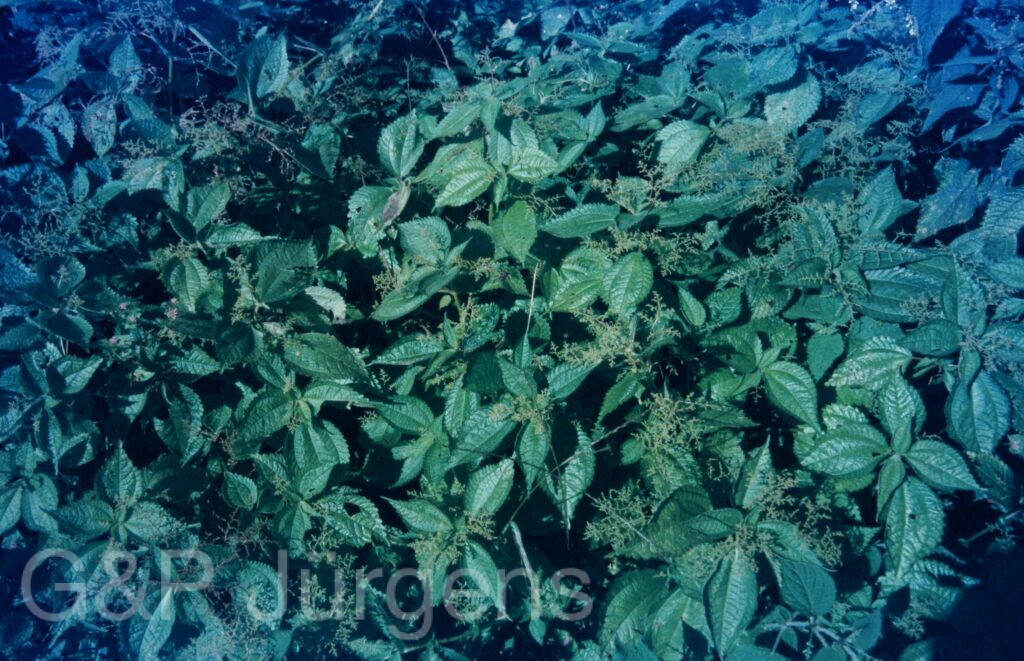
Pilea anisophylla is a perennial herb of the family Urticaceae, widely distributed through the Himalaya and Indo-Malayan region. GBIF records place it in China, Nepal, India, Bhutan, Bangladesh, Myanmar, Thailand and Indonesia, indicating a broad subtropical to warm-temperate range. It is a plant of moist, shaded habitats, growing on damp rocks, mossy boulders, stream banks, forest floors and shaded walls in evergreen and semi-evergreen broad-leaved forest, generally from low elevations up to about 2,500 m. The specimen illustrated from Zhemgang in central Bhutan at roughly 1,000 m in October typifies the humid mid-montane forest where the genus flourishes.

The plant is a soft, fleshy, often somewhat succulent herb with terete, frequently translucent stems that may root at the lower nodes. As the epithet indicates, the paired leaves of each node are strongly anisophyllous, one of the pair being markedly larger than the other; the blades are ovate to elliptic, with a toothed or crenate-serrate margin, three-veined from the base, and dotted with the linear cystoliths characteristic of the family. Stipules are present at the nodes. The flowers are minute, greenish and unisexual, borne in small axillary cymose clusters; like other Urticaceae the staminate flowers have explosively dehiscent stamens that scatter pollen, and the inconspicuous pistillate flowers develop into small, compressed achenes.

Pilea is the largest genus of the nettle family and is taxonomically difficult, with many species separated on subtle vegetative and achene characters; the conspicuous leaf inequality of P. anisophylla is a useful field character. Lacking stinging hairs, the plant is harmless to handle, and as a shade- and moisture-loving understorey herb it is a minor but consistent component of Himalayan forest ground flora. It is not regarded as threatened, its wide range and tolerance of disturbed shaded sites buffering it against habitat change.

Author: Wedd. · Sources: POWO (Kew), GBIF, Flora of China Vol. 5, Flora of Bhutan Vol. 1, Flora of Nepal, Friis: Urticaceae of the Himalaya

Wedd.

Sikkim2011 6
Bhutan Tista-valley 1900m, October

Description

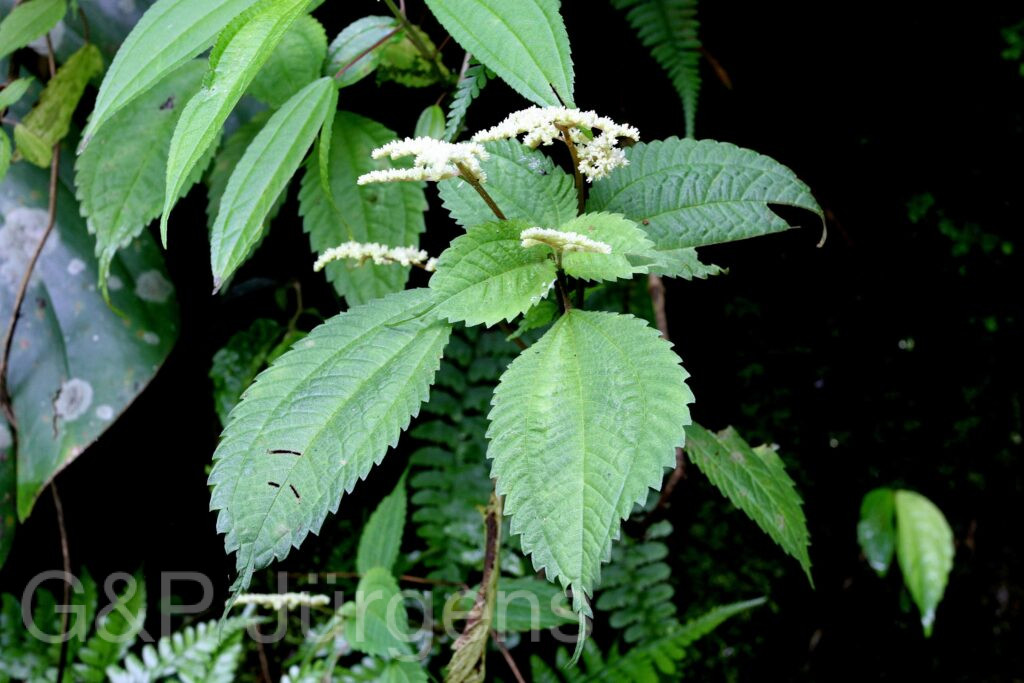
Pilea insolens is a Sino-Himalayan herbaceous species distributed from central Nepal through Sikkim, Bhutan, and northeast India (Darjeeling, Arunachal Pradesh) to Bangladesh, Myanmar, southern China, Japan, and Indonesia. GBIF records 94 occurrences across this range. The species inhabits damp, shaded habitats in subtropical and warm-temperate forests at elevations of 800–2,400 m, where it colonises moist rocks, stream banks, tree bases, and old walls in areas of high humidity. It is most abundant in the eastern Himalayan valleys that receive heavy monsoon precipitation.
Pilea insolens is a succulent, erect to ascending, monoecious perennial herb, 15–40 cm tall. Stems are fleshy, translucent, glabrous, and often reddish-brown at the base. Leaves are opposite, markedly anisophyllous — a characteristic feature, with the larger leaf of each pair broadly ovate to suborbicular, 3–8 cm long, and the smaller leaf often reduced to a stipule-like scale or small blade less than 1 cm. The larger leaf surface is dark green, often with a cystolith-dotted texture visible as pale streaks, with crenate to serrate margins and three prominent basal veins. Stipules are small, membranous, and soon deciduous. Male and female flowers are borne in separate axillary cymes on the same plant; the male flowers are minute with four perianth segments, while the female flowers are even smaller, with an achene enclosed by persistent perianth lobes.
The photographed specimen from the Tista valley in Bhutan at 1,900 m in October represents a typical occurrence in the humid, deeply incised river valleys of the eastern Himalayas. Pilea insolens is distinguished from other Himalayan congeners by its pronounced leaf anisophylly combined with the broadly ovate, crenate larger leaf. The genus Pilea is enormous, with over 700 species globally, and the eastern Himalayan region is a centre of diversity with numerous narrowly distributed endemics. The species' extension from the Himalayas into Japan and Indonesia reflects a shared subtropical element across the monsoon-influenced forests of East and Southeast Asia. Its reliance on humid, undisturbed forest microsites makes it sensitive to deforestation and stream-channel modification.

Author: Wedd. · Sources: POWO (Kew), GBIF, Flora of China Vol. 5, Flora of Bhutan Vol. 1, Grierson & Long (1983), Chen (1982) — Revision of Chinese Pilea

Wedd. ex. Blume

Garw 2005 220 ergebnis ergebnis
India Garhwal Simkarok 2700m, September

Description

Pilea umbrosa is a shade-loving herb of moist montane forests across the Himalaya and into south-east Asia, recorded from Nepal, India, China, Pakistan, Bhutan and Vietnam. The roughly 307 georeferenced collections trace the temperate forest belt from the western Himalaya eastward. As its epithet (umbrosa, "of shady places") implies, it occupies damp, humus-rich, deeply shaded sites: forest floors, rock crevices, mossy banks and the margins of streams beneath broadleaved and mixed canopy. The photographed material from Garhwal at Simkarok at 2700 m in September is characteristic of its upper-temperate habitat and its late-monsoon fruiting period.

It is a succulent, often fleshy perennial herb with semi-translucent, somewhat brittle stems that may root at the lower nodes. The opposite leaves are markedly anisophyllous, the two of a pair unequal in size, ovate to elliptic, with a toothed (serrate to crenate) margin and a characteristic triple primary venation; linear cystoliths are visible on the surface, a diagnostic feature of the genus. Stipules are present at the nodes. As in most Urticaceae the inflorescences are small, axillary cymes of inconspicuous, unisexual, greenish flowers, the male flowers with reflexed tepals and explosively dehiscent stamens that fling pollen at maturity. The fruit is a minute, compressed achene.

Pilea is one of the largest genera of Urticaceae, predominantly tropical and subtropical, and unusually for the family it lacks stinging hairs, making it harmless to handle. The explosive stamen mechanism enabling wind dispersal of pollen is a hallmark of the family. P. umbrosa is a widespread, locally abundant understorey element with no conservation concern, valued ecologically as ground cover that stabilises soil on shaded forest slopes.

Author: Wedd. ex. Blume · Sources: POWO (Kew), GBIF, Flora of China Vol. 5, Flora of Bhutan Vol. 1, Flora of Pakistan, Friis's Revision of Asian Urticaceae

(Lindl.) Kuntze

Bhutan2012 1144
Bhutan, Trashiyangtse 1780m, October
Bhutan2012 1143
Bhutan, Trashiyangtse 1780m, October

Description

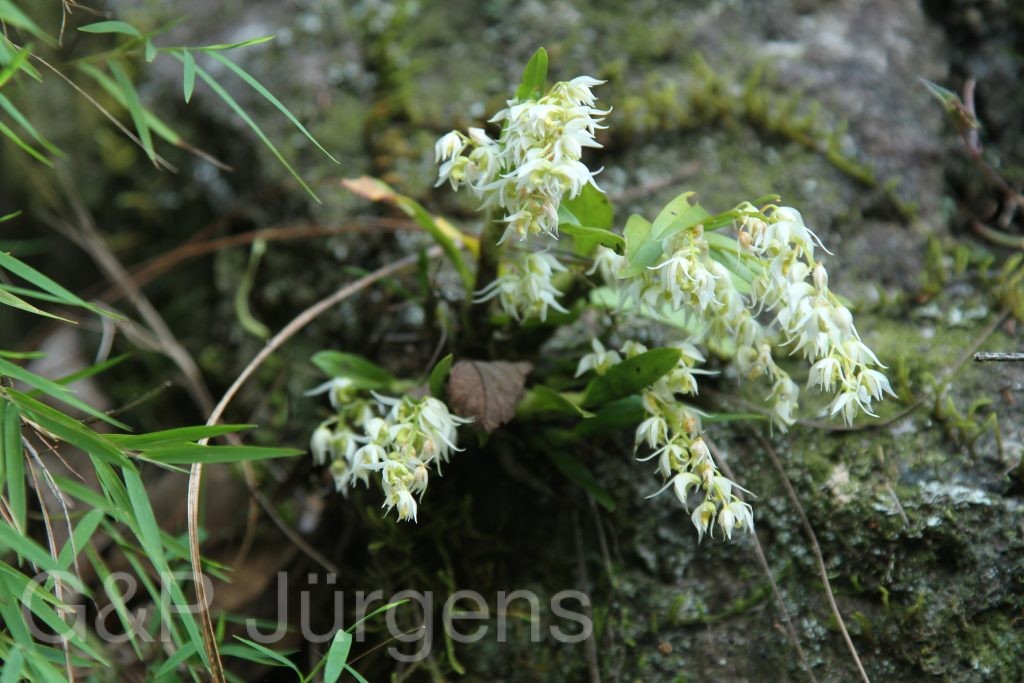
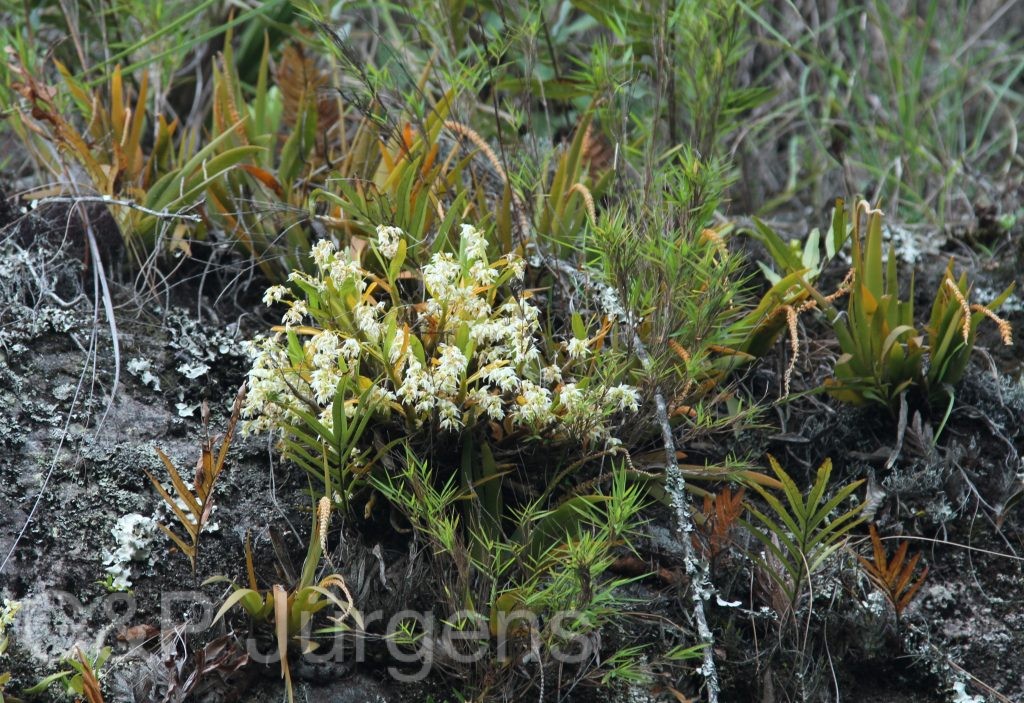
Pinalia acervata is an epiphytic orchid of the warm-temperate and subtropical forests of tropical Asia, ranging widely from China and India through Myanmar, Thailand, Vietnam, Cambodia, Malaysia and Singapore to Bhutan and Nepal, with 114 GBIF records reflecting this broad Indo-Burmese and Sino-Himalayan span. It grows as a humidity-loving epiphyte on mossy trunks and branches in evergreen broadleaved forest, generally at low to moderate elevations. The illustrated plant was found at Trashiyangtse in eastern Bhutan at about 1780 m in October, in the warm, monsoon-fed valleys where epiphytic orchid communities are particularly rich.

The species forms clustered, cylindrical to fusiform pseudobulbs that are densely tufted, each bearing several distichous, lanceolate to oblong leaves toward the apex. The inflorescences are lateral racemes, frequently densely many-flowered and clothed, like the ovaries and outer floral parts, in the rusty or whitish woolly indumentum characteristic of the segregate genus. The small flowers are whitish to pale yellow, with a saccate mentum formed by the lateral sepals against the column foot, and a small three-lobed lip; the fruit is a small ribbed capsule.

The taxon was long placed in the large pantropical genus Eria, as Eria acervata, and the basionym (Lindl.) Kuntze reflects this history; modern phylogenetic work has resolved many former Eria species into smaller, better-circumscribed genera, with this species now treated under Pinalia in tribe Podochileae. As a widespread, adaptable epiphyte it is not considered threatened, though local populations depend on the persistence of humid forest canopy and are diminished by deforestation.

Author: (Lindl.) Kuntze · Sources: POWO (Kew), GBIF, Flora of China, Flora of Bhutan, Genera Orchidacearum (Pridgeon et al.)

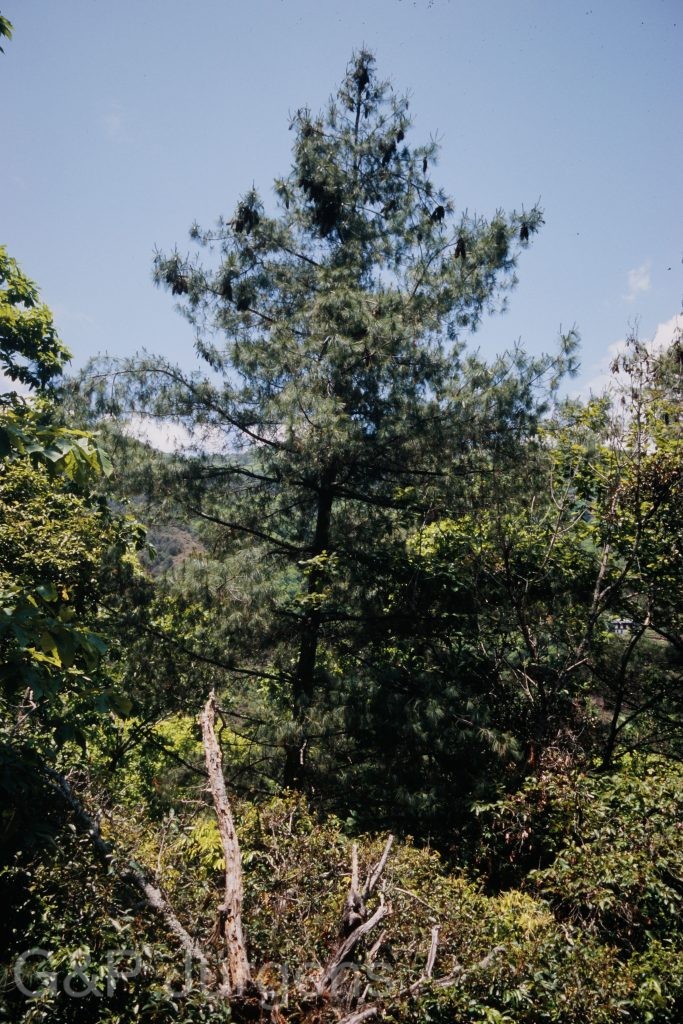
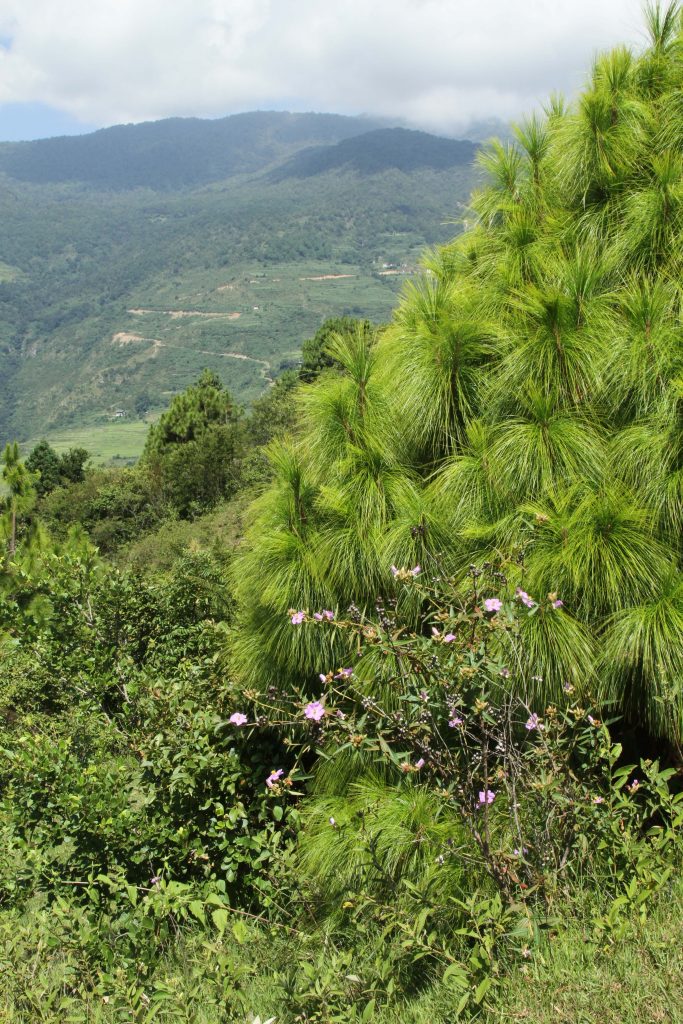
Pinus bhutanica

by G & P Jürgens

Grierson, D.G.Long & C.N.Page

Bhutan2015 468
  Bhutan Trongsa 2300m, October
Bh2008 479 P744
Bhutan, Chongsakha 1800m, May

Description

Pinus bhutanica Grierson, D.G.Long & C.N.Page is a five-needled white pine of the eastern Himalaya, restricted to Bhutan, north-eastern India (Arunachal Pradesh) and adjacent south-eastern Tibet (China); GBIF records about 96 occurrences, the few extralimital points reflecting cultivation or database artefacts. It grows in warm-temperate to subtropical montane forest, often on humid, monsoon-exposed slopes, typically between about 1,700 and 2,400 m. Both photographed stands are Bhutanese – Trongsa at 2,300 m in October and Chongsakha at 1,800 m in May – matching its known occurrence in the wet central and eastern Bhutanese hills.

It is an evergreen coniferous tree to 25 m or more, with spreading branches and a somewhat open crown. The needles are borne in fascicles of five, and are notably long, slender and pendulous, drooping gracefully and distinguishing it from the related P. wallichiana. The species is monoecious, with small pollen cones clustered at the base of new shoots and erect young seed cones that mature in the second year. The mature cone is large, cylindrical and resinous, with thin woody scales; the seeds are winged for wind dispersal, borne beneath the cone scales.

Pinus bhutanica was described as recently as 1980 and belongs to subgenus Strobus (the soft or white pines), being closely allied to the widespread Himalayan blue pine P. wallichiana, from which it differs chiefly in its longer, conspicuously drooping needles and more pronounced resin glands. Its narrow eastern Himalayan range makes it of biogeographic interest as a regional endemic of the wetter Bhutan-Arunachal sector; it is assessed by IUCN as Least Concern owing to stable populations within extensive forest.

Author: Grierson, D.G.Long & C.N.Page · Sources: POWO (Kew), GBIF, Flora of Bhutan, Flora of China, IUCN Red List of Threatened Species, Farjon Handbook of the World's Conifers, Grierson Long & Page protologue of Pinus bhutanica

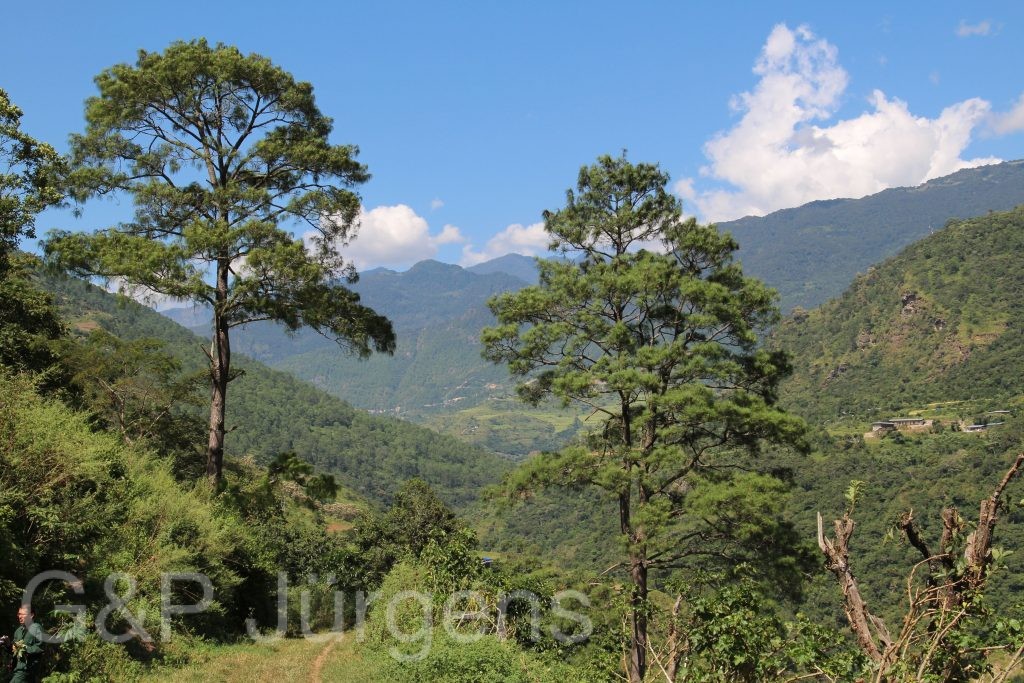
Sarg.

Bhutan2012 531
Bhutan Wangdi, Phodrang 2400m, September
Bhutan2015 312
Bhutan, Trongsa 2100m, October

Description

Pinus roxburghii, the chir or longleaf Himalayan pine, is the dominant conifer of the dry outer ranges and inner valleys of the Himalaya, native across India, Nepal, Bhutan, Pakistan, Afghanistan and China, and widely planted elsewhere, as reflected by occurrence records from South Africa, the United States, New Zealand and Europe. It forms extensive open forests on warm, sun-exposed slopes, ridges and rain-shadowed valleys, characteristically between about 500 and 2300 m. The trees photographed near Wangdi Phodrang at 2400 m and Trongsa at 2100 m in Bhutan illustrate its presence in the dry inner Himalayan valleys, where it forms the lower montane pine belt below the broad-leaved and fir zones.

It is a large evergreen tree with a tall, often clear bole and a rounded to spreading crown, the thick bark deeply fissured into reddish-brown plates that confer fire resistance. The needles are borne in fascicles of three, long, slender and pendulous, light green and finely serrulate, with a persistent basal sheath. It is monoecious: the male strobili cluster at the base of new shoots, while the woody seed cones are large, ovoid-conical and hard, the cone scales bearing a stout, recurved umbo. The winged seeds are released at maturity and dispersed by wind.

Pinus roxburghii belongs to the hard pines (subgenus Pinus) and is the characteristic fire-adapted, drought-tolerant pioneer of the Himalayan subtropical pine forest, regenerating vigorously after burning and forming nearly pure stands. It is economically important as a source of resin (oleoresin tapped for turpentine and rosin), construction timber and fuelwood. Though not threatened given its vast range, its needle litter and flammability strongly shape fire regimes and understorey composition across the lower Himalaya.

Author: Sarg. · Sources: POWO (Kew), GBIF, Flora of China, Conifers of the Himalaya, Annotated Checklist of the Flowering Plants of Nepal, Farjon's A Handbook of the World's Conifers

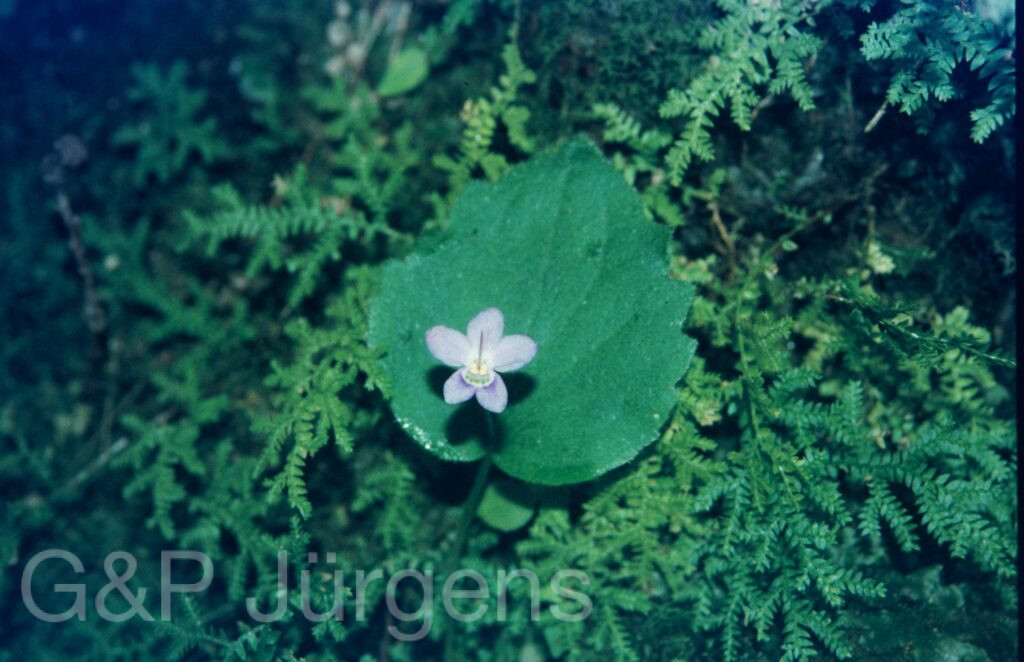
Wall.

Garw 2005 222 ergebnis ergebnis
India Garhwal Simkarok 2700m, September

Description

Platystemma violoides is a small Himalayan herb of the Gesneriaceae, restricted to the western and central Himalaya in Nepal, India, Bhutan and adjacent China, with around 179 recorded occurrences across this comparatively narrow range. It is a chasmophyte of moist, shaded rock faces, damp cliffs and mossy boulders, often in spray zones and on dripping banks within temperate forest, flowering toward the close of the monsoon. In the Indian Garhwal Himalaya it occupies the middle montane belt, as documented by the collection at Simkarok at about 2700 m in September, when the plants are in flower on rain-soaked rock.

The plant is a delicate annual or short-lived perennial that develops a single, large, suborbicular to broadly ovate leaf, cordate at the base, softly hairy and shallowly toothed, pressed against the rock surface in the manner of a monophyllous gesneriad. From the base of the leaf arises a slender scape bearing one or a few showy flowers; the corolla is broadly campanulate to rotate and violet to purplish-blue, recalling a violet and giving the epithet violoides, with a short tube, spreading lobes and two to four stamens. The fruit is a small capsule releasing numerous minute seeds.

The family in this record is given as Leptoboeinae, the subtribe of Old World Gesneriaceae to which the monotypic genus Platystemma belongs, alongside Loxostigma, Leptoboea and related rock-dwelling herbs; the species is properly placed in Gesneriaceae. Its single-leaved habit and adaptation to vertical rock microhabitats parallel those of other Himalayan gesneriads such as Corallodiscus and the African Streptocarpus. Confined to specialised cliff niches, P. violoides is naturally local though not currently regarded as threatened, its persistence depending on the integrity of shaded, perennially moist rock habitats.

Author: Wall. · Sources: POWO (Kew), GBIF, Flora of China Vol. 18, Flora of Bhutan Vol. 2, Flora of Nepal, Weber & Burtt classification of Gesneriaceae