
Sarg.
Description
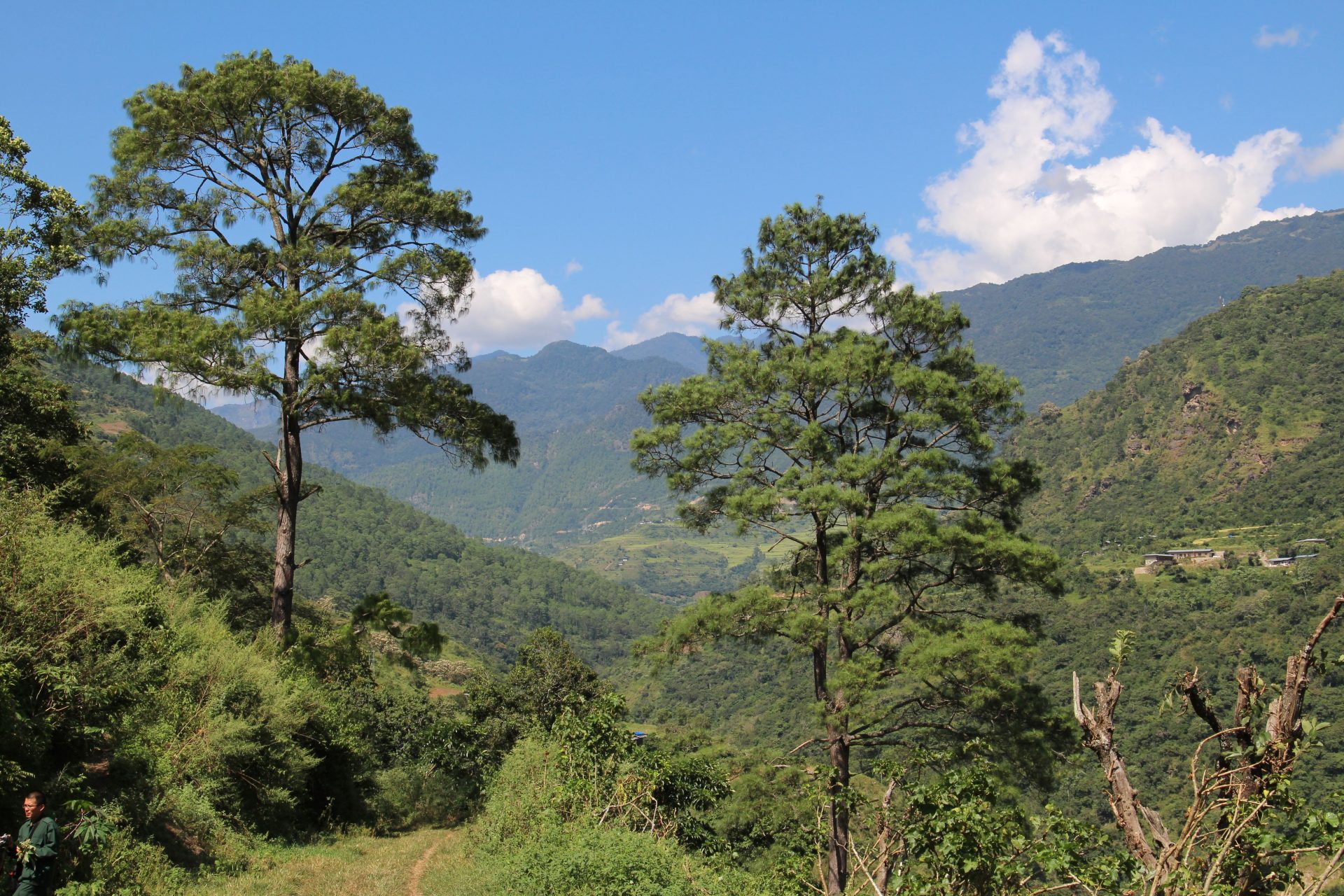
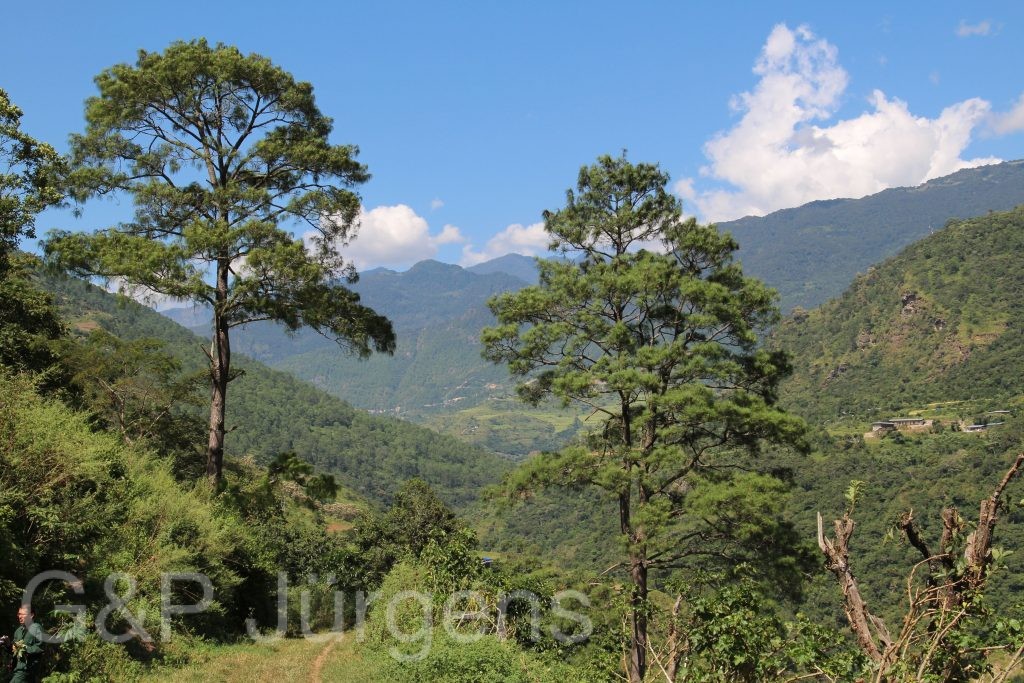
Pinus roxburghii, the chir or longleaf Himalayan pine, is the dominant conifer of the dry outer ranges and inner valleys of the Himalaya, native across India, Nepal, Bhutan, Pakistan, Afghanistan and China, and widely planted elsewhere, as reflected by occurrence records from South Africa, the United States, New Zealand and Europe. It forms extensive open forests on warm, sun-exposed slopes, ridges and rain-shadowed valleys, characteristically between about 500 and 2300 m. The trees photographed near Wangdi Phodrang at 2400 m and Trongsa at 2100 m in Bhutan illustrate its presence in the dry inner Himalayan valleys, where it forms the lower montane pine belt below the broad-leaved and fir zones.
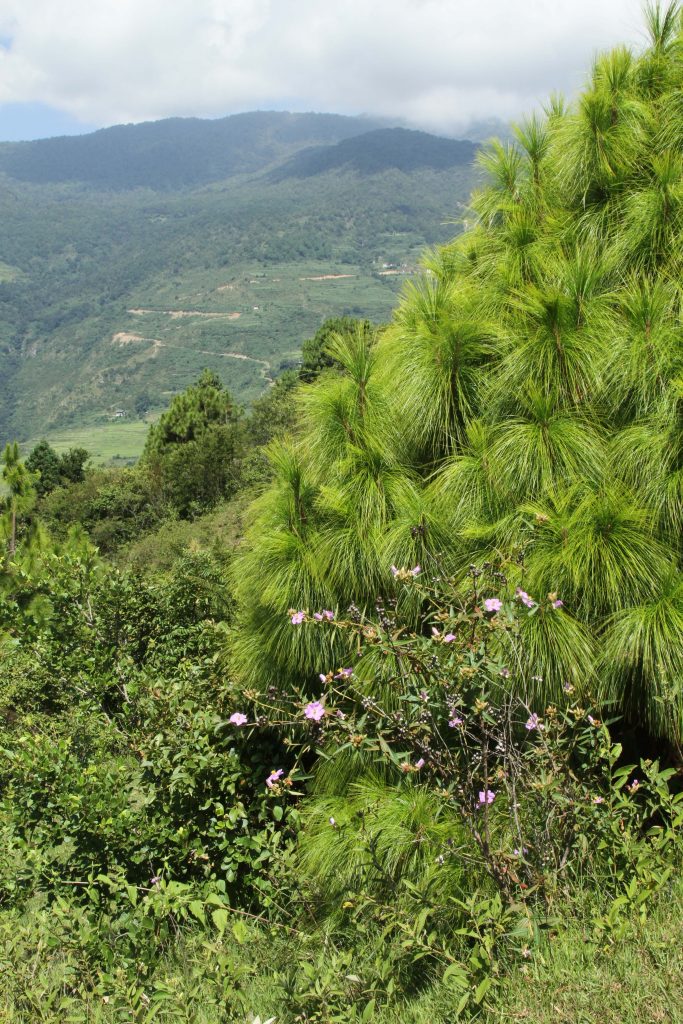
It is a large evergreen tree with a tall, often clear bole and a rounded to spreading crown, the thick bark deeply fissured into reddish-brown plates that confer fire resistance. The needles are borne in fascicles of three, long, slender and pendulous, light green and finely serrulate, with a persistent basal sheath. It is monoecious: the male strobili cluster at the base of new shoots, while the woody seed cones are large, ovoid-conical and hard, the cone scales bearing a stout, recurved umbo. The winged seeds are released at maturity and dispersed by wind.
Pinus roxburghii belongs to the hard pines (subgenus Pinus) and is the characteristic fire-adapted, drought-tolerant pioneer of the Himalayan subtropical pine forest, regenerating vigorously after burning and forming nearly pure stands. It is economically important as a source of resin (oleoresin tapped for turpentine and rosin), construction timber and fuelwood. Though not threatened given its vast range, its needle litter and flammability strongly shape fire regimes and understorey composition across the lower Himalaya.
Author: Sarg. · Sources: POWO (Kew), GBIF, Flora of China, Conifers of the Himalaya, Annotated Checklist of the Flowering Plants of Nepal, Farjon's A Handbook of the World's Conifers