
(Wall.) Boiss.
Description
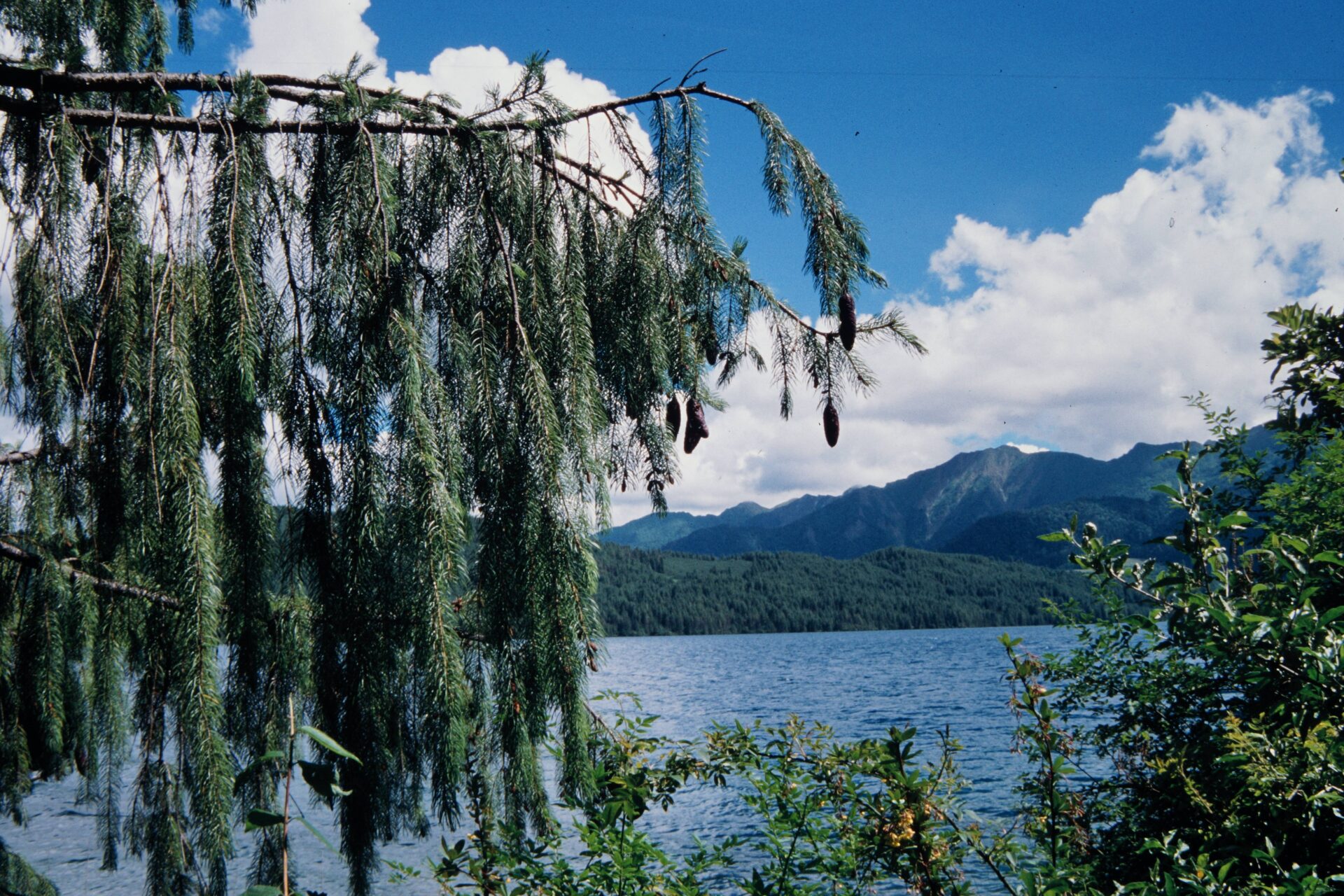
Picea smithiana, the West Himalayan or morinda spruce, is a large coniferous tree native to the western and central Himalaya, with a natural range from Afghanistan through northern Pakistan and India to western Nepal and adjacent Tibet (China). The numerous GBIF records outside this core area (United Kingdom, United States, New Zealand, Spain, Italy, Germany, Belgium and others) reflect its long history in arboreta and forestry cultivation rather than natural occurrence. In the wild it forms montane and subalpine coniferous forest, often mixed with Cedrus deodara, Abies pindrow and Pinus wallichiana, typically between about 2,000 and 3,600 m. The plant photographed at Lara Lake in West Nepal at 3,000 m in June lies near the south-eastern limit of its distribution.
The tree is evergreen, reaching 40 m or more, with a straight trunk and conspicuously pendulous branchlets that give it a weeping habit. The leaves are needle-like, quadrangular in cross-section, dark green, among the longest of any spruce at up to 4 cm, borne radially on raised peg-like pulvini. It is monoecious; the pollen cones are small and reddish, while the seed cones are pendulous, cylindrical, 12-18 cm long, green ripening to glossy brown, with smooth-margined, rounded scales. The winged seeds are shed in autumn.
Picea smithiana is the only spruce native to the western Himalaya and is valued for its soft, light timber and as an ornamental. It is assessed as Least Concern globally, though local populations are reduced by logging and grazing pressure. Its weeping, long-needled morphology distinguishes it readily from the eastern Himalayan Picea spinulosa, with which it forms a vicariant pair across the genus's Himalayan distribution.
Author: (Wall.) Boiss. · Sources: POWO (Kew), Flora of China Vol. 4, Flora of Pakistan, GBIF, Farjon: A Handbook of the World's Conifers