
Wall.
Description
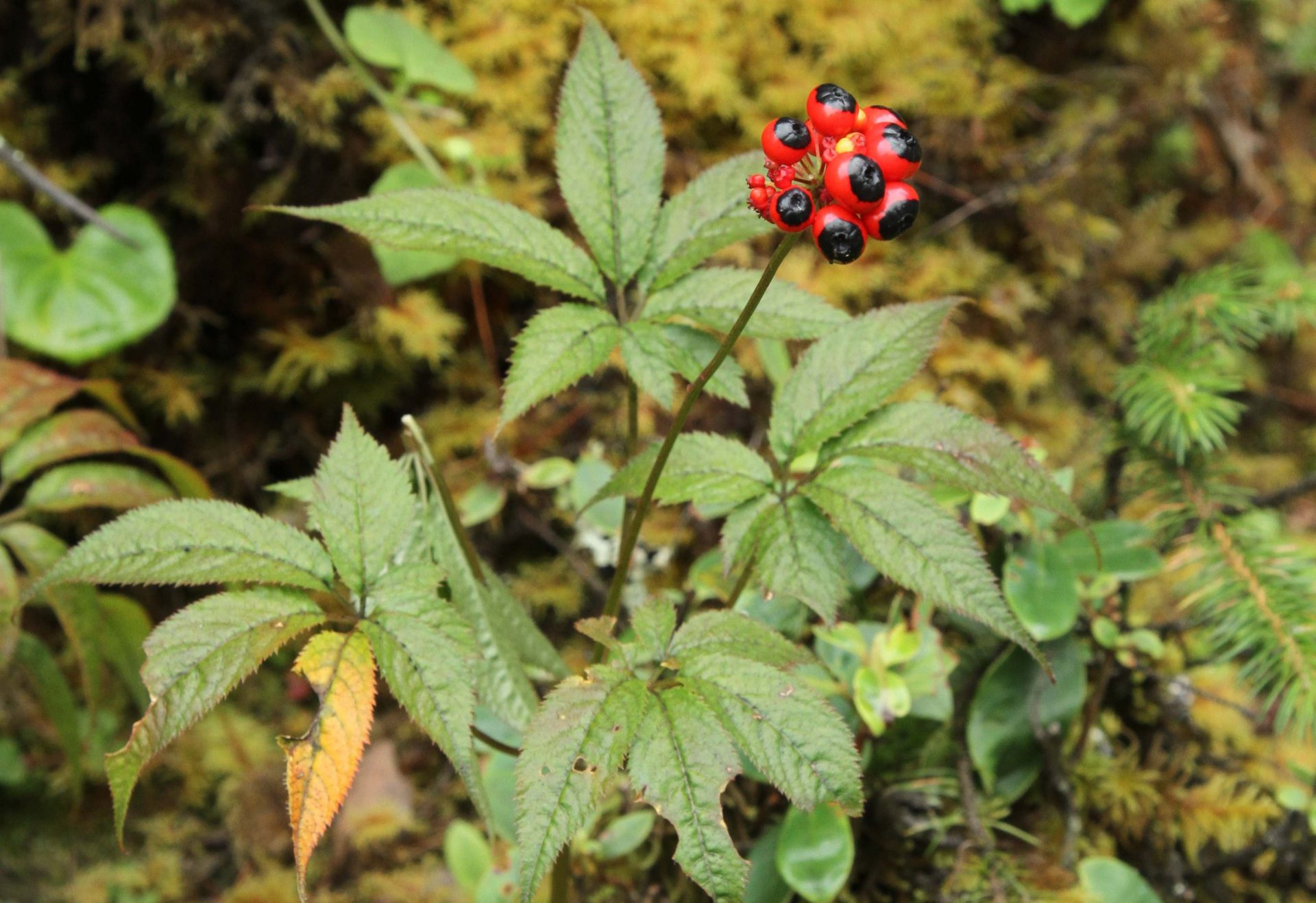
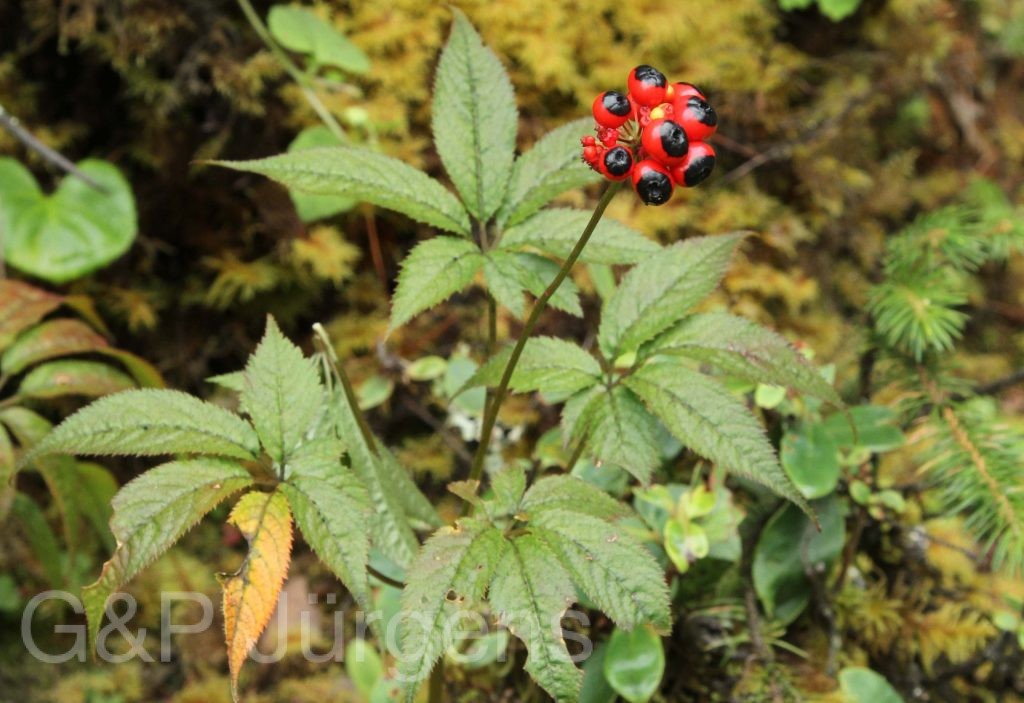
Panax pseudoginseng is a rhizomatous perennial herb of the eastern Himalaya and Sino-Himalayan region, distributed across Nepal, India, Bhutan, China and Myanmar; its c. 255 georeferenced records define a temperate to subalpine forest range (records from Japan, North America, Russia and Europe largely reflect cultivation and study collections). It grows in shaded, humus-rich understorey of broadleaf and mixed forest, on mossy banks and in damp ravines, typically between 2500 and 4000 m. The plant photographed at Shele-La in Bhutan at 3500 m in September grows in the cool, moist upper-temperate to subalpine forest where the genus reaches its Himalayan optimum.
It is a slender erect herb 30-70 cm tall arising from a knotted, often elongate fleshy rhizome bearing prominent stem scars. A single whorl of palmately compound leaves crowns the stem, each leaf with three to five serrate, obovate to oblong leaflets, the terminal ones largest. From the centre rises a long peduncle bearing a solitary terminal umbel of small greenish flowers, each with five petals, five stamens and an inferior two-carpellate ovary with two recurved styles. The fruit is a small, fleshy red drupe, sometimes black-tipped, containing two flattened seeds.
Described by Wallich (as Wall.), P. pseudoginseng is the Himalayan representative of Panax, the ginseng genus of the Araliaceae, and a close relative of the medicinally renowned P. ginseng and P. notoginseng. Its rhizome contains ginsenosides and is harvested in traditional Himalayan and Chinese medicine, exposing wild populations to over-collection. The brightly coloured drupes are bird-dispersed. Because of its slow growth, narrow forest habitat and medicinal value, the species is regarded as conservation-sensitive and locally depleted by harvesting.
Author: Wall. · Sources: POWO (Kew), GBIF, Flora of Bhutan, Flora of China, Flora of Nepal, Wen's revision of Panax (Araliaceae)