Tag:

Bhutan

Flowers of Bhutan — 1326 plant species documented across the Bhutanese Himalaya, from dense broadleaf and conifer forests to alpine scrub and meadows. Bhutan’s largely intact wilderness shelters an exceptional diversity of orchids, rhododendrons, primulas and Himalayan poppies, many of them regional endemics. Each species page includes a botanical description, distribution, habitat and flowering time, with the original photograph and its recorded altitude and locality.

A.DC.

Nepal 2001 232 ergebnis ergebnis
Nepal (Gorkha) Tullikot 1800m, May

Description

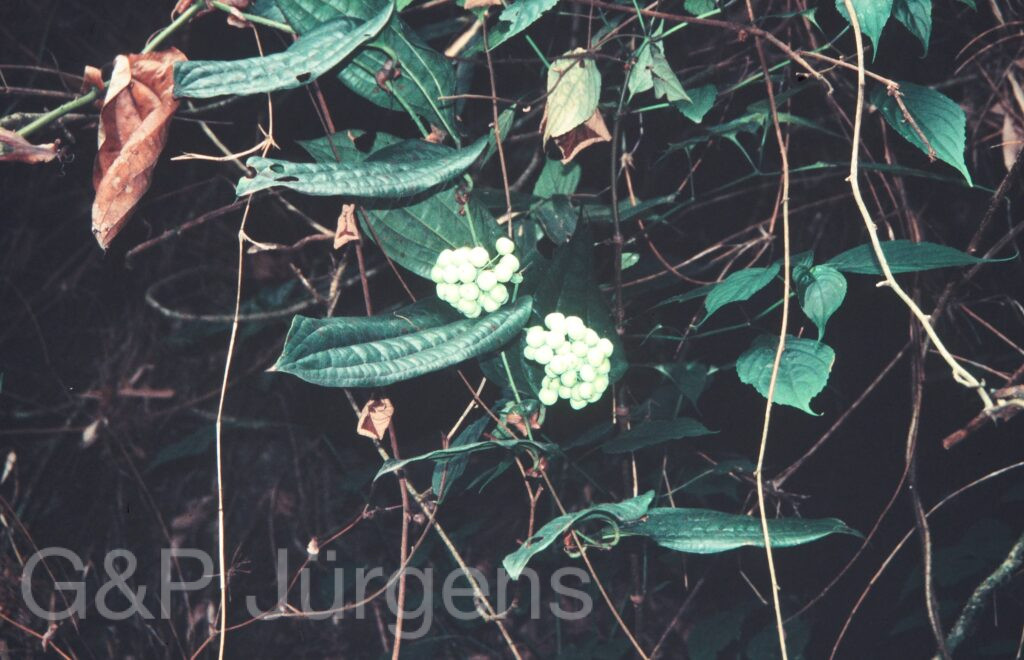
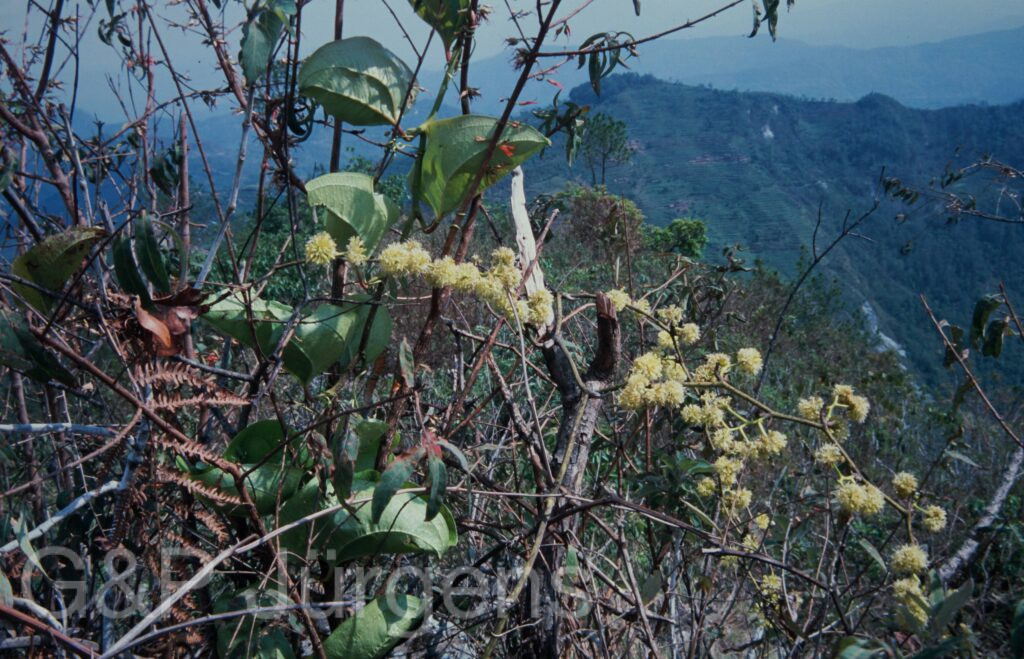
Smilax orthoptera is a climbing monocot of the eastern and central Himalaya, recorded by GBIF from India, Nepal and Bhutan in a modest dataset of about 35 occurrences, an accepted species of the warm-temperate hill forests. It scrambles through the understorey and along forest margins, thickets and shrubby slopes of the lower and middle hill zone, broadly between roughly 1500 and 2500 m, where moist, monsoon-fed broad-leaved forest provides the supports its tendrils require. The image from Tullikot in the Gorkha district of Nepal at 1800 m, in May, places the plant in this mid-hill belt at the start of the growing season, climbing over neighbouring vegetation in dappled forest shade.

It is a woody to subwoody climber arising from a tough, knotty rhizome, with slender, angular to ridged, often prickly stems. The alternate leaves are stalked and bear at the base of the petiole a pair of tendrils derived from stipular appendages, by which the plant climbs; the blades are ovate to ovate-lanceolate, leathery, with several prominent curving main veins running from base to apex in the manner characteristic of the genus. The plant is dioecious, the small greenish to yellowish flowers borne in axillary umbels with six tepals and, in staminate flowers, six stamens; female flowers develop into small globose berries containing few seeds, dispersed by birds.

Smilax is a large, mainly tropical and warm-temperate genus and the principal element of the family Smilacaceae, set apart within the monocots by its climbing habit, paired petiolar tendrils and net-veined yet parallel-ribbed leaves. S. orthoptera is one of several Himalayan species distinguished by stem armature, leaf shape and the form of the tendril-bearing petiole. Restricted in range but locally frequent within its forest habitat, it has not been assessed as threatened, although the species depends on the persistence of intact mid-elevation Himalayan forest.

Author: A.DC. · Sources: POWO (Kew), GBIF, Flora of China Vol. 24, Flora of Nepal, Flora of Bhutan Vol. 3, Koyama's monographic studies of Asian Smilax
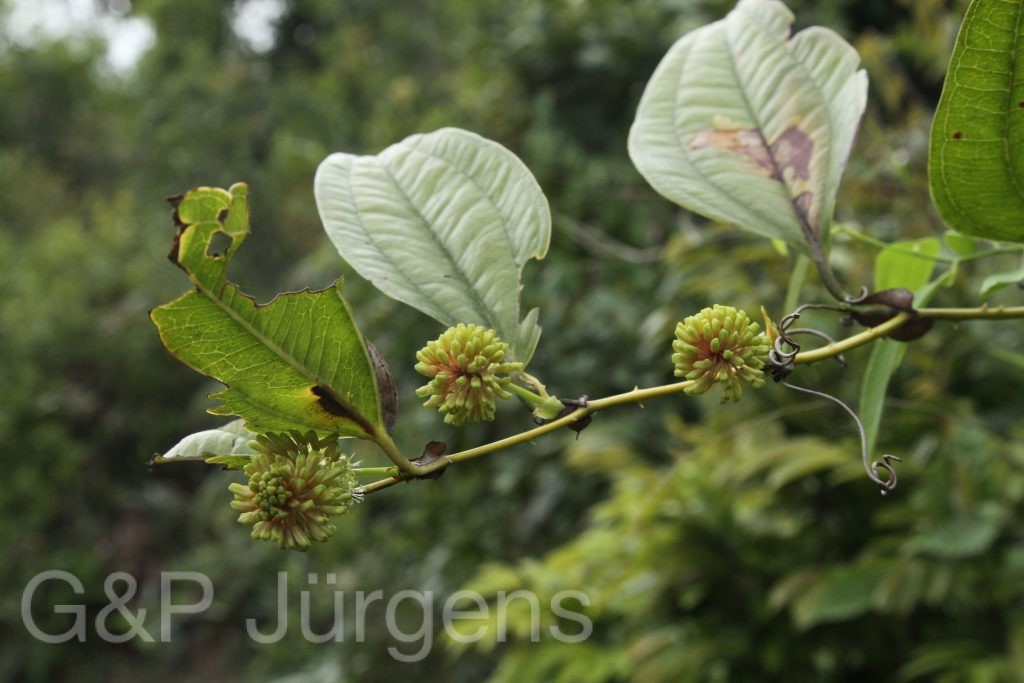
Lour.

Bhutan2014 216
Bhutan Mongar 1920m, May
Bhutan2014 217
Bhutan Mongar 1920m, May

Description

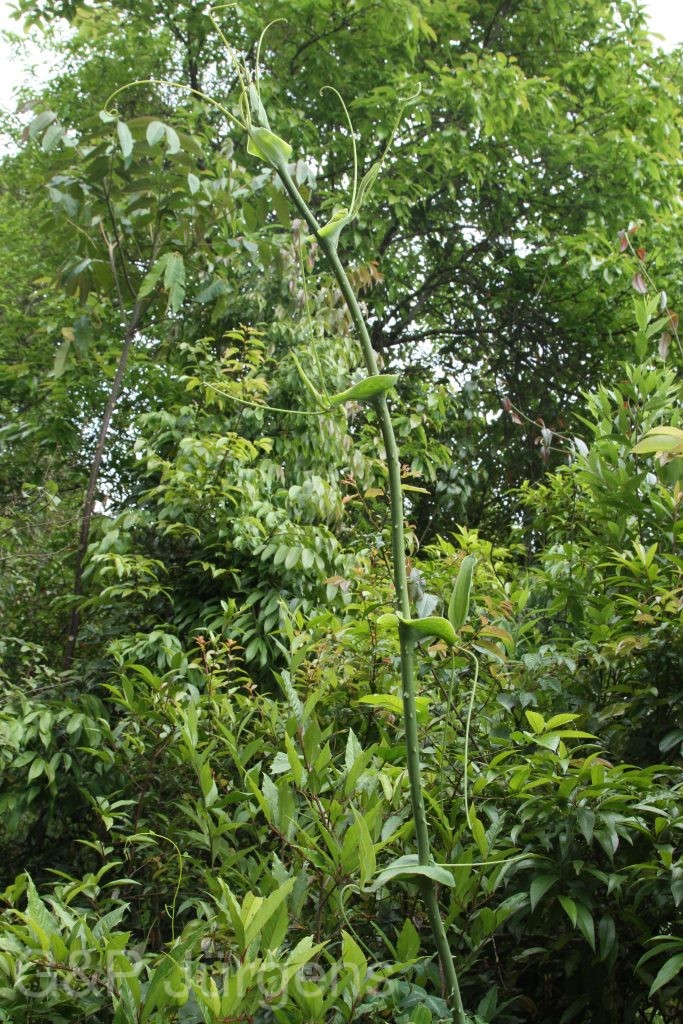
Smilax perfoliata is a robust scrambling climber of the eastern Himalaya, Indo-China and East Asia, ranging from Nepal, Bhutan and north-east India through Myanmar, Thailand, Laos, Cambodia and Vietnam to southern China, Taiwan, Japan, Korea and Sri Lanka, with records also in Indonesia. GBIF holds around 618 occurrences. It is a woody liana of broad-leaved evergreen and semi-evergreen forest, thickets and forest margins, scrambling over shrubs and into the lower canopy at low to middle elevations. The plant from Mongar in eastern Bhutan at 1920 m in May is typical of the temperate to subtropical forest belt it favours.

It is a dioecious vine arising from a thick woody rhizome, the climbing stems and branches armed with scattered prickles. Its leaves are alternate, leathery, broadly ovate to elliptic with several prominent arching main veins; the petiole bears a conspicuous sheathing, clasping wing (whence perfoliata) from which spring a pair of slender tendrils that anchor the climber. The small greenish-yellow flowers are unisexual in axillary umbels, the perianth of six free tepals, staminate flowers with six stamens, pistillate with a superior trilocular ovary. The fruit is a small globose berry ripening dark blue-black, with one to few bird-dispersed seeds.

Smilax, the sole large genus of Smilacaceae, is set apart among monocots by its net-veined, petiole-tendril-bearing leaves and woody climbing habit. S. perfoliata belongs to a complex of broad-leaved Asian climbers delimited by petiole-sheath morphology and leaf venation. Several species of the genus yield sarsaparilla-type saponins and have medicinal uses, the young shoots sometimes eaten. Widespread and adaptable to disturbed forest, S. perfoliata is of no conservation concern.

Author: Lour. · Sources: POWO (Kew), GBIF, Flora of China Vol. 24, Flora of Bhutan Vol. 3, Annotated Checklist of the Flowering Plants of Nepal, Koyama revision of Asiatic Smilax

Kunth

Sikkim 2006 278 ergebnis
Sikkim India Tolung-Chu 1530m, May

Description

Smilax wallichii is a woody, scrambling climber of the Smilacaceae, distributed through the eastern Himalaya. GBIF records are sparse (13 occurrences) and confined to Nepal, India and Bhutan, indicating a comparatively restricted, undercollected range. The species is a plant of subtropical to lower temperate broadleaved forest, where it climbs through trees and shrubs at forest margins, along streams and on ravine sides. The collection from the Tolung-Chu valley in Sikkim at 1,530 m in May exemplifies its occurrence in the humid, evergreen-forested foothill and lower montane belt of the region.

The plant develops from a stout, woody rhizome and produces tough, climbing stems that are often armed with scattered prickles. As in all Smilax, the leaves are alternate, simple, with a characteristic suite of curved-convergent main veins and a reticulate venation, the petiole bearing a pair of tendrils derived from stipular appendages that grip surrounding vegetation. The plants are dioecious; the small, greenish, six-tepalled flowers are borne in axillary umbels, the staminate flowers with six stamens and the pistillate flowers with a three-locular ovary. The fruit is a small, globose berry, ripening dark, containing few seeds.

Smilax is the principal genus of the otherwise small, exclusively climbing family Smilacaceae, distinguished within the monocots by its net-veined leaves, tendrillar petioles and dioecious umbels. Several species are sources of sarsaparilla and are used medicinally, and the rhizomes of Himalayan taxa enter local pharmacopoeias. The limited records of S. wallichii reflect both genuine rarity and under-sampling; as a forest-dependent liana, it is sensitive to the clearance and fragmentation of mid-elevation broadleaved forest.

Author: Kunth · Sources: POWO (Kew), Flora of China Vol. 24, Flora of Bhutan Vol. 3, GBIF, Koyama: Smilacaceae of the Himalaya and Eastern Asia

Solanum betaceum

by GP Jürgens

Cav.

Bhutan2015 313
Bhutan Zhemgang 1650m, October
Bhutan2015 314
Bhutan Zhemgang 1650m, October

Description

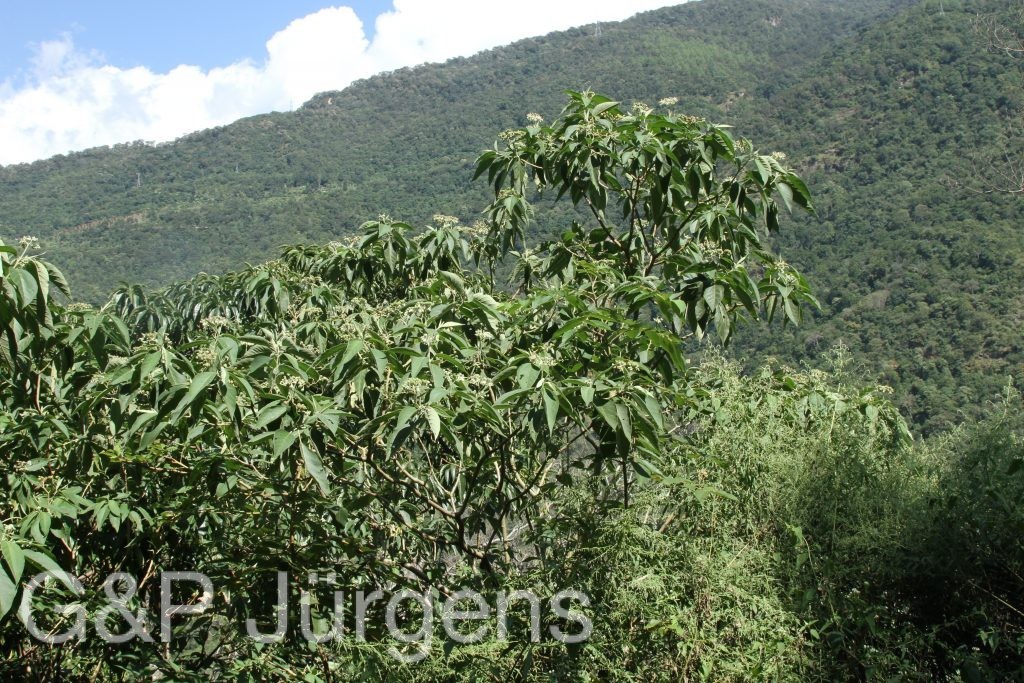
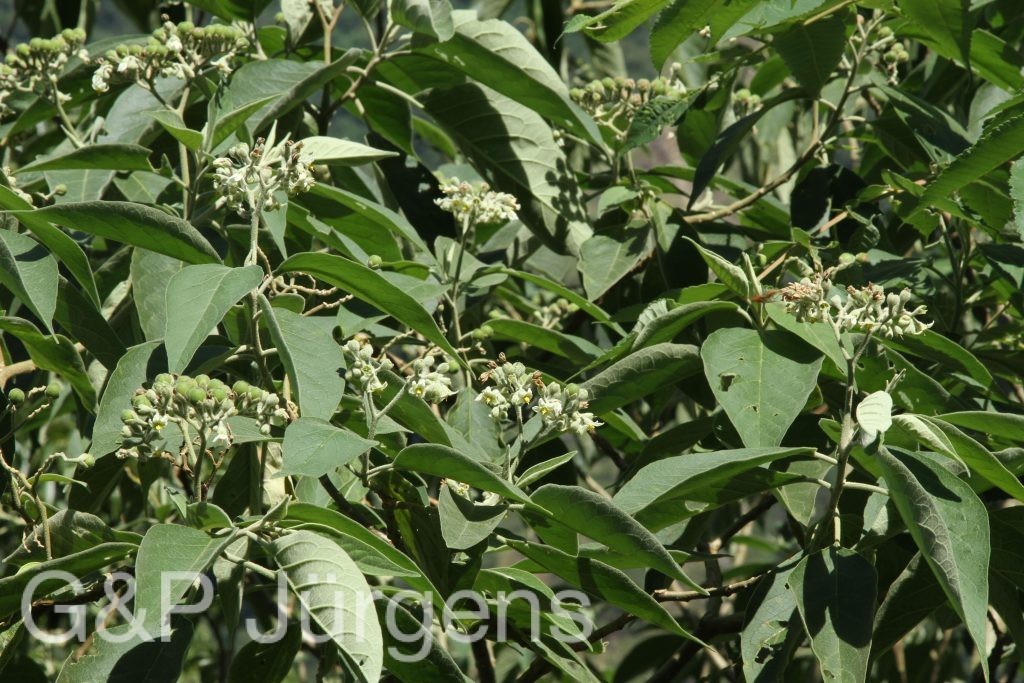
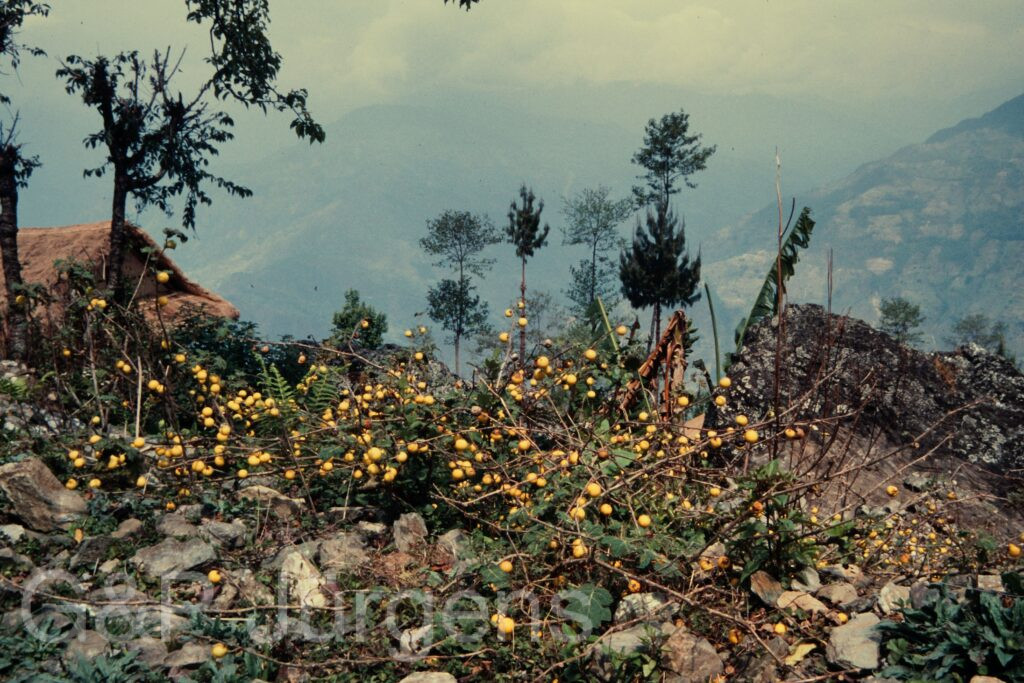
Solanum betaceum Cav. (the tamarillo or tree tomato, long known as Cyphomandra betacea) is a small tree native to the Andean region of South America but now cultivated and naturalised pantropically and in warm-temperate areas; GBIF records (about 4,314 occurrences) span Colombia, Ecuador, Peru, Bolivia, Argentina and Brazil in its native range, together with widespread introductions in Europe, Australasia, southern Africa and South Asia. In the Himalaya it is grown and locally escapes in warm mid-elevation valleys; the photographed plant is from Zhemgang in central Bhutan at about 1,650 m, fruiting in October in cultivation on subtropical hill slopes.

It is a fast-growing, soft-wooded shrub or small tree 2-5 m tall with a brittle, sparingly branched trunk. The leaves are large, alternate, ovate-cordate, softly pubescent and pungently scented, with entire margins and a long petiole. The flowers are borne in lateral cymes and are fragrant, with a rotate to shallowly campanulate pale pink to lilac corolla 1-2 cm across and the connivent yellow anthers typical of Solanum. The fruit is a smooth, egg-shaped berry 4-8 cm long, ripening orange-red to deep purplish, with two locules of small flat seeds embedded in tart, jelly-like pulp.

Molecular phylogenetics has subsumed the former genus Cyphomandra within Solanum, where these arborescent species form a distinct clade pollinated by fragrance-collecting bees. S. betaceum is economically important as the tamarillo, cultivated commercially in New Zealand, the Andes and elsewhere for its vitamin-rich fruit. As a domesticated and widely naturalised crop it is of no conservation concern; in some regions it behaves as a minor environmental weed.

Author: Cav. · Sources: POWO (Kew), GBIF, Flora of China, Solanaceae Source database, Bohs revision of Cyphomandra (Solanum), Flora of Bhutan, Solanaceae treatments in Andean floras

Dunal

Bhutan2015 219
Bhutan Zhemgang 910m, October
Nepal 97 9 P14
Nepal Taplejung 1000m April

Description

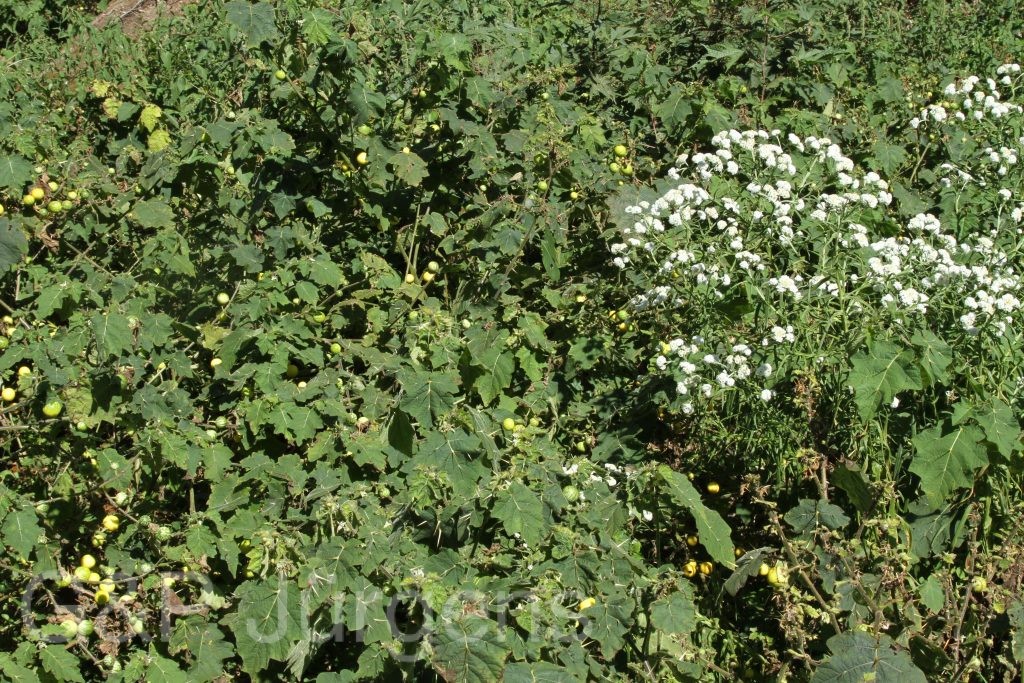
Solanum viarum, the tropical soda apple, is native to subtropical South America, notably Brazil, Argentina, Paraguay and Uruguay, but is now a widespread invasive weed; the GBIF dataset of roughly 32000 records spans the United States, Australia, South Africa, India, China, Vietnam, Thailand, Korea, Mexico and the Himalayan countries Nepal and Bhutan. It colonises pastures, roadsides, field margins, waste ground and disturbed forest edges at low to mid elevations, thriving in open, grazed and ruderal habitats. The illustrated material from Zhemgang in Bhutan at 910 m in October and Taplejung in eastern Nepal at 1000 m in April reflects its establishment in the warm subtropical foothills, where it behaves as an aggressive colonist of disturbed ground.

It is a robust erect prickly perennial herb or subshrub 1–2 m tall, the stems, petioles, leaf veins and calyx armed with stout, broad-based yellowish prickles and clothed in stellate hairs. The leaves are alternate, ovate, deeply lobed and sinuate, prickly on both surfaces along the veins. The inflorescence is a small extra-axillary cyme of white, stellate, five-merous flowers with reflexed petals and a cone of connivent yellow anthers. The fruit is a globose berry about 2–3 cm across, mottled green like a tiny melon when immature and ripening pale yellow, containing numerous flattened seeds embedded in juicy pulp.

Solanum viarum belongs to the spiny Leptostemonum clade of Solanum. Its prolific, animal-dispersed berries, toxic to many vertebrates but readily spread by livestock and wildlife, underlie its notoriety as a noxious weed subject to quarantine and biological control in the United States and elsewhere. In the Himalayan foothills it is a naturalised invader rather than a native element, and its spread is monitored as a threat to pasture and native vegetation.

Author: Dunal · Sources: POWO (Kew), GBIF, Flora of China Vol. 17, Flora of Bhutan Vol. 2, Flora of Nepal, Solanaceae: A Monograph of Solanum (Solanaceae Source)

(Hook.f. & Thomson) Botsch.

BhutanPG2011 204
Bhutan Tsochenchen 3700m, June

Description

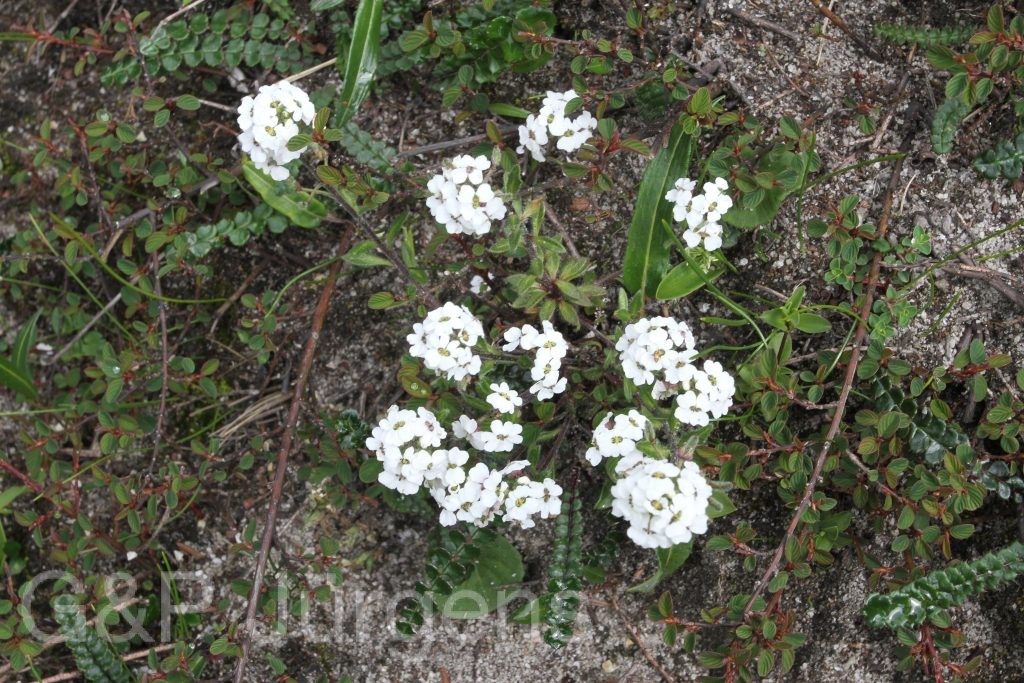
Solms-laubachia platycarpa is a high-alpine crucifer of the eastern Himalaya and the Hengduan-Tibetan region, recorded from China, India and Bhutan, with only about 26 GBIF occurrences reflecting its restricted, hard-to-reach habitat. It is a true cushion-plant of the upper alpine zone, growing among scree, gravel, rock crevices and stony turf, typically above about 3500 m and often to well over 4000 m. The plant shown from Tsochenchen in Bhutan at 3700 m, flowering in June, occupies the exposed, frost-prone substrates characteristic of the genus.

It is a low, densely tufted perennial herb with a stout, branched woody caudex clothed in the persistent petiole-bases of former leaves and topped by rosettes of small, entire, fleshy, oblanceolate to spathulate leaves. The flowers are borne singly or few on short scapes scarcely exceeding the leaf cushions and have four white to pale lilac or purplish petals in the typical cruciferous arrangement. The diagnostic fruit is a flattened, broadly elliptic to orbicular, latiseptate silicula with a persistent style and a few large seeds, the broad flat silique giving the epithet platycarpa.

Solms-laubachia (combined by Botschantzev from Hooker & Thomson's basionym) is a small genus centred on the Qinghai-Tibetan Plateau, allied to Desideria and the alpine Crucifereae; molecular work has clarified its boundaries within tribe Euclidieae. Restricted to fragile high-alpine substrates, such narrowly distributed cushion crucifers are potentially vulnerable to climate-driven habitat contraction and merit monitoring.

Author: (Hook.f. & Thomson) Botsch. · Sources: POWO (Kew), GBIF, Flora of Bhutan, Flora of China, Yue et al. systematics of Solms-laubachia

C.B.Clarke

Bhutan2015 138
Bhutan Galephug 600m, October
Bhutan2015 142
Bhutan Galephug 600m, October

Description

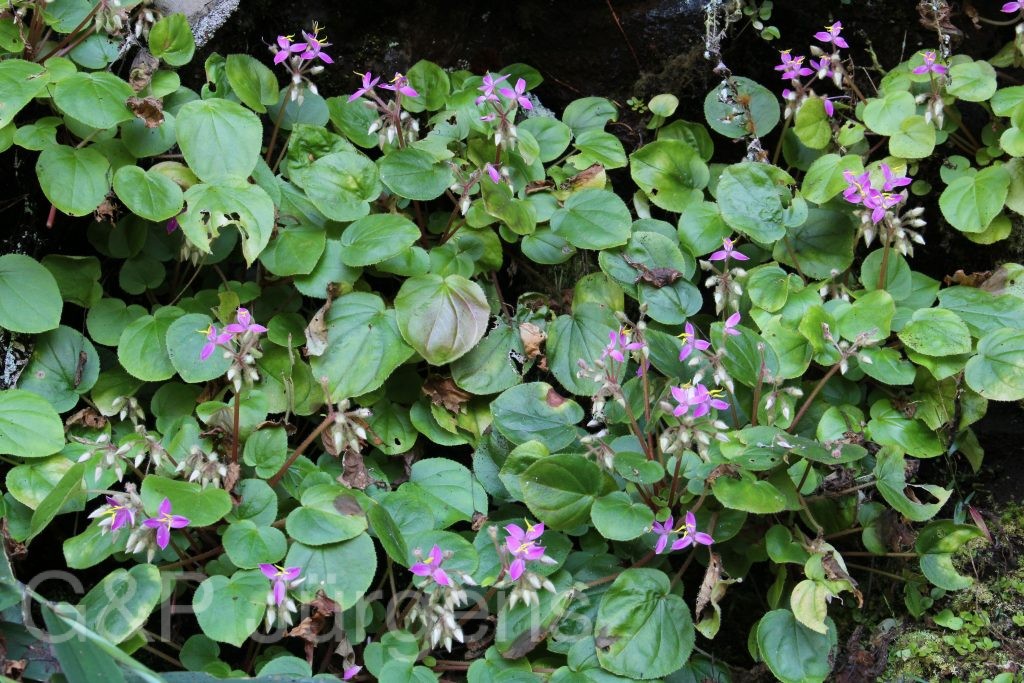
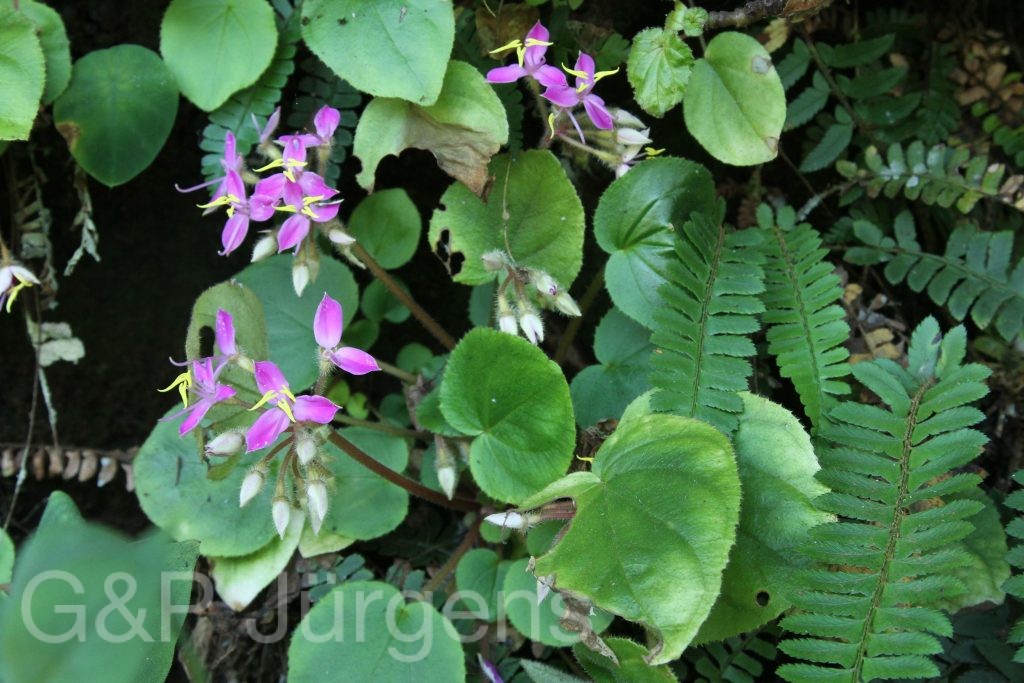
Sonerila khasiana is a small herb of the eastern Himalayan and northeast Indian region, recorded from India, Nepal, Bhutan, China and Myanmar, with comparatively few documented collections. It is a shade-loving plant of moist, humus-rich forest floors, shaded rock faces and damp banks in subtropical and lower montane forest, typically below about 1500 m. The illustrated plant from Galephug in southern Bhutan, at around 600 m and flowering in October, is characteristic of its lowland, post-monsoon flowering habit in warm, perpetually humid foothill forest where deep shade and constant moisture prevail.

The species is a delicate, often somewhat succulent annual or short-lived perennial with slender, ascending, frequently reddish stems. The leaves are opposite, ovate to elliptic, serrulate and traversed by the curved, parallel-converging nervation diagnostic of the Melastomataceae, the lamina often sparsely setose. The inflorescence is a short, terminal, scorpioid cyme of few flowers. The flowers are trimerous, with three pink to rose-purple petals and typically three stamens bearing the conspicuous, yellow, beaked anthers characteristic of the genus; the fruit is a small, three-angled, top-shaped capsule releasing numerous minute seeds.

The epithet refers to the Khasi Hills of Meghalaya, a centre of diversity for the genus. Sonerila is a large palaeotropical genus notable for its consistently trimerous flowers, unusual within a predominantly pentamerous family, and for its many narrow-range, forest-floor endemics. With relatively few records and a dependence on undisturbed shaded forest, such species are potentially sensitive to deforestation, although its full conservation status remains insufficiently assessed.

Author: C.B.Clarke · Sources: POWO (Kew), GBIF, Flora of China Vol. 13, Flora of Bhutan Vol. 2, Flora of Nepal, Revision of Sonerila (Melastomataceae)

Buch.-Ham. ex D. Don

Bh09 353 P569
Bhutan Wangdi, 2400m June
Bh09 354 G570
Bhutan Wangdi, 2600m June

Description

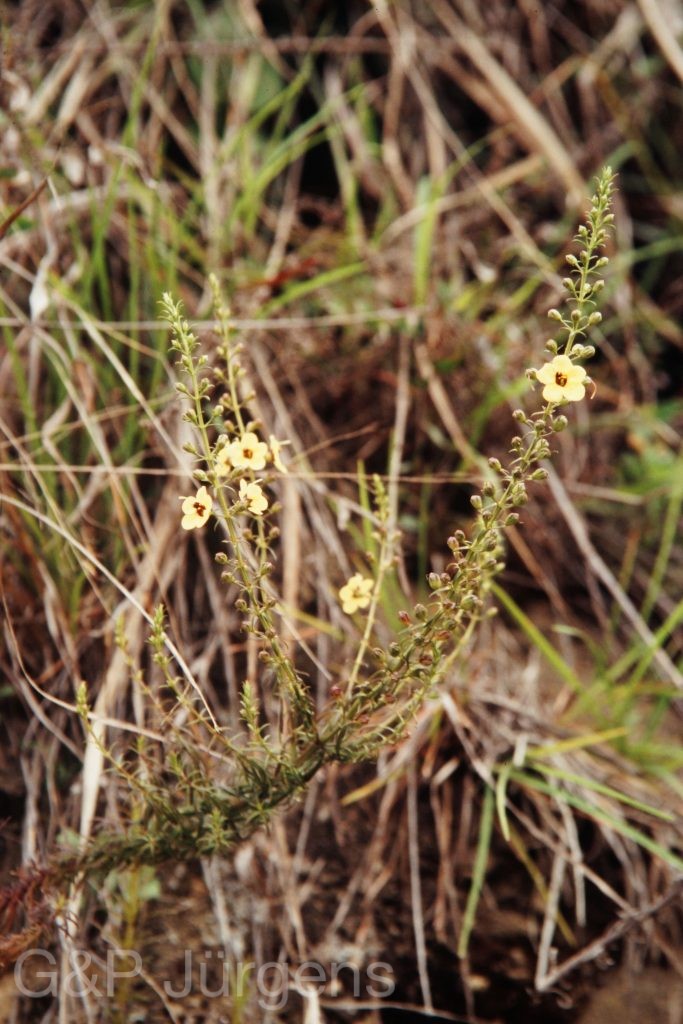
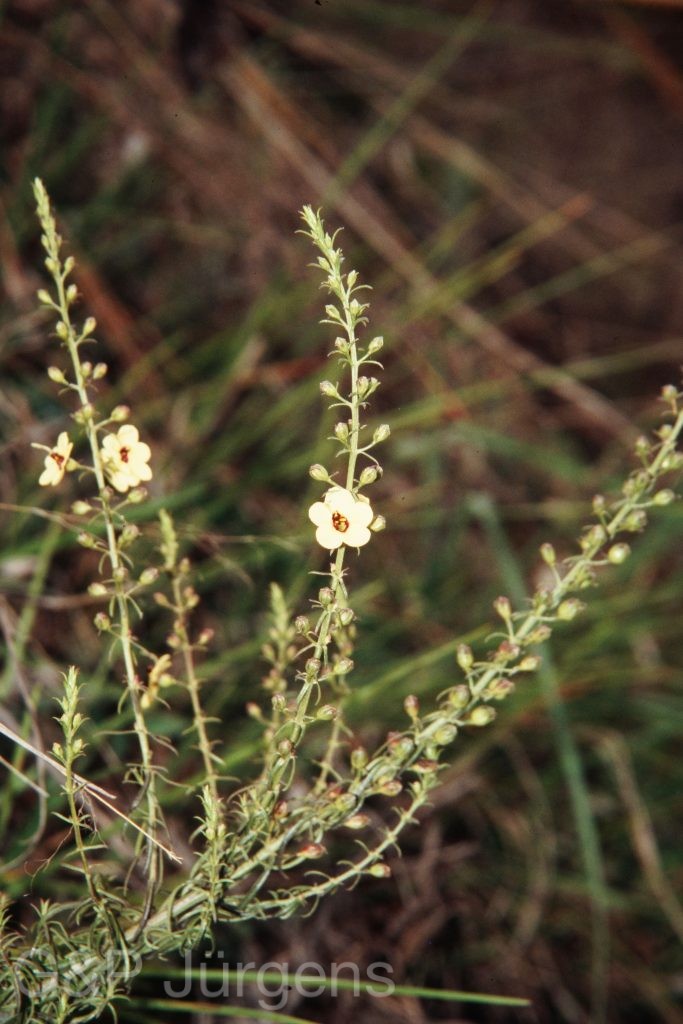
Sopubia trifida Buch.-Ham. ex D.Don is a slender hemiparasitic herb of broad palaeotropical distribution, recorded across South and Southeast Asia and tropical Africa, including China, India, Nepal, Bhutan, Myanmar, Thailand, Indonesia, the Philippines, Sri Lanka, Madagascar, Papua New Guinea and several African nations; GBIF lists around 840 occurrences. It favours open grassy slopes, savanna, terraced field margins, scrub and disturbed sunny ground, mostly from the lowlands up to about 2700 m. The photographed plants were collected near Wangdi in Bhutan at 2400 and 2600 m in June, in the open warm-temperate grassland where this erect parasite grows attached to the roots of grasses.

The plant is an erect annual or perennial herb with stiff, wiry, often branched and minutely scabrous stems. The leaves are opposite below and alternate above, narrowly linear, sessile and frequently divided into a few filiform segments, the epithet trifida referring to this three-parted condition. The flowers are borne in lax terminal spike-like racemes; the corolla is rotate, typically pink to rose-purple, with a short tube and five subequal spreading lobes, while the calyx is campanulate and ribbed. The fruit is a small ovoid, loculicidal capsule containing numerous minute, angular seeds.

Now placed in the broadly recircumscribed Orobanchaceae following the transfer of hemiparasitic genera from the former Scrophulariaceae, Sopubia is a facultative root parasite drawing water and nutrients from neighbouring grasses through haustoria while retaining photosynthetic capacity. Its wide tropical range and tolerance of disturbed grassland account for its abundance. The species is common and not of conservation concern, and is sometimes regarded as a weedy associate of pastures and fallow land.

Author: Buch.-Ham. ex D. Don · Sources: POWO (Kew), GBIF, Flora of China, Flora of Bhutan, Flora of Ceylon, Fischer revision of Sopubia and allied Orobanchaceae

(Lindl.) Rehder

Garh 07 304 ergebnis
India Garhwal Bebra 1400m, June

Description

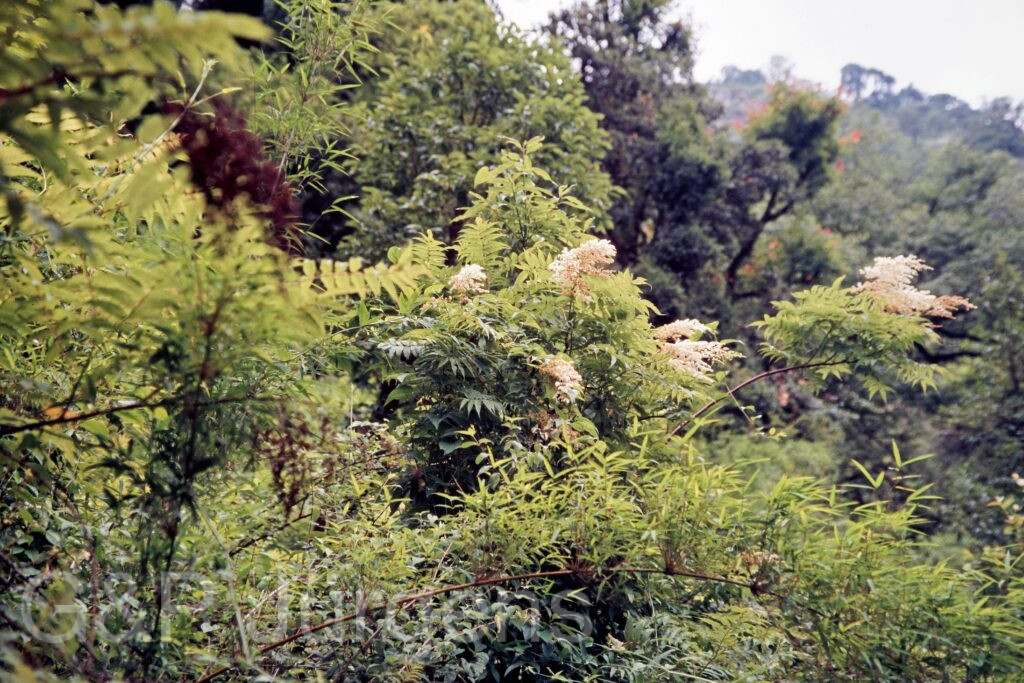
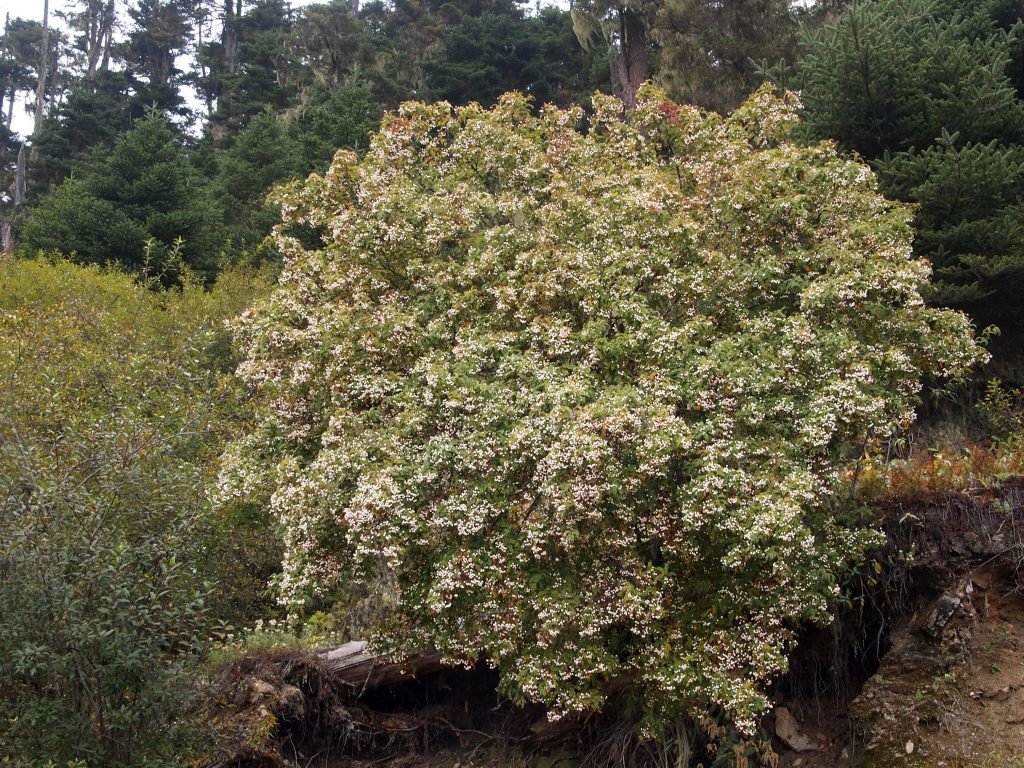
Sorbaria tomentosa is a deciduous shrub distributed along the temperate Himalaya from Afghanistan and Pakistan eastward through northern India and Nepal into south-western China, with the GBIF record (730 occurrences) further documenting naturalised and cultivated populations across Europe and North America. It favours moist, well-drained slopes, stream banks, forest margins and open thickets, generally between about 1200 and 3000 m. The plant photographed at Bebra in the Garhwal Himalaya at 1400 m in June represents the lower montane part of its native range, where it flowers in early summer in disturbed, sunny situations.

The species forms an erect, multi-stemmed shrub 1-3 m tall, with arching branches and stems that are tomentose when young, becoming glabrescent. The leaves are imparipinnate, comprising numerous lanceolate, doubly serrate leaflets that are densely greyish- to whitish-tomentose beneath, giving the foliage a soft, felted texture. The flowers are small and white, borne in large, dense, terminal pyramidal panicles; each has five sepals and five petals, with numerous exserted stamens conspicuously longer than the petals and a gynoecium of five carpels. The fruit is a small follicle, the carpels dehiscing to release minute seeds.

The genus Sorbaria (Spiraeoideae) is distinguished within Rosaceae by its compound leaves and apocarpous follicular fruits, features uniting it with Spiraea relatives. Sorbaria tomentosa is widely grown as an ornamental for its feathery foliage and showy inflorescences, which accounts for its broad extralimital occurrence. Within its native montane habitat it is a pioneer of forest edges and landslip scars, contributing to early successional vegetation and soil stabilisation.

Author: (Lindl.) Rehder · Sources: POWO (Kew), GBIF, Flora of China Vol. 9, Flora of Bhutan Vol. 2, Flora of Nepal, Flora of Pakistan, Robertson's monograph of Rosaceae genera

Wenz.

Bhutan2015 371
Bhutan Tumching-La 4000m, October
Bhutan2012 906
Bhutan Tumching-La 3900m, October
Bhutan2012 907
Bhutan Tumching-La 3900m, October

Description

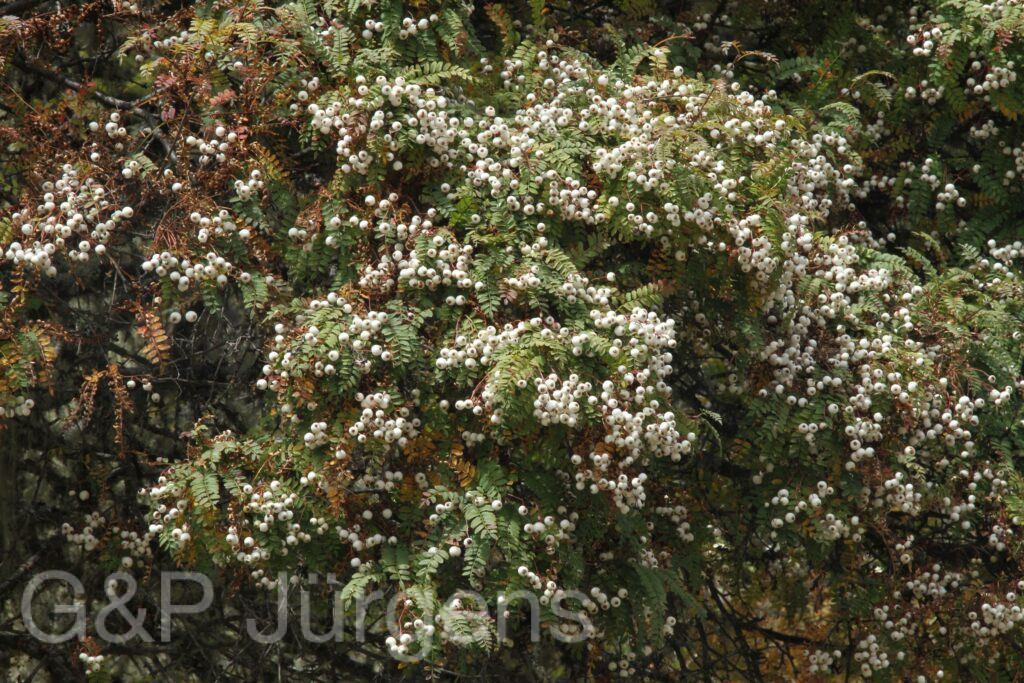
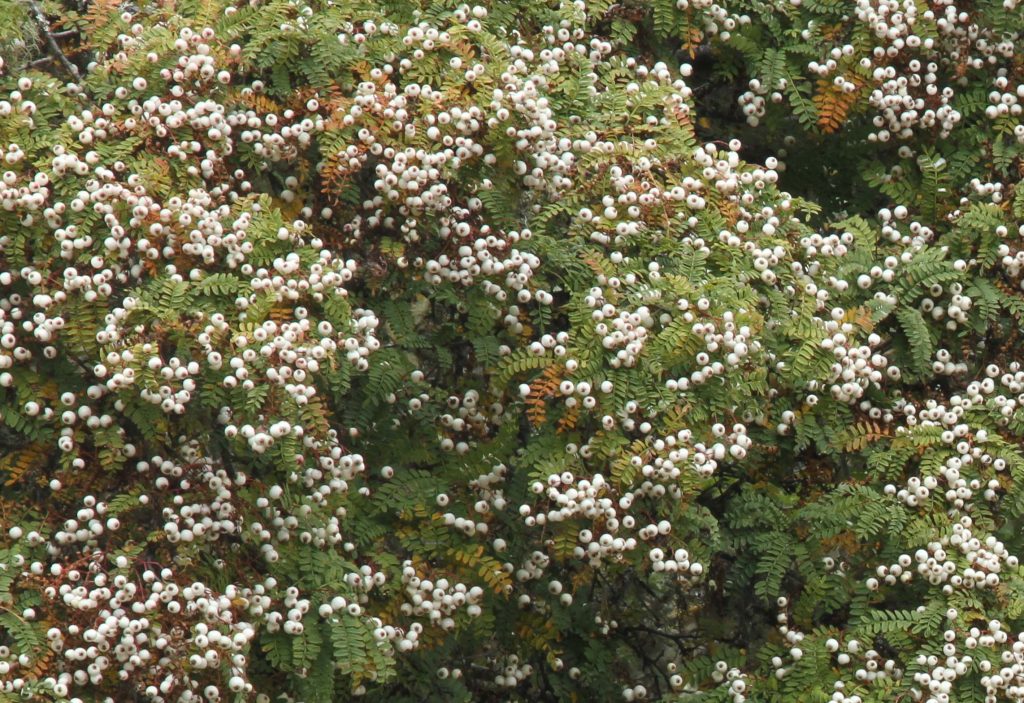
Sorbus microphylla is a high-montane to subalpine deciduous shrub or small tree distributed along the Himalayan arc from Pakistan through Nepal, northern India, Sikkim and Bhutan into south-central China and Myanmar, with the GBIF dataset recording some 344 occurrences including ex-situ collections in Britain, Belgium and North America. It occupies open coniferous and Rhododendron forest, forest margins and alpine thickets, typically between 3000 and 4300 m. The photographed plants were gathered at Tumching-La in Bhutan at 3900-4000 m in October, the fruiting season, where the species forms part of the krummholz and dwarf-shrub community below the treeline.

It is a slender shrub, often 1-3 m tall, with reddish-brown to purplish glabrescent young branches bearing conspicuous lenticels. The leaves are imparipinnate with 10-15 or more pairs of small, crowded, oblong leaflets that are sharply serrate toward the apex, dark green above and paler beneath, turning rich crimson in autumn, the rachis often narrowly winged. The white to pinkish flowers are borne in small terminal corymbs, each with five petals, numerous stamens and two to three styles. The fruit is a small globose pome, white, pink-tinged or pale rose, 6-8 mm across, persisting after leaf-fall.

The species belongs to Sorbus subgenus Albocarmesinae, the white- and pink-fruited Himalayan-Sino mountain ashes, a complex group in which apomixis and hybridisation blur species limits. Its small leaflets and pale fruits distinguish it from related S. ursina and S. foliolosa. The pomes are an important autumn food for thrushes and other montane birds, which disperse the seed. Widespread and locally common across a broad range, it is not considered threatened, though valued horticulturally for its delicate foliage and persistent rosy fruit.

Author: Wenz. · Sources: POWO (Kew), GBIF, Flora of China, Flora of Bhutan, McAllister: The Genus Sorbus