Tag:

Bhutan

Flowers of Bhutan — 1326 plant species documented across the Bhutanese Himalaya, from dense broadleaf and conifer forests to alpine scrub and meadows. Bhutan’s largely intact wilderness shelters an exceptional diversity of orchids, rhododendrons, primulas and Himalayan poppies, many of them regional endemics. Each species page includes a botanical description, distribution, habitat and flowering time, with the original photograph and its recorded altitude and locality.

(Pers.) Ames

Bhutan2014 92
Bhutan Trashigang 1450m, May
Bh2008 471 G732
Bhutan Tsang-Chu, 1800m April
Nepal1992 92 P126 ergebnis
Nepal Amjilassa 2300m March 

Description

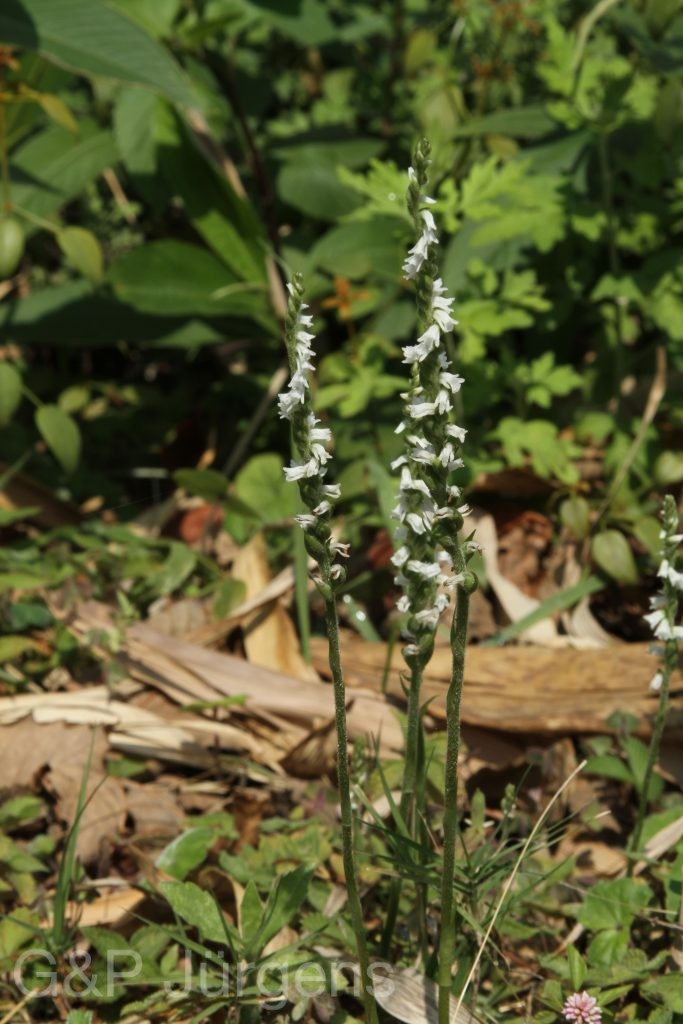
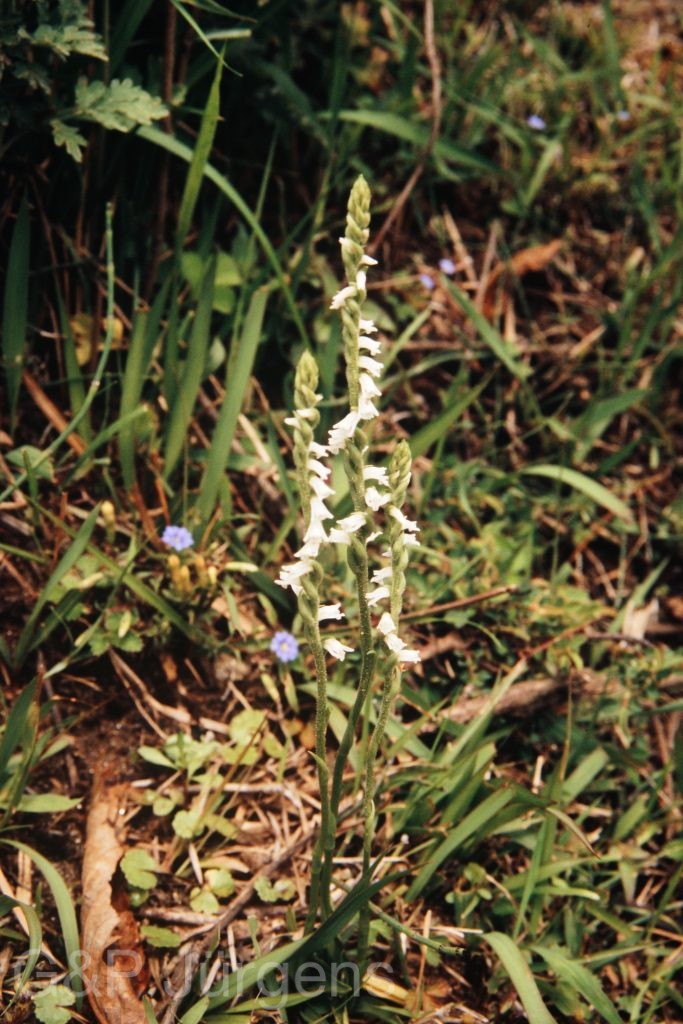
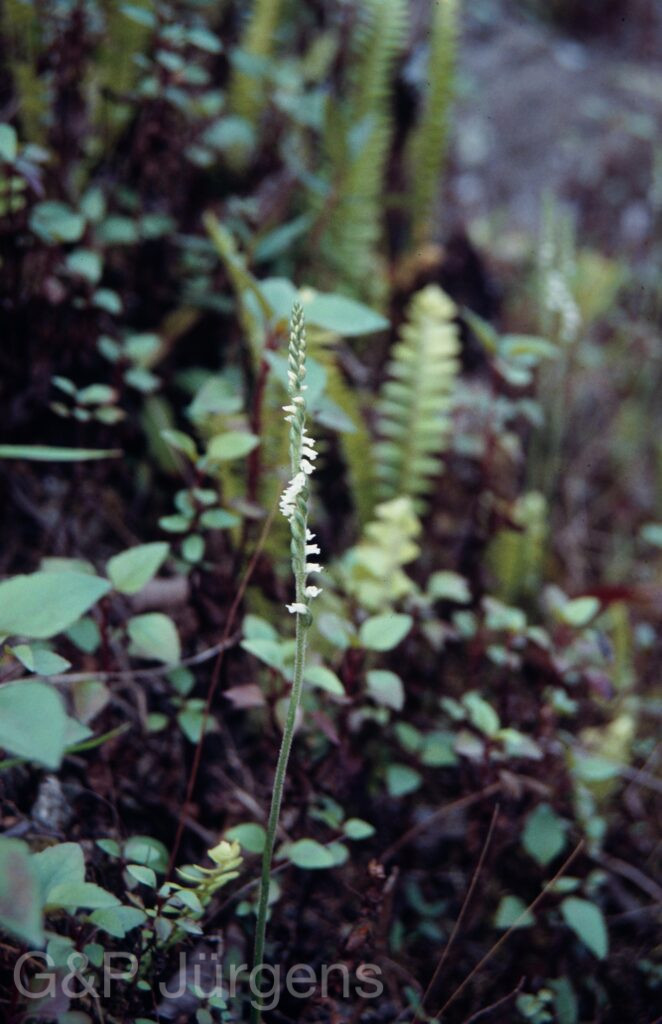
Spiranthes sinensis, the Chinese ladies'-tresses, is one of the most widespread terrestrial orchids of the Old World, documented in GBIF by some 7880 occurrences spanning eastern Asia from China, Japan, Korea and Russia through India, Nepal, Bhutan and Southeast Asia to Australia, New Caledonia and Sri Lanka. It occupies open, moist grassland, marshy meadows, streambanks, paddy margins and grassy slopes from near sea level to about 3000 m. The photographed Himalayan plants from Trashigang in Bhutan at 1450 m in May, the Tsang-Chu at 1800 m in April and Amjilassa in eastern Nepal at 2300 m in March illustrate its tolerance of a wide elevational and seasonal range in damp, sunny situations.

It is a slender terrestrial orchid with fleshy, fasciculate, tuberous roots and a tuft of linear to oblanceolate basal leaves. The erect, finely pubescent inflorescence bears numerous small flowers arranged in a characteristic single spiral around the axis. The flowers are typically pink to rose-purple with a white, recurved, crisped-margined labellum bearing a yellowish, papillose central callus; the dorsal sepal and petals converge to form a hood over the short column. The fruit is a small, erect, ellipsoid capsule releasing dust-like seeds.

A member of subtribe Spiranthinae of the Orchidaceae (here under the input spelling Orchideaceae), S. sinensis forms a taxonomically complex, polyploid-rich aggregate from which several segregates such as S. australis and S. hongkongensis have been recognised. Like most orchids it depends on mycorrhizal fungi for germination and is pollinated chiefly by bees. Despite local declines from wetland drainage, its enormous range and weedy persistence in disturbed grassland make it of Least Concern, though it is protected under CITES Appendix II as for all orchids.

Author: (Pers.) Ames · Sources: POWO (Kew), GBIF, Flora of China, Flora of Bhutan, Annotated Checklist of the Flowering Plants of Nepal, Pridgeon et al. Genera Orchidacearum
Benth.

BhutanPG2011 841
Bhutan Paro-Chu, 2400m July
Nepal 99 587 ergebnis
West-Nepal Garpung-Khola 3300m, July

Description

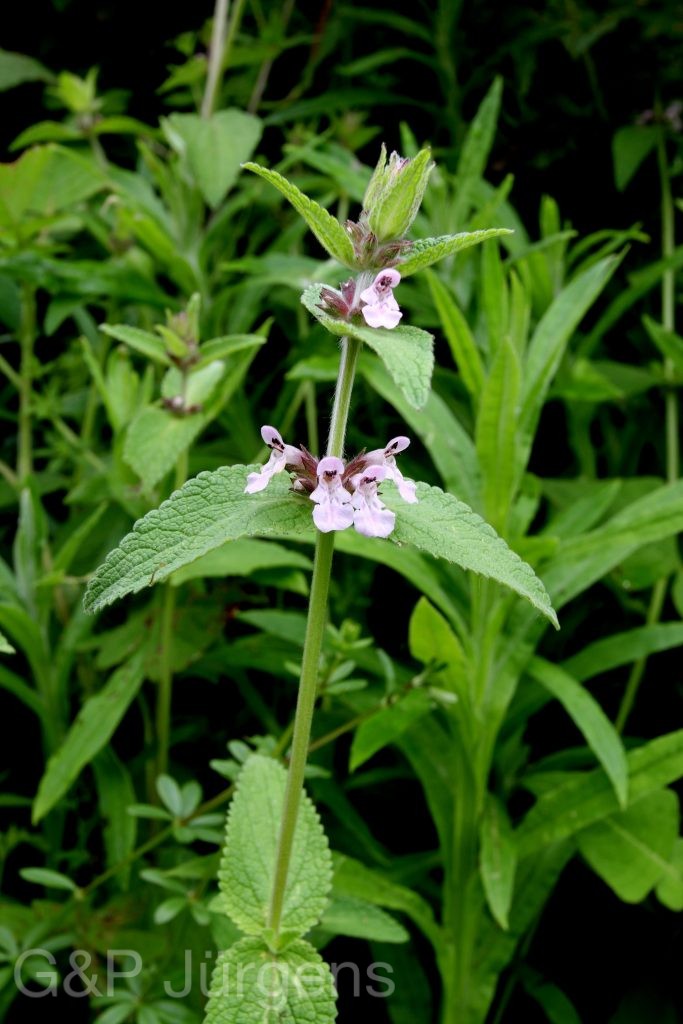
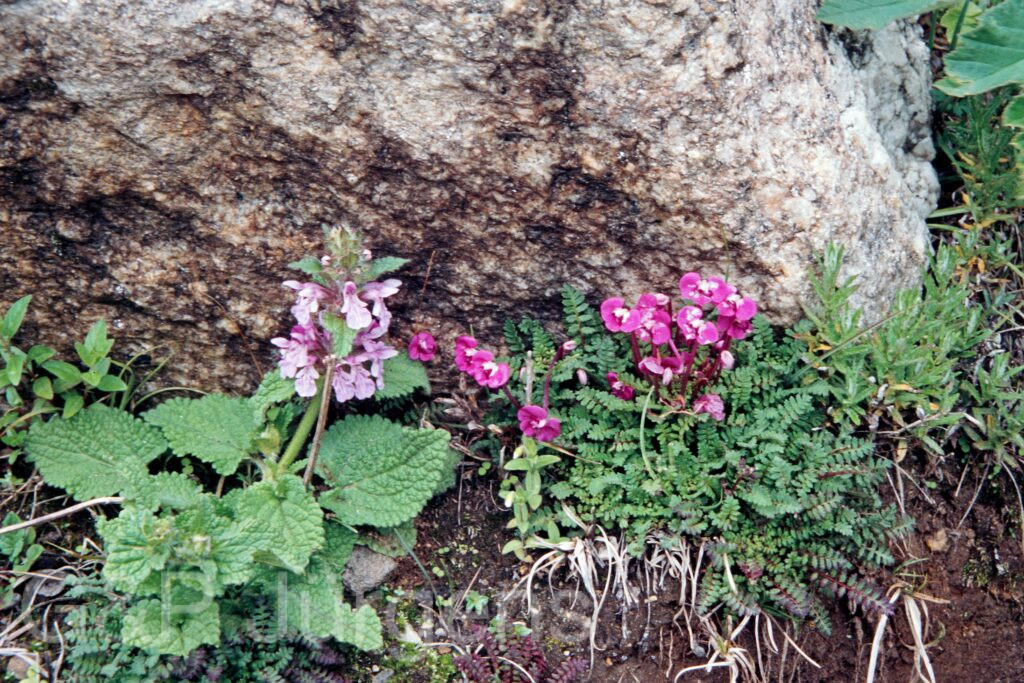
Stachys melissifolia is a perennial mint-family herb of the Himalaya and adjacent mountains, recorded from Nepal, China, India, Bhutan and Pakistan, with around 146 occurrences in GBIF; under its current treatment the name is accepted for the Himalayan plant. It occupies forest margins, moist shaded banks, shrubberies and grassy slopes of the temperate and lower subalpine belt, broadly between 2000 and 3500 m. The photographs from the Paro Chu in Bhutan at about 2400 m and from the Garpung Khola in West Nepal at about 3300 m, both in July, show the species in flower during the summer monsoon in its typical mid-montane woodland-edge habitat.

The plant is an erect to ascending perennial with the quadrangular stems characteristic of the Lamiaceae, usually softly hairy. The leaves are opposite, ovate to oblong with a cordate to rounded base, crenate-serrate margins and a rugose, wrinkled surface, somewhat resembling those of balm (Melissa), as the epithet melissifolia denotes. The flowers are borne in distinct whorls (verticillasters) forming an interrupted terminal spike; the calyx is tubular-campanulate with five subequal teeth, and the bilabiate corolla is pinkish to purple with a short, erect upper lip and a spreading three-lobed lower lip. The fruit comprises four small ovoid nutlets enclosed in the persistent calyx.

Stachys is a large, cosmopolitan genus of the Lamiaceae subfamily Lamioideae, and its Himalayan members have been subject to repeated nomenclatural revision, several names having passed in and out of synonymy. The verticillate inflorescence and bilabiate corolla are adapted to pollination by bees and other long-tongued insects. Widely distributed through the temperate Himalaya, S. melissifolia is common and of no conservation concern.

Author: Benth. · Sources: POWO (Kew), GBIF, Flora of China, Flora of Bhutan, Annotated Checklist of the Flowering Plants of Nepal, Harley et al. Labiatae in The Families and Genera of Vascular Plants

Hook.f. & Thomson ex. Benth.

Bh2008 17 P30
Bhutan Thimphu-Chu, 2800m April
Nepal 97 125 G217
Nepal Mewa-Khola 2470m April

Description

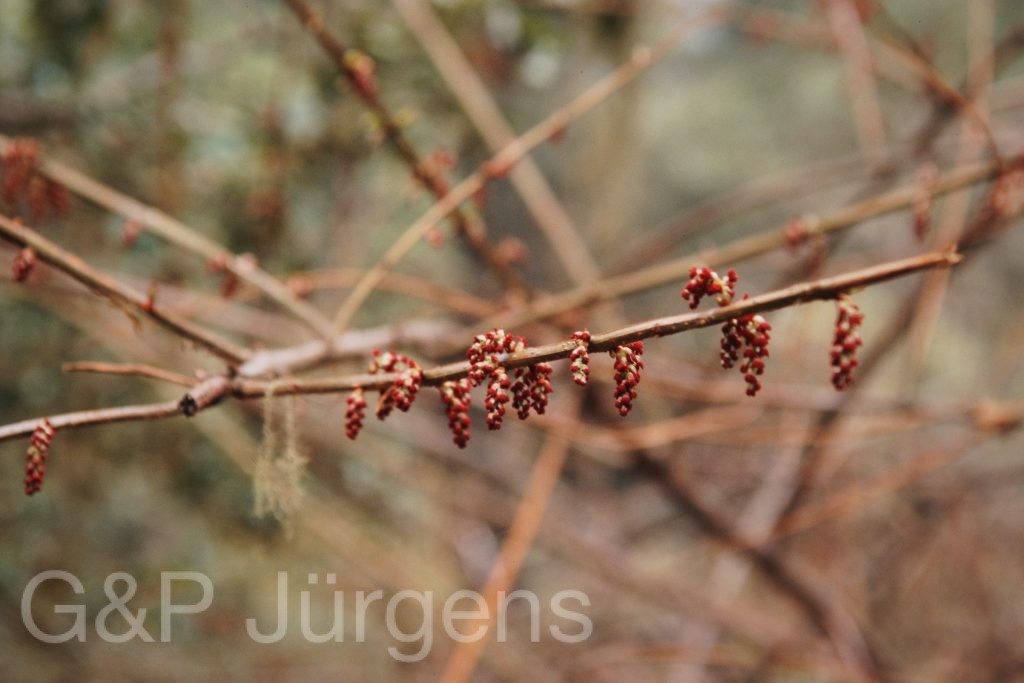
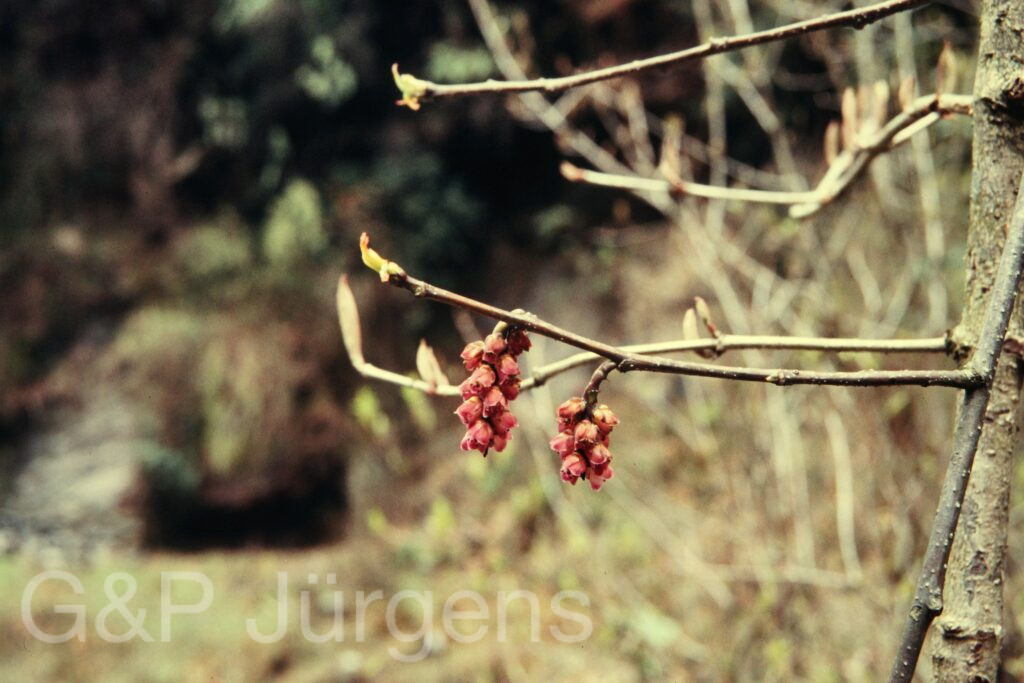
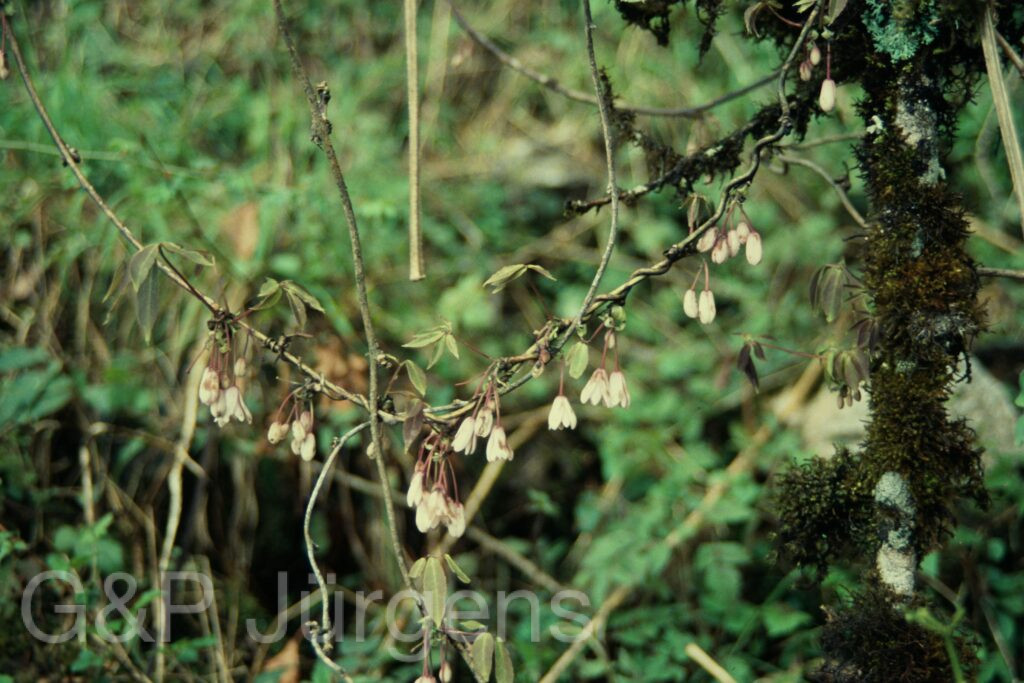
Stachyurus himalaicus is a Sino-Himalayan shrub distributed from Nepal and northern India through Bhutan, northern Myanmar and southern China to Taiwan, with around 4100 GBIF occurrences and a peripheral introduced presence in Japan, Korea and cultivation in Belgium. It grows in moist broad-leaved and mixed evergreen forest, along streamsides, forest margins and shrubby slopes in the warm-temperate to lower cool-temperate belt, roughly 1500 to 3000 m. The plants recorded along the Thimphu-Chu in Bhutan at 2800 m and at Mewa-Khola in Nepal at 2470 m, both flowering in April before leaf expansion, exemplify its precocious early-spring display on humid montane slopes.

It is a deciduous shrub or small tree with reddish-brown, glabrous, lenticellate branchlets. The leaves are alternate, ovate-lanceolate to oblong, acuminate, with serrate to serrulate margins and a slender petiole, the young foliage sometimes flushed reddish. Its diagnostic feature is the inflorescence: stiff, pendent, spike-like racemes produced from the leafless nodes, each bearing numerous small, shortly pedicellate, bell-shaped pale yellow flowers with four sepals, four petals and eight stamens. The superior ovary develops into a small, globose, leathery to fleshy berry containing many minute seeds embedded in pulp.

Stachyurus is the sole genus of the small family Stachyuraceae, an isolated lineage within the Crossosomatales, and S. himalaicus is its principal Himalayan representative, distinguished from the Chinese S. chinensis by leaf and inflorescence characters. The pre-foliar flowering exploits an open canopy and attracts early-season bees, while the berries are bird-dispersed. The species is common and not of conservation concern.

Author: Hook.f. & Thomson ex. Benth. · Sources: POWO (Kew), GBIF, Flora of China Vol. 13, Flora of Bhutan Vol. 2, Flora of Nepal, A Revision of the Genus Stachyurus (Stachyuraceae)

(Wall.) R.Br. ex. Wall.

Bhutan2012 357
Bhutan Dochu-La 2900m, September
Bhutan2014 609
Bhutan Phobjika 3100m, May
Sikkim2004 26 P41
Sikkim West-Bengal, Sambon 1850m April

Description

Stauntonia latifolia is a Himalayan woody climber distributed through China, India, Nepal, Bhutan and Myanmar, with GBIF aggregating some 517 occurrences across the warm temperate belt. It is a liana of moist broad-leaved and mixed forest, scrambling over shrubs and into the canopy along forest margins, ravines and streamsides typically between about 1500 and 3100 m. The accompanying records span this range well, from Sambon on the Sikkim–West Bengal border at 1850 m in April, through the Dochu-La in Bhutan at 2900 m in September, to Phobjika at 3100 m flowering in May, reflecting an extended phenology across elevation and longitude in the eastern Himalaya.

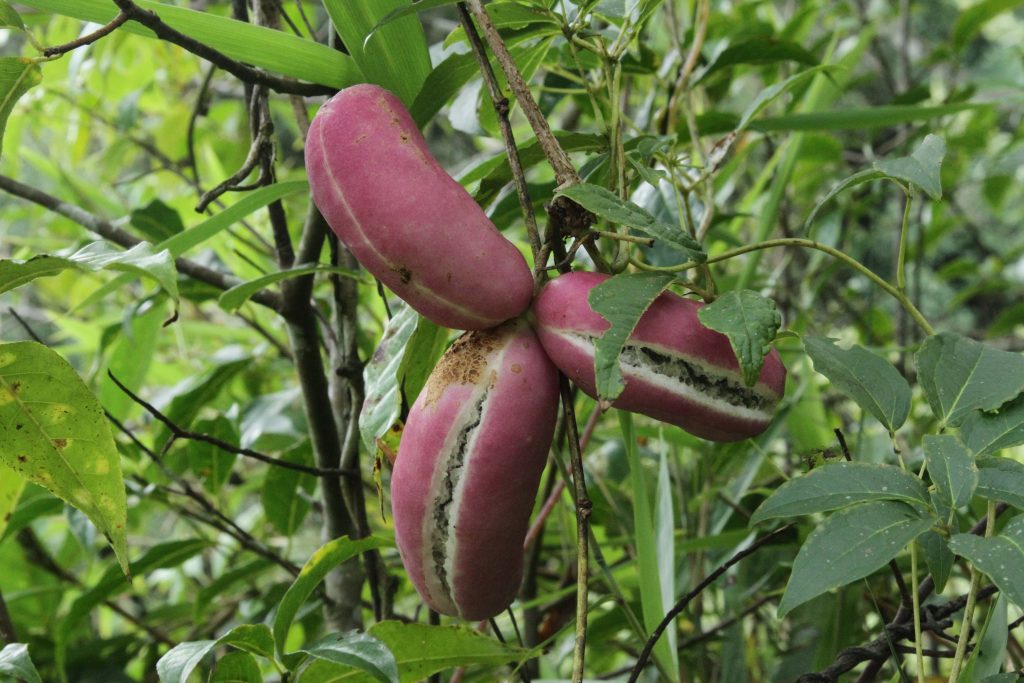
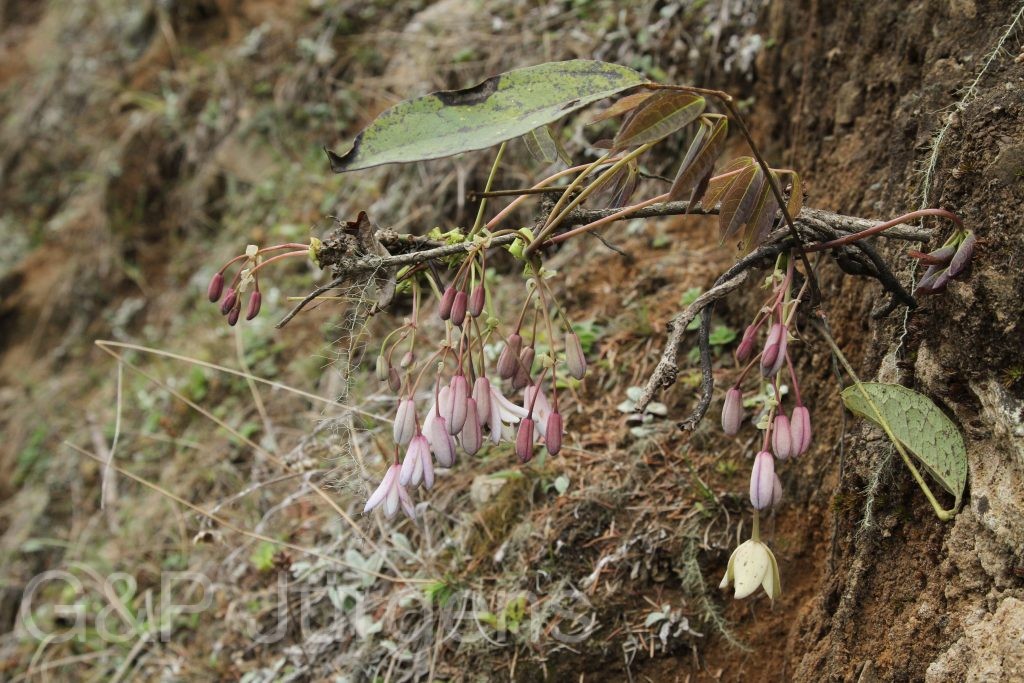
The family is here cited as Ranunculaceae, but the plant in fact belongs to the Lardizabalaceae; the description follows the true affinity. It is an evergreen twining climber with palmately compound leaves of three to seven leathery, entire, ovate to elliptic leaflets borne on long petioles. The plant is functionally monoecious, the flowers unisexual and borne in axillary racemes; they are greenish-white to purplish, lacking true petals, the showy parts being six sepals in two whorls, with six stamens in male flowers and three carpels in female ones. The fruit is a fleshy, oblong, purple berry-like follicle, edible and sweet, containing numerous black seeds embedded in a juicy pulp.

The taxon was described by Wallich and is widely treated under the synonym Holboellia latifolia, the generic limits between Holboellia and Stauntonia having been repeatedly debated and revised; under recent circumscriptions the Himalayan plant is placed in Stauntonia. The Lardizabalaceae are a small east-Asian and Chilean family of considerable phylogenetic interest as an early-diverging lineage of the Ranunculales. The succulent fruits are locally gathered and eaten and serve to disperse the seeds via birds and mammals; the species is common and faces no significant conservation concern.

Author: (Wall.) R.Br. ex. Wall. · Sources: POWO (Kew), GBIF, Flora of China, Flora of Bhutan, Annotated Checklist of the Flowering Plants of Nepal, monographic studies of Lardizabalaceae (Holboellia and Stauntonia)

H. Hara

Nepal 99 554 ergebnis
West-Nepal Churta-Khola 4230m, June

Description

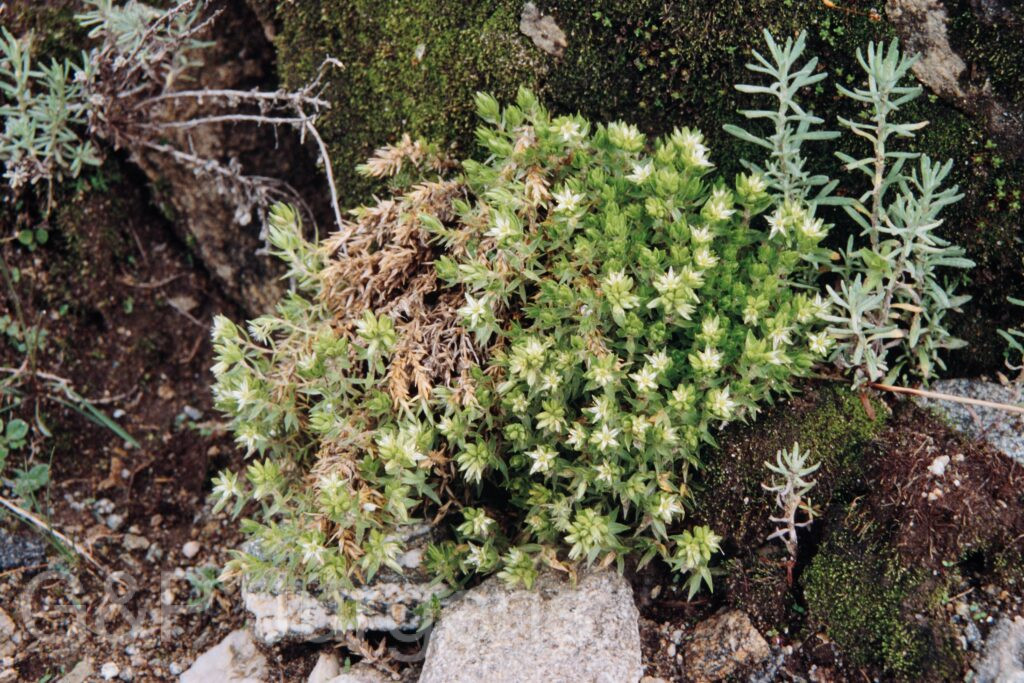
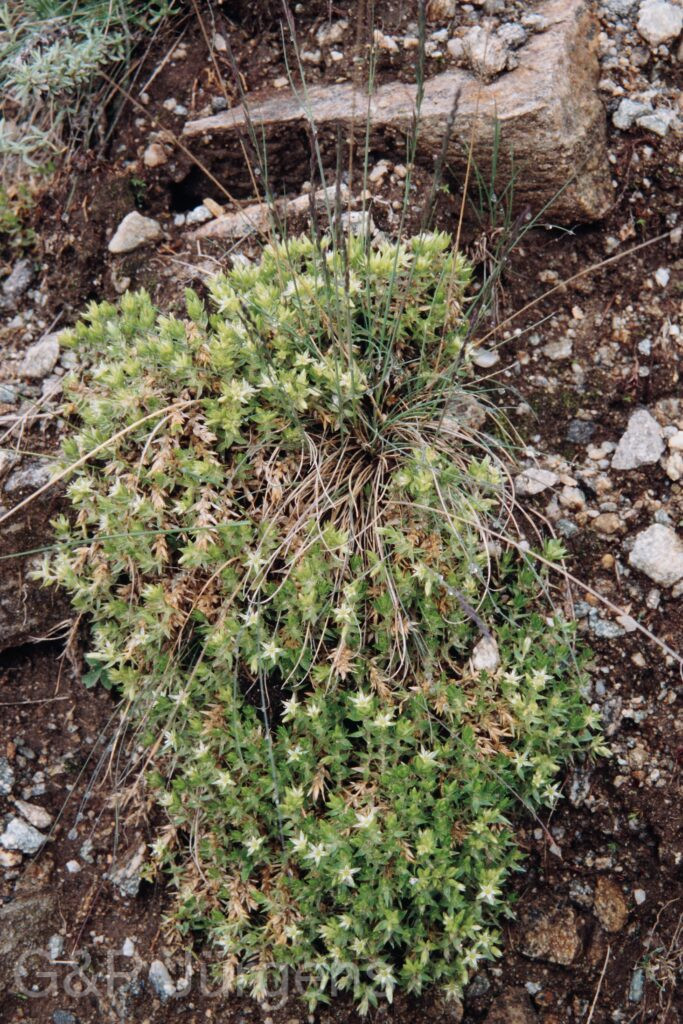
Stellaria congestiflora is a high-alpine chickweed of the Himalaya, recorded from Nepal, China, Bhutan and India, a restricted and infrequently collected distribution reflected in its small number of georeferenced records. It grows in alpine meadows, on stony slopes, screes and the gravelly margins of streams and snowbeds at high elevations, generally well above 4000 m. The plant photographed at Churta-Khola in West Nepal at 4230 m in June is a characteristic occurrence in the cold, open alpine zone, flowering soon after snowmelt at the upper limit of vascular plant growth.

It is a small, tufted or mat-forming perennial herb arising from a slender, branched rootstock. The stems are short, slender and often densely clothed, bearing opposite, sessile, narrowly lanceolate to linear leaves. As the epithet indicates, the small white flowers are aggregated into congested, head-like terminal clusters subtended by leafy bracts, rather than borne in the open, spreading cymes typical of many relatives. Each flower has five sepals and five deeply bifid white petals, ten stamens and a superior ovary bearing three styles; the fruit is a capsule dehiscing by valves to release several small seeds.

Stellaria is a large, cosmopolitan genus of the Caryophyllaceae distinguished by the deeply two-cleft petals, and the dense, congested inflorescence of S. congestiflora, described by H.Hara, separates it from the looser-flowered Himalayan species. Its narrow, high-elevation range makes it potentially sensitive to alpine climate change and habitat shifts, though its remote habitat limits direct human pressure. As a cushion-like alpine herb it contributes to the sparse but specialised flora of the upper screes and snowbed margins.

Author: H. Hara · Sources: POWO (Kew), GBIF, Flora of China, Annotated Checklist of the Flowering Plants of Nepal, Hara's Flora of Eastern Himalaya, monographic studies of Himalayan Stellaria (Caryophyllaceae)

Edgew. & Hook. f.

Nepal 99 555 ergebnis
West-Nepal Churta-Khola 4100m, June
Nepal 99 799 ergebnis
West-Nepal Baga-La-Phedi 4500m, July

Description

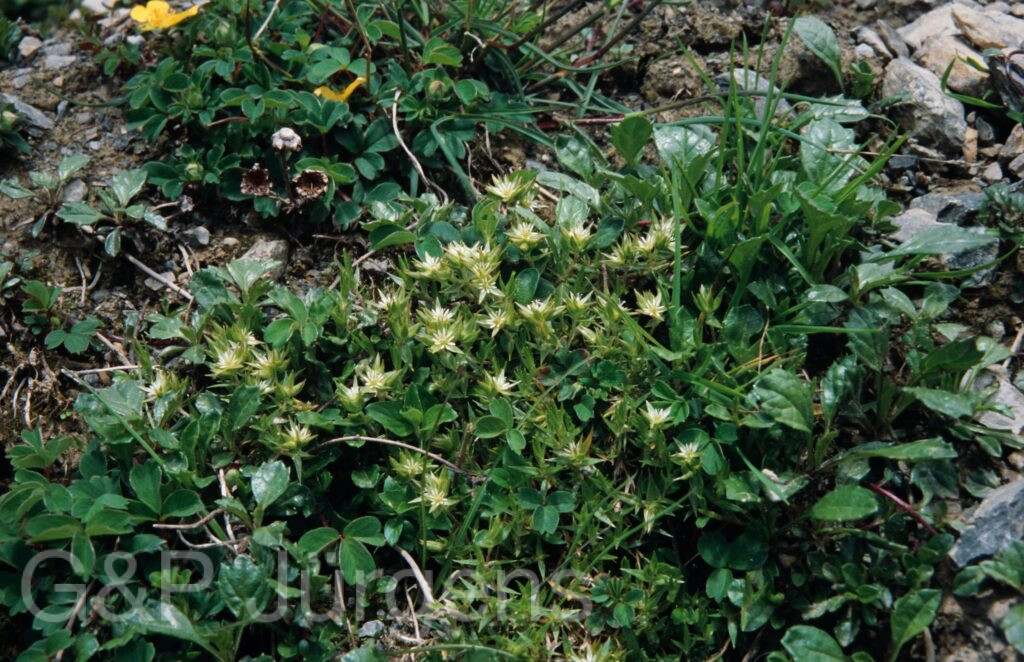
Stellaria decumbens var. pulvinata is a diminutive alpine chickweed of the Himalaya and adjoining Tibetan plateau, recorded by GBIF from China, India, Nepal and Bhutan with around 104 occurrences. The variety occupies cold, exposed alpine and subnival terrain, where it grows in rock crevices, on stabilised scree and among cushion vegetation at very high elevations. It was photographed in West Nepal in the Churta-Khola at 4100 m in June and near the Baga-La-Phedi at 4500 m in July, habitats typical of its preference for open, gravelly ground close to the upper limit of vascular plant life.

As its epithet pulvinata implies, this variety forms dense, hard, compact cushions, more condensed than the laxer typical S. decumbens. The slender, much-branched stems are crowded and decumbent, bearing small, sessile, narrowly lanceolate to ovate leaves arranged in opposite pairs, often somewhat fleshy and ciliate at the margins. The minute flowers are solitary or few, with five free, lanceolate, acuminate sepals and five white petals that are deeply bifid for roughly half their length, the characteristic forked petals of Stellaria; stamens are typically ten and the styles three. The fruit is a small ovoid capsule dehiscing by six valves and releasing several reniform, finely tuberculate seeds.

GBIF accepts the variety. The cushion habit represents convergent adaptation to wind desiccation, frost and a short season shared by many unrelated high-Himalayan plants. Within Caryophyllaceae the species belongs to a complex of dwarf alpine Stellaria whose infraspecific limits remain debated. No conservation concern attaches to this widespread, naturally cryptic high-altitude taxon.

Author: Edgew. & Hook. f. · Sources: POWO (Kew), GBIF, Flora of Nepal, Flora of China, monograph of Himalayan Caryophyllaceae

Kurz

Bhutan2014 1072
Bhutan Paro 2400m, May

Description

Stellaria vestita is a widespread chickweed of tropical and subtropical Asia, ranging from the Himalaya through southern China and Taiwan to Indochina, the Malesian archipelago, the Philippines and New Guinea, and eastward to Japan and Korea; GBIF records over 2,000 occurrences. It grows in open forest, scrub, grassy slopes, hedgerows and disturbed ground, generally from low elevations to about 2,800 m. The individual photographed near Paro in western Bhutan at 2,400 m in May reflects its presence in the temperate mid-montane belt of the eastern Himalaya, on moist, partially shaded banks and forest margins.

It is a perennial herb with weak, ascending to straggling stems 30-90 cm long, terete and densely clothed throughout with spreading white hairs, hence the epithet vestita ('clothed'). The leaves are opposite, sessile or shortly petiolate, ovate to ovate-lanceolate, 1-4 cm long, acuminate and pubescent on both surfaces. The inflorescence is a lax, dichasial cyme of several flowers on slender pedicels. Each flower has five lanceolate, pubescent sepals and five white petals deeply cleft nearly to the base into two lobes, the petals about equalling the calyx; there are typically ten stamens and three styles. The fruit is an ovoid capsule dehiscing by six valves and containing several reniform, tuberculate seeds.

Within the large and taxonomically complex genus Stellaria, S. vestita is recognised by its dense indumentum, deeply bifid petals and pantropical Asian distribution, features separating it from the S. media group and from glabrous montane species. The deeply two-lobed white petals are typical of the genus and aid pollination by small insects, while the many-seeded capsules favour effective local dispersal. As a common, weedy and ecologically tolerant species occupying a wide range of habitats and elevations, it is of least concern and faces no recognised conservation threat.

Author: Kurz · Sources: POWO (Kew), GBIF, Flora of China, Flora of Bhutan, Annotated Checklist of the Flowering Plants of Nepal, Caryophyllaceae monograph

L.

Nepal 1989 65
Nepal Bhatang 2915m, April
Nepal 99 362 ergebnis
West-Nepal Kalomura 3600m, June

Description

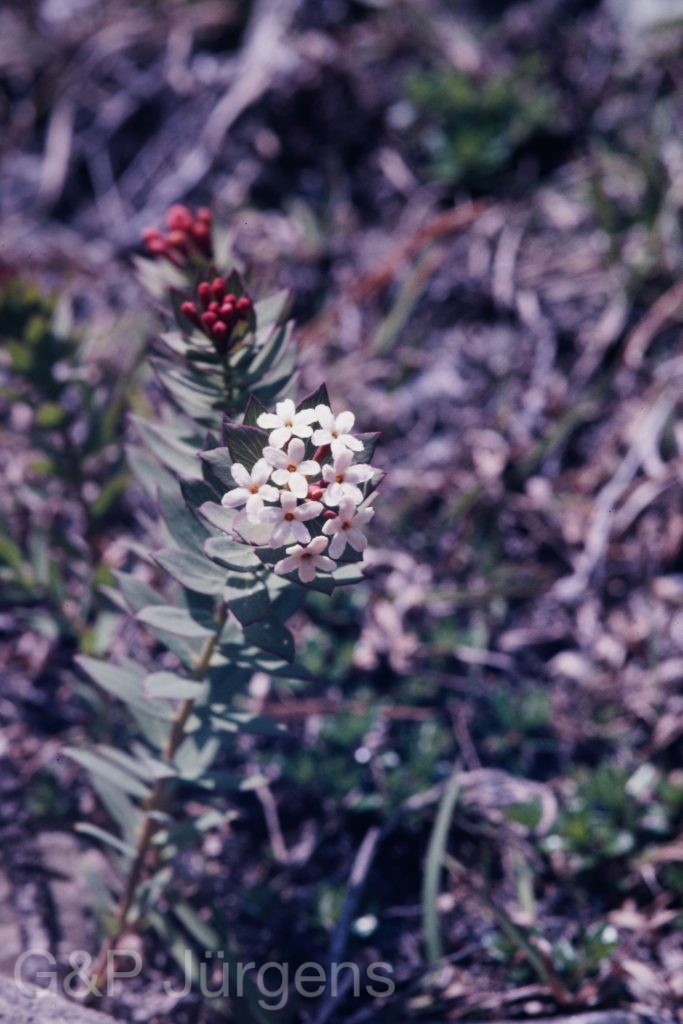
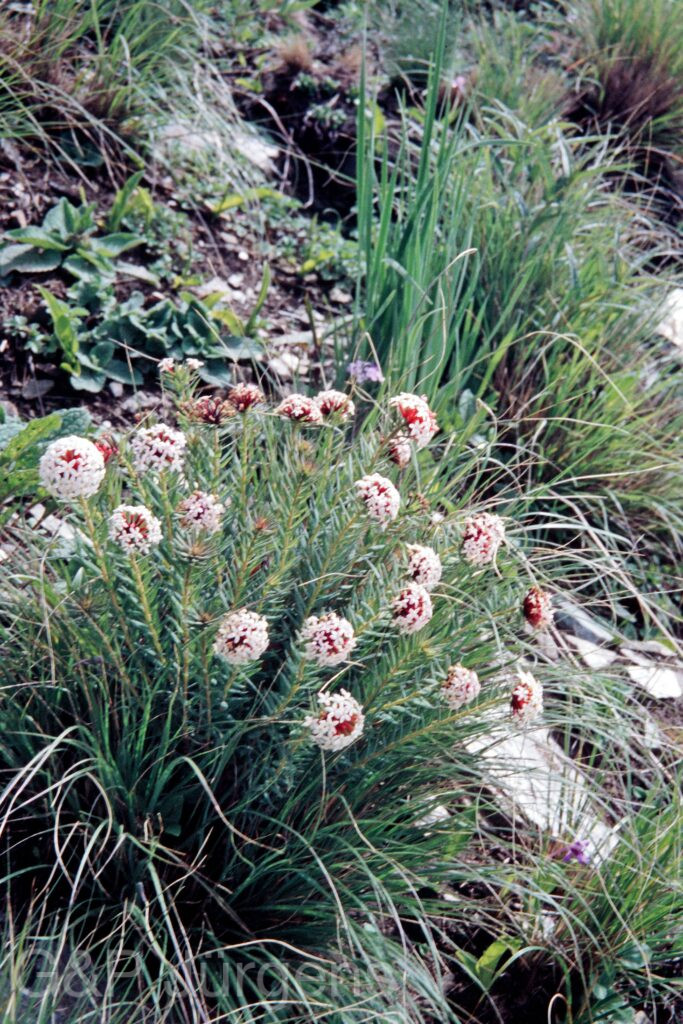
Stellera chamaejasme is a widespread perennial herb of the dry uplands of Central and East Asia, recorded by GBIF from China, Russia, Mongolia, Nepal, India, Bhutan, Kazakhstan, Korea, Iran and Turkey, among others, across some 3,400 georeferenced occurrences. It is characteristic of arid and semi-arid grasslands, alpine and subalpine meadows, sunny rocky slopes and overgrazed pastures on the Tibetan Plateau and throughout the trans-Himalaya, generally between about 2,600 and 4,500 m. The cited Nepalese records, from Bhatang at 2,915 m in April and from Kalomura in West Nepal at 3,600 m in June, span its lower temperate and upper subalpine occurrences and bracket its long spring-to-summer flowering season. It thrives on poor, dry soils where grazing has reduced competing vegetation.

The plant grows from a thick, woody, deep-seated taproot and rootstock, producing numerous erect, slender, unbranched leafy stems in a dense tuft. The leaves are numerous, alternate, crowded, narrowly lanceolate to elliptic, sessile and entire. The flowers are borne in a dense terminal capitate head; each flower lacks petals but has a showy, petaloid, tubular calyx whose five spreading lobes are commonly white above and flushed rose-red to purplish in bud on the outside, producing a striking bicoloured head. There are typically ten stamens in two whorls within the calyx tube, and the fruit is a small dry achene-like nutlet enclosed in the persistent base of the perianth.

Stellera chamaejasme is the best-known species of its genus within Thymelaeaceae and is notorious as a toxic, unpalatable indicator of rangeland degradation; its expansion is regarded across Tibet and Mongolia as a sign of overgrazing, since livestock avoid the poisonous foliage and roots. The plant is rich in bioactive diterpenoids and lignans and has a long history in Tibetan and Chinese traditional medicine, while its tough bast fibres have been used in papermaking. Though abundant and in no way threatened, it is ecologically significant as both a grassland weed and a chemically defended species of considerable pharmacological interest.

Author: L. · Sources: POWO (Kew), GBIF, Flora of China Vol. 13, Flora of Bhutan Vol. 2, Flora of Nepal, Flora of Pakistan, Tan & Wang: revision of Asian Thymelaeaceae and the Stellera complex

(Wall. ex DC.) C.Shih

Bhutan2012 428
Bhutan Wangdi 3300m, June

Description

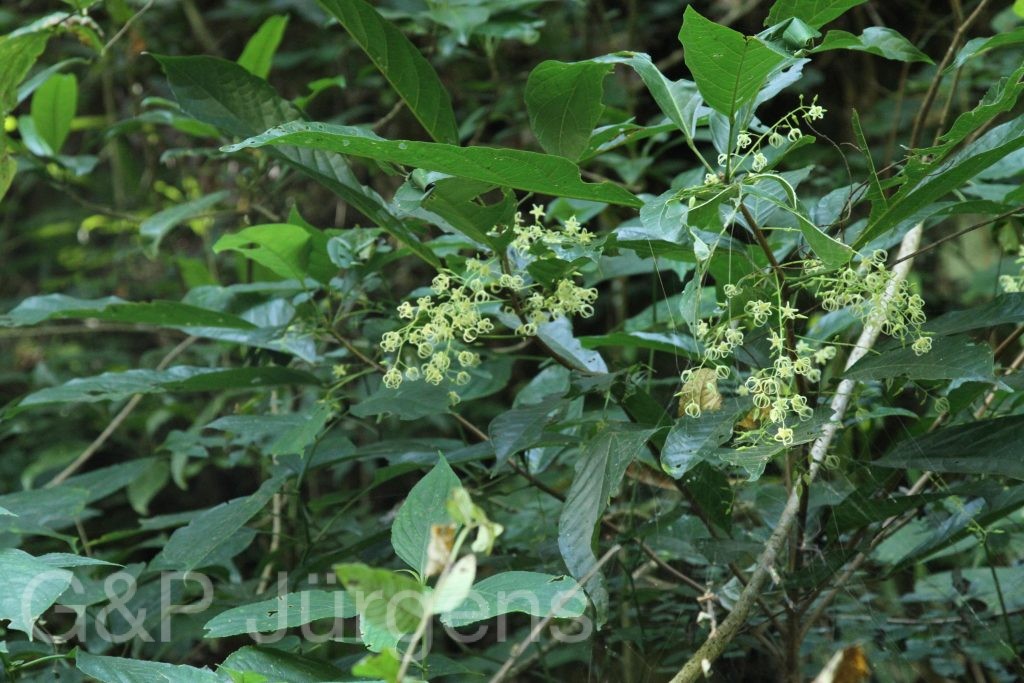
Stenoseris graciliflora is a slender herbaceous composite of the temperate to subalpine Himalaya, ranging through China, India, Nepal, Myanmar and Bhutan, with 160 GBIF records tracing its distribution along the moist montane forest belt and adjoining clearings. It typically grows in forest margins, shrubberies and grassy openings on humus-rich soils between roughly 2500 and 3800 m. The illustrated plant was collected near Wangdi in western Bhutan at about 3300 m in June, in the upper temperate zone where the monsoon supports a tall-herb flora amid fir and rhododendron forest.

In GBIF the name is treated as a synonym, with Stenoseris graciliflora maintained as the accepted name for this entity. The plant is an erect perennial with slender, often leafy and branching stems exuding milky latex when broken, as is typical of the lettuce tribe. The leaves are thin, the lower ones often lyrate-pinnatifid and narrowing to a winged petiole, the upper smaller and clasping. The inflorescence is a lax, narrow panicle of small, few-flowered capitula, each enclosed by a cylindrical involucre of imbricate phyllaries; the florets are all ligulate and pale blue to lilac. The fruit is a flattened, ribbed cypsela bearing a soft white pappus of fine bristles.

Stenoseris is a small genus of the tribe Cichorieae (Lactuceae), segregated from Cicerbita and Lactuca on the basis of its slender capitula, achene morphology and pappus characters. The basionym authority (Wall. ex DC.) C.Shih reflects the species' long taxonomic passage among these closely allied genera. As a widespread montane herb it is not regarded as threatened, though it serves as a useful indicator of intact, humid temperate forest understorey.

Author: (Wall. ex DC.) C.Shih · Sources: POWO (Kew), GBIF, Flora of China, Flora of Bhutan, Compositae of the Himalaya (Cichorieae monographs)

(Jack) Phengklai

Bhutan2015 230
Bhutan Zhemgang 950m, October

Description

Sterculia lanceolata var. coccinea is a tree of tropical and subtropical Asia, ranging from the Indian subcontinent (India, Nepal, Sri Lanka) through Myanmar, Thailand, Indochina (Vietnam, Laos, Cambodia) and southern China into Malesia (Malaysia, Indonesia, Singapore, Brunei, Philippines), as reflected in the 322 GBIF records. It occurs in evergreen and semi-evergreen lowland to lower-montane forest, along streams and forest margins, typically below about 1500 m. The photographed tree from Zhemgang in central Bhutan at around 950 m, fruiting in October, sits at the warm-temperate northern edge of the species' range, where the bright fruiting display is conspicuous in autumn.

The variety is a small to medium tree with a slender bole and spreading crown. The leaves are alternate, simple, elliptic-lanceolate to oblong, entire, glabrescent and pinnately veined, on slender petioles — the lanceolate blade distinguishing this species from the palmately lobed S. villosa. The small flowers are apetalous with a campanulate, lobed calyx and are borne in axillary panicles; the variety coccinea is named for its scarlet colouring. The fruit is the diagnostic cluster of woody, beaked follicles that ripen a vivid red ('coccineus') and split open to reveal glossy black seeds against the crimson inner wall.

Now classified in Malvaceae subfamily Sterculioideae (formerly Sterculiaceae), Sterculia lanceolata is a variable species, and this variety, based on the basionym described by Jack and recombined by Phengklai, segregates the scarlet-fruited Malesian-Indochinese populations. The boldly coloured dehisced follicles are bird-dispersed, the contrasting red and black serving as a visual lure. Widespread and occurring in both primary and secondary forest, the taxon is not regarded as threatened.

Author: (Jack) Phengklai · Sources: POWO (Kew), GBIF, Flora of Thailand, Flora of China, Flora of British India, Kostermans Sterculiaceae monograph