
A.DC.
Description
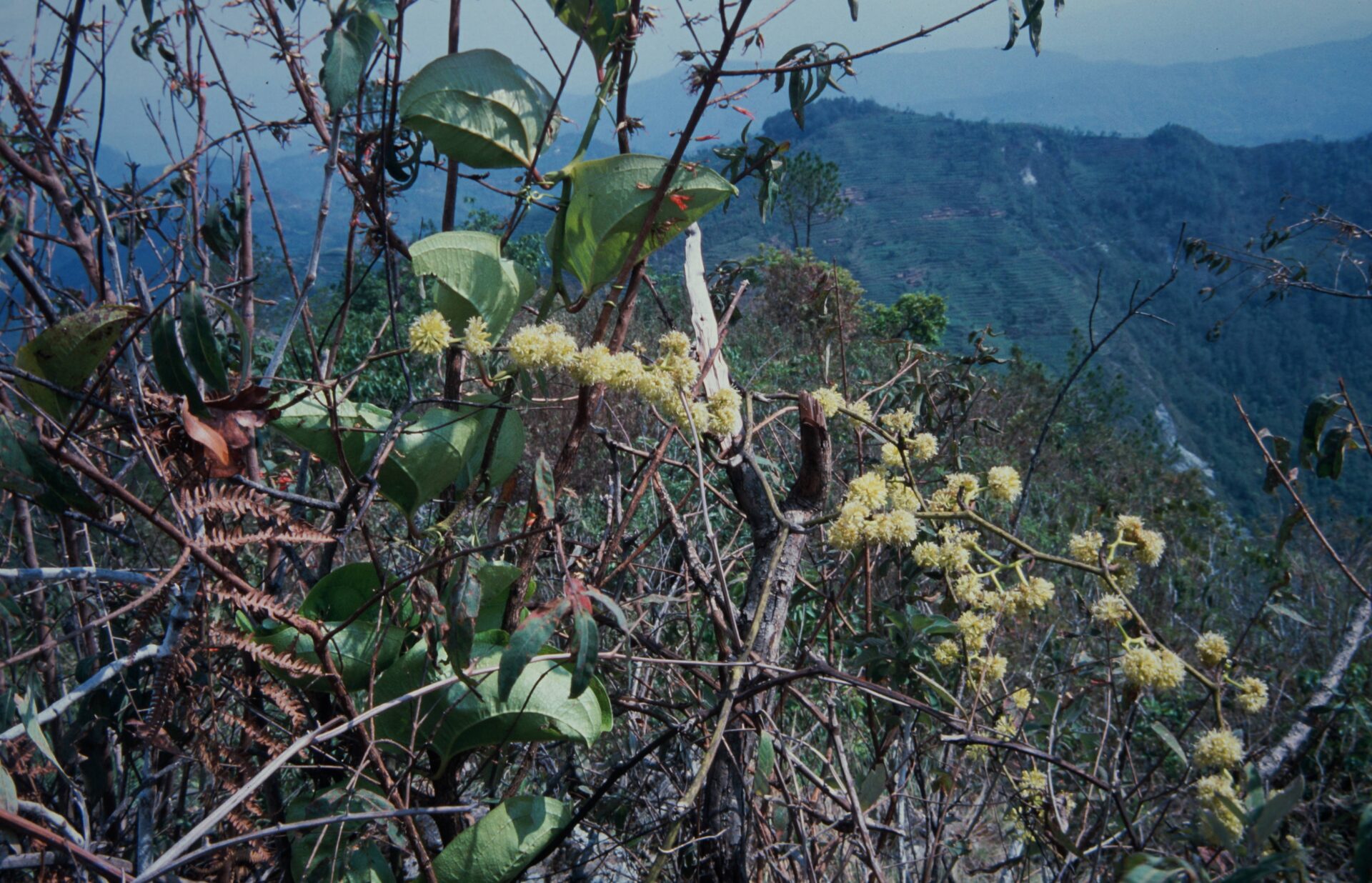
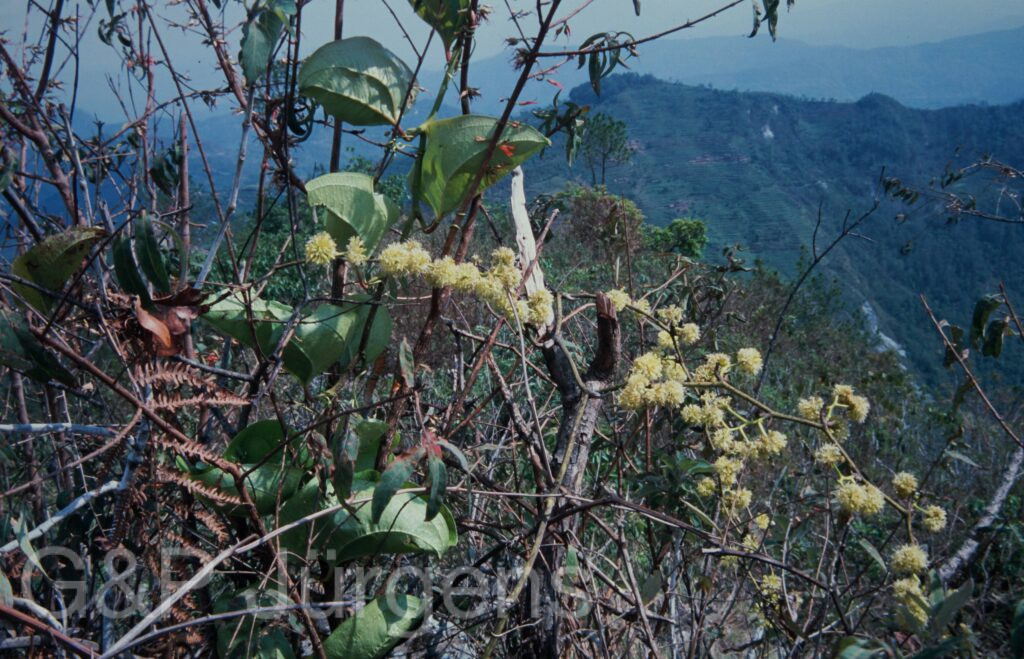
Smilax orthoptera is a climbing monocot of the eastern and central Himalaya, recorded by GBIF from India, Nepal and Bhutan in a modest dataset of about 35 occurrences, an accepted species of the warm-temperate hill forests. It scrambles through the understorey and along forest margins, thickets and shrubby slopes of the lower and middle hill zone, broadly between roughly 1500 and 2500 m, where moist, monsoon-fed broad-leaved forest provides the supports its tendrils require. The image from Tullikot in the Gorkha district of Nepal at 1800 m, in May, places the plant in this mid-hill belt at the start of the growing season, climbing over neighbouring vegetation in dappled forest shade.
It is a woody to subwoody climber arising from a tough, knotty rhizome, with slender, angular to ridged, often prickly stems. The alternate leaves are stalked and bear at the base of the petiole a pair of tendrils derived from stipular appendages, by which the plant climbs; the blades are ovate to ovate-lanceolate, leathery, with several prominent curving main veins running from base to apex in the manner characteristic of the genus. The plant is dioecious, the small greenish to yellowish flowers borne in axillary umbels with six tepals and, in staminate flowers, six stamens; female flowers develop into small globose berries containing few seeds, dispersed by birds.
Smilax is a large, mainly tropical and warm-temperate genus and the principal element of the family Smilacaceae, set apart within the monocots by its climbing habit, paired petiolar tendrils and net-veined yet parallel-ribbed leaves. S. orthoptera is one of several Himalayan species distinguished by stem armature, leaf shape and the form of the tendril-bearing petiole. Restricted in range but locally frequent within its forest habitat, it has not been assessed as threatened, although the species depends on the persistence of intact mid-elevation Himalayan forest.
Author: A.DC. · Sources: POWO (Kew), GBIF, Flora of China Vol. 24, Flora of Nepal, Flora of Bhutan Vol. 3, Koyama's monographic studies of Asian Smilax