
S.C.Chen
Description
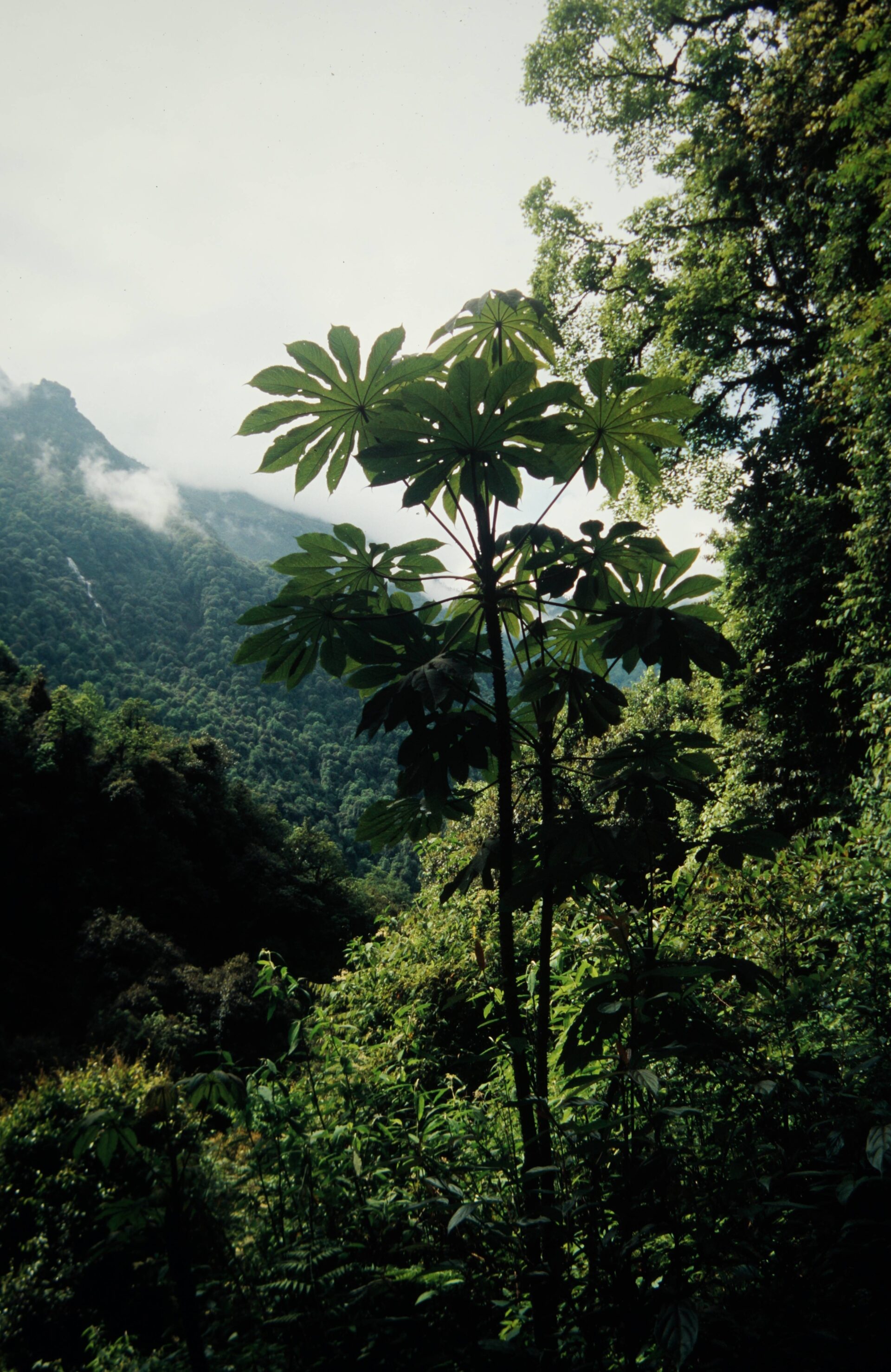
Smilax munita is an eastern Himalayan greenbrier distributed from Nepal through Sikkim and West Bengal in India to Bhutan, north-eastern Myanmar and adjacent China, with around 90 GBIF records reflecting a fairly restricted montane range. It is a climber of temperate broad-leaved and mixed forest, forest margins and thickets, scrambling over shrubs and small trees, typically between about 2,000 and 3,000 m. The plant photographed at Kishong in West Bengal, India, at 2,700 m flowering in May is characteristic of the cool, humid Sikkim-Himalayan forest belt where the genus is well represented.
The plant is a dioecious, woody to subwoody perennial climber arising from a creeping rhizome, the stems armed with stout, scattered prickles (reflected in the epithet munita, "armed"). The leaves are alternate, simple, leathery, ovate to elliptic with several prominent arcuate-convergent main veins, and bear a pair of slender tendrils at the base of the petiole that serve for climbing. The flowers are small, unisexual and greenish, borne in axillary umbels; the perianth consists of six tepals, with six stamens in male flowers and a superior three-locular ovary in female flowers. The fruit is a small globose berry, ripening dark, containing few seeds.
Smilax is the sole large genus of the monocot family Smilacaceae, a lineage of vining herbs and lianas with reticulate-veined leaves and basal tendrils unusual among monocots. Many congeners yield the medicinal "sarsaparilla," and Himalayan species are locally used. The combination of prickly stems, coriaceous tri- to multiveined leaves and the high-montane distribution distinguishes S. munita within the eastern Himalayan members of the genus.
Author: S.C.Chen · Sources: POWO (Kew), Flora of China Vol. 24, Flora of Bhutan Vol. 3, GBIF, Koyama: Smilacaceae of Eastern Asia