Tag:

Bhutan

Flowers of Bhutan — 1326 plant species documented across the Bhutanese Himalaya, from dense broadleaf and conifer forests to alpine scrub and meadows. Bhutan’s largely intact wilderness shelters an exceptional diversity of orchids, rhododendrons, primulas and Himalayan poppies, many of them regional endemics. Each species page includes a botanical description, distribution, habitat and flowering time, with the original photograph and its recorded altitude and locality.

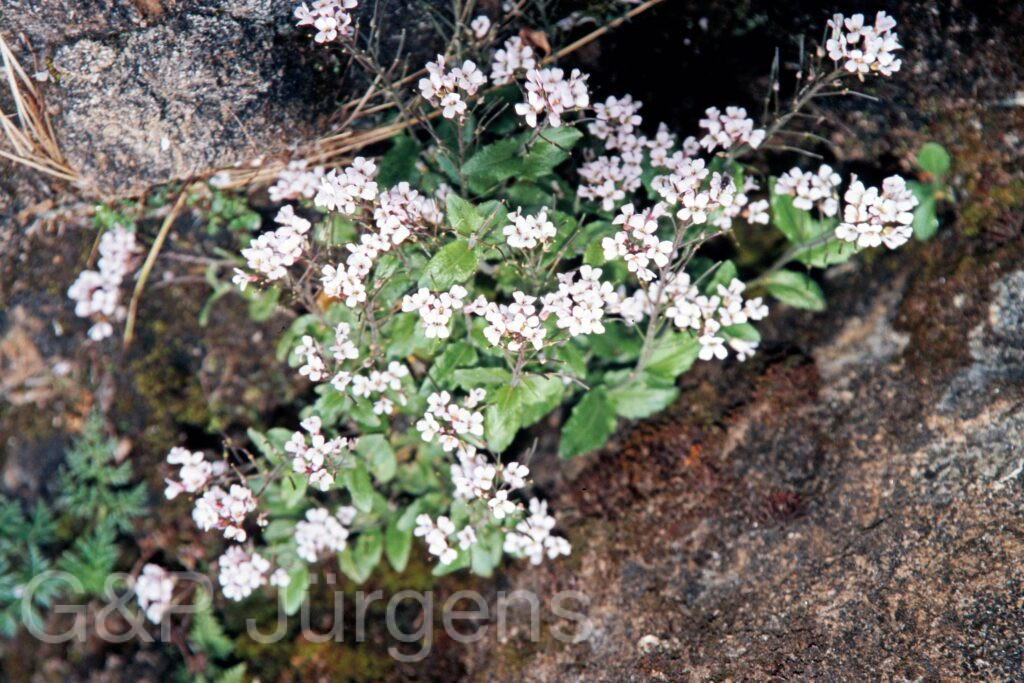
(W.W.Sm.) Al-Shehbaz & Warwick
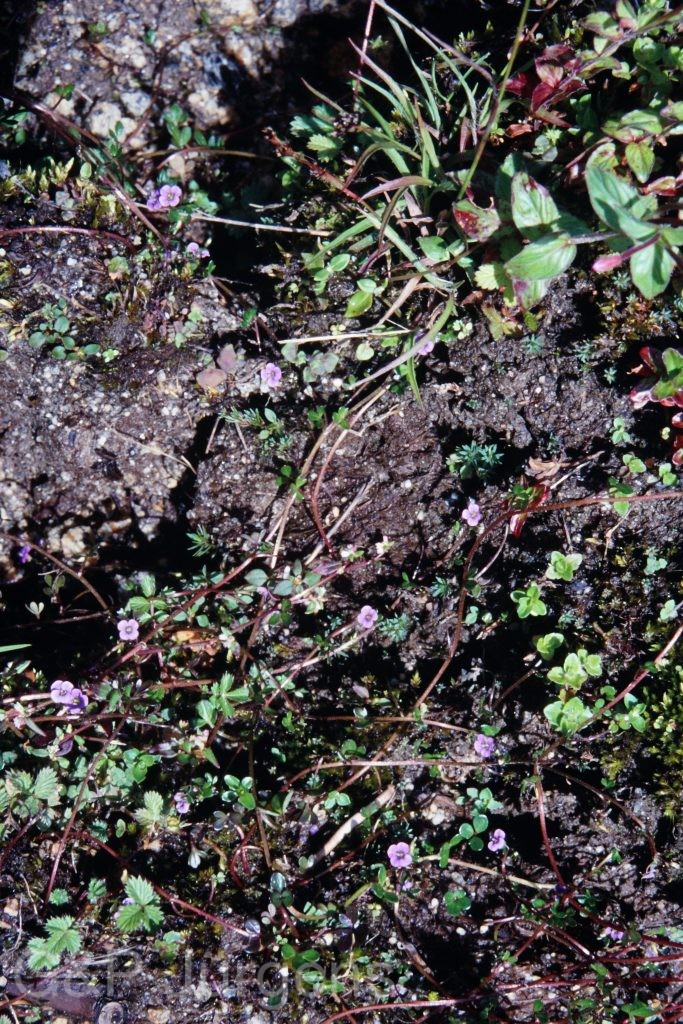
Sikkim2003 104 P142
Sikkim below Dzongri 3850m, August

Description

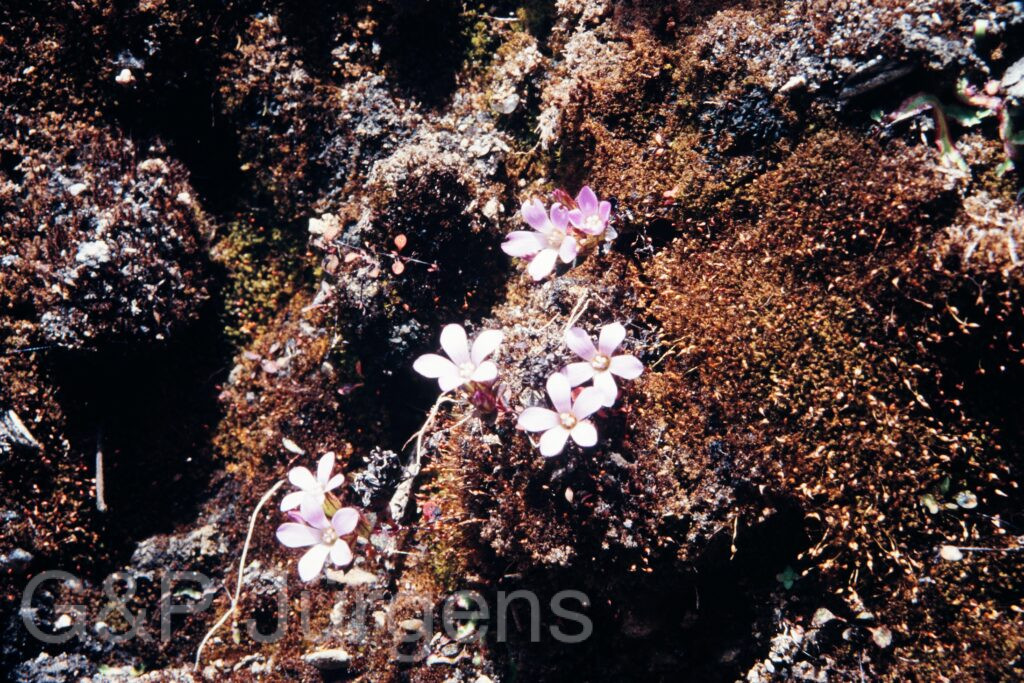
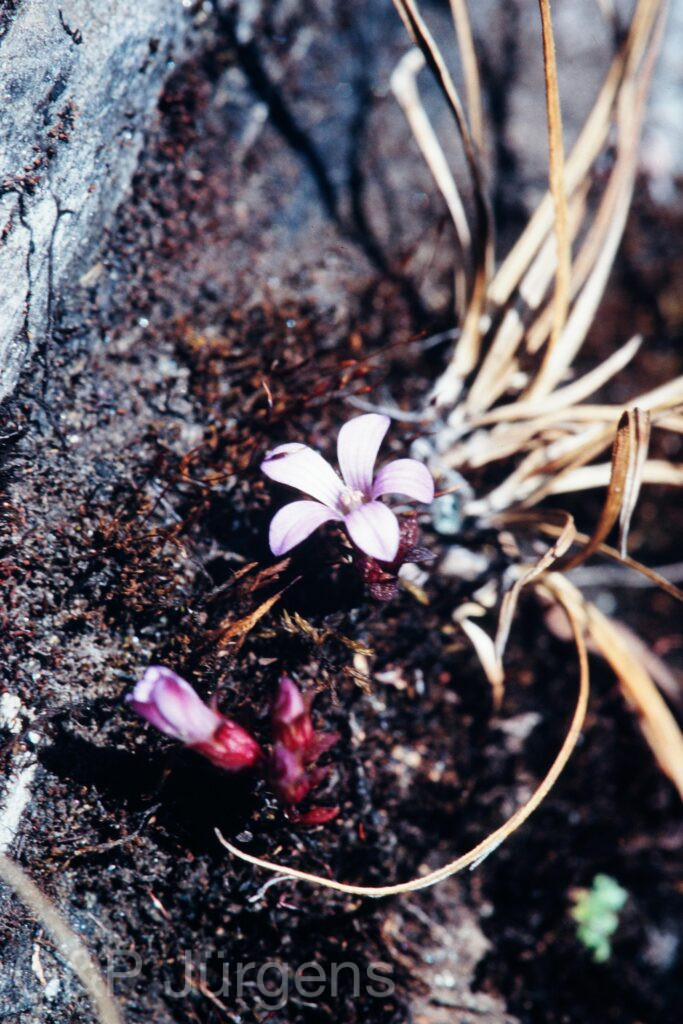
Aphragmus serpens is a diminutive alpine crucifer of the eastern and central Himalaya, recorded from India, Nepal, Bhutan and China, with some 74 georeferenced occurrences indicating a scattered but recurrent presence across the high ranges. It is a plant of cold, open alpine habitats — gravelly and stony slopes, moraine debris, rock ledges and the margins of snow-melt seepages — typically well above treeline. The illustrated material from below Dzongri in Sikkim, at about 3850 m and photographed in August, is representative of the late-summer flowering of this species in the moist eastern Himalayan alpine zone.

The plant is a small, low-growing perennial with a slender, often creeping or trailing habit reflected in the epithet serpens. It arises from a thin rootstock and forms loose tufts or mats of mostly basal leaves; these are small, entire to slightly toothed, narrowed to a petiole, and more or less glabrous to sparsely hairy. The inflorescence is a short, few-flowered raceme; the flowers are typically cruciform with four small petals, usually white to pale lilac or pinkish, four sepals and the characteristic tetradynamous androecium of six stamens. The fruit is a short, oblong to ovoid silicula containing few seeds, the slender style persisting at the apex.

The genus Aphragmus comprises a small group of high-alpine Asian crucifers whose generic limits and species circumscriptions have been substantially revised, this combination being attributed to Al-Shehbaz & Warwick in the course of modern molecular and morphological reassessment of the Brassicaceae. As a specialist of severe high-altitude environments, A. serpens is intimately tied to short, cool growing seasons and reliable snow-melt moisture, and its restricted alpine niche makes it potentially sensitive to climatic warming, though its wide if sparse distribution suggests it is not at present under acute threat.

Author: (W.W.Sm.) Al-Shehbaz & Warwick · Sources: POWO (Kew), GBIF, Flora of China (Brassicaceae), Flora of Bhutan, Al-Shehbaz: monographic revisions of Himalayan Brassicaceae
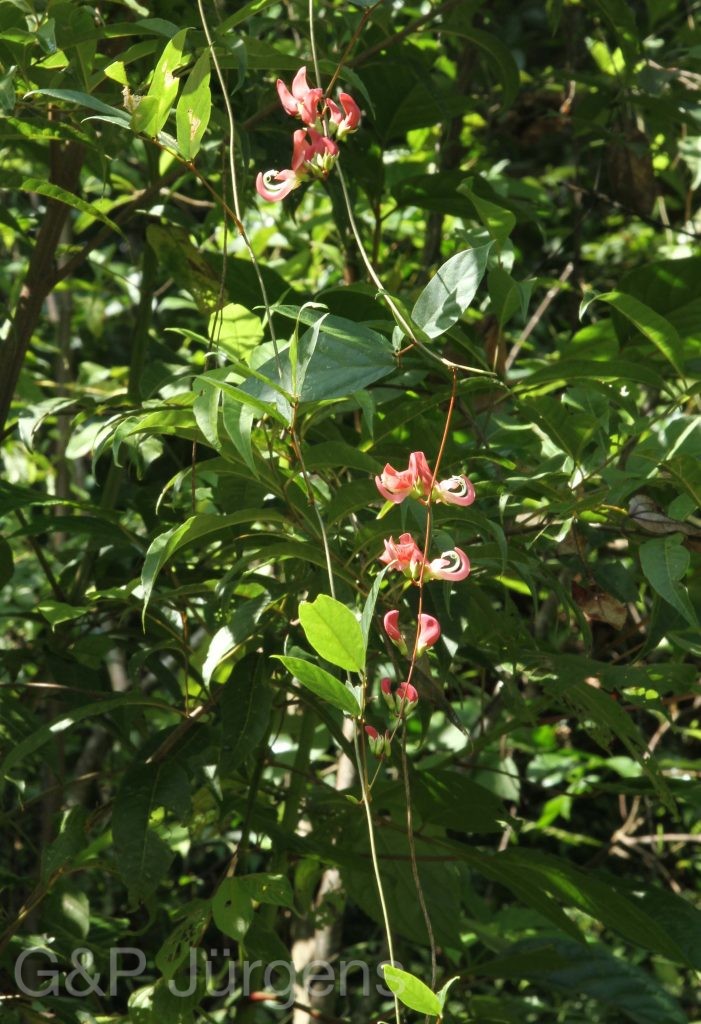
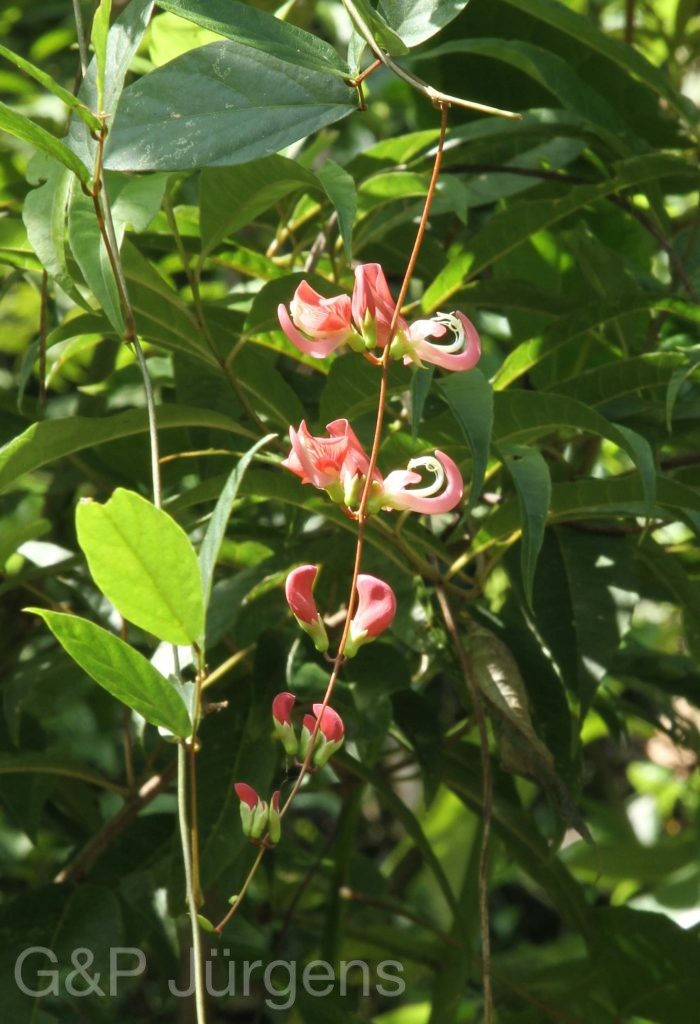
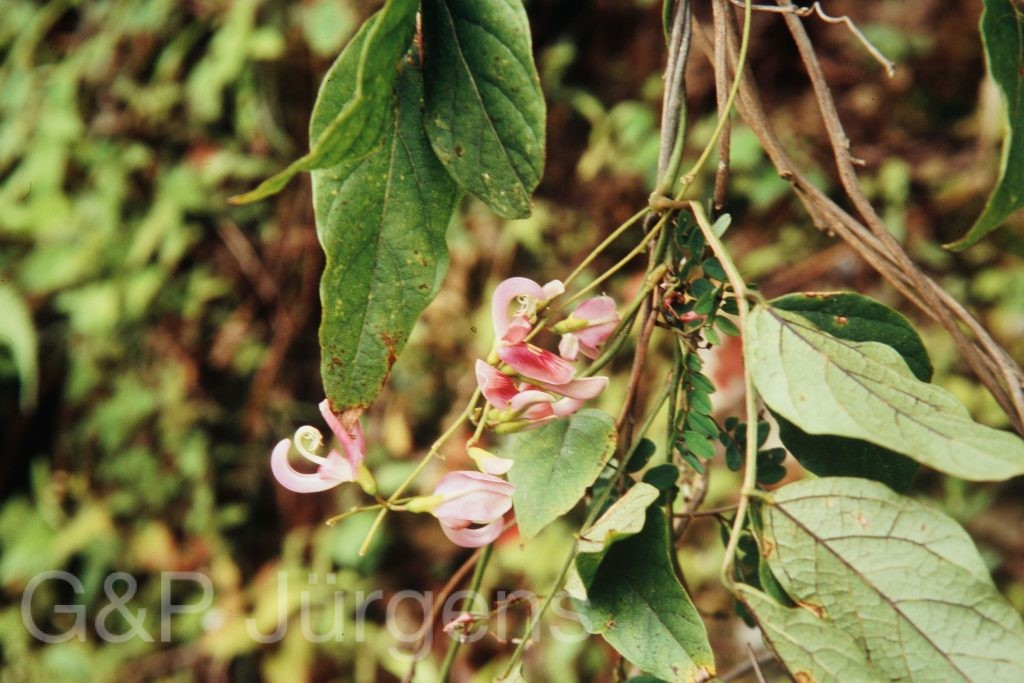
Apios carnea

by GP Jürgens

(Wall.) Benth.

Bhutan2012 990
Bhutan Trithangebe, 1100m October
Bhutan2012 991
Bhutan Trithangebe, 1100m October
Bh09 242 P405
Bhutan Wangdi, 2000m June

Description

Apios carnea is widely distributed through the Himalaya and into south-east and east Asia, recorded from Nepal, north-east India, Bhutan, Myanmar, China, Thailand, Laos, Vietnam, Malaysia, Korea and Japan among its 887 georeferenced occurrences. It is a climbing herb of forest margins, thickets, streamsides and clearings in warm-temperate to subtropical settings, scrambling over shrubs and into the lower canopy. The Bhutan records at Trithangebe (1100 m, October) and Wangdi (2000 m, June) illustrate a broad altitudinal tolerance from about 1000 to 2400 m, flowering through the warm wet season.

It is a perennial twining vine arising from a tuberous, fleshy rootstock, with slender, herbaceous, somewhat woody-based stems. The leaves are pinnately compound (imparipinnate) with usually five to seven ovate-lanceolate, acuminate leaflets. The flowers are borne in dense axillary racemes and are typical papilionate legumes, flesh-pink to dull reddish or salmon, with a broad standard, incurved keel and the characteristic coiled keel-and-style of the genus. The fruit is a slender, elongate, dehiscent legume containing several seeds.

The genus Apios belongs to tribe Phaseoleae of subfamily Faboideae, allied to climbing beans, and the twisted keel enclosing the spirally coiled style and stamens is a notable floral specialisation promoting cross-pollination by bees. As a nitrogen-fixing legume it contributes to soil enrichment, and its tubers have been used locally as food. Common and widespread across its range, it is of no conservation concern, though it is regionally valued both as an ornamental climber and a wild food plant.

Author: (Wall.) Benth. · Sources: POWO (Kew), GBIF, Flora of Bhutan, Flora of China, Flora of Nepal, Lackey Phaseoleae revision (Advances in Legume Systematics)

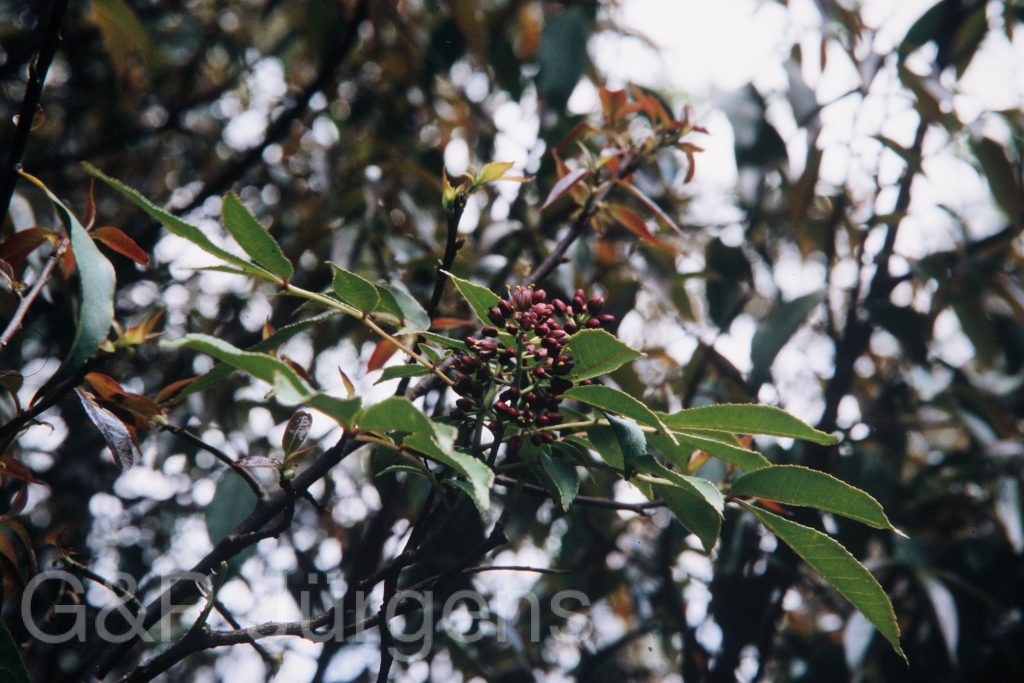
J.Wen

Bh2008 330 P510
Bhutan Tongsa 2400m, April

Description

Aralia gigantea is a large herbaceous to subwoody member of the ginseng family ranging across the eastern Himalaya and adjacent uplands, with GBIF logging 145 occurrences in China, Nepal, India, Myanmar and Bhutan. It grows in moist temperate broad-leaved and mixed forest, along ravines, forest clearings and damp shaded slopes, generally between roughly 2000 and 3000 m. The illustrated plant was recorded in Bhutan near Tongsa (Trongsa) at about 2400 m in April, a representative mid-montane forest station for the species, where it springs up among tall-herb communities as the growing season begins.

The plant is a robust, sparsely prickly herb with stout, somewhat pithy stems arising from a thickened rootstock. Leaves are very large, alternate and two- to three-pinnately compound, the numerous ovate leaflets serrate and acuminate, borne on prickly rachides. The inflorescence is a massive terminal panicle of many small umbels, the individual flowers small, greenish-white and five-merous, with a reduced calyx, five petals, five stamens and an inferior ovary crowned by free or basally united styles. The fruit is a small subglobose drupe, ribbed and dark when ripe, containing several flattened pyrenes and attractive to birds.

The species belongs to a group of giant herbaceous Aralia centred on East and Southeast Asia, distinguished from woody congeners by its large compound foliage and herb-like habit. POWO and GBIF accept the name as currently circumscribed. Its size and rapid seasonal growth make it a conspicuous component of Himalayan tall-herb forest understorey, and like related Aralia it has minor ethnobotanical use.

Author: J.Wen · Sources: POWO (Kew), GBIF, Flora of China, Flora of Bhutan, Annotated Checklist of the Flowering Plants of Nepal, Systematics of Aralia (Araliaceae monograph)

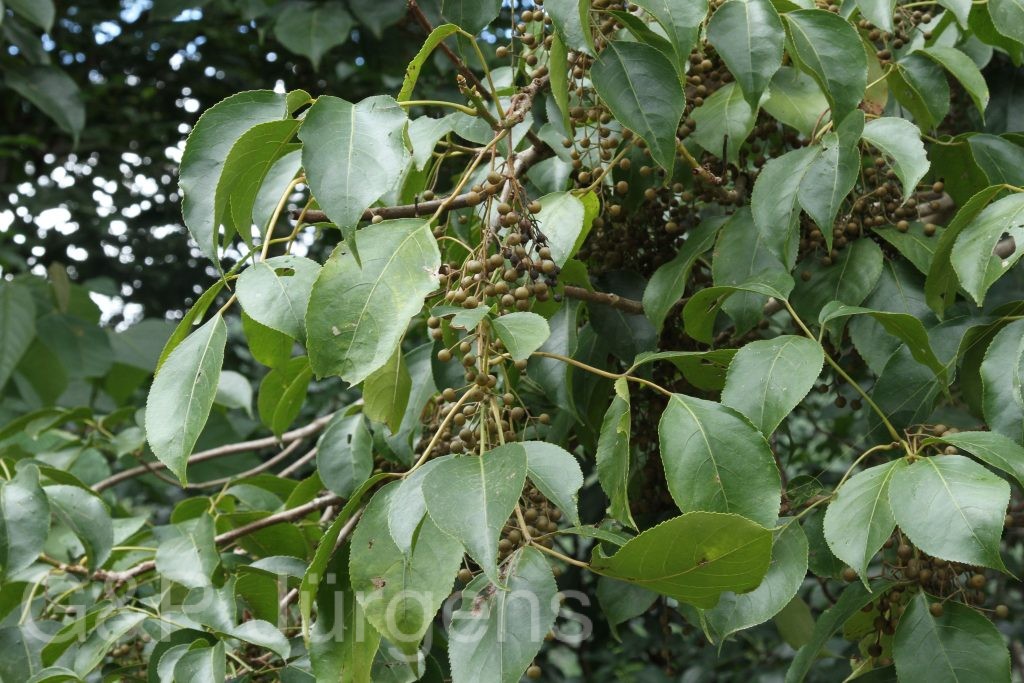
J.Wen, Lowry & Esser

Bhutan2015 646
Bhutan Mo-Chu 1600m, October

Description

Aralia kingdon-wardii is a narrowly distributed eastern Himalayan and southwest Chinese species known from China, Myanmar, Bhutan and northeastern India, with GBIF recording only about 45 occurrences, reflecting its rarity and restricted range. It is a plant of warm-temperate to subtropical broadleaf forest, the photographed material coming from the Mo-Chu valley in western Bhutan at 1600 m in October. It occupies humid forest interiors, ravine slopes, clearings and stream banks on rich, moist soils in the lower montane belt, where it grows as a tall coarse herb or soft-wooded shrub in shaded to semi-open situations.

The species is a robust, often prickly perennial with stout stems and very large, two- to three-pinnately compound leaves, the numerous ovate to ovate-lanceolate leaflets serrate along the margins and acuminate at the apex. The small, five-merous, greenish-white flowers have an inferior ovary and are borne in numerous umbellules aggregated into a very large, much-branched terminal panicle, the typical inflorescence architecture of Aralia. The fruit is a small, dark, more or less globose, ribbed drupe containing several flattened pyrenes, ripening to purple-black and dispersed by birds.

Named for the plant collector Frank Kingdon-Ward, the species was described by J. Wen, Lowry and Esser as part of modern revisionary work clarifying Asian Aralia and the segregation of related Araliaceae genera. Given its limited known range and low number of records, A. kingdon-wardii is of potential conservation interest, dependent on the persistence of intact eastern Himalayan montane forest; its panicles of nectar-rich flowers and bird-dispersed drupes integrate it into forest pollinator and frugivore networks.

Author: J.Wen, Lowry & Esser · Sources: POWO (Kew), GBIF, Flora of China, Flora of Bhutan, Wen, Lowry & Esser studies in Asian Aralia (Araliaceae), Frodin & Govaerts World Checklist of Araliaceae

O.E.Schulz

Garh 07 137 ergebnis
India Garhwal Kinkhola 3500m, June

Description

Arcyosperma primulifolium is a Himalayan crucifer of high-elevation forest and meadow margins, with GBIF recording 99 occurrences from India, Nepal, Pakistan and Bhutan. It occupies moist, shaded slopes, forest edges and damp turf in the upper temperate to subalpine zone, often among rocks and along the transition between birch-rhododendron forest and open alpine pasture. The image was taken at Kinkhola in Garhwal, India, at about 3500 m in June, when the plants flower as the high meadows green up after the spring thaw.

It is a perennial herb with a stout rootstock from which arise a rosette of long-petioled, lyrate to pinnatifid basal leaves; the lamina, with its rounded, crenate terminal lobe, recalls the foliage of a primrose, as the epithet primulifolium notes. The flowering stems are erect and bear smaller, less divided leaves below an elongating raceme. The flowers are white, with four sepals, four clawed petals and the tetradynamous stamens of the Brassicaceae. The fruit is a slender, somewhat flattened silique that distinguishes the monotypic genus; the seeds are arranged in the pod in the manner reflected by the generic name Arcyosperma.

Arcyosperma (Brassicaceae) is a monotypic genus segregated by O. E. Schulz, restricted to the Himalaya and allied within the family's diverse Asian montane crucifers. Its distinctive lyrate leaves and fruit characters set it apart from related genera such as Cardamine and Draba with which it co-occurs. Being a narrow-ranged montane endemic of a single species, it is of particular taxonomic and biogeographic interest, and like other high-Himalayan herbs its populations depend on intact subalpine forest and meadow habitats.

Author: O.E.Schulz · Sources: POWO (Kew), GBIF, Flora of Pakistan, Annotated Checklist of the Flowering Plants of Nepal, Jafri's Flora of West Pakistan (Brassicaceae), Schulz's treatment of Cruciferae in Engler's Das Pflanzenreich

Edgew.

Nepal 99 651 2 ergebnis
West-Nepal Kagmara-La 5000m, July

Description

Arenaria melandryoides is a high-alpine cushion plant of the central and eastern Himalaya, recorded from China, Bhutan, India and Nepal across 35 GBIF occurrences. It is a specialist of the upper alpine and subnival belt, occupying open screes, gravelly slopes, moraines and rock crevices at very high elevations, typically above 4000 m. The population imaged on the Kagmara-La in West Nepal at 5000 m in July exemplifies its extreme montane habitat, where it flowers during the brief summer growing season amid sparse, frost-pruned vegetation on exposed, well-drained substrates.

The species is a low, tufted to cushion-forming perennial herb with a stout, woody rootstock and numerous short, densely leafy shoots forming compact mats. The leaves are small, sessile, linear-lanceolate and somewhat rigid, opposite and crowded, often ciliate. The flowers are solitary or few, borne on short pedicels; the calyx comprises five free, lanceolate sepals, and the five white petals are entire and slightly exceed the calyx. There are typically ten stamens and a superior ovary bearing three styles, ripening into a capsule that dehisces by valves to shed numerous small seeds adapted to wind and gravity dispersal on open ground.

The name Arenaria melandryoides is here treated as a synonym, with the accepted name being Arenaria melandryoides; the related epithet melandryiformis reflected in the source link points to ongoing nomenclatural revision within this taxonomically complex group. Arenaria sensu lato in the Himalaya has been repeatedly recircumscribed, with many species transferred among segregate genera. As a cushion-forming subnival specialist, the plant illustrates the convergent growth forms that buffer alpine Caryophyllaceae against cold, wind and short seasons.

Author: Edgew. · Sources: POWO (Kew), GBIF, Flora of China Vol. 6, Flora of Bhutan Vol. 1, Flora of Nepal, Flora of Pakistan, McNeill's revision of Arenaria

Edgew. & Hook.f.

Sikkim2003 289 P400
Sikkim Saniti-Lake 4250m August

Description

Arenaria ciliolata is a small alpine sandwort of the central and eastern Himalaya, recorded from Nepal, Bhutan, India and China, with an additional outlying datum (gbif_countries: NP, BT, IN, CN, IS) and about 134 GBIF occurrences. It grows on open alpine turf, gravelly and stony slopes, rock crevices and screes well above the treeline, where it forms low cushions or mats in the cold, well-drained habitats typical of the genus. The illustrated material was collected near Saniti Lake in Sikkim at about 4250 m in August, a high-alpine setting where late-summer flowering follows snowmelt. In GBIF the name carries gbif_status SYNONYM, with Arenaria ciliolata given as the accepted name.

The plant is a tufted to mat-forming perennial arising from a branched woody base, with short, densely leafy stems. The leaves are small, opposite, sessile, narrow and rigid, often pungent-tipped and conspicuously ciliate on the margins, the feature evoked by the epithet. The flowers are solitary or few in lax cymes, with five free, white petals exceeding the five lanceolate, often ciliate-margined sepals; the stamens are typically ten and the styles three. The fruit is a capsule opening by valves or teeth at the apex to shed numerous small seeds.

Arenaria is a large, predominantly Northern Hemisphere genus of the pink family with a marked centre of diversity in the mountains of Asia, and the cushion-forming alpine species such as A. ciliolata have figured in repeated taxonomic and phylogenetic reassessments that have realigned segregates within tribe Arenarieae, accounting for the synonymy noted in GBIF. Adapted to harsh high-mountain conditions, the species is widespread across the Himalayan alpine zone and is of no conservation concern.

Author: Edgew. & Hook.f. · Sources: POWO (Kew), GBIF, Flora of Nepal, Flora of China, Annotated Checklist of the Flowering Plants of Nepal, Caryophyllaceae account in The Families and Genera of Vascular Plants

Wall.

Bh09 18 P30
Bhutan Chele-La, 4000m June
Bh09 19 P35
Bhutan Chele-La, 4000m June
Nepal 99 512 ergebnis
West-Nepal Churta-Khola 3900m, June

Description

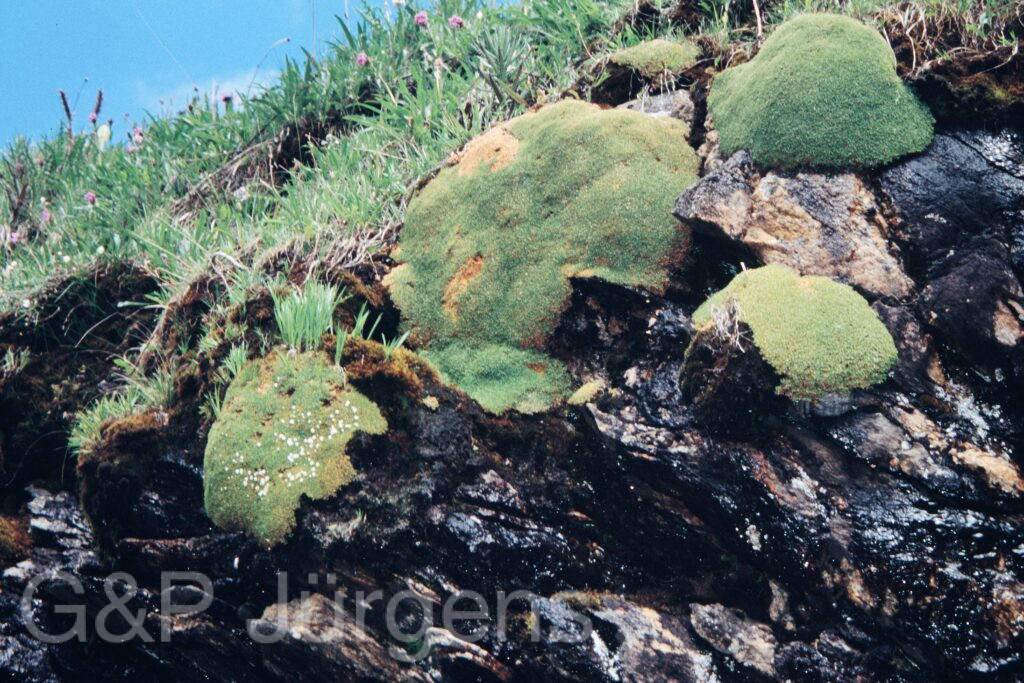
Arenaria densissima is a high-alpine cushion sandwort of the Sino-Himalaya, recorded from China (CN), Nepal (NP) and Bhutan (BT), with 159 GBIF occurrences reflecting its restricted upper-montane to alpine distribution. It is a plant of stony alpine turf, gravelly slopes, screes and exposed ridges, typically between about 3800 and 4800 m, where the dense cushion habit is an adaptation to cold, wind and intense radiation. The illustrated collections were made at Chele-La in Bhutan at around 4000 m and at the Churta-Khola in West-Nepal at about 3900 m, both in June at the start of the alpine flowering season.

It is a small, mat- or cushion-forming perennial herb with a woody, branched rootstock giving rise to densely crowded, congested shoots that form low compact tufts. The leaves are small, sessile, linear to subulate and rigid, closely imbricate and often spine-tipped, creating the dense mossy cushion alluded to by the epithet densissima. The flowers are small, solitary or few, sessile or shortly pedicellate among the leaves; they have five free, ovate sepals, five entire white petals, ten stamens and a superior ovary with styles. The fruit is a small capsule dehiscing by valves or teeth to release minute seeds.

Arenaria, in the family Caryophyllaceae, is a large genus well represented in the high mountains of Asia, where the cushion growth-form has evolved repeatedly as a convergent response to the alpine environment. Species such as A. densissima are characteristic of the Himalayan high-alpine cushion-plant communities and are of biogeographic and ecological interest as pioneers stabilising substrate and providing microhabitats in the cold desert and alpine zones.

Author: Wall. · Sources: POWO (Kew), GBIF, Flora of China, Flora of Nepal, Flora of Bhutan, Monograph of the genus Arenaria (McNeill)

Majumdar

Bhutan2012 301
Bhutan Shale-La, 4100m September

Description

Arenaria edgeworthiana is a Himalayan sandwort recorded from Nepal, China, Bhutan and India, with around 96 georeferenced occurrences in GBIF. In the GBIF backbone the name is treated as a synonym; here Arenaria edgeworthiana is taken as the accepted name for the taxon. It occupies open, well-drained alpine habitats, including stony slopes, rock crevices, gravelly flats and short turf above the treeline, generally between roughly 3500 and 4500 m. The illustrated material was gathered at Shale-La in Bhutan at about 4100 m in September, a typical high-alpine station where this small mat-forming herb grows among scattered cushion plants on exposed ridges.

The plant is a low, tufted or cushion-forming perennial with slender, much-branched stems arising from a woody base. The leaves are small, opposite, sessile and narrowly linear to subulate, often somewhat rigid and crowded, giving the shoots a moss-like or imbricate appearance. The flowers are solitary or few in lax cymes, white, with five free sepals and five entire petals; the stamens are typically ten and the styles usually three, characters that place the plant securely within Arenaria sensu lato. The fruit is a small capsule dehiscing by valves and releasing several minute seeds.

The genus Arenaria has been repeatedly recircumscribed, with many Himalayan cushion species transferred among segregate genera such as Eremogone, which accounts for the synonymy reflected in databases. Plants of this group are well adapted to severe high-mountain conditions, their dense compact habit conserving heat and moisture. No formal conservation assessment applies, but like other restricted alpine endemics it depends on stable, undisturbed high-elevation habitat.

Author: Majumdar · Sources: POWO (Kew), GBIF, Flora of Bhutan, Flora of China, Annotated Checklist of the Flowering Plants of Nepal, McNeill revision of Arenaria

Diels

Nepal 95 384 P683 ergebnis
Nepal Bahanjyang 3800m, October
Nepal 95 385 P684 ergebnis
Nepal Bahanjyang 3800m, October

Description

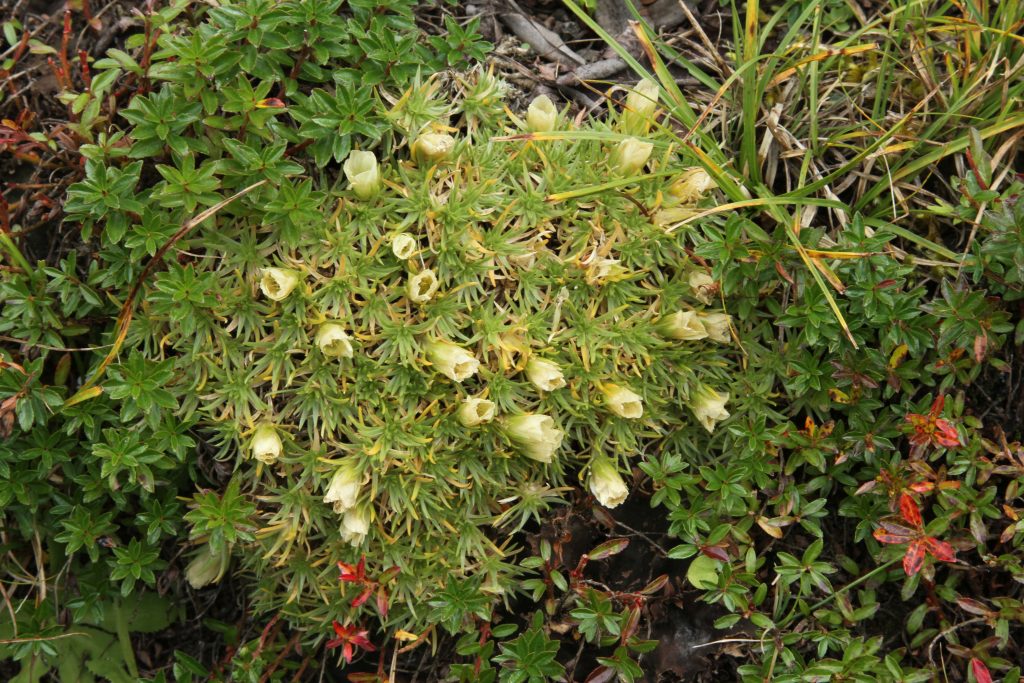
Arenaria forrestii is a high-alpine cushion plant of the Sino-Himalayan region, recorded from China, Bhutan, India and Nepal across some 164 GBIF occurrences. The photographed plant was found at Bahanjyang in Nepal at about 3800 m in October, a typical setting for a species inhabiting open alpine turf, stony slopes, gravelly screes and rocky crevices, generally between 3500 and 4800 m. It forms low compact mats on exposed, well-drained substrates where the cushion habit conserves moisture and buffers against wind, frost and intense montane insolation.

The plant is a densely caespitose perennial forming tight cushions or mats from a branched, somewhat woody caudex and slender rhizomatous base. The leaves are small, sessile, linear to subulate, opposite, rigid and often imbricate, the older bases persisting. Flowering stems are short and few-flowered; the flowers are solitary or in small cymes, with five free, often dark-veined sepals and five white, entire petals exceeding the calyx. The fruit is a small ovoid capsule dehiscing by teeth and releasing several minute reniform seeds.

GBIF treats the recorded name as a synonym, with Arenaria forrestii as the accepted name. The species belongs to the speciose genus Arenaria (sandworts), well represented among Himalayan cushion-forming alpines that contribute to the distinctive scree and meadow communities of the high passes. Such cushion plants act as nurse structures, modifying their microhabitat and facilitating other alpine species. No conservation concern is recognised, populations being widespread though confined to specialised high-elevation habitats.

Author: Diels · Sources: POWO (Kew), GBIF, Flora of China, Flora of Nepal, Flora of Bhutan, McNeill – Monograph of Arenaria (Caryophyllaceae)