Tag:

Bhutan

Flowers of Bhutan — 1326 plant species documented across the Bhutanese Himalaya, from dense broadleaf and conifer forests to alpine scrub and meadows. Bhutan’s largely intact wilderness shelters an exceptional diversity of orchids, rhododendrons, primulas and Himalayan poppies, many of them regional endemics. Each species page includes a botanical description, distribution, habitat and flowering time, with the original photograph and its recorded altitude and locality.

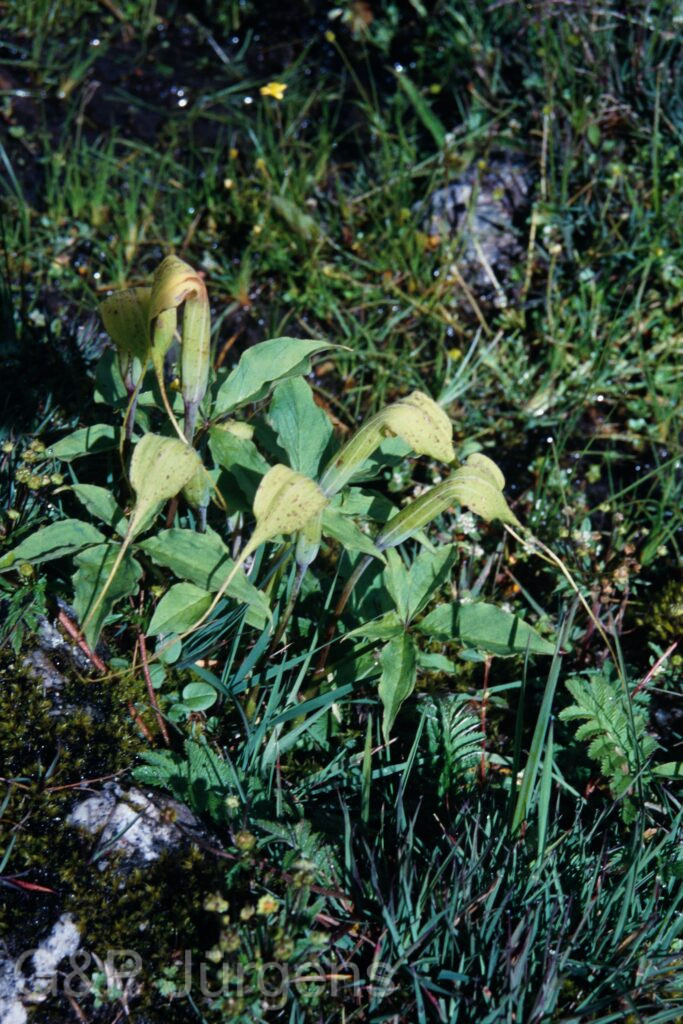
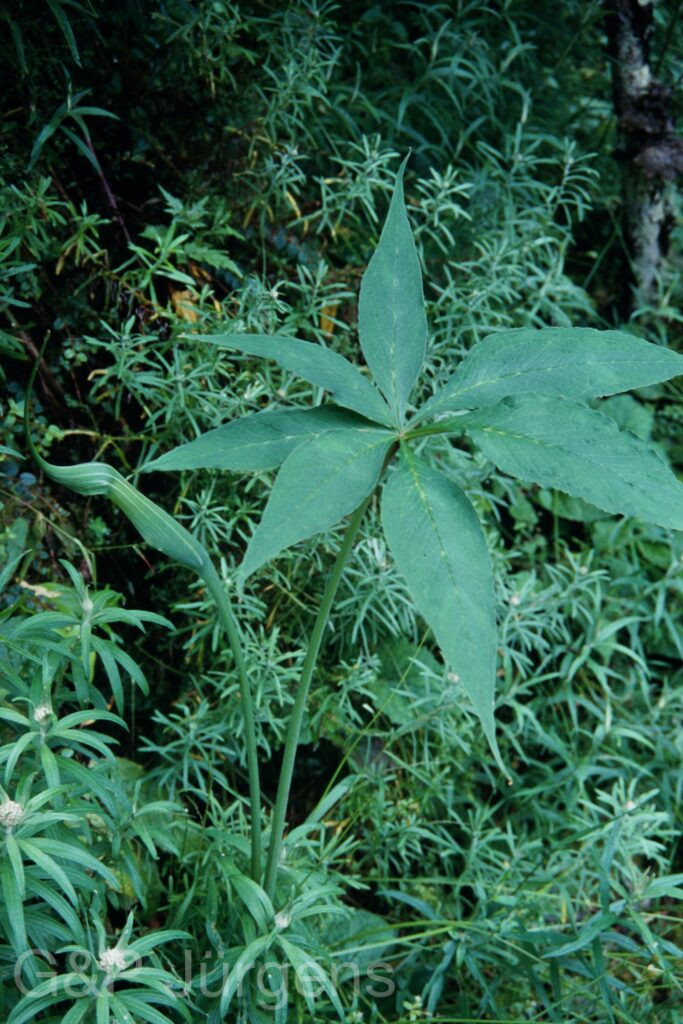
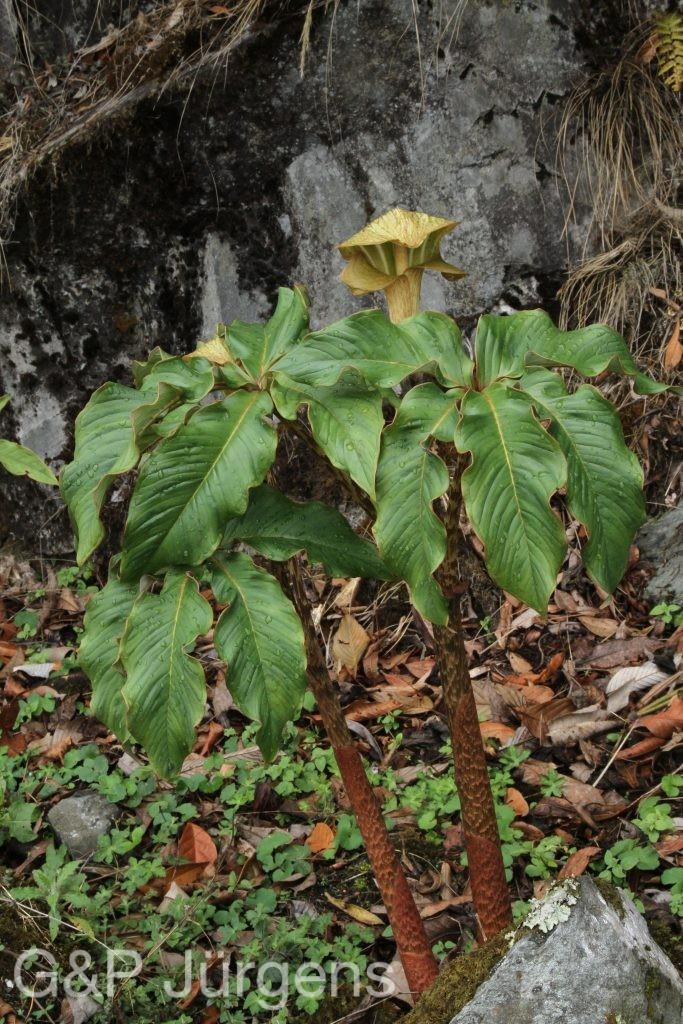
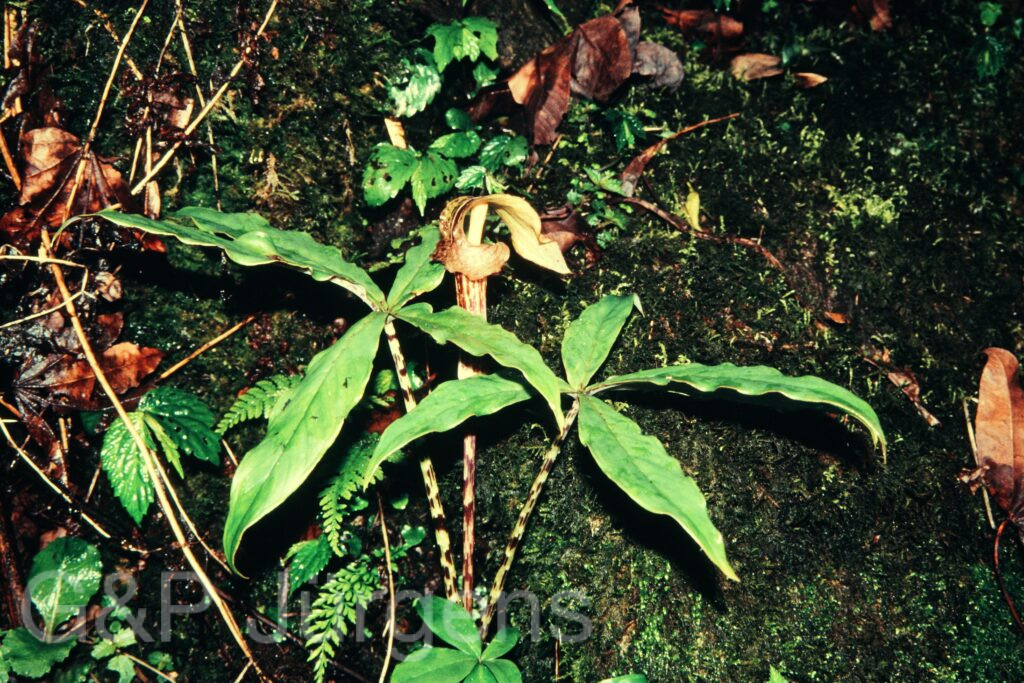
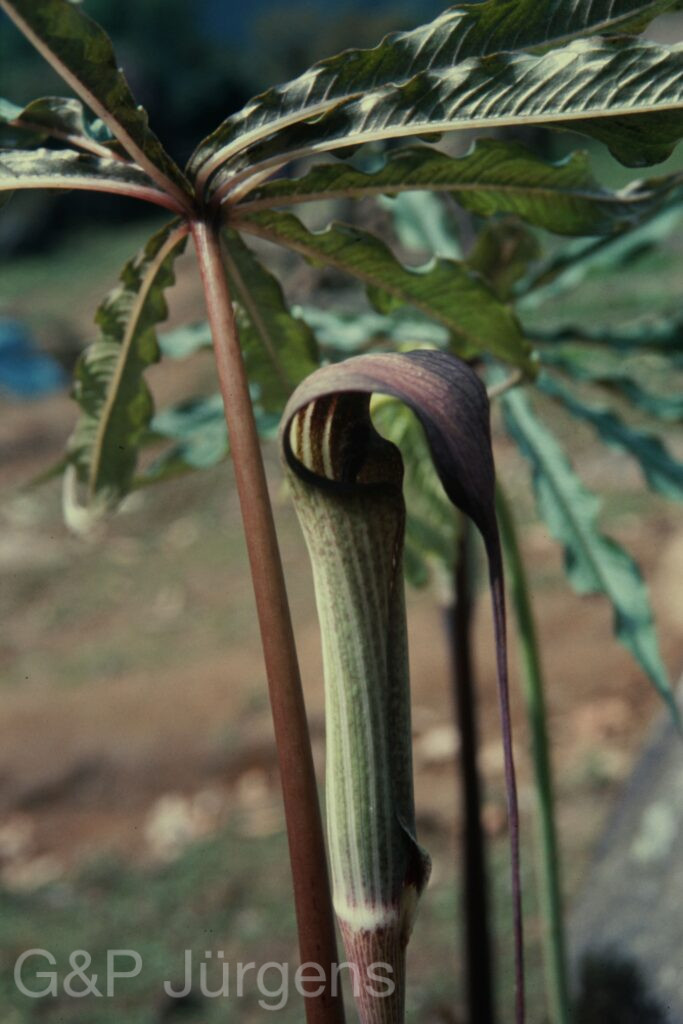
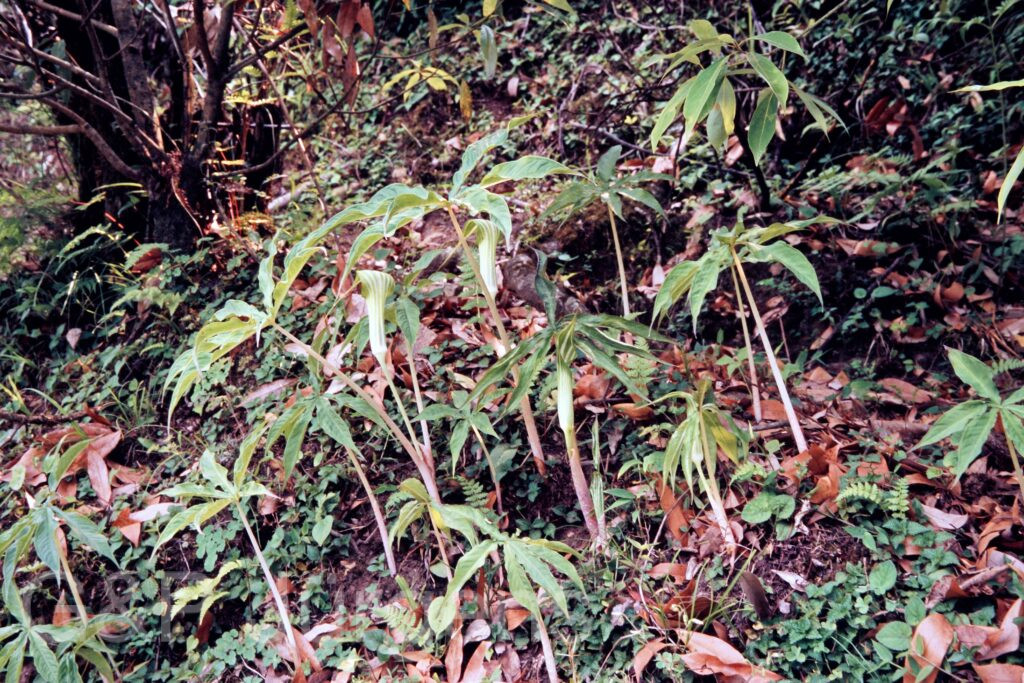
Arisaema echinatum

by GP Jürgens

(Wall.) Schott

Sikkim2004 326 P587
Sikkim/India Kokchurong 3400m May
Sikkim2004 327 P588
Sikkim/India Kokchurong 3400m May
Garh 07 86 ergebnis
India Garhwal Trijugi Narayan 2450m, June

Description

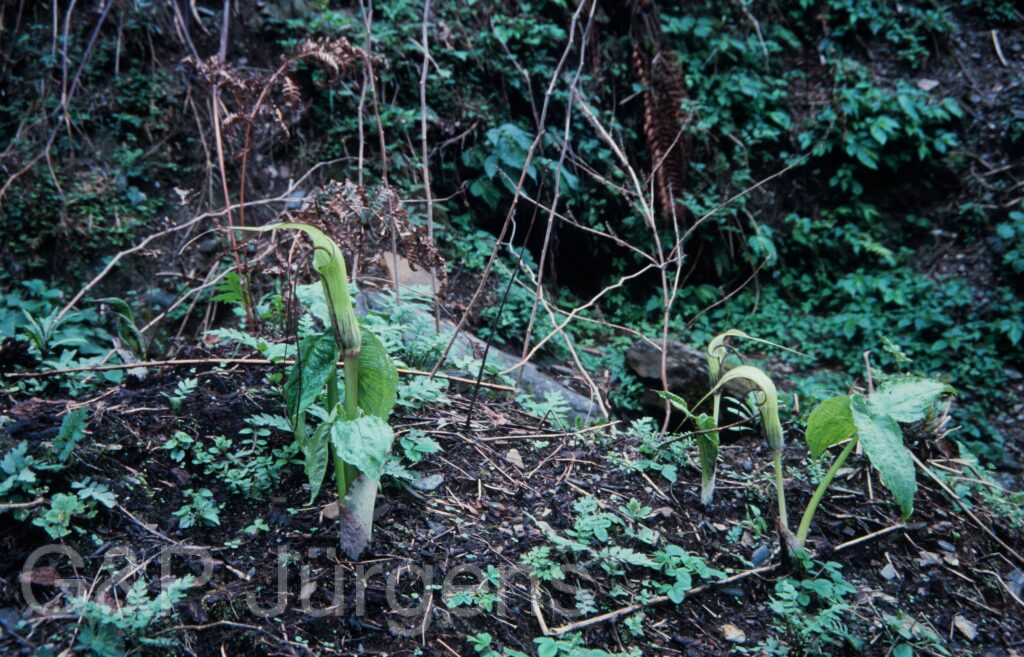
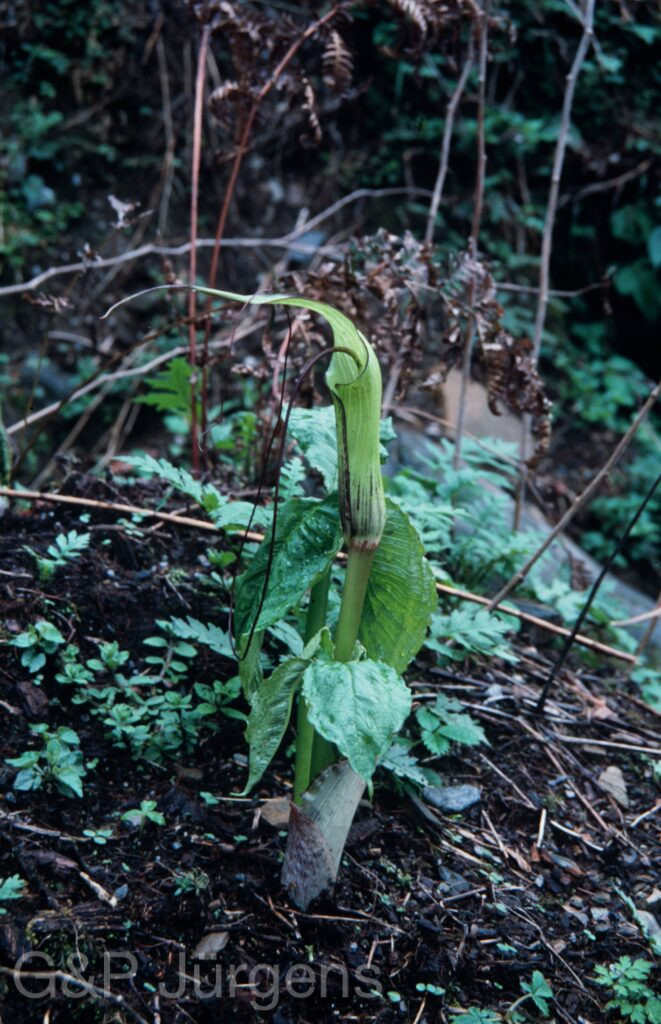
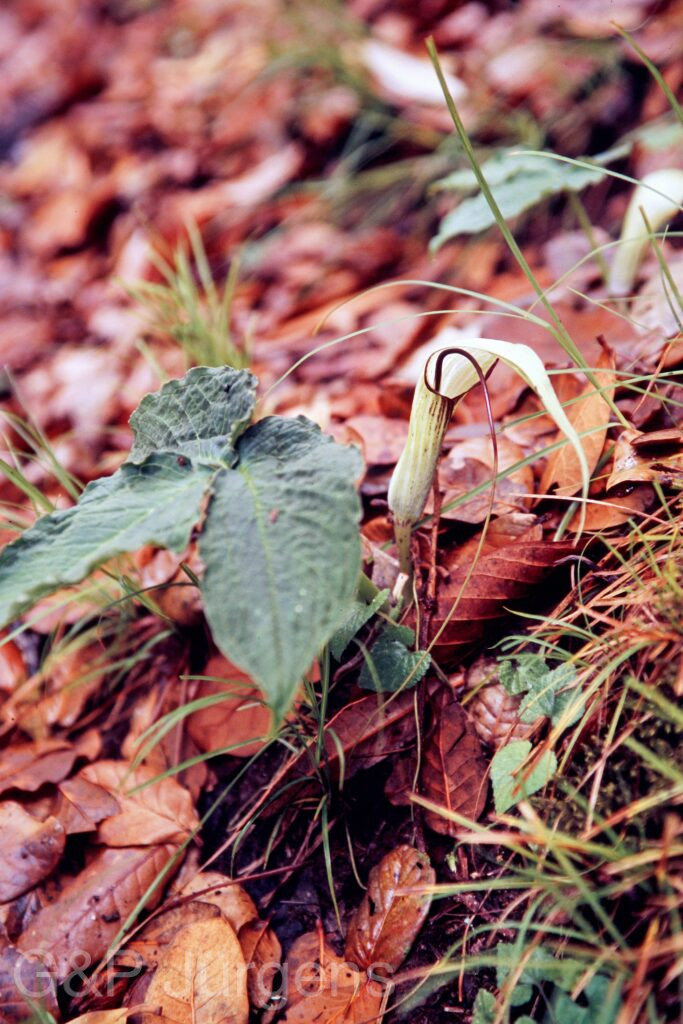
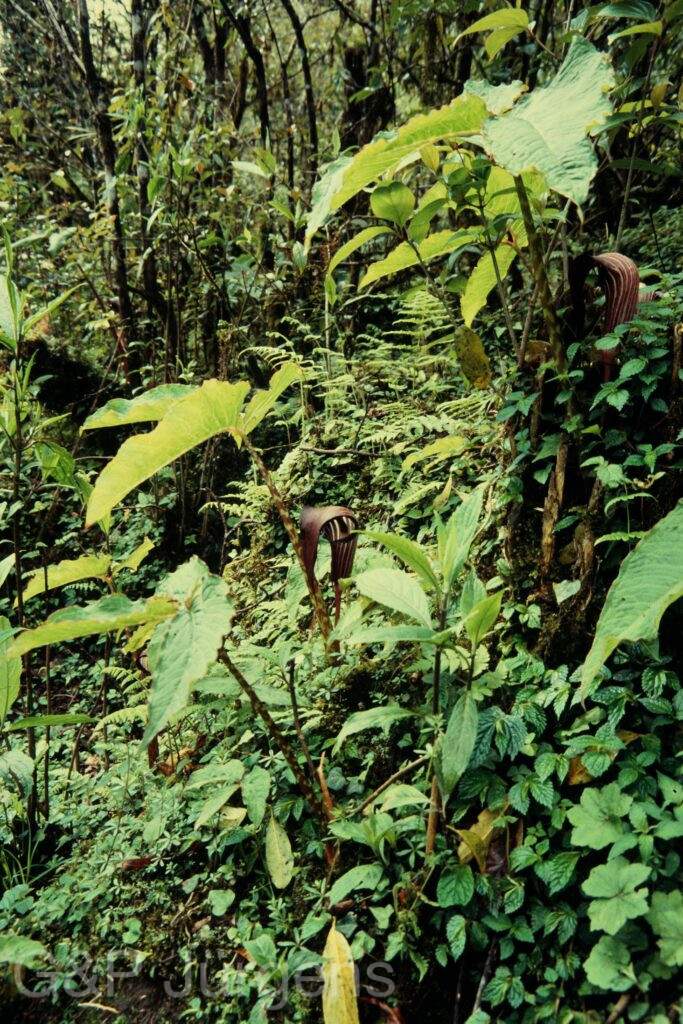
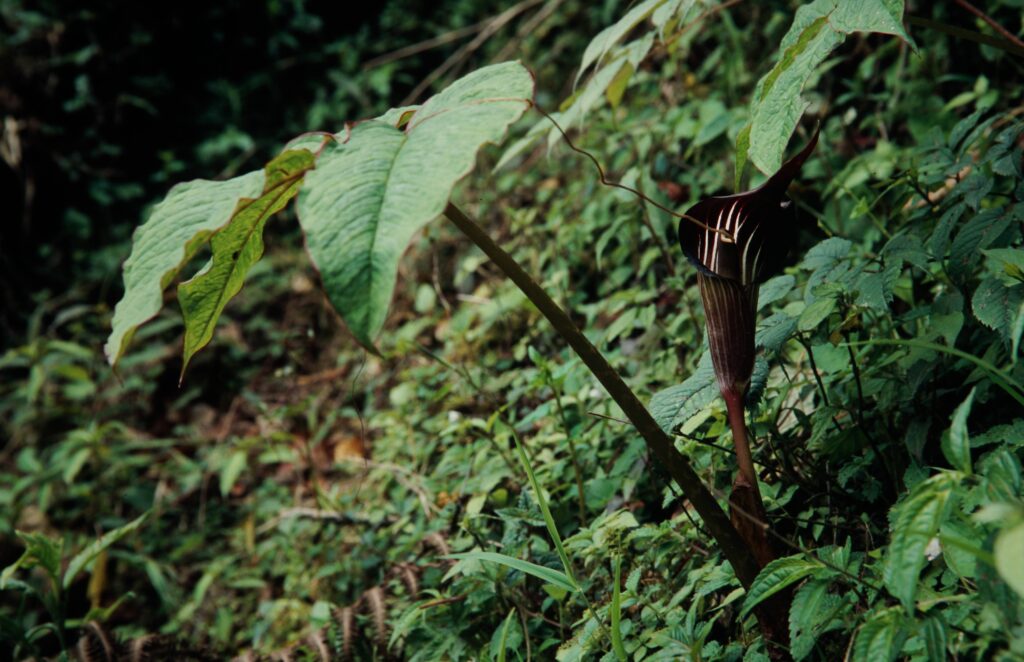
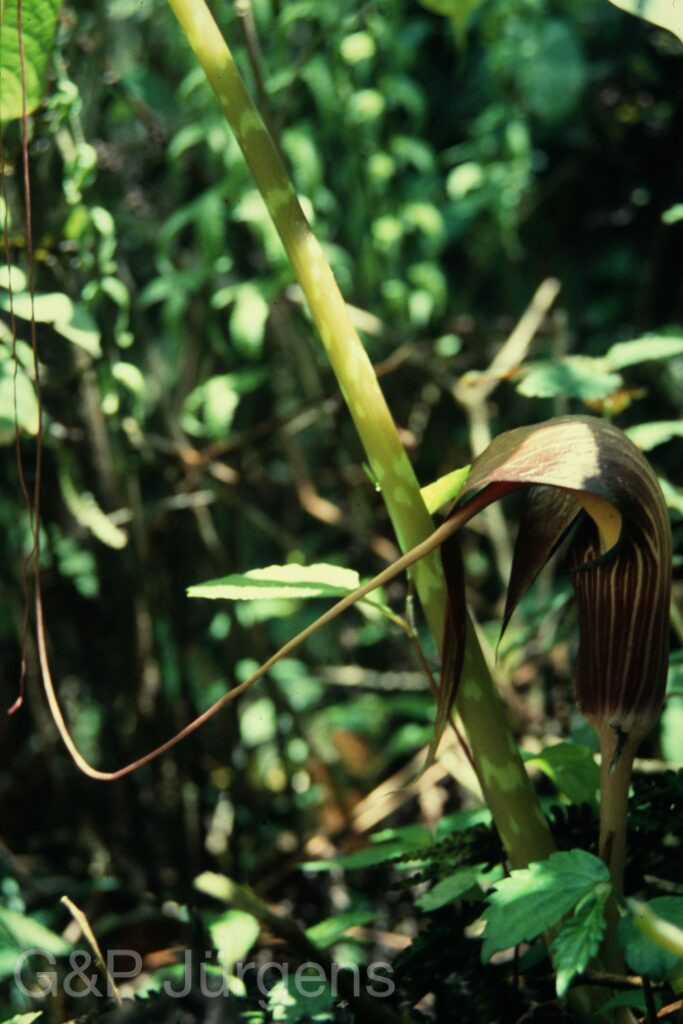
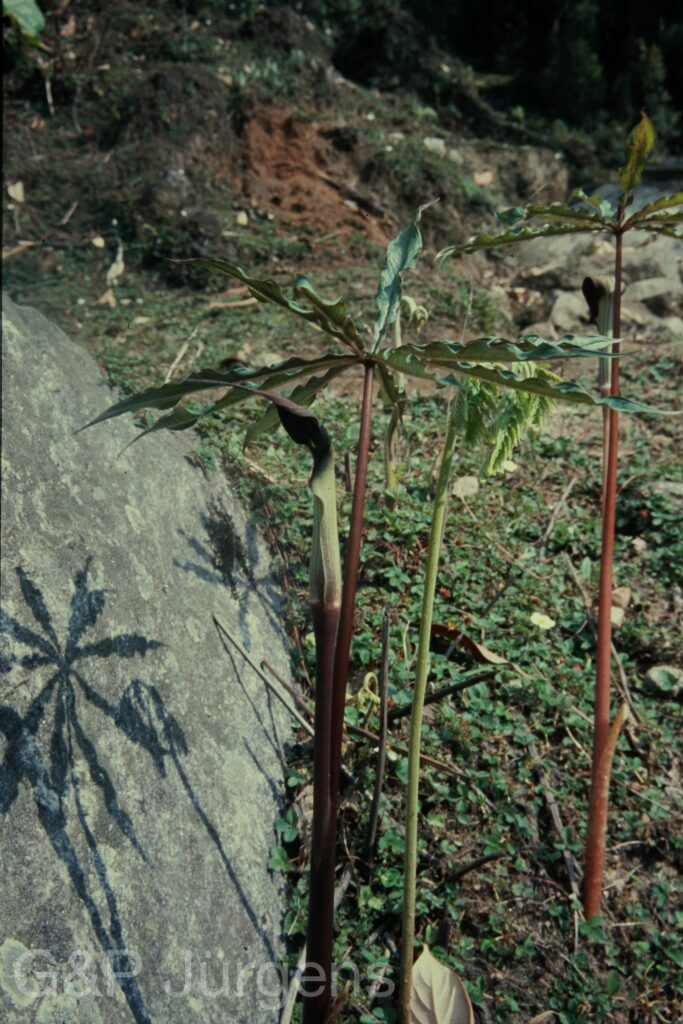
Arisaema echinatum is a tuberous aroid of the Himalaya, distributed through China, Nepal, India and Bhutan, with about 44 georeferenced records spread along the temperate to subalpine Himalayan belt. It grows in moist, shaded forest, among rhododendron and conifer scrub and on humus-rich banks, generally between 2400 and 3500 m. The cited collections from Kokchurong in Sikkim (3400 m, May) and from Trijugi Narayan in Garhwal (2450 m, June) bracket its altitudinal range and show its emergence and flowering through the late spring and early monsoon as the soil warms.

The plant arises from a depressed-globose tuber and usually bears one or two pedately compound leaves, each divided into several oblong-elliptic, acuminate leaflets borne on a long sheathing petiole. The inflorescence comprises a spathe with a cylindrical tube and an incurved, acuminate limb, enclosing the spadix; the diagnostic feature is the sterile appendix of the spadix, which is roughened or echinate with projecting papillae or processes, giving the species its name. As in most Arisaema the plants are sequentially hermaphrodite, shifting sex with size. The infructescence is a dense head of crowded scarlet berries.

Arisaema echinatum, transferred to the genus by Schott from Wallich's basionym, belongs to the taxonomically intricate Himalayan section of the genus, where appendix morphology is a key diagnostic. Pollination is by small flies and fungus gnats lured into and temporarily trapped by the spathe, and the bright berries are bird-dispersed. With a restricted montane range and few records, it is potentially sensitive to forest loss, though it has not been formally assessed for conservation.

Author: (Wall.) Schott · Sources: POWO (Kew), GBIF, Flora of China, Flora of Bhutan, Annotated Checklist of the Flowering Plants of Nepal, Gusman & Gusman The Genus Arisaema
Buchet

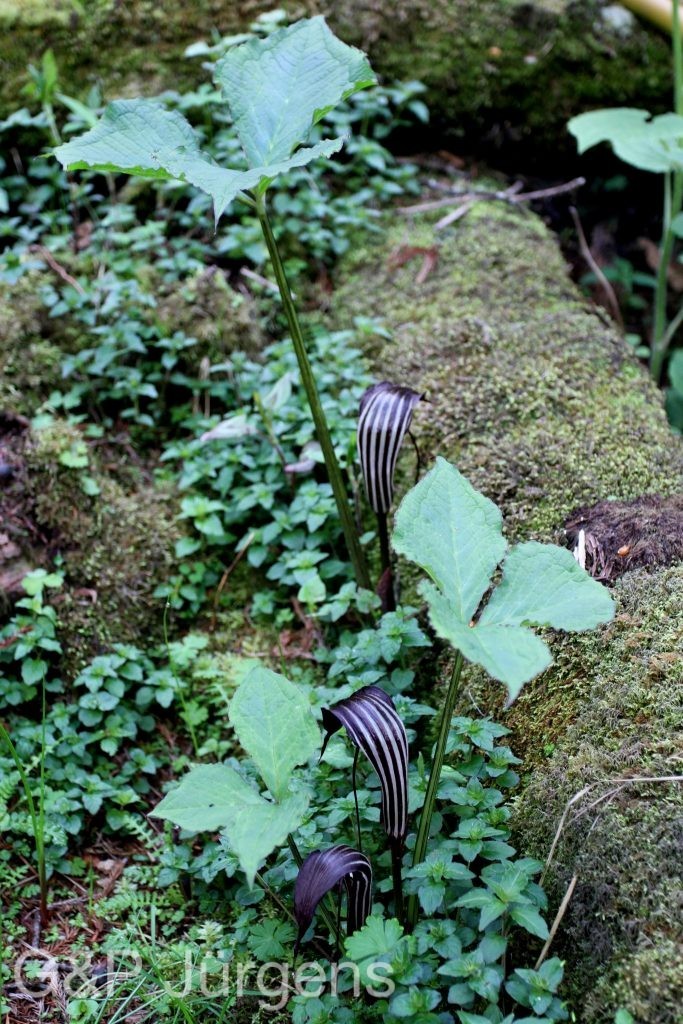
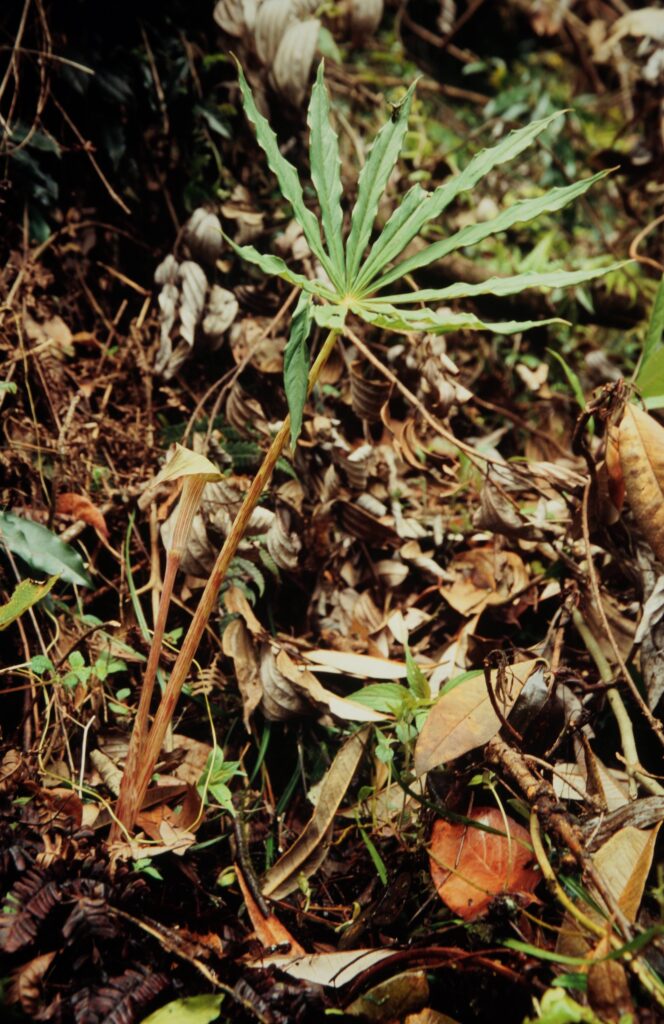
BhutanPG2011 134
Bhutan Tsochenchen, 3550m June

Description

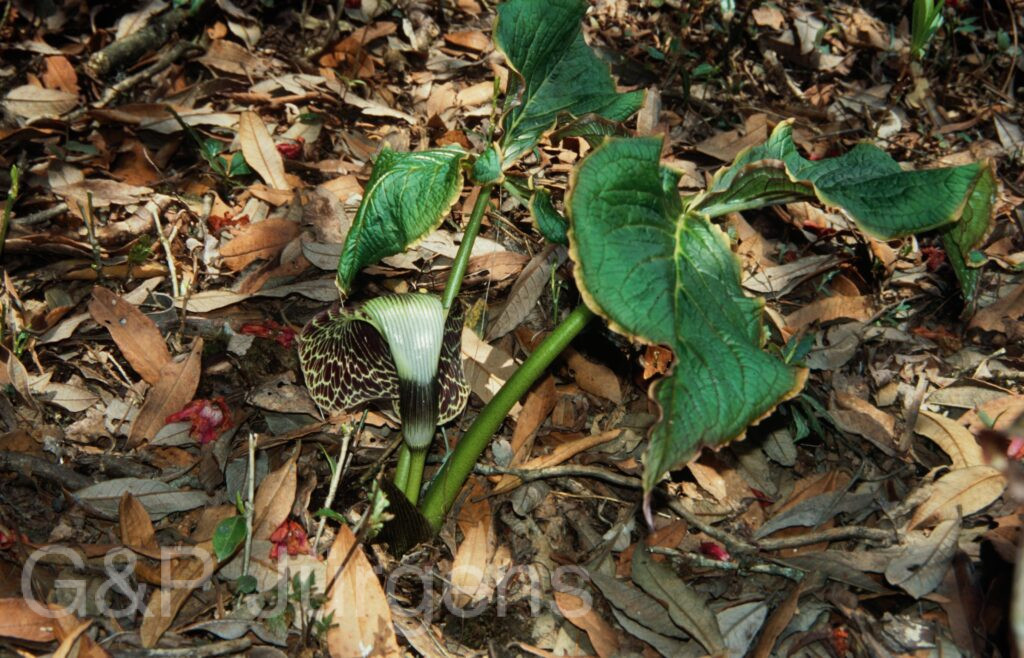
Arisaema elephas is a tuberous perennial aroid of the eastern Himalaya and the Sino-Himalayan mountains, recorded from China, India, Bhutan and Myanmar, with around 426 occurrences in GBIF. It grows in moist subalpine and alpine habitats, in open coniferous and Rhododendron forest, scrub, grassy slopes and meadow margins, generally between about 2700 and 4300 m. The photographed plant was collected in Bhutan at Tsochenchen at 3550 m in June, an elevation and cool, humid montane setting characteristic of the species, which emerges and flowers early in the growing season after snowmelt.

The plant arises from a depressed-globose tuber and typically produces a single leaf divided into three leaflets, the lateral leaflets often markedly asymmetric, with entire to undulate margins. The inflorescence is a spathe enclosing the spadix; the spathe tube is greenish and the limb dark purple to blackish, and the spadix is prolonged into a long, slender, downward-curving appendix that recalls an elephant's trunk, hence the epithet elephas. As in most Arisaema the plants are often functionally dioecious, sex expression shifting with tuber size and vigour. The fruit is a dense club-shaped infructescence of red berries.

Arisaema is a large genus centred on the Himalaya and East Asia, notable for its sequential hermaphroditism (size-dependent sex change) and for pollination by fungus gnats and other small flies attracted into the spathe chamber. Arisaema elephas is a distinctive and well-marked species of the A. elephas group, recognised by its long pendent spadix appendix. It is widespread within its montane range and not currently considered threatened, though alpine populations are sensitive to grazing and habitat disturbance.

Author: Buchet · Sources: POWO (Kew), GBIF, Flora of China, Flora of Bhutan, The Genus Arisaema (Gusman & Gusman)
Schott

Nepal 2009 91 ergebnis
Nepal 2009 102 ergebnis

Both: Nepal Bolgoan, 1980m, May

Description

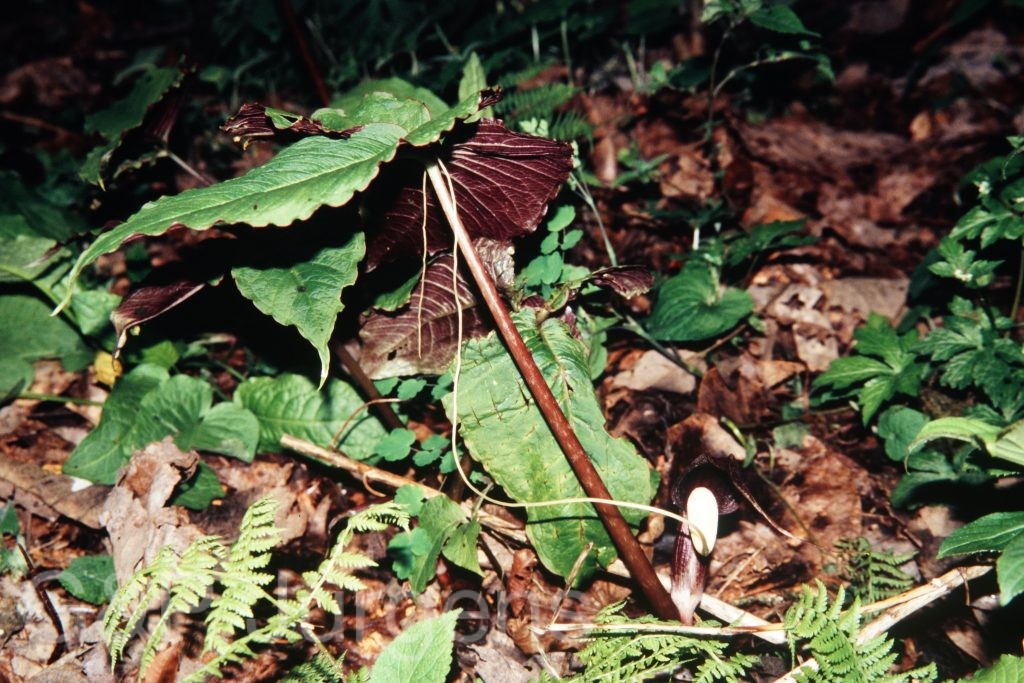
Arisaema erubescens is a widespread tuberous aroid distributed from the Himalaya across much of eastern and southeastern Asia. Its extensive range spans Nepal, northern India (from Uttarakhand to Arunachal Pradesh), Bhutan, Myanmar, Thailand, Vietnam, Taiwan, and much of China, with naturalised populations reported from several other countries. GBIF records over 1,350 occurrences, reflecting its broad distribution. The species inhabits the understorey of subtropical and warm temperate broadleaved forests, forest margins, and shaded ravines at elevations of 900–3,000 m. The photograph from Bolgoan in Nepal at 1,980 m, taken in May, shows the species during its characteristic spring emergence.
The plant arises from a depressed-globose tuber, 2–5 cm in diameter. The pseudostem is 15–40 cm tall, sheathed by cataphylls. Leaves are usually solitary, pedate with 7–15 leaflets; leaflets are elliptic to lanceolate, acuminate, the central one largest, 8–18 cm long, with entire or slightly undulate margins. The spathe is 8–15 cm long, with a tubular lower portion that is green striped with white or pale purple, and an arching, ovate-lanceolate limb that is typically purple-brown to dark maroon — the blushing colour referenced in the epithet erubescens. The spadix appendage is elongate, cylindrical, projecting well beyond the spathe tube, often sigmoid or pendulous. Plants are dioecious or sequentially monoecious. The infructescence is a dense cluster of bright red, globose berries.
Arisaema erubescens is taxonomically variable across its vast range, and several varieties have been described, including var. erubescens and var. onoticum. The species complex has been the subject of considerable systematic revision, as morphological boundaries with related taxa such as A. consanguineum can be subtle. It is one of the most commonly encountered Arisaema species in Himalayan forests and is not considered threatened. The tubers contain calcium oxalate crystals and are toxic if ingested raw, though they have been used in traditional medicine in several cultures.

Author: Schott · Sources: POWO (Kew), GBIF, Li & Hay: Araceae in Flora of China Vol. 23, Pradhan: Himalayan Cobra-Lilies (1997)

Arisaema griffithii

by GP Jürgens

Schott

Bhutan2014 360
Bhutan Tumching-La 3100m, May
Bhutan2014 830
Bhutan Thimphu 2450m, May
Sikkim2004 399 P681
Sikkim/India Lachung 3200m
Nepal 2001 104 ergebnis ergebnis
East-Nepal Gupka Pokhari 3050m, April

Description

Arisaema griffithii is an eastern Himalayan tuberous geophyte distributed through Nepal, Sikkim and Darjeeling in India, Bhutan, and into adjacent southern China (Xizang, Yunnan) and northern Myanmar, with georeferenced records also from Bangladesh. It is a plant of the cool temperate zone, growing in shaded moist forest, shrubberies, forest clearings and grassy slopes broadly between 2400 and 3600 m. The images document its altitudinal span, from Bhutan's Tumching-La at 3100 m and Thimphu at 2450 m flowering in May, to Lachung in Sikkim at 3200 m and Gupka Pokhari in east Nepal at 3050 m in April.

The plant arises from a depressed tuber and typically bears two trifoliolate leaves with broadly ovate to rhombic, acuminate leaflets, the lateral pair often oblique. The species is celebrated for its remarkable inflorescence: the spathe is large and deeply purple, conspicuously net-veined with pale reticulation, with the tube broadly funnel-shaped and the lamina arched and downturned, its margins recurved. The spadix appendix is exserted and elongated into a long, pendent whip-like flagellum. The plants are dioecious, with small unisexual flowers crowded at the base of the spadix, and the female inflorescence develops a cluster of red berries at maturity.

Within Araceae, A. griffithii belongs to section Sinarisaema and is one of the most distinctive members of the genus, named for William Griffith. Its drooping, intricately veined spathe lures fungus-gnat and small fly visitors into the inflorescence. Prized among specialist gardeners, it remains locally frequent and is not considered globally threatened, though vulnerable to habitat loss and tuber collection.

Author: Schott · Sources: POWO (Kew), GBIF, Flora of Bhutan, Flora of China, Gusman & Gusman 'The Genus Arisaema: A Monograph for Botanists and Nature Lovers'

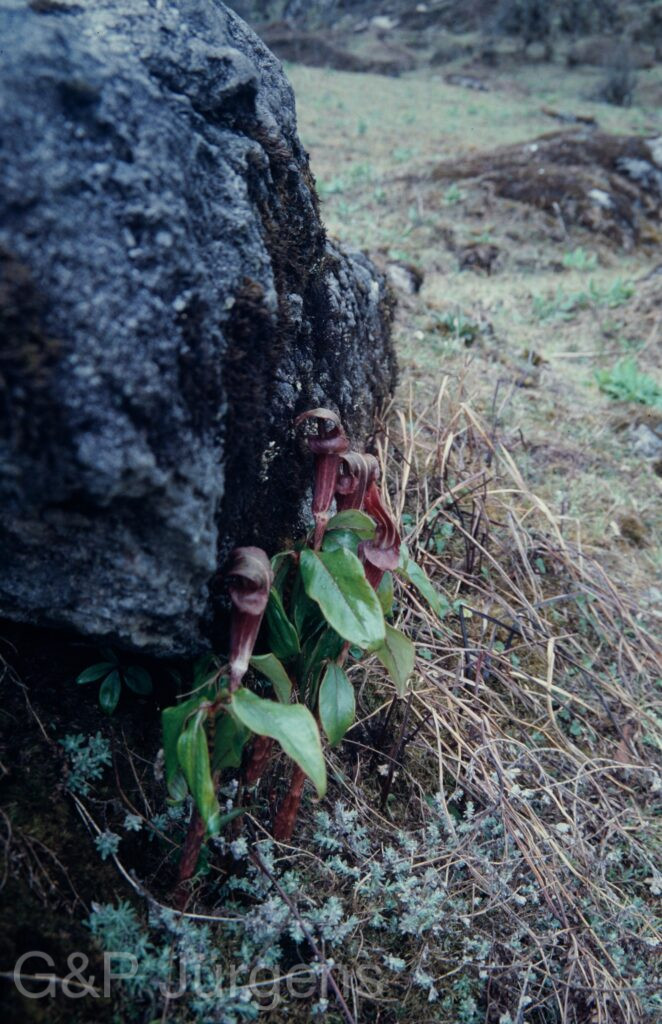
Blume

Nepal 2001 241 ergebnis ergebnis
Nepal (Gorkha) Niuli Kharka 2600m, May
Nepal 2001 242 ergebnis ergebnis
Nepal (Gorkha) Niuli Kharka 2600m, May
Garh 07 264 ergebnis
India Garhwal Belag Khal 2800m, June

Description

Arisaema intermedium is a Himalayan tuberous aroid distributed along the temperate forest belt of the central and eastern Himalaya, recorded by GBIF from India, Nepal, China, Bhutan and Pakistan across some 118 georeferenced collections. It is a plant of moist, humus-rich woodland floors, shady banks, forest clearings and the margins of rhododendron, oak and conifer forest, where it emerges with the onset of the pre-monsoon and monsoon seasons. Its typical elevational band lies between roughly 2,400 and 3,200 m, consistent with the documented occurrences from Niuli Kharka in the Nepalese district of Gorkha at about 2,600 m in May and from Belag Khal in Garhwal, India, at around 2,800 m in June. The flowering coincides with the early growing season before the leaf is fully expanded.

The species grows from a subglobose underground tuber and produces a solitary leaf divided into three leaflets, the central leaflet broadly ovate to rhombic and the laterals obliquely ovate, the blade often somewhat undulate and acuminate. The inflorescence is a typical aroid spathe-and-spadix structure, the pseudostem and peduncle arising together; the spathe tube is greenish and the limb arched, frequently striped purplish and white with a long-acuminate apex. The diagnostic feature of the genus is the spadix appendage, which in this species is elongate and gradually tapering, projecting forward beyond the spathe mouth. As in other Arisaema the plants are paradioecious, smaller individuals bearing male flowers and larger ones female; pollinated female spadices develop into a dense club of fleshy red berries at maturity.

Arisaema intermedium belongs to a notoriously variable complex within section Sinarisaema, and its delimitation against allied taxa such as A. propinquum has long occupied aroid systematists. The genus exemplifies size-dependent sex change (sequential hermaphroditism keyed to tuber reserves), a reproductive strategy of considerable interest to evolutionary ecologists, with pollination effected by fungus-gnats and small flies trapped within the spathe. Though not formally assessed as threatened and locally frequent within its range, the species shares the general vulnerability of forest-floor Himalayan herbs to habitat degradation and the harvesting pressures that affect tuberous aroids.

Author: Blume · Sources: POWO (Kew), GBIF, Flora of China Vol. 23, Flora of Bhutan Vol. 3, Flora of Nepal, Flora of Pakistan, Gusman & Gusman: The Genus Arisaema, A Monograph for Botanists and Nature Lovers

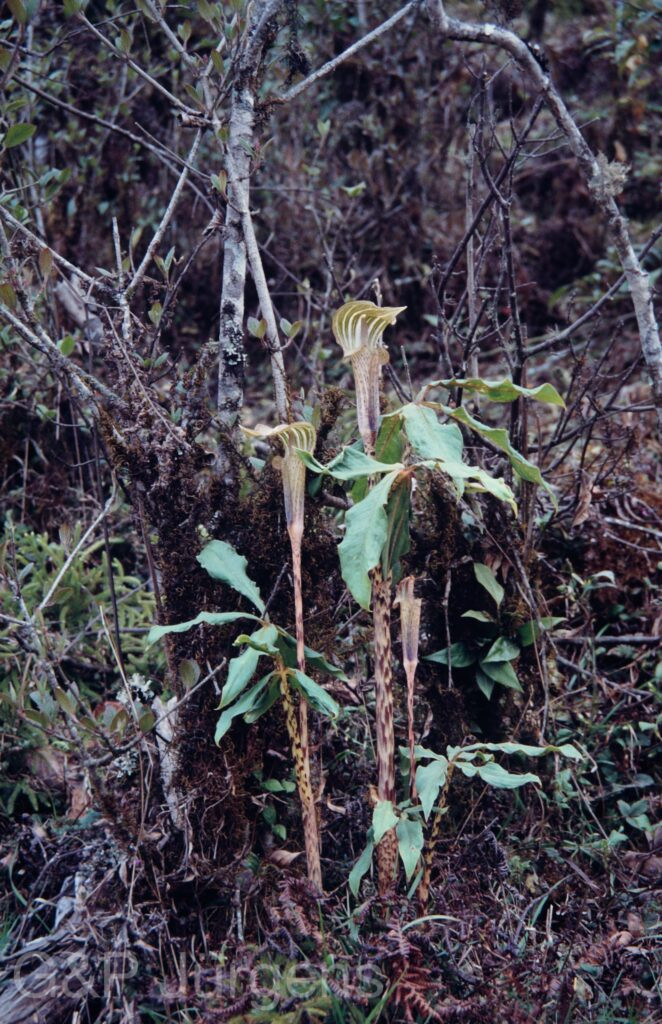
Blume

Sikkim2003 240 P330
Sikkim Dzongri 3920m, August
Sikkim2003 387 P547
Sikkim Dzongri 3920m, August

Description

Arisaema jacquemontii is a slender alpine cobra-lily widely distributed across the Himalaya, ranging from Afghanistan and Pakistan eastward through northern India, Nepal and Bhutan into south-western China. GBIF records some 568 occurrences, the core lying in India, Nepal, China, Pakistan and Bhutan, with additional cultivated or vouchered material reported from Britain, Belgium and Canada. The species inhabits subalpine and alpine meadows, open forest margins, shrubberies and moist grassy slopes, generally between about 2400 and 4500 m. The plant shown was photographed in Sikkim near Dzongri at 3920 m in August, a high pasture setting typical of its summer flowering on the eastern Himalayan ridges.

The plant grows from a depressed, subglobose tuber and produces usually a single pedately divided leaf with five to eleven elliptic-lanceolate, acuminate leaflets borne on a green, sometimes faintly mottled petiole sheathed at the base. The inflorescence is a spathe with a green tube and an erect to slightly arched, narrowly acuminate limb striped green and white. The spadix bears a slender, cylindrical, greenish appendix shorter than the spathe; the species is dioecious, with sterile or fertile zones of minute unisexual flowers concealed within the tube. The fruit is a dense club-shaped infructescence of orange-red berries each containing few seeds.

Arisaema, the largest genus of the Araceae in temperate Asia, exhibits remarkable sexual lability, individual tubers shifting between male and female expression with size and resource status. A. jacquemontii belongs to the section characterised by green, unmottled spathes and is among the most widespread and hardy Himalayan species, frequently grown by alpine gardeners. It is not considered threatened, though high-altitude collection and grazing locally affect populations.

Author: Blume · Sources: POWO (Kew), GBIF, Flora of China, Flora of Bhutan, The Genus Arisaema: A Monograph for Botanists and Nature Lovers, Aroids: Plants of the Arum Family

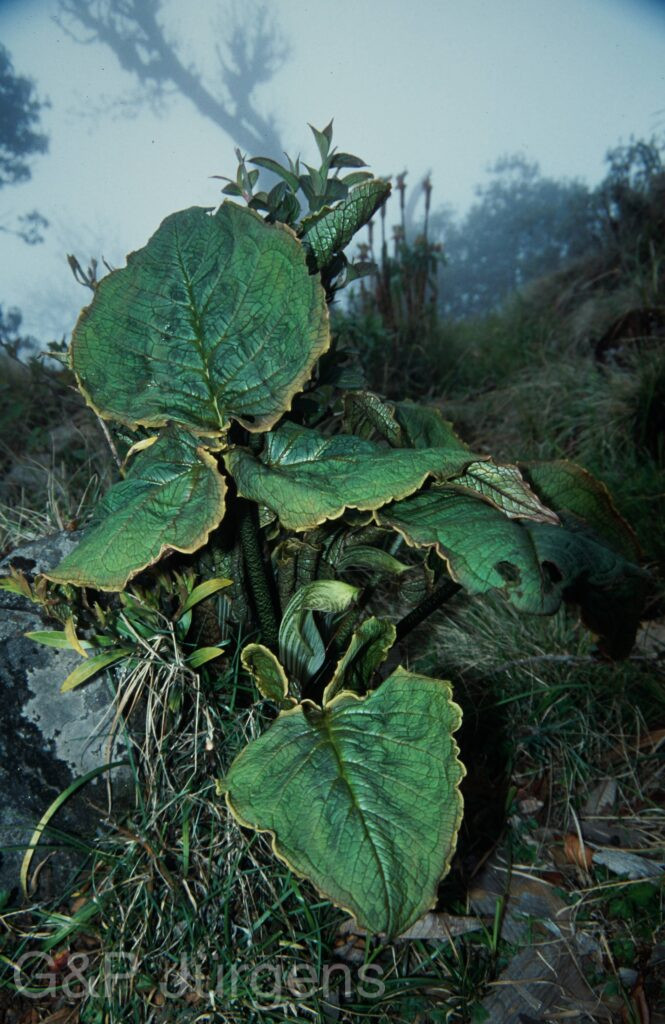
Mart.

Bhutan2014 32
Bhutan, Trashigang 1300m, May
Nepal 97 432 G839
Nepal Tashigaon 3100m May
Nepal 1994 269 ergebnis
Ost-Nepal Milka-Danda 3200m May 
Nepal1992 184 P270 ergebnis
Nepal Banyang 1900m March 

Description

Arisaema nepenthoides is a Himalayan cobra lily distributed from Nepal eastward through Sikkim, Bhutan and north-east India to Myanmar and south-western China, with about 322 GBIF occurrences reflecting its montane range. It is a herb of cool temperate to subalpine forest, growing in moist broad-leaved and conifer-Rhododendron forest, shady banks and forest margins, broadly from 1,900 to 3,600 m. The localities recorded for the photographed plants span this range, from Trashigang in eastern Bhutan at 1,300 m and Banyang in Nepal at 1,900 m to Tashigaon at 3,100 m and Milka Danda at 3,200 m, flowering between March and May as the snows recede.

It is a tuberous perennial arising from a depressed corm, producing a stout, conspicuously mottled pseudostem patterned with brownish-purple and pale markings reminiscent of a snake's skin. Usually two leaves are produced, each pedately divided into several elliptic to oblanceolate leaflets. The inflorescence is a spadix enclosed in a spathe whose tube is greenish and prominently striped, opening into a hooded, incurved limb that recalls the pitcher of a Nepenthes, hence the epithet nepenthoides. The species is dioecious, with the sexes distinguished by the spadix appendage; pollinated female plants develop a dense head of orange-red berries, each with few seeds.

Arisaema is a large genus centred on the Sino-Himalayan region, and A. nepenthoides belongs to a group recognised by its mottled pseudostem and distinctive hooded spathe. Like many relatives it shows sequential gender change, individuals functioning as male when small and as female once the tuber attains sufficient size, an adaptation to resource availability. Pollination is effected by fungus gnats and small flies attracted into the spathe chamber. The conspicuous spathe makes it a sought-after ornamental, but it remains widespread and locally common across the eastern Himalaya and is not considered threatened.

Author: Mart. · Sources: POWO (Kew), GBIF, Flora of China, Flora of Bhutan, The Genus Arisaema (Gusman & Gusman), Araceae of the Himalaya
Arisaema propinquum

by GP Jürgens

Schott

Nepal 2001 310 ergebnis ergebnis
Nepal (Gorkha) Kharka 3100m, May
Nepal 2009 24 ergebnis
Nepal Helambu Koktrok 2600m, May

Description

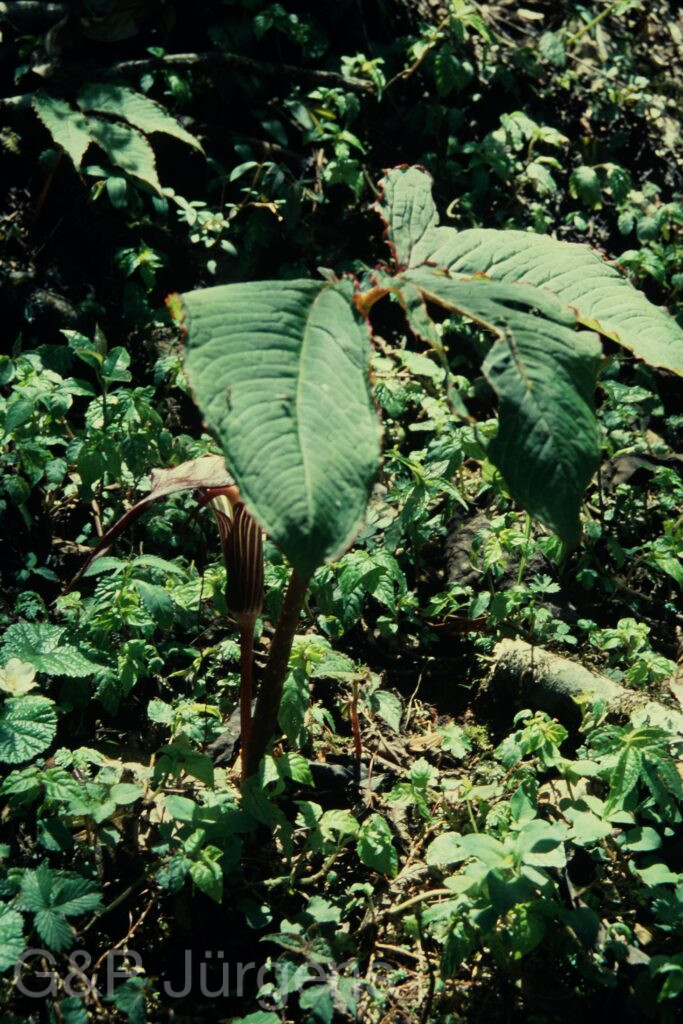
Arisaema propinquum is a Himalayan tuberous aroid distributed from Pakistan and northern India through Nepal, Sikkim and Bhutan into south-western China and Myanmar, with 257 GBIF occurrences across the central and western Himalaya. It grows in moist temperate forest, shrubberies, alpine meadow margins and open slopes, typically between about 2400 and 3700 m. The cited Nepalese collections – from Kharka in the Gorkha district at 3100 m and from Koktrok in Helambu at 2600 m, both in May – place its flowering in the late-spring period as the cobra-lilies emerge with the first monsoon moisture.

It arises from a depressed globose corm and usually produces a single (or paired) leaf divided into three broadly ovate to elliptic leaflets, the lateral ones obliquely based and the whole sometimes flushed purple beneath. The inflorescence is a typical aroid spadix enclosed in a spathe; in A. propinquum the spathe is dark purple with bold whitish or greenish longitudinal stripes, the tube cylindrical and the broad limb arching forward into a long, often filiform tail. The spadix appendage is slender and curved, exserted from the spathe mouth. The fruiting head is a dense ovoid cluster of bright red berries.

Arisaema is a large genus celebrated for paradioecy, in which individuals change sex between female and male states according to size and resources, and for its specialised fly- and fungus-gnat pollination within the trap-like spathe. A. propinquum belongs to the Himalayan striped-spathe assemblage and, while ornamentally prized, remains widespread and is not of conservation concern.

Author: Schott · Sources: POWO (Kew), GBIF, Flora of China, Flora of Bhutan, Annotated Checklist of the Flowering Plants of Nepal, Gusman & Gusman monograph of Arisaema

Arisaema speciosum

by GP Jürgens

(Wall.) Mart.

Nepal 97 439 P855
Nepal Tashigaon 3100m May
Sikkim 2006 6 ergebnis
India West-Bengal Maneybhajang 2000m, May

Description

Arisaema speciosum is an eastern Himalayan cobra lily distributed from Nepal through Sikkim and West Bengal in India, Bhutan and into south-central China, with peripheral records in Myanmar and Thailand; GBIF holds nearly 200 occurrences. It grows in cool, humid temperate forest, in the shade of broadleaved and mixed conifer woodland, on rich, moist, humus-laden soils along stream banks, ravines and shaded slopes. The collections illustrated, from Tashigaon in eastern Nepal at about 3100 m and from Maneybhajang in West Bengal at around 2000 m, both in May, reflect its montane belt of roughly 2000-3300 m, where it emerges and flowers as the pre-monsoon rains advance.

The plant arises from a depressed, tuberous corm and produces a single trifoliolate leaf on a stout, mottled petiole; the three leaflets are broadly ovate, acuminate and often suffused dark purplish-red along the margins and central rib. The inflorescence is a spathe with a deep maroon, white-striped tube and an arching, dark purple-brown limb. Most striking is the spadix, whose appendage is prolonged into a very long, pendent, whip-like filiform tail hanging well below the spathe. The plant is typically dioecious, sex expression varying with tuber size, and female spadices ripen into a dense club of bright red berries.

The epithet speciosum, meaning showy, refers to the dramatic spathe and trailing appendage. Within the large Asian genus Arisaema it belongs to a group with trifoliolate leaves and long-tailed spadices. Like its congeners it is protogynous and paradioecious, with pollination effected by fungus gnats lured into the spathe chamber. The species is grown by specialist cultivators, and habitat disturbance and over-collection are potential local conservation concerns.

Author: (Wall.) Mart. · Sources: POWO (Kew), GBIF, Flora of China, Flora of Bhutan, Gusman The Genus Arisaema, Murata monograph of Arisaema

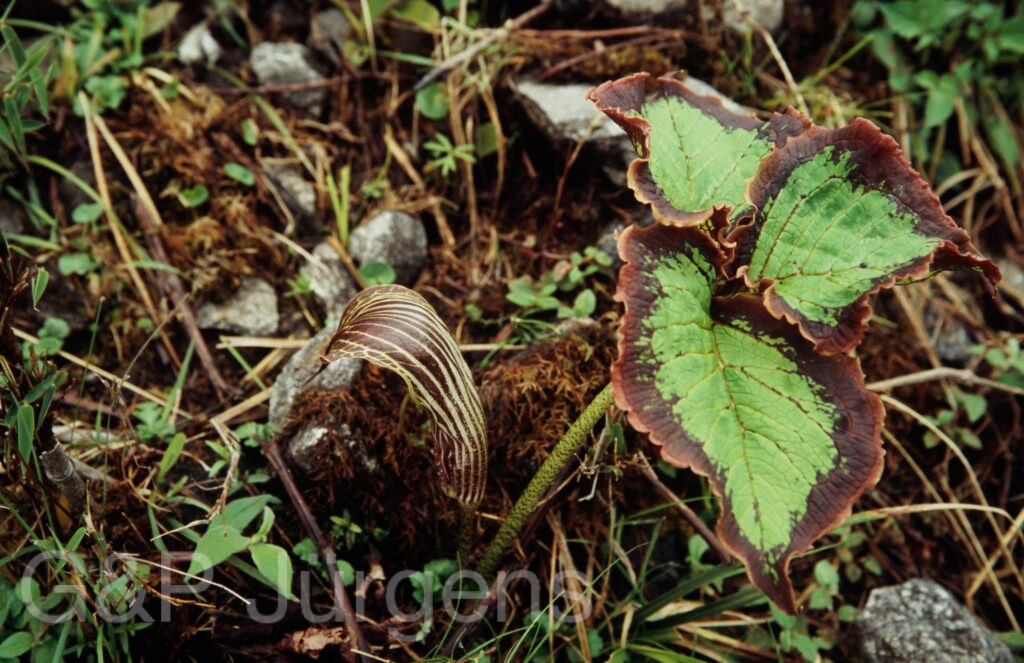
(Schott) Engl.

Bh09 208 G349
Bhutan
Sikkim2004 96 P166
India West-Bengal, Bersay 2600m April
Sikkim2004 98 P168
India West-Bengal, Bersay 2600m April

Description

Arisaema speciosum var. mirabile is a striking tuberous aroid of the eastern Himalaya. GBIF holds only some 20 occurrences, from India, China, Nepal and Bhutan, reflecting its restricted range and the limited collection of this montane taxon. It inhabits moist temperate broadleaved and mixed forest, shaded banks and humus-rich slopes, generally between about 2,000 and 3,000 m. The illustrated plant was photographed at Bersay in West Bengal (Darjeeling–Sikkim Himalaya), and in Bhutan, at around 2,600 m in April, emerging and flowering with the pre-monsoon rains. (Despite the input family "Aceraceae", this is an aroid of the Araceae.)

The plant arises from a depressed tuber and bears characteristically a single trifoliolate leaf with three large, broadly ovate to rhombic leaflets, the central one stalked, often with a reddish margin. The inflorescence is a spathe with a dark purple, white-striped tube and a long-acuminate limb; the spadix is prolonged into a very long, thread-like, pendent appendix that hangs well beyond the spathe, the diagnostic feature of this group. The plants are dioecious; female plants produce a dense head of red berries in fruit.

Var. mirabile is distinguished from typical A. speciosum by features of the spathe and the proportions of the leaflets and appendix, though some authors treat the variation as continuous. The exceptionally long flagelliform spadix appendix is thought to function in pollinator attraction (fungus-gnat trapping). Given its narrow distribution and small documented populations, the taxon merits conservation monitoring, and it is much sought after by specialist aroid growers.

Author: (Schott) Engl. · Sources: POWO (Kew), Flora of Bhutan Vol. 3, Flora of China Vol. 23, GBIF, Gusman & Gusman: The Genus Arisaema (2006)