Tag:

Myanmar

Flowers of the Myanmar Himalaya — 604 species recorded from northern Myanmar (Burma) and the eastern Himalayan borderlands, a biodiversity hotspot linking the Himalaya to the mountains of Yunnan and Southeast Asia. The region’s forests and alpine slopes hold a rich flora of rhododendrons, orchids, balsams and gentians. Every page gives a botanical description, distribution, habitat and flowering time with the original photograph.

(Kurz) W.E.Manning ex Steenis
Bhutan2014 684
Bhutan Wangdi-Phodrang 2280m, May

Description

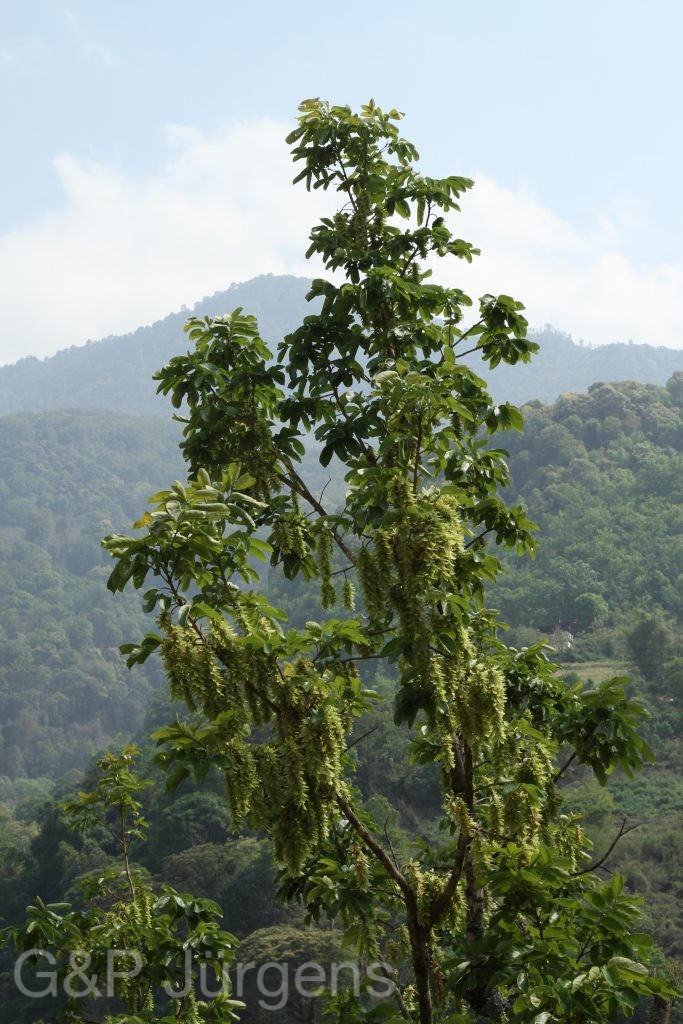
Engelhardia spicata var. integra (Kurz) W.E.Manning ex Steenis is a tree of the walnut family, Juglandaceae, native to the subtropical and warm-temperate forests of South and Southeast Asia. GBIF (around 136 occurrences) records the taxon from China, India, Indonesia, the Philippines, Thailand, Bhutan, Vietnam, Myanmar and Nepal, where it forms a component of broad-leaved hill and montane forest, often on forest margins and slopes. It typically occurs in the subtropical mid-montane belt; the tree photographed at Wangdi-Phodrang in Bhutan at 2,280 m in May represents it in early-season flower within this characteristic elevational zone.

Engelhardia spicata is a medium to large deciduous tree with pinnately compound leaves; in var. integra the leaflets are characteristically entire-margined (hence "integra"), distinguishing it from forms with toothed leaflets. The leaflets are opposite to subopposite along the rachis, elliptic to oblong, glabrous to thinly pubescent. The species is monoecious, with flowers borne in long, pendulous catkin-like spikes; the most striking feature is the fruit, a small nutlet subtended by a conspicuous, enlarged, three-lobed membranous wing (an accrescent bract) that develops into a samaroid structure adapted for wind dispersal, the spikes hanging in long tassels at maturity.

The genus Engelhardia (sometimes spelled Engelhardtia) belongs to subfamily Engelhardioideae of the Juglandaceae, a primarily tropical Asian lineage distinguished from the temperate walnuts and hickories by its winged, bract-derived fruits. The wind-dispersed samaras are an important diagnostic and ecological character, enabling the tree to colonise open and disturbed hill forest. As a widespread but variable species, E. spicata has been treated with several infraspecific taxa, of which var. integra is recognised on the basis of its entire leaflet margins.

Author: (Kurz) W.E.Manning ex Steenis · Sources: POWO (Kew), Flora of China Vol. 4, Flora of Bhutan Vol. 1, GBIF, Manning: The genus Engelhardia (Juglandaceae)
(Griff.) C.K.Schneid.

Sikkim2004 377 G654
Sikkim/India Lachung 2900m May
Nepal 1994 259 ergebnis
Ost-Nepal Milka-Danda 2850m May 

Description

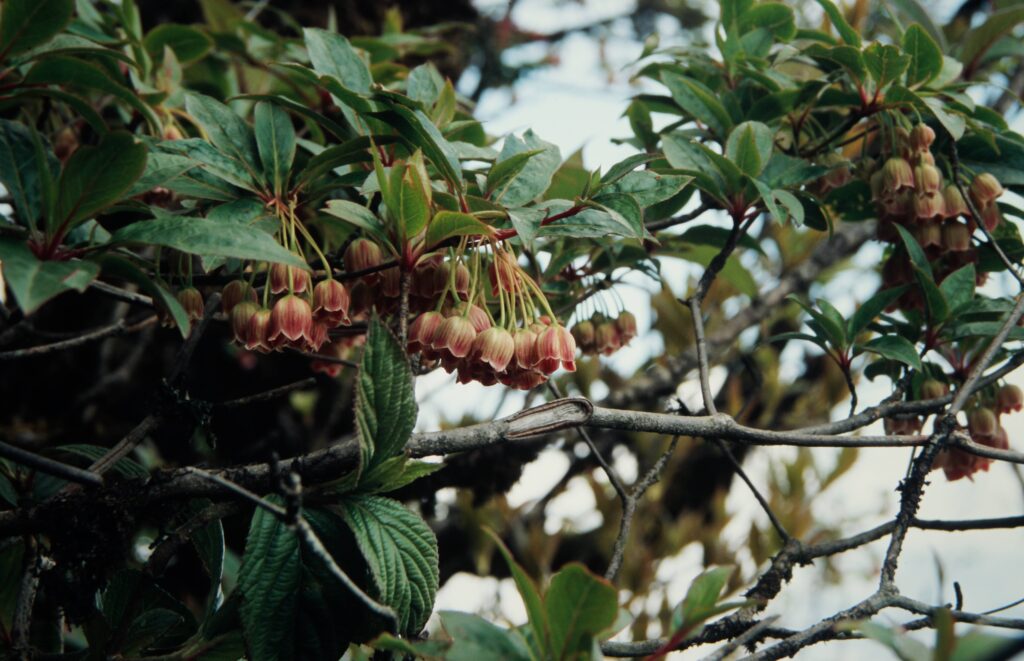
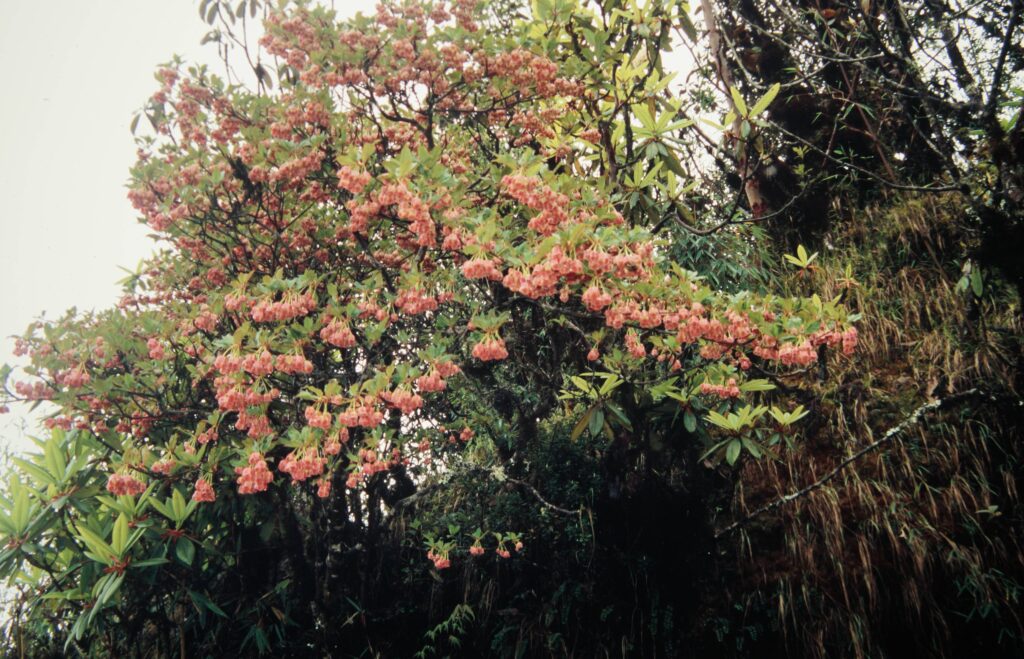
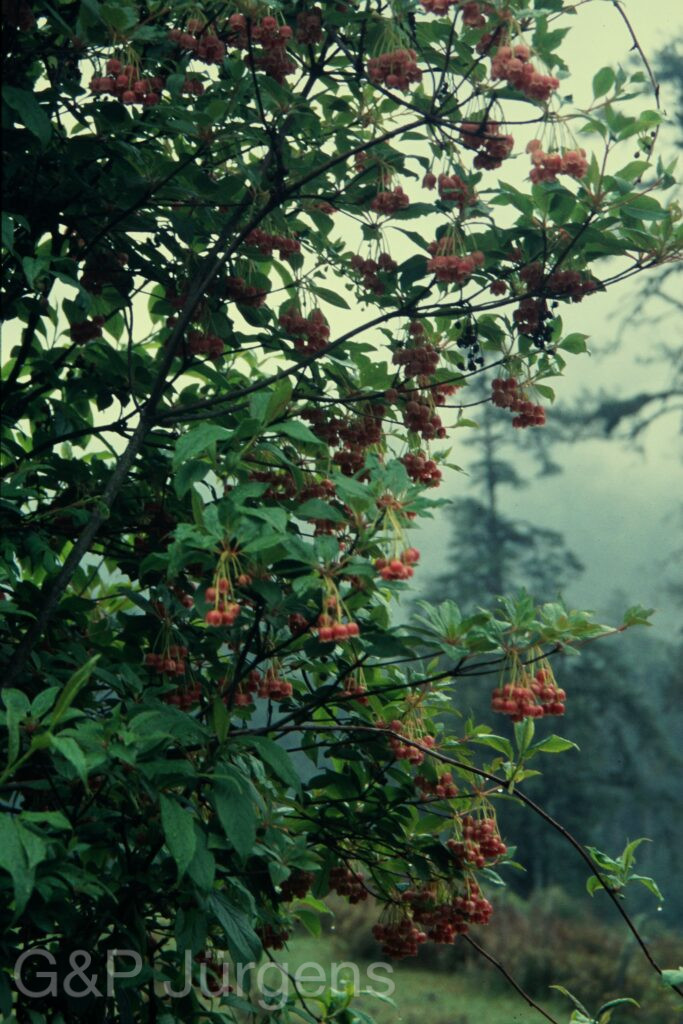
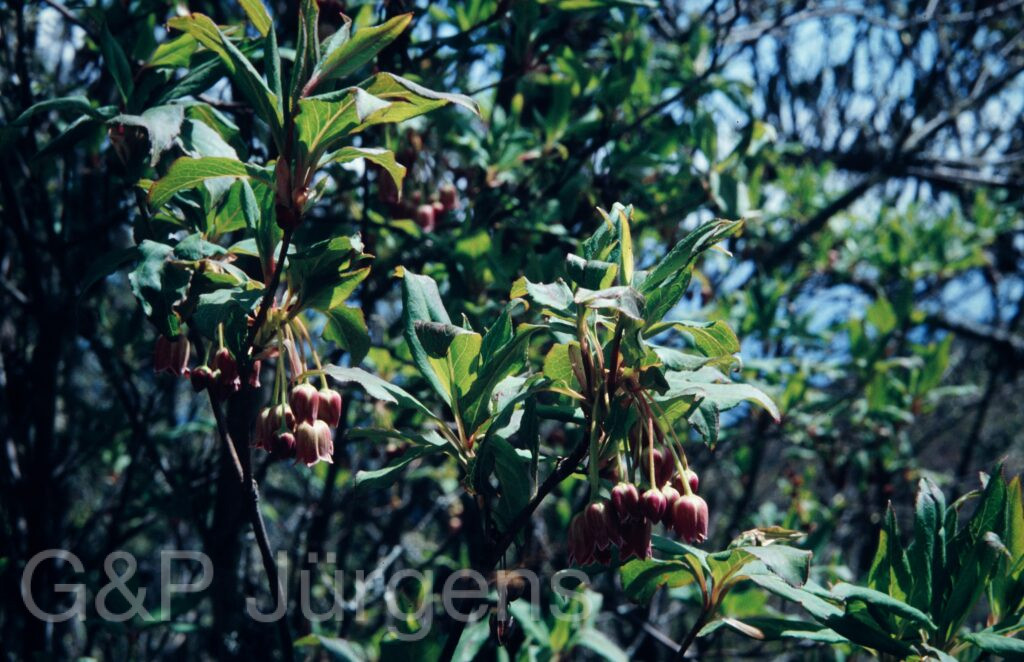
Enkianthus deflexus is a deciduous shrub or small tree of the temperate Himalaya and southwestern China, distributed through China, India, Nepal, Bhutan and Myanmar, and very well documented with around 1667 GBIF records (further records reflect wide cultivation in Europe, North America and East Asia). It forms part of the understorey and forest-margin vegetation of moist temperate forest and Rhododendron-dominated slopes, typically between about 2400 and 3600 m. The cited collections from Lachung in Sikkim (2900 m), Milka Danda in east Nepal (2850 m) and Tonglu in West Bengal (3100 m), all flowering in May, mark its synchronous late-spring anthesis across the cool, humid mid-montane belt.

The species is a many-branched shrub whose leaves cluster toward the ends of the twigs in pseudowhorls; they are obovate to elliptic, finely serrulate, often colouring richly in autumn, and subtended by reddish young growth. The flowers are borne in pendent terminal racemes or umbel-like clusters, each on a slender, often reflexed pedicel (whence deflexus). The corolla is campanulate, creamy to yellowish suffused with red veining, with five short recurved lobes; ten stamens are enclosed within. The fruit is an erect, dehiscent woody capsule on the recurving pedicel, releasing small winged or angled seeds.

Enkianthus is an early-diverging genus of the Ericaceae, sister to much of the rest of the family, and its bell-shaped, nectar-bearing flowers are pollinated by bees and other insects. E. deflexus is valued horticulturally for its dainty blossoms and brilliant autumn foliage, explaining its broad cultivated footprint. Within its native range it is common and not of conservation concern, a characteristic and widespread component of Himalayan temperate forest understoreys.

Author: (Griff.) C.K.Schneid. · Sources: POWO (Kew), GBIF, Flora of Bhutan, Flora of China (Ericaceae), Stevens Revision of Enkianthus

(Grierson & D.G.Long) Panigrahi

Nepal 97 51 P77
Nepal Mewa-Khola 1130m April
Nepal 97 50 P76
Nepal Mewa-Khola 1130m April

Description

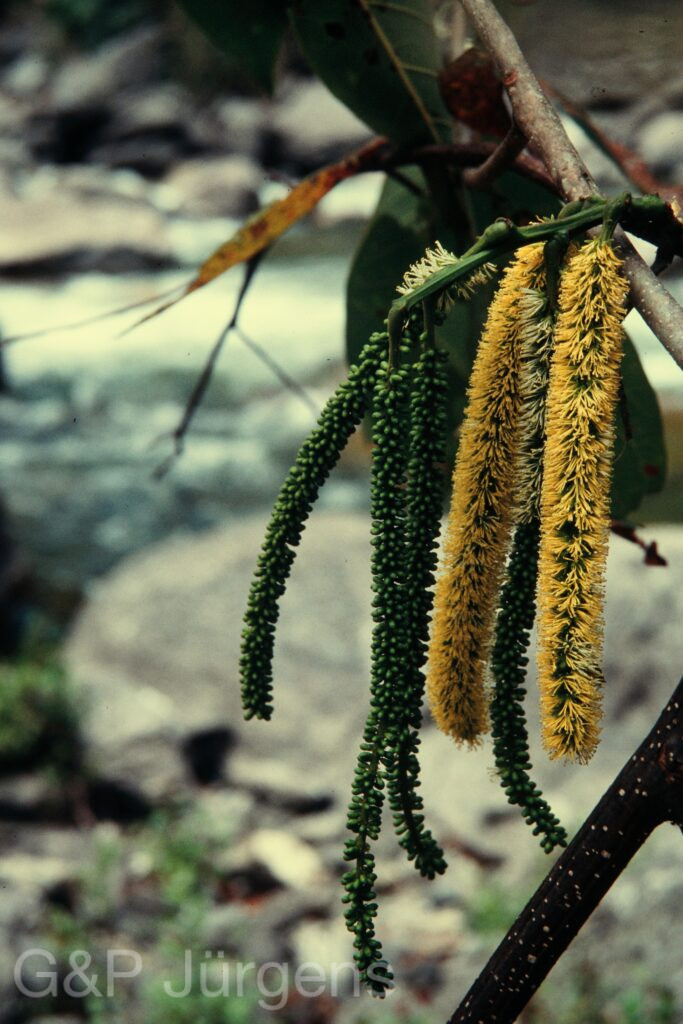
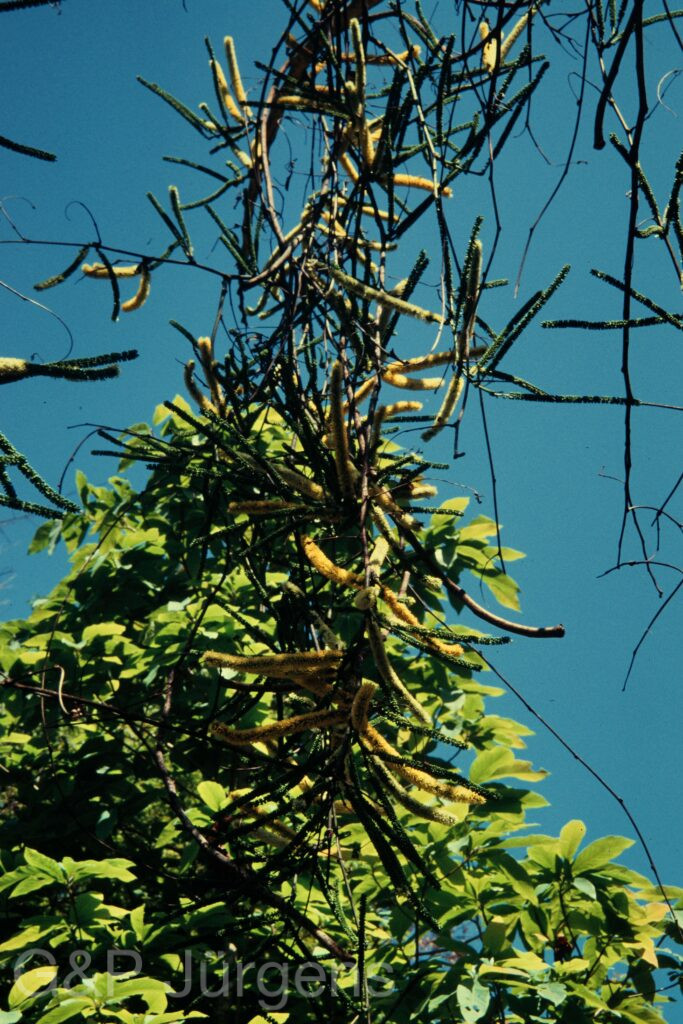
Entada rheedii subsp. sinohimalensis is a Sino-Himalayan liana of warm lower-montane forest, treated by GBIF as a synonym of the accepted Entada rheedii sinohimalensis (under E. rheedii Spreng.). It is a localised eastern Himalayan taxon ranging from Nepal and Sikkim into Bhutan and adjacent China and Myanmar; GBIF holds a single Bangladesh record, underscoring how sparsely this giant climber is documented. It grows in broadleaved subtropical forest and ravine vegetation at low elevations, as in the Mewa Khola of eastern Nepal at 1130 m in April, where it scrambles high into the canopy along humid river valleys.

It is a massive woody liana with stout, twining stems and tendrillate, bipinnate leaves whose pinnae bear several pairs of asymmetric oblong leaflets, the terminal pair of pinnae often modified into a coiling tendril. The flowers are small, sessile and crowded in slender elongate spikes, creamy white to greenish-yellow, with a five-toothed calyx, five free petals and ten exserted stamens giving the inflorescence a feathery aspect. The fruit is among the largest of any legume – a huge, woody, flattened pod up to a metre long that breaks transversely into one-seeded segments, each enclosing a large, hard, glossy brown "sea bean" capable of long-distance hydrochory.

Within the mimosoid clade of Fabaceae, Entada is a pantropical genus of lianas, and subsp. sinohimalensis represents the inland Himalayan-Chinese expression of the widespread E. rheedii. The buoyant, durable seeds are dispersed by water and ocean currents and are used as charms and in folk medicine. The taxon is rarely collected and its conservation status remains unassessed.

Author: (Grierson & D.G.Long) Panigrahi · Sources: POWO (Kew), GBIF, Flora of China, Flora of Bhutan, Annotated Checklist of the Flowering Plants of Nepal, Brenan monograph of Entada

Hausskn.

Sikkim2003 213 G297
Sikkim Dzongri 3900m, August

Description

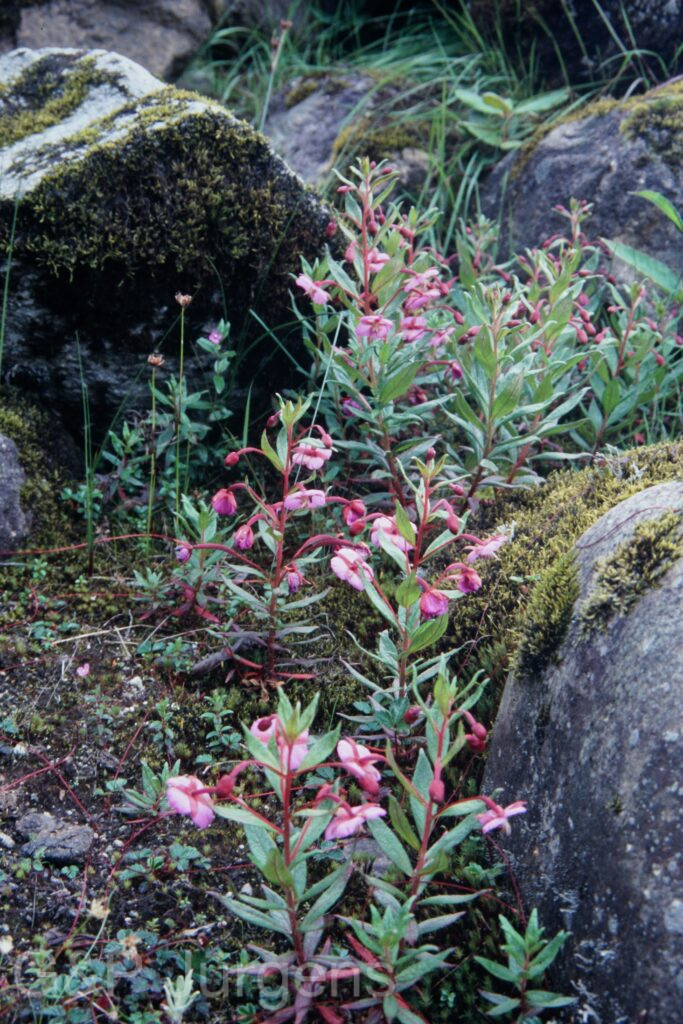
Epilobium conspersum is a perennial herb of the Sino-Himalayan and East Asian mountains, distributed through southwestern China, Nepal, northern India, Myanmar, Bhutan and Japan, with introduced records in the United States; GBIF documents about 134 occurrences. It is a plant of moist, open subalpine and alpine habitats such as stream banks, wet meadows and gravelly flushes, typically between about 3000 and 4200 m. The photographed plant was collected at Dzongri in western Sikkim at around 3900 m in August, on the cool, wet ground this willowherb favours during the monsoon. In GBIF the name carries the status SYNONYM, while Epilobium conspersum is here recognised as the accepted name for this Himalayan material.

The plant produces erect to ascending stems from a perennating base that overwinters by leafy rosettes or short turions. The leaves are opposite below and alternate above, sessile or shortly petiolate, lanceolate to ovate, with a toothed margin, the stems often finely hairy in lines. The flowers are borne in the upper leaf axils; as in the genus they have an inferior, elongate ovary, four notched pink to rose-purple petals, four sepals and eight stamens. The fruit is a long, slender, four-valved capsule that splits to release numerous seeds, each bearing a silky coma for wind dispersal.

Epilobium (Onagraceae) is a large temperate and cold-region genus in which the comose seeds and elongate capsular fruit are diagnostic. The Himalayan species form a taxonomically intricate group, and the synonymy reflected in the GBIF status underscores their nomenclatural complexity. Widespread along its moist alpine corridor, the species is not considered threatened.

Author: Hausskn. · Sources: POWO (Kew), GBIF, Flora of China Vol. 13, Flora of Bhutan Vol. 2, Flora of Nepal, Flora of Pakistan, Raven monograph of Old World Epilobium

Lindl.

Nepal 99 177 ergebnis
West-Nepal Lara-Lake 3000m, June

Description

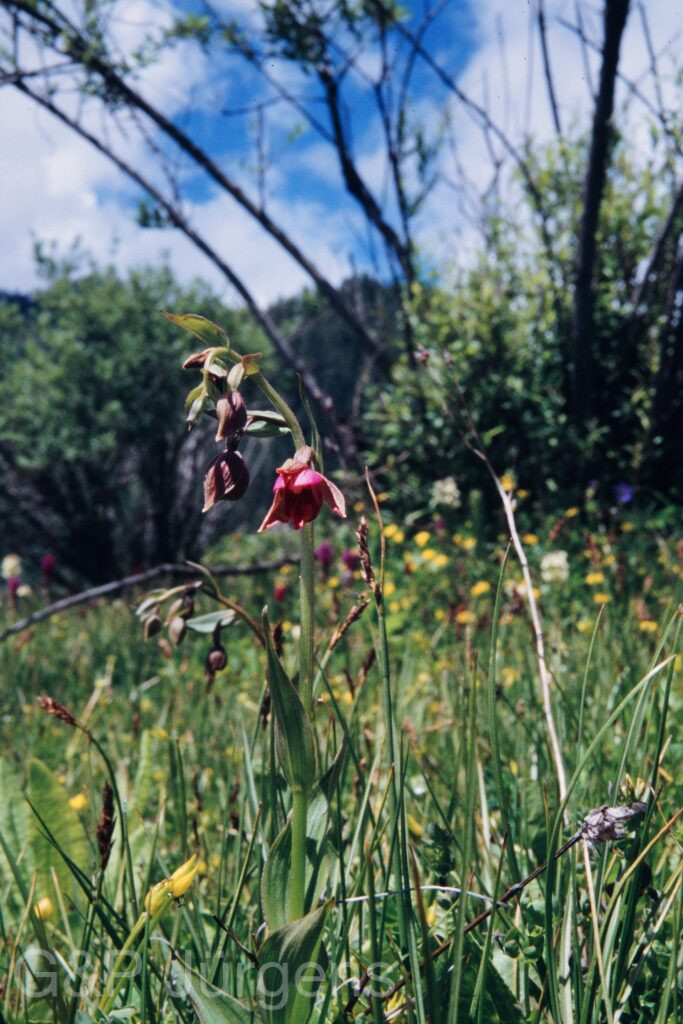
Epipactis royleana Lindl. is a terrestrial orchid of central and western Asia and the Himalaya, with GBIF documenting some 262 occurrences across Nepal, India, China, Pakistan, Afghanistan, Tajikistan, Kyrgyzstan, Uzbekistan, Bhutan, Myanmar and Russia, with scattered records farther afield. It typically grows in moist habitats such as streamsides, marshy meadows, seepage slopes and open coniferous woodland from the montane to subalpine zones, often between about 1500 and 3500 m. The plant photographed at Lara-Lake in West Nepal, at roughly 3000 m in June, illustrates its preference for the damp, lake-margin grasslands of the high Himalayan valleys.

The species is a rhizomatous perennial with erect, leafy stems arising from a short creeping rootstock. The leaves are alternate, ovate to lanceolate, sheathing at the base and prominently veined. The inflorescence is a lax, one-sided terminal raceme of several to many resupinate flowers; each flower has spreading, greenish to purplish-tinged sepals and petals, with a labellum divided into a cup-like basal hypochile and a triangular, often pinkish epichile. As in all Epipactis, the column bears a single anther and the pollinia are mealy, and the fruit is a pendulous, ridged capsule releasing dust-like seeds.

Epipactis is a Holarctic genus in which Himalayan and central Asian taxa form a distinct group; E. royleana is among the more widespread members, exhibiting considerable variation in flower colour across its range. Like other members of the genus it depends on mycorrhizal fungi for germination and early establishment, and its small seeds are wind-dispersed. The species is not currently regarded as threatened across its broad distribution, though, as a wetland-associated orchid, local populations are sensitive to drainage and habitat disturbance.

Author: Lindl. · Sources: POWO (Kew), GBIF, Flora of China, Flora of Pakistan, Flora of Nepal, Delforge Orchids of Europe and Asia

Hook.f.

Bhutan2014 274
Bhutan Trithangebe 700m, May
Bhutan2014 276
Bhutan Trithangebe 700m, May

Description

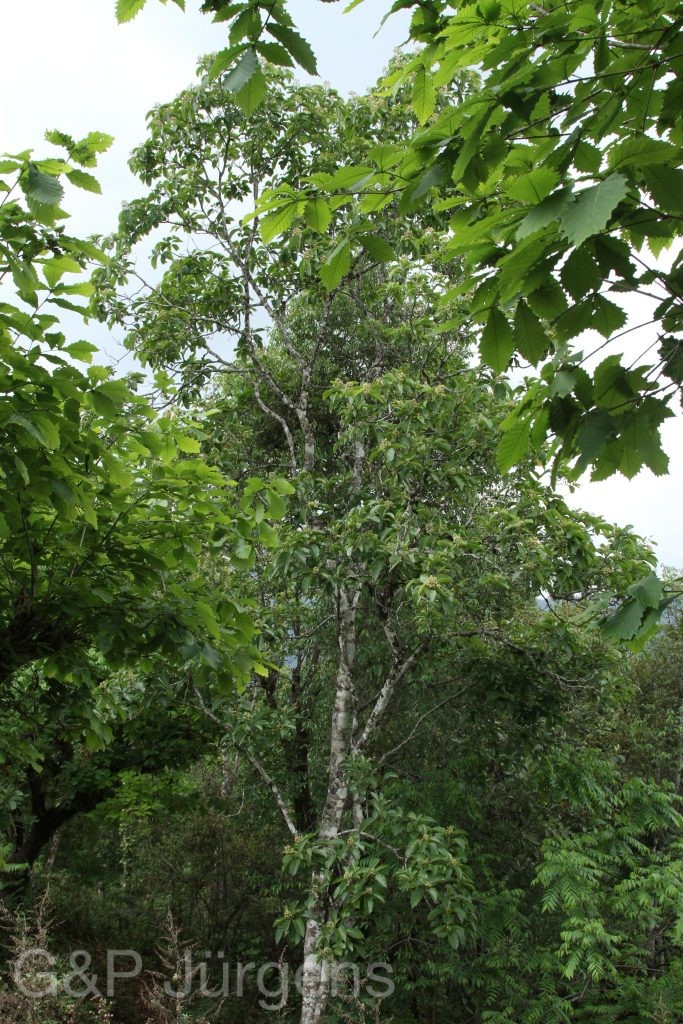
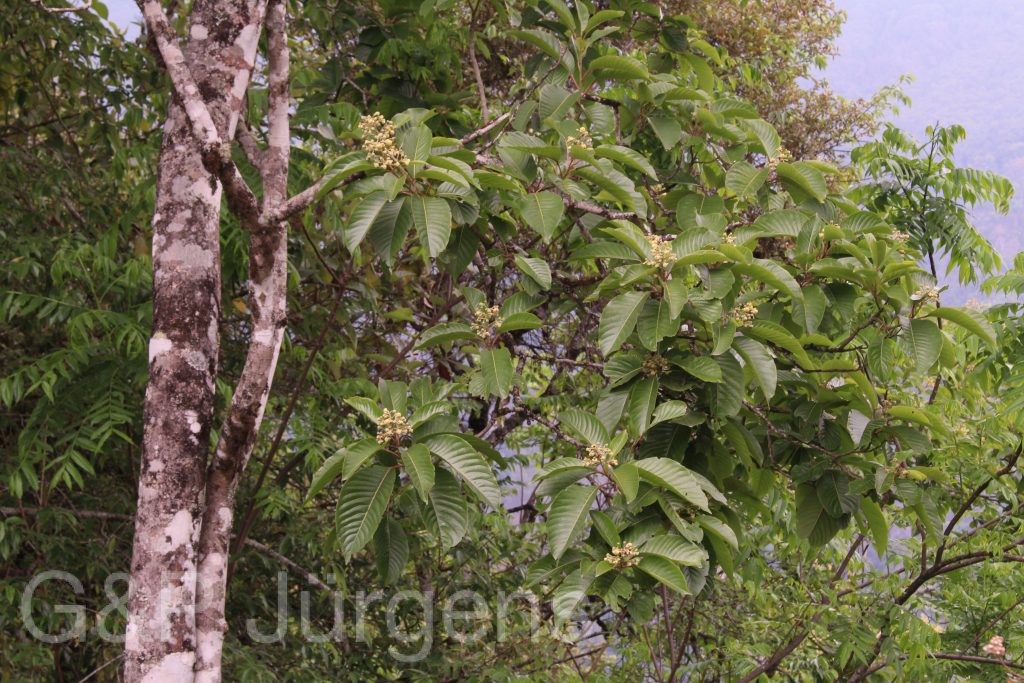
Eriobotrya petiolata is a small evergreen tree of the eastern Himalayan and Indo-Burmese subtropical forests, recorded from India, Bhutan, Myanmar, Bangladesh and China, with cultivated or vagrant records noted from Spain and the United States among the 62 GBIF occurrences. It inhabits warm broadleaved and subtropical hill forest at relatively low elevations. The photographed tree at Trithangebe in southern Bhutan at only 700 m, flowering in May, typifies its preference for humid, frost-free montane foothills well below the alpine plants that dominate the region's high passes.

The species is a tree with stout petiolate leaves, the feature underlying its epithet. The leaves are coriaceous, elliptic to oblong-lanceolate, with a prominent reticulate venation, an acuminate apex, and a margin that is entire to remotely serrate; young growth and the lower surface are typically clothed in rusty tomentum that weathers with age. The inflorescence is a terminal, much-branched, woolly panicle of small white flowers, each with five sepals, five petals, numerous stamens and an inferior ovary. The fruit is a small pome, fleshy at maturity and crowned by the persistent calyx, characteristic of the loquat genus.

GBIF treats the himalayaflora name as a synonym, with Eriobotrya petiolata (Hook.f.) the accepted entity in this dataset; the genus Eriobotrya is itself often submerged within Rhaphiolepis (and broadly within subfamily Maloideae of Rosaceae) in recent molecular treatments, so nomenclature remains in flux. Ecologically the fleshy pomes are dispersed by birds and mammals. As a forest tree of a comparatively restricted Himalayan-Burmese range, it is most threatened by lowland deforestation rather than by any intrinsic rarity.

Author: Hook.f. · Sources: POWO (Kew), GBIF, Flora of Bhutan, Flora of China (Rosaceae), Vidal Eriobotrya revision

(Buch.-Ham. ex DC.) Christenh. & Byng

Bh09 197 P337
Bhutan above Thimphu, 3000m June
Bh09 68 P118
Bhutan above Thimphu, 3000m June
Nepal 99 169 ergebnis
West-Nepal South of Tara-Lake 3000m, June

Description

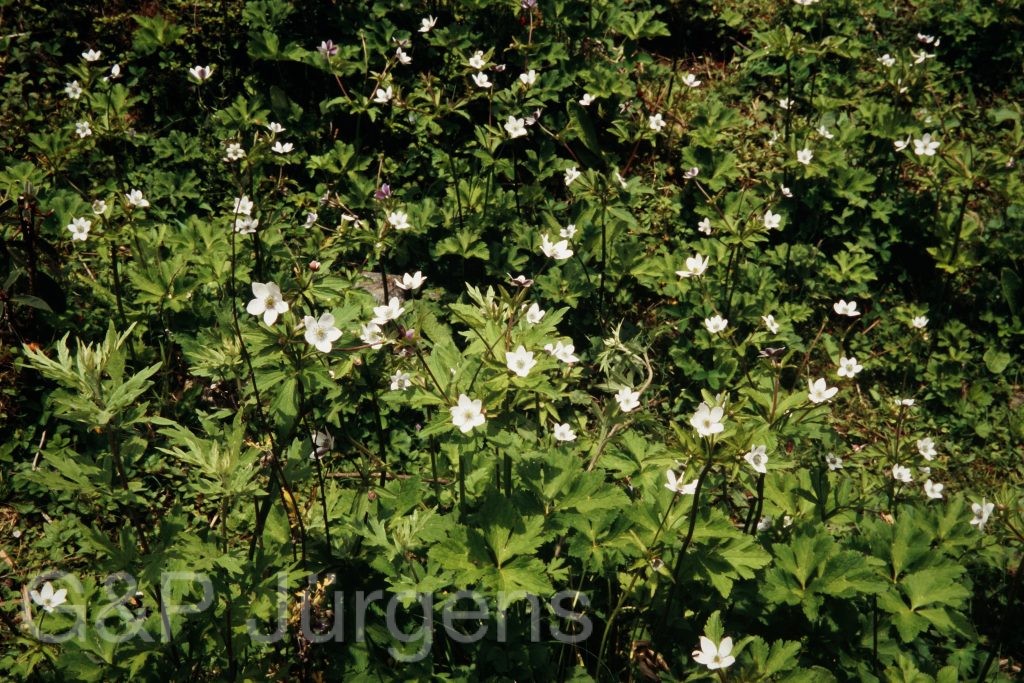
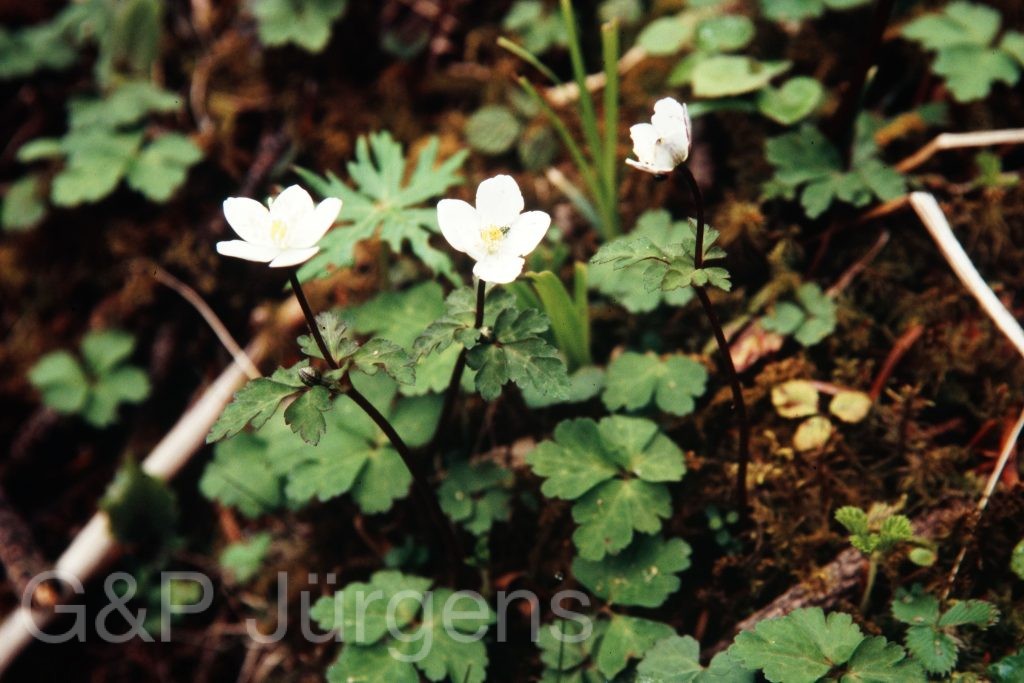
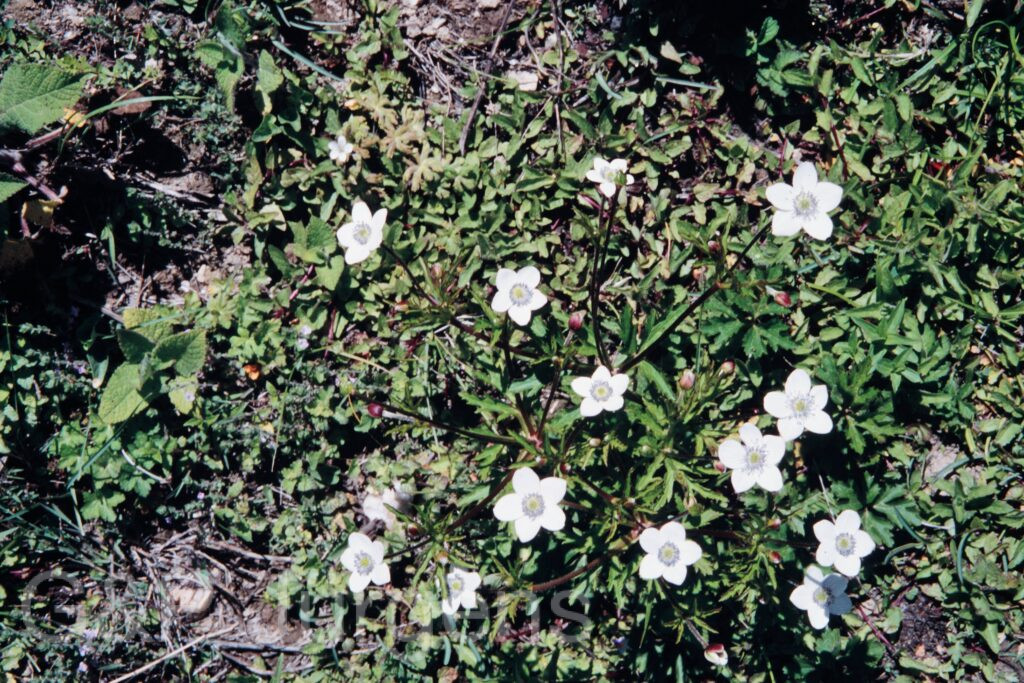
Eriocapitella rivularis (formerly Anemone rivularis) is a widely distributed montane herb of the Sino-Himalayan region. GBIF records span China, Nepal, India, Bhutan, Myanmar and Pakistan, extending to Sri Lanka, with introduced or cultivated occurrences in Europe, Japan and North America, totalling close to 2000 georeferenced collections. It favours moist alpine and subalpine meadows, stream banks, open slopes and forest margins, generally between 2000 and 4200 m. The populations illustrated here were photographed above Thimphu in Bhutan and south of Tara-Lake in West Nepal, both at around 3000 m and flowering in June, typical of its early-summer phenology in the central Himalaya.

It is an erect perennial 20-80 cm tall arising from a stout rootstock, the stems and petioles clothed in spreading white hairs. Basal leaves are long-petiolate and palmately 3-5-lobed, the segments coarsely toothed and bristly. The inflorescence is a lax cyme subtended by a leafy involucre of sessile bracts. Flowers are showy, with 5-6 white petaloid sepals often tinged bluish on the reverse and numerous stamens bearing conspicuous blue-violet anthers; true petals are absent. The fruit is an aggregate of flattened, narrowly winged achenes terminating in a slender hooked beak that aids epizoochorous dispersal.

The transfer to the segregate genus Eriocapitella reflects molecular work resolving the paraphyly of Anemone sensu lato. Pharmacologically it is notable as a source of triterpenoid saponins and is used in Himalayan folk medicine. Its broad ecological amplitude, abundant achene production and wind-aided dispersal render it locally common and of no conservation concern, a characteristic component of grazed Himalayan pasture.

Author: (Buch.-Ham. ex DC.) Christenh. & Byng · Sources: POWO (Kew), GBIF, Flora of China, Flora of Bhutan, Annotated Checklist of the Flowering Plants of Nepal, Monograph of the genus Anemone (Ranunculaceae)

(Buch.-Ham. ex DC.) Nakai

Bhutan2012 1325
Bhutan Pemagatse 1900m, October
Bhutan2012 447
Bhutan Wangdi 2500m, September

Description

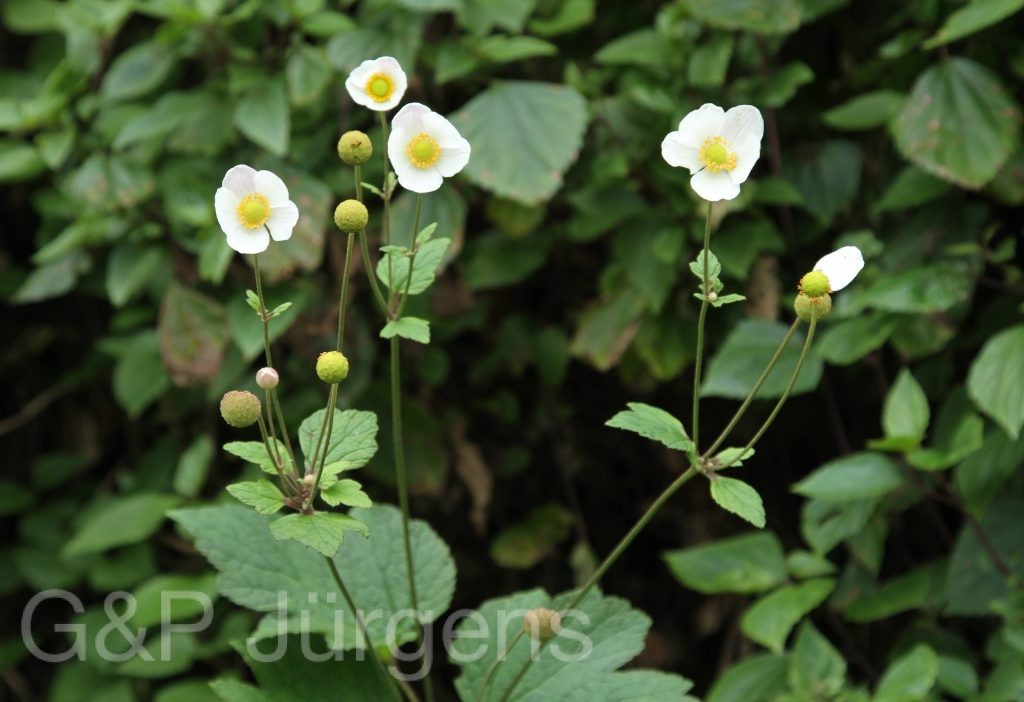
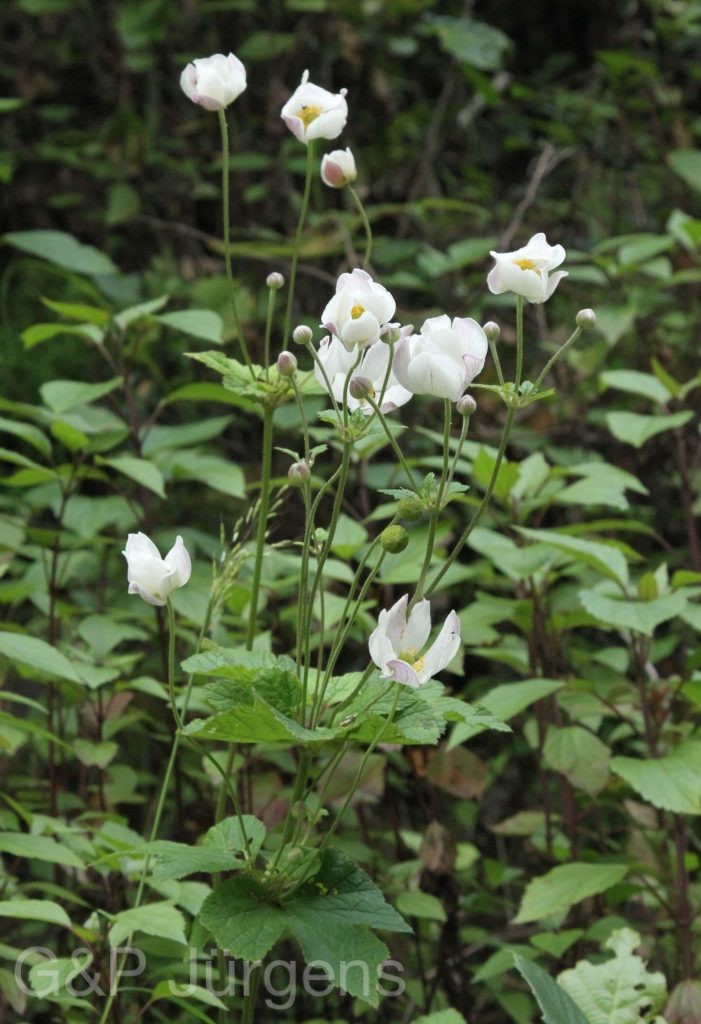
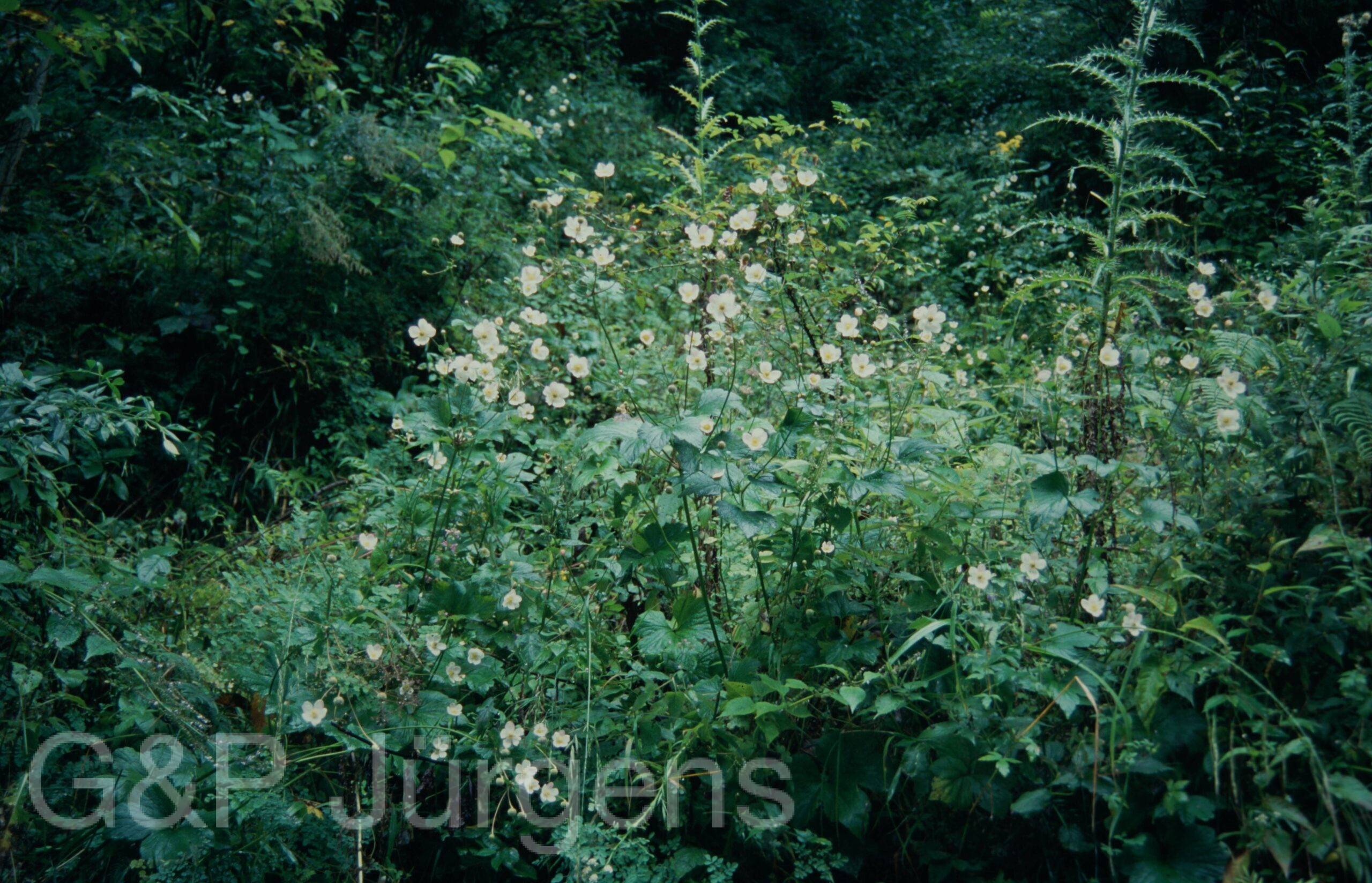
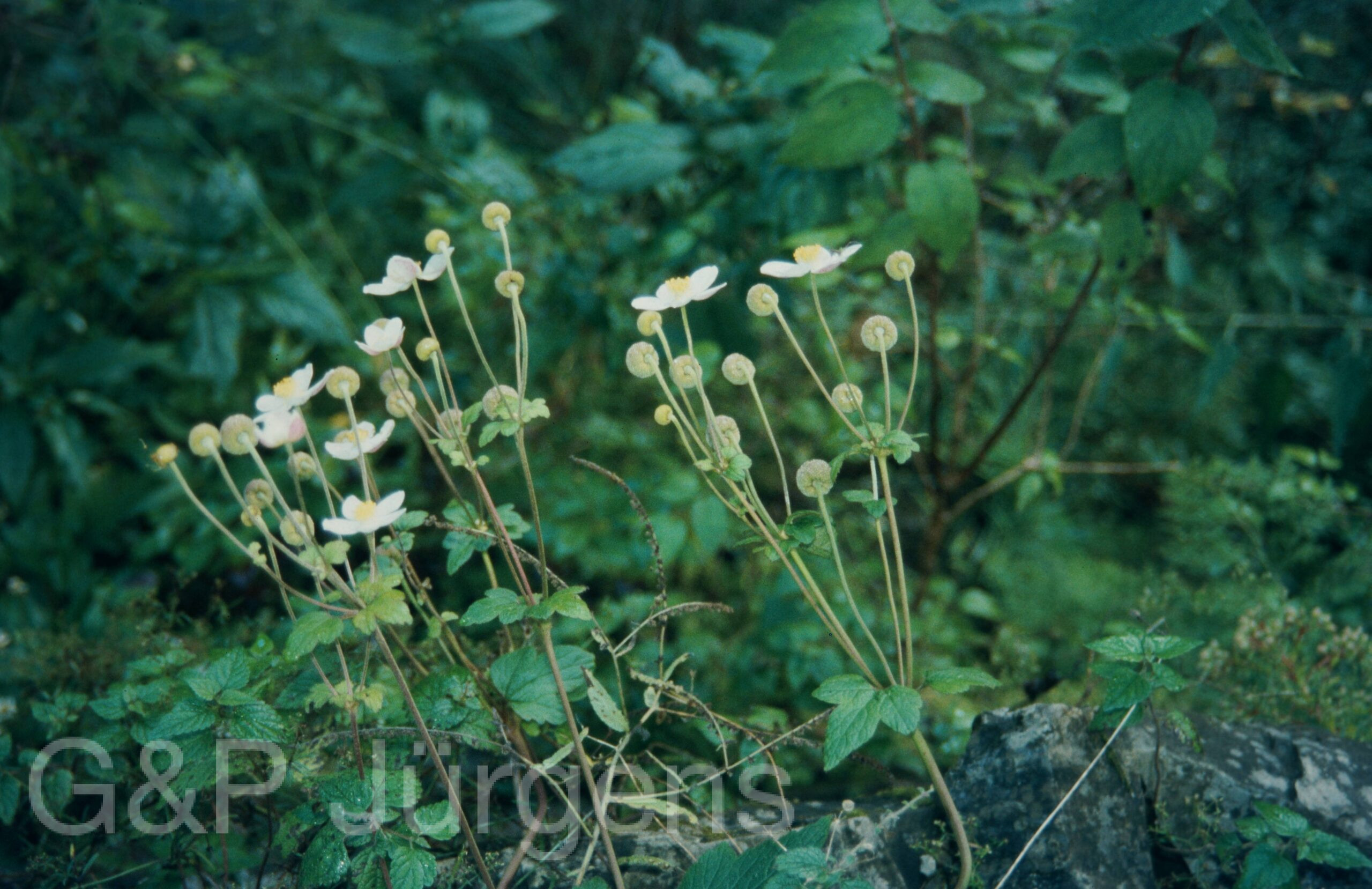
Eriocapitella vitifolia (formerly Anemone vitifolia) is a robust perennial herb widespread across the Himalaya and East Asia, recorded from China, Nepal, India, Bhutan, Taiwan, Myanmar, Pakistan and beyond, with nearly 2000 georeferenced occurrences in GBIF reflecting both its native range and ornamental cultivation. It favours forest margins, open slopes, shrubberies and disturbed banks, mainly in the warm- to cool-temperate belt between about 1500 and 3000 m. The plants illustrated were photographed in Bhutan at Pemagatse (1900 m) and Wangdi (2500 m) and in the Indian Garhwal at Sitel (1850 m), flowering from September into October.

The species arises from a stout, woody rootstock and produces long-petiolate basal leaves with broadly cordate-ovate, vine-like (vitifolia, grape-leaved) blades that are shallowly three- to five-lobed, toothed, and densely white-tomentose beneath. Tall, branching flowering scapes bear cymose clusters of showy flowers, each with five to many petaloid sepals (true petals absent) that are white to pale pink, surrounding a central mass of numerous yellow stamens and a domed cluster of carpels. The fruiting head is globose and conspicuously woolly, the densely hairy achenes being adapted for wind dispersal, a feature reflected in the generic name.

Eriocapitella was segregated from Anemone (Ranunculaceae) on molecular and morphological grounds, comprising the woolly-fruited Asian anemones, and E. vitifolia is one of its most familiar Himalayan representatives. It is widely grown in temperate gardens and is an ancestral parent of the cultivated Japanese anemones, explaining scattered records in Europe, North America and southern Africa. Containing acrid ranunculaceous compounds, it is avoided by grazers and, common and adaptable, is of no conservation concern.

Author: (Buch.-Ham. ex DC.) Nakai · Sources: POWO (Kew), GBIF, Flora of China, Flora of Bhutan, Annotated Checklist of the Flowering Plants of Nepal, Hoot et al. Phylogeny of Anemone and Allies

(Benth.) G.L.Nesom

Bhutan2014 855
Bhutan Thimphu 2600m, May

Description

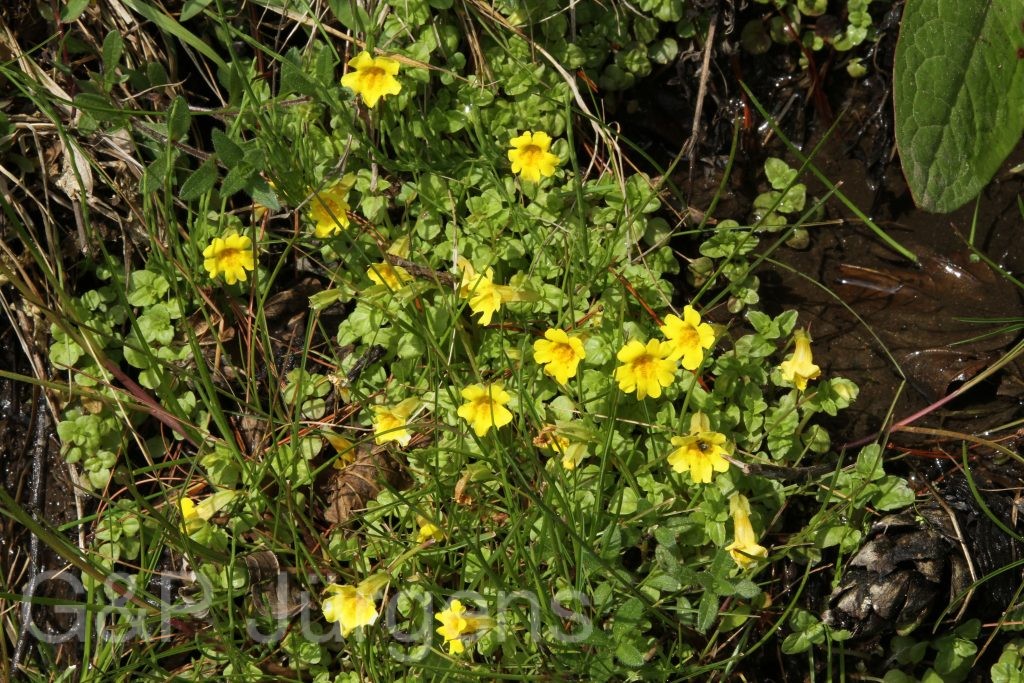
Erythranthe nepalensis is a small wetland herb of temperate East and South Asia, recorded from Japan, China, Korea, Taiwan, Nepal, Bhutan, India, Myanmar, Pakistan and Bhutan, with around 2199 georeferenced occurrences in GBIF. It grows in damp, open ground: stream banks, ditch margins, wet meadows, seepages, rice-field bunds and moist rock crevices from the foothills into the temperate montane zone. The photographed plant from Thimphu in Bhutan at 2600 m in May is characteristic of such cool, moist Himalayan habitats, where it flowers in spring along watercourses and on dripping banks.

It is a slender annual or short-lived perennial herb with weak, decumbent to ascending, often rooting stems forming low mats. The leaves are opposite, small, ovate to broadly ovate, palmately veined, with a few shallow teeth and short petioles. The flowers are solitary in the leaf axils on slender pedicels; the calyx is tubular-campanulate and angled-ribbed, with short triangular lobes, and the corolla is bilabiate and yellow, the throat marked with reddish-brown to purplish spots and the lower lip prominent. There are four didynamous stamens, and the fruit is an oblong capsule enclosed by the persistent ribbed calyx, releasing numerous tiny seeds.

Formerly placed in Mimulus (as Mimulus tenellus var. nepalensis), the species was transferred to Erythranthe by G.L. Nesom following the molecular recircumscription that divided the old Mimulus among several genera and moved them from Scrophulariaceae to Phrymaceae. The spotted, bilabiate yellow flowers are adapted to bee pollination, and the plant's affinity for moist, disturbed ground allows ready local colonisation. Common and widespread across its range, it is of no particular conservation concern.

Author: (Benth.) G.L.Nesom · Sources: POWO (Kew), GBIF, Flora of China Vol. 18, Flora of Bhutan Vol. 2, Flora of Nepal, Taxonomy of Erythranthe (Phrymaceae) (Nesom)

Roxb.

Bhutan2015 65
Bhutan Wangdi Phodrang 1900m, October
Bhutan2012 464
Bhutan Wangdi 2500m, September

Description

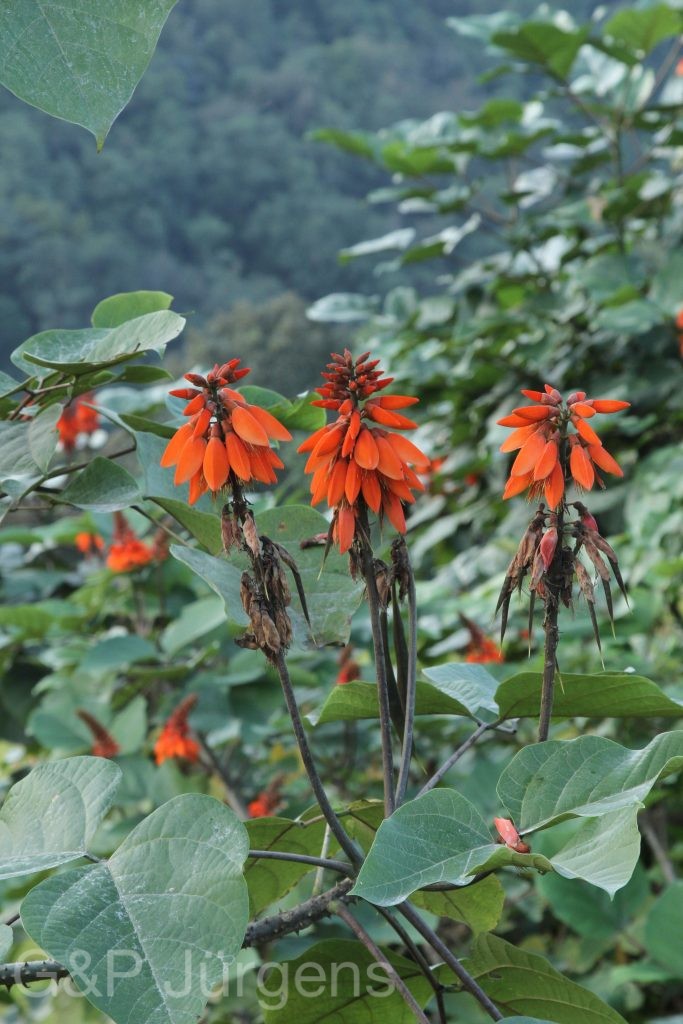
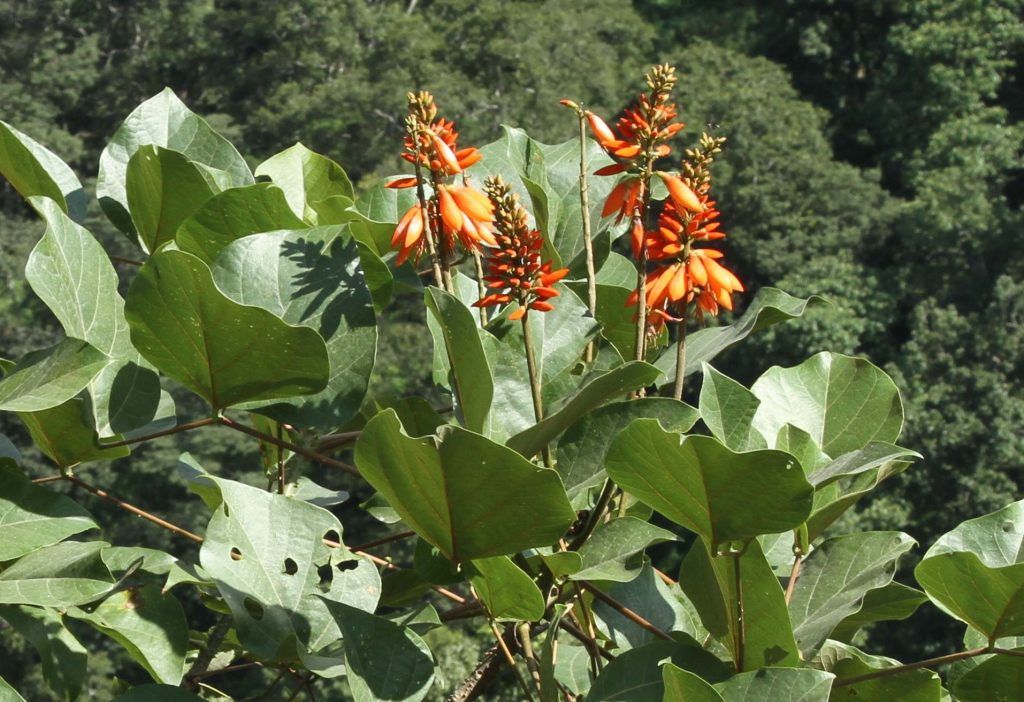
Erythrina arborescens is a Himalayan to Southeast Asian coral tree distributed across China, India, Nepal, Bhutan, Myanmar, Bangladesh, Japan and Thailand, with about 369 GBIF occurrences spanning this wide subtropical to warm-temperate range. It grows in open broad-leaved forest, forest margins, valley slopes and disturbed ground, generally from about 1300 to 3000 m. The trees photographed near Wangdi Phodrang in Bhutan at about 1900 m in October and at about 2500 m in September illustrate its mid-elevation valley habitat, where its scarlet flower spikes appear after the leaves toward the close of the monsoon.

The species is a small to medium-sized deciduous tree with a stout trunk and branches armed with scattered conical prickles. The leaves are alternate and trifoliolate, with broadly ovate to rhombic leaflets, the terminal one largest, on a long prickly petiole. The inflorescence is a dense terminal raceme of large, showy, bright red papilionaceous flowers in which the broad standard petal is conspicuously enlarged while the wings and keel are reduced, an arrangement adapted to bird pollination. The fruit is an elongate, torulose, dehiscent legume constricted between the few shining red-brown seeds.

Erythrina is a pantropical genus of about 130 species notable for ornithophilous, nectar-rich flowers and seeds containing toxic isoquinoline alkaloids. E. arborescens is among the few species extending into temperate Himalayan elevations, its post-monsoon flowering and copious nectar attracting sunbirds and other nectarivorous birds that serve as pollinators. Widely distributed and tolerant of disturbance, it is of least concern; it is locally valued as a shade and ornamental tree and features in traditional medicine across its range.

Author: Roxb. · Sources: POWO (Kew), GBIF, Flora of China, Flora of Bhutan, Annotated Checklist of the Flowering Plants of Nepal, Krukoff & Barneby studies of Erythrina