Tag:

Myanmar

Flowers of the Myanmar Himalaya — 604 species recorded from northern Myanmar (Burma) and the eastern Himalayan borderlands, a biodiversity hotspot linking the Himalaya to the mountains of Yunnan and Southeast Asia. The region’s forests and alpine slopes hold a rich flora of rhododendrons, orchids, balsams and gentians. Every page gives a botanical description, distribution, habitat and flowering time with the original photograph.

Erythrina stricta

by GP Jürgens

Roxb.

Nepal1992 23 P32 ergebnis
Nepal Kharang 1250m March 
Nepal1992 84 P118 ergebnis
Nepal Kharang 1250m, March 

Description

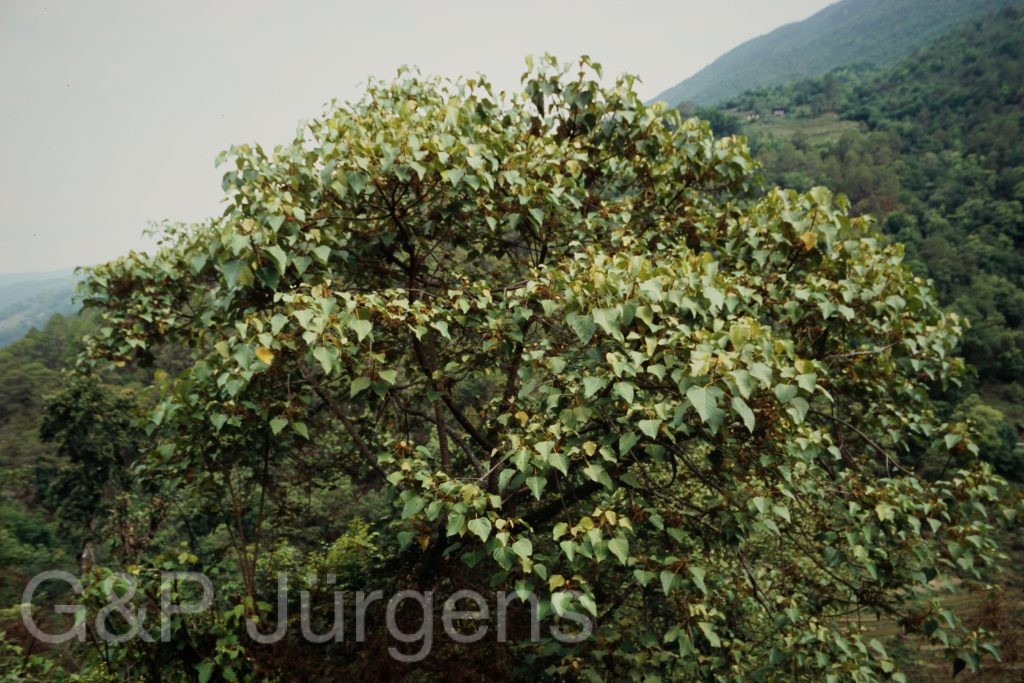
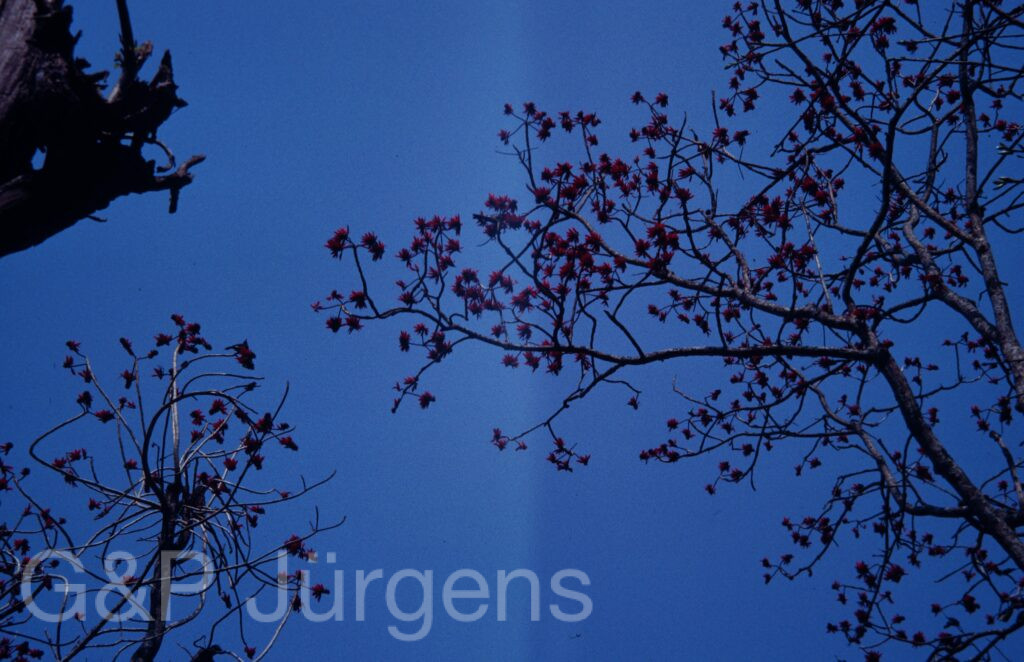
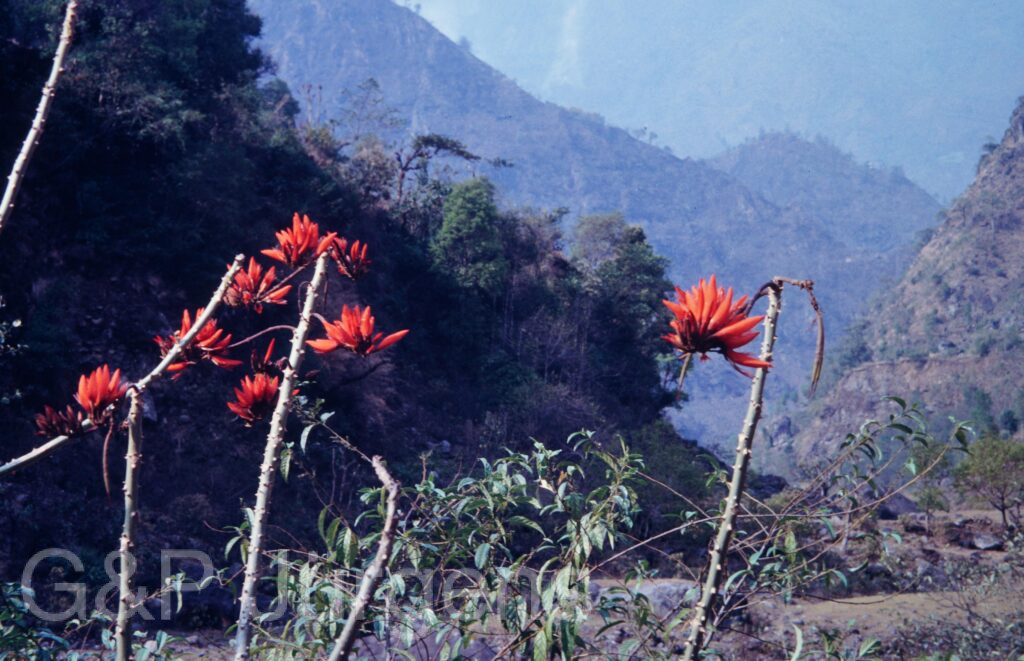
Erythrina stricta Roxb. is a deciduous coral tree widely distributed across tropical and subtropical Asia, recorded from India, Nepal, Bhutan, China, Myanmar, Thailand, Laos, Vietnam, Sri Lanka, Malaysia, Indonesia and the Philippines; its GBIF dataset of 346 occurrences reflects both wild populations and frequent planting. It occurs in open subtropical forest, forest margins, scrub and along cultivated land in the foothills, broadly from the lowlands to about 1500 m. The photographed tree at Kharang in Nepal at about 1250 m, flowering in March, exemplifies its dry-season, leafless flowering in the warm subtropical hill zone of the outer Himalaya, conspicuous as a flush of scarlet bloom on bare branches.

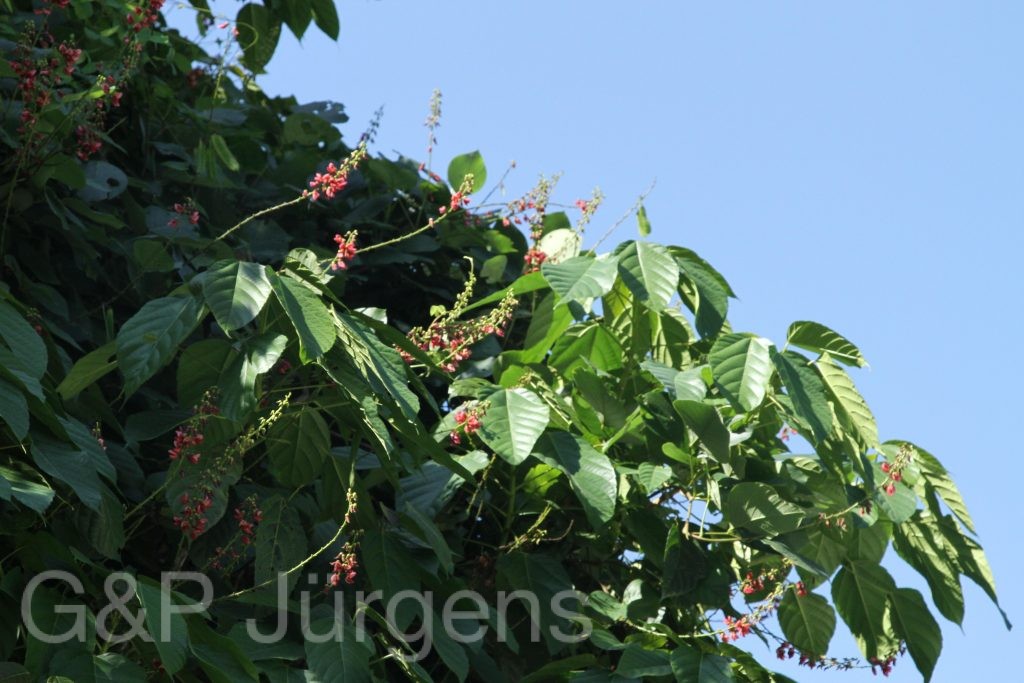
The species is a small to medium-sized deciduous tree with a straight bole and armed branches bearing scattered conical prickles. The leaves are alternate and trifoliolate with broadly ovate to deltoid, entire leaflets, the terminal one rhombic-ovate and larger than the laterals; they are typically shed before flowering. The inflorescence is a dense, erect, terminal raceme of showy papilionaceous flowers; the large, bright scarlet to crimson standard is narrow and nearly straight, much exceeding the small keel and wings, and the nectar-rich flowers attract birds. The fruit is an elongate, torulose, constricted legume that splits to release several reddish, bean-like seeds.

Erythrina (Fabaceae, subfamily Faboideae, tribe Phaseoleae) is a pantropical genus of bird-pollinated coral trees; E. stricta belongs to the Asian assemblage with erect, narrow-standard flowers on leafless branches. It is widely planted as an ornamental, shade and support tree and as a living fence, and its bark and seeds contain Erythrina alkaloids of pharmacological interest. Broadly distributed, fast-growing and commonly cultivated, it is of no conservation concern and serves ecologically as an early dry-season nectar source for birds and insects.

Author: Roxb. · Sources: POWO (Kew), GBIF, Flora of China, Flora of British India, Annotated Checklist of the Flowering Plants of Nepal, Krukoff & Barneby — Conspectus of the genus Erythrina
Wall.

Sikkim 2006 184 ergebnis
India West-Bengal, Samadan 2300m, May
BhutanPG2011 82 ergebnis scaled
Bhutan Menchuang 2850m, June

Description

Euonymus frigidus is a Himalayan spindle tree distributed from central Nepal through northeast India, Sikkim, Bhutan, and northern Myanmar to southwest China (Yunnan, Sichuan, Xizang). GBIF records over 1,570 occurrences, with the majority from China and the eastern Himalayas. The species inhabits cool-temperate and subalpine broadleaved and mixed forests, often growing along forest margins, stream gullies, and shaded slopes at elevations of 1,800–3,200 m. Collections from Samadan in West Bengal at 2,300 m and from Menchuang in Bhutan at 2,850 m illustrate its typical occurrence in the mid-elevation broadleaved forest zone of the eastern Himalayan slopes.
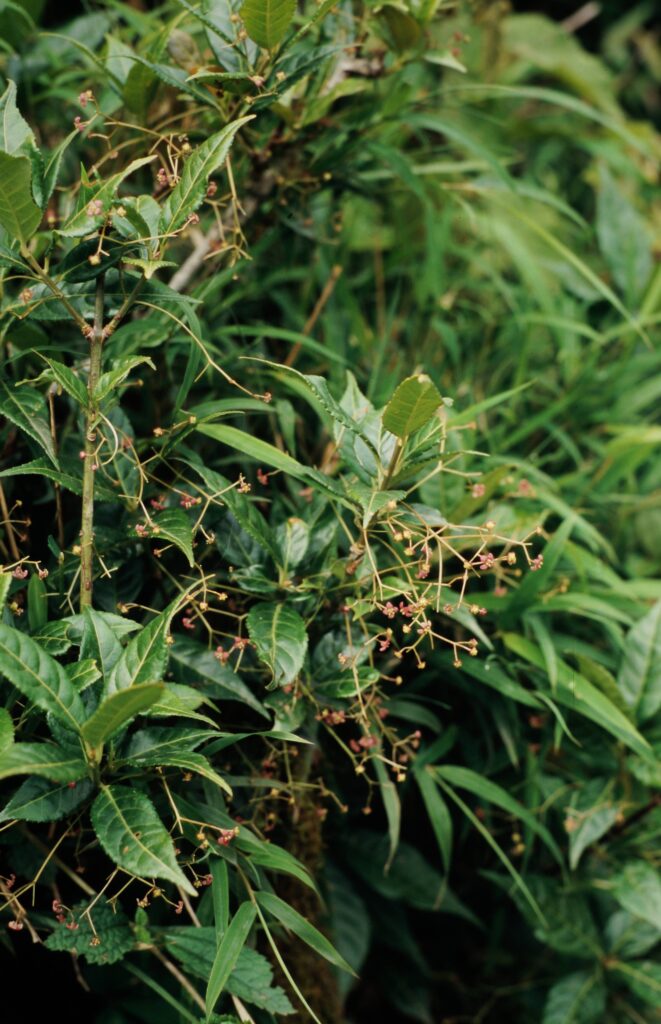
Euonymus frigidus is a large deciduous shrub or small tree, reaching 3–8 m in height, with smooth, greyish-green bark on younger branches. Leaves are opposite, elliptic to oblong-lanceolate, 6–14 cm long, acuminate at the apex, cuneate at the base, with finely crenate-serrate margins, glabrous on both surfaces, and turning reddish-purple in autumn. The inflorescence is an axillary, dichasial cyme bearing 7–15 flowers on slender peduncles. Flowers are tetramerous, small, 6–8 mm in diameter, with greenish-yellow to purplish petals and a conspicuous four-lobed disc. The fruit is a deeply four-lobed capsule, pink to crimson at maturity, splitting to reveal four seeds each enclosed in a bright orange aril — a striking ornamental feature.
The specific epithet 'frigidus' alludes to the cold-temperate habitats in which this species predominantly occurs. Euonymus frigidus is distinguished from the closely related E. hamiltonianus by its generally larger leaves, more deeply lobed capsules, and preference for higher elevations. The conspicuous arillate fruits are an important food source for frugivorous birds, including minivets and laughingthrushes, which serve as effective dispersal agents. The species is occasionally cultivated as an ornamental in European and North American gardens for its vivid autumn colour and decorative fruit.

Author: Wall. · Sources: POWO (Kew), GBIF, Flora of China Vol. 11, Flora of Bhutan Vol. 2, Grierson & Long: Flora of Bhutan (1991)

Hook.f.

Bhutan2014 976
Bhutan Chele-La 3400m, May
Bhutan2014 397
Bhutan Chele-La 3400m, May
Bh09 245 P408
Bhutan 2009

Description

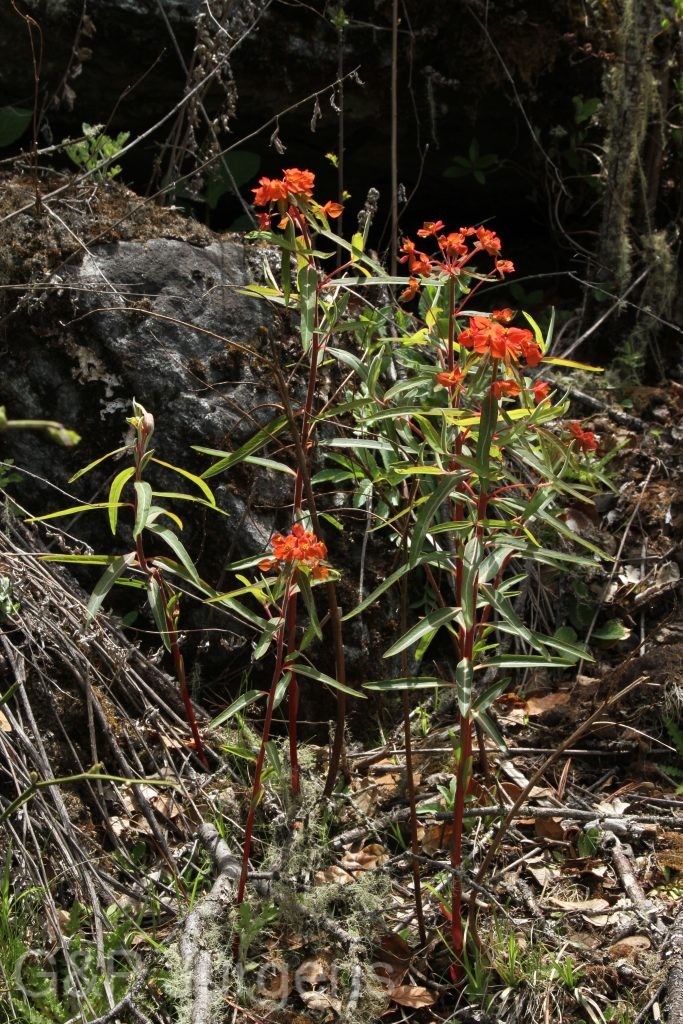
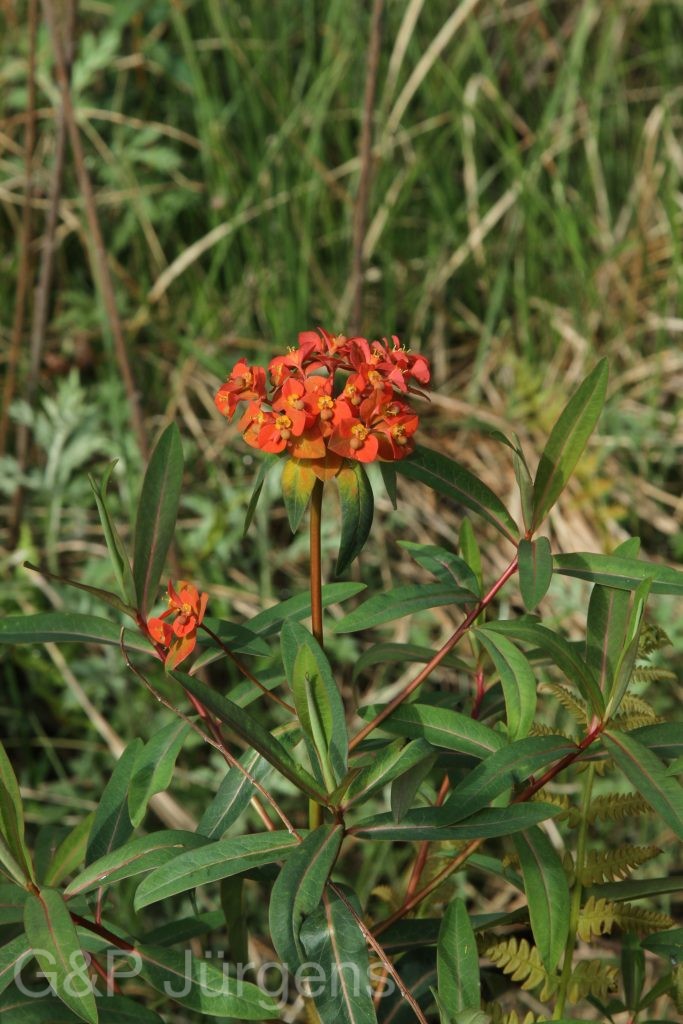
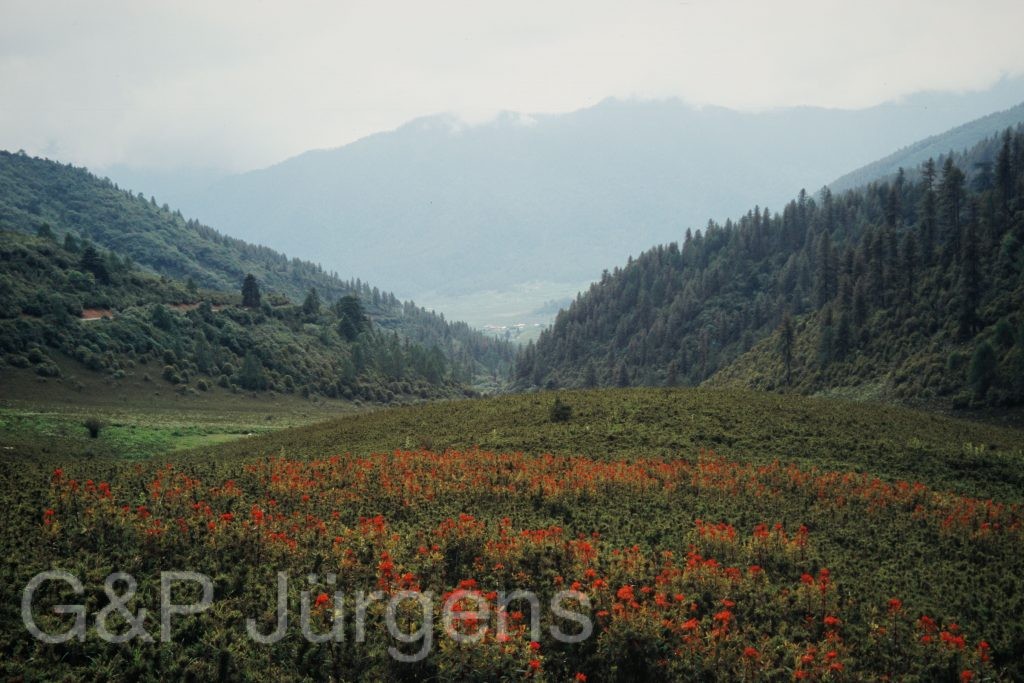
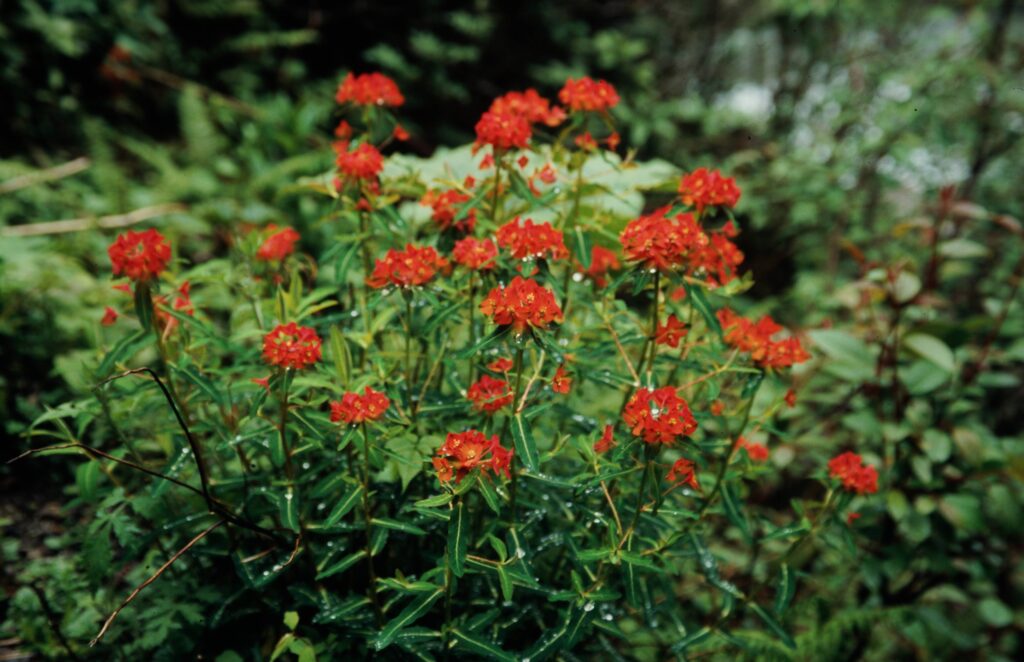
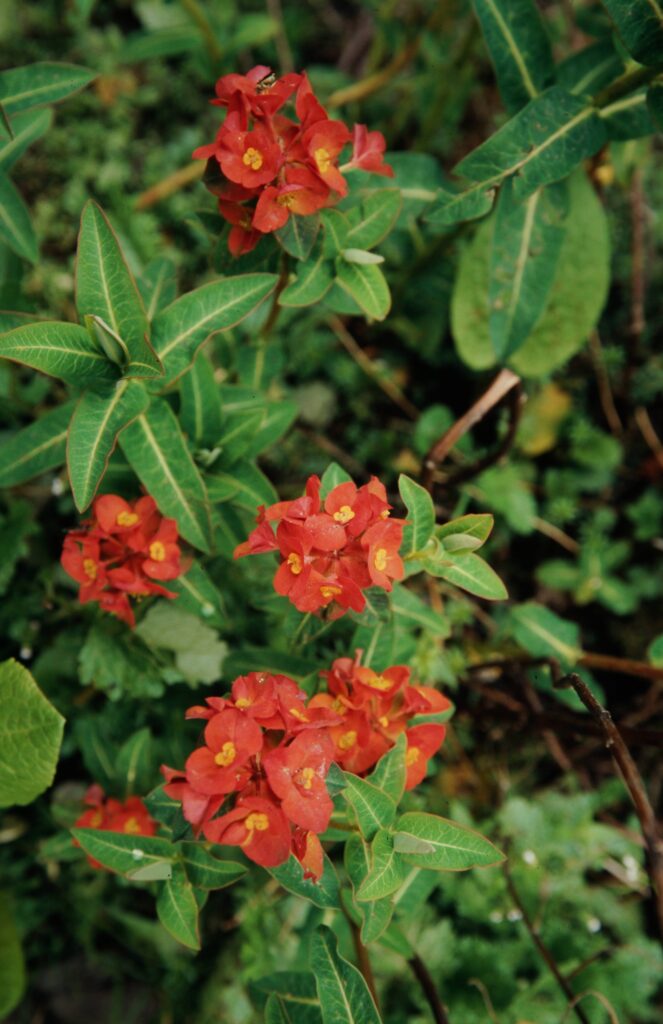
Euphorbia griffithii is a herbaceous perennial spurge of the eastern Himalayan mountains, with 538 GBIF occurrences spanning China, Bhutan, Myanmar, India and Nepal, alongside numerous cultivated records from Britain, Germany, France and North America, reflecting its popularity as a hardy garden perennial. It grows in open subalpine meadows, forest clearings, scrub and grassy slopes in the upper temperate to subalpine zone. It was recorded on the Chele-La in Bhutan at about 3400 m and at Tamrong in West Bengal, India, at about 2650 m, both in May, when the bracts colour vividly at the start of the growing season.

It is an erect, clump-forming herb arising from a creeping rhizome, the unbranched or sparingly branched stems exuding white latex when cut. The leaves are alternate, oblong to oblanceolate, entire, often flushed reddish and frequently with a pale midrib. The inflorescence is a terminal umbel-like cyme of cyathia, each cyathium a cup of fused bracts enclosing reduced flowers; the floral leaves and bracts beneath the cyathia turn fiery orange-red, providing the conspicuous display, while the involucral glands are typically yellowish. The fruit is a three-lobed capsule splitting into mericarps.

Euphorbia (Euphorbiaceae) is one of the largest plant genera, and E. griffithii belongs to its temperate, rhizomatous, herbaceous element rather than the succulent xerophytes. Long in cultivation, with selections such as the well-known coloured-bracted cultivars, it is widespread and secure across its native range. Its brilliant bract colouration and montane meadow habitat make it both a horticulturally important and biogeographically representative member of the eastern Himalayan herbaceous flora.

Author: Hook.f. · Sources: POWO (Kew), GBIF, Flora of China, Flora of Bhutan, Annotated Checklist of the Flowering Plants of Nepal, Radcliffe-Smith's treatment of Euphorbia (Euphorbiaceae)

Boiss.

Nepal 2001 302 ergebnis ergebnis
Nepal (Gorkha) Lambra Kharka 3100m, May
Nepal 2001 301 ergebnis
Nepal (Gorkha) Lambra Kharka 3100m, May
Nepal 97 86 P146
Nepal Tankhu 2100m April

Description

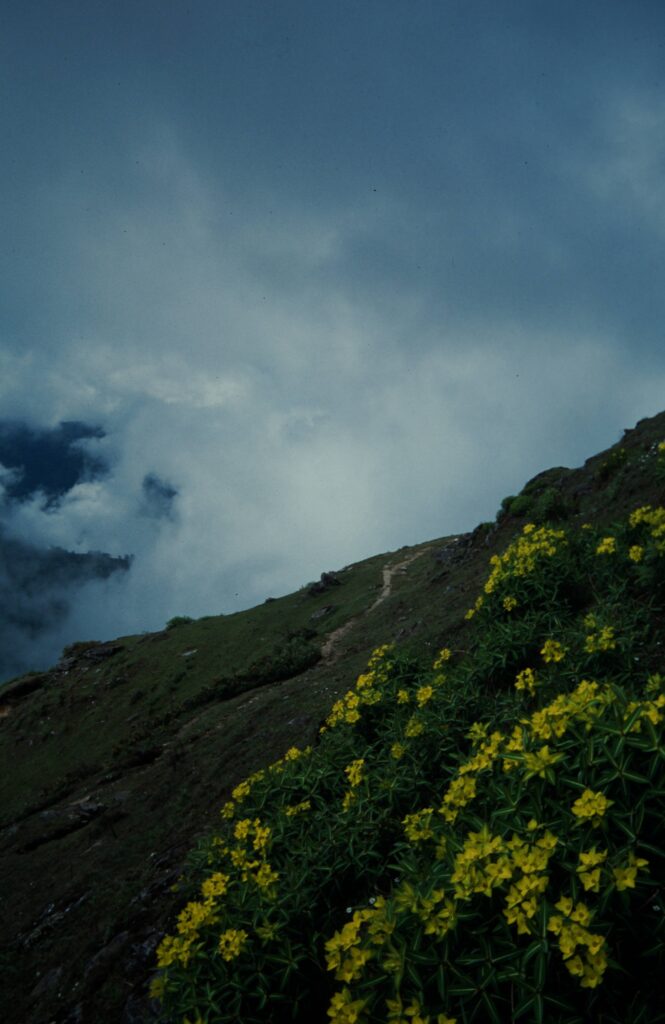
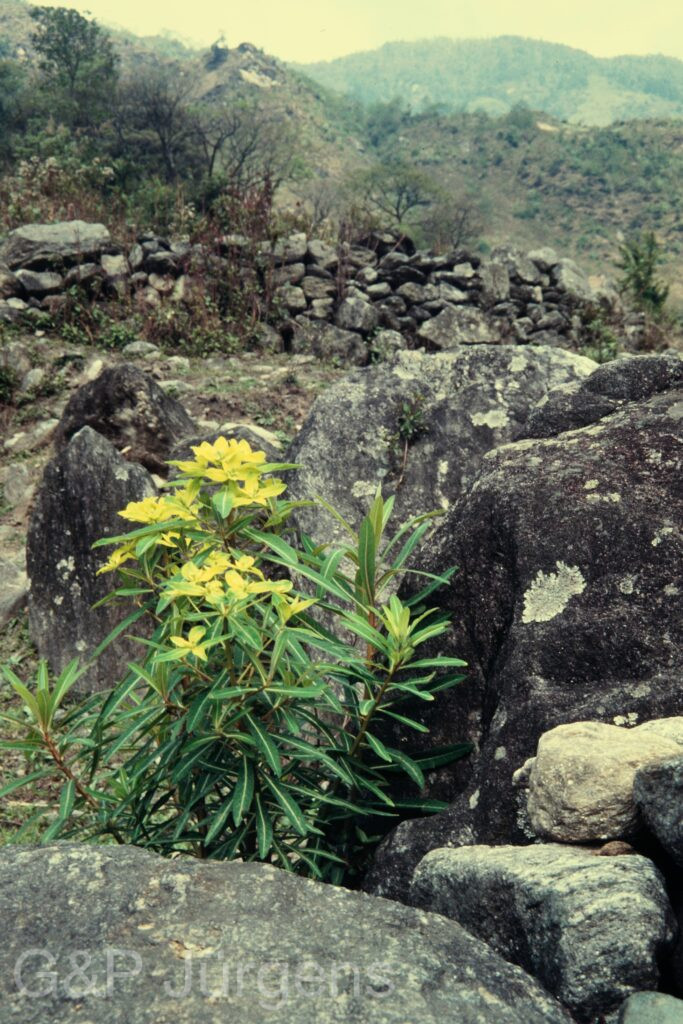
Euphorbia sikkimensis is a robust herbaceous spurge distributed across the eastern and central Himalaya, from central Nepal through Sikkim, Bhutan, and northeast India into southern China (Xizang, Yunnan), with peripheral records from Myanmar, Laos, and Vietnam. It occurs in subalpine meadows, forest clearings, scrub margins, and open hillsides at elevations of 1,800–3,500 m. The species has been documented from the Gorkha district of Nepal at Lambra Kharka at 3,100 m in May and near Tankhu at 2,100 m in April, indicating a broad elevational amplitude and early-season phenology at lower altitudes.
The plant is a stout, erect perennial herb, 30–80 cm tall, with thick, fleshy rootstock and unbranched or sparingly branched stems that exude copious white latex when cut. Leaves are alternate, sessile, linear-lanceolate to oblanceolate, 8–15 cm long and 1–2.5 cm wide, with a prominent pale midrib, entire margins, and a glaucous undersurface. The inflorescence is a terminal, compound cyathium typical of the genus, with a broad umbel of 4–8 primary rays, each ray subtended by obovate, yellowish-green floral bracts. The cyathia bear crescent-shaped glands with short horns. The fruit is a smooth, trilocular capsule approximately 6–8 mm in diameter, explosively dehiscent at maturity, with carunculate seeds.
Euphorbia sikkimensis was described by Boissier from Sikkim collections and belongs to Euphorbia subgenus Esula, a predominantly Eurasian clade of herbaceous spurges. It is notable for its striking appearance in early spring, when the bright red or pink-tinged new stems contrast with the yellowish-green inflorescences. The species has gained horticultural recognition in temperate gardens and is increasingly cultivated as an ornamental perennial in Europe. Ecologically, its copious latex deters herbivory, and it plays a role in early-season pollinator support in montane grassland ecosystems.

Author: Boiss. · Sources: POWO (Kew), GBIF, Flora of China Vol. 11, Annotated Checklist of the Flowering Plants of Nepal

(Hook.f. & Thomson) Al-Shehbaz, G.Q.Hao & J.Quan Liu

Bh09 144 P255
Bhutan Al-Shehbaz, 4100m June

Description

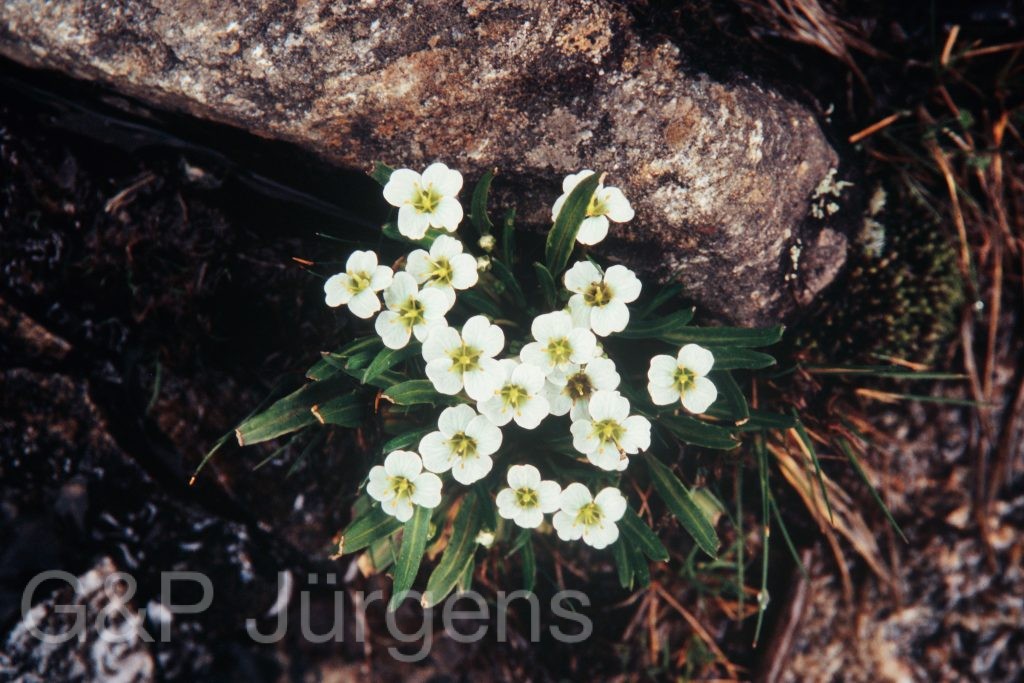
Eutrema scapiflorum (Hook.f. & Thomson) Al-Shehbaz, G.Q.Hao & J.Quan Liu is a dwarf alpine crucifer of the high Sino-Himalaya, recorded from China, India, Nepal, Bhutan and Myanmar. The species is illustrated from Bhutan at approximately 4100 m, flowering in June, consistent with its occurrence in the upper alpine belt. It inhabits open stony slopes, moraines, fellfield, gravelly flushes and the margins of snow-fed rills, generally between 3800 and 5000 m, where it endures intense insolation, freezing nights and a compressed growing season. With around 630 GBIF records it is a genuinely high-elevation specialist, scarce and patchily distributed across its range.

The plant is a small, glabrous, cushion- to rosette-forming perennial arising from a stout caudex and taproot. The basal leaves are crowded, spathulate to oblong-obovate, entire or obscurely toothed, and rather fleshy. As the epithet scapiflorum implies, the white flowers are borne on short, nearly leafless scapes scarcely exceeding the foliage, each flower with four spreading petals and the typical cruciferous tetradynamous androecium. The fruit is a short, oblong to linear silique or silicle, somewhat flattened, dehiscing to release a few seeds in two rows.

The taxon was long placed in the segregate genus Pegaeophyton (as P. scapiflorum), reflected in its original webpage URL, but molecular phylogenetic analyses have shown Pegaeophyton to be nested within Eutrema, prompting the present transfer. It belongs to the tribe Eutremeae, a predominantly Himalayan and Central Asian lineage of cold-adapted mustards. Its restricted high-alpine niche renders it sensitive to upslope vegetation shifts and the retreat of late-lying snow, though no formal conservation assessment has yet been made.

Author: (Hook.f. & Thomson) Al-Shehbaz, G.Q.Hao & J.Quan Liu · Sources: POWO (Kew), GBIF, Flora of China, Flora of Bhutan, Annotated Checklist of the Flowering Plants of Nepal, Al-Shehbaz revisions of Himalayan Brassicaceae

Exacum teres

by GP Jürgens

Wall.

Nepal 95 255 P438 ergebnis
Nepal Valley of Buri Gandaki, Kholabensi 2100m October

Description

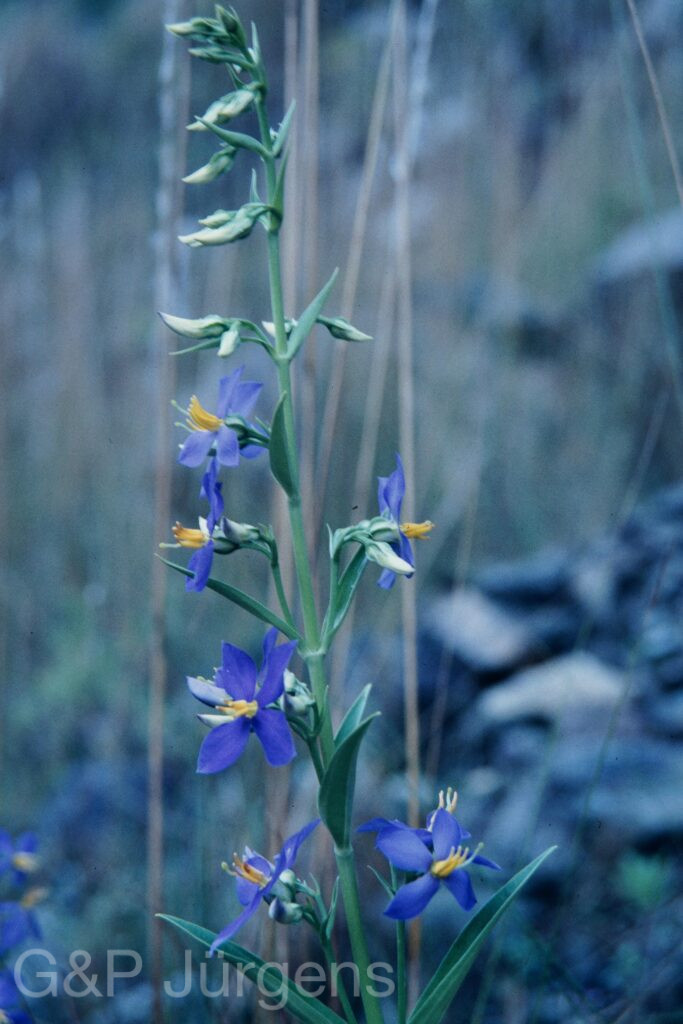
Exacum teres is a slender annual gentian of the eastern Himalaya and adjacent Indo-Burmese region, documented by GBIF (about 125 occurrences) from India, Nepal, Bangladesh, China, Myanmar and Bhutan. It grows in moist, open habitats of the warm-temperate and subtropical belt, including grassy banks, terraced field margins, forest clearings and damp roadside slopes, typically below the main forest line. The illustrated material was gathered in the valley of the Buri Gandaki at Kholabensi in Nepal at about 2100 m in October, a montane locality near the upper edge of its altitudinal range, which extends from the lowland hills up into the cooler middle hills.

The plant is an erect, glabrous herb with a quadrangular, often narrowly winged stem (the epithet teres referring to its terete-cylindric aspect) that branches above. The leaves are opposite, sessile to subsessile, ovate to lanceolate, entire, and conspicuously three- to five-nerved from the base. The flowers are borne in a lax terminal and axillary cyme; each has a four-lobed calyx with keeled, narrowly winged segments, and a rotate to broadly campanulate corolla that is blue to violet with a deeper throat. The four stamens bear large yellow anthers that open by terminal pores, a diagnostic feature of Exacum. The bilocular ovary matures into a small, septicidal capsule containing numerous minute, reticulate seeds.

Exacum is a palaeotropical genus centred on Sri Lanka, southern India and Madagascar, with E. teres representing the small Himalayan element of the lineage. As a widespread annual of disturbed and semi-natural grassland it is not considered threatened. Its poricidal anthers and blue corollas indicate buzz-pollination by bees, and several relatives are of horticultural interest as the cultivated Persian violets.

Author: Wall. · Sources: POWO (Kew), GBIF, Flora of China, Flora of Bhutan, Annotated Checklist of the Flowering Plants of Nepal, Klackenberg's monograph of Exacum (Gentianaceae)

(R.Br. ex Griff.) R.W.Br.

Bh09 232 P388
Bhutan Wangdi, 1700m June

Description

Exbucklandia populnea is an evergreen tree of the family Hamamelidaceae, distributed through the eastern Himalaya and into Southeast Asia. GBIF records document its presence in China, India, Bhutan, Nepal, Myanmar, Thailand, Laos, Vietnam, Malaysia, Indonesia and Sri Lanka, defining a broad Sino-Himalayan to Indo-Malayan range. It is a tree of moist, montane evergreen broad-leaved forest, often locally dominant in mid-elevation forest and on ridge crests, typically between about 1,000 and 2,500 m. The individual illustrated near Wangdue Phodrang (Wangdi) in Bhutan at around 1,700 m in June is characteristic of this humid mid-montane forest belt.

The species is a tall tree reaching 20–30 m with a straight bole and smooth grey bark. The leaves are alternate, long-petiolate, with broadly ovate, palmately three- to five-veined, often shallowly lobed blades reminiscent of a poplar, hence the epithet populnea; they are leathery and glabrous, with the petiole bearing conspicuous, large, paired stipules that sheath the bud and leave an annular scar on falling. The flowers are small, apetalous and aggregated into dense, rounded, capitate heads, the heads themselves grouped on a common axis; each head bears stamens and bicarpellate ovaries. The fruit is a woody capsule, several aggregated into a globose head, dehiscing to release small winged seeds.

The genus Exbucklandia is an isolated member of the relictual, largely Asian family Hamamelidaceae, a group of considerable phylogenetic interest in understanding early angiosperm woody lineages. The conspicuous stipules and capitate, apetalous inflorescences are diagnostic. The timber is locally used in construction and the species is an important canopy component of eastern Himalayan evergreen forest. Though widely distributed and not globally threatened, its montane forest habitat is locally subject to logging and conversion.

Author: (R.Br. ex Griff.) R.W.Br. · Sources: POWO (Kew), GBIF, Flora of China Vol. 9, Flora of Bhutan Vol. 1, Flora of Nepal, Endress: Hamamelidaceae and adjacent families

Wall. ex Benth.

Bhutan2015 109
Bhutan Galephu 500m, October

Description

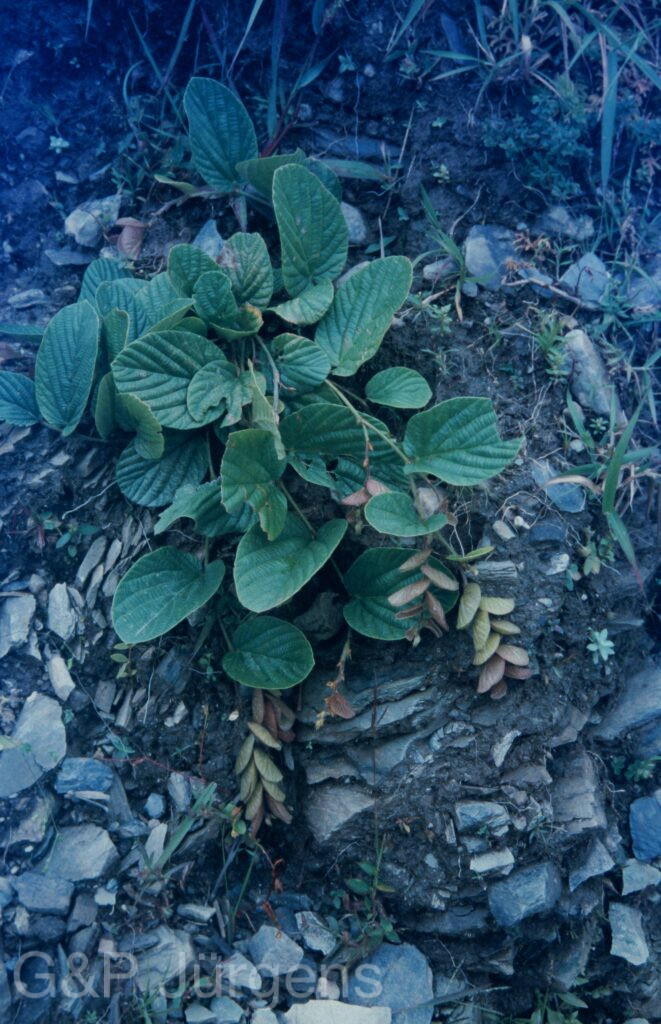
Flemingia paniculata Wall. ex Benth. is a subshrubby legume of the warm submontane belt of tropical and subtropical Asia, recorded from Thailand, Myanmar, India, Nepal, Malaysia, China, Bhutan, Laos and the Philippines, with about 106 georeferenced occurrences in GBIF. It grows in open forest, scrub, grassy slopes, forest margins and disturbed ground at low to moderate elevations, broadly from near sea level to around 1500 m. The photographed plant was found at Galephu in southern Bhutan at about 500 m in October, in the hot, humid foothill zone where the species flourishes in seasonally dry secondary vegetation.

The plant is an erect or ascending perennial herb or small shrub with ribbed, often pubescent stems. The leaves are characteristically unifoliolate (reduced to a single leaflet, unlike the trifoliolate condition of many congeners), the blade ovate to elliptic, prominently veined and frequently glandular, subtended by persistent stipules. The flowers are borne in dense terminal and axillary panicles; the papilionaceous corolla is typically purplish to pinkish, enclosed by a calyx whose lobes are unequal. The fruit is a small, inflated, two-seeded legume that is somewhat hairy and gland-dotted, dehiscing to release the seeds.

Flemingia belongs to the tribe Phaseoleae and is closely allied to Cajanus, distinguished by its glandular indumentum and pod structure; the genus has medicinal and dye uses across its range, several species yielding the orange resin known as waras. Plants help colonise disturbed and degraded slopes and, as nitrogen-fixing legumes, contribute to soil enrichment. The species is widespread and not of conservation concern, though its foothill habitats face pressure from agricultural expansion.

Author: Wall. ex Benth. · Sources: POWO (Kew), GBIF, Flora of China, Flora of Bhutan, Flora of Thailand, Lewis et al. Legumes of the World

(L.) W.T.Aiton

Garw 2005 246 ergebnis ergebnis
India Garhwal Sitel 1850m, September

Description

Flemingia strobilifera is a widespread shrub of tropical and subtropical Asia, now pantropical through introduction, recorded from India, China, Nepal, Myanmar, Thailand, Taiwan, the Philippines, Malaysia, Indonesia, Papua New Guinea and numerous tropical American localities; its roughly 3874 georeferenced records make it by far the most abundantly documented species in this group. It thrives in open forest, scrub, grassland, roadsides and disturbed ground from the lowlands to about 1900 m. The plant photographed at Sitel in the Garhwal Himalaya at 1850 m, flowering in September, marks the upper subtropical edge of its Himalayan range.

It is an erect, branching shrub to about 1-2 m with finely pubescent, angled stems. The leaves are simple (not trifoliolate as in most relatives), ovate to elliptic, acuminate, with three prominent basal veins and entire margins. The species is at once recognised by its inflorescence: the small purplish papilionaceous flowers are enclosed within conspicuous, accrescent, folded and reniform bracts that overlap to form a cone- or strobilus-like cluster, hence the epithet strobilifera. The fruit is a small, inflated, two-seeded pod hidden among the persistent bracts.

Flemingia, of tribe Phaseoleae, is distinguished from Cajanus and allies by its glandular pods and, in this species, the showy enclosing bracts. F. strobilifera is highly variable and several infraspecific forms have been recognised. It is widely used in folk medicine and as a green manure and cover crop, and its nitrogen-fixing root nodules aid soil improvement on poor ground. A vigorous coloniser, it is locally regarded as weedy and is of no conservation concern.

Author: (L.) W.T.Aiton · Sources: POWO (Kew), GBIF, Flora of China, Flora of British India, Annotated Checklist of the Flowering Plants of Nepal, Mukerjee revision of Flemingia

J.Gay

Bh09 291 P480
Bhutan Pele-La, 3200m June

Description

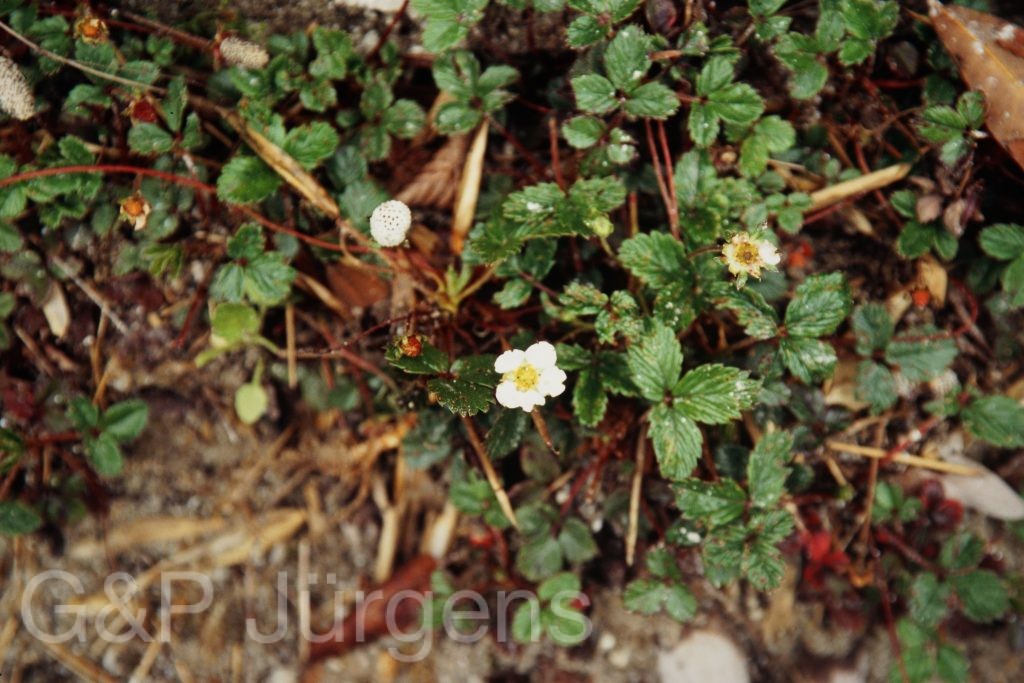
Fragaria daltoniana, the Sikkim strawberry, is a Himalayan wild strawberry native to Nepal, India, Bhutan, southern Tibet (China) and northern Myanmar; the additional GBIF country codes (USA, Norway, France, Sweden, Armenia) reflect cultivated material and herbarium holdings rather than wild range, the dataset listing some 181 records. It grows in moist montane forest margins, clearings, mossy banks, grassy slopes and along streamsides, generally between about 2500 and 4000 m. The plant photographed at the Pele-La in Bhutan at around 3200 m in June represents its typical temperate-forest belt habitat.

It is a slender, stoloniferous perennial herb forming open mats by rooting runners. The trifoliolate leaves are long-petiolate, the leaflets thin, obovate and coarsely serrate, sparsely hairy. Solitary or few white flowers are borne on slender pedicels, each with five spreading petals, numerous stamens and an epicalyx alternating with the sepals. The fleshy receptacle ripens into the diagnostic fruit: an elongate, narrowly ovoid to oblong scarlet 'strawberry' bearing numerous achenes superficially on its surface, larger and more cylindrical than in most relatives but reputedly insipid.

Fragaria daltoniana is one of the few strawberries of the Sino-Himalayan region and is notable to horticulturists and breeders as a wild diploid genetic resource within the genus. Its long, narrow red receptacle distinguishes it from the rounder fruits of F. nubicola and F. vesca, with which it can co-occur. The species is not considered threatened, being locally common across a wide range, though it depends on cool, humid forest-edge microhabitats vulnerable to deforestation and to climatic drying at the lower limits of its altitudinal band.

Author: J.Gay · Sources: POWO (Kew), GBIF, Flora of Bhutan, Flora of China, Annotated Checklist of the Flowering Plants of Nepal, Staudt Taxonomic Studies in the Genus Fragaria