Tag:

Myanmar

Flowers of the Myanmar Himalaya — 604 species recorded from northern Myanmar (Burma) and the eastern Himalayan borderlands, a biodiversity hotspot linking the Himalaya to the mountains of Yunnan and Southeast Asia. The region’s forests and alpine slopes hold a rich flora of rhododendrons, orchids, balsams and gentians. Every page gives a botanical description, distribution, habitat and flowering time with the original photograph.

Losinsk.

BhutanPG2011 366
Bhutan Tsochenchen, 3550m June

Description

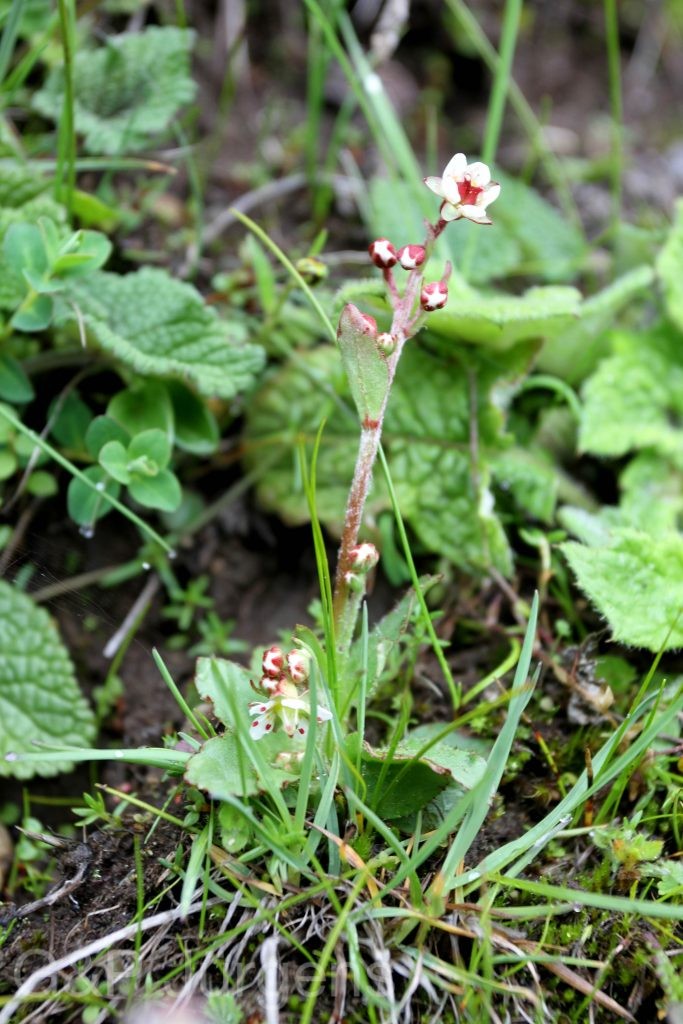
Micranthes pallida (formerly placed in Saxifraga, as reflected in the source link) is a Himalayan rosette herb distributed across the high mountains from Pakistan and northern India through Nepal and Bhutan into south-western China and northern Myanmar; with over 650 georeferenced occurrences (CN, NP, IN, BT, PK, MM) it is one of the more frequent members of its group. It inhabits damp alpine meadows, mossy rock ledges, stream margins and shaded slopes, typically between about 3000 and 4500 m. The plant recorded at Tsochenchen in Bhutan at 3550 m in June, flowering in the brief alpine summer, is characteristic of its cool, moist montane-to-alpine habitat.

It is a perennial herb forming a basal rosette of leaves on a short rhizome. The leaves are spathulate to obovate or broadly ovate, with a cuneate base tapering into a broad petiole, the margins coarsely toothed or crenate, and the blade thin-textured and often somewhat pale or glaucous. From the rosette rises a slender, glandular-pubescent flowering stem bearing a lax, often paniculate or corymbose cyme of small flowers. Each flower has five spreading whitish to pale greenish petals, ten stamens and a half-inferior, bicarpellate ovary that ripens into a many-seeded, two-beaked capsule.

Micranthes is now widely recognised as a genus distinct from Saxifraga sensu stricto, corresponding to the former Saxifraga sect. Micranthes, supported by molecular and morphological evidence; M. pallida belongs to this assemblage of broad-leaved, rosette-forming species. Adapted to the harsh alpine regime through its perennating rhizome and ground-hugging habit, it is widespread and not regarded as threatened across its extensive range.

Author: Losinsk. · Sources: POWO (Kew), GBIF, Flora of China, Flora of Bhutan, Flora of Pakistan, Gornall's revision of Saxifragaceae
Benth.

Bhutan2014 1027
Bhutan Paro 2320m, May
Bh2008 553 G837
Bhutan Paro 1900m April

Description

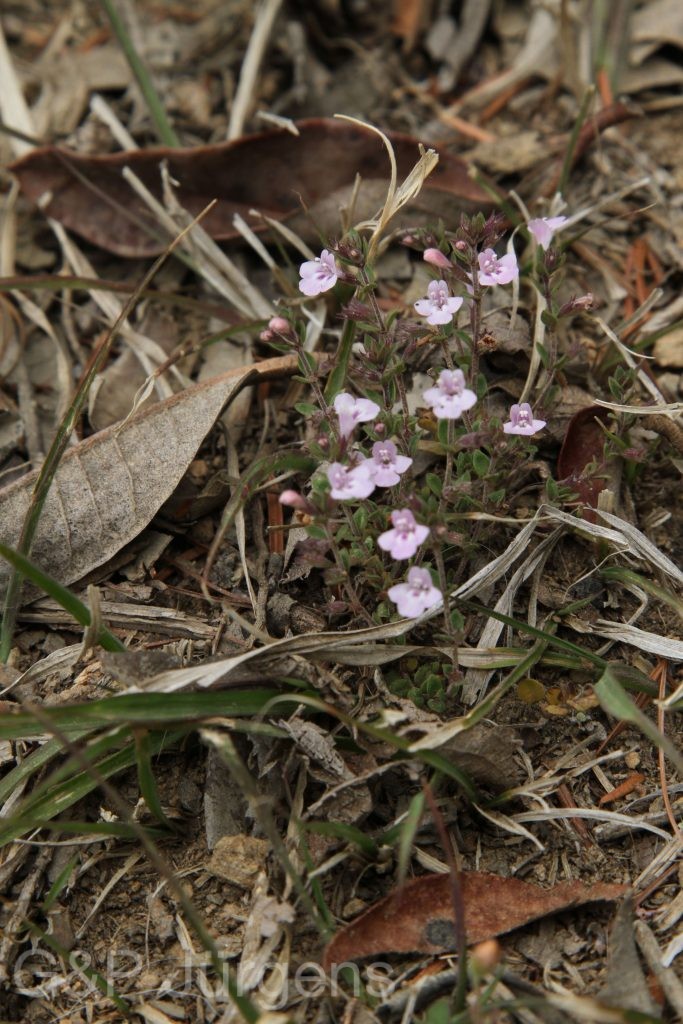
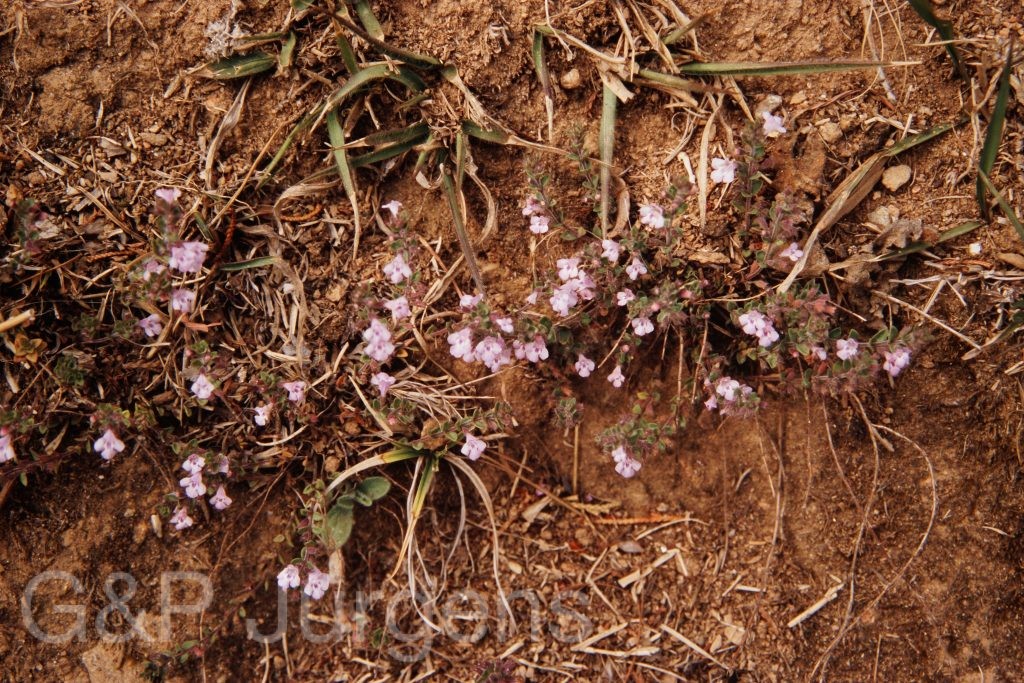
Micromeria biflora is an aromatic herb of remarkably wide Palaeotropical-to-Himalayan distribution, ranging from tropical and southern Africa (Ethiopia, Kenya, Tanzania, South Africa, Zimbabwe, Cameroon, Congo and others) through the Arabian Peninsula (Saudi Arabia, Yemen) and across to Afghanistan, Pakistan, India, Nepal, Bhutan, Myanmar and China; its nearly 1700 georeferenced occurrences underline this broad Old World range. It grows on dry, open, rocky and grassy slopes, banks and disturbed ground in the warm-temperate and montane belts, commonly between about 1500 and 2800 m. The plants documented around Paro in Bhutan at 1900-2320 m in April and May occupy exactly such sunny, well-drained hillsides.

It is a slender, much-branched perennial subshrub forming low, wiry tufts from a woody base, the quadrangular stems finely pubescent and clothed with a strong thyme-like aroma. The leaves are small, opposite, ovate to elliptic, entire and often revolute-margined, gland-dotted and short-petiolate. The pink to pale purple flowers are borne in axillary pairs or small few-flowered whorls, hence the epithet biflora; each has a tubular, ribbed, two-lipped calyx and a bilabiate corolla with the lower lip three-lobed, with four didynamous stamens. The fruit comprises four smooth, ovoid nutlets enclosed in the persistent calyx.

Micromeria belongs to tribe Mentheae of the Lamiaceae, allied to Clinopodium and Satureja, and the generic limits of this group have been much revised on molecular grounds. Rich in volatile monoterpene oils, M. biflora is widely used in folk medicine and as an aromatic herb. Its extensive range and tolerance of disturbed, arid habitats make it a successful and unthreatened species.

Author: Benth. · Sources: POWO (Kew), GBIF, Flora of China, Flora of Bhutan, Flora of Pakistan, Flora of Tropical East Africa, Harley's treatment of Labiatae

Benth.

Sikkim 2006 269 ergebnis
India West-Bengal, Lingza 1300m, May

Description

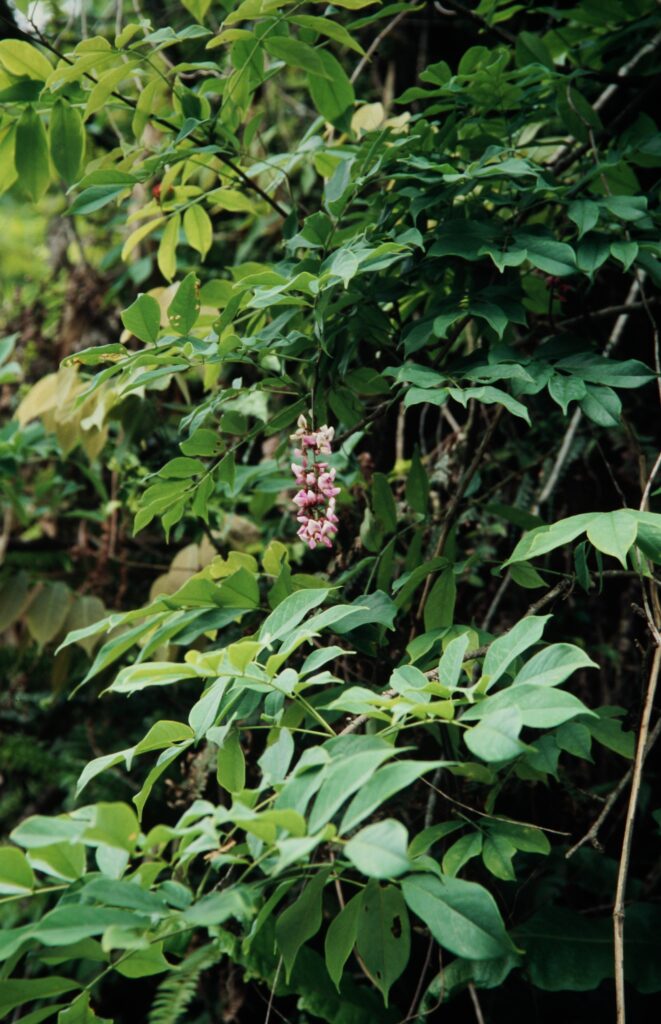
Millettia pachycarpa is a robust woody climber of the eastern Himalaya and South-East Asia, ranging from Nepal, Bhutan and north-east India through Bangladesh, Myanmar, Thailand, Laos and Vietnam to southern China and Taiwan. GBIF holds around 2140 occurrences across this subtropical to warm-temperate range. It grows in broad-leaved forest, forest margins, ravines and along streams, scrambling over trees at low to middle elevations. The plant from Lingza in the Darjeeling hills of West Bengal at 1300 m in May represents a typical eastern Himalayan population, flowering in spring before the monsoon.

It is a large, woody, deciduous liana with stout twining stems. Its leaves are alternate and imparipinnate, with numerous opposite, oblong to oblong-lanceolate leaflets that are dark green and somewhat leathery, glabrescent above and finely appressed-hairy beneath. The flowers are borne in long, dense, pendulous axillary racemes or panicles, the corolla papilionaceous and lilac to purplish-pink, the standard broad and often silky-hairy outside enclosing the wing and keel petals; the stamens are diadelphous and the ovary superior. The fruit is a large, thick, woody pod (the epithet pachycarpa meaning thick-fruited), pendulous and often tuberculate, indehiscent or tardily so, with one to several large hard seeds.

Millettia belongs to tribe Millettieae of the papilionoid Fabaceae, a group much revised in recent decades with several Asian species transferred to allied genera; M. pachycarpa is retained in Millettia in current treatments. The plant is notable for its high content of rotenoids and isoflavonoids: the seeds and roots have long been used as fish poison and insecticide across its range, and it is an important source of rotenone-type compounds. Widespread and frequent in eastern Himalayan forests, it is of no conservation concern.

Author: Benth. · Sources: POWO (Kew), GBIF, Flora of China Vol. 10, Flora of Bhutan Vol. 1, Annotated Checklist of the Flowering Plants of Nepal, Geesink revision of Millettieae

Morus indica

by GP Jürgens

L.

Nepal 97 362 P710
Nepal Arun-Valley 1700m May

Description

Morus indica L. is a deciduous tree or shrub of the mulberry family, widely distributed across temperate and subtropical Asia and extensively cultivated. GBIF documents over 14,000 records from China, India, Taiwan, Korea, Japan, Myanmar, the Philippines and Thailand, together with introductions in Europe and the Americas, reflecting its long history of cultivation for sericulture and fruit. In the Himalaya it occurs in subtropical and lower temperate forest, along valley sides, field margins and roadsides; the photographed plant is from Nepal, the Arun Valley, at 1,700 m in May, a typical mid-elevation montane setting.

The plant is a small to medium tree with grey, fissured bark and milky latex. The leaves are alternate, ovate, often unequally cordate at the base, with a serrate or dentate margin and an acuminate apex; juvenile and coppice leaves are frequently variously lobed, a common feature of the genus. The plant is dioecious or monoecious, the inconspicuous unisexual flowers borne in short, dense, pendent axillary catkins (spikes); staminate flowers have four tepals and four stamens, pistillate flowers a superior ovary with a bifid stigma. The fruit is a fleshy sorosis (multiple fruit) formed from the accrescent perianths, ripening from greenish through red to dark purple-black and edible.

The taxonomy of Asian Morus is unsettled, with M. indica often treated as part of the variable M. alba complex and subject to differing circumscriptions. The species is of major economic importance as the principal food plant of the silkworm and as a fruit and fodder tree, and is consequently both wild and widely naturalised; it is not of conservation concern.

Author: L. · Sources: POWO (Kew), GBIF, Flora of China Vol. 5, Flora of Nepal, Flora of Bhutan Vol. 1, Berg: Moraceae (Flora Malesiana)

(Buch.-Ham. ex Roxb.) Maxim.

Bhutan2015 32
Bhutan Dochu-La 2800m, October
Bhutan2015 33
Bhutan Dochu-La 2800m, October

Description

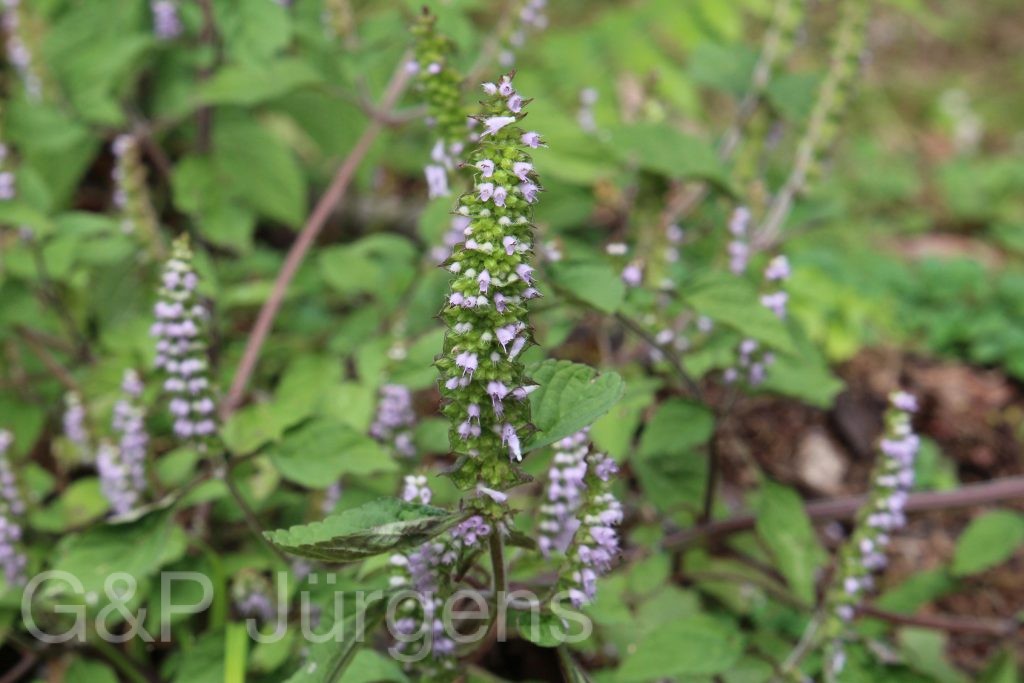
Mosla dianthera is a widespread annual mint of monsoonal Asia, ranging from the Himalaya (Nepal, Bhutan, India, Pakistan, Bangladesh, Myanmar) across China, Korea, Japan, Taiwan and the Russian Far East south into mainland and insular Southeast Asia; with over 7000 GBIF occurrences it is among the most frequently recorded species of its genus. It grows in disturbed and seasonally moist ground, including roadsides, field margins, fallow land, streambanks and open grassy slopes from the lowlands into the temperate hills, as recorded at Dochu-La in Bhutan at 2800 m. As an autumn-flowering annual it completes its cycle on the late monsoon moisture, flowering and fruiting in October.

It is a slender, erect, aromatic annual herb with the quadrangular stems typical of the Lamiaceae, often much branched and sparsely hairy. The leaves are opposite, petiolate, ovate-lanceolate to lanceolate, serrate along the margin and gland-dotted, releasing a pungent scent when crushed. The flowers are borne in lax, terminal and axillary racemes; each two-lipped corolla is small, pale pink to purplish, with a notched upper lip and a three-lobed lower lip. Diagnostic for Mosla are the two fertile stamens (the epithet "dianthera" referring to the two anthers) and the reticulately pitted nutlets. The fruit comprises four small, dry, one-seeded nutlets enclosed in the persistent, gland-dotted calyx.

Mosla is a small Asian genus segregated from Orthodon and allied to Perilla and Elsholtzia within the subfamily Nepetoideae, characterised by the reduction to two stamens and by aromatic terpene-rich foliage. The essential oils of M. dianthera are used in traditional medicine, and the plant is a minor nectar source for bees and other insects. Being a ruderal, broadly tolerant annual of vast geographic range, it is of least conservation concern and is sometimes weedy. (The associated WordPress link erroneously references Pogostemon benghalensis; the taxon treated here is Mosla dianthera.)

Author: (Buch.-Ham. ex Roxb.) Maxim. · Sources: POWO (Kew), GBIF, Flora of China, Flora of Bhutan, Li & Hedge's treatment of the Lamiaceae

Mucuna macrocarpa

by GP Jürgens

Wall.

Nepal 1994 57 ergebnis
Ost-Nepal Bhalukhob 
1800m April
Nepal 1994 55 ergebnis
Ost-Nepal Bhalukhob 
1800m April

Description

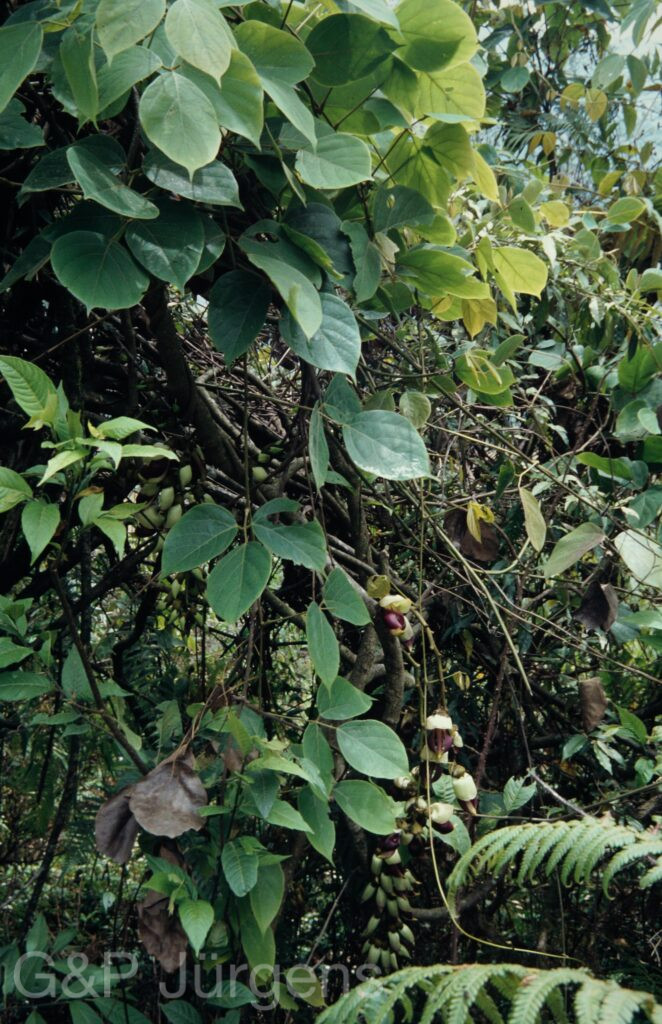
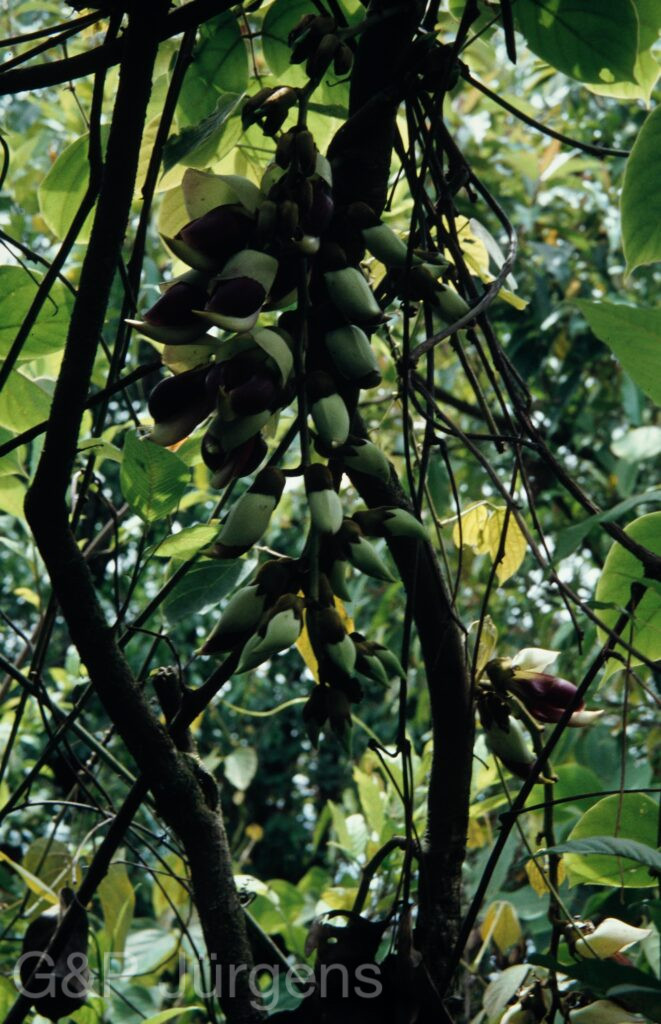
Mucuna macrocarpa is a large woody climber of subtropical and tropical Asia, ranging from Taiwan, Japan and China through Thailand, Laos, Myanmar, India, Vietnam, Nepal, Malaysia and Bhutan; GBIF records some 2100 occurrences, making it by far the best-documented species in this set. It scrambles through warm broadleaved and evergreen forest, along forest edges and ravine slopes at lower montane elevations. The photographed plant grows at Bhalukhob in East Nepal at about 1800 m, flowering in April, in humid subtropical hill forest.

It is a robust, perennial liana with stout woody stems and trifoliolate leaves bearing large, broadly ovate to elliptic leaflets. The pendent, cauliflorous to ramiflorous inflorescences carry showy papilionaceous flowers with a dark, often deep purple to maroon or greenish keel and standard, the keel curved and enclosing the stamens and style. The fruit is a large, woody, oblong pod, broad and often flattened, conspicuously ribbed or winged and clothed in irritant hairs, enclosing several hard, disc-shaped seeds.

The species is accepted. Mucuna is noted for explosive, mechanically triggered flowers adapted to vertebrate pollination: in this and related species the keel snaps open under the manipulation of nectar-feeding bats and, locally, other mammals or large birds, a celebrated case of chiropterophily. The stinging pod hairs deter herbivores, while the buoyant seeds are reported to disperse by water. Its wide range and frequency indicate a secure conservation status across monsoon Asia.

Author: Wall. · Sources: POWO (Kew), GBIF, Flora of China, Flora of Bhutan, Wilmot-Dear's revisions of Asian Mucuna (Leguminosae)

(G.Brückn.

Bhutan2012 426
Bhutan Wangdi 2700m, September

Description

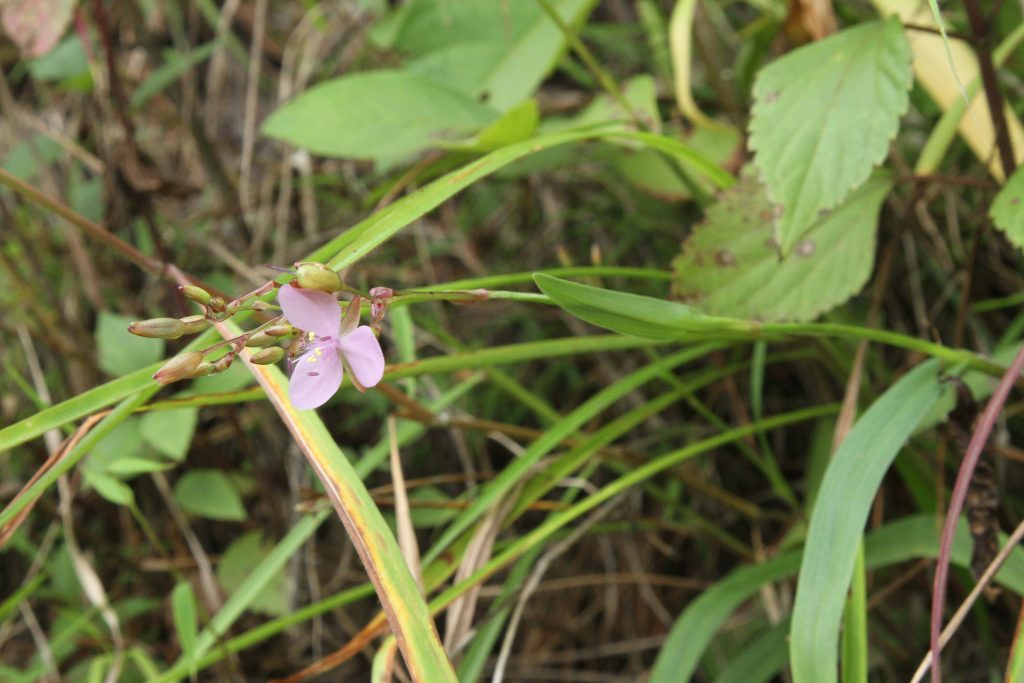
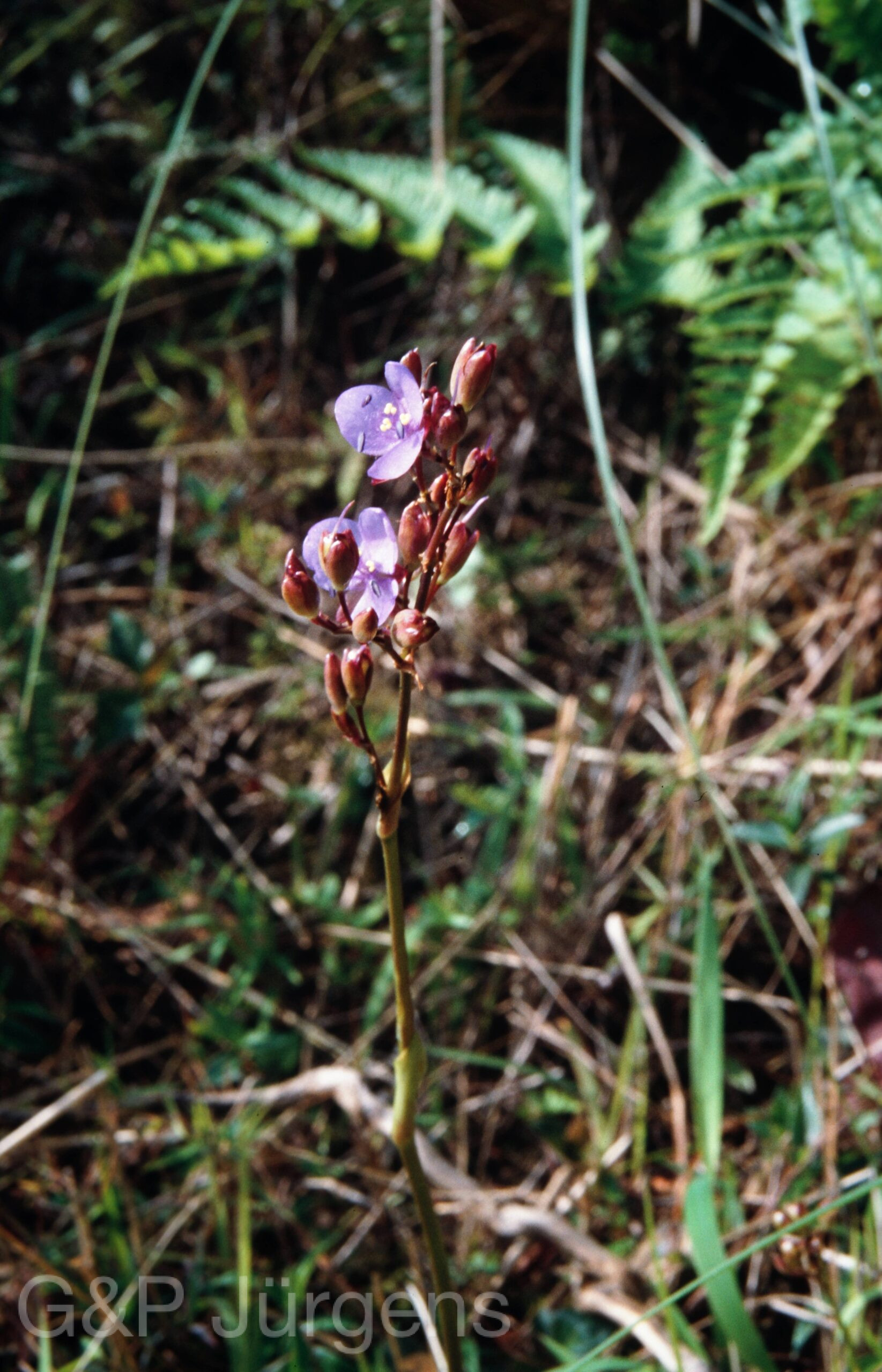
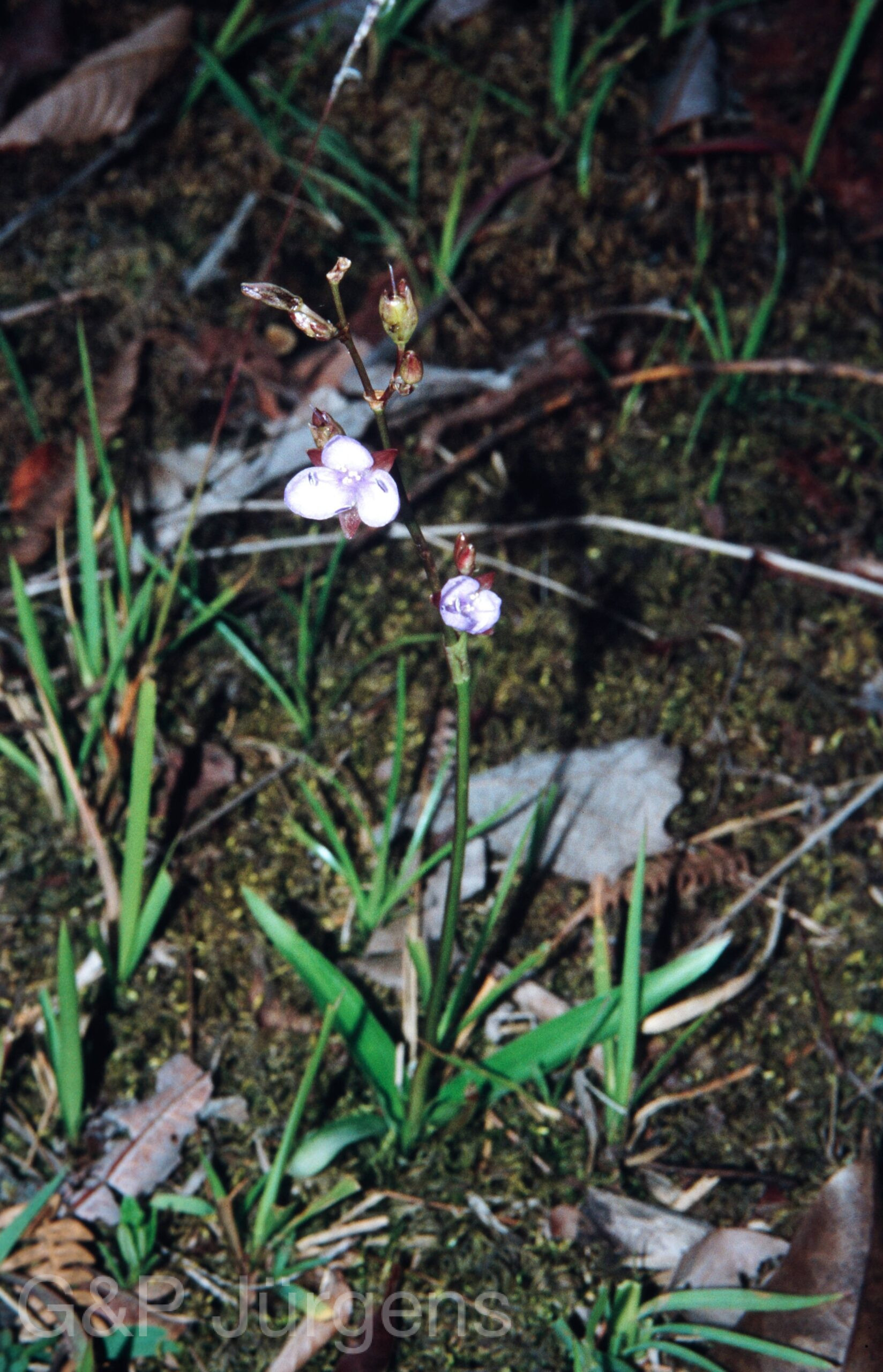
Murdannia divergens (G.Brückn.) Faden ex D.Y.Hong is a dayflower relative widely distributed across tropical and subtropical Asia, recorded by GBIF from China, India, Taiwan, Nepal, Myanmar, Thailand, Vietnam, Bhutan and Laos, with over 500 occurrences. It grows in damp grassland, open forest, scrub, marshy ground and along streamsides, lowland to montane. The Bhutanese material from Wangdi at 2700 m in September reflects its occurrence well into the temperate zone and its late-monsoon flowering, when soil moisture supports the succulent growth typical of the family.

It is a perennial or sometimes annual herb with fleshy roots and ascending to decumbent stems rooting at the lower nodes. The leaves are alternate, linear to linear-lanceolate, sheathing at the base in the manner of the Commelinaceae, with parallel venation. The inflorescence is a terminal, often divergently branched (as the epithet suggests) thyrse, the flowers actinomorphic with three free, ephemeral blue to violet or pinkish-mauve petals and bearded stamens with staminodes, typically three fertile. Each flower lasts a single day; the fruit is a small three-locular loculicidal capsule releasing few rugose seeds.

Murdannia, segregated from Aneilema and Commelina, comprises herbs of seasonally wet ground, and M. divergens belongs to its montane-adapted members. Its day-lasting flowers are pollinated by small bees and hoverflies attracted to the stamen hairs and pollen-presenting anthers. The wide Asian range and ecological flexibility of the species make it common in seasonally moist habitats; it is not threatened, though its dependence on wetland margins links local abundance to monsoon hydrology.

Author: (G.Brückn. · Sources: POWO (Kew), GBIF, Flora of China Vol. 24, Flora of Bhutan Vol. 3, Flora of Nepal, Faden revisions of Asian Commelinaceae

(Stokes) Faden

Description

Murdannia edulis is a tuberous-rooted dayflower relative distributed across tropical and subtropical Asia, from the Himalaya (Nepal, Bhutan, northeast India) through southern China, Taiwan, Myanmar, Thailand and Indochina to Malesia, the Philippines and New Guinea. It grows in open grassland, scrub, forest margins and seasonally moist banks, often on disturbed or cultivated ground, principally at low to mid elevations. The plant recorded at Mulabari in the Gorkha district of Nepal at 1,340 m in May represents its presence in the warm subtropical foothill zone, where it emerges and flowers with the onset of the pre-monsoon rains.

The plant is a perennial herb arising from a cluster of fleshy, fusiform, fascicled tuberous roots that store water and nutrients. The leaves are mostly radical, linear to lanceolate, sheathing at the base and arranged in a basal tuft, with parallel venation typical of the family. The inflorescence is a scapose, terminal panicle of cincinni bearing ephemeral, actinomorphic flowers with three free, pink to pale blue or mauve petals and conspicuous bearded staminodes accompanying the fertile stamens. The fruit is a small, loculicidal, ellipsoid capsule containing few angular seeds.

The genus Murdannia, segregated from Aneilema and Commelina, is distinguished by its enantiostylous, regular flowers and characteristic stamen arrangement; M. edulis was transferred to the genus by Faden, its basionym attributed to Stokes. As the epithet indicates, the starchy tuberous roots are edible and have been used as a famine or supplementary food across its range. The species is widespread, weedy and adaptable, and is of no conservation concern.

Author: (Stokes) Faden · Sources: POWO (Kew), Flora of China Vol. 24, Flora of Nepal, GBIF, Faden: Commelinaceae systematics

Vahl

Bh09 388 P615
Bhutan Punaka-Chju 1600m, June
Nepal 2001 468 ergebnis ergebnis
Nepal (Gorkha) Gunda 1700m, May

Description

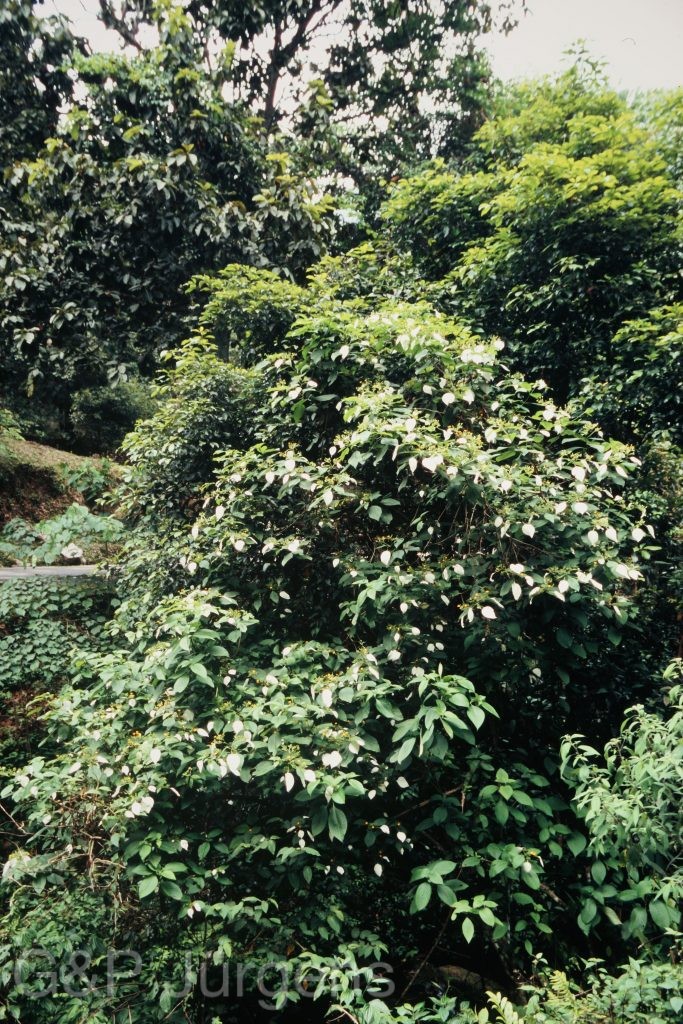
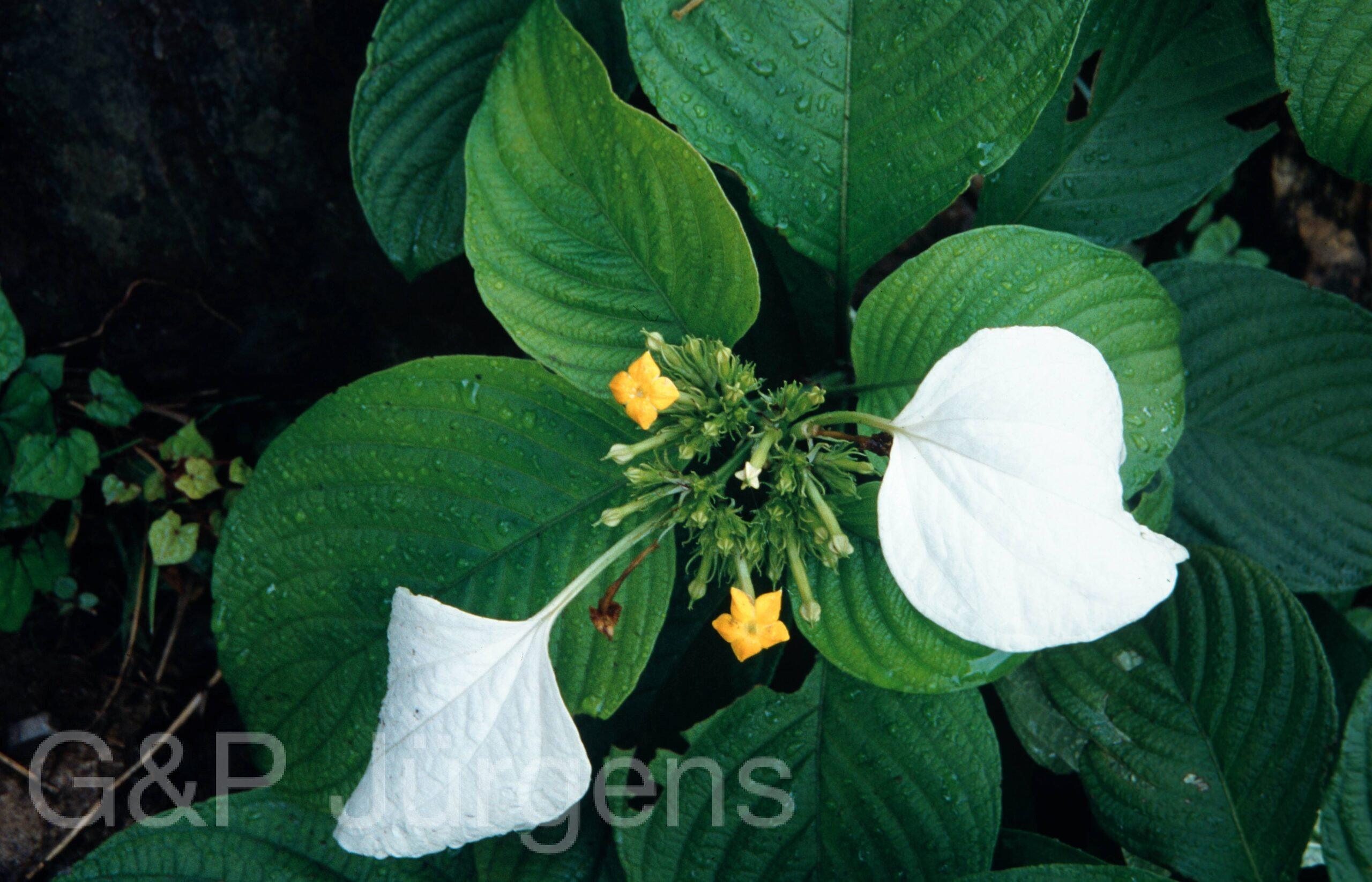
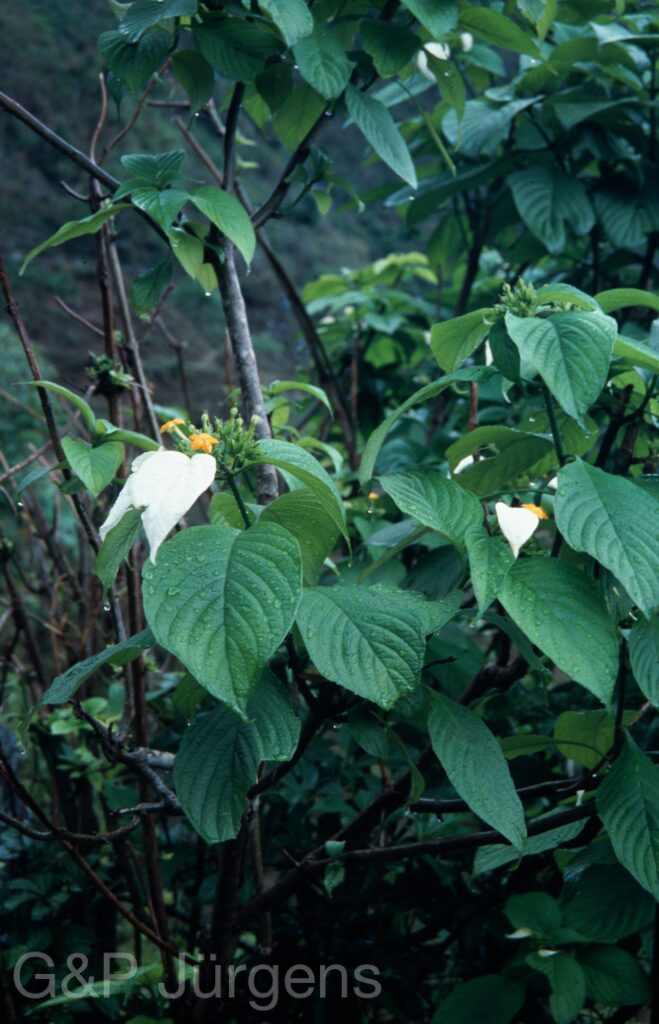
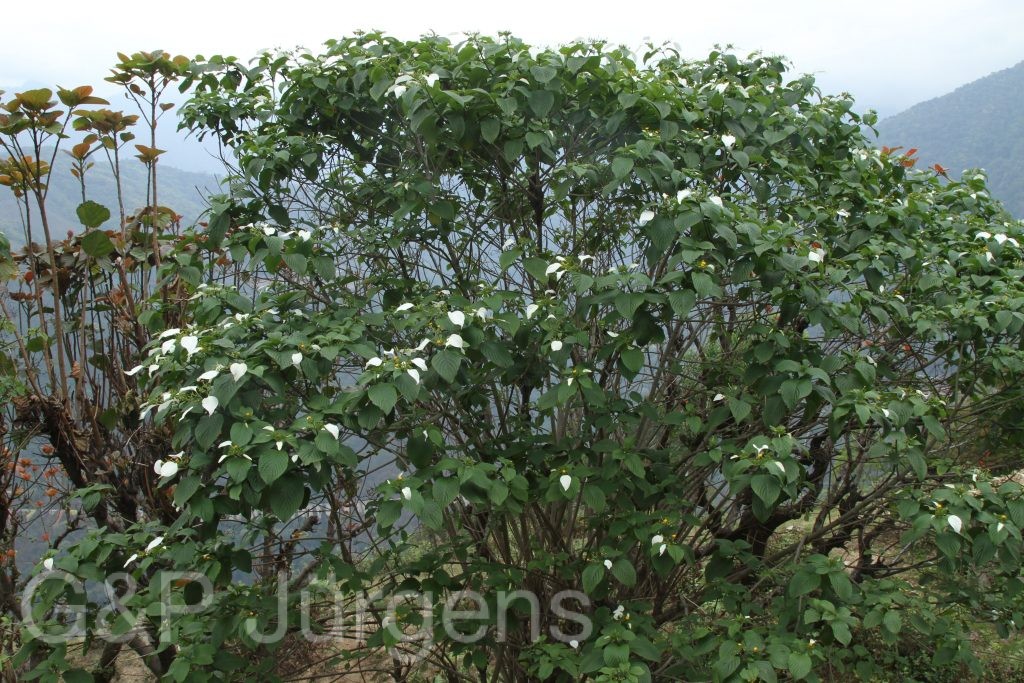
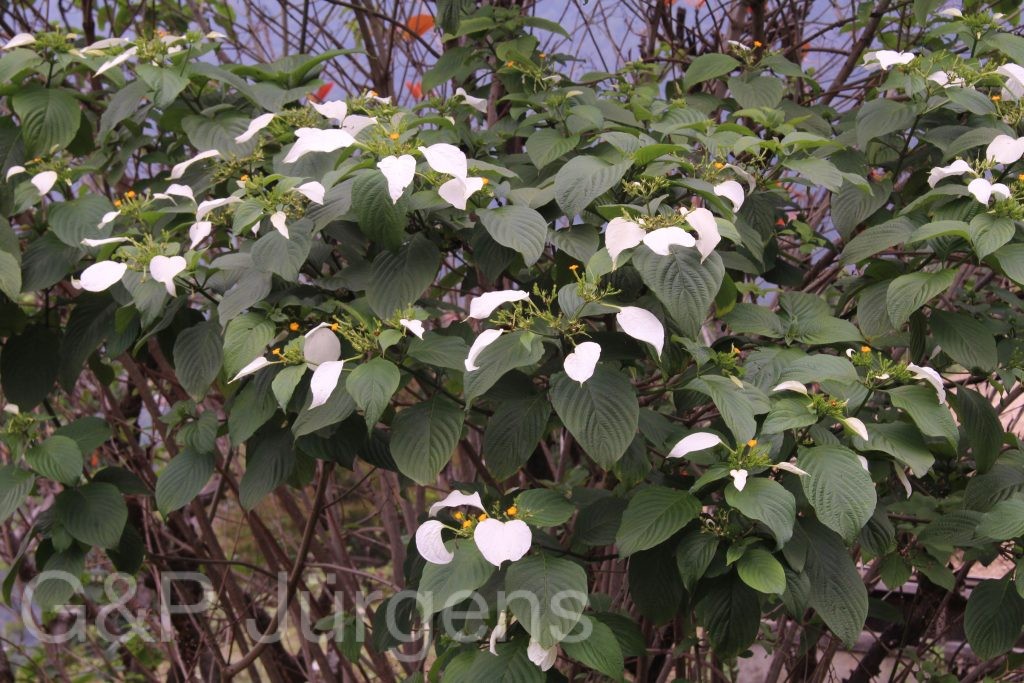
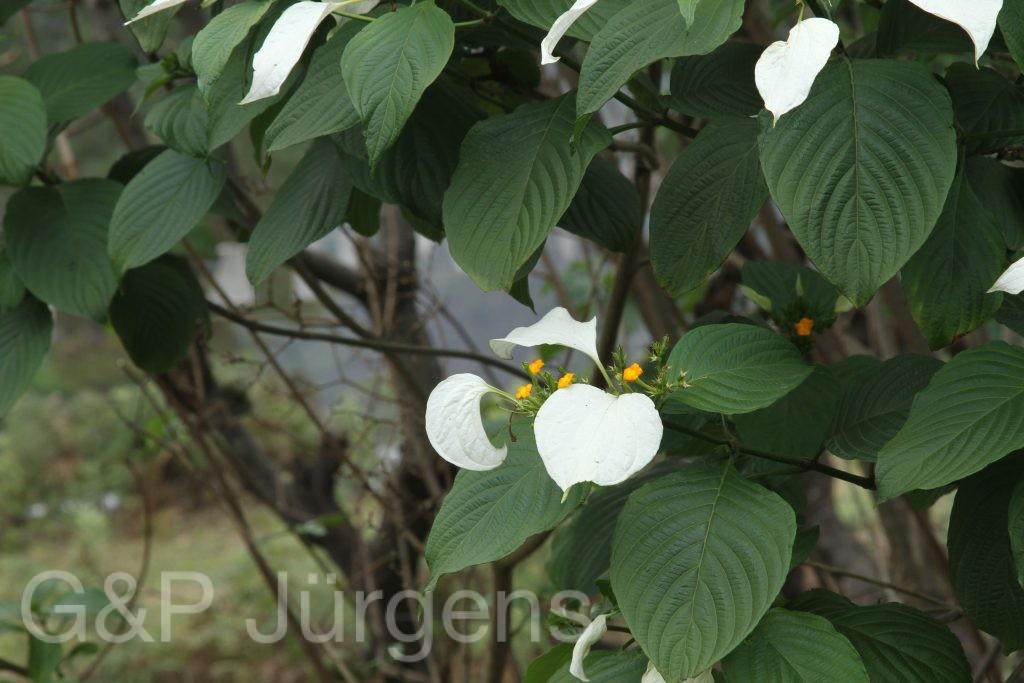
Mussaenda glabra is a widely distributed tropical to subtropical shrub or scrambling liana of Southeast Asia and the eastern Himalaya, documented from numerous countries including India, China, Myanmar, Thailand, Vietnam, Malaysia, Indonesia and Nepal across some 355 GBIF occurrences. The illustrated material was gathered at Punaka-Chu in Bhutan at 1600 m in June and at Gunda in Gorkha, Nepal at 1700 m in May. It grows in moist broad-leaved forest, along streamsides, thickets and forest margins from the lowlands up to about 1800 m, thriving in warm, humid, partly shaded situations.

It is an evergreen shrub or woody climber with terete, often pubescent young branches. The leaves are opposite, ovate to elliptic, entire, acuminate at the apex, with interpetiolar stipules characteristic of the Rubiaceae. The inflorescence is a terminal cyme bearing tubular flowers with a five-lobed orange-yellow corolla; the diagnostic feature is the enlargement of a single calyx lobe in some flowers into a large, conspicuous, white, leaf-like petaloid bract (semaphyll) that advertises the inflorescence to pollinators. The fruit is a fleshy berry containing numerous minute seeds.

The genus Mussaenda is renowned for these showy expanded calyx lobes, an adaptation enhancing pollinator attraction in the shaded understory and a feature widely exploited in horticulture. The fleshy berries are dispersed by birds. With its broad range spanning continental and insular Asia, the species is of least concern, being common across much of its distribution, though dependent on the persistence of intact lowland and submontane forest.

Author: Vahl · Sources: POWO (Kew), GBIF, Flora of China, Flora of Bhutan, Flora of Nepal, Jayaweera – The Genus Mussaenda (Rubiaceae) revision

Hook.f.

Bhutan2014 279
Bhutan Trithangebe near a farmhouse 700m, May
Bhutan2014 281
Bhutan Trithangebe near a farmhouse 700m, May
Bhutan2014 282
Bhutan Trithangebe near a farmhouse 700m, May

Description

Mussaenda roxburghii is a shrub of the eastern Himalayan and Indo-Burmese lowlands and foothills, ranging across India, Nepal, Bhutan, Bangladesh and Myanmar; GBIF logs some 145 occurrences including a few cultivated records farther afield. It grows in warm subtropical hill forest, along forest margins, stream banks, roadside thickets and clearings, generally from near sea level to about 1500 m. The photographed individual grows in Bhutan at Trithangebe beside a farmhouse at around 700 m in May, a typical habitat for this species, which thrives in the humid pre-monsoon warmth of the lower hills near villages.

The species is an erect to scrambling shrub with terete, finely pubescent young branches. The leaves are opposite, ovate to elliptic, acuminate, entire and softly hairy beneath, with interpetiolar stipules. The inflorescence is a terminal corymbose cyme of numerous small flowers; its most striking feature is the enlargement of a single calyx lobe of certain flowers into a large, white, leaf-like petaloid bract advertising the inflorescence. The fertile flowers have a narrowly tubular orange to yellow corolla with five spreading lobes and a hairy throat. The fruit is a small fleshy berry crowned by the persistent calyx and containing minute seeds.

Mussaenda roxburghii Hook.f. exemplifies the genus's showy semaphylls, the expanded white calyx lobes that aid pollinator attraction and recur across tropical Rubiaceae. Widespread and locally common through the Indo-Himalayan foothills, it is not regarded as threatened and persists in secondary vegetation. Related Himalayan congeners such as M. treutleri are sometimes confused with it, and the group remains a focus of regional taxonomic study.

Author: Hook.f. · Sources: POWO (Kew), GBIF, Flora of Bhutan, Flora of British India, taxonomic revisions of Mussaenda (Rubiaceae)