Tag:

Myanmar

Flowers of the Myanmar Himalaya — 604 species recorded from northern Myanmar (Burma) and the eastern Himalayan borderlands, a biodiversity hotspot linking the Himalaya to the mountains of Yunnan and Southeast Asia. The region’s forests and alpine slopes hold a rich flora of rhododendrons, orchids, balsams and gentians. Every page gives a botanical description, distribution, habitat and flowering time with the original photograph.

(D.Don) S.C.Chen & J.J.Wood

Nepal 97 408 P789
Nepal Tashigaon 3000m May

Description

Mycaranthes floribunda is a widespread epiphytic orchid of tropical and subtropical Asia, recorded from India, Nepal, Bhutan, Bangladesh, Myanmar, Thailand, Laos, Cambodia, Vietnam and southern China. With some 182 georeferenced collections in GBIF, it is among the more frequently encountered species of its genus. In the eastern Himalaya it ascends into the temperate zone, as shown by material gathered near Tashigaon in eastern Nepal at around 3000 m in May. It grows chiefly as an epiphyte on the trunks and boughs of trees in humid broad-leaved and mixed evergreen forest, favouring mossy, shaded situations with reliable atmospheric moisture, and occasionally occurs lithophytically on shaded rock.

The plant forms clustered, slender, cane-like pseudostems arising from a short rhizome and clothed in persistent leaf bases. The leaves are several, distichous, narrowly elliptic to lanceolate, coriaceous and acute, articulated to sheathing bases. Inflorescences are lateral or terminal, erect to arching racemes bearing numerous small, densely arranged flowers, the axis and ovaries often furnished with fine mealy or hairy indument. The flowers are pale, the sepals ovate-lanceolate with a short mentum formed at the column foot, the petals narrower, and the trilobed labellum bearing low keels or calli on the disc. The fruit is a small ellipsoid capsule.

The species was originally described by D. Don and was transferred to Mycaranthes by S.C. Chen and J.J. Wood, reflecting the segregation of this lineage from the broadly circumscribed genus Eria, a realignment supported by molecular phylogenetic analyses of the Eriinae. Its wide elevational and geographic amplitude and tolerance of disturbed forest margins render it relatively secure across much of its range, though continuing deforestation locally reduces suitable epiphytic habitat.

Author: (D.Don) S.C.Chen & J.J.Wood · Sources: POWO (Kew), GBIF, Flora of Bhutan, Flora of China, Genera Orchidacearum
W.W. Sm.

Sikkim2011 227
Sikkim Yumthang-Chu 3600m, September
Sikkim2004 285 P498
Sikkim/India Dzongri 3900m May

Description

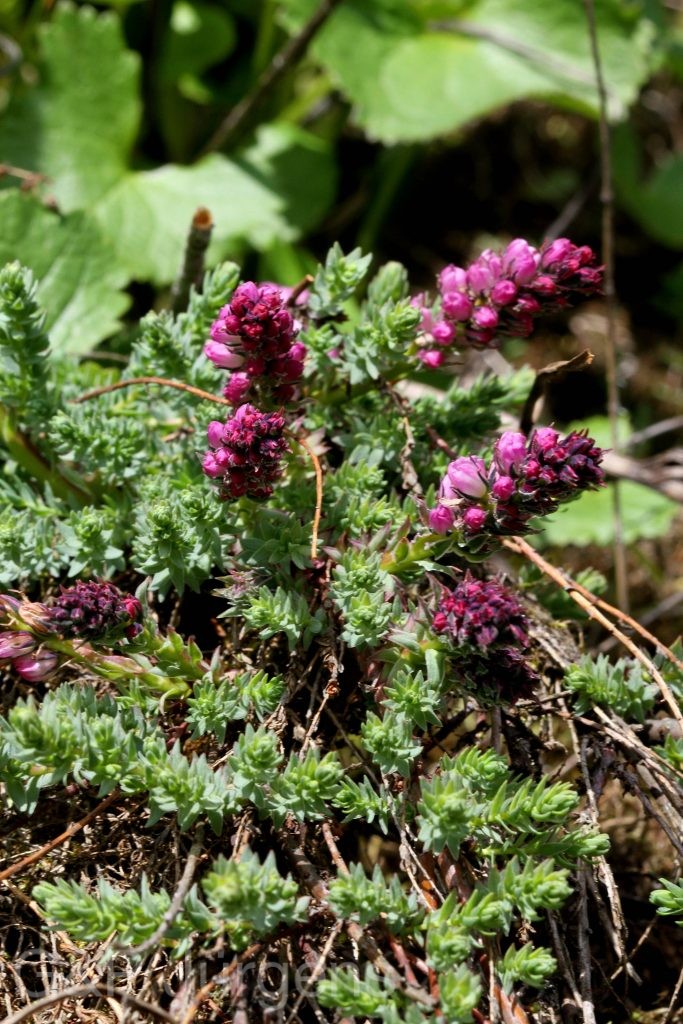
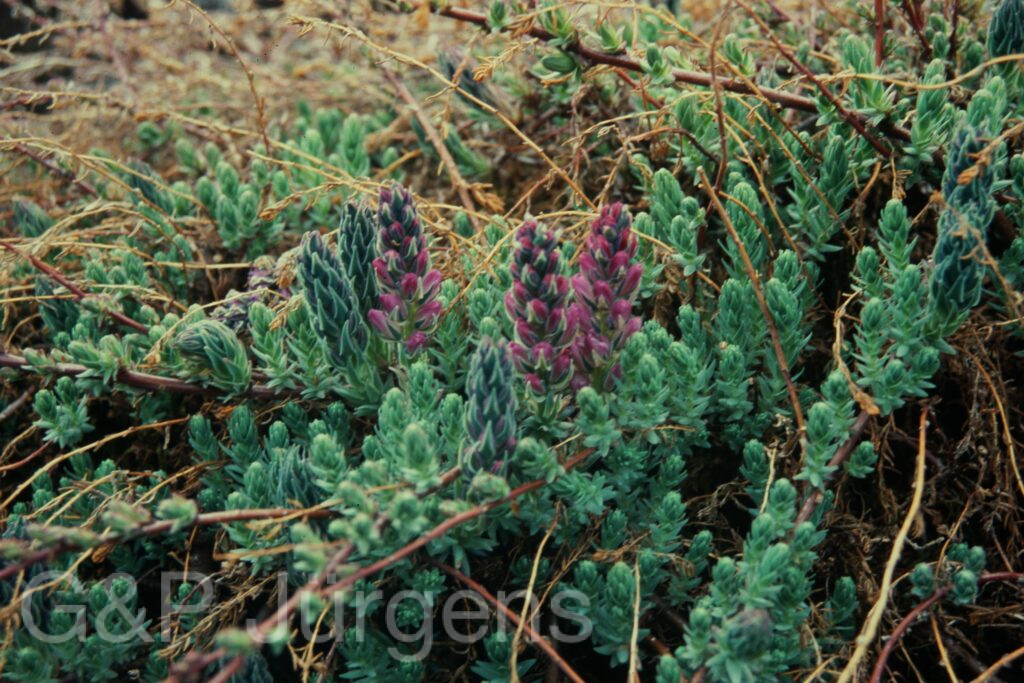
Myricaria rosea W.W.Sm. is a tamarisk-like shrub of the Tamaricaceae native to the eastern and central Himalaya and adjacent China. GBIF records, numbering 268 occurrences, place it in China, Nepal, India, Bhutan and Myanmar. The species is a riparian specialist of high-altitude valleys, colonising gravel bars, glacial outwash, moraine and the sandy margins of mountain streams, generally between 3,300 and 4,300 m. The illustrated plants from the Yumthang-Chu in Sikkim at 3,600 m in September and from Dzongri at 3,900 m in May span its flowering and fruiting seasons in the alpine and subalpine riverine zone.

The plant is a low, much-branched, decumbent to erect shrub with slender, reddish-brown, flexible branchlets. The leaves are small, sessile, scale-like to narrowly lanceolate, glaucous and densely overlapping along the twigs, an adaptation to the dry, exposed habitat. The flowers are borne in dense, terminal, spike-like racemes; each has five rose-pink to purplish petals, a five-parted calyx, and ten stamens whose filaments are connate at the base into a tube, a key character separating Myricaria from the related Tamarix. The fruit is a narrowly conical capsule splitting into three valves to release numerous tiny seeds, each crowned with a tuft of long, basally awned hairs that aids wind and water dispersal.

Myricaria comprises a small group of Central Asian and Sino-Himalayan shrubs of disturbed, unstable riparian and glacial substrates, and M. rosea is one of the distinctly pink-flowered eastern Himalayan members. Ecologically these shrubs are important pioneer colonisers that stabilise braided river gravels and moraine, providing early successional cover; their dependence on natural flood and sediment regimes makes them sensitive to hydrological alteration of high mountain rivers.

Author: W.W. Sm. · Sources: POWO (Kew), GBIF, Flora of China Vol. 13, Flora of Bhutan Vol. 2, Flora of Nepal, Zhang & Zhang: A taxonomic revision of Myricaria (Tamaricaceae)

(D.Don) DC.

BhutanPG2011 707 01 01
Bhutan Chele-La, 3850m July
Sikkim2003 195 P273
Sikkim Dzongri 4000m 08.2003
Nepal 99 283 ergebnis
Nepal Loccu 3155m, May
Nepal 99 366 ergebnis
Nepal Loccu 3155m, May
Nepal 99 822 ergebnis
West-Nepal Baga-La-Phedi 4200m, July

Description

Nardostachys jatamansi, the source of the aromatic drug spikenard, is an alpine herb of the high Himalaya and the Tibetan plateau margins. GBIF records confirm its native distribution across China, Nepal, India, Bhutan and Myanmar, with cultivated or processed material recorded from several other countries, totalling around 1110 occurrences. It grows on open alpine meadows, rocky slopes, grassy ledges and stable scree, generally between about 3000 and 5000 m, in the cool, summer-moist conditions of the high mountains. The photographed collections span its range and altitude well, from the Chele-La in Bhutan at 3850 m and Dzongri in Sikkim at 4000 m to Loccu in Nepal at 3155 m and the Baga-La-Phedi in West Nepal at 4200 m, recorded from May to August during the alpine flowering season.

It is a small, erect perennial herb arising from a stout, woody, aromatic rhizome densely clothed in the fibrous remains of old leaf-bases. The leaves are mostly basal, elongate-spathulate to oblong, entire and somewhat fleshy. The flowering stem bears a compact terminal cyme or head of small flowers; each has a campanulate, pink to pale rose corolla with five lobes, four stamens and an inferior ovary. The fruit is a small, one-seeded achene crowned by the persistent calyx.

Nardostachys is here placed in the Caprifoliaceae, into which the former valerian family Valerianaceae is now subsumed. The species is of great economic and cultural importance, its fragrant rhizome being the jatamansi or spikenard of ancient commerce, still harvested for essential oils, perfumery and traditional medicine. Intensive wild collection coupled with its restricted alpine habitat has led to serious population decline, and the species is assessed as Critically Endangered and listed under CITES Appendix II.

Author: (D.Don) DC. · Sources: POWO (Kew), GBIF, Flora of Nepal, Flora of China (Valerianaceae/Caprifoliaceae), Medicinal Plants of the Himalaya (Polunin & Stainton)

(L.f.) W.H.Lewis

Sikkim 2006 467 ergebnis
India West-Bengal, Ruigi-Chu 2000m, May

Description

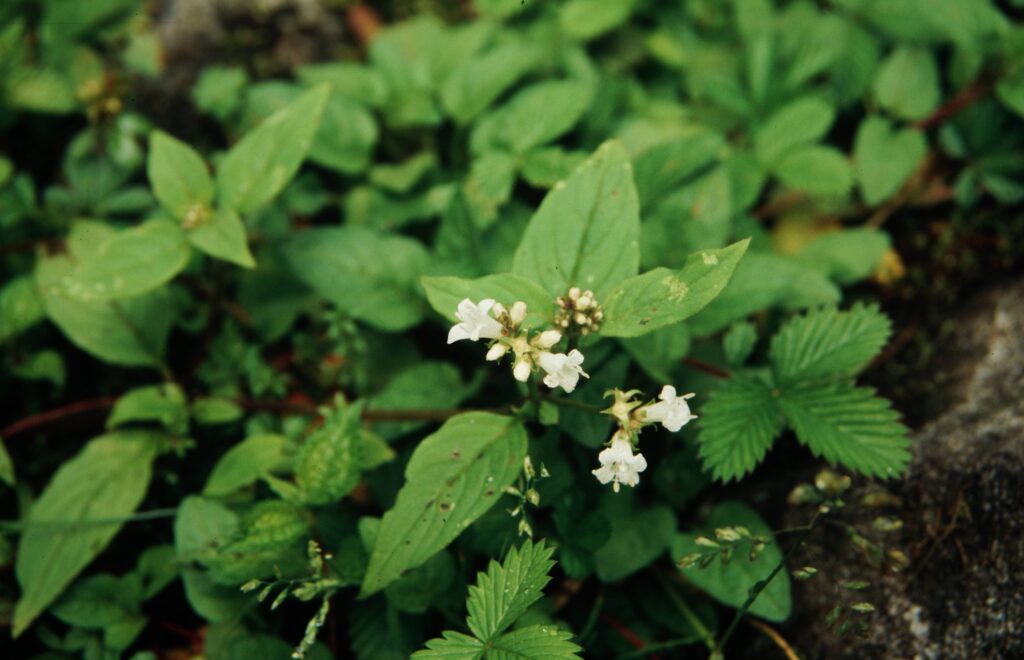
Neanotis hirsuta (L.f.) W.H.Lewis is a slender herbaceous member of the Rubiaceae with a remarkably broad Asian-Pacific distribution, recorded from India, Nepal, Bhutan, Pakistan and Sri Lanka eastwards through China, Taiwan, Japan and Korea, across Southeast Asia (Myanmar, Thailand, Vietnam, Malaysia, Indonesia, Philippines) to New Guinea and the Solomon Islands; with over 2,700 georeferenced occurrences it is among the more frequently collected species in this group. It grows in moist, shaded situations on forest floors, along streambanks, on damp rocks and trail margins and in disturbed grassy ground. The photographed plant from Ruigi-Chu in West Bengal at about 2,000 m in May reflects its presence in the humid mid-montane forests of the eastern Himalaya.

The species is a weak, creeping to ascending annual or short-lived perennial with slender, often hairy, four-angled stems that root at the lower nodes. The leaves are opposite, ovate to lanceolate, with interpetiolar stipules bearing fine bristles. Small flowers are borne in axillary and terminal clusters; each has a four-lobed calyx, a white to pale lilac funnelform corolla with four spreading lobes, four stamens and an inferior bilocular ovary. The fruit is a small didymous capsule that splits to release numerous minute angular seeds.

The genus Neanotis was segregated from Anotis and the broad Hedyotis–Oldenlandia complex by W. H. Lewis, and species delimitation within it remains intricate owing to subtle differences in habit and indumentum. Tolerant of disturbance, N. hirsuta often behaves as a pioneer of moist open ground and can be locally weedy. It is widespread and of no conservation concern.

Author: (L.f.) W.H.Lewis · Sources: POWO (Kew), Flora of China Vol. 19, Flora of Bhutan Vol. 2, GBIF, Lewis: Revision of the genus Neanotis (1966)

(Wall.) Bennet

Bhutan2015 41
Bhutan Wangdi Phoang 2000m, October
Bhutan2012 941
Bhutan Tumching-La 2300m, October
Sikkim2003 40 K52.2
Sikkim above Yoksam 1860m 08.2003

Description

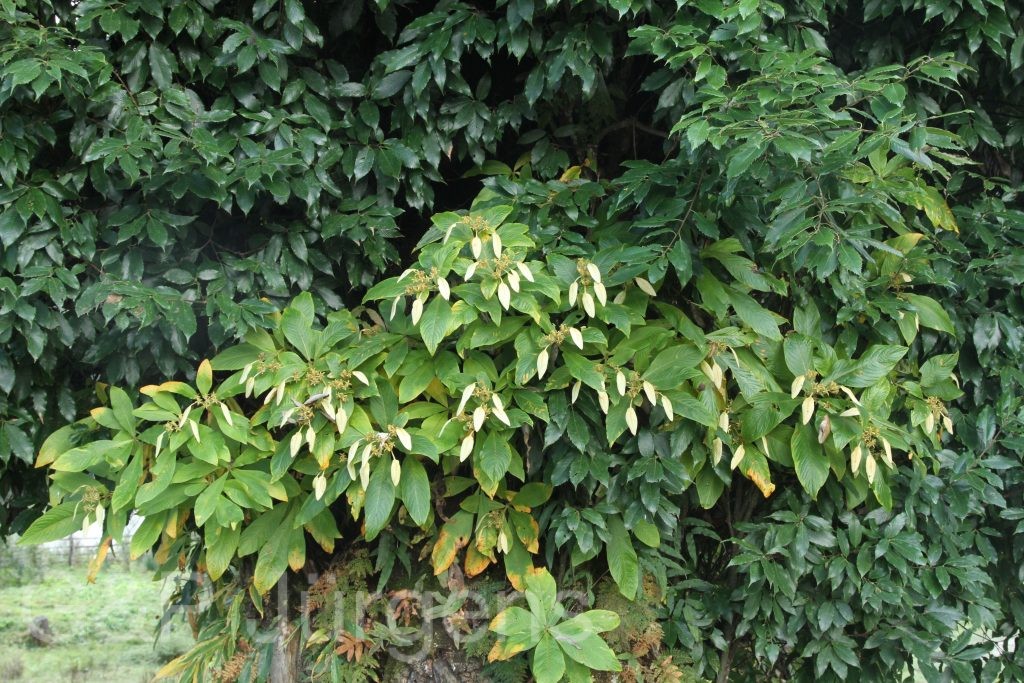
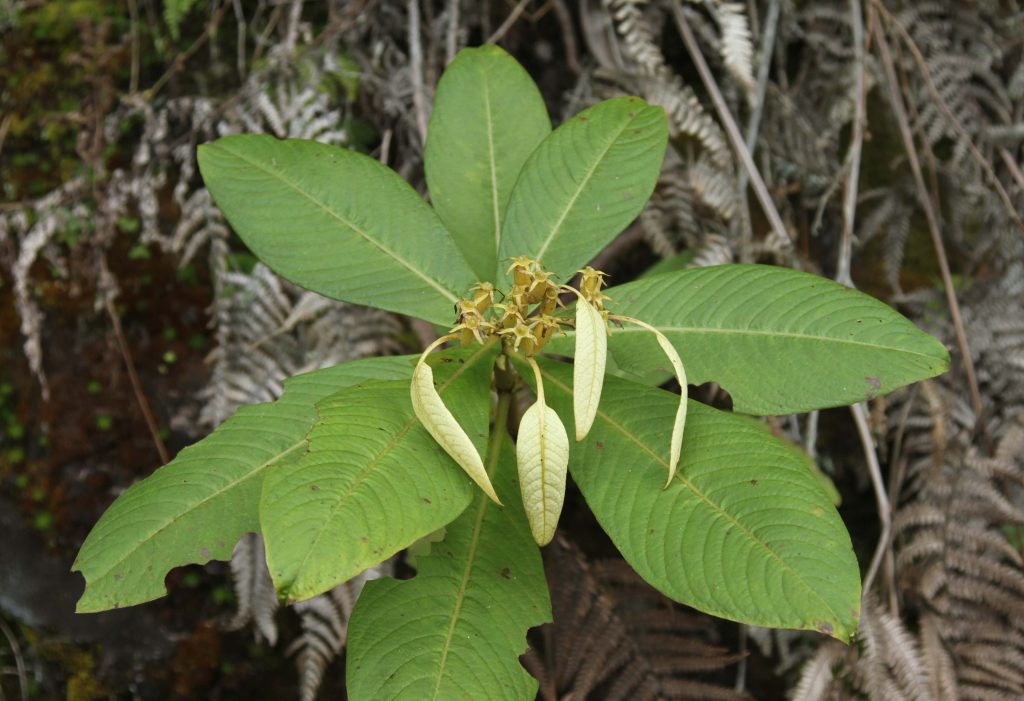
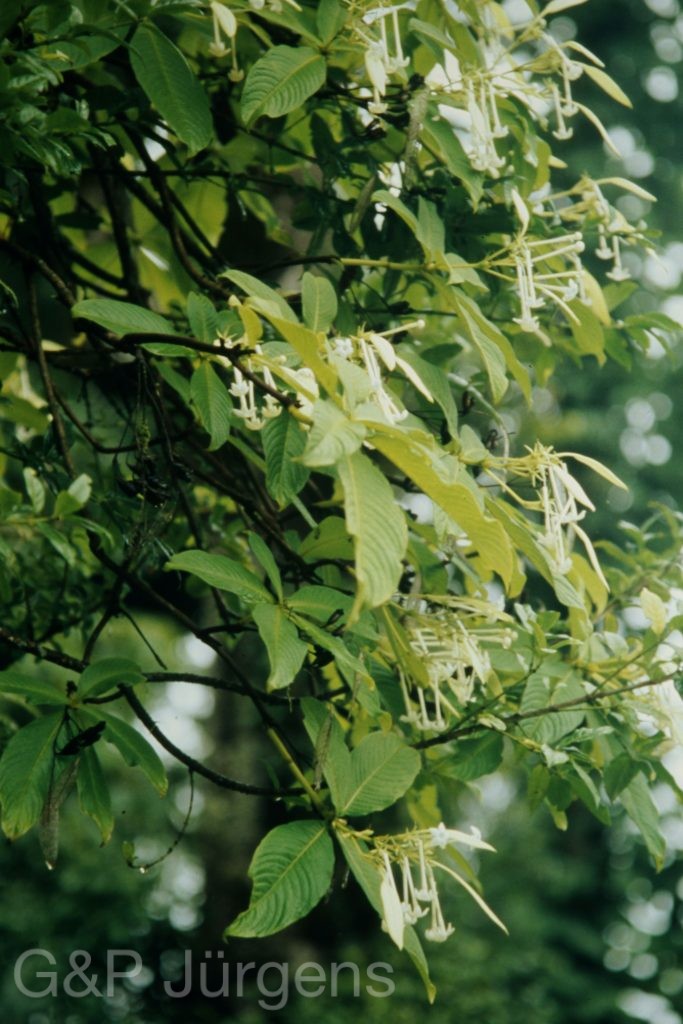
Neohymenopogon parasiticus is an epiphytic shrub of the eastern Himalaya and adjacent Sino-Himalayan and Indochinese mountains, distributed through China, Nepal, India, Thailand, Myanmar, Bhutan and Vietnam (gbif_countries: CN, NP, IN, TH, MM, BT, VN, ZZ, GB, PG), with some 438 GBIF occurrences. Despite the epithet it is not truly parasitic but grows perched on the trunks and mossy branches of trees in humid, mid-elevation broadleaved and mixed forest, occasionally also on rocks. The illustrated collections range from above Yoksam in Sikkim at about 1860 m up to Wangdi Phoang and Tumching-La in Bhutan at around 2000–2300 m, recorded in the late-monsoon to autumn months, reflecting its preference for moist, cloud-bathed submontane forest.

The plant is a glabrous to finely hairy epiphytic shrub with opposite, elliptic to obovate leaves clustered toward the branch tips, the stipules interpetiolar as in Rubiaceae. The flowers are borne in terminal cymose clusters and are showy by virtue of enlarged, white, petaloid calyx-lobes (calycophylls) that subtend the inflorescence and aid pollinator attraction, surrounding tubular corollas. The fruit is a ribbed, dehiscent capsule releasing many small, winged seeds suited to wind dispersal among the canopy.

Neohymenopogon was segregated from Hymenopogon to accommodate this distinctive Himalayan epiphytic lineage, and the species is placed in the madder family among the calycophyll-bearing Rubiaceae that mimic the petaloid bracts of Mussaenda and its allies. As an epiphyte dependent on intact, humid forest canopy, it is sensitive to deforestation, though it remains locally frequent across its range and is not currently of conservation concern.

Author: (Wall.) Bennet · Sources: POWO (Kew), GBIF, Flora of Bhutan, Flora of China, Flora of Nepal, Robbrecht's studies of Rubiaceae systematics

Griff.

Bhutan2012 814 Kopie
Bhutan Zemgang 2000m, October
Bhutan2012 1146
Bhutan Tashiyangtse 1500m, October

Description

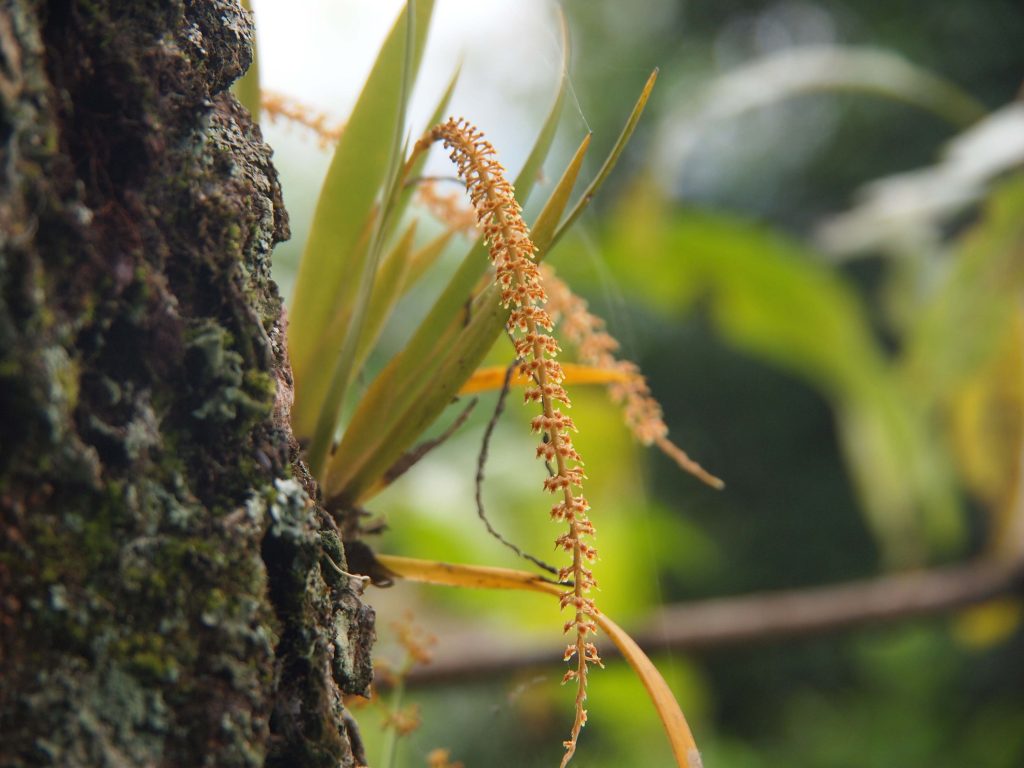
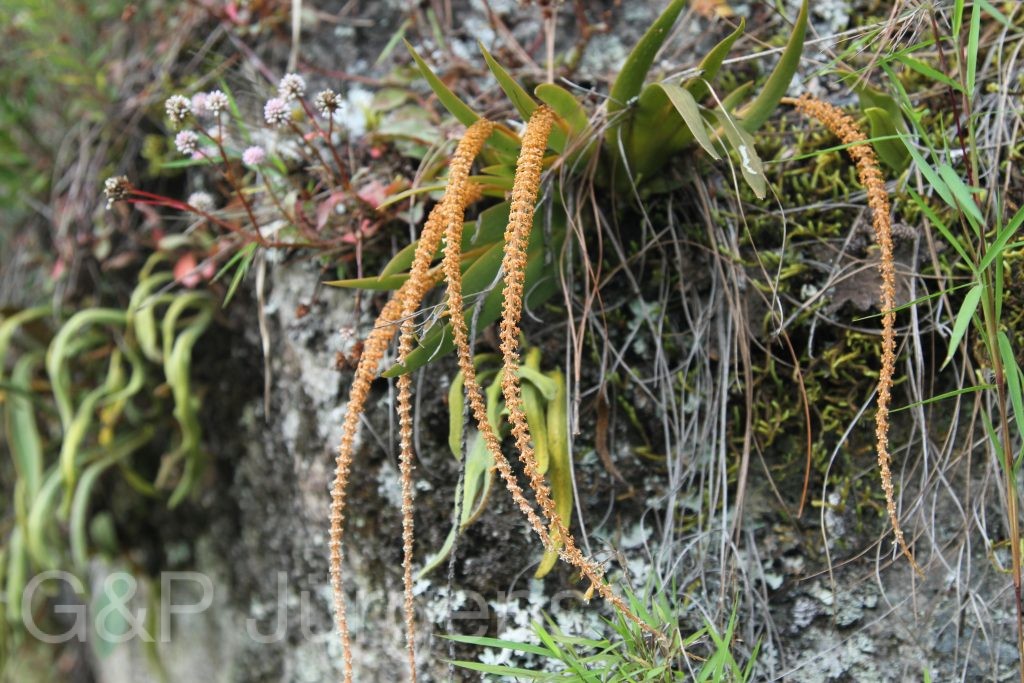
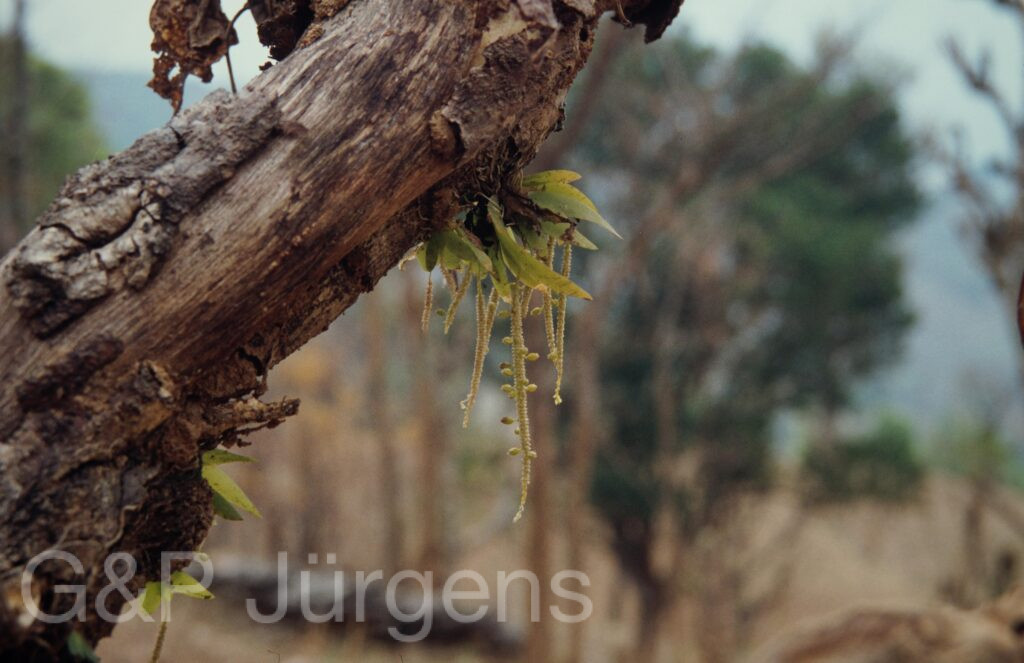
Oberonia acaulis is a small epiphytic orchid widespread across tropical and subtropical Asia, recorded from India, Nepal, Bhutan, China, Myanmar, Bangladesh, Thailand, Vietnam and beyond, with about 198 GBIF occurrences. It grows in warm, humid broad-leaved and subtropical forest, perched on tree trunks and branches in shaded, moist situations from the lowlands into the lower montane zone. The images document it in Bhutan at Zemgang around 2000 m and at Tashiyangtse near 1500 m, both in October, when the minute flowers are borne in dense spikes among forest epiphyte communities.

It is a tufted, dwarf epiphyte lacking pseudobulbs, with a short stem bearing a fan of equitant, laterally flattened (iris-like), fleshy leaves arranged in two ranks. From the centre of the fan arises a slender, erect to arching scape terminating in a long, densely many-flowered cylindrical raceme. The flowers are extremely small, numerous, yellowish to orange-brown, arranged in whorls; the labellum is the most conspicuous part, typically three-lobed with a divided or toothed apex, distinguishing the species within the genus. The fruit is a tiny ellipsoid capsule.

Oberonia is a large pantropical genus of "button orchids" notable for the diminutive size and great number of their flowers, which complicates field identification and rests heavily on the structure of the lip. The minute flowers are thought to be pollinated by small flies or midges. Like all orchids the genus is listed on CITES Appendix II; O. acaulis is widespread and common across its broad range and is not considered threatened.

Author: Griff. · Sources: POWO (Kew), GBIF, Flora of China, Flora of Bhutan, Flora of British India, Genera Orchidacearum (Vol. 4 Epidendroideae)
King & Pantl.

Nepal 1994 27 ergebnis
Ost-Nepal Kandbari 600m April

Description

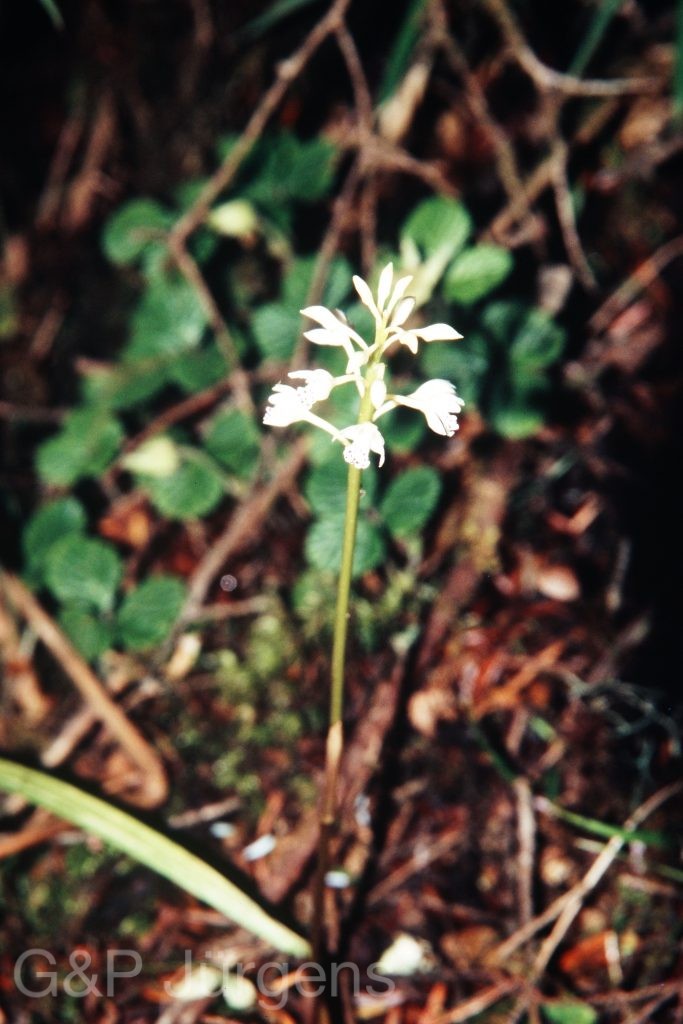
Oberonia falcata is a small epiphytic orchid ranging through the lowland and submontane forests of the eastern Himalaya and Southeast Asia, recorded from India, Nepal, Bhutan, Myanmar (implied regionally), Thailand, Cambodia, Vietnam, Taiwan and Malaysia, with a modest 67 occurrences in GBIF. It grows on the trunks and branches of trees in warm, humid evergreen and semi-evergreen forest, generally at low to moderate elevations. The illustrated plant was collected in eastern Nepal near Kandbari (Khandbari) at about 600 m in April, a typically low, frost-free station consistent with the genus's preference for sheltered, shaded humid forest.

Like other Oberonia, the species is a tufted, stemless to short-stemmed epiphyte with a fan of distichous, laterally flattened (equitant), fleshy leaves that are falcate (sickle-shaped), as the epithet records. From the centre of the leaf-fan arises a slender erect to arching inflorescence densely covered with minute flowers arranged in whorls along the rachis. The individual flowers are tiny and inconspicuous, orange to brownish, with a deeply lobed lip characteristic of the genus; the column is very short. The fruit is a small ellipsoid capsule releasing dust-fine seeds.

Oberonia is a large pantropical Old World genus distinguished by its iris-like flattened leaf-fans and miniature whorled flowers, and species delimitation rests largely on lip morphology. As an epiphyte dependent on undisturbed humid forest canopy, O. falcata is vulnerable to deforestation and the harvesting of host trees across its range. Its minute, scentless flowers are thought to be pollinated by small insects, and like nearly all orchids it relies on mycorrhizal fungi for seed germination and establishment.

Author: King & Pantl. · Sources: POWO (Kew), GBIF, Flora of Bhutan, Orchids of Nepal, Genera Orchidacearum (Oberonia)
Lindl.

Garh 07 88 ergebnis
India Garhwal Trijugi Narayan 2500m, June
Garh 07 89 ergebnis
India Garhwal Trijugi Narayan 2500m, June

Description

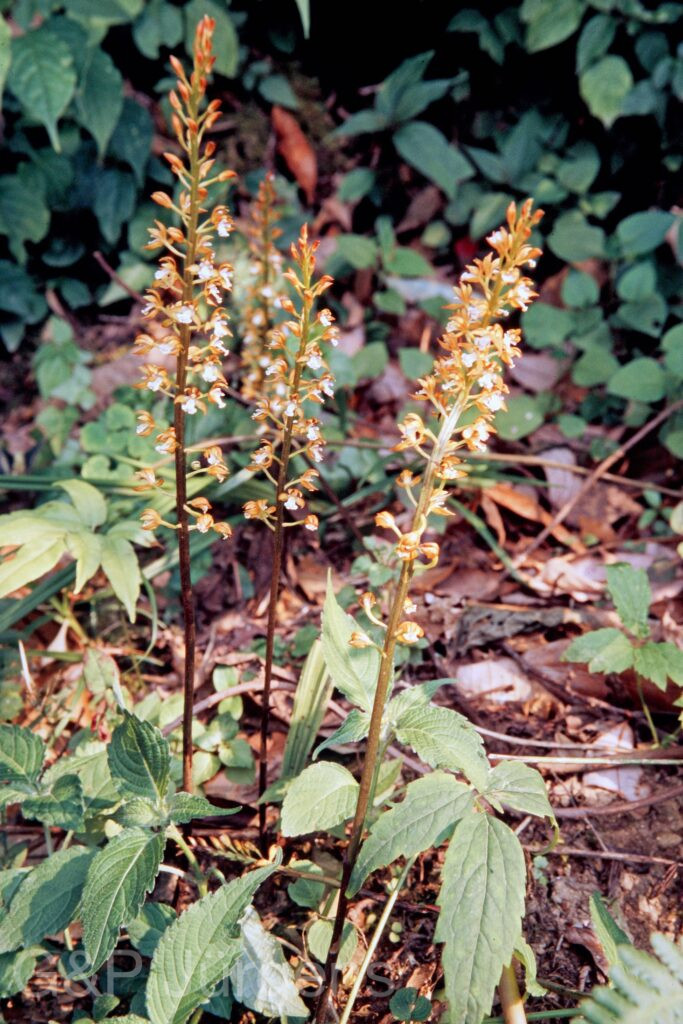
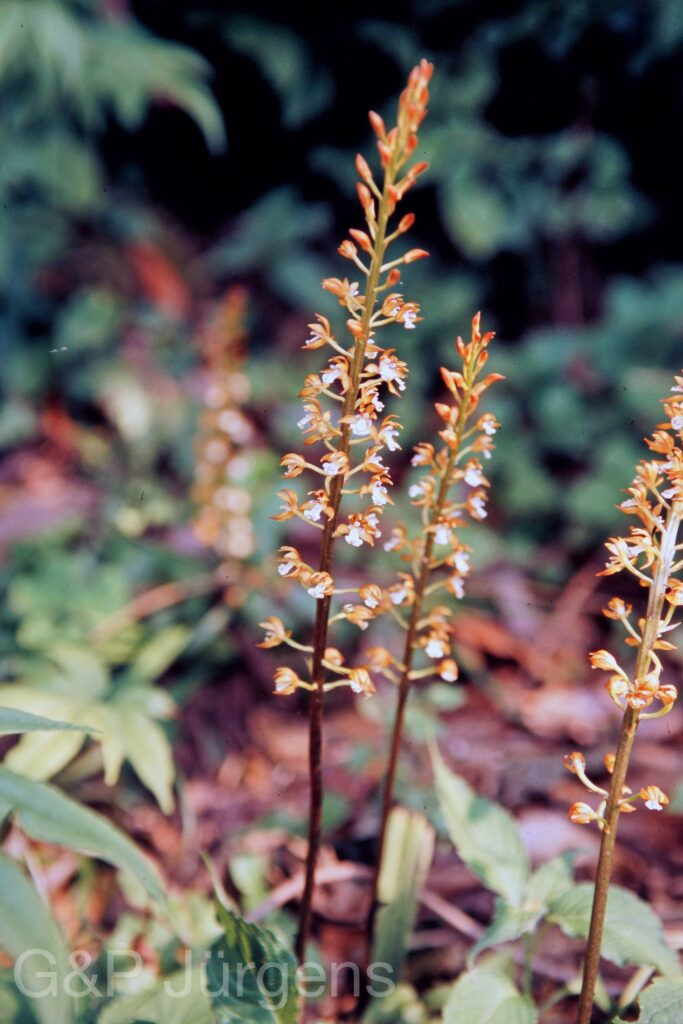
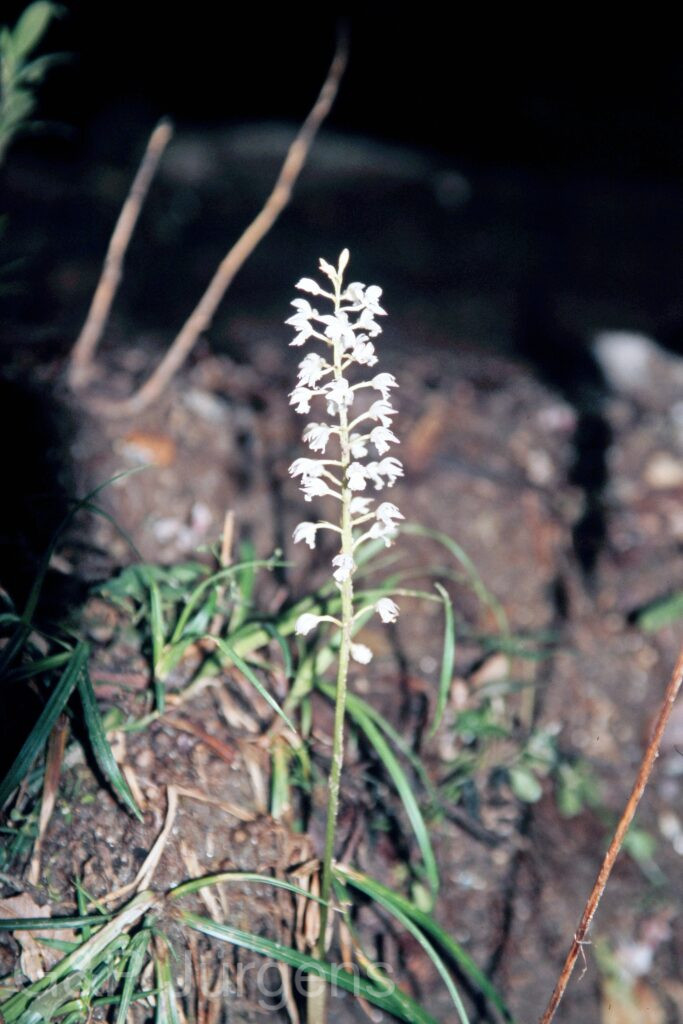
Oreorchis foliosa is a terrestrial orchid distributed across the Himalaya and into south-western China, with verified occurrences in China, India, Nepal, Bhutan and Myanmar. It grows in the humus-rich shade of temperate broadleaved and coniferous forest, on mossy banks and among leaf litter, generally between about 2400 and 3500 m. The material illustrated, from Trijugi Narayan in Garhwal (India) at around 2500 m and from the Dochu-La in Bhutan near 3000 m, both in June, shows the species flowering in the pre- to early-monsoon period in its characteristic moist, lightly shaded forest-floor habitat.

The plant grows from a chain of subterranean corm-like pseudobulbs (corms) that store reserves through the dormant season. From these arise one or two narrowly lanceolate, plicate (longitudinally pleated) leaves, the foliose character noted in the epithet. The erect scape bears a many-flowered raceme of small flowers; the spreading sepals and petals are yellowish to brownish, and the three-lobed labellum is paler, marked with reddish to purple spots or streaks, with a small basal callus or short spur-like base. The fruit is a pendulous dehiscent capsule releasing the dust-fine seeds typical of the family.

The family is written here as in the source as "Orchideaceae"; the correctly formed family name is Orchidaceae. Oreorchis is a small Asian genus of subfamily Epidendroideae allied to Corallorhiza and Cremastra, and like many forest orchids depends on mycorrhizal fungi for germination and establishment. O. foliosa, described by Lindley, is widespread but typically thinly scattered; while not formally assessed as threatened, such forest-dwelling orchids are sensitive to habitat loss and to collection pressure.

Author: Lindl. · Sources: POWO (Kew), GBIF, Flora of China, Flora of Bhutan, Genera Orchidacearum (Pridgeon et al.)
(L.) Kurz

Bhutan2012 969
Bhutan Trithangebe 900m, October
Bhutan2015 103
Bhutan Galephug 500m, October

Description

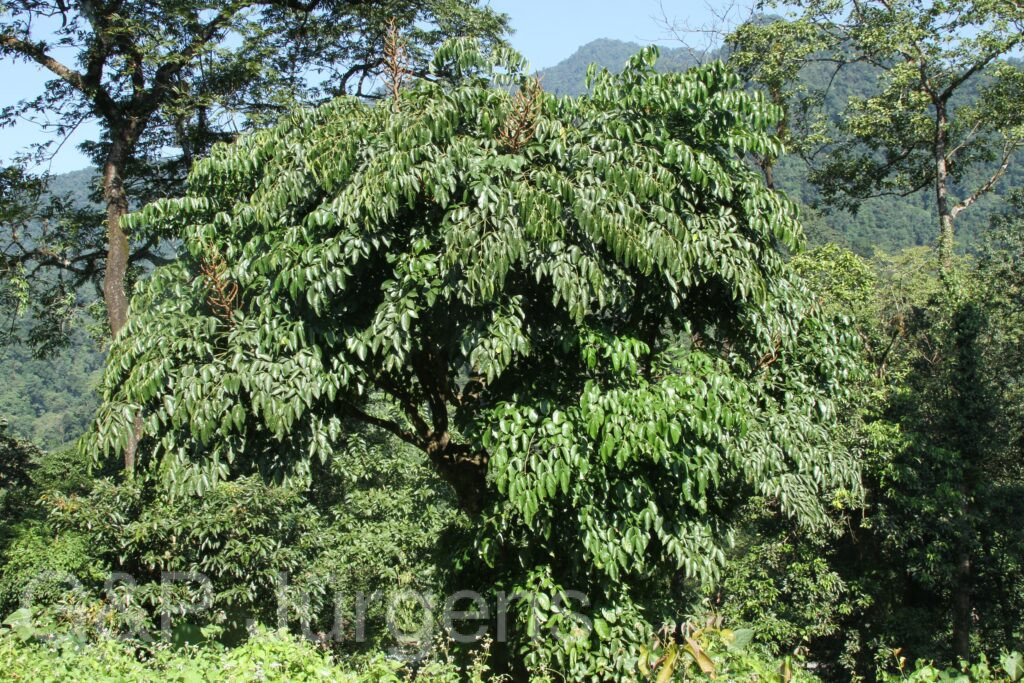
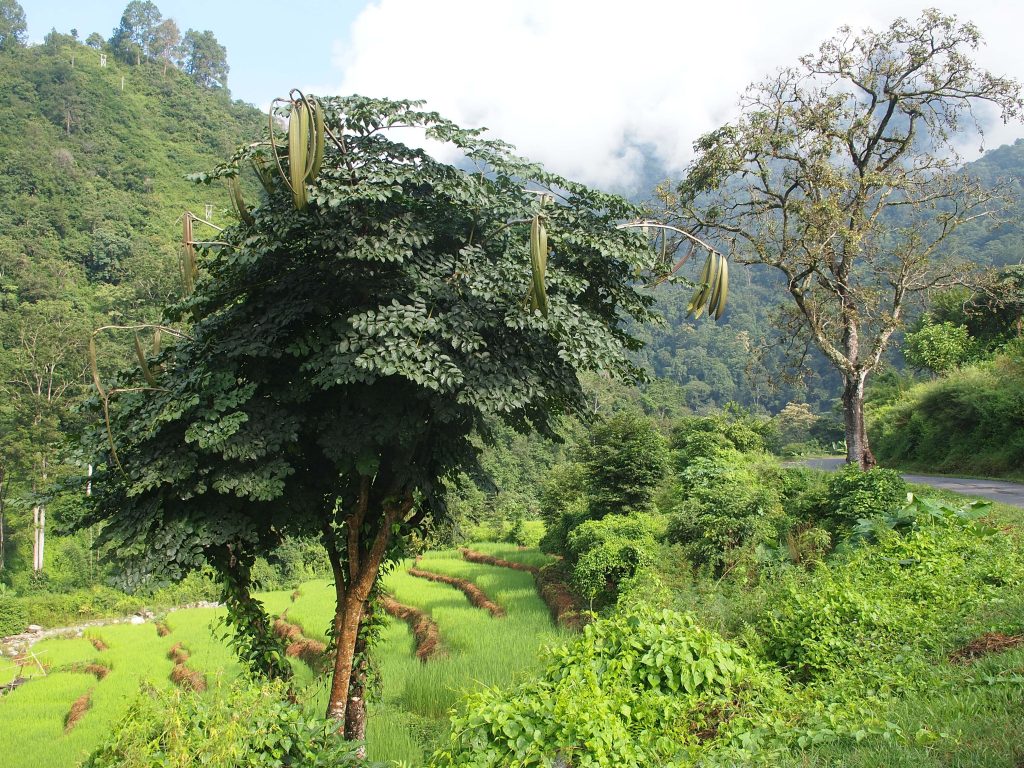
Oroxylum indicum, the Indian trumpet tree or midnight horror, is a small deciduous tree of subtropical and tropical Asia, ranging from India, Nepal and Bhutan through Bangladesh, Myanmar and southern China to Indochina, Thailand, Sri Lanka and across Malesia to the Philippines. GBIF aggregates around 1440 occurrences. It is a tree of forest margins, secondary growth, ravines and roadsides at low to moderate elevations, often in seasonally dry monsoon forest. The Bhutanese specimens at Trithangebe (900 m) and Galephug (500 m) in October occupy this warm foothill zone, fruiting at the close of the monsoon when the great pendulous pods become conspicuous.

The tree has a sparse crown and stout, soft-wooded branches marked with prominent leaf scars. Its leaves are very large, opposite and two- to three-pinnate, often a metre or more across, with ovate, acuminate leaflets, the falling rachides littering the ground beneath. The flowers open at night in a long erect terminal raceme, each large, fleshy and campanulate, lurid reddish-purple outside and paler within, malodorous and bat-pollinated. Most striking is the fruit: a flattened, sword-shaped, sabre-like capsule up to a metre long that splits into two woody valves to release numerous flat seeds broadly winged with a papery membrane for wind dispersal.

A member of Bignoniaceae, Oroxylum is a distinctive near-monotypic genus set apart by its enormous pinnate leaves, nocturnal chiropterophilous flowers and giant samaroid pods. The species is of considerable ethnobotanical importance: its bark, seeds and young fruit are widely used in Ayurvedic and traditional medicine, and the tender pods are eaten as a vegetable. Despite localised harvesting it remains common and widespread, and is not regarded as globally threatened.

Author: (L.) Kurz · Sources: POWO (Kew), GBIF, Flora of China Vol. 18, Flora of Bhutan Vol. 2, Annotated Checklist of the Flowering Plants of Nepal, Gentry monograph of Bignoniaceae

Hook.

Nepal 95 22 P31 ergebnis
Nepal Darondi-Khola 630m, Octobre

Description

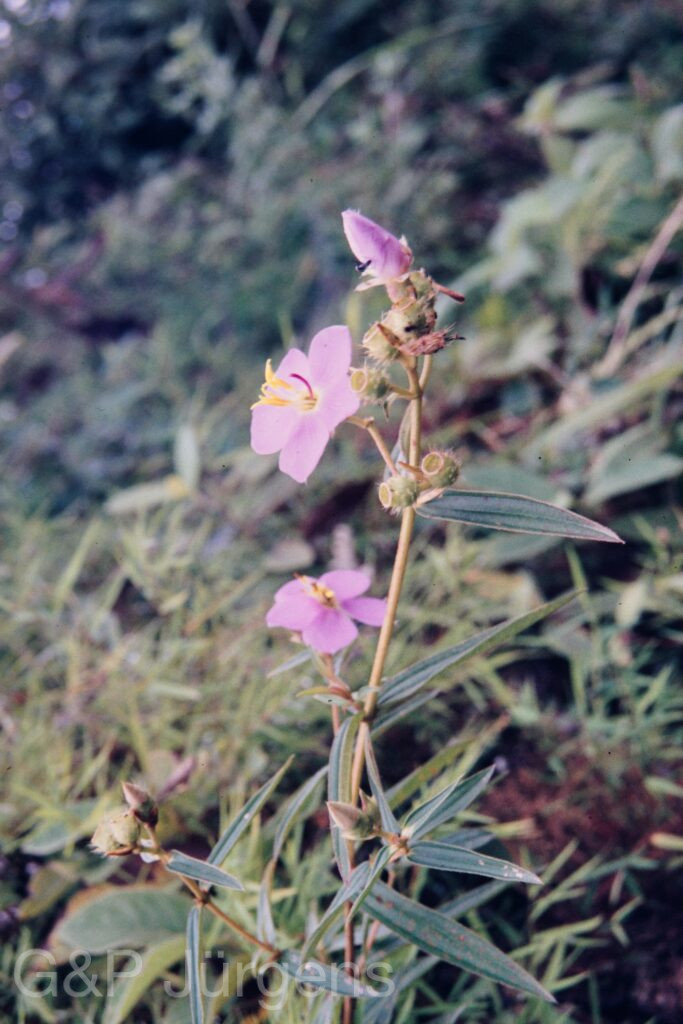
Osbeckia nepalensis is a subtropical to warm-temperate herb or subshrub of the eastern Himalaya and southeastern Asia, ranging through China, Nepal, India, Bhutan, Bangladesh, Myanmar, Thailand, Vietnam, Malaysia and Indonesia; its roughly 563 GBIF occurrences trace a broad Sino-Himalayan to Indochinese arc. In Nepal it descends to low elevations along river valleys, as recorded along the Darondi Khola at about 630 m in October, when the post-monsoon period brings peak flowering. It favours open, sunny situations on grassy hillsides, forest margins and roadside banks, behaving as an early-successional colonist of seasonally humid foothill habitats.

The plant is an erect, branched herb or soft subshrub with four-angled stems clothed, like the foliage, in stiff bristly hairs. The leaves are opposite, ovate-lanceolate, and bear the curved-parallel primary veins diagnostic of Melastomataceae. The handsome flowers are clustered in terminal heads, each with a bristly urn-shaped hypanthium and usually four broad, rounded petals of rich rose-purple to magenta; within are twice as many stamens with geniculate filaments and elongate, beaked, poricidal anthers adapted for buzz-pollination by bees. The fruit is a bristly capsule enclosed in the persistent hypanthium, releasing many minute seeds.

Osbeckia is closely allied to Melastoma, from which it is separated by its smaller, dry, poricidal capsules rather than fleshy berries. O. nepalensis is among the most ornamental species of the genus, valued horticulturally and used locally in herbal medicine. As a common, weedy coloniser of disturbed ground over a very large area, it carries no significant conservation concern.

Author: Hook. · Sources: POWO (Kew), GBIF, Flora of China Vol. 13, Flora of Bhutan Vol. 2, Flora of Nepal, A Revision of Osbeckia (Melastomataceae)