Tag:

Myanmar

Flowers of the Myanmar Himalaya — 604 species recorded from northern Myanmar (Burma) and the eastern Himalayan borderlands, a biodiversity hotspot linking the Himalaya to the mountains of Yunnan and Southeast Asia. The region’s forests and alpine slopes hold a rich flora of rhododendrons, orchids, balsams and gentians. Every page gives a botanical description, distribution, habitat and flowering time with the original photograph.

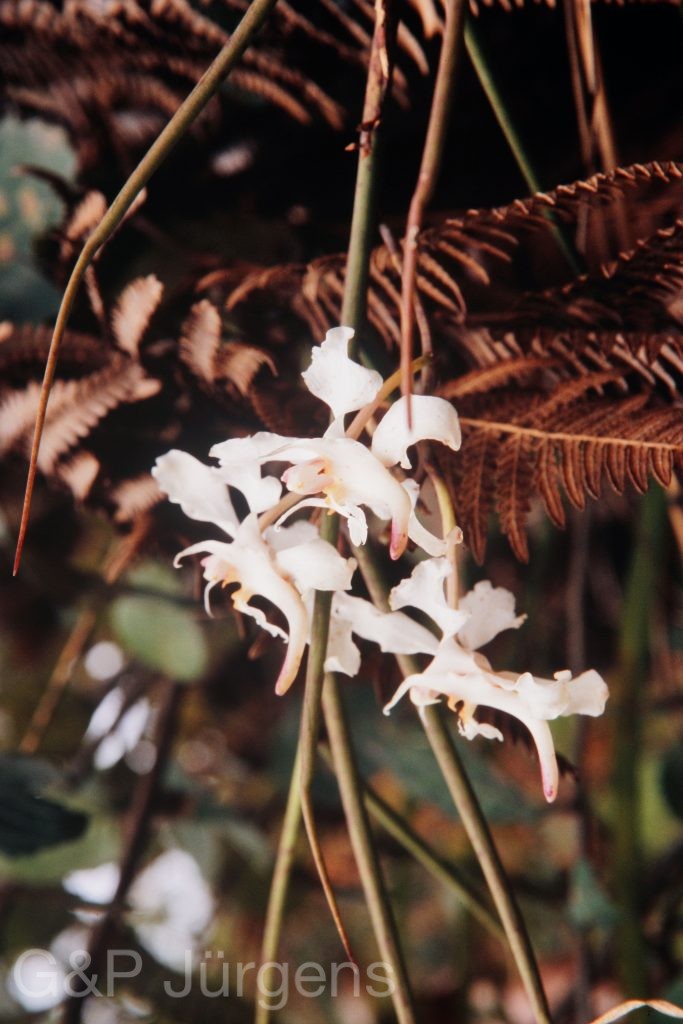
(Rchb.f.) Garay

Bh2008 319 G494
Bhutan Jakar, 2950m April

Description

Papilionanthe vandarum is an epiphytic orchid distributed across the eastern Himalaya and adjoining Indo-Burmese ranges, with records from India, Nepal, Bhutan and Myanmar; GBIF documents some 49 occurrences, the additional points from Belgium, the United States and Great Britain reflecting cultivated material in botanical collections. It grows on tree trunks and mossy branches in humid broad-leaved and coniferous forest, frequently in the montane belt between roughly 1500 and 3000 m, where seasonal monsoon moisture alternates with a drier cool season. The photographed plant from Jakar in central Bhutan at about 2950 m, flowering in April, is typical of its upper elevational range, where it flowers before the summer rains.

The species is readily recognised by its monopodial, scrambling habit and slender, terete (pencil-like) leaves that replace the flattened laminae of most orchids, an adaptation reducing water loss in exposed epiphytic sites. Stems are elongate, branching and rooting freely along their length by means of thick, greyish aerial roots. The inflorescences are short, few-flowered racemes bearing large, showy flowers; sepals and petals are white to pale, broad and somewhat undulate, while the trilobed labellum is prominent, with a spurred base and a coloured throat. The fruit is a dry, elongate dehiscent capsule releasing innumerable dust-like seeds.

Formerly placed in Aerides and Vanda, the species was transferred to Papilionanthe (a small Asian genus of terete-leaved monopodial orchids) by Garay; its terete foliage and pendent habit distinguish it from true Vanda. Like all wild orchids it is listed on CITES Appendix II, and populations are locally threatened by forest clearance and over-collection, though it remains fairly widespread across its Himalayan range.

Author: (Rchb.f.) Garay · Sources: POWO (Kew), GBIF, Flora of Bhutan, Orchids of Bhutan, Genera Orchidacearum (Pridgeon et al.)
Franch.

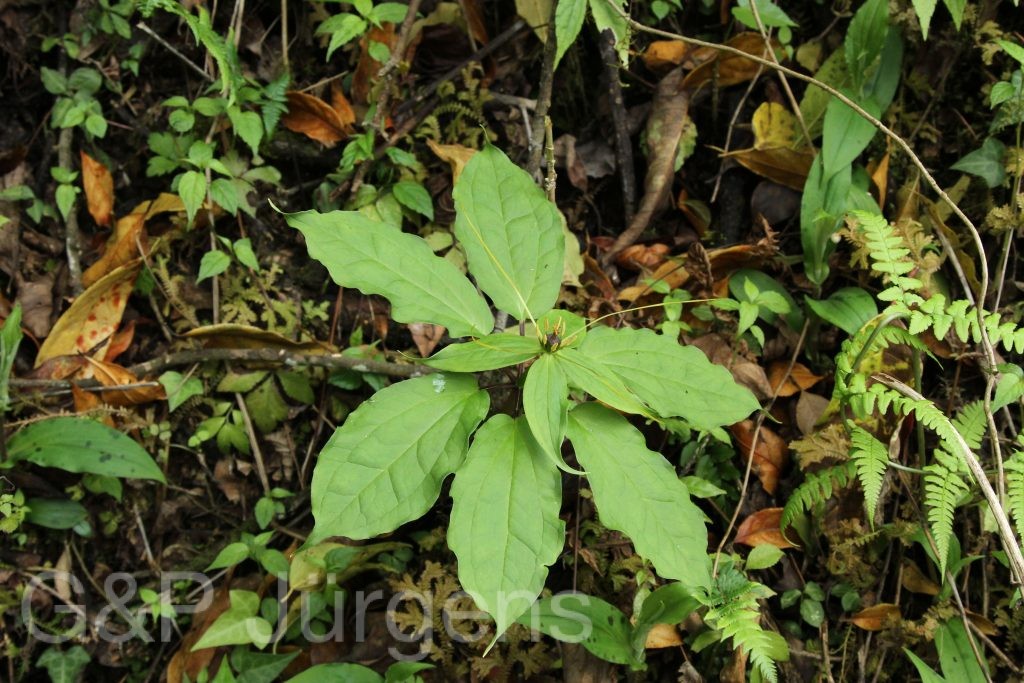
Bhutan2014 469
Bhutan Tongsa 2000m, May
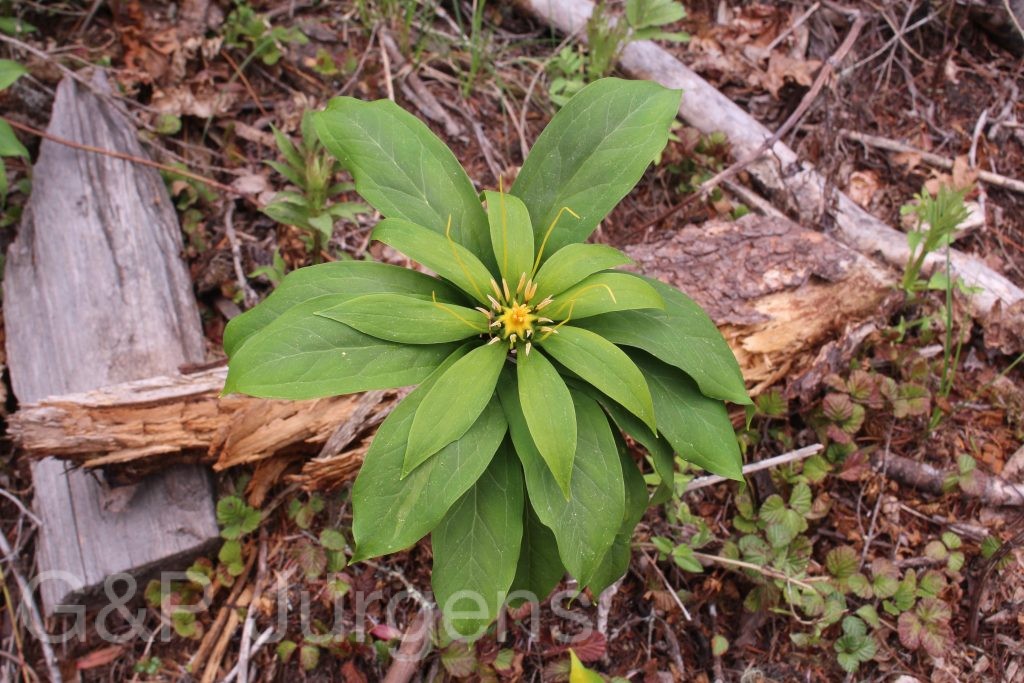
Bhutan2014 586
Bhutan Phobjika 3100m, May

Description

Paris thibetica is a rhizomatous woodland herb of the eastern Himalaya and Sino-Himalayan region, recorded from China, Nepal, India, Bhutan and Myanmar, the Norwegian (NO) datum representing cultivated or herbarium material. Its roughly 281 georeferenced collections concentrate in the temperate forests of the Tibet-Himalaya borderlands. It grows in shaded, moist, humus-rich broadleaved and mixed forest, on banks and in damp ravines beneath the canopy. The photographed plants from Bhutan at Tongsa (2000 m) and Phobjika (3100 m), both in May, demonstrate its broad altitudinal range across the temperate belt and its spring flowering as the rhizome resumes growth after winter.

It is an erect perennial arising from a thick, creeping rhizome that produces a single unbranched stem. At the stem apex is a single whorl of typically four or more leaves, ovate-lanceolate to oblanceolate, with the netted-reticulate venation characteristic of the genus. From the centre of the whorl rises a solitary terminal flower on a slender pedicel. The perianth is in two distinct whorls: the outer of green, leaf-like sepals and the inner of very narrow, filiform to thread-like yellowish-green petals. Numerous stamens with elongate connectives surround a globose ovary crowned by spreading styles. The fruit is a capsule that opens to expose seeds borne in a fleshy, often reddish aril.

The genus Paris (herb-Paris) is placed in the Melanthiaceae (formerly Trilliaceae) and is centred on the temperate Sino-Himalayan mountains, where it is taxonomically intricate and much studied. Several species, including members of the Paris polyphylla complex to which P. thibetica is allied, are valued in traditional medicine for their steroidal saponins, exposing wild populations to harvesting pressure. Slow-growing and habitat-specific, herb-Paris species are increasingly of conservation concern owing to forest loss and over-collection.

Author: Franch. · Sources: POWO (Kew), GBIF, Flora of China Vol. 24, Flora of Bhutan Vol. 3, Flora of Nepal, Li's The Genus Paris (Trilliaceae)

Wall.

Sikkim2003 111 P151
Sikkim below Dzongri 3950m 08.2003

Description

Parnassia pusilla is a diminutive grass-of-Parnassus distributed through the central and eastern Himalaya, recorded from China, Nepal, India, Bhutan and Myanmar and represented by some 177 georeferenced occurrences. It is a plant of cold, wet, open high-elevation ground, characteristically inhabiting alpine seepages, marshy meadows, dripping rock ledges and the gravelly margins of snowmelt streams where the substrate remains saturated through summer. The specimen photographed below Dzongri in Sikkim at about 3950 m in August illustrates its strong affinity for the upper alpine flush zone, where it flowers during the brief monsoon-fed growing season among low cushion vegetation and short turf.

It is a small, glabrous perennial herb arising from a short rootstock, forming a basal rosette from which slender, single-flowered scapes emerge. The basal leaves are long-petiolate with ovate to cordate blades, while each flowering stem bears a single sessile, clasping cauline leaf below the flower. The solitary flower is regular and pentamerous, with five free white petals that are conspicuously veined. Characteristic of the genus, alternating with the fertile stamens are five fringed staminodes, each dissected into gland-tipped filaments that serve as pseudonectaries to attract pollinators. The superior ovary develops into a capsule that splits to release numerous small seeds.

Despite its placement here under Celastraceae, Parnassia is morphologically distinctive, and the family circumscription reflects modern molecular treatments that subsume the former Parnassiaceae within an enlarged Celastraceae. The elaborate gland-tipped staminodes are a notable adaptation for insect pollination, offering visual and possibly olfactory rewards without true nectar. As a specialist of high-altitude wetlands, P. pusilla is sensitive to drainage, trampling by livestock and the desiccation of alpine seeps, so it serves as a useful indicator of intact high-mountain mire habitat.

Author: Wall. · Sources: POWO (Kew), GBIF, Flora of China Vol. 8, Flora of Bhutan Vol. 1, Flora of Nepal, Wu Phylogeny and Biogeography of the Genus Parnassia

Buch.-Ham. ex D.Don

Nepal 97 497 G979
Nepal Arun-Valley 1750m May
Nepal 97 336 P666
Nepal Arun-Valley 1750m May
Nepal 1994 58 ergebnis
Ost-Nepal Bhalukhob 
1900m April

Description

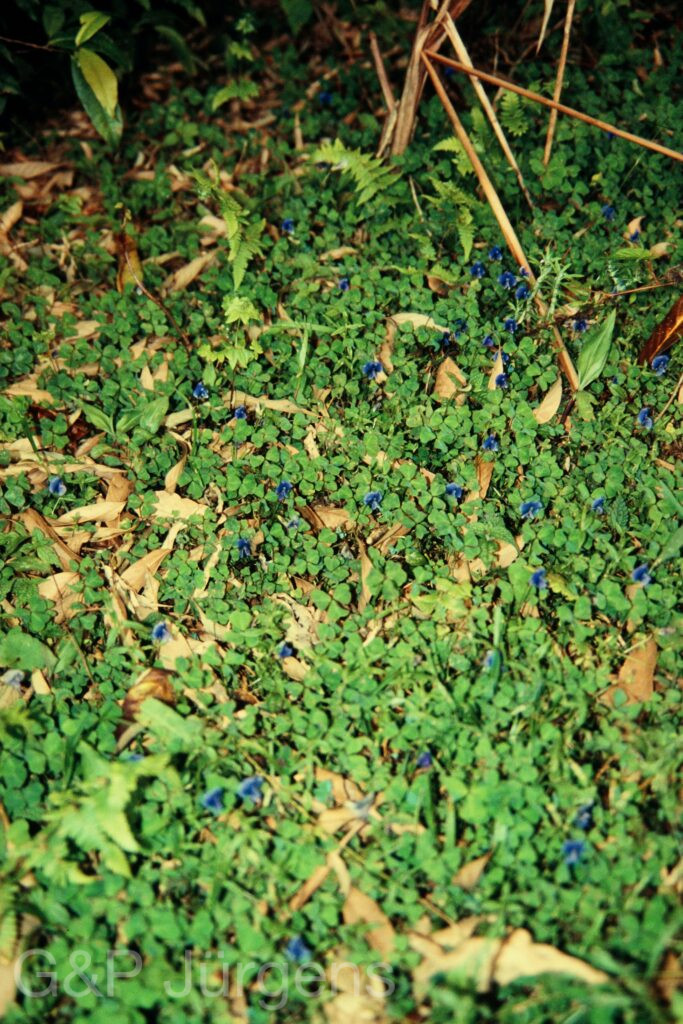
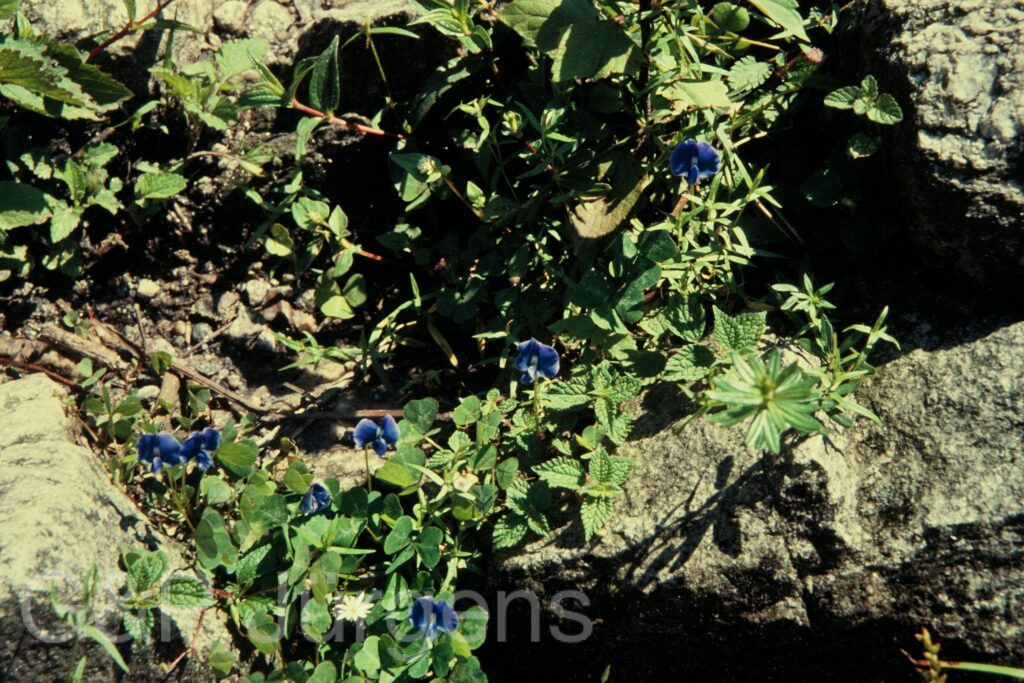
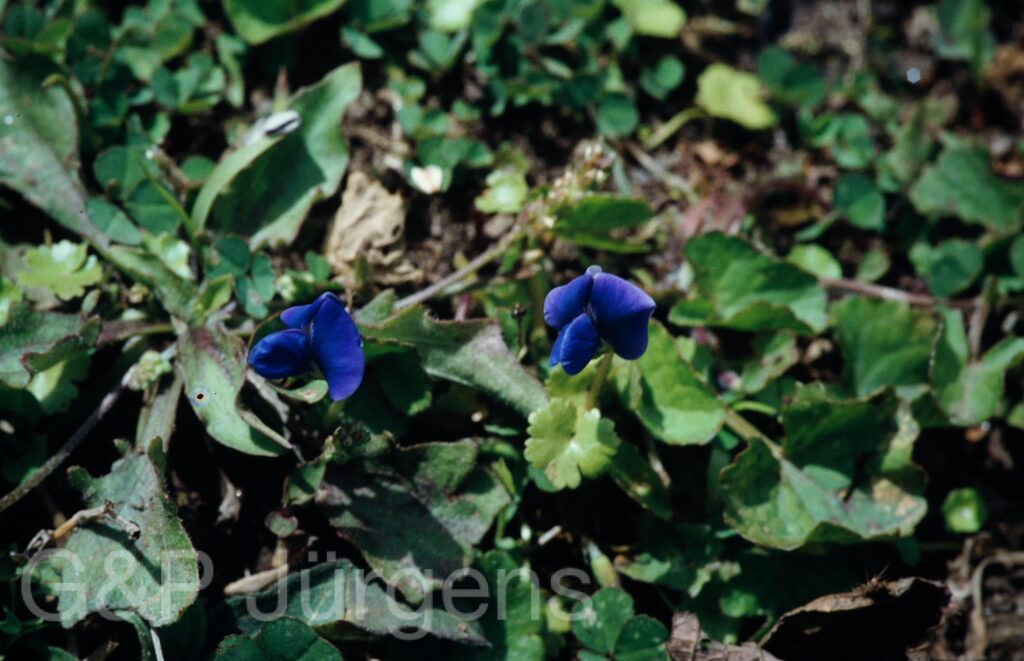
Parochetus communis, the shamrock pea, is a creeping perennial legume with a remarkably wide Afro-Asian montane distribution. GBIF documents around 1730 occurrences spanning the Himalaya (Nepal, India, Bhutan, China), Southeast Asia (Myanmar, Thailand, Vietnam, Malaysia, Indonesia, Sri Lanka), the East African highlands (Ethiopia, Kenya, Tanzania, Uganda, Rwanda, Burundi, DR Congo, Malawi) and naturalised in New Zealand. It grows in moist grassland, forest clearings, streambanks, terrace edges and shaded turf, generally between 1500 and 3000 m. The photographed plants are from eastern Nepal at Bhalukhob (1900 m, April) and the Arun Valley (1750 m, May), where it carpets damp banks in spring.

The plant forms prostrate, rooting stems that spread into loose mats and root at the nodes. The leaves are trifoliolate and clover-like, the obcordate leaflets often marked with a darker band, borne on slender petioles with small stipules. The flowers are solitary or paired in the leaf axils, papilionaceous with a standard, wing and keel; the corolla is a vivid cobalt to gentian-blue, occasionally with paler markings, exceeding the tubular calyx. The fruit is a slender, linear-oblong legume that dehisces to release several small seeds.

Parochetus (Fabaceae, subfam. Faboideae) is a small genus historically treated as monotypic until the segregation of the African P. africanus, leaving Asian material under P. communis. GBIF treats the name as accepted. Its disjunct, sky-island range across Asian and African mountains makes it a classic subject in studies of tropical-alpine biogeography. Widespread and adaptable, it is of least concern and is also cultivated as an ornamental groundcover.

Author: Buch.-Ham. ex D.Don · Sources: POWO (Kew), GBIF, Flora of China, Annotated Checklist of the Flowering Plants of Nepal, Polhill studies of Papilionoid legumes

(Kurz.) Bremek.

Nepal 2001 488 ergebnis ergebnis
Nepal (Gorkha) Labubhesi 1100m, May

Description

Pavetta tomentosa var. glabrescens is a shrub of the warm subtropical and tropical forests of southern and southeastern Asia. GBIF records the species across a broad range encompassing India, Thailand, China, Myanmar, Nepal, Laos, Vietnam, Cambodia, Malaysia, Indonesia, Sri Lanka, Bangladesh and Bhutan, with some 530 occurrences. It grows in deciduous and semi-evergreen forest, woodland margins and scrub at low to mid elevations. The photographed material derives from Nepal in the Gorkha district at Labubhesi, around 1100 m, in May, a humid montane-foothill setting near the lower Himalayan slopes that marks the northern edge of its distribution.

The plant is an erect, branching shrub with opposite, simple, elliptic to oblong leaves that are entire, shortly petiolate and, in the typical variety, softly tomentose; in var. glabrescens the indumentum is reduced and the foliage tends towards near-glabrous, the distinguishing feature of the variety. Interpetiolar stipules are present, as is characteristic of Rubiaceae. The white, fragrant flowers are borne in dense terminal corymbose cymes; each has a four-lobed salverform corolla with a slender tube and a long, far-exserted style, the hallmark of Pavetta. Bacterial leaf nodules, harbouring nitrogen-related endophytes, occur as dark dots in the lamina. The fruit is a small globose, two-seeded berry, ripening black.

GBIF accepts the species, the variety reflecting the glabrescent extreme of a tomentose-pubescent continuum. Bremekamp, who monographed the genus, recognised numerous such infraspecific entities. The genus is notable for its near-obligate bacterial leaf symbiosis. Widespread and ecologically tolerant, the species is of no conservation concern.

Author: (Kurz.) Bremek. · Sources: POWO (Kew), GBIF, Flora of Nepal, Flora of China, Bremekamp monograph of Pavetta

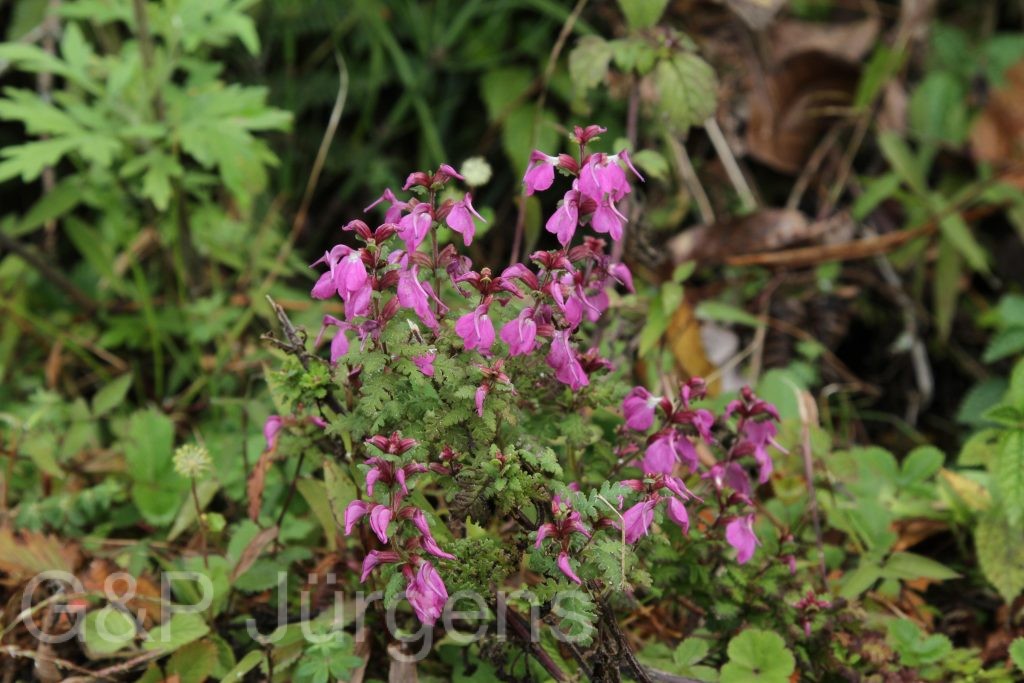
(Buch.-Ham.) Pennell

Nepal 99 901 ergebnis
West-Nepal Sepka 2700m, July

Description

Pedicularis bifida is a hemiparasitic perennial herb of the temperate and subalpine Himalaya, distributed through Nepal, India, Bhutan, China and Myanmar across some 250 documented records. It grows in moist meadows, forest clearings, shrubberies and along streamsides, generally between 2400 and 3800 m, flowering with the summer monsoon. The illustrated plant was collected at Sepka in West Nepal at 2700 m in July, within the typical mid-montane band where the species is most frequently encountered among tall-herb vegetation.

Like all lousewort, the plant is a root-parasite drawing water and nutrients from neighbouring hosts via haustoria. It forms erect, sometimes branched stems clothed with alternate to subopposite, pinnately lobed leaves bearing toothed segments. The flowers are aggregated into terminal leafy-bracted spikes or racemes; the calyx is tubular and toothed, and the strongly zygomorphic corolla is pink to rose-purple with a tube and a galeate upper lip whose apex is conspicuously bifid or beaked, the feature giving the epithet, and a spreading three-lobed lower lip. The four didynamous stamens lie within the galea and the fruit is an oblique, beaked loculicidal capsule.

The genus Pedicularis, transferred from Scrophulariaceae to Orobanchaceae on molecular grounds, reaches extraordinary diversity in the Sino-Himalaya, where elaborate corolla architecture promotes specialised pollination by long-tongued bumblebees. The bifid galea of this species reflects such floral specialisation. As a widespread, locally common meadow component, P. bifida is not considered threatened, though it depends on intact host-rich grassland communities.

Author: (Buch.-Ham.) Pennell · Sources: POWO (Kew), GBIF, Flora of China, Annotated Checklist of the Flowering Plants of Nepal, Flowers of the Himalaya, Prain & Pennell revisions of Pedicularis

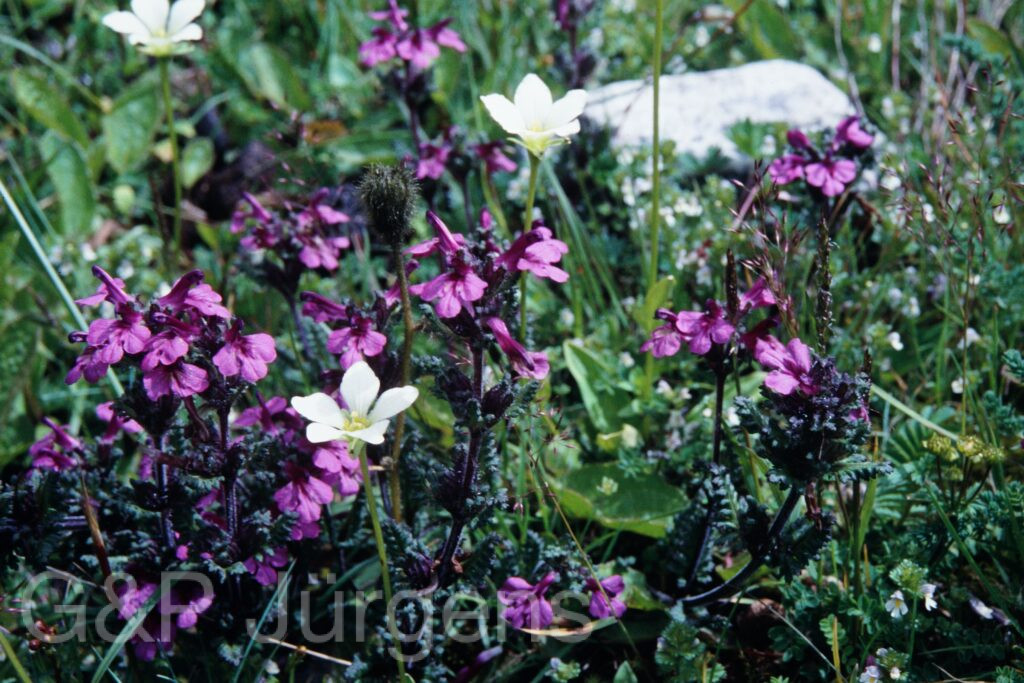
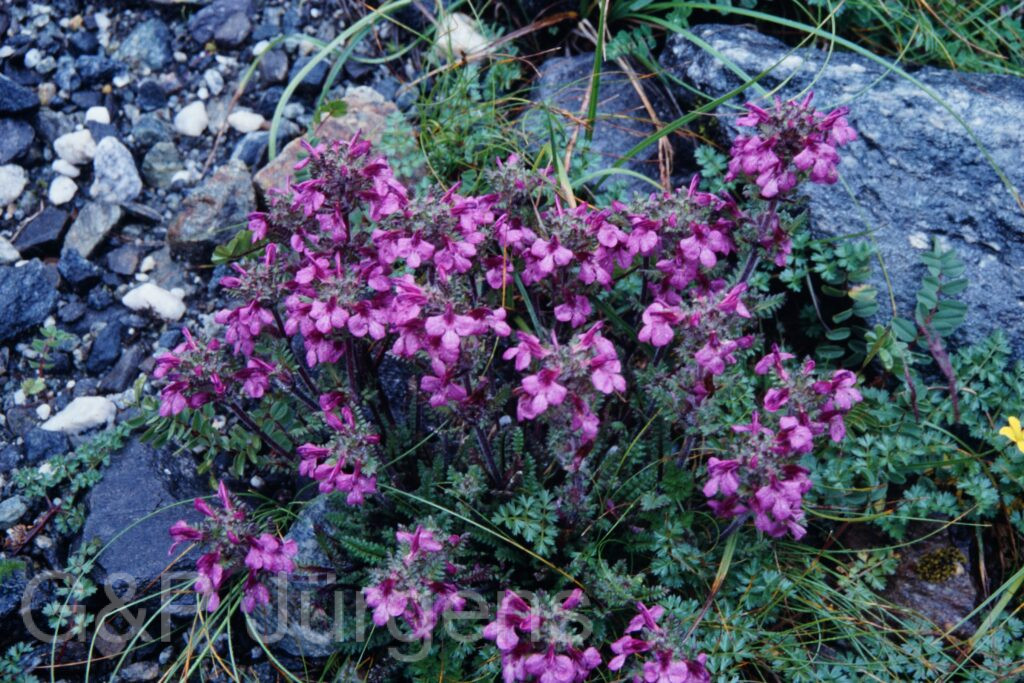
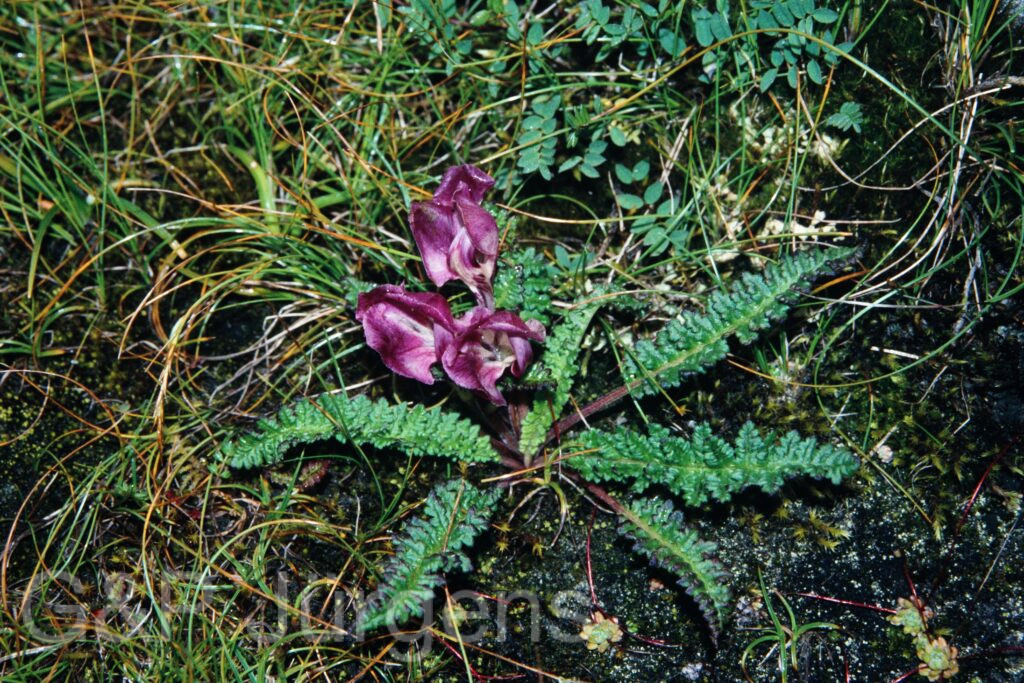
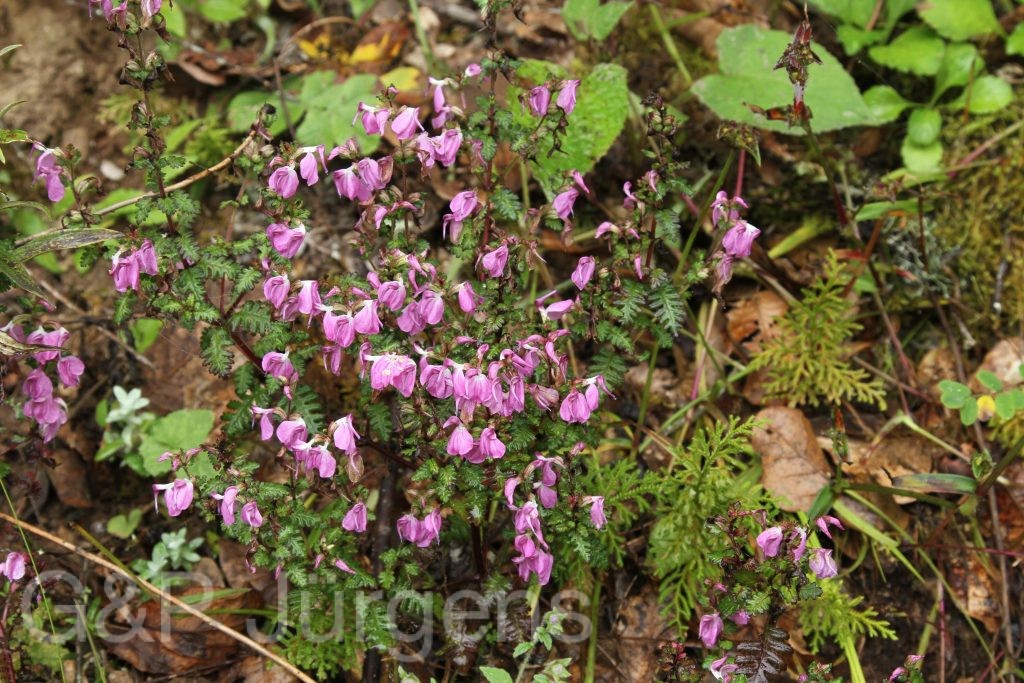
Prain

Sikkim2011 197
Sikkim Lachung 3000m, June
Sikkim2011 230
Sikkim Lachung 3000m, June
Sikkim2003 261 P360
Sikkim Dzongri 4200m August
Sikkim2003 273 P376
Sikkim Dzongri 4100m, August

Description

Pedicularis diffusa is a hemiparasitic alpine herb of the eastern Himalaya and adjacent Tibetan region, recorded from China, Bhutan, India, Nepal, Myanmar and Mongolia, with about 92 occurrences in GBIF. It inhabits subalpine and alpine meadows, open grassy slopes, scrub and the margins of forest, typically between about 3000 and 4500 m. The photographed populations come from Sikkim, at Lachung (3000 m, June) and at the high alpine site of Dzongri (4100-4200 m, August), spanning the species' altitudinal range and flowering from early summer into the late monsoon at the higher stations.

The plant forms loose clumps from a fibrous or somewhat thickened rootstock, with ascending to diffusely spreading stems, the habit reflected in the epithet diffusa. The leaves are pinnately divided into oblong, toothed segments and are arranged along the stems as well as basally. The flowers are borne in lax, leafy, often elongate and interrupted racemes; the corolla is pink to purplish-red, two-lipped, with a galea (hooded upper lip) and a broad three-lobed lower lip, the galea typically beaked or toothed at its apex. The fruit is an oblique, laterally compressed capsule containing few seeds.

Like all Pedicularis, the species is a root hemiparasite, photosynthetic but tapping neighbouring plants via haustoria for water and minerals, an adaptation well suited to nutrient-poor alpine turf. The genus is extraordinarily diverse in the Sino-Himalayan mountains, and corolla architecture, particularly the form of the galea and beak, underpins species delimitation. Its tubular two-lipped flowers are adapted to bumblebee pollination. Restricted alpine specialists of this kind are potentially sensitive to climate warming and grazing pressure on high pastures.

Author: Prain · Sources: POWO (Kew), GBIF, Flora of China, Flora of Bhutan, Pedicularis monograph (Tsoong)

Hook. f.

Sikkim2003 276 G379
Sikkim Dzongri 4300m, August

Description

Pedicularis elwesii is a hemiparasitic herb of the eastern Himalaya and adjacent high mountains of southwestern China, with a distribution spanning China, Nepal, India, Bhutan and Myanmar and some 532 georeferenced records compiled by GBIF. It is a plant of the alpine zone, characteristically inhabiting moist meadows, open turf, streamsides and stony slopes above the treeline, generally between about 3500 and 4500 m. The photographed material from Sikkim, on the Dzongri ridge at 4300 m in August, typifies its preferred habitat among short alpine grassland during the summer flowering peak that follows snowmelt and coincides with the monsoon.

It is a perennial forming a tuft of erect to ascending stems from a stout rootstock, with chiefly basal and cauline pinnatisect to pinnatipartite leaves whose oblong segments are toothed and crenate. The showy inflorescence is a dense terminal spike subtended by leaf-like bracts. As in many Himalayan louseworts the corolla is strongly two-lipped: a hooded galea formed by the upper lip, here often produced into a slender beak, encloses the anthers, while the broad three-lobed lower lip serves as a landing platform. Flowers are typically rose-pink to purplish; the fruit is an oblique, beaked loculicidal capsule.

The species belongs to the large, taxonomically intricate genus Pedicularis, exceptionally diversified in the Sino-Himalayan region where floral specialisation reflects coevolution with long-tongued bumblebee pollinators. Like its congeners it is a root hemiparasite, drawing water and nutrients through haustorial connections to neighbouring alpine plants while retaining functional chlorophyll. No major conservation concern is recognised given its wide range, though its meadows are sensitive to grazing and climatic shifts.

Author: Hook. f. · Sources: POWO (Kew), GBIF, Flora of China, Flora of Bhutan, Pedicularis monograph (Tsoong / Prain)

Wall. ex Benth.

Bhutan2012 834
Bhutan Trongsa 1850m, October
Bhutan2012 1299
Bhutan Trashigang 1820m, October
Sikkim2003 388 P550
Sikkim Zemu Valley 3300m August

Description

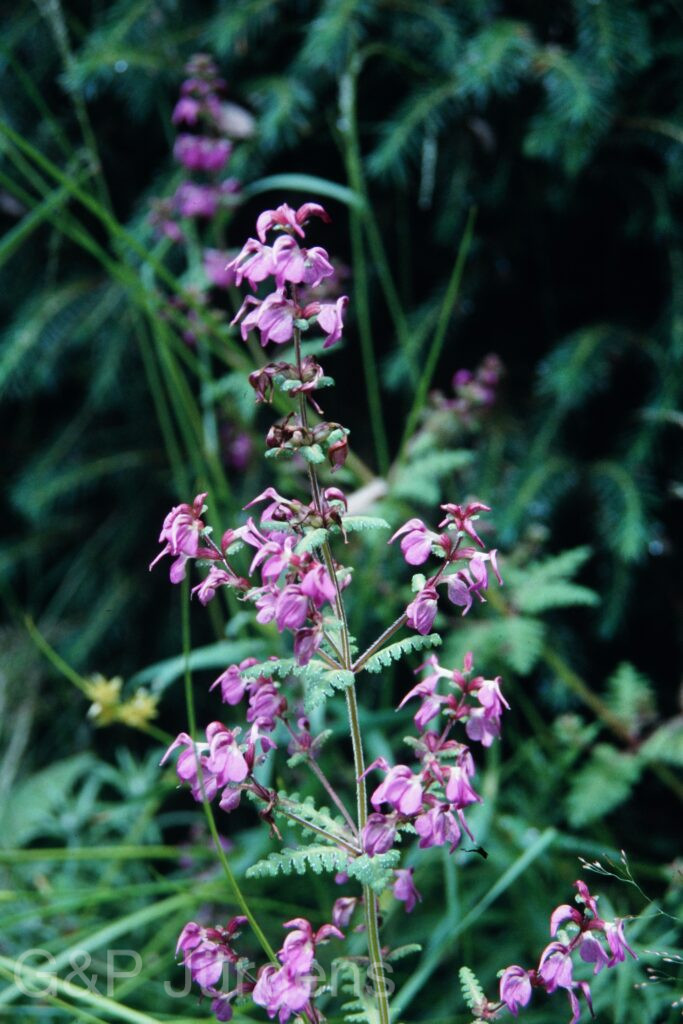
Pedicularis gracilis Wall. ex Benth. is a hemiparasitic herb of the Himalaya and adjacent mountains, occurring across China, Nepal, India, Bhutan, Pakistan and Myanmar. It is recorded from Bhutan at Trongsa and Trashigang between 1820 and 1850 m, flowering in October, and from the Zemu Valley in Sikkim at about 3300 m in August, spanning the warm temperate to subalpine zones. The species grows in open forest, scrub, grassy slopes, meadows and along stream banks, generally between 1500 and 3500 m, where, like all lousewort, it attaches to the roots of neighbouring plants as a facultative root hemiparasite. Its roughly 1008 GBIF records indicate a common and widely distributed species.

The plant is a slender, erect annual or short-lived perennial with a fibrous root system and a tall, sparingly branched stem. The leaves are alternate and pinnatisect, the segments themselves toothed or incised, giving a fern-like aspect. The flowers are borne in a long, lax, leafy-bracted terminal raceme; each has a tubular five-lobed calyx and a two-lipped corolla in pink to rose-purple, the upper lip (galea) hooded and beaked to enclose the four didynamous stamens, the lower lip three-lobed and spreading. The fruit is an obliquely ovoid, beaked capsule containing several seeds.

Pedicularis is one of the largest genera of the Sino-Himalaya, with the region a global centre of its diversity, and the intricate galea forms are closely tied to specialisation upon long-tongued bumblebee pollinators. As a hemiparasite the genus can influence community composition and is sensitive to changes in host vegetation. Being widespread and frequent, P. gracilis is of no particular conservation concern, though it serves as a useful indicator of intact montane grassland and forest-edge habitats.

Author: Wall. ex Benth. · Sources: POWO (Kew), GBIF, Flora of China, Flora of Bhutan, Flora of Nepal, Pedicularis monographs (Prain; Tsoong)

Wall. ex Benn.

Garw 2005 62 ergebnis ergebnis
India Garhwal Valley of flowers 3400m, September
Garh 07 473 ergebnis
India Garhwal Khiar Kutti 3740m, June

Description

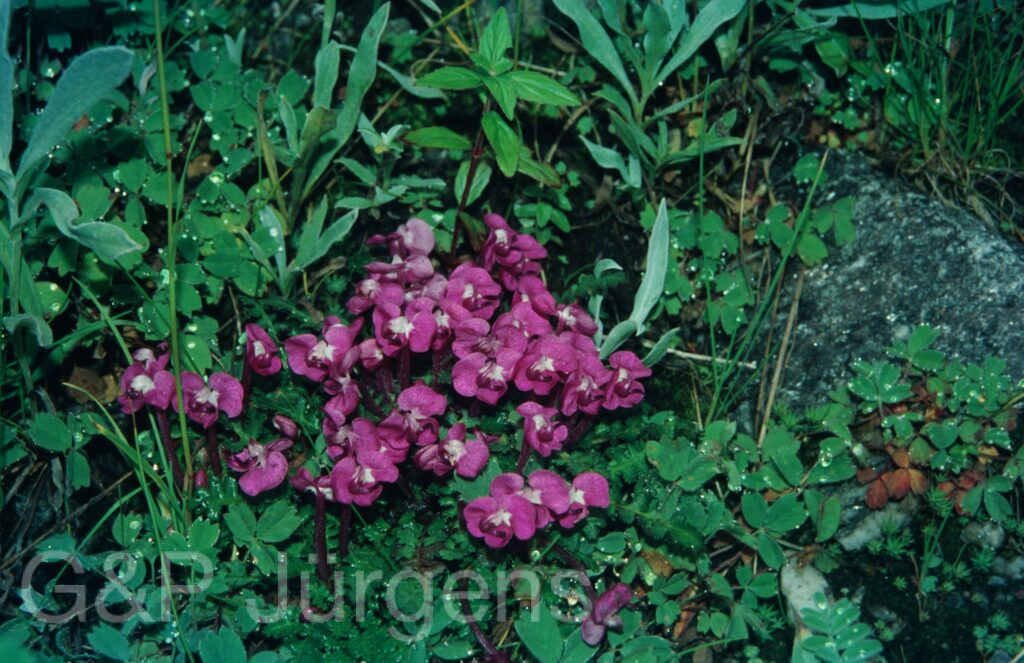
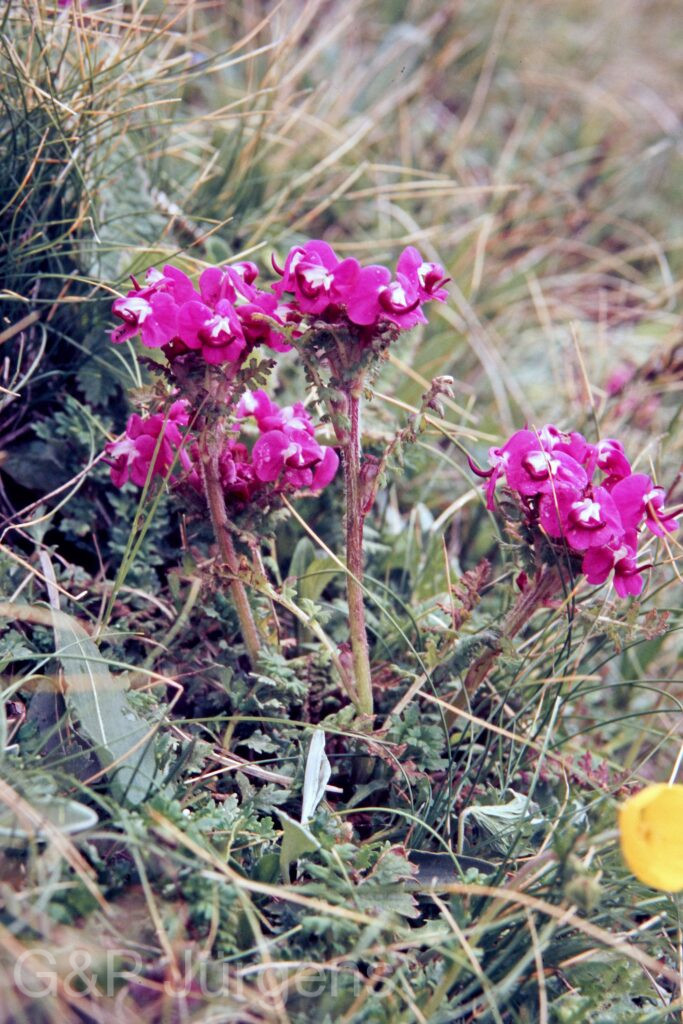
Pedicularis hookeriana Wall. ex Benn. is a hemiparasitic alpine herb distributed across the high Himalaya and adjoining mountains, recorded from Nepal, India, China and Myanmar, with some 61 georeferenced occurrences in GBIF. It inhabits open alpine meadows, moist turf, streamsides and the margins of dwarf-shrub communities, typically between 3300 and 4500 m. The species was documented in the Indian Garhwal Himalaya, both in the celebrated Valley of Flowers at 3400 m in September and at Khiar Kutti at 3740 m in June, the latter coinciding with the early-summer flush of alpine bloom after snowmelt. Like all members of the genus it attaches to the roots of neighbouring graminoids and forbs through haustoria, supplementing its own photosynthesis.

It is a low, often tufted perennial with a thickened rootstock and few erect or ascending stems. The leaves are mostly basal and rosulate, oblong to lanceolate in outline and deeply pinnatisect, the segments incised-dentate and frequently tinged with anthocyanin. The flowers are borne in a short, dense terminal raceme; the calyx is tubular and toothed, while the showy bilabiate corolla is pink to purplish-red, its galea curved and beaked, contrasting with a broad spreading lower lip. The fruit is an obliquely ovoid, somewhat compressed capsule containing several small seeds.

Within the large and taxonomically complex genus Pedicularis, P. hookeriana belongs to the beaked-galea assemblage that radiated extensively across the Sino-Himalayan region, one of the world's principal centres of diversity for the genus. Its long, curved corolla beak is an adaptation to pollination by long-tongued bumblebees, which the flower architecture mechanically guides. Though not formally assessed as threatened, its restriction to fragile alpine turf makes it sensitive to grazing pressure and climate-driven upslope shifts of vegetation belts.

Author: Wall. ex Benn. · Sources: POWO (Kew), GBIF, Flora of China, Flora of Bhutan, Flora of Nepal, Pedicularis monograph (Prain; Tsoong revision of Asian Pedicularis)