
Franch.
Description
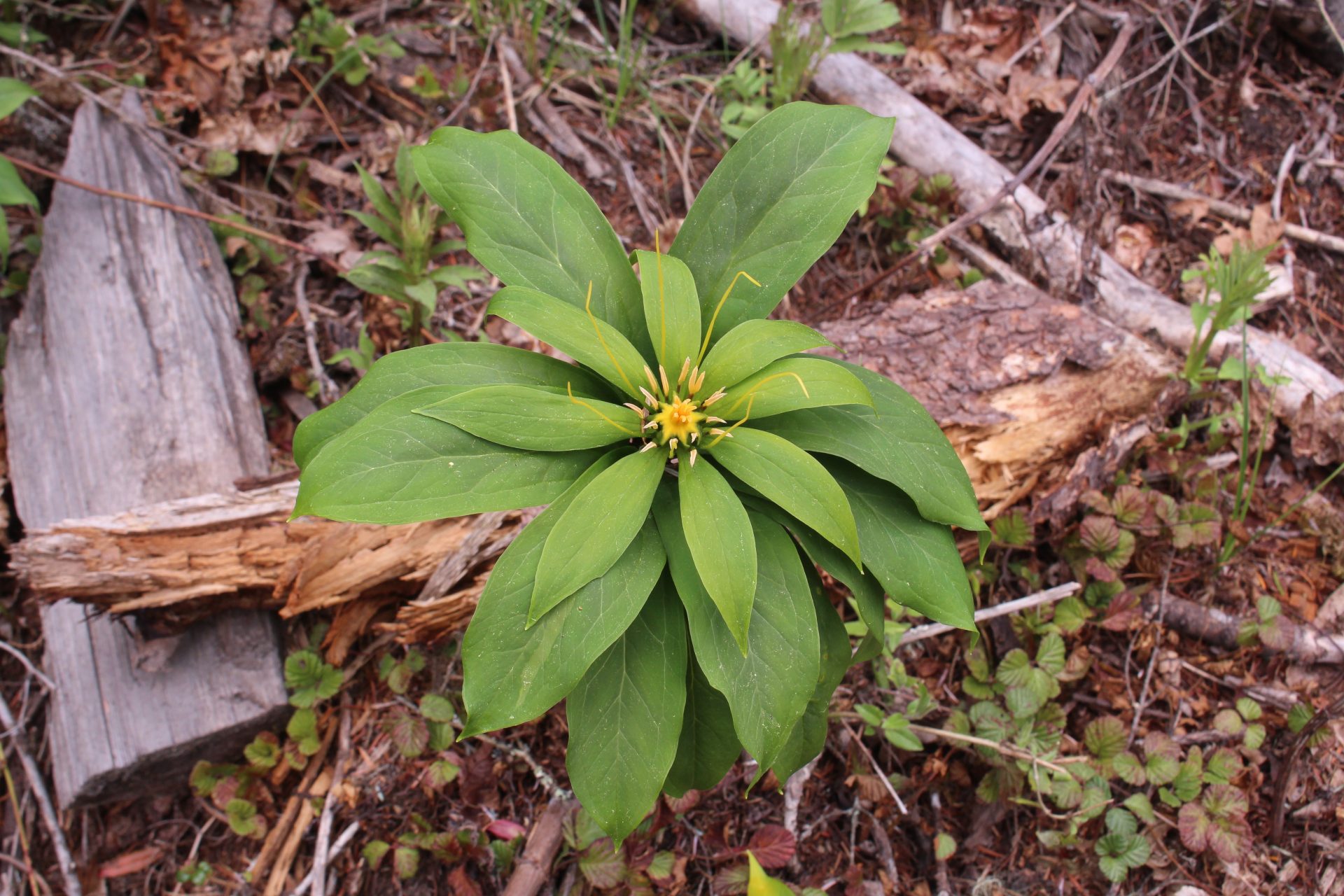
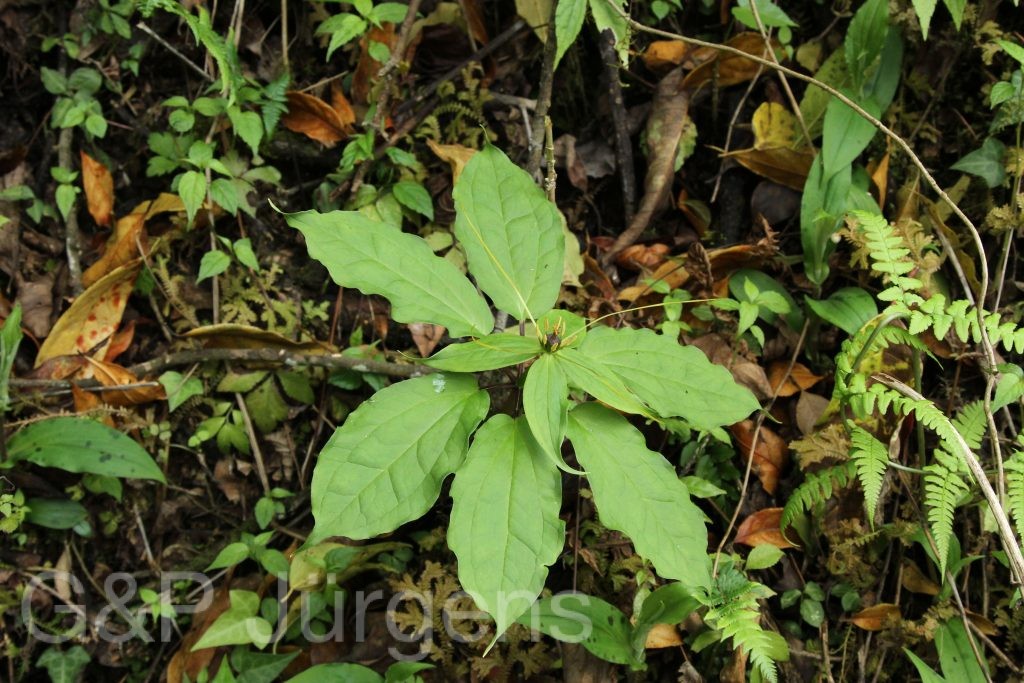
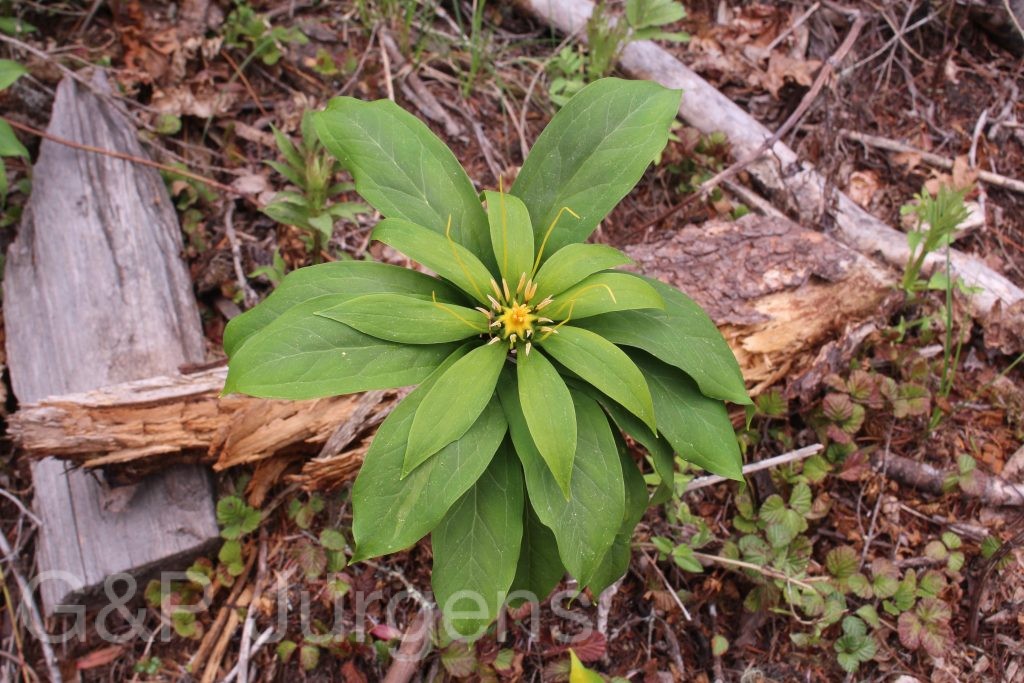
Paris thibetica is a rhizomatous woodland herb of the eastern Himalaya and Sino-Himalayan region, recorded from China, Nepal, India, Bhutan and Myanmar, the Norwegian (NO) datum representing cultivated or herbarium material. Its roughly 281 georeferenced collections concentrate in the temperate forests of the Tibet-Himalaya borderlands. It grows in shaded, moist, humus-rich broadleaved and mixed forest, on banks and in damp ravines beneath the canopy. The photographed plants from Bhutan at Tongsa (2000 m) and Phobjika (3100 m), both in May, demonstrate its broad altitudinal range across the temperate belt and its spring flowering as the rhizome resumes growth after winter.
It is an erect perennial arising from a thick, creeping rhizome that produces a single unbranched stem. At the stem apex is a single whorl of typically four or more leaves, ovate-lanceolate to oblanceolate, with the netted-reticulate venation characteristic of the genus. From the centre of the whorl rises a solitary terminal flower on a slender pedicel. The perianth is in two distinct whorls: the outer of green, leaf-like sepals and the inner of very narrow, filiform to thread-like yellowish-green petals. Numerous stamens with elongate connectives surround a globose ovary crowned by spreading styles. The fruit is a capsule that opens to expose seeds borne in a fleshy, often reddish aril.
The genus Paris (herb-Paris) is placed in the Melanthiaceae (formerly Trilliaceae) and is centred on the temperate Sino-Himalayan mountains, where it is taxonomically intricate and much studied. Several species, including members of the Paris polyphylla complex to which P. thibetica is allied, are valued in traditional medicine for their steroidal saponins, exposing wild populations to harvesting pressure. Slow-growing and habitat-specific, herb-Paris species are increasingly of conservation concern owing to forest loss and over-collection.
Author: Franch. · Sources: POWO (Kew), GBIF, Flora of China Vol. 24, Flora of Bhutan Vol. 3, Flora of Nepal, Li's The Genus Paris (Trilliaceae)