Tag:

Myanmar

Flowers of the Myanmar Himalaya — 604 species recorded from northern Myanmar (Burma) and the eastern Himalayan borderlands, a biodiversity hotspot linking the Himalaya to the mountains of Yunnan and Southeast Asia. The region’s forests and alpine slopes hold a rich flora of rhododendrons, orchids, balsams and gentians. Every page gives a botanical description, distribution, habitat and flowering time with the original photograph.

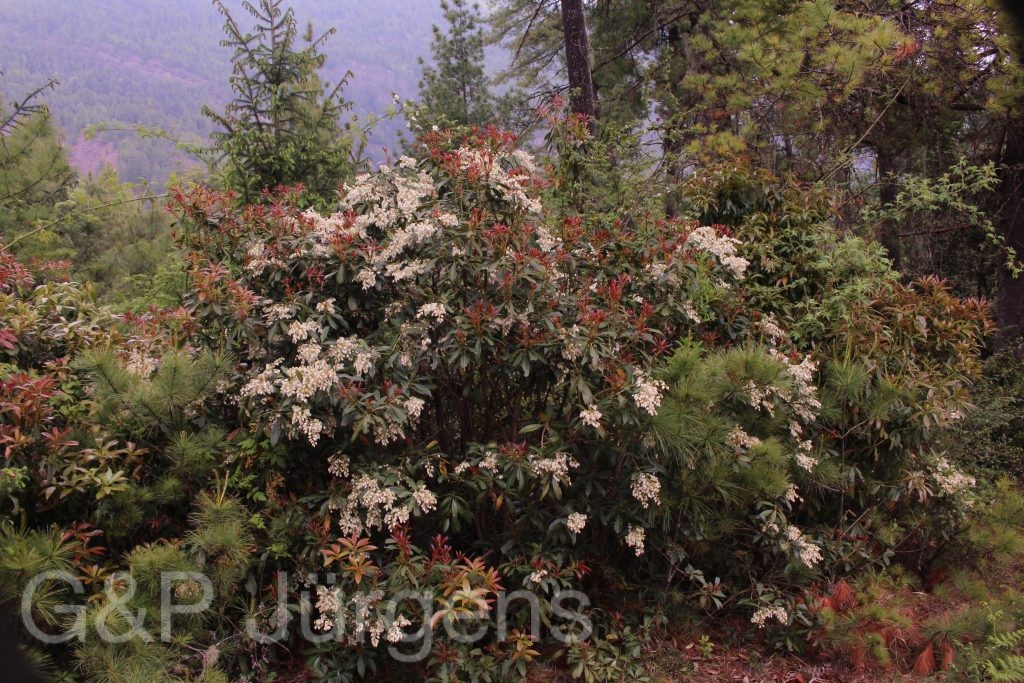
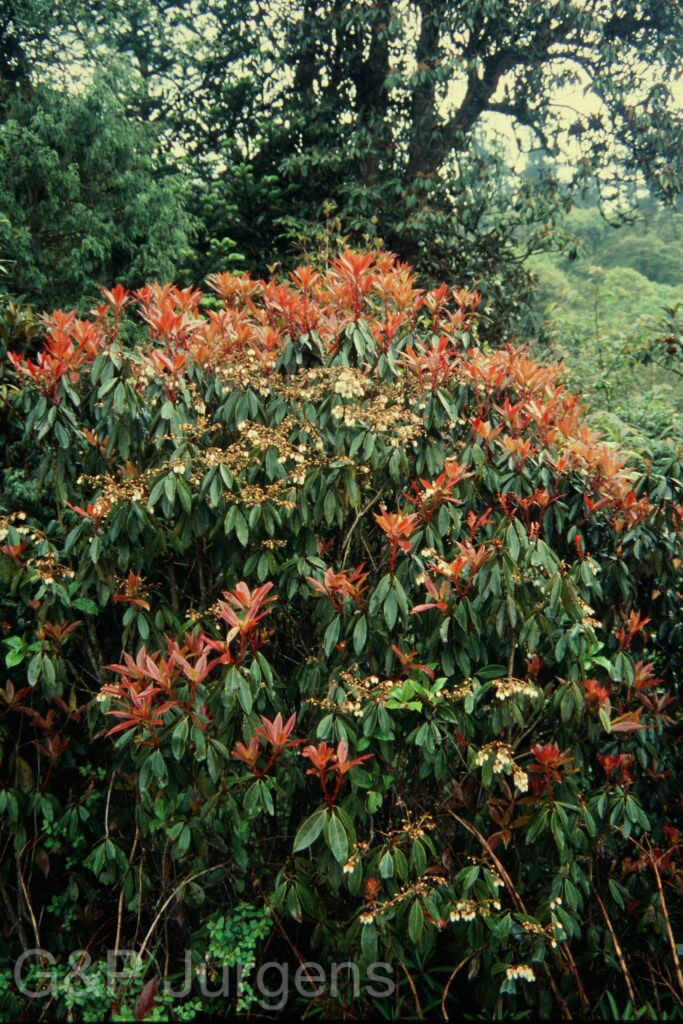
Pieris formosa

by G & P Jürgens

(Wall.) D. Don

Bhutan2014 861
Bhutan Chele-La 3000m, May
Bhutan2014 859
Bhutan Chele-La 3000m, May
Sikkim2004 381 658
Sikkim/India Lachung 3000m May

Description

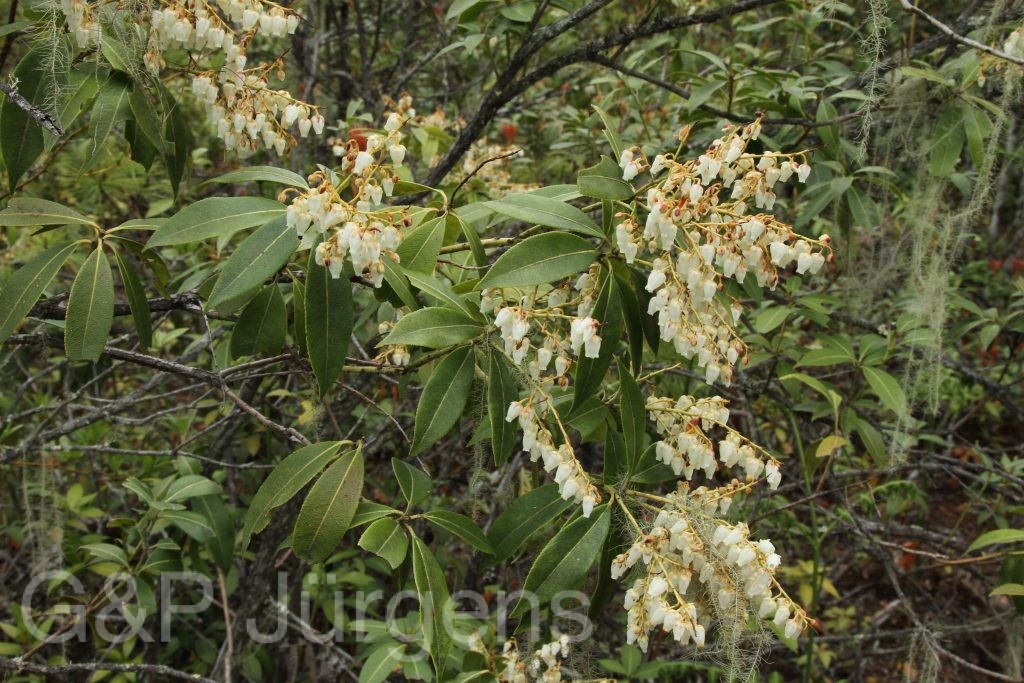
Pieris formosa is an evergreen ericaceous shrub native to the Himalaya and southwestern China, recorded from China, Nepal, India, Bhutan and Myanmar, with cultivated and naturalised records elsewhere accounting for the European, North American, Japanese and other points among its substantial 2971 GBIF occurrences. It occurs in temperate forest, forest margins, thickets and open rocky slopes, generally between 900 and 3300 m. The localities in the caption, Chele-La in Bhutan and Lachung in Sikkim, both around 3000 m in May, represent the cool, humid upper montane forest where the species flowers profusely in spring.

The plant is a much-branched evergreen shrub or small tree reaching several metres, with leathery, oblong-lanceolate to elliptic leaves that are finely serrate, glossy dark green above and frequently flushed bronze or coppery-red when young. The flowers are borne in large, terminal, much-branched panicles; each corolla is small, white, urceolate (urn-shaped) and five-toothed at the mouth, with the stamens enclosed and the ovary superior. Fruit is a small erect, woody, five-valved dehiscent capsule containing numerous minute seeds, the persistent panicles remaining conspicuous after flowering.

Pieris (tribe Lyonieae, subfamily Vaccinioideae) is a small genus of Asian and North American shrubs, and P. formosa is its most robust Himalayan representative, widely grown as an ornamental, notably the form 'Forrestii' selected for its vivid red young growth. Like many Ericaceae it favours acidic, humus-rich soils and harbours grayanotoxins, rendering its foliage poisonous to livestock. Its urn-shaped flowers are pollinated chiefly by bees, and the dust-like seeds are wind-dispersed. The species is common and not threatened across its native range.

Author: (Wall.) D. Don · Sources: POWO (Kew), GBIF, Flora of China, Flora of Bhutan, Bean Trees and Shrubs Hardy in the British Isles
Wedd.

Bhutan2015 180
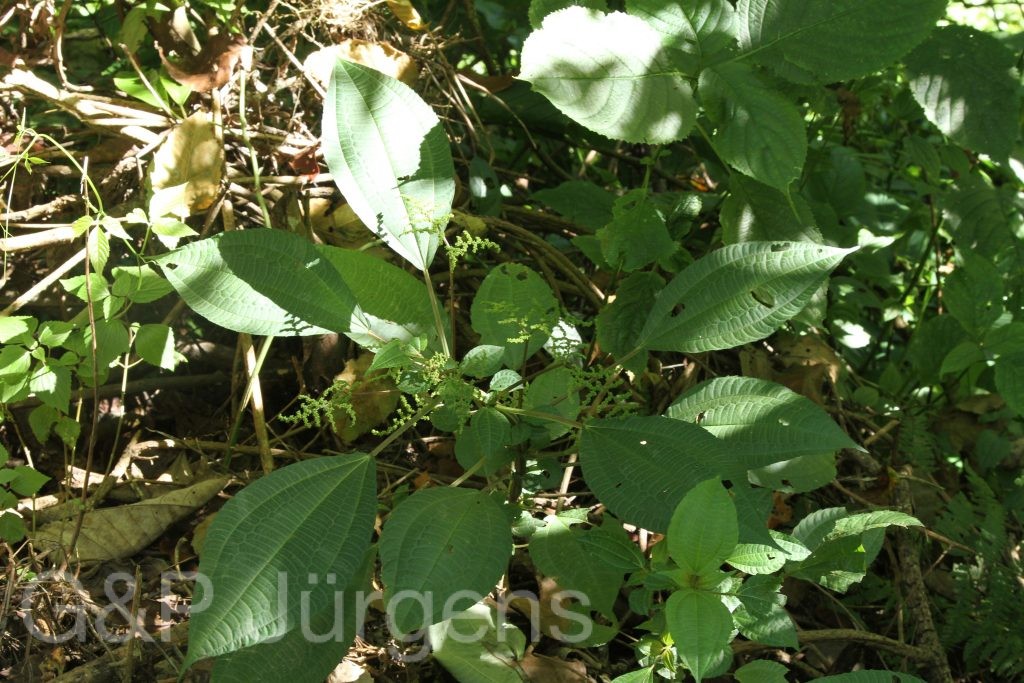
Bhutan Zhemgang 1000m, October

Description

Pilea anisophylla is a perennial herb of the family Urticaceae, widely distributed through the Himalaya and Indo-Malayan region. GBIF records place it in China, Nepal, India, Bhutan, Bangladesh, Myanmar, Thailand and Indonesia, indicating a broad subtropical to warm-temperate range. It is a plant of moist, shaded habitats, growing on damp rocks, mossy boulders, stream banks, forest floors and shaded walls in evergreen and semi-evergreen broad-leaved forest, generally from low elevations up to about 2,500 m. The specimen illustrated from Zhemgang in central Bhutan at roughly 1,000 m in October typifies the humid mid-montane forest where the genus flourishes.

The plant is a soft, fleshy, often somewhat succulent herb with terete, frequently translucent stems that may root at the lower nodes. As the epithet indicates, the paired leaves of each node are strongly anisophyllous, one of the pair being markedly larger than the other; the blades are ovate to elliptic, with a toothed or crenate-serrate margin, three-veined from the base, and dotted with the linear cystoliths characteristic of the family. Stipules are present at the nodes. The flowers are minute, greenish and unisexual, borne in small axillary cymose clusters; like other Urticaceae the staminate flowers have explosively dehiscent stamens that scatter pollen, and the inconspicuous pistillate flowers develop into small, compressed achenes.

Pilea is the largest genus of the nettle family and is taxonomically difficult, with many species separated on subtle vegetative and achene characters; the conspicuous leaf inequality of P. anisophylla is a useful field character. Lacking stinging hairs, the plant is harmless to handle, and as a shade- and moisture-loving understorey herb it is a minor but consistent component of Himalayan forest ground flora. It is not regarded as threatened, its wide range and tolerance of disturbed shaded sites buffering it against habitat change.

Author: Wedd. · Sources: POWO (Kew), GBIF, Flora of China Vol. 5, Flora of Bhutan Vol. 1, Flora of Nepal, Friis: Urticaceae of the Himalaya

Wedd.

Sikkim2011 6
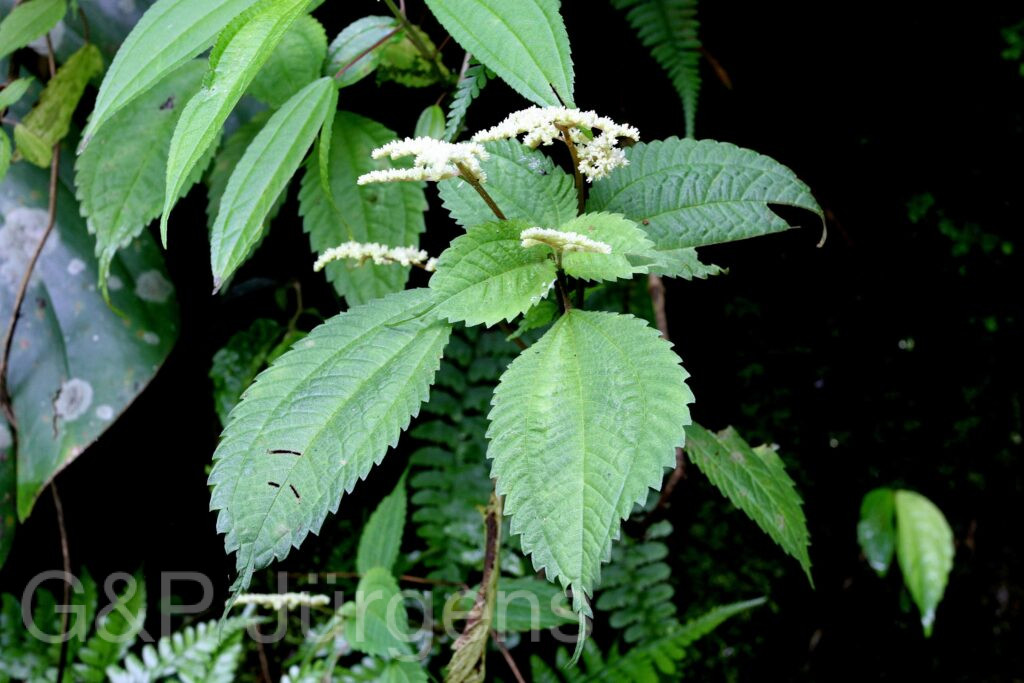
Bhutan Tista-valley 1900m, October

Description

Pilea insolens is a Sino-Himalayan herbaceous species distributed from central Nepal through Sikkim, Bhutan, and northeast India (Darjeeling, Arunachal Pradesh) to Bangladesh, Myanmar, southern China, Japan, and Indonesia. GBIF records 94 occurrences across this range. The species inhabits damp, shaded habitats in subtropical and warm-temperate forests at elevations of 800–2,400 m, where it colonises moist rocks, stream banks, tree bases, and old walls in areas of high humidity. It is most abundant in the eastern Himalayan valleys that receive heavy monsoon precipitation.
Pilea insolens is a succulent, erect to ascending, monoecious perennial herb, 15–40 cm tall. Stems are fleshy, translucent, glabrous, and often reddish-brown at the base. Leaves are opposite, markedly anisophyllous — a characteristic feature, with the larger leaf of each pair broadly ovate to suborbicular, 3–8 cm long, and the smaller leaf often reduced to a stipule-like scale or small blade less than 1 cm. The larger leaf surface is dark green, often with a cystolith-dotted texture visible as pale streaks, with crenate to serrate margins and three prominent basal veins. Stipules are small, membranous, and soon deciduous. Male and female flowers are borne in separate axillary cymes on the same plant; the male flowers are minute with four perianth segments, while the female flowers are even smaller, with an achene enclosed by persistent perianth lobes.
The photographed specimen from the Tista valley in Bhutan at 1,900 m in October represents a typical occurrence in the humid, deeply incised river valleys of the eastern Himalayas. Pilea insolens is distinguished from other Himalayan congeners by its pronounced leaf anisophylly combined with the broadly ovate, crenate larger leaf. The genus Pilea is enormous, with over 700 species globally, and the eastern Himalayan region is a centre of diversity with numerous narrowly distributed endemics. The species' extension from the Himalayas into Japan and Indonesia reflects a shared subtropical element across the monsoon-influenced forests of East and Southeast Asia. Its reliance on humid, undisturbed forest microsites makes it sensitive to deforestation and stream-channel modification.

Author: Wedd. · Sources: POWO (Kew), GBIF, Flora of China Vol. 5, Flora of Bhutan Vol. 1, Grierson & Long (1983), Chen (1982) — Revision of Chinese Pilea

(Lindl.) Kuntze

Bhutan2012 1144
Bhutan, Trashiyangtse 1780m, October
Bhutan2012 1143
Bhutan, Trashiyangtse 1780m, October

Description

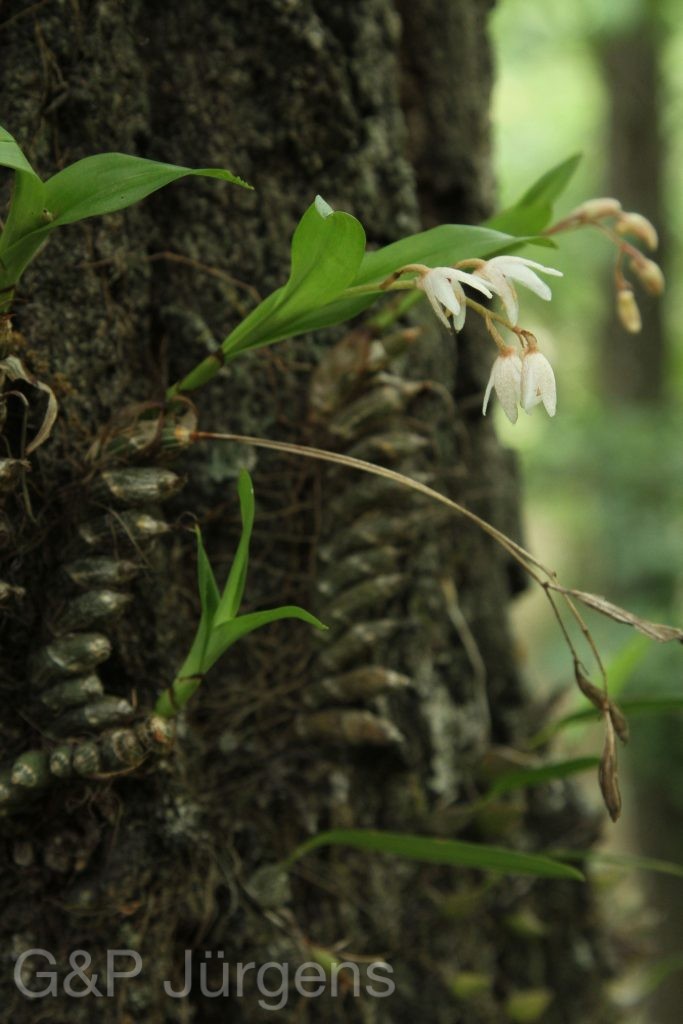
Pinalia acervata is an epiphytic orchid of the warm-temperate and subtropical forests of tropical Asia, ranging widely from China and India through Myanmar, Thailand, Vietnam, Cambodia, Malaysia and Singapore to Bhutan and Nepal, with 114 GBIF records reflecting this broad Indo-Burmese and Sino-Himalayan span. It grows as a humidity-loving epiphyte on mossy trunks and branches in evergreen broadleaved forest, generally at low to moderate elevations. The illustrated plant was found at Trashiyangtse in eastern Bhutan at about 1780 m in October, in the warm, monsoon-fed valleys where epiphytic orchid communities are particularly rich.

The species forms clustered, cylindrical to fusiform pseudobulbs that are densely tufted, each bearing several distichous, lanceolate to oblong leaves toward the apex. The inflorescences are lateral racemes, frequently densely many-flowered and clothed, like the ovaries and outer floral parts, in the rusty or whitish woolly indumentum characteristic of the segregate genus. The small flowers are whitish to pale yellow, with a saccate mentum formed by the lateral sepals against the column foot, and a small three-lobed lip; the fruit is a small ribbed capsule.

The taxon was long placed in the large pantropical genus Eria, as Eria acervata, and the basionym (Lindl.) Kuntze reflects this history; modern phylogenetic work has resolved many former Eria species into smaller, better-circumscribed genera, with this species now treated under Pinalia in tribe Podochileae. As a widespread, adaptable epiphyte it is not considered threatened, though local populations depend on the persistence of humid forest canopy and are diminished by deforestation.

Author: (Lindl.) Kuntze · Sources: POWO (Kew), GBIF, Flora of China, Flora of Bhutan, Genera Orchidacearum (Pridgeon et al.)

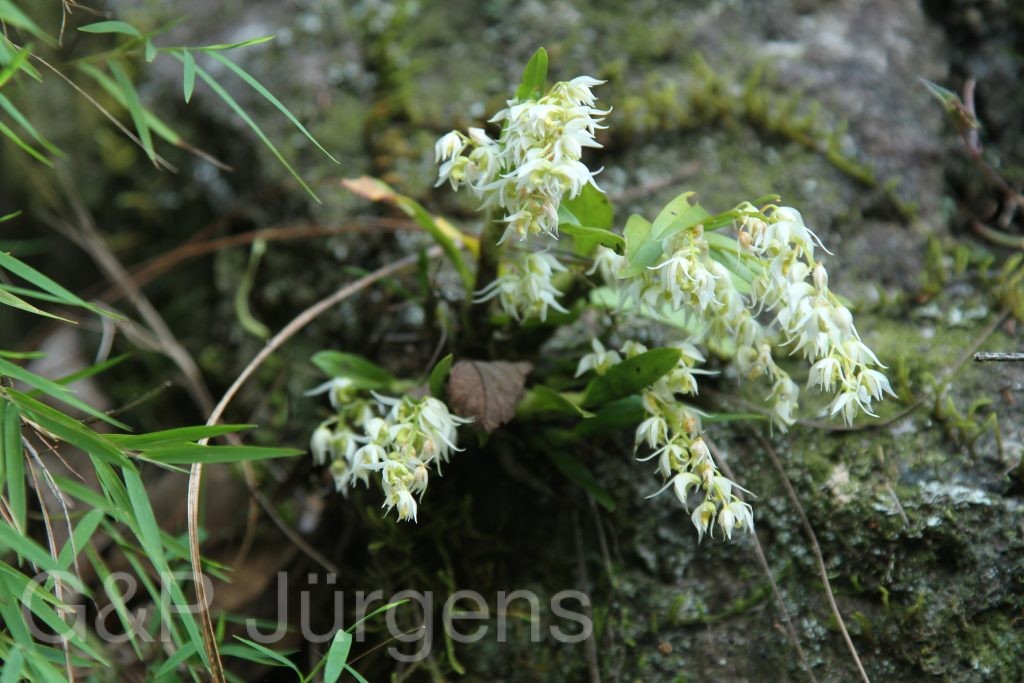
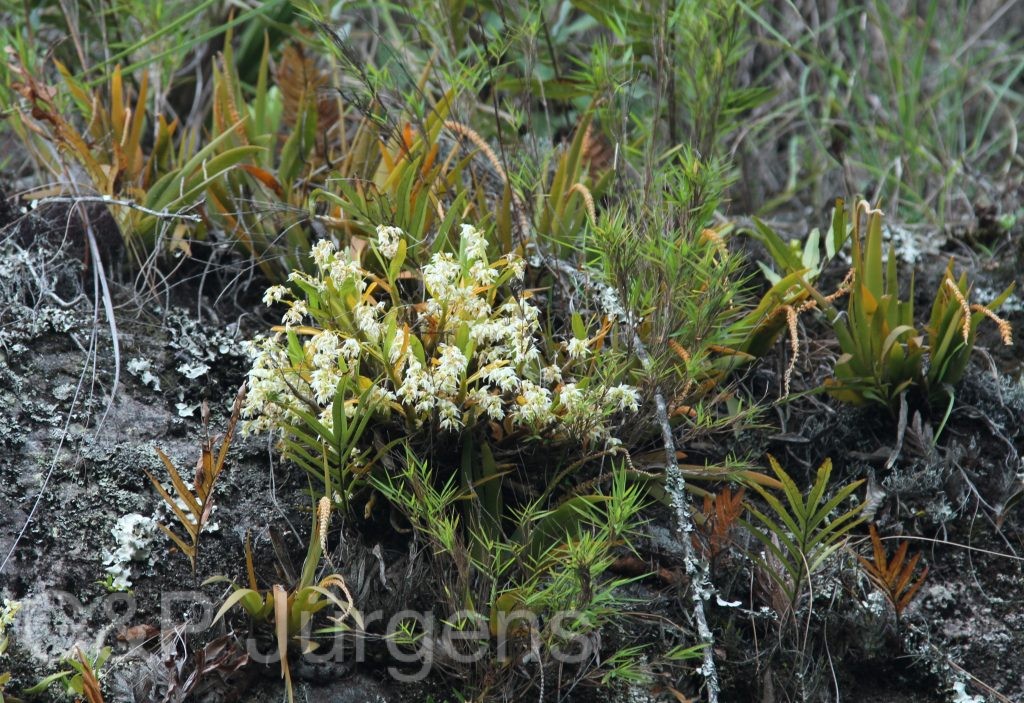
(Rchb.f.) Kuntze

Bh2008 320 P495
Bhutan Jakar, 2950m April
Bh2008 321 G496
Bhutan Jakar, 2950m April

Description

Pinalia amica (Rchb.f.) Kuntze, long known under Eria amica, is an epiphytic orchid widely distributed through tropical and subtropical Asia. GBIF records (about 203 occurrences) extend from Nepal, northern India and Bhutan eastward through Myanmar, southern China, Taiwan, Thailand, Laos, Cambodia, Vietnam and Malaysia. It grows as an epiphyte, occasionally a lithophyte, on mossy trunks and branches in humid broad-leaved and mixed forest, from the foothills up to about 2000-3000 m. The plant photographed at Jakar in Bhutan at 2950 m in April, flowering in spring, occurs near the upper part of its altitudinal range in cool, moist montane forest where high humidity and shaded, well-aerated bark provide its rooting substrate.

It is a sympodial epiphyte with cylindric to fusiform pseudobulbs or stems clustered on a creeping rhizome, each bearing a few apical leaves. The leaves are oblong-lanceolate, leathery and several-nerved. The inflorescence is a lateral raceme of several to many flowers, the rachis and ovaries usually finely hairy. The flowers are small, cream to pale yellow, often marked with reddish-brown striations; the sepals form a short mentum at the base with the column foot, and the lip is three-lobed and bears longitudinal keels or calli. The pollinarium carries eight waxy pollinia, and the fruit is a ribbed dehiscent capsule releasing dust-like seeds.

The broadly circumscribed genus Eria has been dismembered on molecular evidence, and species of the Eria amica group are now placed in Pinalia within tribe Podochileae; Pinalia amica is the currently accepted name. Like most epiphytic orchids it depends on mycorrhizal fungi for seed germination and produces enormous numbers of minute wind-dispersed seeds. Widespread across Asia, it is not regarded as threatened overall, though, as with all orchids, it is listed on CITES Appendix II, and local populations are sensitive to deforestation and collection.

Author: (Rchb.f.) Kuntze · Sources: POWO (Kew), GBIF, Flora of China, The Orchids of Bhutan, Annotated Checklist of the Flowering Plants of Nepal, Ng et al. molecular phylogeny of Eria and allied genera

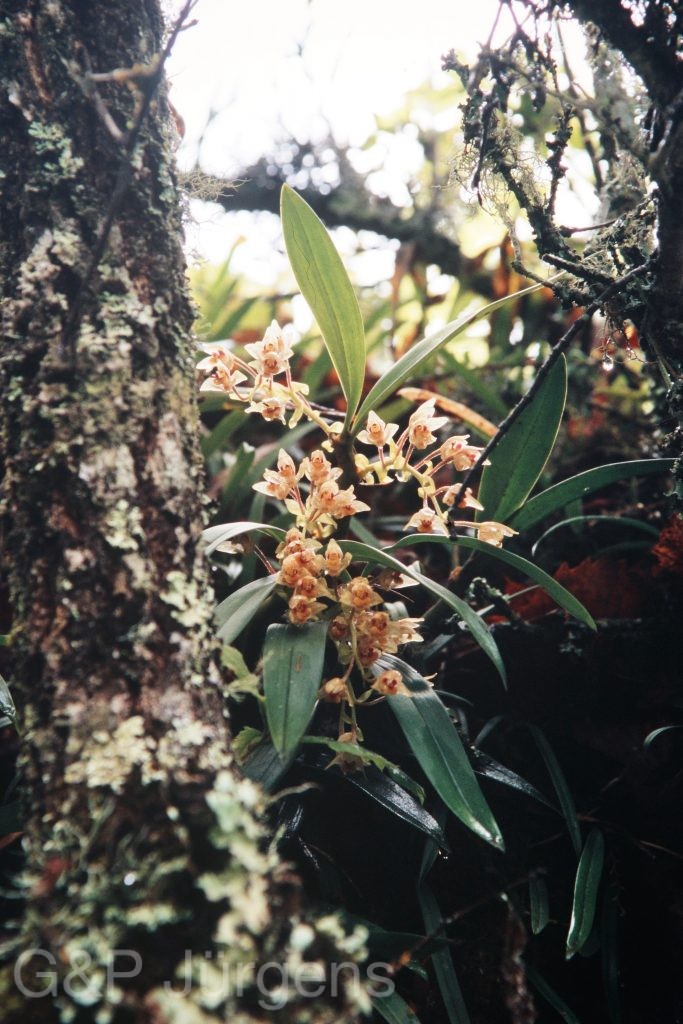
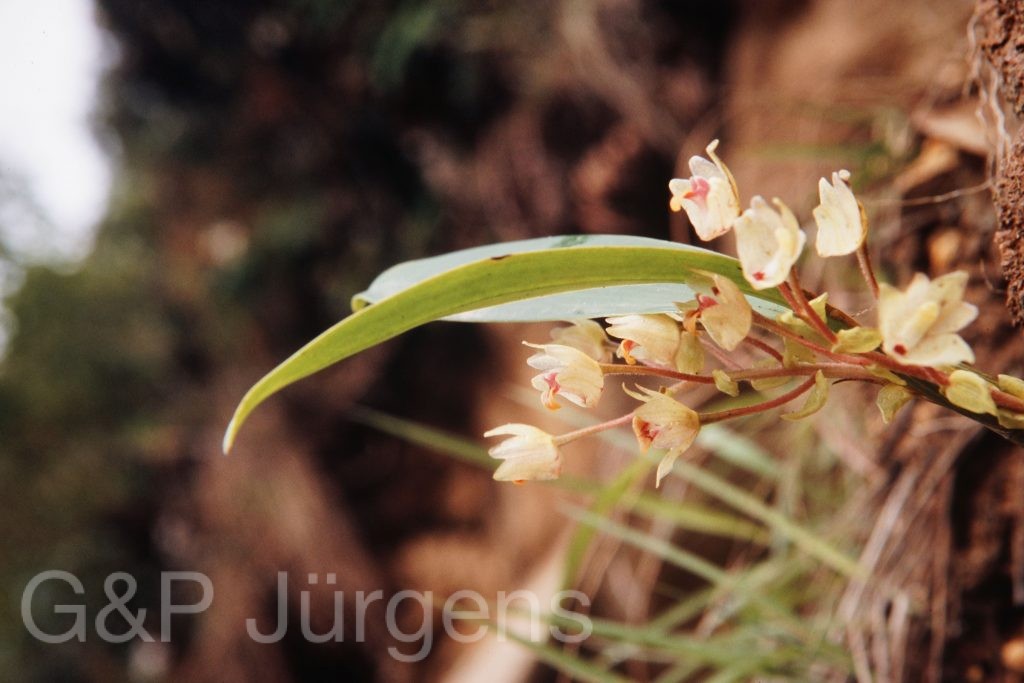
(Lindl.) Kuntze

Bhutan2014 177
Bhutan Trashigang 2100m, May

Description

Pinalia excavata is an epiphytic orchid of the Eastern Himalaya and adjacent southern China and Indochina, with GBIF records from China, India, Nepal, Bhutan and Myanmar and a modest tally of documented occurrences. It grows as an epiphyte on tree trunks and mossy branches in humid broad-leaved and evergreen montane forest, favouring shaded, well-ventilated situations in the warm-temperate to lower montane belt. The species occupies low to middle elevations; the photographed plant from Trashigang in eastern Bhutan at about 2100 m in May represents a typical station within its altitudinal range, flowering in late spring as the pre-monsoon humidity rises.

The plant produces clustered, fusiform to cylindrical pseudobulbs arising from a creeping rhizome, each bearing several apical leaves. The leaves are lanceolate to elliptic, thin-textured to somewhat leathery and prominently veined. The inflorescence is a lateral or subterminal raceme bearing numerous small flowers, the rachis and ovaries usually clothed in fine hairs as is characteristic of the genus. The flowers are pale, whitish to cream or yellowish, with spreading sepals and petals; the lateral sepals are adnate to the column foot to form a short mentum, and the trilobed labellum bears raised keels or ridges along its disc. The column is short and footed, and the fruit is a small ribbed capsule.

Pinalia comprises species formerly placed in the broadly circumscribed Eria, segregated on the basis of molecular and morphological evidence; P. excavata was originally described under Eria and is treated by current authorities under Pinalia. As a forest epiphyte dependent on intact humid canopy, it is vulnerable to deforestation and habitat degradation across its range, although it is not presently the subject of a formal threat assessment.

Author: (Lindl.) Kuntze · Sources: POWO (Kew), GBIF, Flora of China, Flora of Bhutan, The Orchids of Bhutan (Pearce & Cribb)

(Hook.) Sweet

Bhutan2014 342
Bhutan Tumching-La 3000m, May
Bhutan2014 886
Bhutan Chele-La 3300m, May

Description

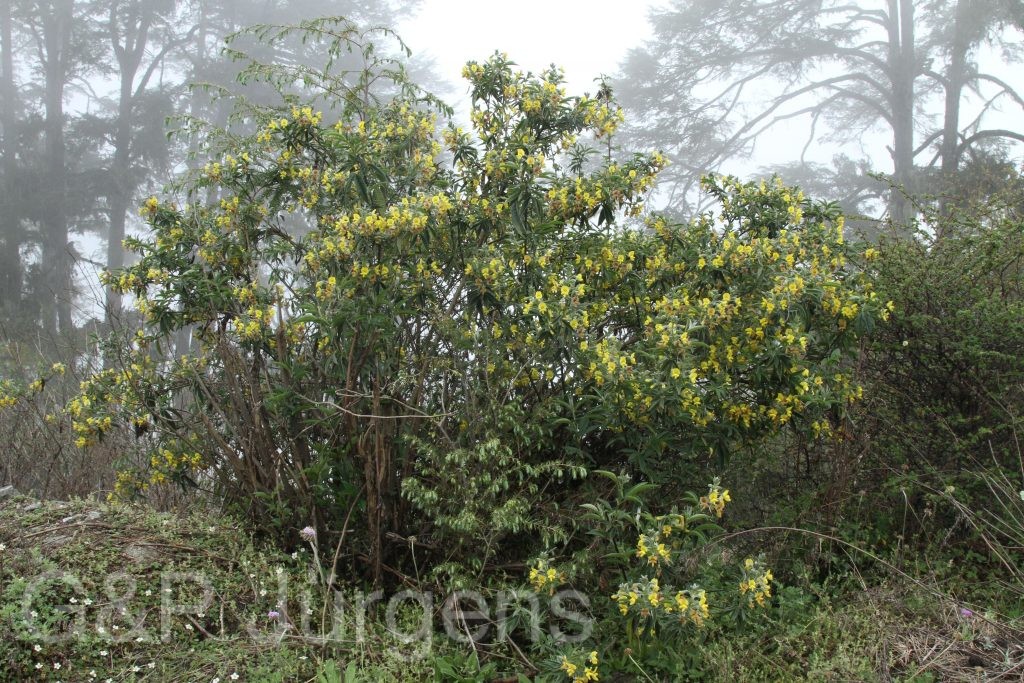
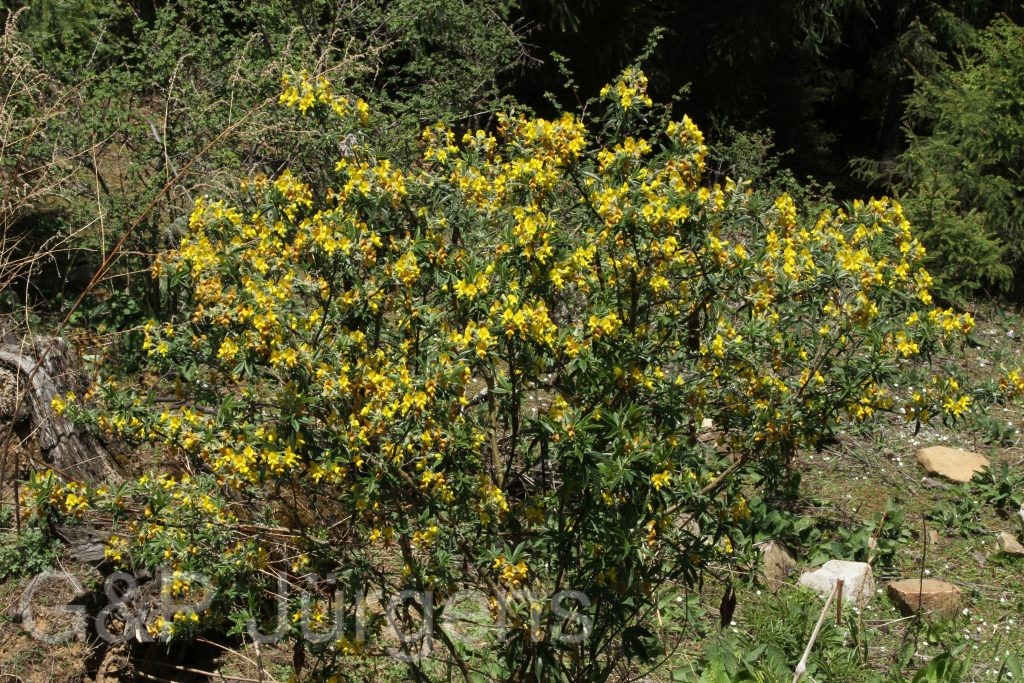
Piptanthus nepalensis is a Sino-Himalayan shrub distributed along the southern flank of the great ranges from Nepal and northern India eastward through Bhutan into south-western China (Yunnan, Sichuan, Xizang), with outlying records in Myanmar; the species is widely cultivated and naturalised in temperate gardens, accounting for the European, North American and Antipodean records (GB, DE, BE, NL, US, CA, NZ) among its more than 1600 georeferenced occurrences. It favours open scrub, forest margins, rocky slopes and stream banks in the upper montane and subalpine belts, typically between about 2500 and 4000 m. The populations on the Bhutanese passes of Tumching-La (3000 m) and Chele-La (3300 m), flowering with the spring thaw in May, are characteristic of its habitat among Rhododendron and conifer scrub.

It is a deciduous to semi-evergreen shrub reaching 1-4 m, with stout greenish branchlets bearing silky-pubescent young growth. The leaves are trifoliolate, long-petiolate and stipulate, the leaflets elliptic to lanceolate, dark green and glabrescent above, glaucous and appressed-silky beneath. The showy golden-yellow papilionaceous flowers, 2.5-3 cm long, are borne in terminal erect racemes; the calyx is bilabiate and silky, and the standard, wings and keel are typical of the tribe Thermopsideae. The fruit is a flattened, elongate, dehiscent legume to 12 cm, glaucous-pubescent and containing several dark reniform seeds.

Piptanthus is a small genus of the broadly defined Thermopsideae allied to Thermopsis and Anagyris, distinguished by its woody habit and trifoliolate leaves. Long-cultivated for its early bloom, P. nepalensis hosts nitrogen-fixing rhizobia that aid colonisation of skeletal soils. It is not considered threatened, being abundant across a broad range, though its toxic quinolizidine alkaloids deter browsing.

Author: (Hook.) Sweet · Sources: POWO (Kew), GBIF, Flora of China, Flora of Bhutan, Flora of Nepal, Turner's revision of Piptanthus (Thermopsideae)

(D.C.) Rehder & E.H. Wilson

Bhutan2014 26
Bhutan Samdrup 850m, May

Description

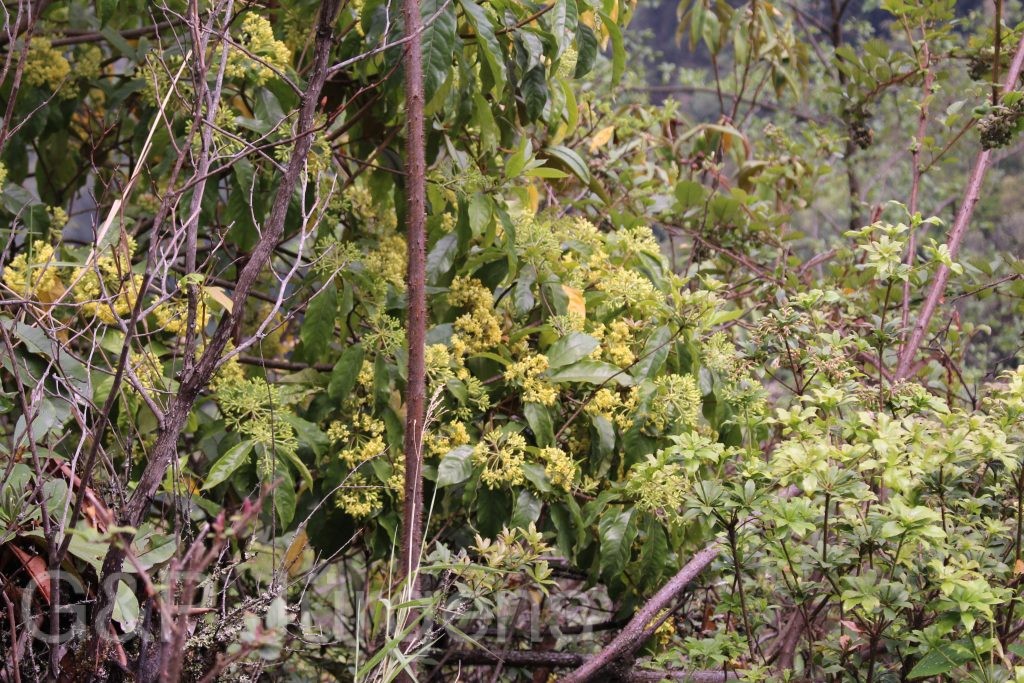
Pittosporum napaulense is an evergreen tree of the Himalaya and adjacent uplands, distributed from northern India and Nepal through Bhutan into southwestern China and Myanmar, with records also from Thailand; GBIF documents over two hundred occurrences across this range. It is a plant of subtropical to warm-temperate broadleaved forest, forest margins and ravine slopes, generally found between about 800 and 2000 m. The tree photographed at Samdrup in southern Bhutan at 850 m, in flower in May, exemplifies this preference for the warm, humid lower foothill forests of the eastern Himalaya, where it grows as an understorey to canopy tree and produces its fragrant flowers in late spring before the onset of the heaviest monsoon rains.

The plant is a small to medium-sized tree with smooth grey bark and glabrous twigs. The leaves are alternate but often crowded toward the branch tips in a pseudo-whorled arrangement, elliptic to oblong-lanceolate, leathery, entire and glossy, with the margins sometimes faintly wavy. The flowers are borne in terminal corymbose panicles and are creamy white to pale yellow and sweetly fragrant; each flower is five-merous, with free petals whose lower portions cohere into a tube and spreading upper lobes, five stamens, and a superior ovary. The fruit is a globose to ovoid woody capsule that splits into valves to expose numerous small seeds embedded in a sticky, resinous orange-red pulp, the viscid coating that gives the genus its name (Pittosporum, "pitch-seed") and aids dispersal by birds.

Pittosporum is a largely Old World genus of trees and shrubs centred on the tropics and subtropics of Asia, Australasia and the Pacific, and P. napaulense is the principal Himalayan representative. The family name is rendered "Pittosporaceaea" in the source; the accepted spelling is Pittosporaceae. The resinous, sticky-seeded capsules are a hallmark of the family, and the bark and leaves of this and related species have featured in local traditional medicine. As a widespread and ecologically adaptable forest tree spanning several countries and a broad elevational band, P. napaulense is not considered threatened, though its lower-elevation forest habitat is subject to ongoing pressure from agriculture and settlement in the densely populated eastern Himalayan foothills.

Author: (D.C.) Rehder & E.H. Wilson · Sources: POWO (Kew), GBIF, Flora of China Vol. 9, Flora of Bhutan Vol. 1 Part 2, Flora of Nepal, A Monograph of the Asian species of Pittosporum (Wenbin Zhang and Hua Peng)

(Hook.f.) Soó

Sikkim2003 96 P133
Sikkim above Chora 3600m 08.2003
Sikkim2003 97 P134
Sikkim above Chora 3600m 08.2003

Description

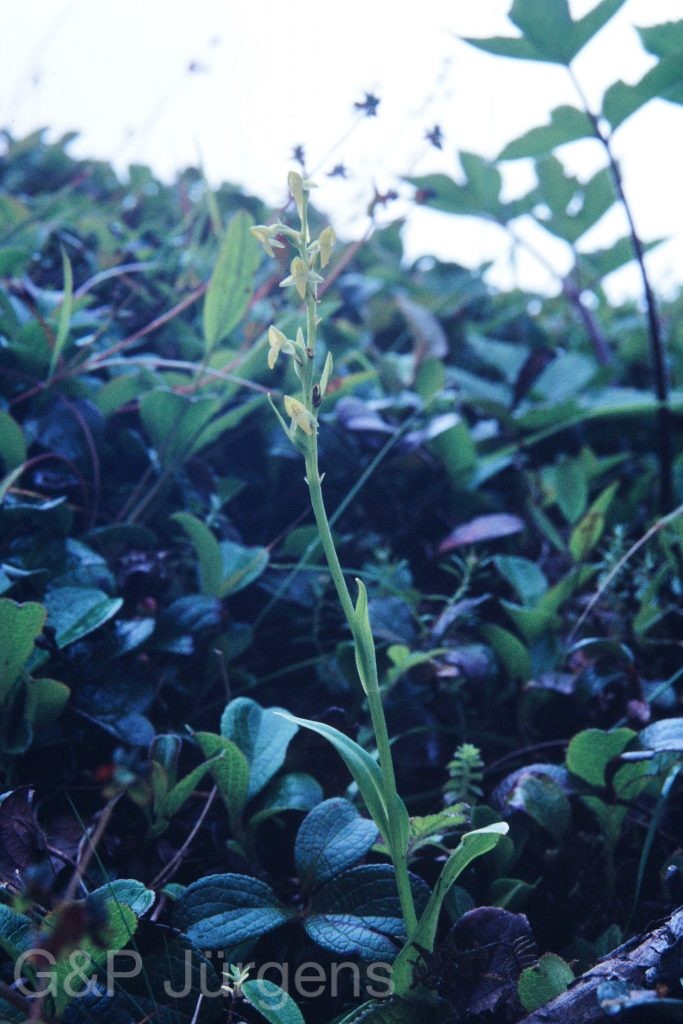
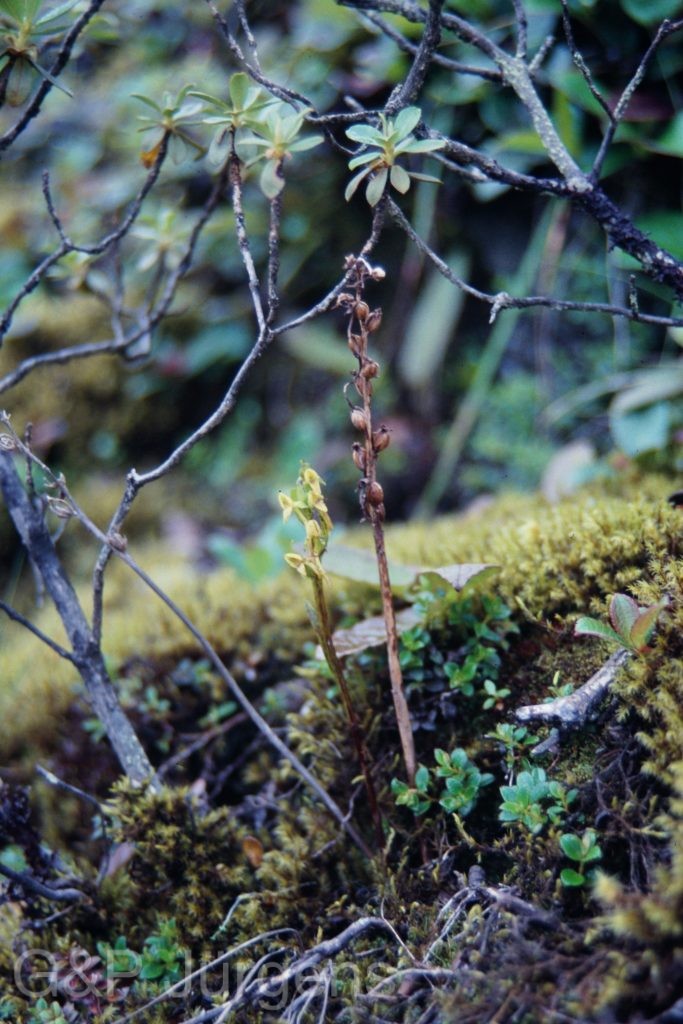
Platanthera leptocaulon is a terrestrial orchid of the eastern Himalaya and adjacent mountains of south-western China, recorded from Sikkim and the rest of northern India, Nepal, Bhutan, Myanmar and Yunnan and Sichuan in China. The roughly 67 georeferenced collections concentrate in the high subalpine to alpine belt, where the species occupies moist open turf, the margins of dwarf-shrub thickets and grassy hollows kept damp by snowmelt. The plant photographed above Chora in Sikkim at 3600 m in August typifies its habitat, flowering during the late-summer monsoon at elevations of roughly 3000-4200 m on humus-rich, well-drained slopes.

It is a slender, glabrous herb arising from ovoid to fusiform root-tubers, the erect stem comparatively thin and wiry (the epithet leptocaulon meaning "slender-stemmed"). The few cauline leaves are oblong-lanceolate to linear, sheathing at the base and grading upwards into bracts. The lax terminal raceme bears small greenish to greenish-white flowers; the dorsal sepal and petals are connivent to form a hood over the column, the lateral sepals spreading, and the entire, narrowly oblong labellum extends backwards into a slender cylindrical spur. The viscidia are naked and the pollinia are attached by slender caudicles, with fruit a small erect dehiscent capsule releasing dust-like seed.

The genus Platanthera is a large Holarctic and Asian assemblage centred on temperate and montane regions, and P. leptocaulon belongs to the species-rich Sino-Himalayan radiation, the basionym having been transferred by Soo from Habenaria. Like most members of the genus it depends on mycorrhizal fungi for germination and probably on long-tongued nocturnal pollinators attracted to the spurred flowers. Though not formally assessed, its broad transboundary range and tolerance of grazed alpine pasture suggest reasonable security, but populations remain vulnerable to overgrazing and the warming-driven upslope contraction of alpine grassland.

Author: (Hook.f.) Soó · Sources: POWO (Kew), GBIF, Flora of China, Flora of Bhutan, The Genus Platanthera (Orchidaceae) monograph

(Hook.f.) Soó

BhutanPG2011 818 01 01
Bhutan Chele-La 3500m, July

Description

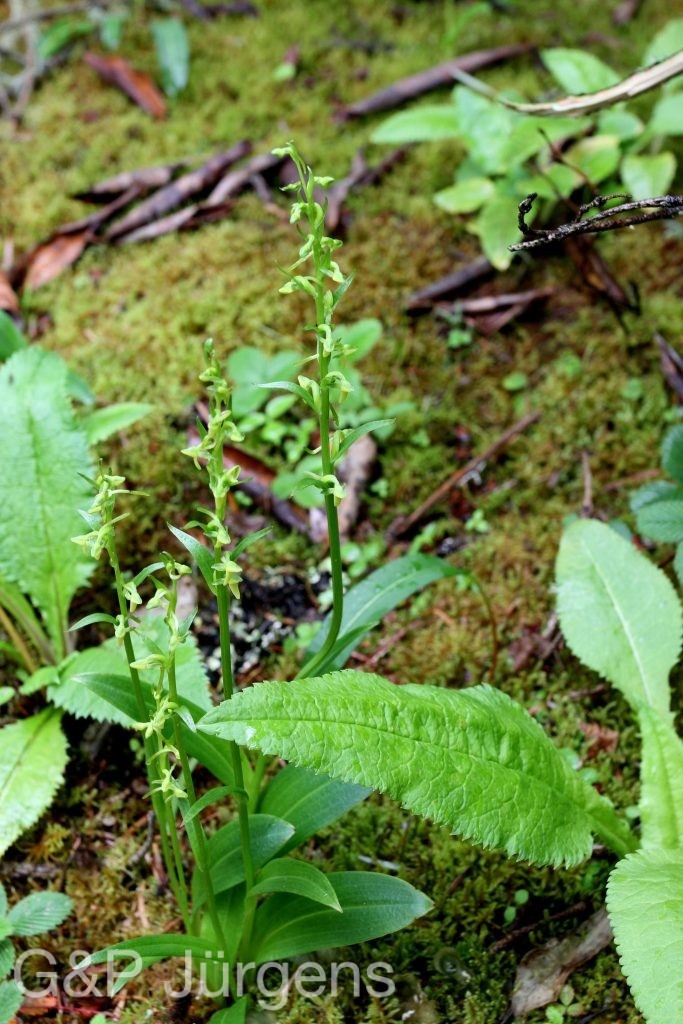
Platanthera stenantha (Hook.f.) Soó is a terrestrial orchid of the Himalaya and western China, recorded by GBIF from China, Nepal, India, Myanmar and Bhutan across some 138 occurrences. It inhabits open subalpine and alpine slopes, grassy meadows, and the edges of Rhododendron and birch scrub, typically between about 3000 and 4000 m. The plant photographed on the Chele-La pass in Bhutan at around 3500 m in July, at the height of the monsoon flowering season, exemplifies its association with cool, moist, well-lit high-montane grassland.

The species grows from elongate, fleshy root-tubers and produces an erect leafy stem bearing several oblong to lanceolate cauline leaves that grade upwards into bracts. The inflorescence is a slender, fairly dense terminal raceme of small greenish to yellowish-green flowers, the specific epithet stenantha referring to their narrow form. The dorsal sepal and petals form a loose hood over the column, the lateral sepals spread, and the narrow, tongue-shaped labellum hangs downward and is prolonged at its base into a slender spur, usually about equalling or exceeding the ovary, that holds nectar for moth or butterfly pollinators.

Platanthera is a large genus of tribe Orchideae characterised by its spurred labellum and widely separated, often divergent pollinia-bearing anther cells. Platanthera stenantha belongs among the green-flowered Sino-Himalayan species and is distinguished from its relatives by floral proportions and spur length. With a moderately wide distribution it is not regarded as globally threatened, but its high-grassland habitat is subject to grazing and climatic pressures, and like all orchids it falls under CITES Appendix II.

Author: (Hook.f.) Soó · Sources: POWO (Kew), GBIF, Flora of Bhutan, Flora of China, Pearce and Cribb Orchids of Bhutan, World Checklist of Orchidaceae