Tag:

Myanmar

Flowers of the Myanmar Himalaya — 604 species recorded from northern Myanmar (Burma) and the eastern Himalayan borderlands, a biodiversity hotspot linking the Himalaya to the mountains of Yunnan and Southeast Asia. The region’s forests and alpine slopes hold a rich flora of rhododendrons, orchids, balsams and gentians. Every page gives a botanical description, distribution, habitat and flowering time with the original photograph.

(Sm.) D.Don

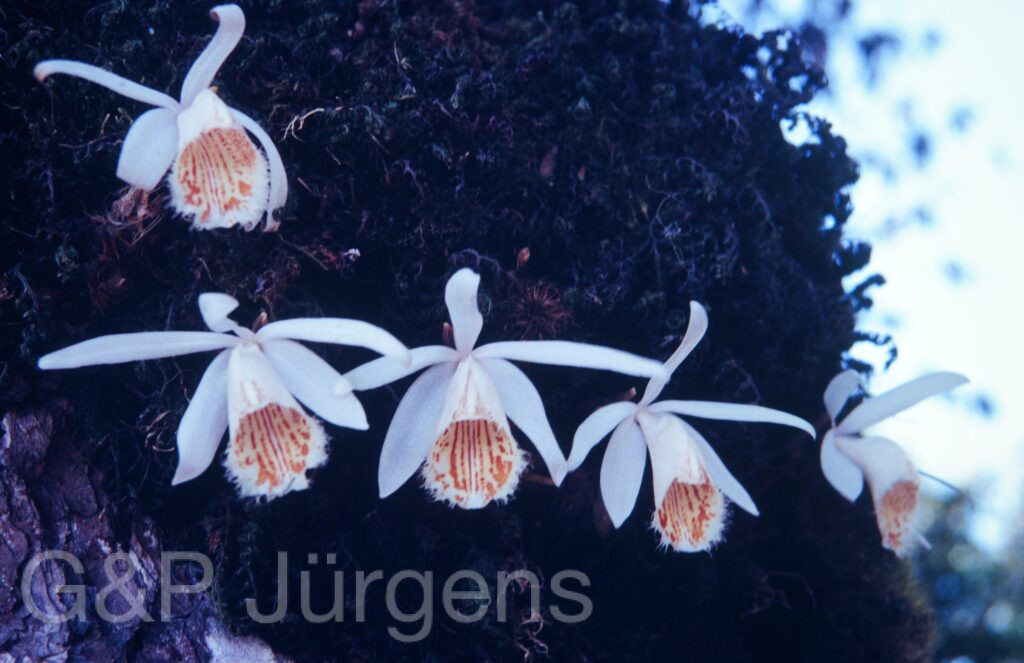
Nepal1992 42 P60 ergebnis
Nepal Nundhaki 1500m March 
Nepal1992 56 P81 ergebnis
Nepal Nundhaki 1500m March 
Nepal1992 242 P359 ergebnis
Nepal Nundhaki 1500m March 

Description

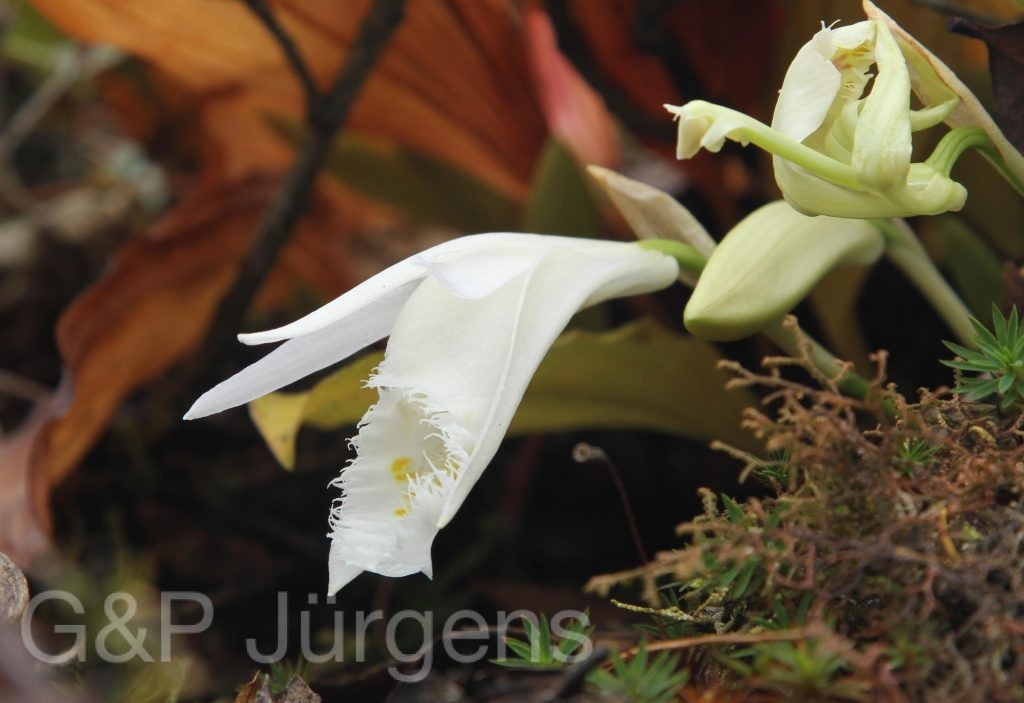
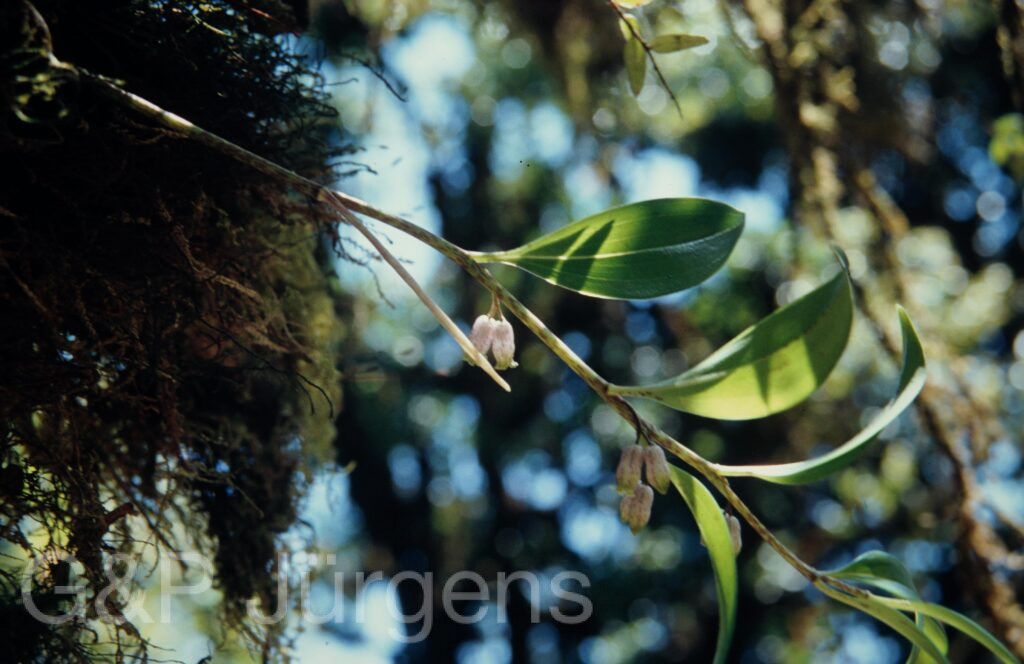
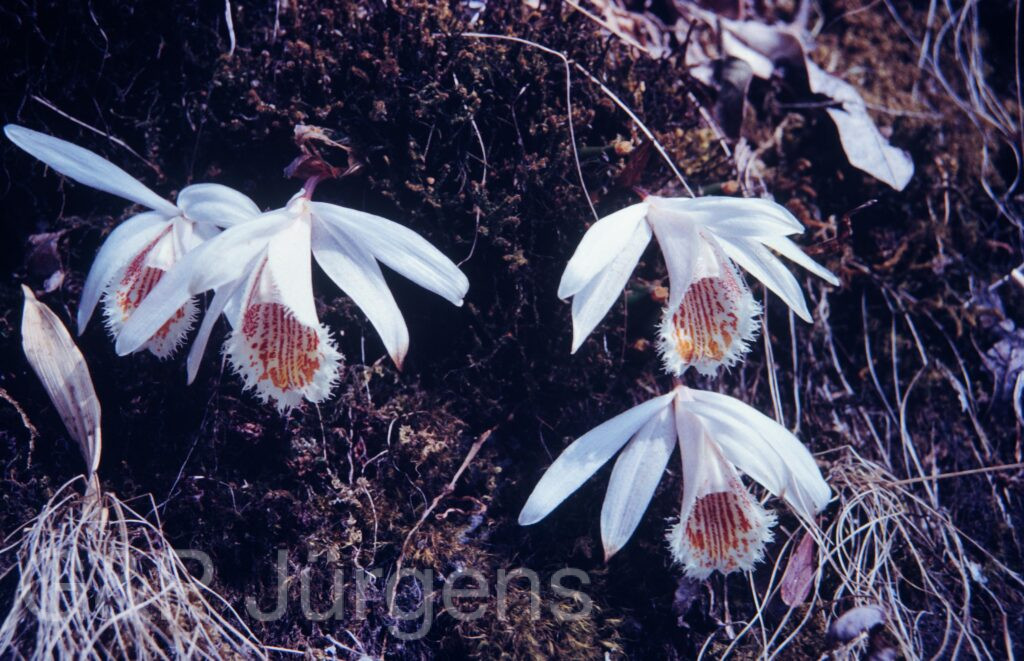
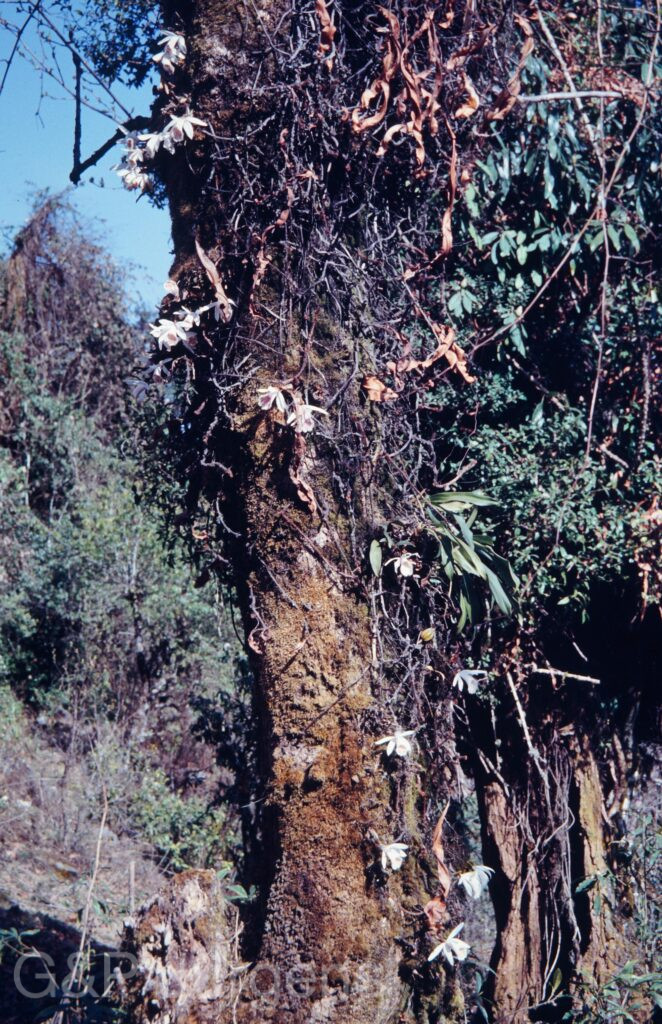
Pleione humilis is a dwarf orchid of the Himalaya and adjoining mountains, native to Nepal, India, Bhutan, Myanmar and Thailand, with around 136 georeferenced occurrences across this eastern arc. It grows chiefly as an epiphyte on mossy tree trunks and branches, and occasionally as a lithophyte on shaded, humus-covered rocks, in cool, humid temperate forest. The illustrated plant from Nundhaki in Nepal, at about 1500 m and flowering in March, exemplifies the species' habit of blooming in late winter to early spring, characteristically before or as the new leaves expand at relatively low montane elevations.

The plant grows from small, flask- to top-shaped, often warty pseudobulbs, each producing a single (occasionally paired) plicate, deciduous leaf. The flowers, usually borne singly on a short scape from the base of the pseudobulb, are large for the plant's size and showy, with spreading, narrow, white to pale pink sepals and petals. The conspicuous trumpet-shaped labellum is broadly funnel-form and frilled at the margin, white marked within by yellow to brown and red blotches and bearing several toothed or fringed keels (lamellae) along the disc. The slender, winged column lies enclosed within the lip, and the fruit is a ribbed dehiscent capsule shedding dust-like seeds.

Pleione is a small genus of about two dozen Sino-Himalayan and Southeast Asian orchids, much admired and cultivated, of which P. humilis is one of the winter-flowering, single-leaved species. As with all orchids it is protected under CITES Appendix II, and wild populations are threatened by collection for horticulture and by clearance of the moist forest on which the epiphytic plants depend; conservation therefore hinges on protecting both the species and its montane forest habitat.

Author: (Sm.) D.Don · Sources: POWO (Kew), GBIF, Flora of Bhutan (Orchidaceae), Flora of China (Orchidaceae), Cribb & Butterfield: The Genus Pleione (monograph)
(Sm.) D.Don

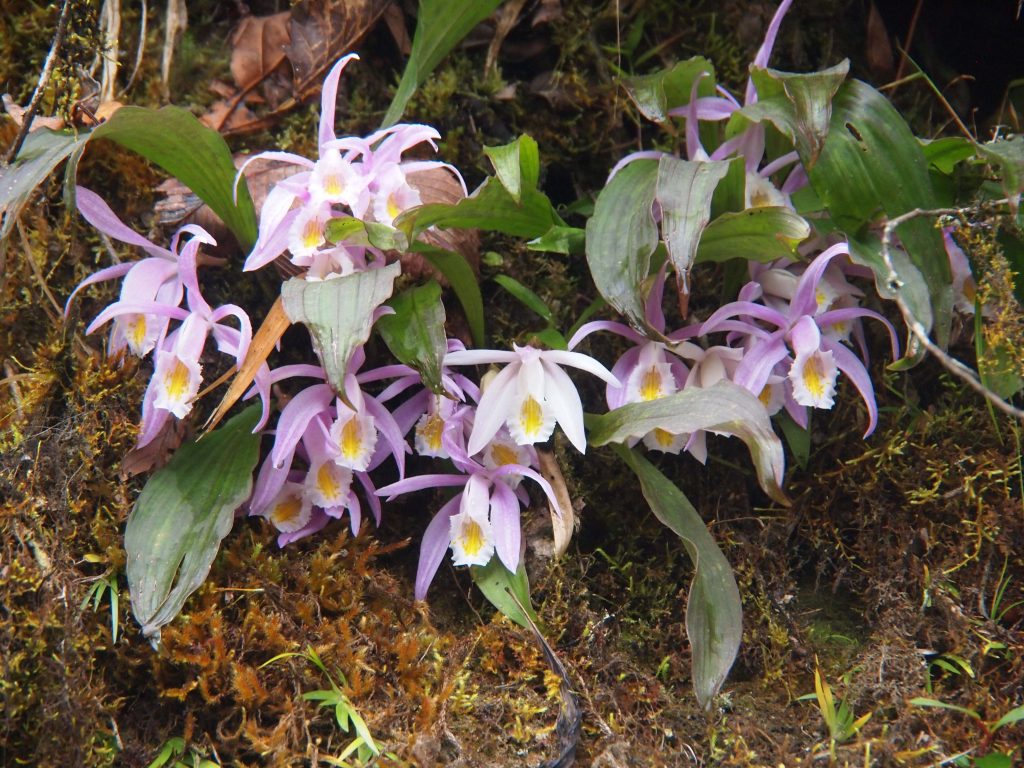
Bhutan2012 828 Kopie
Bhutan Tongsa 2050m, October
Bhutan2012 831 Kopie
Bhutan Tongsa 2050m, October
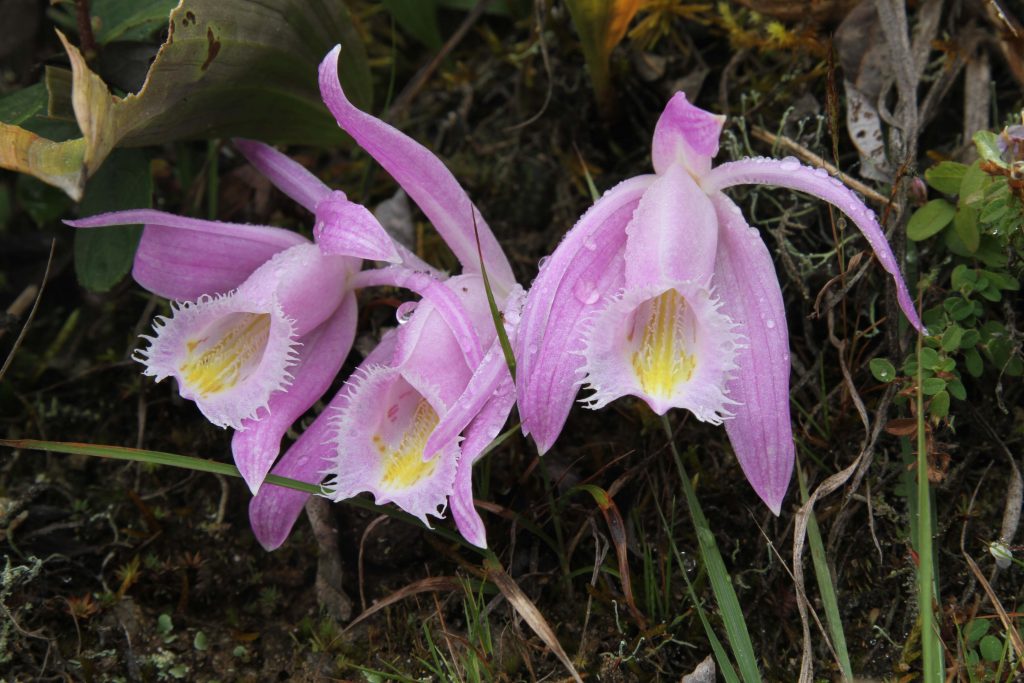
Bhutan2012 1302
Bhutan Trashigang 1900m, October

Description

Pleione praecox is an autumn-flowering epiphytic and lithophytic orchid of the eastern Himalaya and Indo-Burmese region, ranging through India, Nepal, Bhutan, China, Thailand, Myanmar, Vietnam and Bangladesh, with cultivated records in Britain and the United States among its roughly 335 GBIF occurrences. It grows on mossy tree trunks, rocks and banks in humid broadleaved montane forest, typically between about 1200 and 2500 m. The cited Bhutanese plants from Trongsa (2050 m) and Trashigang (1900 m), both flowering in October, exemplify its diagnostic late-season anthesis, the epithet praecox referring to bloom appearing as or before the leaves develop.

The species is a deciduous sympodial orchid producing conspicuous, flask-shaped to conical pseudobulbs, often mottled green and purple, each typically bearing one or two pleated, lanceolate leaves that are shed in the dormant season. The showy flowers, borne singly (rarely paired) on a short scape from the base of a pseudobulb, have spreading rose-pink to magenta sepals and petals. The funnel-shaped labellum is the showpiece: broad, fimbriate at the margin, and marked internally with several toothed or lamellate crests and reddish-brown blotching. The column is slender and winged, and the fruit is an ellipsoid capsule.

Pleione is a small genus of subtribe Coelogyninae, and P. praecox is among its most horticulturally prized species, widely cultivated by alpine and orchid growers, which accounts for its scattered records in Europe and North America. Its showy labellum attracts bee pollinators despite offering little reward. Although locally frequent, wild populations face pressure from commercial and amateur collection of pseudobulbs and from clearance of montane forest, making in-situ conservation of its epiphytic habitat important.

Author: (Sm.) D.Don · Sources: POWO (Kew), GBIF, Flora of Bhutan, Flora of China (Orchidaceae), Cribb & Butterfield The Genus Pleione

Hand.-Mazz.

BhutanPG2011 57JPG
Bhutan Jakar 2600m June
Bh09 295 G486
Bhutan Pele-La, 3200m June
Bh09 296 G487
Bhutan Pele-La, 3200m June

Description

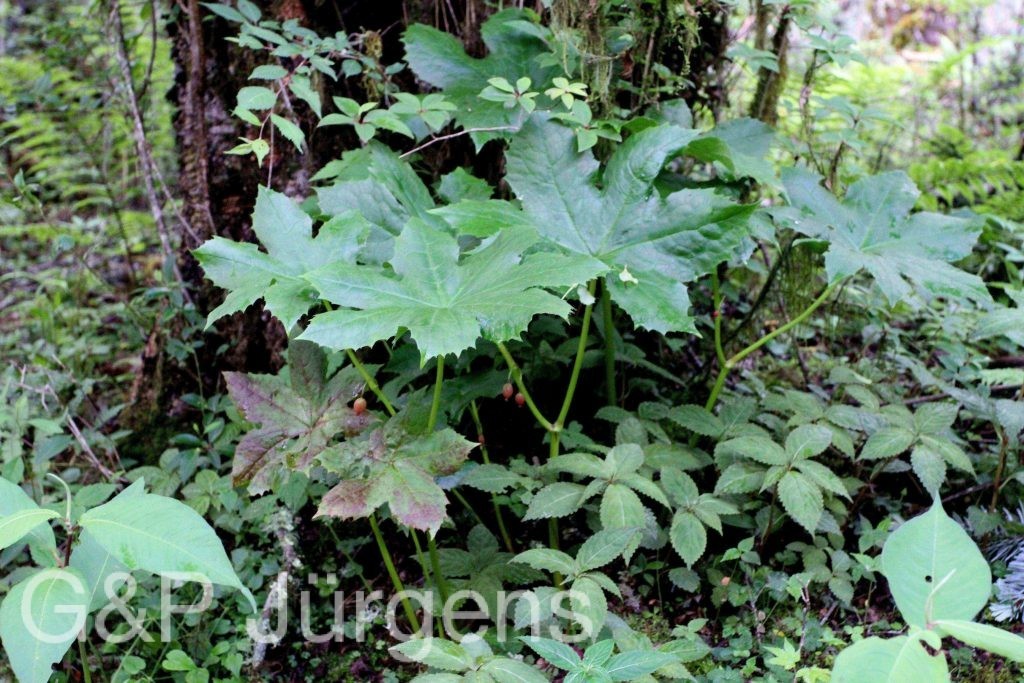
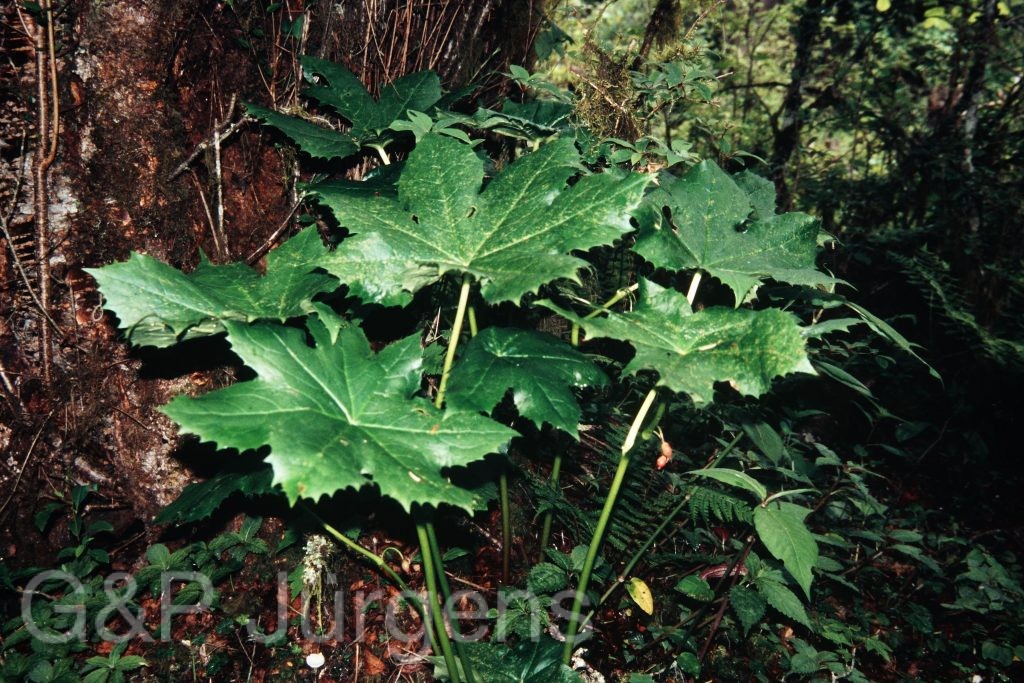
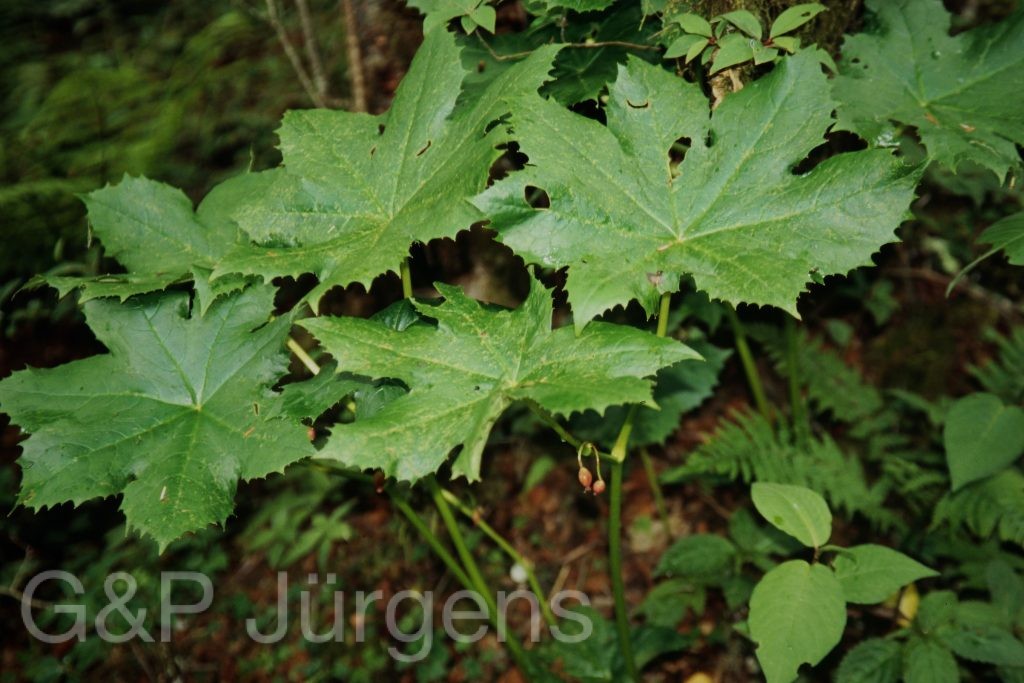
Podophyllum aurantiocaule is a Sino-Himalayan woodland herb recorded from China, Myanmar and India (with one extralimital cultivated record from the Netherlands), the c. 25 georeferenced occurrences reflecting a relatively narrow and uncommon distribution in the eastern Himalaya and adjacent mountains. It grows in the shade and humus of temperate broadleaved and conifer forest, on cool, moist, sheltered slopes and forest floor, generally between about 2400 and 3400 m. The illustrated plants were photographed at Jakar in Bhutan at 2600 m and at Pele-La at 3200 m, both in June, sites characteristic of the species, which emerges and flowers in early summer beneath the forest canopy. Under GBIF this name is treated as a synonym, with Podophyllum aurantiocaule itself recognised as the accepted name in that backbone.

It is a perennial herb arising from a stout creeping rhizome, sending up an erect, fleshy, often orange-tinted stem, the colouration reflected in the epithet aurantiocaule. The stem bears typically two large, long-petioled, peltate to deeply palmately lobed leaves whose margins are toothed. A single, rather large, nodding flower is borne at the fork between the leaves; it has free, somewhat fleshy petals in shades of dull red to purplish, numerous stamens and a single superior carpel. The fruit is a large fleshy berry containing many seeds embedded in pulp.

The Asian podophylloids, treated either in a broad Podophyllum or in the segregate genera Dysosma and Sinopodophyllum, are placed in Berberidaceae and are renowned for the lignan podophyllotoxin, precursor of the anticancer drugs etoposide and teniposide. As a slow-growing, rhizomatous, narrowly distributed forest herb subject to medicinal collection and habitat loss, P. aurantiocaule is intrinsically vulnerable, and members of this complex are widely flagged for conservation attention.

Author: Hand.-Mazz. · Sources: POWO (Kew), GBIF, Flora of China, Flora of Bhutan, Shaw monograph of the podophylloid Berberidaceae

Kuntze

Bhutan2012 1165
Bhutan Trashiyangtse 1780m, October

Description

Pogostemon linearis is an Asian mint distributed through India, China, Bhutan, Myanmar, Bangladesh and westward to Iran, with around 99 georeferenced records in GBIF. It is a plant of warm-temperate to subtropical hill country, occurring on open grassy slopes, forest edges, streambanks and disturbed ground in the lower and middle montane zone. The Bhutanese material photographed near Trashiyangtse at about 1780 m in October reflects its typical autumn flowering at modest elevation, where it benefits from the warm, moist conditions of the eastern Himalayan foothills and frequently colonises seasonally damp, sunny situations.

The species is an erect to ascending herb or subshrub with quadrangular stems that are often pubescent. The leaves, as the epithet indicates, are narrow, linear to linear-lanceolate, sessile or shortly petiolate, with serrate to subentire margins and an acute apex. The flowers are borne in dense, cylindrical, spike-like verticillasters forming a terminal thyrse; each small flower has a tubular, five-toothed calyx and a campanulate, weakly two-lipped corolla. The four stamens are characteristically long-exserted and bear conspicuously bearded filaments, a diagnostic feature of Pogostemon, giving the inflorescence a fluffy appearance. The fruit comprises four smooth nutlets enclosed by the persistent calyx.

Described by Kuntze, P. linearis belongs to a genus best known for P. cablin, the source of patchouli oil. The bearded, far-exserted stamens place it firmly within Pogostemon and distinguish it from related Lamiaceae genera. Its broad distribution, ecological tolerance and association with open and disturbed habitats indicate a secure conservation status throughout its range.

Author: Kuntze · Sources: POWO (Kew), GBIF, Flora of Bhutan, Flora of China, Bhatti & Ingrouille revision of Pogostemon

Buch.-Ham. ex D. Don

Bhutan2014 669
Bhutan Wangdi-Phodrang 2280, May

Description

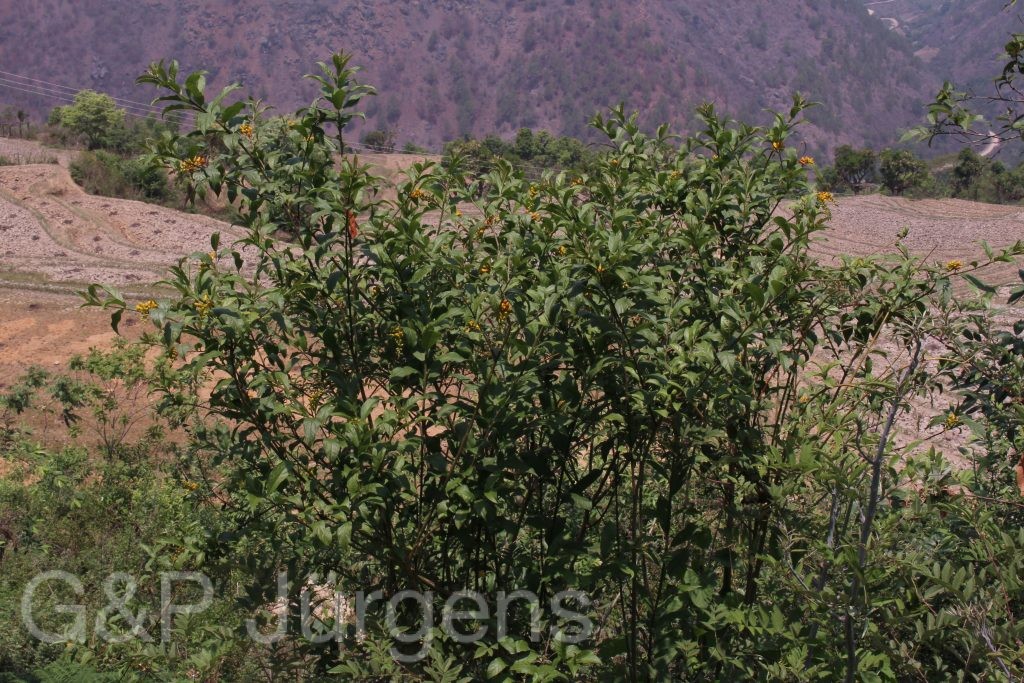
Polygala arillata is a shrubby milkwort of the Himalaya and Southeast Asia, distributed from Nepal, NE India and Bhutan through southern China to Myanmar, Thailand, Vietnam, Bangladesh, Sri Lanka and Malesia, with 2,908 GBIF occurrences. It grows in temperate and subtropical broad-leaved forest, forest margins, clearings and shrubby slopes, commonly between about 1,000 and 2,800 m. The Bhutanese collection from Wangdi Phodrang at about 2,280 m in May reflects its late-spring flowering in mid-montane forest, where it grows as a conspicuous understorey or edge shrub.

It is an erect shrub or small tree 1–3 m tall with terete, finely pubescent branchlets. The leaves are alternate, elliptic to obovate-oblong, 8–18 cm long, acuminate, entire and shortly petiolate, often somewhat membranous. The inflorescence is a pendent terminal or leaf-opposed raceme of showy flowers; each flower has five sepals, the two inner enlarged into petaloid, deep yellow to reddish wings, and three petals fused into a tube with a fringed keel, the whole strongly zygomorphic. The fruit is a fleshy, laterally compressed, reddish capsule, and the seeds bear a conspicuous white aril, from which the epithet arillata is derived.

The species belongs to the large, cosmopolitan genus Polygala and is among its more robust, woody Asian representatives. GBIF treats the name as accepted. The arillate seeds suggest dispersal by birds or ants attracted to the fleshy appendage, and the showy keeled flowers are adapted to insect pollination. Widespread and locally common, it is of least concern; its roots and bark are used in regional traditional medicine.

Author: Buch.-Ham. ex D. Don · Sources: POWO (Kew), Flora of China Vol. 11, Flora of Bhutan Vol. 1, GBIF, Bennett: Polygalaceae in Hooker's Flora of British India (1882)

Baker

Sikkim 2006 315 ergebnis
India West-Bengal, Chaana 1800m, May

Description

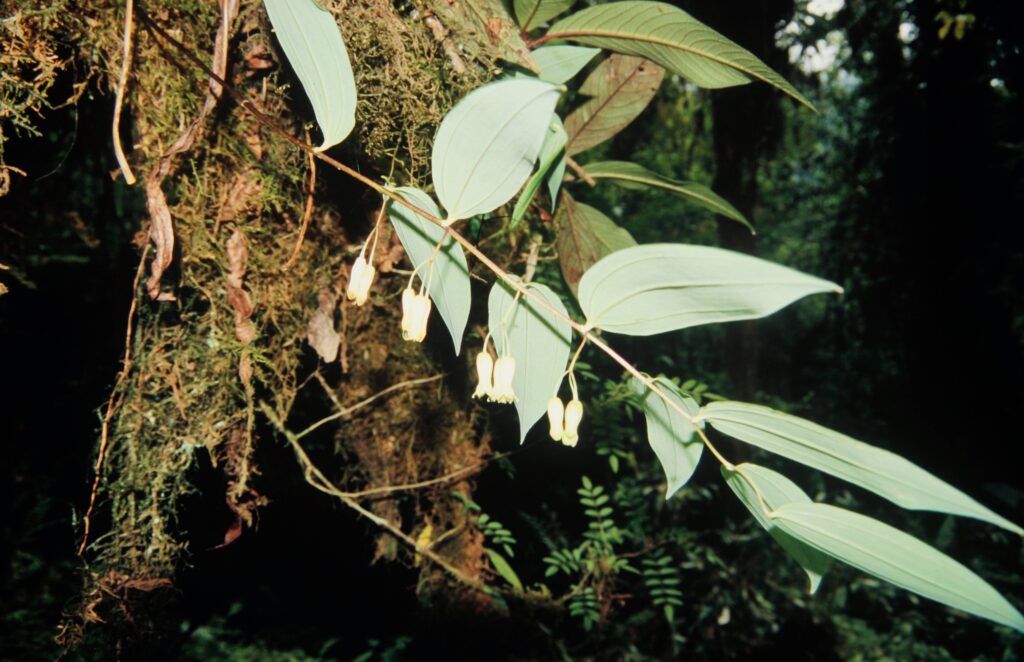
Polygonatum brevistylum is a rhizomatous perennial of the eastern Himalaya and adjacent ranges. GBIF documents it (some 27 occurrences) from Nepal, India, Bhutan and Myanmar, in moist temperate forest, forest margins, shrubberies and shaded banks. It grows in cool, humus-rich soils within the broadleaved and mixed conifer zone, generally between about 1,500 and 3,000 m. The photographed plant is from Chaana in West Bengal (Darjeeling–Sikkim Himalaya) at around 1,800 m, flowering in May, a representative low-montane station for the species as it sends up shoots in spring.

The plant has a stout, knotty, horizontally creeping rhizome from which arises an erect or arching stem. The leaves are alternate, ovate to elliptic and acuminate, glabrous, sessile or shortly petiolate. The flowers are pendent and borne in few-flowered axillary clusters; the perianth is tubular-campanulate, white to greenish-white, with six short lobes, and, as the epithet brevistylum signals, a notably short style. The fruit is a globose berry, ripening blue-black to purplish and containing several seeds.

Polygonatum (Solomon's-seal), now placed in Asparagaceae (formerly Convallariaceae or Liliaceae sensu lato), is taxonomically intricate in the Himalaya, where several closely allied rhizomatous species occur. The short style and the clustered axillary flowers are useful diagnostic characters separating P. brevistylum from sympatric congeners. Himalayan Polygonatum rhizomes are widely gathered for food and traditional medicine, so localised harvesting pressure may affect accessible populations.

Author: Baker · Sources: POWO (Kew), Flora of China Vol. 24, Flora of Bhutan Vol. 3, GBIF, Jeffrey: The Genus Polygonatum (Liliaceae) in Eastern Asia

(Wall.) Royle

Bh2008 611 P920
Bhutan, Punakha 2400m, May

Description

Polygonatum cirrhifolium is a rhizomatous perennial herb widely distributed across the Himalaya and the mountains of central and western China, recorded from China, Nepal, India, Bhutan, Myanmar and Vietnam, with around 2251 georeferenced records (records from Canada, Norway and Britain reflect cultivation). It occurs in temperate forest, forest margins, shrubberies and grassy alpine slopes, on moist humus-rich soils typically between about 2000 and 4000 m. The photographed plant from Punakha in Bhutan at 2400 m, flowering in May, sits near the lower edge of its broad altitudinal span.

It has a stout, knotted, horizontal rhizome from which arises an erect to arching stem. The narrow, linear-lanceolate leaves are borne in whorls of three or more, and the epithet cirrhifolium refers to their slender apices, which are characteristically prolonged and curled into tendril-like tips. The pendent flowers hang one to four together in the leaf axils; each perianth is tubular, pale rose-purple to whitish, the six tepals fused into a cylinder with short lobes and enclosing six stamens. The fruit is a globose berry that ripens from red to purplish-black.

Polygonatum, in Asparagaceae subfamily Nolinoideae, is here represented by a whorled-leaved species readily told from P. oppositifolium by its tendrilled leaf tips. The rhizome, known in Chinese and Himalayan medicine, is gathered as a tonic drug, and the species is among the sources of the herbal material huangjing. The pendent nectar-bearing flowers are bumblebee-pollinated and the berries bird-dispersed. Though widespread and not threatened overall, sustained medicinal harvesting locally depletes wild populations.

Author: (Wall.) Royle · Sources: POWO (Kew), GBIF, Flora of China, Flora of Bhutan, Annotated Checklist of the Flowering Plants of Nepal, Jeffrey monograph of Polygonatum

(Wall.) Royle

Nepal 97 328 P653
Nepal Arun-Valley 2000m May

Description

Polygonatum oppositifolium is a rhizomatous perennial herb of the Himalaya and adjacent mountains, ranging through India, Nepal, China, Bhutan and Myanmar, with around 184 georeferenced records concentrated along the southern Himalayan flank (several distant country codes reflect cultivation or data artefacts rather than wild populations). It grows in moist, shaded broad-leaved and mixed forest, on banks and among rocks in leaf-litter-rich soils at middle elevations. The photographed plant from the Arun Valley of eastern Nepal at about 2000 m, flowering in May, typifies its warm-temperate forest habitat.

The plant has a creeping, knotted, fleshy rhizome from which arises an arching to suberect stem. As the epithet indicates, the lanceolate to ovate-lanceolate leaves are predominantly opposite (occasionally whorled), sessile to shortly petiolate, acuminate and prominently veined. The flowers hang in short axillary cymes; each perianth is tubular and greenish-white, the six tepals fused into a cylindrical tube with short recurved lobes, enclosing six included stamens with filaments adnate to the tube. The fruit is a small globose berry, ripening dark blue to blackish and containing few seeds.

Polygonatum (Solomon's seal), placed in Asparagaceae subfamily Nolinoideae, is distinguished from related genera by its rhizome scars and tubular flowers. P. oppositifolium is notable within the Himalayan members for its opposite leaf arrangement. The pendent flowers are bumblebee-pollinated and the berries bird-dispersed. The rhizomes are gathered locally in traditional medicine; while not currently regarded as threatened, such harvesting and forest degradation warrant monitoring of wild stands.

Author: (Wall.) Royle · Sources: POWO (Kew), GBIF, Flora of China, Annotated Checklist of the Flowering Plants of Nepal, Flora of Bhutan, Jeffrey monograph of Polygonatum

Royle ex Kunth

Bh2008 333 P513
Bhutan Phobjika 2700m, April
Nepal 1994 59 ergebnis
Ost-Nepal Bhalukhob 
1900m April

Description

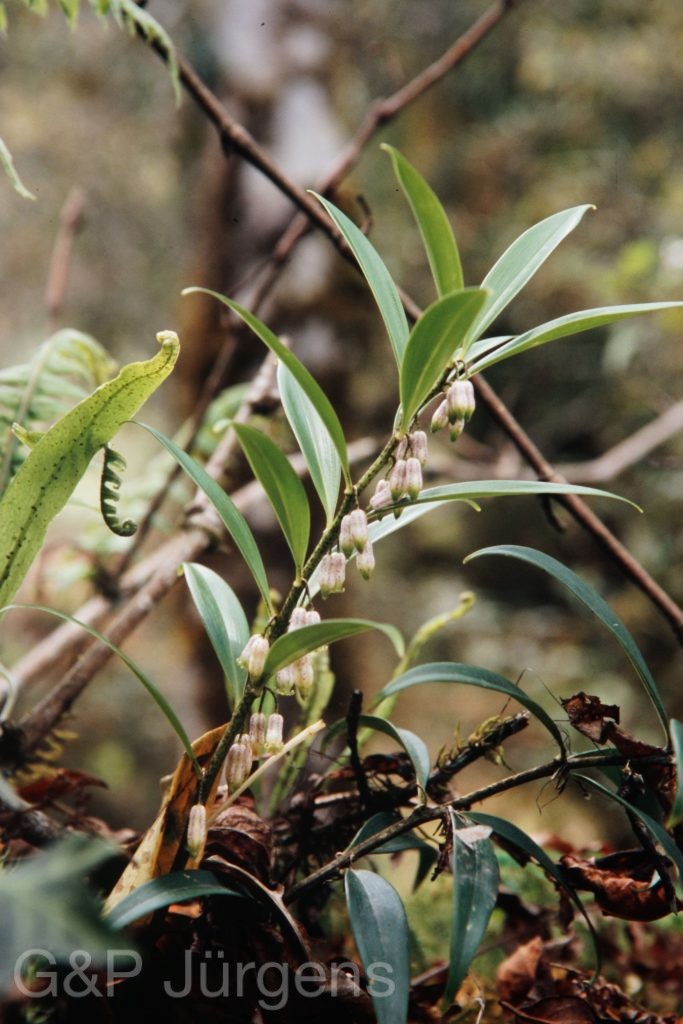
Polygonatum punctatum is a Sino-Himalayan Solomon's seal distributed through China, Nepal, India, Bhutan, Myanmar, Thailand, Vietnam and Laos, with over 450 georeferenced occurrences and additional records from cultivation. It is a plant of cool, shaded temperate forest, mossy banks, rock ledges and humus-rich slopes, where it often grows as a lithophyte or epiphyte. The populations documented at Phobjikha in Bhutan at about 2700 m and at Bhalukhob in eastern Nepal at about 1900 m, both in April, reflect its montane forest habitat, emerging and flowering in spring.

The species grows from a creeping, knotted rhizome that produces an arching to pendent leafy stem. The leaves are alternate, sometimes appearing sub-opposite, ovate to lanceolate and acuminate, often somewhat leathery. Slender axillary inflorescences bear one to several tubular flowers; the perianth is fused into a narrow cylindrical tube, greenish-white and frequently marked with purple dots or spots (the punctate patterning evoked by the epithet), with six short lobes and included stamens. The fruit is a small globose berry, dark purple to blackish when ripe, containing a few seeds.

Within Asparagaceae (formerly Convallariaceae or Liliaceae sensu lato), Polygonatum is a Northern Hemisphere genus whose East Asian and Himalayan species are taxonomically intricate, separated by leaf arrangement, flower number, perianth markings and rhizome form. The frequently epiphytic or saxicolous habit of P. punctatum is unusual within the largely terrestrial genus. Widespread and locally common, it is not regarded as threatened, though several Himalayan congeners are harvested for the medicinal rhizome.

Author: Royle ex Kunth · Sources: POWO (Kew), GBIF, Flora of Bhutan, Flora of Nepal, Flora of China, Jeffrey's revision of Polygonatum

D.Don

Sikkim 2006 261 ergebnis
India West-Bengal, Lingza 1300m, May

Description

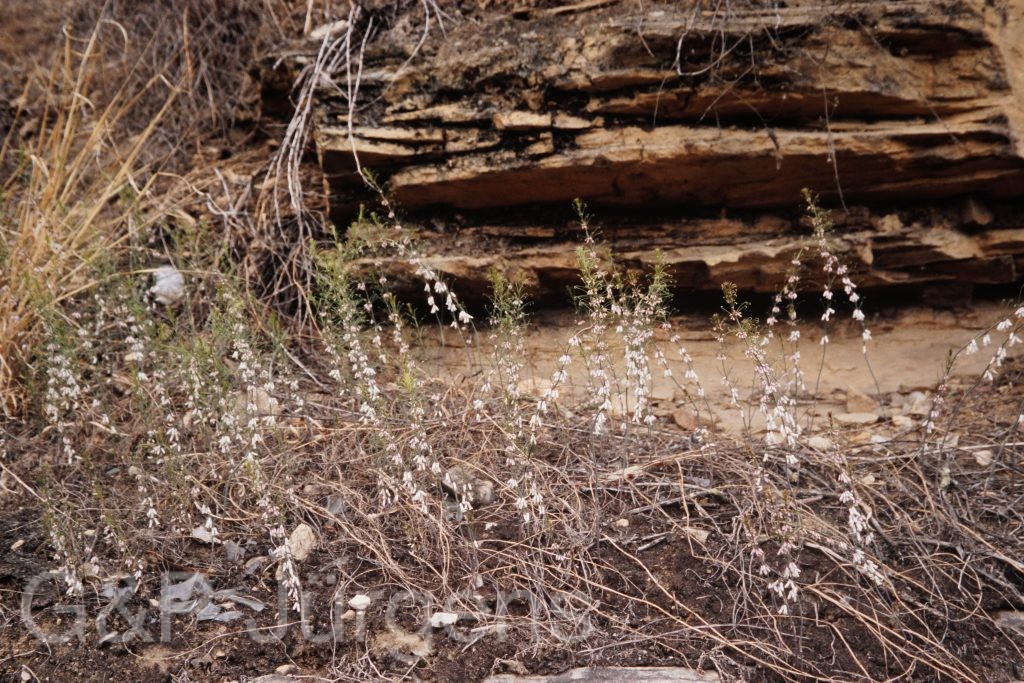
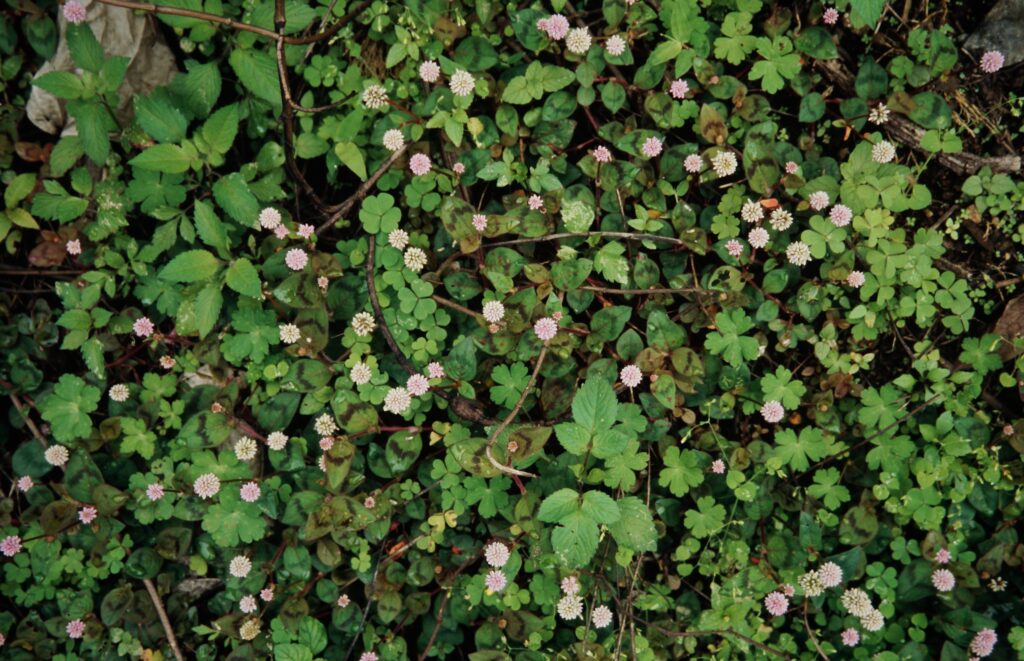
Polygonum microcephalum is a herb of the eastern Himalaya and montane Southeast Asia, widely distributed from Nepal and north-east India through Bhutan and south-western China (Yunnan, Sichuan, Xizang) to northern Myanmar and Vietnam. The very large global occurrence figures returned under the accepted genus Persicaria reflect aggregated records of the broader complex; this taxon is properly treated as Persicaria microcephala (D. Don) H. Gross. It grows in moist, shaded situations — forest understorey, streamsides, ditches and disturbed clearings — chiefly between about 800 and 2,800 m. The plant photographed at Lingza in West Bengal, India, at 1,300 m in May represents its typical low-montane subtropical broadleaf forest habitat.

It is a perennial herb with slender, often reddish, ascending to scrambling stems rooting at the lower nodes, the swollen nodes sheathed by membranous, cylindrical ochreae. The leaves are alternate, ovate to broadly lanceolate, acuminate, frequently marked with a dark chevron and red venation, the surfaces sometimes finely pubescent. The flowers are minute and aggregated into small, dense, head-like or short-spike inflorescences, the perianth of five tepals white to pinkish; stamens commonly eight. The fruit is a trigonous, dark, shining achene enclosed within the persistent perianth.

The segregation of Persicaria from Polygonum sensu lato, supported by molecular phylogenetics, places this species in a large genus characterised by ochreate sheaths and capitate or spiciform inflorescences. The dark-marked, often red-flushed foliage has brought certain forms into cultivation. The species is widespread, ecologically adaptable and of no conservation concern, behaving locally as a colonist of disturbed ground.

Author: D.Don · Sources: POWO (Kew), Flora of China Vol. 5, Flora of Bhutan Vol. 1, GBIF, Hong et al.: Polygonaceae in Flora of China