
(Wall.) D. Don
Description
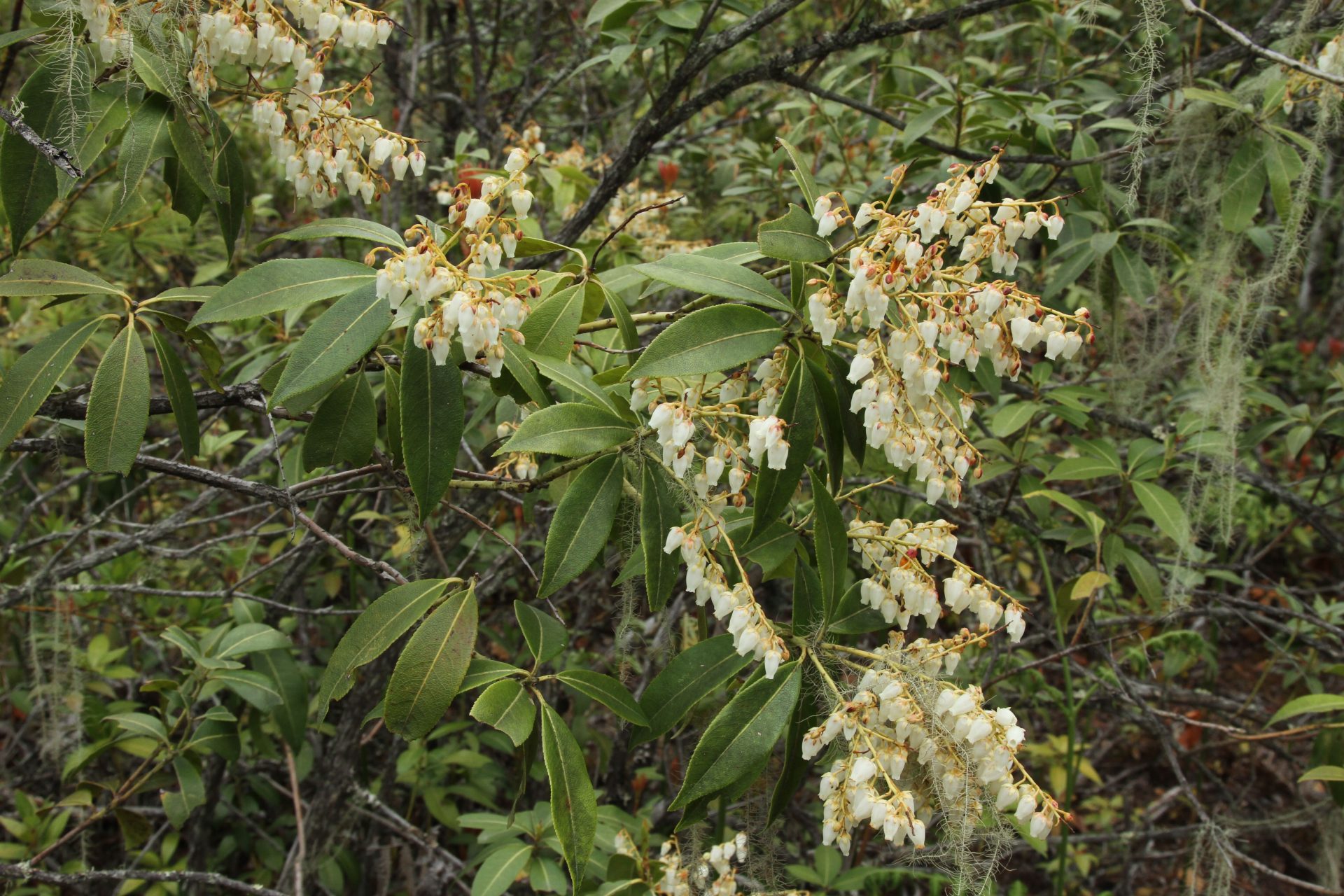
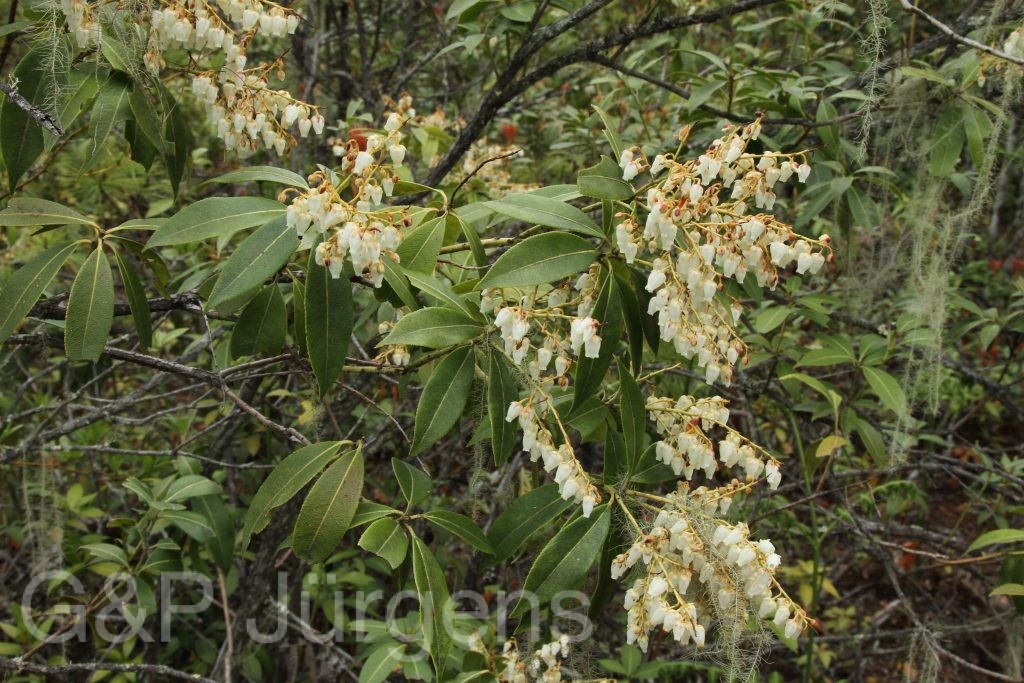
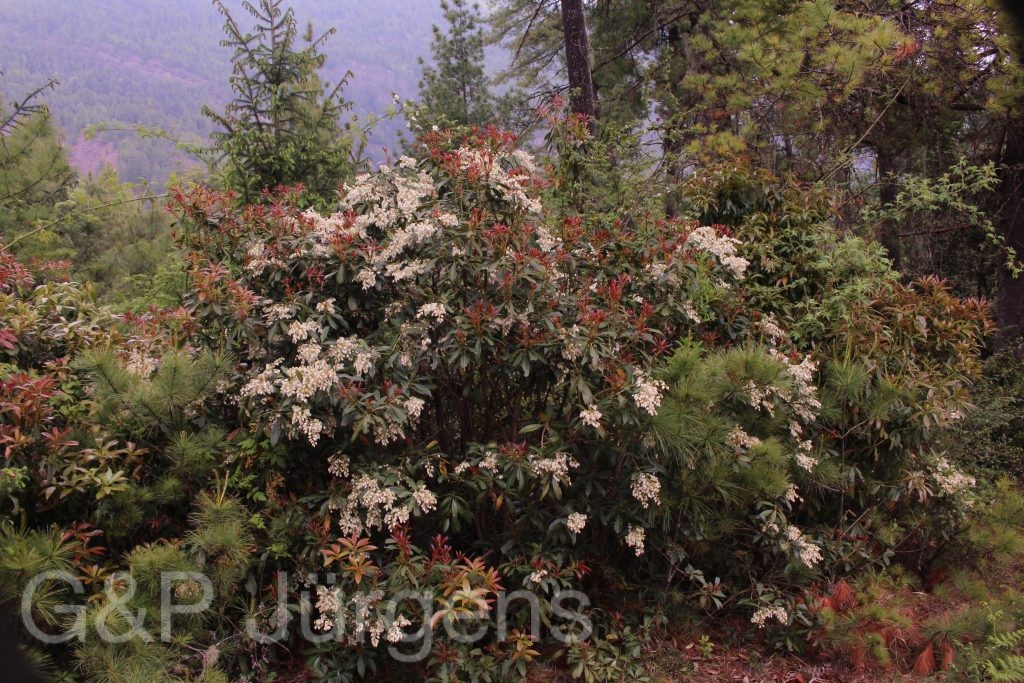
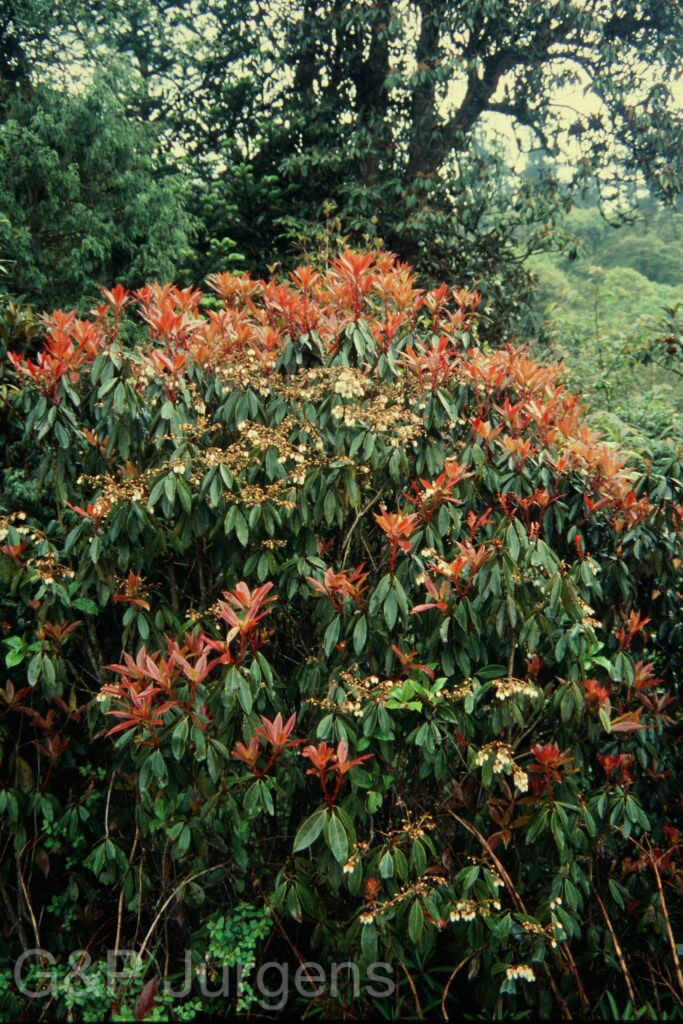
Pieris formosa is an evergreen ericaceous shrub native to the Himalaya and southwestern China, recorded from China, Nepal, India, Bhutan and Myanmar, with cultivated and naturalised records elsewhere accounting for the European, North American, Japanese and other points among its substantial 2971 GBIF occurrences. It occurs in temperate forest, forest margins, thickets and open rocky slopes, generally between 900 and 3300 m. The localities in the caption, Chele-La in Bhutan and Lachung in Sikkim, both around 3000 m in May, represent the cool, humid upper montane forest where the species flowers profusely in spring.
The plant is a much-branched evergreen shrub or small tree reaching several metres, with leathery, oblong-lanceolate to elliptic leaves that are finely serrate, glossy dark green above and frequently flushed bronze or coppery-red when young. The flowers are borne in large, terminal, much-branched panicles; each corolla is small, white, urceolate (urn-shaped) and five-toothed at the mouth, with the stamens enclosed and the ovary superior. Fruit is a small erect, woody, five-valved dehiscent capsule containing numerous minute seeds, the persistent panicles remaining conspicuous after flowering.
Pieris (tribe Lyonieae, subfamily Vaccinioideae) is a small genus of Asian and North American shrubs, and P. formosa is its most robust Himalayan representative, widely grown as an ornamental, notably the form 'Forrestii' selected for its vivid red young growth. Like many Ericaceae it favours acidic, humus-rich soils and harbours grayanotoxins, rendering its foliage poisonous to livestock. Its urn-shaped flowers are pollinated chiefly by bees, and the dust-like seeds are wind-dispersed. The species is common and not threatened across its native range.
Author: (Wall.) D. Don · Sources: POWO (Kew), GBIF, Flora of China, Flora of Bhutan, Bean Trees and Shrubs Hardy in the British Isles