Tag:

Spring

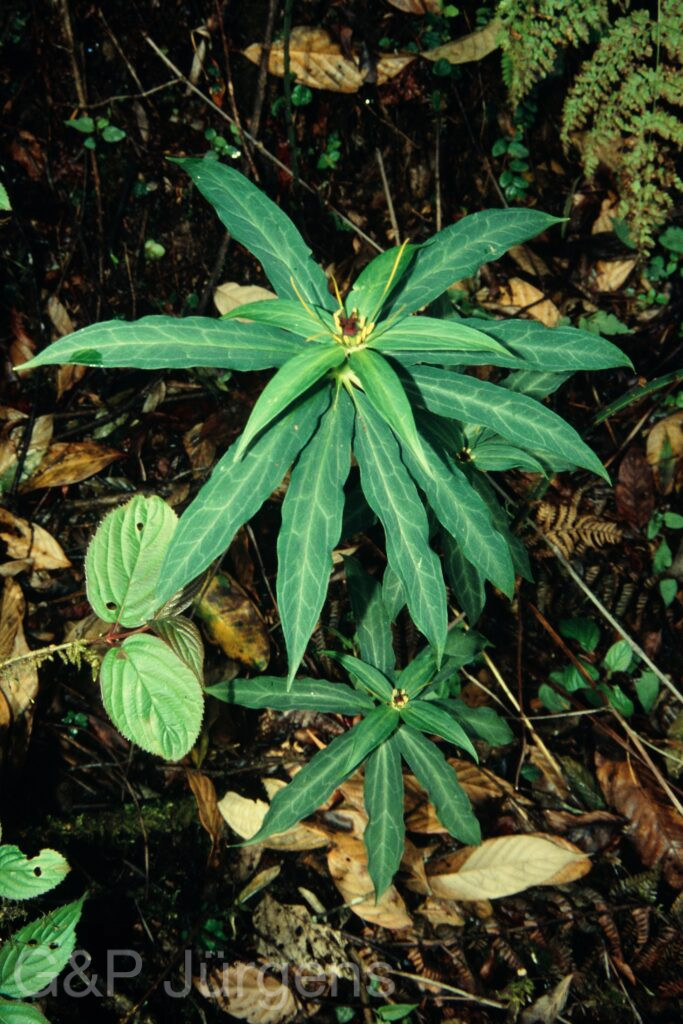
Paris mairei

by GP Jürgens

H.Lév.

Sikkim2004 7 G12
Sikkim West-Bengal, Sambon 1800m April
Sikkim2004 115 P196
Sikkim West-Bengal, Sambon 1800m April
Nepal 97 265 G547
Nepal Bagong-Khola 2700m May

Description

Paris mairei is a rhizomatous woodland herb of the Sino-Himalayan region, distributed across SW China, Nepal, NE India and Bhutan, with GBIF documenting around 269 records. It is a plant of shaded, humus-rich forest, growing in moist broadleaved and coniferous woodland, thickets and shady ravines of the temperate zone. The photographed populations at Sambon in the Sikkim–West Bengal hills (1,800 m, April) and at Bagong Khola in Nepal (2,700 m, May) reflect its altitudinal span from the warm temperate to the upper temperate forest belt, where it flowers in spring as the canopy leafs out.

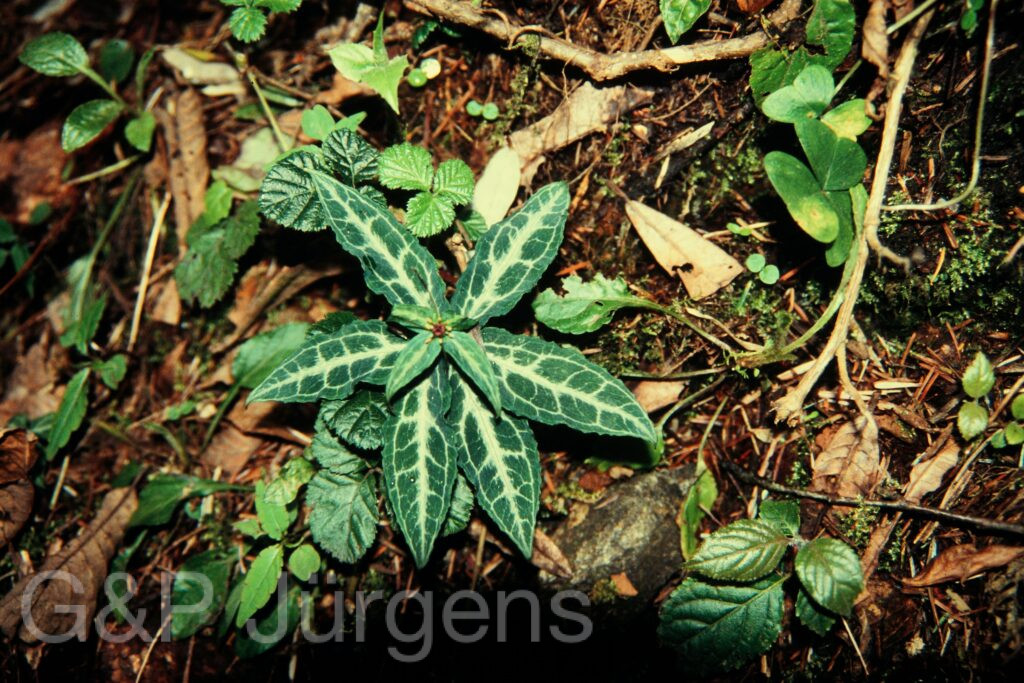
It is an erect perennial arising from a creeping, knotty rhizome, bearing a single terminal whorl of stalkless or shortly petiolate, ovate to lanceolate, net-veined leaves. From the centre of the whorl rises a solitary, long-pedicellate flower with the parts in the characteristic Paris arrangement: a whorl of green, leaf-like outer perianth segments (sepals), filiform or narrowly linear inner segments (petals), prominent stamens with the connective often produced beyond the anther, and a central ovary crowned by spreading stigmas. The fruit is a capsule that splits to expose seeds with a coloured fleshy aril.

The genus Paris (now placed in Melanthiaceae rather than the former Trilliaceae) is renowned for its steroidal saponins, several Asian species being important in traditional Chinese medicine, which has driven heavy wild collection and conservation concern in parts of the range. The single leaf whorl and solitary, spider-like flower make the genus instantly recognisable, while the contrast between broad sepaloid and thread-like petaloid segments is diagnostic at species level. P. mairei is distinguished within the genus by its leaf and floral proportions and stamen connective form.

Author: H.Lév. · Sources: POWO (Kew), Flora of Nepal, GBIF, Flora of China Vol. 24, Li: The Genus Paris (Paridaceae)
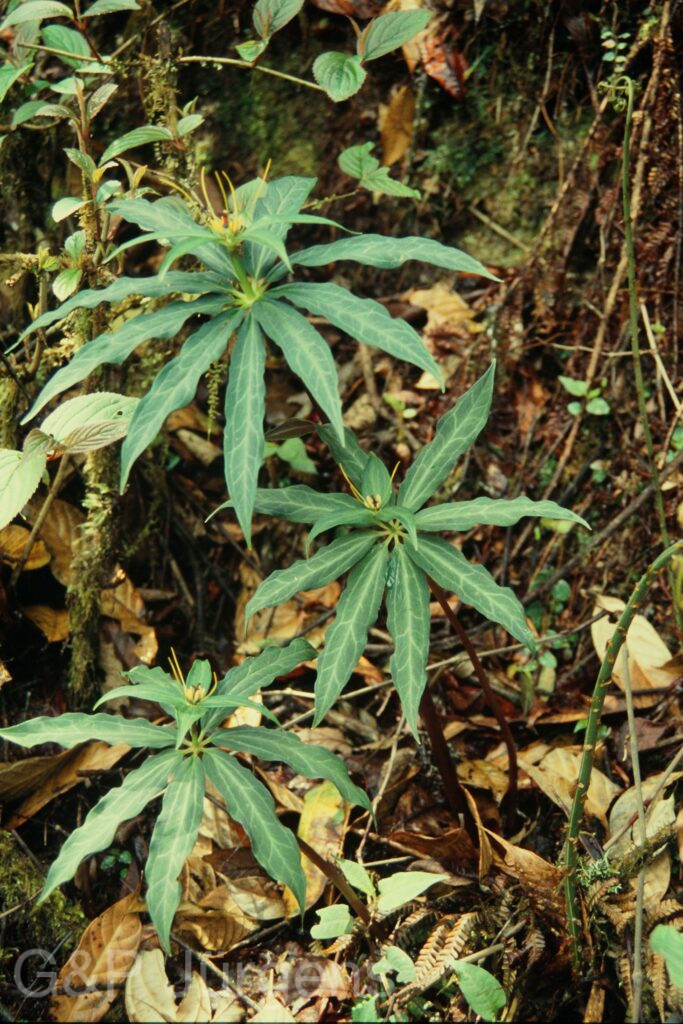
Franch.

Bhutan2014 469
Bhutan Tongsa 2000m, May
Bhutan2014 586
Bhutan Phobjika 3100m, May

Description

Paris thibetica is a rhizomatous woodland herb of the eastern Himalaya and Sino-Himalayan region, recorded from China, Nepal, India, Bhutan and Myanmar, the Norwegian (NO) datum representing cultivated or herbarium material. Its roughly 281 georeferenced collections concentrate in the temperate forests of the Tibet-Himalaya borderlands. It grows in shaded, moist, humus-rich broadleaved and mixed forest, on banks and in damp ravines beneath the canopy. The photographed plants from Bhutan at Tongsa (2000 m) and Phobjika (3100 m), both in May, demonstrate its broad altitudinal range across the temperate belt and its spring flowering as the rhizome resumes growth after winter.

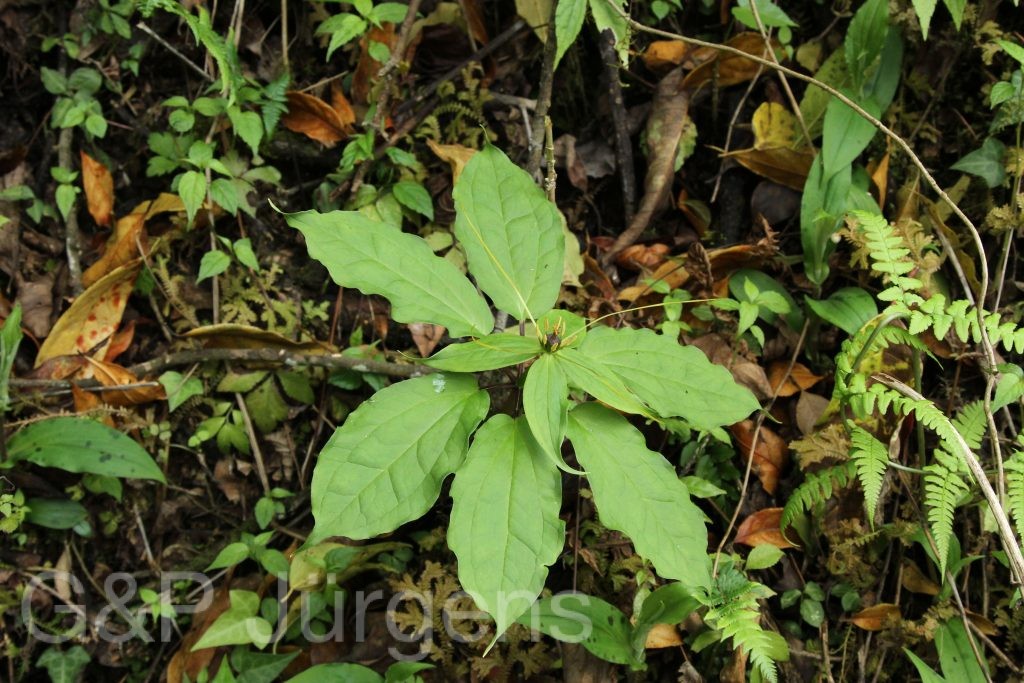
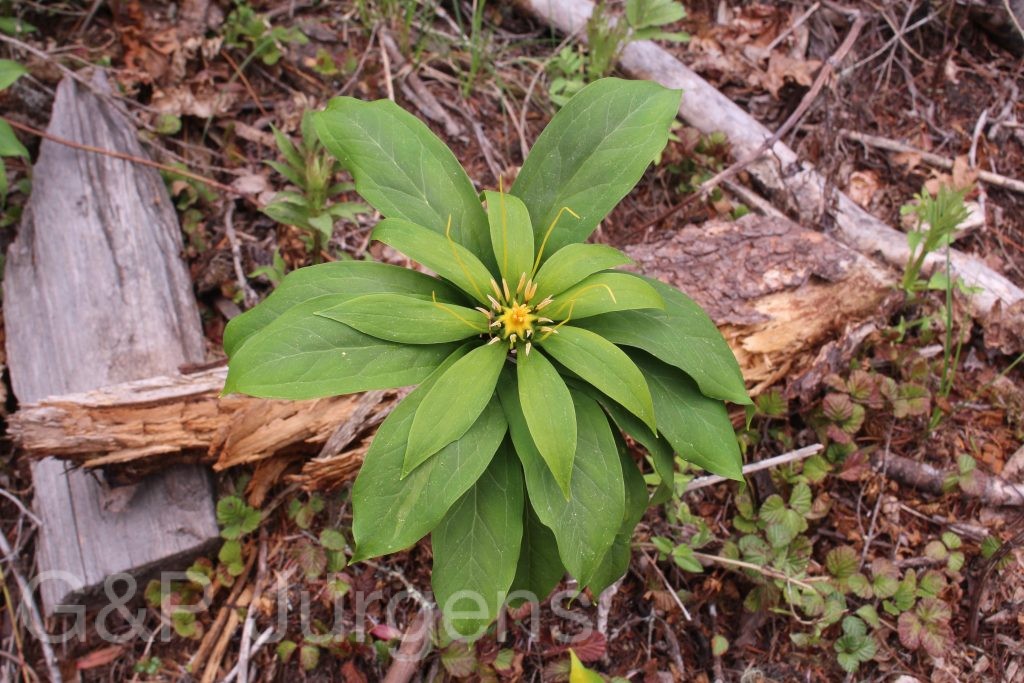
It is an erect perennial arising from a thick, creeping rhizome that produces a single unbranched stem. At the stem apex is a single whorl of typically four or more leaves, ovate-lanceolate to oblanceolate, with the netted-reticulate venation characteristic of the genus. From the centre of the whorl rises a solitary terminal flower on a slender pedicel. The perianth is in two distinct whorls: the outer of green, leaf-like sepals and the inner of very narrow, filiform to thread-like yellowish-green petals. Numerous stamens with elongate connectives surround a globose ovary crowned by spreading styles. The fruit is a capsule that opens to expose seeds borne in a fleshy, often reddish aril.

The genus Paris (herb-Paris) is placed in the Melanthiaceae (formerly Trilliaceae) and is centred on the temperate Sino-Himalayan mountains, where it is taxonomically intricate and much studied. Several species, including members of the Paris polyphylla complex to which P. thibetica is allied, are valued in traditional medicine for their steroidal saponins, exposing wild populations to harvesting pressure. Slow-growing and habitat-specific, herb-Paris species are increasingly of conservation concern owing to forest loss and over-collection.

Author: Franch. · Sources: POWO (Kew), GBIF, Flora of China Vol. 24, Flora of Bhutan Vol. 3, Flora of Nepal, Li's The Genus Paris (Trilliaceae)

Buch.-Ham. ex D.Don

Nepal 97 497 G979
Nepal Arun-Valley 1750m May
Nepal 97 336 P666
Nepal Arun-Valley 1750m May
Nepal 1994 58 ergebnis
Ost-Nepal Bhalukhob 
1900m April

Description

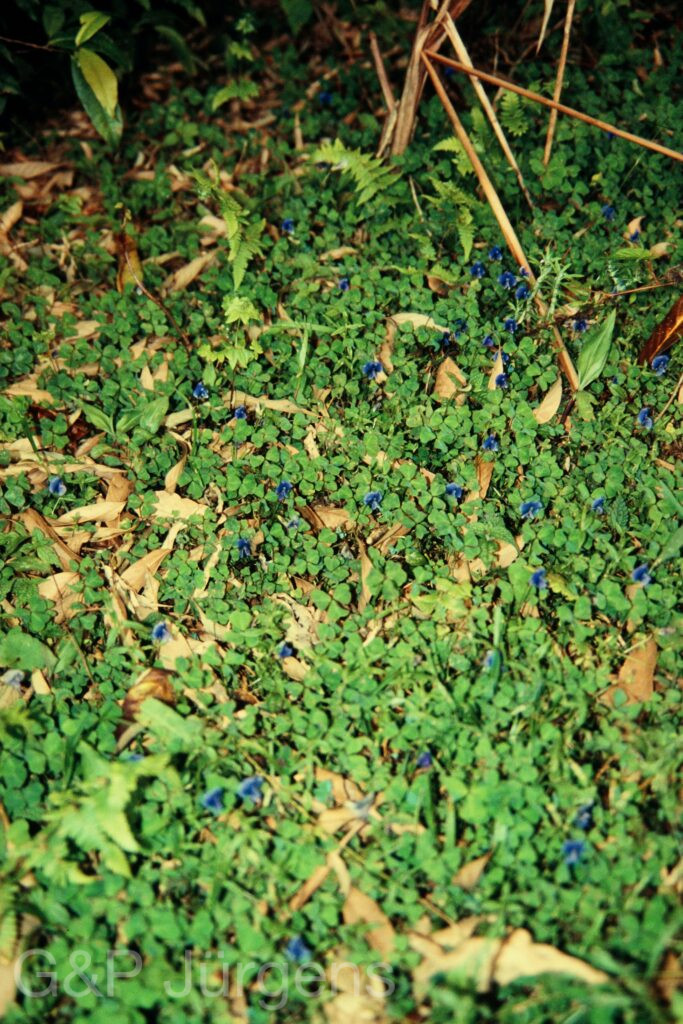
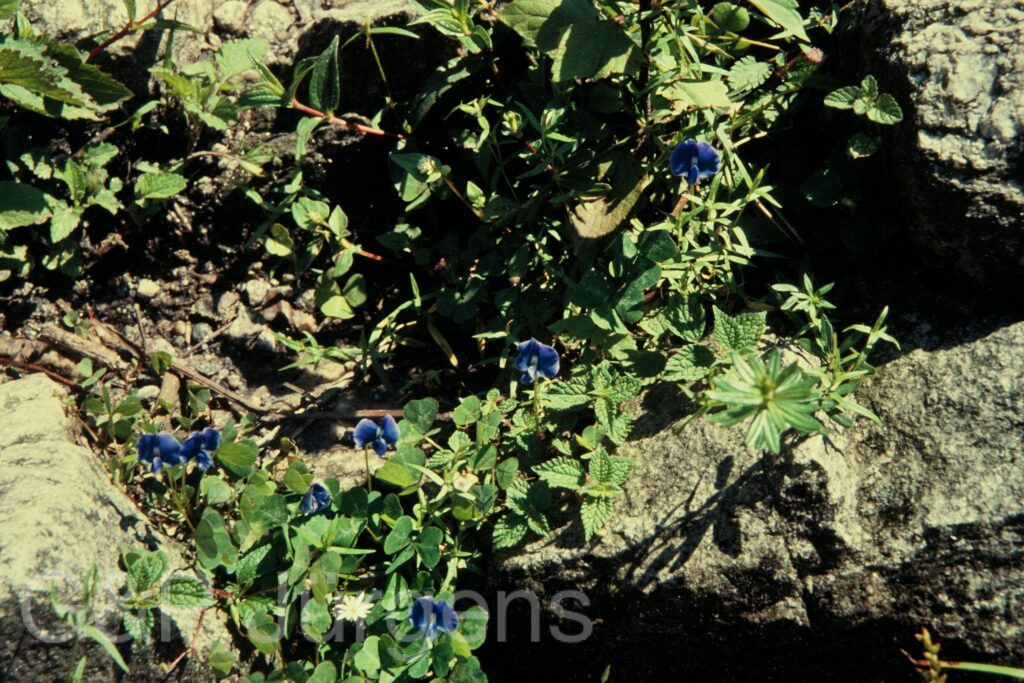
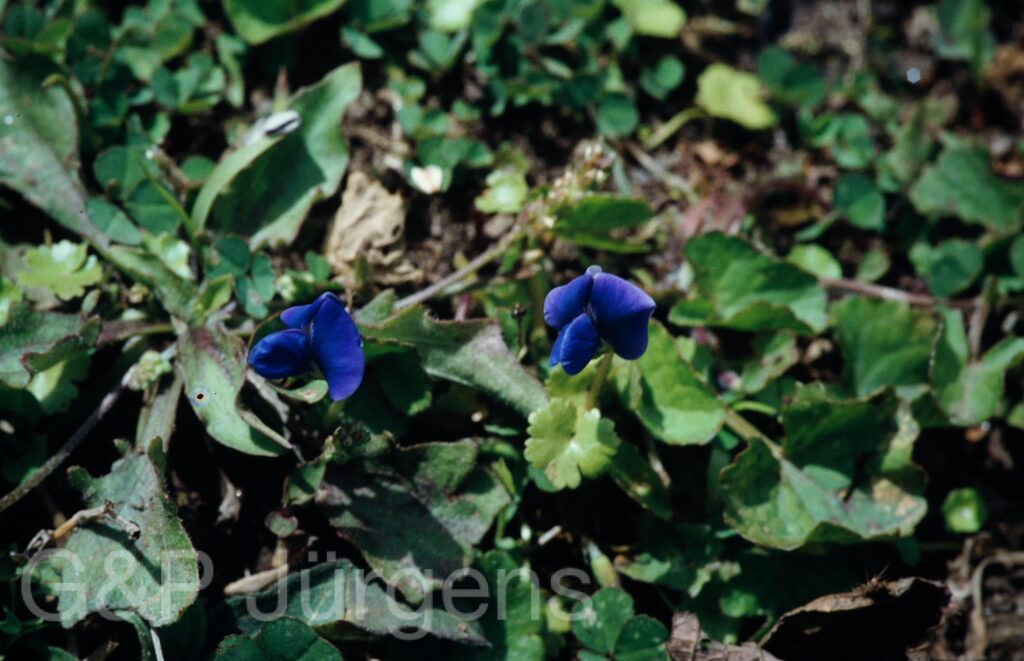
Parochetus communis, the shamrock pea, is a creeping perennial legume with a remarkably wide Afro-Asian montane distribution. GBIF documents around 1730 occurrences spanning the Himalaya (Nepal, India, Bhutan, China), Southeast Asia (Myanmar, Thailand, Vietnam, Malaysia, Indonesia, Sri Lanka), the East African highlands (Ethiopia, Kenya, Tanzania, Uganda, Rwanda, Burundi, DR Congo, Malawi) and naturalised in New Zealand. It grows in moist grassland, forest clearings, streambanks, terrace edges and shaded turf, generally between 1500 and 3000 m. The photographed plants are from eastern Nepal at Bhalukhob (1900 m, April) and the Arun Valley (1750 m, May), where it carpets damp banks in spring.

The plant forms prostrate, rooting stems that spread into loose mats and root at the nodes. The leaves are trifoliolate and clover-like, the obcordate leaflets often marked with a darker band, borne on slender petioles with small stipules. The flowers are solitary or paired in the leaf axils, papilionaceous with a standard, wing and keel; the corolla is a vivid cobalt to gentian-blue, occasionally with paler markings, exceeding the tubular calyx. The fruit is a slender, linear-oblong legume that dehisces to release several small seeds.

Parochetus (Fabaceae, subfam. Faboideae) is a small genus historically treated as monotypic until the segregation of the African P. africanus, leaving Asian material under P. communis. GBIF treats the name as accepted. Its disjunct, sky-island range across Asian and African mountains makes it a classic subject in studies of tropical-alpine biogeography. Widespread and adaptable, it is of least concern and is also cultivated as an ornamental groundcover.

Author: Buch.-Ham. ex D.Don · Sources: POWO (Kew), GBIF, Flora of China, Annotated Checklist of the Flowering Plants of Nepal, Polhill studies of Papilionoid legumes

Sims

Bh2008 493 G762
Bhutan Samtengang, 2200m April

Description

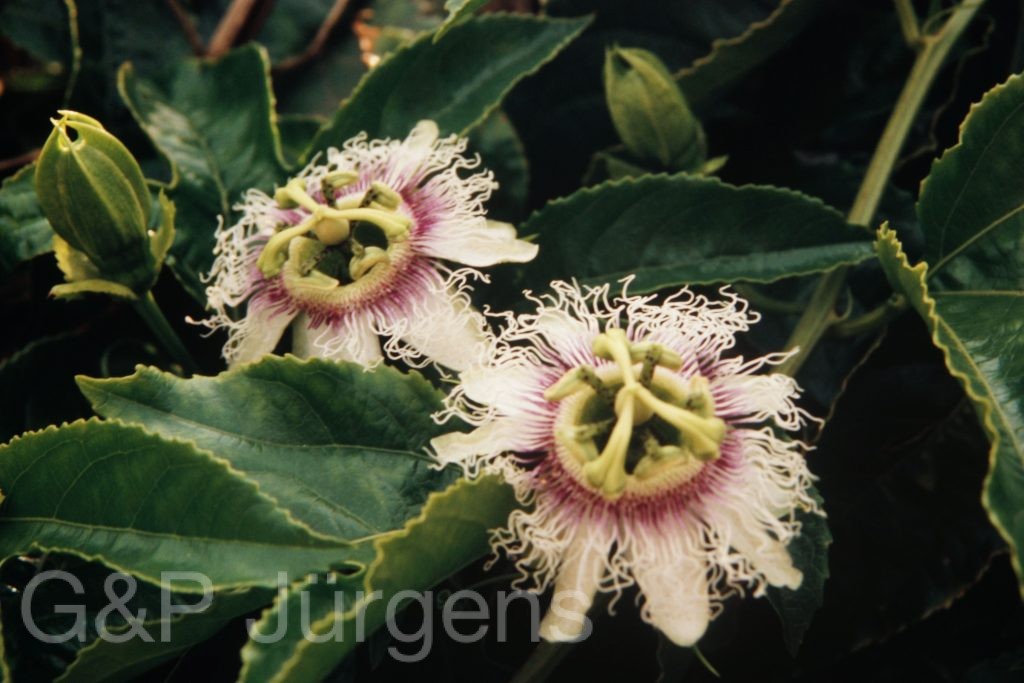
Passiflora edulis, the passion fruit, is a climbing vine native to subtropical South America (its core GBIF records cluster in Brazil, Argentina, Colombia, Ecuador and Peru) but now pantropically cultivated and naturalised, with records spanning Australia, the United States, South Africa, India and China. In the Himalaya it occurs as an introduced and cultivated plant, and the photographed individual from Samtengang in Bhutan at 2200 m, flowering in April, reflects this cultivated status in warm-temperate hill country rather than a native occurrence. It thrives in disturbed ground, hedges, plantation margins and gardens, scrambling over supports in frost-free to mildly temperate conditions.

It is a woody, evergreen, tendril-climbing perennial vine with deeply three-lobed, glossy, serrate leaves bearing axillary tendrils by which it ascends. The solitary, axillary flowers are large and intricate, with five sepals and five petals subtending a conspicuous corona of long, wavy filaments, white above and banded purple toward the base. The androgynophore raises five stamens and a tricarpellate ovary with three styles above the corona, the whole structure famously interpreted as emblematic of the Passion. The fruit is a globose to ovoid berry, purple or yellow at maturity, with a tough leathery rind enclosing numerous arillate seeds in fragrant, juicy, edible pulp.

Passiflora is a large, predominantly Neotropical genus celebrated for its elaborate, often bee-, bird- or bat-pollinated flowers and for hosting specialised heliconiine butterfly larvae on its cyanogenic foliage. P. edulis is one of the most economically important species, grown commercially for its fruit, and exists in distinct purple-fruited and yellow-fruited forms. Vigorous and readily naturalising, it is regarded as a weedy invader in some warm regions, though in the Himalayan context it remains a cultivated introduction.

Author: Sims · Sources: POWO (Kew), GBIF, Flora of China Vol. 13, Flora of Bhutan Vol. 2, Flora of Nepal, Killip's The American Species of Passifloraceae

(Kurz.) Bremek.

Nepal 2001 488 ergebnis ergebnis
Nepal (Gorkha) Labubhesi 1100m, May

Description

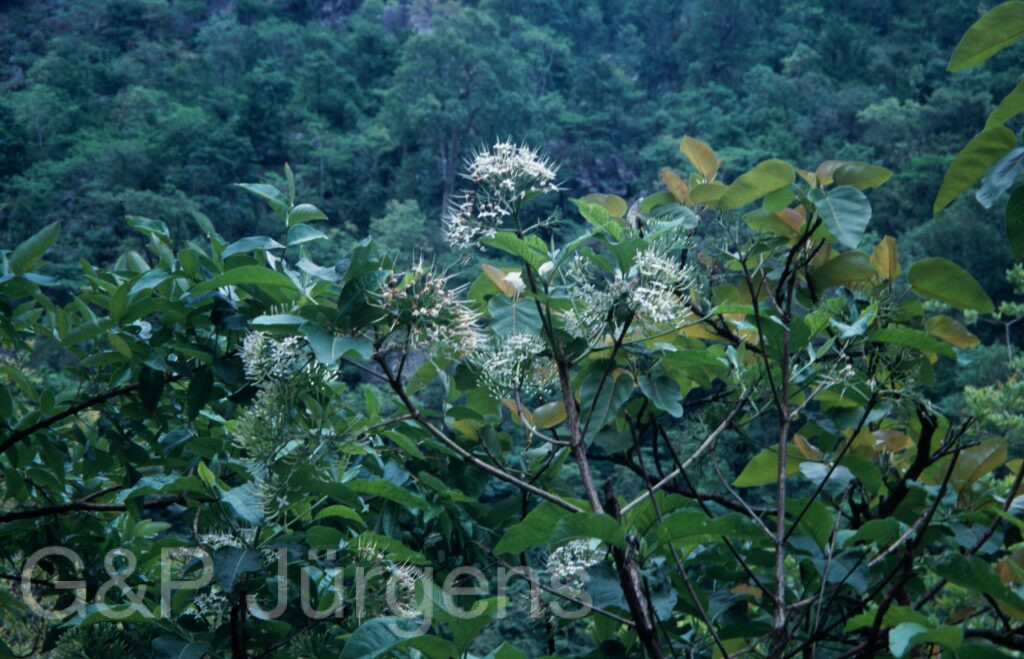
Pavetta tomentosa var. glabrescens is a shrub of the warm subtropical and tropical forests of southern and southeastern Asia. GBIF records the species across a broad range encompassing India, Thailand, China, Myanmar, Nepal, Laos, Vietnam, Cambodia, Malaysia, Indonesia, Sri Lanka, Bangladesh and Bhutan, with some 530 occurrences. It grows in deciduous and semi-evergreen forest, woodland margins and scrub at low to mid elevations. The photographed material derives from Nepal in the Gorkha district at Labubhesi, around 1100 m, in May, a humid montane-foothill setting near the lower Himalayan slopes that marks the northern edge of its distribution.

The plant is an erect, branching shrub with opposite, simple, elliptic to oblong leaves that are entire, shortly petiolate and, in the typical variety, softly tomentose; in var. glabrescens the indumentum is reduced and the foliage tends towards near-glabrous, the distinguishing feature of the variety. Interpetiolar stipules are present, as is characteristic of Rubiaceae. The white, fragrant flowers are borne in dense terminal corymbose cymes; each has a four-lobed salverform corolla with a slender tube and a long, far-exserted style, the hallmark of Pavetta. Bacterial leaf nodules, harbouring nitrogen-related endophytes, occur as dark dots in the lamina. The fruit is a small globose, two-seeded berry, ripening black.

GBIF accepts the species, the variety reflecting the glabrescent extreme of a tomentose-pubescent continuum. Bremekamp, who monographed the genus, recognised numerous such infraspecific entities. The genus is notable for its near-obligate bacterial leaf symbiosis. Widespread and ecologically tolerant, the species is of no conservation concern.

Author: (Kurz.) Bremek. · Sources: POWO (Kew), GBIF, Flora of Nepal, Flora of China, Bremekamp monograph of Pavetta

(Prain) T.Yamaz.

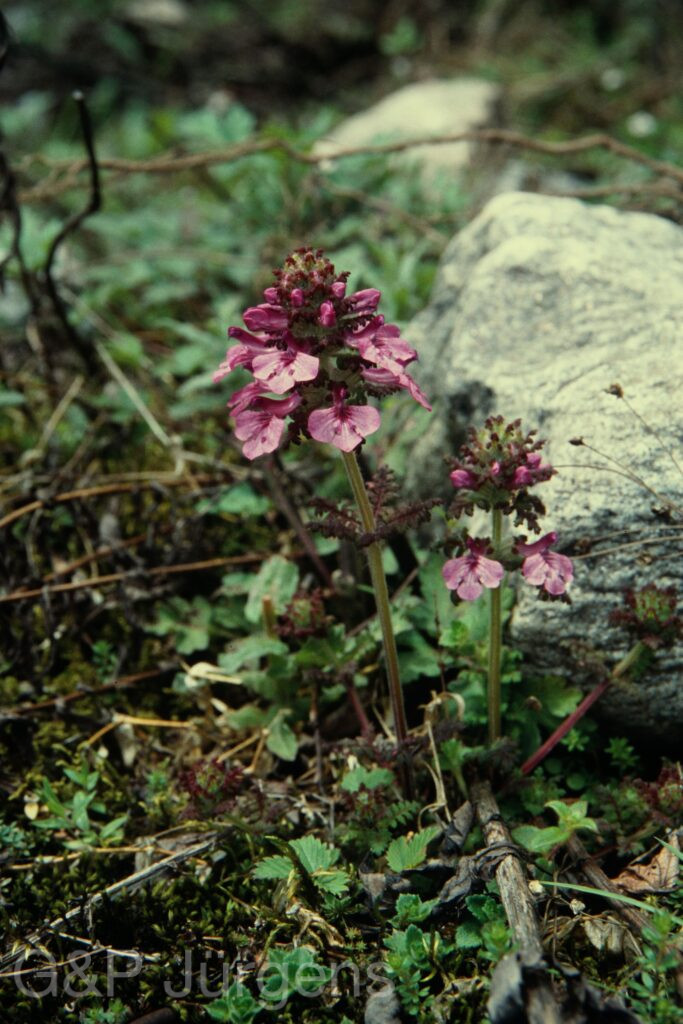
Sikkim2004 427 G737
Sikkim/India Yumtahng 3500m May

Description

Pedicularis roylei var. speciosa is a hemiparasitic perennial of the eastern Himalaya, distributed across the high-montane and subalpine belt of southern China (Xizang and adjacent Yunnan) and Nepal, with populations extending into Sikkim and the Chumbi region. The variety is documented from a modest number of records (GBIF lists around 12 occurrences from CN and NP), reflecting both its restricted range and the limited collecting in its remote habitats. It occupies open alpine meadows, moist grassy slopes, the margins of Rhododendron and Abies forest, and streamside flushes between roughly 3000 and 4300 m. The photographed plant from the Yumthang valley in northern Sikkim at about 3500 m, flowering in May, is typical of these subalpine pastures where snowmelt sustains a brief but vigorous flush of growth. As a root-hemiparasite, it draws water and minerals from neighbouring grasses and forbs via haustoria while retaining functional green foliage.

The plant forms a low, clumped herb arising from a stout caudex, with erect or ascending stems often clothed in soft hairs. The leaves are mostly basal and pinnatisect, with oblong-lanceolate segments that are themselves toothed or crenate, giving the foliage a fern-like texture. The inflorescence is a dense spike or capitate cluster of conspicuous flowers; var. speciosa is distinguished by its notably large, showy corollas. The bilabiate corolla is rose-pink to purplish, the galea (upper lip) prolonged into a slender, often beak-like apex that twists or curves, while the broad three-lobed lower lip forms a landing platform. The calyx is tubular and toothed, and the four didynamous stamens lie concealed within the galea. The fruit is an obliquely ovoid capsule containing several seeds.

Within the large and taxonomically complex genus Pedicularis, which reaches its global diversity peak in the Sino-Himalayan region, this taxon belongs to a group whose beaked galeas reflect specialised pollination by long-tongued bumblebees. The variety, based on the basionym described by Prain and later treated by T. Yamazaki, is sometimes folded into a broadly circumscribed P. roylei; GBIF accepts it at varietal rank. Its elaborate floral architecture exemplifies the radiation of corolla forms that has accompanied the genus's hemiparasitic lifestyle. Though not currently regarded as threatened, alpine Pedicularis are sensitive to grazing pressure and climate-driven shifts in the snowmelt regime, making long-term monitoring of Himalayan populations desirable.

Author: (Prain) T.Yamaz. · Sources: POWO (Kew), GBIF, Flora of China Vol. 18, Flora of Bhutan Vol. 2 Part 3, Flora of Nepal, A Revision of the Genus Pedicularis (Pennell; Yamazaki, Pedicularis of Eastern Asia)

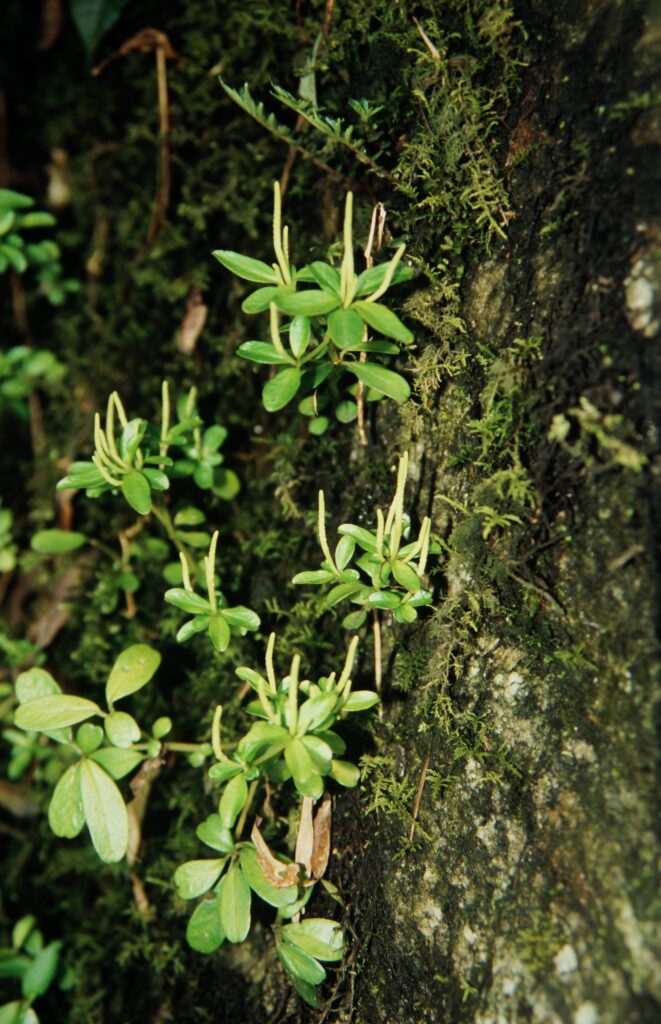
(G.Forst.) Hook. & Arn.

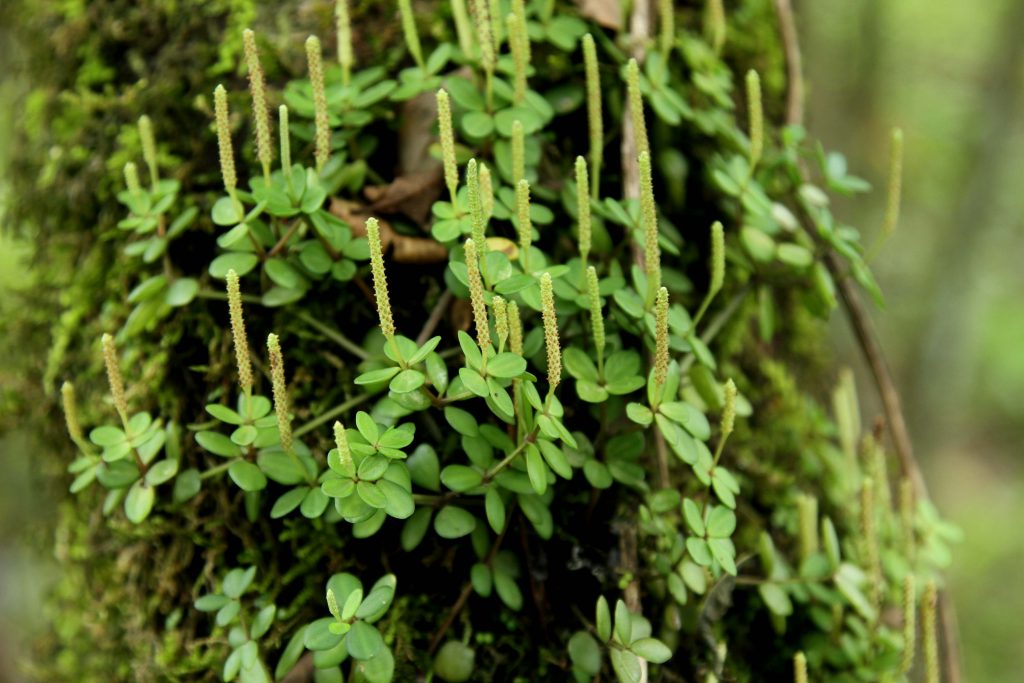
Bhutan2012 1010
Bhutan Trithangebe 1000m, October
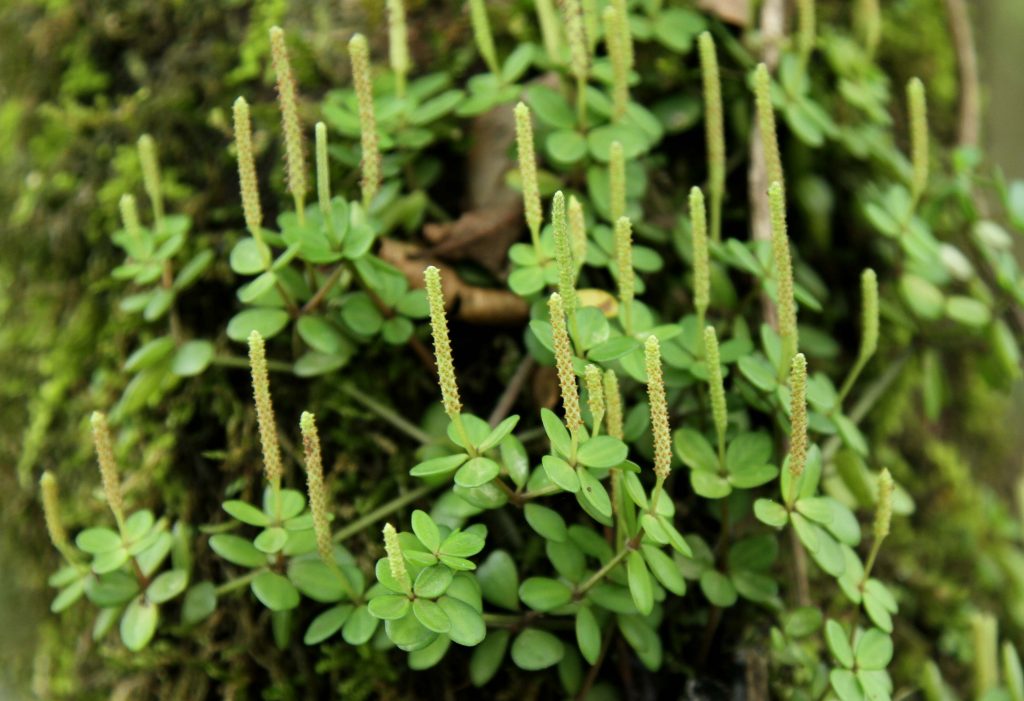
Bhutan2012 1011
Bhutan Trithangebe 1000m, October
Sikkim 2006 472 ergebnis
India West-Bengal, Ruigi-Chu 2000m, May

Description

Peperomia tetraphylla is a small succulent herb of pantropical and warm-temperate distribution. GBIF (some 13,039 occurrences) documents it from the Americas (Brazil, Mexico, the United States, the Andes), Africa and the Indian Ocean islands, Asia (China, India, Indonesia, Taiwan) and Australasia, reflecting an extraordinarily wide range. It grows as an epiphyte on mossy trunks and as a lithophyte on shaded, humid rocks in forest. The illustrated plants are from Bhutan at Trithangbi (1,000 m, October) and West Bengal at Ruigi-Chu (2,000 m, May), spanning its Himalayan altitudinal range in moist broadleaved forest.

The plant is a fleshy, glabrous to finely pubescent herb with creeping then ascending stems rooting at the nodes. The leaves are succulent, characteristically borne in whorls of three to four (whence tetraphylla), small, elliptic to obovate and shortly petiolate. The inflorescence is a slender terminal or axillary spike of minute, naked, bisexual flowers lacking a perianth, each subtended by a peltate bract; the stamens are two and the stigma single. The fruit is a tiny ovoid drupelet, often borne sessile along the rachis.

Peperomia (Piperaceae) is a large pantropical genus, and P. tetraphylla is notable as one of its most widespread species, occurring on most continents. Its small succulent leaves and CAM-like physiology suit it to the seasonally dry, epiphytic microhabitats it occupies. Of no conservation concern given its vast range, it is locally used in folk medicine and is grown as a miniature ornamental, illustrating the cosmopolitan tropical element reaching into the lower Himalaya.

Author: (G.Forst.) Hook. & Arn. · Sources: POWO (Kew), Flora of China Vol. 4, Flora of Bhutan Vol. 1, GBIF, Wanke et al.: Phylogeny of Piperaceae

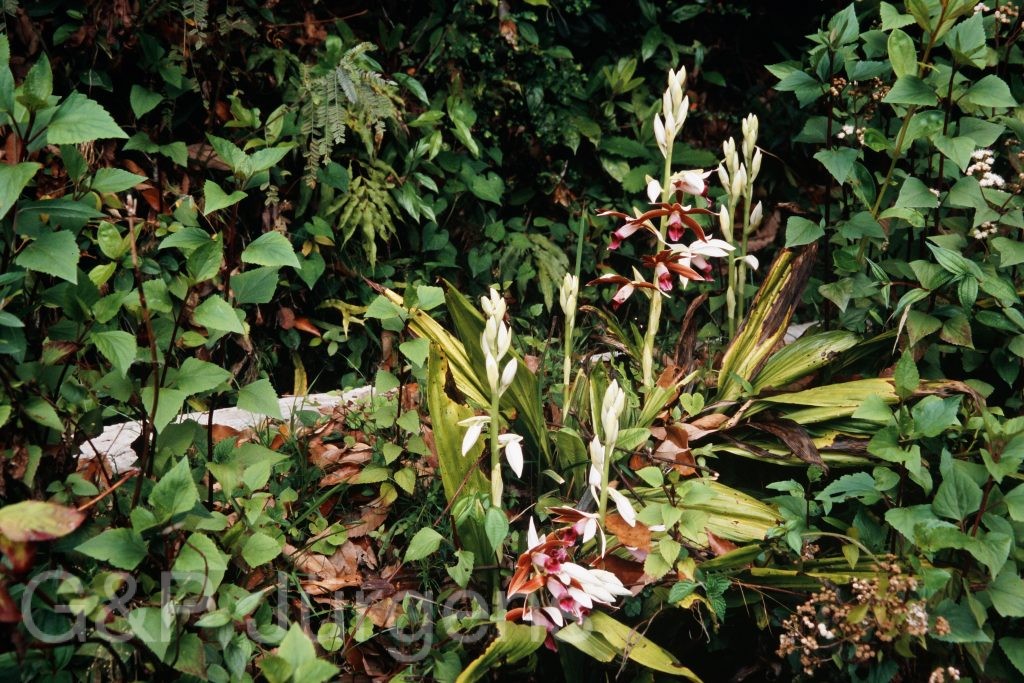
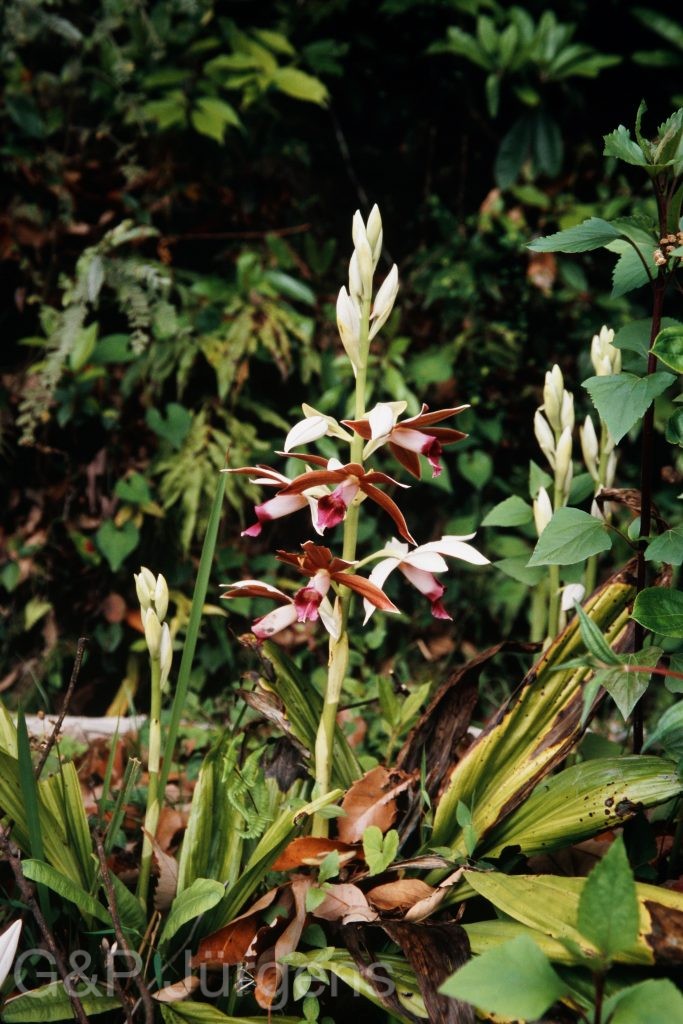
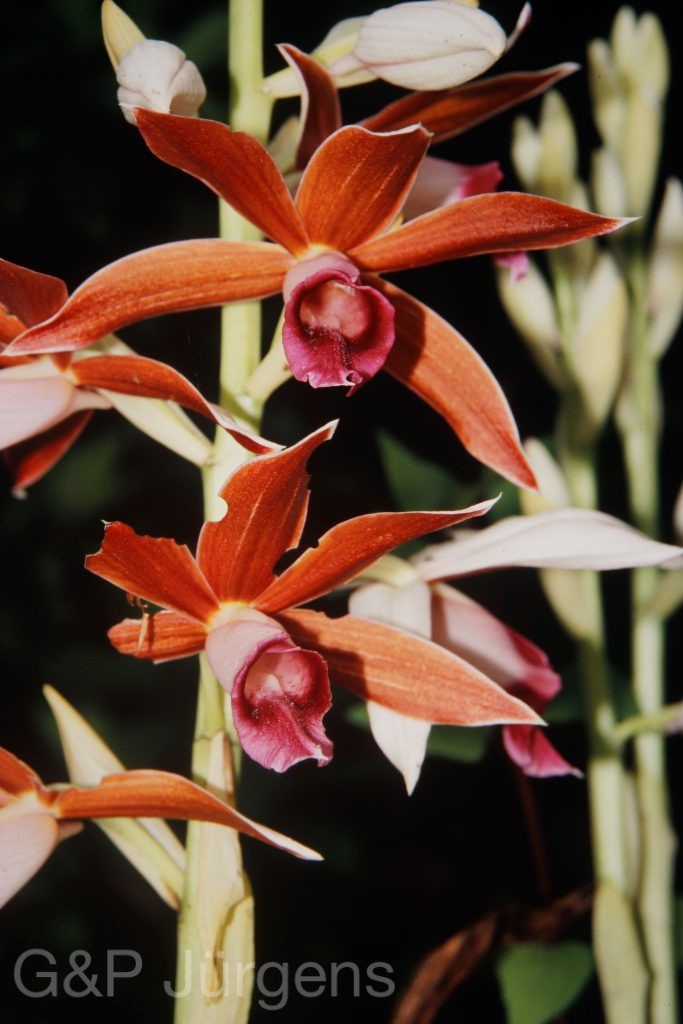
(Banks) Blume

Bh2008 482 G750
Bhutan Samtengang, 2040m April
Bh2008 483 P751
Bhutan Samtengang, 2040m April
Bh2008 485 G753
Bhutan Samtengang, 2040m April

Description

Phaius tankervilleae, the nun's-hood or swamp orchid, is a robust terrestrial orchid with an exceptionally wide Old World tropical and subtropical distribution, recorded from China, India, Bhutan, Indonesia, Malaysia, Papua New Guinea, Australia, the Pacific islands and many other regions, with around 660 occurrence records (some, as in the Americas and Caribbean, reflecting introduction). It grows in damp grassland, marsh margins, swampy forest clearings and moist roadside banks from the lowlands into the lower hills. The photographed plant from Samtengang in western Bhutan at 2040 m, flowering in April, lies toward the upper part of its montane range.

It is a large terrestrial orchid arising from clustered, conical pseudobulbs partly buried in the substrate. The leaves are few, large, broadly lanceolate, plicate (longitudinally pleated) and tapered to a sheathing base. The inflorescence is a tall, erect raceme bearing many showy flowers; the sepals and petals are similar, brownish-red to maroon within and silvery-white outside, while the prominent labellum is tubular and rolled, white flushed with rose-purple and yellow in the throat, with a short basal spur. The fruit is a pendulous capsule releasing innumerable dust-like seeds.

The accepted name Phaius tankervilleae, based on Banks's epithet and combined by Blume, is treated as current despite synonym status in the source dataset; the input family spelling "Orchideaceae" is a variant of the correct Orchidaceae. Like nearly all orchids it depends on mycorrhizal fungi for seed germination. Widely grown as an ornamental and broadly distributed in the wild, it is nonetheless locally threatened by wetland drainage and over-collection in parts of its range.

Author: (Banks) Blume · Sources: POWO (Kew), GBIF, Flora of China (Orchidaceae), Grierson & Long Flora of Bhutan, The Orchids of Bhutan (Pearce & Cribb), Seidenfaden's revisions of mainland Asian Orchidaceae

(Lindl.) Christenson & Pradhan

Bhutan2014 674
Bhutan Wangdi 2280m, May
Bhutan2014 676 scaled
Bhutan Wangdi 2280m, May
Bh2008 511 G785
Bhutan Chongsakha, 1800m April

Description

Phalaenopsis taenialis is a small epiphytic orchid distributed through the eastern Himalaya and adjacent regions, recorded from China, India, Nepal, Bhutan, Vietnam and Myanmar, with about 161 georeferenced occurrences. It grows on tree trunks and mossy branches in humid, broadleaved evergreen and semi-evergreen forest of the subtropical to lower temperate belt, broadly between 1500 and 2500 m. The cited Bhutanese localities at Wangdue (2280 m) in May and Chongsakha (1800 m) in April are typical of its moist, sheltered mid-elevation forest habitat, where it flowers in spring before the full monsoon.

It is a dwarf, monopodial epiphyte, often nearly leafless at flowering, with a short stem bearing well-developed, flattened, photosynthetic roots that clasp the bark. The leaves, when present, are few, thin and elliptic, and may be shed during the dry season. The inflorescence is a slender raceme of small, delicate flowers; the sepals and petals are pinkish to pale lilac, spreading, and the three-lobed labellum is the distinctive feature, with a callus and small lateral lobes characteristic of the species. The fruit is a dry, ribbed capsule releasing dust-fine seeds.

The species was long placed in Kingiella or Doritis and is sometimes segregated as Hygrochilus or Aerides allies, but is now treated within an enlarged Phalaenopsis following the combination by Christenson and Pradhan. Its deciduous, root-dominated habit is an adaptation to seasonally dry epiphytic perches. As a forest-dependent epiphyte vulnerable to habitat loss and orchid collection, it is of conservation interest across its range.

Author: (Lindl.) Christenson & Pradhan · Sources: POWO (Kew), GBIF, Flora of China, Flora of Bhutan, Christenson's monograph of Phalaenopsis

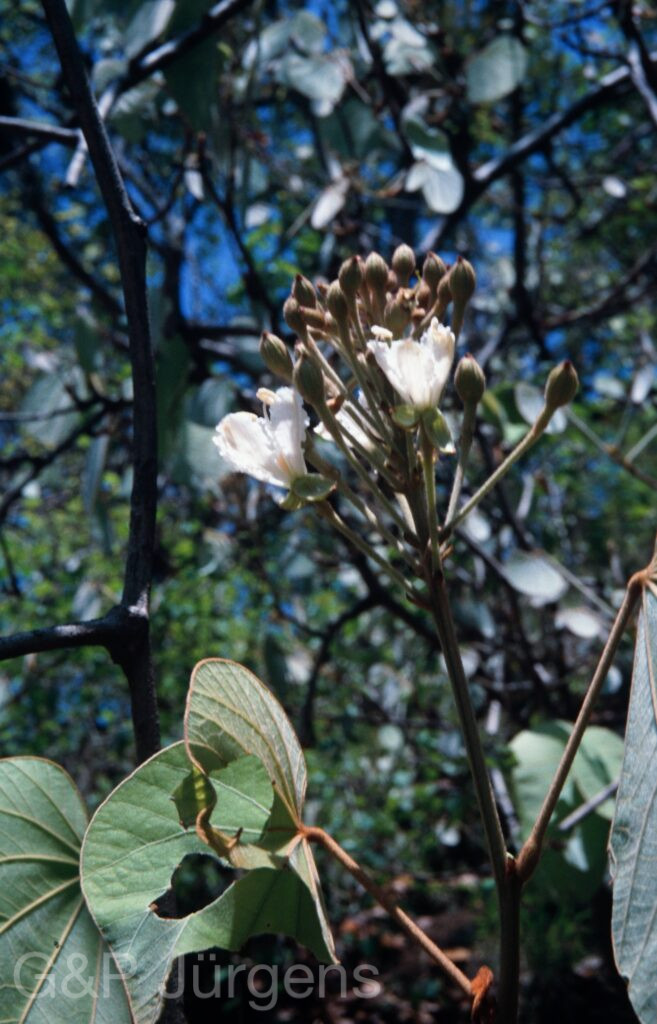
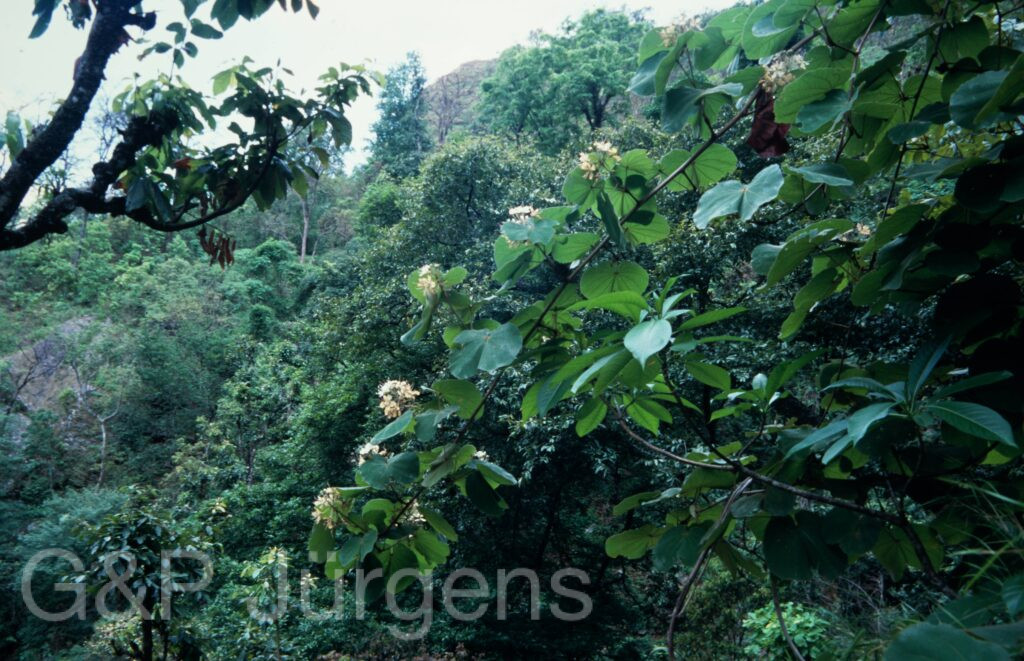
(Wight & Arn.) Benth.

Nepal 2001 184 ergebnis ergebnis
East-Nepal Sabha-Khola 2000m, May
Nepal 2001 476 ergebnis ergebnis
Nepal (Gorkha) Labubhesi 1200m, May

Description

Phanera vahlii (formerly placed in Bauhinia) is a massive woody climber of the Indian subcontinent and Indo-Burmese region, native to India, Nepal, Bhutan, Bangladesh, Myanmar, Laos, Vietnam and China, with over 400 georeferenced records and many further occurrences reflecting cultivation and naturalisation elsewhere. It is a liana of subtropical forests, riverine thickets and forest edges. The Nepalese populations documented from the Sabha Khola in the east at about 2000 m and from Labubhesi in Gorkha at about 1200 m, both flowering in May, span its broad altitudinal tolerance from foothill valleys into temperate forest.

The plant is a gigantic, high-climbing leguminous vine ascending by paired, coiled tendrils, with stems and young parts clothed in dense ferruginous tomentum. The leaves are large, broadly orbicular and conspicuously bilobed at the apex, deeply notched between two rounded lobes in the manner characteristic of the Bauhinia alliance, the lower surface rusty-pubescent. The flowers are borne in large terminal panicles; each has a campanulate calyx and five cream to yellowish-white, clawed petals, with fertile stamens and reduced staminodes. The fruit is a large, woody, oblong pod densely covered with brown velvety hairs and containing several flattened seeds.

The segregation of Phanera from Bauhinia, based on tendrillate climbing habit, stamen number and pollen characters, is now widely followed though some authorities retain a broadly circumscribed Bauhinia. The species is economically important: its tough fibre yields cordage and its very large leaves are used as plates and for wrapping. Widespread and frequently exploited, it is not considered threatened.

Author: (Wight & Arn.) Benth. · Sources: POWO (Kew), GBIF, Flora of Nepal, Flora of British India, Flora of China, Wunderlin's revision of Bauhinia and Phanera