Tag:

Spring

(Lindl.) Kuntze

Bhutan2014 177
Bhutan Trashigang 2100m, May

Description

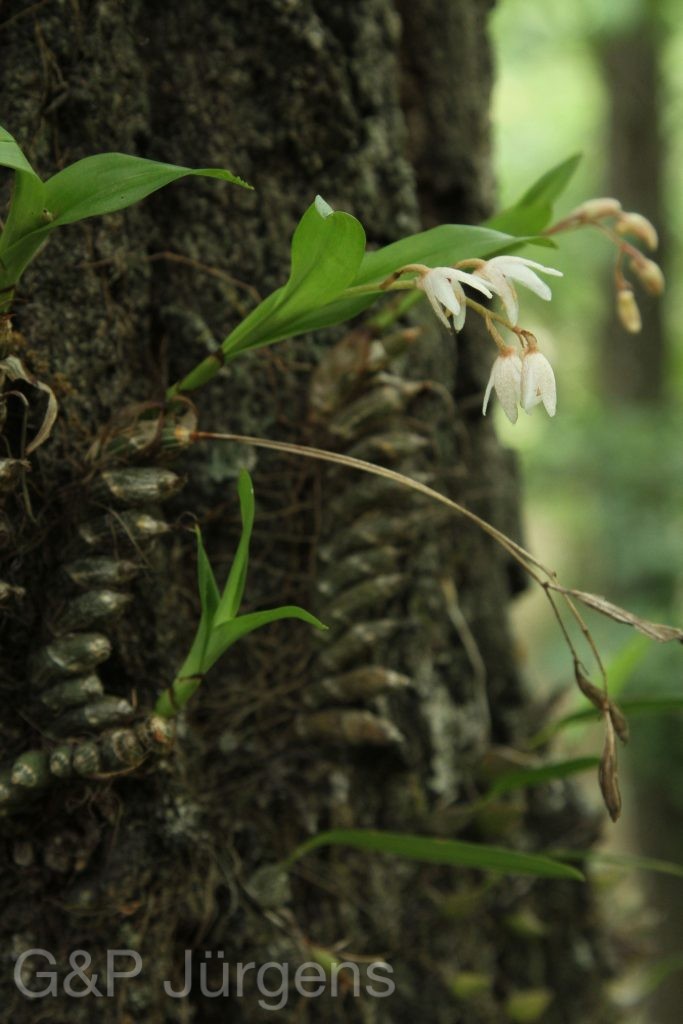
Pinalia excavata is an epiphytic orchid of the Eastern Himalaya and adjacent southern China and Indochina, with GBIF records from China, India, Nepal, Bhutan and Myanmar and a modest tally of documented occurrences. It grows as an epiphyte on tree trunks and mossy branches in humid broad-leaved and evergreen montane forest, favouring shaded, well-ventilated situations in the warm-temperate to lower montane belt. The species occupies low to middle elevations; the photographed plant from Trashigang in eastern Bhutan at about 2100 m in May represents a typical station within its altitudinal range, flowering in late spring as the pre-monsoon humidity rises.

The plant produces clustered, fusiform to cylindrical pseudobulbs arising from a creeping rhizome, each bearing several apical leaves. The leaves are lanceolate to elliptic, thin-textured to somewhat leathery and prominently veined. The inflorescence is a lateral or subterminal raceme bearing numerous small flowers, the rachis and ovaries usually clothed in fine hairs as is characteristic of the genus. The flowers are pale, whitish to cream or yellowish, with spreading sepals and petals; the lateral sepals are adnate to the column foot to form a short mentum, and the trilobed labellum bears raised keels or ridges along its disc. The column is short and footed, and the fruit is a small ribbed capsule.

Pinalia comprises species formerly placed in the broadly circumscribed Eria, segregated on the basis of molecular and morphological evidence; P. excavata was originally described under Eria and is treated by current authorities under Pinalia. As a forest epiphyte dependent on intact humid canopy, it is vulnerable to deforestation and habitat degradation across its range, although it is not presently the subject of a formal threat assessment.

Author: (Lindl.) Kuntze · Sources: POWO (Kew), GBIF, Flora of China, Flora of Bhutan, The Orchids of Bhutan (Pearce & Cribb)
Kuntze

Nepal 2001 462 ergebnis ergebnis
Nepal (Gorkha) Gunda 1700m, May

Description

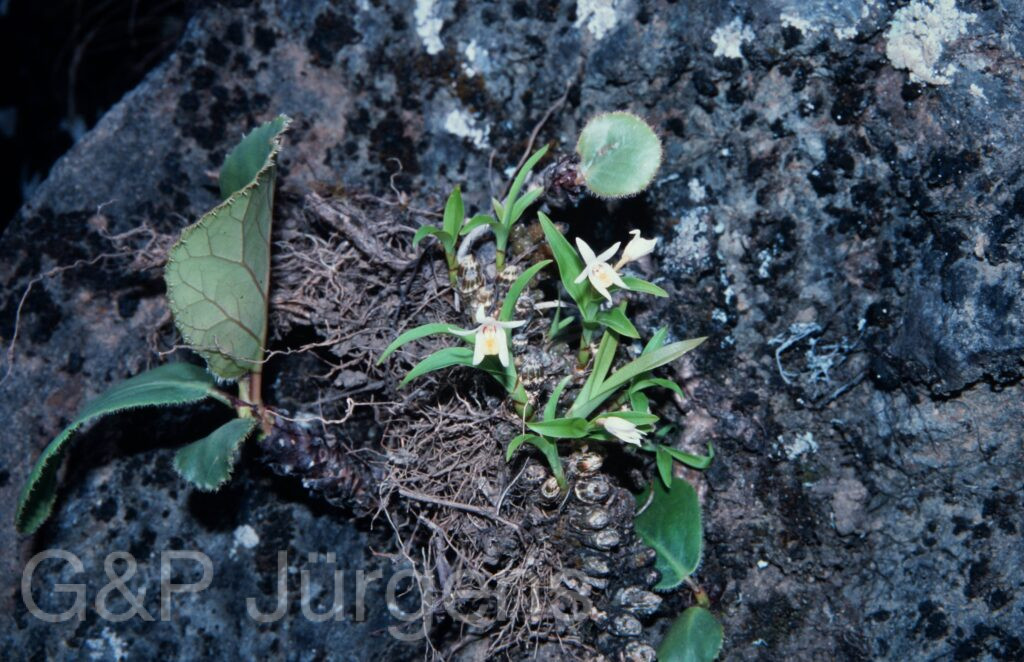
Pinalia leucantha is an epiphytic orchid of the central and eastern Himalaya, recorded from northern India, Nepal, Bhutan and adjacent southern China, with georeferenced collections (c. 59 in GBIF) along the moist subtropical to lower temperate belt of the range. It typically grows on mossy trunks and major branches of broad-leaved forest trees, occasionally on shaded rocks, between roughly 1000 and 2000 m. The photographed plant from Gorkha district, Gunda (1700 m, flowering in May), is characteristic of this monsoon-influenced habitat, where high humidity and a marked dry winter govern the growth cycle.

The species is a tufted, sympodial epiphyte forming clustered, fusiform to cylindrical pseudobulbs that are several-noded and clothed when young in papery sheaths. Each pseudobulb bears a few apical, oblong-lanceolate to elliptic, coriaceous leaves with acute tips. The inflorescence is a lateral to subterminal raceme carrying numerous small, whitish to cream flowers, the floral parts frequently invested with fine ferruginous hairs typical of the genus. Sepals and petals are spreading, the lateral sepals adnate to the column foot to form a short mentum; the lip is three-lobed with a fleshy, often keeled disc, and the pollinia are eight, waxy and clavate.

The genus Pinalia comprises species formerly placed in a broadly circumscribed Eria, segregated within tribe Podochileae (subtribe Eriinae) on vegetative and column characters supported by molecular data, and many Himalayan epiphytes have been recombined into it. As a widespread forest epiphyte, P. leucantha is not currently regarded as threatened, though like most epiphytic orchids it is sensitive to deforestation and collection; CITES Appendix II listing applies to all Orchidaceae in trade.

Author: Kuntze · Sources: POWO (Kew), GBIF, Flora of Nepal, Flora of Bhutan, Flora of China (Orchidaceae), The Orchids of Bhutan

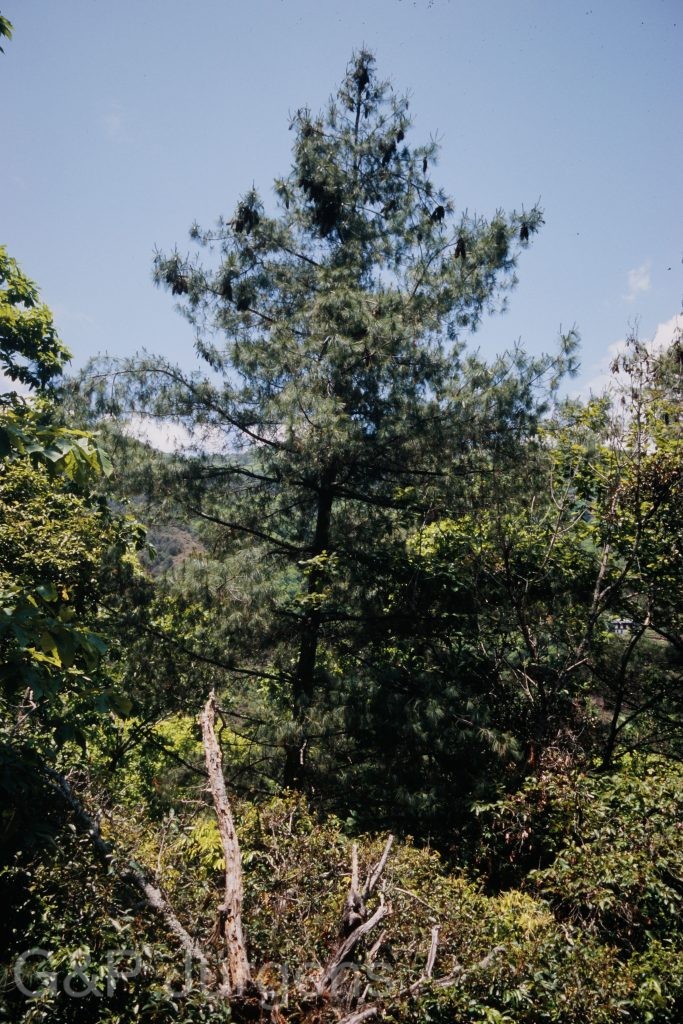
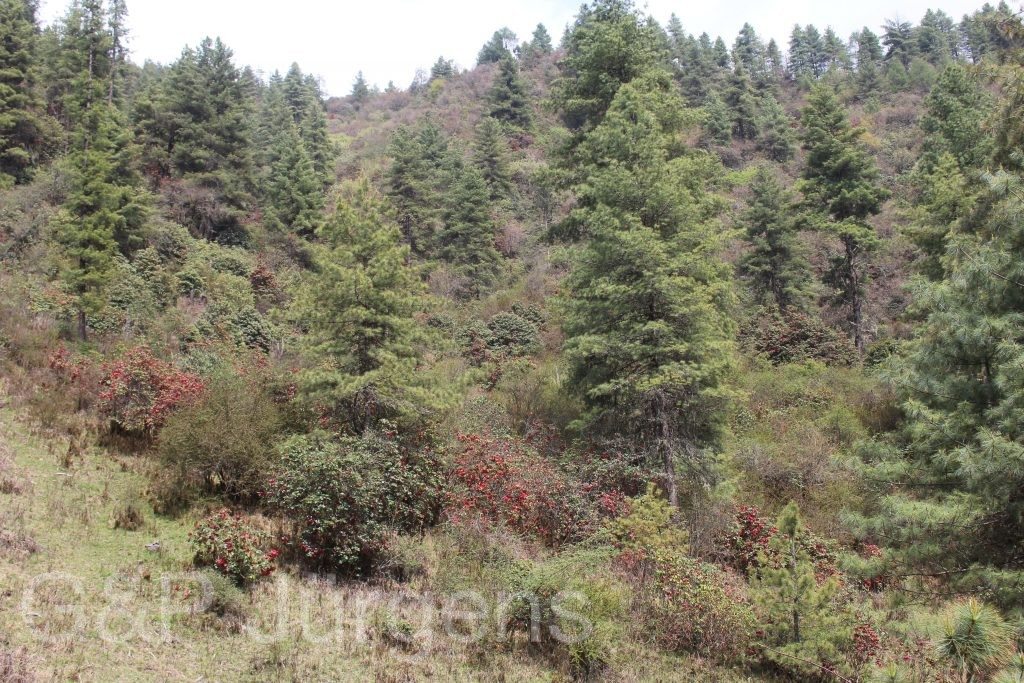
Pinus bhutanica

by G & P Jürgens

Grierson, D.G.Long & C.N.Page

Bhutan2015 468
  Bhutan Trongsa 2300m, October
Bh2008 479 P744
Bhutan, Chongsakha 1800m, May

Description

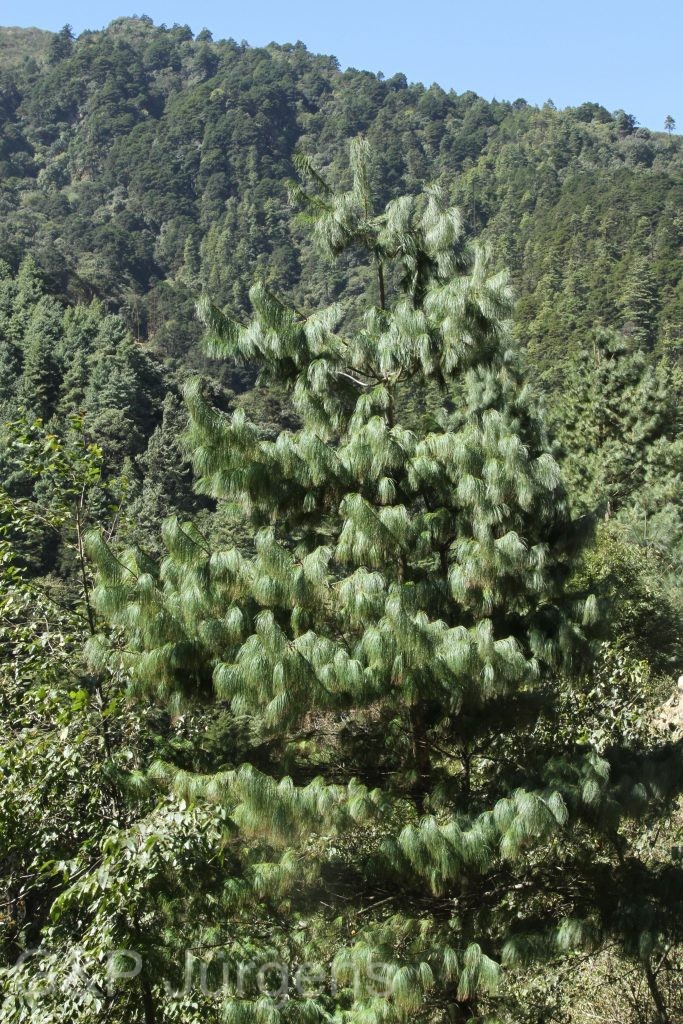
Pinus bhutanica Grierson, D.G.Long & C.N.Page is a five-needled white pine of the eastern Himalaya, restricted to Bhutan, north-eastern India (Arunachal Pradesh) and adjacent south-eastern Tibet (China); GBIF records about 96 occurrences, the few extralimital points reflecting cultivation or database artefacts. It grows in warm-temperate to subtropical montane forest, often on humid, monsoon-exposed slopes, typically between about 1,700 and 2,400 m. Both photographed stands are Bhutanese – Trongsa at 2,300 m in October and Chongsakha at 1,800 m in May – matching its known occurrence in the wet central and eastern Bhutanese hills.

It is an evergreen coniferous tree to 25 m or more, with spreading branches and a somewhat open crown. The needles are borne in fascicles of five, and are notably long, slender and pendulous, drooping gracefully and distinguishing it from the related P. wallichiana. The species is monoecious, with small pollen cones clustered at the base of new shoots and erect young seed cones that mature in the second year. The mature cone is large, cylindrical and resinous, with thin woody scales; the seeds are winged for wind dispersal, borne beneath the cone scales.

Pinus bhutanica was described as recently as 1980 and belongs to subgenus Strobus (the soft or white pines), being closely allied to the widespread Himalayan blue pine P. wallichiana, from which it differs chiefly in its longer, conspicuously drooping needles and more pronounced resin glands. Its narrow eastern Himalayan range makes it of biogeographic interest as a regional endemic of the wetter Bhutan-Arunachal sector; it is assessed by IUCN as Least Concern owing to stable populations within extensive forest.

Author: Grierson, D.G.Long & C.N.Page · Sources: POWO (Kew), GBIF, Flora of Bhutan, Flora of China, IUCN Red List of Threatened Species, Farjon Handbook of the World's Conifers, Grierson Long & Page protologue of Pinus bhutanica

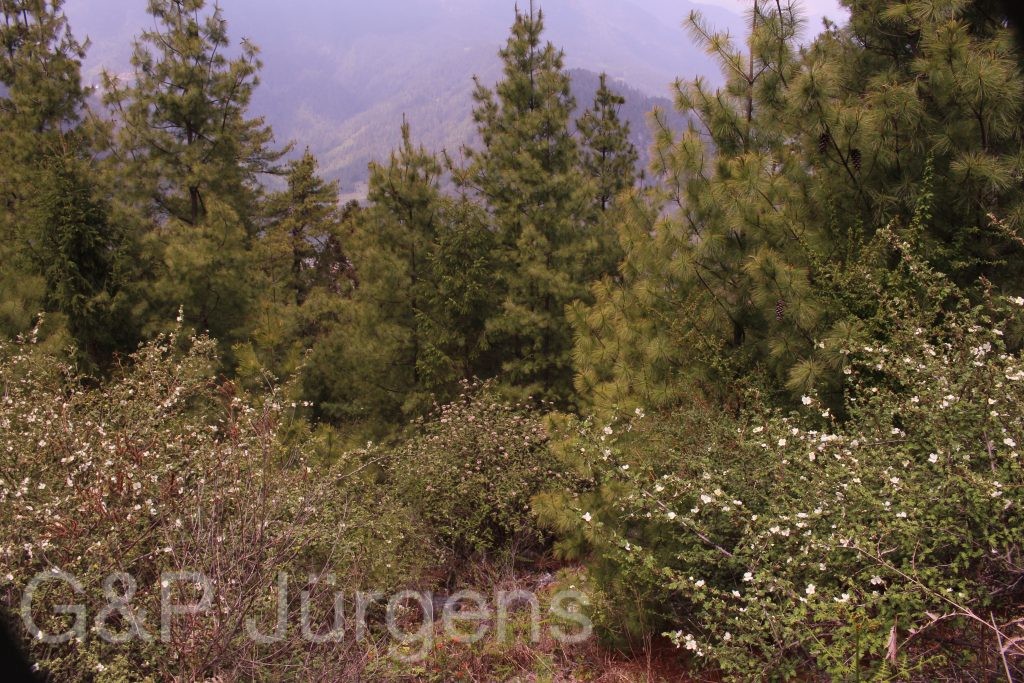
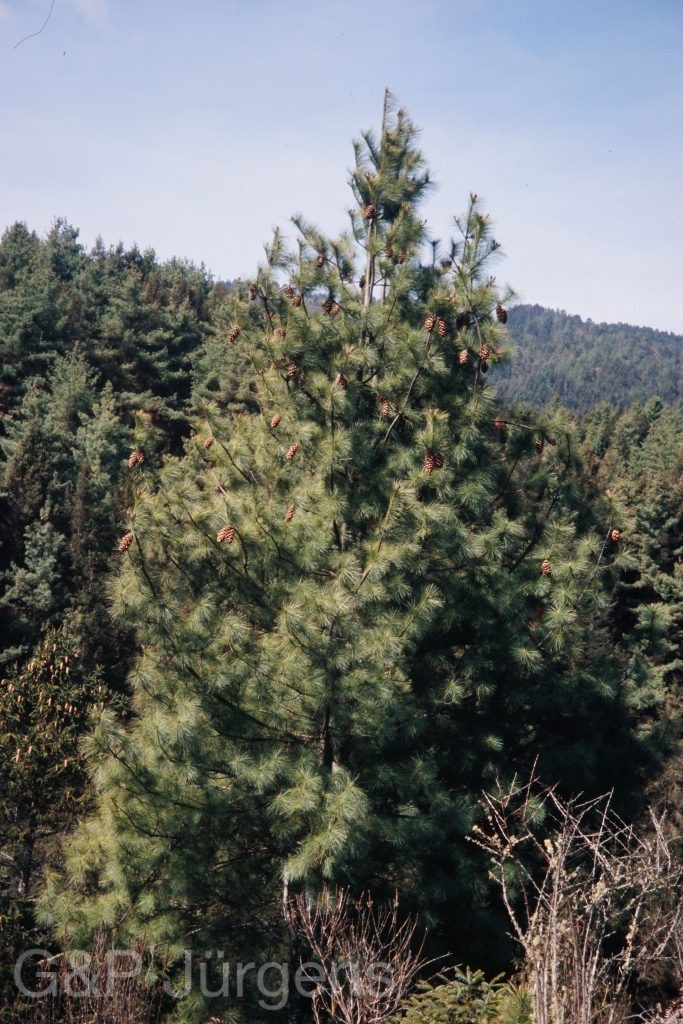
(Wall. ex. D.Don) A.B.Jacks.

Bhutan2014 544
Bhutan, Phobjika 3000m, May
Bhutan2014 961
Bhutan, Haa-valley, 2800m, May
Bh2008 295 P454
Bhutan, Ura 2900m, April

Description

Pinus wallichiana, the Bhutan or blue pine, is a major timber conifer of the Himalaya and Hindu Kush, ranging from Afghanistan and Pakistan through Kashmir, the Indian Himalaya, Nepal and Bhutan to south-eastern Tibet and China. It is among the best-recorded Himalayan trees, GBIF holding over 2400 occurrences, many from cultivation in Europe, North America and Australasia where it is a graceful ornamental. Natively it forms montane forests, often with Picea, Abies and Cedrus, on well-drained slopes between about 1800 and 4000 m. The Bhutanese stands at Phobjikha, the Haa valley and Ura between 2800 and 3000 m exemplify its dominance in the temperate conifer belt.

It is a large evergreen tree to 40 m or more, with a straight trunk, greyish fissured bark and whorled spreading branches forming a broad conical crown. The needle leaves are five per fascicle, slender, soft and drooping, 12 to 20 cm long, glaucous-bluish (whence blue pine) and finely serrulate. It is monoecious: small yellow pollen cones cluster at the base of new shoots, while the seed cones are long-pedunculate, cylindrical and resinous, 15 to 30 cm long and pendent, with broad woody scales spreading at maturity, each fertile scale bearing two winged, wind-dispersed seeds.

A member of Pinus subgenus Strobus (the soft or white pines, section Quinquefoliae), P. wallichiana is allied to P. griffithii and other five-needle pines of eastern Asia and North America, distinguished by its long pendulous cones and drooping foliage. It is important for construction timber, resin and fuel, and ecologically as a pioneer colonising landslides and abandoned terraces. Though widespread and not threatened, it is locally susceptible to blister rust and to over-exploitation near settlements.

Author: (Wall. ex. D.Don) A.B.Jacks. · Sources: POWO (Kew), GBIF, Flora of China Vol. 4, Flora of Bhutan Vol. 1, Flora of Pakistan, Farjon A Handbook of the World's Conifers

Buch.-Ham. ex D. Don

Bhutan2014 293
Bhutan Trithangebe near a farmhouse 800m, May

Description

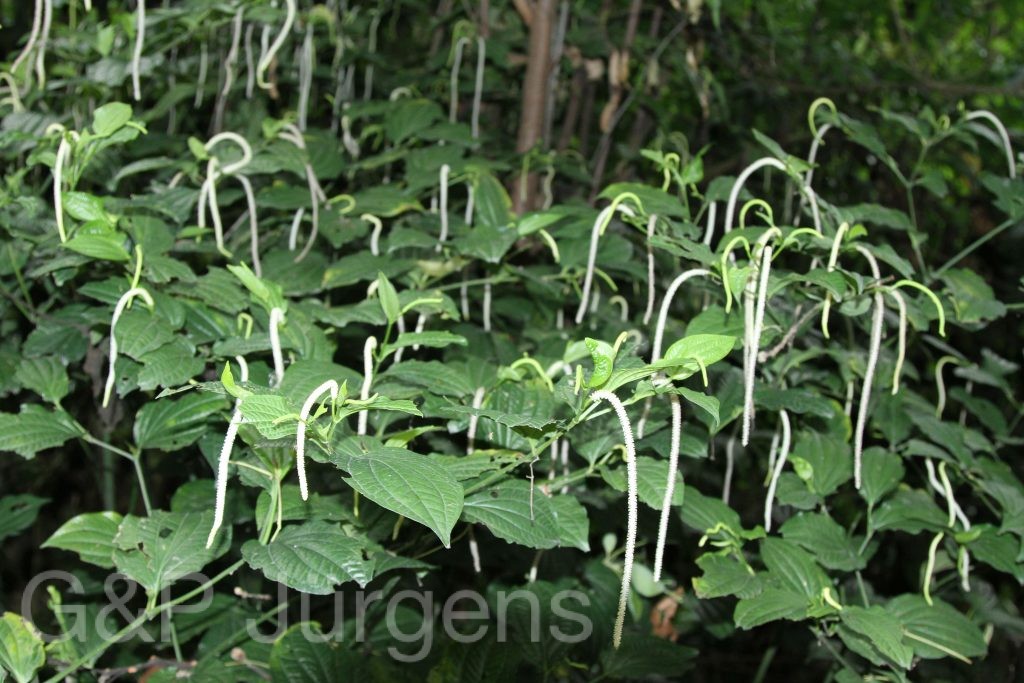
Piper suipigua (Buch.-Ham. ex D. Don) is a climbing pepper of the family Piperaceae distributed across the eastern and central Himalaya and adjacent regions, occurring in India, Nepal, Bhutan, Bangladesh, Thailand and southern China. The roughly 200 GBIF records indicate a relatively narrow but well-defined sub-Himalayan range. It is a plant of warm-temperate to subtropical forest, growing as a root-climber on tree trunks and over rocks, and is frequently encountered in the disturbed margins of cultivation and around dwellings, as reflected in the Bhutanese record from Trithangebe near a farmhouse at 800 m in May. It typically occurs from the foothills to about 1,500 m.

The plant is a woody to herbaceous climber attaching by adventitious clasping roots at the nodes, with somewhat swollen, jointed stems. The leaves are alternate, ovate to ovate-cordate, entire, acuminate at the apex and palmately several-nerved from near the base, the lower surface frequently glandular-dotted. The minute, perianth-less flowers are densely crowded on slender, pendulous or erect spikes opposed to the leaves, each subtended by a peltate bract; the species is generally dioecious. The fruit is a small, sessile, fleshy drupe aggregated into a fleshy fruiting spike.

Piper is a very large pantropical genus of considerable economic importance, including the source of black pepper (P. nigrum) and betel (P. betle). P. suipigua is one of several Himalayan wild peppers whose aromatic leaves and fruits are used locally as a condiment, masticatory and in folk medicine. The genus is characterised by its sympodial growth, swollen nodes and minute flowers densely packed on opposed spikes. Locally common in suitable habitat, the species is not regarded as being of conservation concern.

Author: Buch.-Ham. ex D. Don · Sources: POWO (Kew), Flora of Bhutan Vol. 1, GBIF, Flora of China Vol. 4, Gardner: Pipers of Nepal and the Himalaya

(Hook.) Sweet

Bhutan2014 342
Bhutan Tumching-La 3000m, May
Bhutan2014 886
Bhutan Chele-La 3300m, May

Description

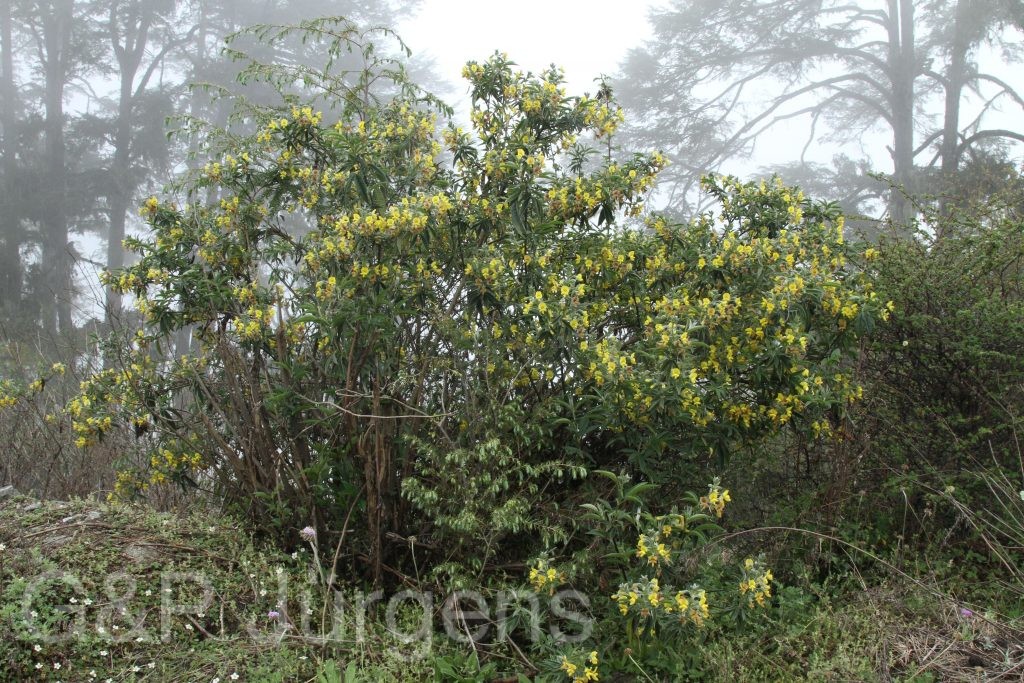
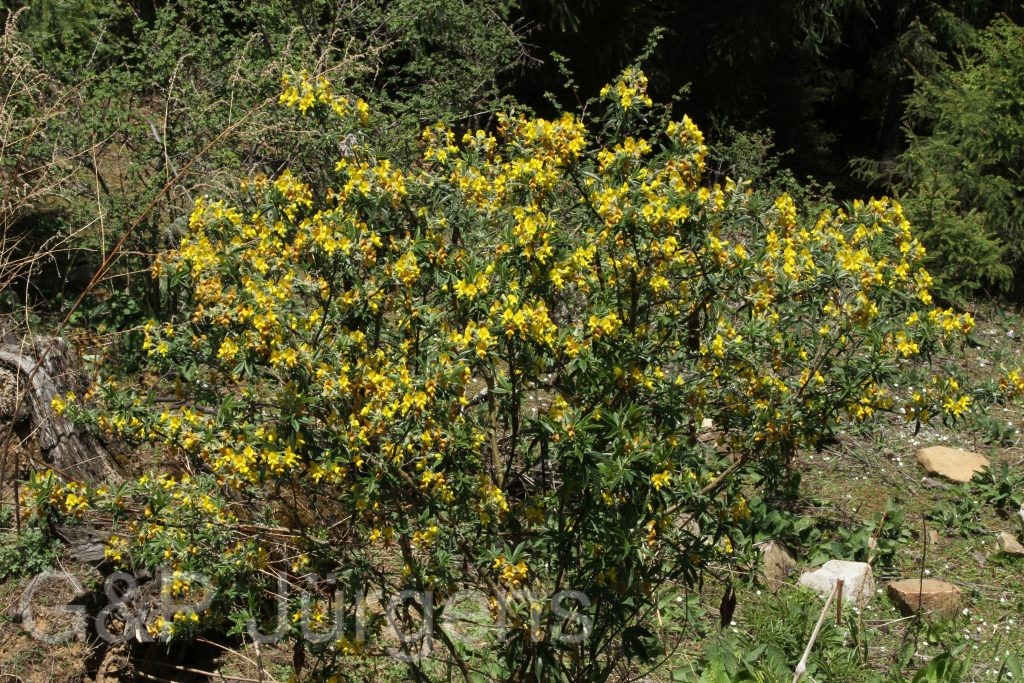
Piptanthus nepalensis is a Sino-Himalayan shrub distributed along the southern flank of the great ranges from Nepal and northern India eastward through Bhutan into south-western China (Yunnan, Sichuan, Xizang), with outlying records in Myanmar; the species is widely cultivated and naturalised in temperate gardens, accounting for the European, North American and Antipodean records (GB, DE, BE, NL, US, CA, NZ) among its more than 1600 georeferenced occurrences. It favours open scrub, forest margins, rocky slopes and stream banks in the upper montane and subalpine belts, typically between about 2500 and 4000 m. The populations on the Bhutanese passes of Tumching-La (3000 m) and Chele-La (3300 m), flowering with the spring thaw in May, are characteristic of its habitat among Rhododendron and conifer scrub.

It is a deciduous to semi-evergreen shrub reaching 1-4 m, with stout greenish branchlets bearing silky-pubescent young growth. The leaves are trifoliolate, long-petiolate and stipulate, the leaflets elliptic to lanceolate, dark green and glabrescent above, glaucous and appressed-silky beneath. The showy golden-yellow papilionaceous flowers, 2.5-3 cm long, are borne in terminal erect racemes; the calyx is bilabiate and silky, and the standard, wings and keel are typical of the tribe Thermopsideae. The fruit is a flattened, elongate, dehiscent legume to 12 cm, glaucous-pubescent and containing several dark reniform seeds.

Piptanthus is a small genus of the broadly defined Thermopsideae allied to Thermopsis and Anagyris, distinguished by its woody habit and trifoliolate leaves. Long-cultivated for its early bloom, P. nepalensis hosts nitrogen-fixing rhizobia that aid colonisation of skeletal soils. It is not considered threatened, being abundant across a broad range, though its toxic quinolizidine alkaloids deter browsing.

Author: (Hook.) Sweet · Sources: POWO (Kew), GBIF, Flora of China, Flora of Bhutan, Flora of Nepal, Turner's revision of Piptanthus (Thermopsideae)

(D.C.) Rehder & E.H. Wilson

Bhutan2014 26
Bhutan Samdrup 850m, May

Description

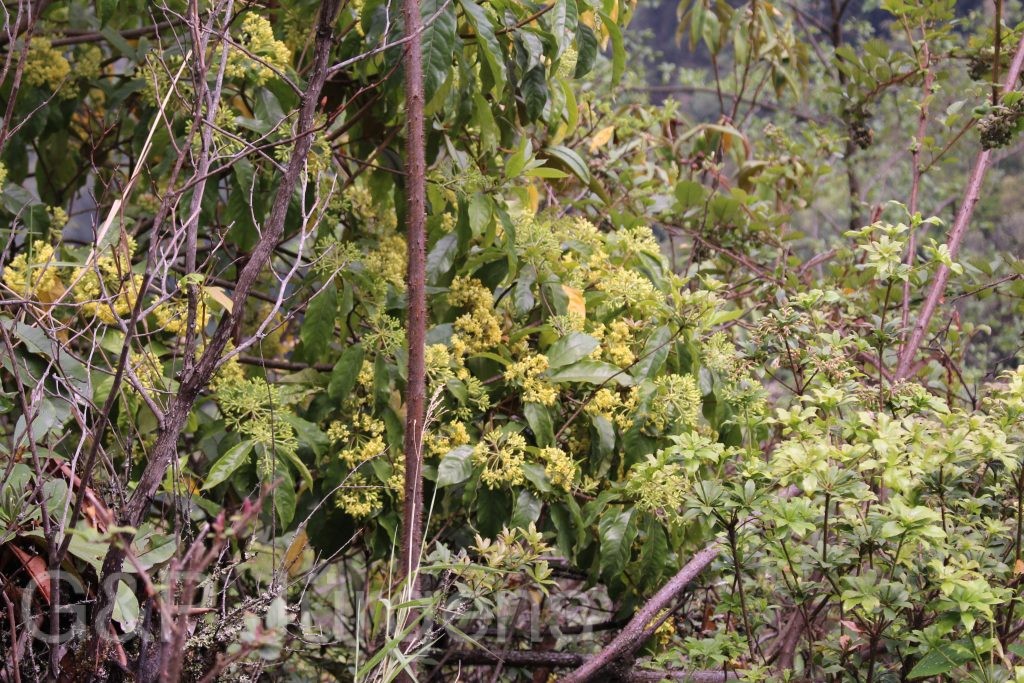
Pittosporum napaulense is an evergreen tree of the Himalaya and adjacent uplands, distributed from northern India and Nepal through Bhutan into southwestern China and Myanmar, with records also from Thailand; GBIF documents over two hundred occurrences across this range. It is a plant of subtropical to warm-temperate broadleaved forest, forest margins and ravine slopes, generally found between about 800 and 2000 m. The tree photographed at Samdrup in southern Bhutan at 850 m, in flower in May, exemplifies this preference for the warm, humid lower foothill forests of the eastern Himalaya, where it grows as an understorey to canopy tree and produces its fragrant flowers in late spring before the onset of the heaviest monsoon rains.

The plant is a small to medium-sized tree with smooth grey bark and glabrous twigs. The leaves are alternate but often crowded toward the branch tips in a pseudo-whorled arrangement, elliptic to oblong-lanceolate, leathery, entire and glossy, with the margins sometimes faintly wavy. The flowers are borne in terminal corymbose panicles and are creamy white to pale yellow and sweetly fragrant; each flower is five-merous, with free petals whose lower portions cohere into a tube and spreading upper lobes, five stamens, and a superior ovary. The fruit is a globose to ovoid woody capsule that splits into valves to expose numerous small seeds embedded in a sticky, resinous orange-red pulp, the viscid coating that gives the genus its name (Pittosporum, "pitch-seed") and aids dispersal by birds.

Pittosporum is a largely Old World genus of trees and shrubs centred on the tropics and subtropics of Asia, Australasia and the Pacific, and P. napaulense is the principal Himalayan representative. The family name is rendered "Pittosporaceaea" in the source; the accepted spelling is Pittosporaceae. The resinous, sticky-seeded capsules are a hallmark of the family, and the bark and leaves of this and related species have featured in local traditional medicine. As a widespread and ecologically adaptable forest tree spanning several countries and a broad elevational band, P. napaulense is not considered threatened, though its lower-elevation forest habitat is subject to ongoing pressure from agriculture and settlement in the densely populated eastern Himalayan foothills.

Author: (D.C.) Rehder & E.H. Wilson · Sources: POWO (Kew), GBIF, Flora of China Vol. 9, Flora of Bhutan Vol. 1 Part 2, Flora of Nepal, A Monograph of the Asian species of Pittosporum (Wenbin Zhang and Hua Peng)

(Lindl.) Rollisson

Sikkim2011 381
Sikkim Lachen 2600m, June
Nepal 2001 262 ergebnis ergebnis
Nepal (Gorkha) Jaurey Kharka 2700m, May
Nepal 2001 263 ergebnis ergebnis
Nepal (Gorkha) Jaurey Kharka 2700m, May

Description

Pleione hookeriana is a small epiphytic and lithophytic orchid of the eastern Himalaya and Indochina, distributed across Nepal, India, Bhutan, China and Laos, with about 204 GBIF occurrences. It inhabits cool, humid montane forest, growing on mossy tree trunks, branches and shaded rocks in the temperate zone, favouring situations with abundant atmospheric moisture. The images document it in Sikkim near Lachen at about 2600 m in June and in the Gorkha district of Nepal at Jaurey Kharka around 2700 m in May, where it flowers on moss-clad substrates as the monsoon approaches.

It is a dwarf, deciduous orchid growing from a small annual pseudobulb that bears a single plicate leaf. The flower is solitary and produced with or just before the leaf on a short scape arising from the base of the pseudobulb. The sepals and petals are narrow, spreading and pale pink to rose-lilac; the labellum is comparatively large, obovate, fringed at the margin, and marked within by a yellow to brown-spotted, lamellate throat that contrasts with the paler perianth. The column is slender and winged. The fruit is a dry dehiscent capsule releasing dust-like seeds.

Pleione hookeriana is the smallest-flowered species of its genus and is distinguished by its diminutive habit and patterned lip. Like all Pleione it has an annual pseudobulb cycle and depends on mycorrhizal fungi for seed germination. The showy lip and contrasting throat markings attract bee pollinators in spring. As an attractive orchid it is subject to horticultural collection, and the entire genus is listed on CITES Appendix II, regulating international trade.

Author: (Lindl.) Rollisson · Sources: POWO (Kew), GBIF, Flora of China, Flora of Bhutan, The Genus Pleione (Cribb & Butterfield), CITES Appendices

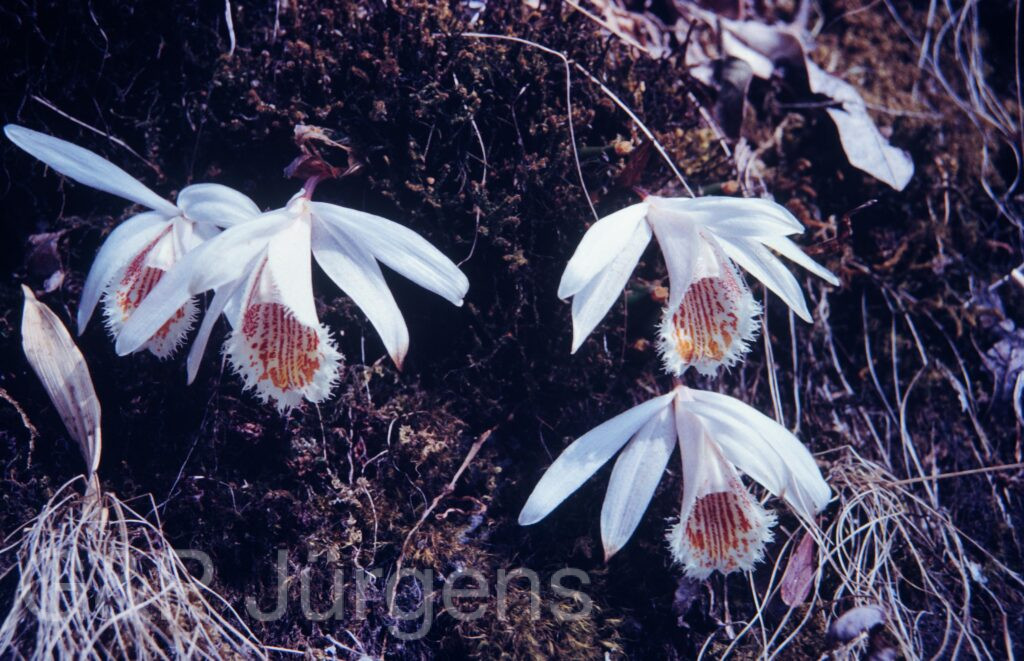
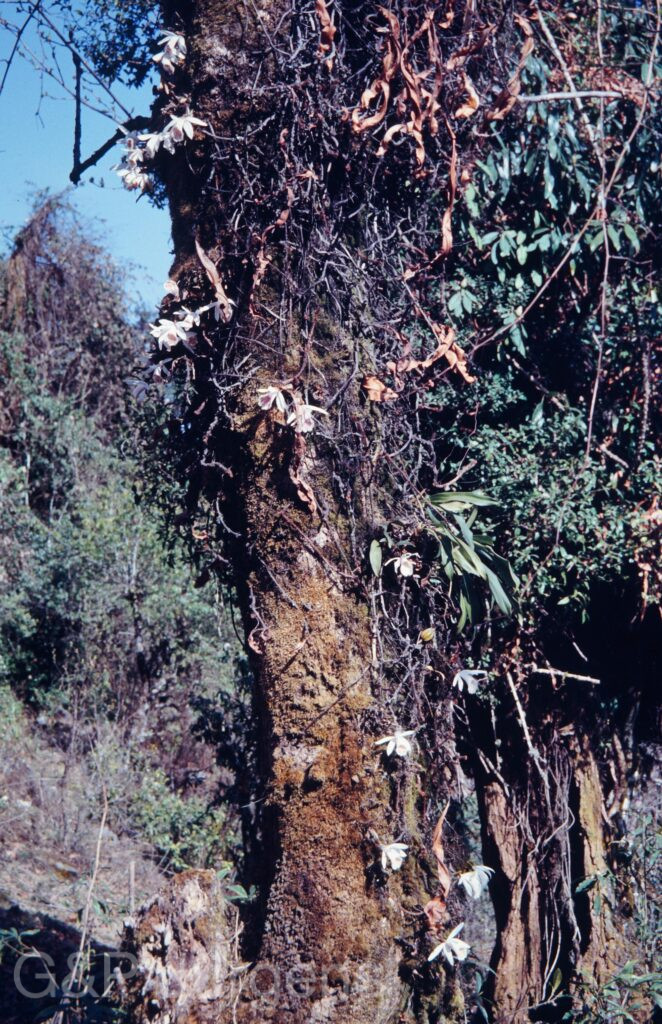
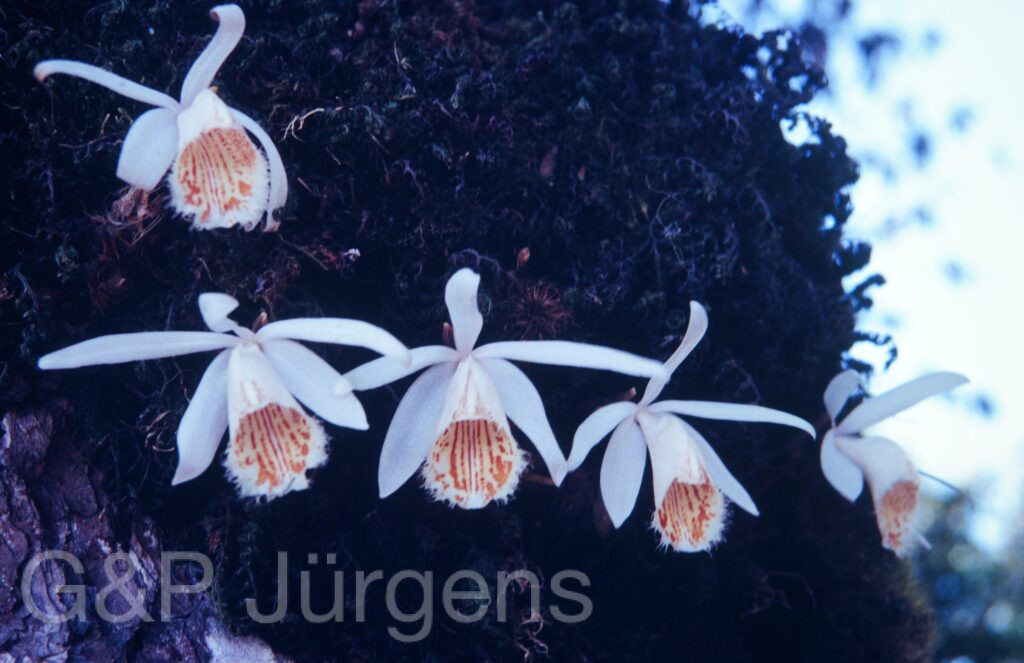
(Sm.) D.Don

Nepal1992 42 P60 ergebnis
Nepal Nundhaki 1500m March 
Nepal1992 56 P81 ergebnis
Nepal Nundhaki 1500m March 
Nepal1992 242 P359 ergebnis
Nepal Nundhaki 1500m March 

Description

Pleione humilis is a dwarf orchid of the Himalaya and adjoining mountains, native to Nepal, India, Bhutan, Myanmar and Thailand, with around 136 georeferenced occurrences across this eastern arc. It grows chiefly as an epiphyte on mossy tree trunks and branches, and occasionally as a lithophyte on shaded, humus-covered rocks, in cool, humid temperate forest. The illustrated plant from Nundhaki in Nepal, at about 1500 m and flowering in March, exemplifies the species' habit of blooming in late winter to early spring, characteristically before or as the new leaves expand at relatively low montane elevations.

The plant grows from small, flask- to top-shaped, often warty pseudobulbs, each producing a single (occasionally paired) plicate, deciduous leaf. The flowers, usually borne singly on a short scape from the base of the pseudobulb, are large for the plant's size and showy, with spreading, narrow, white to pale pink sepals and petals. The conspicuous trumpet-shaped labellum is broadly funnel-form and frilled at the margin, white marked within by yellow to brown and red blotches and bearing several toothed or fringed keels (lamellae) along the disc. The slender, winged column lies enclosed within the lip, and the fruit is a ribbed dehiscent capsule shedding dust-like seeds.

Pleione is a small genus of about two dozen Sino-Himalayan and Southeast Asian orchids, much admired and cultivated, of which P. humilis is one of the winter-flowering, single-leaved species. As with all orchids it is protected under CITES Appendix II, and wild populations are threatened by collection for horticulture and by clearance of the moist forest on which the epiphytic plants depend; conservation therefore hinges on protecting both the species and its montane forest habitat.

Author: (Sm.) D.Don · Sources: POWO (Kew), GBIF, Flora of Bhutan (Orchidaceae), Flora of China (Orchidaceae), Cribb & Butterfield: The Genus Pleione (monograph)

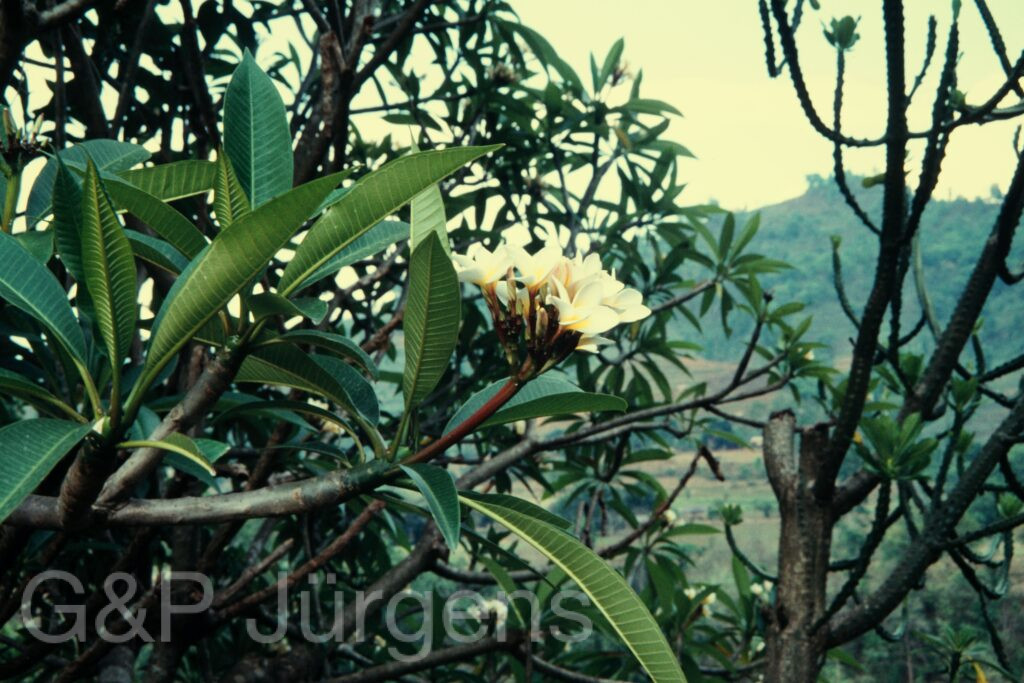
Plumeria rubra

by GP Jürgens

L.

Nepal 97 575 P1112
Nepal Sabha-Khola 550m May
Nepal 1994 36 ergebnis
Ost-Nepal Simbhuwa Kola 
1000m April

Description

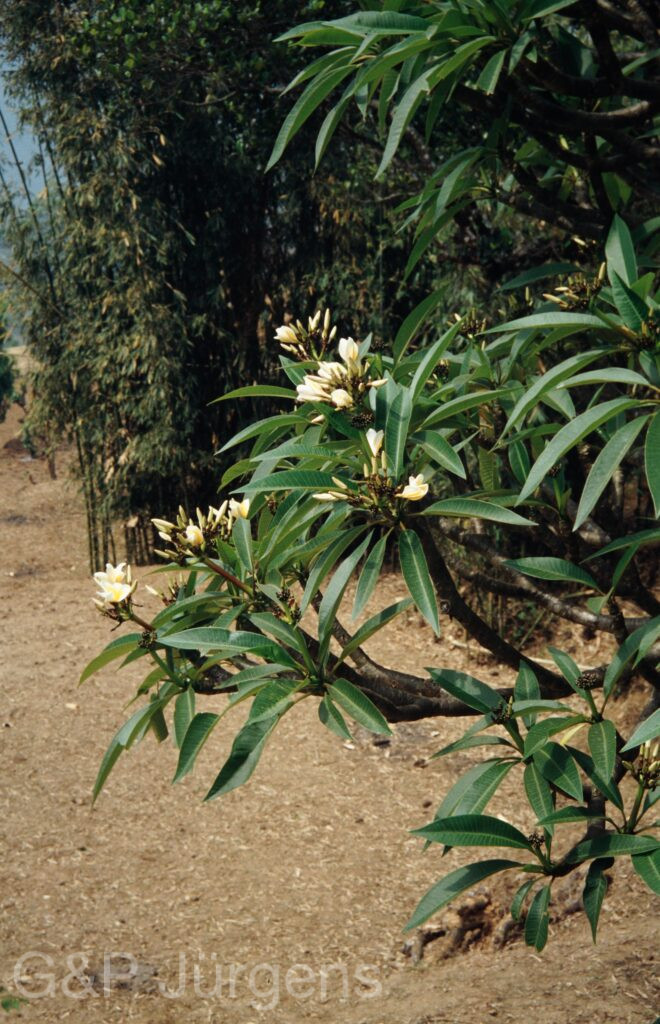
Plumeria rubra, the red frangipani, is a small tree native to Mexico and Central America but now pantropical through cultivation, a spread vividly reflected in its GBIF record of over 11,600 occurrences spanning Mexico, Guatemala, Costa Rica, Panama, Brazil, Colombia, Ecuador, Peru, the United States, India, South Africa, Indonesia, China, French Polynesia and many more. In the Himalayan foothills it is an introduced ornamental and temple tree rather than a wild element; the images from the Sabha-Khola valley (550 m, May) and the Simbhuwa Kola in eastern Nepal (1000 m, April) document it in the warm, frost-free lowland and lower hill zone where it is widely planted around dwellings, gardens and shrines. It tolerates seasonal drought, thriving in open, sunny, well-drained sites and flowering through the warm pre-monsoon and monsoon months.

It is a deciduous tree to about 5-8 m with a spreading crown of stout, blunt, sparingly branched stems exuding copious milky latex when cut. The large, alternate leaves are clustered toward the branch tips, oblong to elliptic-lanceolate, leathery, with prominent pinnate lateral veins joined by a marginal collecting vein. The strongly fragrant flowers are borne in terminal cymes; each has a salverform corolla with five overlapping, asymmetric lobes, typically white to yellow with a yellow eye in many forms but ranging to pink and deep red in the species and its cultivars. The fruit is a pair of divergent, cylindrical follicles releasing numerous winged seeds.

Plumeria belongs to the Apocynaceae subfamily Rauvolfioideae and comprises several New World species, of which P. rubra is the most variable and most widely grown, hybridising freely in cultivation. Its latex contains the iridoid glycoside plumieride and related compounds, and the plant carries deep cultural significance across South and Southeast Asia for use in offerings and garlands. Though of conservation concern nowhere because of its vast cultivated range, in the Himalaya it persists entirely as a human-introduced ornamental and has not naturalised into native forest.

Author: L. · Sources: POWO (Kew), GBIF, Flora of China Vol. 16, Flora of Nepal, Woodson's revision of Plumeria (Apocynaceae of the New World)