Tag:

Spring

D.Don

Sikkim 2006 463 ergebnis
India West-Bengal, Ruigi-Chu 2100m, May

Description

Polygonum molle D.Don is a robust perennial knotweed of the Himalaya and adjacent uplands. Under current circumscription the name is treated as a synonym, the accepted genus being Koenigia, into which many former Asian Polygonum and Aconogonon species have been transferred following molecular phylogenetic studies. The taxon occurs from Pakistan and Nepal eastward through Sikkim and Bhutan into southwest China, with the broad GBIF country list reflecting the wide aggregate concept of the genus and numerous cultivated or naturalised records across Europe and North America. It was recorded in West Bengal at Ruigi-Chu at 2,100 m in May, growing in moist temperate forest clearings, stream banks, and shrubby slopes between about 1,500 and 3,000 m.

The plant forms stout, erect, much-branched stems up to 1–2 m tall arising from a woody rootstock, the nodes sheathed by membranous, often brownish ochreae. The leaves are large, ovate to ovate-lanceolate, acuminate, with a softly pubescent (hence "molle") and somewhat velvety lower surface. Numerous small whitish to greenish flowers are borne in much-branched, paniculate inflorescences of slender racemes; each flower has a five-parted perianth that persists around the trigonous, glossy achene at maturity.

The transfer to Koenigia reflects a substantial reorganisation of tribe Persicarieae, in which the traditional broad Polygonum proved polyphyletic. Plants of this group are pioneer colonisers of disturbed temperate habitats and contribute to slope stabilisation. Robust and widespread, the species is of no conservation concern, though its taxonomy at species rank remains in flux pending fuller sampling.

Author: D.Don · Sources: POWO (Kew), Flora of China Vol. 5, Flora of Bhutan Vol. 1, GBIF, Schuster et al.: Phylogeny of Polygoneae (Taxon, 2011)
Buch.-Ham.

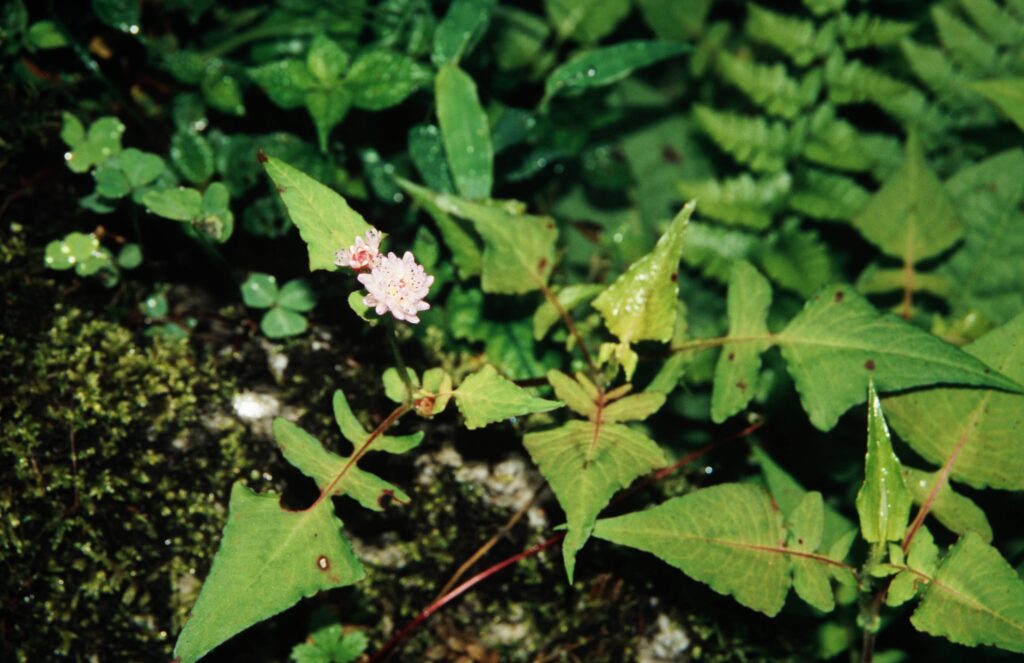
Sikkim 2006 458 ergebnis
India Sikkim, Ringi-Chu 2100m May

Description

Polygonum runcinatum is a widely distributed knotweed found across the Himalaya and extending through much of eastern and southeastern Asia to Malesia. Its range encompasses Nepal, Bhutan, India, Pakistan, Myanmar, China, Taiwan, Thailand, Vietnam, Malaysia, Indonesia, and Papua New Guinea, with scattered records elsewhere. GBIF documents over 1,660 occurrences, reflecting its abundance and broad ecological amplitude. The species colonises moist, open to semi-shaded habitats including forest margins, stream banks, roadsides, damp meadows, and disturbed ground at elevations from 500 to 3,500 m. The photograph from Ringi-Chu in Sikkim at 2,100 m, taken in May, shows the species at a mid-elevation site in the eastern Himalaya.
The plant is a prostrate to ascending perennial herb, 20–60 cm long, often forming extensive mats. Stems are slender, branched, rooting at lower nodes, reddish-brown, glabrous to sparsely pubescent. Leaves are distinctive: ovate to lanceolate, 3–8 cm long, with a hastate to runcinate base bearing prominent, backward-pointing basal lobes — the feature indicated by the epithet runcinatum. The upper leaf surface frequently bears a dark, V-shaped or chevron-like blotch, a useful field character. Ocreae are tubular, membranous, ciliate. Flowers are borne in dense, globose, terminal capitate heads, 8–12 mm in diameter, on slender peduncles. Individual flowers are small, with a five-lobed perianth, pink to deep rose, occasionally white. Stamens usually eight. The achene is trigonous, dark brown, enclosed within the persistent perianth.
Polygonum runcinatum has been transferred by some authors to Persicaria as P. runcinata (Buch.-Ham.) H.Gross, reflecting the broad restructuring of Polygonum sensu lato based on molecular phylogenetic evidence. The species is ecologically versatile and often weedy, colonising disturbed habitats rapidly. It plays a role in soil stabilisation on moist slopes and provides floral resources for small pollinators. It is not threatened and is considered common to locally abundant throughout its extensive range.

Author: Buch.-Ham. · Sources: POWO (Kew), GBIF, Li et al.: Polygonaceae in Flora of China Vol. 5, Grierson & Long: Flora of Bhutan Vol. 1

L.

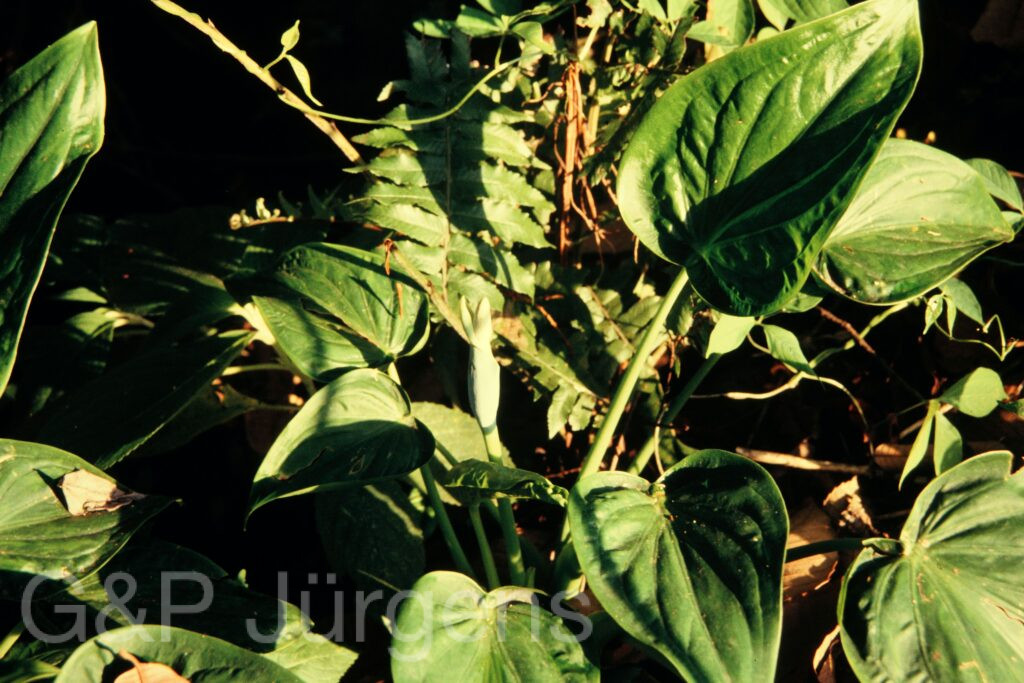
Nepal 97 548 P1074
Nepal Sabha-Khola 530m May

Description

Pontederia hastata is an aquatic to semi-aquatic herb of tropical and subtropical Asia and Australasia, with 931 GBIF occurrences extending from India, Nepal, China and Sri Lanka through Southeast Asia to the Philippines, Papua New Guinea, Fiji and northern Australia. It grows in still and slow-moving fresh water, inhabiting ponds, ditches, marshes, paddy fields and the margins of streams and pools in the lowlands and low hills. The plant recorded along the Sabha-Khola in Nepal at 530 m in May exemplifies its lowland wetland habitat, where it grows rooted in shallow water or mud and flowers in the warm pre-monsoon period.

The species is a perennial, more or less emergent herb arising from a creeping rhizome and rooting at the nodes. The leaves are long-petiolate, the petioles sometimes slightly spongy and inflated, bearing sagittate to hastate blades with diverging basal lobes that give the plant its epithet. The flowers are borne in a dense spike or raceme subtended by a leaf-like spathe; each is bluish to pale violet, with six perianth segments fused below into a tube, six stamens often differing in length, and a tricarpellate ovary. The fruit is a capsule enclosing numerous small seeds dispersed by water.

The taxon has long been known as Monochoria hastata, reflected in the source link, but Monochoria is now subsumed within an enlarged Pontederia on phylogenetic grounds, making Pontederia hastata the accepted name. Like its relatives, the plant is an effective coloniser of disturbed aquatic and agricultural wetlands; it is widely used as a leaf vegetable and remains common, of no conservation concern across its broad range.

Author: L. · Sources: POWO (Kew), GBIF, Flora of China Vol. 24, Flora of Bhutan Vol. 3, Flora of Nepal, Flora of Pakistan, Pellegrini's revision of Pontederiaceae

Populus tremula

by GP Jürgens

L.

Bhutan2014 957
Bhutan Chele-La 3400m, May
Bhutan2014 958
Bhutan Chele-La 3400m, May

Description

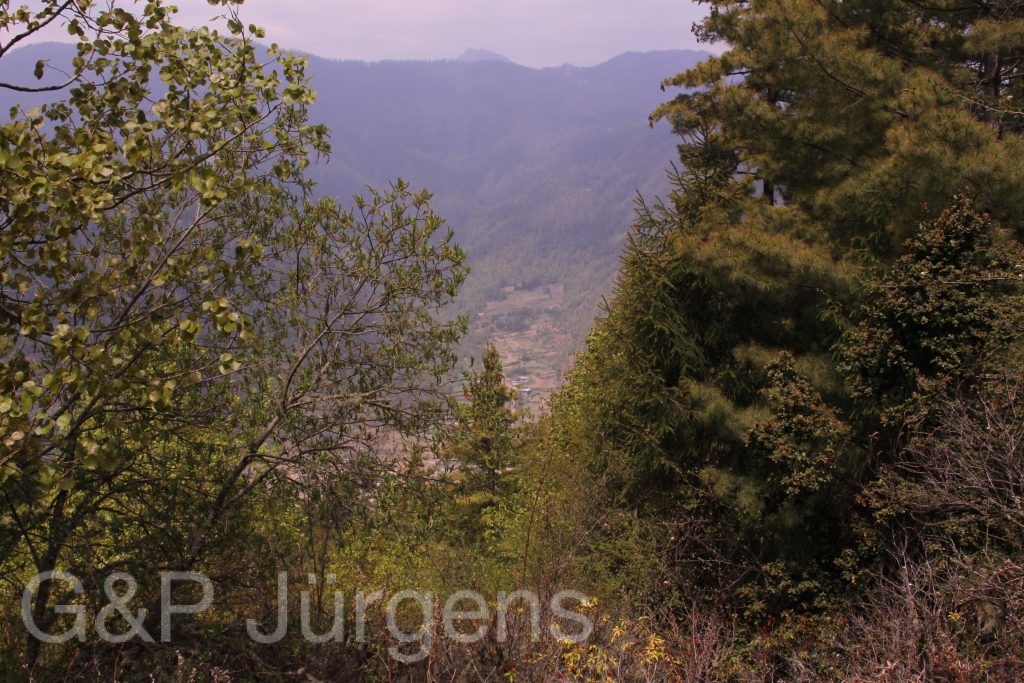
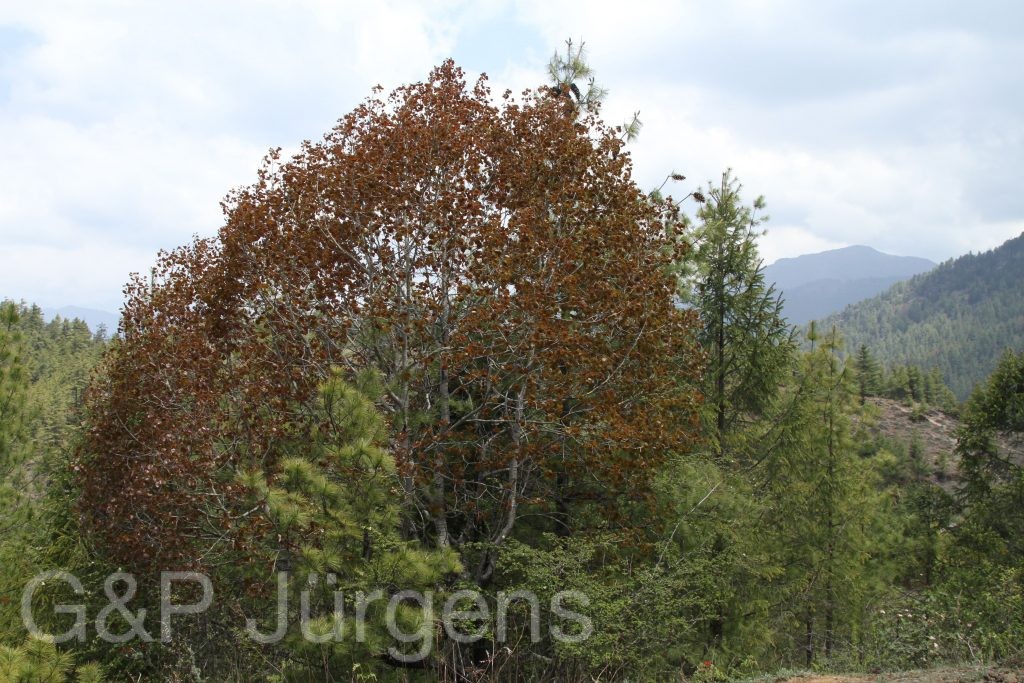
Populus tremula, the Eurasian aspen, is among the most widely distributed trees of the Northern Hemisphere, ranging across virtually all of Europe and temperate Asia, as the vast GBIF dataset of over 779,000 records from Sweden, France, Germany, Britain, Russia, China and beyond attests. In the Himalaya it reaches its southern Asian limit as a high-montane element, and the photographed tree from Bhutan's Chele-La at 3400 m in May represents this elevated outpost. It is a pioneer of disturbed ground, forest clearings, burnt areas, screes and woodland margins, tolerant of a wide range of soils and climates from boreal lowland to subalpine slopes, where it often forms clonal stands by root suckering.

It is a deciduous tree with smooth, greenish-grey bark, becoming furrowed at the base of old trunks. The alternate leaves are nearly orbicular to broadly ovate with a crenate to sinuate margin, borne on long, conspicuously laterally flattened petioles that allow the foliage to flutter in the slightest breeze, the trait giving the tree both its epithet tremula ("trembling") and its English name. Juvenile and sucker leaves are larger and more triangular. Like all poplars it is dioecious, the flowers borne in pendulous catkins that appear before the leaves; each flower subtended by a fringed bract, the males with numerous stamens, the females with a one-celled ovary. The fruit is a small capsule releasing cottony, plumed seeds dispersed by wind.

Aspen is a keystone pioneer species of immense ecological importance, supporting rich communities of insects, fungi and lichens and frequently forming genetically uniform clonal groves that can persist for centuries. Within Salicaceae it belongs to section Populus (the aspens and white poplars). Its presence in the eastern Himalaya illustrates the trans-Eurasian continuity of temperate forest floras; the species is of least conservation concern and is widely exploited for timber, pulp and matchwood.

Author: L. · Sources: POWO (Kew), GBIF, Flora of China Vol. 4, Flora of Bhutan Vol. 1, Flora of Pakistan, Eckenwalder's Conifers and Salicaceae Treatments

Hook.f.

Sikkim2004 288 G500
Sikkim/India Dzongri 3900m May

Description

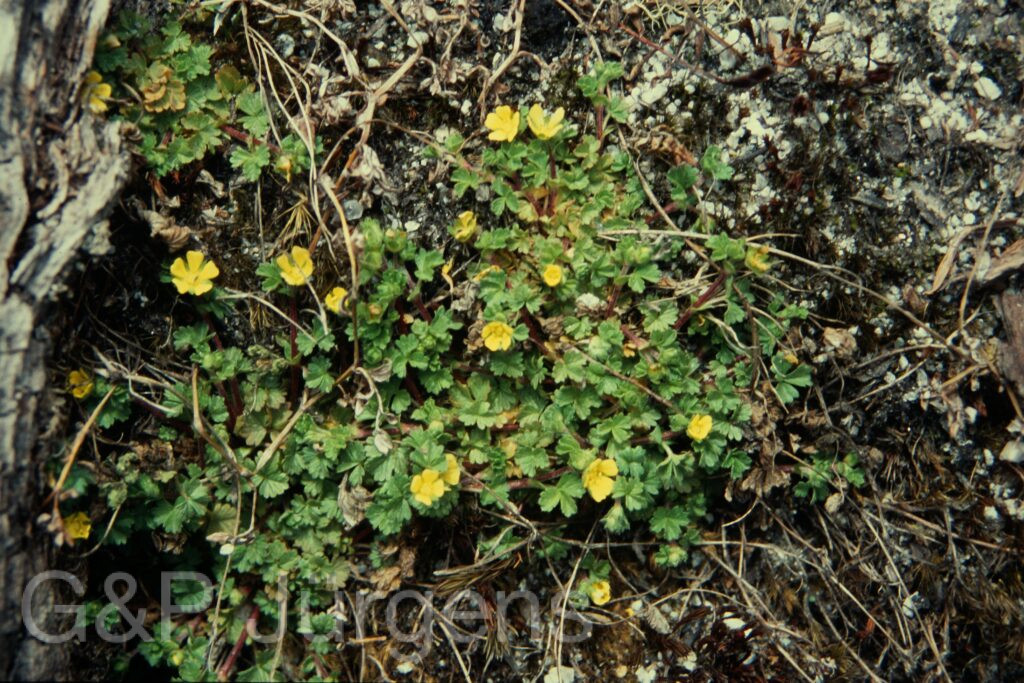
Potentilla monanthes var. sipthorpioides is a small alpine cinquefoil endemic to the eastern and central Himalaya, recorded from Nepal, India and Bhutan. It is a plant of open alpine turf, damp grassy slopes, rock ledges and the margins of streams and snow-melt flushes in the high mountains, generally between about 3500 and 4500 m. The photographed plant grows at Dzongri in Sikkim, northern India, at around 3900 m, flowering in May soon after snowmelt. With only nine georeferenced occurrences it is among the more sparsely documented Himalayan potentillas, reflecting both its restricted range and its inconspicuous, low-growing habit in remote high terrain.

It is a slender, tufted perennial herb arising from a slender rootstock, forming low mats or small cushions. The leaves are mostly basal, ternate or digitately divided, with small obovate to cuneate leaflets that are toothed at the apex, green and thinly hairy to silky, on slender petioles. The flowering stems are short and slender, ascending, usually bearing solitary or few flowers. The flowers are small, with five green sepals alternating with narrower epicalyx segments, and five obovate to obcordate yellow petals slightly exceeding the calyx. The numerous stamens surround a domed receptacle bearing many free carpels. The fruit is a cluster of small dry achenes seated on the dry receptacle.

Within the variable Potentilla monanthes complex, this variety is distinguished by characters of leaf division and stature, and its taxonomic limits remain somewhat uncertain pending revision of the Himalayan members of the genus. Its restricted distribution and few records mean its conservation status is poorly assessed; high-altitude grazing pressure and climatic change in the alpine zone are potential concerns for such narrow-range taxa.

Author: Hook.f. · Sources: POWO (Kew), GBIF, Flora of Bhutan, Flora of Nepal, Soják's revisions of Asian Potentilla

Royle

Bhutan2014 1073
Bhutan Paro 2500m, May

Description

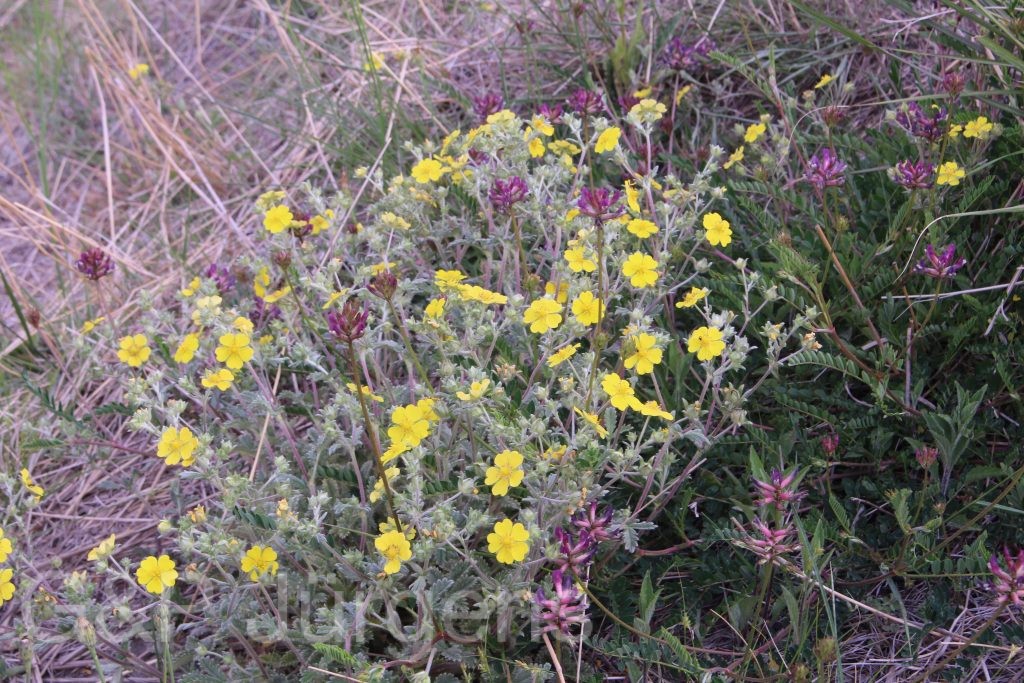
Potentilla saundersiana is a high-altitude cinquefoil of the central Asian and Himalayan mountains, distributed across China, Nepal, India, Bhutan and Pakistan, with GBIF recording about 1092 occurrences. It is a plant of dry alpine and subalpine habitats, frequenting stony slopes, gravelly meadows, open grassland and rock crevices over a wide elevational span, often from around 2500 up to well above 4500 m. The photographed material from near Paro in western Bhutan at 2500 m, flowering in May, lies toward the lower end of its range, where it grows on sunny, well-drained banks; the species more typically ascends into the high alpine turf and screes of the inner ranges.

It is a tufted perennial herb arising from a stout, branched, woody rootstock crowned by the persistent remains of old leaf bases. The leaves are mostly basal and digitately compound, with three to five obovate leaflets that are deeply incised or toothed, green above and densely white-tomentose beneath, giving the plant a characteristic silvery aspect. The flowering stems are slender and few-leaved, bearing a lax cyme of flowers. Each flower has an epicalyx and calyx of five segments each and five bright yellow, obcordate petals surrounding numerous stamens and a domed receptacle of many carpels. The fruit is an aggregate of small, dry, glabrous achenes seated on the dry receptacle.

Potentilla is a large and taxonomically complex genus in which polyploidy, apomixis and hybridisation blur species boundaries, and P. saundersiana itself is a variable aggregate within which several varieties have been recognised. Its dense leaf indumentum and cushion-forming habit are adaptations to the cold, dry, high-radiation conditions of the alpine zone. As a widespread and abundant component of Himalayan and Tibetan alpine grassland it is of no conservation concern, though it is a useful indicator of dry alpine and steppe habitats.

Author: Royle · Sources: POWO (Kew), GBIF, Flora of China, Flora of Bhutan, Flora of Pakistan, Wolf monograph of the genus Potentilla

W.W. Sm.

Bhutan2014 924
Bhutan Chele-La 4000m, May
Bhutan2014 926
Bhutan Chele-La 4000m, May
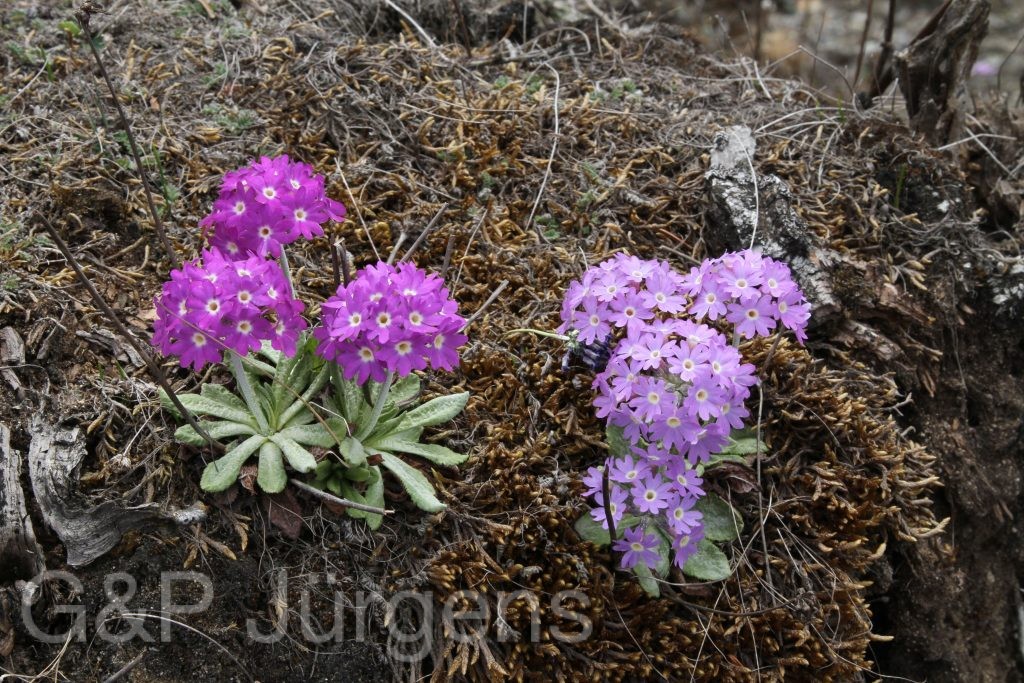
Bh2008 588 G880
Bhutan Chele-La 3900m April

Description

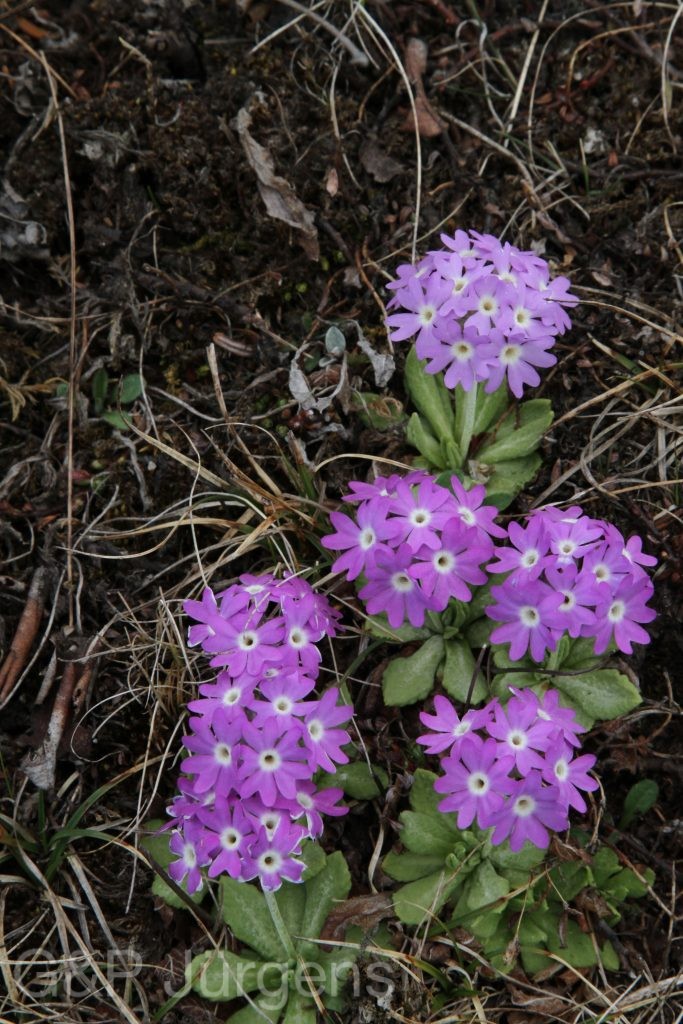
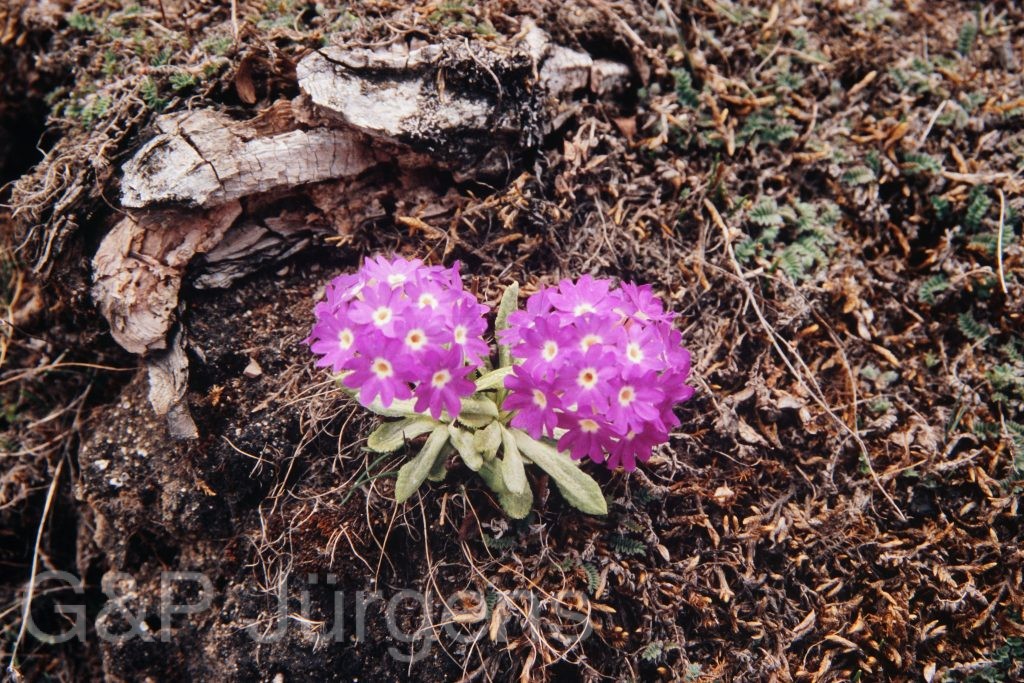
Primula atrodentata is a small alpine primrose of the high eastern and central Himalaya, native to China, Nepal, India, Bhutan and Pakistan, with about 161 georeferenced records confined to the upper subalpine and alpine zones. It grows on damp open slopes, alpine meadows, rocky turf and the margins of snow-melt seepages, typically between about 3000 and 4500 m. The photographed plants were recorded at the Chele-La in western Bhutan at 3900-4000 m, flowering in April and May immediately after snow-melt, when these cushion-forming primulas carpet the freshly exposed turf.

The species is a low, tufted perennial herb with a short rhizome and a basal rosette of obovate to spathulate leaves, the blade narrowed to a winged petiole, the margins finely toothed and the undersurface mealy with white or yellowish farina; the rosettes are often clothed at the base with persistent bud-scales. The flowers are borne in a dense, globose terminal umbel atop a slender, farinose scape that elongates after anthesis. The corolla is salver-shaped with a slender tube and spreading, notched lobes, coloured pale lilac to violet or rarely white, with a small yellow eye. The fruit is a small ovoid capsule shorter than the persistent calyx.

Primula atrodentata belongs to section Capitatae of the genus, the dense-headed primulas, distinguished by its compact globose umbel and toothed, farinose leaves; the epithet refers to the dark-tipped (atro-) teeth of the leaf margin and calyx. A characteristic early-flowering snow-melt species, it is heterostylous and insect-pollinated. Widespread and locally abundant across its alpine range, it is not regarded as threatened.

Author: W.W. Sm. · Sources: POWO (Kew), GBIF, Flora of Bhutan, Flora of China, The Genus Primula (Richards)

H.R.Fletcher

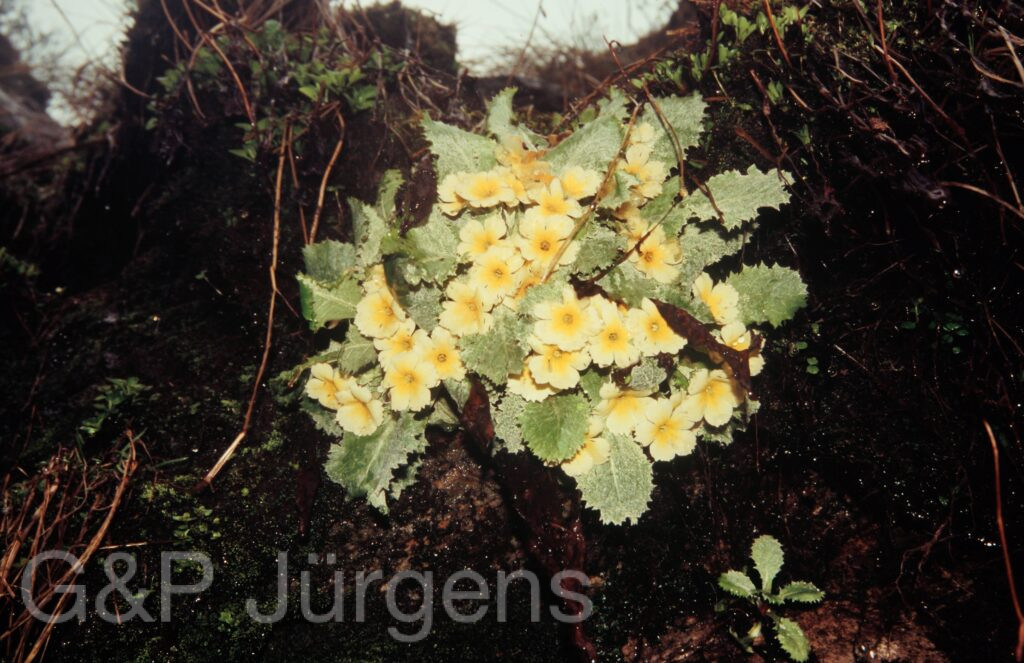
Nepal 2009 49 ergebnis
Nepal Helambu Nasem Pati 3550, May

Description

Primula aureata is a narrowly endemic primrose known only from central Nepal, where GBIF records (about 35 occurrences, all from Nepal) confirm its restricted range. It is a plant of cool, shaded, perpetually humid sites, growing on damp, mossy cliffs, dripping rock faces and shaded gully walls in the upper temperate and subalpine zone. The illustrated plant was photographed in the Helambu region at Nasem Pati at about 3550 m in May, a locality representative of the species' small known distribution along the moist ridges north of the Kathmandu valley, where it flowers soon after the winter snows clear.

The plant is a small, stemless perennial forming a basal rosette of leaves that emerge from a resting bud heavily coated in pale farina. The leaves are obovate to spathulate, toothed towards the apex, narrowed to a winged petiole, and dusted beneath with white meal. From the rosette rises a short scape bearing a few-flowered umbel; each flower has a tubular, farinose calyx and a flat-faced, pale yellow corolla with a deeper golden-yellow eye, the epithet aureata alluding to this golden centre. The corolla lobes are obcordate and notched, and the species is heterostylous with pin and thrum forms. The fruit is a small capsule enclosed in the persistent calyx.

Primula aureata belongs to section Petiolares, a largely Himalayan group of farinose, rosette-forming primulas of shaded, moist rock habitats. Its very limited range, dependence on specialised cliff microhabitats and small known population make it a plant of conservation interest, vulnerable to disturbance and collection; it is also esteemed in cultivation by alpine specialists. Localised endemics of this kind underline the high level of plant endemism in the central Nepal Himalaya.

Author: H.R.Fletcher · Sources: POWO (Kew), GBIF, Annotated Checklist of the Flowering Plants of Nepal, Flora of Bhutan, Smith and Fletcher's monographs of Primula section Petiolares, Richards' monograph Primula

Craib

Sikkim 2006 345 ergebnis
India West-Bengal, Tolung 2500m, May

Description

Primula bracteosa is a temperate to subalpine primrose of the eastern Himalaya, recorded from Bhutan, India and Nepal, with 51 georeferenced occurrences across this comparatively narrow range. It favours cool, shaded, moist situations such as mossy banks, damp rock ledges and the humus-rich floor of broadleaved and conifer forest. The plant photographed at Tolung in West Bengal, India, at 2500 m in May documents its spring flowering in the moist temperate forest belt, when the rosettes emerge and bloom early in the season following snowmelt and the first monsoon moisture.

The plant forms a basal rosette of obovate to spathulate leaves that are toothed to crenate along the margin, often farinose (mealy) beneath and tapering to a winged petiole. The flowers are borne in a terminal umbel atop a slender scape; as the epithet indicates, the umbel is subtended by conspicuous bracts. The individual flowers are salverform with a slender corolla tube and a spreading, notched-lobed limb, pink to rose-purple or lilac with a yellow or greenish eye. Like most Primula the species is typically heterostylous, with pin and thrum flower morphs promoting outcrossing. The fruit is a small capsule releasing numerous minute seeds.

Within the large and taxonomically complex genus Primula, P. bracteosa is placed in section Petiolares, a group of early-flowering, often farinose eastern-Himalayan primroses centred on Sikkim, Bhutan and adjacent regions. The section is prized but demanding in cultivation. Restricted to cool, humid montane forest, the species is locally frequent in suitable habitat but potentially vulnerable to forest disturbance and a warming climate.

Author: Craib · Sources: POWO (Kew), GBIF, Flora of Bhutan, Flora of China, The Genus Primula monograph (Richards), Flowers of the Himalaya (Polunin & Stainton)

H.R.Fletcher

Nepal 2001 362 ergebnis ergebnis
Nepal (Gorkha) Rupina-La 3350m, May
Nepal 2001 361 ergebnis ergebnis
Nepal (Gorkha) Rupina-La 3350m, May

Description

Primula buryana var. purpurea is an alpine primrose found in central and eastern Nepal, growing in moist rocky crevices, moss-covered banks, and shaded cliff faces at 3,000–4,200 m elevation.

This compact perennial forms rosettes of small, rounded to spathulate leaves with a mealy (farinose) coating on the undersurface. The flowers are borne in umbels of 2–6 on slender scapes 5–15 cm tall. The variety purpurea is distinguished by its deep purple to violet-purple flowers with a contrasting yellow eye, differing from the type variety which has paler, lilac blooms.

Primula buryana belongs to the section Petiolares, a group of Himalayan primulas that are notoriously difficult to cultivate outside their native habitat due to their requirement for cool, humid conditions with excellent drainage.

Author: H.R.Fletcher · Sources: POWO (Kew), Flora of Nepal, Richards: Primula (2003)